Wednesday, May 07, 2025


Gibraltar Finds Cocaine on Bulker Using New Underwater Drones

Gibraltar
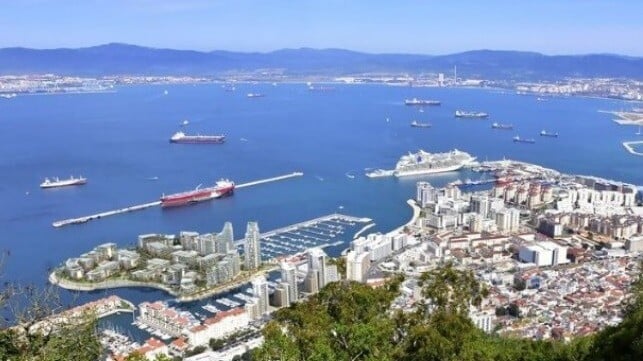
Gibraltar is a busy bunkering port for ships after crossing the Atlantic (HM Gov)

Published May 6, 2025 12:46 PM by The Maritime Executive


Gibraltar is highlighting its success in stopping drug smuggling with its newly acquired underwater drones. HM Customs made a sizable drug bust from a bulker in the anchorage by deploying drones that were acquired in December 2024.

The Chinese-owned bulker Great Zhou (39,744 dwt) arrived in Gibraltar on April 30 on a bunkering stop after a voyage from Santos, Brazil. HM Customs undertook a routine check of the vessel while also using its newly acquired drones.

The survey of the underwater areas of the vessel raised suspicions at one of the vessel’s sea chests on the port side of the hull. Divers ultimately retrieved four packages that had been hidden in the sea chest and the investigation found they contained 120 kg of cocaine.


HM Customs detained the vessel and interviewed the crew. It was later permitted to proceed to a scheduled port call in Italy.

The Chief Minister, the Hon Fabian Picardo congratulated HM Customs for the successful operation. He noted, “This is why my Government has made serious investment in HM Customs to support their crucial work in combatting drug crime, with real results for Gibraltar and for other countries that these drugs are intended for."

Officials in Gibraltar believe the crew was not aware of the drugs hidden on the outside of the hull. They also believed that the drugs were not meant to be offloaded in Gibraltar but would have proceeded to another country in Europe but through their efforts interrupted a smuggling operation.


Troubled Ferry Glen Sannox Has Vibration Issues

Glen Sannox
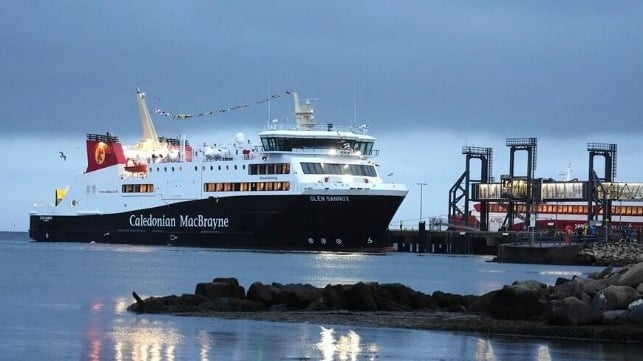
Glen Sannox, January 2025 (AP / PA Wire)

Published May 5, 2025 8:02 PM by The Maritime Executive


The long-delayed Scottish ferry Glen Sannox had another setback in March, when a failed weld seam put the ship out of commission for two days - and resolving the matter fully could take even longer. The ferry just entered operations after six years of construction delays. 

The five-inch crack in Glen Sannox's hull had relatively minor effects on operations, and it was quickly repaired with welding. The cause, however, may be associated with a previously undiscovered source of vibration. The brand new ferry has a vibration problem that "only occurs near where the crack appeared," operator CalMac told The Scotsman. 

“Further investigation into the root cause of the vibration is underway and CalMac, Caledonian Maritime Assets Limited (Cmal) and Ferguson Marine are working together," a CalMac spokesperson told the outlet. 

It is just one of the post-delivery issues affecting Glen Sannox. In April, an unspecified control issue took out all but one of Glen Sannox's passenger elevators. The sole remaining elevator must be operated by a crewmember manually, reducing throughput during loading and unloading. CalMac has hired in contractors to address the problem. 

The Scottish government is currently negotiating with Peel Ports to buy and nationalize Ardrossan Harbor, on the east side of the Firth of Clyde, with plans to revamp the facilities to serve Glen Sannox and sister ship Glen Rosa. The Sannox currently sails out of Troon, making for a longer transit than she would if she were operating out of Androssan. The port sale could proceed by next summer. 

“There is a requirement to agree heads of terms . . . before any change of ownership could be confirmed, following a fair and negotiated settlement, and due diligence undertaken by Cmal," Scottish Transport Secretary Fiona Hyslop said last week. 

More delays for Glen Rosa

Sister ship Glen Rosa is nearly seven years overdue and four times overbudget, and the official schedule from Ferguson Marine suggests that she will finally be ready by September. However, Scottish MPs have complained that they have not received a timely update from Ferguson on construction progress and final cost, and rumors in the Scottish press suggest that the ferry's delivery could now be delayed again - until early 2026.  

The government-owned shipyard says that it is committed to providing the Scottish Parliament with an update in due course. Ferguson is on its third chief executive in little more than a year, and the latest - former Babcock executive Graeme Thompson - took up his post just last week. 


Poland Sells Derelict Russian Tanker for Scrap After Seven Years in Gdynia

Derelict Russian tanker
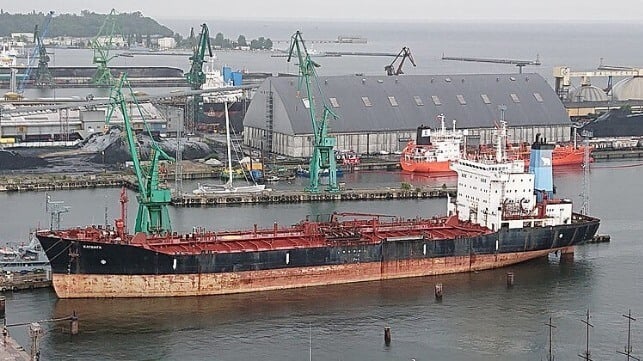
Khatanga has been docked in Poland for nearly eight years, twice breaking away from its dock (Braveheart - CC BY-SA 4.0)

Published May 6, 2025 5:15 PM by The Maritime Executive


Polish authorities confirmed that a deal has been reached and pending final documentation a derelict Russian-owned product tanker will finally be departing after more than seven years at the dock in Gdynia. The vessel had drawn new interest after safety and security concerns were raised in January 2025 which led to a government order to remove the vessel.

A Port of Gdynia Authority spokesperson confirmed to the media on May 5 that the tanker Khatanga (23,000 dwt) is ready to leave the port but said they had requested additional time from the Maritime Directorate in Gdynia. In February, an order was issued requiring the removal of the ship from the port within three months. Port officials said they had been trying for months to gain the authority to remove the ship which they noted had broken away from the dock on two occasions and which they believed was a safety threat. 

Media reports at the time highlighted that the cargo tanks had not been properly vented for years increasing the risk of an explosion. There was also speculation that the Russians might be using the ship as a base to spy on NATO activities in the port.

The Khatanga arrived in Gdynia in October 2017 but was detained after issues were identified during a Port State inspection. The owners, Murmansk Shipping Company, promised repairs to address structural issues identified during the inspection and to take steps to correct issues identified regarding the training and competence of the crew. Instead, the tanker languished in the port before the owner declared bankruptcy in 2020. A court-appointed receiver checked on the vessel on several occasions, but it was otherwise abandoned without a crew or maintenance. However, because it was involved in a bankruptcy the port lacked the authority to have the vessel removed.

Port officials report following the government order that the tanker has now been sold to a qualified scrapyard in Denmark licensed for the required remediation and dismantling of the vessel. However, because the European Union has classified the vessel as waste, and because it is incapable of navigation, they require documentation before the ship can be towed from the port.

Currently, they are waiting for the necessary documentation from the Danish Ministry of the Environment. In preparation, the port spokesperson said that technical and environmental activities have been completed, and the fuel onboard has been removed.

The Maritime Directorate in Gdynia also authorized the port to seek reimbursement from the Russian shipowner for the costs incurred while the ship had remained at Gdynia. In February 2025, port officials estimated the costs at nearly $3.5 million.
 

(Top photo in Gdynia harbor in July 2020 by Braveheart - CC BY-SA 4.0)

US energy companies seek exemption from Trump plan to move LNG on US-built ships

MAY 7, 2025
REUTERS


FILE PHOTO: An LNG tanker is guided by tug boats at the Cheniere Sabine Pass LNG export unit in Cameron Parish, Louisiana, U.S., April 14, 2022. REUTERS/Marcy de Luna/File Photo© Thomson Reuters

By Lisa Baertlein and Jarrett Renshaw

LOS ANGELES/WASHINGTON (Reuters) -U.S. energy groups are asking President Donald Trump's administration to exempt liquefied natural gas tankers from a new rule that will require producers to move an increasing percentage of their exports on U.S.-built vessels as part of a broader push to revive domestic shipbuilding

The U.S. is the world's No. 1 LNG exporter at $34 billion annually and the Trump administration has been a supporter of the industry in his push for energy dominance.

In a move that shocked the industry, the U.S. Trade Representative (USTR) announced April 17 that LNG producers would have to transport 1% of their exports on U.S.-built ships starting in April 2028. That percentage would escalate to 15% in April 2047 and beyond.


That could put the U.S. LNG industry at a disadvantage to its peers around the world because there aren't enough U.S.-built ships to meet the requirement, the American Petroleum Institute (API) said in an April 23 letter to U.S. Energy Secretary Chris Wright and National Energy Dominance Council Chair Doug Burgum seen by Reuters. Burgum is also U.S. Interior Secretary.

It "risks counteracting the significant progress the Trump Administration has made towards reducing uncertainty and unleashing U.S. LNG," API CEO Mike Sommers wrote in that letter. API counts as members some of the world's largest energy companies, such as Exxon Mobil, Chevron and Cheniere Energy.

Individual exporters that do not comply could lose their export licenses, even though the percentages apply to the overall industry and to ships that exporters do not own or control, industry groups warned.

"They have little control over their ability to comply with USTR's new requirements but ultimately face the consequences of not doing so," Sommers said in the letter.

"We will continue working with USTR and the Department of Energy in support of feasible and durable policies that benefit consumers and advance American energy dominance," Aaron Padilla, API's vice president of corporate policy, told Reuters in a statement late on Tuesday.

Representatives from the USTR and White House press office did not immediately respond to requests for comment. USTR proposed the rules as part of a larger effort to counter China's growing commercial and military dominance on the high seas


There are now 792 LNG carriers in operation globally, according to shipping consultancy AXSMarine.


LNG ships from South Korea and Japan dominate that group with 703 combined. China, which aims to become a LNG tanker powerhouse, built 58. Five come from U.S. shipyards - though those 1970s-era American made vessels are laid up and not currently in use, AXSMarine said.

South Korea remains the dominant builder with 232 LNG carriers currently on order. China, while still behind, is rapidly expanding its footprint with 101 LNG carriers on order, AXS Marine said.


U.S. shipyards cannot turn out vessels fast enough to meet the USTR deadline, the Center for LNG told Reuters in a statement.

"There are no such vessels in existence today, and building them would take decades, making compliance impossible for the industry," Charlie Riedl, executive director at the Center for LNG, said in a statement on Wednesday.

The USTR requirement for 1% of LNG exports to be transported on U.S.-built vessels would require as many as five American-built ships by the end of the decade, which is not feasible, API CEO Sommers said in the letter.


That's because it would take as long as five years to build one LNG carrier at either of the two U.S. shipyards with docks long enough to build such a ship, Sommers said.

"We urge the Administration to exempt crude oil and refined product imports and exports - consistent with this Administration's approach to exempt these same products from baseline and reciprocal tariffs," Sommers wrote.

Vehicle carrier operators also hope to win relief from new rules that would levy hefty U.S. port fees on all of their foreign-built vessels. USTR also announced those unexpected rules on April 17.

(Reporting by Lisa Baertlein in Los Angeles and Jarrett Renshaw in Washington; additioanl reporting by Arathy Somasekhar in Houston; Editing by Chizu Nomiyama)


Indian Registry Continues Growth as MOL Transfers LPG Carrier

LPG carrier
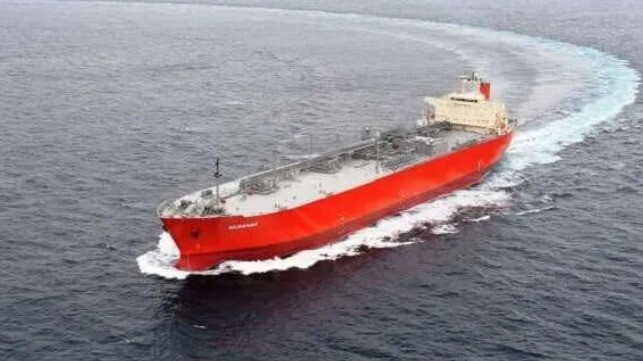
MOL now has eight LPG carriers and a total of 11 ships under the Indian flag (MOL)

Published May 7, 2025 4:49 PM by The Maritime Executive


Shipping under the Indian flag is continuing to grow as international companies move ships to the registry. It comes as India seeks to become a powerhouse in international shipping, shipbuilding, and repairs.

Japan’s Mitsui O.S.K. Lines is continuing the trend by expanding its fleet under the Indian flag. According to India’s Economic Times, MOL (India) has emerged as the country’s fourth-largest ship owner. It has a fleet of 11 ships operating under the Indian flag and staffed with Indian crews as per the requirements of the flag.

In April, the company reflagged its LPG carrier Yamabuki (58,811 dwt) to India and renamed the ship Green Sachi. Built in 2010, the vessel became the eighth LPG carrier the company has flagged in India. The ship had previously been registered in Liberia. Its move followed its sister ship, which became Green Sanvi under the Indian flag in November 2024.

The company, in March, when the management was transferred to the Indian company, highlighted it as a “valuable addition significantly expands our fleet capabilities and strengthens our commitment to serving the Indian subcontinent.” They said the vessel would play a crucial role in enhancing our regional operations, providing reliable and efficient maritime transport solutions.”

India’s government the Economic Times highlights is taking steps to encourage the growth of its domestic fleet. The cabinet approved a subsidy scheme for vessels registered in India after February 2021 and budgeted a subsidy for moving crude oil, LPG, coal, and fertilizer for state-run firms on Indian ships.


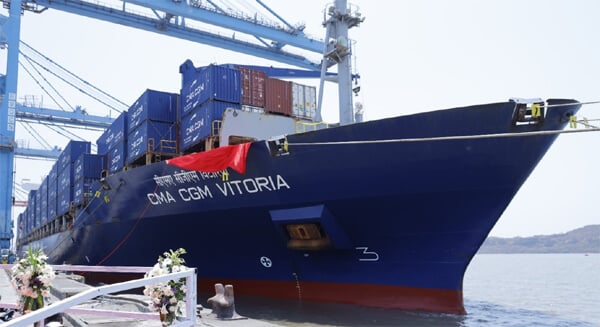
CMA CGM recently transferred the first of four containerships to the Indian flag (IRS)


Major shipping companies are responding to India as they look to increase business with the subcontinent. At the end of March, BW LPG announced it was selling two VLGCs acquired in the Avance Gas transaction, BW Pampero and BW Chinook (each 53,500 dwt), to BW LPG India. The ships are currently registered in the Marshall Islands. The deal valued each vessel at $75 million, with delivery set for the third quarter of 2025. 

BW LPG India was established as a joint venture in 2017 and currently has seven ships. It reports transporting approximately 20 percent of India’s gas imports. BW cited the opportunities tied to India’s continued growth in LPG demand.

The newest arrival to the Indian ship registry is CMA CGM, which became the first major foreign carrier to reflag a containership to the Indian flag. CMA CGM Vitoria was officially transferred on April 28. The company said it will register three more vessels in the coming months in India. They highlighted that the efforts underscore CMA CGM’s commitment to India and its ambition to further develop its presence in the country.

The Indian Registry of Shipping commented that this milestone, with the transfer of the CMA CGM vessel, marks a significant achievement in IRS’s growing engagement with major global shipping companies. They said it reinforces its standing as a trusted and recognized classification society on the international stage.


Germany Adds FSRU and LNG Terminal as it Works to Manage Import Suppl

FSRU arriving Germany
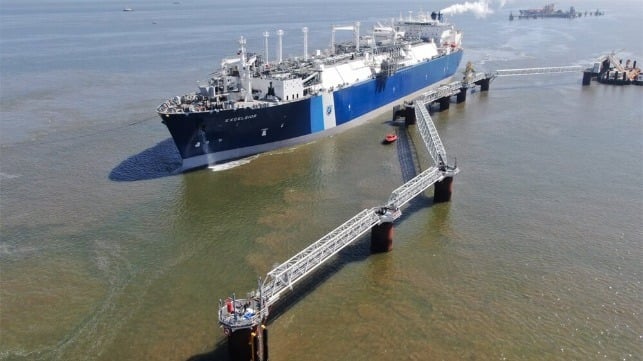
Excelsior arrivied in Germany to expand the LNG import capacity (DET)

Published May 4, 2025 12:10 PM by The Maritime Executive


Germany’s federally owned Deutsche Energy Terminal GmbH (DET) announced the arrival of its third FSRU unit and the second to be placed in the port of Wilhelmshaven. Coming a little over two months after another German company terminated an FSRU contract in the east, the country continues to work to balance the imports of LNG and plan for the country’s long-term energy needs.

With the support of the German government, the LNG import projects were started in 2022 to replace the flow of gas from Russia after the start of the war in Ukraine. Five FSRU units were chartered with the first going to Wilhelmshaven and later ones placed at strategic points around the country. The first LNG cargo arrived in January 2023.

“This winter, we saw how quickly German natural gas storage facilities are depleting. The discontinuation of pipeline-based gas deliveries via Ukraine at the turn of the year put our European neighbors under pressure,” said Dr. Peter Röttgen, Managing Director of DET. “Past experience has shown us: As long as renewables do not yet fully cover our energy needs, a reliable natural gas supply remains crucial.”

A specially developed second terminal was built in Wilhelmshaven to support the arrival of the second FSRU unit. It is a purpose-built island jetty in the Jade Stream with the company highlighting the unique structure. While it is in the seabed of the Jade Stream, the steel structure has no physical connection to the dyke 1.5 kilometers away. It is connected to the onshore transfer station underwater via various pipelines.

“In order to reliably fill the storage facilities for next winter and keep natural gas prices as low as possible for industry, commerce, and, last but not least, households, we need the capacity of LNG terminals to strengthen the resilience of our energy supply – especially in crisis situations,” said Röttgen.

On April 28, the FSRU Excelsior reached Wilhelmshaven. The 277-meter-long Floating Storage and Regasification Unit built in 2005 and owned by the shipping company Excelerate Energy will be operated by DET. In the coming weeks, the floating regasification vessel will be connected to the long-distance gas grid and prepared for commissioning under strict safety requirements.

Wilhelmshaven02 is DET's second terminal in Wilhelmshaven and, together with Brunsbüttel, DET's third terminal. The FSRU Excelsior has a storage capacity of 138,000 cubic meters of LNG. 

In 2025, the regasification ship will feed up to 1.9 billion cubic meters of natural gas into the German gas grid. This corresponds to the natural gas consumption for heating 1.5 million households in apartment buildings. In each of the two subsequent years, the regasification and grid feed-in capacity of the Excelsior will then reach up to 4.6 billion cubic meters, which is equivalent to the heating energy required by up to 3.7 million four-person households. 

Deutsche ReGas in February terminated its charter for the FSRU Energos Power. The 174,000 cbm vessel had been operating since February 2024 as one of the two FSRUs on the 13.5 bcm/year Deutsche Ostsee LNG import terminal, located in the port of Mukran (Rügen Island), Germany. Reports suggested the vessel would be going to Egypt, but the 145,000 cbm FSRU Neptune which is 50 percent owned by Hoegh LNG and sub-chartered by Deutsche ReGas from TotalEnergies remained operational at the terminal in the eastern part of the country.

Data from the German Federal Network Agency (Bundesnetzagentur), highlighted that the FSRUs now represent about eight percent of the country’s LNG imports. Approximately 69 TWh of natural gas were imported via the LNG terminals in Wilhelmshaven, Brunsbüttel, Lubmin, and Mukran during the 2024-2025 season.


EU Proposes More Tanker Sanctions as it Maps End of Russian Energy Imports

crude oil tanker
The sanctions could add 100 more tankers bringing the total to over 300 shadow fleet tankers (file photo)

Published May 7, 2025 2:43 PM by The Maritime Executive


The European Commission is proposing two key strategies to further curtail the Russian energy market and move toward energy independence. While citing strong progress, commissioners said more must be done to break free and continue the pressure on Russia to end the war in Ukraine.

According to the media reports, the proposal for the 17th round of sanctions enacted since the start of the war in Ukraine was distributed to the member countries on Tuesday, and today, May 7, discussions began on the scope of the package. Reports indicate it is not only focusing on the shadow fleet but also the companies and countries helping Russia avoid the current sanctions and further restrictions on exports of goods and advanced technologies that can be used by the Russian military.

The number of vessels and organizations included in the proposed package varies between reports, but most agree that more than 100 additional tankers could be sanctioned. That would bring to over 300 the number of vessels the EU has designated. Between 50 and 60 individuals and entities are believed to be targeted, including ones in China, Vietnam, Turkey, and Serbia, according to a story in the Financial Times.  Others could be included that are in the UAE and Uzbekistan. 

Bloomberg is reporting today that the package may also target, for the first time, Litasco Middle East DMCC, the trading division of Lukoil based in Dubai. Bloomberg reports that Lukoil was the second-largest seller of Russian crude in the international markets in 2024. The package may also include the Russian insurance company VSK, but it will continue an exemption until at least June 2026 for Russia’s Sakhalin-2 energy project, which is reported to be vital to Japan.

The European Commission cited data showing that Russian oil imports have been slashed from 27 percent at the beginning of 2022 to just three percent of the EU market. Further, it points out that coal imports have been totally banned, and now it is moving to end gas imports. They cited data that gas imports fell from a market share of 45 percent (150 bcm) in 2021 to 19 percent (52 bcm) in 2024. However, they acknowledged that 2024 saw a rebound in Russian gas imports.

“It is now time for Europe to completely cut off its energy ties with an unreliable supplier,” said European Commission President Ursula von der Leyen.  EU Commissioner for Energy and Housing Dan Jorgensen joined the president in saying “No more,” citing Russia’s weaponizing energy, blackmail against member states, and using monies for its war chest.

Under the proposed plan, a roadmap is set out to gradually remove Russian oil, gas, and nuclear energy from the EU markets. Member states have said in the past that they needed the EU to act so that they could break long-term contracts. Under the proposal presented yesterday, the EC calls for ending new contracts with suppliers of Russian gas, including pipelines and LNG, at the end of 2025. This would include existing spot contracts. That step, they said, would slash by one-third the remaining supplies of Russian gas. The Commission proposed to stop all remaining Russian gas imports by the end of 2027. Attention would then turn to the phase out of nuclear energy and uranium.

The EU expects to replace up to 100 billion cubic meters of natural gas by 2030. They expect a decrease in demand by 40 to 50 bcm by 2027 while noting at the same time LNG capacities are expected to increase around the world by around 200 bcm by 2028. They note that it would be more than five times the current EU imports of Russian gas.


Unfair Trade

Trump's tariffs don't signal the end of globalization. They're intended to level the playing field.


Published May 7, 2025 11:45 PM by Erik Kravets


(Article originally published in Mar/Apr 2025 edition.)


Esperanto. The Maginot Line. Feudalism. Tariffs. What do these things have in common? They were all clung to despite the tide of history, even after it had become obvious that the water was coming in and had no intention of making a halt.

The idea that public policy can override social and economic forces is, in its way, comforting. We would surely all like to imagine that we are masters of our fate. But Sophocles knew better: "…what is fated, no one can flee, neither by chariot nor by ship."

Take note, mariners. The Greek is saying that you had better rise with the tide.

So far, globalization has been unstoppable. Then and now, trade tensions and arguments about tariffs indicate globalization's continuing strength, not its failure.

I wrote about tariffs in 2020 ("Tariff Follies," Sept./Oct. 2020), in the waning days of the first Trump Administration. Back then, the oracles were prophesying that globalization would perhaps grind to a halt. One panicky prediction went so far as to suggest global trade volume could collapse by 17 percent, an apocalyptic number that would drag down global shipping along with it.

So, how did that go?

I'm happy to report that my five-year-old advice weathered the test of time. "The hot air blowing around tariffs and trade and the intensity of the arguments they engender do not nearly match with the reality," I wrote. That reality turned out to be "business as usual." Instead of shrinking, global trade volume grew by a satisfying six percent vis-à-vis 2020. Global container volumes also set a new record, reaching 74 million TEUs in 2024. All good signs.

Now it's 2025. Trump and tariffs are on the agenda. Again, people are concerned.

WORD ON THE STREET

But before we delve deeper, what's the word on the street?

According to Citibank, an undifferentiated 10 percent tariff could cut European GDP by 0.3 percent over two years. The Institute for the German Economy projected that the already shrinking German economy could suffer further losses in the 2025-29 timeframe equal to 180 billion euros. Italy's economy could contract by 1.2 percent, according to the French Center for International Economic Studies. Tottering Europe would be easy to push into a recession.

Divestment from tariff-afflicted manufacturing sectors may lead to difficulty in obtaining credit and a one or two percent price drop for equities. So would you like to buy the dip?

The machinery and automobile sectors will be hurt the most. They make up 41 percent of Europe's exports to the U.S. Europe sells America a surplus of 102 billion euros of machinery and automobiles each year.

BMW, the German automaker, is expected to take a 400-million-euro hit to its earnings. Other carmakers, however, like Volkswagen, remain unconcerned, remarking that its "North American assembled VW-brand vehicles meet the USMCA rules of origin and are exempted from the 25 percent tariffs." USMCA stands for the U.S.-Mexico-Canada Agreement, a free trade treaty.

Italian-led Stellantis, known for its Jeep and Dodge brands, has gone further. It's not only using the USMCA exemption but planning to expand its U.S. operations, aligning with Trump's goal to compel investment in American car manufacturing and provide jobs for Americans. Under USMCA, any vehicle with 75 percent of its parts originating in North America is tariff-exempt.

Europe has few options when it comes to retaliation. Europe mostly imports oil, coal and natural gas from the U.S. These fuels are not likely to be taxed further by European governments because energy costs are already so politically dangerous.

This illustrates how some can, and will, rise with the tide, while others will struggle.

SHIPPING'S RESPONSE

It's not only globalization that continues despite headwinds. Indeed, in the words of William Arthur Ward, "the pessimist complains about the wind; the optimist expects it to change; the realist adjusts the sails."

Let's see how shipping companies are responding.

First Maersk, the Danish titan. Charles van der Steene, its North America President, acknowledged that "the shortterm effect of any tariff clearly is inflation." But the bigger cost driver is a duty on Chinese-manufactured cargo vessels of $1-1.5 million per port call. Seventy-nine percent of Maersk's orderbook is for Chinese freighters, so worry is justified.

Depending on the vessel size, the additional cost per container could work out to around $100. The freight to move a container from Shanghai to Los Angeles sits at roughly $2,650 presently, so while this seems disruptive on its face, the new duty is only a drop in the bucket. Supposedly, this fee will boost purchasing of newbuilds from South Korean and Japanese shipbuilders.

Next, CMA CGM, the French shipping giant, which is proving itself agile. Rodolphe Saadé, CMA CGM's CEO, pledged a $20 billion investment in the U.S. including $8 billion for up to 30 new U.S-flagged containerships, $7 billion for logistics, encompassing new logistics hubs and warehouses, $4 billion for new port facilities and $1 billion for air freight hubs and aircraft. These investments will create approximately 10,000 American jobs.

And, finally, Hapag-Lloyd, the German container giant, whose CEO, Rolf Habben, is perhaps my kindred spirit. In February, he suggested that "it is too early to push the panic button" and counseled patience. Then, he pragmatically noted: "The U.S. President also wants the U.S. economy to grow. They will need more goods for that." And that means ships will be moving cargo.

IMPACTS

Now, let's take a moment to examine the strategic situation in more detail.

At the end of Trump's previous term, in 2019, the U.S. was bringing in $71 billion per year in tariff revenue. By 2024, that number had grown to $97 billion, which is more, but not so much more that it would be significant relative to America's $29 trillion economy. Even if Trump's hyped-up new tariffs enter fully into force, they would only make up about 2.5 percent of U.S. tax revenue, which is about the average from 1974-2023.

In value terms, the picture is similar and doesn't appear to be especially shocking.

For decades, on average, the U.S. levied tariffs of 2.71 percent against imported goods. The rest of the world imposed tariffs more than twice as high, 6.7 percent on average, on American products. Putting aside rhetoric, the Trump Administration's tariff adjustments will likely address this longstanding disparity rather than create a new trade paradigm.

A sampling of the rhetoric from the Trump administration suggests that the tariffs are more for domestic posturing than an effort to rework globalization. Commerce Secretary Howard Lutnick's remark exemplifies this neatly: "These countries have used us and abused us. That is going to change. It's unbelievable the way we get ripped off around the world, and Donald Trump is going to level set it, make it reciprocal and make it fair."

It isn't that the system needs to go. It needs to be "level set," to be made "fair."

LEVELING THE PLAYING FIELD

And, in truth, there's surprising merit to that argument.

Gilberto Garcia-Vazquez, Chief Economist at Datawheel, agrees that "the world imposes tariffs more than twice as high as those applied by the U.S. on imports," which also fails to take into account the rich tapestry of non-tariff trade barriers that are conspicuously common abroad but not in the U.S.

I detailed this in my 2020 article, but the situation is worse now. The U.N. Council on Trade and Development estimates that 70 percent of world trade is subject to what it calls "technical barriers," with climate change a major policy driver.

If the U.S. moves its economic policy in line with the rest of the world's protectionism, it's certainly a bad decision, but it's hardly a paradigm shift. A wise mariner knows that the tide will roll in and that it will eventually roll out. Only a fool would try to resist it.

The opinions expressed herein are the author's and not necessarily those of The Maritime Executive.
 

U.S. Tariffs Create Uncertainty for Ship Leasing and Finance

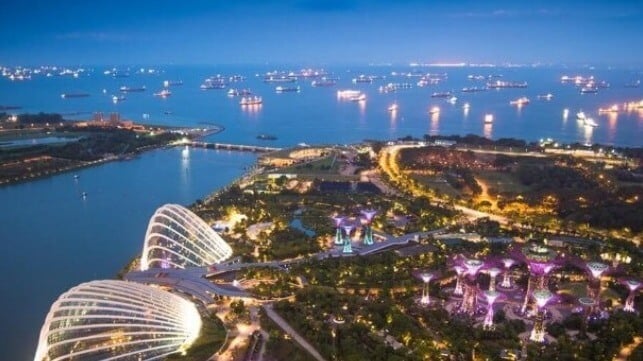
Singapore anchorage
iStock / Primeimages

Published May 7, 2025 7:04 PM by Leigh Hansson


As the U.S. considers a new wave of tariffs targeting Chinese-linked goods and services, Leigh Hansson, Global Regulatory Enforcement Partner at law firm Reed Smith, examines the growing regulatory uncertainty facing the global shipping industry.

The latest proposals from the U.S. Trade Representative (USTR) have raised concerns that vessels financed through Chinese leasing arrangements could be subject to additional port fees, even when ownership and control are commercially diverse.

One of the most pressing legal and operational questions now confronting the industry is what will qualify as “Chinese-owned” or “Chinese-controlled” under the new framework. While the latest USTR draft, published last week, has softened some of the more aggressive provisions found in earlier versions, it has not eliminated the core risk: that vessels with Chinese financing ties may be caught within the tariff scope.

This uncertainty is particularly acute for owners engaged in sale and leaseback transactions with Chinese financial institutions. For example, a Greek shipowner leasing a vessel from a Chinese lessor could see that vessel classified as “Chinese-controlled” — even if the commercial operations and technical management are handled elsewhere. In such cases, exposure to new tariffs or port charges could have material commercial consequences.

This ambiguity is prompting a wave of risk assessments across the sector. At Reed Smith, we are seeing heightened activity as clients seek to map their exposure in advance, rather than waiting for enforcement actions to materialize. Some are even considering restructuring their deals to reduce potential liability.

In parallel, we are seeing increased demand for contractual protections, adjusted insurance terms, and clearer disclosures around beneficial ownership and financing sources, to allow flexibility if tariffs come into force. Across the board, clients are looking for ways to future-proof their deals against regulatory surprises.

For now, the lack of a definitive legal definition of “Chinese ownership” leaves the industry operating in a regulatory grey zone. If the proposed tariffs are introduced as expected, they could force a re-evaluation of vessel financing structures globally — especially those that involve Chinese financial institutions or leasing companies.

 In the face of this uncertainty, the best course of action for shipowners is caution. Until regulators clarify the thresholds and triggers for enforcement, stakeholders should assume that any material Chinese involvement in a vessel’s ownership or financing structure could fall within scope. Staying ahead of the regulatory curve, through legal, financial, and operational planning, is essential for mitigating exposure in this evolving environment.

Leigh Hansson is a Global Regulatory Enforcement Partner at Reed Smith.

The opinions expressed herein are the author's and not necessarily those of The Maritime Executive.
 

What's New in the Revised SHIPS for America Act

U.S. flag on USNS Mercy file image
USN file image

Published May 4, 2025 1:41 PM by Charlie Papavizas


On April 30, Senator Mark Kelly (D-AZ), together with several original co-sponsors, reintroduced the SHIPS for America Act in the U.S. Senate, first introduced in December 2024, divided into two bills. Companion legislation was also introduced in the U.S. House of Representatives by Rep. Trent Kelly (R-MS) and Rep. John Garamendi (D-CA). This is a major, historic effort to revitalize the U.S. merchant marine. The legislation had to be reintroduced to be considered by the new U.S. Congress, which commenced in January.

Here, we concentrate on the differences between the December bill and the April bills. For a more general summary of the proposed legislation, see Sen. Kelly’s April 30 press release.

The two Senate bills—S. 1536 and S. 1541—have five original cosponsors: Republicans Todd Young (IN), Lisa Murkowski (AK), and Rick Scott (FL), and Democrats Tammy Baldwin (WI) and John Fetterman (PA). The second proposal consists of tax provisions, with the remaining balance of the original SHIPS Act referred to the Senate Commerce Committee, and the tax provisions referred to the Senate Finance Committee. In this fashion, the bills can move on separate tracks and avoid the potential delay of sequential consideration.

Although the current proposal is substantially the same as the earlier proposal, there are significant differences:

• Relationship to China Shipbuilding Section 301 Investigation – The original SHIPS Act cross-referenced the section 301 China shipbuilding investigation undertaken by the U.S. Trade Representative. The USTR issued its final action in that investigation on April 17, imposing substantial fees on Chinese-built and Chinese-operated vessels. Consideration was reportedly given to having the new SHIPS Act expressly have those fees be deposited in the Maritime Security Trust Fund that the SHIPS Act would create. The new SHIPS Act would direct such fees to the, to be created, Trust Fund – among other fees directed to that Fund and retain its originally proposed “penalty rates” for vessels and owners connected with any “country of concern” which overlap with the section 301 fees. This formulation is in fact what the original U.S. labor section 301 petitioners requested in March 2024.

• No Fault Termination Payment – The, to be created, 250-vessel “Strategic Commercial Fleet” is the crown jewel of the SHIPS Act. Private contractors would be required to build vessels in the United States in that Fleet with U.S. government financial assistance pursuant to seven-year renewable contracts. The original SHIPS Act provided a formula in the event the program or contract was terminated early to cover the contractor’s anticipated extra cost of building a vessel in the United States, but at a 50 percent rate. The new SHIPS Act expands that no-fault coverage to 100 percent.

• SCF Vessel Carriage of U.S. Government Cargoes – The U.S. government operating support payments to SCF vessels may be greater than the levels of support provided to existing vessels in the Maritime Security and Tanker Security Programs. Vessels in those programs also rely on the carriage of U.S. government cargoes reserved to them by the cargo preference laws to supplement such support payments. To account for the potential support amount difference, the original SHIPS Act provided that SCF vessels would not receive support payments for any day they carried reserved government cargoes and that such carriage would only be permitted if the U.S. Maritime Administrator determined that no SCF U.S.-flag vessel is available. The new SHIPS Act tightens that waiver process and provides that the waiver decision must be made by the Secretary of Transportation -- and such a decision is non-delegable.

• SCF Vessel U.S. Repairs Requirement – The original SHIPS Act contains enhanced duties for repairs to U.S.-flag vessels outside the United States with a ten-year exception for the Maritime Security Program, Tanker Security Program, Cable Security Program, SCF vessels, and vessels enrolled in the Voluntary Intermodal Sealift Agreement (VISA) program. The new SHIPS Act adds a requirement that SCF operating agreements require the owner to undertake their vessel repairs in the United States pursuant to a “set percentage, agreed to between” the Maritime Administration and the vessel owner.

• U.S.-Flag Cargo Preference Non-Availability Determinations – Although existing cargo preference authority is supposed to reside in the U.S. Maritime Administration, agencies which ship cargoes have sometimes taken unilateral decisions on whether the U.S.-flag reservation can be waived and how it can be waived. The new SHIPS Act tightens that process and inserts the, to be created, Maritime Security Advisor as a decision maker.

• Adjusting Tariffs to Incentivize U.S.-Flag Carriage – The United States in its early days supported its merchant marine in foreign trade by either discounting tariffs on goods carried by U.S.-flag vessels or imposing a surcharge on tariffs for foreign carriage. One of the vestiges of that support is a 1790-enacted law that still exists in the U.S. code, which permits the President to add a 10 percent tariff surcharge to goods imported from any country that discriminates against U.S.-flag vessels. Consideration was reportedly given to including new authority to impose such discounts or surcharges. The new SHIPS Act modifies the existing law to provide for an automatic tariff surcharge of 10 percent on any goods imported into the United States on a foreign vessel unless foreign and U.S.-flag rates are the same.

• Voluntary Ship America Program – The original SHIPS Act would establish a “Ship America Office” in the Maritime Administration charged with promoting the use of U.S.-flag vessels by commercial shippers. The new SHIPS Act adds a requirement for that Office to develop a “Ship America verification program to develop self-certification industry standards.”

Chair of Winston & Strawn's top-ranked maritime and admiralty practice, Charlie Papavisas is nationally recognized in major legal directories. Chambers USA ranks him as the only “Star Individual” in the category of “Transportation: Shipping/Maritime: Regulatory,” who is “the Dean of the maritime bar” and “the godfather of maritime law.” He is widely known for his experience with Jones Act laws and the U.S. offshore wind industry.

This guidance note appears courtesy of Winston & Strawn and may be found in its original form here

The opinions expressed herein are the author's and not necessarily those of The Maritime Executive.
 MADE IN U$A

Japan’s Mitsubishi Shipyard Completes Largest Overhaul Contract for US Navy

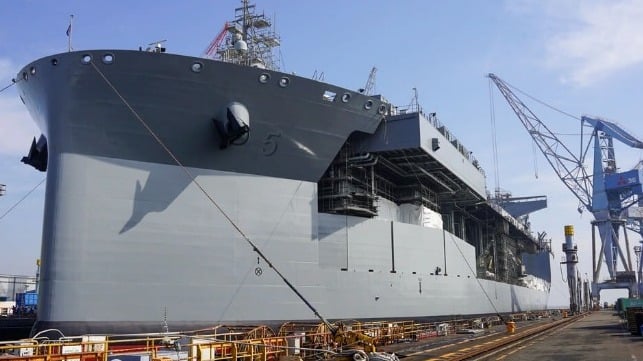
USS Miguel Keith in Japanese shipyard
USS Miguel Keith completed a five-month overhaul in Japan (USN)

Published May 2, 2025 4:41 PM by The Maritime Executive


The U.S. Navy’s Lewis B. Puller-class expeditionary mobile base USS Miguel Keith recently completed a five-month Regular Overhaul but instead of undertaking it as a U.S. shipyard, it was completed at Japan’s Mitsubishi Heavy Industries (MHI) in Yokohama. It marks the first time a Japanese shipyard has bid on and won a contract of this scale for a U.S. Navy vessel and the Navy’s strategy of using international shipyards to keep critical vessels available in their assigned areas.

The shipyard has previously conducted smaller voyage repair contracts for the U.S. Navy but the Navy’s regulations generally prohibit overhauling, repairing, or maintaining U.S. naval vessels in foreign-owned and operated shipyards outside the United States except for these small projects. However, it was determined since the ship was not scheduled to return to the U.S. within 15 months, and the project was under six months, that the work would be done in Asia.

This was the first regular overhaul project for the U.S. Ship Repair Facility and Regional Maintenance Center’s Singapore Detachment, according to Douglas Cabacungan, the Project Manager. “Usually, we provide shorter emergent and continuous maintenance repairs outside of Japan,” said Cabacungan. “So, we were able to expand our skill set, work outside of our comfort zone, and work with a contractor we normally do not work with which will pay dividends when we need to start operating in places we aren’t currently.”

The Singapore Detachment planned the $12 million project executed by MHI. During the availability, 56,000 square feet of nonskid decking was replaced on the flight deck and mission deck. In twenty-nine spaces, including the galley, scullery, laundry, and berthing areas, deck replacement and preservation were accomplished. Over 10,000 square feet of the forward deckhouse superstructure and MOGAS deck and associated equipment were also preserved. MHI also fabricated, welded, and replaced over 300 feet of flight deck catwalk safety handrails. Additionally, four galley ovens were replaced, and the entire exterior of the ship was painted bow to stern.

“The ability to use Mitsubishi Heavy Industry’s shipyard to conduct this level of maintenance availability has allowed SRF-JRMC’s organic workforce in Yokosuka to focus their efforts on the three other warship maintenance availabilities being conducted simultaneously,” said Capt. Wendel Penetrante, Commander of SRF-JRMC. “We were even able to complete one of those availabilities 3 days early and respond to two unplanned voyage repairs.”

The USS Miguel Keith is a 787-foot (240-meter) long vessel designed to be a customizable floating command base that can launch helicopters and small boats, provide living quarters for troops, and command-and-control facilities. Her large open decks can accommodate a variety of other capabilities, including berthing for special operations troops, laundry facilities, or cold storage. The ship has been operating in the U.S. 7th Fleet area of operations since September 2020 with a mixed crew of sailors and civilian mariners from Military Sealift Command (MSC). The overhaul was completed on April 15 the Navy reports. 

This project follows two large overhauls that were assigned in 2024 to South Korea’s Hanwha Ocean. The first was completed earlier this year and work on the USNS Yukon is currently underway in South Korea.  The U.S. has also expanded its use of international shipyards assigning smaller projects for the first time in 2022 to India’s L&T (Larsen & Toubro) Kattupalli shipyard in Chennai.

Secretary of the Navy John Phelan this week has been visiting shipyards in Japan and South Korea. The discussions centered on the repair projects and support from the international yards as the United States looks to rebuild its shipbuilding capabilities and expand its fleet.