Thursday, May 08, 2025

KARACHI
An obituary
when memory is erased for profit, cities lose their soul.
Published May 8, 2025
Dawn
The writer is an architect.


KARACHI is a strange city — divided by public-private partnerships and developed in isolation. Its caretakers no longer incorporate context, history, or citizens’ rights. The city tends to silence you — either through the bullet or by denying your human right to dignified infrastructure. What is a city without a historical context? I write today in a defeated tone. Developers, politicians, investors, and capitalistic methods have triumphed, while activists, urban thinkers, and social welfare bodies have been told to go home.

Three important heritage properties listed under Sindh Cultural Heritage (Preservation) Act, 1994, have been lost in the same way. Each property was purchased recently by investors or builders. All were vacant and declared ‘dangerous’ by the Sindh Building Control Authority (SBCA). This process is hardly straightforward — it is a power-driven strategy. These properties are acquired by influential people, who seek to obtain favourable reports supporting commercial ambitions.

The three heritage buildings we lost this month are: Cowasjee Kharas House, Panachand Building, and most tragically, the Kanji Building. Heritage Walk Karachi has, for five years, monitored this structure from afar, alerting the Sindh Heritage Department of illegal activity at the site. Three months ago, the developer purchased the adjacent building that structurally supported the Kanji Building. The supporting structure was dismantled, rendering the building weak and vulnerable. Despite repeated letters to departments urging them to stabilise the structure with scaffolding, no action was taken. On May 3, the Kanji Building’s stone frame could no longer bear the burden — it collapsed, leaving behind debris infused with cultural memory, architectural craftsmanship, and undocumented archives.

Suit 666 of 2024, recently filed in the Sindh High Court, has dealt a devastating blow to Karachi’s heritage landscape. It has handed absolute power to the SBCA — the very body that is supposed to prevent neglect by owners and users of such properties. Instead, the SBCA does little beyond awarding these buildings the label ‘dangerous property’. KDA regulations regarding heritage sites place greater responsibility on oversight and protection than on hastily issuing such certificates. The authority’s inaction reveals weaknesses in our regulatory frameworks.


In Kanji’s debris lie the remnants of Karachi’s history.

The Sindh minister for culture and heritage, along with the advisory (technical) committee, has attempted to address the menace of wilful demolitions — many of which are apparently facilitated through SBCA channels. Builders and property owners covertly damage their own properties to engineer a ‘dangerous’ status and gain demolition approval. Important government institutions collecting real estate revenues should review the city and its infrastructure from various angles, not just a commercial extractive lens.

Meanwhile, Karachi is being concretised through development schemes. Town municipal corporations exacerbate this trend. Public parks are being transformed into commercialised padel grounds. No policies exist to safeguard neighbourhood rights. Tertiary lanes are clogged with private vehicles and 24-hour rental grounds, causing noise pollution. The city never sleeps — and thus never repairs. Strategies that claim to activate parks often do the opposite: aviaries in spaces like the Frere Hall impose cruelty on animals while squandering funds that could have supported liveable infrastructure. Old town Karachi remains below acceptable living standards. Sociologists and urban planners stress the importance of grassroots collaboration and community partnerships — not profit-driven public-private vent­u­-res.

Heritage and cultural development in Karachi operate in silos. Select buildings already in good condition undergo token ‘restoration’ and are handed back to the public as showpieces — gestures meant to distract from the larger decay. Access to cultural heritage is not charity; it is a right. Sadly, powerful actors make decisions in isolation. These are portfolio-driven strategies — not urban planning. As researchers, we monitor the government’s social media and public narratives. What emerges is a picture of not social welfare but a fractured, self-serving methodology.

The Kanji Building bore witness to decades of state neglect, the abuse of power, the erosion of collective hopes, and the imposition of silence. Its collapse was not by time but by design.

In its debris lie the remnants of Karachi’s identity — its craftsmanship, aesthetic values, partition-era history, and unfulfilled desires. Let its absence speak out. Let the ruins testify to what history could not save, because power chose not to. Let the Kanji Building’s fall be a warning: when memory is erased for profit, cities lose their soul.

X: @marvimazhar
Published in Dawn, May 8th, 2025
Water war
Dawn,
Published May 8, 2025


PLANES and bombs are not the end of it. New Delhi is also up to mischief on another front. This weekend, without prior intimation, which officials say it is bound to provide under the terms of the Indus Waters Treaty, India virtually blocked water from flowing into the Chenab in Pakistan, reducing water availability for crops this side of the border. 

Punjab irrigation officials said Pakistan’s waters were being used to fill up three Indian reservoirs with a total capacity of 1.2 MAF, and there was a possibility that the stored water would be released without warning, causing dangerous flooding downstream. “If they keep filling their dams and avert discharging, they may leave us without water for four to five days more,” an official remarked. Meanwhile, India had also started the process of augmenting the reservoir holding capacity at its Salal and Baglihar projects in Indian-occupied Jammu and Kashmir. A Reuters report stated that ‘reservoir flushing’ was underway at the two projects to enhance their capacity to hold water, and that if other dams also started doing the same, Pakistan’s water share could be adversely affected in the future. This, of course, is a serious situation that needs constant monitoring by Pakistan. The Chenab irrigates vast tracts of farmland in Punjab, and India’s actions are aimed at sabotaging Pakistan’s water and food security. If they continue to escalate, water disputes between the two nations have the potential to trigger a wider, more serious conflict in the future.

The Modi regime, whose judgment has been clouded by hubris ever since India’s economic clout started inviting international attention, lit a fuse after making the unilateral decision to ‘suspend’ the IWT. Its actions have placed the treaty’s status in uncertainty, at least for now. This is a dangerous game for New Delhi to be playing. Water is a lifeline for Pakistan’s economy, and any actions India takes to try to alter its supply in violation of the IWT will be taken as a provocation to war by Pakistan. Islamabad has made this clear. If India continues to push the boundaries of acceptability, Pakistan may soon face a situation where its options may be limited to kinetic measures. Climate change has presented the country with severe existential crises that it needs to overcome in order to protect the lives and livelihoods of its people. Any foreign act or aggression that imperils Pakistan’s waters and therefore the well-being of its people cannot be countenanced.

Without further ado, Pakistan needs to mount an aggressive legal challenge against India’s move to ‘suspend’ the IWT and either compel or convince it to reverse its decision. Diplomatic channels should continue to be utilised to prevent any serious violation of water-sharing agreements, which have the potential to place millions on both sides in peril. The IWT has survived wars and conflict over issues much more serious than the one manufactured most recently by New Delhi. It cannot be simply undone by one side over flimsy pretexts. India must be held to its commitments.

Published in Dawn, May 8th, 2025

Water security to 2047

Ali Tauqeer Sheikh 
Published May 8, 2025 
Dawn,

The writer is a climate change and sustainable development expert.


INDIA’S unilateral decision to place the Indus Waters Treaty (IWT) in abeyance threatens Pakistan’s water security after six decades of cooperative management. While pursuing legal challenges, Pakistan must also implement transformative water strategies to secure its future amidst climate change and the risk of upstream infrastructural development.

This crisis will intensify in the coming decades as Pakistan’s population doubles by 2050 while available water resources potentially diminish by half. Under these conditions, Pakistan must quadruple its water productivity simply to maintain current levels of water security.

Given these challenges, Pakistan needs to ad­­opt a comprehensive strategy spanning the next 25 years to 2050, coinciding with India’s projected timeline for developing the diversion infrastructure. This strategy should position Pakistan to reduce water insecurity by its centennial anniversary in 2047. The strategy should address both supply and demand dimensions, combining policy reforms and technological innovation with structural institutional transformation. The following six tracks can be followed concurrently.

Maximise water productivity: Agriculture consumes over 90 per cent of our water resources. Pakistan must extract more value from each drop of water by dramatically increasing agricultural water productivity. Following the example of Indian Punjab and Haryana, it should target annual increases of 1-2pc in water productivity for major crops. Compounded over 25 years, this would yield a 28-64pc increase in overall water productivity, enabling us to maintain or increase agricultural output with less water.

Pakistan must quadruple its water productivity to maintain current levels of water security.

This transformation requires modernising irrigation infrastructure to reduce the current 60pc water loss during conveyance and field application. Transitioning from flood irrigation to more ef­­­ficient methods like drip and precision irrigat­i­­on systems, implementing digital water monito­r­ing technologies, and adopting conservation ag­­ri­culture techniques that improve soil water retention would improve efficiency. The Pakistan Agri­cultural Research Council, now facing unwise clo­­sure, has already piloted these options. The les­­sons can be upscaled. Critical staple crops (sugarcane, wheat, rice and cotton) currently consu­me disproportionate water resources relative to their economic value.

Conjunctive management of surface and gro­undwater resources, a cornerstone of the unimplemented National Water Policy, must become a central tenet of our agricultural water strategy. By recharging groundwater during the monsoons through nature-based solutions like constructed wetlands and modified farm practices, Pakistan can create natural subsurface reservoirs that stabilise water availability in dry periods.

These steps would help with vital agricultural exports. With consistent implementation over the 25-year timeline, Pakistan could achieve water productivity comparable to regional benchmarks, ensuring agricultural sustainability with decreasing surface water flows.

Harness hill torrents: Pakistan’s hill torrent systems represent an untapped resource that cou­ld transform agriculture in mountainous regions. While currently irrigating 0.84-3.16 million acres, proper management could expand this to 17.2m ac­­res, benefiting 15-20m people in economically disadvantaged areas. Contemporary manageme­nt approaches integrating remote sensing, AI, and community participation convert destructive sea­so­­­­nal flash floods into productive irrigation resources.

A comprehensive hill torrent management programme could add 12-16 MAF of water annually — more than our current total storage capacity. This option avoids inter-provincial tensions triggered by the expansion of the canal network, by precisely targeting areas with the greatest need.

Develop alternative water sources: Pakistan must prioritise developing entirely new water sources, particularly for its coastal urban centres. Desalination technology offers a viable solution for Karachi, which houses 15pc of Pakistan’s population, as well as for Hyderabad and other coastal cities, potentially serving 25-30m people.

Modern reverse osmosis desalination, especially when powered by renewable energy, has become cost-effective for urban and industrial water supply. Public-private partnerships can mobilise capital for infrastructural investments. By meeting coastal urban demand through desalination, Pakistan can reduce pressure on the Water Apportionment Accord, freeing up to 4 MAF of water annually from the Indus system for farming and other uses.

Complementary to desalination, Pakistan must expand wastewater treatment and reuse. Israel now recycles 86pc of its wastewater, primarily for agricultural use. If Pakistan were to achieve even half this rate, it could reclaim some 3-4 MAF annually, supplementing freshwater supplies while reducing marine pollution.

These alternative sources provide diversification to Pakistan’s water portfolio, reducing vulnerability to changes in transboundary flows while addressing the specific needs of growing urban consumption.

Implement rational water pricing: Pakistan’s heavily subsidised water pricing undermines conservation efforts. A 25-year plan for gradual cost recovery from industrial, municipal, and agricultural water users is essential for suppressing growing demand.

In the farm sector, appropriate pricing would encourage shifts away from water-intensive crops like sugarcane and rice in water-scarce regions. In urban areas, it would drive adoption of water-saving technologies and behaviour. Water pricing reform must be implemented with carefully designed protections for small farmers and vulnerable populations. While politically challenging, pricing reform is among the most powerful tools for addressing Pakistan’s water crisis through demand management.

Transform water institutions: Pakistan should pursue a comprehensive institutional reform agenda learning from our failures and successful global examples. This includes recasting the mandates of several existing institutions and streamlining coordination between federal and provincial water institutions, and integrated hydrological data systems.

Convert crisis into an opportunity:The IWT’s suspension is a frontal attack on the Indus Valley civilisation and the Indus Basin — our food machine feeding millions in South, Central and West Asia. Instead of allowing our economy and society to become hostage to India’s unilateralism, it’s time for us to invest in our water security and address Pakistan’s chronic water management issues. A transformed water management system could fuel our economy and provide insurance against climatic uncertainties and transboundary pressures.

By implementing comprehensive reforms and adopting proven management strategies, Pakist­­an can build resilience against both diplomatic uncertainties and climate change impacts.

Published in Dawn, May 8th, 2025


The changing winds
 Dawn,
Published May 7, 2025 


SINDH recently experienced upheaval in the form of weeks-long agitation and dharnas against the proposal to construct new canals on the already stressed Indus River System. The anti-canals movement (ACM) was unique in many ways and deserves to be explored to understand the impact it may have left on politics in Sindh and the rest of the country.

The cause: The ‘protection’ of the Indus has too many meanings in the context of Sindh. A great majority of indigenous people have had a spiritual and historical affinity with the river that has sustained livelihoods, identities, settlements, demography and culture. For the environmentalist, the Indus is the preserver of the ecology — the delta, marine life, the coastal lands and communities. For the constitutionalists, the executive fiats threatening the due share of Sindh, the lower riparian, violate the constitutional architecture that provides for the distribution of powers and resources, including water, within the federation. And finally, for the nationalists and proponents of provincial autonomy, the proposed diversion of water from the Indus River System in the name of corporate farming posed a grave threat to Sindh’s security and integrity. Thus, the river is a point of convergence for varied, even rival, forces on a single agenda — saving the Indus.

The leadership: An amazing feature of this mass movement was its spontaneity. Though various political parties, particularly nationalists, lawyers and civil society, played a significant role in marshalling the ACM, a great majority of the people took to the streets on their own, without being galvanised or guided by a central leadership. In fact, the lack of a tightly organised structure proved helpful. Various individuals and groups resorted to their own ways and means to register their protest, adding exceptionally diversified colour and synergy to the mix. For instance, the unbearable heat and suffocating clouds of dust that enveloped the protest venues were made tolerable, and, even enjoyable, by artists, poets, singers, musicians and comedians, who gave the otherwise sombre and tense ambience a festive look.

The participants: It was truly a ‘people’s movement’. Among the people were a sizeable number of women, including young girls, who not only participated but also, in many instances, led the movement. The common cause of saving a river that was crucial to both the cities and villages brought out people from all over the province, including the metropolis. Besides all the opposition parties, there were media persons, doctors’ bodies, labour unions, peasant communes, intellectuals, writers, students, academia and even children. In fact, the movement also proved successful because it embodied a host of public grievances. The large crowds and conference halls provided various groups and individuals an opportunity to vent their grievances. Thus the lawyers raised their voice against the 26th Constitutional Amendment, media persons railed against Peca, urban civil society decried the increasing authoritarianism and violence in the country, and farmers, students and the rural intelligentsia fulminated against neo-feudalisation, bad governance, joblessness, poor services and lack of security in the province. Religious minorities also joined the movement. Among them were relatives and friends of Priya Kumari, a Hindu girl who has been missing for many years, with the government failing to recover her.


The anti-canals movement is certainly a triumph of the political process.

The means: Another striking feature of the ACM was its peaceful character. It went on for many weeks. Large crowds of people vociferously registered their anger against the provincial and federal governments. Even President Asif Zardari was castigated for ‘approving’ the canals. Yet, no incident of violence or vandalism occurred. True, commuters and transporters did face hardships and financial losses. The economy also suffered enormously due to the disruption of inter-city and inter-provincial traffic. But it was the studied indifference of the federal government, and the ‘double game’ played by the provincial government, which had heightened tempers, forcing the lawyers to throng the highways. While, the federal government ‘waited out’ the ACM for many weeks, expecting it to die down, the provincial government somersaulted and joined the protest against its coalition partner. Neither government showed any seriousness or urgency to break the impasse. The matter was taken to the relevant constitutional forum — the Council of Common Interests — where it was swiftly resolved, only when the country had become practically disjointed by the prolonged dharnas on interprovincial junctions.

Civic cooperation: Perhaps the most startling feature of the ACM was the overwhelming support it received from the people. In fact, Babarloi, the principal site of the dharna, near Khairpur, presented a novel model of communitarianism or civic cooperation. Local communities and people coming from all over the province set new records of generosity. Thousands of protesters received free food, water, refreshments, lodgings and even logistics. I must mention this exceptionally generous person — Papu Khan Mahar — who daily served around 50,000 bottles of mineral water, tea and biscuits to thousands of people at Babarloi. Moreover, the local communities protected the thousands of stranded trucks and trailers that lined the national highway. Not a single instance of looting was reported. In fact, many drivers were taken care of by the local villagers. Sur­prisingly, during the ACM, the number of crimes considerably dropped, even in those rural areas which are otherwise known for lawlessness.

Thankfully, the canals issue has been ‘resolved’, at least for the present, though the federal government has yet to disclose the source of irrigation for its planned large-scale corporate farming project. But the ACM is certainly a triumph of the political process that, in the end, recognised the legitimacy of the cause espoused by the people of Sindh. It is also a good omen for the province’s stagnant polity. A new coalition of forces — lawyers, civil society, political workers, students, farmers, the media, artists, etc — has emerged to fill the void created by the prevailing ‘one-party’ system in the province. It is too soon to predict an imminent change as a result of the ACM, but the winds are surely drifting away from the oligarchy that has long ruled the province, if not the entire country.

The writer is a lawyer.
shahabusto@hotmail.com

Published in Dawn, May 7th, 2025
Opinion

Kashmir

The Guardian view on India and Pakistan: a newly dangerous moment in an old dispute

Editorial


Both sides believe they are treading carefully, but without intercession the military clash following the murder of Hindu tourists in Kashmir could escalate

Wed 7 May 2025

The familiarity of military confrontation between India and Pakistan is no cause for reassurance: this is the worst violence in years. Though neither wants full-blown conflict, the dispute over Kashmir has produced three wars and multiple crises over eight decades. When two nuclear-armed neighbours clash, we should worry.

One reason is that errors and misjudgments are always possible. Following its overnight strikes on Pakistan, which it accuses of involvement in the massacre of Hindu tourists in Indian-administered Kashmir last month, India said that it hit only terrorist infrastructure and that its actions were “not escalatory”. This is not a judgment that can be made unilaterally. Pakistan said India was “igniting an inferno” and that its military is authorised to take corresponding actions.

The second cause for concern is the shifting context of the hostility. In India, Narendra Modi’s success is built on his identity as a Hindu nationalist strongman. He is also under intense pressure because he had declared unequivocally that Kashmir had returned to normalcy and would be not only “terror-free but [also] a heaven for tourists”.

In Pakistan, where the military pulls the strings, the parlous state of the economy is only one cause of the generals’ unpopularity. Last month, the army chief, Asim Munir, stirred controversy by calling Kashmir Pakistan’s “jugular vein” – a loaded phrase echoing the description of its founder, Muhammad Ali Jinnah. That rhetoric angered India even before the Kashmir attack that came five days later.

The massacre was claimed by the Resistance Front, regarded by India as a proxy of the Pakistan-based Lashkar-e-Taiba. Islamabad denies any link, but the military’s connections with militant groups are opaque. India is becoming increasingly blunt about attributing blame.

In the past, the US has pushed the two sides to de-escalate. But the Trump administration has little attention to spare and less diplomatic capacity. It does not have an ambassador in New Delhi. Its relations with Pakistan are at a low. Europe is preoccupied by Ukraine, security and US tariffs. Beijing should press Pakistan to keep a cool head.

Pakistan’s response to the strikes may soon be clearer. In the last crisis, in 2019, the two sides quietly stepped back from the brink. India can say it has struck; Pakistan says that it downed Indian jets (Indian officials have reportedly confirmed losing aircraft). Such an outcome would be a relief for civilians along the line of control – the de facto border – who are once more paying for decisions made far away as heavy artillery fire continues. But it might be only a temporary reprieve, and not for all. India’s announcement that it was suspending the Indus waters treaty – which might ultimately allow it to turn off the tap – is less dramatic than firing missiles, but could prove devastating for farmers in Pakistan.

Last year, Mr Modi promised to restore the special status of Jammu and Kashmir, which his government wrongly demoted to centrally administered territories six years ago. He should do so. That decision, and the lockdown that followed, have fuelled anger and militancy. Pressure should be maintained on the Pakistani military over its dangerous accommodation of militants.

The scholar Sumit Ganguly notes in his book Deadly Impasse that the two nations have often shown striking strategic restraint, but also that the dispute remains “remarkably durable”. It would be complacent to count on calibration.


Modi’s deadly bombing strike on Pakistan goes to the heart of India’s great dilemma

Chietigj Bajpaee


A military attack on the same day as a trade deal with the UK reveals a nation keen to strut the world stage, but hampered by regional enmity and history

Wed 7 May 2025 

Concluding a “landmark” trade agreement with the UK and launching military operations against Pakistan on the same day: it is fair to say that, for India, the future and the past have collided this week. The agreement with Britain, which has been three years in the making, is one of several India is negotiating, including with the US and EU. It illustrates its appeal as a rising global power – the world’s most populous country and its fastest-growing major economy, which is also the fifth (and on course to be third) largest overall. In contrast, the military operations targeting Pakistan and Pakistan-administered Kashmir demonstrate how India continues to be bogged down by instabilities in its neighbourhood and held hostage to its history.

India’s military actions are in response to a terrorist attack last month in which 26 tourists were killed in Indian-administered Kashmir. The name of the military operation – Sindoor – refers to a symbol of marriage, alluding to the women who lost their husbands in the attack that selectively targeted Hindu men. New Delhi says it is trying to ensure the conflict remains limited between the nuclear-armed neighbours. It says its operations have targeted terrorist infrastructure rather than military facilities, although civilian casualties have been reported, and referred to its military action as a “precision strike” that has been “focused, measured and non-escalatory in nature”.

Whether it remains “non-escalatory” will depend on Pakistan’s response. The situation remains precarious amid the risk of accidental escalation, limited external pressure and both sides adopting an assertive military posture to appease their domestic political constituencies and hyper-nationalist foreign policies. In the past, the US played a prominent role in de-escalating tensions. But President Donald Trump nonchalantly referred to the current hostilities as a “a shame”, while stating earlier that both countries would sort it out in “one way or another”. In a world where the US sees international relations through the prism of “spheres of influence” – as reflected in Trump’s claims to Canada, Greenland and the Panama canal, while seeing the Russian invasion of Ukraine as Europe’s problem – there is clearly a limited appetite for Washington to get involved in South Asian geopolitics.

India and Pakistan have fought three wars since they were established in 1947, two of them over Kashmir. The territory is vital to Pakistan’s security, with about 80% of the country’s cultivated land dependent on water from the Indus water system that traverses Kashmir – that’s why the recent decision by India to hold a longstanding water agreement in abeyance is seen as an existential threat to Pakistan. A week before the terrorist attack, Pakistan’s army chief, Asim Munir, referred to Kashmir as Pakistan’s “jugular vein”. Reports of critical mineral deposits in Kashmir have also elevated the strategic importance of the territory to India.

However, at the heart of the tensions is the question of identity rooted in the scars of partition in 1947 that created the countries of India and Pakistan. The Pakistani state – and in particular the military and intelligence establishment – has derived legitimacy from maintaining a well-entrenched anti-India identity. The real source of authority in Pakistan is not the prime minister (Shehbaz Sharif) or the president (Asif Ali Zardari), but rather Munir and the head of the country’s intelligence service, the ISI (Muhammad Asim Malik). No civilian prime minister has completed a full term in the country’s 77-year history. If India-Pakistan relations were on good terms, there would be little justification for the military to have such a dominant role in Pakistani politics and the economy.

On India’s part, the decision by the government of Narendra Modi to rescind the special autonomous status of Kashmir in 2019 , and divide the state into two territories that were directly ruled by New Delhi, fuelled tensions with Islamabad. New Delhi claims that doing this normalised Kashmir’s status, pointing to an increase in tourism and investment inflows and largely peaceful elections in the territory last year. However, last month’s terrorist attack and India and Pakistan’s tit-for-tat military responses show that Kashmir is far from normal. Moreover, local grievances remain as Kashmiri autonomy and identity have gradually been eroded in both Indian and Pakistan-administered Kashmir.

These tensions are unlikely to subside anytime soon. Much like the Israel-Palestine conflict or tensions across the Taiwan Strait and the Russian invasion of Ukraine, they are rooted in longstanding historical faultlines and questions of national identity. Ultimately, India’s global aspirations remain held hostage to regional instabilities.

Dr Chietigj Bajpaee is senior fellow for south Asia at the thinktank Chatham House


Pakistan and India trade accusations of drone attacks as conflict escalates


Pakistani military official accuses Delhi of ‘another blatant act of aggression’ a day after Indian strikes killed dozens

Shah Meer Baloch in Islamabad
Thu 8 May 2025

Pakistan and India accused each other of overnight drone and missile attacks, with Delhi claiming to have thwarted strikes on more than a dozen cities and Islamabad claiming to have shot down 25 Indian drones.

The allegations levelled on both sides marked a stark escalation of the conflict between the two nuclear-armed nations, after Indian missile strikes on Pakistan in the early hours of Wednesday killed 31 people.

India said the strikes were a direct retaliation for an attack in Indian-administered Kashmir late last month, in which militants killed 25 Hindu tourists and their guide. India had accused Pakistan of direct involvement in the attacks, through Islamist militant organisations it has long been accused of backing.

Pakistan’s military spokesperson Gen Ahmed Sharif Chaudhry said at a press conference that India had “apparently lost the plot” as he accused it of “yet another blatant military act of aggression” in sending more than a dozen drones overnight over major cities including Rawalpindi, where Pakistan’s military has its headquarters.

He said Pakistan’s air defence systems had brought down more than a dozen drones, and a confrontation with another airborne Indian device had left four Pakistani soldiers injured. He said a civilian in the Miano area of Sindh, which borders India, died in an incident involving a drone, but he did not give further details.

Chaudhry said Pakistan considered the drones to be a “serious provocation” by India and said drone debris was being collected by the armed forces and police.

“This naked aggression continues and the armed forces are on high degree of alert and neutralising them as we speak,” he said.

India alleged that Pakistan had attempted to launch drones and missiles at a number of military targets in its north and west, including in the cities of Amritsar, Srinagar and Chandigarh. It said its air defence systems stopped all the attacks.
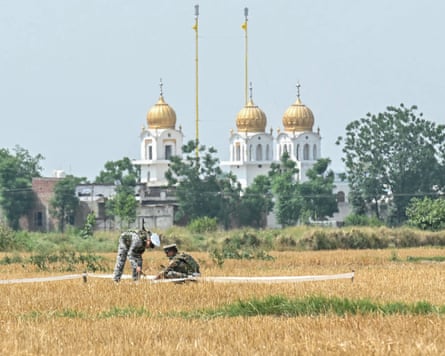
Indian soldiers inspect the debris of a missile in a field on the outskirts of Amritsar on Thursday. Photograph: Narinder Nanu/AFP/Getty Images

India’s defence ministry said it had “neutralised” the air defence system over the Pakistani city of Lahore and said: “Any attack on military targets in India will invite a suitable response.”

India’s foreign minister, Subrahmanyam Jaishankar, warned on Thursday that India would respond to any military aggression by Pakistan. “If there are military attacks on us, there should be no doubt that it will be met with a very, very firm response,” he told a visiting Iranian delegation.

Speaking to the Guardian, a senior Pakistani security official denied India’s claims of any Pakistani attack on military installations in India.

“The damage to Lahore’s system is minor, more like a scratch, it is still functioning,” he said. “We have shot down at least 25 Indian drones across bordering regions in Punjab and Sindh provinces.”

The security official said Pakistan had not yet begun its offensive retaliation against India for the missile and drone attacks, but was clear that action would now be taken.

“We have not fired any missiles or drone attacks inside India or any military installations,” he said. “This is fake news from Indian authorities. The offensive response will come now.”

Amid reports of drone attacks in Lahore, the US embassy in Pakistan issued a warning to its consulate staff: “Due to reports of drone explosions, downed drones, and possible airspace incursions in and near Lahore, the US consulate general in Lahore has directed all consulate personnel to shelter in place.”

India’s strikes on Wednesday were the most extensive military attack on Pakistan in decades, with nine locations targeted, including four in Pakistan’s Punjab region.

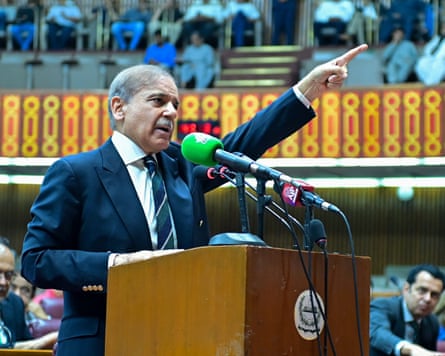
In a speech late on Wednesday night, Pakistan’s prime minister, Shehbaz Sharif, said he would “avenge each and every drop of blood of our martyrs”.
Pakistan’s prime minister, Shehbaz Sharif, addressing a special session at the National Assembly in Islamabad on Wednesday. Photograph: Pakistan’s prime minister office/AFP/Getty Images

Across both countries, flights were suspended and airports shut down. In Pakistan, all flights from Karachi, Lahore and Sialkot airports were suspended until Thursday night. More than 20 local airports across the north of India were closed until Saturday.

In Pakistan’s Sindh region, which shares a border with India, a state of emergency was declared in all hospitals and health facilities, and all medical personnel and support staff leave was cancelled, according to a notice issued by the provincial health department.

In Amritsar, 20 miles from the Pakistan border, a second security drill and brief blackout were carried out on Wednesday evening, and residents were urged to stay alert.

India’s border states of Rajasthan and Punjab were also put on high alert, with all police leave cancelled and border security forces given shoot-on-sight orders for any suspicious activities. India has activated anti-drone systems near the border.

Sharif called India’s attacks an “act of war”, and senior army officials and government ministers vowed Pakistan would respond. However, by Thursday morning the nature of that response remained unclear.

Some government ministers suggested Pakistan’s claim to have shot down five Indian military aircraft, including three elite French-made Rafale jets, during the confrontation on Wednesday was retribution, while others said Pakistan’s full response was yet to come.

India’s Pakistan strikes show how warfare has been normalised again
Read more


It is widely acknowledged that any decision over Pakistan’s military response to India will be made by the country’s army chief, Gen Asim Munir, who is under mounting public pressure to show strength against India.

Ministers in the Indian government said their attacks were retribution for Pakistan’s alleged involvement in a militant attack in the Indian region of Kashmir in April that killed 26 people. Pakistan has denied any role in that attack.

India claimed Wednesday’s strikes targeted “terrorist infrastructure” including training camps and homes belonging to well-known militant organisations that have been behind some of the worst terror attacks in India over the past two decades. They emphasised they had not hit any Pakistani military bases or equipment, and described the strikes as “measured, not escalatory, proportionate and responsible”.

However, Pakistan denied that any terror groups had been operating in the areas hit by Indian missiles, and said the strikes had targeted only civilians.

Along the contested border between India and Pakistan, which divides the disputed region of Kashmir, intensive cross-border shelling between the two sides continued into a second night. It was reported that at least one Indian soldier had been killed along with 11 civilians, and local people continued to be evacuated from the area.

International diplomatic efforts continued in an attempt to get the two sides to de-escalate. The Iranian foreign minister, Abbas Araghchi, landed in Delhi on Thursday morning, after earlier offering to play a mediating role between the two countries. The Saudi foreign minister also made a surprise trip to India on Thursday morning, where he met Jaishankar.

Modi, Kashmir and Pakistan

Published May 8, 2025 
 Dawn
The writer is a business and economy journalist.

INDIA and Pakistan are being driven, inexorably, towards a confrontation that neither side wants but neither side can avert. The drivers of conflict have multiplied, the limits tested by these episodic stand-offs have been stretched, and the points of contact between their militaries during the kinetic manoeuvres in each of these stand-offs has multiplied.

From the first such stand-off, perhaps in 1990, till today, there is an unmistakable trajectory of escalation. What is driving this?

One of the big drivers is India’s attempt to end its difficulties in occupied Kashmir using a violent development model that has lain behind the rise of Narendra Modi. The model was born in the early 2000s that saw two pivotal developments in both India and Pakistan. Up until 9/11, Pakistan was being pushed increasingly towards global isolation and its economy was depleted to near breaking point. The country had undergone three rounds of debt rescheduling and just finished a gruelling, short-term Stand-by Arrangement with the IMF that left the populace battered with unemployment and sharply rising energy costs. There was no further growth path for Pakistan in those years other than deeper structural reform, which was proving too heavy a burden even for a dictator with near absolute power.

However, 9/11 changed all that overnight. Instantly, Pakistan went from being an international pariah to a front-line state in a superpower’s war, and was eventually crowned with the status of ‘major non Nato ally’. The volume of money that poured into the country, coupled with the generous terms of debt rescheduling extended by the Paris Club in December 2001, impacting a total debt stock of $12.5 billion, allowed the regime of Gen Musharraf to pump growth to unprecedented levels, creating a bubble economy that made more fortunes for more people than any similar period in the country’s history.


Modi’s model of development rested on the ability to efficiently dispossess people and take land required for large-scale projects.

This sudden reversal of fortunes in Pakistan came as a rude shock to our neighbours in India. Over the course of the 1990s, India and Pakistan were locked in a stand-off over Kashmir, which left India increasingly embattled by the uprising in the occupied territory and Pakistan in the grip of sanctions and isolation. India accused Pakistan of sponsoring the uprising in occupied Kashmir, and of providing training and cover to militants in the troubled valley. At one point, Pakistan came close to being placed on the State Department’s list of sponsors of terrorism, a designation that would have had far-reaching implications for the country had it come to pass.

By 2001, India’s policy of imposing a crushing isolation on Pakistan was finally bearing fruit when 9/11 came along and reversed it all. This was a big shock to the Indian foreign policy establishment, which had shouldered a tremendous cost in men and materiel for repression of the uprising in occupied Kashmir, under the hopes that pressure on Pakistan would eventually cause the uprising to die down. All those hopes were dashed once Pakistan became a superpower favourite again.

The Congress party had seen its fortunes sag throughout the 1990s, losing power to the BJP by the end of the decade. But in 2004, it scored a surprising victory at the polls and renewed its electoral strength again in 2009 by increasing its seats in the Lok Sabha from 153 to 206.

Yet trouble brewed behind this double movement in the early 2000s, which had seen the return to power of the Congress party in India and a reversal of Pakistan’s fortunes. This was when Modi made his appearance on the big stage of Indian politics with the Gujarat riots in 2002, cynically using communal hate and violence as a tool to grab power. Once in power, Modi unrolled a model of violent development, which fused rent-seeking alliances with billionaires at the federal level, with high levels of public expenditure on infrastructure projects to promote ports, power plants, luxury urban housing developments and more. This model of development rested on the ability to efficiently dispossess people and take land required for large-scale projects, high levels of government spending and a close, symbiotic relationship between wealthy elites, the party apparatus and the government machinery of India.

Fortunes changed following the Great Financial Crisis in 2008. The Congress party was at a loss for ideas on how to restart growth in India, and Musharraf’s growth bubble burst comprehensively while Pakistan’s troubles with the US mounted. As Pakistan sank once more into its pre-9/11 state of isolation coupled with a depleted economy, the Congress party hurtled towards its most stunning electoral defeat ever in 2014. That was Modi’s year, when he also brought this model of violent development as his party’s vision for achieving a final resolution of New Delhi’s long-running Kashmir problem.

Two ideas were central to this vision, and both have a pedigree in India’s policy conversation going back at least to the early 2000s. One was to revoke Kashmir’s special status granted under Article 370 of the Indian constitution. The second was to cast off the constraints of the Indus Waters Treaty. With both these done, the government would be in a better position to use public funds to initiate large-scale infrastructure projects through which to select winners and losers within Kashmir. The idea was to reward those who would play ball with the government, and crush those who wouldn’t.

These are the broad developments that imparted such inexorable momentum to the episodic return of stand-offs between India and Pakistan. Modi’s India wants to make Kashmir its own, regardless of the wishes of Kashmir’s inhabitants. Pakistan is determined to thwart this ambition, regardless of the cost it has to pay along the way. Neither side can win in this situation. Yet none can afford to lose either.

The writer is a business and economy journalist.

Published in Dawn, May 8th, 2025


Unwarranted aggression
 Dawn
Published May 8, 2025


IT is a time of great peril in the subcontinent. India’s provocative attack targeting several locations in Azad Kashmir and Punjab early on Wednesday comes after two weeks of sabre-rattling by warmongering officials and media personnel in that country following the tragic Pahalgam episode.

It appears that the danger has not passed, as Prime Minister Shehbaz Sharif told the nation last evening that India would “suffer the consequences” of its ill-advised moves. Earlier, there was a welcome show of political unity in the National Assembly, while the day began with a meeting of the National Security Committee, which dubbed New Delhi’s perilous actions as “acts of war”.

The deadly aggression against Pakistan has put both neighbours on the path to more conflict, unless a negotiated end to this dispute — and to the core issue of Kashmir — is found. Pakistan has responded to the blatant violation of its sovereignty resolutely, with the state saying that five Indian warplanes were downed during the hostilities. It is hoped that the message been understood in New Delhi, and that the latter’s shenanigans will not be repeated.

Aside from sites in Azad Kashmir, locations in Punjab were also hit. At least 31 people in Pakistan were killed in India’s so-called Operation Sindoor, according to the DG ISPR. This reckless act on India’s part could have resulted in more casualties had the intruders not been confronted in time. The Indian military’s claim that the attacks were “non-escalatory in nature” defies belief. Violating a country’s frontiers, hitting its cities and towns and murdering its people is not just escalatory; these are very much acts of war. Moreover, if the Indian state says only the ‘terror infrastructure’ was targeted, then how would New Delhi explain the fact that civilian neighbourhoods, as well as the Neelum-Jhelum hydropower project, were attacked? The fact is that the Indian state took this ill-conceived action to cover up for its massive security lapse in Pahalgam. What happened in the held Kashmir tourist spot was indeed deplorable, and the guilty should be brought to justice. Yet the BJP government has used the tragedy to create war hysteria against Pakistan, without any proof of this country’s involvement in that attack.

If India has solid evidence against Pakistan, why has it failed to make it public? Using Pahalgam as a casus belli against Pakistan seems to be a manoeuvre by the Modi regime to boost its standing domestically, and throw its weight around in the neighbourhood. This foolish gambit has failed and has brought the nuclear-armed neighbours to the brink of war.

Following the Indian attack, there has been a crescendo of global voices calling for restraint and de-escalation, with several states offering their good offices to mediate. Pakistan has shown itself ready to accept such offers, but will India respond positively to prevent the slide towards all-out war? The events of the past few weeks have once again demonstrated that the Kashmir dispute remains a global flashpoint. While India may believe its own fiction that the Kashmir dispute has been ‘resolved’, Pakistan, the Kashmiris as well as the world community continue to acknowledge the fact that the region remains disputed. Pakistan and India have fought several wars over Kashmir, and are on the precipice of a fresh conflict due to it.

Therefore, in order to establish long-term peace in South Asia, both states need to talk to each other, frankly and meaningfully. This may be a bitter pill to swallow for the Hindu revivalist BJP regime, which has never stopped dreaming of ‘Akhand Bharat’. But it would be to its own detriment if it does not shed its ideological fantasies and come to the table with Pakistan and the Kashmiris to achieve a solution acceptable to all. The alternative is perpetual hostility. In the immediate future, the global community must step up efforts to de-escalate, and media and civil society on both sides should stop fanning the flames of war.


Published in Dawn, May 8th, 2025


The phoney peace
Published May 8, 2025 
 Dawn


INDIA’S true enemy is not Pakistan: it is hubris, the arrogance of a born-again bully. 

India emerged as a unified nation-state in 1947, the People’s Republic of China two years later. Both boast a heritage that is more than 5,000 years old. Yet each has spent the past seven decades struggling to resolve unfinished business left by divisive powers — Great Britain and America. In India’s case, this included the disputed former kingdom of Jammu & Kashmir. In China’s case, it was the renegade island of Taiwan.

Today, China and India are determined to straddle the 21st century. They have hegemonic ambitions. India aspires to dominate its subcontinent; China, the rest of the world.

China is a post-1972 enemy of US’s making, just as Russia (once an ally against Germany) is a product of Europe’s post-1945 paranoia. Meanwhile, hostility in the subcontinent, has brought Pakistan and India yet again to the edge of an abyss.

Tensions following the terrorist attack in Pahalgam on April 22 are simmering. It is a sign of the BJP government’s insecurity that it should have reacted so quickly and so pointedly after that incident. It accused Pakistan (without naming it) of masterminding the attack. It unleashed punitive measures such as an unwarranted suspension of the Indus Waters Treaty, banning overflights, sealing borders, expelling Pakistani nationals, freezing trade, and appealing to the IMF and ADB to stop aid to Pakistan.

Even Dr Goebbels would have admired the jingoism of Indian media anchors.

It released a barrage of transparent propaganda aimed at winning the sympathy of the international community. Even Dr Goebbels would have admired the jingoism of Indian media anchors, chained all too obviously to the mothership of the Ministry of External Affairs.

Their aim is to convince their compatriots that India has won the phoney war. Realists know that both countries will have to revert (hopefully sooner rather than later) to a state of phoney peace — the period of uneasy relations that followed the Tashkent Agreement of 1966, the Shimla summit in 1972, and the Lahore Declaration of 1999.

Analysts meanwhile are busy calculating who has gained what, and who lost how much from this latest India-Pakistan confrontation?

Had this country carried out an attack at Pahalgam, it would have had everything to lose: the sympathy of the beleaguered Kashmiris, damage to its precarious solvency, its credibility with the IMF, agricultural dehydration, diplomatic isolation, and political schism within. And unlike 1999, there would have been no Bill Clinton in the White House to rescue it from a Kargil-type incursion.

India on its side has gained less than it had planned. It has dented the front-fender in its drive to obtain a seat in the Security Council. It enjoys less credibility in international circles than it assumed. It does not have the United Nations in its back pocket. Its blunderbuss diplomacy has backfired. It will have to admit that water is not an India-owned natural resource, and that impetuous repudiation of international agreements is bad policy.

Indian governments have yet to learn that anti-Pakistan patriotism is an obsolete, outworn tool with which to start a fire.

I had written this much when news came that very early on May 7, India had unilaterally attacked five targets in Azad Jammu & Kashmir and Pakistan, including Muridke, which is 55 kilometres from where I live. I drove around my neighbourhood. Everything appeared calm as the city woke up to another cloudless morning.

Since then, throughout the day, reports of attacks and counterattacks have inundated news channels. The phoney war has turned serious and in ea-rnest. Not quite the conventional war yet with sir­ens and air-raid shelters and a run on the banks, but an aerial-cum-cy­ber war with strategic objectives like airports, com­-mand centres, possibly even dams. The Indians have made the first strike. Any escalation will be at a time and place of Pakistan’s choosing.

I recall after the 1965 war M.M. Ahmad (then adviser to president Ayub Khan) talking to the Americans who feared an escalation, involving other allied countries. He told the US ambassador that for Pakistan it was already a world war.

Since those who start wars never ask for a public mandate before declaring hostilities, they should listen to voices outside their own minds. They should heed the ad­­v­­­ice of persons who fought wars against wars. “War does not determine who is right,” the philosopher and pacifist Bertrand Russell warned, “only who is left.” And the British prime minister Stanley Baldwin’s chilling advice to the living: “War would end — if the dead could return.” All sides should keep his warning in mind as they contemplate their next move.

The writer is an author.

www.fsaijazuddin.pk

Published in Dawn, May 8th, 2025

Islamabad turns the tables on New Delhi as de-escalation efforts reach fever pitch

Published May 8, 2025 


PULWAMA (India-held Kashmir): Metal debris of an Indian fighter plane lie on the ground in Wuyan.—Reuters


• ISPR says 31 lives lost, 57 injured in six Indian strikes, Lt-Gen Chaudhry accuses India of perpetrating ‘terrorism’ against innocent civilians

• Military touts shooting down five jets including Rafales; India claims three planes ‘crashed’ in its territory

• Firing continues across LoC; Neelum-Jhelum hydel project also targeted

• Trump urges both countries to stop, offers to help however he can

• Erdogan conveys message of solidarity

• UN says world can’t afford conflict in S. Asia

• Dar confirms contact between national security advisers on both sides

• UNMOGIP team visits damaged sites in AJK as emergency response centre set up to coordinate relief efforts


ISLAMABAD: Pakistan on Wednesday mourned the loss of 31 lives in attacks by Indian forces on civilians, terming New Delhi’s actions “terrorism” and accusing it of continuous ceasefire violations on the Line of Control (LoC).

Despite a ramping up of rhetoric from the Indian side, diplomatic channels remained open, as Foreign Minister Ishaq Dar confirmed contact between the national security advisers of India and Pakistan, and US President Donald Trump urged both sides to stop the violence.

“I want to see it stop. And if I can do anything to help, I will. I will be there,” he said.


The Pakistan military touted the downing of five Indian fighter jets as a major victory — a claim which was seemingly acknowledged when Indian officials admitted that at least three of their aircraft had “crashed” within their territory.

On Wednesday, as both countries continued to trade heavy artillery fire, authorities revealed the extent of the damage caused by Indian strikes on six locations — Ahmedpur East, Muridke, Sialkot and Shakkargarh in Punjab and Muzaffarabad and Kotli in Azad Kashmir.

The military’s chief spokesperson said that at least 57 people had been injured in the attacks, while a hydropower project was also shelled by Indian forces.

Muzaffarabad Deputy Commissioner Mudasser Farooq said the intake structure of the Neelum-Jhelum Hydropower Project (NJHP) was targeted the previous night, which damaged the intake gates and a hydraulic protection unit. An ambulance belonging to the project was also hit.

Lt-Gen Ahmed Sharif Chaudhry said that as per the Geneva Conventions, it was prohibited to attack, destroy, remove or render useless objects that were indispensable to the survival of the civilian population, such as drinking water supplies/installations and irrigation works.

Trump’s plea & NSAs’ chat

Donald Trump called for India and Pakistan to halt their fighting immediately, and offe­red to help end the worst violence between the two nuclear-armed neighbours in two decades. “It’s so terrible,” Mr Trump said at the White House. “I get along with both, I know both very well, and I want to see them work it out. I want to see them stop.

“They’ve gone tit-for-tat, so hopefully they can stop now, but I know both. We get along with both countries very well, good relationships with both, and I want to see it stop. And if I can do anything to help, I will. I will be there,” he said.

Meanwhile, in an interview to TRT World, Foreign Min­ister Ishaq Dar confirmed that the national security advisers of India and Pakis­tan had been in touch. Mr Dar was questio­n­­ed about whether the NSAs had spoken after the overnight action, to which he said: “Yes there has been contact between the two.”

Pakistan had recently named ISI Director General Lt Gen Muhammad Asim Malik as the NSA, while his counterpart from India is Ajit Doval. Earlier, NDTV quoted Do­­val as telling his foreign counterparts that India has no in­­tention to escalate. How­ever, other voices in the Indian government seemed to contradict his sentiment.


UN observers arrive to inspect the site of a damaged mosque after Indian strikes in Muzaffarabad, on Wednesday.—AFP

Indian ‘operation’ and ‘crashes’

According to New Delhi, its strikes targeted “terrorist camps” that served as rec­ruitment centres, launchpads, and indoctrination centres, and housed weapons and training facilities. “Intelligence and monitoring of Pakistan-based terror modules showed that further attacks against India were impending, therefore it was necessary to take pre-emptive and precautionary strikes,” Indian Foreign Sec­retary Vikram Misri, the top official in its external affairs ministry, told the briefing.

Pakistan claimed to have shot down at least three Rafale fighters, and two Russian-made fighter jets during engagements.

Although India did not confirm Pakistan’s claim of shooting down five of its jets, local government sources in Indian-held Kashmir told Reuters that three fighter jets had crashed in separate areas during the night.

All three pilots had been hospitalised, the sources added. Indian defence ministry officials were not immediately available to confirm the report.

Images circulating on local media showed a large, damaged cylindrical chunk of silver-coloured metal lying in a field at one of the crash sites.

Meanwhile, CNN quoted a French security official as saying that at least one of the dow­ned aircraft was, in fact, a Rafale aircraft.

Preparations in AJK, held Kashmir

Meanwhile, preventive me­­asures were taken along the Line of Control on Wednesday, as the AJK government on Wednesday established a Cen­tral Emergency Response Cen­­tre to coordinate rescue, relief, and damage assessment efforts.

Officials in Muzaffarabad, Haveli, Poonch, and Kotli noted that a precise evaluation of property losses was still underway. As part of the emergency measu­r­­es, all educational institutions across the region were ordered closed until further notice.

In Muzaffarabad’s Shawai area, a mosque struck by missiles — killing three people, including its 80-year-old caretaker — remained the focus of high-profile visits throughout the day.

Among the visitors were members of the United Nations Military Observers Group for India and Pakistan (UNMOGIP), who were briefed by military officials on the unprovoked Indian attack.

Deputy Commissioner Faro­­oq said many residents had been evacuated from Shawai overnight and returned home by the afternoon. Residents who lived near the mosque shared harrowing accounts of the attack.

“At first, we had no idea what was happening. My daughter and I had just stepped into the veranda when she was struck by shrapnel. We immediately ran for cover,” said Safeer Awan, a lawyer whose house is located just metres from the mosque.

Erdogan conveys solidarity

Turkish President Recep Tayyip Erdogan has spoken by phone with Prime Minister Shehbaz Sharif to convey his solidarity after Indian strikes, Reuters reported.

During the call, Mr Erdogan told the premier that Turkiye supported Pakistan’s “calm and restrained policies” in the crisis, his office said in a statement.

Mr Erdogan also described Islamabad’s call for an investigation into the Pahalgam attack as “appropriate”.

Meanwhile, the UN has renewed its call for “maximum restraint”, APP reported. Responding to questions at a news briefing at UN Headquarters in New York, UN Spokesperson Stephanie Tremblay reiterated that the world cannot afford a military confrontation between the two nations.

Asked whether the UN personnel serving the United Nations Observer Group in India and Pakistan, which monitors the Line of Control, were safe, she said, “Yes, we checked and everybody was safe.”

With input from AFP and Reuters. Anwar Iqbal in Wash­ington and Tariq Naqash in Muzaffarabad also contributed to this report

Published in Dawn, May 8th, 2025
Deaths and destruction in Bahawalpur, Muridke after Indian strikes

Published May 8, 2025

Muridke: Shrapnel from Indian munitions is displayed amid the debris of destroyed structures at the Government Health and Educational complex after Indian strikes; while (right) rescue workers recover a body from a damaged building at the site of a suspected Indian missile attack.—M. Arif / White Star


• Four missiles struck Jamia Masjid Ummul Qura in Muridke, killing three civilians

• 13 people, including two girls, martyred in Subhan mosque strike

• Funeral of Bahawalpur victims held at Dring Stadium


LAHORE: Tensions between India and Pakistan have intensified after a series of Indian air and drone strikes resulted in the deaths of at least 31 Pakistani civilians, with many others injured, including 16 martyred only in Muridke and Bahawalpur.

As many as three civilians were kil­led when four Indian missiles struck Jamia Masjid Ummul Qura and an ad­­joining house in Muridke, some 40 kilometres from Lahore. The decea­sed were identified as Abdul Malik (from Jhang), Mohammad Alam (Samundri), and Midasar (Chunian).

Two others were injured and shif­ted to local hospitals. Sources said that the area had reportedly been evacuated earlier due to warnings of a possible strike, which helped reduce further casualties. The mosque was des­troyed and local authorities later arr­a­­­nged visits for both international and domestic media to inspect the site.

Bahawalpur

In Bahawalpur, officials confirmed that 13 civilians, including four men, seven women and two three-year-old girls, were killed in the missile strike on Subhan Mosque, located in the Chowk Azam area on the outskirts of Bahawalpur between the night of May 6 and 7.

The military’s media wing ISPR has yet to release an official list of the deceased. Most of the victims belonged to the same family, but they have yet to be officially identified.

When Dawn contacted the related government officials for the lists of the martyrs and injured, it was informed that the ISPR was finalising it before releasing it to the media.

High-level visits were conducted by Corps Commander Bahawalpur Lt Gen Aqeel, Divisional Commissioner Musarrat Jabeen and Punjab Health Minister Khawaja Salman Rafique, who met with the injured at Bahawal Victoria Hospital on directives from the Punjab chief minister.

The targeted mosque and madressah complex are located in Azam Chowk, not in Ahmedpur East as previously speculated.

The madressah premises also include residences, where most of the deceased lived and were targeted by the Indian missiles.

Dawn learnt that the private seminary during the last week had been evacuated by the local administration, apprehending any Indian assault on it. However, the residents of the seminary’s residential quarters and students were allowed to return just a day before the attack.

Witnesses reported hearing four po­­werful explosions that shook windows as far as Satellite Town and Ba­­ghdadul Jadeed Railway Station. Des­pite the panic, many residents rushed towards the blast site, chanting slogans in support of the armed forces.

Meanwhile, life went on as usual in Bahawalpur, with commercial activities in the grain, vegetable markets and local bazaars continuing on Wednesday along with the normal flow of traffic on roads.

However, public and private schools, colleges, and universities remained closed under the government’s orders.

The funeral prayers for victims were offered at Bahawalpur’s Dring Sta-dium under tight security measures.

Narowal

In Narowal’s Shakargarh sector, Indian forces launched drone and mortar shell attacks on civilian areas late Tuesday night. A government dispensary sustained partial damage, while mortar shells and drone munitions fell in surrounding fields but failed to detonate. The Pakistan Army also launched a counterattack on Indian forces. The Indian army also fired ammunition in the Harra and Sial villages.

A drone was later recovered from a tree and defused by the bomb disposal squad after being alerted by citi­­zens. Narowal Deputy Com­mis­sioner Syed Hassan Raza declared an emergency at all hospitals across the district, including BHUs, RHCs and DHQ Hospital. Doctors and paramedical staff were placed on 24-hour alert and full stocks of medicines and medical supplies were ensured.

Asif Chaudhry in Lahore, Majeed Gill in Bahawalpur and Abid Mahmood in Narowal contributed to this report

Published in Dawn, May 8th, 2025

Unwarranted aggression
Dawn
Published May 8, 2025 


IT is a time of great peril in the subcontinent. India’s provocative attack targeting several locations in Azad Kashmir and Punjab early on Wednesday comes after two weeks of sabre-rattling by warmongering officials and media personnel in that country following the tragic Pahalgam episode.

It appears that the danger has not passed, as Prime Minister Shehbaz Sharif told the nation last evening that India would “suffer the consequences” of its ill-advised moves. Earlier, there was a welcome show of political unity in the National Assembly, while the day began with a meeting of the National Security Committee, which dubbed New Delhi’s perilous actions as “acts of war”.

The deadly aggression against Pakistan has put both neighbours on the path to more conflict, unless a negotiated end to this dispute — and to the core issue of Kashmir — is found. Pakistan has responded to the blatant violation of its sovereignty resolutely, with the state saying that five Indian warplanes were downed during the hostilities. It is hoped that the message been understood in New Delhi, and that the latter’s shenanigans will not be repeated.

Aside from sites in Azad Kashmir, locations in Punjab were also hit. At least 31 people in Pakistan were killed in India’s so-called Operation Sindoor, according to the DG ISPR. This reckless act on India’s part could have resulted in more casualties had the intruders not been confronted in time. The Indian military’s claim that the attacks were “non-escalatory in nature” defies belief. Violating a country’s frontiers, hitting its cities and towns and murdering its people is not just escalatory; these are very much acts of war. Moreover, if the Indian state says only the ‘terror infrastructure’ was targeted, then how would New Delhi explain the fact that civilian neighbourhoods, as well as the Neelum-Jhelum hydropower project, were attacked? The fact is that the Indian state took this ill-conceived action to cover up for its massive security lapse in Pahalgam. What happened in the held Kashmir tourist spot was indeed deplorable, and the guilty should be brought to justice. Yet the BJP government has used the tragedy to create war hysteria against Pakistan, without any proof of this country’s involvement in that attack.

If India has solid evidence against Pakistan, why has it failed to make it public? Using Pahalgam as a casus belli against Pakistan seems to be a manoeuvre by the Modi regime to boost its standing domestically, and throw its weight around in the neighbourhood. This foolish gambit has failed and has brought the nuclear-armed neighbours to the brink of war.

Following the Indian attack, there has been a crescendo of global voices calling for restraint and de-escalation, with several states offering their good offices to mediate. Pakistan has shown itself ready to accept such offers, but will India respond positively to prevent the slide towards all-out war? The events of the past few weeks have once again demonstrated that the Kashmir dispute remains a global flashpoint. While India may believe its own fiction that the Kashmir dispute has been ‘resolved’, Pakistan, the Kashmiris as well as the world community continue to acknowledge the fact that the region remains disputed. Pakistan and India have fought several wars over Kashmir, and are on the precipice of a fresh conflict due to it.

Therefore, in order to establish long-term peace in South Asia, both states need to talk to each other, frankly and meaningfully. This may be a bitter pill to swallow for the Hindu revivalist BJP regime, which has never stopped dreaming of ‘Akhand Bharat’. But it would be to its own detriment if it does not shed its ideological fantasies and come to the table with Pakistan and the Kashmiris to achieve a solution acceptable to all. The alternative is perpetual hostility. In the immediate future, the global community must step up efforts to de-escalate, and media and civil society on both sides should stop fanning the flames of war.

Published in Dawn, May 8th, 2025

25 Israeli-made drones used by India in attempt to attack Pakistan, all shot down: ISPR

Published May 8, 2025 

ISPR Director General Lt Gen Ahmed Sharif Chaudhry said on Thursday that 12 Indian drones were neutralised overnight at various locations across Pakistan amid escalating military activity with the neighbouring country. — DawnNews TV

This photo — displayed during an ISPR press briefing on May 8, 2025 — shows part of an Israel-made drone sent by India into Pakistan’s territory that was downed by the armed forces, in an undisclosed location. — screengrab via DawnNewsTV


Pakistan’s armed forces have taken down 25 Israeli-made Harop drones sent into the country by India since last night, the Inter-Services Public Relations (ISPR) said on Thursday.

A day earlier, Pakistan mourned the loss of 31 lives in overnight attacks by Indian forces on civilians, describing New Delhi’s actions as “terrorism” and accusing it of continuous ceasefire violations on the Line of Control (LoC).

The Pakistan military termed the downing of five Indian fighter jets as a major victory — and it was seemingly acknowledged when Indian officials admitted that at least three of their aircraft had “crashed” within their territory.

On Wednesday, as both countries continued to trade heavy artillery fire, authorities revealed the extent of the damage caused by Indian strikes at six locations — Ahmedpur East, Muridke, Sialkot and Shakkargarh in Punjab and Muzaffarabad and Kotli in Azad Kashmir.

“The Pakistan Army, using their soft-kill (technical) and hard-kill (weapons) skills fully, have shot down 25 Israeli-made Harop drones,” the ISPR said in a press release today.

Referring to Pakistan’s response to Indian strikes, the ISPR press release said: “After the destruction of its five modern jets, drones and several posts, as well as soldier deaths, India is attacking Pakistan using these Israeli-made Harop drones in panic.”

“This cowardly attack is a sign of India’s worry and panic,” the statement added.

“The debris of these Israeli-made Harop drones is being collected from various locations across Pakistan,” the military’s media wing said. It asserted that the Pakistan Army was “giving a befitting reply to the enemy and crushing all its nefarious designs”.

Meanwhile, the Indian defence ministry admitted that its armed forces targeted a number of locations in Pakistan in the morning today. Indian outlet ANI News reported that Harpy drones were used by the Indian military to target Pakistan’s “air defence system”. According to the Database of Israeli Military and Security Export, the Harop is a “later development of the Harpy”.

The ministry’s statement also alleged that Pakistan had “increased the intensity” of firing at the LoC, where the two countries’ troops have been exchanging fire for the past several days.

“The Harpy is designed to attack radar systems and is optimised for the suppression of enemy air defences (Sead) role. It carries a high explosive warhead,” the ANI report read.

In a press briefing early today, ISPR Director General Lt Gen Ahmed Sharif Chaudhry said Pakistan’s forces had neutralised 12 drones sent by India since last night. He also stated that four army personnel were injured as one drone, besides those downed, managed to engage a military target partially.

The ISPR DG detailed the locations where 12 of those drones sent by India were neutralised — Lahore, Attock, Gujranwala, Chakwal, Rawalpindi and Bahawalpur in Punjab, as well as Sukkur’s Miano, Umerkot’s Chhor and near Karachi in Sindh.

“Other than these 12, one drone, however, managed to engage a military target near Lahore partially,” Lt Gen Chaudhry said.

“Four men of the Pakistan Army have been injured in this attack near Lahore and partial damage to an equipment has occurred,” he said.

The DG ISPR further said that as a result of India’s drone activity, one civilian embraced martyrdom and another was injured in Miano.

During the press briefing, the military’s media spokesman also showed a series of pictures showing the debris of the drones. He added that the debris and downed drones were being collected from multiple locations.

“As we speak, the process of India sending across these Harop drones, this naked aggression continues, and the armed forces are on high degree of alert and neutralising them as we speak,” he continued.

“This is a serious, serious provocation,” the DG ISPR said.

“The Indians have resorted to these measures after] having miserably failed on the night of May 6 and 7, when they attacked places of worship and civilian infrastructure and killed innocent civilians, including children, women and [the] elderly,” he continued.

He further said: “Not only that, having faced the destruction of five of their aircraft, multiple drones, and suffering heavy casualties along LoC and damage, it appears that India has apparently lost the plot.

“And rather than going on a path of rationality, it is further escalating in a highly charged environment to satisfy the hubristic mindset of the Indian government,” Lt Gen Chaudhry asserted.

“The international community can visibly see the path that India is treading through this extremely provocative military aggression in a region, which is highly fragile and putting the security of the region and beyond at risk,” he said.

The DG ISPR added that the Pakistan armed forces remain “fully vigilant to any type of threat”. He then repeated the details of the Indian drones downed in Urdu.


All you need to know about Israel-made Harop drones used by India in Pakistan

Over the last decade, India has imported military hardware worth $2.9 billion from Israel, including radars, surveillance and combat drones, and missiles.

Published May 8, 2025 

The Pakistani military on Thursday said it took down nearly two dozen Indian drones sent on this side of the border since last night, as tensions between the neighbouring countries continue to rise.

According to the Inter Services Public Relations (ISPR), the armed forces shot down 25 Harop drones sent by India using their “soft-kill (technical) and hard-kill (weaponised) skills fully”.

In a press conference earlier today, DG ISPR Lt Gen Ahmed Sharif Chaudhry said the drones were neutralised at various locations, including Karachi and Lahore. He also showed a series of pictures showing the debris of the drones.

He said that the process of India sending across these Harop drones was a “serious serious provocation”. “This naked aggression continues, and the armed forces are on a high degree of alert and neutralising them as we speak,” Gen Chaudhry asserted.

Harop drone is a loitering munition system developed by the MBT Missiles Division of Israel Aerospace Industries (IAI).

As per information available on the IAI website, loitering munitions are designed to hover over the battlefield and attack upon the operator’s commands. The Harop is particularly known for its ability to hunt down enemy air defenses and other important targets. It combines the characteristics of a UAV (Unmanned Aerial Vehicle) and a missile, which is an airborne ranged weapon capable of self-propelled flight.

The drone can operate both fully autonomously or be manually operated in its human-in-the-loop mode. If a target is not engaged, the drone can return and land itself back at base. Harop, with its folding wings, can be launched from a truck- or ship-mounted canister, or configured for air-launch.

Speaking to Dawn.com, Dr Fahad Irfan Siddiqui, associate professor at Jamshoro’s Mehran University of Engineering and Technology, explained that Harop was a military grade technology drone. It was used for several purposes, including data collection and payload-installed attacks.

“Agri and civil survey drones have jammers installed in them, which get disconnected from their base station by blocking UHF frequencies. But for military grade drones, they are operated through satellites. It is difficult to block their radio frequency. An extremely advanced military technology can be blocked satellite by satellite (it is debatable, though),” he said.

Dr Siddiqui highlighted that the drones we were hearing of in headlines seemed to be quadcopter-type, which were difficult to detect but were not lethal.

“According to international law, any drone weighing more than 250 grams requires a license from the respective country’s civil aviation authority. Drones weighing less are generally considered toy drones and are often used for recreational purposes such as photography; these typically do not require a license,” he elaborated.

“Drones over 250 grams are subject to stricter regulations. They are prohibited from flying within a five-kilometre radius of sensitive military installations, airports, and certain government buildings — these areas are designated as no-fly zones. Moreover, the same five-kilometre buffer zone rule applies near international borders,” the professor added.

Under the International Humanitarian Law, targeting civilian sites, as India did in Pakistan, is a grave violation. The increasing use of loitering munitions and other advanced weapon systems in recent years has spurred international discussions on Lethal Autonomous Weapon Systems (LAWS). While a universally agreed-upon definition of LAWS remains elusive, they are generally understood as weapons that can select and attack targets without direct human intervention.

Loitering munitions, especially those with autonomous capabilities like the Harop, could potentially be classified as LAWS, raising significant questions about their compliance with IHL principles.

Over the last decade, India imported military hardware worth $2.9 billion from Israel, including radars, surveillance and combat drones, and missiles, TRT Global reported.

Earlier, in 2016 and 2020, the Harop was extensively used by Azerbaijan in the Nagorno-Karabakh conflict against Armenia, per information available on the Israeli military and security export database. The attack drone supposedly hit a bus full of soldiers, killing half a dozen of them in the process, and destroying the bus.

In recent years, the drone has become an export success, with India and Azerbaijan purchasing the system. The drones were also reportedly used in Syrian conflicts, credited with the destruction of a Syrian Air Defence SA-22 Greyhound in 2018 and in an attack on the Syrian Armed Forces in December 2024. There are also indications that Turkiye may have been an early adopter of the Harop, potentially using it as early as 2005.

Header image: Picture of the Harop Long Range Loitering Munition. — Israel Aerospace Industries