Friday, May 09, 2025


Source: Intercept

Police conspired to violently attacks anti-genocide protesters at the University of California, Los Angeles last year, according to a suit filed last week in Los Angeles Superior Court. 

At the height of the school’s encampment against Israel’s war on Gaza last spring, one of hundreds across the country, a mob of pro-Israel protesters attacked pro-Palestine protesters for more than four hours. On the night of April 30, 2024, police stood by and watched as counter-protesters aimed and shot fireworks, sprayed chemical agents, harassed, and sexually assaulted pro-Palestine protesters, students and faculty alleged last month in a separate, ongoing lawsuit

The day after the melee, Los Angeles Mayor Karen Bass, UCLA administrators, and seven different law enforcement agencies laid plans to dismantle the school’s encampment for good. 

UCLA invited multiple outside police forces to campus to clear the encampments on May 1. More than 700 police officers from the Los Angeles County Sheriff’s Department, the Los Angeles Police Department, California Highway Patrol, the University of California Police Department, and private security were on campus the night of the raid. 

Protesters are now suing the state of California, which oversees California Highway Patrol, and the city of Los Angeles, which oversees the LAPD, for violence against the demonstrations. The police fired more than 50 rounds of rubber bullets at protesters, striking several people in the head; some of the injuries sent demonstrators to the hospital.

The projectiles shattered bones in one student’s hand and required her to undergo surgery and extensive rehab. Another person, who police shot in the head, was diagnosed with internal bleeding.(The governor’s office referred questions to California Highway Patrol. CHP, LAPD, and UCLA did not respond to requests for comment.)

“If you want to talk about fascism, they deployed a police state on campuses all across California.”

A lawyer for the protesters said it was important to hold Bass and California Gov. Gavin Newsom, often mentioned as possible future party leaders, to account because, though the governing authorities are Democrats, their actions against the protesters helped give rise to Donald Trump’s extreme crackdown.

“These attacks also happened in Democratic-run cities and blue states,” said attorney Ricci Sergienko, who filed the suit on Thursday. “That is a clear, direct path to what’s happening now with Trump, because the Democratic Party and their leaders made enemies out of these young people.” 

“If you want to talk about fascism, they deployed a police state on campuses all across California,” Sergienko said. “We want to talk about what fascism is, and authoritarian repression and suppression — that is modeled here in California.”

Rules on Rubber Bullets

The new lawsuit says police violated that law and protesters’ rights under the state constitution when they attacked people at the encampment last May. 

After protests against police killings of George Floyd and Breonna Taylor in 2020, police took heavy criticism for repeatedly shooting protesters with rubber or foam bullets, even losing a major lawsuit over the issue. Agencies like the LAPD and LA Sheriff’s Department faced injunctions restricting the use of weapons like rubber bullets — also known as 40-millimeter kinetic impact projectiles. 

In California, lawmakers responded by passing a law that prohibited officers from using the projectiles against protests unless the situation presented an objective, reasonable defense against a threat to life or serious injury. 

In the wake of the 2020 protests, UCLA also changed its guidelines to prioritize deescalation tactics and minimize use of outside police forces on campus. 

California Highway Patrol, on the other hand, responds less frequently to protests and was not accused of using similar weapons in 2020. CHP officers nonetheless stormed UCLA encampments last spring and fired more than 50 rounds of the kinetic impact projectiles, said Becca Brown, another attorney working on the lawsuit. 

“LAPD did it as well, but they did not use them quite as heavily as CHP,” Brown said. 

The new California law restricts the indiscriminate use of rubber bullets into a crowd because they can be — and have been — deadly, Brown explained. 

“They cannot be used indiscriminately,” she said. “They cannot be used simply because someone is non-compliant.” 

Following criticism, police offered justifications for the use of force in some cases, according to an LAPD after-action report on the agency’s response to the UCLA encampments. Examples included someone throwing a traffic cone at police or removing an officer’s helmet. 

“They cannot be used simply because someone is non-compliant.”

The report offered several recommendations for the LAPD, including proper reporting of use-of-force incidents and the need for clear commands from police leaders. The report called on the police to improve communication between agencies because LAPD officers “did not appear to have a clear understanding of their mission.” 

Plaintiffs in the suit include a Ph.D. candidate at UCLA, an undergraduate student, another college student, and an architectural designer. Police shot all three of them with rubber bullets and hit several of them in the head. 

The police attack on the protests has had effects beyond the physical, the complaint says, and has caused plaintiffs to reconsider exercising their First Amendment rights to demonstrate against Israel’s war on Gaza. The protesters are also concerned that if they participate in future protests, they’ll be subject to further attacks from the state and police. 

“The encampment clearance by means of violence, excessive force, and kinetic energy projectiles traumatized Plaintiffs, chilled their protest activity, and justifiably made them less willing to engage in any further Palestine-related protest activity,” the complaint says. “This was the natural consequence of the dramatic and violent clearing organized and carried out by CHP and LAPD, which would have certainly chilled any ordinary person from engaging in Palestine solidarity advocacy in the future.” 

One plaintiff, UCLA Ph.D. candidate Abdullah Puckett, “has become more hesitant and afraid of continuing his participation in protests,” the complaint said. “He now feels that he must reconsider whether he can participate in protests and if so, to what extent he can participate. He now fears that he will experience violent retaliation at the hands of law enforcement if he participates in protests.”

UCLA Gaza Crackdown

Police arrested more than 200 people as a result of the UCLA encampment. The LAPD, which had a $3.2 billion budget last year, sought more than half a million dollars in reimbursement from the governor’s office for the response, in part for more than 2,400 overtime hours, the Daily Bruin reported.

“How are they supposed to go back to campus and feel safe?”

Arrested students wound up with criminal records. Those records are now being used by the Trump administration to target students for abduction and deportation.

“For international students that may have been arrested at any of these encampments, they then had that on their record, which led to the Trump administration running background checks on international students,” said Sergienko, the lawyer. “And if they had gotten arrested at an encampment, that got flagged and could be subject to deportation under Trump’s fascist policies.” 

California’s Democratic lawmakers are now pushing for a bill that amounts to an “educational gag order” targeting ethnic studies classes over concerns about antisemitism. 

“That’s another attack on speech coming from the blue state, the liberal paradise of California,” Sergienko said. 

“A real question is, how are students supposed to feel safe on campus knowing that the administration would call in a thousand school shooters to come attack them while on campus?” Sergienko said. “How are they supposed to go back to campus and feel safe? 

On Wednesday night, UCLA students showed “The Encampments,” a documentary released earlier this year. The school called in the LAPD to break up the screening. Police arrested three students.

Fired After Zionist Uproar, Artist Mr. Fish Won’t Stop Drawing The Truth

By Dwayne BoothMarc Steiner 
May 8, 2025
Source: The Real News Network

World-renowned political cartoonist Dwayne Booth, more commonly known as Mr. Fish, has found himself in the crosshairs of the new McCarthyist assault on free expression and higher education. While employed as a lecturer at the University of Pennsylvania, Booth became a target of Zionist and pro-Israel critics, and his work became a flashpoint of controversy in the months leading up to his firing in March. Facing charges that certain cartoons contained anti-Semitic tropes, J. Larry Jameson, interim president of the University of Pennsylvania, denounced Booth’s illustrations as “reprehensible.”

In a statement about his firing, Booth writes: “The reality – and something that, unfortunately, is not unique to Penn – is that colleges and universities nationwide have been way too complicit with the largely Republican-led efforts to target students and faculty members engaged in any and all speech rendered in support of trans/black/immigrant, and women’s rights, free speech, the independent press, academic freedom, and medical research – speech that also voices bold criticism of right-wing nationalism, genocide, apartheid, fascism, and specifically the Israeli assault on Palestine.”

In this special edition of The Marc Steiner Show, Marc sits down with Booth in the TRNN studio in Baltimore to discuss the events that led to his firing, the purpose and effects of political art, and how to respond to the repressive crackdown on art and dissent as genocide is unfolding and fascism is rising.

We Were So Close: Life After Conscience and the Abraham Accords
May 8, 2025


Screenshot


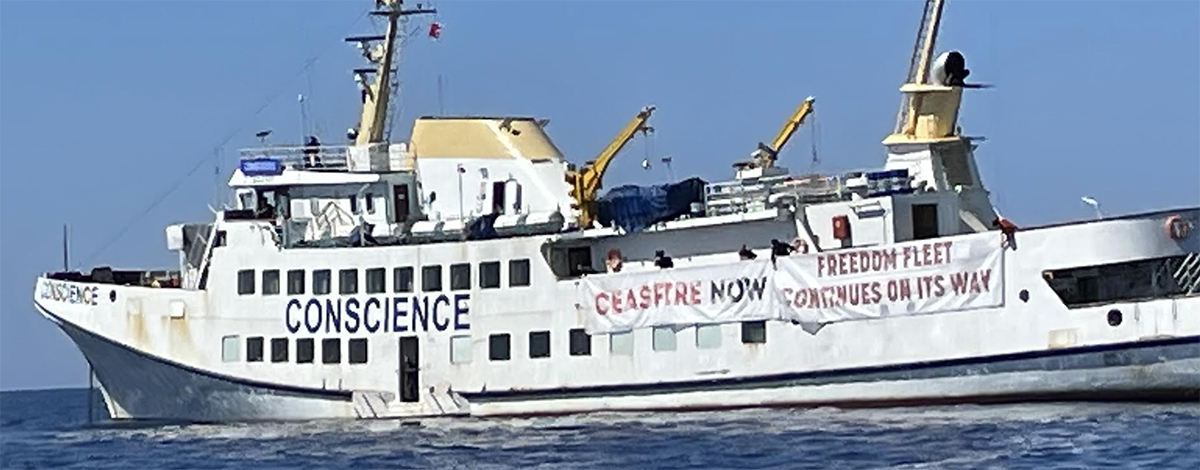
“We were so close,” Cassandra Dixon wrote, from Malta -where she had hoped to board Conscience, the aptly named Freedom Flotilla ship which two weaponized drones bombed on May 2, 2025, almost certainly launched by Israel. Cassandra had traveled to Malta after spending six weeks in Masafer Yatta, the West Bank region where, for two months, she lived among villagers whom local Israeli settlers constantly persecuted.

In a blog post entitled Hard Days in Masafer Yatta, Cassandra told of villagers stunned and bewildered by round after round of violent attacks. Vehicles torched, olive trees destroyed, wells poisoned. Settlers barged into homes, beating villagers who had been sound asleep. With their vehicles destroyed, villagers relied on a hostile Israeli military for transport to emergency rooms and intensive care units. The military would then arrest dozens of young villagers for indefinite detention without trial.

In a recent letter, Cassandra wrote about a man who lay on the ground, bleeding, after attacking settlers shot his leg. Soldiers chatted amiably with the settlers before finally arresting him, shackling him to a gurney, and taking him to an Israeli hospital where a surgeon amputated his leg.

During a 2023 sojourn among villagers in the south Hebron hills, a settler fractured Cassandra’s skull with a heavy stick. Not one to draw attention to herself, she persisted with a court case in hopes of building precedents to protect vulnerable Palestinians.

She and her companions aiming to reach Gaza insist on breaking the siege. Their effort to deliver food, fuel, medicine, tents, and water represents international sanity, a symbolic, challenging effort to nonviolently resist Israel’s savagery.

They long to reach Gaza’s shore with supplies for victims of Israeli bombardment, knowing the victims’ skin grafts will not heal without adequate nutrients. They want to help doctors in Gaza’s hospitals treat diabetes patients denied insulin by the Israeli blockade. They know the heart-wrenching consequences when hospitals lack cardiac catheters, blood pressure medicines, and potable water. They shudder when they hear reports of women fueling ovens with old sneakers, or Doctors Without Borders assessments that Gaza’s main desalination plant now produces potable water at only 10 percent of its former capacity.

Chose life, that you and your descendants might live,” (Deuteronomy 30), speaks to their deepest values.

Urgently, onlookers must conscientiously choose between the rhetoric of unarmed peacemakers and the ugly threats of Israel’s leaders.

They need to starve,” said Israeli Heritage Minister Amichai Eliyahu on May 6, 2025, speaking about Gaza to the Israeli daily Yedioth Ahronoth. “If there are civilians who fear for their lives, they should go through the emigration plan” – (a term for ethnic cleansing into tent refugee cities).

“Whoever harms us will be harmed by us, sevenfold,” Israel’s Defense Minister Israel Katz said in a May 5 statement, vastly understating the brutal disproportionality of Israel’s escalating regional violence.

In fact, Mr. Katz is securing deepened isolation for Israel, a country now surrounded by populations it has remorselessly bombed and bullied. With nuclear weapons bunkered at the Negev desert’s Shimon Peres Nuclear Research Center, among other locations, Israel’s defiance of international law incalculably intensifies the nuclear threat throughout its region and the world.

Now, lead Trump envoy Steve Witkoff hints at an upcoming expansion of the Abraham Accords, a set of bilateral treaties between Israel and U.S. allied autocracies which essentially serve as massive arms deals in exchange for normalization of relations with Israel. To date, Bahrain, the United Arab Emirates, Morocco and Sudan have entered into these agreements which leave the issue of Palestinian safety and self-determination totally out of the picture. One by one, the Arab countries entering into the Abrahamic Accords abdicate meaningful solidarity with Palestine in exchange for economic deals and access to state-of-the-art U.S. weapons which they use to subjugate domestic dissent and engage in foreign wars.

Pressing forward with the Abraham Accords will embolden Saudi Arabia to seek nuclear technology from the United States. So far, Mohammad bin Salman has refused cooperation with UN oversight agencies, and the Kingdom of Saudi Arabia has assured the world that if Iran acquires nuclear weapons, Saudi Arabia will also get them.

The Abraham Accords are not a peace deal: they represent a confederacy of killers.

Why should countries that have sown havoc and suffering throughout the region be exalted as brokers of peace? The nations of the world should be forging strong bonds to resist Israel’s genocidal ethnic cleansing by suspending Israel from the General Assembly, halting all weapon shipments to Israel, and ending all trade with illegal Israeli settlement industries. The United Nations Security Council should be invoking Chapter VII of the UN Charter to set up a peace-keeping entity tasked with ensuring delivery of food and humanitarian aid to Palestinians now being starved by Israel.

President Trump and his envoy Steven Witkoff understand real estate transactions. Bludgeoning opponents, in their undereducated views, will lead to success. Hence, it seems the Abraham Accords will imminently be signed. These accords normalize Israel’s bloodthirsty refusal to acknowledge Palestinian human rights, including the right to live.

In contrast to the sluggish, dull response of the world’s political leaders, I think of Pope Francis, who, before his death, asked that the specific “Popemobile” he had used to criss-cross Palestine during his final visit there be turned into a mobile health clinic.

Rev. John Dear tells about French peace activists who sought Pope Francis’s advice, a few years ago. “Start a revolution,” Pope Francis responded. “Stir things up. The world is deaf. You have to open its ears.”

Last spring, a worldwide student movement for Gaza led us closer and closer to conversion, turning away from greed and fear, extending the hand of friendship to thoswho are most in need, telling the truth to, and about, the powerful, and exposing the sins of militarism.

In the Old Testament we are told that when Father Abraham had raised his arm, bearing a knife, to slay his son, Isaac, an angel appeared to him, saying “Do not lay a hand upon the boy.” In Wilfrid Owen’s interpretation of the story, the angel continues: “Behold, / a ram, caught in a thicket by its horns; / Offer the ram of pride instead.”

This is the Abraham Accord that should be enacted, releasing all captives, making reparations for suffering caused, and vowing to end to all wars.


Kathy Kelly
Kathy Kelly (born 1952) is an American peace activist, pacifist and author, one of the founding members of Voices in the Wilderness, and, until the campaign closed in 2020, a co-coordinator of Voices for Creative Nonviolence. As part of peace team work in several countries, she has traveled to Iraq twenty-six times, notably remaining in combat zones during the early days of both US–Iraq wars. From 2009 to 2019, her activism and writing focused on Afghanistan, Yemen, and Gaza, along with domestic protests against US drone policy. She has been arrested more than sixty times at home and abroad, and written of her experiences among targets of US military bombardment and inmates of US prisons.
FASCISTS OF A FEATHER ...

US and Hungary Stand Alone at ICJ in Favor of Israel’s Blockade on Gaza

May 6, 2025
Source: Truthout


Since March 2, Israel has blocked all food, medicine, fuel, and other relief from entering the besieged Gaza Strip, home to 2.1 million Palestinian people. “Israel is starving, killing and displacing Palestinians while also targeting and blocking humanitarian organizations trying to save their lives,” Ammar Hijazi, Palestine’s ambassador to the Netherlands, told the International Court of Justice (ICJ) during last week’s five-day hearing. “Humanitarian aid is being used as a weapon of war.”

The ICJ convened the hearing at the request of the UN General Assembly to address the following question:

What are the obligations of Israel, as an occupying Power and as a member of the United Nations, in relation to the presence and activities of the United Nations, including its agencies and bodies, other international organizations and third States, in and in relation to the Occupied Palestinian Territory, including to ensure and facilitate the unhindered provision of urgently needed supplies essential to the survival of the Palestinian civilian population as well as of basic services and humanitarian and development assistance, for the benefit of the Palestinian civilian population, and in support of the Palestinian people’s right to self-determination?

Just days after the World Food Programme said it had run out of food in Gaza, the hearing commenced at the Peace Palace in The Hague, Netherlands. Thirty-nine states, the United Nations and three other international organizations presented oral arguments. All states but two — the U.S. and Hungary — condemned Israel’s denial of humanitarian assistance to the starving people of Gaza. Although Israel refused to orally address the ICJ, it filed a written statement with the court. Israeli Foreign Minister Gideon Sa’ar said that Israel decided “not to take part in this circus” and called the ICJ hearings part of a “systematic persecution and delegitimisation of Israel.

Patricia Pérez Galeana, representing Mexico, quoted UN Secretary-General António Guterres’s April 29 statement to the UN Security Council: “The humanitarian situation throughout the Gaza Strip has gone from bad, to worse, to beyond imagination.”

Since October 7, 2023, Israel has killed more than 52,000 Palestinians, over 15,000 of them children. Thousands are missing under tons of rubble. Using the excuse of destroying Hamas, Israel has destroyed the life-sustaining infrastructure in Gaza, including shelter, hospitals, water treatment facilities, sanitation systems, farms, heat and power grids.

During the hearing, Saudi Arabia’s Mohamed Saud Alnasser said, “Israel’s hideous conduct, which piles illegality upon illegality, is well documented.” Zane Dangor, representative of South Africa, told the court, “The humanitarian aid system is facing total collapse. This collapse is by design.”

In June 2024, the UN Independent International Commission found, “Throughout the siege on Gaza, Israel has weaponized the withholding of life-sustaining necessities, specifically by cutting off supplies of water, food, electricity, fuel and other essential supplies, including humanitarian assistance.”

“Under the world’s watchful eye, Palestinians across the Occupied Palestinian Territory are being subjected to atrocity crimes, persecution, apartheid and genocide,” Dangor stated. “While we watch, the gaze of Palestinians is directed squarely at the international community, and this Court — whose advice is urgently being sought, for the protection of their most fundamental rights, including the right to life.”

While the current blockade on Gaza is unprecedented in scope and duration, Israel has maintained a siege by air, sea and land on the Occupied Palestinian Territory since 2007. A report by the Euro-Med Human Rights Monitor released in 2021 stated that the Israeli blockade “has affected all social, economic and humanitarian sectors,” leading to mass poverty and unemployment, a deteriorating health sector, and energy and wastewater crises. “Most refugees are unable to secure their daily needs of food, water, electricity, health care and education,” the report stated.

Israel Falsely Claims It Has Facilitated Humanitarian Assistance

In its written submission, Israel maintained that its refusal to allow humanitarian assistance into Gaza is justified by defense and security concerns no matter how urgently that assistance is needed. Israel said the case was “outrageously brought against it for seeking lawfully to repel heinous attacks against its citizens and territory” and it “is part of an abusive and systematic campaign that regrettably weaponizes international law, and international legal institutions, with the aim of depriving Israel of fundamental rights accorded to all sovereign States, including the right to defend itself.”

Israel failed to mention that the ICJ unequivocally established in its 2004 advisory opinion “Legal Consequences of the Construction of a Wall in the Occupied Palestinian Territory” the non-applicability of self-defense under Article 51 of the UN Charter in the situation between Israel and the Occupied Palestinian Territory. A state cannot invoke the right of self-defense to defend against an attack which originates inside a territory it occupies. Because Israel continues to occupy Gaza, it has relinquished its right to claim self-defense in response to Palestinian attacks.

Moreover, as Marko Rakovec argued for Slovenia, no claim to the right of self-defense can ever justify violations of international humanitarian law or international human rights law, including the denial of urgently needed humanitarian assistance.

In addition, Israel falsely stated that “as before,” it “goes to great lengths to continue to allow and facilitate the provision of necessary humanitarian assistance and services in Gaza under very challenging circumstances.” Although Israel has blocked all humanitarian aid from Gaza since March 2, it began preventing food, water, electricity and gas from entering Gaza immediately after the October 7, 2023, attacks.

Israel argued that it “is committed to observing all the international legal obligations that are incumbent upon it, including those prescribed by the law of armed conflict and those reflected in the provisional measures indicated by the International Court of Justice.” But in spite of the ICJ’s orders in January, March and June of 2024 that it take immediate steps to allow unrestricted and unhindered aid to enter Gaza, Israel has shamelessly violated those commands.

Israel’s Legal Obligations as the Occupying Power

On July 19, 2024, the ICJ ruled that Israel was illegally occupying the West Bank, East Jerusalem and Gaza. Even though Israel withdrew its military presence from the Gaza Strip in 2005, the ICJ affirmed that Israel continues to occupy Gaza because it exercises “effective control” over “the land, sea and air borders” and maintains “restrictions on movement of people and goods, collection of import and export taxes, and military control over the buffer zone.” The court also held that international law prohibits the acquisition of territory by threat or use of force and protects the right of the Palestinian people to self-determination.

During last week’s hearing, state after state reiterated Israel’s legal obligations by virtue of its status as an occupying power.

Israel has a legal duty to administer the territory for the benefit of the local population; to agree to and facilitate relief schemes; to facilitate the proper functioning of all institutions dedicated to the care and education of children; and to maintain the medical establishments and hospitals, including those set up by UN entities.

In addition, Israel must respect the decisions of the Palestinian people to receive basic goods and services from UN entities, including food, water, shelter, hygiene, medical supplies and clothing, in order to fully benefit from their right to self-determination. Israel has an obligation to assist those UN activities.

Israel’s Unilateral Ban on UNRWA Is Illegal

The United Nations Relief and Works Agency for Palestine Refugees in the Near East (UNRWA) is the agency that has provided food, education and health care to Palestinian refugees since 1949. “As a subsidiary organ of the United Nations established by the General Assembly, UNRWA is entitled to all rights and privileges accorded to UN organs by international law,” Ma Xinmin said on behalf of China. “In fulfilling its obligations toward UN organs in good faith, Israel shall safeguard and facilitate UNRWA’s humanitarian operations, protect the safety of the personnel and ensure its privileges and immunities.”

Nevertheless, in January, Israel banned UNRWA from operating in the Occupied Palestinian Territory and urged funders to stop financial support of the organization. The U.S. and several of its allies (which provided 60 percent of UNRWA’s funding) immediately suspended funds. All except the U.S. resumed funding UNRWA.

Since Israel is a member state of the United Nations, bound by the UN Charter, it may not deny any impartial humanitarian organization such as the UN the ability to administer relief schemes. Because it is the occupying power in the Occupied Palestinian Territory, Israel cannot unilaterally declare that a humanitarian organization is not impartial and deny its relief procedures. Humanitarian relief employees, medical personnel and UN personnel must be respected, protected and treated humanely and not subjected to intimidation or harassment. Attacks shall not be directed against them.

Ardi Imseis, speaking on behalf of Palestine, quoted UN Secretary-General António Guterres, who said that “UNRWA is indispensable in delivering essential services to Palestinians” and “UNRWA is the backbone of the United Nations humanitarian relief operations” in Gaza. The secretary-general’s written statement to the court says:


Since October 2023, UNRWA has supported nearly 2.3 million affected individuals [in Gaza] with food, healthcare, and shelter. It has distributed food aid to around 1.9 million people and provided more than 60% of primary healthcare services in Gaza. Furthermore, UNRWA has sheltered hundreds of thousands of internally displaced persons in more than 100 schools and continues to deliver psychosocial support and primary health consultations.

Imseis told the ICJ that Israel seeks to prevent UNRWA from fulfilling its mandate in order to further “the erasure of the Palestinian people in Gaza, and ultimately in the rest of the Occupied Palestinian Territory, including through forcible transfer.” UNRWA, Imseis added, is the “last hope” of the Palestinians, particularly in Gaza, to survive Israel’s genocide.

Israel alleged that 19 out of UNRWA’s 13,000 staff took part in Hamas’s October 7, 2023, attack. UNRWA fired nine staffers, concluding that they could have been involved, although the evidence was not authenticated or corroborated.

The UN secretary-general appointed Catherine Colonna, former foreign minister of France, to lead an independent review to assess whether UNRWA was doing everything within its power to ensure neutrality and respond to allegations of serious neutrality breaches when they are made. The review concluded that Israel’s allegations were unsubstantiated and lacked credible evidence.

Sally Langrish argued to the ICJ that, “The United Kingdom considers that UNRWA is an ‘impartial humanitarian organization’ for the purposes of Article 59 of [the Fourth Geneva Convention]. In so far as impartiality is understood as meaning ‘neutrality,’ UNRWA also satisfies that requirement.” She quoted the Colonna report, which states that “since 2017 UNRWA has established and updated a significant number of policies, mechanisms and procedures to ensure compliance with the obligation to uphold the principle of neutrality.”

Since Israel occupies Palestinian territory, it cannot exercise sovereignty or sovereign powers over it, Elinor Hammarskjöld, legal counsel of the United Nations, told the ICJ, quoting a prior ruling of the court. “The enactment of the ‘Law to Cease UNRWA Operations’ and of the ‘Law to Cease UNRWA Operations in the Territory of the State of Israel’ by the Knesset of Israel on 28 October 2024 appears to constitute an extension of sovereignty over — or exercise sovereign powers in — the Occupied Palestinian Territory, including East Jerusalem,” she added.

In the past 19 months, Israeli forces have killed nearly 300 UNRWA workers, and detained and abused more than 50 UNRWA staff, including teachers, doctors and social workers.

Nuh Yilmaz, arguing on behalf of Turkey, called Israel’s unilateral decision to stop the transfer of humanitarian aid to Gaza “a form of collective punishment against all civilians in Gaza.” Article 33 of the Fourth Geneva Convention, to which Israel is a party, specifically forbids collective punishment. It says, “No protected person [civilian] may be punished for an offense he or she has not personally committed. … Reprisals against protected persons and their property are prohibited.” Collective punishment is considered a war crime.

Israel has long had UNRWA in its sights. In 2018, Prime Minister Benjamin Netanyahu said that “UNRWA is an organisation that perpetuates the Palestinian refugee problem and the narrative of the right-of-return, as it were, in order to eliminate the State of Israel” and it needed “to pass from the world.”

“UNRWA is much more than a relief agency,” Mohamed Helal argued on behalf of the League of Arab States. “UNRWA is the principal instrument by which the United Nations protects the right of return of Palestine refugees. It is not an exaggeration to argue that preserving the right of return is the agency’s raison d’être.” And, he added, “In addition to being a fundamental right of Palestine refugees, preserving the right of return is essential to protecting the right of self-determination.”

In an apparent attempt to circumvent UNRWA’s delivery of humanitarian assistance to the people of Gaza and neutralize criticism, the U.S. and Israel are planning to establish an alternative delivery scheme. But the UN and all aid organizations operating in Gaza reject the U.S.-Israeli plan. It is thus unlikely that funders will finance it.

Only the U.S. and Hungary Support Israel’s Claims


In their testimonies at the ICJ hearing, both the U.S. and Hungary parroted Israel’s specious claims. Josh Simmons, a legal adviser at the U.S. State Department, admitted that Israel must provide aid to Gaza but said it does not have to work with UNRWA. Hungary argued that the ICJ should not render an advisory opinion as it “may directly contribute to the escalation of the conflict.”

It is no coincidence that it is the U.S. and Hungary that are attempting to shield Israel and its leaders from international accountability. In November 2024, the International Criminal Court (ICC) issued arrest warrants for Netanyahu and former Defense Minister Yoav Gallant for war crimes and crimes against humanity. They are charged with the war crimes of starvation as a form of warfare and intentional attacks on civilians. The warrants also charge them with the crimes against humanity of murder, persecution, and other inhumane acts. The charges stem from Israel’s denial of food, water, electricity and fuel, and specific medical supplies to the Palestinians in Gaza.

States parties to the Rome Statute, including Hungary, have a duty to cooperate with the court and facilitate the arrest of any ICC suspect who enters their territory. On April 3, Hungarian President Viktor Orbán hosted Netanyahu, blatantly refusing to fulfill Hungary’s legal obligation to arrest the Israeli prime minister and send him to The Hague. Although Orbán announced Hungary’s withdrawal from the statute on April 3, it does not take effect for one year.

The U.S. government has long enabled Israel in its commission of genocide, war crimes and crimes against humanity. It has furnished Israel with billions of dollars in military assistance and provided it with diplomatic and political cover in the UN Security Council.

It is likely that the ICJ will issue its advisory opinion in a matter of months. Although its decision will not be legally binding, it will probably have a profound impact on international law, international assistance to Israel and global public opinion.

Meanwhile, the people of Gaza continue to endure unimaginable suffering. Maher Ghanem, who lives in the Gaza city of Deir al-Balah, told The New York Times, “What we’re going through in Gaza can’t be called life.”


ZNetwork is funded solely through the generosity of its readers.Donate


Marjorie Cohn
Marjorie Cohn is professor emerita at Thomas Jefferson School of Law, dean of the People’s Academy of International Law, and past president of the National Lawyers Guild. She sits on the national advisory boards of Veterans For Peace and Assange Defense and she is the U.S. representative to the continental advisory council of the Association of American Jurists. Her books include Drones and Targeted Killing: Legal, Moral and Geopolitical Issues.


Palestine Beyond The Colonial Logic Of International Law

The colonization of Palestine is not an anomaly in the liberal global order but its most glaring indictment. It exposes the hypocrisy of an international system that decries colonialism while institutionalizing and legitimizing it.
May 4, 2025
Source: Mondoweiss


Palestinians try to go about their daily lives amid the rubble of buildings or their makeshift tents during the Eid al-Fitr holiday, in Jabalia, in the northern Gaza Strip on March 31, 2025. (Photo: Omar Ashtawy/APA Images)


The concept of exceptionalism is often invoked to explain “the Palestinian question” within the international system. Palestine is framed as an anomaly: an anachronistic settler-colonial project, enduring apartheid, occupation, and genocidal practices in a post-colonial world. Consequently, Israel’s violence, unlawful practices, and impunity are considered deviations within an international system otherwise grounded in shared values, impartial institutions, and a universal normative framework.

This narrative is dangerously misleading. It obscures the entrenchment of colonialism within the modern world order. Far from being an outlier, Palestine exposes the colonial foundations of international relations. Israel’s perpetration of colonialism is not an aberration in a fair and just world; it is instead the starkest manifestation of a global order designed and structured to uphold, protect, and legitimize (neo)colonial power dynamics.
The colonial architecture of international law

International law emerged to sanction the enslavement of millions of Africans, the colonial conquest of the so-called “New World,” and the subjugation of its Indigenous peoples economically, culturally, and politically. For over 500 years, it has orchestrated Europe’s history of exploitation and dispossession, serving to mediate competing imperial ambitions and legitimize territorial expansion. The works of Francisco De Vitoria and Hugo Grotius, considered the fathers of international law, exemplify this. Their conceptualization of “natural law” established a standard of civilization based on European lifestyles as the benchmark to advance territorial conquest and the oppression of non-Europeans. According to this standard, the so-called “civilized” had the right to conquer, while the “uncivilized” were to be enslaved, exploited, subjugated, and genocided. Any means of resistance of the “uncivilised” became synonymous with savagery and terrorism. The standard of civilization essentially consisted in the institutionalized power to colonize.

As international law evolved, it adapted to the features of new forms of colonialism. The global order that emerged from the ashes of World War II was still ruled by superpowers and their interests. However, it was presented as a fair and equal system under the facade of a universal legality guaranteed by super-partes institutions, steered by the United Nations.

The enshrinement of the Trust Territories system in the UN Charter and the Eurocentric epistemologies informing the codification of international treaties, such as the Universal Declaration of Human Rights or the Genocide Convention among others reveal this continuity. The old standard of civilization was “repackaged” and translated into new and more acceptable dichotomies such as democratic vs. undemocratic, developed vs. underdeveloped, and liberal vs. non-liberal. European ideals of democracy, development, and economic liberalism became the new justification for the control and exploitation of other regions and peoples. The UN Security Council’s veto system is the most ostentatious admission of the post-WWII system’s renewed commitment to the hegemony of superpowers.

The decolonization wave of the 1950s to the 1970s brought only nominal independence, as former colonies remained ensnared in new forms of domination. Political independence obfuscated the enduring economic subjugation exercised through financial institutions, unfair trade agreements, and multinational corporations extracting wealth, reinforced by IMF and World Bank structural adjustment programs. Former President of Ghana and political theorist Kwame Nkrumah denounced this period as the transition from classical colonialism to neo-colonialism. This economic subordination has been legitimized by ideological narratives that have presented capitalist development as equating to universal human rights standards, concealing its exploitative agenda.

International law and institutions, in essence, heralded a symbolic emancipation, short of material liberation from colonialism.
The ‘right to armed struggle’: friend or foe?

The laws of war, particularly the Geneva Conventions of 1949 and their Additional Protocols of 1977, reflect this contradiction. The pretense of regulating anticolonial struggle under the same legal frameworks that govern conflicts between states reproduces and further entrenches an inherent power imbalance rather than mitigating it.

This approach, while ostensibly universal in its application, imposes a formal legal symmetry between colonizers and the colonized—between an occupying power and those resisting domination. These norms fail to account for the structural inequalities and power dynamics that define colonial relationships. By treating the resistance of the colonized as subject to the same legal constraints as state militaries, these legal frameworks obscure the material and historical conditions of oppression.

Furthermore, these legal norms often function to delegitimize and criminalize resistance while preserving the structural dominance of the colonizer. The principle of distinction, for example—intended to protect civilians—does not adequately consider how colonial regimes blur the lines between military and civilian targets, nor does it address the inherent violence of occupation itself. Similarly, the prohibition of certain methods of warfare disproportionately restricts those resisting colonial rule, limiting their means of self-defense while leaving intact the superior military capabilities of the colonizer.

This legal framework thus serves not as a neutral arbiter of justice, but as a mechanism that entrenches the very power dynamics it claims to regulate. By regulating the scope and actors of violence through a framework of false equivalence, these norms enable colonial powers to depict colonized peoples as incapable of adhering to key legal principles. In doing so, they render anti-colonial wars of liberation impossible within the parameters of international law.
International law’s war on Palestine

The question of Palestine epitomizes this hegemonic essence of international law. Zionist settler-colonial ideology emerged and continues to operate within the political and economic framework of Europe’s imperial history, embedded in the international order as such.

UN General Assembly Resolution 181 partitioned Palestine, legitimized land dispossession, and embedded settler colonialism within international law. Despite being legally flawed, as it exceeded the UN General Assembly’s authority and was non-binding, the resolution became the basis for the unquestionable legitimation of Israel and the colonial legacy of the international system. The modern history of Palestine thus reflects this dialectic between internationally legalized systems of domination and resistance to the colonial framework underpinning them.

The Oslo framework sustained this dichotomy, further entrenching Zionist settler-colonialism under the guise of “peace negotiations. It is a political move to crystallize settler-colonialism and pacify the Palestinian resistance, promoting the paradoxical ambition to achieve the legitimization of Zionism by acceptance of the colonized/Palestinians themselves. Through this strategy and the narrative of “pragmatic approach,” the international community presents settler-colonialism as a “just and fair solution” eradicating the rights and aspirations to liberation, justice, and return of the indigenous population. In this framework, colonial control and oppression are further entrenched through neoliberal economic and political dependence that normalizes violence and domination under the guise of state-building. It formalizes the colonial relationship creating a colluded class of colonized – the Palestinian Authority (PA )- and empowering it as an intermediary gatekeeper of colonial power. This ultimately reinforces Israel’s architecture of settler-colonial violence. Israel’s ongoing mass expulsion and destruction campaign in the northern West Bank–the largest since 1967– conducted jointly with the PA stands as a stark testament to this ongoing reality.

It is not by chance that Palestine’s statehood project is revived every time that the colonial power is challenged in its essence and the decolonial mobilization resurges highlighting the long-term limits and inconsistencies of the international system. The campaign for the recognition of the state of Palestine is the genealogical continuation of the partition of Palestine. The current moment attests to it: with a live-streamed genocide, the only strategy that is re-proposed at the international level is, paradoxically, the reference to “legitimate solutions” and “legal frameworks” that do not question the settler-colonial foundations of Palestinian dispossession, but take it as a fait accompli. This is a strategic trajectory masked as an effort to implement mechanisms of accountability and justice through the intervention of international institutions, which rather than being “super parties” are vectors of colonial hegemony.

Emblematic in this sense are the ICC arrest warrants for Netanyahu and Gallant –which were initially requested also for Ismail Haniyeh and Yahya Sinwar, Mohammad Deif if they were not killed by the same colonial authority against which they were fighting before the warrants were ratified. While the world acclaimed this decision (that lacks enforcement) as historical, it was instrumental to flatten and normalize the asymmetric power relations between colonized and colonizer, putting anticolonial resistance leaders on the same dock as the state authorities ordering and implementing colonial massacres to eradicate and eliminate an entire people. This “bi-partisan” approach, and insistence on “objectivity” becomes the rule that subdues any attempt to denounce and revert unbalanced power relations.

The colonial foundations of international law have neutralised the colonised-coloniser relation and drowned it into a cycle of bothsidesism that always favors the more powerful colonizer, who not only holds the sword against the neck but also owns the power over the narrative.
Dismantling the master’s house

The colonization of Palestine is not an anomaly in this global order but its most glaring indictment. It exposes the hypocrisy of an international system that decries colonialism rhetorically while institutionalizing and legitimizing it practically. The frameworks of international law and governance, designed by and for the colonial powers, have always prioritized the preservation of power hierarchies under the guise of legality and justice. They reframe settler-colonialism as a legitimate underpinning of international relations.

Since October 7, 2023, the perceived universality of the international system has been fundamentally questioned, exposing its inherent contradictions. The evolving discourse and mechanisms of international law have revealed their limitations and the persistent alignment with colonial domination and its corollaries: racial privilege, systemic inequality, and capital accumulation. This moment calls for a critical reassessment of the conceptual and practical frameworks that underpin justice and liberation. Audre Lorde’s assertion that “the master’s tools will never dismantle the master’s house. They may allow us temporarily to beat him at his own game, but they will never enable us to bring about genuine change” underscores the necessity of reimagining these paradigms. The way forward requires a profound structural transformation, one that addresses and dismantles the entrenched systems of international law and governance that sustain oppression. In their place, alternative paradigms rooted in authentic equality, joint struggle, and decolonial justice must be cultivated. The Palestinian struggle for liberation exemplifies this broader challenge, compelling a confrontation with the colonial underpinnings of the global order and envisioning a world where justice transcends rhetoric to become an equitable and lived reality for all.

Mjriam Abu Samra
Mjriam Abu Samra is a Marie Curie Post-Doc Fellow at the Department of Philosophy and Cultural Heritage at the University of Venice Ca’ Foscari, Italy, and at the Department of Anthropology at UC Davis, USA. She has been the Coordinator and Senior Researcher at the Renaissance Strategic Center—ARDD in Amman, Jordan.


Source: Truthout

Atop Israeli minister has vowed that Israel’s military will “conquer” Gaza and flatten everything that’s left, regardless of whether or not that plan endangers the lives of the remaining Israeli captives being held in the Strip — undercutting Israeli President Benjamin Netanyahu and the media’s narrative about Israel pushing for a deal.

On Sunday, Netanyahu’s security cabinet approved a plan for Israel to occupy Gaza indefinitely and flatten whatever is left standing, cordoning millions of Palestinians to a “humanitarian area” or forcibly expelling them from the Strip.

In a video announcing the plan, Netanyahu said that Israel will wait to implement the plan until after President Donald Trump’s Middle East visit next week, during which Trump is not expected to visit Israel. He and Israel’s top military spokesperson said that their primary goal is to secure the return of Israeli captives.

“One thing will be clear: there will be no in-and-out,” Netanyahu said. “If no hostage deal is reached [by Trump’s visit], Operation Gideon’s Chariots will begin with full force and will not stop until all its objectives are achieved.”

But Finance Minister Bezalel Smotrich, who is part of the security cabinet, said on Monday that the supposed contingency for a hostage deal doesn’t exist, and that Israel’s intention is to occupy Gaza no matter the consequences for the people Israel has claimed it’s waging the genocide to save.

“We are finally going to occupy the Gaza Strip. We will stop being afraid of the word ‘occupation,’” Smotrich said during a far right Israeli newspaper conference, per The Times of Israel.

He added that there will be “no retreat from the territories we have conquered, not even in exchange for hostages,” and said that Israel would discuss “sovereignty” after occupation is achieved.

This is in line with what many analysts and experts have said are Israel’s true intentions in Gaza, citing Israel’s infrastructural changes in the Strip, the military’s destruction of Rafah, or Israeli leaders’ own words and actions throughout the genocide.

“War Criminal Netanyahu has announced a plan to forcibly expel and ethnically cleanse the entire Palestinian population, flatten, and annex Gaza. This comes after 64 days of blocking food and aid. This was always their plan,” said Rep. Rashida Tlaib (D-Michigan) on Monday. “The U.S. is an accomplice in this genocide.”

Israeli ministers have previously bragged about sabotaging ceasefire deals, even as American and Israeli officials have claimed that the remaining captives are the only reason they’re continuing their assault on Gaza. In reality, Israeli officials are trying to eliminate Palestinians from Gaza, as well as, seemingly, the entire concept of Gaza itself, as Smotrich said recently.

“We have promised the Israeli people that at the end of the war, Gaza will no longer be a threat to Israel,” Smotrich said in a radio interview late last month. “We need to eliminate the problem of Gaza.”

Israel Govt OKs Gaza Capture Plan
May 6, 2025
Source: Mint Press

Today, Israel’s government approved plans for its forces to capture the entire Gaza Strip and remain in the occupied territory indefinitely in a move that will no doubt spark fierce international condemnation. While Israel has the political cover to attempt such an operation, is it actually feasible with the resistance still in place? In this episode, State of play are joined by Jon Elmer of Electronic Intifada to discuss what may transpire on the ground in the coming days.


Famine in Gaza: Will We Continue to Watch as Gaza Starves to Death?

May 8, 2025
Source: Originally published by Z. Feel free to share widely.


The situation in Gaza today starkly highlights Israeli exceptionalism. Israel is employing the starvation of two million Palestinians in the blockaded and devastated Gaza Strip as a tactic to extract political concessions from Palestinian groups operating there.

On April 23, the United Nations Office for the Coordination of Humanitarian Affairs (OCHA) described the current humanitarian situation in Gaza as “the worst ever seen throughout the war”. Despite the severity of these pronouncements, they often appear to be treated as routine news, eliciting little concrete action or substantive discussion.

Israeli violations of international and humanitarian laws regarding its occupation of Palestine are well-established facts. A new dimension of exceptionalism is emerging, reflected in Israel’s ability to deliberately starve an entire population for an extended period, with some even defending this approach.

The Gaza population continues to endure immense suffering, having experienced the loss of approximately 10 percent of its overall numbers due to deaths, disappearances and injuries. They are confined to a small, largely destroyed area of about 365 square kilometers, facing deaths from treatable diseases and lacking access to essential services, and even clean water.

Despite these conditions, Israel continues to operate with impunity in what seems to be a brutal and protracted experiment, while much of the world observes with varying degrees of anger, helplessness, or total disregard.

The question of the international community’s role remains central. While enforcing international law is one aspect, exerting the necessary pressure to allow a population facing starvation access to basic necessities like food and water, is another. For the people of Gaza, even these fundamental needs now seem unattainable after decades of diminished expectations.

During public hearings in The Hague starting on April 28, representatives from many nations appealed to the International Court of Justice to utilize its authority as the highest court to mandate that Israel cease the starvation of Palestinians.

Israel “may not collectively punish the protected Palestinian people,” stated the South African representative, Jaymion Hendricks. The Saudi envoy, Mohammed Saud Alnasser, added that Israel had transformed the Gaza Strip into an “unlivable pile of rubble, while killing thousands of innocent and vulnerable people.”

Representatives from China, Egypt, Algeria, South Africa, and other nations echoed these sentiments, aligning with the assessment of Philippe Lazzarini, head of UNRWA, who stated, last March, that Israel is employing a strategy of “weaponization of humanitarian aid”.


However, the assertion that the weaponization of food is a deliberate Israeli tactic requires no external proof; Israel itself declared it. The then Israeli Defense Minister, Yoav Gallant, publicly announced a “complete siege” on Gaza on October 9, 2023, just two days after the start of the genocidal war.

Gallant’s statement – “We are imposing a complete siege on (Gaza). No electricity, no food, no water, no fuel – everything is closed. We are fighting human animals and we act accordingly” – was not an impulsive outburst but a policy rooted in dehumanizing rhetoric and implemented with extreme violence.

This “acting accordingly” extended beyond closing border crossings and obstructing aid deliveries. Even when aid was permitted, Israeli forces targeted desperate civilians, including children, who gathered to receive supplies, bombing them along with the aid trucks. A particularly devastating incident occurred on February 29, 2024, in Gaza City, where reports indicated that Israeli fire killed 112 Palestinians and injured 750 more.

This event was the first of what became known as the “Flour Massacres”. Subsequent similar incidents took place, and, in between these events, Israel continued to bomb bakeries, aid storage facilities, and aid distribution volunteers. The intention was to starve Palestinians to a degree that would allow for coercive bargaining and potentially lead to the ethnic cleansing of the population.

On April 1, an incident occurred where an Israeli military drone struck a convoy of the World Central Kitchen, resulting in the deaths of six international aid workers and their Palestinian driver. This event led to a significant departure of the remaining international aid workers from Gaza.

A few months later, starting in October 2024, northern Gaza was placed under a strict siege, with the aim of forcing the population south, potentially towards the Sinai desert. Despite these efforts and the resulting famine, the will of the Gazan population did not break. Instead, hundreds of thousands reportedly began returning to their destroyed homes and towns in the north.

When, on March 18, Israel reneged on a ceasefire agreement that followed extensive negotiations, it once again resorted to starvation as a weapon. There was little consequence or strong condemnation from Western governments regarding Israel’s return to the war and to the starvation policies.

“Using starvation of civilians as a method of warfare” is classified as a war crime under international law, explicitly stated in the Rome Statute. However, the relevance of such legal frameworks is questioned when those who advocate for and consider themselves guardians of these laws fail to uphold or enforce them.

The inaction of the international community during this period of immense human suffering has significantly undermined the relevance of international law. The potential consequences of this failure to act are grave, extending beyond the Palestinian people to impact humanity as a whole.

Despite this, hope persists that fundamental human compassion, separate from legal frameworks, will compel the provision of essential supplies like flour, sugar, and water to Gaza. The inability to ensure this basic aid will profoundly question our shared humanity for years to come.


ZNetwork is funded solely through the generosity of its readers. Donate


Ramzy Baroud

Ramzy Baroud is a US-Palestinian journalist, media consultant, an author, internationally-syndicated columnist, Editor of Palestine Chronicle (1999-present), former Managing Editor of London-based Middle East Eye, former Editor-in-Chief of The Brunei Times and former Deputy Managing Editor of Al Jazeera online. Baroud’s work has been published in hundreds of newspapers and journals worldwide, and is the author of six books and a contributor to many others. Baroud is also a regular guest on many television and radio programs including RT, Al Jazeera, CNN International, BBC, ABC Australia, National Public Radio, Press TV, TRT, and many other stations. Baroud was inducted as an Honorary Member into the Pi Sigma Alpha National Political Science Honor Society, NU OMEGA Chapter of Oakland University, Feb 18, 2020.
Leave A Reply


Source: Originally published by Z. Feel free to share widely.

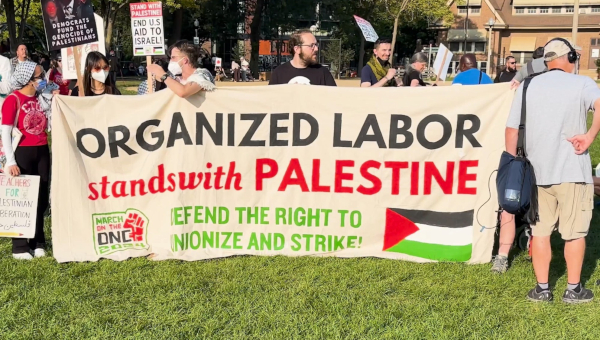
To the Free Trade Unions in the United States of America and to every free worker and trade unionist fighting for justice, freedom, and human dignity.

We salute you on the eve of International Workers’ Day, a day that embodies the unity and solidarity of workers in confronting oppression and exploitation. We raise to you the voice of Gaza’s workers, who today stand at the forefront of confronting the most heinous forms of genocide, siege, and starvation, imposed on our people for decades and continuing to this day with direct support from the US administration under Donald Trump, and previous administrations, in blatant violation of all humanitarian and international laws.

Dear members of American trade unions,

For over 16 months, Gaza has been subjected to a brutal assault that has resulted in the martyrdom of tens of thousands of innocent civilians, including thousands of workers, along with the systematic destruction of infrastructure, homes, hospitals, schools, and factories. The occupation has stripped Gaza of all means of life, sparing no service or productive sector from systematic devastation, leading to the collapse of healthcare, public services, education, and the economy. Millions of Palestinians now find themselves displaced, without food, water, shelter, electricity, or medicine.

The genocide is in a dangerous escalation. The occupation continues its policy of collective starvation by closing crossings and preventing the entry of humanitarian aid, placing our people at risk of mass famine while the international community remains powerless, silent, or even complicit in this crime against humanity. These policies are not merely intended to subjugate our people but are part of a settler-colonial regime aimed at completely erasing Palestinian existence.

Dear comrades,

Workers in Gaza are among the most affected by this catastrophe. Economic life has come to a complete halt, workplaces have been destroyed, and tens of thousands have been forcibly pushed into unemployment, with no social safety nets in place. Today, workers and their families live in inhumane conditions, deprived of their most basic rights, struggling to survive – whether from hunger or under bombardment.

This war would not have been possible without the unlimited US support for the occupation, whether through military funding, political and diplomatic backing, or arms deals that kill our children, women, and elderly every day. The US administration under Trump has continued what the previous administration started, becoming a direct accomplice in genocide, ignoring the voices of millions inside and outside of the United States, and an overwhelming majority of the nation, who reject this brutal aggression.

Therefore, we call on you, the American labour unions, to translate your solidarity into effective actions that go beyond statements and speeches and create real pressure to stop this dirty war.

What we ask of you today:

1. Escalate pressure within workplaces and American decision-making institutions to end the military, financial, and diplomatic support provided by the US administration to the occupation and hold accountable the companies and institutions involved in financing and supporting Israel’s war machine and the genocide.

2. Join and expand the current boycott campaigns targeting Israeli companies and their supporters, especially in the shipping and logistics sectors. This includes boycotting Israeli ships like “ZIM” and stopping business with companies that transport weapons and military equipment to the occupation, such as “Maersk” and others.

3. Enforce labour sanctions at US ports and airports to block arms shipments to Israel, following the example of past labour movements that boycotted apartheid South Africa and other workers across the globe.

4. Support and coordinate efforts with the student movement in the US, which is facing severe repression for its principled stance in supporting the Palestinian cause. Solidarity between the labour and student movements can create immense pressure against the unjust policies of the US administration, and effectively respond to the Trump administration’s broad assault on civil liberties and freedom of expression.

5. Call for general strikes and widespread civil disobedience to expose the US government’s complicity in the war and hold it accountable for the crimes of the occupation, just as labour movements have done in past struggles against imperialist wars.

6. Pressure Congress and the US administration to halt arms shipments and military aid to Israel and cancel any agreements that reinforce colonialism and oppression at the expense of oppressed peoples.

Dear members of the labour movement in America,

We sincerely appreciate all the efforts made by US trade unions and the voices that have stood in solidarity with the Palestinian cause.

Moreover, we emphasize that the current stage demands that these efforts be developed in a cumulative manner, transforming solidarity into practical and sustainable actions that contribute to stopping Palestinian bloodshed, ending the occupation and siege, and achieving justice for our people.

We in the General Federation of Trade Unions in Gaza address this call to you on the eve of International Workers’ Day, affirming that your struggle for workers’ rights in the United States is inseparable from our struggle against occupation and colonialism. True labour solidarity is demonstrated through actions, not just words, and we count on your awareness and determination to take concrete steps to end this tragedy.

It is our collective responsibility – as trade unions and labour movements worldwide – to stand against injustice and use our collective power to generate change. Together, we can break the chains of occupation, end oppression, and build a world that is more just and humane.

Long live workers’ unity and solidarity… Long live the struggle of peoples for freedom, dignity, and justice! •

Basheer Al-Sisi, General Secretariat of the Palestinian General Federation of Trade Unions – City of Gaza