Friday, May 09, 2025


Wärtsilä Launches Onboard Carbon Capture System, Key to Cutting CO2
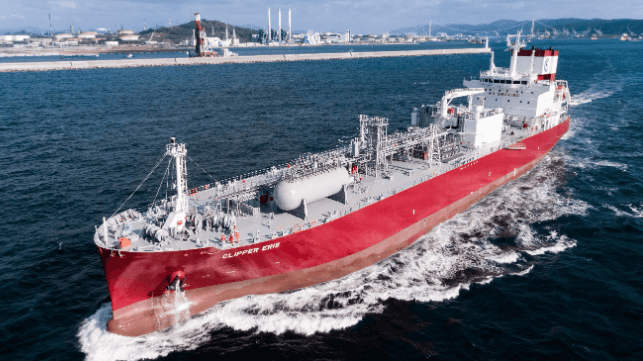
ethane carrier fitted with carbon capture
Solvang's Clipper Eris completed the installation of the CCS system developed with Wärtsilä (Solvang)

Published May 7, 2025 7:43 PM by The Maritime Executive


In a development Wärtsilä calls a breakthrough in decarbonization, the company has announced the commercial launch of its much-anticipated onboard carbon capture system. Wärtsilä reports successful trials at sea and at its plant in Norway, and says the ability to capture CO2 from ship exhaust systems will have a major impact on the industry’s efforts to reduce GHG emissions.

"CCS is a game-changer for the maritime industry, and we are already seeing huge interest in the market for this solution," said Håkan Agnevall, President and CEO of Wärtsilä. 

According to the company's tests, the new Wärtsilä system can reduce vessel CO2 emissions by up to 70 percent - providing shipowners with an immediate way to meet carbon regulations, without waiting for costlier and less readily available green fuels. Based on testing, Wärtsilä estimates that the total cost comes to about $54-76 per tonne of CO2, including capital and operating costs. Any carbon-based fuel can work, and it's straightforward for the crew to operate and maintain, says Wärtsilä President of Marine Solutions Roger Holm.

Wärtsilä has been developing this technology since 2019, but the commercial launch follows the retrofit of the first shipboard system onboard Solvang ASA’s Clipper Eris (18,000 dwt). The system has been in operation since the Clipper Eris set sail from Singapore in February 2025. 

Wärtsilä is among the biggest suppliers of engineered solutions in the maritime industry, and Holm says that the company is becoming a strategic partner for shipowners rather than a vendor of individual systems. That is especially true as owners look for guidance on how to make the green transition. 

"We have the broadest offering portfolio in the maritime industry. We can do green fuel engines, we can do carbon capture, and we can do other efficiency improvements, like voyage optimization. So thanks to that total picture, we can have a different discussion than if you only have one tool in the toolbox," Holm says. "It's really rewarding to talk to our customers from this strategic angle, more than being just an equipment provider."

Costs and regulatory requirements are critical to picking the best options for owners, Holm says. Each shipowner will use CO2-saving tools like CCS to meet their own objectives, and each use case is unique. "This is what we discuss with every customer we meet. How do you decarbonize in a way that you also optimize the financial feasibility? How do you decarbonize at the right speed? This is a key discussion we have with every single customer," Holm says. 

Since decarbonization is a long road, it often starts by building ships today that can be upgraded later when the market conditions are right. Solvang ASA, Clipper Eris' owner, is working with Wärtsilä on making its next generation of ships ready for later installation of CCS. This includes CCS-ready scrubber systems for HFO operation, as well as space and utility requirements for an eventual upgrade.


Berge Bulk Begins Pilot for Onboard Carbon Capture System on Bulker
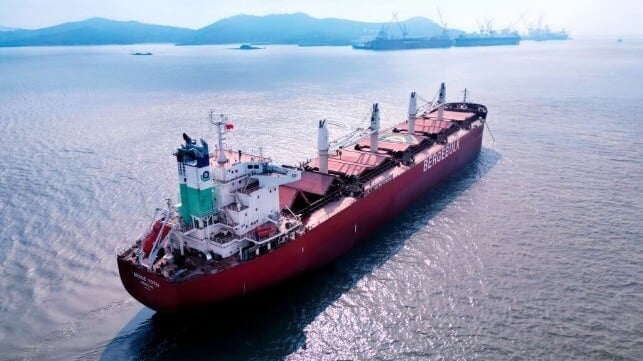
bulker with onboard carbon capture emission system
Bulker Berge Yotei was recently fitted with onboard carbon capture as a pilot for the technology (Berge Bulk)

Published May 8, 2025 6:53 PM by The Maritime Executive


Berge Bulk has become the latest ship owner to begin to test an onboard carbon capture system. Interest continues to grow in the technology as a means of maintaining the economic life of in-service vessels as the new emissions regulations emerge, as well as a possible approach for newbuilds during the period of uncertainty and lack of supply for alternative fuels.

“Carbon capture is a key pillar of our decarbonization strategy,” said James Marshall, CEO of Berge Bulk. “While we remain committed to optimizing fleet efficiency, installing decarbonization technology, and switching to new fuels, we must also capture carbon at the same time. We’ve been actively capturing carbon through nature-based solutions on shore for many years, now it’s time to also start capturing carbon on board.”

The pilot project is taking place aboard the company’s 63,000 dwt Ultramax bulker, Berge Yotei. Delivered in 2020 and in the Isle of Man registry, the ship was built at the Imabari Shipyard in Japan.

The system being used in the pilot was developed by Value Maritime and integrates carbon capture into an exhaust gas cleaning system known as the Filtree System. It is designed to capture up to 15 tonnes of CO2 per day, representing a potential 30 percent reduction in emissions during operations.

Unlike conventional scrubbers, the Filtree System removes both sulfur oxides and CO? from a vessel’s exhaust. CO? is absorbed into a reusable amine solution, which can be offloaded in port for regeneration or reuse. Potential applications include use in greenhouses, beverage production, and other industrial processes.
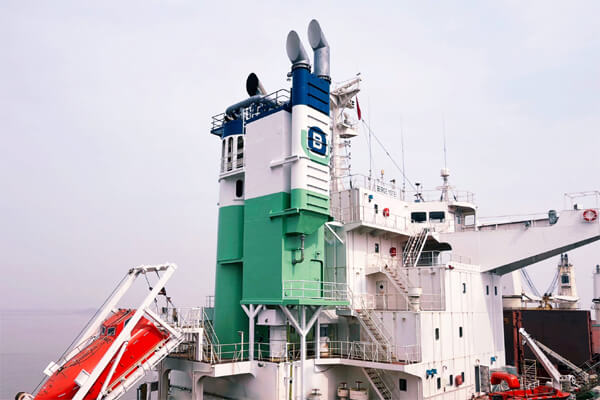
 

Carbon capture system was integrated with the scrubber and easily installed on the vessel's funnel (Berge Bulk)


Berge notes that while regulatory frameworks such as MARPOL and the EU ETS are still evolving, it is already contributing practical insights into how onboard carbon capture systems can be implemented, monitored, and scaled. The company, which owns, operates, and manages a fleet of over 100 vessels with a carrying capacity of more than 15 million dwt, emphasizes the need for collaboration across governments, ports, technology providers, and regulators to develop the infrastructure, protocols, and commercial models needed to support carbon capture at scale.

Value Maritime was established in 2017 and began installing its system in 2021. It has recently completed installations on other large vessels. Eastern Pacific’s chemical tanker Pacific Cobalt (49,886 dwt) installed the system in 2023. Mitsui O.S.K. Lines also recently installed the system on its tanker Nexus Victoria (75,000 dwt).

After some initial skepticism due to the need for storage and offloading CO2, the technology is gaining interest in the maritime sector expanding on the shore applications are large emitters. Wärtsilä just announced the commercial launch of its onboard carbon capture system calling it a breakthrough in decarbonization for in-service and new build vessels.


Design Work Awarded for First U.S. LCO2 Terminal Serving Florida’s Emitters
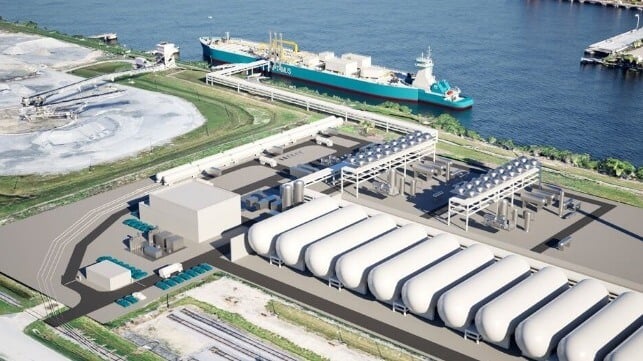
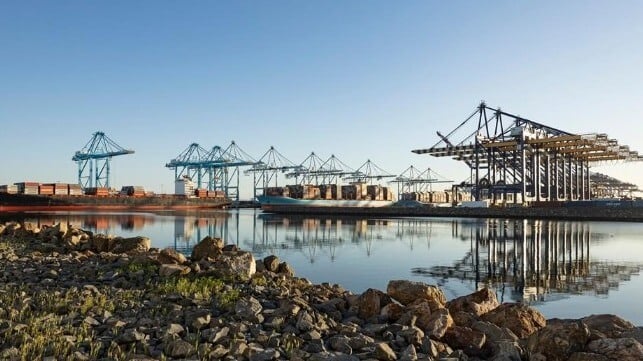
LCO2 terminal in Port Tampa Bay
Concept for the first LCO2 terminal in the U.S. which would be served by the first LCO2 barge and tug (Aptamus)

Published May 8, 2025 4:51 PM by The Maritime Executive


A contract has been awarded for the front-end engineering and design of the first U.S. temporary storage and liquefaction processing terminals for captured CO2. Known as COAST20 (Carbon Ocean and Storage Transport 20), it is an ambitious project that would provide a solution for the transport and storage of carbon emissions captured from Florida’s industry and be the kickoff for an industry that is also emerging in Europe.

The project is being developed by Aptamus Carbon Solutions, a subsidiary of Overseas Shipholding Group, and has identified a 15-acre parcel with access to an existing deep-water berth in Port Tampa Bay for T-RICH (Tampa Regional Intermodal Carbon Hub) for the handling of the captured CO2. 

It would be connected to a discharge and regassification terminal at LBC Tank Terminals, Baton Rouge, Louisiana. Transport of the CO2 would employ a 20,000-ton liquified CO2 tank vessel, which will be the first to be built in the U.S. The design calls for the first liquefied CO2 articulated tug-barge to be built in the U.S.

Aptamus has entered into an agreement with Entr, the consultancy arm of Aker Solutions, to conduct the front-end engineering and design for the COAST 20 project’s terminals. The concept for the Tampa Bay terminal calls for two 50 percent capacity liquefaction trains with a total throughput of 2 million tons per year and 30,000 cbm of LCO2 storage. The CO2 would be delivered to the facility from pipelines, rail, or truck, and exit on the LCO2 barge. The company’s website says the potential future throughput of the plant is as much as 8 million metric tons per year.  

“We are excited to bring our pioneering expertise in designing and building CO 2 terminals, and other first-of-their-kind carbon removal projects around the globe, to Florida,” said Knut Egil Pedersen, Vice President of hydrogen and CO 2 at Aker Solutions.

The receiving terminal would be located on the Mississippi River near Baton Rouge, adjacent to an existing dedicated CO 2 pipeline system for delivery to permanent underground storage sites.

“Florida is the third highest CO2 emitting state in the nation,” explains Aptamus President, Jeffrey Ross Williams. “Entr’s development of the Port Tampa Bay hub and the LBC Tank Terminals site on the Mississippi River offers the ideal solution for managing captured CO2 in Florida, and we are delighted to partner with them for this critical project. COAST20 will also allow power generation companies to meet the increasing demand for electricity in Florida while managing their carbon output.”

COAST20 was selected in 2024 for an award to be partially funded by the U.S. Department of Energy and includes the design of the Port Tampa Bay intermodal hub site to collect captured CO2 from emitters across the state of Florida. Port Tampa Bay and LBC are also partners in the Aptamus COAST20 project. 

The project is based on the determination that the Tampa Bay region is home to a high concentration of power-generating facilities and large industrial CO2 emitters. They believe that there are major operations that will become stranded emitters that require a solution for handling CO2 emissions. COAST20 is presented as a cost-effective solution.


 

Hyundai Partners with AI and Robotics Start-ups for Humanoid Welding Robots

humanoid welding robot
Concept Rendering of humanoid welding robot from Persona AI's website

Published May 8, 2025 2:30 PM by The Maritime Executive


South Korea’s HD Hyundai is partnering with AI and robotics start-ups to develop a humanoid robot capable of complex, precise welding tasks as part of the smart shipyard of the future. The companies are saying they aim to “usher in a new era of human-machine collaboration,” which will enhance productivity and safety.

“Unlike conventional robots that focus solely on repetitive tasks, these robots must be able to observe, reason, and make decisions,” said HD Hyundai Robotics Vice President Young-hoon Song. He explained that the goal is to have robots that will perform complex welding tasks in the shipyard environment.

Hyundai is partnering with newly-launched, Houston-based Persona AI, a start-up focusing on embodied artificial intelligence, and Vazil, a five-year-old South Korean company focused on robotics integration and manufacturing. The companies will work together to develop the prototypes by the end of 2026. They expect field testing and commercial development to begin in 2027.

Persona AI, earlier this year, raised more than $10 million in pre-seed funding, according to InnovationMap. Two of its founders, Nicolaus Radford and Jide Akinyode, InnovationMap reports helped develop a NASA humanoid robot, and both are former employees of Nauticus Robotics, a provider of autonomous subsea robots. On its website, Persona AI highlights the potential for humanoid robots to provide scalable labor for tough jobs ranging from welding to assembly, fabrication, building, and mining. 

Development of humanoid hardware and AI-based control and learning algorithms for the welding robots will be led by Persona AI. Vazil Company will develop the welding tools and build the industrial testing environment. 

Hyundai has been working to develop the shipyard of the future, which it believes will incorporate automation and other key technologies. Its HD Korea Shipbuilding & Offshore Engineering company will support the deployment of the system, providing live shipyard settings and field engineering data. HD Hyundai Robotics will contribute welding-path AI training data and performance validation.

"Welding humanoids will not only boost productivity but also significantly reduce the burden on workers and greatly enhance safety,” said HD KSOE Senior Vice President Dong-ju Lee. “By developing robots optimized for shipyard tasks, we aim to set a new paradigm in shipbuilding automation. Our goal is a smart shipyard where humans and intelligent robots collaborate seamlessly."

Shipyards and other applications have been using welding bots to perform repetitive tasks on assembly lines. Vazil Company CTO Sungwon Kim highlights that they envision an application that will elevate shipyard automation to the next level. The goal is to enhance productivity and improve workplace safety in shipyards.


Aging Vessels, Manning, and Training Issues Affect Seafarers' Happiness

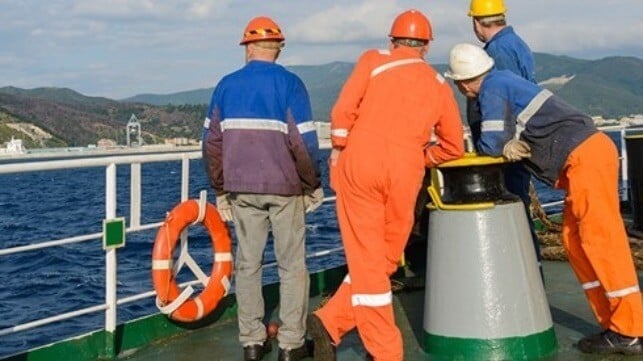
crew standing at the rail
Happiness Index points to manning issues, the strain of aging vessels, and training among the concerns of seafarers (IMO)

Published May 8, 2025 6:11 PM by The Maritime Executive


While crew satisfaction has stabilized, the latest edition of the Seafarer Happiness Index highlights the strains from aging vessels, safe manning issues, and a lack of training among the key concerns of seafarers. The quarterly survey run by The Mission to Seafarers, in collaboration with Idwal and NorthStandard, and supported by Inmarsat, is marking its 10th year, with the organizers saying it offers essential insights into the experiences and concerns of seafarers and the areas that require improvement.

The Q1 report shows an overall rise in seafarer happiness to 6.98 out of 10, up from 6.91 in Q4 2024, with the organizers saying overall it revealed a steadying in seafarer satisfaction. Traditionally, issues related to welfare, food, connectivity, manning, and shore leave were among the elements consistently cited by seafarers. The organizers are saying that despite pressure points, many seafarers continue to find fulfillment in their work. They point to teamwork and camaraderie helping with the experience while saying seafarers enjoy the technical aspects of their roles. 

The latest survey identifies safe manning as the most critical concern for seafarers. Respondents described how diminishing crew sizes combined with aging vessel infrastructure were adding to the pressures. The Mission to Seafarers says many respondents reported having to implement triage systems for maintenance tasks, addressing only the most urgent repairs while routine upkeep falls behind. This, of course, raises safety concerns for the crew and the vessels. Slap-dash repairs aboard the containership Dali, for example, have become a central issue in the investigation into the ship hitting and destroying Baltimore’s Francis Scott Key Bridge.

Training also emerged as a concern in Q1. While many seafarers acknowledged access to some development opportunities, others expressed a desire for training that feels “more grounded in reality.” The Mission to Seafarers says there is a desire for more consistent, practical, and scenario-based instruction that builds real confidence, not just theoretical knowledge, especially in high-stress or emergency situations.

“Addressing challenges like aging vessels, inadequate training, and restricted shore leave is not just a matter of welfare – it’s essential for operational performance and future-proofing the sector,” said Ben Bailey, Director of Programme for The Mission to Seafarers. “These issues are clearly interlinked. Neglecting seafarers compromises the reliability of global maritime trade.”

The impact of the workload is reported to be creating stress and lowering the seafarers’ happiness. The Mission to Seafarers points to long hours, especially during port operations, and says respondents also cited excessive administration burdens and constant pressure from shoreside management as negatively affecting morale.  

They also repeat a persistent concern over the limitations of shore leave. The Mission says it is a deeply felt frustration among seafarers. Other issues, including prolonged contracts and limited connectivity, also remain a concern as they increase the sense of isolation and disconnection for seafarers. 

“While it is positive to see strong teamwork, pride in the profession, and some improvements in connectivity, there continue to be key challenges that shouldn’t be ignored,” said Yves Vandenborn, Head of Loss Prevention Asia-Pacific, NorthStandard. He notes progress in some areas of concern while saying, “Persistent overwork, stagnant wages, and patchy welfare support continue to have a negative impact on morale.”

Based on the results and long-term insights from 10 years of the survey, The Mission to Seafarers says the industry must act decisively. It is calling for investing in vessel upkeep, prioritizing targeted, hands-on training, and ensuring crews have access to rest, support, and connections ashore and at home.


Judge Awards Damages to Red Hill Spill Victims

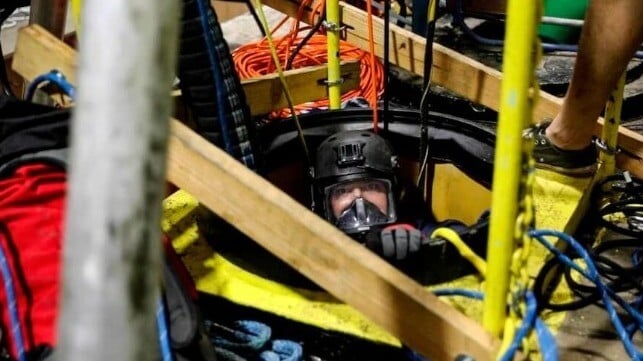
A Navy diver inspects the contaminated well at the Red Hill Bulk Fuel Storage Facility near Pearl Harbor, 2021 (USN)

Published May 8, 2025 5:05 PM by The Maritime Executive


A federal court has ruled that the U.S. Navy is liable for damages in connection with the Red Hill fuel leak at Pearl Harbor in 2021, which contaminated a military base water supply system and affected thousands of servicemembers and their families. 

17 plaintiffs who filed a civil suit over health effects from fuel-contaminated drinking water are owed compensation, U.S. District Judge Leslie Kobayashi ruled Wednesday. She ruled that the Navy was negligent in its operation of Red Hill, resulting in the release of 19,000 gallons of jet fuel into an access tunnel - where an unknown amount drained into a water supply well. 

The damages per person are comparatively small, ranging from $3,000 to $75,000. Kobayashi ruled that the plaintiffs were not entitled to compensation for economic losses or spill-related expenses, and she denied most of the plaintiffs' claims for ongoing medical care. 

“While the damages awarded by the court are disappointing, this is a step forward in our clients’ pursuit of justice, and we continue to review options to resolve the remaining 7,500-plus cases," said plaintiffs' lawyer Just Well Law PLLC in a statement. "The Court rejected the Government’s argument that thousands of our clients were just psychosomatic and that there was not enough fuel to make anyone sick."

Multiple plaintiffs told Hawaii News Now that the dollar value of the judgement was too low and "disheartening" for victims. "It feels like the government was not held accountable for anything," one plaintiff told HNN. 

The judge's ruling will provide a benchmark for other class-action suits filed by thousands of affected people. It broadly aligns with the Department of Defense's own findings: last year, the Pentagon's inspector general concluded that the U.S. Navy didn't understand the spill risks involved in operating its Red Hill fuel tank site at Pearl Harbor, and it repeatedly failed to respond when a major spill finally occurred, missing multiple opportunities to prevent harm to personnel. Site operators didn't have an accurate map of the facility and its piping, hadn't conducted response drills, and hadn't included the drinking water well or the possibility of a pipeline spill in their formal spill response plan, the IG's investigators found.


Maersk Cites “Increasingly Volatile Environment” Lowering Volume Forecast

Maersk
Maersk points to volatility and the impact of the tariffs creating market uncertainty (file photo)

Published May 8, 2025 3:57 PM by The Maritime Executive


Maersk, the largest publicly-traded container carrier and logistics company, cited the “increasingly volatile environment,” telling investors that it expects volume growth in the global container market will slow and possibly even be negative in 2025. The carrier reported, however, a strong start for the first quarter of 2025, which it expects to carry into the second quarter as customers build inventories before the full effect of the tariff war overtakes the market.

“With trade tensions flaring up and uncertainty on the rise, global supply chains are once again in the spotlight,” said CEO Vincent Clerc. He believes Maersk is well-positioned because of its integrated shipping and logistics offering, which could help customers make the best business decisions in the face of current uncertainties.

First quarter container volumes the company reported were stable versus a year ago, while it benefited from higher freight rates in Q1 2025. Profits for its ocean segment soared to $1.9 billion this quarter versus just under $1 billion a year ago. Costs have stabilized after last year when diversions around South Africa began due to the security issues in the Red Sea. Maersk said today it expects the disruption in the Red Sea will continue through the rest of the year.

Despite the looming tariffs and volatility, Maersk said it expects market growth in the second quarter. While admitting that volumes on routes from China to the U.S. plunged 30 to 40 percent in April, Maersk said it believes customers are building inventories, which supported the second quarter, while pointing to uncertainty and the risk of contractions in the second half of the year if the tariffs are not rolled back.

Maersk’s remarks came as Donald Trump heralded the U.S.’s first trade deal, which came from long-time ally the United Kingdom. Trump, however, told reporters that he recognized the tariffs on China would be lowered while still predicting a trade deal would be reached.

Due to the unpredictability, Maersk, however, revised its outlook for the global container market saying growth would be lower than the previous four percent prediction. Its revised estimate set the low end of the range at a one percent contraction, “given the increased macroeconomic and geopolitical uncertainty.”

Maersk said the sequential declines it reported today were expected while it called Q1 “solid results.” Clerc told investors the company would be “doubling down on the work underway on automation and cost management to remain fit for what lies ahead.”

Despite the increased uncertainty leading to a more cautious container volume growth outlook, Maersk reconfirmed its full-year guidance provided in February. It is still projecting earnings (EBITDA) of $6 to $9 billion but said its free cashflow would be negative by at least $3 billion. 

Near-term, Maersk said it was able to reallocate some capacity to other markets, which it said still had strong demand. Clerc said so far the trade war has mostly impacted the flow between China and the U.S. telling CNBC it has “not yet contaminated any of the other trade lanes.”

Clerc told Reuters that they were confident the supply chain would stabilize. He said “the dream of producing locally” for all the needs is not possible. While the trade war casts a shadow over the U.S. economy, he called the current tariffs prohibitive, predicting volatility ahead before the market stabilize. 
 

First Drop for Inbound Containers Forecast After Surge Ahead of Tariffs

container imports
Import volumes are expected to drop dramatically as the tariffs take effect (Port of Lo Angeles file photo)

Published May 9, 2025 3:20 PM by The Maritime Executive


U.S. retailers and the logistics tracking services for shippers are sounding the alarm on the expected dramatic declines coming for import containers as the Trump tariffs go into effect. The National Retail Federation (NRF) released data predicting the first year-over-year decline in imports in 19 months, noting the tariff uncertainties were coming at an important time of the year in the buying cycle. Data software company Descartes says the data suggests sourcing patterns, tariffs, and trade risks are continuing to evolve.

Descartes released data from its global trade software yet again highlighting that importers have been rushing to get goods into the United States ahead of the imposition of the tariffs. It reports that container imports were up 1.2 percent over March and better than 9 percent year-over-year, surpassing 2.4 million TEU. Descartes notes it was one of the strongest Aprils on record. 

The data highlights the efforts to frontload shipments, especially from Asia where Descartes says imports from China were up 5.4 percent from March to April. They note that Chinese-sourced commodities included furniture, plastics, and machinery, all of which were targeted with the tariffs. Dramatic year-over-year gains emerged from countries such as Vietnam (32.5 percent) and Thailand (13.4 percent). 

Descartes believes it was having a direct impact on ports as well with it forecasting strong gains in volumes at Los Angeles (13.9 percent) and Long Beach (12 percent). It, however, notes volumes incoming at Savannah and Charleston were down as shippers focused on the faster trans-Pacific routes.

“While container import growth remained strong in April, it may be, in part, because U.S. importers are continuing to pull shipments forward ahead of new U.S. tariffs, in particular the 145% tariff on Chinese goods implemented on April 9,” said Jackson Wood, Director, Industry Strategy at Descartes. “Since the new elevated tariffs do not apply to goods already in transit when the tariffs were implemented, the tariff impact may be reflected more significantly in May container import volumes.”

It believes this has been a factor in the 8.6 percent increase for U.S. imports in the first four months of 2025. Descartes highlights that China accounted for 33.4 percent of total U.S. inbound container volume in April. 

“We are starting to see the true impact of the tariffs on the supply chain,” predicts NRF Vice President for Supply Chain and Customs Policy Jonathan Gold. He notes the tariffs “come at the most important time in the buying process” for retailers. Many retailers are pausing or canceling orders as a result, and small retailers, in particular, “are concerned about what to expect in the coming months and how to order for the future.”

The retailer’s trade association is forecasting a dramatic decline in imports starting in May down to 1.81 million TEU. The NRF predicts volumes will plateau during the summer between 1.7 and 1.8 million TEU per month, a decline of greater than 20 percent per month versus 2024 levels.

The NRF notes that imports have been elevated since last summer, first as retailers brought in cargo ahead of an October strike at East Coast and Gulf Coast ports, and then in anticipation of an escalation of tariffs after the November elections.


Trump: Port Traffic Slowdown "A Good Thing"

Boxships alongside at Port of Long Beach, April 2025 (Corine Solberg / Sipa via AP Images)

Published May 8, 2025 8:58 PM by The Maritime Executive


This week, after major container ports on the West Coast reported less ship traffic due to falling imports, U.S. President Donald Trump told reporters that a drop in boxship volume is a win for the American economy. 

"That means we lose less money . . . when you say it slowed down, that's a good thing, not a bad thing," Trump said in response to a reporter's questions at a press conference Thursday. 

After the imposition of 145 percent tariffs on Chinese goods last month, buying activity for goods for export from China to the U.S. plummeted, followed by a sharp drop in container bookings. "Carriers reacted to the drop in exports out of China in the immediate aftermath of reciprocal tariff announcements by the US Government at the start of April by increasing blanked sailings," explained Xeneta's Peter Sand in a recent customer note. 

The number of ships departing China for the U.S. West Coast has dropped sharply: the Port of Long Beach reports 30 blanked sailings in May and June, and the Port of Long Beach reports another 30. Port of Long Beach CEO Mario Cordero confirmed to local NBC LA that volume is already down, and said that traffic hasn't been this slow since the pandemic. 

The number of vessels isn't the full picture. Based on AIS, the boxships that are under way from China to the U.S. this week are riding an average of about two feet higher in the water than normal, says Flexport CEO Ryan Peterson - indicating that they are carrying less cargo. 

The slowdown may not last long. The U.S. and China have begun much-anticipated negotiations on a new trade agreement, and this will eventually result in lower tariffs on Chinese goods, Trump confirmed Thursday. "Right now you can’t get any higher. It’s at 145 percent so we know it’s coming down," Trump told Bloomberg TV. 


South Korea Funds Project to Build World’s Largest Liquid Hydrogen Carrier

hydrogen carrier
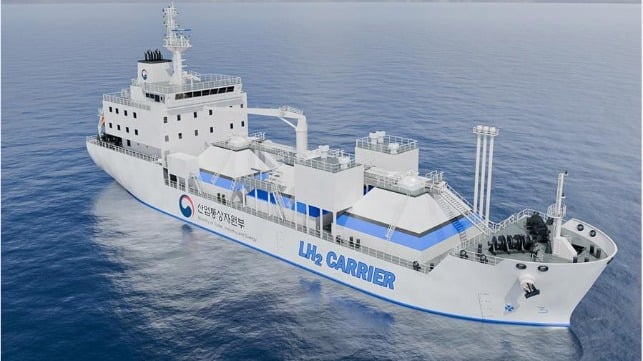
South Korea plans a demonstration liquified hydrogen carrier by 2027 as it works to build leadership in the technology (MOTIE)

Published May 9, 2025 3:46 PM by The Maritime Executive


South Korea’s Ministry of Trade, Industry, and Energy announced the formation of a public-private partnership and funding for an effort to build the world’s largest liquid hydrogen carrier. The government views it as a key opportunity where South Korea’s shipbuilders can develop a leadership position building on its current strategy of focusing on high-value ships.

“Liquefied hydrogen carriers are an area with high technical difficulty and very high initial technology development risk, so it is important for the government to play a leading role in securing a new source for Korean-shipbuilding,” said an official from the Ministry of Trade, Industry and Energy announcing the new project. “We will actively support the early acquisition of large-scale liquefied hydrogen carrier technology by organizing related laws and systems so that the technology we have developed can become a global standard.”

The government announced $39.5 million in funding in 2025 to launch the partnership which will involve the country’s three major shipbuilders (Hyundai Heavy Industries, Hanwha Ocean, and Samsung Heavy Industries) as well as experts from the ministry, universities, and research institutes.

It mapped out an ambitious schedule calling for the construction of a 2,000 cbm demonstration ship by 2027. It said the technology for a large ship would be completed by 2030 and the development of a 40,000 cbm vessel by 2032. They are calling for the commercialization of a large, 160,000 cbm vessel by 2040.


Korea looks to build a competitive advantage to support commercial hydrogen vessels by the 2040s (MOTIE)


To complete the ships, they called for cooling technology for the hold saying it will require -253 degrees C, ultra-low temperature storage tank technology versus the -163 degrees C required for LNG. They envision a vacuum insulation system. For the propulsion, they are proposing using hydrogen evaporation gas generated in the cargo hold combined with a fuel cell, hybrid engines using an energy storage system.

During the presentation, they recognized that liquified hydrogen carriers are highly difficult ships with no commercial examples having yet been developed. They highlighted 43 research and development projects currently underway involving 101 organizations, saying their goal is to unique the efforts into a single project.

The new task force will use the best domestic liquified hydrogen experts with the support of the Ministry.

They noted that the only hydrogen carrier that has been built is a small-scale demonstration vessel built in Japan. It has a 1,250 cubic meter tank. It too was built under a government-sponsored research program.

The designs for the Korean demonstration vessel call for a ship that will be 304 feet (92.8 meters) in length. It will have a capacity of 140 tons (2,300 cbm), making it the world’s largest and a key step in the development of this critical new market.


Captain Appears in Hong Kong Court on Charges From 2023 Pipeline Break

Chinese containership
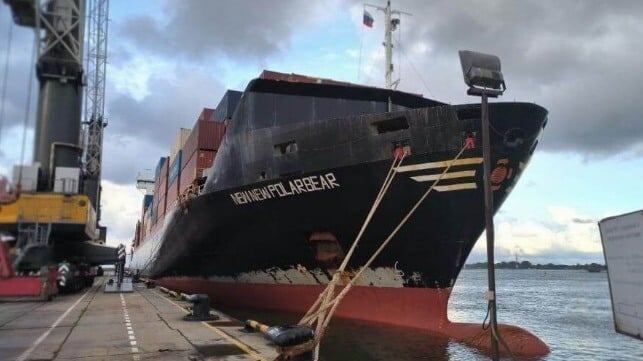
Master of the NewNew PolarBear is being held in Hong Kong on charges related to the 2023 incident damaging the Balticconnector pipeline (file image courtesy NewNew Shipping)

Published May 9, 2025 2:12 PM by The Maritime Executive


In what appears to be a surprise development in the two-year-old case related to the damage of a gas pipeline in the Baltic, China on Thursday charged the captain of the containership suspected in the incident with a criminal charge related to the incident. The South China Morning Post reported the development saying that the captain of the containership Newnew Polar Bear was taken into custody in Hong Kong after appearing in court.

The 43-year-old Chinese captain of the containership, Wan Wenguo, appeared in a Hong Kong court on May 8, on one criminal charge for causing damage to the Balticconnector, a natural gas pipeline running between Estonia and Finland, and damage to a communication cable. The South China Morning Post listed the charges as “a breach of navigation safety protocols by failing to ensure the ship had enough anchors.” The captain also faces two charges of not making daily reports to the vessel’s owner.

News of the charges appeared to come as a surprise to the authorities in Finland and Estonia, which are conducting a joint investigation. Last month, the Finnish newspapers reported that the investigators had requested information from China and were still waiting for a response. Over the two years, there have been several reports that China was hindering the investigation, and while acknowledging the vessel had damaged the undersea infrastructure blamed the damage on bad weather.

Finland’s National Bureau of Investigation issued a statement today saying its investigation with Estonia was ongoing. It noted cooperation with Chinese authorities while saying details about the developments would have to come from the authorities in China and Hong Kong. They acknowledged several meetings and exchanges of information with the authorities in China and Hong Kong.

Wan is a Chinese national, but the ship at the time was registered in Hong Kong. It was operating for a Chinese shipping company that highlighted the opening of the container route between China and St. Petersburg, Russia, using the Northern Sea Route through the Arctic.

The vessel was in the Gulf of Finland, starting a return trip to China, when on October 8, the gas and telecom lines were damaged. The Finnish authorities later recovered a broken anchor and reported a drag trail on the seabed. It was the first of the incidents that led to allegations of deliberate sabotage efforts in the Baltic.

The South China Morning Post reports the captain is being held pre-trial. The next hearing was scheduled for July, it reports, allowing time for further investigations.

UK Rolls Out “Largest Ever” Sanction Package Targeting Shadow Tankers

shadow fleet tanker
Europe has become more aggressive against the shadow fleet including Germany moving to seize a tanker (Havariekommando)

Published May 9, 2025 11:14 AM by The Maritime Executive


The UK is moving forward with another round of sanctions against Russian entities and the shadow fleet in what Prime Minister Keir Starmer called the “largest ever sanctions.” The announcement came as the UK was meeting in Norway with colleagues in the 10-nation Joint Expeditionary Force to discuss security issues for Northern Europe.

“The shadow fleet operation, masterminded by Putin’s cronies, is not just bankrolling the Kremlin’s illegal war in Ukraine - the fleet’s languishing vessels are known to be damaging critical national infrastructure through reckless seafaring in Europe,” the UK said reporting it has listed 100 additional tankers. The UK also listed one Russian-flagged offshore service vessel, which it said is benefiting from supporting the Russian government.

The UK now attests to having sanctioned more shadow fleet ships than any other country. In December 2024, it also imposed sanctions against 133 tankers. The EU has also moved aggressively with its sanctions and reported this week it is working on a new sanctions package including more than 100 tankers. When the new sanctions are enacted, the EU will have sanctioned more than 300 tankers.

In addition to the vessels, the UK listed five executives working in the Russian energy sector who it says are supporting and benefitting from the oil sales. It is also listing two energy companies, BX Energy and Nord Axis, and added Norwegian insurance company Romarine and Russian insurance company Soglasie to the sanctions list.

The UK describes the shadow fleet as “decrepit and dangerous,” saying it was also moving to protect Europe’s infrastructure. It cites the damage caused to undersea assets by the tankers while highlighting the efforts of the Joint Expeditionary Force to monitor key infrastructure. Member nations include Denmark, Estonia, Finland, Iceland, Latvia, Lithuania, Norway, the Netherlands, Sweden, and the UK.

In January, the group activated a tracking system known as Nordic Warden developed by the UK. It is being used to monitor activity in a region that includes parts of the English Channel, the North Sea, Kattegat, and the Baltic. NATO also moved along with its member nations to increase monitoring in the Baltic after the incidents that damaged the undersea cables.

The UK highlights that the drop in oil prices is putting further pressure on the Russian economy as the costs of the war have increased. 

A new report from S&P Global, however, shows that more Russian oil is moving on tankers owned or operated within the G7 as the price of oil has fallen below the price cap. S&P Global Commodities at Sea and Maritime Intelligence Risk Suite data shows that almost 1.3 million barrels a day were being lifted by the ships from the G7 nations, the highest since March 2024. They are also reporting that G7-linked tankers are carrying more Russian oil from the Urals than non-G7 tankers, the first time this occurred since July 2023, according to S&P.

The EU is expected to move ahead with its next round of sanctions in June and is reported to be looking to coordinate it with a similar action by the United States. Donald Trump has threatened to increase sanctions on Russia if they cannot achieve progress with the ceasefire agreement between Russia and Ukraine.

Stop the War Coalition: PM seeks to drag Britain into yet another war without justification or Parliamentary consent

“Let’s not forget that Starmer pledged before he was elected that parliamentary consent would always be sought before taking military action.”

By Stop the War

Stop the War condemns the bombing of Yemen by the British government. Keir Starmer is seeking to drag us into yet another war without justification or parliamentary consent and with zero recognition of the reason why the Houthis are blockading the Red Sea – to help support the Palestinians who are facing Israel’s genocide in Gaza, which is being armed by the UK government.

Lindsey German, Stop the War Coalition convenor, said:

“It is not Yemen and the Houthis who are causing the regional instability and risking economic security for families in the UK. 

It’s the British government arming Israel’s genocide in Gaza that’s bringing us ever closer to war in the Middle East, and the slashing of benefits to fund massive increases in defence spending that is pushing families and the most vulnerable further into poverty at home.

Let’s not forget that Starmer pledged before he was elected that parliamentary consent would always be sought before taking military action. Yet now we have the disgrace of a ‘Labour’ government that is simultaneously supporting a genocide in Palestine, bombing Yemen, imprisoning climate protestors, cracking down on the right to protest and imposing still more austerity on its own citizens to pay for yet more endless wars, all without absolutely any mandate from the British people.”