Saturday, May 10, 2025

A GNOSTIC BIBLE

Feminine Translation Bible receives award from Religion Communicators Council

Mark 7 Publishing


RNS Press Release Distribution Service
May 8, 2025

The Holy Bible Feminine Translation, the only word-for-word translation that translates the Holy Spirit to the feminine gender, received the Award of Merit from the Religion Communicators Council.

The Holy Bible Feminine Translation Expanded Edition 2 was published July 2024 in paperback and digital pdf by Mark 7 Publishing.

The Holy Bible Feminine Translation Version (FTV-Bible) is a word-for-word translation containing bias free Scriptures that uses the American Standard Version of 1901 (ASV) for its starting textual base. The ASV is the product of the work of over 50 Evangelical Christian scholars that has been called “The Rock of Biblical Honesty.”  The goal of this Bible is to carry forward this legacy of biblical Honesty with recognition of the dual feminine attributes of God as well as His dual masculine attributes.

The FTV-Bible is a result of interpreting and translating the Bible through the Discipline of the Cross of YHWH, written 6,876 times, pronounced Yahweh. The Study section shows the cross is a consistent destination of seven Sprits of God that deciphers Bible text called Jesus’ Witness Cipher.

Bridging Beliefs in the HOLY BIBLE Feminine Translation Version

A Bridge to Gender Balance
The Divine Feminine is a spiritual and philosophical concept representing the feminine counterpart to traditionally patriarchal and masculine frameworks in religion, culture, and energy systems. The Divine Feminine in this Feminine Translation Bible can be seen as the dual feminine attributes of God. The Most-High Holy Spirit of Light, heavenly Mother of the Son of God, and Sons of Light, plus the earthly mother of all living humans, serve as a bridge to counterbalance gender in this Bible.

An Earth to Heaven Bridge
This Bible was translated through the Discipline of the Cross, where on the foot it is written: BeholdI am YHWH —the God of all flesh(Jer 32:27)   All living humans are translated to be children of our Father God through His divine feminine daughter Eve, the mother of all living humans (Gen 3:20)   whom we are all natural descendants on the foot of an Earth to Heaven Bridge— the Tree of Life Cross.(Cipher 3)  She bruised the head of the serpent when she birthed her God appointed seed, Seth, who began the righteous line of all the “elect” Patriarchs in Luke’s ascending genealogy of Jesus Christ.(Cipher 31) The Elect are those predestined to be saved. (Cipher 36)

Numbered Bridges (Study section)
There are 15 crosses numbered 77 77 77 77 in the Old Testament, that together is a bridge of understanding for Israel to the 77 77 77 77 Genealogy Cross of their Messiah, who begins the New Testament. These bridges are previously hidden signs that the Jews demanded, while the Greeks looked for wisdom (1Cor 1:22) The number 77 is the signature number of Jesus Christ. (Cipher 48)

A 6,000 Year Bridge (Study section)
Jesus Witness Cipher is a timeless phenomenon for deciphering Bible text that teaches one how to SEE and visually perceive Scripture through the Cross. This previously hidden, recurring, phenomenon is timeless, because it has consistently structured Scripture that bridges a period of 6,000 years using 40 different human authors.  Validated with the Discipline of Biblical Numbers, this timeless Cipher bears witness of a single divine author of the Bible 77 times. It illustrates how the Cross is the consistent destination of Seven Spirits of God, that answer seven questions in divine order, that seamlessly bridges the Old Testament to the New Testament.


Since 1949, the Wilbur Awards have been presented annually to recognize excellence in the communication of religious issues, values, and themes in public secular media.Through the awards, the Religion Communicators Council (RCC) recognizes the work of individuals, production companies and agencies as they communicate about religious issues, values and themes with professionalism, fairness, respect and honesty.

Past winners include Morgan Freeman, Oprah Winfrey, Jane Pauley, Mister Rogers, CBS Sunday Morning, ABC’s 20/20, Meet the Press, Vanity Fair, Canadian Broadcasting Corporation, and the New York Times.

The Award of Merit is the level of recognition provided by the Religion Communicators Council, for work deemed meritorious and worthy of acknowledgment

###

Contact:
JW Farquhar
Mark 7 Publishing
8035170451
farquhar.jw@gmail.com

Disclaimer: The views and opinions expressed in this article are those of the authors and do not necessarily reflect the official policy or position of RNS or Religion News Foundation.

To put pressure on Trump, Democrats turn to religion — and religious activists

(RNS) — ‘Faith leaders have been at the forefront of every progressive movement in our nation’s history … so I’m glad to see faith leaders speaking out and getting into good trouble in opposition to the upcoming reconciliation bill,’ Delaware Sen. Chris Coons told RNS.


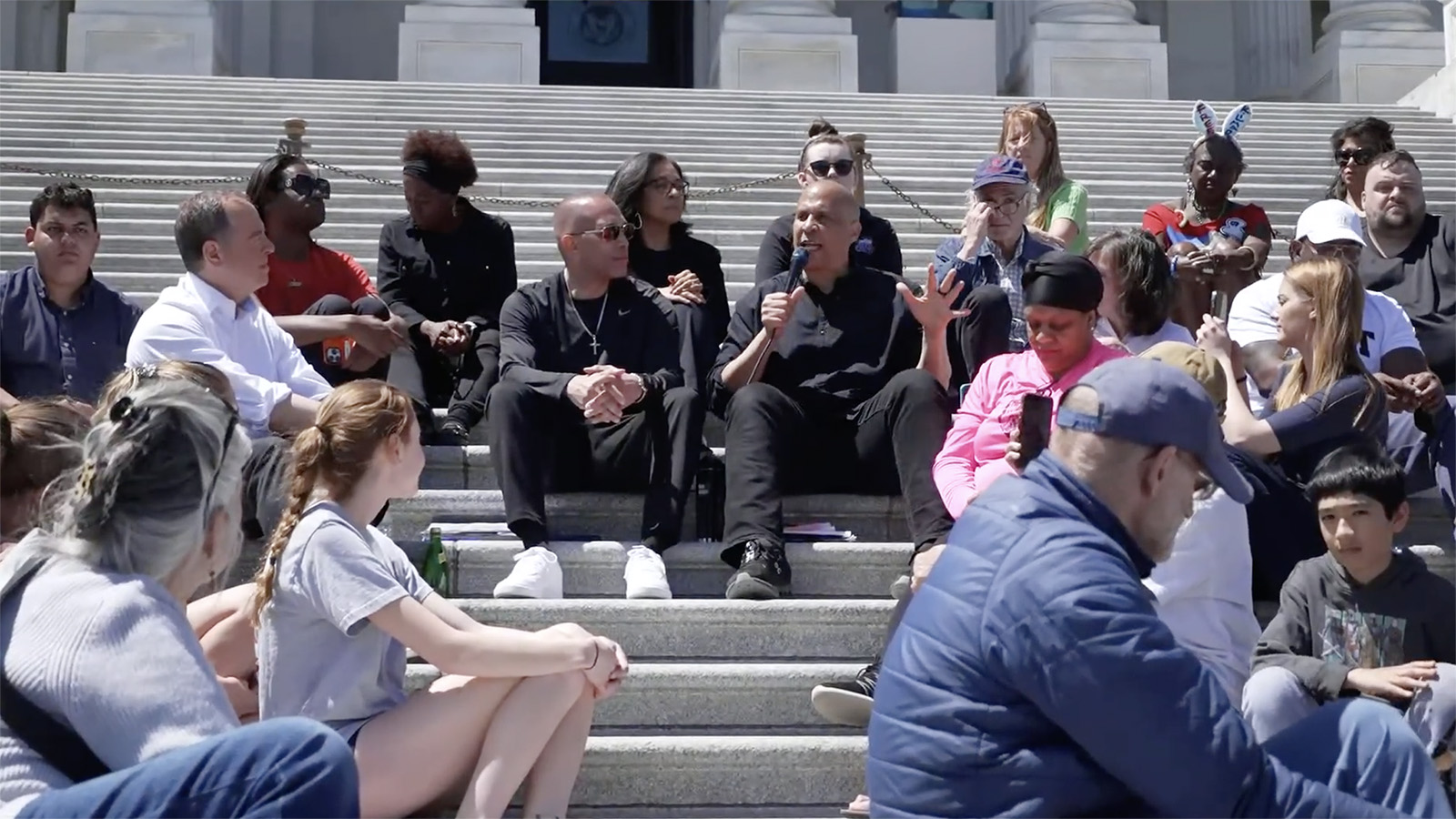
House Minority Leader Hakeem Jeffries, center left, and Sen. Cory Booker, center right, host a “sit-in” on the steps of the U.S. Capitol, April 27, 2025, in Washington. (Video screen grab)

Jack Jenkins
May 7, 2025

WASHINGTON (RNS) — As the sun rose over the U.S. Capitol on the last Sunday in April, House Minority Leader Hakeem Jeffries, wearing a gold cross necklace, sat next to Sen. Cory Booker on the building’s stone steps. The two looked around quietly for a moment, awaiting confirmation that the livestream of their “sit-in” — a daylong effort designed to push back against the Republican-led budget proposal and actions by President Donald Trump’s administration — had begun.

After someone off-camera informed them the broadcast was live, both men immediately bowed their heads in prayer.

“Father God, we humble ourselves before you and before all who may watch today,” said Booker, the New Jersey Democrat who attends a Baptist church in Newark. After asking the Almighty for strength, he prayed that his words might “be of service at this crisis moment in American history.”

It was a preview of the next 12 hours, as the two prominent Democratic lawmakers and a slew of guests outlined a decidedly faith-forward argument against Republican leaders and the Trump administration. The pair discussed their own religious backgrounds, referred to liberation theology, read from the Bible and lauded what Booker called the transformative power of “faith traditions” — a phrase that came up no fewer than 45 times during the broadcast.

When the two weren’t talking, they passed a microphone to fellow lawmakers such as Georgia Sen. Raphael Warnock, who is also a pastor, and to various faith leaders, including activist and Yale Divinity School professor the Rev. William Barber II.

“If you pray at the opening session of the Senate or the House but then after you pray — P-R-A-Y — you pass a budget that preys — P-R-E-Y-S — on people that are vulnerable, then you just canceled out your P-R-A-Y,” Barber told the crowd as he stood next to Booker and Jeffries.

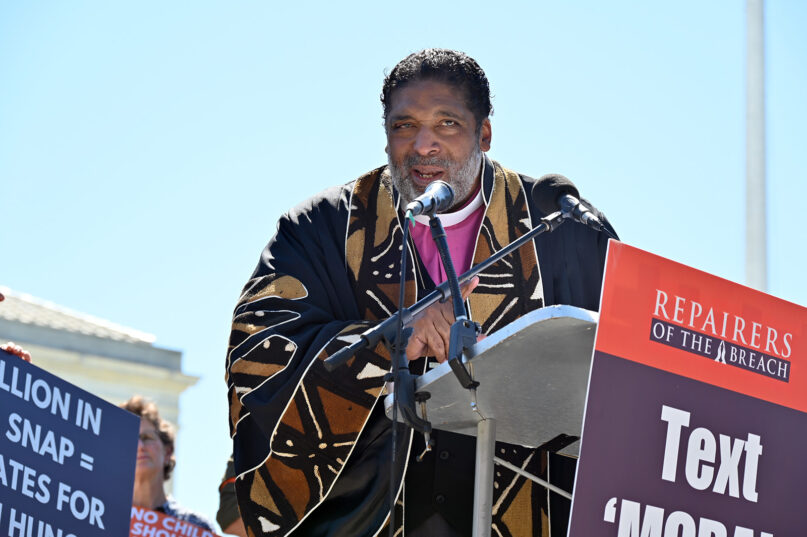
The Rev. William Barber II speaks at a Moral Monday rally near the U.S. Capitol, April 28, 2025, in Washington. (RNS photo/Jack Jenkins)

The sit-in, with its faith-filled language and its clergy participants, was part of an apparent strategic pivot by Democratic leaders desperate to find a foothold in a country where Republicans and conservatives dominate all three branches of government. As frustrated liberals pressure party leaders to counter the Trump administration, Democrats are taking some cues from the work of progressive religious activists — particularly Barber and his allies — who have been some of Trump’s loudest critics since his first administration.

“While many progressives, liberals and Democrats have been struggling to try and catch up to what the Trump administration is doing, people like William Barber and other folks on the religious left have had a kind of moral clarity about what’s going on for a long time,” Ruth Braunstein, a sociology professor at the University of Connecticut and director of the school’s Meanings of Democracy Lab, said in an interview. “So I think they’ve been able to respond more quickly.”

Faith-based pushback to Trump’s second presidency began the same day he was sworn in, when Barber preached a sermon challenging Trump’s incoming administration and issued a challenge to like-minded faithful, saying, “In this moment, we must remember whose we are and who we are.”

The next day, Trump sat for a sermon at the Washington National Cathedral, where the Rt. Rev. Mariann Budde, the Episcopal bishop of Washington, made headlines for asking the president to “have mercy” on transgender people, immigrants and refugees. A few days after that, a group of Quakers filed a lawsuit over the Trump administration’s decision to reduce restrictions on immigration enforcement raids at churches, the first in what would eventually become six faith-led lawsuits — including one led by the U.S. Conference of Catholic Bishops — that list dozens of religious organizations and even entire denominations as plaintiffs. Meanwhile, Jewish, Muslim and Christian organizations — including some evangelicals — have issued statements, staged vigils and participated in protests against the administration, especially its immigration and deportation policies.

The day after the sit-in, on April 28, Barber launched a series of weekly “Moral Monday” demonstrations on Capitol Hill that began with the pastor being arrested alongside two others while praying in the Capitol Rotunda against the GOP-led budget. A week later, five faith leaders allied with Barber were arrested in the Rotunda while doing the same.


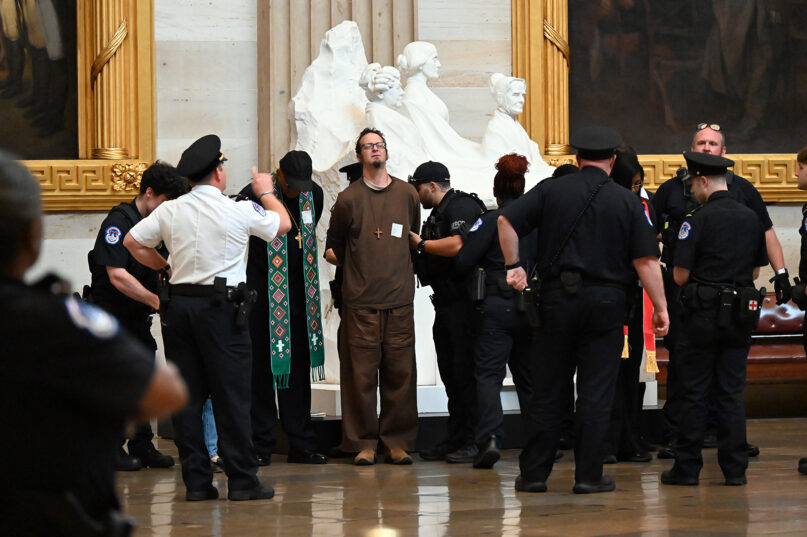
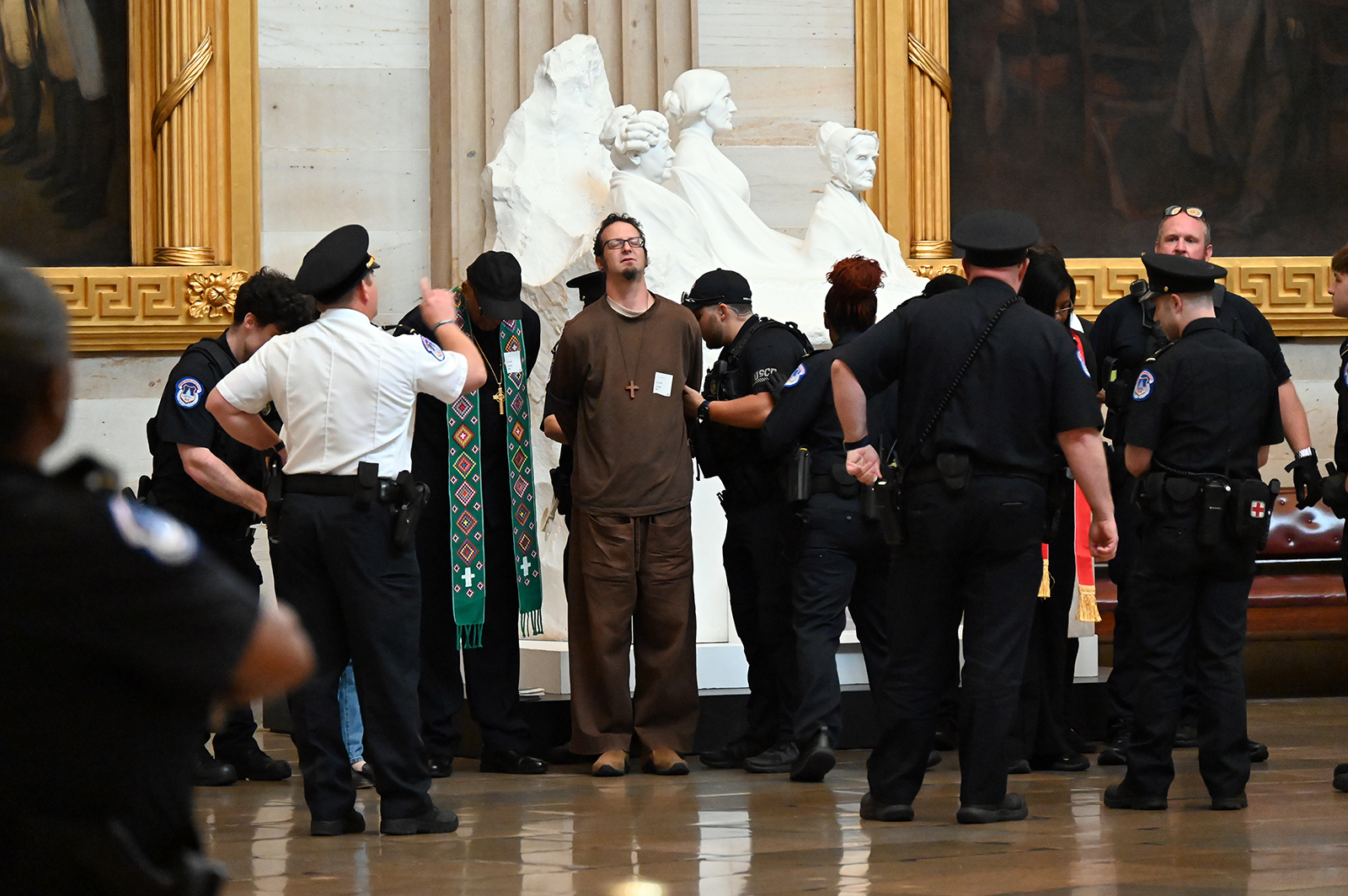
Capitol police arrest Shane Claiborne, center, and others after they prayed in the U.S. Capitol Rotunda, May 5, 2025, in Washington. (RNS photo/Jack Jenkins)

“Let truth trouble the chambers of the Capitol,” Shane Claiborne, a longtime Christian activist, said in a prayer shortly before he was arrested in the Rotunda on Monday (May 5). “Let there be no peace where there is no justice. Let there be no comfort for those who legislate cruelty.”

Sen. Chris Coons of Delaware — a Democrat and Presbyterian who graduated from Yale Divinity School — was one of several Democrats who publicly celebrated the activism.

“Faith leaders have been at the forefront of every progressive movement in our nation’s history – from abolition to labor rights to civil rights and on – so I’m glad to see faith leaders speaking out and getting into good trouble in opposition to the upcoming reconciliation bill,” Coons told RNS in a statement, referring to Barber’s arrest.

Coons added that “there are over 2,000 references to caring for the poor in Scripture” — a topic he discussed with Booker when the New Jersey senator took questions during his 25-hour speech in late March — and said he doesn’t “believe passing a bill that takes away health care from our most vulnerable in order to pay for new tax breaks for the wealthiest Americans aligns with Jesus’ teachings.”

Braunstein said Democrats’ pivot to faith doubles as a rejection of the idea that the Republican Party is the truly religious party — and an acknowledgment of the powerful role faith continues to play in American politics.

ALL WHITE AND ALT RIGHT

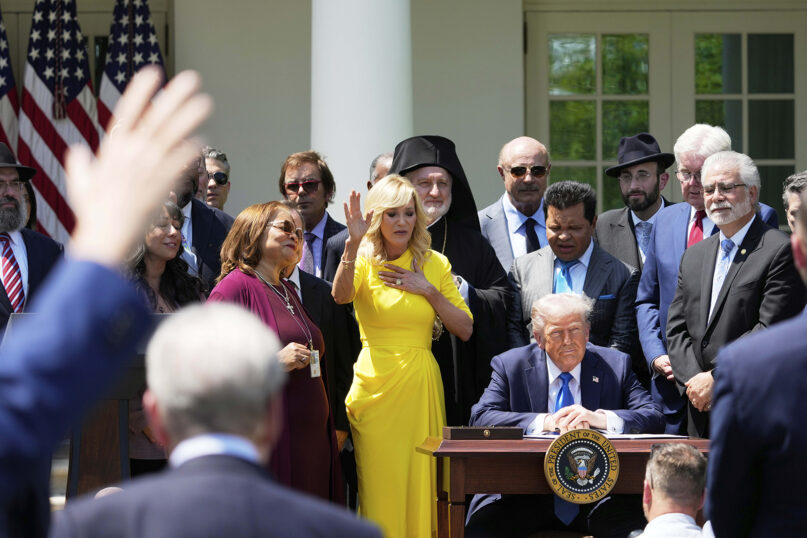
President Donald Trump and other religious leaders listen to a musical performance before Trump signs an executive order during a National Day of Prayer event in the Rose Garden of the White House, May 1, 2025, in Washington. (AP Photo/Alex Brandon)

“I think what we’re seeing is a very clear strategy by some prominent Democrats to be louder about the role of their faith.”

Also important, she said, is how many of the loudest voices among lawmakers and faith leaders are people of color.

“As much as we talk about white evangelicals as being this stalwart bloc of Republicans, the most consistent and loyal partisans in this country are Black Christians, and they consistently vote Democratic,” she said.

For his part, Booker repeatedly appealed to faith during that marathon speech — which attracted widespread attention and became a source of inspiration for some liberals — before winding down with several phrases long used in progressive religious circles.

“This is a moral moment. It’s not left or right; it’s right or wrong,” Booker said, before concluding with a line made famous by the late Georgia congressman and civil rights icon John Lewis: “Let’s get in good trouble.”


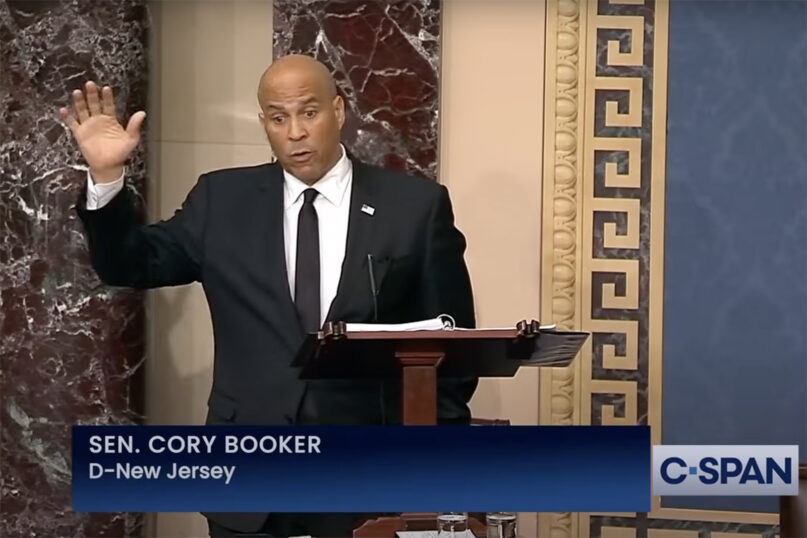
New Jersey Sen. Cory Booker addresses the U.S. Senate, March 31, 2025, at the start of a 25-hour speech at the Capitol. (Video screen grab)

“He quoted from our movement,” Barber said of Booker, who has previously participated in some of Barber’s demonstrations.

Asked about lawmakers’ endorsement of his activism, Barber said he hoped lawmakers would “invite” religious leaders in — as well as people who might be negatively impacted by the budget proposals.

Lawmakers have, in fact, invited religious activists into the Capitol, but the fledgling alliance appears to be a delicate balance, with figures on both sides steering clear of explicit coordination. Barber has long refused to allow lawmakers to speak at his protests, and he told RNS he was unaware Jeffries and Booker were planning their sit-in until he received a call about the event the night before. Barber also said that before his arrest at the U.S. Capitol, he was escorted into the building by staff members from the office of Rep. Jamie Raskin — a lawmaker who has attended some events led by Barber — but stressed the aides were not aware of the pastor’s protest plans.

Similarly, a spokesperson for Raskin said only that the office “helps thousands of people access the Capitol complex each year, including faith leaders like Reverend Barber.”

Jeffries was also reticent when asked at a press conference about Barber’s arrest. While he didn’t overtly endorse Barber’s actions, he also didn’t condemn them.

“We’re in a ‘more is more’ environment, and Rev. Barber spoke powerfully at the sit-in yesterday,” Jeffries said.

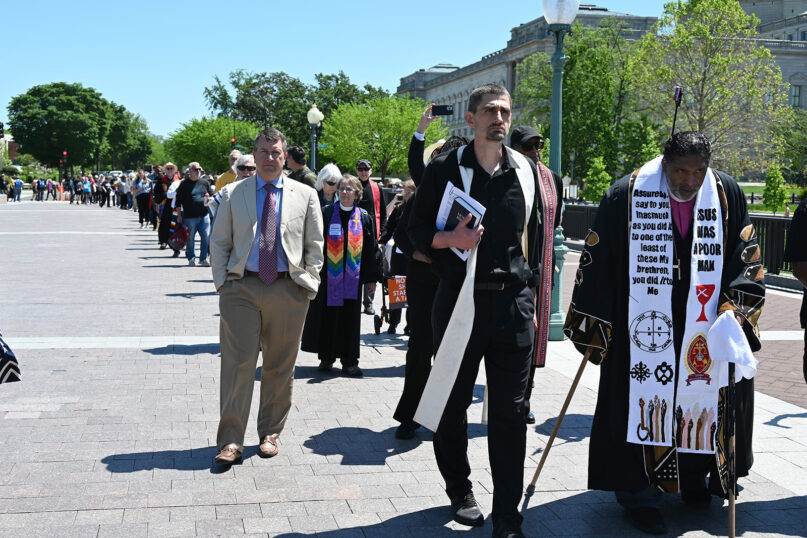
The Rev. William Barber II, front right, and the Rev. Jonathan Wilson-Hartgrove lead a procession from a Moral Monday rally to the U.S. Capitol, April 28, 2025, in Washington. (RNS photo/Jack Jenkins)

Other lawmakers have long-standing relationships with activists. Barber said that when Rep. Al Green of Texas — the lawmaker who stood up alone to protest Trump’s joint address to Congress in March, shouting “you don’t have a mandate to cut Medicaid” — learned about the pastor’s Moral Monday effort, the congressman called him and offered to help any way he could, floating the possibility of celebrating their efforts from the floor of the House. The two have known each other for years, Barber said, with Green attending Barber’s sermons and participating in past demonstrations.


n a statement to RNS, Green said he is “in support of Rev. Barber’s activism and driven by it,” and confirmed his Christian faith played a role in his own protest during Trump’s speech. He cited Matthew 25 as inspiration, referring to the passage as his “North Star” when it comes to issues involving food, clothing, shelter and health care.

But for Barber and his allies, whether Democrats endorse their activism is largely beside the point.

“I don’t know if it’s about who’s turning to who, but what we have to understand about MAGA — we cannot mobilize the American people just on a partisan basis,” he said. “We’re past that. This has to be an issue of morality versus immorality, right versus wrong.”


Shane Claiborne, four other faith activists arrested while protesting GOP budget bill

WASHINGTON (RNS) — 'Stir the conscience of our nation. Let justice rise up on these very steps, let truth trouble the chambers of the Capitol,' Shane Claiborne said as he prayed.


Capitol police arrest Shane Claiborne, center, and others after praying in the U.S. Capitol Rotunda, Monday, May 5, 2025, in Washington. (RNS photo/Jack Jenkins)

Jack Jenkins
May 5, 2025

WASHINGTON (RNS) — Five faith leaders were arrested while praying in the U.S. Capitol Rotunda on Monday (May 5), the second time in as many weeks clergy and others have been handcuffed as they speak out against the Republican-led budget bill.

Among those arrested was Shane Claiborne, a longtime activist and co-director of Red Letter Christians, a Christian social justice group. Claiborne, who is based in Philadelphia and known for his longstanding opposition to the death penalty and gun violence, prayed side by side with others for several minutes in the Rotunda before eventually being arrested by Capitol police.

“Reorder our moral compass,” Claiborne said, standing near a statue commemorating famous suffragettes and abolitionists. “Stir the conscience of our nation. Let justice rise up on these very steps, let truth trouble the chambers of the Capitol. Let there be no peace where there is no justice. Let there be no comfort for those who legislate cruelty.”


Claiborne added: “Let those of us gathered here rise not with fear but with fire, because as long as the details are still being worked out in committee …” as the group, which included Christian and Jewish activists, responded in unison: “You can work a miracle.”

Shortly after an officer gave multiple verbal warnings, roughly two-dozen officers surrounded the group and began arresting them one by one. Members of the group prayed and some sang “This Little Light of Mine” as they were led away from the Rotunda.

RELATED: Rev. William Barber arrested in Capitol Rotunda after praying against Republican-led budget

According to organizers, also arrested were the Revs. Alvin Jackson and Hanna Broome, both affiliated with the activist group Repairers of the Breach; Ariel Gold, USA director of the interfaith The Fellowship of Reconciliation; and the Rev. Joel Simpson, pastor at First United Methodist Church in Taylorsville, North Carolina.


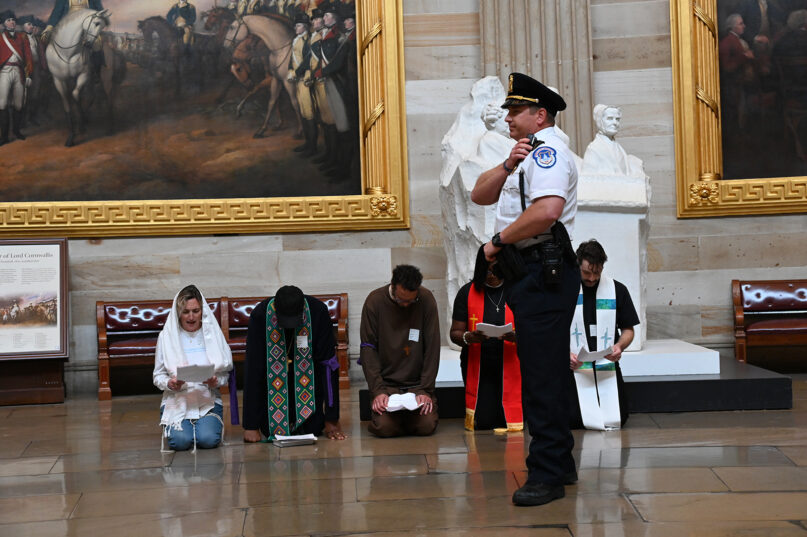
A group kneels in prayer in the Capitol Rotunda before being arrested, Monday, May 5, 2025, in Washington. (RNS photo/Jack Jenkins)

Police cleared the Capitol Rotunda to make the arrests but allowed press to continue documenting the scene as they placed the five people in handcuffs. At a similar protest a week before, press were steered into a section with a closed door and then instructed to leave the floor entirely.

In an email to RNS on Monday, Capitol Police confirmed they arrested five people after warning them multiple times, charging them with “crowding, obstructing, and incommoding.”

Reached by phone after he was released from police custody several hours after the demonstration, Claiborne said his interactions with officers were largely positive but he felt protest was necessary. He cited inspiration from the Rev. Martin Luther King, Jr.’s civil rights advocacy and argued the GOP-led budget constituted an emergency for the poor, comparing the legislation to an out-of-control fire.

“We think that these are extreme times, and they warrant extreme measures,” Claiborne said. “So we’re going to bear witness, non-violently.”

The demonstrators had initially approached the U.S. Capitol steps to stage their prayer, but police erected barricades as they approached and temporarily closed off the area on the east side of the Capitol.

The protest is the latest in an ongoing Monday protest effort launched last month by the Rev. William Barber, a prominent pastor, anti-poverty activist and founder of the Center for Public Theology and Public Policy at Yale Divinity School. The campaign is focused on countering the proposed Republican budget, with organizers protesting potential cuts to Medicaid and other programs designed to help low-income Americans.
RELATED: Trump signs executive order creating Religious Liberty Commission

Last week, Barber and two others were arrested while praying in the Rotunda.

“It is a sad day in America when you can be arrested in the people’s house for merely praying because the congresspeople in a party in that house are choosing to prey — P-R-E-Y — on the most vulnerable of this nation, along with the president of the nation,” Barber told RNS in a phone interview, referring to the latest arrests. “But we will not bow. We will not stop. We have to raise moral dissent.”

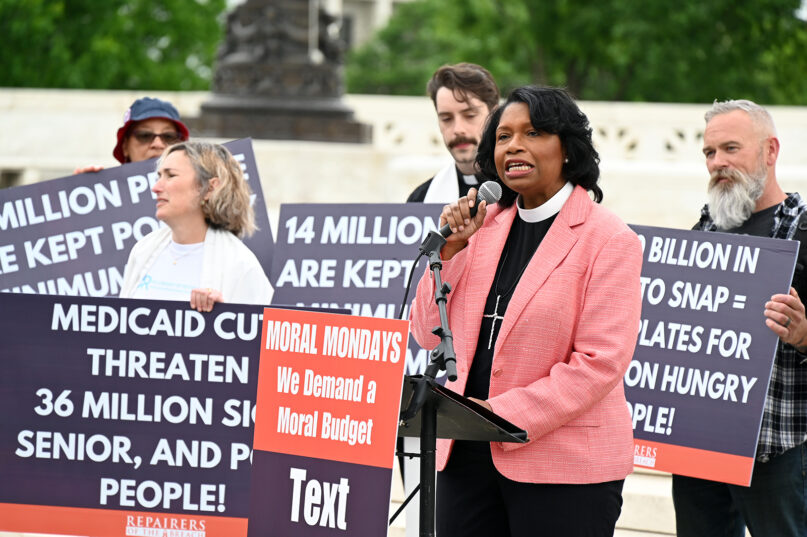
The Rev. Leslie Copeland-Tune speaks at a rally near the U.S. Supreme Court, Monday, May 5, 2025, in Washington. (RNS photo/Jack Jenkins)

The arrests both weeks followed rallies earlier in the day in front of the U.S. Supreme Court, where faith leaders repeatedly decried the bill.

“We are gathered here in front of the U.S. Supreme Court, and in the shadow of the Capitol, to stand up and to speak out about a federal budget that seems to have emerged like a phoenix from the very pit of hell,” said the Rev. Leslie Copeland-Tune, of the National Council of Churches, on May 5.

Claiborne also railed against the bill and criticized those who have invoked faith to defend President Donald Trump’s policies. He held up a version of the four biblical gospels that had all verses relating to the poor, love and compassion redacted to make his point.

“It’s called the Gospel of Donald Trump,” he said.

Organizers say they plan to continue the demonstrations over the next few weeks as Congress continues to debate the budget bill, which Trump has described as a “big, beautiful bill.”

Claiborne said even as he and the others sat in the back of a police van on Monday, the group was already planning future demonstrations.

“We were doing two hours of organizing with Rev. Alvin (Jackson) in there,” Claiborne said, laughing. “One less Zoom call.”

This story has been updated with comments from Claiborne and Barber.


US-backed group issues proposal to take over Gaza aid distribution from UN, reports claim

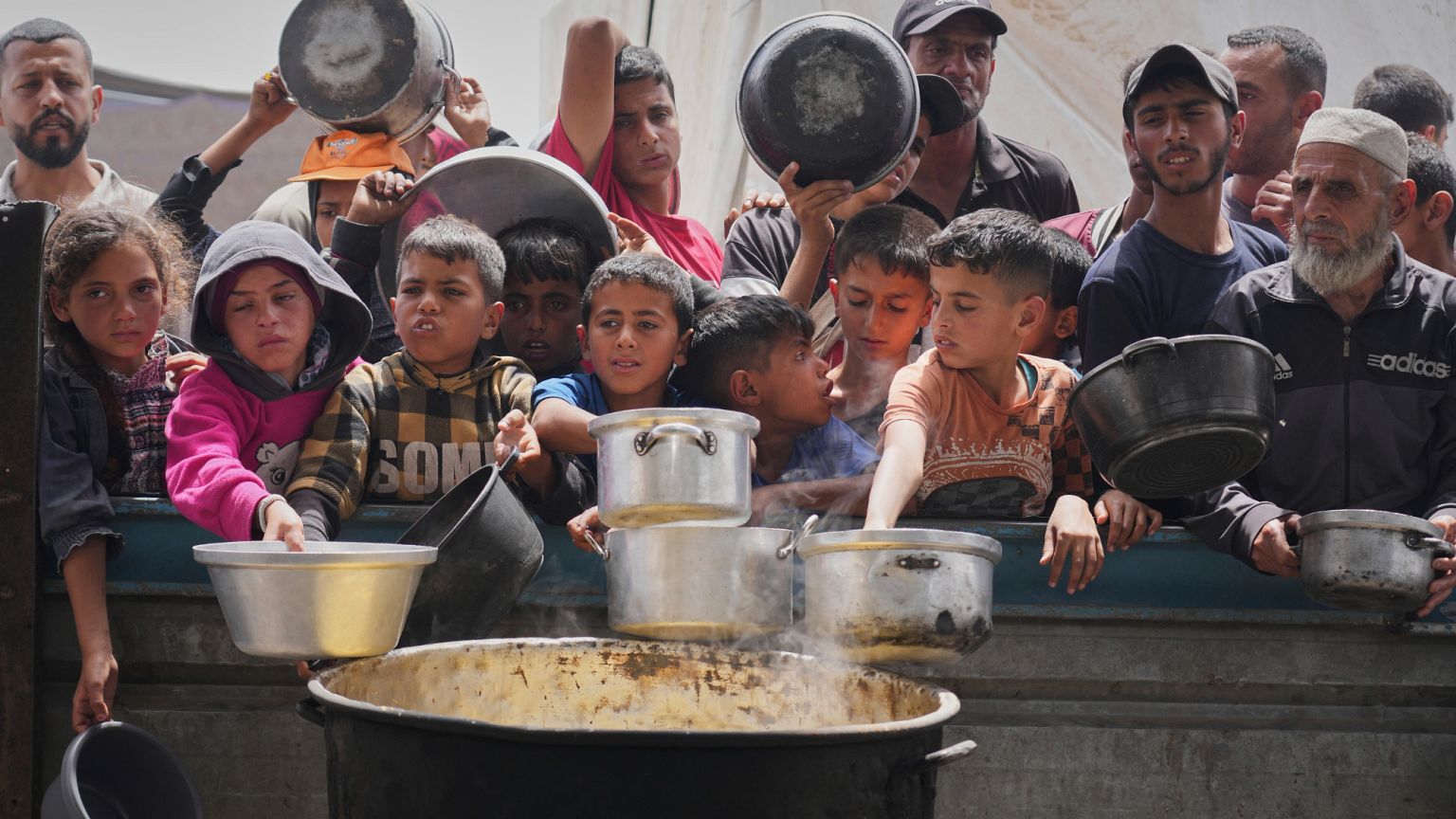
Aid workers have criticised the plans, saying the proposal can't meet the needs of Gaza's large population and would forcibly displace large numbers of Palestinians by forcing them to move nearer aid hubs.


Copyright AP Photo

By Gavin Blackburn with AP
Published on 09/05/2025 

A group of US security contractors, former military officers and humanitarian aid officials is proposing to take over the distribution of aid to Gaza based on plans similar to ones designed by Israel.


According to a proposal from the newly created group, the Gaza Humanitarian Foundation (GHF), obtained by AP, the idea is to implement a new aid distribution system supplanting the current one run by the UN and other international aid agencies.

The 14-page proposal circulated this week among aid groups and UN officials lays out plans similar to those Israel has been discussing privately with international aid groups for weeks.

Under the new group's proposal, Palestinians would receive pre-packaged rations, potable water, hygiene kits, blankets and other supplies at four distribution hubs under the protection of private security contractors.

The group said it wants to partner with the UN and international aid groups in handing out their supplies.

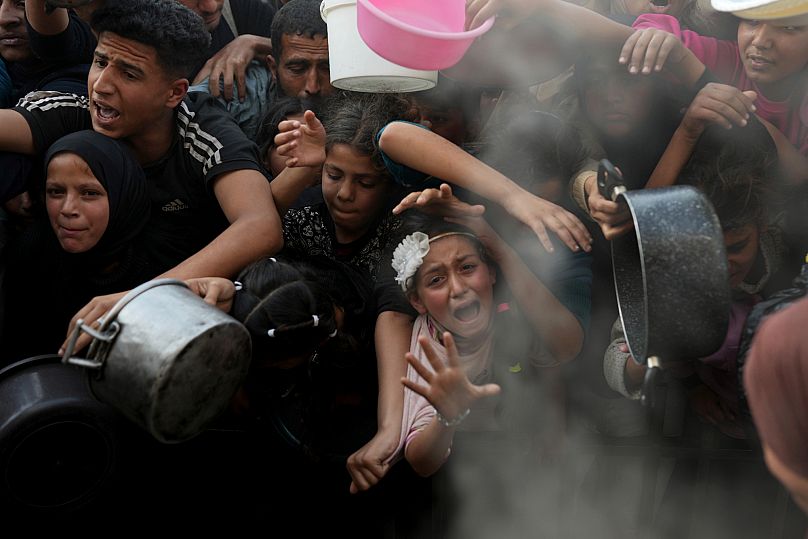
A Palestinian girl struggles as she and others try to get donated food at a distribution centre in Beit Lahiya, 16 March, 2025AP Photo

A US official confirmed the authenticity of the proposal and said David Beasley, the former director of the UN World Food Program, is the lead choice to run GHF.

The official, speaking on condition of anonymity to discuss plans that have not been made public, said the proposal could still be revised, and Beasley's role is not confirmed.

Israel has blocked food, fuel, medicine and all other supplies from entering Gaza for 10 weeks, worsening a humanitarian crisis for the 2.3 million Palestinians living in the enclave.

Officials say the aim of the blockade is to force Hamas militants to release the 59 hostages they still hold in Gaza.

Israel has also said it won't allow aid back into the Strip until a system is in place that gives it control over distribution.

A UN official said last week that Israel's plans would "weaponise aid" by placing restrictions on who is eligible to receive it.

Israel accuses Hamas and other militants of siphoning off large amounts of aid for personal gain and to strengthen their units. The UN and aid workers deny there is a significant diversion.

How would the proposal work?

According to the document, GHF would initially set up four distribution sites, each serving 300,000 people.

That would cover about half of Gaza's population. The system would be scaled up to meet the needs of 2 million people.

But the proposal does not provide a timeframe, and aid workers warn that food is rapidly running out in Gaza under Israel’s blockade.

The GHF proposal said subcontractors would use armoured vehicles to transport supplies from the Gaza border to distribution sites, where they would also provide security.

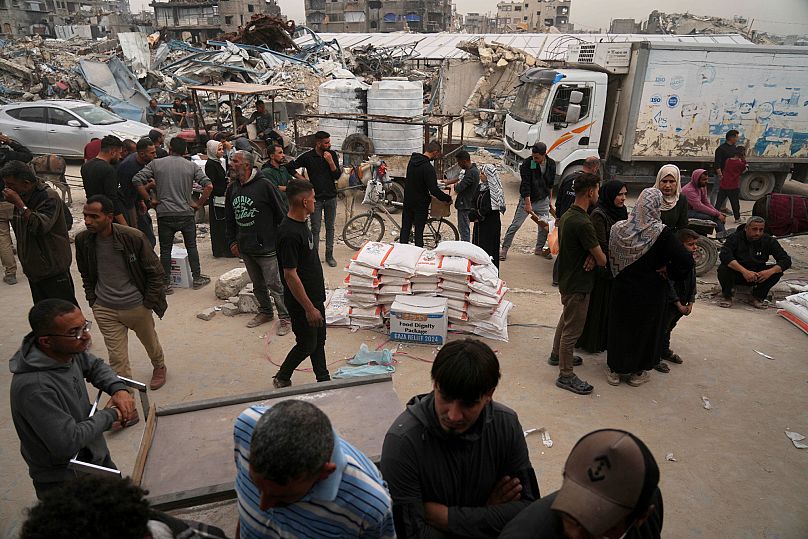
Palestinians receive bags of flour and other aid distributed by UNRWA in Jabaliya, 1 April, 2025AP Photo

It did not specify who would provide security but said it could include personnel who previously worked in the Netzarim Corridor, an Israeli-held zone cutting off northern Gaza.

A private logistics and operations company, Safe Reach Solutions, has operated in the corridor.

GHF said people would receive assistance based on need, with no eligibility requirements. Aid workers say Israel has said it intends to vet aid recipients and screen them using facial recognition.

What have aid groups said?

Aid workers have criticised the plans, saying the proposal could not possibly meet the needs of Gaza's large population and that they would forcibly displace large numbers of Palestinians by forcing them to move nearer to the aid hubs.

Throughout the Israel-Hamas war in Gaza, the UN and other humanitarian groups have been carrying out a massive aid delivery programme.

They have trucked in supplies and distributed them across the territory, going as close as possible to where Palestinians were located.

What has chiefly hampered the system, aid workers have said, are Israeli military operations and restrictions on movement, as well as the low amount of aid allowed to enter even before the blockade.

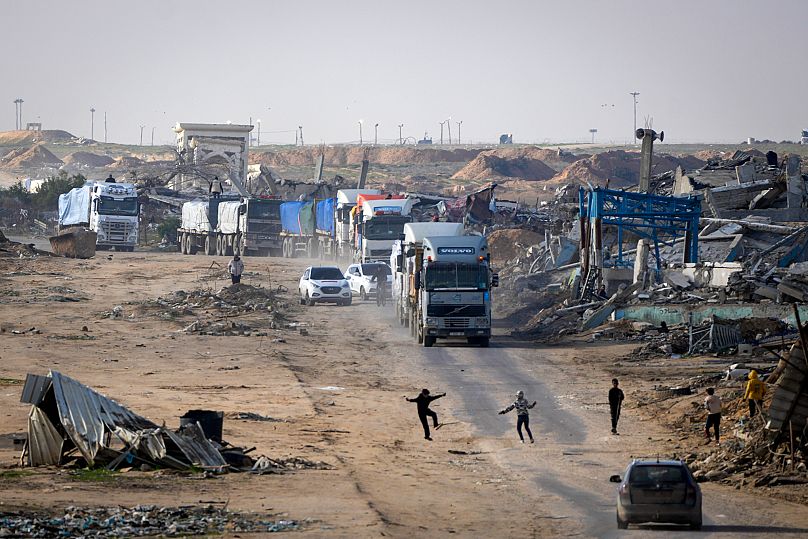
Trucks carrying humanitarian aid enter Gaza from Egypt in Rafah, 12 February, 2025
AP Photo

Convoys have also been attacked by criminal groups stealing aid, and Palestinians have sometimes taken supplies from trucks.

Aid workers have cast doubt on whether GHF would meet humanitarian requirements for neutrality and independence.

Shaina Low, communications adviser for Norwegian Refugee Council, one of the main organisations in Gaza, said aid groups are concerned the plan will be used "to advance military and political goals."

By forcing the population to relocate around aid hubs, the system would "depopulate entire parts of Gaza" and could be used to potentially expel the population, she said.

"They are framing (the plan) to fix the problem that doesn't really exist," she said, referring to Israel's claims that it must prevent Hamas from stealing aid.

Related

Israel says it's stopping all goods and aid from entering Gaza

The use of private security companies has also alarmed humanitarian workers. While it's common for private security firms to operate in conflict zones, they have to respect humanitarian law and, at minimum, be fully vetted and monitored, said Jamie Williamson, executive director of the International Code of Conduct Association.

Tamara Alrifai, communications director for the UN agency for Palestinian refugees, UNRWA, which has led the aid effort in Gaza, said the plan was logistically unworkable.

She said the foundation does not appear able to match the current infrastructure needed to distribute food and address other humanitarian needs.


Irish PM says Gaza is 'hell on earth'


Ireland's Taoiseach Micheál Martin called the situation in Gaza ‘hell on earth’. He told The Europe Conversation that Israel is committing war crimes, and criticised the EU’s lack of response. Food and medicine have been blocked from entering the besieged area for almost 60 days.

Martin has condemned what he described as Israel’s weaponisation of basic life necessities, referring to the country’s restriction on food and aid from entering the strip for almost two months. He told The Europe Conversation that this raises very significant issues for the European Union and the human rights laws which are central to the bloc's existence.

“In my view, this constitutes a war crime,” the Irish Prime Minister, who belongs to the Fianna Fáil party, said. “And I don't say that easily.”

He argued that he is in favour of a resolution, and wants the release of the hostages, stating it is “shocking to take people as hostages”. In November 2023, Martin visited a kibbutz where around 10% of the population was attacked during the 7 October attack by Hamas.

“I went to see, first hand, the impact of the horrific Hamas attack on Israel. I've condemned it from the outset when I went there to show empathy to people who have been attacked,” he said, adding that the hostages should have been released a long time ago.

He said however that the war waged in response has “lost any moral compass in terms of its unacceptable impact on the civilian population and on children”.

“And in Ireland, there is this sadness now and horror and a sense of helplessness at what we see on our TV screens: young children in stretchers and hospitals, very badly injured. Many families being wiped out, kids being orphaned. From a humanity point of view, it's beyond comprehension.”

The Taoiseach denounced what he called Israel’s “doubling down” in terms of intensification of the war on the ground. “I know that Israel would say, well, Hamas is in the hospitals and so forth. But children need basic access to medicine,” he said.

‘Hell on Earth’

Martin met with Ursula von der Leyen in Brussels on Thursday, discussing matters ranging from trade and support for Ukraine to the Middle East. During this meeting, the Taoiseach shared his concerns about the ongoing humanitarian crisis.

“I think the president heard clearly my perspective on it. And I think she understands where I'm coming from and where others are coming from,” Martin said.

“I anticipate that there will be a lot of thinking across Europe on this issue.” While he welcomed the European Union’s announcement of the recent €1.6 billion financial support package for Palestinians, Martin noted that, when it comes to a response, he doesn’t believe there is a consensus within the European Union.

“I acknowledge and I understand the different backgrounds of member states, and the historic background that has informed member states' approach to the Middle East,” he said.

“But there is an unacceptable level of death and destruction and displacement [in Gaza]. And it is, many people have said, going back to 2011, it's hell on earth.”

He argued that the EU has been quick to communicate its concerns to other countries around the world when they violate territorial integrity, adding that this is fundamental to the European Union and what it stands for.

Israel argued in the past that the restriction of aid is lawful and that Gaza still has enough available provisions.

Israeli foreign minister Gideon Sa'ar announced the closure of the Israeli embassy in Dublin in December last year due to what he described as the "extreme anti-Israel policy of the Irish government" which he characterised as "antisemitism".

Last month, Fine Gael - in coalition with Martin's Fianna Fáil - confirmed its delegates at the European People’s Party's Valencia congress refused to put their names to a motion condemning Hamas’ October 7, 2023 attacks in Israel and calling for the release of remaining hostages, and defended the party’s position. The Fine Gael delegation said it could not support the motion because it didn’t mention “the ongoing suffering of the people of Gaza", as reported.

Euronews has contacted the Israeli embassy in Brussels and the mission of Israel to the EU and NATO for a response.


The Netherlands pivots on Israel as it asks for EU-Israel trade deal review


Dutch Foreign Minister Caspar Veldkamp said his government is "drawing a line in the sand" over the Gaza humanitarian aid blockade, which he says goes against international humanitarian law.

The Netherlands is ramping up its pressure on Israel over its war on Hamas in Gaza in what appears to be a significant change in course for one of Israel's most loyal allies.

Dutch Foreign Minister Caspar Veldkamp said on Wednesday that Israel's ongoing blockade of humanitarian aid is in violation of international humanitarian law, and urged collective action from Brussels to review the EU-Israel trade deal.

"What we're doing here, is giving a very clear signal," Veldkamp said at the meeting of EU foreign ministers in Warsaw.

"We've drawn our line in the sand because the situation in Gaza Strip is dismal, it's a catastrophic humanitarian situation," he added.

Ahead of the meeting, Veldkamp had written a letter to EU foreign affairs chief Kaja Kallas urging a review of the EU-Israel trade deal, saying Israel is violating the association agreement.

The letter, seen by Euronews, states that Israel's "continued blockade of humanitarian aid and electricity supplies to the Gaza Strip" is "at odds with the provisional measures of the International Court of Justice."

Veldkamp also wrote that Israel's intended system to control all aid distribution in Gaza does not comply with humanitarian principles of "neutrality, impartiality and independence."

The Dutch proposal will be examined when EU foreign ministers next convene in Brussels on May 20, top diplomat Kaja Kallas confirmed on Thursday.

She added that further possible responses to Israel's plans to expand the war in Gaza would be “brainstormed.”

The EU-Israel Association Agreement governs trade ties between the two partners “shall be based on respect for human rights and democratic principles.”

The Dutch government intends to veto any agreement extension pending an EU review into Israel's compliance with the pact, which came into force in 2000.

The EU is Israel's largest trading partner, and the Netherlands has previously led initiatives to block discussions on suspending the association agreement.

It is some of the strongest language yet from the Dutch government against its ally, which has so far avoided outright accusing Israel of violating international law.

Pressure from aid organisations

The Dutch government had been on the receiving end of mounting pressure from local branches of international aid organisations to take a stronger stance against Israeli violence in Gaza.

Dutch Prime Minister Dick Schoof sat down with representatives of Oxfam Novib, Amnesty International, Pax, Save the Children and Doctors Without Borders last month, who had then expressed disappointment at the conversation's outcome.

"There is no red line for the government. They are holding onto the conviction that diplomatic pressure achieves more," Oxfam Novib director Michiel Servaes asid.

On Thursday, Schoof expressed support for Veldkamp's statements, saying they reflect government policy. He said Israel's announcement to expand its operations in Gaza and control the entire Strip was probably a factor that contributed to Veldkamp's decision to write to Kallas.

Still, the move was not without internal criticism. Geert Wilders of the hard-right PVV, the main coalition partner and the winner of the most recent national election, lashed out at Veldkamp on X, calling him a "weak minister".

Other foreign ministers present in Warsaw echoed Veldkamp's words.

Belgian Foreign Minister Maxime Prévot said, "it’s time for the European Union and the whole international community to wake up. Honestly, what we are seeing is an absolute shame. It’s not acceptable.”

Luxembourg Foreign Minister Xavier Bettel said he had spent much time in the region in recent months, but his pleas to Israel to show restraint have been in vain.

“I have the feeling they’re listening to no one. I fully understand they have pressure, and Hamas, and they still have hostages. But we have to be around to table to see how we can find solutions,” Bettel told reporters.

“We need to find a solution to that and not to give the impression to the Palestinians that at the end of the day, they won’t exist anymore,” he said.

The Israel-Hamas war began when Hamas militants attacked southern Israel on 7 October 2023, killing around 1,200 people, most of them civilians. Hamas took 251 people as hostages, and is currently holding 59, of whom 24 are believed to be alive.

A subsequent Israeli offensive has to date killed 52,400 Palestinians, mostly women and children, according to the Hamas-run Gaza health ministry whose figures do not distinguish between fighters and civilians.

The Israeli military says 850 of its soldiers have died since the start of the war.


Opinion

As attacks on Christians rise in Israel, Netanyahu's snub of Francis is a dangerous step

(RNS) — Even a perfunctory tweet from the Foreign Ministry was quickly deleted under pressure from far-right coalition members.


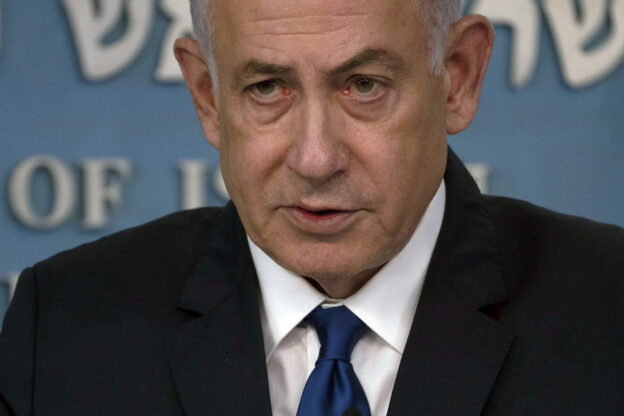
Israeli Prime Minister Benjamin Netanyahu delivers a speech in Jerusalem, March 17, 2024. (AP Photo/Leo Correa)

Daoud Kuttab
May 6, 2025

(RNS) — At a session of the Israeli Knesset’s Immigration, Absorption and Diaspora Affairs Committee on Monday (May 5), Aida Touma-Sliman, a Christian legislator from northern Israel, sounded the alarm about a disturbing pattern of harassment of Christians in the country. During Holy Week, many Christians from the West Bank were denied entry into Jerusalem, and on Holy Saturday, the eve of Easter, Israeli police prevented worshippers from reaching churches.


The disruptions were a continuation of a sharp increase in attacks against Christians documented in a March 2025 report by the Rossing Center for Education and Dialogue that showed rising incidents of violence: clergy spat on, church property vandalized, crosses desecrated and pilgrims harassed. In many cases, police were slow to respond — if they responded at all.

RELATED: Pope Francis will be remembered for fighting antisemitism

“If this country respects all religions,” Touma-Sliman said, “what is happening against Christian clergy should have caused a huge uproar and upended the country.”

Touma-Sliman also condemned the Israeli government’s glaring failure to recognize the death of Pope Francis. The government of Israeli Prime Minister Benjamin Netanyahu sent a lower-level aide to Francis’ funeral, along with the Israeli ambassador to the Holy See, while the leaders of some 130 other nations attended. The excuse given — that the funeral fell on the Jewish Sabbath — rang hollow, especially in light of the Israeli ambassador’s presence at the service.


The Israeli government sent only a bland, formal message of condolences on the day of Francis’ death, and even a perfunctory tweet from the Foreign Ministry was quickly deleted under pressure from far-right coalition members.

This relative silence, particularly from a nation that brands itself a defender of religious freedom, was not simply a diplomatic oversight. It was a calculated act of disrespect, and a concession to elements of Netanyahu’s coalition, many of whom revile the pope for his moral clarity, especially when it came to Palestinians. As Touma-Sliman warned, “It sends a dangerous message that encourages demented extremists to continue their attacks on religious sanctities.”


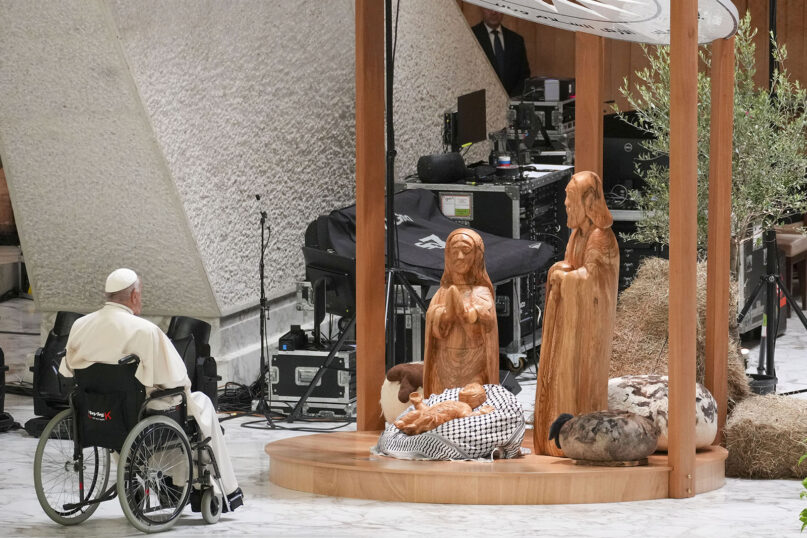
Pope Francis prays in front of a Nativity scene that was crafted in the West Bank city of Bethlehem, in the Paul VI Hall at the Vatican, Dec. 7, 2024. The Nativity scene caused controversy because it featured baby Jesus in a kaffiyeh. (AP Photo/Andrew Medichini)

From the beginning of the Gaza conflict, Francis called the congregants of the Holy Family Church in Gaza City, the only Catholic church in the strip, offering comfort to them as they sheltered against Israeli attacks on that city.

But he also offered solace to both Christians and Muslims enduring unimaginable devastation. At his final Christmas in St. Peter’s Square, he oversaw a Nativity Scene in which baby Jesus was wrapped in a Palestinian kaffiyeh — a quiet but powerful statement. In an extraordinary gesture of solidarity, the pope bequeathed his popemobile to Gaza so that it can be converted into an ambulance.


A solemn Mass was held at the Holy Family Church in Gaza City, and Christians and Muslims came to grieve a man they saw as a rare Western leader willing to speak truth to power. “A person who thinks only about building walls, and not building bridges,” he once said, “is not Christian. This is not in the gospel.”

While it might be argued that these very acts motivated Netanyahu to withhold proper recognition of Francis’ death, Netanyahu publicly expressed condolences for U.S. President Jimmy Carter, a sharp critic of Israeli policies.

Wadie Abu Nassar, a Catholic from Haifa and coordinator of the Forum of Christians in the Holy Land, called the government’s response to the pope’s death a betrayal: “He was the leader of the most important church in the world. … He has followers among people who are Israeli taxpayers. The man deserves some respect.”

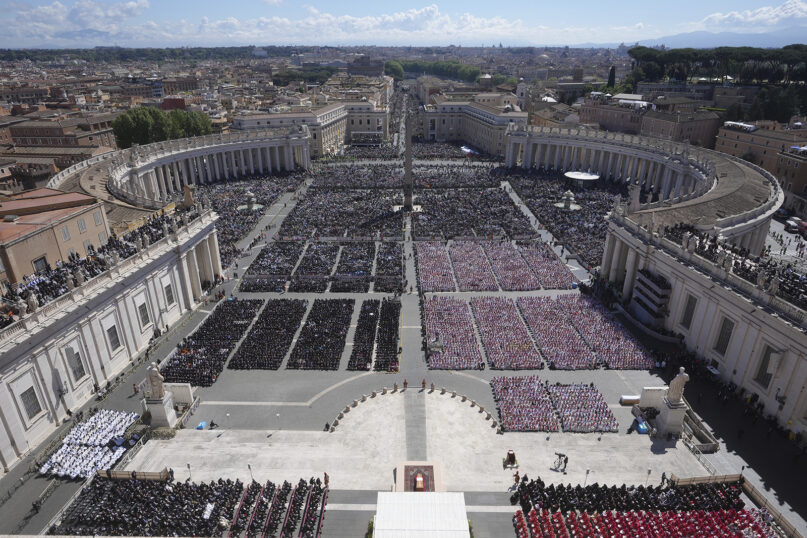
A view of the funeral of Pope Francis in St. Peter’s Square at the Vatican, April 26, 2025. (AP Photo/Alessandra Tarantino)

The silence is not just about the pope. The Israeli government’s refusal to protect its Christian citizens, who have built schools, hospitals and cultural institutions, is more than neglect. It is complicity. Netanyahu’s response is about a deeper moral erosion taking place as nationalism, religious identity and political expediency take precedence over shared citizenship.

Touma-Sliman on Monday demanded a clear national policy to combat religious hatred and racism in Israel, holding the police accountable for their role in fostering a culture of impunity. “The police must bear full responsibility for their violent, arbitrary practices and degrading behavior, especially during religious occasions,” she said.

But this is not an Israeli question alone. The global church and the world at large must not look away, but honor Francis by heeding his call: Demand peace, uphold dignity, and reject the normalization of hatred, whether against Palestinians or against the Christians trying to serve them.
RELATED: Charlie Kirk doesn’t feel safe in Bethlehem. It’s his worldview that’s to blame, not my city.

History will remember this moment. It will remember who stood for respect and who deleted it out of fear. It will remember which governments chose silence over truth, walls over bridges, and expedience over principle. It will remember Francis for how he lived: boldly, compassionately and unflinchingly on the side of the oppressed.

(Daoud Kuttab, an award-winning Palestinian journalist, is the author of “State of Palestine NOW” and the publisher of a website for Christians in Jordan and Palestine. Follow him on X @daoudkuttab. The views expressed in this commentary do not necessarily reflect those of RNS.)


Islam Beyond Phobia

Christian leaders love Francis' popemobile gesture, but not the people it will now serve

(RNS) — Faith leaders celebrate the repurposing of the popemobile but can’t bring themselves to call for a ceasefire.


Final work is being carried out to transform the popemobile used by Pope Francis during his 2014 Holy Land pilgrimage into a mobile health unit for Gaza. 
(Photo courtesy of Caritas Jerusalem)

Omar Suleiman
May 6, 2025


(RNS) — It is one of the most surreal images to emerge from the genocide in Gaza: The former popemobile, once the armored symbol of papal ceremony, reconfigured into a mobile health clinic. Once used to carry Pope Francis through cheering crowds, it is now meant to be packed with medical supplies and loaded onto a cargo ship, with the hope that it will reach Gaza and serve children trapped beneath siege.

If it makes it past the Israeli blockade — a blockade that has suffocated Gaza for nearly two decades — it will become a mobile clinic, equipped with oxygen tanks, medicine, and surgical tools for children who are bleeding, starving and surviving under conditions unimaginable to most of the world.

RELATED: Pope Francis the diplomat relied on personal encounters that had global reach

This was not a PR stunt. According to Vatican officials, this was one of the pontiff’s final wishes. In his last days, he asked that his vehicle be used not for spectacle, but for service. Especially in Gaza.


It is a powerful image. But the hypocrisy that surrounds it is even louder.

Western Christian leaders and commentators are applauding this gesture and showering the pope with praise, but some of the commentators celebrating the popemobile’s new purpose are the same ones who remained silent as tens of thousands of children were bombed and starved. Or worse, they cheered it on.

You cannot love the symbol and abandon the substance.


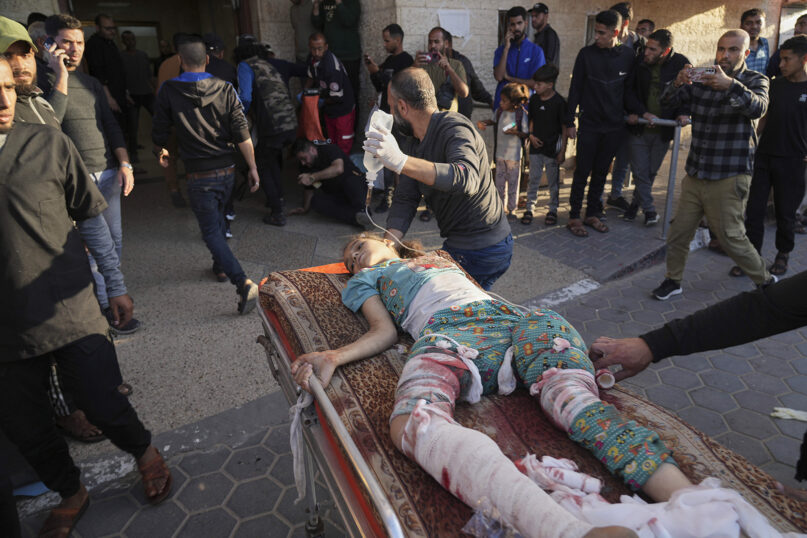
A Palestinian girl wounded in an Israeli airstrike on a school in Bureij refugee camp is brought to Al-Aqsa Martyrs Hospital in Deir al Balah, central Gaza Strip, on May 6, 2025. (AP Photo/Abdel Kareem Hana)

When Francis died, words like “humble,” “gentle,” “compassionate” echoed across official tributes. But missing from most of them was the one place he had spoken about more than almost any other in his final months: Gaza.

Francis called the siege “shameful.” He spoke daily with members of Gaza’s tiny Christian community. He condemned the killing of civilians, the starvation of children, the systematic destruction of homes, churches and hospitals. He didn’t tiptoe around Gaza. He embraced it.

But somehow, in the official remembrances, that part of his legacy is already being erased.

This silence is not new. But it is deeply telling.

In a recent conversation, the Rev. Munther Isaac, a Palestinian Christian leader from Bethlehem, spoke to me of the heartbreak of watching fellow Christians in the West remain silent, or worse, support the violence. He reminded us that solidarity is not seasonal and that the church’s failure to stand with the oppressed in Gaza will be remembered.

What does it say about a faith that celebrates the repurposing of the popemobile but can’t bring itself to call for a mere ceasefire? That mourns the suffering of the poor but justifies the mass killing of Palestinian children? That praises the pope’s compassion while ignoring his final message?

You cannot celebrate the legacy of Francis while erasing the people he wanted to be remembered with.


Pope Francis waves to people from his popemobile along the Copacabana beachfront as he arrives for the Stations of the Cross procession in Rio de Janeiro, July 26, 2013. (AP Photo/Andre Penner, File)

You cannot quote Jesus (peace be upon him) while ignoring those being crucified by bombs made in your country and dropped on civilians you refuse to name.

You cannot speak of a God who loves humanity while giving the religious language to the dehumanization that continues to further this genocide.

RELATED: Pope Francis encouraged Christian-Muslim dialogue and helped break down stereotypes

The popemobile now waits at the blockade — silent but loud in its witness. It stands as a symbol of rebuke to those who continue to betray their so-called prophetic witness for bankrupt political expediency.


If the vehicle makes it through, it will deliver not just supplies, but a statement. That the people of Gaza matter. That their lives are sacred. That their children deserve more than silence.


WHY FRANCIS SHOWED EMPATHY FOR LGBTQ PEOPLE


Religion Hub

Why ‘The Calling of Saint Matthew’ by Caravaggio was Pope Francis’ favorite painting − an art historian explains

(The Conversation) — The motto that Francis selected for his papacy, ‘looking at him with mercy, he chose him,’ was inspired by Caravaggio’s painting.


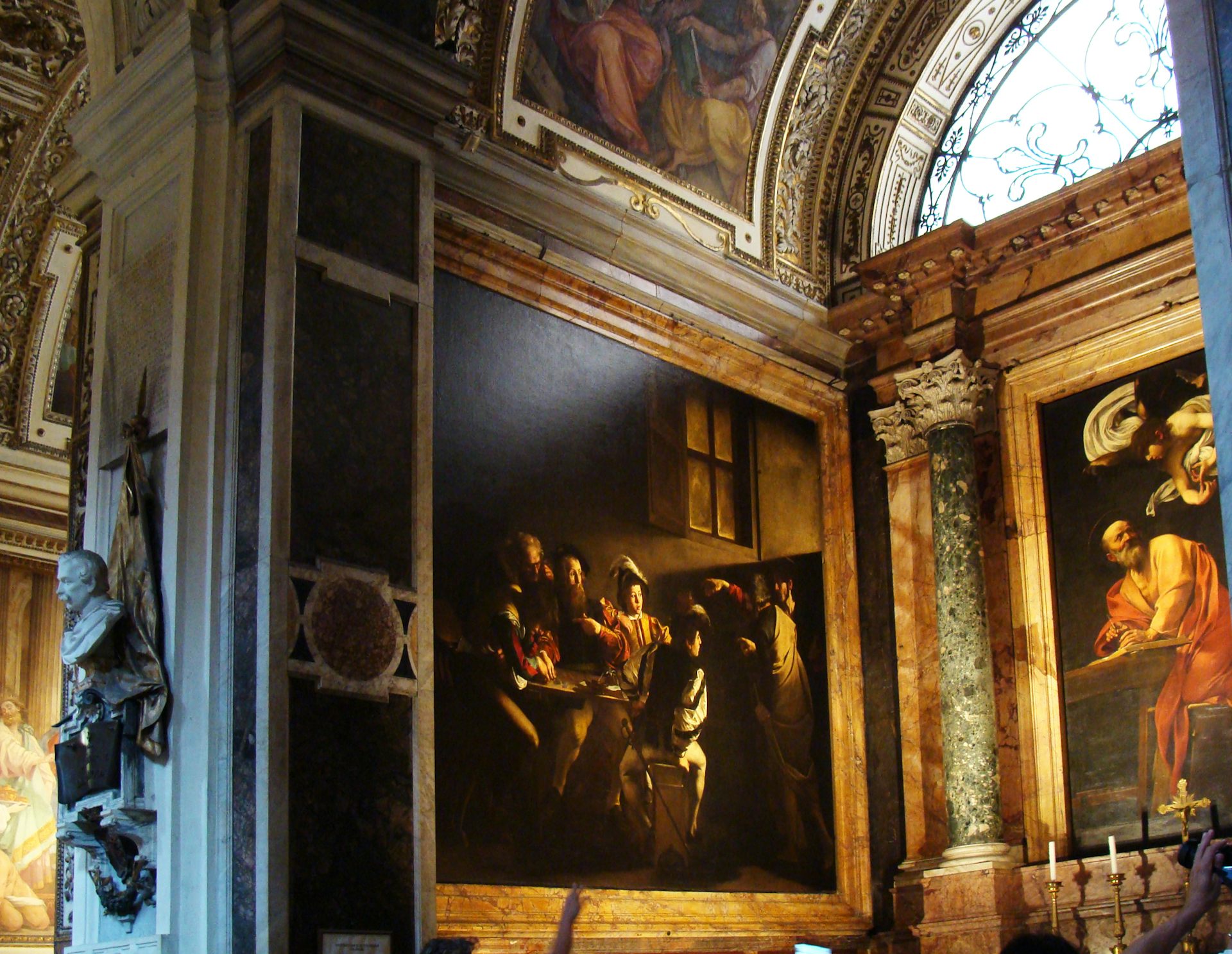
'Calling of Saint Matthew,' in Chapel San Luigi. (Virginia Raguin, CC BY)

Virginia Raguin
May 7, 2025


(The Conversation) — Pope Francis left a lasting legacy, not least his appreciation for art.
In his 2025 biography, “Hope,” Francis spoke of his admiration for the Baroque painter Caravaggio. He recalled that during his travels to Rome as a cardinal, he prayed in front of the painting by Caravaggio – “The Calling of Saint Matthew.”

The painting is found in the chapel dedicated to St. Matthew in the Church of San Luigi dei Francesi. The donor of the chapel was a French cardinal, Matthieu Cointerel, who died in 1585. This was the first commission for Michelangelo Merisi da Caravaggio, who was hired in July 1599. A year later, “The Calling of Saint Matthew” and “The Martyrdom of Saint Matthew,” depicting the beginning and the end of the apostle Matthew’s ministry, were installed.

The motto that Francis selected for his papacy, “miserando atque eligendo,” translated as “looking at him with mercy, he chose him,” is directly connected with this painting. The words “miserando atque eligendo” come from a sermon on the calling of Matthew written in the eighth century by the celebrated monk and historian Bede the Venerable. It is used in the readings for the Feast of St. Matthew on Sept. 21.

‘The Calling of Saint Matthew’

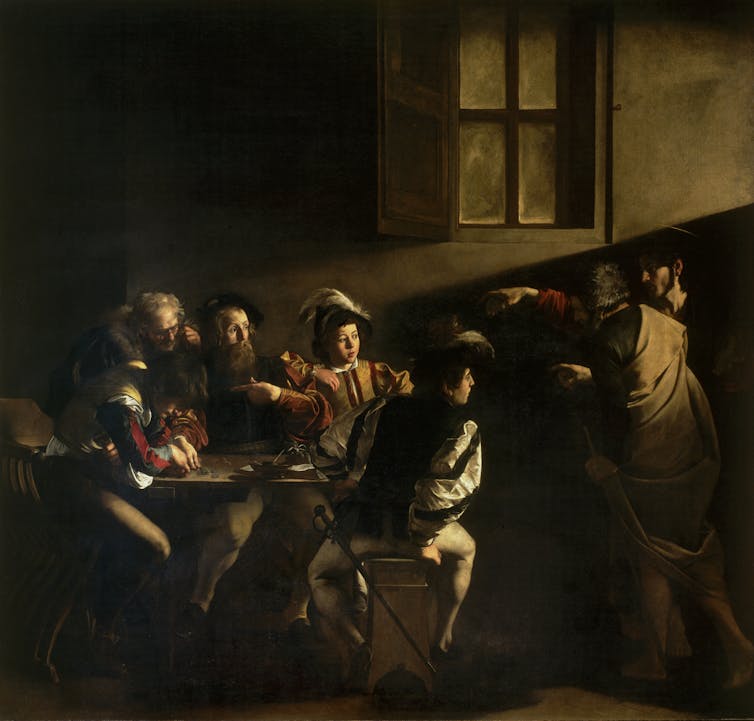
Matthew is described in the Bible as a tax collector, viewed at the time as a highly dubious occupation. In the painting, Christ enters the room from the right. We see only his silhouetted head and outstretched arm pointing in Matthew’s direction.

The ‘Calling of Saint Matthew,’ by Caravaggio.
Caravaggio via Wikimedia Commons

Light from the window behind Christ, which aligns with the actual light from the window in the chapel, falls on a group of men, including some handsome youths in fancy clothes, counting money. Matthew, the bearded man in the center, makes a gesture that suggests, “Who, me?”

Matthew became one of four disciples of Christ – along with Mark, Luke and John – whose accounts of Christ’s life, called Gospels, are included in the Bible.
Francis and Jesuit training

Francis’ thinking about this painting was shaped by his training as a Jesuit, a Catholic order that he entered in 1958. Jesuits practice something called a process of “discernment.” The painting represents God calling to Matthew to show him his will for the future, one that requires discernment. The founder of the order, Ignatius of Loyola, stressed a humble but vigorous effort to understand God’s will for each individual, as part of this process.

Ignatius’ own life demonstrated this search for God’s will. His initial career as a soldier ended when he was gravely wounded in the battle of Pamplona in 1521, permanently damaging his leg. He subsequently tried to follow the life of a hermit, meditating in solitude, and then tried to become a missionary to the Holy Land.

At the age of 33, he entered a university in order to become a priest, ultimately initiating the most influential transformation of religious education since the Middle Ages. Jesuits became a great teaching force, stressing individual study and debate over memorization. Ignatius was named a saint in 1622.

‘The Inspiration of St. Matthew’

Caravaggio’s ‘The Inspiration of St. Matthew.’
Gonzaloferjar via Wikimedia Commons, CC BY-SA

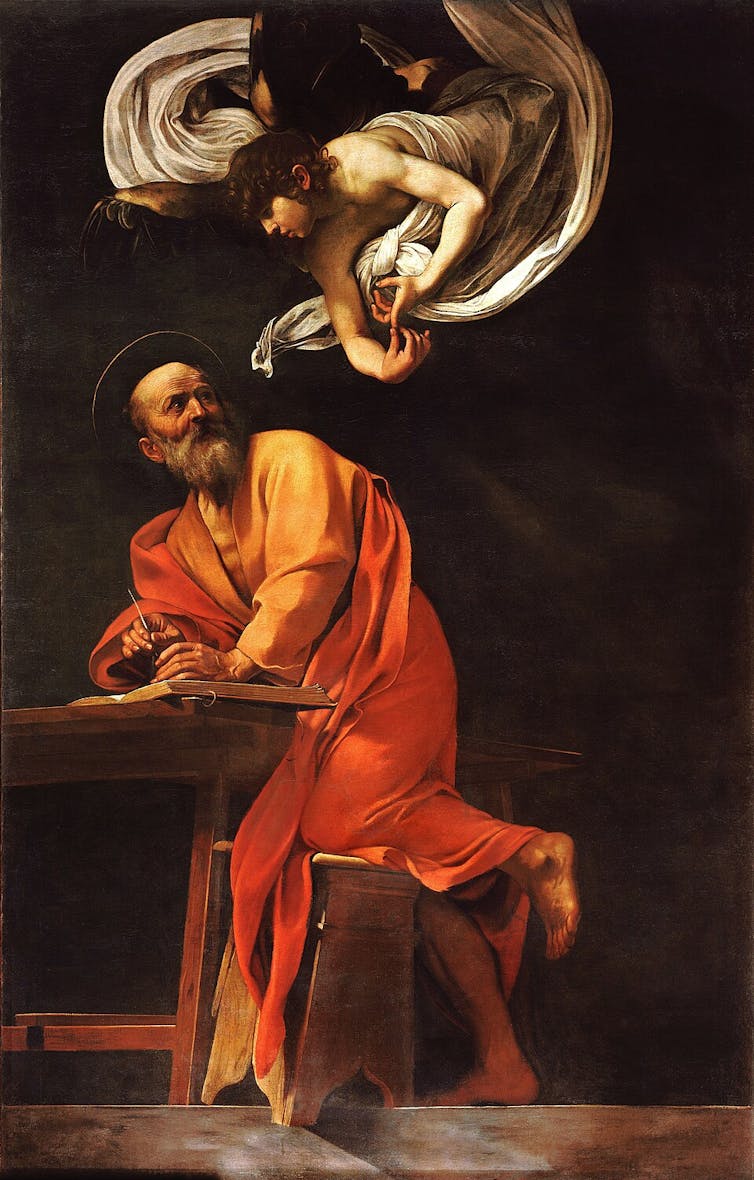
The central painting in the chapel, “Inspiration of Saint Matthew” is Caravaggio’s third painting, which was put in place in 1602. The patrons originally planned to install statues at the center, but upon their arrival they rejected the idea and commissioned Caravaggio instead. This painting also shows the saint searching to understand God’s directions.

In this painting, Matthew is in conversation with his symbol, a winged man. Each of the four evangelists are represented in art through symbols. The winged man symbol for Matthew refers to the beginning of his Gospel that records the genealogy of Christ.

The angel-like figure, resembling one of the young men depicted alongside the saint in Caravaggio’s “The Calling of St. Matthew,” appears to hold his left index finger with his right hand, as if to signal that this is the first and most important point. Matthew seems careworn, even distracted, struggling to write while leaning his knee on a bench.

Francis remarked in his biography that Caravaggio increased viewers’ empathy by using “contemporary figures from the artist’s own time.” The figures in the painting are dressed in clothes worn in Italy in the late 16th century, so that the viewers in Caravaggio’s time could see themselves in the painting.

Viewers come to art with different perspectives derived from their own experiences and challenges. Francis, too, connected to art through his own experiences.

(Virginia Raguin, Distinguished Professor of Humanities Emerita, College of the Holy Cross. The views expressed in this commentary do not necessarily reflect those of Religion News Service.)


The Conversation religion coverage receives support through the AP’s collaboration with The Conversation US, with funding from Lilly Endowment Inc. The Conversation is solely responsible for this content.
New pope warns against materialism in his first mass

Story by DPA International
• 1d •

The newly elected Pope Leo XIV (C), the American Robert Prevost, appears on the balcony of St. Peter's Basilica in the Vatican after the Papal Conclave. Oliver Weiken/dpa© DPA International

In his first mass as the new leader of the Catholic Church on Friday, Pope Leo XIV warned materialism and cautioned that losing one's faith can have "dramatic side effects."

These include finding that "the meaning of life is lost, mercy is forgotten, human dignity is violated in the most dramatic ways, the crisis of the family and many other wounds from which our society is suffering significantly," he said, speaking in Italian.

The comments came one day after Cardinal Robert Francis Prevost was announced as the first US pontiff, with white smoke emerging from the Sistine Chapel chimney after four rounds of voting in the papal conclave.

Now Pope Leo XIV, he presided over the first mass as leader of the world's 1.4 billion Catholics on Friday morning, flanked by cardinals in the Vatican's Sistine Chapel.

Leo was clad in a long white robe and wearing a traditional mitre. He wore dark shoes, not the red shoes worn by many previous popes, which his predecessor Francis had also eschewed.

The 69-year-old said faith is regarded as something "absurd," as something for "weak and unintelligent people."

Faith is often replaced by other things such as technology, money, success, power and pleasure, he said.

He added that the figure of Jesus Christ is often seen merely as a "charismatic leader or superhuman." This, he said, was effectively a form of atheism.


Related video: Pope Leo XIV holds first mass as leader of the Catholic Church (cbc.ca)

US pope considered a centrist

Chicago-born Leo, 267th pontiff in two millennia of Church history, is considered a centrist who does not shy away from criticizing politics. US President Donald Trump was among the first to congratulate him, calling it a "great honor" for the United States.

However Prevost had repeatedly criticized the policies of the Trump administration. Before his appointment as a cardinal, he spent many years as a missionary and bishop in Peru, where he also holds citizenship.

There is much anticipation about whether he will continue the cautious reform course of the Argentinian Francis - or be deferential to conservative cardinals who want a more traditional direction. In Europe, the Catholic Church has recently seen a significant decline in membership, driven by numerous abuse scandals. However, the number of Catholics is growing on other continents.

No immediate changes

Leo has decided to temporarily keep the current heads of the Vatican's key offices and institutions in their positions, the Holy See said on Friday. He has also not yet decided whether he will reside in the Apostolic Palace like previous popes. Francis lived for 12 years in a relatively modest apartment in the Vatican guesthouse Santa Marta.

Reactions keep coming

Following his Thursday's election, congratulations poured in from around the world and the well wishes continued on Friday.

"I believe we have found the right candidate," German Cardinal Rainer Maria Woelki told Domradio, a German-Catholic broadcaster based in Cologne, where Woelki is archbishop. He was one of three German cardinals eligible to vote.

Woelki pointed out Leo's extensive pastoral experience in Peru, saying the new pope is therefore familiar with different worlds and can be "a bridge builder."


Woelki said Leo's election after only four rounds of voting is "a very good indicator" that the Church hierarchy is behind him.

"There are not the major divisions and differences that were being talked about."

In Moscow, the Russian Foreign Ministry hopes Russia's exchange with the Vatican will continue under the new pope.

"We value the constructive cooperation with the Vatican in resolving a number of humanitarian issues in the context of the conflict in Ukraine," the ministry said in a statement published on its website.

The relationship is based on a mutual commitment to "traditional spiritual and moral values" and a similar approach to issues of global development and the establishment of a just world order, the Russian ministry said.

Leo's predecessor, pope Francis had repeatedly called for peace in Ukraine, which Russia invaded more than three years ago.

In March, the former pontiff said the underdog, meaning Ukraine, must have the courage to negotiate, a statement that drew criticism worldwide, as some saw it as suggesting Kiev capitulate.

Relations between Russian Orthodox Church and the Catholic one have not always been smooth, with the Russian Church accusing Catholics of trying to proselytize Russians for years.

In 2016, the first ever meeting was held between the Patriarch of the Russian Orthodox Church, Kirill I and Francis, the pope then.

Busy days ahead

The new pontiff has a packed schedule for the coming days, including an expected appearance at around midday on Sunday on the balcony of St Peter's Basilica for the traditional Regina Coeli prayer.

Pope Leo is to be inaugurated on May 18 with a mass in St Peter's Square, the Vatican said later, in a ceremony due to take place at 10 am (0800 GMT) next Sunday in the Vatican. The first of his weekly general audiences is planned for May 21.


Pope Leo XIV says choice of name reflects social commitment


By AFP
May 10, 2025


Pope Leo XIV addressed cardinals two days after being elected the 267th leader of the Catholic Church - Copyright AFP Money SHARMA

Pope Leo XIV said Saturday he intended to follow his predecessor’s path as pontiff, praising Francis’s “complete dedication to service” and explaining his name choice reflected a commitment to social causes, according to the Vatican.

Addressing a meeting of cardinals two days after being elected the 267th pope, Chicago-born Robert Francis Prevost said a pontiff was “a humble servant of God and of his brothers and sisters, and nothing more than this”.

Describing himself as Saint Peter’s “unworthy Successor” in one of his first addresses as pontiff, Leo praised Francis’s dedication “to (the) sober simplicity of life”.

“Let us take up this precious legacy and continue on the journey, inspired by the same hope that is born of faith,” he said, according to a transcript of his speech to the College of Cardinals published by the Vatican.

The first leader of the world’s 1.4 billion Catholics to come from the United States, the new pope also said he chose to be called Leo XIV as a homage to Leo XIII, a 19th-century pontiff who defended workers’ rights.

“I chose to take the name Leo XIV” because his late namesake “addressed the social question in the context of the first great Industrial Revolution”.

Today, the Church’s social teaching is needed “in response to another Industrial Revolution and to developments in the field of artificial intelligence that pose new challenges for the defence of human dignity, justice and labour,” Leo added.

In his first homily as pope Friday, Leo urged the Church to restore the faith of millions, warning that a lack of faith often went hand-in-hand with “the loss of meaning in life, the neglect of mercy, appalling violations of human dignity, the crisis of the family and so many other wounds that afflict our society.”

The Augustinian, who was made cardinal by Francis in 2023, it not a globally recognised figure although he had been on many Vatican watchers’ lists of potential popes ahead of the conclave.

Over the coming days his actions and words will be closely scrutinised.

On Sunday, he will address the faithful once again from the balcony of St Peter’s Basilica, giving the Regina Coeli prayer.

He plans to meet with foreign diplomats to the Vatican next week and on May 18 he will preside over his inauguration mass at St Peter’s Square, which is expected to draw world leaders and thousands of pilgrims.


‘You’re gonna be the Pope,’ Leo XIV’s brother recalls telling him

By AFP
May 9, 2025


Louis Prevost, brother of newly elected Pope Leo XIV, Robert Prevost, thinks his brother's papacy will be able to unite the Catholic Church, attract more faithful and make the world a more peaceful place - Copyright AFP CHANDAN KHANNA

Gerard MARTINEZ

Louis Prevost is still reckoning with what just happened in his family.

His little brother, Robert Francis Prevost, is now Pope Leo XIV, the first American pope in the Catholic Church’s history, an incredible fate for a boy from Chicago who dreamt of becoming a priest.

“We knew from a very early time, maybe when he was five or six, he was going to be a priest. There was no doubt in my mind,” Prevost, 73, told AFP from his home in Port Charlotte, Florida.

“When we played games, as kids, he liked to play priest a lot. I thought: ‘what the heck? Priest?’

“He bought Necco wafers, little candy discs, and he’d pretend those were communion and give it to all our friends the yard,” Prevost recounted with a smile.

“We were teasing him when he was six years old: ‘you’re gonna be the Pope.’ And he didn’t like that.”

On Thursday, after white smoke billowed out of the chimney of the Sistine Chapel, Prevost recalled feeling nervous because he felt the cardinal chosen to be pope would be his brother.

He turned on the TV, trying to calm down during the prolonged wait got the announcement.

When Cardinal Dominique Mamberti said his brother’s name at the Vatican, Prevost burst with joy.

“I was in the bed, sitting down. It’s good thing I was because I probably would have fallen over,” Prevost said.

“When I thought: ‘My brother’s the Pope. You’re kidding me.’ My mind was blown out of this world, it was crazy, ridiculous. So excited.”

– ‘Out of reach’ –

Now with the initial excitement subsiding, he is left wondering how his youngest brother’s new role might affect their personal relationship.

“This could be bad for the family. Will we ever see him again? Will we ever get to talk to him like brothers again? Or will it have to be all official? How are you Holy Father, blah, blah, blah. It opens up a lot of questions,” Prevost said.

“He’s still there, but he’s out of reach. We can’t just pick up the phone and call him. Now it’s got to be really special when you get to call the Pope,” he added.

Prevost hopes his other brother, John, will be able to give him some answers when he visits Rome from their hometown of Chicago.

He thinks his brother’s papacy will be able to unite the Catholic Church, attract more faithful and make the world a more peaceful place.

“Whether he has the ability to settle, like the Gaza thing or the Russia and Ukraine conflict, who knows? But I’ve seen him take two warring parties and make peace in five minutes between them,” Prevost said. “He’s got a gift to communicate to people and make them open their eyes.”

He also hopes having an American pope will revitalize the Catholic Church in the United States.

“When he comes to America, he’s going to speak English, not Latin or Spanish or Italian,” Prevost said.

“People will understand what he’s saying. They’ll see him, they’ll realize he’s one of us.”