Saturday, May 10, 2025


Abortion Abolitionists All-Out Campaign to Ban Mifepristone


Rolling Thunder

A fifteen panel cartoon called 'A Brief Taxonomy of Pro-Lifers.' Description and transcript at https://www.patreon.com/posts/brief-taxonomy-70493654 .

Operation Rolling Thunder was a sustained U.S. bombing campaign over Vietnam. The Rolling Thunder Revue was a 1975–76 madcap concert tour headed by Bob Dylan, featuring  extraordinary musicians and collaborators. Now, there’s a new “Rolling Thunder”; a maximalist anti-abortion campaign aimed at pressuring the Trump administration, the FDA, Congress and the courts to ban the use of mifepristone. To bolster their claims against mifepristone, abolitionists have latched on to a new non-peer-reviewed highly questionable study by a conservative think tank.

During the Presidential campaign, Trump juked and jived on his position on abortion access as seven states passed measures to enshrine abortion rights and several others, including red Kansas blocked efforts to restrict existing access. Now the Administration must balance the real-politique of the upcoming mid-term elections with the zeal of the anti-abortion coalition.

The question remains as to whether abortion abolitionists can prevail over the will of the majority of women and men who support access to abortion.

Restricting and ultimately banning access to medication abortion has been a longtime goal of the conservative movement. According to the Guttmacher Institute, The Heritage Foundation’s Project 2025, the playbook for the Trump administration, advocated “reinstating medically unnecessary restrictions on mifepristone that require in-person dispensing and limit who can prescribe and receive the medication.

“By effectively ending telehealth provision of the method, these restrictions would limit access to the method for anyone who faces barriers to reaching a brick-and-mortar clinic, including individuals receiving telehealth care (under the protection of shield laws) in states where abortion is banned.”

Project 2025 “also recommends revoking mifepristone’s US Food and Drug Administration (FDA) approval, which would remove the drug from the market entirely.”

Politico’s Alice Miranda Ollstein recently reported that, “While the Trump administration paid little attention to the medication in its first months in office, and even filed a court brief to preserve access, the activists are counting on a report from the conservative think tank Ethics and Public Policy Center to light a fire under those in power.”

Ollstein further notes that “Mifepristone, one of two drugs used in roughly two-thirds of all abortions in the U.S., is a longtime target of conservative activists who consider it the primary driver of the increase in abortions since Roe’s fall in 2022 and the method millions of women are using to circumvent state bans”

According to the Ethics and Public Policy Center report:

  • This largest-known study of the abortion pill is based on analysis of data from an all-payer insurance claims database that includes 865,727 prescribed mifepristone abortions from 2017 to 2023.
  • 10.93 percent of women experience sepsis, infection, hemorrhaging, or another serious adverse event within 45 days following a mifepristone abortion.
  • The real-world rate of serious adverse events following mifepristone abortions is at least 22 times as high as the summary figure of “less than 0.5 percent” in clinical trials reported on the drug label.
  • The FDA should immediately reinstate its earlier, stronger patient safety protocols to ensure physician responsibility for women who take mifepristone under their care, as well as mandate full reporting of its side effects.
  • The FDA should further investigate the harm mifepristone causes to women and, based on objective safety criteria, reconsider its approval altogether.

Health Secretary Robert F. Kennedy Jr. and FDA chief Marty Makary — have already expressed openness to re-examining the pills’ safety and efficacy. The Guardian reported that “Last month, Makary told the Semafor World Economy Summit that he had ‘no plans to take action’ on mifepristone. However, he added: ‘There is an ongoing set of data that is coming into the FDA on mifepristone. So if the data suggests something or tells us that there’s a real signal, we can’t promise we’re not going to act on that data.’”

While Ollstein pointed out that “Medical experts and abortion-right supporters say it exaggerates the danger of a medication that more than 100 scientific studies have found are safe and effective,”

Anti-abortion activists are treating the Ethics and Public Policy Center report as if receiving manna from heaven. “One of the things that we have the ability to do now with this data is to pressure the FDA and lawmakers to reconsider, if not suspend, their approval of this medication until they can do more research into it,” Maria Baer, a podcast host for the Colson Center for Christian Worldview, said on a private Zoom call last week where anti-abortion leaders discussed the strategy. The groups on the call included Susan B. Anthony Pro-Life America, Americans United for Life, the Ethics and Public Policy Center, Students for Life and Live Action.

Abortion-rights supporters are calling the report “junk science,” maintaining, according to Ollstein, “that the paper was released directly by the conservative think tank and not published in a medical journal where it would have been vetted by outside experts in the peer review process.” Ollstein argues that, “Medical experts and abortion-right supporters say it exaggerates the danger of a medication that more than 100 scientific studies have found are safe and effective.”

“Activists on the Zoom call pushed back on those criticisms, arguing that academia is ‘broken’ and they couldn’t trust the peer reviewers not to leak or ‘sabotage’ their effort.”

As the Guardian recently reported, “So far this year, lawmakers in at least 12 states have introduced legislation that would treat fetuses as people and leave women who have abortions vulnerable to being charged with homicide – a charge that, in several of these states, carries the death penalty.”

Abortion abolitionists will not be satisfied until all abortions are illegal, abortion pills banned, doctors punished for performing abortions, women stigmatized and criminalized for having abortions, and anyone daring to help a woman get an abortion is punished severely.

In a move that is surprising on the surface, on May 5, Trump Justice Department lawyers asked a federal judge to dismiss a lawsuit aimed at restricting access to the abortion pill mifepristone on technical jurisdictional grounds.

Quoted in the NY Times, Mary Ziegler, a law professor and abortion law expert at the University of California, Davis, said that “the Trump administration’s action to dismiss the case is surprising, but I think the best way to read it is that they’re just buying time to figure out what to do about mifepristone.” …She said the filing “avoids saying anything on the substance at all,” and might reflect cautiousness before the mid-term elections.

Rolling Thunder is a blending of legal effort with political muscle, aiming not just to defund Planned Parenthood and close clinics, but to eliminate the most accessible form of abortion care altogether. If successful, it could further fragment reproductive rights across the U.S., deepening the divide between states that protect abortion access and those that seek to eliminate it entirely.


Bill Berkowitz is a longtime observer of the conservative movement. Gale Bataille is a long time activist, social worker and mental health director for Solano and San Mateo counties. Read other articles by Bill Berkowitz and Gale Bataille.


AI is a Perfect Storm Threatening Humanity

AI is a perfect storm threatening humanity
©  Getty Images/XH4D

The global economy was already navigating a minefield of volatility, uncertainty, complexity, and ambiguity (VUCA) when US President Donald J. Trump’s ‘Liberation Day’ tariffs reverberated across international markets. This aggressive escalation of trade barriers, including a mélange of sudden rate hikes, retaliatory measures, and rhetorical brinkmanship, didn’t just amplify the chaos; it ignited the specter of a full-blown economic firestorm.

Volatility unleashed

The moment the tariffs were announced, markets convulsed. Stock indices plummeted, erasing $2.1 trillion in global market cap within days, while currency markets whipsawed as traders scrambled to price in the fallout. Supply chains, still reeling from pandemic-era disruptions, faced new shocks. Factories in Vietnam scrambled to reroute shipments, German automakers recalculated production costs overnight, and Chinese exporters braced for 145% retaliatory duties on key goods. The tariffs acted like a sledgehammer to an already teetering Jenga tower of global trade, with each blow amplifying volatility far beyond their intended targets.

Uncertainty weaponized

While volatility reigned, the tariff war between the United States and China introduced a deeper, more corrosive uncertainty. Businesses accustomed to stable trade rules now faced policy seesaws. Exemptions granted one day were revoked almost overnight while the constant threat of broader tariffs were dangled without clarity on timing or scope.

CEOs delayed investments, fearing sudden cost hikes. The Federal Reserve, already grappling with inflation, found itself trapped in a Catch-22 situation: raise rates to tame inflation and risk recession, or hold steady and watch confidence erode. Meanwhile, allies like the EU and Canada retaliated with precision strikes on politically sensitive US exports, ranging from bourbon to motorcycles, threatening 2.6 million American jobs at one point. The potential unemployment tallies just kept rising worldwide.

The message was clear: no one was safe from the fallout.

Gulf AI giant moves into US amid tech rivalry – FT

Complexity spirals out of control

As the trade war escalated, the global economic order began to fracture. Nations abandoned decades of multilateralism in favor of ad hoc alliances. China fast-tracked deals with the EU and ASEAN and began to court rivals Japan and India. The US, on the other hand, found itself isolated. Companies, desperate to adapt, began planning redundant supply chains – one for tariff-free markets and another for the US. This only served as a costly and inefficient hedge against further disruptions. Regulatory labyrinths simultaneously emerged overnight. A single auto part might now face several different tariff rates depending on its origin, destination, and material composition. The system now groaned under the weight of its runaway complexity.

Ambiguity: Strategy or stumbling block?

Worst of all was the ambiguity. Trump framed the tariffs as a “negotiating tool” to revive US manufacturing, yet no coherent industrial policy followed. Were these temporary measures or a permanent decoupling from China? Would they actually bring jobs back, or simply raise prices for consumers? The administration’s mixed signals left allies questioning America’s reliability and adversaries probing for weakness. Geopolitically, the tariffs accelerated a crisis of trust. NATO allies doubted US commitments, Southeast Asian nations hedged toward Beijing, and the Global South explored alternatives to the dollar. The longer the ambiguity persisted, the more the world adapted to a reality where the US was no longer the anchor of the global economy.

What makes these tariffs uniquely dangerous is their role as a VUCA multiplier. They don’t just create volatility – they lock it in. Uncertainty doesn’t subside – it metastasizes. Complexity isn’t resolved – it becomes the new normal. And ambiguity isn’t clarified – it is weaponized. The result is a self-reinforcing cycle: tariffs provoke retaliation, which fuels inflation, which strains central banks, which spooks investors, which forces more protectionism. Meanwhile, the dollar’s dominance erodes, supply chains Balkanize, and businesses lose faith in long-term planning.

AI as the VUCA force multiplier

When the first round of tariffs was imposed by Washington DC, traditional economic models anticipated familiar disruptions in the form of market corrections, supply chain adjustments, and eventual equilibrium. What these models missed was the presence of a new wildcard – AI systems that don’t just respond to volatility but can amplify it. Algorithmic trading platforms and predictive logistics tools, operating on assumptions of continuity, struggled to adapt to the sudden, chaotic shifts introduced by trade barriers. In some sectors, this has led to mismatches between inventory and demand, not because of human misjudgement, but due to machine learning models which are ill-equipped to handle the cascading effects of cross-sectoral VUCA.

AI is indeed accelerating the fragmentation of the global economic order. As nations implement competing AI systems to manage trade flows, we may see the emergence of parallel digital realities. One country’s customs AI might classify a product as tariff-free while another’s system slaps it with prohibitive duties. This isn’t just bureaucratic confusion; it represents the breakdown of shared frameworks that have enabled global commerce for decades. We used to worry about trade wars between nations; now we should worry about conflicts between the machines built to manage them. In a hypothetical future, trade wars will be fought by rival AI systems fighting proxy battles through markets, logistics, and information. Personally, I doubt this planet has scope for another crisis beyond this one, as Albert Einstein’s adage that WW4 will be fought with sticks and stones  comes to mind.

In the midst of the ongoing VUCA torrent, many clueless bureaucrats and executives have quietly turned to AI, particularly GPTs, to make sense of the myriad crises facing their nations and institutions. Many flawed decisions may have been made and sums allocated for “future-proofing.” Let me tell you why this is a recipe for disaster: one prominent GPT model gave me not one but five (5) erroneous and wholly-fictitious examples of how AI had messed up the post-Liberation Day geo-economic landscape. And here is the scary part: only those well-versed in complex systems, global risks and AI would have discerned those flaws. Otherwise, the scenarios generated by the GPT model were generally more accurate than most of those voiced by pundits on prime time television.

Why did the GPT model make such mistakes? I am convinced that AI is being surreptitiously used to sift out the gullible from the indispensable, perhaps in preparation for a post-VUCA world. But that remains a relatively optimistic theory!

Mass unemployment ahead?

AI and VUCA are rapidly converging to create the preconditions for the worst unemployment crisis since the Industrial Revolution. Back then, the West could resort to new markets in the form of colonies. This time, however, there are no new territories left to colonize – only the continued cannibalization of societies themselves. The accelerating spiral of global wealth inequality is not an anomaly; it is the clearest symptom of this internalized exploitation.

The world is not merely staring at job losses in specific sectors. No, this is about the simultaneous breakdown of multiple stabilizing mechanisms that have historically absorbed economic shocks.

Russia’s Digital Development Minister Maksut Shadaev recently claimed that half of his nation’s civil servants could be replaced by AI. Shadaev, however, noted that certain professions, such as doctors and teachers, cannot be replaced. Bill Gates thinks otherwise. He predicts that AI will swiftly replace humans in nearly every professional sphere, including teaching and medicine. For once, I wholly agree with Gates.

So, what do we do with the “excess humans”? Institute a CBDC-mediated rationing system as a stop-gap measure?

Culmination of systemic global corruption

The VUCA-AI quagmire unfolding today is the consequence of decades of entrenched patronage systems that were perfected in the West and subsequently exported to the Third World. These were intrinsically corrupt systems that rewarded compliant mediocrity over critical thought. In sidelining genuine thinkers, these structures forfeited any real chance of forging a balanced, intelligent response to the collision between VUCA dynamics and artificial intelligence.

In the end, we are left with a world designed by clowns and supervised by monkeys, to borrow a phrase from a disillusioned Boeing pilot. Many Third World pundits and policymakers, themselves products of the West’s neocolonial machinery, are now advocating a wholesale pivot towards the BRICS bloc. Like courtiers in a globalist brothel suddenly desperate for new clientele, these elites now decry the very “inequalities” that once elevated them to cushy posts – at the expense of the citizens they claim to represent.

As far back as 1970, the Nobel Laureate Albert Szent-Györgyi had warned of the consequences of the “terrible strain of idiots who govern the world.” Szent-Györgyi, who bagged the Nobel Prize in Medicine (1937) for discovering Vitamin C had however hoped that the youth of the future would save humanity from a gerontocracy that cannot “assimilate new ideas.”

Little did he know that the same gerontocracy had already hatched a plan to create a new breed of “young global leaders” – even children – who were more feckless and pliant than their predecessors. This may have been the real raison d’etre behind the World Economic Forum. Personally, I can find no other justification behind the founding of this institution.

In the end, individuals with real ideas – both young and old – have largely abandoned a system that no longer rewards insight, only compliance. Their views no longer appear on search engines as Big Tech had employed a variety of pretexts to shadowban their viewpoints.

However, the day may come when the phones of ideators may start ringing again in the quest for “solutions”. It will be too late by then.

Dr Mathew Maavak is a regular commentator on risk-related geostrategic issues. Read other articles by Mathew.
Wooden spears found in a German coal mine could change the history of human hunting

Story by Adithi Ramakrishnan
 The Independent 

Ancient wooden spears unearthed over two decades ago in a German coal mine may be younger than previously thought, potentially shifting our understanding of early human hunting practices.

The discovery, made in Schöningen, includes complete spears crafted from spruce and pine, considered among the oldest hunting weapons ever found. Alongside the spears, researchers also unearthed the remains of nearly 50 horses, painting a picture of a prehistoric hunt.

Originally dated to 300,000 years ago, the spears were believed to belong to Homo heidelbergensis, a human ancestor thought to be the common link between modern humans and Neanderthals. However, new research suggests the spears may be younger, potentially placing them within the timeframe of Neanderthal existence. This raises the possibility that these sophisticated hunting tools were wielded not by Homo heidelbergensis, but by Neanderthals themselves.

This potential shift in ownership could reshape our understanding of Neanderthal capabilities and their role in the prehistoric landscape.

But the new analysis using a different dating technique suggests the spears are younger, placing them about 200,000 years old. The new age means the hunting weapons may have been used by Neanderthals instead, according to research published Friday in the journal Science Advances.


This 2007 photo provided by researchers shows the end of a wooden hunting spear estimated to be about 200,000 years old discovered in a coal mine in the German town of Schöningen.
 (C. S. Fuchs/Niedersächsisches Landesamt für Denkmalpflege via AP) 


Recent work has suggested that some Neanderthals mixed and mated with early humans. The balanced, well-crafted spears could help scientists understand what Neanderthals were capable of and how they worked together to hunt.

The spears are “pretty sophisticated for something that old," said study co-author Jarod Hutson with the Smithsonian National Museum of Natural History.

Related video: How did Neanderthals Hunt Woolly Mammoths (Simple History)

But it's not yet clear why the new dating disagrees with previous estimates. Archaeologist Thomas Terberger with the University of Göttingen said more research is needed to be sure of the spears' age and who used them to hunt.

“For the moment, I find the arguments interesting, but not absolutely convincing,” said Terberger, who had no role in the new study.


More than 80% of Quebecers say they’re part of the Canadian nation: poll

RATHER BE CANADIAN THAN AMERIKAN

Story by Courtney Greenberg


The flags of Quebec and Canada are shown on flagpoles.

A new poll reveals that more than 80 per cent of Quebec residents say that they’re part of the Canadian nation.

The findings showed that despite the rhetoric by political leaders in the province that push for separatism, the majority of residents may not feel that way, according to the poll. Bloc Québécois leader Yves-François Blanchet called Canada an “artificial country with very little meaning,” in April, ahead of the federal election. This week, Parti Québécois leader Paul St-Pierre Plamondon showed support for Alberta Premier Danielle Smith , who dangled the possibility of a referendum before the federal government to leverage demands. St-Pierre Plamondon called the move a “striking gesture” for the “autonomy and defence of her own province.”

The Association for Canadian Studies poll was conducted by Leger on May 1 to May 3. Leger asked Quebec residents, who believe that to be a nation means that members share a common culture, language and history, if they are part of the Canadian nation. Around 82 per cent agreed that they are.

Other Canadians, who also held the same definition of what it means to be a nation, were asked whether they agreed that Quebecers are part of the Canadian nation. Nearly the same amount, 83 per cent, agreed.

Meanwhile, the poll found that roughly 72 per cent of Bloc Québécois voters said Quebecers are part of the Canadian nation. This is compared to the 90 per cent of Liberal voters in Quebec who agreed, 78 per cent of Conservative voters, and 83 per cent of NDP voters.

“I was surprised at the extent to which a clear majority of Bloc Québécois voters agreed that the Quebecers were part of the Canadian nation,” said president and CEO of the Association for Canadian Studies and Metropolis Institute Jack Jedwab in an emailed statement to National Post. “It speaks to the degree to which Quebecers and other Canadians don’t make the distinctions politicians and academics insist (on making) between nations and countries.”

He continued: “Too often some politicians and academics appear to be blurring the distinction between nation and country to support a political objective.”

The federal election seemed to spark the question of separatism in other provinces as well. Albertans have rallied recently to show their support for separatism, and in another Leger poll, more than half of Canadians said that Alberta separation should be taken seriously . In mid-April, a survey showed that residents of Saskatchewan wanted to leave Canada the most, compared to other provinces, if Liberals won the election.

However, the findings from the new Leger poll suggest that Quebecers may now be more willing to turn away from separatism. This could be due to increased tensions between the U.S. and Canada since President Donald Trump took office. There has been a push among Canadians to buy local goods and to travel within in the country .

One Quebec resident and longtime Bloc Québécois supporter, Lucie Nucciaroni, told CBC News ahead of the federal election that although she was a a Quebec sovereigntist, “preserving Canada’s sovereignty is even more important.”

“We can’t live like Americans. Quebec needs Canada and Canada needs Quebec,” she said.

The responses to the poll came from 1,626 respondents in Canada. A margin of error cannot be associated with a non-probability sample in a panel survey for comparison purposes. A probability sample of 1626 respondents would have a margin of error of plus or minus 2.5 per cent, 19 times out of 20.
William Shatner says that the US should join Canada following Trump’s ‘insulting’ comments

Story by Greg Evans
The Independent


Star Trek legend William Shatner has hit back at Donald Trump’s continued interest in making Canada part of the United States, claiming the president’s comments are “insulting”.

The Canadian star Shatner, who famously played Captain James T Kirk in various Star Trek TV shows and films from 1966 until 1994, spoke about Trump's comments on his country during an interview with Fox News’ Jess Watters on Tuesday (6 May).

“At a certain point, persistence becomes insulting,” said the 94-year-old. Shatner also joked that Carney should make a counteroffer to Trump and offer the US the chance to become Canada’s 11th province. “Think of the joy! And it’s the best thing,” said the star.

Shatner added: “Here you have a friendly group of people saying, ‘Come on over. It’s cleaner, there’s plenty of power, there’s some lovely people who want to work with you. Be our 11th province!’”

“I mean, everybody’s so serious about what is an unserious offer. Tens of thousands of Canadian soldiers have died in the fight for freedom and making the world playable for all of us. You can’t denigrate that. You can’t deny that,” he said.

Shatner has doubled down on his comments with a series of posts on X/Twitter where he has continued to talk up the prospect of the United States joining Canada.


William Shatner as Captain Kirk in ‘Star Trek Generations' (Paramount Pictures)

On Friday (9 May), he wrote: “To all of you wonderfully dear naive & gullible types out there whom I love so much… If you are angry about my posts on the US becoming a Canadian province: imagine how Canadians felt when an actual leader of a friendly neighbouring country floated that idea across the border. Doesn’t feel good; does it?

 Learn a lesson from it.”

Shatner has already talked up the potential benefits that Americans could enjoy from the deal, including better access to Canadian-style French fries, poutine and free healthcare.

In an Oval Office meeting with new Canadian Prime Minister Mark Carney on Tuesday (6 May), Trump was asked whether he still wanted Canada to join the US.


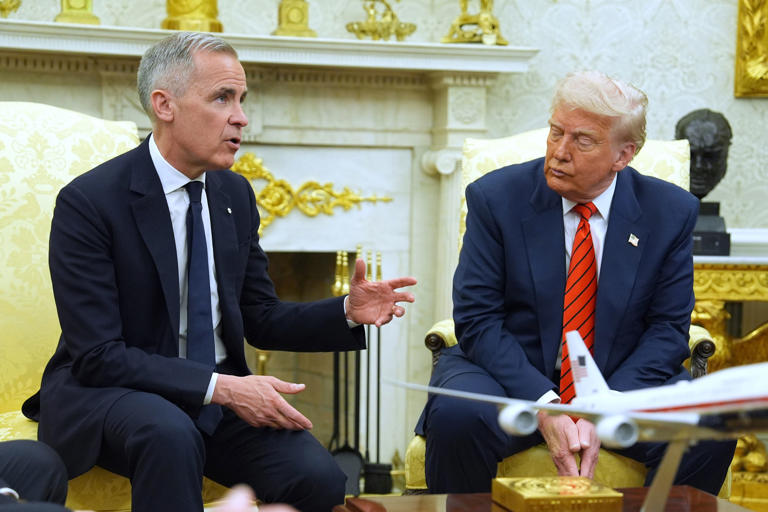
President Donald Trump meets Canadian Prime Minister Mark Carney in the Oval Office of the White House (Copyright 2025 The Associated Press. All rights reserved)

“I do feel it's much better for Canada, but we’re not going to be discussing that unless somebody wants to discuss it,” Trump said. Carney responded by saying that “there are some places that are not for sale” and said Canada remains one of those places.


Exclusive-China buys Canadian, Australian wheat as heat hits crop, traders say

Story by Michael Hogan, Peter Hobson and Gus Trompiz
MAY 10, 2025


FILE PHOTO: The crop is seen in a wheat field ahead of annual harvest near Moree, Australia, October 27, 2020. Picture taken October 27, 2020. REUTERS/Jonathan Barrett/File Photo© Thomson Reuters

HAMBURG/CANBERRA/PARIS (Reuters) -Chinese buyers bought between 400,000 and 500,000 metric tons of wheat from Australia and Canada in recent weeks, traders said, as heat threatens to damage crops in China’s agricultural heartlands.

China is the world's top wheat grower and also imports large amounts of grain when domestic supply falls short of demand.

Earlier this week, Henan province, which grows about a third of China's crop, issued a risk warning as hot, dry weather threatened the wheat growing in its fields.

Chinese buyers have purchased four or five 55,000-ton shipments of wheat from Australia for delivery in July or August and around 200,000 tons from Canada, sources at two major trading firms in Australia said. The wheat is of milling quality.

The bookings from Australia were the first made by China from the country since last year, said one of the traders.

COFCO, the state-owned Chinese firm that handles most of the country's wheat imports, did not immediately respond to a request for comment.

China has in recent years been one of the world's biggest wheat importers, buying in around 11 million tons worth $3.5 billion in 2024. Australia and Canada are typically its biggest suppliers.


But shipments slowed sharply after China reaped large wheat and corn harvests last year and have since remained low.

China delayed or redirected shipments from Australia earlier this year and imported less than a million tons of wheat in the seven months to March 31, Chinese customs data accessed through Trade Data Monitor show.

One of the sources said their company had lowered its forecast of Chinese 2025 wheat production by around 5 million tons but there was no guarantee that more purchases would follow because China has large wheat inventories.

"China is well self-sufficient in feed grains this crop year with heavy stocks," said Rod Baker, an analyst at Australian Crop Forecasters in Perth, adding that faltering economic growth in China was also depressing demand for grains.

Talk of Canadian wheat sales to China has echoed around agricultural business circles in Winnipeg, Canada's grain industry capital, according to traders. Few concrete details on the sales have emerged

Chinese buyers would have avoided buying U.S. wheat due to tariffs and the trade war between Washington and Beijing, one trader said. China in the past has been a top destination for U.S. wheat sales.

The drop-off in Chinese imports earlier in the current 2024/25 season had contributed to subdued international wheat prices, with benchmark futures in Chicago still near a four-year low touched last July.

Along with weather risks to China's upcoming harvest, attractive prices may have lured Chinese importers back into the market as the 2025/26 season approaches, traders said.

BARLEY

Chinese importers also booked a large amount of barley, according to traders.

Some said that six panamax bulk carriers carrying around 360,000 tons of French or Ukrainian new-crop barley had been sold for delivery in July or August, with others putting the volume much higher at around 1 million tons, also for shipment this summer.

"Chinese wheat and barley import buying has been very quiet in the past year and these are the first major deals I have seen in many months," a German trader said.

Feed barley purchases with optional origin were from Ukraine or France. The deals were done at a price of around $250-$254 a tonne delivered to China, one trader said.

(Reporting by Michael Hogan in Hamburg, Peter Hobson in Canberra, Gus Trompiz in Paris, Ed White in Winnipeg; Additional reporting by Ella Cao in Beijing; Editing by Simon Webb and Louise Heavens)
Witkoff breaches diplomatic protocol by meeting Putin without US interpreter

TRUMP DID IT FIRST IN 2018 IN HELSINKI

Story by Bohdan Babaiev
RBC-Ukraine 


Photo: Steve Witkoff and Vladimir Putin (Getty Images)© RBC-Ukraine (CA)

Trump's Special Envoy Steve Witkoff held talks with Russian President Vladimir Putin about Ukraine without his own interpreter. He relied on a Kremlin translator, breaching standard diplomatic protocol, reports NBC News.

According to one Western official, Witkoff, who was tasked with negotiating a potential end to the war in Ukraine, met with Putin on February 11, March 13, and April 11 — all without his own interpreter. Instead, he "used their translators."

"If they speak to each other in Russian, he doesn’t know what they are saying," the official added.

Two former US ambassadors confirmed that Witkoff does not speak Russian. By relying on Kremlin interpreters, he risked missing key nuances in Putin's messaging and had no way to independently verify what was being said.

At the same time, the Kremlin leader, who has some knowledge of English, still uses an interpreter at official events. During the April 25 meeting with Witkoff, he was accompanied by Special Advisor Yuri Ushakov and Special Envoy for Investment and Economic Cooperation Kirill Dmitriev. An interpreter also joined Putin's delegation.

In a brief video released by the Kremlin, Witkoff is seen smiling as he enters the room alone before shaking hands with Putin. Judging by the footage, Trump's Special Envoy arrived without any advisers or experts — the kind who typically accompany US officials during sensitive and complex negotiations.

When a woman joined Witkoff at his side of the table, he pointed at her and asked, "Interpreter? From the embassy? OK."

Former US Ambassador to Russia Michael McFaul said relying on a Kremlin interpreter was "a very bad idea" that put Witkoff "at a real disadvantage."

"I speak Russian and have listened to Kremlin interpreters and U.S. interpreters at the same meeting, and the language is never the same... Having a US interpreter present also ensures a more accurate written account of the meeting for the rest of the government, known as a memorandum of conversation or 'memcon,'" McFaul said via email Wednesday.

He also noted that at the end of every meeting he attended, he would question the interpreter to make sure "we heard everything correctly." McFaul emphasized that this would not be possible when using a Russian official.

For her part, White House Deputy Press Secretary Anna Kelly stated that Witkoff "abides by all security protocols in coordination with the State Department."

NBC sources also reported that Witkoff's aircraft, which is to travel to Russia for meetings, is not equipped with a secure government communications system. However, they said Witkoff made confidential calls from the US Embassy before boarding the plane and has a secure mobile phone.

What Trump thinks about Witkoff

Recently, US President Donald Trump praised Steve Witkoff's work on the Ukraine war. He called him "a true professional."

"Mr. Witkoff is talking constantly back and forth. He's a real professional. He's got a great relationship with both countries, and I think we have a good chance," Trump said.


Beliefs in spirits, afterlife are popular across religiously diverse countries, new study finds

(RNS) — The survey marks the first time Pew Research Center asked people outside the United States and Asian countries about practices related to Buddhism, Asian folk religions and New Age spirituality.


(Image courtesy Pixabay/Creative Commons)

May 8, 2025

(RNS) — A first-of-its-kind Pew Research Center study of religious practices and spiritual beliefs in more than 30 countries shows beliefs in spirits and life after death are common around the world.

The study, published on Tuesday (May 6), polled 50,000 people across 36 countries about their beliefs in the afterlife, spells, curses, and spirit ancestors. The survey also asked respondents about whether they carried religious items, consulted fortune tellers, and lit candles or incense for spiritual reasons.

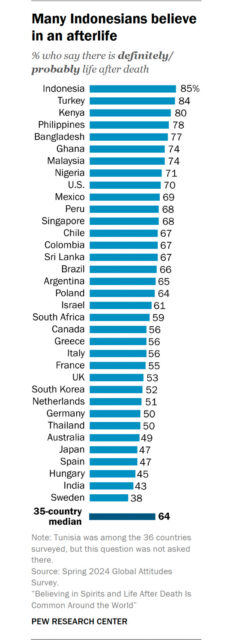
According to the study, most adults (64% median across countries) believe in life after death. Eighty-five percent of respondents in Indonesia said there is “definitely or probably life after death,” the highest percentage worldwide, followed by Turkey and Kenya, where 84% and 80% agreed, respectively. Seventy percent of Americans indicated belief in the afterlife. In Sweden, only 38% agreed, the lowest recorded.

Researchers tried to capture precisely what it means to be religious or spiritual, and what aspects of spirituality people connect with most, said Jonathan Evans, a senior researcher at the Pew Research Center.

“We wanted to see in people’s lived experiences, what do they believe? What do they practice?” he said. “Potentially, sometimes they believe or practice things that are not considered by some folks as orthodox to their tradition.”

The survey marked the first time Pew asked respondents across six continents at the same time about practices related to Buddhism, Asian folk religions, and New Age spirituality. These new questions cover a “wide set of dimensions of religion and spirituality,” Evans said, where previous surveys were more focused on the beliefs and practices particular to specific regions.

RELATED: Who are the ‘nones’? New Pew study debunks myths about America’s nonreligious.

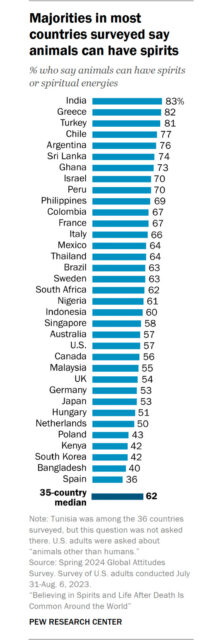
The study shows beliefs in animals having spirits are fairly common across countries (62% median), with minimal differences based on the country’s religious majority. In India, which is predominantly Hindu, 83% said they believed animals “can have spirits or spiritual energies,” the highest of any countries. In Hinduism, several animals are considered sacred, such as cows, elephants and monkeys. Next was Greece, where 82% agreed animals have spirits, and 81% in Muslim-majority Turkey, according to the survey. In the U.S., 57% agreed.

A majority of respondents said they believe nature, mountains, rivers or trees have spirits (56% median). In Thailand, which is predominantly Buddhist, 73% agreed, and 57% in Indonesia, which is primarily Muslim, agreed.

Even in countries where people were less religious, a majority of respondents said they believe in spirits and life after death, the survey found. For example, in Sweden and Japan, only 7% said religion is very important to them, but 65% and 69%, respectively, believe animals and nature could have spiritual energies.

The study also shows generational differences shift when considering spiritual beliefs compared with traditional religious beliefs and related practices such as service attendance and prayer. Adults over age 50 were more likely to say religion was very important in their lives, according to past Pew research, compared with younger adults (ages 18 to 34). Likewise, younger adults are less likely to identify with any religion. This study confirmed that’s true in most countries.

“Majorities in most countries surveyed say animals can have spirits” (Graphic courtesy of Pew Research Center)
“Many Indonesians believe in an afterlife” (Graphic courtesy of Pew Research Center)

However, younger adults are more likely to say they believe in spirits and spiritual energies across countries. The widest gaps were in Colombia, where 80% of those between 18 and 34 said they believed in spirits and spiritual energies, and 56% of those 50 and older agreed.

“This is the opposite pattern that we’ve seen from around the world on people who say they pray daily,” Evans said.

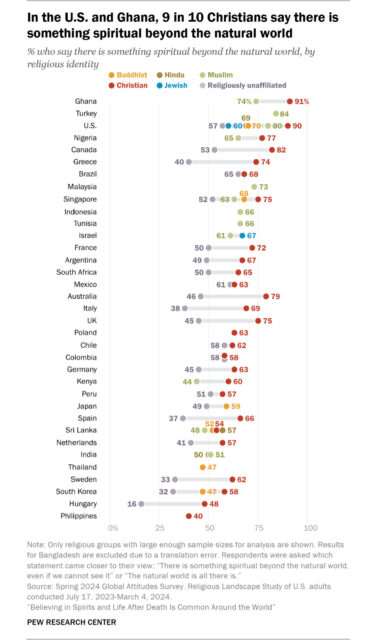
The study also highlights the wide array of beliefs held by religiously unaffiliated adults, often referred to as “nones,” across countries. Though nones were less likely to engage in most religious practices, in some countries they tended to adopt some beliefs often embraced by religious groups. For example, in Mexico, 61% of the religiously unaffiliated said they believed in something spiritual beyond the natural world, compared to 63% of Christians.

The study also shows beliefs in spells, curses and magic were broadly held across the four African countries surveyed: Ghana, Kenya, Nigeria and South Africa. More than 50% of adults in Latin American countries surveyed shared those beliefs, as did 30% in the U.S.

Generally, people who said religion was very important in their lives were more likely to believe in curses, spells or magic.

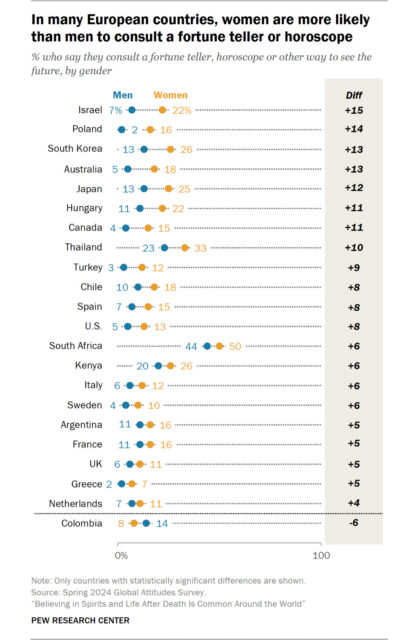
Though less than a quarter of respondents in most countries said they consulted a fortune teller, horoscope or other ways to see their futures, women were more likely to do so than men. Women were also more likely than men to carry religious items, according to the study.

The study also explores connections between a country’s wealth and attitudes toward spiritual ideas. Though wealthy countries usually present a lower level of religiosity, the study’s questions on spiritual practices show those beliefs are less connected to a country’s wealth.

“In the U.S. and Ghana, 9 in 10 Christians say there is something spiritual beyond the natural world” (Graphic courtesy of Pew Research Center)
“In many European countries, women are more likely than men to consult a fortune teller or horoscope” (Graphic courtesy of Pew Research Center)

Though respondents in rich countries were less likely than those in developing countries to believe in spells, curses and magic, the gap narrowed between respondents in wealthy and developing countries on whether they believed in spirit ancestors’ abilities to harm them.

The study also establishes links between one’s likelihood of lighting incense and candles for spiritual and religious reasons and respondents’ level of education. In Greece, 57% of adults who were less educated lit candles for spiritual reasons, as opposed to 36% among the more educated. And in Nigeria, 50% of the less educated lit candles for spiritual reasons, and 30% of the more educated did.

In five countries, a majority of respondents indicated they light candles or incense for spiritual or religious reasons: India (91%), Thailand (73%), Sri Lanka (70%), the Philippines (65%) and South Africa (63%). In America, only 20% did.


RELATED: Decline in American Christian observance has slowed, Pew study finds

Responses were gathered by Pew during phone and in-person interviews from January through May 2024. Data on American adults was pulled from the center’s recent Religious Landscape and American Trends Panel studies.

For some countries, some questions were removed and adapted to align with the respective cultural context, according to Pew. In Tunisia, some were removed to guarantee pollsters’ and respondents’ safety.
Former theology professor's program takes a 'playful' approach to planning for death

(RNS) — Lea Schweitz is creating a community around end-of-life preparedness.


(Photo by Wendelin Jacober/Pexels/Creative Commons)

May 6, 2025


(RNS) — Lea Schweitz has become a fan of and a facilitator for having conversations we all like to avoid.

She remembers that soon after her Stage 4 lung cancer diagnosis two years ago, a caregiver told her she better get her finances together. But between triaging her responsibilities and focusing on healing, she set aside the daunting “get your affairs in order” aspect of her diagnosis, she told RNS.

Then, her 10-year-old’s friend showed up at her Chicago home on Halloween in a Grim Reaper costume.
“The whole thing was hilarious to me,” said Schweitz, a former systematic theology professor. “It was this little snapshot of this long playdate with death that we had gone on.”


\
Lea Schweitz. (Photo by Kate Kaplan)

Soon after the Grim Reaper visit, Schweitz invited friends to gather and do the end-of-life planning she’d been avoiding. And in February 2024, she started her Substack, “Playdates with Death,” which aims to serve as a place for people from anywhere to come together and do the hard work of preparing for their deaths. The online community meets on Zoom once a month for a “community playdate,” which tackles one of 12 projects for the year, from obituary writing, to creating phone trees for emergencies, to funeral planning, to a Q&A session with an estate attorney. Schweitz has started hosting workshops on related topics at churches.

Americans are starting to talk about death in new ways. The new FX on Hulu show “Dying for Sex,” starring Michelle Williams, is about dying of cancer, and has become a hit. The growing death-tech industry hopes to streamline end-of-life planning. Death Over Dinner is a project that encourages people to discuss death at their next dinner party. And in February, The New York Times’ Tech Tip focused on digital estate planning.

Meanwhile, the International End of Life Doula Association’s membership rose from about 1,700 in 2023 to 2,296 last year. The death awareness movement of the 1970s and 1980s seems to have to morphed into the death positive movement today, which encourages people to talk about and learn to accept the reality of death, dying and burial — topics that often make people anxious or scared.

Schweitz earned her Ph.D. in religion at the University of Chicago. Throughout her career, she’s long been asking deep, hard questions, whether about climate change, dementia or technology.

Then, two years ago, at age 48, while navigating a job loss and divorce, the mom of two received her diagnosis.

“There’s a need to find playful ways to do this hard work in community,” Schweitz said. “Professional training helped me hold this space with people’s biggest concerns. As hard as it is, it is also life-giving and glorious.”

While “Playdates with Death” isn’t explicitly religious, Schweitz said many of the practices are theologically and spiritually informed, whether she’s leading a gratitude practice or an embodied movement session.
 
RELATED: At a progressive Christian festival in the woods of North Carolina, psychedelics were top of mind

Kathleen Garces-Foley, professor of religious studies at Marymount University in Arlington, Virginia, has written extensively about hospice and efforts to improve end-of-life care by bringing “spiritual presence” to those who are dying. While there is no specified survey to ask people if they are interested in end-of-life information and care, she said that once you add up those seeking “death cafes, death doulas and death memoirs, you do get a picture of interest.”

“Using death as a spiritual opportunity for growth was a popular theme in the 20th century,” she said. “But the growing financial burden of end-of-life care is a big concern.”

For Schweitz’s workshop series at St. Paul & St. Andrew United Methodist Church in Manhattan, 75 people signed up.

“Doesn’t that tell you how hungry people are for information like this?” said participant Leah Heimbach. “There were young, old, some in other states.”

The four-part series that started in January covers subjects such as “Finding your why and the big 3 of end-of-life planning” and “End-of-life celebrations.” Schweitz intends to bring the workshops, which first started with her friends, to different churches around the country.

Among the participants was Courtney Behm, 45, who moved to Manhattan from Ohio four years ago and had been intending to update her life planning paperwork, she said. When she saw the workshops advertised, she said it gave her the nudge she needed.


A variety of posts on Lea Schweitz’s “Playdates with Death” Substack. (Screen grab)

Behm works in construction management, but her family runs a fourth-generation funeral business. She’s always known taking care of these types of things while you are still around can be a huge support for your family, but she hadn’t yet gone into the details that “Playdates with Death” offered.

“Lea makes complex things relatable,” Behm said. For example, when Schweitz said on her Substack that an obituary writing lesson would be part of one of the church sessions, Behm decided to attend. “It’s a powerful experience to write an obituary,” she reflected. “It helped me get grounded before I dove into the work.”

Whether Schweitz is leading in-person workshops or online community playdates, her goal is to “turn the volume down” on participants’ nervous systems when considering these tough topics, she said. She opens with a lighthearted check-in question and gentle movement, like chair yoga, before moving into the day’s task. She ends every “playdate” with a dance session, hoping everyone will leave feeling better than when they came in, even after doing the hard work of preparing for death.

Heimbach, 64, has a health care background and was intrigued when she heard about the workshops, she said. At a “celebration of life” session, her view on funerals expanded as Pastor Andrea Steinkamp told stories about various funerals at St. Paul & St. Andrew. For one member who loved gardening, her memorial service was held outside at the church.

“My husband doesn’t make a big deal about what he’s done, but I intend to have a celebration for him,” Heimbach said. “That’s what I learned in the celebration of life session. Sometimes, it isn’t for you — it’s helping the people left behind.”

Schweitz considers herself adjacent to end-of-life caretakers like death doulas and hospice workers but is clear that’s not the work she is doing. She sees herself as a community builder around end-of-life planning to empower families to take care of necessary tasks before things are dire, she said.

“It’s not necessarily folks who have gotten a diagnosis recently,” she said of her participants. “You have to want to be in this space — if things are imminent, it’s harder to have that cheeky playfulness.”

She said the group is for people of all ages, and the hope is participants can stay relaxed and playful when having hard conversations because they practiced once a month through the workshops.

Earlier this month, Behm submitted her life planning paperwork to an attorney.

“It’s a lot of work,” she said. “But you can see how much it can help others.”
How anti-caste reformer BR Ambedkar left his legacy on modern Buddhis

(RNS) — Many Buddhists today trace their social justice activism to the work of BR Ambedkar, the Indian caste abolitionist who once led a mass conversion of Dalits, or lower caste, to Buddhism.


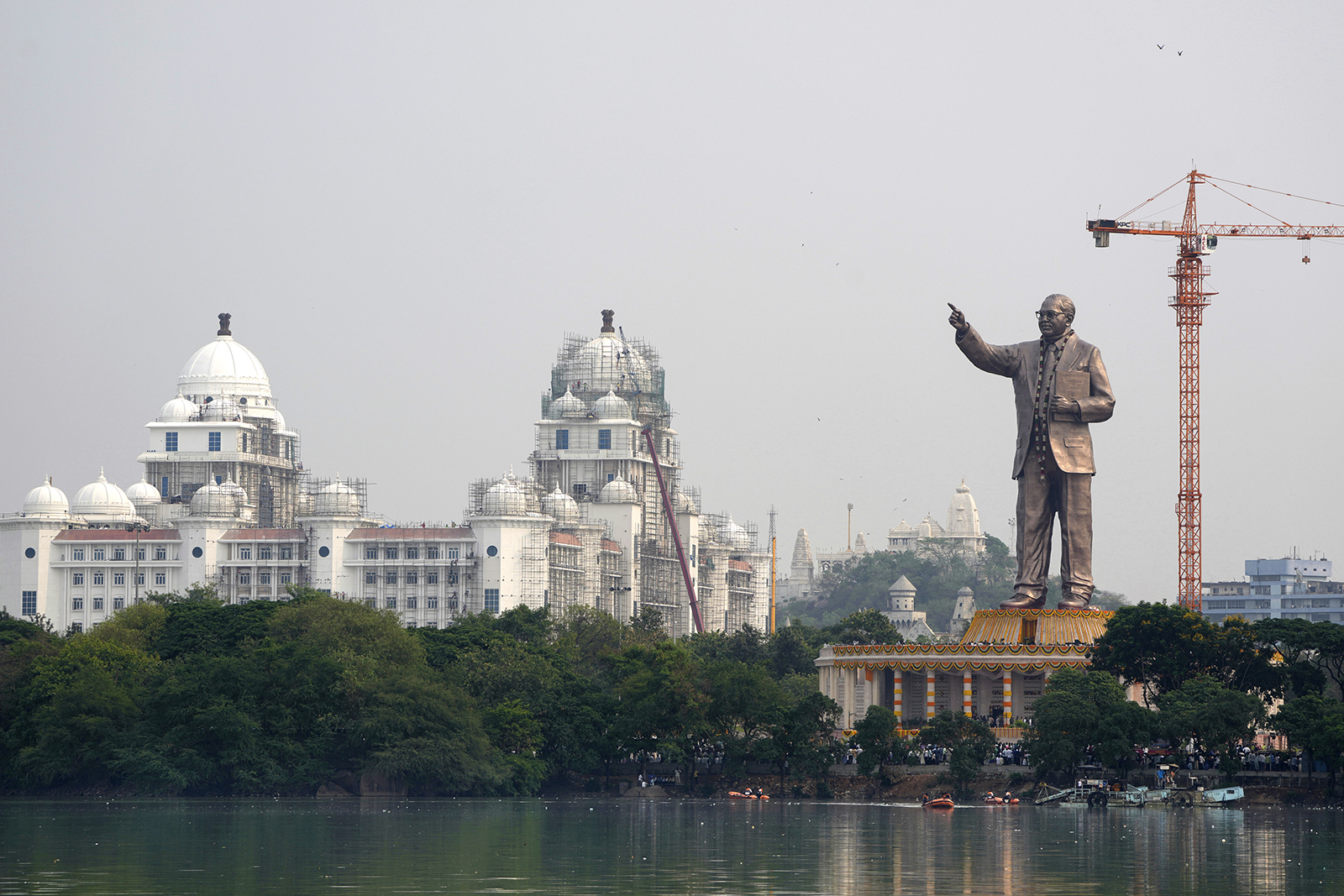
A 125-foot statue of Bhimrao Ramji Ambedkar, which was inaugurated on his birth anniversary, is seen overlooking new secretariat building in Hyderabad, India, Friday, April 14, 2023. Ambedkar, an untouchable, or dalit, and a prominent Indian freedom fighter, was the chief architect of the Indian Constitution, which outlawed discrimination based on caste.(AP Photo/Mahesh Kumar A.)


Richa Karmarkar
May 5, 2025


(RNS) — Last month marked the 10th Dalit History Month, a worldwide, community-led observance recognizing the people and events throughout history that raised up India’s oppressed minority class, once referred to as untouchables.

During discussions and retreats celebrating Dalit achievements, the top name on many minds was Bhimrao Ramji Ambedkar, known as Babasaheb, or “respected father.” The visionary social reformer and law minister who died in 1956 dedicated his life to abolishing the long-held caste hierarchy in India.

Ambedkar was known for leading movements to assert rights of Dalits, or members of the lowest caste, to public water, education and Hindu temples. Eventually, an affirmative action program was enshrined, and untouchability was eradicated within the Constitution of India. His followers are known as “Ambedkarites.”

Yet the decades Ambedkar spent attempting to reform the Hindu religion, which he saw as inherently structured by caste, ended in one of the largest mass conversions to any religion in history. Following his lead, nearly half a million Dalits in India converted to Buddhism from Hinduism in a single ceremony on Oct. 14, 1956. It was a socio-political statement that rejected Hindu justification for caste division — specifically the varna and jati systems found in some of the earliest Hindu texts that designate one’s occupation and social status by birth.


Portrait of a young Bhimrao Ramji Ambedkar.
(Photo courtesy Wikimedia/Creative Commons)

“I had the misfortune of being born with the stigma of untouchability,” Ambedkar once said. “But it is not my fault. I will not die a Hindu, for this is in my power. I say to you, abandon Hinduism and adopt any other religion which gives you equality of status and treatment.”

Pointing to Ambedkar’s influence, in the 1961 Indian census, more than 90% of the 3 million people registered under the Mahar caste — Ambedkar’s caste of origin — had converted to Buddhism in Maharashtra, his home state. Today, Maharashtra is home to the largest percentage of Buddhists in India. They are made up mostly of Dalit converts, known sometimes as “neo-Buddhists.”

William Edelglass, a scholar and practitioner of Buddhist thought, said Ambedkar saw Hinduism as a “religion of rules,” as opposed to Buddhism, a “religion of principles.” And rather than abandon religion altogether, Ambedkar saw faith as necessary for “understanding others and setting up the conditions to work together,” Edelglass said.

While he was encouraged by Muslims, Christians, Sikhs and Zoroastrians to join their faiths, Buddhism, with its indigenous roots in ancient India, seemed to Ambedkar the “most suitable contemporary religion” for rational, scientific thinkers like himself, Edelglass said.

“Ambedkar sees the practice of Buddhism as one of training the mind, of education, of finding dignity,” said Edelglass, director of studies at the Barre Center for Buddhist Studies in central Massachusetts. “The concepts of liberty, fraternity and equality — he says he doesn’t get that from the French Revolution, but he gets that from his master, the Buddha, and he sees the Buddha as a very political thinker.”

Importantly, Edelglass said, Dalits who converted to Buddhism have a literacy rate higher than 81%, which is significantly higher than the national average of Hindu Dalits.

“A big part of what Ambedkar wanted was that Buddhism provided a source of a sense of dignity and worth,” Edelglass said.

Buddhism’s influence on Ambedkar is well-documented, including in his famous treatise “The Annihilation of Caste.” Lesser known are his contributions and reforms to the Buddhist faith. His version of Buddhism, Navayāna, or New Vehicle Buddhism, denies the tenets of karma and reincarnation, espouses ritualistic and supernatural aspects of the tradition, reinterprets the concept of suffering from internal to societal and rejects monastic exclusivity, as Ambedkar believed enlightenment was available to all.

Navayāna Buddhism has left a sizable impact on what scholars refer to as Buddhist modernism, or the scientific, mindful tradition often most recognizable to those in the West, Edelglass said. Ambedkar’s emphasis was on solutions to social conflict between groups and individuals.

“That’s the project — to end conflict and marginalization,” Edelglass said. “That’s what Ambedkar Buddhism is about.”

Dharmacharya Ananta, an initiated member of the Triratna Buddhist Community originally from the U.K., said Ambedkar’s social justice lens has helped him see a new approach to Buddhism.

RELATED: Hindus debate the legacy of caste in America

“Dr. Ambedkar is of a lot of interest particularly to Buddhists who are looking for someone who is giving more guidance on social action and how social action can fit with Buddhist spiritual teachings in a way that isn’t simply, ‘Be pacifist. Be non-violent. Be nice to people,'” said Ananta, who is chair of the Triratna sangha in New York and New Jersey. “It’s more complex and more involved than that.”

A longtime activist and volunteer for international human rights causes, Ananta is part of Karuna, an Indian charity organization working to uplift marginalized communities through education and career diversification opportunities, especially for those of lower caste standings who are often relegated to a particular degrading job from birth.

Learning from Ambedkar, Ananta said he understands that liberation through Buddhism includes not only improving one’s social standing, but spiritual transformation and emphasizing individual potential. Raising up a person’s ability to see beyond their circumstances, Ananta said, is as relevant as responding to emergencies and immediate needs.

“It’s not just the very important aspect of improving material conditions, but it’s about what’s going to support people from this community to live with a sense of dignity and help them to reframe their sense of who they are,” Ananta said.

Ananta said he knows through his work that caste is still a lived reality that affects millions of Indians. Though social norms, like inter-caste marriages, and job opportunities have been changing, many Indians, like Dhananjay Chavan, a psychiatrist living in Maharashtra, say there is a long way to go.

“Caste is class in India, and class is caste,” he said. “It is an extremely unequal society, and that has been a bit of a eye-opener for me. And it came much later, and it came because I was extremely interested in the Buddha.”

Chavan, raised a “cultural Hindu,” he said, switched gears shortly after college. He devoted 20 years to a meditation institute and, inspired by Ambedkar, eventually wrote a rejection of the theory of karma and reincarnation in his 2023 book “The Book of Karma.”

“The theory of karma gave the spiritual sanctity for caste because it says you are born into a lower caste because of some karma of your past,” he said. “Not only is that not a scientific theory, but it also does a disservice to society by giving a religious basis to this system.”

But to D.B. Sagar, a Dalit activist originally from Nepal, Hinduism and Buddhism can coexist — even in the same household, incorporating both Hindu pujas and Buddhist mantras. The “Hindu-Buddhist” who now practices law in the Washington, D.C., area finds peace in both traditions and doesn’t see caste as a religious issue that uniquely stems from Hinduism. Instead, it’s a social stratification that exists wherever there is religion, including within Buddhism across many Asian countries, Sagar said.

In that vein, Sagar argued, Ambedkar’s conversion to Buddhism was a “political instrument because he knew it may not give a solution, particularly, but at that point in time, it was the best strategy to negotiate and to have his agenda (become) stronger.” The founder of the International Commission on Dalit Rights, Sagar said he applauds Ambedkar for his “resiliency, and his tactical, legal and political battle to organize and unite the community.”

In Edelglass’ view, however, Ambedkar devoted enormous amounts of energy in the last decade of his life to studying Buddhism, and a merely political, rather than “spiritual, moral training” wouldn’t have worked. While it’s true Ambedkar “seems to have thoroughly given up on Hinduism,” Edelglass said, “at times, he seemed to be open to the possibility that Hinduism can change and become a religion of justice.”

Sunita Viswanath, executive director of Hindus for Human Rights, a United States advocacy organization, said this vision can still be true.

“Along with hundreds and thousands of his followers, Ambedkar was famously and vocally skeptical of the possibility of anti-caste reform within the Hindu community,” Viswanath said during a Dalit History Month webinar, titled “Can Hindus annihilate caste? Engaging Ambedkar’s critique to envision an anti-caste Hinduism.” The April 26 webinar was a conversation between three scholars of caste and Hindu theology.

“However, in several places, Dr. Ambedkar stated that Hindus who do have the will for anti-caste reform would not have to look beyond the teachings of Vedantic texts such as the Upanishads for the requisite resources,” Viswanath said. “The truth is, caste is not going to be annihilated without masses of Hindus rejecting caste. We are those anti-caste Hindus that Ambedkar was addressing.”