Sunday, May 11, 2025

‘Bad news for JD Vance’: New pope could spell trouble for US politicians


Erik De La Garza
May 10, 2025 
RAW STORY


A new op-ed published Friday suggested that the election of Pope Leo XIV – the first American pope – could pose challenges for U.S. politicians like Vice President JD Vance, who have aligned themselves with Catholic ideology.

That’s according to Commonweal editor-at-large Mollie Wilson O’Reilly, who argued Friday that Pope Leo’s American roots and fluency in English remove longtime language barriers between the Vatican and American elected officials. Unlike his predecessors, she told readers, the new pope is expected to speak directly to American Catholics.

“There will be no opportunity for anyone to soften his remarks with ‘What the Holy Father meant to say…’” Wilson O’Reilly wrote in an MSNBC op-ed. “This is certainly bad news for Catholics like Vice President J.D. Vance, who want to use church teaching to serve authoritarian ends.”

She added: “Perhaps the cardinals liked the idea of an American pope who can condemn human rights abuses and call for restitution and repentance in words that will not need translating.”

The columnist went on to tell readers Friday that the new, native English-speaking pope, “surely recognizes the need to be shrewd in dealing with American politics.”


“If and when he speaks directly to America, it will be because he has something important to say,” she concluded.

The only question left, according to O’Reilly, will be: “ Are we prepared to listen?”
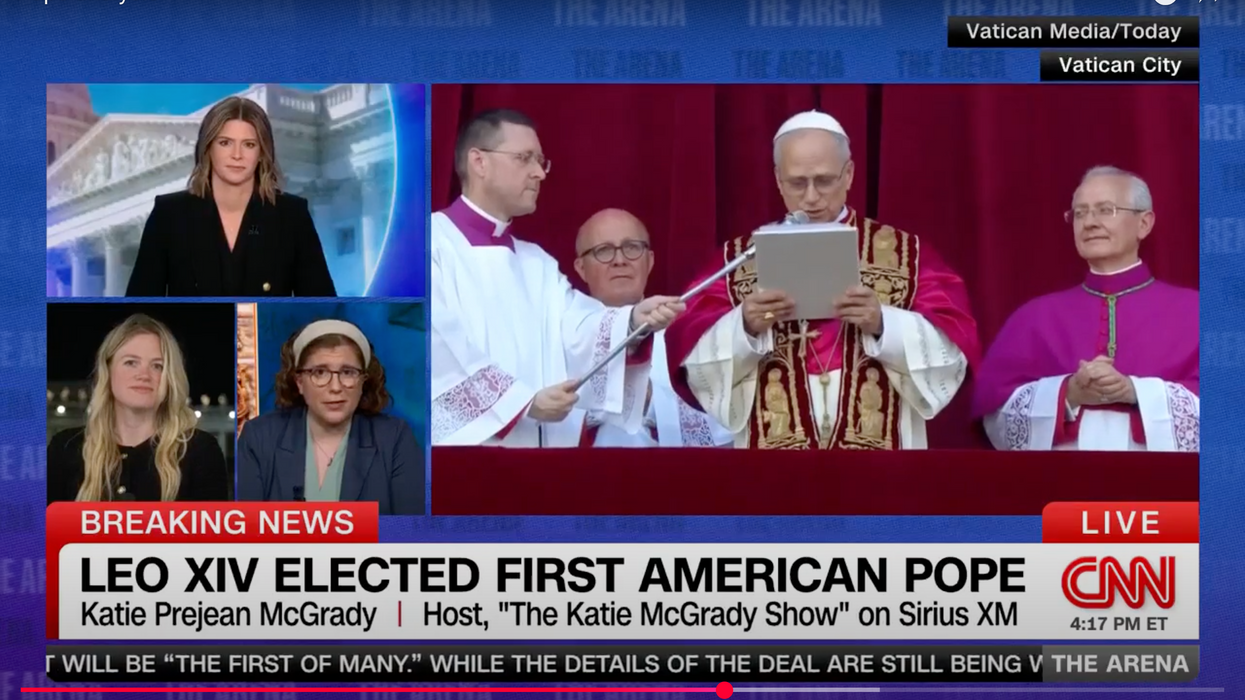

New pope will put 'loud American Catholics in their place': analyst


Vatican analyst Katie McGrady on CNN on May 8, 2025. (screengrab)

May 08, 2025
ALTERNET

Vatican analyst Katie McGrady has said Cardinal Dr. Robert Prevost, who was elected to be the new pope Thursday, "has the training to put all of the loud American Catholics in their place."

She added that Prevost's training is as a canonist. "He's a canon lawyer. He knows the teachings of the church and the laws of the church very intimately. He has his doctorate," McGrady noted during an appearance on CNN Thursday.

She continued, "He was on mission to Peru while he was writing his doctoral dissertation, so he's a man who can clearly multitask."

"If anybody is going to be able to speak with clarity, it's a canonist missionary who has his bachelors of science degree," McGrady said.

New York Times reporter Elizabeth Dias noted earlier during the segment that there have been mixed reactions from Americans on different sides of the political spectrum regarding the new pope. "People are trying to sort out what they make of who he might be. Both camps—conservative and liberal—are hoping that the signal from the name he chose, Pope Leo the 14th, might indicate that he will be a champion of their priorities," she said.

"I've heard from both sides. On the conservative side, some say that the name suggests he will emphasize moral clarity. On the liberal side, others think he might represent the social justice aspect of the Church," Dias added.

Earlier on Thursday, Cardinal Prevost was chosen as pope on the second day of the conclave, becoming the head of 1.4 billion Roman Catholics. He made history by becoming the first American pope.

Upon assuming his role, he welcomed his congregation with the words, “Peace be with you.”

Watch the vide below or at this link.
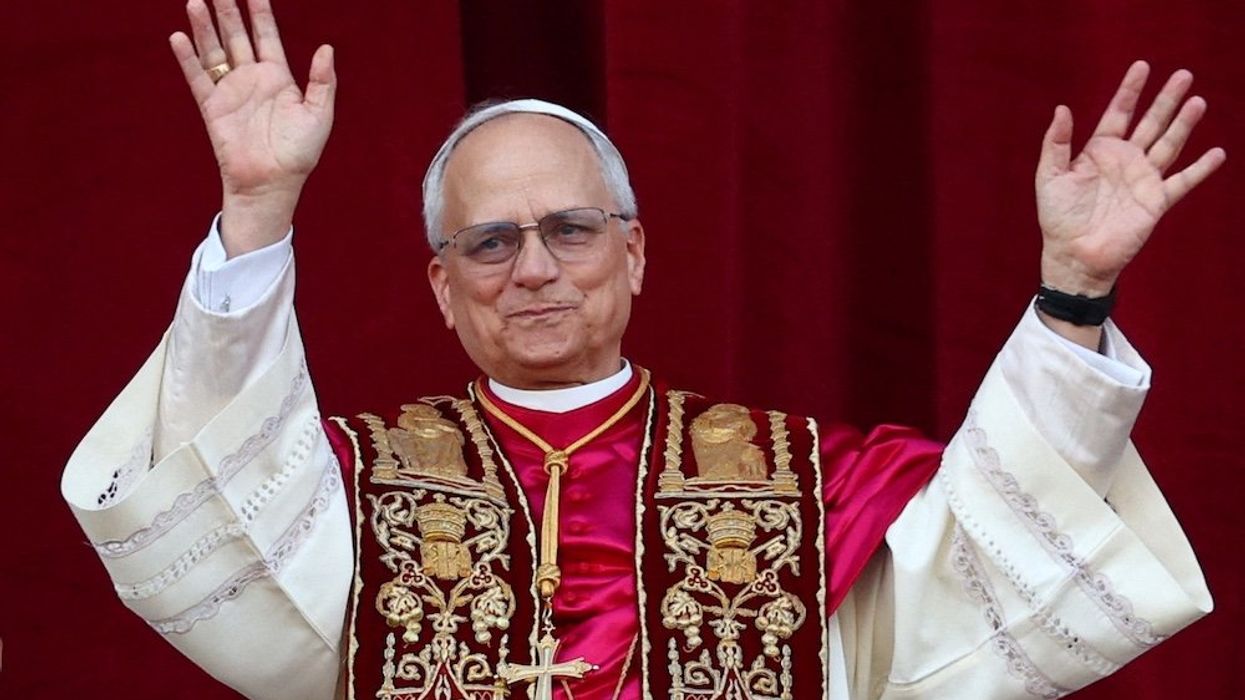


'Our new woke pope': Newly minted pontiff’s post slamming JD Vance lights up social media


Newly elected Pope Leo XIV, Cardinal Robert Prevost of the United States appears on the balcony of St. Peter's Basilica, at the Vatican, May 8, 2025. REUTERS/Guglielmo Mangiapane

May 08, 2025
ALTERNET

Cardinal Dr. Robert Prevost has officially taken the name Pope Leo XIV, becoming the first American head of the Catholic Church in history. And a tweet Prevost wrote earlier this year about Vice President JD Vance is going viral.

In February, Prevost amplified an op-ed published in the National Catholic Reporter in which author Kat Armas criticized the vice president (who converted to Catholicism in 2019) over his remarks suggesting there was a hierarchy of Christian priorities. Vance told Fox News in late January: "There is a Christian concept that you love your family and then you love your neighbor, and then you love your community, and then you love your fellow citizens, and then after that, prioritize the rest of the world. A lot of the far left has completely inverted that."

Prevost's tweet repeated the headline of the op-ed: "JD Vance is wrong: Jesus doesn't ask us to rank our love for others."

"[The Apostle] Paul reminds them: love starts close. It moves first toward those in front of us, ensuring widows were not abandoned while preserving the church's resources for those truly without support," Armas wrote in the op-ed. "But make no mistake — this isn't about love confined to bloodlines or geographic boundaries. It's about love rooted in responsibility, expanding outward. And it was subversive even then."

Prevost/Leo XIV's tweet lit up social media, with various journalists and commentators like Democratic strategist Matt McDermott celebrating "our new woke pope."

"Well this will be fun," Independent D.C. bureau chief Eric Michael Garcia tweeted.

"Get in loser we're combing through the new pope's old tweets," Business Insider senior politics reporter Bryan Metzger tweeted.

Dan Cluchey, who was a speechwriter for former President Joe Biden, also celebrated the tweet by observing that the "new pope already upholding the only tradition that matters: s----ing on JD Vance."

"STOP STOP IF I START LIKING THE CHICAGO POPE ANY MORE I'LL FORGET THE REFORMATION," tweeted theologian Dr. Laura Robinson.

Tahra Hoops, who is the director of economic analysis at the Progress Chamber, combed into the op-ed Leo XIV tweeted and opined that he was "abundance-pilled," referring to the political theory that public policy should be oriented around making sure all members of society have a high standard of living.

President Donald Trump has not yet commented on Leo XIV's tweet, but delivered a statement on his Truth Social account writing: "Congratulations to Cardinal Robert Francis Prevost, who was just named Pope. It is such an honor to realize that he is the first American Pope. What excitement, and what a Great Honor for our Country. I look forward to meeting Pope Leo XIV. It will be a very meaningful moment!"

Progressive outreach, traditional doctrine? Where Pope Leo XIV stands on the key issues

Pope Leo XIV has been described as a potential bridge-builder for a divided Catholic Church, likely to pursue parts of his predecessor’s progressive agenda while reaching out to disgruntled conservatives. From his stance on women’s roles in the Church to his criticism of the Trump administration’s anti-immigrant policies, his past statements offer clues as to which way his papacy might lean.

Issued on: 09/05/2025
By: Pauline ROUQUETTE
FRANCE24

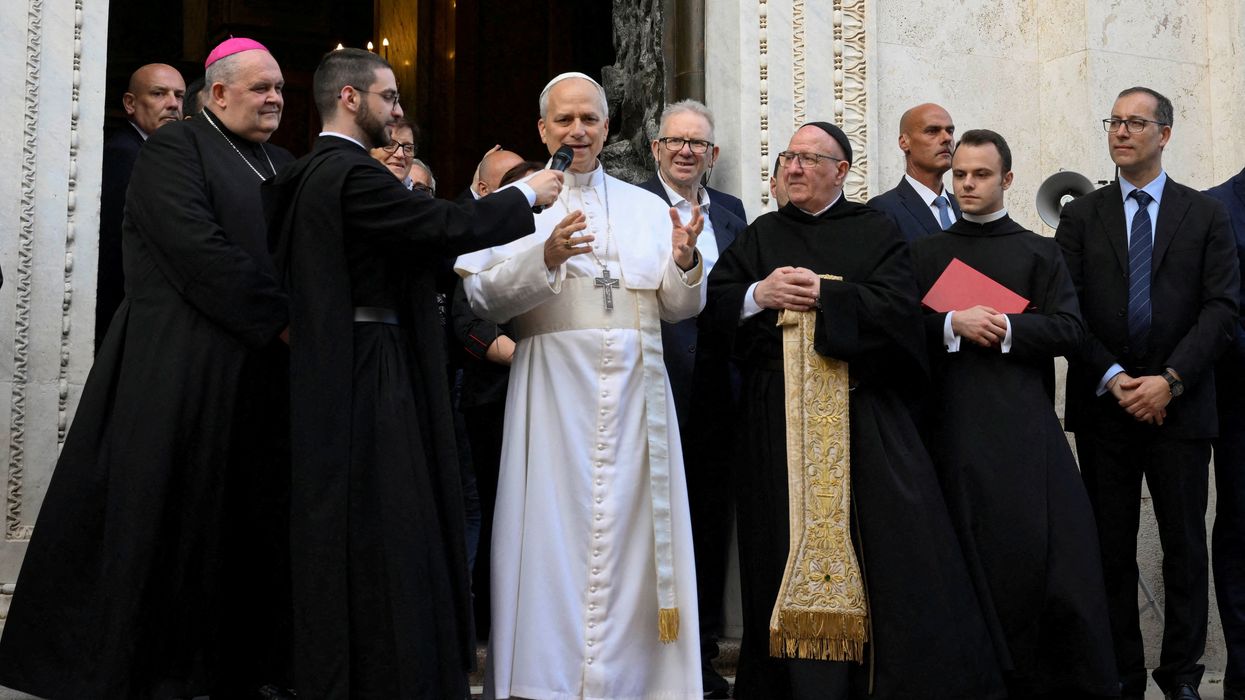
Pope Leo XIV addresses the faithful from the balcony of St. Peter's Basilica in the Vatican following his election as pontiff on May 8, 2025. © Tiziana Fabi, AFP

Vatican-watchers say the new pope’s choice of name, a tribute to Leo III’s 19th-century pursuit of social justice and reform, points to continuity with many of the causes also championed by the late Pope Francis.

Others have pointed at the traditional red cape and papal trappings Leo XIV sported on his first appearance as pope – garments his predecessor eschewed upon his election in 2013 – as suggesting a return to some degree of tradition after Francis's unorthodox pontificate.

Read morePope Leo XIV: Robert Prevost, from Peru missionary to first American pontiff

Here’s a look at where the Chicago-born former missionary and Peru-based archbishop has stood on some of the key issues roiling the 1.4 billion-member Catholic Church.

Same-sex couples and LGBT+ rights


The new pontiff, born Robert Francis Prevost, is expected to adopt a more cautious stance on the subject of same-sex couples after his predecessor authorised priests to offer informal blessings of couples in “irregular” unions in a landmark 2023 document that angered conservatives within the Church.

In October 2024, Prevost expressed the need for dialogue between each bishops’ conference to discuss blessings on a case-by-case basis, taking into account cultural differences around the world, according to a report by the College of Cardinals.

He noted that some bishops in Africa described how local culture made the church's new policy difficult to implement. "[I]t wasn’t rejecting the teaching authority of Rome, it was saying that our cultural situation is such that the application of this document is just not going to work,” then Cardinal Prevost said.

Following his election to the papacy, LGBT+ faith groups expressed hope that the first American pontiff had “moved on” from opinions he voiced in a 2012 address to the world Synod of Bishops, when he criticised the media's "sympathy" for the “homosexual lifestyle”.

“Western mass media is extraordinarily effective in fostering within the general public enormous sympathy for beliefs and practices that are at odds with the Gospel – for example abortion, homosexual lifestyle, euthanasia,” Prevost said at the time.

“We trust he will be open to listen to the lived experience of LGBT+ Catholics, their parents and families,” the UK-based LGBT+ Catholics Westminster Pastoral Council said in a statement on Thursday.

“Opinions and ideas can change,” the group added, noting that Prevost had “expressed openness to marginalised groups”.

01:40© France 24

Women in the Church

Pope Francis’s efforts to open the Church to the modern world helped foster debate on the role of women in the church, although Pope Leo XIV, like his predecessor, remains opposed to the ordination of women as priests.

At a gathering of bishops in October 2023, Prevost argued that the ordination of women would not solve the Church's problems and could even create new ones, according to the report by the College of Cardinals.

The 69-year-old pope does, however, support greater inclusion of women in non-ordained leadership roles within the Church.
 
Pope Francis elevated the US cardinal to prefect of the Dicastery for Bishops during a consistory at St. Peter's Square on September 30, 2023. © Tiziana Fabi, AFP

Significantly, Prevost presided over one of the most notable reforms of Francis’s pontificate, when he added three women to the voting bloc that decides which bishop nominations to forward to the pope.

As Leo XIV prepared to celebrate his first Mass as pontiff in the Sistine Chapel on Friday, two women delivered the traditional Scripture readings, perhaps an indication of the new pope's intention to follow in his predecessor's footsteps on expanding the role of women.
 
Climate change

The former archbishop of Chiclayo is known in Peru as a saintly missionary who waded through mud to bring help to the needy after torrential rains flooded the region. He is widely expected to pursue his predecessor’s advocacy in the fight against climate change.

Prevost declared in November 2024 that “humanity's dominion over nature should not be tyrannical” but rather “a relationship of reciprocity”.

He has voiced support for the use of climate-friendly technology, such as solar panels and electric vehicles, and has urged followers on social media to sign petitions calling for climate action.
 
Social justice

Pope Leo XIV’s choice of name signals a commitment to social justice that is in line with his predecessor’s global ministry and harks back to a late 19th-century pope regarded as the founder of Catholic social thought.

Vatican spokesman Matteo Bruni confirmed that the choice of the name Leo was a reference to Leo XIII, whose “Rerum Novarum” encyclical addressed workers’ rights and capitalism at the dawn of the industrial age.

The new pontiff, a member of the mendicant Augustinian Order known for its charity work, is expected to continue Francis’s critique of unbridled capitalism and his social outreach in favour of the poor and marginalised.

He has also spoken out against racism.

At the height of the 2020 racial justice movement that swept the globe after the police killing of George Floyd, Prevost retweeted a series of posts on his then Twitter account, urging the eradication of prejudice and hatred.

“We need to hear more from leaders in the Church, to reject racism and seek justice,” he wrote in a post from May 30, 2020.
 
Immigration

Like his predecessor, who spoke out against the current US administration’s mass deportation of immigrants, the first US pontiff is starkly at odds with the White House on the subject of immigration.

Then Cardinal Prevost's X account indicates a history of criticising the policies of US President Donald Trump and Vice President JD Vance, a Catholic convert who has argued that Christians should prioritise their families over the rest of the world.

Read morePrior to election, Pope Leo reposted articles criticising Trump and Vance

He reposted an article in February that was bluntly headlined, “JD Vance is wrong: Jesus doesn’t ask us to rank our love for others."

When Trump had a meeting last month with El Salvador's President Nayib Bukele to discuss jailing suspected gang members deported from the US at a prison notorious for human rights abuses, Prevost reposted a comment that asked: “Do you not see the suffering? Is your conscience not disturbed?”

Church sex abuse

In a 2023 interview with the Vatican News website, Prevost said the Church must be transparent and honest in dealing with the abuse allegations that have shattered its standing across the world.

His own record on sexual abuse cases, however, has not been thoroughly examined in public.

The Survivors Network of those Abused by Priests, a US-based advocacy group, expressed “grave concern” about his election, accusing him of failing to take action against suspected predatory priests when he served in both Chicago and in Peru.

"You can end the abuse crisis – the only question is, will you?" it said in a statement addressed to the new pope.

Bishop Accountability, a group that tracks clergy sexual abuse, was more cautious in its response, suggesting the former archbishop had a mixed record on the issue. The group praised his efforts to help one abuse victim in Peru but raised questions about his handling of other allegations levelled against two priests.
‘Synodality’ and inclusivity

“Synodality”, which refers to efforts to make the Church more inclusive, attentive to lay people and respectful of diversity, was a key mantra of Francis’s pontificate. His successor is widely expected to stick to that approach.

The future pope said in a 2023 interview with Vatican News that polarisation in the Church was a wound that needed to be healed.

“Divisions and polemics in the Church do not help anything. We bishops especially must accelerate this movement towards unity, towards communion in the Church,” he said.

03:55© France 24


Thanking his predecessor in his first address from the balcony of St. Peter’s Basilica on Thursday, the newly elected pope made clear his intention to carry forward the vision of a Church that walks together, builds bridges and remains close to those suffering.

“To all of you, brothers and sisters of Rome, of Italy, of the whole world, we want to be a synodal Church, a Church that walks, a Church that always seeks peace, that always seeks charity, that always seeks to be close, especially to those who suffer,” he said.

Natalia Imperatori-Lee, the chair of religious studies at Manhattan University in the Bronx, told AP that Prevost’s election could send a strong message to the US Catholic Church, which has been deeply divided between conservatives and progressives and which has fuelled much of the right-wing opposition to Francis.

“I think it is going to be exciting to see a different kind of American Catholicism in Rome,’’ she said.

This article was translated from the original in French by Benjamin Dodman.


The Election of Pope Leo XIV

White Smoke and Speculation

The occasion of electing another Pope was a spectacle in time and, in many ways, outside it. It was the one rare occasion in the twenty-first century where ancient ceremony, the old boy network – many presumptive virgins – along with festive dressing up, were seen with admiration rather than suspicion. Feminists were nowhere to be heard. Women knew their place; the phallocrats were in charge. Secret processes and factions, unscrutinised by media or any temporal body, could take place in secure, deliberative seclusion. Reverential followers of unquestioning loyalty turned up to the square of St. Peter’s Basilica in Rome awaiting the news of the election. Then, the white smoke rises from the Sistine Chapel’s chimney, with gasps of excitement and elation.

Taking a punt on who the new leader of the Catholic Church will be once the conclave of Cardinals concludes is a failing bet. A mischievous remark was once made by an Australian commentator on Church matters that you would have better chances picking a winner at the Melbourne Cup horse race than the next pontiff.

The choice of Leo XIV, formerly Cardinal Robert Francis Prevost, Prefect of the Dicastery of Bishops, was suitably surprising. Few had their cards on a pick from the United States, let alone a pick from Chicago, Illinois. But ever politic, the church narrative was quick to point out his naturalised status as a Peruvian and his elevation to the position of Bishop of Chiclayo in September 2015. He had been an Augustinian missionary. Not only was he a Western hemispheric representative, but one who doubled up as truly American, comprising North and South. This was an identitarian jackpot, a treat for the advertising wing of the Vatican.

Clues on what Leo’s reign will look like are few in number. “We must seek together,” he urges, “how to be a missionary Church, a Church that builds bridges, dialogue, always open to receive like this square with its open arms, all, all who need our charity, our presence, dialogue and love.” His choice of name suggests a lineage of diplomatic and doctrinal-minded figures.

Much Fourth Estate commentary has been vague, laden with cryptic references and snatches of speculation. In the absence of detail, obsession over minutiae becomes paramount. He turned up in the garb of Benedict XVI, suggested one observer on the BBC World Service, but spoke like his immediate predecessor, Pope Francis I. “We saw a balance of the aesthetics of the traditional church,” opined Charlie Gillespie of Sacred Heart University, “along with language that sounded like Pope Francis.”

Any use of the term “moderate” is also bound to be meaningless, though Leo’s brother, John Prevost, has aired his own prediction: “I don’t think we’ll see any extremes either way.” Such a figure is straitjacketed by doctrine and buttoned up by process. One who is bound to follow ancient texts drafted by the superstitious, however modernised in interpretation, will be caged by them. In 2012, for instance, Prevost was revealing on that very issue when commenting on church attitudes to homosexuality. Certain Western values, he thought, proved sympathetic to views “at odds with the gospel”, one of them being the “homosexual lifestyle.”

The same cannot be said about Leo’s attitudes to migrants and the poor. A social media account bearing Prevost’s name did not shy away from attacking the immigration policy of the Trump administration via a number of reposted articles. In February, for instance, an article from the National Catholic Reporter titled “JD Vance is wrong: Jesus doesn’t ask us to rank our love for others” featured. Suffice to say that his selection did not impress certain figures in the MAGA movement, most notably Steve Bannon. Calling Leo the “worst pick for MAGA Catholics,” Bannon sniffed a conspiracy. “This is an anti-Trump vote by the globalists that run the Curia – this is the pope Bergoglio [Francis I] and his clique wanted.”

The orbit of other problems will also be impossible for the new pontiff to escape. The stain of clerical sex abuse remains an immovable reminder of organisational defect and depravity. Terrier like activists continue their sorties against the Church, demanding redress and publishing their findings on such outlets as ConclaveWatch.org. Earlier this year, the Survivors Network of those Abused by Priests (SNAP), along with Nates Mission, another survivors’ organisation, named the then Cardinal Prevost as one of six figures seminal in covering up sexual abuse in the church. These formed a dossier of complaints submitted to Cardinal Pietro Parolin, the Vatican’s secretary of state. According to the campaigners, the dossier documenting claims of mismanagement and cover-ups marked “the first time multiple high-ranking cardinals have been targeted … by co-ordinated, survivor-led action.”

An open letter published on May 8 by SNAP also proved sharp on the election. “The sex offender in the collar commits two crimes: one against the body, and one against the voice. The grand pageantry around your election reminds us: survivors do not carry the same weight in this world as you do.” The organisation further stated that Prevost, when provincial of the Augustinians, permitted Father James Ray, a priest accused of child abuse with restricted ministry since 1991, to reside at the Augustinians’ St. John Stone Friary in 2000. From the outset, the Pope’s ledger is already a heavy one.

Binoy Kampmark was a Commonwealth Scholar at Selwyn College, Cambridge. He lectures at RMIT University, Melbourne. Email: bkampmark@gmail.comRead other articles by Binoy.

‘No more war’: Pope Leo XIV delivers first Sunday blessing from Saint Peter’s Basilica


In his first Sunday blessing as the leader of the Catholic Church, Pope Leo XIV urged world leaders to end war and called for lasting peace in Ukraine and a ceasefire in Gaza.


Issued on: 11/05/2025 
By: FRANCE 24
Pope Leo XIV leads a Regina Caeli prayer from the central balcony of Saint Peter's Basilica on May 11, 2025. © Remo Casilli, Reuters

Pope Leo XIV called for a just and lasting peace in Ukraine and an immediate ceasefire in Gaza with the release of hostages and delivery of humanitarian aid in his first Sunday noon blessing aspontiff.

“No more war!” Leo said from the loggia of St. Peter’s Basilica.

Recalling the end of World War II 80 years ago, Leo quoted Pope Francis in denouncing the number of conflicts ravaging the globe today, saying it was a “third world war in pieces”.

02:19© France 24


Leo also recalled that Sunday was Mother’s Day in many countries and wished all mothers, “including those in heaven” a Happy Mother’s Day.

The crowd, filled with marching bands in town for a special Jubilee weekend, erupted in cheers and music as the bells of St. Peter’s Basilica tolled.

The midday prayer drew thousands of people anxious for a closer look at the modest pontiff, born Robert Francis Prevost, who before becoming the first US pope spent much of his life as a missionary in Peru.

Read moreProgressive outreach, traditional doctrine? Where Pope Leo XIV stands on the key issues

Cardinals chose Leo as the 267th pope at a secret conclave Thursday, praying he could heal rifts within the Church, renew faith among the world's 1.4 billion Catholics and address a host of modern-day challenges weighing on the more than 2,000-year-old institution.

Addressing cardinals on Saturday, the 69-year-old Leo called himself a "humble servant of God... and nothing more than this", and an "unworthy successor" to Saint Peter, according to a transcript of his speech released by the Vatican.
Tribute to Francis

In the first clues as to the direction of his pontificate, he said he would be driven by the legacy of his predecessor, Pope Francis – who died April 21 aged 88 – "with his example of complete dedication to service and to sober simplicity of life".

Read morePope Francis, first Latin American pontiff and champion of the forgotten

On Saturday, Leo prayed before Francis's simple marble tomb inside Santa Maria Maggiore basilica. The church was a favourite of Francis and faithful have continued to line up to pay their respects there.

Cardinals describe the Chicago-born Leo as in the mold of Francis, with a commitment to the poor and disadvantaged, and a focus on Catholics in far-flung areas of the Church away from Rome.

As an Augustinian and former missionary, he also believes the Church is committed to "the missionary conversion of the entire Christian community", as he told cardinals.

Before visiting Francis's tomb, Leo made a surprise outing Saturday to an Augustinian shrine southeast of Rome, the Basilica Sanctuary of the Mother of Good Counsel.

Cardinals have described the new pope's personal style as less direct than the sometimes impulsive Francis, a progressive who shook up the Church and often ruffled feathers within the Roman Curia, or government of the Holy See, during his 12-year papacy.

Cardinal Timothy Dolan, the conservative archbishop of New York, called his fellow countryman "a man of deep faith, rooted in prayer and capable of listening".

"This is what gives us hope; not a political programme or a communicative strategy but the concrete testimony of the Gospel," Dolan told Italian newspaper La Stampa.

Soon after being elected Thursday, the soft-spoken Leo's first appearance at the balcony of Saint Peter's saw him wish peace to "all the people, wherever they are.. to the whole Earth".
Now for journalists, diplomats

Leo's Regina Coeli prayer to the Virgin Mary, that is recited particularly during Easter, kicks off a busy week of meetings and audiences.

On Monday, he will be officially presented to the international media who came to Rome to cover his election.

He plans to meet diplomats to the Vatican on Friday and then on Sunday May 18 he presides over the inaugural mass at Saint Peter's to mark the beginning of his pontificate.

The following week is marked by Leo's first general audience on May 21 – a normally weekly event by the pope that includes readings from Scripture and a homily for the public.

He also plans to meet with members of the Roman Curia and Vatican officials on May 24.

In one of his first decisions, Leo has already said the heads of dicasteries, or Vatican departments, will keep their positions for now. Those roles had been suspended between Francis's death and the new pope's election.

"The Holy Father wishes to reserve some time for reflection, prayer and dialogue, before any definitive appointment or confirmation," the Vatican said.

Meanwhile, the pontiff begins his tours to take possession of Rome's four papal basilicas – including a visit to Santa Maria Maggiore on May 25, where his predecessor Pope Francis is buried.

Francis named Leo a cardinal in 2023 after choosing him to lead the powerful Dicastery of Bishops, which advises the pontiff on bishop appointments.

But he has been largely unknown outside the Vatican.

He spent approximately two decades in Peru on missions, a central priority of the Augustinian order, taking Peruvian citizenship and learning Spanish – which he used during his first address from Saint Peter's Basilica.

(FRANCE 24 with AFP and AP)


'Open up those archives': Abuse survivors demand accountability from Pope Leo


Pope Leo XIV speaks during a surprise visit at the Sanctuary of the Mother of Good Counsel in Genazzano, Rome, in Italy, May 10, 2025. Francesco Sforza/Vatican Media/Handout via REUTERS


May 11, 2025

Survivors of sexual abuse by Catholic priests are calling for Pope Leo XIV to institute a zero-tolerance policy and for the church to investigate his handling of prior sexual abuse allegations. “He needs to be transparent. He needs to be honest,” says Peter Isely, a survivor of sexual assault by a Catholic priest and a co-founder of the Survivors Network of Those Abused by Priests. “Wait and see,” says James V. Grimaldi, executive editor of National Catholic Reporter. “Don’t listen to what they say. Watch what they do.” We are also joined by Father Bryan Massingale, professor of theological and social ethics at Fordham University.


This is a rush transcript. Copy may not be in its final form.

AMY GOODMAN: I want to bring our next guest into this conversation. He’s back in Rome, Italy: Peter Isely. He is a survivor of sexual assault by a Catholic priest as a 13-year-old boy growing up in Wisconsin. Peter is one of the founders and global affairs chief of SNAP, Survivors Network of Those Abused by Priests. SNAP’s open letter in response to the new pope, quote, “highlights the grim reality underpinning the College of Cardinals — many who voted in this conclave actively shielded abusers, and many who will be appointed to the curia under this papacy bear similar stains,” they write.

Peter Isely, can you talk about your organization’s very grave concerns about Cardinal Prevost being elected pope?

PETER ISELY: Yeah, and you can imagine how difficult this is for me to be sitting here, for survivors to — what they’re experiencing today, especially when survivors from Peru and some in the United States who were raped and sexually assaulted by Augustinians, the order that Prevost was provincial of and then global — head of the global order, what it felt like to see him walk out on that balcony, knowing that your family, you, your life has permanently changed because of how he has managed or mismanaged sexual abuse cases. It’s hard not to be a part of the Leo fan club right now. I’m pretty confident I’m the most unpopular person probably in Rome right now, and certainly on this panel


But here are the facts, and this is why we were in Rome launching Conclave Watch. People need to know what the records on sexual abuse and cover-up are of these cardinals. And we filed a _ Vos estis_ complaint. That’s the official mechanism that you’re supposed to use when a bishop has evidence of covering up sex crimes. And in that filing, there is plenty of evidence — now, I’m not saying he’s guilty, but we’re saying it reaches well beyond probable cause that he covered up sex crimes as Augustinian provincial and as head of the Augustinian Order and then as a bishop in Peru from 2014 to 2023.

And the worst is a case that he was directly involved in, three sisters who were sexually assaulted and raped by two priests in his diocese. They were, like, 6 and 7 years old. The statute of limitations in Peru for child sex crimes is four years. So, they didn’t go to the police by — you know, 9 years old, they didn’t go to the police. But they did it, and one of them admitted it. He admitted to the church that he committed these heinous, awful crimes against these girls. And what Prevost did with that information is that he didn’t launch an — give it to justice officials, say, in Peru to find out if there’s any possibility of prosecution. He took that criminal evidence, like they do all around the world, and he shipped it via diplomatic pouch over here to the Vatican over here. What are they doing with it? And that case was closed because of the civil statute in Peru. The man has sexually assaulted children. They were left in ministry. These victims had to go public. Imagine the courage of these three women, women that didn’t get to read the Gospel today or whatever, what happened over there, but these three women raped and sexually assaulted by two Peruvian priests. Prevost — I’m sorry, I hate saying this — I hate saying this —

AMY GOODMAN: I want to, Peter —


PETER ISELY: — the evidence is that he covered up these crimes.

AMY GOODMAN: Peter, I wanted to go to a clip —

PETER ISELY: Who’s sitting right now in the Augustinian headquarters, by the way?

AMY GOODMAN: I wanted to go to a clip, by the way.


PETER ISELY: Yes.

AMY GOODMAN: This recent scrutiny centering around Cardinal Robert Prevost’s alleged awareness and mishandling of accusations of sex abuse against two priests, when Prevost, now the pope, was the archbishop, as you described, in Peru. This is a clip of Ana María Quispe, a Peruvian woman, who you were talking about, who accused the two priests, Eleuterio Vásquez and Ricardo Yesquén, of sexual abuse. In an interview with the Peruvian media in 2023, she said the abuse started when she was 9 years old.
ANA MARÍA QUISPE: [translated] What happened to me was around 2007. At the time, the priests would invite us to celebrations, to go on missions, to pray the Rosary with him or to Mass. He would insist on having youth go on missions with him to rural regions in the mountains. After so much insistence, my parents agreed, because the priests and I were really close. When it was time to go to bed, he ended up sleeping with me. It was something I didn’t expect, and it was very uncomfortable. … In regards to Father Ricardo Yesquén, I attended a youth missionary group with him. … I was standing in line to greet him when he kissed me. He sat me on top of his legs, and he kissed me.


AMY GOODMAN: So, there is the clip of Ana María Quispe, the Peruvian woman accusing two priests of sexual abuse. If you can talk further, Peter, as you sit there in Rome, what your demands are at this point, and if you’ve ever spoken to the current pope, to Pope Leo XIV?


PETER ISELY: No, I’ve never spoken to him. I don’t know if any survivor has spoken to him. He hasn’t tweeted anything from survivors, as far as I know.

I mean, here’s what we wanted from him. Here’s what he needs to do. One, he needs to pass not a policy, a law, a canon law — that’s what governs the Catholic Church — a zero-tolerance law. And what that means is simple. Any cleric, any priest, known, determined — known, determined, like these priests were known and determined — to have committed acts of sexual abuse, violence, rape, assault against a child will be permanently removed from the Catholic priesthood. He can no longer be a priest. He can’t function as a priest. He can’t represent himself as a priest. That zero tolerance right now around the world. You can be a bishop, you can have priests — and they know of these priests — who have raped and sexually assaulted children, and you can stay in the ministry, you can transfer them to new assignments, and that’s perfectly legal under this church law.

Secondly, he needs to tell us how he has handled these cases. There needs to be an independent body, not hired by the church, not hired by him, that’s going to look into the abuse archives that he’s involved with, so when he was Augustinian provincial, when he was head of the Augustinian Order. Right now we’re in the Augustinian headquarters. Those files might be right here. They might be, like, three floors down from me. Those need to be reviewed, what cases did he handle, because every case of an Augustinian during that time of rape and sexual assault — and there were cases — went to him, he was responsible for. And in Peru, all that time in Peru, every case in his diocese, he was responsible for. That needs to be examined. He needs to be transparent. He needs to be honest. Let’s open the archives and see what he’s done. Even with the case, by the way, of this victim, her other two sisters then came forward with her. It’s not just her. It’s her and her two sisters, for God’s sake. Let’s see the report he sent to Rome that has led to the closing of this case.

And then, finally, the last job he had was head of the Dicastery of Bishops. All the reports of bishops that have covered up sex crimes, guess where they’re supposed to go. Guess where Vos estis is supposed to be instituted. Over there with him. So, he knows of all the — any reports of bishops that have covered up sex crimes, or cardinals. Those files are over there. So, he needs to open up those archives, because, believe me, we want to trust him.


Right now there is no indication, when it comes to this, that he can be trusted. I am the last person that wants to say this. Do you know how difficult this is for me to say, with all the praise and adulation and glory? I agree with many of the positions that the other two guests talked about. I agree with that. But just because I criticize Pope Leo, and just because we had the same problem with Francis covering up sex crimes, that does not make us JD Vance, that doesn’t make us conservatives, because, oh God, you know, we’re criticizing Pope Leo. And I’m sorry to get so worked up about this, but it is extraordinarily difficult to be in these conversations right now.

JAMES V. GRIMALDI: Can I respond, Amy?

AMY GOODMAN: Yes, James Grimaldi, editor of National Catholic Reporter, who’s sitting next to Peter Isely in the studio in Rome, if you could respond?

JAMES V. GRIMALDI: Yeah. First, I want to say that there is no media organization in the world that has done more to expose sexual abuse by priests than the National Catholic Reporter. That’s number one. We gave our database of abusers to SNAP and Bishop Accountability. That’s why they have a database. So I just wanted to make that point.

Second, I’m from Missouri, Amy. You’ve got to show me. And I think Peter’s a nice man, like Peter a lot. But he’s conflated a number of things. The cases that he’s talking about are horrific. They’re awful. Those priests should be banished from the Catholic Church. We agree on that. No question whatsoever. The question that I don’t have, the evidence that I don’t have — and when I met Peter the other night, I asked him to send it to me. And, in fact, I emailed him the next day, and I said, “Give me that evidence on Prevost,” because he was on our short list. We thought he could become the next pope. And I didn’t get a reply. Now, he’s here in Rome. I didn’t have his card. I sent it through their website. So, it could be that for whatever happened and a million things going on — and I’m running a team of seven people — but I’m still eager to see the evidence, because you’ve got to show me that his fingerprints are on a cover-up, and we don’t have that.

Third, I agree with a lot that he just said. And we don’t know if Pope Leo is going to agree or not. I hope he does, because I am a lifelong, as you know, Amy, after having exposed Jack Abramoff, the corrupt lobbyist — I’m all in favor of transparency and openness. And Francis made some steps in that direction. Did he go far enough? No. Could Pope Leo go further? Yes. You know, I’m with Peter. Let’s go downstairs and look for the archives. I love archives. If those archives are here, they should open them up. I want to see exactly what happened. So, all of the things he’s talking about — and the canon law change, which he mentioned to me the other night, I think that’s a great idea. We have no evidence yet that he isn’t going to do that.

And I agree with our priest friend that we had on a minute ago. You know, something he said 13 years ago, how do we know it hasn’t changed? I mean, people’s minds change. As you know, Amy, as you know very well, Amy Coney Barrett allegedly told Senator Susan Collins she would not overturn Roe v. Wade because she believed in stare decisis. How did that work out? Well, people change their minds. And we don’t know what’s going to happen with Pope Leo. So, I would say wait and see. Don’t listen to what they say. Watch what they do.

AMY GOODMAN: So, I’m going to give you right there, Peter —

PETER ISELY: Let me respond.

AMY GOODMAN: — the last 30 seconds, and then to Father Bryan Massingale for a final comment here. But what I want to do is have the two of you back on as you review the evidence, because this is obviously an ongoing conversation, Peter.

PETER ISELY: Did you hear the victim talking? They did an open letter. Do you know what guts it took to put their names on a letter that they released to the public with their names on it? They’re the ones that said they went to Prevost. Let’s see the report Prevost sent. I am talking and believing the victims. Their accounts are completely consistent. There are two —

JAMES V. GRIMALDI: I believe the victims, too.

PETER ISELY: Please let me finish, sir, OK? And you never sent me the email.

JAMES V. GRIMALDI: I did.

PETER ISELY: OK, fine. OK, let me finish, please. And the thing is, please respect the fact, whether you disagree with me or not, that I am a survivor of rape and sexual assault by a priest in the Catholic Church. And what I’m thinking about is that young lady in Peru and her sisters and what they are going through right now, seeing the praise and adulation of this man. He covered up those crimes in Peru. There’s plenty of evidence for an investigation.

He did it in Chicago. This is in court records. He put two priests in residences, one next to a high school, pedophile priest, one next to an elementary school, pedophile priest. He didn’t even tell the parents of those children or the principal of that school, “I’ve got a pedophile priest like 1,000 feet away from your school.” OK? Didn’t do any of that. So, that’s not the care of children.

And I’ll tell you, finally, he was out on that balcony. Did you hear one word to victims of sexual crimes and violence in the Catholic Church? All about peace. Peace is about ending violence. And so, the violence he can end — I don’t know what he can do about the Ukraine and anything else, but he can end the sexual violence in the church, pass said zero-tolerance now law. He knows what it is. It’s been drafted. Pass it. And let’s see the archives. There’s plenty of evidence. Maybe you can ask him. I mean, you seem to be good friends with him. Let’s go get those archives.

JAMES V. GRIMALDI: I’ve never — I’ve never met him. I want to see your evidence. JGrimaldi —

PETER ISELY: I’ve said it. Go up — go to — go —

JAMES V. GRIMALDI: I’m going to give you my email, Peter.

PETER ISELY: You said you did that before. Go to —

JAMES V. GRIMALDI: JGrimaldi@ncronline.org.

PETER ISELY: OK. OK, great, fine.

JAMES V. GRIMALDI: JGrimaldi@ncronline.org.

PETER ISELY: I know NCR. [inaudible]

AMY GOODMAN: We’re going to have to leave it there, but we’re going to —

PETER ISELY: OK, let’s — OK, all right.

AMY GOODMAN: We’re going to have to leave it there, but we’re going to continue this conversation, because it’s clearly —

PETER ISELY: Please.

AMY GOODMAN: — an absolutely critical one. I want to thank Peter Isely, as the two of you also pat each other on the back there. You’re clearly both interested in the investigation of this and getting to the bottom of it.

PETER ISELY: James, please. OK?

AMY GOODMAN: Peter Isely is the survivor of sexual assault by a Catholic priest when he was growing up in Wisconsin, and the founder, one of the founders of SNAP, the Survivors Network of Those Abused by Priests. And I also want to thank James Grimaldi, executive editor of the National Catholic Reporter. We have a date to put the two of you back on the show. But I want to get a final comment from our guest here in New York. You may not be in Rome, but you have a lot to say about this. As we look at the future of the new pope, Reverend Bryan Massingale, what do you want to see?

FATHER BRYAN MASSINGALE: I guess I want to see a couple things. I want the pope to be a voice for the voiceless. What we see around the world and in our own country is rising intolerance, the scapegoating of the migrant and the immigrant. We are seeing the erasure of trans people from our public lives. We’re seeing the revision of our histories, when we try to edit Harriet Tubman out of the Underground Railroad, all in the name of DEI. And this is only in this country. We know that populist nationalisms are increasing around the world. We need this pope to be a voice for the voiceless.

We also need the pope to be a moral conscience for the world. There are so few leaders of global — global leaders of moral integrity. And I was pleased to see that he was taking on JD Vance. But we need him to step into that void of moral and ethical leadership that we have in our world right now.

And we also need the pope to be a prophet of hope in these uncertain times. We haven’t talked about climate change. And I think one of the things that being from Peru — and he sees that climate change is threatening the existence of entire island nations around the world. We’re seeing people in our own country that are wrestling with growing uncertainty, and we see how that uncertainty is being weaponized by public leaders. We need someone who can be an articulate voice of hope.

AMY GOODMAN: I want to thank you so much for being with us, Father Bryan Massingale, professor of theological and social ethics at Fordham University here in New York, recent article for the monthly Catholic magazine America headlined “Pope Francis and the future of Catholic moral theology.” We will link to that.
'Rolling Thunder': Christian nationalists ramp up game plan for Trump’s second term


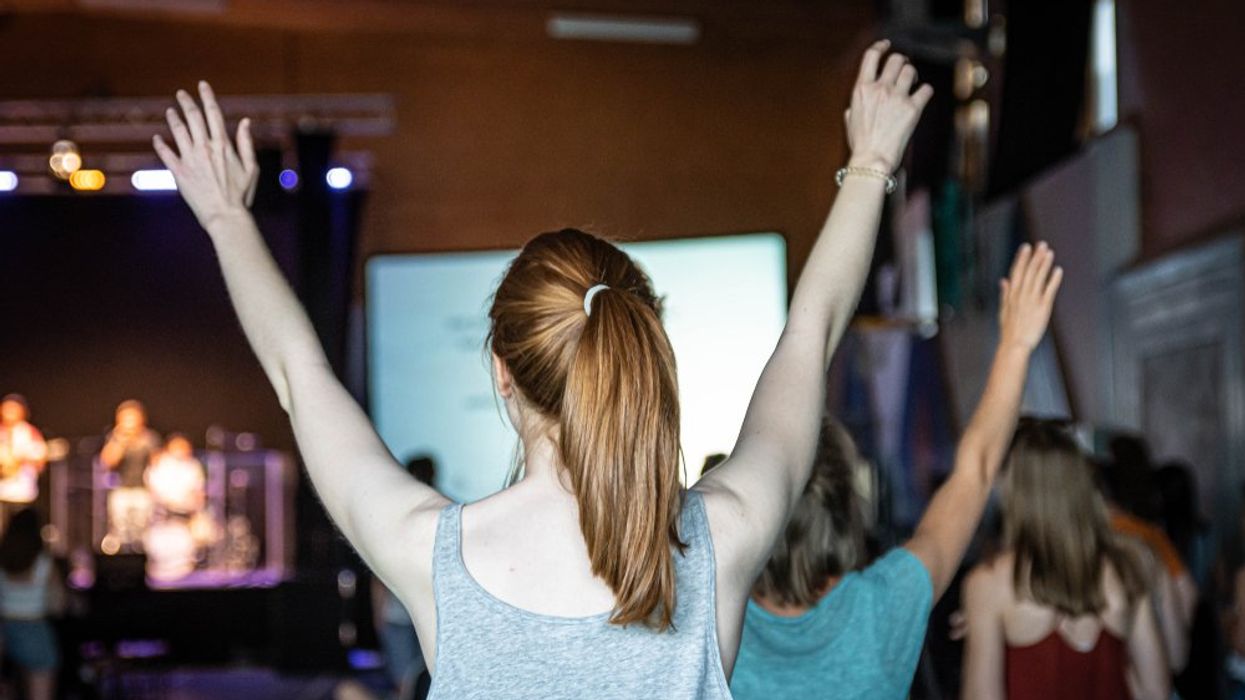
Attendees at an evangelical megachurch in 2019 
May 07, 2025
ALTERNET

When Republicans flipped the U.S. Senate in 2024 and Donald Trump narrowly defeated then-Vice President Kamala Harris in the presidential race, anti-abortion groups and far-right Christian nationalists were optimistic. Republicans now control the White House and both branches of Congress, and anti-abortion activists are hoping for abortion restrictions at the national level.

However, the GOP majorities in the Senate and the U.S. House of Representatives are small, and House Republicans in swing districts are worried about the 2026 midterms — especially with Trump having low approval ratings in countless polls only three and one-half months into his second presidency. Abortion was a bad issue for Republicans in the 2022 midterms, and Democratic strategists are hoping it will hurt the GOP in 2026 as well.

In an article published on May 7, Politico's Alice Miranda Ollstein examines Rolling Thunder — anti-abortion activists' game plan for Trump's second presidency.

"The nation's most influential anti-abortion groups have a new plan to roll back access to the procedure for millions of Americans in what they're calling the 'biggest opportunity for the pro-life movement' since toppling Roe v. Wade," Ollstein reports. "The effort, which the groups have privately named 'Rolling Thunder,' is the movement's first concerted attempt under the second Trump Administration to target abortion pills, and aims to convince the FDA (U.S. Food and Drug Administration), Congress and courts to crack down on their use."

Ollstein adds, "While the Trump Administration paid little attention to the medication in its first months in office, and even filed a court brief to preserve access, the activists are counting on a report from the conservative think tank Ethics and Public Policy Center to light a fire under those in power."

Ollstein notes that the drug Mifepristone is "is a longtime target of conservative activists who consider it the primary driver of the increase in abortions since Roe's fall in 2022."

"The groups also hope to wield the report to pressure Congress to strip the remaining federal funding from Planned Parenthood — which they consider the country's best-known purveyor of the drugs — and give conservative legal groups fodder to prosecute doctors who prescribe the pills to patients who live in states with abortion bans," the Politico reporter explains. "Missouri Republican Sen. Josh Hawley told Politico he plans to introduce legislation — inspired by the groups' report — that would restrict access to the pills and make it easier for patients who have taken them to sue the manufacturers, Danco and GenBioPro."

Ollstein adds, "(Hawley) is also joining the groups' pressure campaign on the FDA…. Planned Parenthood and other abortion-rights supporters are slamming the report as 'junk science' as they mount their own pressure campaign to save their funding — highlighting that the paper was released directly by the conservative think tank and not published in a medical journal where it would have been vetted by outside experts in the peer review process."

Read the full Politico article at this link.
Donald Trump just inadvertently invoked the Christian understanding of the Antichrist


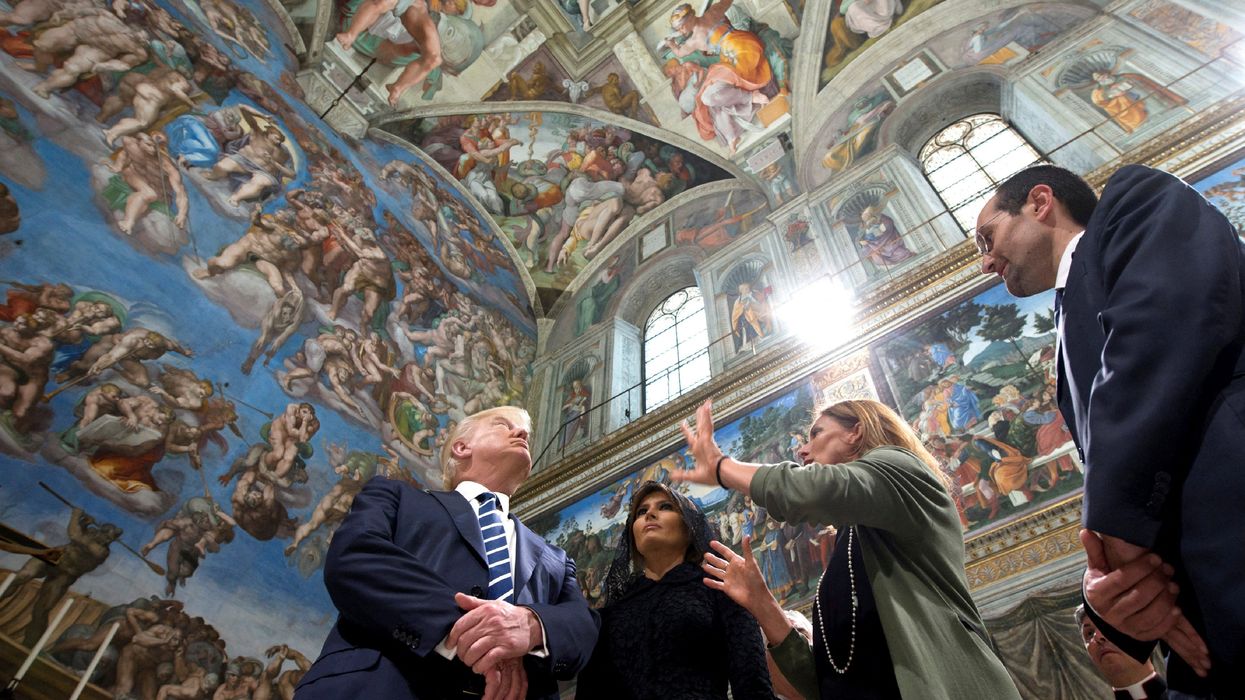
President Trump and his wife Melania visit the Sistine Chapel after a private audience with Pope Francis at the Vatican, May 24, 2017. Osservatore Romano/Handout via REUTERS


May 09, 2025

The US presidency and the papacy came together on May 3 when Donald Trump posted an AI-generated photograph of himself dressed as the pope to Truth Social. The image was then shared by the White House’s accounts.


Seated in an ornate (Mar-a-Lago-style) golden chair, he was wearing a white cassock and a bishop’s hat, with his right forefinger raised.

Trump has since told reporters he “had nothing to do with it […] somebody did it in fun”.

This image of “Pope Donald I” is of historical significance, for reasons of which, no doubt, the White House and Trump were blissfully unaware. It is the first ever image to combine the two most important understandings of the figure of the Antichrist in Western thought: on the one hand, that of the pope, and on the other, that of the authoritarian, despotic world emperor.

On April 22, the day after Pope Francis’ death, Trump declared “I’d like to be pope. That would be my number one choice”. On April 28, Trump told The Atlantic “I run the country and the world”.

So, both pope and world emperor.

The Imperial Antichrist


In the New Testament, the First Letter of John says, before Christ came again, the Antichrist will appear: the most conspicuous sign the end of the world was near.

The Antichrist would be the archetypal evil human being who would persecute the Christian faithful. He would be finally defeated by the forces of good. As Sir Isaac Newton suggested, “searching the Prophecies which [God] hath given us to know Antichrist by” is a Christian obligation.

The first life of the Antichrist was written by a Benedictine monk, Adso of Montier-en-der, around 1,100 years ago. According to Adso, the Antichrist would be a tyrannical evil king who would corrupt all those around him with gold and silver. He would be brought up in all forms of wickedness. Evil spirits would be his instructors and his constant companions.


The Antichrist, left, is depicted as a king, in this image from a 12th century manuscript.
Wikimedia Commons

Seeking his own glory, as Adso put it, this king “will call himself Almighty God”.


The Antichrist was opposite to everything Christ-like. According to the Christian tradition, Christ was fully human yet absolutely “sin free”. The Antichrist too was fully human, but completely “sin full”. The Antichrist was not so much a supernatural being who became flesh, as a human being who became fully demonised.

Influenced by Christian stories of the Antichrist, Islam and Judaism constructed their own Antichrists – al-Dajjal, the Antichrist of the Muslims, and Armilus, the Antichrist of the Jews. Both al-Dajjal and Armilus are king-like messiahs.

Over the centuries, many world leaders have been labelled “the Antichrist” – the Roman emperors Nero and Domitian were Antichrist figures, and the French emperor Napoleon was named the Antichrist in his own time.

There have been more recent leaders who have been likened to the Antichrist, among them former president of Iraq Saddam Hussein, King Charles III, former Russian leader Mikhail Gorbachev, al-Qaeda founder Osama bin Laden, and Trump.

The Papal Antichrist

In the year 1190, King Richard I of England, on his way to the Holy Land, was informed by the Italian theologian Joachim of Fiore (c.1135–1202) the next pope would be the Antichrist.

In the history of the Antichrist, this was a momentous occasion. From this time on, the tyrannical Antichrist outside of the Church would be juxtaposed with the papal deceiver within it.

That the Catholic pope was the Antichrist was the common reading of the pope in the 16th-century Protestant Reformation.

Martin Luther (1483–1546), the founder of the Protestant revolution, declared the pope “is the true […] Antichrist who has raised himself over and set himself against Christ”.

Just as all Christians would not worship the Devil as God, he went on to say, “so we cannot allow his apostle the pope or Antichrist, to govern as our head or lord”.


This 1877 painting depicts Martin Luther summoned by the Catholic Church in 1521, to renounce or reaffirm his views criticising Pope Leo X.

As he was about to be burned by the Catholic Queen Mary for his Protestant beliefs, the Anglican bishop Thomas Cranmer (1489–1556) declared, “as for the pope, I refuse him, as Christ’s enemy and antichrist with all his false doctrine”.

Even in 1988, as Pope John Paul II addressed the European Parliament, the Northern Ireland hardline Protestant leader Ian Paisley roared, “Antichrist! I renounce you and all your cults and creeds” – to which, we are told, the pope gave a slight bemused smile.


Except among the most extreme of Protestant conservatives, the idea of the papal Antichrist no longer has any purchase. The papal Antichrist has vacated the Western stage for the imperial Antichrist.

The Antichrist and the end of the world

In the history of Christianity, the idea of the Antichrist was a key part of Christian expectations about the return of Christ and the end of the world.

In the final battle between the forces of good and evil, the Antichrist would be defeated by the forces of Christ. In short, the rise of the world emperor who was the Antichrist was a sign that the end of the world was at hand.

In the light of the Western history of “the Antichrist”, the image of the imperial and papal US president is a powerful sign that the global order – at least as we have known it for the last 80 years – may be at an end.

Philip C. Almond, Emeritus Professor in the History of Religious Thought, The University of Queensland

This article is republished from The Conversation under a Creative Commons license. Read the original article.


Jewish Voices for Palestine and Free Speech Slam House GOP 'Kangaroo Hearing' on Antisemitism

"What we are seeing has nothing to do with keeping Jews safe and everything to do with crushing dissent," said one Barnard College student.


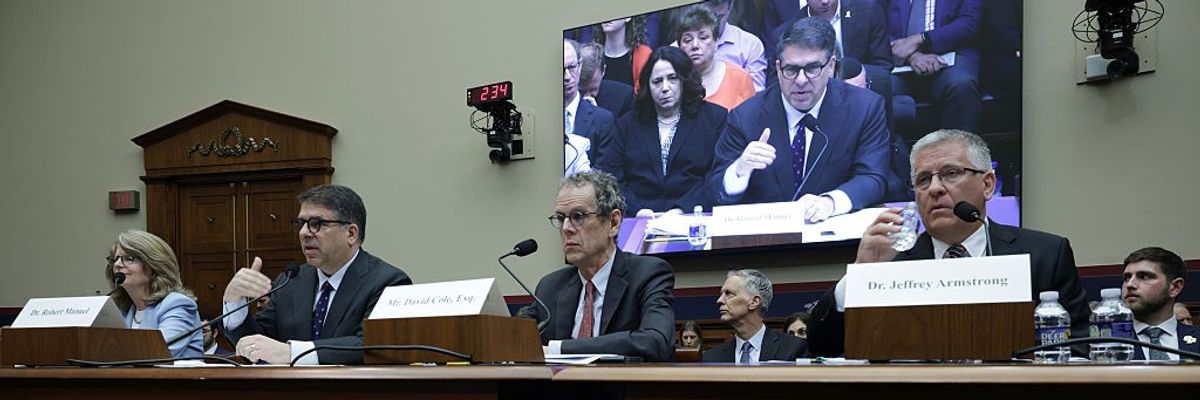
Haverford College president Wendy Raymond, DePaul University president Robert Manuel, Georgetown Law Center professor David Cole, and California Polytechnic State University president Jeffrey Armstrong testify during a House Education and Workforce Committee hearing on Capitol Hill in Washington, D.C. on May 7, 2025.
(Photo: Alex Wong/Getty Images)


Brett Wilkins
May 07, 2025
COMMON DREAMS


Jewish students and academics for Palestinian rights and free speech on Wednesday condemned a congressional hearing in which House Republicans repeatedly conflated opposition to Zionism and Israeli crimes against Palestine with antisemitism, while Democratic lawmakers warned against the weaponization of civil rights to suppress dissent.

The House Education and Workforce Committee held the hearing—titled "Beyond the Ivy League: Stopping the Spread of Antisemitism on American Campuses"—which followed last year's panel on antisemitism, both real and contrived, at Columbia University.

This time, the presidents of Haverford College, DePaul University, and California Polytechnic State University were grilled by lawmakers including committee Chair Tim Walberg (R-Mich.), who said that Israel should deal with Gaza "like Nagasaki and Hiroshima" and was a manager at the Moody Bible Institute, which according to a memo from a group of mostly Jewish Haverford professors, "trains students to convert Jewish people to Christianity."

The memo notes that committee member Rep. Mark Harris (R-N.C.) once said Jews and Muslims will never know "peace in their soul" until they renounce their religions and accept Jesus Christ as their lord and savior. Another committee member, Rep. Mary Miller (R-Ill.), said that Nazi leader Adolf Hitler was "right" about political movements' need to capture youth support, before later apologizing.


Yet these and other Republican lawmakers on the panel pressured the three university presidents to crack down on constitutionally protected speech, while conflating support for Palestine and criticism of Israel with antisemitism.

"Haverford employs faculty members who engage in blatant antisemitism with no apparent consequences," said Walberg. "For example, one professor declared online that Zionism is Nazism."

Asked by Walberg if the phrase "long live the intifada"—an affirmation of Palestinians' legal right to armed resistance against Israeli oppression—is "protected speech at Haverford's campus," college president Wendy Raymond incorrectly said, "That is an antisemitic form of speech."

Walberg also falsely called the Hamas-led October 7, 2023 attack on Israel "unprovoked" and singled out students and faculty who praised Palestinians who resist Israel—which is facing a genocide case at the International Court of Justice and whose prime minister and former defense minister are fugitives from the International Criminal Court, where they are wanted for alleged war crimes and crimes against humanity, including extermination and forced starvation, in Gaza.

DePaul University president Robert Manuel said he was "deeply sorry" for "mistakes" made at the Chicago school, where two Jewish students were brutally attacked last November in what prosecutors have charged as a hate crime, while touting the banning of pro-Palestine groups including Students for Justice in Palestine from campus.

While noting that the Constitution "doesn't protect antisemitic violence, true threats of violence, or certain kinds of speech that may properly be labeled 'harassment,'" Georgetown University Law Center professor and former ACLU national legal director David Cole told the committee that the First Amendment "protects speech many of us find wrongheaded or deeply offensive, including anti-Israel advocacy and even antisemitic advocacy."


Cole accused the committee of making "broad-based charges of antisemitism without any factual predicate."

"To be honest, and with all due respect, the hearings this committee held on this same subject last year are reminiscent not of a fair trial of any sort, but of the kind of hearings the House Committee on Un-American Activities used to hold," Cole contended. "And I think we can all agree that the HUAC hearings were both a big mistake and a major intrusion on the First Amendment rights of Americans."

Cole also took aim at U.S. President Donald Trump's weaponization of antisemitism to threaten and defund colleges and universities that don't crack down on Palestine defenders, stressing that "the government may not threaten funding cuts as a tool to pressure recipients into suppressing such viewpoints."

Dozens of Jewish Haverford students signed an open letter to members of the House Education Committee ahead of Wednesday's hearing stating that "we are all deeply concerned by how you are weaponizing our pain and anguish for your own purposes."


"It is clear to us that these hearings will not, and have no desire to, protect us or combat antisemitism," the letter says. "Instead, this congressional hearing weaponizes antisemitism to target freedom of speech on college campuses, silences political dissidents, and attacks students who speak out in solidarity with Palestine. It is a blatant assault on our Black, brown, transgender, queer, noncitizen, and Palestinian peers."


A day before the hearing, the group Jewish Voice for Peace Action (JVPA)—which called the panel a "kangaroo hearing"— brought nine Columbia University and affiliated students to Capitol Hill to meet with members of Congress and "speak about their experiences as Jewish students who have been steadfastly committed to advocating for the safety and freedom of the Palestinian people."

Columbia junior Shay Orentlicher said that "I'm here asking my representatives to call for the release of my friend Mahmoud Khalil and to put real pressure on the Trump regime," referring to the permanent U.S. resident facing deportation after helping to lead pro-Palestine protests at the New York City university.

"I cannot stand to see the Trump administration smear Mahmoud as an antisemite when it could not be further than the truth," Orentlicher added.

Tali Beckwith-Cohen, a Jewish senior at Columbia-affiliated Barnard College, argued: "The Trump regime is using false allegations of antisemitism to disappear our friends, punish student protestors, and dismantle higher education. What we are seeing has nothing to do with keeping Jews safe, and everything to do with crushing dissent."

"Thousands of Jews on campuses across the country have spoken out in solidarity with the people of Gaza and we will not be silent," Beckwith-Cohen vowed.

JVPA political director Beth Miller contended that "the far-right does not care about Jewish safety."

"Trump and his allies in Congress are platforming neo-Nazis and Christian nationalists, all while pretending to care about antisemitism in order to take a hatchet to our communities and most basic freedoms," Miller added. "This is intended to silence the Palestinian rights movement, sow chaos, and sharpen authoritarian tools that will then be used to dismantle civil liberties and democracy itself."

Rep. Bobby Scott (D-Va.), the ranking member of the House Education Committee, pushed back on Republicans' assertions during Wednesday's hearing, noting that "my colleagues on the other side of the aisle have not held any hearings on other forms of discrimination and hate, such as racism, Title IX gender violations, Islamophobia, homophobia, or the challenges of meeting the needs of students with disabilities."

Rep. Greg Casar (D-Texas) noted that Trump praised attendees of the deadly 2017 "United the Right" white supremacist rally in Charlottesville, Virginia as "very fine people," and that Health and Human Services Secretary Robert F. Kennedy Jr. "spread an antisemitic conspiracy theory that Covid was engineered to target white and Black people but spare Jewish people."

Casar asked committee Republicans to condemn these and other antisemitic incidents by raising their hands. None did.

"Not a single Republican today has been willing to condemn any of this antisemitism," Casar lamented. "Unfortunately, the party of 'very fine people on both sides' or ' Jewish space lasers' does not give a damn about stopping antisemitism. If my Republican colleagues want to stop the spread of antisemitism, maybe they should stop apologizing for and promoting antisemites."

Rep. Ilhan Omar (D-Minn.) argued that "it is abundantly clear that the cynical work of the majority party on this committee is now being expanded and weaponized by the [Trump] administration seeking to squash dissent."

"Political protest, anti-war protest, pro-Palestinian protest—this is all protected speech under the First Amendment, regardless of citizenship status," Omar said after listing a number of Palestine defenders, including green-card holders, targeted for deportation by the Trump administration.

"Using immigration authorities to target, abduct, and detain noncitizens for their activism is a clear violation of their rights and a hallmark of an authoritarian government," she added.

Asserting that "throughout history, college campuses have been the places where worldviews, politics, cultures meet," Rep. Summer Lee (D-Pa.) said that "some of the most transformative movements for justice in this country were ignited by students on college campuses."

"We cannot allow them to use efforts to divide our marginalized communities against each other."

"Now, that tradition of protest, academic freedom, and the core principle of free speech is under attack," Lee noted. "Not genuinely in the name of safety and student well-being, but under the guise of control used to suppress the voices of marginalized groups."

Lee said that it's clear that committee Republicans don't care about tackling antisemitism and other forms of bigotry "because they've dismantled and closed regional offices for civil rights... tasked with investigating antisemitism, that they have not spoken out against the Nazi salutes of Elon Musk or the Great Replacement Theory that led to the largest antisemitic massacre in my district."

"They have done nothing about anti-Blackness—I won't hold my breath for a hearing on that," she continued.

"We haven't acknowledged that our safety and our liberation are tied together," Lee added. "We cannot allow them to use efforts to divide our marginalized communities against each other... We are the closest we have ever been—ever been—to losing our civil liberties. We have to fight against it."