Sunday, May 11, 2025

Wells Fargo Wants to Privatize USPS. We Should Dismantle the Mega Bank Instead.

Why would a mega bank with one of the worst reputations in a scandal-ridden industry take over a popular institution?

May 11, 2025

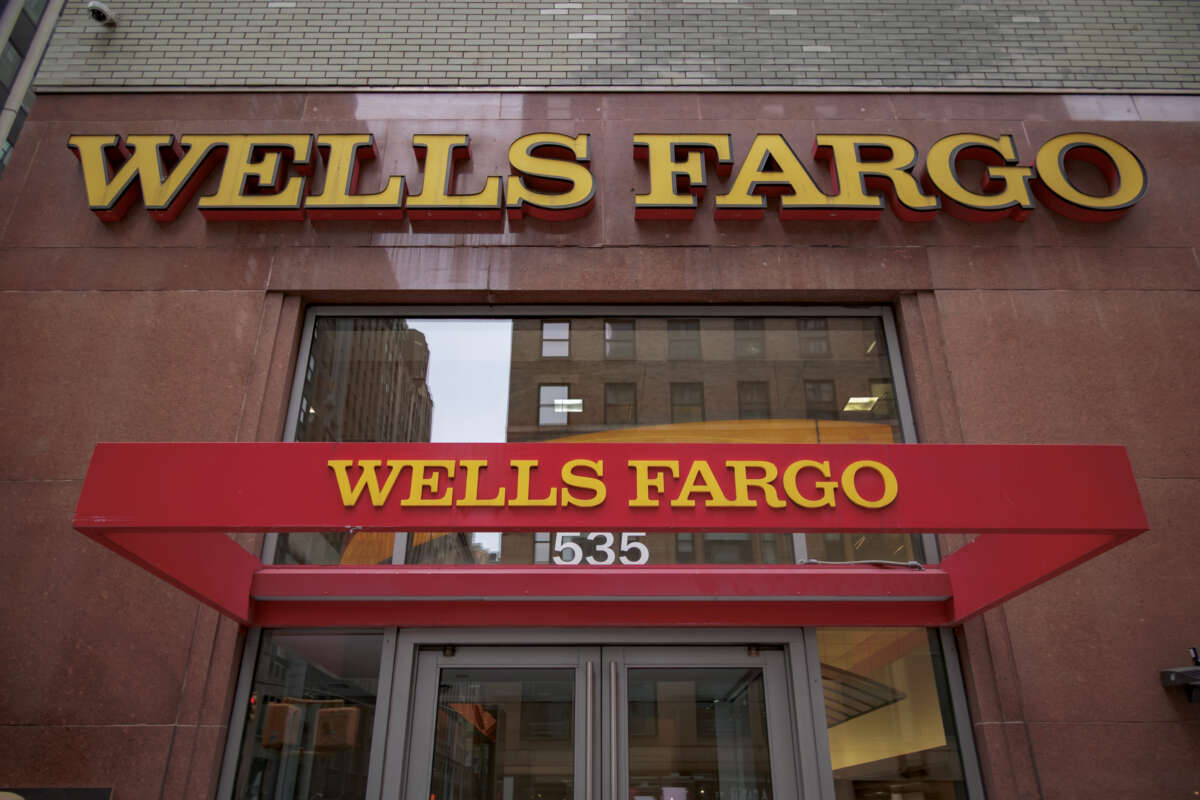
A sign at the entrance to a Wells Fargo bank in Manhattan, New York, on May 14, 2025.Erik McGregor/LightRocket via Getty Images


The United States Postal Service (USPS) is a front line in the struggle for democracy and justice against corporate power, as a memo released by Wells Fargo unveils. Published February 27, the memo outlines a plan for privatizing the USPS and enabling investors to reap the profits. The plan has been met with criticism and protest, since achieving profitability relies on selling off property, firing workers, limiting or eliminating services, and raising parcel rates by up to 140 percent. At the end of March, senators introduced a resolution calling on Congress to affirm the USPS as an independent agency and protect it against privatization.

Wells Fargo outlines challenges to implementing their plan, including that legislation needed for privatization is unlikely to pass through Congress, support for the USPS remains high especially among rural communities and investors in a privatized USPS would need to contend with “nine collective bargaining agreements with seven unions covering 550,000 employees.” But the mega bank has solutions for each of these challenges.

First, it suggests using a reconciliation bill that would only require a simple majority of votes to pass through the Senate, aggressively limiting or eliminating services to frustrate public support, and undercutting unionized labor by laying off workers and slashing benefits.

In laying out its privatization plan, the bank is returning to a previous, historical ambition: Wells Fargo was founded in 1852 by stagecoach mail delivery executives, Henry Wells and William Fargo. Wells and Fargo wanted to capitalize on the California gold rush and used stagecoaches to ship gold and deliver mail and other supplies between outposts and mining towns scattered across the state. Over the decades, Wells Fargo merged with other “pony express” mail services to monopolize delivery. The westward expansion of the railroads eventually ended the bank’s reign over mail delivery, but Wells Fargo’s interests in USPS remain centered on capitalization and monopolization.

Steps toward privatization may already be underway. Before resigning from his position, Postmaster General Louis DeJoy signed an agreement with Elon Musk’s “Department of Government Efficiency” — the pseudo agency finding efficiencies in the federal government on the backs of public-sector workers — and announced the elimination of 10,000 jobs.

Related Story

As Trump Pushes Privatization of USPS, Amazon May Be Preparing to Take Over
A new CEO statement from Amazon suggests it could be angling to take over the US Postal Service. 
By Jonathan Rosenblum & Benjamin Y. Fong , Truthout May 6, 2025

USPS took a big step toward privatization on May 9, when the USPS Board of Governors announced that FedEx official David Steiner would become the next Postmaster General. Steiner was favored by President Donald Trump to lead the agency, despite the clear conflict of interest appointing a senior executive from a USPS competitor.
Privatization Is an Attack on Democracy

It’s a special kind of irony that a mega bank with one of the worst reputations in an industry where the bar is embarrassingly low wants to take over a broadly popular federal agency. The truth is, we need the USPS. We do not need Wells Fargo.

If there’s a federal agency that exemplifies democracy’s potential, it’s the USPS. The USPS delivers to every address in the country, without exception. No matter who you are or where you live, the USPS delivers birthday cards and love letters, including to people who are incarcerated in jails and prisons. Election ballots are sent through the mail, where people make choices about who will represent their concerns in the halls of political power. Prescription medication and abortion pills are received in the mail, providing people with access to health care and reproductive justice. Tax refunds, social security and stimulus checks arrive in the mail, offering people some financial security in a volatile economy. Seeds and saplings are delivered through the mail, making the USPS a partner in environmental justice efforts. The USPS even transports insects and live animals, including honeybees and baby chicks that sustain local food and agriculture.

What’s more, the USPS employs workers at competitive wages and with union representation. These wages and benefits are hallmarks of working conditions and benefits won through organized labor, where workers express their collective power and fight for dignity on the job. Postal workers earn a median wage that is higher than the national average and receive benefits like health care and paid leave. With Black employees making up 29 percent of its staff, the USPS has played an important role in building the Black middle class (perhaps a reason President Donald Trump and Musk have the agency in their crosshairs, given the administration’s anti-Black and segregationist agenda). Moreover, since formal education is not required to become a postal service worker, the USPS is one of the few places where workers can earn decent pay regardless of education level.

As I’ve written before, we should be imagining the dismantling of Wells Fargo, not the privatizing of the USPS.

Wells Fargo is an enormously unpopular bank well-known for its scandalous business practices. On a 2023 ranking of the 100 largest publicly traded banks, factoring criteria like credit quality and profitability, Wells Fargo came in last place. Two years later, it didn’t even make the list. The mega bank has been charged billions of dollars in fines and penalties from regulators for repeated wrongful and illegal practices, including foreclosing on people’s homes, repossessing vehicles, and overcharging fees and interest. The bank is fodder for comedy routines and an easy target for activists and policy makers wanting to express their displeasure with the finance industry overall.

A bank that has kicked people out of their own homes and deprived people of their livelihoods now wants to undermine the public service that delivers the mail, too. If Wells Fargo and private investors get their way, more expensive parcel rates would be only one of many concerns. One place to look for understanding just how much privatization can cost are the experiences of people who are incarcerated.

For people locked behind bars, mail and phone calls are lifelines to the outside world. But, they’re expensive to get. Phone calls are especially costly, in part because these services have been monopolized by private telecommunications companies taking advantage of captive populations. In some jails and prisons, telecoms charge $1 per minute for phone calls. One 15-minute phone call can easily cost as much as $25 — an outlandish price for the human right of communicating with loved ones. In 2024, the Federal Communications Commission intervened and issued a rule cutting costs for phone calls in jails and prisons. Under the new rule, a 15-minute phone call now costs between 90 cents and $1.35.

If the USPS is privatized, we can expect private investors to raise prices on stamps and parcel rates in the same way telecoms have made their profits off people who are incarcerated. Instead of the promise to deliver to every address, your zip code will matter more than ever. Rural communities, communities of color and poor communities will likely pay the highest rates for mail delivery, since, like incarceration, residential segregation aids in identifying groups of people for exploitation.

Instead of privatizing the USPS, we should be expanding its public services. For example, the USPS can expand the financial services it already provides. The agency sells over $21 billion in money orders every year and, between 1911 and 1967, operated a popular banking system out of the nation’s post offices. At its height, nearly 4 million people held $3.4 billion in interest-bearing accounts (over $50.5 billion in today’s dollars). People made deposits and purchased savings bonds alongside sending and receiving mail. However, President Lyndon B. Johnson ended postal banking as sales from defense bonds waned after World War II, bank lobbyists applied pressure, and people went elsewhere for financial services.

It’s certainly possible the USPS is better at offering these financial services than Wells Fargo, given the bank’s massive “fake accounts” scandal, where employees, under pressure to meet aggressive sales quotas, opened bank accounts for people without their knowledge and then charged excessive fees. In fact, rather than privatization, the USPS could be expanded to operate a public banking system again — a timely idea since private banks are facing less regulatory oversight from the Consumer Financial Protection Bureau to rein in their costs and fees.

The USPS is an agency where struggles for democracy and justice converge. If you care about organized labor, you care about the USPS. If you care about climate change, you care about the USPS. If you care about racial, economic and reproductive justice, you care about the USPS. If you care that your grandma receives her social security check, you care about the USPS.

Wells Fargo does not care about any of these things. Don’t let it privatize the USPS.

There are a few things you can do to take action and save the USPS. Sign a petition, call your senators, host a teach-in event in your community or record a video about what the USPS means to you. Tell Wells Fargo and the Trump administration to get their hands off the USPS.


This article is licensed under Creative Commons (CC BY-NC-ND 4.0), and you are free to share and republish under the terms of the license.

Terri Friedline
 writes, organizes and teaches about racial capitalism, technology and the financial system. She is a professor of social work at the University of Michigan and is the author of Banking on a Revolution: Why Financial Technology Won’t Save a Broken System (Oxford University Press).
Want to Stop Trump’s Attacks on the NLRB? History Shows Strikes Are the Answer.

Workers’ legal rights are inherently precarious in a capitalist economy. Only periodic mass upheaval has renewed them.
May 10, 2025

Valencia Simpson (left) and Asiata Adekunle Murtala (right) rally with more than 55,000 members of SEIU Local 721 on strike on April 29, 2025, in Los Angeles, California.Carlin Stiehl / Los Angeles Times via Getty Images


LONG READ


May Day 2025 in the United States came amid the most aggressive assault on U.S. workers in a century. The federal agencies that provide some minimal protection against corporate power — the National Labor Relations Board (NLRB), the Environmental Protection Agency (EPA), and many more — are being systematically destroyed. On May 1, hundreds of thousands protested at roughly 1,300 actions across the United States. Under the broad theme “Workers Over Billionaires,” they condemned union-busting, austerity, climate destruction, anti-immigrant terror, the U.S.-Israeli genocide, and other facets of the assault.

Protests like these are important, but will have little impact on their own. Stopping the billionaires will require much more.

To protect the NLRB, EPA, and other agencies, we must consider what allowed for those agencies in the first place. From a historical perspective, what’s surprising isn’t so much the current blitzkrieg as the fact that agencies that help protect people and environment were tolerated for so long despite business opposition to them.

Regulatory agencies ultimately stabilize capitalism, but they are usually met with either hostility or grudging support from capital. As many observers have remarked, an unrestrained capitalist class will tend to undermine its own long-term stability by devouring the workers and natural resources that make profits possible. It will also block the government reforms that could save capitalists from themselves.

The history of the NLRB is a stark example. Created in 1935 under the National Labor Relations Act (“Wagner Act”), the board furnished a legal framework for unionization and collective bargaining by private sector workers. Whatever their moral commitments, New Deal Democrats were also driven by the need to channel worker rebellion into bureaucratic channels and thereby restore stability to a class system under threat from below. The act tellingly included new legal restrictions on union activities.

Related Story

Italy Shows How Amazon Can Be Forced to Bargain: Shut Down Its Distribution
Amazon is huge and powerful, but Italian workers have shown it can be forced to negotiate. Could US workers do the same? 

Capitalists only accepted the NLRB reluctantly. They soon tried to handcuff it, most notably with the 1947 Taft-Hartley Act that drastically curtailed workers’ rights to unionize, strike, boycott and join anti-capitalist political parties. Most of Taft-Hartley remains on the books today.

That the NLRB has survived at all reflects the lingering imprint of past worker insurgency. For nine decades, most corporate leaders and state elites have seen the NLRB as preferable to the unknown chaos of dismantling it, especially since they were able to clip its wings.

But as the labor upsurge that spurred the NLRB’s creation receded into the past, and new upsurges were less frequent and disruptive, much of the ruling class came to question the need for the board at all. Now that President Donald Trump and Elon Musk are intent on returning workers to the Gilded Age, fellow capitalists long ambivalent about the NLRB may not object to a coup de grâce. They definitely won’t object if Trump and Musk choose the lesser option of further neutralizing the agency through defunding, hamstringing and pro-business appointments.

Either way it’s a good moment to revisit the agency’s birth. Defending the NLRB, let alone winning something better, requires understanding the historical conditions and organizing strategies that made its creation possible. Until the labor movement again becomes a real threat to capitalists, workers’ legal rights will continue to be eroded.

Union Recognition Before 1935

The industrial unions that formed in the late 1800s and early 1900s were violently crushed in the aftermath of World War I. By the 1920s only about 10 percent of United States workers were unionized.

The courts and laws of the pre-NLRB era were generally unequivocal enemies of labor. In 1842 the Supreme Judicial Court in Massachusetts ruled that workers, not employers, were responsible for dangerous workplace conditions. In 1857, the Supreme Court upheld slavery for Black people. In 1905, it declared that laws limiting work hours were unconstitutional. In rulings between 1917 and 1922, it gave its blessing to the anti-union pledges that employers forced on workers and to bans on mass picketing, sympathy strikes and secondary boycotts. Judges readily granted injunctions to employers who faced strikes, based on the many local, state and federal laws that prohibited and harshly penalized work stoppages. This meant that by the 1920s, most strikes were effectively illegal. Meanwhile, the bosses were usually free to fire and even kill disobedient workers, since murders often went unpunished.


For workers to wield real power, they can’t rely on lobbying, elections and NLRB complaints.

Still, workers did achieve some notable victories, almost always as a result of strikes and strike threats. Several years before muckraking journalist Upton Sinclair published his meatpacking exposé The Jungle, Chicago’s slaughterhouse workers had won a 10-hour day by using work stoppages that created what an industry journal described as “a state of siege.”

Later, fears of disruption to wartime production, and thousands of actual strikes, led to widespread adoption of the eight-hour day. Over 1 million workers won the eight-hour day from their employers between 1915 and 1917. Only in the second half of 1918 did the National War Labor Board, which had been established to manage wartime labor relations, move to extend the eight-hour limit across industry.

A rare legislative advance was a 1916 federal law granting railroad workers the eight-hour day. Congress passed it one day before railway unions had threatened to go on strike. The railroad owners only accepted it in 1917 when workers again threatened a national strike.

Transit and logistics workers were also crucial in forcing some employers to grant de facto union recognition. In 1919, illegal picketing by Seattle’s longshore workers won them union control over hiring. Especially significant were the battles of the Amalgamated Association of Street and Electric Railway Employees of America, founded in 1892. An 1898 federal law urging employers to agree to “voluntary arbitration” went ignored. By waging over 200 strikes — with scores of workers killed — union members forced the streetcar companies to agree to arbitration. By 1915, the national union had secured over 200 collective bargaining agreements.

The Amalgamated’s exercise of workplace power contributed to victories for the entire working class. The union’s successful battles for arbitration provided a model that states and later the federal government used to end industrial conflict. Its fight for safer streetcars also established precedents for later court rulings on workplace safety.


“The Industrial War” in the 1930s

In 1937, Fortune magazine remarked that the recent “assistance rendered by the government” to workers “is itself symptomatic of a real pressure” external to the government. “Washington has strengthened labor’s position, not just for the hell of it, but in response to forces that the depression stimulated and revitalized.”

One of those forces was the economic crisis itself, which market-based approaches between 1929 and 1935 had failed to end. The other force was the title of the article: “The Industrial War.” As profits soared to new levels, workers grew less compliant. Some 5.6 million went on strike between 1933 and 1937.

In June 1933, President Franklin Delano Roosevelt had signed the National Industrial Recovery Act, Section 7(a) of which affirmed workers’ right “to organize and bargain collectively through representatives of their own choosing.” Section 7(a), and the unionizing and strikes that followed, are often cited as evidence that labor-friendly Democrats catalyzed the labor movement’s growth.

This argument misses the deeper causes of labor’s advance. Communists and other radicals provided the early organizing muscle in the key mass production industries. They consciously targeted the most strategic sectors of the economy, starting with coal.

Between 1928 and early 1933, the communist-led and interracial National Miners Union (NMU) had organized coal workers from western Pennsylvania to Alabama. They carried out mass strikes peaking in 1932.

John L. Lewis, president of the United Mine Workers of America (UMWA), took action to counter the communists’ rising influence. In February 1933, he pressed Congress “to foster collective bargaining as a means of combating Communism,” writes historian Irving Bernstein. The UMWA was the crucial “impetus” for the inclusion of Section 7(a) in the June 1933 law, Bernstein notes. Without the communists, Section 7(a) might never have been included.

The UMWA also benefited directly from the communists’ work since coal companies saw the UMWA as a lesser evil. After suffering major losses in the 1920s, the UMWA soon received thousands of new members.

Other unions benefited indirectly. The UMWA’s new dues-paying members delivered revenue that Lewis soon reinvested into union organizing in the auto, steel, electronics and meatpacking industries, where communists were again often the key organizers.

The next turning point came in 1934. Sen. Robert Wagner’s proposed bill went nowhere when he introduced it in March 1934. A year later, a similar version passed both houses with overwhelming support.

The decisive shift from 1934 to 1935 didn’t come from above. As of early 1935, President Roosevelt and Labor Secretary Frances Perkins hadn’t “lifted a finger” in support of union rights, as Perkins herself admitted. What made the difference were the 1,856 strikes by almost 1.5 million workers during 1934, including three massive radical-led strikes in San Francisco, Minneapolis and Toledo.

By February 1935, Wagner’s bill, and its House counterpart from Rep. William Connery, appeared preferable to continued bedlam. Most of Congress agreed with Representative Connery’s argument that reform was necessary to keep “the gates of hell” from bursting wide open, and “to save those corporations from communism” by facilitating unionization. President Roosevelt signed the new law in July.

Over the next 12 years, unions would gain 12 million new members. It didn’t happen automatically though. Even after Roosevelt signed the law, most employers ignored it. Only after another round of shopfloor upheaval would they allow it to be enforced.

“Another Means of Defense”


The most decisive confrontation were the sit-down strikes at General Motors (GM) factories between December 30, 1936, and February 11, 1937. GM’s profits had risen from $8 million to $240 million in the prior four years, thanks largely to speedup of the assembly line and the poverty wages of GM workers. In 1936, the United Auto Workers (UAW) began organizing workers in Flint, Michigan, supported by reinvested UMWA dues.

Workers strategically shut down two “mother plants,” preventing around 10,000 cars a day from being produced. Fifteen additional plants went on strike and many more stopped production due to the supply chain disruption. Business Week grudgingly noted that organizers had “skillfully picked out the bottle-necks of production and choked them off.”

The sit-downs were widely seen as illegal. Judges issued two legal injunctions at GM’s request, ordering workers to vacate the plants or face harsh legal penalties. The workers defied them. On February 11, GM finally surrendered, recognizing the UAW for six months during which time the union signed up tens of thousands of members.

U.S. Steel then quickly recognized its own union to prevent a similarly debilitating strike. Two of the three biggest corporations in the country, both notoriously anti-union, had conceded.

That’s especially remarkable given that the Supreme Court was widely expected to rule the Wagner Act unconstitutional that spring. It might have done so if not for the auto and steel victories and the prospect of continued industrial strife. Had it overturned Wagner, wrote Fortune that November, “the labor situation in the US might swiftly have become blood and chaos.” The court’s April 1937 ruling stated that unionization “is often an essential condition of industrial peace.”

Labor’s occasional breakthroughs since the 1930s have usually resulted from 1930s-style militancy, most of it illegal.

GM granted more definitive union recognition in 1940 after factional rivalries within the UAW had further destabilized its factories. The factions were conducting alternating work stoppages to win workers’ support.

Other industries complained of similar chaos. Business Week reported in 1938 that companies were now “look[ing] to the government for help” by calling upon the NLRB to conduct orderly elections. It was the bosses’ invitation that finally empowered the NLRB.

Meatpacking too was notable for “workers’ reliance on direct action to bring their employers to terms,” writes scholar Rick Halpern in his valuable study Down on the Killing Floor. “Strategically situated killing-floor workers” exploited chokepoints in the production process. The Packinghouse Workers Organizing Committee secured its first NLRB election in 1937 by shutting down the floor at key nodes and using the threat of meat spoilage.

In some packinghouses workers were so well organized that they refused employers’ pleas to let the NLRB adjudicate disputes. “You’re looking at the Labor Board in this plant right now,” they told the boss in one confrontation. Black communist organizer Hank Johnson said that the workers “have another means of defense equal to the service being given by the NLRB.” The union’s remarkable degree of interracial solidarity bolstered that defensive capacity.


Forgetting the “Other Means”

Lured by the promise of NLRB assistance, and threatened by legal repression, most unions quickly abandoned the militancy that had allowed for their growth. They turned instead to litigation, lobbying and electoral campaigns while purging radicals. Employers meanwhile went back on the offensive, securing the 1947 Taft-Hartley Act and many later restrictions.

President Harry Truman promised to repeal Taft-Hartley if elected in 1948. He neither fulfilled that promise nor any of his other progressive campaign pledges. When employers blocked repeal, union leaders vowed to campaign against anti-labor members of Congress “with all our energies.” The pitiful result was a Republican trifecta in 1952 and the NLRB’s further lurch to the right.

Almost every Democratic president from Truman to Joe Biden has promised legislation to limit employers’ union-busting activity. Each time employers lobbied hard in opposition, and the Democratic president didn’t really put up a fight. The defeat of labor law reform under President Jimmy Carter ushered in “a far more open employer opposition to unionization and collective bargaining,” writes leading NLRB historian James Gross.

Yet through it all, most U.S. unions have continued to prioritize bureaucratic channels. They have failed to absorb the lesson that Business Week hinted at in 1976: Business enjoys “direct access to the highest levels of the federal government,” while labor does not. For workers to wield real power, they can’t rely on lobbying, elections and NLRB complaints that take years to resolve and at best levy small penalties on employers.

Labor’s occasional breakthroughs since the 1930s have usually resulted from 1930s-style militancy, most of it illegal. Workplace health and safety laws would be weaker or nonexistent if not for wildcat strikes by coal miners. Federal workplace and other disability protections were only achieved after building occupations by disabled activists. Desegregation of the work force, which the Wagner Act did not even attempt, was only accomplished (to the extent it has been) by Black boycotts and other disruptive protests that defied injunctions and violent repression.

The growth of public-sector unions was possible for similar reasons. Though public workers’ right to unionize is often credited to President John F. Kennedy’s 1962 executive order pertaining to federal workers, hundreds of U.S. cities already had public unions by the 1950s. Many had gone on strike at least once, a tactic not permitted by President Kennedy’s decree and still illegal in most places today.

Even for federal workers, the 1962 order didn’t necessarily change much. Postal workers only won the right to bargain over wages and work conditions in 1970, when about 200,000 of them held the biggest wildcat strike in U.S. history. Educator strikes, from the 1960 New York City strike to the dozens of the past decade, have also defied anti-strike laws to win major gains for educators and students.

Beyond the NLRB

The most notable labor reforms in U.S. history have only been possible because workers rebelled against their bosses, often in defiance of employer-friendly laws. Their rebellions left behind legal and institutional bindings that somewhat restrained employers. But the bindings only held if large numbers of employers agreed that they were the lesser evil. If capitalists now want to return us to the viciousness of the pre-1935 era, they’ll only be stopped if they’re made to fear pandemonium as a result.

Whether the NLRB is eliminated or just further defanged, the long-term erosion of worker rights won’t be reversed unless labor can recover its capacity for inflicting pain on employers. That may require us to operate outside the NLRB, which means less security for unions but also more freedom to use strikes and boycotts.

Early signs are underwhelming. Faced with the most aggressively anti-worker White House of the post-1935 era, most U.S. labor officials have been timid and narrowly focused on their own unions. Some union leaders have spoken out, but their resistance has been mostly at the legal and rhetorical levels. When Trump decreed an end to federal workers’ collective bargaining rights, their union leaders promised “immediate legal action.” Abductions of immigrant workers have drawn angry public criticism from some union heads.

Lawsuits, criticisms and rallies are clearly inadequate unless linked to a plan for building strike capacity. Equally important, that plan must foster broad solidarity to overcome the racism, nationalism and sectoral insularity within the working class. What if unions in a few key sectors struck in support of federal workers, immigrants or Palestinians? Aside from a few bold voices like Sara Nelson of the flight attendants’ union, U.S. labor leaders have not yet shown interest in pursuing that approach.

The scattered labor wins of recent years confirm the importance of striking. The most important victories have followed strikes or strike threats. Educators have struck dozens of times, often illegally, and have won good wages, better working and learning conditions, and even protections against Immigration and Customs Enforcement. Many of those strikes happened in Trump’s first term. The UAW, for decades the epitome of pro-corporate unionism, recaptured a bit of its early militancy and won historic gains with its 2023 “Stand-Up Strike.” (Though on tariffs, its president Shawn Fain has favored a myopic nationalism over class solidarity.)

In a reminder of the political power of strikes, it was flight attendants’ credible threat of a debilitating multisector strike that ended the Republicans’ 2019 government shutdown. Political strikes are much more common outside the United States. Workers in South Korea, Argentina and Greece offer recent models from which the U.S. labor movement could learn.

Since Trump’s reelection, some pro-labor analysts have noted that the NLRB is not the only “means of defense.” Jennifer Abruzzo, the NLRB general counsel whom Trump quickly fired, predicts that if the NLRB is destroyed “workers are going to take matters into their own hands.”

The main impetus will come from below. The groups most likely to think outside the NLRB box are left-wing reformers inside established unions, dynamic new unions like Familias Unidas por la Justicia, and voices for democratic unionism like the Southern Workers Assembly. Non-union groups like the Emergency Workplace Organizing Committee are already providing training and support.

Established union leaders, meanwhile, should be pressured to pony up resources like the mineworkers did in the 1930s. Union treasuries currently include $47 billion in financial assets and only $7 billion in liabilities. That money should be poured into new organizing, political education, strike preparedness trainings and strike funds. The UAW’s announcement of $40 million for a new organizing drive is a good step, though that figure represents less than 4 percent of the international’s net assets.

Rebuilding our capacity to strike begins with workplace conversations, mass assemblies and development of escalation strategies. Those are also the best avenues for confronting racism and xenophobia among coworkers and union leaders. At no time since the 1930s has the need for dedicated organizers been so great.

This article is licensed under Creative Commons (CC BY-NC-ND 4.0), and you are free to share and republish under the terms of the license.


Kevin A. Young teaches history at the University of Massachusetts Amherst. He is the author of Abolishing Fossil Fuels: Lessons from Movements That Won, which contains a more detailed history of the NLRB’s creation.


'Death by a thousand cuts': Inside a mysterious FL right-wing think tank inspiring Trump


U.S. President-elect Donald Trump makes remarks at Mar-a-Lago in Palm Beach, Florida, U.S. January 7, 2025. REUTERS/Carlos Barria TPX IMAGES OF THE DAY

May 08, 2025

PHOENIX — As an Arizona bill to block people from using government aid to buy soda headed to the governor’s desk in April, the nation’s top health official joined Arizona lawmakers in the state Capitol to celebrate its passage.

Health and Human Services Secretary Robert F. Kennedy Jr. said to applause that the legislation was just the start and that he wanted to prevent federal funding from paying for other unhealthy foods.

“We’re not going to do that overnight,” Kennedy said. “We’re going to do that in the next four years.”

Those words of caution proved prescient when Arizona’s Democratic governor, Katie Hobbs, vetoed the bill a week later. Nevertheless, state legislation to restrict what low-income people can buy using Supplemental Nutrition Assistance Program benefits is gaining momentum, boosted by Kennedy’s touting it as part of his “Make America Healthy Again” platform. At least 14 states have considered bills this year with similar SNAP restrictions on specific unhealthy foods such as candy, with Idaho and Utah passing such legislation as of mid-April.

Healthy food itself isn’t largely a partisan issue, and those who study nutrition tend to agree that reducing the amount of sugary food people eat is a good idea to avoid health consequences such as heart disease. But the question over the government’s role in deciding who can buy what has become political.

The organization largely behind SNAP restriction legislation is the Foundation for Government Accountability, a conservative policy think tank out of Florida, and its affiliated lobbying arm, which has used the name Opportunity Solutions Project.

FGA has worked for more than a decade to reshape the nation’s public assistance programs. That includes SNAP, which federal data shows helps an average of 42 million people afford food each month. It also advocates for ways to cut Medicaid, the federal-state program that connects 71 million people to subsidized health care, including efforts in Idaho and Montana this year.

FGA’s proposals often seek to limit who taps into that aid and the help they receive. Those backing the group’s mission say the goal is to save tax dollars and help people lift themselves out of poverty. Critics argue that FGA’s proposals are a backdoor way to cut off aid to people who need it and that making healthy food and health care more affordable is a better fix.

Now, FGA sees more room for change under the Trump administration and the Kennedy-led health department, calling 2025 a “window of opportunity for major reform,” according to its latest annual report.

A Vision for Limiting Government Benefits

Tarren Bragdon, a former Maine legislator, founded FGA in 2011 to promote policies to “free millions from government dependency and open the doors for them to chase their own American Dream,” he said in a statement on FGA’s website. The main foundation started out as a staff of three with about $60,000 in the bank. As of 2023, it had a budget of more than $15 million and a team of roughly 64, according to the latest available tax documents, and that’s not counting the lobbying arm.


The foundation got early funding from a grant from the State Policy Network, which has long backed right-leaning think tanks with ties to conservative activists including brothers Charles and David Koch.

FGA declined several interview requests for this article.

In recent years, the nonprofit helped draft a 2017 Mississippi law, the Jackson Free Press found, which intensified eligibility checks for public aid that made it more difficult for some applicants to qualify. It successfully pushed a 2023 effort in Idaho to impose work requirements for food benefits that health care advocates said led some recipients to lose access.

The same year, the group helped pass SNAP restrictions affecting eligibility in Iowa. Since those restrictions have taken effect, the Food Bank of Iowa has seen a record number of people show up at its pantries amid rising grocery prices and a scaling back of covid pandemic-era federal support, said Annette Hacker, a vice president at the nonprofit.

Part of the group’s strategy is to pass legislation state by state, with the idea that the crush of new laws will increase pressure on the federal government. For example, states can’t limit what food is purchased through SNAP without federal approval through a waiver process. And in the past, some of FGA’s efforts have stalled because states never got that approval.

Kennedy’s agenda now echoes some of FGA’s key messages, and he has said states can expect approval of their waivers. Meanwhile, congressional leaders are eyeing nationwide Medicaid cuts and work requirements, which FGA considers among its major issues. The foundation also has a connection working inside the administration: Its former policy director, Sam Adolphsen, was tapped to advise President Donald Trump on domestic matters.

“We’re excited to fight from Topeka to Washington, D.C., as opposed to Washington, D.C., to Topeka,” Roy Lenardson, FGA’s state government affairs director, told Kansas lawmakers in February when testifying in support of SNAP legislation there.

Shaping State Policies

In the states, FGA has become known as a conservative “thought leader,” said Brian Colby, vice president of public policy for Missouri Budget Project, a progressive nonprofit that provides analysis of state policy issues.

“Conservatives used to try to chop away at the federal budget,” Colby said. “These guys are doing it at the state level.”

In its 14 years, FGA has created a playbook to shape state policy discussions around public benefits behind the scenes. In Montana, retired Republican legislator Cary Smith, who worked with FGA, said not all of the think tank’s ideas split along party lines.

“They offer a buffet of options,” he said. “Their agenda is making government accountable; it’s in the name.”

He said besides drafting legislation, FGA provides talking points and data to help policymakers support their arguments. “They would go in and would say, ‘This is what Medicaid fraud is costing us,’” Smith said. “That would be the number you’d want to use in your bill.”In January, FGA released a memo for states to “stop taxpayer-funded junk food.” In February, Stateline reported that Wyoming Republican state Rep. Jacob Wasserburger said the group asked him to sponsor a SNAP restriction bill. The state sponsor of similar legislation in Missouri has repeated at least one of FGA’s talking points, as reported by the Missouri Independent. In Arizona, Republican Rep. Leo Biasiucci, who sponsored the SNAP legislation there, told KFF Health News FGA was behind that bill as well.

Opponents of such bills argue the proposals are not as simple as they sound. Amid debate on a SNAP bill in Montana, Kiera Condon, with the Montana Food Bank Network, testified the legislation would force grocery store workers to sort through what counts as soda or candy, “which could result in retailers not participating in SNAP at all.”

State lawmakers tabled the Montana bill in April.

Montana legislators also easily passed a bill to extend the state’s Medicaid expansion program even after FGA began publishing a series of papers that asserted the program was “breaking” Montana’s budget. FGA had presented data saying most Montanans on the program don’t work, which state data refutes.

Ed Bolen, who leads food aid strategies at the left-leaning Center on Budget and Policy Priorities think tank, said FGA has a pattern of proposing technical changes to existing laws and “unworkable work requirements” that cause people to lose benefits.

After working with policymakers in Kansas for a decade, FGA helped pass legislation that limited how long people can access cash assistance, added work requirements to SNAP, and banned the state from spending federal or state funds to promote public aid. Many of those changes came through 2015 legislation known as the “HOPE Act” drafted by FGA, The Washington Post reported.

Analysis from Kansas Appleseed, an advocacy organization for low-income Kansans, found the SNAP caseload sharply declined after the bill was enacted because of the new hurdles, dropping from 140,000 households in January 2014 to 90,000 as of January 2020.

“It’s death by a thousand cuts,” said Karen Siebert, an adviser for Harvesters, a community food bank network in Kansas and Missouri. “Some of these FGA proposals are such complex policies, it’s hard to argue against and to explain the ripple effects.”

In 2024, the foundation produced more than two dozen videos featuring state politicians from across the nation touting the organization’s goals and dozens of research papers arguing public benefits are wrecking state budgets. FGA also has its own polling team to produce data out of the states it’s working to influence.

The organization released a list of 14 states it labeled as “redder and better” places to exert more influence. That included Idaho, where the group has four registered lobbyists in the state Capitol.

In 2023, FGA helped present and successfully lobby for legislation there to require people receiving food aid to work at least 80 hours a month. The organization called the resulting law “landmark welfare reform” years in the making.

And this year, Idaho lawmakers passed more requirements for people enrolled in Medicaid who can work. FGA staffers worked with one of the co-sponsors of the legislation on a similar bill last year that failed, then again this year. A compromise bill passed with FGA’s backing, marking another victory for the foundation.

David Lehman, a lobbyist for the Idaho Association of Community Providers, which represents health organizations that have opposed FGA bills, said Idaho illustrates how FGA works with sympathetic lawmakers in conservative states to gain more ground.

“They’re pushing an already rolling rock downhill,” he said.


KFF Health News is a national newsroom that produces in-depth journalism about health issues and is one of the core operating programs at KFF—an independent source of health policy research, polling, and journalism. Learn more about KFF.

This article first appeared on KFF Health News and is republished here under a Creative Commons license

.
'Brain drain': On two prominent Yale scholars' move to Canada amid Trump purge


Timothy Snyder in 2017 (Wikimedia Commons)

May 04, 2025

In the most non-controversial and basic sense, the rule of law means formal legality. The law binds citizens and governments. When it comes to nation states, law is enacted by democratically elected legislatures; legal statutes are openly available and sufficiently clear to follow. State actions can be judicially reviewed for compliance with a constitution.

In its more ambitious conceptualization, the rule of law can also be understood to include substantive human rights and equity. In Canada, The Constitution Act of 1982 references the rule of law in its preamble.

The modern Canadian iteration of the rule of law — which includes substantive ideas about human rights as well as Indigenous treaty rights — is based on liberal ideas shared by many countries, including, historically, the United States. What distinguishes a rule-of-law state from an authoritarian one to a large extent is whether state actions can be judicially reviewed for compliance with a constitution.

Although rule of law scholars debate the parameters of the concept of the rule of law, few would debate that what is happening during U.S. President Donald Trump’s second term presents anything other than a wholesale attack on the rule of law both domestically in the U.S and internationally.

I am a rule of law researcher, educator and lawyer. Since Trump was elected to his first term in 2016, I’ve relied on American scholars, from a variety of disciplines, to understand what is happening.

These include two prominent Yale professors, philosopher Jason Stanley and historian Timothy Snynder, both of whom have recently announced they’re moving to the Munk School of Global Affairs at the University of Toronto.


Authoritarian impulse

In their scholarship, Stanley and Snyder have sought to explain the authoritarian impulses of the first Trump administration and how to resist it.

Stanley’s father, a German Jew who fled Germany for America in 1939, carries the remembrance of fascism.

Both Stanley and Snyder explore the similarities between what is occurring in Trump’s America, Viktor Orban’s Hungary, Vladimir Putin’s Russia, Xi Jinping’s China and, equally chillingly, between Trump’s America and Adolf Hitler’s Germany. Even prior to the first Trump presidency, Stanley already asked in his 2015 book, How Propoganda Works, whether the U.S., “the world’s oldest lib
eral democracy,” might already have become a liberal democracy “in name only?”

Examination of propaganda, rhetoric

In his 2018 book, The Road to Unfreedom: Russia, Europe, America, Snyder described Trump as a “sado-populist, whose policies were designed to hurt the most vulnerable people of his own electorate.”

Stanley’s focus on propaganda and rhetoric were especially useful for framing the politics of Trump.

Similarly, Snyder’s focus on the similarities between Trump and other authoritarian leaders, through their attachment to extreme illiberal ideologies, helped frame public discourse in the U.S. during the first Trump presidency. “Illiberal” does not imply conservative in opposition to “being liberal” (with the resonance of “leftist”); rather, it denotes a repudiation of liberal democracy, in the words of political scientist Thomas J. Main.

Both Stanley and Snyder are on the public record explaining their decision to immigrate to Canada, on the basis that they can no longer continue their scholarly activities in an American university, even a premier one like Yale.Jason Stanley speaks with Amanpour and Company.


Improper interference

This is an admission by important thinkers that civil society, intellectuals and critical scholars, in particular, are under assault.

It comes as no surprise given other developments. Trump’s executive orders, threats to some university funding and crackdowns on activists and academics — as well as the attempted deportations of those without U.S. citizenship — have used the idea of combatting campus antisemitism as cover for an attack on free expression, academic independence and student activism.

From my perspective as a Jewish person, a post-secondary teacher and as someone with a legal education, all of these developments have hit hard, especially alongside accounts of some of America’s most prestigious law firms caving to improper interference by the Trump administration.

What ‘fascism’ means

In the introduction to his bestselling 2020 book, How Fascism Works, Stanley wrote: “In recent years, multiple countries across the world have been overtaken by a certain kind of far-right nationalism; the list includes Russia, Hungary, Poland, India, Turkey and the United States.”

He explains the choice of the word “fascism” to speak about each of these countries, despite their differences of degree and context:
“I have chosen the label ‘fascism’ for ultra nationalism of some variety (ethnic, religious, cultural), with the nation represented in the person of an authoritarian leader who speaks on its behalf. As Donald Trump declared in his Republican National Convention speech in July 2016, ‘I am your voice.’”

In his similarly bestselling book, On Tyranny, published in 2017, Snyder wrote: “To abandon facts is to abandon freedom. If nothing is true, then no one can criticize power, because there is not basis upon which to do so. If nothing is true, then all is spectacle. The biggest wallet pays for the most blinding lights.”

Now that Trump is back in office, Stanley and Snyder, as well as Snyder’s Yale colleague and spouse, Marie Shore, the celebrated author of The Ukrainian Night, are leaving Yale for Canada with good reason.Author Timothy Snyder speaks about Democracy and the Risk of Tyranny with Public Policy Forum.

Shared mutual concern


While the departure of a handful of prominent academics is hardly a trend, it raises questions about whether there will be an accelerated academic “brain drain”, or more American students in Canada.

As a Canadian, I would like to say America’s loss is our gain, and I wish these scholars well. I am also aware that narratives of flight to Canada as refuge have historically bolstered national myths while obscuring Canadian inequities. My hope is that Canadians will not observe the arrival of U.S. scholars with smugness, but instead with shared concern.

We should not be blind to this unique moment in which Canada is called to revisit why we care about Canada and keep watch on the rule of law. Yet, we must also recognize our own profound historical blind spots.

For example, while an overt threat to sovereignty is new for some Canadians, it is nothing new for Canada’s Indigenous Peoples. Today it’s important to understand the distinctively Canadian importance of Indigenous law to any reaffirmation of the rule of law tradition in Canada in the 21st century.

Too much cynicism might prevent us from acknowledging the importance of these three scholars’ decisions to leave their country and come to ours at this particular time in history. However, my hope is also that we are also inspired by their considerable truth-telling skills to demand Canada also do better.

Jeffrey B. Meyers, Instructor, Legal Studies and Criminology, Kwantlen Polytechnic University

This article is republished from The Conversation under a Creative Commons license. Read the original article.
A new publisher will focus on books by men. Are male writers and readers under threat?

Women, on balance, read far more than men do, and are much more willing to read books by men than men are to read books by women. It would be fair to say all writers of literary fiction are largely dependent on a predominately female audience – and have been for a long time.


Photo by Toni Koraza on Unsplash

May 06, 2025

A new publisher, Conduit Books, founded by UK novelist and critic Jude Cook, will focus on publishing literary fiction and memoirs by men: at least initially. Conduit is currently seeking its launch title, “preferably a debut novel by a male UK novelist under 35”. It aims to publish three books a year from 2026. Diminishing attention is now paid to male authors, Cook feels, creating a need for “an independent publisher that champions literary fiction by men”.

This argument has been made closer to home, too. Earlier this year, Australian poet and fiction writer Michael Crane bemoaned the diminishing space and attention for male authors, claiming to be unfairly overlooked as a white male author over 50.

Are there declining numbers of male authors in Australia and elsewhere? How is this reflected in prizes, readership statistics and sales? And if less men than women are reading, particularly literary fiction, then might this be a logical outcome of a gender divide in demand and engagement?

Prizes, working writers and sales


While more focused on age than gender, Crane noted “most books published locally are by women”. He also argued female writers have recently come to dominate the Miles Franklin Literary Award shortlist.

There is some truth in this: since 2012, the year the Stella Prize was founded, there have been 12 women winners of the Miles Franklin and just one man. In the equivalent preceding period (1999–2011), there were ten men and three women. So, there has been a change – even a flip – in the past decade or so.

That said, older male authors have historically been overrepresented in literary culture, both within Australia and globally. The shift seems, in part, a correction.


While the number of working writers in Australia has grown steadily since 1983, the percentage of male writers has diminished: from 55% (in 1988) to just 17% (as of 2023), according to a recent Creative Australia study of Australian professional artists.

Looking at last week’s Australian bestseller list, topped by US self-help guru Mel Robbins’ Let Them Theory, eight of ten authors are women. The bestseller list for Australian writers only, topped by colouring-in book Cosy Calm, is further dominated by women: no male writers are represented in the top ten.

Last year’s overall top ten bestseller list in Australia reads similarly: seven titles were authored by women. Two of these, ranked first and second, were RecipeTin Eats cookbooks by Nagi Maehashi.

In the UK, too, female authors are increasingly dominating publishing lists and the space and attention for male authors has dwindled. New and established male authors lack the “cultural buzz” associated with female authors like Sally Rooney, who have arguably captured the literary zeitgeist, wrote literary critic Johanna Thomas-Corr in the Guardian.

On the other hand, in the period when Australia’s leading literary prize had 12 women and one male winner (2012–24), the Man Booker Prize was still narrowly dominated by men, with eight male and six female winners. (Two women, Bernardine Evaristo and Margaret Atwood, shared the 2019 prize.)

And in the US during that period, the Pulitzer Prize for Fiction was heavily dominated by men, with nine male and four female winners. (The 2023 prize was shared, between Barbara Kingsolver and Hernan Diaz.) The 2025 Pulitzer was announced today: the fiction winner is Percival Everett, for James.

Do men need better stories?

While Cook’s project has its sceptics, it seems well intentioned. As Cook notes, current conversations around toxic masculinity make it more important than ever to “pay attention to what young men are reading”. Other commentators have argued the decline of male authors and readers is a cause for concern, too.

In recent months, Las Vegas English professor David J. Morris argued in the New York Times that dwindling interest in literary fiction represents emotional, cultural and educational regression among men in the United States. He notes women readers now account for about 80% of US fiction sales.

The alienated, disaffected young men who have been drawn to the “manosphere” and contributed to Trump’s second election win “need better stories – and they need to see themselves as belonging to the world of storytelling”. He makes a good case for the importance of literary fiction in developing emotional intelligence – and that the decline in male readership is therefore troubling

.
Jude Cook.Literary Consultancy

Cook seems to agree: he believes important narratives and voices are being overlooked. He is keen to publish novels and stories that focus on fatherhood, masculinity, working-class life, relationships and other topics that relate to “navigating the 21st century as a man”.

He stresses, however, that Conduit Books is not taking an “adversarial stance”. It will “not exclude writers of colour, or queer, non-binary and neurodivergent authors”.

Women read more than men

A February 2025 Australia Reads survey indicates “avid readers” (who regularly start new books and read daily) are predominantly women, whereas “ambivalent readers” and “uninterested non-readers” were far more likely to be men.


Furthermore, recent research suggests there is still a significant gender bias in male reading habits. Men made up less than 20% of the readership for the top ten bestselling titles by female authors, Nielsen Bookscan data revealed in 2023. Conversely, the readership for bestselling titles by male authors was more evenly split: 56% men and 44% women.


Women, on balance, read far more than men do, and are much more willing to read books by men than men are to read books by women. It would be fair to say all writers of literary fiction are largely dependent on a predominately female audience – and have been for a long time.

Back in 2005, when male writers were not exactly underrepresented in the literary marketplace, UK novelist Ian McEwan embarked on an experiment. Seeking to clear out some shelf space, he took a stack of novels to a nearby park and attempted to give them away to passersby. The free books were happily accepted by women, but he failed to give away a single title to a man. McEwan gloomily concluded: “when women stop reading, the novel will be dead”.

Publishing and demand

Cook believes works by men that grapple with themes especially relevant to male readers are “not being commissioned” in the current literary environment.

A 2020 diversity study reported 78% of editorial staff in the UK are women (though the same study indicates just under half of senior management roles in publishing are still occupied by men).

An anonymous male publisher told the Guardian a few years ago “the exciting writing is coming from women right now”, but this was “because there aren’t that many men around. Men aren’t coming through.”

Another publisher, from literary imprint Serpent’s Tail, said: “If a really good novel by a male writer lands on my desk, I do genuinely say to myself, this will be more difficult to publish.”

One publisher says: ‘If a really good novel by a male writer lands on my desk, I do genuinely say to myself, this will be more difficult to publish.’Pixabay/Pexels

Sales figures seem to back this. The Guardian calculated, based on figures from the Bookseller, that 629 of the 1,000 bestselling fiction titles from 2020 were written by women, with 341 authored by men (27 were co-authored by men and women, and three were by non-binary writers). Of course, many still read the historical literary canon, which is overwhelmingly male.

Cook seems to argue men are now less interested in literary fiction because there are fewer contemporary male authors, and they attract less commentary and acclaim. But it is just as likely female authors have become more prominent because women are consistently more engaged with literary fiction – and the publishing market is simply adapting to cater to its principal audience.

Can we bring back male readers?

So will publishing and promoting more men bring back male readers? Or does this just amount to a demand that the overwhelmingly female audience for literary fiction should pay more attention to male authors? As literary critic Thomas-Corr notes, regardless of authorship, a lot of men
couldn’t give a toss about fiction, especially literary fiction. They have video games, YouTube, nonfiction, podcasts, magazines, Netflix.

Male writers are still well represented in these mediums, so perhaps it may be as or more important to devote serious attention to their narratives and storytelling practices. Novels aren’t, after all, the only engines for emotional intelligence or empathy.

Cook’s initiative will at the very least create more discussion around the growing absence of male authors and readers in literary spaces, and will probably ensure the first few titles published by Conduit Press will be received with interest. But given contemporary reading demographics, it seems reasonable to expect male authors will occupy an increasingly niche space in literary publishing.

Julian Novitz, Senior Lecturer, Writing, Department of Media and Communication, Swinburne University of Technology

This article is republished from The Conversation under a Creative Commons license. Read the original article.
Jubilant Peruvians celebrate new pope at mass in adoptive city


By AFP
May 11, 2025


Thousands gathered at St Mary's Cathedral in Chiclayo to pay homage to Leo, who spent eight years as the city's bishop - Copyright AFP 

Ernesto BENAVIDES

Thousands of Catholics gathered on Saturday for an outdoor mass in the Peruvian city of Chiclayo to celebrate the election of Pope Leo XIV, who for years lived, ate and prayed among them.

The first American head of the Catholic Church spent nine years in the commercial hub along the Pacific coast, where he is claimed as one of their one.

Chiclayo “is a simple town that he loved deeply and that he continues to carry in his heart,” Chiclayo Bishop Edinson Farfan told a packed congregation at St Mary’s Cathedral.

Pope Leo, born Robert Francis Prevost in Chicago, first set foot in Peru four decades ago as a missionary.

He returned to the city in 2014 and the following year was named bishop, becoming a naturalized Peruvian citizen in the process.

He remained there until he was summoned to Rome by his predecessor, the late pope Francis, in 2023.

In his first address from the Vatican on Thursday, Leo briefly greeted his “beloved diocese of Chiclayo” in Spanish and paid homage to his “faithful people.”

Seven thousand miles away, many in the city could hardly believe “el obispo” is the new pope.

“There are no words to explain the emotion, the feeling that our pope has been here, close to us,” said Rosa Maria Bernadese, a 57-year-old teaching assistant, who joined the celebration at St Mary’s Cathedral.

Amid a sea of yellow balloons, some faithful waved pictures from Leo’s time as a bishop. One held a sign that read: “Papa Leo XIV, Chiclayo will always be your home”.

“Papa amigo, Chiclayo esta contigo (Pope, my friend, Chiclayo is with you),” they chanted as applause broke out.

Bishop Farfan described Leo as “deeply sensitive to social justice” and praised his “big heart” and closeness to the poor, migrants, refugees and “those who suffer.”

“The city of friendship, the city of the Eucharist, accompanied the Holy Father Leo XIV in his pilgrimage so that he may now accompany and guide the universal Church from Chiclayo, from Latin America, the continent of hope for the whole world,” he added.

From the front row of the mass, Maria Elena Laboriano, 45, said: “We are very happy that the current pope is a Chiclayan.”

Others expressed joy that the pope has cast an international spotlight on Chiclayo, where they hope he will return.

“For sure, we will extend an invitation for him to come and visit us,” Farfan said.
With papacy, Leo XIV inherits Vatican money troubles


By AFP
May 10, 2025


The Catholic Church's economic affairs have long been murky and scandal-prone. 
— © AFP Fabrice COFFRINI

Maxence D'AVERSA

Along with the spiritual leadership of the world’s 1.4 billion Catholics, Pope Leo XIV now inherits oversight of the Vatican’s shoddy finances — and his predecessor’s efforts to clean them up.

The dire state of the Holy See accounts was among the topics cardinals tasked with choosing a successor to Pope Francis discussed ahead of the conclave, according to the Vatican.

Their pick, American Robert Francis Prevost — now Leo XIV — is likely to continue Francis’s push to bring some order, said the chairman of the Vatican’s bank, known as the Institute for Works of Religion (IOR).

“Francis has started the process, I’m sure Leo XIV will continue,” Jean-Baptiste de Franssu, a French businessman who was appointed to the role by Francis in 2014 as part of a radical overhaul of the Holy See’s economic framework, told AFP.

The Vatican fills its coffers by running hospitals, museums, and owning a vast real estate portfolio, together with donations from the faithful.

Yet, its finances regularly run in the red.

In 2023, it reported a consolidated loss of almost 70 million euros ($79 million) on revenue of 1.2 billion euros.

The Catholic Church’s economic affairs have long been murky and scandal-prone.

In a telling example, in 1982 the Banco Ambrosiano — a bank majority-owned by the IOR — collapsed amid accusations of money-laundering mafia money.

Its director, Roberto Calvi, was found hanging that same year from London’s Blackfriars Bridge.

– Resisting resistance –

When Francis became pope in 2013, things were not much improved.

Italy’s central bank had recently suspended all bank card payments in the Vatican over its failure to implement anti-money laundering laws, and a year earlier the US had added the tiny city-state to its list of countries of concern for money-laundering.

In 2014 Francis created a special secretariat for the economy, clamping down on corruption and stepping up scrutiny of investments.

“There was no strong governance, the rules were not respected, we did not have the right competence,” de Franssu recalled of his early days at IOR.

Francis once likened the effort fix and bring transparency to the books to “cleaning the Sphinx of Egypt with a toothbrush”, but the efforts produced some results, including the closure of nearly 5,000 suspect bank accounts.

The Vatican’s reputation improved: it joined the Single Euro Payments Area and was later commended by the Council of Europe for its fight against money laundering.

“We have been more resistant than those that wanted to resist,” said de Franssu.

Yet problems persist.

Italian Cardinal Angelo Becciu, a former advisor to Francis who once one of the most powerful figures in the Vatican, was sentenced to five years and six months in jail for embezzlement in 2023.

He was one of 10 defendants in a trial that began in 2021 focused on a disastrous investment by the Vatican in a luxury building in London.

The accused included financiers, lawyers and ex-Vatican employees accused of a range of financial crimes in what prosecutors called a “rotten predatory and lucrative system”.

The trial involved the risky purchase of a building in London’s upmarket Chelsea neighbourhood, that resulted in major losses for the Vatican.

The scandal was particularly embarrassing because Church funds used for such ventures also came from the Peter’s Pence, money donated by the faithful for the pope’s charities.

Becciu — who was earlier removed from office and stripped of his cardinal “rights and privileges” and thus did not take part in the conclave that elected Leo XIV — lodged an appeal.

Among the ongoing financial challenges facing Leo are a decline in donations from the faithful, rising staff costs and a fragile retirement system.

Francis said last year the latter currently “cannot guarantee in the medium term the fulfilment of the pension obligation for future generations”.