Monday, May 26, 2025


Enhance agricultural water management in the African Union


Implementing the IDAWM framework to enhance agricultural water management in the African Union


United Nations University


Africa's predominantly rainfed agricultural sector is highly vulnerable to erratic rainfall and the impacts of climate change. Despite having significant irrigation potential, only a small fraction of Africa’s arable land is currently equipped for irrigation. A new policy brief by the United Nations University Institute for Water, Environment and Health (UNU-INWEH) - Implementing the IDAWM Framework to Enhance Agricultural Water Management in the African Union – developed in collaboration with Centre on Climate Change & Planetary Health of London School of Hygiene and Tropical Medicine, International Water Management Institute (IWMI), Water Research Commission and the African Union, explores how effective agricultural water management (AWM) can help address these challenges within the Framework  for Irrigation Development and Agricultural Water Management (IDAWM).

Expanding irrigation is a key adaptation strategy for de-risking rainfed systems and improving productivity. While there is potential for irrigation development, careful conceptualisation and management are needed to address and balance trade-offs. With irrigation comes environmental (e.g., land use change, degradation, increased water abstraction and pollution), social (power and gender shifts within communities) and governance (water access and rights) challenges. Systematic and practical approaches are needed to ensure the benefits of irrigation are realized while minimizing and/or halting the adverse effects.  

While encouraging irrigation expansion, the UNU policy brief highlights the need for a careful consideration of the trade-offs, including the unintended consequences of irrigation efficiency improvements that have resulted in increased water use in many parts of the world.

“Sustainable irrigation isn't just about increasing productivity; it's about balancing environmental, social, health and governance trade-offs to create resilient and inclusive agri-food systems that deliver multiple benefits for people and the planet," said Prof. Tafadzwa Mabhaudhi, Water, Energy, Food and Environment (WEFE) Lead at UNU-INWEH, who led the team of authors.

To address these challenges, the African Union Commission (AUC) has developed the IDAWM Framework, a coordinated strategy to support evidence-based regional and national agricultural water policies to achieve continental food security goals. The IDAWM framework provides a structured approach to identifying AWM challenges, fostering discussions, and setting priorities for sustainable irrigation development. If effectively implemented, the IDAWM Framework could unlock Africa’s agricultural potential and contribute to achieving continental food security goals.

“Unlocking Africa's agricultural potential lies in transforming water, energy and environmental systems – through systematic and responsible agricultural water management and irrigation development, and thinking beyond water, we can mitigate climate vulnerabilities and catalyze food security for millions," said Prof. Kaveh Madani, UNU-INWEH Director.  

Key messages:  

  • Approximately 90% of agriculture in sub-Saharan Africa is rainfed, making it highly vulnerable to climate change and variability impacts, with significant implications for agrarian communities.
  • If effectively implemented, the African Union's Framework for Irrigation Development and Agricultural Water Management (IDAWM) can catalyse food systems transformation by fostering systems integration, mitigating environmental trade-offs and enhancing climate change adaptation and mitigation.
  • Addressing and balancing trade-offs that may arise from irrigation expansion - such as reduction of environmental flows and improvement of irrigation efficiency, becomes important in operationalising the framework.
  • Adopting systems approaches that acknowledge the interlinked and catalytic nature of AWM is essential to support investments that deliver benefits for humans and nature.  
  • Holistic policies covering multiple sectors such as agriculture, health, environment, water, and energy are needed to promote and strengthen integrated, inclusive and comprehensive cross-sectoral and multi-stakeholder collaboration.  
  • Strengthened institutional arrangements to support local-level decision-making, management and capacity building are crucial to ensure efficient, inclusive and equitable water use.

Download the policy brief:

“Implementing the IDAWM Framework to Enhance Agricultural Water Management in the African Union” 

The weird way that penguin poop might be cooling Antarctica

May 25, 2025 

In December 2022, Matthew Boyer hopped on an Argentine military plane to one of the more remote habitations on Earth: Marambio Station at the tip of the Antarctic Peninsula, where the icy continent stretches toward South America. Months before that, Boyer had to ship expensive, delicate instruments that might get busted by the time he landed.

“When you arrive, you have boxes that have been sometimes sitting outside in Antarctica for a month or two in a cold warehouse,” said Boyer, a Ph.D. student in atmospheric science at the University of Helsinki. “And we’re talking about sensitive instrumentation.”

But the effort paid off, because Boyer and his colleagues found something peculiar about penguin guano. In a paper published on Thursday in the journal Communications Earth and Environment, they describe how ammonia wafting off the droppings of 60,000 birds contributed to the formation of clouds that might be insulating Antarctica, helping cool down an otherwise rapidly warming continent. Some penguin populations, however, are under serious threat because of climate change. Losing them and their guano could mean fewer clouds and more heating in an already fragile ecosystem, one so full of ice that it will significantly raise sea levels worldwide as it melts.

A better understanding of this dynamic could help scientists hone their models of how Antarctica will transform as the world warms. They can now investigate, for instance, if some penguin species produce more ammonia and, therefore, more of a cooling effect. “That’s the impact of this paper,” said Tamara Russell, a marine ornithologist at Scripps Institution of Oceanography, who studies penguins but wasn’t involved in the research. “That will inform the models better, because we know that some species are decreasing, some are increasing, and that’s going to change a lot down there in many different ways.”

With their expensive instruments, Boyer and his research team measured atmospheric ammonia between January and March 2023, summertime in the southern hemisphere. They found that when the wind was blowing from an Adelie penguin colony 5 miles away from the detectors, concentrations of the gas shot up to 1,000 times higher than the baseline. Even when the penguins had moved out of the colony after breeding, ammonia concentrations remained elevated for at least a month, as the guano continued emitting the gas. That atmospheric ammonia could have been helping cool the area.

The researchers further demonstrated that the ammonia kicks off an atmospheric chain reaction. Out at sea, tiny plantlike organisms known as phytoplankton release the gas dimethyl sulfide, which transforms into sulphuric acid in the atmosphere. Because ammonia is a base, it reacts readily with this acid.

This coupling results in the rapid formation of aerosol particles. Clouds form when water vapor gloms onto any number of different aerosols, like soot and pollen, floating around in the atmosphere. In populated places, these particles are more abundant, because industries and vehicles emit so many of them as pollutants. Trees and other vegetation spew aerosols, too. But because Antarctica lacks trees and doesn’t have much vegetation at all, the aerosols from penguin guano and phytoplankton can make quite an impact.

In February 2023, Boyer and the other researchers measured a particularly strong burst of particles associated with guano, sampled a resulting fog a few hours later, and found particles created by the interaction of ammonia from the guano and sulphuric acid from the plankton. “There is a deep connection between these ecosystem processes, between penguins and phytoplankton at the ocean surface,” Boyer said. “Their gas is all interacting to form these particles and clouds.”

But here’s where the climate impacts get a bit trickier. Scientists know that in general, clouds cool Earth’s climate by reflecting some of the sun’s energy back into space. Although Boyer and his team hypothesize that clouds enhanced with penguin ammonia are probably helping cool this part of Antarctica, they note that they didn’t quantify that climate effect, which would require further research.

That’s a critical bit of information because of the potential for the warming climate to create a feedback loop. As oceans heat up, penguins are losing access to some of their prey, and colonies are shrinking or disappearing as a result. Fewer penguins producing guano means less ammonia and fewer clouds, which means more warming and more disruptions to the animals, and on and on in a self-reinforcing cycle.

“If this paper is correct — and it really seems to be a nice piece of work to me — [there’s going to be] a feedback effect, where it’s going to accelerate the changes that are already pushing change in the penguins,” said Peter Roopnarine, curator of geology at the California Academy of Sciences.

Scientists might now look elsewhere, Roopnarine adds, to find other bird colonies that could also be providing cloud cover. Protecting those species from pollution and hunting would be a natural way to engineer Earth systems to offset some planetary warming. “We think it’s for the sake of the birds,” Roopnarine said. “Well, obviously it goes well beyond that.”

This article originally appeared in Grist at https://grist.org/science/research-penguin-poop-cooling-antarctica/.

Grist is a nonprofit, independent media organization dedicated to telling stories of climate solutions and a just future. Learn more at Grist.org
Condemnation of Israel's Starvation and Ethnic Cleansing of Gaza Intensifies—Even From Within

"A sane state does not wage war against civilians, does not kill babies as a hobby, and does not set goals for itself like the expulsion of a population," said one formerp Israeli lawmaker.


Hungry Palestinian children gather to receive food aid in the Jabalia Refugee Camp, Gaza on May 19, 2025.
(Photo: Abood Abusalama/Middle East Images/AFP via Getty Images


Brett Wilkins
May 20, 2025
COMMON DREAMS

International outrage over Israel's intensified Gaza onslaught is mounting along with the death toll from airstrikes and forced starvation as a trio of Western leaders threatened "concrete actions" if the genocidal assault and siege on the Palestinian enclave don't stop—and as even prominent Israeli voices denounced their country's actions.

On Monday, the leaders of France, the United Kingdom, and Canada issued a rare joint statement strongly opposing the expansion of Israel's latest offensive, dubbed Operation Gideon's Chariots, which aims to conquer and indefinitely occupy all of Gaza and ethnically cleanse much of its population, possibly to make way for Jewish recolonization as advocated by many right-wing Israelis.

"Yesterday's announcement that Israel will allow a basic quantity of food into Gaza is wholly inadequate," the statement asserted. "We call on the Israeli government to stop its military operations in Gaza and immediately allow humanitarian aid to enter Gaza."

Five truckloads of humanitarian aid entered Gaza through the Kerem Shalom crossing on Monday, The Times of Israelreported. Israeli authorities gave the United Nations permission for about 100 more aid trucks to enter Gaza on Tuesday. This is a mere fraction of the at least 500-600 daily trucks needed to fulfill Gaza's tremendous humanitarian needs.

"Yesterday's announcement that Israel will allow a basic quantity of food into Gaza is wholly inadequate."

"The Israeli government's denial of essential humanitarian assistance to the civilian population is unacceptable and risks breaching international humanitarian law," the leaders added. "We condemn the abhorrent language used recently by members of the Israeli government, threatening that, in their despair at the destruction of Gaza, civilians will start to relocate. Permanent forced displacement is a breach of international humanitarian law."

Numerous Israeli officials have endorsed the forced starvation of Palestinians as a means to coerce them into leaving parts of Gaza. After calling for the "total annihilation" of Gaza earlier this month, Israeli Finance Minister Bezalel Smotrich sought to soothe those who decried his government's decision to allow a trickle of aid into the strip by assuring them Monday that "we're destroying Gaza."

The three leaders' statement stresses that "we will not stand by" while the government of fugitive Israeli Prime Minister Benjamin Netanyahu "pursues these egregious actions."

"If Israel does not cease the renewed military offensive and lift its restrictions on humanitarian aid, we will take further concrete actions in response," the leaders warned.

Shifting to the illegally occupied West Bank—where Israel is pushing ahead with a major land grab and Israel Defense Forces (IDF) soldiers and civilian settler-colonists are killing, wounding, and forcibly displacing Palestinians—the joint statement added: "We oppose any attempt to expand settlements in the West Bank. Israel must halt settlements which are illegal and undermine the viability of a Palestinian state and the security of both Israelis and Palestinians."

"We will not hesitate to take further action, including targeted sanctions," the leaders vowed.

"Further action" was afoot Tuesday as the U.K. announced it is suspending negotiations with Israel on a free trade agreement, explaining that "it is not possible to advance discussions on a new, upgraded FTA with a Netanyahu government that is pursuing egregious policies in the West Bank and Gaza."

U.K. Minister for the Middle East Hamish Falconer reiterated the "government's opposition to the wholly disproportionate escalation of military activity in Gaza and emphasize that the 11-week block on aid to Gaza has been cruel and indefensible."

The U.K. also announced sanctions targeting three far-right Israeli extremists, including settler leader Daniella Weiss, as well as three illegal settlement outposts and two groups "that have supported, incited, and promoted violence against Palestinian communities in the West Bank."

The British move stands in stark contrast with the Trump administration's reversal of sanctions imposed on a handful of Israeli settlers during the tenure of former President Joe Biden. Both Trump and Biden have lavished Israel with billions of dollars in armed aid and staunch diplomatic support. Trump has proposed a U.S. takeover of Gaza and the transformation of the razed strip into the "Riviera of the Middle East."

Netanyahu hit back at France, the U.K., and Canada on Tuesday, accusing the allies of "offering a huge prize for the genocidal attack on Israel on October 7 while inviting more such atrocities."

More than 1,100 Israelis and others were killed and over 250 people taken hostage by Hamas-led militants on October 7, 2023. An unknown number of Israelis were also killed by so-called "friendly fire" and under the Hannibal Directive, which authorizes lethal force against IDF soldiers in order to prevent them from being taken prisoner by enemy forces.

Also on Tuesday, former French Prime Minister Dominique de Villepin urged Western governments to "economically and strategically isolate" Israel over Operation Gideon's Chariots.

"After the reoccupation of Gaza, the second step will be deportation," de Villepin said. "The political objective of Benjamin Netanyahu and his government is the deportation of the population of Gaza, which is the hallmark of ethnic cleansing."

De Villepin said that "there are three things that must be done immediately," including the suspension of the European Union's trade and cooperation agreement with Israel, an arms embargo, and referral of Israeli officials to the International Criminal Court (ICC).

"If you want to stop what is happening today, you must make it clear to Israel that there will be a before and an after," de Villepin added.

The Hague-based ICC has already issued arrest warrants for Netanyahu and former Israeli Defense Minister Yoav Gallant for alleged war crimes and crimes against humanity in Gaza, including extermination and forced starvation. Israel is also facing a genocide case before the International Court of Justice.

The E.U.—which is Israel's largest trading partner— said Tuesday that it would review the wide-ranging trade and cooperation pact, citing a provision stating that relations "shall be based on respect for human rights and democratic principles."

Swedish Foreign Minister Maria Malmer Stenergard said she would push for more punitive measures, including "sanctions against individual Israeli ministers."

"Israeli forces have begun a full-scale invasion to ethnically cleanse all Palestinians from Gaza."

In the United States, Rep. Rashida Tlaib (D-Mich.), the only Palestinian American member of Congress, said Monday on social media that "Israeli forces have begun a full-scale invasion to ethnically cleanse all Palestinians from Gaza."


"War criminal Netanyahu announced plans to forcibly expel the entire population and permanently occupy the land," she added. "This is the final stage of their genocide. World leaders must impose sanctions and a full arms embargo."

More Israelis are also condemning their country's actions in Gaza. On Monday, the Israeli human rights group B'Tselem accused Israel of "carrying out a deliberate, systematic campaign of ethnic cleansing in the Gaza Strip" in a social media post showing that hundreds of Palestinians have been killed by Israeli forces in recent days.


Overall, more than 53,500 Palestinians have been killed and over 121,000 others have been wounded by Israeli forces since October 2023, with at least 14,000 others missing and believed dead and buried beneath rubble, according to the Gaza Health Ministry. Millions more have been forcibly displaced, starved, or sickened by Israel's assault and siege.

Israeli Army Radio correspondent Doron Kadosh said Monday that Israel's planned location of humanitarian aid distribution centers suggests a more sinister motive:
The idea... is that anyone who comes from the north of the Gaza Strip to the dividing center will not be able to return north of the Netzarim corridor, but will be forced to stay south of the Netzarim corridor. This will be a "one-way ticket," and it will effectively force the Gazan population to come south of the Netzarim axis if they want to receive food. In this way, Israel intends to expedite and promote the evacuation of the Gazan population from the north of the Gaza Strip to the south. In this way, Israel believes, it will be possible to completely empty the northern Gaza Strip of its population.

"Despite dozens of evacuation notices, there always remained in the northern Gaza Strip a hard core of 200-300 thousand Gazans who refused to leave the south of the Netzarim axis," Kadosh added. "This time, Israel believes, it is a plan that will leave the Gazans no choice—and will force them to evacuate south."

Progressive former Israeli lawmaker Yair Golan—a decorated general who once served as deputy IDF chief of staff—faced sharp rebuke Tuesday after calling for the ouster of Netanyahu's "vengeful, unintelligent, and immoral" government.

During an interview with public broadcaster Kan, Golan said that Israel is "on the path to becoming a pariah state, like South Africa once was, if it does not return to acting like a sane country."

"A sane state does not wage war against civilians, does not kill babies as a hobby, and does not set goals for itself like the expulsion of a population," Golan asserted.

Netanyahu responded by calling IDF troops "the most moral in the world."

"Golan and his friends on the radical left are echoing the most despicable antisemitic blood libels against IDF soldiers and the state of Israel," the prime minister added.


Meanwhile, United Nations experts warned that Israel's forced starvation—which has already killed at least scores of Gazans, mostly children and the elderly—could kill as many as 14,000 infants in the next two days unless the amount of aid entering the strip increases dramatically.

"We are witnessing, in real time, the deliberate starvation of a civilian population as a method of warfare," Human Rights Watch said Monday. "Over 2 million Palestinians in Gaza are living in famine."
WALL ST DEMS

16 Senate Dems Join GOP to Advance Crypto Bill—A Gift to Trump's 'Reeking Corruption'

"No Democrats should be supporting Trump's self-enrichment," said one grassroots progressive group.


People walk past an advertisement featuring Donald Trump with Solana, XRP, USDC Bitcoin in Hong Kong 
(Photo: May James/SOPA Images/LightRocket via Getty Images)

Eloise Goldsmith
May 20, 2025
COMMON DREAMS

Despite concerns that it does not address U.S. President Donald Trump's ties to the crypto industry, 16 Democrats in the Senate voted with most Republicans on Monday to advance a bill that creates a regulatory framework for stablecoins, digital assets whose value is tied to traditional currency, such as the U.S. dollar, or a commodity like gold.

The industry-backed Guiding and Establishing National Innovation for U.S. Stablecoins (GENIUS) Act passed a cloture vote, with support from Sens. Kirsten Gillibrand (D-N.Y.), the original co-sponsor of the bill, Angela Alsobrooks (D-Md.), Ruben Gallego (D-Ariz.), Mark Warner (D-Va.), Lisa Blunt Rochester (D-Del.), Catherine Cortez Masto (D-Nev.), Ben Ray Luján (N.M.), Adam Schiff (D-Calif.), Cory Booker (D-N.J.), Elissa Slotkin (D-Mich.), John Fetterman (D-Pa.), Maggie Hassan (D-N.H.), Martin Heinrich (D-N.M.), Jon Ossoff (D-Ga.), Alex Padilla (D-Calif.), and Jacky Rosen (D-Nev.). The bill is now teed up for Senate debate.

Back in February, a coalition of consumer groups and watchdogs warned that the bill would accelerate the "convergence of Big Tech and Big Finance" and is "a necessary prerequisite for future giveaways to the crypto industry."

In early May, the legislation faltered after several crypto-friendly Democrats raised concerns that it did not contain strong enough provisions around anti-money laundering, national security, and other issues.

Pro-crypto Democrats have said that the version of the bill that was considered on Monday contains a number of revisions that address those concerns, including more consumer protections and some limitations on Big Tech's ability to issue stablecoins.

However, Sen. Elizabeth Warren (D-Mass.)—the top Democrat on the Senate Committee on Banking, Housing, and Urban Affairs—said on the Senate floor Monday that the bill's "basic flaws remain unaddressed," according to prepared remarks.

Warren is concerned, in particular, that the bill does not "rein in the president's crypto corruption."

"Trump and his family have already pocketed hundreds of millions of dollars from his crypto ventures and they stand to make hundreds of millions more from his stablecoin, USD1, if this bill passes," Warren said. "Passing this bill means that we can expect more anonymous buyers, big companies, and foreign governments to use the president's stablecoin as both a shadowy bank account shielded from government oversight and as a way to pay off the president personally."

USD1 is a stablecoin developed by the Trump family crypto firm, World Liberty Financial. A few weeks ago, it was announced that USD1 would be used for a $2 billion deal between an investment firm established by the government of Abu Dhabi, MGX, and the world's largest crypto exchange, Binance.

Warren on Monday also expressed concern that the bill, even with revisions, creates a relatively weak regulatory framework, and still allows Big Tech to create private currencies, among other objections.

"Democrats correctly deride Republicans for abetting Trump's endless, daily, sulfurous corruption. But given the chance to stand up to his crypto grift—perhaps the most reeking corruption in presidential history—too many Democrats instead yielded to another depravity, namely unprecedented political spending by a handful of crypto corporations and billionaires," said Public Citizen co-president Lisa Gilbert on Monday, referencing election spending by the crypto industry.

In the last election cycle, crypto industry-supported super political action committees gave money to multiple senators who voted for cloture on Monday, including Slotkin and Gallego.

"No Democrats should be supporting Trump's self-enrichment," the grassroots progressive group Indivisible wrote on Tuesday on Bluesky.


Climate change driving sexual and reproductive health risks among young adolescents in Kenya


Food, water, and sanitation insecurities linked to school dropout, gender-based violence, and early pregnancy


University of Toronto


Toronto, ON – Climate change and extreme weather events are threatening the sexual and reproductive health (SRH) of young adolescents in Kenya, according to a new study published earlier this month in BMJ Global Health. The study reveals that food, water, and sanitation insecurities are placing young adolescents aged 10-14, especially girls, at increased risk of school dropout, transactional sex, gender-based violence, and early pregnancy.

“Climate change isn’t just an environmental issue, it’s an urgent public health emergency for young adolescents,” says lead author Dr. Carmen Logie, Professor at the University of Toronto’s Factor-Inwentash Faculty of Social Work (FIFSW) and Canada Research Chair in Global Health Equity and Social Justice with Marginalized Populations. “In our study, we heard stories from young adolescents and community elders describing how drought, floods, and resource shortages are pushing children to drop out of school or exchange sex for food, water, or menstrual products.”

The study involved 297 participants, including 119 elders and 178 young adolescents across six climate-affected regions in Kenya: Mathare, Kisumu, Isiolo, Naivasha, Kilifi, and Kalobeyei Refugee Settlement. Researchers from the University of Toronto collaborated with two Kenyan community-based organizations, the Centre for the Study of Adolescence and Elim Trust. Using focus groups, walk-along interviews, and participatory mapping workshops, the study examined how climate change-induced resource insecurities are shaping SRH risks among youth.

“Girls told us about the shame of not having clean clothes or menstrual supplies, and how it led them to stay home from school or enter exploitative relationships just to meet basic needs,” says co-author Aryssa Hasham, Research Officer at FIFSW. “These are not isolated incidents. They’re part of broader, gendered systems of vulnerability and disadvantage that have been exacerbated by climate change.”

The study identified multiple direct and indirect pathways linking extreme weather events to poor SRH outcomes. Droughts and floods disrupted food systems, contributing to school dropout, street involvement and homelessness, and sexual exploitation. Water shortages were linked to educational disruptions and exposed girls to harassment and violence at collection sites. Lack of access to safe sanitation contributed to menstruation-related school absences and coercive sexual encounters in exchange for menstrual supplies.

The authors call for climate-informed SRH interventions tailored to the realities of young adolescents in low-resource, high-risk settings. Their findings offer a roadmap for policy makers, NGOs, and health systems working at the intersection of environmental justice and adolescent health.

“We must act quickly to develop climate-informed, adolescent-centred, and gender-transformative programs,” says co-author Dr. Julia Kagunda, Director of Elim Trust. “These programs must address the root causes of insecurity to protect young people’s health and futures.”

Sanders Endorses Working Class Champion Troy Jackson for Maine Governor

"Troy knows what's going on with the working class of Maine because he's part of that working class," said Sen. Bernie Sanders.


A screengrab from a campaign ad shows Maine Democratic gubernatorial candidate Troy Jackson.
(Photo: Troy Jackson for Governor/YouTube)


Jake Johnson
May 21, 2025
COMMON DREAMS

U.S. Sen. Bernie Sanders on Wednesday endorsed Troy Jackson's Democratic gubernatorial bid in Maine, calling the former state Senate president and fifth-generation logger "different" from establishment Democrats who have abandoned the working class.

"The working class is under attack from oligarchs and their friends in Washington and in state capitols across the country," Sanders (I-Vt.) said in a statement. "It's no wonder working folks are angry. They are angry because they feel like no one is in their corner and Democrats just aren't listening to them."

"Fighting for the working class of Maine is not something new for Troy," the Vermont senator continued. "That's what he has done for his entire life as a logger and as a member of the Maine state legislature. Troy knows what's going on with the working class of Maine because he's part of that working class."

Jackson, who officially announced his gubernatorial run on Monday, similarly cast himself as a departure from the Democratic status quo, declaring that "too many" members of his party "have lost touch with working people or shown they're not up to the fight."

"All while Mainers struggle as prices rise, wages stagnate, and greedy corporations rake in record profits to buy off politicians," Jackson said. "I know what it's like to punch a clock, live paycheck to paycheck, be treated like I didn't matter while some billionaire got rich off my back—and how to turn that feeling of powerlessness into action."


Jackson, who served as the president of Maine's Senate from 2018 to 2024, joins a 2026 field that includes Angus King III—the son of U.S. Sen. Angus King (I-Maine)—and Maine Secretary of State Shenna Bellows.

The candidates are vying to succeed Democratic Gov. Janet Mills, who is term-limited and set to leave office in January 2027.

Jackson supported Sanders' 2016 and 2020 bids for the Democratic presidential nomination, expressing support for the Vermont senator's push for single-payer health insurance, lower prescription drug prices, and stronger union protections.

"That's what every politician in this country should be working for," Jackson said at a 2019 rally for Sanders in Portland, Maine.

In his statement endorsing Jackson, Sanders said that "under the oligarchic and authoritarian regime of Donald Trump, we find ourselves living in an unprecedented moment in modern American history."

"As a result, we've got to respond in an unprecedented way," said Sanders. "We need candidates who, unequivocally, will stand with working-class families against the enormous power of the monied interests."


The 'Iron Stache' Is Back: Wisconsin Ironworker Randy Bryce Announces 2026 House Run

"With what Trump and Musk have been doing, it's more important than ever to get union people, working people, into Congress."


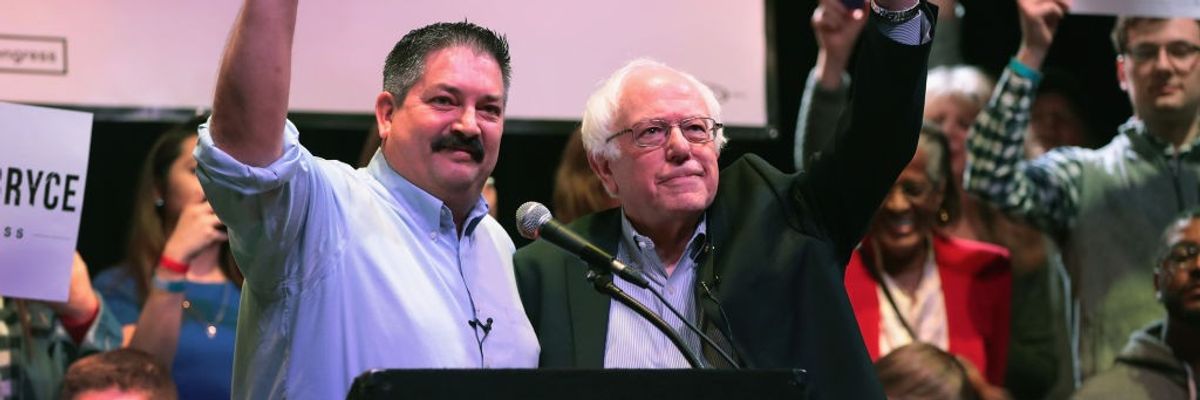
Democratic congressional candidate Randy Bryce (left) gets a boost from U.S Sen. Bernie Sanders (I-Vt.) (right), who showed up to support him at a February 24, 2018 in Racine, Wisconsin.
(Photo: Scott Olson/Getty Images)


Brett Wilkins
May 20, 2025
COMMON DREAMS


As congressional Republicans and the administration of President Donald Trump set their sites on slashing vital social services, former union ironworker-turned-progressive Democratic U.S. House candidate Randy Bryce announced Tuesday that he will seek to oust the incumbent Trump ally in 2026 and help save Medicaid, Medicare, and Social Security.

Bryce—also known as the "Iron Stache" due to his prominent moustache—is a disabled veteran who launched his 2018 campaign with a viral video skewering then-House Speaker Paul Ryan's (R-Wis.) attacks on healthcare. Bryce, who raised over $7 million with donations averaging around $25, won the Democratic primary but lost to Rep. Bryan Steil (R-Wis.) in the 2018 general election.He aims to face Steil in the next cycle.

"Every great story begins with a spark. Ours began in 2018, when one man stood up to Washington," Bryce said in an ad released Tuesday announcing his new campaign for Wisconsin's 1st Congressional District seat. "Now, as old enemies come out of the shadows, we need him one more time."


"Trump promised to bring manufacturing back," Bryce continued. "Eight years later, we're still waiting. We can't afford to wait any longer—not for jobs, or healthcare, or a damn living wage."

"This isn't about left versus right," he added. "This about the billionaires versus the rest of us, and we've got the numbers!"

As the Milwaukee Journal Sentinelreported Tuesday:
At the time, Bryce ran on supporting "Medicare for All" legislation, raising the minimum wage to $15 per hour, and boosting unions. He remains a member of the Ironworkers Local 853 and in the years since his first campaign, he said, has served as a union representative, worked with Social Security Works, an advocacy group seeking to expand Social Security, and more recently has helped people with disabilities find work.

Like his ally Sen. Bernie Sanders (I-Vt.), Bryce believes that Democrats lack a coherent vision for defeating Trumpism and the oligarchy that's enriching itself at the expense of working-class Americans.

The solution? "With what Trump and Musk have been doing, it's more important than ever to get union people, working people, into Congress," Bryce toldCapital Times associate editor and Nation national affairs correspondent John Nichols on Tuesday, referring to de facto Department of Government Efficiency chief and world's richest person, Elon Musk.


"What Trump's doing, and what Bryan Steil is helping him do, is really scaring people," Bryce told Nichols. "I'm talking to veterans, to people who rely on Medicaid, to families that can't keep up with rising prices, to workers. They're all angry."

"You've got an administration that is strangling the Social Security system, laying off people, cutting services," he added. "The Republicans in Washington are pulling what's left of the rug out from under us. I just think this is a going to be an election where people in the 1st District say, Enough!"
'We Have a Better Idea': Sanders Unveils College for All Act as Trump Targets Higher Education

"Instead of increasing the cost of college in order to give more tax breaks to billionaires," said Sen. Bernie Sanders, "we are going to make public colleges and universities tuition-free."


Sen. Bernie Sanders speaks to a Los Angeles crowd on April 12, 2025.
(Photo: Sam Ghazi/Middle East Images/AFP via Getty Images)

Jake Johnson
May 21, 2025
COMMON DREAMS

As U.S. President Donald Trump and congressional Republicans move to gut federal student aid programs to help fund tax cuts for the rich, Sen. Bernie Sanders on Wednesday will introduce legislation aimed at making public colleges and universities tuition-free for most Americans.

The College for All Act of 2025, shared exclusively with Common Dreams ahead of its official introduction, would eliminate public college and university tuition and fees for students from married households earning $300,000 or less per year or single households earning $150,000 or less.

The legislation would also make public community colleges and trade schools tuition-free for all students, and provide grants to Historically Black Colleges and Universities, Tribal Colleges and Universities, and other institutions to eliminate tuition and fees for eligible students.

Sanders (I-Vt.) and Rep. Pramila Jayapal (D-Wash.), who will introduce identical companion legislation in the House, presented the bill as a direct counter to Trump and congressional Republicans, whose emerging reconciliation package and proposed federal budget for the coming fiscal year would enact deep cuts to federal higher education funding—while delivering huge tax breaks to the richest Americans.

"Instead of increasing the cost of college in order to give more tax breaks to billionaires, we have a better idea," said Sanders. "We are going to make public colleges and universities tuition-free so that working-class students can succeed and are not burdened with a lifetime of debt."

Jayapal, a senior House Democratic whip and chair emerita of the Congressional Progressive Caucus, said that "Congress can and must ensure that working families never have to take out crushing loans to pursue an education."

"The College for All Act will free students from a lifetime of debt, invest in working people, and transform higher education across America by making a degree more accessible to poor and working families across this country," she added. "This is more important now than ever as Trump continues to attack education in this country through attempts to strip funding from universities and to dismantle the Department of Education."

"Young people should not have to go deeply into debt to get the education they and our nation need. We must make public colleges and universities tuition-free."

The legislation stands no chance of passing the Republican-controlled Congress, but it represents an alternative vision for higher education that has proven extremely popular with the American public. A 2021 Pew Research Center survey found that 63% of U.S. adults support making public colleges and universities tuition-free.

More recent polling has shown similar support, with Democratic voters overwhelmingly backing the proposal as higher education costs rise and students graduate saddled with massive student loan debt.

Sanders plans to introduce the legislation Wednesday morning at a Senate Health, Education, Labor, and Pensions (HELP Committee hearing on the state of higher education in the U.S., where public college costs more per student than in any other country except Luxembourg, according to the Education Data Initiative.

"Making public colleges and universities tuition-free is not a radical idea," declares a summary of the College for All Act provided by Sanders' office. "Other wealthy countries like France, Germany, Denmark, Sweden, Norway, and Finland made their public colleges and universities tuition-free or virtually tuition-free several years ago."

"Over 50 years ago, many of our most prestigious public colleges and universities were also tuition-free or virtually tuition-free," the summary notes. "In a competitive global economy, we need the best-educated workforce in the world. Young people should not have to go deeply into debt to get the education they and our nation need. We must make public colleges and universities tuition-free."
Senator Urges Contempt Motion Against Trump Officials Over Alleged Deportations to South Sudan


"A federal judge is wise to Trump's ploy of illegally deporting immigrants and then claiming there is nothing he can do to get them back," said the former executive director of Human Rights Watch


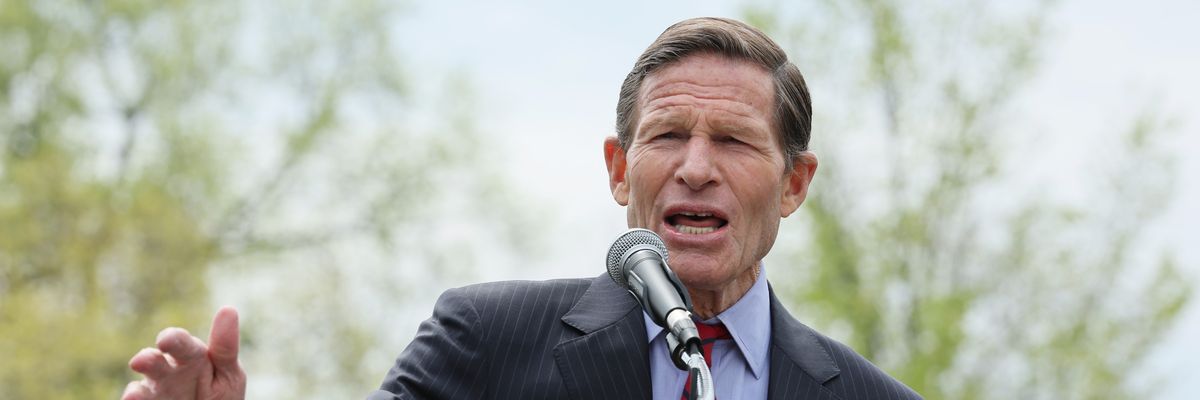
U.S. Senator Richard Blumenthal (D-Conn.) speaks at the rally to Say NO to Tax Breaks for Billionaires & Corporations at U.S. Capitol on April 10, 2025 in Washington, D.C.
(Photo: Jemal Countess/Getty Images for Fair Share America)

Eloise Goldsmith
May 21, 2025
COMMON DREAMS

Democratic U.S. Sen. Richard Blumenthal of Connecticut on Tuesday urged a federal judge to consider holding U.S. officials in contempt of court following the Trump administration's alleged deportation of multiple immigrants from Southeast Asia to South Sudan, possibly in violation of an order handed down by that same judge earlier this spring.

On Tuesday, lawyers for the immigrants accused the Trump administration of deporting nationals from Myanmar and Vietnam to South Sudan in violation of a court order. In court filings, the lawyers also said they received "information" that there were likely at least 10 others also on the same plane to South Sudan.

In April, U.S. District Judge Brian Murphy of Massachusetts directed the Trump administration to give immigrants a chance to challenge their deportations to a third country. Murphy ruled that the Trump administration must give them 15 days' notice to raise concerns about danger they may face if deported.

"If those individuals were on a plane sent to South Sudan, it seems a violation of the court order. Judge Murphy ought to be really angry, his order has been violated, and he ought to consider a contempt of court motion, and no doubt the plaintiffs are considering it now," said Blumenthal on CNN on Tuesday evening.

"Violation of court orders ought to be treated with the utmost of sanctions, because otherwise the law is dead letter," Blumenthal continued.

Murphy hastily called a hearing on Tuesday evening and issued a ruling that the Trump administration must "maintain custody and control of class members currently being removed to South Sudan or to any other third country, to ensure the practical feasibility of return if the Court finds that such removals were unlawful," according to The Associated Press.

During the hearing, Murphy warned criminal sanctions could be invoked against those involved in the deportations who were aware of his order. "Based on what I have been told," he said according to The New York Times, "this seems like it may be contempt."

In addition to not being the country of origin of the individuals feared deported, South Sudan has faced continued instability and political violence between government forces and opposition factions.

Murphy has ordered U.S. officials back to court on Wednesday so they can provide more information, such as who exactly was removed and what opportunity they were given to raise concerns about dangers they may face upon deportation, according to the AP. Officials must also give information about the whereabouts of the migrants who have apparently already been deported.

In March, the Trump administration sent Venezuelan immigrants to a megaprison in El Salvdor after invoking a little-used wartime statute. As those deportations were taking place, a federal judge ordered that any planes carrying them either not take off or turn around, but the Trump administration did not turn the planes around.

A federal judge has ordered the U.S. government to facilitate the release of a Salvadoran man who was on one of the planes to El Salvador. The man, Kilmar Abrego Garcia, is still in El Salvador and the Trump administration has said that it is up to El Salvador whether to release him.

Commenting on reporting of the judge's order to keep the immigrants apparently sent to South Sudan in U.S. custody, human rights advocate and former executive director of Human Rights Watch Kenneth Roth wrote: "A federal judge is wise to Trump's ploy of illegally deporting immigrants and then claiming there is nothing he can do to get them back."

Sunday, May 25, 2025

‘Leap together,’ Kermit the Frog says in commencement address at University of Maryland graduation

WESTPOINT GRADS WISH HE HAD DONE THEIRS


Kermit the Frog speaks during University of Maryland's commencement ceremony on May 22, 2025, in College Park, Maryland. (Riley Sims/University of Maryland via AP)

Kermit the Frog speaks during University of Maryland's commencement ceremony on May 22, 2025, in College Park, Maryland. (Stephanie S. Cordle/University of Maryland via AP)

Kermit the Frog speaks during University of Maryland's commencement ceremony on May 22, 2025, in College Park, Maryland. (Riley Sims/University of Maryland via AP)Next


AP
May 23, 2025

Kermit, who was created in 1955 and became the centerpiece of the Muppets franchise, is no stranger to the school

Muppets creator Jim Henson graduated from Maryland in 1960 with home economics as his major


COLLEGE PARK, Maryland: Kermit the Frog knows it’s not easy being green — or graduating from college and entering the real world, especially during a time of economic uncertainty and political turmoil.

Members of the University of Maryland’s class of 2025 received their diplomas Thursday evening with sage advice from the amphibious Muppet ringing in their ears.

“As you prepare to take this big leap into real life, here’s a little advice — if you’re willing to listen to a frog,” the beloved Muppet said. “Rather than jumping over someone to get what you want, consider reaching out your hand and taking the leap side by side, because life is better when we leap together.”


The university announced in March that Kermit, who was created in 1955 and became the centerpiece of the Muppets franchise, would be this year’s commencement speaker. He is also no stranger to the school.

Muppets creator Jim Henson graduated from Maryland in 1960. A home economics major, he fashioned the original frog puppet from one of his mother’s coats and a Ping-Pong ball cut in half, according to a statement from the university. Henson died in 1990.
A bronze statue of Henson and Kermit sitting on a bench is a well-known feature of the College Park campus.

In a video announcing the speaker pick, Kermit is described as an environmental advocate, a bestselling author, an international superstar and a champion of creativity, kindness and believing in the impossible.

His speaker bio calls him “a star of stage, screen and swamp” whose simple mission is to “sing and dance and make people happy.”

“I am thrilled that our graduates and their families will experience the optimism and insight of the world-renowned Kermit the Frog at such a meaningful time in their lives,” university President Darryll J. Pines said in a statement.

Beyond ceasefire, India and Pakistan battle on in digital trenches


A man reads news on his mobile phone after the ceasefire announcement between India and Pakistan, in Srinagar, Indian-administered Kashmir. (REUTERS/File)

Kashaf Rehman
&
Muhammad Ibrahim
May 24, 2025
ARAB NEWS 

Both states continue to push competing narratives after the four-day military standoff, which ended on May 10 with a US-brokered truce

Digital rights experts note how it is often laced with hate, targeting vulnerable communities like Muslims in India and Hindus in Pakistan


ISLAMABAD: As Indian and Pakistani guns fell silent after trading fire for days this month, the war over facts and fiction is far from over and fierce battle rages on social media as to who won, who distorted the truth, and which version of events should be trusted.

As both states continue to push competing narratives, experts warn that misinformation, censorship and AI-generated propaganda have turned digital platforms into battlegrounds, with real-world consequences for peace, truth and regional stability.

The four-day military standoff, which ended on May 10 with a US-brokered ceasefire, resulted from an attack in Indian-administered Kashmir that killed 26 people last month. India accused Pakistan of backing the assault, a charge Islamabad has consistently denied.

While the truce between the nuclear-armed archfoes has since held, digital rights experts have sounded alarm over the parallel information war, which continues based on disinformation, censorship and propaganda on both sides, threatening the ceasefire between both nations.

Asad Baig, who heads the Media Matters for Democracy not-for-profit that works on media literacy and digital democracy, noted that broadcast media played a central role in spreading falsehoods during the India-Pakistan standoff to cater to an online audience hungry for “sensational content.”

“Disinformation was overwhelmingly spread from the Indian side,” Baig told Arab News. “Media was playing to a polarized, online audience. Conflict became content, and content became currency in the monetization game.”

A man clicks a picture of a billboard featuring Pakistan's Army Chief General Syed Asim Munir (C), Naval Chief Admiral Naveed Ashraf (R), and Air Chief Marshal Zaheer Ahmed Babar Sidhu, along a road in Peshawar. (AFP/File)

Several mainstream media outlets, mostly in India, flooded the public with fake news, doctored visuals and sensationalist coverage, fueling mass anxiety and misinformation, according to fact-checkers and experts, who say the role of media at this critical geopolitical juncture undermined journalistic integrity and misled citizens.

“I think this is a perfect example of the media becoming a tool of propaganda in the hands of a state,” said prominent digital rights activist Usama Khilji, calling on those at the helm of television and digital media outlets to independently verify state claims using tools like satellite imagery or on-ground sources.

In Pakistan, X, previously known as Twitter, had been banned since February 2024, with digital rights groups and global organizations calling the blockade a “blatant violation” of civic liberties and a threat to democratic freedoms.

But on May 7, as Pakistan’s responded to India’s missile strikes on its territory that began the conflict, the platform was suddenly restored, allowing users to access it without a VPN that allows them to bypass such restrictions by masking their location. The platform has remained accessible since.

“We were [previously] told that X is banned because of national security threats,” Khilji told Arab News, praising the government’s “strategic move” to let the world hear Pakistan’s side of the story during this month’s conflict.


“But when we actually got a major national security threat in terms of literal war, X was unblocked.”

Indian authorities meanwhile blocked more than 8,000 X, YouTube and Instagram accounts belonging to news outlets as well as Pakistani celebrities, journalists and influencers.

“When only one narrative is allowed to dominate, it creates echo chambers that breed confusion, fuel conflict, and dangerously suppress the truth,” Khilji explained.

VIRTUAL WAR

Minutes after India attacked Pakistan with missiles on May 7, Pakistan released a video to journalists via WhatsApp that showed multiple blasts hitting an unknown location purportedly in Pakistan. However, the video later turned out to be of Israeli bombardment of Gaza and was retracted.

A woman wearing a T-shirt featuring ‘OPERATION SINDOOR’ checks her mobile phone near a market area in Ludhiana. (AFP/File)

On May 8, Indian news outlets played a video in which a Pakistani military spokesperson admitted to the downing of two of their Chinese-made JF-17 fighter jets. X users later pointed out that the video was AI-generated.

Throughout the standoff both mainstream and digital media outlets found themselves in the eye of the storm, with many official and verified accounts sharing and then retracting false information. The use of AI-generated videos and even video game simulations misrepresented battlefield scenarios in real time and amplified confusion at a critical moment.

Insights from experts paint a disturbing picture of how information warfare is becoming inseparable from conventional conflict. From deliberate state narratives to irresponsible media and rampant misinformation on social platforms, the truth itself is becoming a casualty of war.


AFP Digital Verification Correspondent Rimal Farrukh describes how false information was often laced with hate speech, targeting vulnerable communities like Muslims in India and Hindus in Pakistan.

“We saw dehumanizing language, misleading visuals, and recycled war footage, often from unrelated conflicts like Russia-Ukraine or Israel-Gaza, used to stoke fear and deepen biases,” she told Arab News.