Monday, May 26, 2025

Suriname votes for new government to steer oil windfall

By AFP
May 25, 2025


People queue before voting at a polling station during parliamentary elections in Paramaribo on May 25, 2025 - Copyright AFP Juan BARRETO

Laurent ABADIE

Voting began Sunday in Surinamese parliamentary elections that will determine who will harness giant oil wealth to carry out a rags-to-riches transformation of the smallest country in South America.

The tiny nation — the only one in the Americas with Dutch as its official language — is battling high debt, rampant inflation and poverty affecting nearly one in five of its 600,000 inhabitants.

But recent offshore crude discoveries suggest this may all be about to change.

“It will be a huge amount of income for the country,” incumbent President Chan Santokhi told AFP this week. “We are now able… to do more for our people so that everyone can be part of the growth of the nation.”

On Sunday, Surinamese began electing a new parliament of 51 members, who within weeks must choose a new president and vice-president for a five-year term.

Santokhi is constitutionally eligible for a second term but, with no single party in a clear lead, pollsters are not picking any favorites.

“We have laid the foundations for economic stability and we need to build on that,” Defence Minister Krishna Matheora told AFP after voting as the polls opened early Sunday, arguing it was “important” for Santokhi’s Progressive Reform Party (VHP) to win.

Whoever does take the reins will have a grand opportunity to transform the country’s fortunes.

Experts say Suriname stands to make billions of dollars in the next decade or two from recently discovered offshore crude deposits.

French group TotalEnergies announced last year a $10.5 billion project to exploit an oil field off Suriname’s coast with an estimated capacity of producing 220,000 barrels per day.

Production should start in 2028 and the country has created a “Royalties for Everyone” fund to put money from the expected windfall directly into the hands of citizens.


– China alliance –


Fourteen parties are taking part in Sunday’s election, including Santokhi’s centrist VHP and the leftist National Democratic Party (NDP) of deceased former coup leader and autocrat-turned-elected-president Desi Bouterse.

Also in the running is the center-left General Liberation and Development Party (ABOP) of Vice President Ronnie Brunswijk, a former guerrilla who rebelled against Bouterse’s government in the 1980s.

Provisional results are expected by late Sunday.

Suriname, a diverse country made up of descendants of people from India, Indonesia, China, the Netherlands, Indigenous groups and African slaves, marks its 50th anniversary of independence from the Dutch throne this November.

Since independence, it has looked increasingly towards China as a political ally and trading partner and, in 2019, became one of the first Latin American countries to join the Asian giant’s Belt and Road infrastructure drive.

US Secretary of State Marco Rubio made a stopover in Suriname in March on a Latin American tour aimed at countering China’s growing influence in the region.

More than 90 percent of the country is covered in forest and it is one of few in the world with a negative carbon footprint.

Santokhi insists this status is not in danger and that Suriname can use its oil windfall “for the transition towards the green energy which we need, also because we know the fossil energy is limited.”

“It will be gone after 40 years.”

Suriname poised for cash inflow from newly discovered oil

By AFP
May 24, 2025


Suriname expects to rake in about $10 billion from a huge offshore oil find - Copyright AFP/File Ranu Abhelakh


Laurent ABADIE

Suriname, South America’s smallest country, is preparing for an inflow of cash from a huge offshore oil find, with the president insisting the population will receive a direct share of the wealth.

The Dutch-speaking nation of about 600,000 people expects to rake in about $10 billion in the next decade or two, with crude extraction set to begin in 2028.

Projected output is 220,000 barrels per day (bpd) — up from about 5,000 to 6,000 — in a country where one in five people live in poverty.

“From 2028, we’ll be an oil-producing country,” President Chan Santokhi told AFP ahead of elections Sunday for lawmakers who will choose the next president.

He is one of several candidates in the running to steer the former Dutch colony wedged between Brazil, Guyana and French Guiana.

“It will be a huge amount of income for the country,” Santokhi said. “We are now able… to do more for our people so that everyone can be part of the growth of the nation.”

Besides investing in agriculture, tourism, health, education and green energy, some of the oil money is being paid directly to Surinamese citizens under a program Santokhi has dubbed “Royalties for Everyone” — RVI for its Dutch acronym.

“It’s their share,” he said.

Victorine Moti, a finance ministry official responsible for the fund, told AFP: “The whole population of Suriname is eligible for this program, everybody who was born before the 1st of January 2025 and had the Surinamese nationality.”

“In figures, it’s 572,000 people.”

All eligible citizens can register to receive a one-off payment equivalent to $750 paid into an account with an interest yield of seven percent per year.

“With the certificate, they can go to the bank and they have two options: they can withdraw the money or they can choose to save. Hopefully, they will try to save and not cash out immediately,” said Moti.

The first beneficiaries are the elderly and disabled, paid with funds advanced by banks.

Next in line will be people 60 and older, then — once the revenues start flowing in 2028 — the biggest group of people aged 18-59.

People who save their money for 10 years will receive a bonus of $150 on top of interest earned.


– ‘Enjoy my money’ –


Naslem Doelsan, 80, has already received her certificate and told AFP she will cash out “to buy good food and some household stuff.”

“Why do I need… money in the bank? I’m already old and I want to enjoy my money,” she said.

Fellow retiree Jai Abas, 91, told AFP he would keep the money in the bank for now, and maybe give his granddaughter, who lives in the Netherlands, some “pocket money” when she visits.

“What would I do with money? I am old. I can’t go anywhere,” said Abas, adding his only vice is cigarettes.

Anuschka Tolud, a 38-year-old in a wheelchair, said she would save her payout in the hopes it can one day augment her $113 monthly welfare payout.

Santokhi had previously spoken about avoiding the so-called “oil curse,” also known as “Dutch disease,” that had befallen other resource-rich countries, such as Venezuela, Angola and Algeria, that were unable to turn oil wealth into economic success.

Norway became an exception by creating a sovereign wealth fund.

Suriname, the president said, would take a “unique” approach, well aware that its crude resources will last only about 40 years.

“We have income from the profit of the oil, we will have income from our fiscal revenues and we will have income from the royalties,” he said.


– Property of the nation –


In 2024, French multinational TotalEnergies committed to investing $10.5 billion in the offshore oil field of GranMorgu in the Atlantic Ocean.

An article in the Surinamese Constitution states that “natural riches and resources are property of the nation and shall be used to promote economic, social and cultural development.”

But some worry that the benefits may not find their way to all citizens, especially those who live in rural areas, Indigenous communities and Maroons — descendants of African slaves.

“I myself am curious as to how funds and bureaucracy will be accessed by Indigenous and Maroon communities,” Giovanna Montenegro, director of the Latin American and Caribbean Studies Program at Binghamton University in New York State, told AFP.

US Banana Giant Chiquita Fires Thousands of Striking Workers in Panama

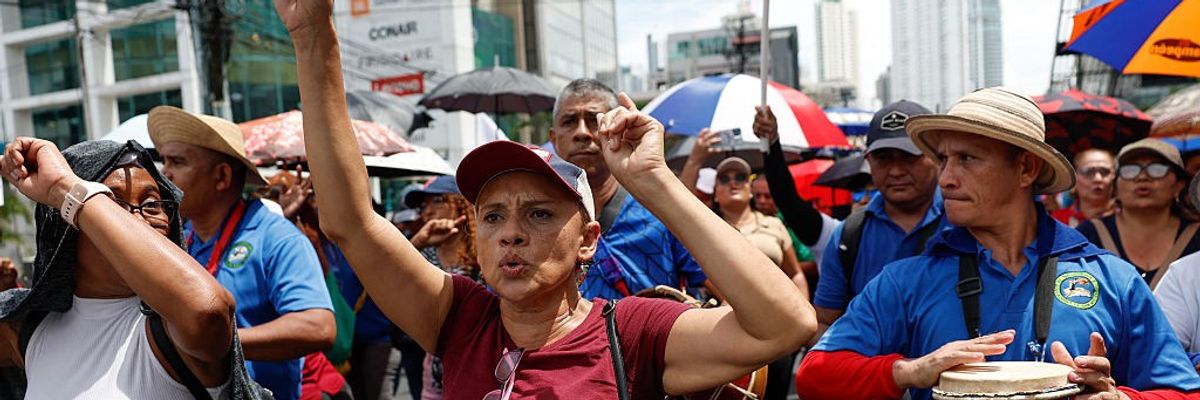
The Chiquita workers' strike is part of a nationwide protest movement against pension reforms approved by Panama's right-wing government.


Workers take part in a protest against the government of President José Raúl Mulino amid an indefinite strike in Panama City on May 20, 2025.
(Photo: Martin Bernetti/AFP via Getty Images)


Common Dreams Staff
May 23, 2025

The U.S.-headquartered banana giant Chiquita said Thursday that it moved to fire thousands of Panamanian workers who walked off the job last month as part of nationwide protests against the right-wing government's unpopular reforms to the nation's pension system.

Citing an unnamed source close to Chiquita, Reutersreported that the mass firings are expected to impact around 5,000 of the company's 6,500 Panamanian workers. José Raúl Mulino, Panama's right-wing president, defended the banana giant formerly known as United Fruit, accusing striking workers of unlawful "intransigence."

The company estimates that the strike, which began in late April, has cost it at least $75 million.

The pension reforms, known as Law 462, sparked outrage across Panama, with unions and other groups warning the changes would result in cuts to retirement benefits, particularly in the future for younger workers. The law transitions the country's pension system to an individual account structure that opponents say will be far less reliable than its predecessor.

"With the previous legislation, we could retire on 60% to 70% of our salary. Now, with the new formula, that amount drops to just 30% to 35%," said Diógenes Sánchez of Panama's main teachers' union. "It's a starvation pension."

The Associated Pressnoted Thursday that in recent weeks, "marches and occasional roadblocks have stretched from one end of the country to the other as teachers, construction workers, and other unions expressed their rejection of changes the government said were necessary to keep the social security system solvent."
Tens of thousands protest in Madrid against healthcare privatisation


Copyright UGTMadrid en x.com

By Jesús Maturana
Published on 25/05/2025 - 


More than 30,000 people took to the streets of the Spanish capital on Sunday in protest against the health policy of the Community of Madrid's government.

The demonstration, organised under the slogan 'Let's save our public health', highlighted the growing public unease over what they see as the privatisation and dismantling of Madrid's public health system.

Organised by the platform 'Vecinas y vecinos de los barrios y pueblos de la Comunidad de Madrid', the protest started simultaneously from four strategic points in the capital.

This mass mobilisation reflects the widespread concern about the current state of public healthcare in the city and the policies implemented by the regional government.

Demonstrators criticised the "unbearable delays in primary care" and the shortage of staff.

The manifesto read during the rally denounced the existence of a million people on waiting lists and "tens of thousands of children without a paediatrician assigned to them" in what is Spain's richest region.

Ricardo Chacón, representative of the organising platform, said the privatisation of health was "not working" and that it was in private economic interests rather than for the benefit of patients.

Luis López, another spokesperson for the group, called for a significant increase in the regional health budget, demanding that at least 25% be earmarked for strengthening primary care.

The organisers emphasised the importance of preventive healthcare as a more economical and effective strategy than focusing resources solely on curative treatments.

This perspective seeks a paradigm shift in health management in Madrid, prioritising the accessibility and quality of primary health care.

Political positioning and controversies surrounding Madrid's healthcare system

The demonstration had a notable representation of left-wing parties and trade unions supporting citizens' demands. Reyes Maroto, Socialist spokesperson in the Madrid City Council, urged support for the "thousands of people who are waiting for a medical appointment" and do not have private insurance as an alternative.

Manuela Bergerot, from Más Madrid, offered concrete data on the regional health crisis: 139,000 children without a paediatrician assigned to them and 625,000 patients without a family doctor.

The political leader directly linked this situation to privatisation policies, specifically denouncing the relationship between the Quirón Group and the personal entourage of the president of the Community of Madrid, Isabel Díaz Ayuso.

MEP Irene Montero (Podemos party) added an ethical dimension to the debate, saying that without universal access to quality public healthcare "there is no democracy and no dignity of life".

Montero also referred to controversy over the Quirón Group's contracts with Ayuso's partner, alleging an increase in payments and privatisations coinciding with this personal relationship.

The mobilisation of citizens in defence of Madrid's public health system is evidence of a growing political polarisation around regional health management. While the demonstrators demand a reversal of privatisation policies.

Meet the 'crazy conspiracy theorist' who has Trump's ear — and 'divides the GOP'


OPINION
Steven Harper  

May 23, 2025 
ALTERNET

Laura Loomer is 31 years old and a graduate of Barry University, a private Catholic university. A former commentator on Alex Jones’s Infowars and a far-right conspiracy theorist, she has 1.5 million followers on X. Loomer traffics in anti-Muslim and anti-immigrant rhetoric. She has called herself a “proud Islamophobe” and “pro-white nationalism.”

And she has U.S. President Donald Trump’s ear.

In 2020, Loomer was the Republican nominee for Congress from the Florida district where Mar-a-Lago is located. She campaigned almost exclusively on her allegiance to Trump who, along with Roger Stone, supported her candidacy. Loomer lost the election, as well as her bid to become the party’s nominee again in 2022.

An Extreme Trump Loyalist

During the 2024 campaign, Loomer said on X that if Vice President Kamala Harris—whose mother was born in India—won the election, “the White House will smell like curry.” Those comments drew the condemnation of even Rep. Marjorie Taylor Greene (R-Ga.) and Sen. Lindsey Graham (R-S.C.), who called her “toxic.”

“Getting Loomered” means targeting someone to determine the sufficiency of the person’s loyalty to Trump and his agenda.

A fervent Trump supporter during the 2024 Republican primaries, she claimed without evidence that Republican Florida Gov. Ron DeSantis exaggerated his wife’s bout with breast cancer to gain sympathy votes during his presidential campaign. Her conspiracy theories range from school shootings to election fraud. She shared a video on X stating that the 9/11 attacks were an “inside job.”

According to Sen. Thom Tillis (R-N.C.), “Laura Loomer is a crazy conspiracy theorist who regularly utters disgusting garbage intended to divide Republicans.”


A Powerful Influence

Trump aides have tried to limit Loomer’s access to the president—with mixed results. In 2024, She accompanied Trump during appearances commemorating 9/11 in New York and Pennsylvania and traveled on his plane to Iowa where Trump told the audience, “You want her on your side.”

Trump’s top advisers have learned the price of not being on Loomer’s side. In March 2025, she started her own research firm— Loomered Strategies—to provide high-level opposition research and vetting for hire. “Getting Loomered” means targeting someone to determine the sufficiency of the person’s loyalty to Trump and his agenda.

According to Trump, “She’s a strong person. She’s got strong opinions…”

On April 2, she “Loomered” the National Security Council (NSC). Meeting with Trump in the Oval Office, she attacked the character and loyalty of several NSC officials and named the people he should fire. Michael Waltz, who headed the agency, joined the meeting late and briefly tried to defend some of his people. But Trump immediately fired six of her targets.

Waltz and his deputy, Alex Wong, managed to survive Loomer’s onslaught that day, but not for long. Less than a month later, Trump announced Waltz’s termination. The intervening revelation of his inadvertent inclusion of The Atlantic’s editor Jeffrey Goldberg on a sensitive group chat on the Signal app had made him vulnerable in any event.

But Wong was out too. Loomer had speculated that Wong’s family was part of a conspiracy and that he had added Goldberg to the Signal chat “on purpose as part of a foreign opp to embarrass the Trump administration on behalf of China.” Wong’s father is of Taiwanese descent, and Loomer had referred to Wong’s wife Candice as a “Chinese woman.” Candice Wong had clerked for U.S. Supreme Court Justice Brett Kavanaugh, was a career prosecutor, and served as a Justice Department official during Trump’s first term.

Three weeks later, Loomer went after an assistant U.S. attorney in Los Angeles, Adam Schleifer, who had unsuccessfully run for Congress as a Democrat in 2020. She posted on social media that Schleifer was a “Biden holdover” and a “Trump hater” who should be fired. An hour later, Schleifer received a one-sentence email terminating his employment. In a highly unusual action, the message came directly from the White House on behalf of the president personally. It gave no reason for Schleifer’s dismissal.

Impervious to Facts

Loomer has also attacked the National Intelligence Council, an elite internal think tank that reports to the director of national intelligence, Tulsi Gabbard. Previously, the White House had asked the council to assess the link between the Venezuelan government and the notorious Tren de Aragua gang. Without such a link, Trump could not rely on the Alien Enemies Act of 1798 to deprive the gang’s members of due process before deporting them.

On February 26, senior analyst at the council Michael Collins reported the intelligence community’s consensus that the Venezuelan government did not control the gang. But on March 15, Trump signed a proclamation invoking the Alien Enemies Act based on purportedly factual findings that contradicted the report.

With a presidential inner circle that includes Laura Loomer, we’re all in deep trouble.

When Collins’ report became public and revealed Trump’s lie, Loomer blasted the council as “career anti-Trump bureaucrats” who “need to be replaced if they want to promote open borders.” In the same post, she pasted images of Collins’s LinkedIn profile and an article about the council’s memo. Three weeks later, Gabbard fired Collins.

Meanwhile, federal courts have blocked Trump’s use of the Alien Enemies Act in every district where he has tried to invoke it. The courts have found that the act’s predicate—that the Venezuelan gang is engaged in either a “war,” “invasion,” or a “predatory incursion” of the United States—does not exist.

At a Mar-a-Lago press conference in April 2024, Trump praised Loomer as “a woman of courage,” he said, “You don’t want to be Loomered. If you’re Loomered, you’re in deep trouble.”

With a presidential inner circle that includes Laura Loomer, we’re all in deep trouble.
'America First': Far-right MAGA Catholics declaring war against 'globalist' Pope Leo


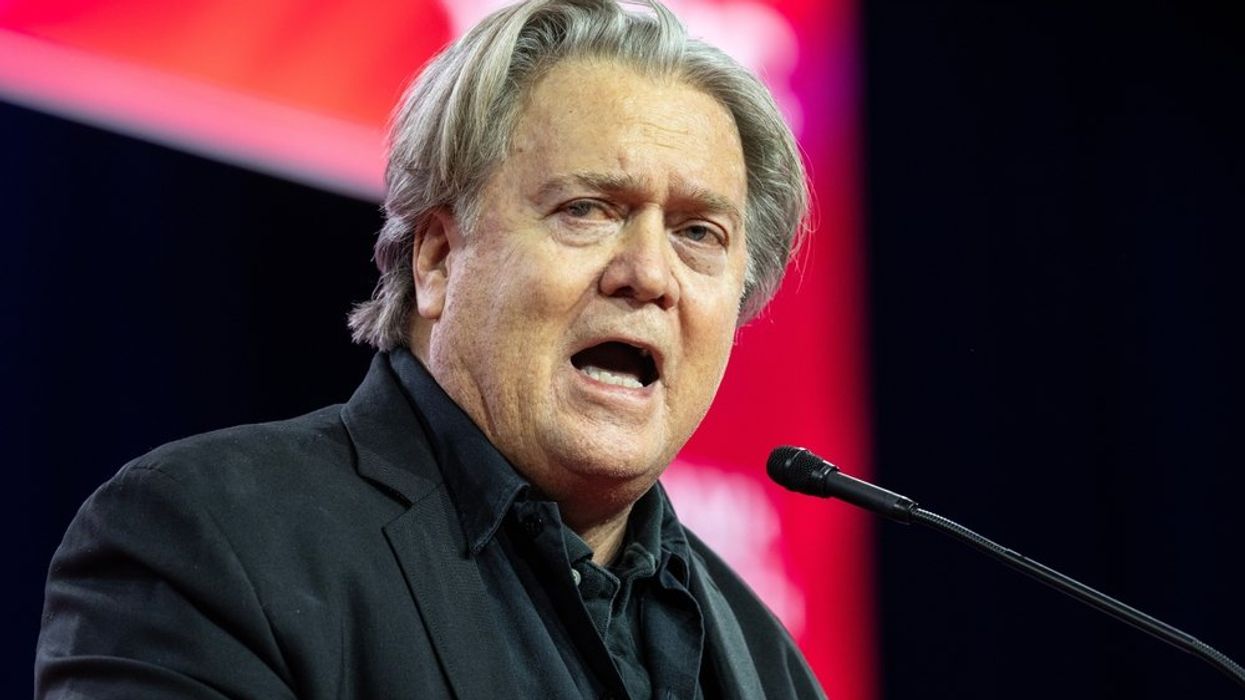
Steve Bannon at CPAC 2023 on March 3, 2023

May 21, 2025 | 
ALTERNET

When the Vatican announced that 69-year-old Robert Francis Prevost, now Pope Leo XIV, would be replacing the late Pope Francis, many moderate and liberal Catholics in the United States applauded the choice as historic. Chicago native Prevost is now the first American pope in the long history of the Catholic Church.

But far-right MAGA Republicans responded to the announcement with anger and are disappointed that Pope Leo has similar views to Pope Francis and isn't a far-right social conservative.

In an article published on May 21, The Guardian's Julian Coman notes the ideological differences between far-right MAGA Catholics — including Vice President JD Vance and "War Room" host Steve Bannon — and the new pope.

READ MORE: MAGA Catholics 'not a fan' of Leo as new Pope calls 'for a united church'

MAGA conspiracy theorist Laura Loomer was quick to attack Pope Leo after the announcement, describing him as "anti-Trump, anti-MAGA, pro-open Borders, and a total Marxist like Pope Francis" on X, formerly Twitter. Loomer is Jewish, not Catholic, but according to Coman, MAGA Catholics share that view of him.

"The comic-book casting of the new pope as a globalist villain in the U.S. culture wars is traceable back to his predecessor's impact on liberal opinion a decade ago," Coman explains. "Pope Francis' sometimes-lonely championing of progressive causes, such as the rights of migrants, gave him a kind of liberal celebrity and led Time Magazine to name him 'Person of the Year' in 2013. Pope Leo, born in Chicago, has been pre-emptively caricatured by much of the MAGA right as a continuity pontiff who will, in effect, front up the religious wing of the Democratic Party."

Coman continues, "Leaving the simplistic conflation of religious perspective and political positioning aside, the truth is far more interesting than that. It may also be more challenging for Catholic MAGA luminaries such as the vice-president, JD Vance, the secretary of state, Marco Rubio, and Donald Trump's sometime adviser Steve Bannon if they are serious about their faith."

The Guardian journalist describes Vance (who was raised Protestant but converted to Catholicism) and Bannon as "representatives of a traditionalist movement in the church" that "sought to undermine Francis' papacy at every turn and has become a kind of theological vanguard for the America First era."

"Enter Pope Leo," Coman writes. "The most geographically diverse conclave in church history was surely aware that in choosing an American to succeed Francis, it was setting up a potential showdown between the Vatican and Trumpian nationalism."

Nonetheless, some right-wing Catholics are defending Pope Leo, including Philadelphia-based immigration attorney and political columnist Christine Flowers.

In a May 9 column for Broad & Liberty, Flowers stressed that while she was hoping for a more "conservative" pope and has disagreements with Pope Leo, she admires him as a person. Flowers wrote, "This Pope is one for the 21st Century, and if he is the last one that I encounter before I am consecrated with last rites, I will die a happy woman."


Read Julian Coman's full article for The Guardian at this link.


'Open up those archives': Abuse survivors demand accountability from Pope Leo


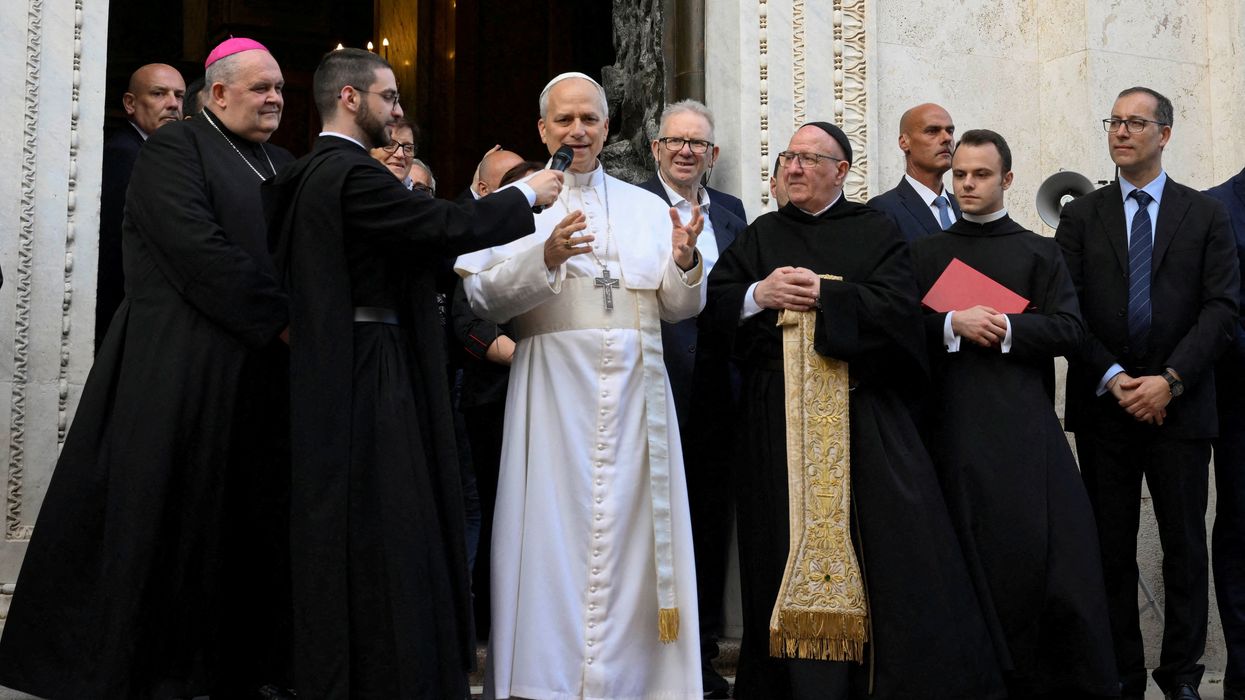
Pope Leo XIV speaks during a surprise visit at the Sanctuary of the Mother of Good Counsel in Genazzano, Rome, in Italy, May 10, 2025. Francesco Sforza/Vatican Media/Handout via REUTERS

May 11, 2025 | 


Survivors of sexual abuse by Catholic priests are calling for Pope Leo XIV to institute a zero-tolerance policy and for the church to investigate his handling of prior sexual abuse allegations. “He needs to be transparent. He needs to be honest,” says Peter Isely, a survivor of sexual assault by a Catholic priest and a co-founder of the Survivors Network of Those Abused by Priests. “Wait and see,” says James V. Grimaldi, executive editor of National Catholic Reporter. “Don’t listen to what they say. Watch what they do.” We are also joined by Father Bryan Massingale, professor of theological and social ethics at Fordham University.


This is a rush transcript. Copy may not be in its final form.


AMY GOODMAN: I want to bring our next guest into this conversation. He’s back in Rome, Italy: Peter Isely. He is a survivor of sexual assault by a Catholic priest as a 13-year-old boy growing up in Wisconsin. Peter is one of the founders and global affairs chief of SNAP, Survivors Network of Those Abused by Priests. SNAP’s open letter in response to the new pope, quote, “highlights the grim reality underpinning the College of Cardinals — many who voted in this conclave actively shielded abusers, and many who will be appointed to the curia under this papacy bear similar stains,” they write.

Peter Isely, can you talk about your organization’s very grave concerns about Cardinal Prevost being elected pope?

PETER ISELY: Yeah, and you can imagine how difficult this is for me to be sitting here, for survivors to — what they’re experiencing today, especially when survivors from Peru and some in the United States who were raped and sexually assaulted by Augustinians, the order that Prevost was provincial of and then global — head of the global order, what it felt like to see him walk out on that balcony, knowing that your family, you, your life has permanently changed because of how he has managed or mismanaged sexual abuse cases. It’s hard not to be a part of the Leo fan club right now. I’m pretty confident I’m the most unpopular person probably in Rome right now, and certainly on this panel.

But here are the facts, and this is why we were in Rome launching Conclave Watch. People need to know what the records on sexual abuse and cover-up are of these cardinals. And we filed a _ Vos estis_ complaint. That’s the official mechanism that you’re supposed to use when a bishop has evidence of covering up sex crimes. And in that filing, there is plenty of evidence — now, I’m not saying he’s guilty, but we’re saying it reaches well beyond probable cause that he covered up sex crimes as Augustinian provincial and as head of the Augustinian Order and then as a bishop in Peru from 2014 to 2023.

And the worst is a case that he was directly involved in, three sisters who were sexually assaulted and raped by two priests in his diocese. They were, like, 6 and 7 years old. The statute of limitations in Peru for child sex crimes is four years. So, they didn’t go to the police by — you know, 9 years old, they didn’t go to the police. But they did it, and one of them admitted it. He admitted to the church that he committed these heinous, awful crimes against these girls. And what Prevost did with that information is that he didn’t launch an — give it to justice officials, say, in Peru to find out if there’s any possibility of prosecution. He took that criminal evidence, like they do all around the world, and he shipped it via diplomatic pouch over here to the Vatican over here. What are they doing with it? And that case was closed because of the civil statute in Peru. The man has sexually assaulted children. They were left in ministry. These victims had to go public. Imagine the courage of these three women, women that didn’t get to read the Gospel today or whatever, what happened over there, but these three women raped and sexually assaulted by two Peruvian priests. Prevost — I’m sorry, I hate saying this — I hate saying this —

AMY GOODMAN: I want to, Peter —


PETER ISELY: — the evidence is that he covered up these crimes.

AMY GOODMAN: Peter, I wanted to go to a clip —

PETER ISELY: Who’s sitting right now in the Augustinian headquarters, by the way?

AMY GOODMAN: I wanted to go to a clip, by the way.


PETER ISELY: Yes.

AMY GOODMAN: This recent scrutiny centering around Cardinal Robert Prevost’s alleged awareness and mishandling of accusations of sex abuse against two priests, when Prevost, now the pope, was the archbishop, as you described, in Peru. This is a clip of Ana María Quispe, a Peruvian woman, who you were talking about, who accused the two priests, Eleuterio Vásquez and Ricardo Yesquén, of sexual abuse. In an interview with the Peruvian media in 2023, she said the abuse started when she was 9 years old.
ANA MARÍA QUISPE: [translated] What happened to me was around 2007. At the time, the priests would invite us to celebrations, to go on missions, to pray the Rosary with him or to Mass. He would insist on having youth go on missions with him to rural regions in the mountains. After so much insistence, my parents agreed, because the priests and I were really close. When it was time to go to bed, he ended up sleeping with me. It was something I didn’t expect, and it was very uncomfortable. … In regards to Father Ricardo Yesquén, I attended a youth missionary group with him. … I was standing in line to greet him when he kissed me. He sat me on top of his legs, and he kissed me.


AMY GOODMAN: So, there is the clip of Ana María Quispe, the Peruvian woman accusing two priests of sexual abuse. If you can talk further, Peter, as you sit there in Rome, what your demands are at this point, and if you’ve ever spoken to the current pope, to Pope Leo XIV?


PETER ISELY: No, I’ve never spoken to him. I don’t know if any survivor has spoken to him. He hasn’t tweeted anything from survivors, as far as I know.

I mean, here’s what we wanted from him. Here’s what he needs to do. One, he needs to pass not a policy, a law, a canon law — that’s what governs the Catholic Church — a zero-tolerance law. And what that means is simple. Any cleric, any priest, known, determined — known, determined, like these priests were known and determined — to have committed acts of sexual abuse, violence, rape, assault against a child will be permanently removed from the Catholic priesthood. He can no longer be a priest. He can’t function as a priest. He can’t represent himself as a priest. That zero tolerance right now around the world. You can be a bishop, you can have priests — and they know of these priests — who have raped and sexually assaulted children, and you can stay in the ministry, you can transfer them to new assignments, and that’s perfectly legal under this church law.

Secondly, he needs to tell us how he has handled these cases. There needs to be an independent body, not hired by the church, not hired by him, that’s going to look into the abuse archives that he’s involved with, so when he was Augustinian provincial, when he was head of the Augustinian Order. Right now we’re in the Augustinian headquarters. Those files might be right here. They might be, like, three floors down from me. Those need to be reviewed, what cases did he handle, because every case of an Augustinian during that time of rape and sexual assault — and there were cases — went to him, he was responsible for. And in Peru, all that time in Peru, every case in his diocese, he was responsible for. That needs to be examined. He needs to be transparent. He needs to be honest. Let’s open the archives and see what he’s done. Even with the case, by the way, of this victim, her other two sisters then came forward with her. It’s not just her. It’s her and her two sisters, for God’s sake. Let’s see the report he sent to Rome that has led to the closing of this case.

And then, finally, the last job he had was head of the Dicastery of Bishops. All the reports of bishops that have covered up sex crimes, guess where they’re supposed to go. Guess where Vos estis is supposed to be instituted. Over there with him. So, he knows of all the — any reports of bishops that have covered up sex crimes, or cardinals. Those files are over there. So, he needs to open up those archives, because, believe me, we want to trust him.


Right now there is no indication, when it comes to this, that he can be trusted. I am the last person that wants to say this. Do you know how difficult this is for me to say, with all the praise and adulation and glory? I agree with many of the positions that the other two guests talked about. I agree with that. But just because I criticize Pope Leo, and just because we had the same problem with Francis covering up sex crimes, that does not make us JD Vance, that doesn’t make us conservatives, because, oh God, you know, we’re criticizing Pope Leo. And I’m sorry to get so worked up about this, but it is extraordinarily difficult to be in these conversations right now.

JAMES V. GRIMALDI: Can I respond, Amy?

AMY GOODMAN: Yes, James Grimaldi, editor of National Catholic Reporter, who’s sitting next to Peter Isely in the studio in Rome, if you could respond?

JAMES V. GRIMALDI: Yeah. First, I want to say that there is no media organization in the world that has done more to expose sexual abuse by priests than the National Catholic Reporter. That’s number one. We gave our database of abusers to SNAP and Bishop Accountability. That’s why they have a database. So I just wanted to make that point.

Second, I’m from Missouri, Amy. You’ve got to show me. And I think Peter’s a nice man, like Peter a lot. But he’s conflated a number of things. The cases that he’s talking about are horrific. They’re awful. Those priests should be banished from the Catholic Church. We agree on that. No question whatsoever. The question that I don’t have, the evidence that I don’t have — and when I met Peter the other night, I asked him to send it to me. And, in fact, I emailed him the next day, and I said, “Give me that evidence on Prevost,” because he was on our short list. We thought he could become the next pope. And I didn’t get a reply. Now, he’s here in Rome. I didn’t have his card. I sent it through their website. So, it could be that for whatever happened and a million things going on — and I’m running a team of seven people — but I’m still eager to see the evidence, because you’ve got to show me that his fingerprints are on a cover-up, and we don’t have that.

Third, I agree with a lot that he just said. And we don’t know if Pope Leo is going to agree or not. I hope he does, because I am a lifelong, as you know, Amy, after having exposed Jack Abramoff, the corrupt lobbyist — I’m all in favor of transparency and openness. And Francis made some steps in that direction. Did he go far enough? No. Could Pope Leo go further? Yes. You know, I’m with Peter. Let’s go downstairs and look for the archives. I love archives. If those archives are here, they should open them up. I want to see exactly what happened. So, all of the things he’s talking about — and the canon law change, which he mentioned to me the other night, I think that’s a great idea. We have no evidence yet that he isn’t going to do that.

And I agree with our priest friend that we had on a minute ago. You know, something he said 13 years ago, how do we know it hasn’t changed? I mean, people’s minds change. As you know, Amy, as you know very well, Amy Coney Barrett allegedly told Senator Susan Collins she would not overturn Roe v. Wade because she believed in stare decisis. How did that work out? Well, people change their minds. And we don’t know what’s going to happen with Pope Leo. So, I would say wait and see. Don’t listen to what they say. Watch what they do.

AMY GOODMAN: So, I’m going to give you right there, Peter —

PETER ISELY: Let me respond.

AMY GOODMAN: — the last 30 seconds, and then to Father Bryan Massingale for a final comment here. But what I want to do is have the two of you back on as you review the evidence, because this is obviously an ongoing conversation, Peter.

PETER ISELY: Did you hear the victim talking? They did an open letter. Do you know what guts it took to put their names on a letter that they released to the public with their names on it? They’re the ones that said they went to Prevost. Let’s see the report Prevost sent. I am talking and believing the victims. Their accounts are completely consistent. There are two —

JAMES V. GRIMALDI: I believe the victims, too.

PETER ISELY: Please let me finish, sir, OK? And you never sent me the email.

JAMES V. GRIMALDI: I did.

PETER ISELY: OK, fine. OK, let me finish, please. And the thing is, please respect the fact, whether you disagree with me or not, that I am a survivor of rape and sexual assault by a priest in the Catholic Church. And what I’m thinking about is that young lady in Peru and her sisters and what they are going through right now, seeing the praise and adulation of this man. He covered up those crimes in Peru. There’s plenty of evidence for an investigation.

He did it in Chicago. This is in court records. He put two priests in residences, one next to a high school, pedophile priest, one next to an elementary school, pedophile priest. He didn’t even tell the parents of those children or the principal of that school, “I’ve got a pedophile priest like 1,000 feet away from your school.” OK? Didn’t do any of that. So, that’s not the care of children.

And I’ll tell you, finally, he was out on that balcony. Did you hear one word to victims of sexual crimes and violence in the Catholic Church? All about peace. Peace is about ending violence. And so, the violence he can end — I don’t know what he can do about the Ukraine and anything else, but he can end the sexual violence in the church, pass said zero-tolerance now law. He knows what it is. It’s been drafted. Pass it. And let’s see the archives. There’s plenty of evidence. Maybe you can ask him. I mean, you seem to be good friends with him. Let’s go get those archives.

JAMES V. GRIMALDI: I’ve never — I’ve never met him. I want to see your evidence. JGrimaldi —

PETER ISELY: I’ve said it. Go up — go to — go —

JAMES V. GRIMALDI: I’m going to give you my email, Peter.

PETER ISELY: You said you did that before. Go to —

JAMES V. GRIMALDI: JGrimaldi@ncronline.org.

PETER ISELY: OK. OK, great, fine.

JAMES V. GRIMALDI: JGrimaldi@ncronline.org.

PETER ISELY: I know NCR. [inaudible]

AMY GOODMAN: We’re going to have to leave it there, but we’re going to —

PETER ISELY: OK, let’s — OK, all right.

AMY GOODMAN: We’re going to have to leave it there, but we’re going to continue this conversation, because it’s clearly —

PETER ISELY: Please.

AMY GOODMAN: — an absolutely critical one. I want to thank Peter Isely, as the two of you also pat each other on the back there. You’re clearly both interested in the investigation of this and getting to the bottom of it.

PETER ISELY: James, please. OK?

AMY GOODMAN: Peter Isely is the survivor of sexual assault by a Catholic priest when he was growing up in Wisconsin, and the founder, one of the founders of SNAP, the Survivors Network of Those Abused by Priests. And I also want to thank James Grimaldi, executive editor of the National Catholic Reporter. We have a date to put the two of you back on the show. But I want to get a final comment from our guest here in New York. You may not be in Rome, but you have a lot to say about this. As we look at the future of the new pope, Reverend Bryan Massingale, what do you want to see?

FATHER BRYAN MASSINGALE: I guess I want to see a couple things. I want the pope to be a voice for the voiceless. What we see around the world and in our own country is rising intolerance, the scapegoating of the migrant and the immigrant. We are seeing the erasure of trans people from our public lives. We’re seeing the revision of our histories, when we try to edit Harriet Tubman out of the Underground Railroad, all in the name of DEI. And this is only in this country. We know that populist nationalisms are increasing around the world. We need this pope to be a voice for the voiceless.

We also need the pope to be a moral conscience for the world. There are so few leaders of global — global leaders of moral integrity. And I was pleased to see that he was taking on JD Vance. But we need him to step into that void of moral and ethical leadership that we have in our world right now.

And we also need the pope to be a prophet of hope in these uncertain times. We haven’t talked about climate change. And I think one of the things that being from Peru — and he sees that climate change is threatening the existence of entire island nations around the world. We’re seeing people in our own country that are wrestling with growing uncertainty, and we see how that uncertainty is being weaponized by public leaders. We need someone who can be an articulate voice of hope.

AMY GOODMAN: I want to thank you so much for being with us, Father Bryan Massingale, professor of theological and social ethics at Fordham University here in New York, recent article for the monthly Catholic magazine America headlined “Pope Francis and the future of Catholic moral theology.” We will link to that.


'We feel paralyzed': Expert details how Trump 'disempowers' Americans with 'sadistic cruelty'


May 24, 2025 |
ALTERNET

In an article published by The Bulwark on May 15, Never Trump conservative Bill Kristol laid out some reasons why he considers President Donald Trump "far more dangerous" than the late President Richard Nixon. While "Tricky Dick" acted in a "dodgy," corrupt fashion behind closed doors during the Watergate era, Kristol argued, Trump is openly authoritarian — and is normalizing extremism in the process.

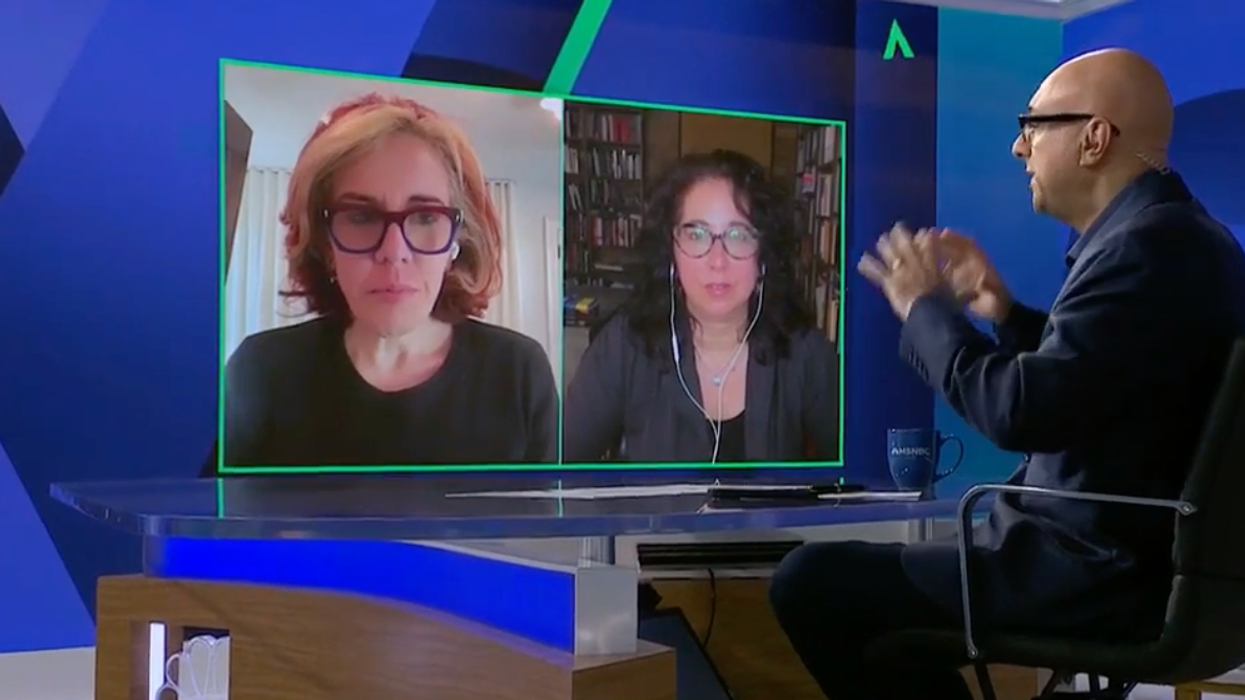
Yale University history professor and author Marci Shore made a similar argument during a Saturday morning, May 24 appearance on MSNBC. Although Shore, unlike Kristol, didn't mention Nixon, she warned that Trump's open authoritarianism is making some Americans feel "paralyzed."

When host Ali Velshi noted examples of Trump taking revenge against his political enemies, Shore told him and Vanity Fair's Molly Jong-Fast — who was also featured as a guest — "What's striking about what's going on now is that there's not even an attempt to hide this. The fact that this is a retribution is open. It's shameless. It's laid bare. That has been the strategy of this regime from the beginning."

Shore continued, "All of it is right there on the surface: the vulgarity, the racism, the flagrant disregard for the rule of law, the boundless corruption, the naked transactionalism, the sadistic cruelty. And that paradoxically disempowers us in the opposition because it's so obvious that we feel paralyzed and start digging around to see what might be hidden when the problem is not what's been hidden, but what has been normalized."

However, Jong-Fast (who was suffering from laryngitis) told Velshi and Shore that "the good news" is that "the courts have your back" and "have been protecting people" by standing up to Trump. And Shore applauded progressive Rep. Jasmine Crockett (D-Texas) and others for being so vocal in their dissent.

Shore told Velshi and Jong-Fast, "The point that Molly made is very important. There are people resisting. There are judges resisting. There are judges with integrity. There are people like Jasmine Crockett who I don't know personally, but who have been absolutely fearless — you know, who are out there every day speaking truth to power. It's really important to acknowledge that and stand in solidarity, and recognize what so many Americans have been doing."

Shore continued, "The other thing is that when you have a situation of terror, you run into classic collective action problems…. Sometimes, the universities push back, and sometimes, people put their head down and try to get in line so that they're not going to be attacked next. And that's a classic collective action problem."

READ MORE: 'America First': Far-right MAGA Catholics declaring war against 'globalist' Pope Leo

Watch the full video below or at this link.


Rising Seas From Fossil Fuels Threaten Inland Migration 'Never Witnessed in Modern Civilization'

With governments "scaling back their already meager" actions to tackle climate breakdown, said one ecologist, "our present-day human culture is on a suicide course."


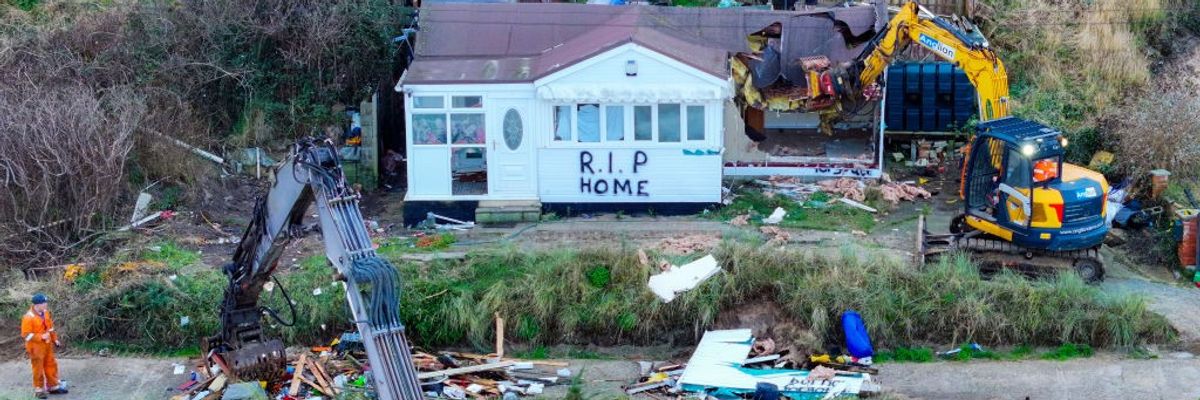
A beach house adorned with "RIP HOME" is demolished by workers before it falls down the sea cliff on December 11, 2023 in Hemsby, England. The collapse of a private access road, prompted by high tides and winds, led Great Yarmouth Borough Council to declare some houses "not structurally sound and unsafe."
(Photo: Christopher Furlong/Getty Images)


Jessica Corbett
May 20, 2025
COMMON DREAMS

Less than six months away from the next United Nations summit for parties to the Paris climate agreement, scientists on Tuesday released a study showing that even meeting the deal's 1.5°C temperature target could lead to significant sea-level rise that drives seriously disruptive migration inland.

Governments that signed on to the 2015 treaty aim to take action to limit global temperature rise by 2100 to 1.5°C beyond preindustrial levels. Last year was not only the hottest in human history but also the first in which the average global temperature exceeded 1.5°C. Multiple studies have warned of major impacts from even temporarily overshooting the target, bolstering demands for policymakers to dramatically rein in planet-heating fossil fuels.

The study published Tuesday in the journal Nature Communications Earth and Environmentwarns that 1.5°C "is too high" and even the current 1.2°C, "if sustained, is likely to generate several meters of sea-level rise over the coming centuries, causing extensive loss and damage to coastal populations and challenging the implementation of adaptation measures."

"To avoid this requires a global mean temperature that is cooler than present and which we hypothesize to be closer to +1°C above preindustrial, possibly even lower, but further work is urgently required to more precisely determine a 'safe limit' for ice sheets," the paper states, referring to Antarctica and Greenland's continental glaciers.

Co-author Jonathan Bamber told journalists that "what we mean by safe limit is one which allows some level of adaptation, rather than catastrophic inland migration and forced migration, and the safe limit is roughly 1 centimeter a year of sea-level rise."

"If you get to that, then it becomes extremely challenging for any kind of adaptation, and you're going to see massive land migration on scales that we've never witnessed in modern civilization," said the University of Bristol professor.

In terms of timing, study lead author Chris Stokes, from the United Kingdom's Durham University, said in a statement that "rates of 1 centimeter per year are not out of the question within the lifetime of our young people."


- YouTube

There are currently around 8.18 billion people on the planet. The study—funded by the United Kingdom's Natural Environment Research Council—says that "continued mass loss from ice sheets poses an existential threat to the world's coastal populations, with an estimated 1 billion people inhabiting land less than 10 meters above sea level and around 230 million living within 1 meter."

"Without adaptation, conservative estimates suggest that 20 centimeters of [sea-level rise] by 2050 would lead to average global flood losses of $1 trillion or more per year for the world's 136 largest coastal cities," says the study, also co-authored by University of Wisconsin-Madison professor Andrea Dutton and University of Massachusetts Amherst's Rob DeConto in the United States.

DeConto said Tuesday that "it is important to stress that these accelerating changes in the ice sheets and their contributions to sea level should be considered permanent on multigenerational timescales."

"Even if the Earth returns to its preindustrial temperature, it will still take hundreds to perhaps thousands of years for the ice sheets to recover," the professor explained. "If too much ice is lost, parts of these ice sheets may not recover until the Earth enters the next ice age. In other words, land lost to sea-level rise from melting ice sheets will be lost for a very, very long time. That's why it is so critical to limit warming in the first place."


While the paper sparked some international alarm, Stokes highlighted what he called "a reason for hope," which is that "we only have to go back to the early 1990s to find a time when the ice sheets looked far healthier."

"Global temperatures were around 1°C above preindustrial back then, and carbon dioxide concentrations were 350 parts per million, which others have suggested is a much safer limit for planet Earth," he said. "Carbon dioxide concentrations are currently around 424 parts per million and continue to increase."

The new paper continues an intense stream of bleak studies on the worsening climate emergency, and specifically, looming sea-level rise. Another, published by the journal Nature in February, shows that glaciers have lost an average of 273 billion metric tons of ice annually since 2000.

Despite scientists' warnings, the government whose country is responsible for the largest share of historical planet-heating emissions, the United States, is actually working to boost the fossil fuel industry. Upon returning to office in January, U.S. President Donald Trump declared an "energy emergency" and ditched the Paris agreement.

Responding to the new study on social media, Scottish ecologist Alan Watson Featherstone called out both the U.S. and U.K. governments. He said that with many countries "scaling back their already meager and [totally] inadequate actions to address climate breakdown, our present-day human culture is on a suicide course."
In 'Anti-Science Move,' FDA Expected to Broadly Restrict Access to Covid Vaccines

"I think that changes like this will lead to more unnecessary deaths," said one doctor.


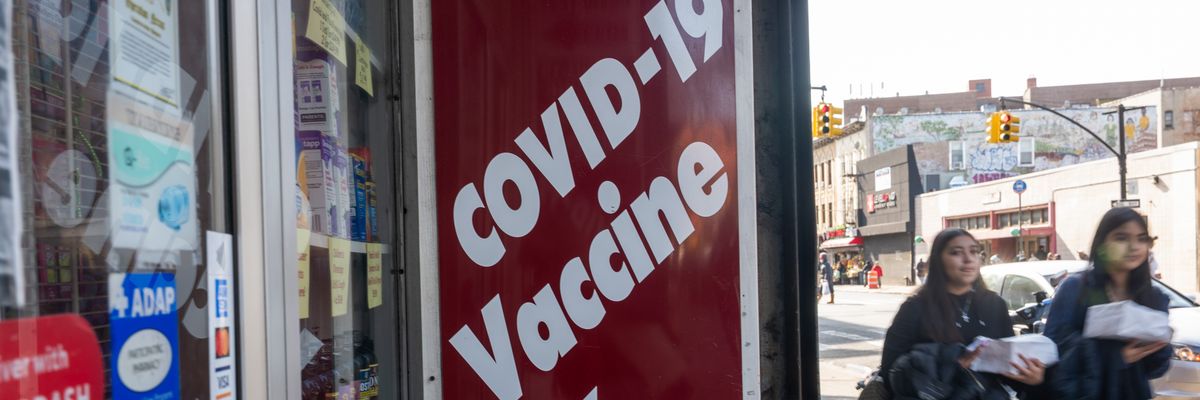
A pharmacy advertises the Covid-19 vaccine as the nation marks the fifth anniversary of the Covid-19 pandemic on March 13, 2025 in New York City.
(Photo: Spencer Platt/Getty Images)


Julia Conley
May 21, 2025
COMMON DREAMS


Public health experts on Tuesday warned Tuesday that forthcoming Food and Drug Administration guidance on the Covid-19 vaccine would "cause confusion" and result in fewer people getting inoculated against the virus that killed 350,000 people in the U.S. before the shots became available.

Dr. Vinay Prasad, head of the agency's vaccine division, and Dr. Martin Makary, the FDA commissioner, wrote in the New England Journal of Medicine that the vaccine "booster" doses that have been available for the last several years to anyone aged six months and older carry "uncertain" benefits for much of the population.

The officials said the next round of shots will be available only for adults over 65 and those with certain medical conditions.

They said that before a new round of updated vaccines are made available in the fall, the FDA "anticipates the need" for new clinical trials for many patients under 65. Participants in the trial would be given either the new shots or a placebo and followed by vaccine manufacturers for at least six months to determine if the vaccines continued to provide them with protection from Covid.

Both Prasad and Makary were vocal skeptics of vaccine mandates and other public health measures during the coronavirus pandemic, and Health and Human Services Secretary Robert F. Kennedy, Jr.—who oversees the FDA—has spread baseless misinformation about the Covid shots and other vaccines.

Kennedy said in 2021 that the shots were the "deadliest ever made"; the Centers for Disease Control and Prevention (CDC) has found the vaccines reduce people's risk of developing serious illness, long-term symptoms, and hospitalization.

Dr. Daniel Griffin, a physician in New York, toldThe New York Times that the FDA's plan will ultimately "very slowly [reduce] vaccination in the country."

"I think that changes like this will lead to more unnecessary deaths," said Griffin.

Makary and Prasad made their announcement days before scientific advisers to the FDA are set to decide on the composition of the Covid vaccines that will be offered this fall.

Dr. Lucky Tran, director of science communication and media relations at Columbia University Irving Medical Center, emphasized that many Americans have conditions that raise the risk of severe illness when they get Covid—including asthma, pregnancy, diabetes, obesity, and some mental health conditions.

"However, limiting Covid vaccines to people with specific conditions only causes confusions and decreases uptake," said Tran. "Most are unaware they have a condition that puts them at risk, so many who would want to get vaccinated may not try because they think they don't qualify."


About 74% of people in the U.S. have at least one condition that puts them at higher risk for severe disease, according to the CDC.

For people without medical conditions who are under age 65, it was unclear Wednesday whether they will be able to get vaccinated in the fall—and if shots are available to them, whether insurers will cover the costs.

William Schaffner, an infectious disease physician who is on the CDC's vaccine advisory panel—which recommends who should get FDA-approved vaccines—toldThe Washington Post that the panel could include in this year's recommendations that health people under 65 can still get a shot to protect themselves.

"They could add that line... and it would allow those people very focused on prevention who would like to get the vaccine and have it paid for by their insurance," Schaffner told the Post.

But Prasad said the FDA could still limit access because the agency "can only approve products if it concludes, based on the available scientific evidence, the benefit-to-harm balance is favorable."

Pediatricians expressed concern for children's safety if vaccines become unavailable to them; the CDC reported 150 pediatric deaths from Covid over the 12-month period that ended last August.

"I think there is strong data to suggest Covid should be part of routine childhood vaccinations," Amesh Adalja, an infectious disease physician, toldSTAT News. "We vaccinate kids for things that have less morbidity and mortality than Covid, like chickenpox for example."

Tran denounced the anticipated guidance as "an anti-science move that will kill more Americans."

"The FDA is being led by people who have consistently spread misinformation about Covid and vaccines," said Tran. "Their record indicates that they cannot be trusted to implement evidence-based guidance for vaccines, and their policies will kill people and make them sicker."
Scientists have lost their jobs or grants in US cuts. Foreign universities want to hire them

Medical researchers from universities and the National Institutes of Health rally near the Health and Human Services headquarters to protest federal budget cuts, in Washington. (AP/File)

AP
May 26, 202503:36

Already, several universities have announced hiring freezes, laid off staff or stopped admitting new graduate students

As the Trump administration cut billions of dollars in federal funding to scientific research, thousands of scientists in the US lost their jobs or grants — and governments and universities around the world spotted an opportunity.

The “Canada Leads” program, launched in April, hopes to foster the next generation of innovators by bringing early-career biomedical researchers north of the border.

Aix-Marseille University in France started the “Safe Place for Science” program in March — pledging to “welcome” US-based scientists who “may feel threatened or hindered in their research.”

Australia’s “Global Talent Attraction Program,” announced in April, promises competitive salaries and relocation packages.

“In response to what is happening in the US,” said Anna-Maria Arabia, head of the Australian Academy of Sciences, “we see an unparalleled opportunity to attract some of the smartest minds here.”

Since World War II, the US has invested huge amounts of money in scientific research conducted at independent universities and federal agencies. That funding helped the US to become the world’s leading scientific power — and has led to the invention of cell phones and the Internet as well as new ways to treat cancer, heart disease and strokes, noted Holden Thorp, editor-in-chief of the journal Science.

But today that system is being shaken.

Since President Donald Trump took office in January, his administration has pointed to what it calls waste and inefficiency in federal science spending and made major cuts to staff levels and grant funding at the National Science Foundation,the National Institutes of Health, NASA and other agencies, as well as slashing research dollars that flow to some private universities.

The White House budget proposal for next year calls to cut the NIH budget by roughly 40 percent and the National Science Foundation’s by 55 percent.

“The Trump administration is spending its first few months reviewing the previous administration’s projects, identifying waste, and realigning our research spending to match the American people’s priorities and continue our innovative dominance,” said White House spokesperson Kush Desai.

Already, several universities have announced hiring freezes, laid off staff or stopped admitting new graduate students. On Thursday, the Trump administration revoked Harvard University’s ability to enroll international students, though a judge put that on hold.

Research institutions abroad are watching with concern for collaborations that depend on colleagues in the US — but they also see opportunities to potentially poach talent.

“There are threats to science ... south of the border,” said Brad Wouters, of University Health Network, Canada’s leading hospital and medical research center, which launched the “Canada Leads” recruitment drive. “There’s a whole pool of talent, a whole cohort that is being affected by this moment.”

Promising a safe place to do science

Universities worldwide are always trying to recruit from one another, just as tech companies and businesses in other fields do. What’s unusual about the current moment is that many global recruiters are targeting researchers by promising something that seems newly threatened: academic freedom.

European Commission President Ursula von der Leyen said this month that the European Union intends “to enshrine freedom of scientific research into law.” She spoke at the launch of the bloc’s “Choose Europe for Science” — which was in the works before the Trump administration cuts but has sought to capitalize on the moment.

Eric Berton, president of Aix-Marseille University, expressed a similar sentiment after launching the institution’s “Safe Place for Science” program.

“Our American research colleagues are not particularly interested by money,” he said of applicants. “What they want above all is to be able to continue their research and that their academic freedom be preserved.”

Too early to say ‘brain drain’

It’s too early to say how many scientists will choose to leave the US It will take months for universities to review applications and dole out funding, and longer for researchers to uproot their lives.

Plus, the American lead in funding research and development is enormous — and even significant cuts may leave crucial programs standing. The US has been the world’s leading funder of R&D — including government, university and private investment — for decades. In 2023, the country funded 29 percent of the world’s R&D, according to the American Association for the Advancement of Science.

But some institutions abroad are reporting significant early interest from researchers in the US Nearly half of the applications to “Safe Place for Science” — 139 out of 300 total — came from US-based scientists, including AI researchers and astrophysicists.

US-based applicants in this year’s recruitment round for France’s Institute of Genetics, Molecular and Cellular Biology roughly doubled over last year.

At the Max Planck Society in Germany, the Lise Meitner Excellence Program — aimed at young female researchers — drew triple the number of applications from US-based scientists this year as last year.

Recruiters who work with companies and nonprofits say they see a similar trend.
Natalie Derry, a UK-based managing partner of the Global Emerging Sciences Practice at recruiter WittKieffer, said her team has seen a 25 percent to 35 percent increase in applicants from the US cold-calling about open positions. When they reach out to scientists currently based in the US, “we are getting a much higher hit rate of people showing interest.”

Still, there are practical hurdles to overcome for would-be continent-hoppers, she said. That can include language hurdles, arranging childcare or eldercare, and significant differences in national pension or retirement programs.

Community ties

Brandon Coventry never thought he would consider a scientific career outside the United States. But federal funding cuts and questions over whether new grants will materialize have left him unsure. While reluctant to leave his family and friends, he’s applied to faculty positions in Canada and France.

“I’ve never wanted to necessarily leave the United States, but this is a serious contender for me,” said Coventry, who is a postdoctoral fellow studying neural implants at the University of Wisconsin-Madison.

But it’s not easy to pick up and move a scientific career — let alone a life.

Marianna Zhang was studying how children develop race and gender stereotypes as a postdoctoral fellow at New York University when her National Science Foundation grant was canceled. She said it felt like “America as a country was no longer interested in studying questions like mine.”

Still, she wasn’t sure of her next move. “It’s no easy solution, just fleeing and escaping to another country,” she said.

The recruitment programs range in ambition, from those trying to attract a dozen researchers to a single university to the continent-wide “Choose Europe” initiative.
But it’s unclear if the total amount of funding and new positions offered could match what’s being shed in the US.

A global vacuum

Even as universities and institutes think about recruiting talent from the US, there’s more apprehension than glee at the funding cuts.

“Science is a global endeavor,” said Patrick Cramer, head of the Max Planck Society, noting that datasets and discoveries are often shared among international collaborators.
One aim of recruitment drives is to “to help prevent the loss of talent to the global scientific community,” he said.

Researchers worldwide will suffer if collaborations are shut down and databases taken offline, scientists say.

“The US was always an example, in both science and education,” said Patrick Schultz, president of France’s Institute of Genetics, Molecular and Cellular Biology. So the cuts and policies were “very frightening also for us because it was an example for the whole world.”