Monday, May 26, 2025

Where in the U.S. are hospital occupancy rates most concerning?


By Dr. Tim Sandle
May 25, 2025
DIGITAL JOURNAL


Typical bed in a hospital. — Image by Peachyeung316 — CC BY-SA 4.0

New research estimates that U.S. hospital occupancy rates could hit critical levels by 2032, risking bed shortages across the nation, a new analysis has identified how occupancy rates differ across the states.

The study by personal injury attorneys, Foster Wallace, submitted to Digital Journal forassessment, has analyzed data from the American Hospital Directory’s compilation of statistics for non-federal, short-term, acute care hospitals in each state, with statistics sourced from each hospital’s most recent Medicare cost report.

The researchers examined this data to determine the number of patient days per staffed bed in hospitals across each state. For example, if one patient spends five days in hospital and another spends two, this would be counted as seven patient days. The total number of patient days were then scaled by the number of available hospital beds.

The states with the highest numbers indicate that they have the highest occupancy of hospital beds, ranking these states as the most reliant on hospital care.

Top 10 States Most Reliant on Hospital Care:

Rank State Patient Days Per Staffed Bed Number of Hospitals Gross Patient Revenue per Patient Day 
Delaware 267.8 $18,807 
Maryland 266.6 49 $7,609 
Washington 265.0 60 $31,561 
Massachusetts 258.2 71 $24,307 
Vermont 257.3 $31,435 
Nevada 256.4 30 $43,595 
Oregon 243.6 35 $24,984 
Hawaii 238.4 14 $21,329 
North Carolina 234.5 110 $26,535 
10 Georgia 230.5 111 $30,685 

To generate the data, each state’s number of hospitals, total patient days, staffed beds and gross patient revenue were used to calculate the following: Average number of staffed beds per hospital
Average number of patient days per hospital
Patient days per staffed bed – staffed beds account for all beds available for patient lodging (excluding those used for specialized procedures).
Gross patient revenue per patient day

This ranking is based on the number of patient days per staffed bed, indicating occupancy rates of hospitals in each state and their reliance on hospitals.

Delaware is the state most reliant on hospital care. The findings reveal that at 267.8 patient days per staffed bed, Delaware has the highest rate in the U.S.

The findings also identified that Delaware has the highest average number of patient days per hospital compared to all other states, at around 70,763—a staggering 75% higher than the national average (40,494 patient days per hospital).

Maryland ranks second, with a rate of 266.6 patient days per staffed bed. This is based on total patient days of nearly 2.76 million across 10,347 staffed beds in the state. However, at an estimated $7,609, Maryland has the lowest gross patient revenue per patient day in the nation.

Washington ranks third, with 265 patient days per staffed bed. According to the findings, the state had almost 2.78 million patient days and 10,476 staffed beds across the state’s 60 hospitals, recorded in the most recent report.

The fourth state among those most reliant on hospital care is Massachusetts. The findings identified a rate of 258.2 patient days per staffed bed, based on almost 3.7 million patient days and 14,313 staffed beds across 71 hospitals.

Vermont places fifth, with 257.3 patient days per staffed bed across the state’s seven hospitals. The state recorded 851 staffed beds and 218,981 patient days, with a gross patient revenue per patient day estimated at $31,435, based on the state’s reported overall gross patient revenue.

Completing the top ten states most reliant on hospital care is Nevada in sixth (256.4 patient days per staffed bed), Oregon in seventh (243.6) and Hawaii in eighth (238.4). Rounded out by North Carolina in ninth (234.5) and Georgia in tenth place (230.5).

Top 10 States Least Reliant on Hospital Care:

Rank State Patient Days  Per Staffed Bed Number of Hospitals Gross Patient Revenue per Patient Day 
Wyoming 90.4 15 $33,336 
Mississippi 152.8 65 $29,364 
South Dakota 155.3 23 $36,023 
Louisiana 163.6 108 $31,309 
Montana 176.5 14 $25,075 
Utah 182.8 36 $34,609 
Arkansas 185.2 52 $24,407 
Oklahoma 188.6 90 $34,475 
Kansas 189.5 54 $37,932 
10 Alabama 191.4 90 $27,750 
The findings also revealed the states that are the least reliant on hospital care, with Wyoming found to have the lowest rate in the U.S. at just 90.4 patient days per staffed bed. This is according to the state’s reported 1,283 staffed beds and 115,955 patient days overall.

Mississippi follows with 152.8 patient days per staffed bed, as identified by the study. According to the findings, Mississippi had almost 1.4 million patient days and 9,127 staffed beds recorded across its 65 hospitals.

South Dakota ranks third. The study identified that the state has a rate of 155.3 patient days per staffed bed. Additionally, finding that South Dakota has the highest gross patient revenue per patient day of all states in the top ten least reliant on hospital care, at an estimated $36,023.

Louisiana places fourth. The state was found to report over 2.26 million patient days and 13,834 staffed beds across 108 hospitals. This equates to 163.6 patient days per staffed bed in the state.

The fifth state least reliant on hospital care is Montana. The findings identified that the state has a rate of 176.5 patient days per staffed bed, based on 371,284 patient days and 2,104 staffed beds across 14 hospitals.

Rounding out the top ten states that rely on hospital care the least is Utah in sixth (182.8 patient days per staffed bed), Arkansas in seventh (185.2) and Oklahoma ranking eighth (188.6). In ninth is Kansas (189.5), and Alabama places tenth (191.4).

The findings suggest that states like Delaware and Maryland, with the highest number of patient days per staffed bed, may face struggles in meeting patient needs outside of hospital settings. This heavier dependence on hospitals may have the potential to create challenges and risks, making it harder to provide more personalized or preventative care.
Tech company downsizing continues into 2025

By Dr. Tim Sandle
DIGITAL JOURNAL
May 26, 2025


Image by Volker Agueras Gäng — CC BY 2.0.

Mass layoffs are sweeping through the technology industry, as is apparent in a report looking at the companies that have eliminated the most jobs in 2025 around the world. The report comes from RationalFX, who detail the 90,471 layoffs announced so far.
Intel

Major tech companies have recently announced job cuts, including computer hardware giant Intel, which revealed plans to cut around 20% of its workforce by the end of the year (around 20,000 employees). Intel has recorded the highest number of layoffs to date. Following a reduction of more than 15,000 jobs in 2024.

Despite conflicting reports from company execs, the move is putting between 20,000 and 25,000 employees at risk of losing their jobs. Intel is not the only company to downsize.

By aggregating layoff announcements sourced from the U.S. WARN notices, the job portal TrueUp, TechCrunch and the Layoffs.fyi layoff tracker since the beginning of 2025, the report shows that technology is the sector that has taken the biggest brunt of job losses.

The data indicates that a total of 90,471 employees in the tech sector have been laid off since the start of the year. U.S.-based companies have let go of 65,545 people, or roughly 72.5% of all announced layoffs by tech firms around the world. The most massive layoffs this year come from tech giants Intel (21,780), Panasonic (10,000), and Microsoft (8,840).

Panasonic and Microsoft

Panasonic ranks second for the most layoffs so far this year after it announced 10,000 layoffs as part of a major overhaul, aiming to improve profitability and operational efficiency. Microsoft has also let go of a significant portion of its staff, 8,840 employees in total.

Geography

The U.S. leads in the number of layoffs, totalling 65,545, followed by Japan with 10,100, Sweden with 3,053, Switzerland with 3,050, and India with 2,688. California is the U.S. state where the companies with the most layoffs are headquartered in the United States. Firms based there have eliminated 38,352 positions; other states with significant job cuts are Washington (13,385), Texas (3,656), Massachusetts (2,520), and Arizona (2,450).

Drivers – goodbye to coding?

Financial pressures and the drive toward automation appear to be the main forces behind the recent waves of layoffs. There is less and less demand for generic coding and data-centric positions in tech firms. Even jobs that were in high demand just a year ago are becoming increasingly obsolete in the wider tech industry, such as AI development and prompt engineering. In addition, many tech giants are working to streamline their operations by cutting unnecessary layers of middle management across their organisations.

Many tech giants are also cutting jobs despite strong earnings. Microsoft reported $70.1 billion in Q1 revenue and $25.8 billion in net income but laid off 8,840 employees, including senior staff. Meta posted $16.64 billion in profit and cut 3,720 jobs. Chegg laid off 22% of its workforce after investing in a GPT-4-powered AI assistant.

The 90,471 laid off between January 1 and May 20, 2025, average 646 job losses per day. If the current pace continues, the tech industry is on track to cut an additional 145,500 jobs by year-end, bringing the projected total for 2025 to 235,871 layoffs in the global tech sector.


Megalodon: The broad diet of the megatooth shark


The prehistoric predatory fish Otodus megalodon did not feed solely on other large predatory animals at the top of the food chain – zinc detected in fossils delivers clues about its other prey


Goethe University Frankfurt

Fossilized Tooth 

image: 

Jeremy McCormack with a fossilized megalodon tooth (Otodus megalodon). Photo: Uwe Dettmar for Goethe University

view more 

Credit: Uwe Dettmar for Goethe University


FRANKFURT. Otodus megalodon was the largest predatory fish in Earth’s history: Measuring up to 24 meters, it was longer than a truck with a trailer and weighed almost twice as much. Embedded in its jaws were triangular teeth the size of a hand, and its bite had the force of an industrial hydraulic press. It swam through the world’s oceans between 20 and 3 million years ago, frequently on the hunt for prey to satisfy a calorie demand as vast as its size: According to estimates, it required around 100,000 kilocalories per day. Science widely assumed that megalodon’s main calorie intake was in the form of whales.

At least that’s what it did should a whale come long, says Dr. Jeremy McCormack from the Department of Geosciences at Goethe University Frankfurt. It appears, after all, that megalodon partook of a much broader range of prey than previously assumed, as the geoscientist discovered together with scientists from Germany, France, Austria and the US. The researchers examined fossilized megalodon teeth, which are more or less all that has remained of the cartilaginous fish that gave the shark its name, megalodon, meaning “big tooth”.

The researchers extracted zinc from the fossil teeth, an element that occurs in atomic variants (isotopes) of different weights. Zinc is ingested with food, whereby less of the heavier isotope zinc-66 than the lighter isotope zinc-64 is stored in muscles and organs. Accordingly, the tissue of fish that eat fish absorbs significantly less zinc-66, and those which, in turn, hunt them for food absorb even less. That is why Otodus megalodon and its close relative Otodus chubutensis had the lowest ratio of zinc-66 to zinc-64 at the top of the food chain.

“Since we don’t know how the ratio of the two zinc isotopes at the bottom of the food pyramid was at that time, we compared the teeth of various prehistoric and extant shark species with each other and with other animal species. This enabled us to gain an impression of predator-prey relationships 18 million years ago,” explains McCormack. The giant teeth they used for their study mostly came from fossil deposits in Sigmaringen and Passau – 18 million years ago, a relatively shallow estuary, less than 200 meters deep, flowed along the Alps, teeming with various other shark species alongside megalodon.

McCormack explains: “Sea bream, which fed on mussels, snails and crustaceans, formed the lowest level of the food chain we studied. Smaller shark species such as requiem sharks and ancestors of today’s cetaceans, dolphins and whales, were next. Larger sharks such as sand tiger sharks were further up the food pyramid, and at the top were giant sharks like Araloselachus cuspidatus and the Otodus sharks, which include megalodon.” McCormack stresses, however, that the Otodus sharks cannot be sharply differentiated from the lower levels of the pyramid: “Megalodon was by all means flexible enough to feed on marine mammals and large fish, from the top of the food pyramid as well as lower levels – depending on availability.”

According to McCormack, this means that the idea of Otodus sharks homing in on marine mammals when it comes to food needs to be revised: “Our study tends rather to draw a picture of megalodon as an ecologically versatile generalist.” Comparisons between the fossils from Sigmaringen and Passau, for example, showed that the creatures from Passau fed more on prey from lower levels of the food pyramid, which also points to regional differences in the range of prey or changes in its availability at different times.

Analyzing teeth on the basis of zinc content is a very new method, and McCormack is delighted with the comprehensive and coherent results it produced not only for prehistoric shark and whale species but also for herbivorous prehistoric rhinoceroses and even shark species that exist today. McCormack: “Determining tooth zinc isotope ratios has once again proven to be a valuable instrument for paleoecological reconstructions.” “It gives us important insights into how the marine communities have changed over geologic time, but more importantly the fact that even ‘supercarnivores’ are not immune to extinction,” adds Kenshu Shimada, a paleobiologist at DePaul University in Chicago, USA, and a coauthor of the new study. Previous studies, including one led by McCormack, indicated that, at least in part, the rise of the modern great white shark is to blame for the demise of Otodus megalodon.

Jeremy McCormack at the mass spectrometer, which is used to determine the zinc isotope ratio. This ratio provides information about the diet of Otodus megalodon. Photo: Uwe Dettmar for Goethe University

Credit

Uwe Dettmar, Goethe University

megalodon can be seen in the Linz Castle Museum in Austria, for example.

Credit

OÖ Landes-Kultur GmbH


U.S. Ramps Up Defenses for Naval Support Facility Diego Garcia

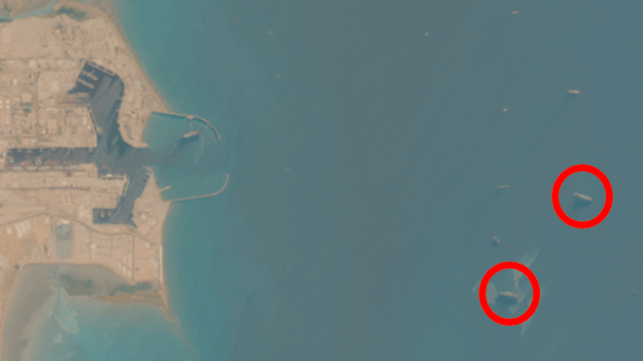
Shahid Mahdavi (110-3) and Shahid Bagheri (110-4) in the Bandar Abbas roads, May 24 (Sentinel-2/CJRC)

Published May 25, 2025 7:33 PM by The Maritime Executive


A number of recent satellite passes over Diego Garcia – historically part of the British Indian Ocean Territory, now part of Mauritius - have identified the presence on the airfield of up to six F-15 strike aircraft. There are normally no US aircraft permanently stationed on Diego Garcia, with aircraft deployed only for specific short-duration tasks and missions. The presence of the F-15s on Diego Garcia has been confirmed by official Indo-Pacific Command channels, which have specified that the aircraft in question are F-15Es with a dual air-to-air and air-to-ground/sea mission capability. This acknowledgement advertises that the deployment is meant for deterrence purposes, to warn off a potential adversary and to give notice that a threat has been identified and can be dealt with. The nature of the threat remains undefined, but there are a number of possibilities to be considered.

Iran’s Islamic Revolutionary Guard Corps (IRGC) specifically has referenced and threatened the US naval and air presence on Diego Garcia on numerous occasions, alongside general threats made recently to target any foreign bases from which the United States would mount an attack on Iran. Rear Admiral Alireza Tangsiri, the IRGC Navy (Nedsa) commander, has said that converted tankers Shahid Mahdavi (110-3) and Shahid Bagheri (110-4) are configured to undertake long-range deployments and can be equipped with both ballistic missiles and drones. The Admiral noted that the Shahid Mahdavi had “cruised in the area of American forces stationed on Diego Garcia” on a 40-day deployment through the Indian Ocean cruise, which ended on May 18, 2024. Both ships have demonstrated the capability to fire Fateh-313 missiles with a range of 500 kilometers, as well as medium-range drones.

In the latest satellite imagery available, both the Nedsa drone carriers were at anchor in the Bandar Abbas roads (Shahid Mahdavi at 27.0693N 56.1881E and Shahid Bagheri at 27.0878N 56.2001E), and have been so since at least the beginning of May. However, while the threat focus is usually on these two ships, other Nedsa ships can also launch missiles and drones.

An article published by Iran’s Press TV on September 23, 2024, also noted that Diego Garcia would be within range of the IRGC’s Shahed-136B drone, if launched from Iran’s south-east coast.

At such range, neither the regular Iranian Navy nor Air Force could realistically press home an attack on Diego Garcia. In April 1981, during the Iran-Iraq war, the Iranian Air Force demonstrated that it had the ability to mount attacks in depth, destroying 25 Iraqi aircraft on the H-3 airfields close to the Jordanian border. Although the Iranians still have the very same aircraft in service, their reliability is now dubious, and the range to Diego Garcia is much greater, making such an operation unfeasible. The Iranian Navy is proud of its 86th Flotilla round-the-world cruise in 2022, but its frigates and the single operational Kilo-class submarine would be vulnerable and lack the support necessary to operate at long range.

Any IRGC attempt to attack Diego Garcia would be limited in scope, and might yet rely on a novel attack concept not yet unidentified. To get close, they would have to rely on surprise and on remaining undetected in the deep ocean. But the Iranians are unlikely to know how effective US surveillance is - and with the F-15Es now protecting the island, are unlikely to want to try and find out.


Bangladesh Cancels Naval Shipbuilding Contract with India

GRSE
File image courtesy GRSE

Published May 25, 2025 3:26 PM by The Maritime Executive


Bangladesh has reportedly canceled a $21 million shipbuilding contract with India’s state-run Garden Reach Shipbuilders and Engineers (GRSE). The deal was signed last year between Bangladesh Navy and GRSE, and it involved construction of an 800-ton ocean-going tug, financed with a $500 million credit extended to Bangladesh by India for purchase of defense equipment.

However, following the ouster of Bangladeshi Prime Minister Sheikh Hasina last August, the country’s ties with India are in the doldrums. A week ago, India limited imports of ready-made garments from Bangladesh, blocking 11 traditional land routes for the trade. Earlier, India had also canceled a transshipment agreement that allowed exports of goods from Bangladesh to third countries. These trade restrictions are seen as a tit-for-tat move after Bangladesh banned imports of yarn from India by land routes.

Further, the withdrawal of the naval contract has been interpreted as another escalation in the deteriorating trade ties between the two countries. The cancellation of the tug order was made public through a stock exchange filing by GRSE.

“In line with the Disclosure Requirements provision of the Securities and Exchange Board of India, we wish to inform you that the government of Bangladesh has cancelled the order,” said GRSE.

During the reign of Prime Minister Hasina, India had been eyeing Bangladesh as a key market for its military exports. At the signing of the tug contract, it was hailed as a first major shipbuilding deal opening up Bangladesh market to Indian shipbuilders. GRSE had also signed a contract with the Bangladesh Inland Waterways Authority to build a trailing suction hopper dredger valued at $16.6 million.

China remains the largest supplier of naval equipment to Bangladesh. This defense cooperation has become even stronger under the leadership of Mohammad Yunus, the Bangladeshi interim leader, whose foreign policy appears to favor China.  


Three Injured in Boiler Explosion on Bulker in New Zealand

Bulker Olivia - Transport Accident Investigation Commission (TAIC)
Courtesy Transport Accident Investigation Commission (TAIC)

Published May 25, 2025 11:30 PM by The Maritime Executive


Maritime investigators in New Zealand are probing an incident in which three crewmembers were seriously injured after an explosion occurred aboard a bulk carrier at the country’s South Port.

The Transport Accident Investigation Commission (TAIC) is reporting that it has initiated investigations of an engine room explosion on the bulker Olivia that occurred on May 24 while the vessel was berthed at South Port, Bluff.

The 180-meter bulk carrier departed the Port of Bintulu in Malaysia on March 25, arriving in Bluff on April 22.

Shipping data at South Port shows Olivia was moored at berth 11 where she was loading a cargo of logs. She was slated to depart the port on May 29.

“The reported circumstances were that three crew members onboard the M.V. Olivia were working on a boiler in the engine room. During this process, there was an explosion or flashback, causing injury to the three crew members,” said TAIC in a statement.

The agency added that it is treating the incident as a ‘serious marine casualty’ as required under the International Maritime Organization’s Casualty Investigation Code, with an investigation already underway.

Though TAIC did not provide details on the incident in one of New Zealand’s leading ports in bulk cargo handling, media reports indicate that the St John Ambulance responded after the incident. The St John team assessed and treated the three crewmembers, one of whom was in a moderate condition and the other two in a serious condition.

Built in 2013 at Nanyang Ship Engineering - Jiangmen in China, the Olivia sails under the flag of Malta.

South Port is the southernmost commercial port in New Zealand and handles more than 3.2 million tonnes of cargo annually. During the half year ending December 31, 2024, the deep-water port recorded 131 calls by large vessels.


Bulker Grounds Outside of Shipping Channel in the Øresund

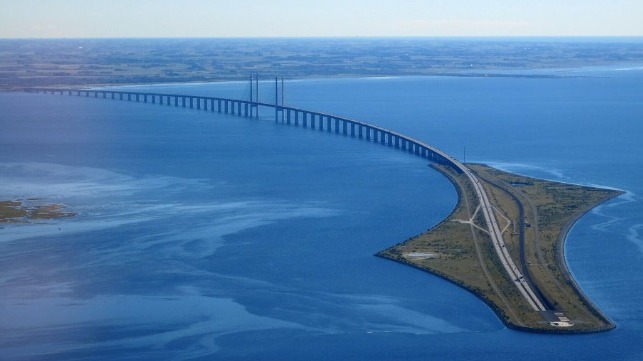
Oresund Bridge (Nick D / CC BY SA 4.0)

Published May 25, 2025 11:04 PM by The Maritime Executive


A Turkish bulker went aground Sunday in the Øresund, according to the Swedish Coast Guard, and it is being investigated as a possible case of gross negligence. 

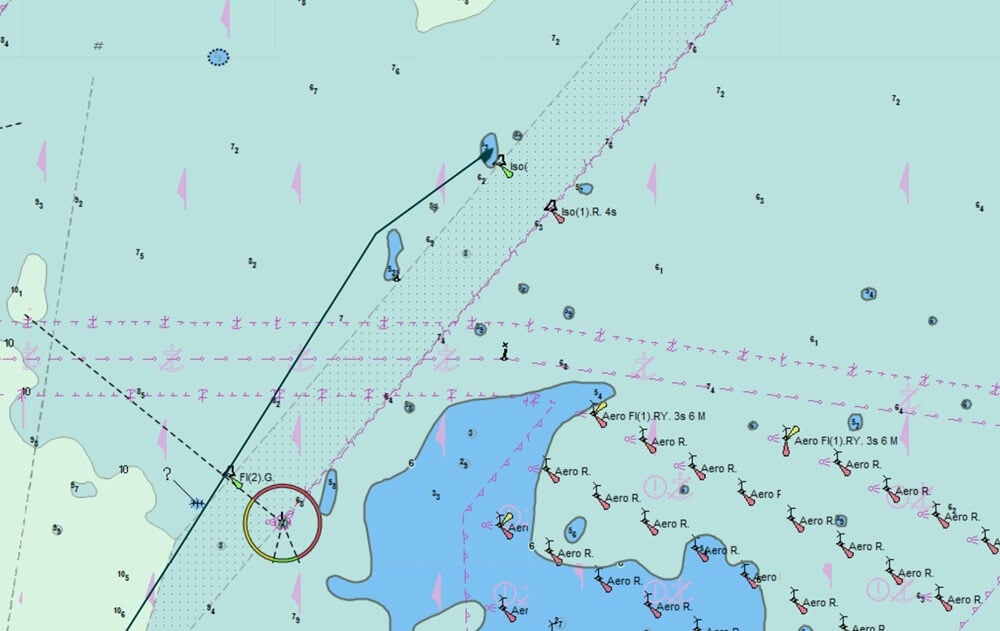
In the early hours of Sunday morning, the small bulker Ali Aykin was headed northbound into the Øresund. She was carrying a cargo of scrap metal on a routine voyage from Gdansk, Poland to Setubal, Portugal. AIS data suggests that at about 0015 hours, she missed the entrance to the fairway and deviated to the northwest of the shipping lane. At 0100, she went aground on a charted shoal, located just outside the marked fairway on the south side of the Øresund Bridge.

Courtesy Pole Star

One individual has been arrested on suspicion of "gross negligence in maritime traffic," the Swedish Coast Guard told local media. The crew are being interviewed and officials are gathering evidence from the vessel. 

"There are many shoals in the Sound and the inlets and outlets. Therefore, it is very important to stay within the designated areas that are clearly marked," said Swedish coast guard spokesman Mattias Lindholm, speaking to Hallands Nyheter. 

Salvage planning for refloating the ship is under way, and a Swedish response vessel is on scene monitoring the situation. The vessel is carrying about 18,000 gallons of diesel in her tanks, but no pollution has been detected so far. 

The 5,000 dwt Ali Aykin is 26 years old and has an extensive history of inspection problems, racking up more than 60 deficiency citations in the last six months alone. She was detained for 20 days in Sweden last year for serious issues, including damaged hatches, inoperative watertight doors, a broken radio, blocked escape routes, a broken fixed firefighting system, a broken emergency generator, and noncompliant fire pumps. 

Top image: Oresund Bridge (Nick D / CC BY SA 4.0)

Trump Greenlights US Steel Merger Despite Union Warning of 'Corporate Sellout'

"Our concern remains that Nippon, a foreign corporation with a long and proven track record of violating our trade laws, will further erode domestic steelmaking capacity and jeopardize thousands of good, union jobs."


A general view of Nippon Steel's East Nippon Works Kimitsu Area is seen on January 7, 2025 in Kimitsu, Japan.
(Photo: Tomohiro Ohsumi/Getty Images)

Jake Johnson
May 24, 2025
COMMON DREAMS

President Donald Trump on Friday signaled broad approval for Japanese steel giant Nippon's bid to purchase U.S. Steel, a reversal of his campaign-trail opposition to the merger that came a day after the United Steelworkers union implored the president to uphold his pledge to scrap the proposed deal.

In a post on his social media platform, Trump announced a "planned partnership" between U.S. Steel and Nippon, prompting confusion about the specific terms of the deal. U.S. Steel's stock jumped over 20% on the news, and both companies applauded the announcement and praised Trump.

The president wrote that U.S. Steel "will REMAIN in America" and keep its headquarters in Pittsburgh.

One unnamed person familiar with the merger negotiations told the Financial Times that the president's post was "considered 'tacit approval'" of the $15 billion takeover deal that was first announced in late 2023. The Biden administration blocked Nippon's proposed acquisition of U.S. Steel earlier this year, and Trump opposed the merger during his 2024 presidential campaign.

Former U.S Sen. Sherrod Brown (D-Ohio) called Trump's reversal "a betrayal of American workers.

United Steelworkers international president David McCall said in response to Trump's announcement that "we cannot speculate" about the details of the arrangement. But he reiterated the union's concerns that "Nippon, a foreign corporation with a long and proven track record of violating our trade laws, will further erode domestic steelmaking capacity and jeopardize thousands of good, union jobs."

Last month, Trump ordered the Committee on Foreign Investment in the U.S. to conduct an internal review of "potential national security risks associated with the proposed transaction." Reutersreported that the committee, which submitted its review on Wednesday, was "divided in its recommendation," but "most panel members believe any security risks posed by the deal can be addressed."

McCall on Thursday responded to the panel's recommendation with a scathing statement, warning that "allowing the sale of U.S. Steel to Nippon, a serial trade cheater, will be a disaster for American Steelworkers, our national security, and the future of American manufacturing."

"It is simply absurd to think that we could ever entrust the future of one of our most vital industries—essential to both national defense and critical infrastructure—to a company whose unfair trade practices continue to this day," said McCall. "For decades, Nippon has been dumping its products into our markets, costing us thousands of good, community-supporting jobs and undermining our steelmaking capabilities."

"Now, as it continues to make flashy promises about proposed investments, it remains clear Nippon is simply seeking to undercut our domestic industry from the inside," he continued. "President Trump has publicly pledged to block this sale since January 2024. We now urge him to act decisively, shutting the door once and for all on this corporate sellout of American Steelworkers and defending U.S. manufacturing."
UK renationalises first train operator under Labour reforms


By AFP
May 25, 2025


The renationalisation of South Western Railway, which notably serves London Waterloo station, means a third of journeys in Britain are now on publicly owned services - Copyright AFP Indranil MUKHERJEE

Alexandra BACON

A private train operator servicing parts of southern England, including London, on Sunday became the first to be returned to public ownership under a government plan to renationalise Britain’s much-maligned railways.

All UK rail operators are due to be renationalised within the next two years in a key policy launched by Prime Minister Keir Starmer following his Labour party’s return to government last July after 14 years in opposition.

“South Western Railway is now under public ownership. And this is just the start,” Starmer said on X, formerly Twitter, naming the service kickstarting his government’s plan.

He vowed the renationalisation “will put passengers first”, with “better services, with simpler ticketing, on more comfortable trains”.

Train passengers in Britain suffer from frequent cancellations, in addition to high ticket prices and regular confusion over which services they can be used on.

The privatisation of rail operations took place in the mid-1990s under the Conservative prime minister of the time, John Major, but the rail network remained public, run by Network Rail.

Four of the 14 operators in England are already run by the state owing to poor performance in recent years, but this was originally meant to be a temporary fix before a return to the private sector.

Labour triumphed over the Conservative party in elections last year, with its manifesto including promises to fix the country’s ailing transport services.

Legislation was approved in November to bring rail operators into public ownership when the private companies’ contracts expire — or sooner in the event of poor management –- and be managed by “Great British Railways”.

Transport Secretary Heidi Alexander said in a statement that will end “30 years of fragmentation”, but warned that “change isn’t going to happen overnight”.


– ‘Public good’ –


“We’ve always been clear that public ownership isn’t a silver bullet, but we are really firing this starting gun in that race for a truly 21st-century railway, and that does mean refocusing away from private profit and towards the public good,” she added.

In an example of how passengers might not immediately notice much difference, South Western’s first service under public ownership on Sunday was set to include a rail replacement bus because of engineering work.

Government figures show that the equivalent of four percent of train services in Britain were cancelled in the year to April 26.

The rate was three percent for South Western.

Rail unions — which have staged a stream of strikes in recent years over pay and conditions due to a cost-of-living crisis — welcomed the state takeover.

“We’re delighted that Britain’s railways are being brought back where they belong — into the public sector,” said Mick Whelan, general secretary of union Aslef.

“Everyone in the rail industry knows that privatisation… didn’t, and doesn’t, work,” he added.

Two operators serving towns and cities in southeastern and eastern England are next to be brought back into public ownership by late 2025.

All the current contracts are set to expire by 2027.

UK media reported that the renationalisation of South Western means a third of journeys are now on publicly owned services.

The government has said renationalisation will save up to £150 million ($200 million) per year because it will no longer have to pay compensation fees to rail operators.

The main rail operators in Scotland and Wales, where transport policy is handled by the devolved administrations in Edinburgh and Cardiff, are also state-owned.