Monday, May 26, 2025

GOP is winning its battle against human decency


Thom Hartmann
May 22, 2025
RAW STORY


Here we are again, my friend, watching the age-old story play out before our eyes. The Republicans are preparing to hand out trillions in tax cuts to their billionaire benefactors, and how do they plan to pay for this latest giveaway to the oligarchy? By ripping healthcare away from 13.7 million Americans, including millions of our most vulnerable seniors who depend on Medicaid for their very survival.

But this isn’t just about healthcare policy. This is about the fundamental question that’s defined America since the New Deal: Are we a society that believes in the common good, or are we returning to the brutal Social Darwinism of the Gilded Age?

Let’s remember how we got here. For most of our post-war history, America operated on a simple principle that both parties understood: we take care of each other. This wasn’t socialism or communism; it was basic human decency codified into law.

When Lyndon Johnson signed Medicaid into law in 1965, he wasn’t just creating a healthcare program. He was affirming that in the wealthiest nation in human history, no American should have to choose between medical care and bankruptcy, between their medication and their mortgage, between living and dying because of the size of their paycheck or bank account.

But then came the Reagan Revolution, and with it, the poisonous idea that “government is the problem,” that the market is a god who must be obeyed (and is owned and run by the morbidly rich), and that every person should fend for themselves in the raw jungle of unregulated capitalism.

That’s when we began dismantling the social contract that made America great.

Here’s what the corporate media won’t tell you: Medicaid isn’t just for the “undeserving poor”; it’s the backbone of our system of long-term care for American seniors.


Our beloved Medicare doesn’t cover nursing home care: Medicaid does. In fact, Medicaid pays for 63 percent of all nursing home care in this country.

Think about a grandmother who worked her entire life, paid her taxes, raised her children, and contributed to her community. When she needs long-term care, it’s Medicaid that’s there for her. Not the private insurance industry that spent decades collecting her premiums. Not even Medicare. Just Medicaid. That’s it.

Republicans want to cut nearly $800 billion from Medicaid to pay for their tax breaks for Musk, Trump, and their billionaire friends; they’re working out the details this week in the House of Representatives.

This would be the greatest upward redistribution of wealth in American history, and they’re using our grandparents’ healthcare as the piggy bank.

That type of a massive cut will throw at least 8 and as many as 15 million American Americans, most seniors, out into the streets or eliminate their health coverage. They want to turn American families into financial victims of the for-profit healthcare system that eagerly awaits their arrival because it treats human suffering as a profit center.

This is what oligarchy looks like. This is what happens when a small group of ultra-wealthy individuals capture the government and use it to enrich themselves at the expense of everyone else. It’s not capitalism: it’s feudalism with a stock market.

When you gut Medicaid, you don’t just hurt individuals, you destroy entire communities. Rural hospitals, already hanging on by a thread, will close by the dozens. We’ve already lost 200 rural hospitals in the past decade because roughly a dozen states refused to expand Medicaid under Obamacare. How many more can we afford to lose?

These aren’t just statistics. These are communities where people have lived for generations, where children grow up, where families build lives. When that hospital closes, when seniors can no longer get care, when pregnant women have to drive three hours to give birth (more than half of all babies’ births in America are paid for with Medicaid) that’s not just healthcare policy. That’s the systematic destruction of American communities to enrich a handful of billionaires.

And it’s not just Medicaid. The Trump-Musk regime is simultaneously sabotaging Social Security, pushing out 7,000 public servants who helped Americans sign up for and claim their earned benefits. They’re declaring people dead who are very much alive, cutting them off from their Social Security, their bank accounts, their very ability to survive in modern society.

This is intentional. This is designed. They want to break these systems so badly that Americans will give up on the idea of government working for regular people, and instead accept that only the wealthy deserve security, healthcare, and dignity in their old age.

So here’s the fundamental question: What kind of society do we want to be?

Do we want — as Republicans preach we should — to be the kind of country where your worth is determined by your bank account? Where getting cancer means you might lose your home? Where growing old means living in fear of bankruptcy? Where the accident of your birth ZIP code determines whether you live or die? Where simply getting an education burdens you financially for the rest of your life?


Or do we want — as Democrats have worked to create since the 1930s — to fully become a society where we share the risks and rewards, where healthcare and education are human rights, where growing old doesn’t mean choosing between medicine and food?

This isn’t just about left versus right. This is about oligarchy versus democracy. This is about whether we’re going to let a handful of billionaires and massive insurance corporations dismantle the social contract that previous generations fought and died to establish.

We are the richest nation in the history of the world. We have the resources to take care of every American. The question is whether we have the political will to make our billionaires pay their fair share, to tax wealth the way we tax work, and to remember that we’re all in this together.

Our seniors didn’t fight in World War II and build the greatest economy in human history so that their grandchildren could watch them die in poverty. They fought to create a country where everyone — everyone — has a shot at the American Dream.

That’s the America worth fighting for. That’s the social contract worth defending. And if we don’t fight for it now, who will?

The choice is ours, America. But we better make it fast, because Republicans and their billionaire owners are coming for our Medicaid, they’re coming for our Social Security, and they won’t stop until they’re defeated or they’ve turned America into a feudal state where the many serve the few.

Is that the legacy we want to leave our children? I don’t believe it. We inherited a “Government Of the People, By the People, For the People.” Will we let them turn it into a government “Of the Billionaires, By the Billionaires, For the Billionaires”?


The time to choose — and to let our elected officials know our choice — is now.
When Trump Lies, Democracy Dies


Trump’s lies are no longer just words; they have deadly and costly effects and can soon produce calamitous consequences.


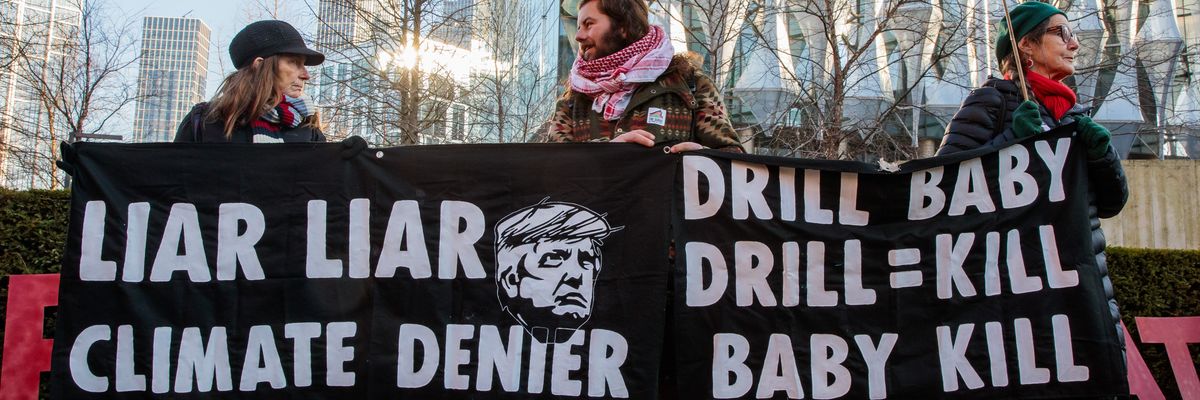
Climate activists gather outside the U.S. embassy just over a week before the inauguration of then-U.S. President-elect Donald Trump in solidarity with people on the frontline of the climate crisis and in protest against his policies based on climate denial on January, 11 2025 in London, United Kingdom.

(Photo: Mark Kerrison/In Pictures via Getty Images)

Ralph Nader
May 26, 2025
Common Dreams

The chronic lies of Der Führer Trump, hour by hour, day after day, are having deadly and costly impacts on the American people, with many more casualties in the pipeline of wreckage he and his henchman Elon Musk have wrought since January 20.

President Donald Trump’s lies, threats, and fake promises come from what dozens of psychologists who in 2017 perceived Trump as possessing an “unstable, dangerous personality.” Trump, a serial megalomaniac, announced recently: “I RUN THE COUNTRY AND THE WORLD.”

Confident that he can violate any law, any constitutional restraint, any international treaty, Dangerous Donald says he is “having fun,” flipping out one illegal executive order after another with cruel and vicious hammer blows against:Dedicated civil servants performing crucial tasks for Americans he has fired or replaced;
Recent immigrants, paying taxes and working essential jobs at low wages (harvesting our food, cleaning up after us, caring for our children and elderly, for example); and
Law enforcers and courts who worked to bring him to justice. The list of Trump’s wreckage is endless.

The torrent of Trumpian falsehoods have their own mass media—his own social media—and the mainstream media which still reports them out, including repeating his CAPITAL LETTERS, without giving his victims any right of reply, even when they are named. True, the mass media now tells us when some of his wild and crazy concoctions are “false” like his shameless false claim that a picture of graves was purportedly of slain white South African farmers.

But fact-checking doesn’t reach most of the people who receive Trump’s lies. For these people, his carve outs of reality are unrebutted. Unfathomably, reporters do not demand that he, Donald Trump, provide the evidence and the legal basis for his prevarications every single time they impact policy. Rarely, when they do, as in the case of Trump alleging widespread fraud by Social Security recipients, he backed off.

Mostly, however, starting with his endless assertion that he won the 2020 election “in a landslide,” eye-rolling reporters and editors don’t seem to see any point in routinely saying to him: “Prove it or admit you are mistaken.” In the vernacular—“put up or shut up.”

It doesn’t matter that Know-it-all Trump never admits any wrongdoing, any mistake, any failure, or any broken promises to his believing MAGA supporters. What matters is after a while, more and more people begin to see that he’s a fake, a delusionary con man and turn against him and proclaim “YOU’RE FIRED!”

For now, ensconced in the White House, Trump’s lies are no longer just words; they have deadly and costly effects and can soon produce calamitous consequences.

Here are some samples. Trump falsely dismisses with repeated disbelief the violent climate crises—notwithstanding record wildfires, floods, hurricanes, sea-level rise, and droughts. His response to these problems: Push to abolish FEMA, already firing thousands of staff. He is also dismissing scientists who study, document, and predict approaching climate disasters, from federal agencies, including the National Weather Service and the EPA, and cutting grants to scientific organizations and universities.

He continues to scoff at expert predictions of emerging pandemics, as he did in early 2020, mocking and dillydallying, while Covid-19 spread, resulting in hundreds of thousands of preventable deaths. His response to these perils: Strip-mine the Centers for Disease Control and Prevention and the National Institutes of Health expert staff and their grants to outside scientists.

He falsely asserts that overregulation of widespread corporate crookery is harming the economy and costing jobs. His response to these falsehoods: Close down agencies like the Consumer Financial Protection Bureau, firing regulators illegally, taking the federal cops off the corporate crime beat and, recently, just openly failing to enforce the law at all and dropping existing criminal cases against over 100 companies, including the Boeing crimes crashing two 737 Max aircraft.

He absurdly and cravenly asserts the super-rich and giant corporations are overtaxed. His response to this ridiculous allegation: Push through Congress super-rich tax cuts, ballooning the deficit, forcing cuts in Medicaid and even Medicare, afflicting people with disabilities, and closing many rural hospitals (See, New York Times: What’s in Trump’s Tax Bill?) He grotesquely describes this legislation as a “big, beautiful bill” even though it will cut critical feeding programs for poor children, severely weaken “Meals on Wheels,” “Head Start,” and federal food inspection programs.

Millions of people would lose health insurance and other life-saving and life-sustaining social safety nets. Savagely, Trump is increasing the bloated, wasteful military budget far beyond what the generals asked for and loading tens of billions of dollars onto the Department of Homeland Security to police a relatively quiet Southern Border and contract for more private prisons to hold immigrants or asylum seekers whom they round up.

If the Senate doesn’t throw out this House-passed bill (by one vote) and only tweaks it on its way to the enriching Trump and his bloody pen, consider this the beginning of the end for the Republican Party in the coming elections. For Trump is ruthlessly skewering both red and blue state voters and families, breaking contracts with small businesses, rescinding popular clean energy programs, reducing student loans, and roiling the stock markets holding the savings and pensions of tens of millions of conservative and liberal families. He is going berserk against the American people while shielding massive corporate crime and corporate welfare from law and order.

It would help this growing movement of street protests against Trump if, to take two institutions, banding together as labor unions and universities they stop cowering before the Tyrant and roar back with all their unused, formidable influence and members. Bully Donald has come a long way using intimidation to pick off his victims because they do not push back in an organized fashion.

Moreover, the feeble Democratic Party just doesn’t fire its corporate-conflicted consultants, and retire its serial losers controlling its leadership, which lost elections to the worst most vulnerable GOP in history. They should patriotically quit and welcome younger, progressive leaders, some already challenging corporate Democrats in the coming primaries, to take over and replace decay and despair with dynamism and dexterity. These challengers know they are in a race against time and have no time for the lumbering, bureaucratic, disarrayed entrenched Democratic apparatchiks to lose our Republic to a fascistic dictatorship wrecking our country at warp speed.

This younger generation should connect with older, seasoned progressive Democrats who for decades have been fighting for real reforms in our country and are eager to lend their experience and advice. They include former Labor Secretary Robert Reich, who in 2001 penned an op-ed in The Washington Post declaring “…The Democratic Party. It’s Dead.” Other stalwarts include Jim Hightower (Texas), Joel Rogers (Wisconsin), Robert Kuttner (Boston), Bishop William Barber (North Carolina), Joan Claybrook (D.C.), Mark Green, co-author with me of the book on Trump titled WRECKING AMERICA (2020), and many others.

These people and others (see winningamerica.net) do not have marbles in their mouths; they know how to communicate with people on forward directions supported by a megamajority of liberal and conservative voters. (See my 2014 book, Unstoppable: The Emerging Left-Right Alliance To Dismantle The Corporate State).
A New Phase of Trump Neofascism

No holds barred. Nothing out of bounds. Rapacious, racist, nativist, vindictive, corrupt.


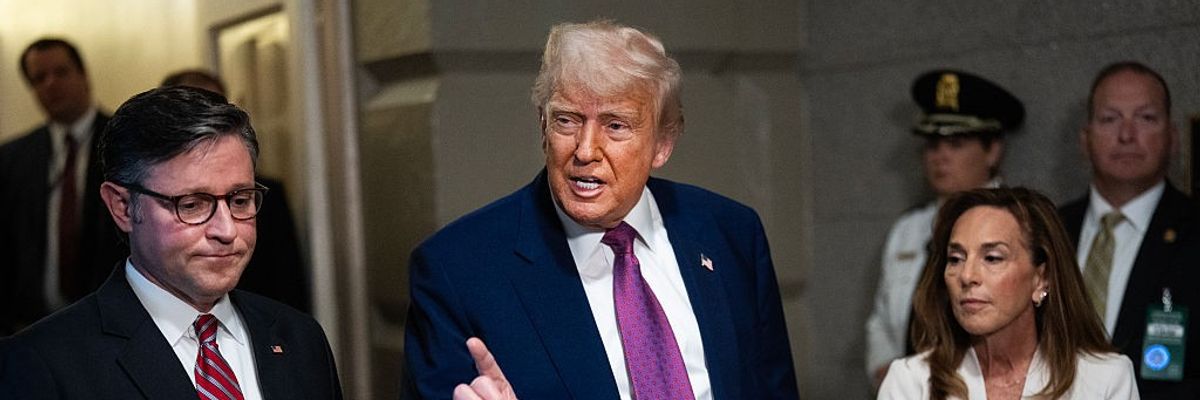
U.S. President Donald Trump, House Speaker Mike Johnson (R-La.), and House Republican Conference Chair Lisa McClain (R-Mich.) talk with reporters on May 20, 2025.
(Photo: Tom Williams/CQ-Roll Call, Inc. via Getty Images)

Robert Reich
May 25, 2025


Friends,

I thought I couldn’t be more shocked and sickened than I already was, but what’s happened this week is truly horrifying.

In the Oval Office, before cameras and journalists, Trump openly lied to the president of South Africa about alleged violence against white South Africans. The Trump regime has also granted refuge to white South Africans while continuing to bar or deport people of color who desperately need refuge.

The regime told Harvard it can no longer enroll foreign students and that its existing foreign students must transfer to another university or lose their legal status in the United States.

Trump auctioned off a personal dinner to foreigners who poured money into his own crypto business. He has also accepted Qatar’s gift of a $400 million “flying palace” (it’s also just for him — no other president in future years can use it).

At Trump’s insistence, House Republicans have passed a giant bill that would, if enacted, be the largest redistribution of income and wealth in American history — from the poor and working class to the rich and super-rich. The bill includes a poison pill that eliminates the power of courts to hold officials in contempt for disregarding court orders.

In recent days, according to Peter Baker, chief White House correspondent of The New York Times, Trump or his team have charged, investigated, or threatened with investigation New York Attorney General Letitia James, Andrew Cuomo, Kamala Harris, Bruce Springsteen, Beyonce, Bono, Oprah Winfrey, James Comey, unnamed “treasonous” Biden aides, the city of Chicago, and the Kennedy Center.

"The more Trump's tyranny is exposed, the stronger the resistance. The worse it gets, the larger the backlash."

Trump seems to have entered into a new and wilder stage of authoritarian neofascism. No holds barred. Nothing out of bounds. Rapacious, racist, nativist, vindictive, corrupt.

If you’re also horrified by all this, know that most other Americans are, too (if polls are to be believed).

Resistance is more important than ever.

I feel enormous gratitude to the judges who are trying to stop this. Most have shown themselves to be principled, steadfast, and courageous.

We should also be grateful to the public servants still in their jobs who are standing up to this.

And to everyone else who is pushing back.

Grateful to all communities that are protecting their residents and neighbors from Trump’s vicious dragnet.

Thankful to all the people fighting his attacks on Medicare and Medicaid. Teachers, public employees, workers, and grassroots groups fighting his attacks on the poor.

To the professors, administrators, and students joining together to fight his attacks on higher education.

Appreciative of all who are planning to protest on June 14. It’s Trump’s birthday, on which he’s trying to justify a huge military parade using the pretext of the 250th anniversary of the start of the Continental Army that fought against King George III.

On that day we will join together to tell the world and affirm for ourselves that we do not abide kings.

The more Trump’s tyranny is exposed, the stronger the resistance. The worse it gets, the larger the backlash. The crueler and more vicious his regime becomes, the more powerful the alliances being formed at every level of society to stop him.

We will sweep vulnerable Republican lawmakers out of office in 2026 or before.

We will support groups like the ACLU that are taking Trump to court.

We will spread the truth.

Tyrants cannot succeed where people refuse to submit to them. We will not submit. We will emerge from this stronger than we were before, and more committed to the common good.

Be safe. Be strong. Hug your loved ones.


© 2021 robertreich.substack.com


Robert Reich, is the Chancellor's Professor of Public Policy at the University of California, Berkeley, and a senior fellow at the Blum Center for Developing Economies. He served as secretary of labor in the Clinton administration, for which Time magazine named him one of the 10 most effective cabinet secretaries of the twentieth century. His book include: "Aftershock" (2011), "The Work of Nations" (1992), "Beyond Outrage" (2012) and, "Saving Capitalism" (2016). He is also a founding editor of The American Prospect magazine, former chairman of Common Cause, a member of the American Academy of Arts and Sciences, and co-creator of the award-winning documentary, "Inequality For All." Reich's newest book is "The Common Good" (2019). He's co-creator of the Netflix original documentary "Saving Capitalism," which is streaming now.
Full Bio >
Staring Down the Abyss of 2025: A Reprise

We should do our best to accept that we are confronting a major collapse of a way of living that we had taken for granted.


A protester wears a mask depicting U.S. President Donald Trump during a May Day Strong Coalition rally in Washington, D.C. on May 1, 2025.
(Photo: Brendan Smialowski/AFP via Getty Images)

Steve Kaagan
May 26, 2025
Common Dreams

In early January Common Dreams  published my forecast of consequential developments in 2025, ones that would affect the way we’re governed and how we live our lives day-to-day. Now that the year is nearing the halfway point, and in the spirit of Memorial Day, it is instructive to review the list, which included the following:
Democratic institutions will continue to crumble, with focus on the erosion of the rule of law in the U.S. and elsewhere;
Long-standing norms governing public affairs, such as a bar to prosecuting political opponents, will loosen their grip on behavior;
Countless species, especially among birds and insects, will go extinct;
“Unnatural” disasters attributable to climate change, like wildfires and floods, will devastate wondrous landscapes and settled communities;
Politically or environmentally induced mass migration, as experienced now in various parts of the world, will become more pervasive;
Income inequality between the top .01% and the lowest 50% will increase; and
economic stability, as in the historic world-wide acceptance of the U.S. Dollar, will wane.

I added the following as caveats to this grim list: uncertainties regarding the targets, timing, locales, extent of severity, and designation of victims.

Broadly speaking the forecast has been accurate. My purpose in conducting this initial review now, however, is not to gloat. Others may have been equally, if not more on target. Furthermore, most of what was predicted was in the wind before the year began. It would be useful at this point to reflect critically, focusing on the caveats noted above, and to address two important questions: “So what?” and “Now What?”

Most telling about what has happened to date in 2025 is the severity, acceleration, and chaos attending several of the enumerated elements, especially those relating to our form of governance and our economic well-being. Even more tragic than the qualifiers just noted is the countless number of innocent victims that have been swept up through indiscriminate governmental action. While the current administration in this country has led the way against those whose main “infraction” has been to exercise their right of free speech, allies like Israel have taken to maiming, starving, and murdering an entire people.

Yes, we should be prepared in the months ahead for even greater severity, continuing acceleration, and unbridled chaos. We should also expect that there will be more victims whose rights are trampled, or lives impaired or destroyed. The strategy of the administration is clear: Do as much as one can as fast as one can, causing as much pandemonium as possible.

So what and now what? What are the implications for those of us who seek to contain a wildfire threatening our political, social, cultural, and economic base? As many others have argued, a more radical, broad-based and well-coordinated disaster relief effort is warranted, involving all those who seek to perpetuate our constitutional republic. “All” here includes notables, leaders of major institutions—judicial, educational, occupational, journalistic, bolstered by millions of ordinary citizens of all ages and backgrounds. This wildfire is barely 5% contained, having engulfed our public life. The stakes are the upholding of a political framework grounded in a set of moral values that has remained largely intact for 250 years.

At the same time, it is important to recognize that individual minds and hearts—yours and mine—are deeply affected by this wildfire. We have been the beneficiaries of this experiment in nationhood, and we are on the verge of becoming its victims. What shall we do with our AMs and PMs beyond joining the “bucket brigade” of mass resistance? What mindset and emotional posture might sustain us going forward?

First and foremost, we must do what we can to quell our fears about the rampant destruction taking place, destruction that is well beyond our control as individuals. Fear breeds a turning inward, a defensive grasping for a way of being that will no longer be available to us. Things will never return to the state they were in before the wildfire broke out. It is better to accept that a large-scale transformation is afoot, one that beckons a personal transformation that we have the capacity to shape.

Essential for countering fear are an ongoing attachment to individual right action, compassionate outreach to others, bearing witness to what is happening around us through conversation or writing, and blessing moral action by others. We can endeavor to heal relationships, both familial and neighborly, and we can seek joy in the most intrinsic pleasures.

Much of what unfolds in the years ahead will cause us to grieve. We should do our best to accept that we are confronting a major collapse of a way of living that we had taken for granted. In place of denial and nostalgia, let’s look for opportunities amid inevitable personal transformation—for durable hope, serendipitous grace, the beauty of human kindness, and the practice of compassion.

Our work is licensed under Creative Commons (CC BY-NC-ND 3.0). Feel free to republish and share widely.

Steve Kaagan is an octogenarian, writer, wooden whale craftsman, teacher, and consultant.
Full Bio >


'Direct Attack on Freedom of the Press': Hegseth Cracks Down on Journalists Covering Pentagon

One journalist said he is "angry and frustrated—but not surprised—that MAGA propaganda-loving conspiracy theorists like SecDef Hegseth and his team have dropped this JDAM-sized attack on the press."


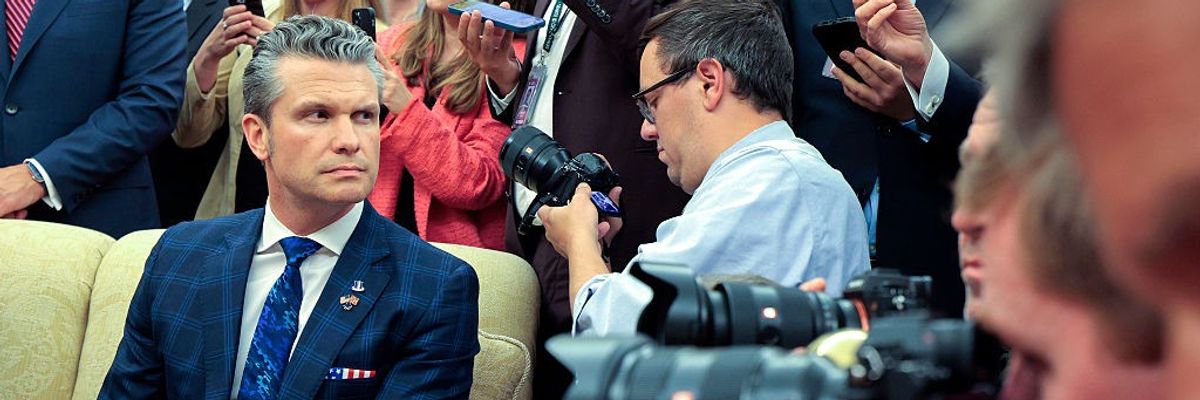
U.S. Secretary of Defense Pete Hegseth attends an Oval Office meeting on April 24, 2025 in Washington, D.C.
(Photo: Chip Somodevilla/Getty Images)


Jake Johnson
May 24, 2025
COMMON DREAMS

U.S. Defense Secretary Pete Hegseth, who has pledged to do his part in making the Trump administration the most transparent in history, issued a memo Friday imposing tight restrictions on reporters' movements at the Pentagon in an apparent bid to crack down on leaks.

Under the new policy, which takes effect immediately, journalists are prohibited from entering many locations across the Pentagon building unless they're accompanied by Trump administration personnel—restrictions that Hegseth claims are necessary to protect national security.

"If press require access to other areas/offices within the Pentagon for 'in-person' interviews (or other engagements), they are required to be formally escorted to and from those respective offices by authorized DoD personnel from those specific offices/Agencies/Military Departments," Hegseth's two-page memo states.

Reporters covering the Pentagon will also be "required to complete an updated in-briefing form explaining their responsibilities to protect" classified and "sensitive" information.

"Failure by any member of the resident or visiting press to comply with these control measures will result in further restrictions and possibly revocation of press credentials," reads the memo.

"The Pentagon is making it harder for journalists to do their jobs and easier for power to go unchecked."

The restrictions come in the wake of several scandals that have personally implicated Hegseth, including the revelation that he used a private group chat that included members of his family and his personal attorney to discuss plans for a U.S. attack on Yemen. They also come amid a broader Trump administration assault on press freedom.

The Pentagon Press Association (PPA), which represents journalists covering the U.S. military, said in a statement that Hegseth's memo "appears to be a direct attack on the freedom of the press and America's right to know what the military is doing."

Kevin Baron, a founding officer of the PPA, said he is "angry and frustrated—but not surprised—that MAGA propaganda-loving conspiracy theorists like SecDef Hegseth and his team have dropped this JDAM-sized attack on the press."

"It's un-American," Baron added. "It's dangerous."

National Press Club president Mike Balsamo echoed the PPA's criticism of the new policy, which he said represents a "stark departure from longstanding norms that balanced operational security with meaningful press access."

"By blocking access to common areas, restricting movement without escorts, and complicating basic reporting functions," said Balsamo, "the Pentagon is making it harder for journalists to do their jobs and easier for power to go unchecked."

Hegseth announced the press policy changes as the U.S. military is poised to receive a $1 trillion budget for the coming fiscal year despite mountains of evidence of waste, fraud, and abuse of taxpayer dollars to line the pockets of military contractors. Late last year, the Pentagon failed its seventh consecutive audit.

The American military is involved in conflicts around the world, and the Trump administration—with Hegseth's vocal support—has eased restrictions on U.S. airstrikes and raids outside of "conventional war zones."
War No More: Veterans Reflect on the Meaning of Memorial Day


This Memorial Day, let us honor the memory of the dead by pledging to protect our precious planet, its people, and its environment.


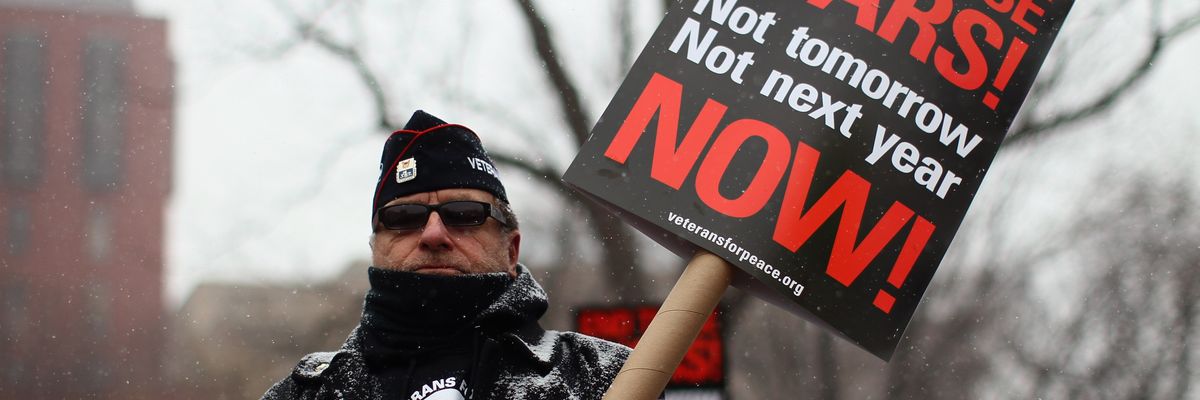
Dave Hancock, a veteran from the war in Vietnam, participates in an anti-war protest in front of the White House December 16, 2010 in Washington, D.C.
(Photo: Win McNamee/Getty Images)

Gerry Condon
May 26, 2025
Common Dreams

This Memorial Day weekend, Veterans For Peace is calling on its members and friends to reflect on the gravity of the day, whose official purpose is to “honor all those who died in service to the U.S. during peacetime and war.” Veterans For Peace chooses to honor ALL who have died in wars, both combatants and civilians. Our hope is that a sober accounting of the casualties of war will mitigate against the tendency to turn Memorial Day—like Veterans Day—into a patriotic celebration of U.S. militarism.

We remember the words of President Dwight Eisenhower, who during World War II, was the supreme commander of the Allied Expeditionary Forces in Europe:
“War is a grim, cruel business, a business justified only as a means of sustaining the forces of good against those of evil.” He also famously stated, “I hate war as only a soldier who has lived it can, only as one who has seen its brutality, its futility, its stupidity.”

Medal of Honor winner Marine Corps General Smedley Butler took it a bit further:
War is a racket. It always has been. It is possibly the oldest, easily the most profitable, surely the most vicious. It is the only one international in scope. It is the only one in which the profits are reckoned in dollars and the loss of lives.

Veterans For Peace is deeply familiar with the pain that emanates from the loss of those lives. We have lost too many friends in wars in foreign lands, and in their aftermath at home due to suicide and service-related diseases. We have spent countless hours with Gold Star families mourning the loss of their loved ones. We also recognize that the “enemy” killed by our bullets and bombs had family and friends who loved them too. Their pain is no different than ours.

Brown University’s Costs of War Project estimates that over 7,000 U.S. service members have died in the wars following 9/11. Perhaps even more disturbing is the fact that more than 8,000 U.S. “contractors” have lost their lives in these conflicts. These hidden deaths reflect the U.S. government’s deception regarding these wars and its disregard for those who perish in them.

The more than 15,000 deaths mentioned above do not account for over 6,000 veterans who died by suicide each yearbetween 2001 and 2022, totaling more than 145,000 people, as documented by the nonprofit Stop Soldier Suicide. Veterans face a 58% higher risk of suicide than non-veterans. While military contractors experience many of the same mental health challenges as veterans, reliable suicide and mental health statistics are not available.

We must help to build a peaceful world based on mutual respect for the human rights of all, as well as for the rights of nature.

Civilian casualties are much greater. We must acknowledge that in modern warfare, it is civilians who make up the bulk of the dead and wounded. The number of civilians killed by the violence in the post-9/11 wars is staggering. Brown University estimates the low end of opposition deaths at 288,923 and civilian deaths at 408,749. The total number of direct violence-related deaths is estimated to be 905,000 people. And even more people die after the wars ends.

A May 2023 Brown University study estimated that there are 3.6 to 3.8 million indirect deaths, with a total death toll of 4.5 to 4.7 million people in post-9/11 war zones. As we mark 50 years since the end of the U.S. war in Vietnam, we will not forget that 3 million Vietnamese died in that unjust and unnecessary war, most of them civilians.

Endless war and suffering persists today, with tens of thousands dying in conflicts that are fueled by U.S.-supplied arms and “intelligence.” The U.S. was an instigator of the terrible war in Ukraine, where hundreds of thousands of young soldiers have perished. The U.S. continues to provide bombs and political cover for the unspeakable genocide in Gaza, where estimates of civilian death range from 50,000 to over 100,000, with an even greater number of life-altering wounds. A generation of young Palestinian amputees and double and triple amputees will be a sober reminder to the world for years to come.

Another victim of war is the U.S. economy, which is greatly distorted by the ever-ballooning military budget, now proposed to reach One Trillion Dollars ($1,000,000,000,000) a year, even as essential social programs vital to poor and working class families are being gutted.

The “modernization” of nuclear weapons is included in the budgets of both the Department of Defense and the Department of Energy, totaling an estimated $946 billion over the next decade, and harkening a no-holds-barred era that could too easily lead to a nuclear war. Eighty years after the U.S. dropped nuclear bombs on the civilian populations of Hiroshima and Nagasaki, it is high time to put an to end to war before it puts an end to human civilization. War must be universally deemed obsolete, illegal, and unacceptable.

Wars will not end, however—and nuclear war will not be averted—unless there is a sea change in the thinking of the U.S. people and our political leaders. We must abandon the military doctrine of seeking “full spectrum dominance” in every corner of the globe. We must embrace the emerging multipolar world and take our place as one nation among many. We must help to build a peaceful world based on mutual respect for the human rights of all, as well as for the rights of nature. As the Vietnam-era poster reads, “War is not good for children or other living things.”

This Memorial Day, let us honor the memory of the dead by pledging to protect our precious planet, its people and its environment. Rather than exalting war, we must come together to abolish war once and for all.


Our work is licensed under Creative Commons (CC BY-NC-ND 3.0). Feel free to republish and share widely.


Michael T. Mcphearson
Michael T. McPhearson is the executive director of Veterans For Peace, and was a U.S. Army field artillery officer during the Gulf War. A prominent peace and racial justice advocate, McPhearson co-founded the Don’t Shoot Coalition in Ferguson, Missouri following the 2014 killing of Michael Brown Jr. and serves on the board of the ACLU of Washington.
Full Bio >

Gerry Condon
Gerry Condon is a Vietnam-era veteran and former president of Veterans For Peace.
Full Bio >


Rio Grande LNG Expansion: a Lose-Lose Proposition

The project jeopardizes the health and environment of frontline communities, threatens local economies and endangered wildlife, and exposes investors to financial and reputational risks.


A woman takes part in a protest against fracked gas exports at Skadden, Arps, Slate Meagher, & Flom LLP on June 15, 2022 in New York, United States.
(Photo: John Smith/VIEWpress)

Ryan Leitner
May 26, 2025
Common Dreams

In its 2024 fourth quarter update, NextDecade, a Houston-based liquefied natural gas company, announced its intention to more than double its export capacity at the Rio Grande LNG facility near Brownsville, Texas. Despite NextDecade’s sunny projections, community members and investors in the project’s owner, Global Infrastructure Partners, and its parent company, BlackRock, should be wary of risks associated with the LNG facility. The proposed expansion could further harm local communities, the region, and pose significant risks to investors.

LNG is primarily composed of methane, a potent greenhouse gas with 80 times the atmospheric warming potential of carbon dioxide over a 20-year period. As originally proposed, this project was estimated to emit the equivalent emissions of 44 coal power plants every year, about 163 million tons of carbon dioxide annually. The newly announced expansion would be projected to emit over 300 million tons of carbon dioxide equivalent every year, or the equivalent of the emissions from 83 coal plants annually.

Perhaps in an effort to address criticism about emissions, NextDecade’s original proposal included carbon capture and storage (CCS), though some opponents described this as greenwashing from the beginning. The company withdrew its CCS application with the Federal Energy Regulatory Commission (FERC) in August 2024, yet continues to tout sustainability on its website.

The path forward demands a just transition to clean energy that respects both people and the planet.

The Rio Grande LNG facility sits in a region already burdened by economic hardship and environmental injustice. Its expansion will amplify air pollution, exposing local residents—many of whom are Latino and low-income—to increased risks of respiratory illnesses, cancer, and other serious health conditions.

Several nearby towns and entities formally oppose the project, including Laguna Vista, South Padre Island, Port Isabel, and the Laguna Madre Water District. The Rio Grande LNG terminal is being built on the sacred land of the Carrizo/Comecrudo Tribe of Texas, yet Rio Grande LNG, regulatory agencies, and banks have failed to consult with that Tribe on its impacts.

Additionally, according to an environmental report,, the facilities will likely significantly degrade local fishing, shrimping, and natural tourism industries, putting communities’ livelihoods at risk. The project also threatens critical wetlands adjacent to the Laguna Atascosa National Wildlife Refuge, which protects endangered species such as the ocelot and Kemp’s Ridley sea turtle. The noise, light, and industrial activity will disrupt fragile ecosystems and threaten biodiversity. The opposition shines a light on the environmental risks inherent in this project.

Rio Grande LNG has faced significant challenges, including pending approval and permitting of the project from the Federal Energy Regulatory Commission. Some banks and insurance companies have wavered in their support. Long before the expansion announcement, insurance company CHUBB backed out of the project. Societe Generale, BNP Paribas, and La Banque Postale have also pulled financial support from the project in the last several years.

For investors, this means escalating risks: construction delays, legal battles, potentially stranded assets, and the threat of diminished returns. Continuing to pour capital into this project is not just environmentally irresponsible—it is financially imprudent.

The global energy market is also shifting rapidly. Ongoing trade wars and on-and-off-again tariffs could make it difficult for Rio Grande LNG to meet its Final Investment Decision, the last fundraising hurdle a project like this must clear before beginning a new stage of construction. At the same time, LNG demand is projected to peak before 2030, and an oversupply threatens to depress prices. And the methane emissions from LNG production undermine the climate benefits often touted by proponents.

The Rio Grande LNG expansion is a lose-lose proposition. It jeopardizes the health and environment of frontline communities, threatens local economies and endangered wildlife, and exposes investors to financial and reputational risks. The path forward demands a just transition to clean energy that respects both people and the planet.

Investors in Global Infrastructure Partners and its parent company BlackRock can limit the harms associated with this project. Potential investors with each company should decline to invest in the expansion of the Rio Grande LNG terminal for the sake of local residents, the region’s economy, and returns on investments.


Our work is licensed under Creative Commons (CC BY-NC-ND 3.0). Feel free to republish and share widely.


Ryan Leitner is a senior research and campaign coordinator for climate with the Private Equity Stakeholder Project
Full Bio >

A Dead World, Plastic-Wrapped to Preserve Freshness

If people who try to steer clear of plastics are still thoroughly enmeshed in them, what does that say for everyone else? And how worried should we all be?


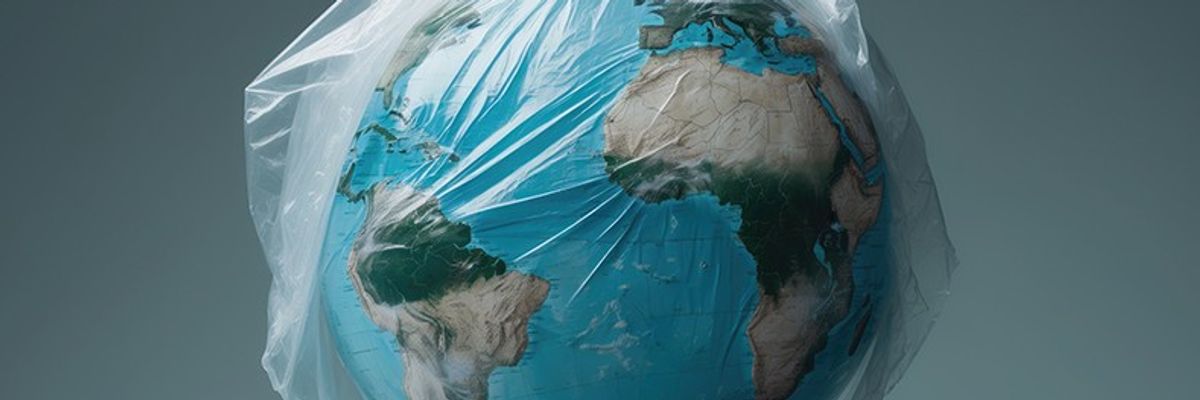
A globe is covered in plastic wrap.
(Photo: Adobe Stock)


LONG READ


Richard Heinberg
May 26, 2025
Common Dreams

In the classic 1967 film The Graduate, a family friend of lead character Benjamin Braddock (played by Dustin Hoffman) offers him career advice: “One word. Plastics!”


I was 16 when The Graduate was released, and, like Hoffman’s character, completely uninterested in plastics as a career option. But here we are nearly six decades later, and I must admit that, from a purely economic standpoint, Benjamin Braddock received a smart tip.

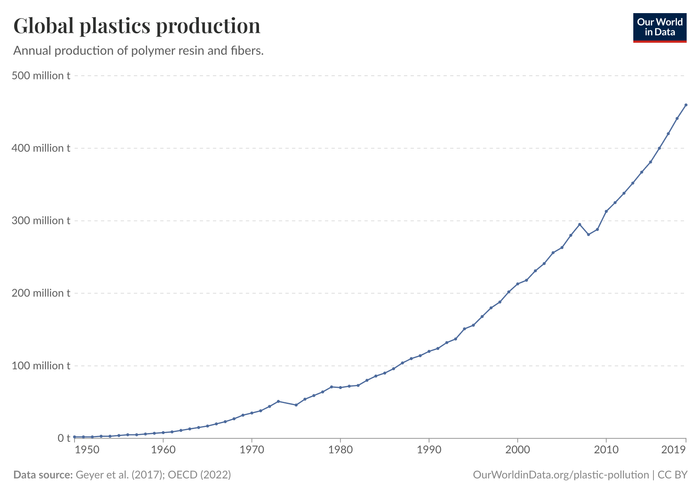
World plastics production exploded over the intervening decades, from about 25 million metric tons in 1967 to roughly 450 million in 2024. The stock prices of plastics manufacturers soared as the industry expanded, capitalizing on research into new kinds of (and ways of using) synthetic, polymer-based materials. Seemingly endless varieties of vinyl, polystyrene, acrylic, and polyurethane could be extruded, injection-molded, pressed, or spun into a blizzard of products with a stunning array of desirable properties—including durability, disposability, flexibility, hardness, insulative properties, heat resistance, and tensile strength. Plastic was cheap and it could take on any shape or color. It was a magic material that could do almost anything. Soon it was everywhere: in toys, packaging, fabrics, paints, building supplies, medical devices, car interiors, electronics, and more.


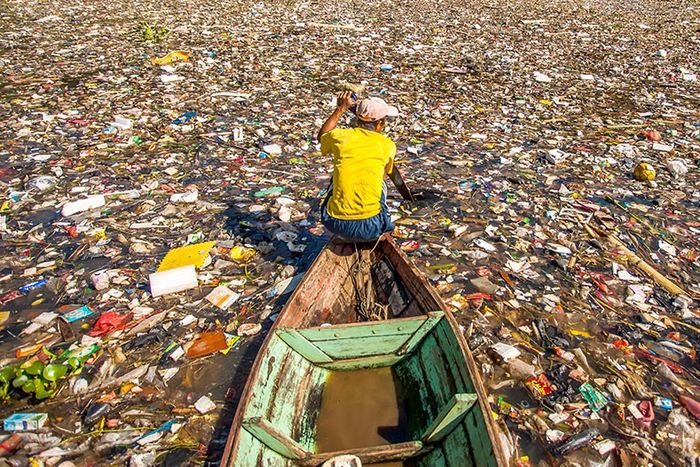
The chemical stability of plastics meant that, as objects made of it were eventually discarded, shards and particles would make their way into the natural environment and persist there. Today, traces of plastic can be found everywhere on our planet—in rivers, the air, Arctic snow, at the tops of mountains and bottoms of seas, in plants and soil, and in the bodies of animals from insects to humans.

If fossil fuels enabled the modern age by providing the energy for industrial expansion, they also radically altered the materials that both support and imperil human life. Most plastics are made from fossil fuels, and, like it or not, we now live in an age of oil and plastic. Since fossil fuels are finite, depleting resources, this age will necessarily be brief in geologic terms. If there are future geologists and archaeologists, they will easily identify strata from our fleeting era by evidence of the rapid growth (and decline) of human numbers and their environmental impact, and by durable materials we have left behind—many of which will be plastics.

In this article, we’ll explore plastic’s impacts on humans and nature. And I’ll indulge in a little speculation on the world after plastic.


Humans: Swimming in Plastic


My wife Janet and I have been concerned about plastic pollution for years. We keep food in glass containers, and we use fabric shopping bags. And yet, looking around our house, I see plastic everywhere. The keyboard on which I type this article is plastic. So is the computer monitor in front of me. Even the cloth shopping bags we use (to avoid single-use polyethylene bags) have plastic as a fabric component and are sewn with nylon thread. If people who try to steer clear of plastics are still thoroughly enmeshed in them, what does that say for everyone else? And how worried should we all be?

Scientific data on the human health impacts of environmental plastic, and especially microplastics, has burgeoned in recent years. We eat microplastics, inhale them, and absorb them through our skin. They can impair respiratory and cardiovascular health and disrupt the normal functioning of digestive systems. Studies have shown that microplastics can induce persistent oxidative stress, inflammation, and DNA damage, and are implicated in chronic diseases like cancer.

One potentially existential impact, explored in Shanna Swan’s book Count Down (and my recent article on the subject) is the impact of plastics and other chemicals on sperm counts and women’s reproductive health. Men’s average sperm counts have declined by over half in the last 50 years. During the same period, estrogen-mimicking synthetic chemicals (including plastics) have proliferated in the environment. Correlation does not prove causation, but research has shown clear pathways by which plastics-related chemicals disrupt reproductive cells and systems. One of the most widespread disruptors of sperm cells is a group of chemicals called phthalates, which we absorb from plastic food packaging. Phthalates are easily measured in urine, and elevated levels typically follow the consumption of plastic-packaged cheese.

Often there simply is no option for receiving the health benefit of supplements, organic foods, medical care, and medicines without a concomitant exposure to health-compromising plastics.

Here's another correlation in which causation is implicated, though in this case still unproven: As sperm counts are declining, so are population growth rates, with global human population set to shrink in the decades ahead (many countries are seeing plummeting fertility rates, while others are still adding population rapidly). While some environmentalists are breathing a sigh of relief, since fewer people could translate to reduced pollution and resource depletion, growthist commentators see population shrinkage as a crisis requiring heroic pushback; hence the recent rise of pronatalism in many nations. Falling birthrates are usually ascribed to families delaying childbirth for economic reasons, but the reproductive impacts of chemical pollution cannot be ruled out as a contributing cause. In a recent article, chemistry professor Ugo Bardi argues that the link between plastics and plummeting fertility is real, and that the result will be, in the best case, a shrinking and aging population; in the worst case, extinction.

Just as frightening as losing the ability to reproduce is losing the ability to think. Recent studies have documented the presence of microplastics in the human brain. Of even greater concern is the finding that the brains of dementia patients tend to contain more plastic particles than others. Are plastics a cause of dementia? We don’t know yet.

Trying personally to avoid the dangers of plastics invites irony and contradiction. An example that springs to mind is the food supplements industry. Its products appeal to consumers who seek “natural” health benefits from vitamins and other micronutrients. Yet most of the health-promoting pills, powders, and potions that consumers take are delivered in plastic bottles; even glass bottles are often shrink-wrapped. Much the same could be said for pharmaceuticals: Most are plastic packaged. Similarly, the food industry, including its health-food segment, relies on sanitation and food preservation typically entailing plastics. Often there simply is no option for receiving the health benefit of supplements, organic foods, medical care, and medicines without a concomitant exposure to health-compromising plastics.

Nature: Shrink Wrapped


(Photo: Adobe Stock)

If the negative impacts of plastic affected only humans, it might be possible (though callous) to say that our overly clever species is just reaping its just deserts. However, those impacts are falling on other creatures as well, and on whole ecosystems. As a result, our entire planet is being transformed—and not in a good way.

Let’s start with water. As Jeremy Rifkin argues in Planet Aqua: Rethinking Our Home in the Universe, life is all about water. Unsurprisingly, plastic pollution is typically swept via storm drains into streams, rivers, and lakes, which supply drinking water for local communities.

Rivers then carry plastic particles (as well as plastic bags, toys, and other larger objects) into the oceans—which provide the world with food and oxygen, regulate the global climate, and are home to between 50 and 80% of all life on Earth. Intact plastic objects, such as single-use shopping bags, may entangle, or clog the digestive systems of, animals such as fish, whales, and sea turtles, in some cases causing them to die of malnutrition. Gradually, the churning of ocean waters breaks these objects down into smaller and smaller particles, which even more marine creatures ingest. Ocean plastics also impact the overall health and function of marine ecosystems by altering habitats, such as by changing the physical structure of coral reefs and seagrass beds. A widely cited 2016 report by the World Economic Forum estimated that by mid-century, plastics in the world’s oceans will outweigh all the remaining fish.

They don’t just harm the humans who have unleashed them. They impact all of life.

Microplastics are dispersed not just in water, but also in the atmosphere. In an urban environment, humans may be exposed to as many as 5,700 microplastic particles per cubic meter of air, and each of us may be inhaling up to 22,000,000 micro- and nanoplastics (i.e., particles less than a micron in size) annually. The human health impacts of airborne plastics are increasingly being documented; however, atmospheric micro- and nanoplastics likewise affect other creatures. They even change the weather by promoting cloud formation, thereby increasing rain- and snowfall.

From water and air, plastics pass into the soil. Also, plastics enter farm soils by deliberate human action—in processed sewage sludge used for fertilizer, in plastic mulches, and in slow-release fertilizers and protective seed coatings. Some estimates suggest that, altogether, more plastics end up in soils than in the oceans. Studies have shown that microplastics alter soil bulk density, microbial communities, and water-holding capacity.

From water, air, and soil, plants take up micro- and nanoplastics. Research suggests that microplastics generally have a negative effect on plant development, affecting both seed germination and root or shoot growth, depending on environmental conditions, plant species, and plastic concentration.

From water, air, soil, and plants, microplastics enter the bodies of humans and other animals. We’ve already noted impacts on human reproductive health. Similar impacts on hormones and sperm have been observed in wild mink in Canada and Sweden, alligators in Florida, crustaceans in the U.K., and in fish downstream from wastewater treatment plants around the world.

The environmental impact of plastics is complicated and often indirect, as plastics collect and spread other pollutants. While some plastics are themselves relatively inert, they accumulate other chemicals on their surface—including persistent organic pollutants (POPs), heavy metals, and antibiotics—and serve as dispersal vectors, thereby leading to an overall increase of toxicity and bioaccumulation in the environment.

In short, plastic particles are now systemically present worldwide. While it may be possible to remove large plastic objects from oceans, rivers, creeks, or shorelines, microplastics can’t be cleaned up at scale by any means currently widely deployed. They are part of the biosphere and are changing the way nature functions. They don’t just harm the humans who have unleashed them. They impact all of life.
The World After Plastics

Many folks’ first response upon learning of the dire impacts of plastics pollution is to explore alternative materials. Prior to the plastics revolution, people used objects made of wood, stone, metal, clay, glass, animal skin or bone, and plant fibers. In many instances we could revert to those materials, though often with a sacrifice of affordability or durability. Researchers are finding ways to increase desirable qualities in traditional materials; for example, one company promises to produce wood stronger than steel.

Bioplastics have been around for nearly two centuries in the form of the celluloid once used by the early motion picture industry and fountain pen manufacturers. However, because they often lack the durability of petro-plastic, bioplastics’ main current usage is largely confined to disposable cutlery and plates, and biodegradable supermarket produce bags. Ongoing research will likely expand the range and usefulness of bioplastic materials.

Plastics recycling has been explored since the 1980s; still, after nearly a half-century, most recycling facilities reject the great majority of plastic items that make it into recycle bins (most items go directly into trash bins and hence to landfills that leach toxics). There is research underway by plastics manufacturers to make their products more recyclable, but those efforts are in their infancy.

Even though it’s hard to avoid plastics, make your best effort.

Perhaps the best hopes for cleaning up some of the plastics already choking our environment lie with bioremediation processes using bacteria and mushrooms. Small-scale trials, using a variety of species, show promising results for removing plastics from water and soil, though the atmosphere will pose a bigger challenge.

The transition to alternative materials, the development of more useful bioplastics, the growth of plastics recycling, and plastics bioremediation all confront two formidable obstacles—scale and speed. Currently, the scale of these solutions is too small, and their rate of adoption is too slow to make much of a difference. That is unlikely to change without government regulations to discourage the use of current plastics along with subsidies to promote alternatives and cleanup efforts. Such post-plastic regulations and subsidies might be seen as one of the Big Solutions needed (along with the global energy transition from fossil fuels to renewables, intended to slow climate change) to keep the current global polycrisis from descending into an unstoppable Great Unraveling. But, with the advent of the second Trump administration, Big Solutions are no longer a priority for the world’s economic, military, and cultural superpower. Indeed, the Trump administration is overturning efforts to rein in a range of harmful chemicals and has thrown climate action into reverse gear. Without U.S. leadership, campaigns to forge global solution treaties will probably be stymied.

So, it is unlikely that government policy will halt the global proliferation of plastics and plastic pollution. In contrast, resource depletion, spasmodic economic and financial contraction, deglobalization, and war are more likely to be limiting factors.

Sadly, however, by the time falling rates of fossil fuel extraction close the spigot on world plastics production, we will be living in a world even more contaminated with plastics. And those plastics will continue to break down into ever smaller bits. They won’t fully decompose into harmless molecules for a very long time, if ever. While plastics are expected to last decades or centuries, one expert argues they may never really go away.

Even after the end of the age of plastics, its wake of destruction will persist. In the worst instance, if sperm counts continue to plummet, higher life could mostly disappear, at least for a few million years. Eventually, evolution will probably find a way to work around microplastics and the other hazards that humanity has generated in just the past century or two. But our species may not be part of that workaround.

What can any of us do in the face of this profound dilemma? First, treat plastics and toxics proliferation as the existential crisis it is. Educate others: Share this article with friends and sign up for the free live PCI online event, “Troubled Waters: How Microplastics are Impacting Our Oceans and Our Health.” Contact your elected representatives. Although President Donald Trump has embraced the fossil fuel industry, and federal health agencies are undertaking worrisome actions, there could be opportunities to raise the issue of plastics—many of which are produced outside the U.S.—with folks in the MAGA and MAHA worlds.
Second, take the crisis personally. Even though it’s hard to avoid plastics, make your best effort. There are multiple products, websites, and influencers to help you reduce your personal plastic consumption.

Third, make plastics reduction and cleanup a focus of community action. Spend an hour each week picking up plastic garbage in your local creek. Bonus points if you get some friends and neighbors to help. It may seem like a paltry response in the face of the enormity of the threat, but it’s certainly better than nothing. You’ll feel more engaged, less victimized. Maybe the exercise you get will improve your brain function and you’ll be able to think of even more and better ways to defeat the plasticization of our planet and our future.

Note: This is one of the most depressing articles I’ve ever written. Near the beginning of the article, I shared how my wife and I try (mostly unsuccessfully) to avoid plastic. I went on to build the case that humanity is toying with life on Earth, all for short-term profit and convenience. That’s truly dispiriting. I concluded with some ideas for de-plasticizing. I hope you’ll run with some of these ideas, and I just want to say that I intend to take my own advice and double down on my efforts to eliminate plastic from the scene.


Our work is licensed under Creative Commons (CC BY-NC-ND 3.0). Feel free to republish and share widely.


Richard Heinberg
Richard Heinberg is a senior fellow at the Post Carbon Institute and the author of fourteen books, including his most recent: "Power: Limits and Prospects for Human Survival" (2021). Previous books include: "Our Renewable Future: Laying the Path for One Hundred Percent Clean Energy" (2016), "Afterburn: Society Beyond Fossil Fuels" (2015), and "Peak Everything: Waking Up to the Century of Declines" (2010).
Full Bio >
'Could Amount to a Bribe': Group Threatens Lawsuit If Paramount Caves to Trump

"Corporations that own news outlets should not be in the business of settling baseless lawsuits that clearly violate the First Amendment and put other media outlets at risk."


Shari Redstone attends an event on September 18, 2024 in New York City.
(Photo: Bryan Bedder/Getty Images for Paramount+)

Jake Johnson
May 24, 2025
COMMON DREAMS

If Paramount Global, the parent company of CBS News, settles a $20 billion lawsuit brought by U.S. President Donald Trump, it could face another lawsuit from a leading press freedom organization.

The Freedom of the Press Foundation (FPF), a Paramount shareholder, notified company executives in a letter on Friday that a settlement with Trump "could amount to a bribe" to the president and his administration "for their approving and not impeding" a merger of Paramount and the entertainment company Skydance.

FPF addressed its letter to Shari Redstone, Paramount's controlling shareholder. In recent weeks, Redstone—who stands to profit from federal approval of the merger—has come under fire for advocating a settlement with Trump and keeping tabs on CBS coverage of the president, who claims the outlet deceptively edited an interview it conducted with Kamala Harris ahead of the 2024 election.

Paramount's leadership has reportedly discussed settling the Trump lawsuit for up to $20 million. Redstone has privately pushed for a settlement in hopes that it will "clear the way for the merger's approval," The Wall Street Journalreported last month.

"I am writing to demand that you institute an immediate litigation hold, as FPF plans to file a shareholder derivative lawsuit on behalf of Paramount in the event of a settlement by Paramount," wrote Seth Stern, FPF's director of advocacy. "We expect that other long-term shareholders will join the suit."

FPF notes that a derivative lawsuit "is a procedure that allows shareholders of a company to recover damages incurred due to impropriety by executives and directors."

"Any damages award would go to Paramount, not FPF," the group added.


The lawsuit warning comes after a trio of U.S. senators cautioned that Paramount "may be engaging in potentially illegal conduct" by pursuing a settlement with Trump in exchange for approval of the Skydance merger.

"Paramount appears to be attempting to appease the administration in order to secure merger approval," wrote Sens. Elizabeth Warren (D-Mass.), Bernie Sanders (I-Vt.), and Ron Wyden (D-Ore.) in a May 19 letter to Redstone.

Internally, Paramount executives have acknowledged that settling the Trump suit "could expose directors and officers to liability in potential future shareholder litigation or criminal charges for bribing a public official," the Journalreported in February.

In a statement on Friday, Stern said that "corporations that own news outlets should not be in the business of settling baseless lawsuits that clearly violate the First Amendment and put other media outlets at risk."

"A settlement of Trump's meritless lawsuit may well be a thinly veiled effort to launder bribes through the court system," said Stern. "Not only would it tank CBS's reputation but, as three U.S. senators recently explained, it could put Paramount executives at risk of breaking the law."

"Our mission as a press freedom organization is to defend the rights of journalists and the public, not the financial interests of corporate higher-ups who turn their backs on them. When you run a news organization, you have the responsibility to protect First Amendment rights, not abandon them to line your own pockets," Stern added. "We hope Paramount will reconsider the dangerous path it appears to be contemplating but, if not, we are prepared to pursue our rights as shareholders. And we hope other Paramount shareholders will join us."
WAR CRIME
Israeli Officer Says 'Nearly Every' IDF Platoon Has Used Palestinians as Human Shields in Gaza

"These are not isolated accounts; they point to a systemic failure and a horrifying moral collapse," said the executive director of Breaking the Silence.


People watch as smoke billows following an Israeli strike in Jabalia, Gaza on May 25, 2025.
(Photo: Bashar Taleb/AFP via Getty Images)


Jake Johnson
May 25, 2025
COMMON DREAMS


Israeli soldiers have "systematically" used Palestinians as human shields during the 19-month assault on the Gaza Strip, The Associated Press reported Saturday, citing Palestinian civilians and members of the Israel Defense Forces who described engaging in the practice that is banned under international humanitarian law.

"Orders often came from the top, and at times nearly every platoon used a Palestinian to clear locations," APreported, citing the account of an unnamed Israeli officer.

One Palestinian man, Ayman Abu Hamadan, said Israeli soldiers dressed him in army fatigues, attached a camera to his forehead, and forced him to enter homes to ensure they were clear of bombs and militants. Abu Hamadan said he was passed from unit to unit for over two weeks.

"Soldiers stood behind him and, once it was clear, entered the buildings to damage or destroy them, he said," AP reported. "He spent each night bound in a dark room, only to wake up and do it again."

Nadav Weiman, executive director of Breaking the Silence—an anti-occupation group founded by former Israeli soldiers—told AP that "these are not isolated accounts; they point to a systemic failure and a horrifying moral collapse."

Israeli officials frequently justify attacks on homes, hospitals, and other civilian infrastructure by alleging that Hamas uses Gaza's civilian population as human shields. But Israeli forces have long been accused of using detained Palestinians as human shields, both during and prior to the current assault on Gaza.

According to the Israeli human rights organization B'Tselem, "Over the years, the military practiced an official policy of using Palestinians as human shields, ordering them to carry out military activities that put their lives in jeopardy: Palestinians were forced to remove suspicious objects from roads, tell other Palestinians to come out and surrender themselves, physically shield soldiers while they fired, and more."

"In most cases, no one was held accountable," the group said.

Earlier this year, an anonymous Israeli officer wrote in a column for Haaretz that "in Gaza, human shields are used by Israeli soldiers at least six times a day."

"Today, almost every platoon keeps a 'shawish,' and no infantry force enters a house before a 'shawish' clears it," the officer wrote. "This means there are four 'shawishes' in a company, twelve in a battalion, and at least 36 in a brigade. We operate a sub-army of slaves."

In response to AP's reporting, the IDF told the Jerusalem Post that it would only investigate the claims in the story "if further details are provided."

The reporting came as Israel continued with its large-scale ground offensive and aerial assault in Gaza, where the entire population is facing a dire hunger crisis due to Israel's monthslong siege.

On Sunday, according toReuters, "Israeli military strikes killed at least 23 Palestinians across the Gaza Strip... including a local journalist and a senior rescue service official."

Hours earlier, an Israeli strike on a home in Khan Younis killed nine children of a Nasser Hospital pediatrician and badly injured her husband while she was at work.

"Targeting families in the still-standing buildings: distinguishable sadistic pattern of the new phase of the genocide," Francesca Albanese, the United Nations special rapporteur on the occupied Palestinian territories, wrote in response to the deadly strike.