Monday, May 26, 2025

'Legislating From the Bench,' 
US Supreme Court Greenlights Trump Firing of Labor Regulators

Justice Elena Kagan wrote in her dissent that the president believes the 90-year precedent "should be either overruled or confined... And he has chosen to act on that belief—really, to take the law into his own hands."
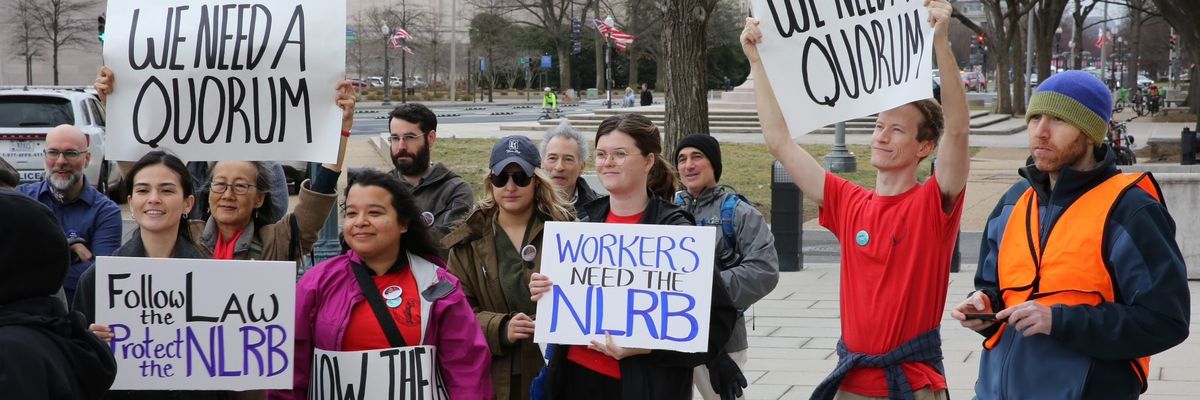

Critics of U.S. President Donald Trump's decision to fire National Labor Relations Board Member Gwynne Wilcox gathered outside a Washington, D.C. court hearing her case on March 5, 2025.
(Photo: AFL-CIO/X)

Jessica Corbett
May 22, 2025
COMMON DREAMS

In a decision that alarmed legal experts, the U.S. Supreme Court on Thursday blocked the reinstatement of two labor regulators fired by President Donald Trump in apparent violation of federal law intended to prevent such ousters for political reasons.

The Trump administration asked the high court—which has a right-wing supermajority—to block orders from the District Court for the District of Columbia against the president's removal of Merit Systems Protection Board (MSPB) Member Cathy Harris and National Labor Relations Board (NLRB) Member Gwynne Wilcox.

An unsigned two-page opinion—from which the three liberals dissented—provides the Trump administration that relief, but the majority declined to take up the cases more fully, meaning they will play out U.S. Court of Appeals for the D.C. Circuit. The Hillnoted that the move "leaves both agencies without a quorum required to conduct certain business in the meantime."

In her fiery dissent, Justice Elena Kagan wrote that "for 90 years, Humphrey's Executor v. United States... has stood as a precedent of this court. And not just any precedent. Humphrey's undergirds a significant feature of American governance: bipartisan administrative bodies carrying out expertise-based functions with a measure of independence from presidential control."

While the MSPB and NLRB are the focus of this case, "there are many others," she continued. "The current president believes that Humphrey's should be either overruled or confined... And he has chosen to act on that belief—really, to take the law into his own hands."

"Our Humphrey's decision remains good law, and it forecloses both the president's firings and the court's decision to award emergency relief," Kagan added. "Our emergency docket, while fit for some things, should not be used to overrule or revise existing law."


Slate's Mark Joseph Stern similarly stressed the significance of Thursday's development on social media, writing that "the Supreme Court just effectively overruled 90 years of precedent on the shadow docket, greenlighting Trump's firing of multimember agency leaders while their cases are pending—despite Congress' effort to protect them against removal. A huge decision."

"The Supreme Court goes out of its way to say that its order today does NOT allow Trump to remove members of the Federal Reserve because it is 'uniquely structured' and has a 'distinct history tradition,'" he noted. "I do not think those distinctions hold water."

The right-wing justices' opinion states that "Gwynne Wilcox and Cathy Harris contend that arguments in this case necessarily implicate the constitutionality of for-cause removal protections for members of the Federal Reserve's Board of Governors or other members of the Federal Open Market Committee."

"We disagree," the court's majority said. "The Federal Reserve is a uniquely structured, quasi-private entity that follows in the distinct historical tradition of the First and Second Banks of the United States."

Multiple other court watchers echoed Stern's take on social media.


"I don't mean to be a caricature, but this just isn't law. The Supreme Court is always making policy. But this is beyond," said Noah Rosenblum, a New York University associate law professor law, summarizing the decision. "'This dicta in an emergency order will reassure the markets but just, uh, trust us on the law here, OK, no we're not overruling Humphrey's yet, and when we do we'll spare the Fed.'"

Christine Kexel Chabot, a Marquette University associate law professor law, said: "The court is legislating from the bench: It has eliminated removal restrictions it finds unimportant while keeping those it finds too consequential to kill (the Fed). Article II provides an undifferentiated grant of 'the executive power,' not one that applies to the NLRB and excepts the Fed."
Trump FDA commissioner complains about 'throwing insulin" to diabetics

ANOTHER DANGEROUS,CLUELESS,SCREWBALL

David Edwards
May 25, 2025 
RAW STORY

Fox News/screen grab

Food and Drug Administration (FDA) Commissioner Marty Makary argued that insulin should be withheld from people with diabetes and replaced with "cooking classes."

During a Sunday interview on Fox News, Makary promoted a report from President Donald Trump's Make America Healthy Again (MAHA) Commission.

"You know, scientists have been waving the flag for years, saying you've got to look at this body of scientific data, and the modern medical establishment really has been disconnected," he opined. "We've got to stop and ask ourselves, should we be focusing more on school lunch programs, not just putting every kid on Ozempic?"

"We've got to talk about environmental toxins that cause cancer, not just the chemo to treat it," he continued. "And maybe we need to treat more diabetes with cooking classes, not just throwing insulin at people."

Makary said he "could not be more excited" about the MAHA report.

"It talks about 70% of the diet being ultra-processed," he added. "It talks about pesticides, microplastics, natural light exposure in children, sleep quality. Remember, Republican, Democrat, and independent moms showed up in high numbers to vote for President Trump over this very issue."


Watch the video below from Fox News or at the link.

Critics Say RFK's MAHA Report Offers 'Half-Baked Finger-Pointing' Instead of Real Policy Solutions

"To be meaningful, the findings of the report must translate into concrete actions that truly advance a healthier, more sustainable food system for America's farmers and consumers."


U.S. Secretary of Health and Human Services Robert F. Kennedy Jr. (L) and Secretary of Education Linda McMahon attend a MAHA (Make America Healthy Again) Commission event in the White House in Washington, D.C., on May 22, 2025.
(Photo: Jim Watson/AFP via Getty Images)


Julia Conley
May 23, 2025
COMMON DREAMS

Hours after Republicans in the U.S. House passed a budget reconciliation package Thursday that would slash hundreds of billions of dollars in healthcare and federal food assistance programs for low-income Americans, the nation's top health agency released a highly anticipated report on chronic diseases in children—one that had nothing to say about the impacts those cuts will have on millions of children and instead offered a litany of complaints about families' lifestyles, vaccines, and "overmedicalization," with few solutions.

Led by Health and Human Services Secretary Robert F. Kennedy Jr., the so-called "Make America Healthy Again" Commission released The MAHA Report, urging the federal government to "act decisively" to reverse "the childhood chronic disease crisis by confronting its root causes—not just its symptoms."

But longtime campaigners in the food safety realm said that while the report's partial focus on the wide use of pesticides, herbicides, and other chemicals—many of which are banned in Europe—is a positive step, the document gave little indication that Kennedy and other Trump administration officials plan to listen to scientists who warn that these chemicals are linked to cancer, birth defects, and immune function.

As Civil Eatsreported in April, dozens of GOP lawmakers wrote to Kennedy and other commission members including Agriculture Secretary Brooke Rollins and Environmental Protection Agency Administrator Lee Zeldin, warning that a push to limit pesticides in food was being pushed by "activist groups promoting misguided and sometimes malicious policies masquerading as health solutions."

"Protecting children's health and building a healthy food system must trump pesticide corporations' profits," said George Kimbrell, legal director of Center for Food Safety, in a Thursday statement. "Policy and governance must be based on sound science and reject fearmongering and lobbying influence alleging that these toxins are needed for a healthy food system or agricultural economy."

The report also includes numerous mentions of health guidelines and standards in Europe, but Zeldin was clear in a call with reporters as the document was released that ensuring the health of American children "cannot happen through a European mandate system that stifles growth."

The commission suggested that U.S. farmers will continue to use 300 millions of pounds of glyphosate and 70 million pounds of atrazine per year—herbicides that, respectively, have been the subject of thousands of lawsuits filed by cancer patients and contaminate the drinking water of 40 million Americans.

While the World Health Organization has classified glyphosate as a probable carcinogen and numerous countries have banned the weed-killer, the MAHA Commission said "human studies are limited" regarding glyphosate and similar products. The report allowed that "a selection of research studies... have noted a range of possible health effects."

Even that language was enough to anger agricultural groups and the Republican politicians who are allied with them, with the American Soybean Association accusing the commission of "glaring misinformation and anti-farmer findings" on Friday.

Kimbrell said the report "falls woefully short of providing any next steps in how the government is going to stop this health epidemic from continuing."

"To be meaningful, the findings of the report must translate into concrete actions that truly advance a healthier, more sustainable food system for America's farmers and consumers," he said.

The report also makes no mention of factory farming and its link to antibiotic resistance via corporate farmers' widespread antibiotic use; the leading causes of death for children in the U.S., gun violence and car accidents; and dental cavities, which is one of the most common chronic health problems in children.

Kennedy has spearheaded an effort to remove fluoride from public drinking water, saying in the report that exposure to high levels of fluoride is linked to low IQ in children. Widespread community water fluoridation has been linked to a sharp decrease in tooth decay among children, with the Centers for Disease Control and Prevention hailing the practice, now used in 60% of the country, as a major public health achievement.

Medical organizations have said concerns about fluoridation raised by Kennedy and others are unfounded.

During his confirmation hearings, Kennedy dismissed the idea that healthcare should be a human right—falsely claiming Americans prefer the for-profit health insurance industry to government-run systems that have been shown to be far less costly and have better outcomes. The report also makes no mention of the harms of tying healthcare to profit, even as it compared U.S. life expectancy and healthcare costs unfavorably to those in other wealthy nations.

In a video posted to social media, dietician Jessica Knurick emphasized that Kennedy is right to point out the nation's "chronic disease problem."

"But he gets the causes and the solutions completely wrong," she said. "His causes are not evidence-based and they play into the idea of scientific and regulatory corruption to erode trust in science. And his solutions distract from evidence-based solutions that could actually help while actively undermining public health."


With the MAHA Report focusing heavily on sedentary lifestyles and low-income people's reliance on ultraprocessed, inexpensive food, Food and Water Watch (FWW) senior policy analyst Rebecca Wolf said the document amounts to "half-baked finger-pointing that blames the sick."

"Improving public health in America cannot happen without reigning in corporate control. It is a grave mistake to exclude Big Ag from culpability," said Wolf. "Any administration serious about public health must strictly regulate the corporations putting our food and water supplies at risk."

Policy solutions that went ignored in the report, said Wolf, include:Closing the "Generally Recognized as Safe" loophole that allows corporations to self-certify the safety of food additives without Food and Drug Administration approval;
Canceling plans to roll back existing regulations for per- and polyfluoroalkyl substances, or PFAS;
Fully funding and staffing food safety agencies, which have been slashed by the Trump administration; and
Stopping state legislatures from passing laws called "Cancer Gag Act legislation" by opponents, which would limit pesticide manufacturer liability in health-related lawsuits.

"The report is right to highlight the health impacts of ultraprocessed foods, microplastics, PFAS, and pesticides," said FWW, "but falls short of directing real policy recommendations capable of reigning in corporate polluters."
'The emperor has no clothes': Rand Paul rips into Trump's 'big, beautiful bill'

David Edwards
May 25, 2025
RAW STORY


Fox News/screen grab

Sen. Rand Paul (R-KY) tore into President Donald Trump's "big, beautiful" budget bill for failing to make significant spending cuts.

In a Sunday interview on Fox News, host Shannon Bream noted that millions could lose access to health care and the Supplemental Nutrition Assistance Program (SNAP) if the Senate passed the bill recently approved by House Republicans.

"Well, see, on the one hand, you can offer people free stuff," Paul opined. "And people are, oh, thank you for free health care. But what you don't tell them is we're borrowing the money from China to pay for your health care... I think it's the greatest threat to our national security."

"We bring in about $5 trillion in revenue, and we spend $7 trillion," he continued. "The $5 trillion is consumed by Social Security, Medicare, Medicaid, food stamps, and other welfare programs. So the people say, well, we're taking this off the table, and we're not going to touch any of those programs. Well, they're just not frankly serious."

Paul predicted there would be "very disappointed conservatives" unless welfare programs were cut.

"Somebody has to stand up and yell, the emperor has no clothes, and everybody's falling in lockstep on this, passed the big, beautiful bill, don't question anything," he said of the budget bill. "This is a problem we've been facing for decades now, and if we don't stand up on it, I really fear the direction the country is going."

Watch the video below from Fox News or at the link.

There's a hidden provision in that big ugly bill that makes Trump king

Robert Reich
May 22, 2025
RAW STORY


Phony Time magazine cover with Donald Trump wearing a crown. (The White House)

I’ve been following with a mixture of dismay and disgust Trump’s One Big Ugly Bill, soon to head to the Senate. I’ll report back to you on it

But I want to alert you to one detail inside it that’s especially alarming. With one stroke, it would allow Trump to crown himself king.

As you know, Trump has been trying to neuter the courts by ignoring them.

The Supreme Court has told Trump to “facilitate” the return of Abrego Garcia, a legal resident of the United States whom even the Trump regime admits was erroneously sent to a brutal prison in El Salvador. Trump has essentially thumbed his nose at the Court by doing nothing.

Lower federal courts have told him to stop deporting migrants without giving them a chance to know the charges against them and have the charges and evidence reviewed by a neutral judge or magistrate (the minimum of due process). Again, nothing.

Judge James Boasberg, Chief Judge of the federal district court for the District of Columbia, issued a temporary restraining order preventing the Trump regime from flying individuals to the prison in El Salvador without due process.

Judge Boasberg has found that the Trump regime has willfully disregarded his order.

What can the courts do in response to Trump’s open defiance of the judges and justices?

The courts have one power to make their orders stick: holding federal officials in contempt and enforcing such contempt citations against them.

Enforcing a contempt citation means fining or jailing the Trump lawyers who argue before them, and possibly invoking contempt all the way up the line to Trump.


Boasberg said that if Trump’s legal team does not give the dozens of Venezuelan men sent to the Salvadorian prison a chance to legally challenge their removal, he’ll begin contempt proceedings against the administration.

In a separate case, U.S. District Court Judge Paula Xinis has demanded that the Trump administration explain why it is not complying with the Supreme Court order to “facilitate” the release of Abrego Garcia.

Xinis questions whether the administration intends to comply with the order at all, citing a statement from U.S. Department of Homeland Security chief Kristi Noem that Abrego Garcia "will never be allowed to return to the United States." According to Xinis, "That sounds to me like an admission. That's about as clear as it can get."

So what’s next? Will the Supreme Court and lower courts hold the administration in contempt and enforce contempt citations?

Not if the Big Ugly Bill is enacted with the following provision, now hidden in the bill:

“No court of the United States may use appropriated funds to enforce a contempt citation for failure to comply with an injunction or temporary restraining order if no security was given when the injunction or order was issued….”

Translated: No federal court may enforce a contempt citation.

Obviously, courts need appropriated funds to do anything because Congress appropriates money to enable the courts to function. To require a security or bond to be given in civil proceedings seeking to stop alleged abuses by the federal government would effectively immunize such conduct from judicial review because those seeking such court orders generally don’t have the resources to post a bond.

Hence, with a stroke, the provision removes the judiciary’s capacity to hold officials in contempt.

As U.C. Berkeley School of Law Dean and Distinguished Professor of Law Erwin Chemerinsky notes, this provision would eliminate any restraint on Trump.

‘Without the contempt power, judicial orders are meaningless and can be ignored. There is no way to understand this except as a way to keep the Trump administration from being restrained when it violates the Constitution or otherwise breaks the law. …

‘This would be a stunning restriction on the power of the federal courts. The Supreme Court has long recognized that the contempt power is integral to the authority of the federal courts. Without the ability to enforce judicial orders, they are rendered mere advisory opinions which parties are free to disregard.”


With this single provision, in other words, Trump will have crowned himself king. No congress and no court could stop him. Even if a future Congress were to try to stop him, it could not do so without the power of the courts to enforce their hearings, investigations, subpoenas, and laws.

What can you do? To begin with, call your members of Congress and tell them not to pass Trump’s One Big Ugly Bill.

Robert Reich is a professor of public policy at Berkeley and former secretary of labor. His writings can be found at https://robertreich.substack.com/


Op-Ed:
Antiquarians and economic illiterates rejoice! The Big Suicidal Bill is here.


ByPaul Wallis
DIGITAL JOURNAL
May 25, 2025


The US Treasury Department said the budget deficit rose in fiscal year 2024, hitting the third-largest on record. — © AFP/File SAUL LOEB

Analyses of the Big Beautiful Bozo Bill are swarming the headlines. Even allowing for the total inadequacy of the astonishingly outdated US revenue system, this bill is direct from prehistory. Nobody living in a tree would believe it or trust it.

This is the definitive version of wealth inequality. Bernie Sanders has been calling it a massive upward redistribution of wealth for many years. You have to admire his tact. It’s an atrocity in progress. The total management failure that this budget enshrines can’t work on any level.

It’s the epitome of an ultra-dogmatic senile conservative wish list. It’s largely about tax breaks and political lip service to populist policies that won’t work either. It addresses absolutely none of America’s chronic domestic disasters on any level. It will make many of the Main Street catastrophes much worse through added costs alone.

Put it this way – If you can’t read a balance sheet and don’t know how to check your numbers, it looks great. It’s terrible basic accountancy at best, and likely to be fatal at worst. The Penn-Wharton House Reconciliation Bill seems like a surprisingly polite funeral oration.

Let’s start with the obvious:

America is in a terminal debt cycle and just lost its last AAA rating. That makes everything more expensive.

The Federal debt is systemic and a massive burden on net revenue.

This bill raises the debt by $4 trillion. The new debt ceiling is likely to be reached by late 2026. That means more borrowing will be required in one year.

The costs of immigration policies and similar obsessions have yet to be quantified, but there’s an allowance of $150 billion in the budget.

There are no simple but informative “revenue minus spending” projections like you’d expect from a first-year business student or a moderately educated house brick.

Inflation and real added costs like imports and exports apparently aren’t factors in calculations.

America doesn’t have a national VAT, unlike the rest of the Western world. That makes raising revenue even more cumbersome and very much more inefficient.

Red states are totally dependent on blue states to pay the revenue that keeps the red states alive.

People who never pay taxes are getting tax cuts while the poor pay more taxes.

Corporate taxes aren’t an issue. Why not?

America doesn’t have free healthcare, unlike the rest of the Western world. About 325,000 Americans go bankrupt per year with medical costs. Everyone else just goes progressively broke.

The bill includes increases in real spending based on the various mutterings from the White House. The Golden Dome, invading Greenland, annexing Canada, ridiculous tantrum-based trade-destroying tariffs, and obscene and insane foreign relations aren’t in the budget.

The likely outcome of this ungodly mess will be an automatic massive built-in rolling deficit with no revenue to balance the spending for years. The only way to pay for it will be through big borrowing.

There are no indications of how the states will respond to the sheer number of instant revenue shortfalls and loss of business.

Even the theory of this budget would get an instant F in grade school, and that’s flattery. What it won’t get is an atom of sympathy. This disaster is all self-inflicted. Nobody wants to do business with this degree of incompetence.

Now the good news, such as it is.

It’s highly unlikely that this absurdity or the next budget will survive the mid-terms.

The only available fix is to repeal this load of garbage, lose the morons responsible, and modernize the revenue system.

America will eventually stagger out of the rubble, but this is going to be extremely expensive.

This is a budget for necrophiles.

_________________________________________________

Disclaimer
The opinions expressed in this Op-Ed are those of the author. They do not purport to reflect the opinions or views of the Digital Journal or its members.
Senate-Passed No Tax on Tips Bill a 'Distraction From the Real Fight'

"We cannot tax-break our way out of an economy that continues to pay people less than it costs to live," said the group One Fair Wage.


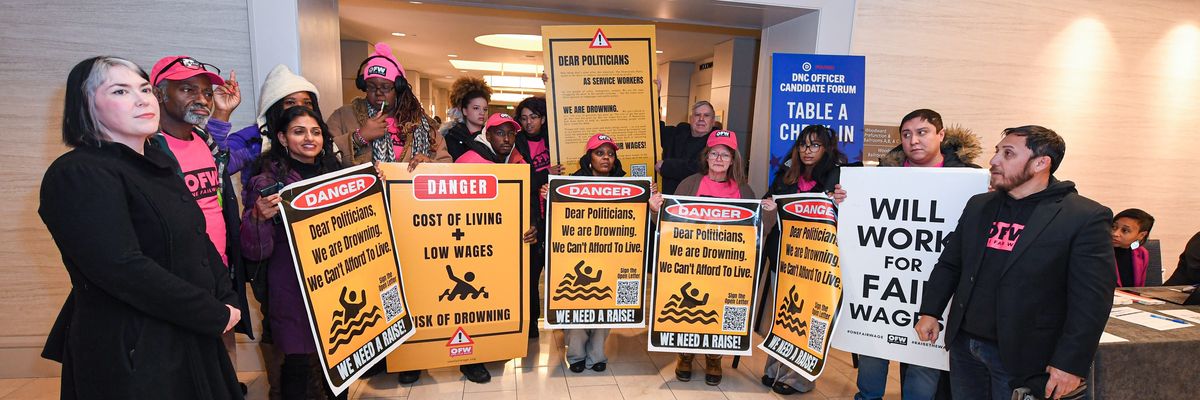
One Fair Wage supporters attend the "Win With Workers" Rally and Press Conference at the DNC Midwestern Candidate Forum on January 16, 2025 in Detroit, Michigan.
(Photo: Aaron J. Thornton/Getty Images for One Fair Wage)


Eloise Goldsmith
May 21, 2025
COMMON DREAMS

After the U.S. Senate on Wednesday unexpectedly passed a bill that would exempt some tips from federal income tax, one labor group that campaigns for raising wages warned that while the bill would offer moderate relief to some Americans, it does not address the poverty wages facing many in the service sector—a message the group has hit on in the past.

"For all the bipartisan celebration, this bill is a distraction from the real fight," said Saru Jayaraman, president of One Fair Wage, in a statement on Wednesday. "If Democrats want to offer a true alternative, they need to say it loud and clear: it's time to raise the minimum wage and end the subminimum wage once and for all."

The bill passed by the Senate on Wednesday, the No Tax on Tips Act, would establish a new federal tax deduction of up to $25,000 for cash tips reported to employers by employees for the purposes of withholding payroll taxes. Qualified cash tips include "any cash tip received by an individual in the course of such individual's employment in an occupation which traditionally and customarily received tips on or before December 31, 2023," according to the bill text. Employees who made more than $160,000 in the prior tax year are not able to claim the deduction.

Currently, for tax purposes, tips are treated the same as regular wages. The bill was cosponsored by a bipartisan group of lawmakers and was passed by unanimous vote. It will now go to the House.

The idea of getting rid of federal taxes on tipped wages was touted by U.S. President Trump on the campaign trail and then-presidential candidate Vice President Kamala Harris also embraced the idea.

An analysis published last year by Yale's Budget Lab found that a "meaningful share" of tipped workers already pay nothing in federal income tax and that tipped work is a very small slice of the labor market.

Less than 4% of workers in the bottom half of hourly wage jobs, people making below $25 an hour in 2023, are in tipped jobs. Thirty seven percent of tipped workers in 2022 made so little that they paid zero in federal income tax before factoring in credits, according to Yale's analysis, and for non-tipped occupations, the equivalent share was much smaller—only 16%.

A report from One Fair Wage released last summer found that the annual income of tipped restaurant workers was so low that 46% of them do not earn enough to pay income taxes based on their individual income.

According to analysis from the Economic Policy Institute (EPI), in addition to helping relatively few workers, exempting taxes on tips could potentially undercut pay for many more workers, would encourage tax avoidance, and would reduce pressure on employers to increase base pay, among other concerns.

According to One Fair Wage, the true relief from the country's affordability crisis will come through raising wages, not through "tax gimmicks."

"We cannot tax-break our way out of an economy that continues to pay people less than it costs to live," the group added.

EPI also calls ending taxation on tips "a distraction from proven methods for supporting low-wage workers, like raising the minimum wage and eliminating the subminimum wage for tipped workers."
CBO Report Shows Trump-GOP Bill Would Spur Unparalleled Wealth Transfer From Poor to Rich

"If enacted, this would be the largest transfer of wealth from the poor to the rich in a single law in U.S. history."


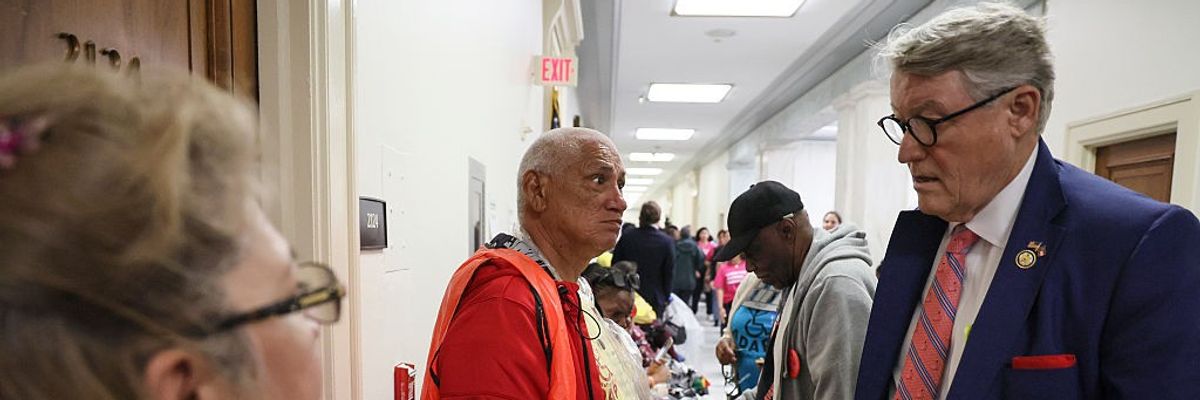
Protesters question Republican lawmakers entering a House Energy and Commerce Committee hearing on May 13, 2025 in Washington, D.C.
(Photo: Jemal Countess/Getty Images for Protect Our Care)


Jake Johnson
May 21, 2025
COMMON DREAMS

The nonpartisan Congressional Budget Office said Tuesday that the Republican legislation speeding through the U.S. House of Representatives would cut household resources for the bottom 10% of Americans while delivering gains to the wealthiest in the form of tax breaks.


"If enacted, this would be the largest transfer of wealth from the poor to the rich in a single law in U.S. history," Bobby Kogan, senior director of federal budget policy at the Center for American Progress, said in response to the CBO analysis, which was released shortly before the start of a dead-of-night House Rules Committee hearing on the Republican reconciliation package.

On average, according to the CBO, U.S. households would "see an increase in the resources provided to them by the government over the 2026–2034 period."

But the resources "would not be evenly distributed among households," the CBO found, estimating that "in general, resources would decrease for households in the lowest decile (tenth) of the income distribution, whereas resources would increase for households in the highest decile."

"This is what Republicans are fighting for—lining the pockets of their billionaire donors while children go hungry and families get kicked off their healthcare."

The analysis takes into account an extension of soon-to-expire provisions of the 2017 Trump-GOP tax cuts as well as Republicans' push for around $1 trillion in combined cuts to Medicaid and the Supplemental Nutrition Assistance Program (SNAP), which would primarily harm low-income Americans.

"The nonpartisan Congressional Budget Office's unprecedented analysis has confirmed what Democrats have known to be true—the GOP Tax Scam will hurt working families the most while delivering massive tax breaks for billionaires like Elon Musk," said House Minority Leader Hakeem Jeffries (D-N.Y.), who joined Rep. Brendan Boyle (D-Pa.) in requesting the distributional analysis.

"Any claims otherwise are intentionally deceptive regarding the Republican plans to rip healthcare away from nearly 14 million Americans and take food out of the mouths of millions of people, including children and seniors," said Jeffries. "Republicans are attempting to quickly jam this unpopular legislation through the House because they know that the longer they wait, the more will come to light about this cruel and unconscionable bill. For a party that claims to be for the working class, this analysis indicates the opposite."


Boyle, the ranking member of the House Budget Committee, said that "this is what Republicans are fighting for—lining the pockets of their billionaire donors while children go hungry and families get kicked off their healthcare."

"CBO's nonpartisan analysis makes it crystal clear: [President] Donald Trump and House Republicans are selling out the middle class to make the ultra-rich even richer. Every word out of Trump's mouth about helping working Americans was a lie."

The CBO also said Tuesday that the Republican reconciliation package, which Trump has championed, would trigger automatic cuts to Medicare spending—reductions that the nonpartisan body did not factor into its distributional analysis.

The CBO's analysis also did not include the impact of a tentative deal to boost the cap on state and local tax deductions (SALT), a change that would primarily benefit wealthy households.

"This reported SALT deal and accelerated Medicaid cuts would make the bill even more effective at transferring resources from low-income to high-income households," said Brendan Duke of the Center on Budget and Policy Priorities, referring to GOP hardliners' push for an earlier start date for Medicaid work requirements, which experts have decried as cruel and ineffective.


House Speaker Mike Johnson (R-La.) arrives at a House Rules Committee meeting on May 21, 2025.
(Photo: Kevin Dietsch/Getty Images)


'They're Not Just Cutting Medicaid': GOP Bill Would Trigger Over $500 Billion in Medicare Cuts

"This is what Republicans do—pay for massive tax breaks for billionaires by going after programs families rely on the most: Medicaid, food assistance, and now Medicare."


Jake Johnson
May 21, 2025
COMMON DREAMS

The sprawling reconciliation package that House Republicans are rushing through committee would trigger over $500 billion in automatic cuts to Medicare, according to a Congressional Budget Office estimate released late Tuesday.

The CBO analysis, requested by Rep. Brendan Boyle (D-Pa.), came just hours before Republicans convened a dead-of-night House Rules Committee hearing on the budget legislation as they scramble to meet their Memorial Day deadline.

If enacted, the Republican bill would add trillions of dollars to the deficit over the next decade by delivering another round of tax cuts skewed to the rich, partially offset by huge cuts to Medicaid and other programs.

According to the CBO, the bill's addition to the deficit would trigger a process known as sequestration under the Statutory Pay‑As‑You‑Go (PAYGO) Act of 2010, a law long reviled by progressives that requires spending cuts equal to legislation's average deficit impact.

Unless lawmakers offset the deficit impact of the Republican bill or agree to waive the PAYGO requirements—which the GOP measure does not do—the Office of Management and Budget (OMB) "would be required to issue a sequestration order not more than 14 days after the end of the current session of Congress (excluding weekends and holidays) to reduce spending by $230 billion in fiscal year 2026," the CBO said.

"The deficit will explode so badly it will trigger automatic cuts, including over half a trillion dollars from Medicare."

Under PAYGO, automatic Medicare cuts are capped at 4%. The CBO estimates that the Republican legislation would trigger roughly $45 billion in Medicare cuts in 2026 and a total of $490 billion in cuts to the program between 2027 and 2034.

"This Republican budget bill is one of the most expensive—and dangerous—bills Congress has seen in decades," said Boyle, the top Democrat on the House Budget Committee. "The nonpartisan CBO makes it clear: The deficit will explode so badly it will trigger automatic cuts, including over half a trillion dollars from Medicare."

"This is what Republicans do—pay for massive tax breaks for billionaires by going after programs families rely on the most: Medicaid, food assistance, and now Medicare," Boyle added. "It's reckless, dishonest, and deeply harmful to the middle class."

Boyle highlighted the CBO's findings during his testimony at the House Rules Committee hearing, which began in the early hours of Wednesday morning.

"This is really the breaking news," Boyle said. "Over the last several months, there's been no discussion of Medicare at all. There has been of Medicaid, but not of Medicare."

"Because of the size of the deficits, because of the PAYGO or Pay-As-You-Go Act, that would trigger sequestration of Medicare, and it would total over $500 billion," Boyle continued. "The official figure that CBO confirms is $535 billion in cuts to Medicare."


Boyle and other Democrats said the looming Medicare cuts amount to a betrayal of President Donald Trump's vow to shield the program—a promise that was included in the GOP's 2024 election platform.

"They're not just cutting Medicaid," said Rep. Teresa Leger Fernández (D-N.M.), referring to the reconciliation bill's roughly $600 billion in proposed cuts to the healthcare program for low-income Americans. "They're cutting Medicare too."


House Budget Committee Democrats wrote on social media that "Trump promised to protect Medicare."

"He lied," they added.
Trump and Co Are Doing Their Best to Make America White Again (As If It Ever Was!)

Along with overlapping groups, including immigrants, transgender and other LGBTQ+ folks, women, and union workers, Black Americans are clear targets for this administration.


A sign reading, "No to Racism No to Trump" is displayed during a rally opposing the inauguration of the 47th U.S. President Donald Trump, outside Downing Street on January 20, 2025 in London, England.
(Photo: Leon Neal/Getty Images)


Rebecca Gordon
May 21, 2025
TomDispatch


On May 5, the New York Metropolitan Museum of Art’s Costume Institute held its annual fundraising gala. The event showcases the extraordinary imaginations of people who design exorbitant clothes and the gutsiness of those who dare (and can afford) to wear them.

I’m dimly aware of this annual extravaganza because of my interest in knitting, spinning, and weaving—the crafts involved in turning fluff into yarn and yarn into cloth. Mind you, I have no flair for fashion myself. I could never carry off wearing the simplest of ballgowns, and I’m way too short to rock a tuxedo. My own personal style runs to 1970s White Dyke. (Think blue jeans and flannel shirts.) But I remain fascinated by what braver people will get themselves up in.

One of my favorite movies is Paris Is Burning, a 1990 documentary about the underground Harlem ballroom scene, where drag queens and transgender folks, mostly Black and Latina, recreated a fierce version of the world of haute couture. It was a testament to people’s ability to take the detritus of what systems of racism and economic deprivation had given them and spin it into defiant art.

So I was excited to learn that the theme of this year’s gala was to be “Superfine: Tailoring Black Style,” an homage to the tradition of Black dandyism, about which Vogue magazine writes:
There is something undeniably magnetic about the sharp creases of a tailored suit, the gleam of polished leather shoes, the swish of a silk pocket square. But for Black dandyism, this isn’t just about looking good—it’s a declaration. A defiant reclaiming of space in a world that has long sought to define and confine Black identity. So, what exactly is Black dandyism? At its core, it’s a fashion revolution, a movement steeped in history, resistance, and pride.


The Met’s gala theme was chosen back in October 2024, when it still seemed possible that, rather than electing a fascist toddler, this country might choose a Black woman as president. In that case, the gala could have served as an extended victory toast. (As it happens, Kamala Harris did in fact attend.)

Instead, this country is today laboring under an increasingly authoritarian regime in Washington, one proudly and explicitly dedicated to reversing decades of victories by various movements for Black liberation.


Resuscitating Employment Discrimination

I wrote “laboring under” quite intentionally, because one of one of Trump 2.0’s key attacks on African Americans comes in the realm of work. The Heritage Foundation’s Project 2025 in its ominous preelection document Mandate for Change made this clear in a chapter on the Labor Department. The first “needed reform” there, it insisted, would be to uproot DEI (diversity, equity, and inclusion) efforts wherever they might be found in the government and military. Its authors wrote that the new administration must:
Reverse the DEI Revolution in Labor Policy. Under the Obama and Biden administrations, labor policy was yet another target of the Diversity, Equity, and Inclusion (DEI) revolution. Under this managerialist left-wing race and gender ideology, every aspect of labor policy became a vehicle with which to advance race, sex, and other classifications and discriminate against conservative and religious viewpoints on these subjects and others, including pro-life views. The next administration should eliminate every one of these wrongful and burdensome ideological projects.


In case the reader has any doubt about the evils attributed to DEI, that chapter’s next “needed reform” made it clear that the greatest of those horrors involved any effort whatsoever to prevent racial discrimination against people of color. To that end, Project 2025 wanted the federal government to stop collecting racial demographics in employment. It called on the next administration to eliminate altogether the gathering of such data by the Equal Employment Opportunity Commission (EEOC) on the grounds that collecting “employment statistics based on race/ethnicity… can then be used to support a charge of discrimination under a disparate impact theory. This could lead to racial quotas to remedy alleged race discrimination.”

In other words, as I wrote months before Donald Trump returned to power, “If you can’t demonstrate racial discrimination in employment (because you are enjoined from collecting data about race and employment), then there is no racial discrimination to remedy.”

The 1964 Civil Rights Act first established the EEOC’s mandate to collect such employment data by race in its Title VII, the section on employment rights. Title VII remains a major target of the second Trump administration. That’s especially true when it comes to federal employment, where all federal agencies are required “to maintain an affirmative program of equal employment”—an idea abhorred by the Trump administration.

The employment-rights section of the Civil Rights Act covers all employers, including the federal government. And in 1965, President Lyndon Johnson went even further, issuing Executive Order 11246, which applied similar principles to the employment practices of federal contractors. That order established the Office of Federal Contract Compliance Programs (OFCCP), which uses the EEOC’s data to ensure that federal contractors don’t discriminate against what are considered protected classes of workers.

Not surprisingly, Project 2025 called on the next administration to rescind Executive Order 11246, which is precisely what President Donald Trump did on January 21, 2025, his second day in office, in an order entitled (apparently without irony) “Ending Illegal Discrimination and Restoring Merit-Based Opportunity.” (To be clear, by “illegal discrimination,” Trump, of course, meant imagined “discrimination” against white people.) In addition to eliminating that mandate, Trump’s order also rescinded a number of later executive orders meant to ensure racial equity in employment, including:
(i) Executive Order 12898 of February 11, 1994 (Federal Actions to Address Environmental Justice in Minority Populations and Low-Income Populations);
(ii) Executive Order 13583 of August 18, 2011 (Establishing a Coordinated Government-wide Initiative to Promote Diversity and Inclusion in the Federal Workforce);
(iii) Executive Order 13672 of July 21, 2014 (Further Amendments to Executive Order 11478, Equal Employment Opportunity in the Federal Government, and Executive Order 11246, Equal Employment Opportunity); and
(iv) The Presidential Memorandum of October 5, 2016 (Promoting Diversity and Inclusion in the National Security Workforce).


According to Project 2025, preventing “discrimination” against whites requires another move as well: eliminating any law or policy that prohibits discriminatory employment outcomes. In other words, intentional racial discrimination, which is often impossible to prove, would remain the only legitimate form of discrimination.


Decimating the Black Middle Class

Why have I made such a detailed excursion into the weeds of federal law and policymaking? Because the real-world effects on African American communities of such arcane maneuvering will likely be staggering.

Federal employment was a crucial factor in building today’s Black middle class, beginning in the decades after emancipation and accelerating significantly under the provisions of that 1964 Civil Rights Act and the various presidential orders that followed. As Danielle Mahones of the Berkeley Labor Center of the University of California points out, “Federal employment has been a pathway to the middle class for African American workers and their families since Reconstruction, including postal work and other occupations.” We can now expect, she adds, “to see Black workers lose their federal jobs.”

The Trump administration’s apparently race-neutral attack on supposed waste, fraud, and abuse in the federal workforce is guaranteed to disproportionately remove Black workers from federal employment.

And with Donald Trump’s victory in November 2024, that indeed is the plan that has been brought to the White House by Russell Vought, one of the key architects of Project 2025 and now head of the Office of Management and Budget. Implementation began with the series of executive orders already described, which largely govern the hiring of new employees. But actions affecting federal hiring don’t take effect quickly, especially in periods of government cutbacks like we’re seeing today.

Fortunately for Vought and his co-conspirators at the Heritage Foundation, Trump had another option in his anti-Black toolbox: the chainsaw wielded by Elon Musk and his Department of Government Efficiency. While estimates vary, the best estimate is that, thanks to Musk and crew, around 260,000 federal workers have by now “been fired, taken buyouts, or retired early.”

Eliminating federal employees in such a way has indeed had a disproportionate effect on Black workers, since they comprise almost 19% of that workforce, while the country’s total workforce is only 13% Black. (At the Post Office, the figure may be closer to 30%.) If 260,000 federal workers have lost their jobs under Trump and Musk, then almost 50,000 of them may be Black. In other words, cutting federal jobs disproportionately affects Black workers.

“Negro Removal”

Of course, Donald Trump’s approach to Blacks is hardly new in this country. “Negro removal” has a long history here. When I first moved to San Francisco in the late 1970s, there was a big blank area in the middle of the city. Acres of empty blocks sat in the section of town known as the “Western Addition” or, to the people who had once lived there, “the Fillmore.” The Fillmore had been a racially mixed neighborhood. Populated by Japanese- and Filipino-Americans, it had also housed a significant Black enclave. As a local NPR podcast described the scene, “If you were walking down San Francisco’s Fillmore Street in the 1950s, chances are you might run into Billie Holiday stepping out of a restaurant. Or Ella Fitzgerald trying on hats. Or Thelonious Monk smoking a cigarette.” The neighborhood was often called the “Harlem of the West.”

But “urban renewal” projects, initiated under the federal Housing Act of 1949, would tear down over 14,000 housing units and an unknown number of businesses there in the name of “slum clearance and community redevelopment.” By the time I arrived, however, much of the Fillmore had been rebuilt, including the Japantown business area, though many empty lots remained. Today, they’ve all been filled in, but the 10% of the city’s population that had been African American when “urban renewal” began has been halved. And while Blacks still represent 5% of the city’s population, they also account for 37% of the unhoused.

The writer and activist James Baldwin visited San Francisco in 1963, while the Fillmore’s razing was in full swing. “Urban renewal,” he pointed out, “is Negro removal.” And according to Mindy T. Fullilove, a professor of urban studies and health, San Francisco’s urban renewal experience was duplicated across the country. As she put it back in 2001:
[U]rban renewal affected thousands of communities in hundreds of cities. Urban renewal was to achieve “clearance” of “blight” and “slum” areas so that they could be rebuilt for new uses other than housing the poor… The short-term consequences were dire, including loss of money, loss of social organization, and psychological trauma.


As Fullilove argued, federal policies like urban renewal, involving “community dispossession—and its accompanying psychological trauma, financial loss, and rippling instability—produced a rupture in the historical trajectory of African American urban communities.” She believes that such federal intervention foreclosed the possibility that Black people would follow the route to full participation in U.S. social, commercial, and political life taken by “earlier waves of immigrants to the city.”

Policies that appear to be “race neutral” can have racialized effects. The phrase “urban renewal” says nothing about uprooting Black communities, yet that is what it achieved in practice. Just as earlier federal policies led to the removal of Black communities from the hearts of hundreds of U.S. cities, the Trump administration’s apparently race-neutral attack on supposed waste, fraud, and abuse in the federal workforce is guaranteed to disproportionately remove Black workers from federal employment. Together with the planned ejection of millions of immigrants, and following the Project 2025 playbook, Trump, Elon Musk, and their minions like Stephen Miller are doing their best to Make America White Again. (As if it ever was!)


Text and Subtext

The second time around, Trump’s administration sees race everywhere. It’s the subtext of almost everything its officials say and it’s right there in the “text” of its actions and pronouncements.

Ironically enough, Mindy Fullilove’s article is—for the moment—still available from the National Institutes of Health library website. Given the “Negro removal” that the Trump administration has been eagerly pursuing on its thousands of websites and libraries, though, who knows how long it will remain there. Certainly, you can expect to see further erasures of African Americans from any arena this administration enters. As Washington Post columnist Theodore T. Johnson writes,

Not only does this White House see race; it is also a preoccupation: One of its first executive orders enacted an anti-diversity agenda that purged women, people of color, and programs from federal websites and libraries. Trump directed the firing of multiple generals and admirals who are Black, female, or responsible for the military following the rule of law.


Recent weeks have seen the purging (and in some cases, embarrassed restoration) of any number of Black historical figures, including Jackie Robinson, Harriet Tubman, and the Tuskegee Airmen, from government websites.

Nor are attacks on employment and representation the new administration’s only attempts to constrain the lives of African Americans. On April 28, Trump issued an executive order devoted to “Strengthening and Unleashing America’s Law Enforcement to Pursue Criminals and Protect Innocent Citizens.” In addition to “unleashing” local law enforcement, the order prepares the way for military involvement in local policing. It also seeks to roll back consent decrees governing the behavior of police departments judged discriminatory by previous Justice Departments. In 2025, no one should be confused about the respective races of the “criminals” and “innocent citizens” referred to in Trump’s order.

So yes, along with overlapping groups, including immigrants, transgender and other LGBTQ+ folks, women, and union workers, Black Americans are clear targets for this administration. That’s why even as rarified an event as the Met Gala may be, it still inspires me. As Ty Gaskins wrote in Vogue, Black style is a “defiant reclaiming of space in a world that has long sought to define and confine Black identity.”

Isn’t it now time for all of us to reclaim our space—and nation—from Donald Trump?
Trump's racist provocations will lead to violence. It's what he wants

Sabrina Haake
May 24, 2025 
RAW STORY


Donald Trump shows alleged news reports as he meets South African President Cyril Ramaphosa in the Oval Office. REUTERS/Kevin Lamarque

The world is watching in disbelief as the president of the United States goes full Aryan. After coaxing Black and brown voters into his tent, Donald Trump loaded a gun, trained it at their heads, and blocked the exits.

Trump’s racism surprises exactly no one, but his unprecedented aggression in arresting a Black member of Congress and sending brown migrants to prison without legal process hints at real strategy from an administration otherwise known for incompetence.

Political writers often quip that Trump’s racial animus is performative: red meat thrown to a carnivorous base, a little candy to keep MAGA extremists standing back and standing by. Plus, daily outrage keeps media focus where Trump wants it: on him.

But Trump is not just feeding and entertaining his base, he’s simultaneously trying to goad Democrats — racial minorities in particular — into violence. He’s deliberately trying to incite race riots in the streets, complete with looting and mayhem, as predicate to martial law.

America for me, Sudan for thee

In late March, Trump’s Homeland Security Secretary, Kristi Noem, put on full makeup and a push-up bra to pose as jailer at a human zoo in El Salvador. She stood in front of brown human props caged in forever cells “stuffed to the rafters,” even though the vast majority of them have never been convicted of a crime.

Trump wants to boot 20 million brown and Black immigrants out of the country with no thought of the resulting labor shortage he’s creating for farmers, construction, and health care providers. He asked El Salvadorean dictator Nayib Bukele to build additional gulags for that purpose, and, in the meantime, has begun sending migrants to South Sudan, a country where they have no ties. On Wednesday, another judge found that Trump violated another federal court order by deporting brown migrants, without legal process, to a country so dangerous the State Department warns people not to set foot there.

Against this backdrop of staged cruelty toward migrants and refugees of color, Trump crafted a deliberate race-based contrast, by welcoming a “small subset” of other immigrants: white Afrikaners. Embracing the same racist minority that led South Africa's brutal apartheid regime, to whom Elon Musk has family ties, Trump is institutionalizing racial preference while also endorsing the racist violence of aparthei

Ambushing South Africa’s president

If welcoming white Afrikaners wasn’t enough to punctuate the memo, Trump ambushed South African President Cyril Ramaphosa in the Oval Office, showing a social media video distorted to support claims of an ongoing “genocide” against white farmers in Ramaphosa’s country.

After both presidents were seated, Trump dimmed the lights to show dramatic footage of a row of crosses, claiming, “These are the — these are burial sites right here … Each one of those white things you see is a cross. And there's approximately a thousand of them. They're all white farmers, the family of white farmers … Those people are all killed.”

Trump’s bogus video was instantly and widely refuted. Those crosses weren’t grave markers of murdered white farmers; they were placed along the road as part of a political protest over the apparent murder of two farmers at their home, not a thousand, back in 2020. Trump also showed an image he said was from South Africa but was actually from the Democratic Republic of Congo.

Trump knows that 45% of the country will never hear that refutation, as Fox News praised the meeting and video, amplifying Trump’s false claims of white genocide to gin up racial hatred among white MAGA supporters.

Arresting Black officials

Trump is also flexing unconstitutional muscle to intimidate Black officials. Two weeks ago, ICE agents arrested Newark’s Black Mayor, Ras Baraka, while he and members of Congress were visiting a detention center. When that case was ignominiously dismissed, Trump officials pivoted and arrested Rep. LaMonica McIver (D-N.J.), also Black, also touring the facility.

Federal law, under the Consolidated Appropriations Act, 2020 at Section 532, grants members of Congress the right to inspect ICE detention facilities without prior notice, as a function of congressional oversight. Not only did McIver have the right to conduct oversight at the facility, she has a constitutional obligation to do so.

Democratic leadership released a joint statement calling the arrests “blatant attempts at intimidating” members of Congress. They might have added that the arrests were part of Trump’s strategy of fomenting race-based violence nationwide.
Inciting divisive racial violence as a segue to martial law

Backing up the camera from the micro to see the macro, Trump’s persistent DEI attacks against corporations and universities, his well-choreographed abuse of brown migrants, and his very public attempts to intimidate Black elected officials by arresting them supports a sinister theory: that Trump wants to trigger racial violence to give him cover to declare martial law before the midterms.

Rule by martial law is not a new concept; it exists throughout autocratic regimes and lies at the core of Project 2025, which Trump, despite disavowing, has been implementing with alacrity.

Architects of Project 2025 want a unitary government with power consolidated in a single, strongman executive. Their Mandate for Leadership is a 920-page road map directing Trump’s efforts to amass excessive power by sidelining both the legislative and judicial branches, efforts already well under way. Project 2025 champions a far-right, white, Christian nationalist, pro-corporate, and anti-worker philosophy. Enabled by removing checks and balances on Trump’s power, Christo-fascists want the state to regulate bedroom behavior, outlaw homosexuality and birth control, and impose state-forced births nationwide, including in democrat-run cities and states. They redefine personal autonomy as an asset that belongs to an all-powerful state.

The dictators’ playbook


The ever-prescient Thom Hartmann recently distilled the dictators’ playbook into two steps: Aspirant dictators must first create an ‘enemy within.’ Check. Then, they encourage or exploit“big, splashy attacks on the country” to seize more power. If race riots start, this second box will be checked.

Hartmann observes that, “Trump appears to be preparing for the type of authoritarian crackdown Germany saw after the Reichstag fire that propelled Hitler to power in 1933.” Trump’s chilling EO, “Strengthening and unleashing America’s law enforcement to pursue criminals and protect innocent citizens” makes plain that Trump intends to illegally deploy the military against American citizens.

Trump’s carousel of abuse is a sinister ploy to elicit help from the very minorities he seeks to oppress. He is poking us to explode in violent outrage so that he can declare martial law before the midterms, sic the military on US citizens, and “protect America” from yet another disaster he purposely created.

Americans should heed Martin Luther King Jr. and engage in non-violent, righteous resistance instead. Wherever you are, whatever you are doing, show up on June 14 and show the world your disgust at America’s would-be king. You, me, and millions of Americans can stop him, and it starts by showing up.


Sabrina Haake is a 25+ year federal trial attorney specializing in 1st and 14th A defense. Her columns are found @ Alternet, Chicago Tribune, Howey Political Report, Indiana Democrats’ Kernel of Truth, Inside Indiana Business, MSN, Out South Florida, Raw Story,Salon,Smart News, South Florida Gay News, State Affairs, and Windy City Times. Her Substack, The Haake Take, is free.
This media expert explains Trump's fascist appeal

John Stoehr
May 24, 2025 
ALTERNET


I’m going to make a confession in this introduction to my interview with Jennifer Mercieca, a professor of communication and journalism at Texas A&M. Here it is: I have lost so much trust in democracy that I don’t know how to rebuild trust in democracy. She says that “anyone who supports democracy should work to build trust between people, and between people and the government,” and I just don’t know.


I mean, I used to have faith. Since the conclusion of Donald Trump’s second impeachment trial for the crimes of mutiny and insurrection, I had felt pretty confident that in 2024 most people most of the time could tell the difference between a sandwich and a shit sandwich, and I was pretty confident they could do that, because they already had.

Now, after only months of his second presidency, polls are showing majorities of people, including those who voted for him, don’t like what he’s doing, even though he’s doing what he said he was going to do. At the same time, my liberal brethren are pointing to these same polls as a proof of the tide turning against Trump, seemingly overlooking the implication that hope for democracy rests in the hands of people for whom the future will never come and yesterday never happened.

That said, my interview with Professor Mercieca does rekindle some faith, especially by pointing out that we live in a time of information overload. Everything everywhere seems to happen all at once. In that context, Trump tells a story that “scary outsiders are doing scary things and you should be scared!” Liberals, she said, need to tell a counter-narrative, one that works against the grain of that story.

That I can trust. The good work. The good people. May it be so.

JS: Trump says things to suggest he’s the Big Man in charge. Then, sometimes in the same breath, he says he’s not responsible. The Kilmar Abrego Garcia case, for instance. How does the fascist square that?

JM: This is an apparent contradiction, but is easily resolved when you understand that fascist leaders are unaccountable or “cognitively irresponsible” leaders. That means they want to rule over others without being questioned about the success or failure of their policies. They don’t want citizens or media to question their authority or their decisions. They want “because I said so” to end any conversation. So Trump represents himself as all-powerful, but also has many strategies to deflect responsibility so his decisions cannot be questioned.

JS: The electorate voted for the Big Man, but now at least one poll suggests a majority sees him as a “dangerous dictator.” All of this was obvious. Were the founders right to be skeptical of democracy?

JM: I wouldn’t conclude that Trump’s re-election tells us much about the appropriateness of democracy as a form of government or whether the founders were right. They lived in a very slow media environment and they were generally skeptical that the public could get enough information to make good decisions.

Our problem is the opposite, of course. Living in a world with too much information allows propagandists like Trump to manipulate reality. Also, it was very easy to believe that Trump wouldn’t do the things he promised he would do. When he said that he’d be a “dictator on day one,” folks either didn’t believe him, or thought someone or some institution would stop him, or wanted him to be a dictator to solve what they saw as urgent problems. Probably that last group (rightwing authoritarian voters) still support Trump and are happy with his presidency so far.

JS: I have said we’re in a transition, as we were in the 1970s. Back then, it was between the liberal consensus (New Deal, Great Society) and the conservative consensus (Ronald Reagan, neoliberalism). You have also said as much. How do you see it?

JM: Governments around the world are backsliding from stable democracies to authoritarianism. According to V-Dem data, the world is down to levels of democracy not seen since the 1980s, nearly three quarters of the world’s population now live in autocracies. So we live in an era of democratic collapse.

We also live in an era of climate catastrophe. And an era of massive societal changes in migration, the economy and communication. These things are related because when things are unstable people look for stability and believe the promises of “strong leaders” who claim they will restore order. Autocrats take advantage of vulnerabilities, and right now we’re vulnerable — in the US and around the world.

JS: I think it is useful to think about Trump in terms of Big Man theory (the Leviathan, as you said recently). The crisis facing democracy seems to be that that’s what Americans want. What do liberals do in your view to fight against that?

JM: Rightwing authoritarians (RWAs) are a significant portion of the electorate (some scholars estimate 35-40 percent of people), but they’re not always “activated” — meaning they don’t always use the RWA framework to think about politics.

When RWA are activated, they look to a “strong leader” who promises to restore stability and protect them. These authoritarian “strong leaders” use fear-appeals, outrage-bait and other strategies to cultivate the appearance of instability. These leaders thrive on distrust, cynicism and frustration in a political community and use strategies to try to make all of those democracy-threatening conditions worse. Anyone who supports democracy should work to build trust between people and between people and the government. That doesn’t mean denying that problems exist. It means solving problems and demonstrating trustworthiness.

One more thing. Authoritarianism works because it’s a compelling story: scary outsiders are doing scary things and you should be scared! Unfortunately, fear-appeals work. They hijack our ability to think critically and scare us into submission. Liberals and friends of democracy need to tell a different story, but one that is also compelling. That story needs to unite the nation in a common goal and affirm human dignity. I don’t think “fight fascism” or “fight Trump” are the kinds of messages that can reach tuned-out Americans. They might respond to a positive story about America’s future that moves us past identity and cultural issues and talks about how to solve the big structural problems that affect us