Wednesday, May 28, 2025


Unlocking the SDGs: Circular economy solutions to boost sustainable consumption


Tsinghua University Press
Concept of circular economy 

image: 

Concept of circular economy

view more 

Credit: Circular Economy


A paper describing the circular economy as a vital enabler for the sustainable use of resources to achieve the UN agenda for SDGs was published in the journal Circular Economy on 14 April 2025 (https://doi.org/10.1016/j.cec.2025.100140). In this article, Khajuria and co-authors focused on reuse, recycling, and resource optimization, which assist businesses, governments, and communities in achieving the Sustainable Development Goals (SDGs).


They published their study on 14 April 2025, in Circular Economy.


The SDG accelerator initiative focuses on leveraging circular economy principles to drive efficient and sustainable consumption, directly supporting the achievement of the United Nations Sustainable Development Goals (SDGs), particularly SDG 12: Responsible Consumption and Production. The circular economy model emphasizes reducing waste, maximizing resource efficiency, and promoting product longevity, repairability, and recyclability to minimize environmental impact and ensure the well-being of current and future generations.


Sustainable consumption is defined as using resources more efficiently and mindfully to meet present needs without compromising the ability of future generations to meet theirs. It emphasizes promoting long-lasting, reusable, and recyclable products to reduce pressure on natural resources and minimize waste. Transitioning to a circular economy involves designing products for durability, repairability, and recyclability, as well as fostering practices such as reusing, refurbishing, and recycling. These actions directly reduce waste and resource depletion, making them essential to achieving SDG 12.


The lead author, Anupam Khajuria, a research fellow and academic associate at the United Nations University, Japan, underlines – “Transitioning to a circular economy is not just an environmental imperative, but a powerful accelerator for sustainable growth. By reimagining how we design, use, and reuse resources, we can drive efficient consumption, empower small businesses, and unlock new opportunities for innovation. The SDG Accelerator demonstrates that when we invest in circular solutions, we pave the way for resilient economies that responsible production and consumption become the foundation for a sustainable future for all”.


“Efficient sustainable consumption is at the heart of a thriving circular economy, which holds the key to addressing the planet’s urgent environmental challenges. By embedding circular principles into business models, supply chains, and consumer behavior, we can drastically reduce waste and resource depletion”, explains Prabhat Verma, a co-author and a professor at Osaka University, Japan.


About Circular Economy

Circular Economy (CE) is an international fully open-access journal co-published by Tsinghua University Press and Elsevier and academically supported by the School of Environment, Tsinghua University. It serves as a sharing and communication platform for novel contributions and outcomes on innovative techniques, systematic analysis, and policy tools of global, regional, national, local, and industrial park's waste management system to improve the reduce, reuse, recycle, and disposal of waste in a sustainable way. It has been indexed by Ei CompendexScopus (CiteScoreTracker 2024 10.0), InspecCAS, and DOAJ. At its discretion, Tsinghua University Press will pay the Open Access Fee for all published papers from 2022 to 2026.

OECD nations show mixed progress toward energy and economic convergence


Shanghai Jiao Tong University Journal Center


Abstract

Purpose – This study examines the convergence of energy diversification, financial development and per-capita income in OECD countries.


Design/methodology/approach – The research employs the club convergence test to assess convergence among OECD countries and uses Granger causality tests and panel regressions to identify the determinants of convergence, using data from 1997 to 2021.


Findings – The convergence tests showed no overall convergence but revealed convergence clubs for each factor. Granger causality tests indicated short-run bi-directional relationships between the variables. Long-run panel regression analysis confirmed that technological progress significantly improves per capita income and energy diversification. Additionally, it revealed bi-directional relationships between energy diversification and financial development, a uni-directional relationship from financial development to per capita income and a U-shaped effect of per capita income on energy diversification, with a turning point at $67,112.8 per year.


Practical implications – The findings suggest that within each convergence club, implementing microeconomic incentives for technology development and diffusion in energy, production, and financial services could help lagging countries catch up.


Originality/value – This study pioneers the testing of convergence in energy diversification, financial development and per capita income in OECD countries and identifies the determinants of this convergence.

Background and Motivation

In an era where global economies are confronted with the dual challenges of climate change and socioeconomic inequality, understanding how nations converge or diverge in energy use, financial development, and income growth has become more critical than ever. While existing research has delved into income and financial convergence across regions, significant gaps remain in analysing energy diversification alongside these factors, particularly within OECD countries. Addressing this important research void, China Finance Review International (CFRI) is pleased to present the paper titled "Energy diversification, financial development and economic development: an examination of convergence in OECD countries", which investigates whether energy diversification, financial development, and per-capita income converge over time in OECD nations.


Methodology and Scope​​

The study employed rigorous statistical methods to analyse data from 38 OECD countries spanning 1997–2021, a period marked by rapid technological innovation and shifting energy policies. The key approaches included:

  • Club Convergence Tests: Utilising Phillips and Sul’s (2007, 2009) log-t framework, researchers identified subgroups of countries (convergence clubs) with similar growth trajectories in energy diversification, financial development, and income.
  • Granger Causality Tests: To explore short-term relationships, the team tested whether changes in one variable (e.g., energy diversification) predict future changes in others (e.g., income).
  • Panel Regression Models: Long-term drivers of convergence were analysed, controlling for factors such as technological progress, oil prices, and human development.

By innovatively combining these methods, the study disentangled overlapping trends and causal links, offering a holistic view of convergence dynamics.


Key Findings and Contributions

  • No Universal Convergence, but Clubs Emerge: OECD countries do not uniformly converge across all three metrics. Instead, distinct clubs are formed based on energy diversification, financial development, and income levels. For example, three clubs emerged in energy diversification, with countries like Costa Rica, Luxembourg, and Latvia leading low-carbon clusters.
  • Technology as a Double-Edged Sword: Technological progress boosted income and energy diversification, but widened gaps in financial development. Wealthier nations were able to adopt AI-driven energy innovations and accelerate the adoption of renewable energy, while others lagged.
  • Circular Relationships: Short-term feedback loops were identified, where energy diversification spurred income growth, and financial development enhanced renewable energy investment.
  • Long-term Drivers: The impact of income on energy diversification followed a U-shaped curve, with a turning point at $67,112.8 annual income (2015 USD). Below this threshold, richer nations relied more on fossil fuels.
  •  

Why It Matters​​

This study challenges the assumption that OECD nations naturally converge toward shared development goals. Instead, it reveals a ​​patchwork of progress​​, where clubs of countries advance together while others lag. Key takeaways for policymakers:

  • ​​Targeted Collaboration​​: Nations within convergence clubs can share best practices (e.g., renewable energy incentives).
  • ​​Tech Equity​​: Bridging gaps requires international cooperation to democratise clean energy tech and financial tools.
  • ​​Climate-Smart Policies​​: The U-shaped income-energy link underscores the need for tailored strategies, e.g., subsidies for low-income nations to bypass fossil fuels.


Practical Applications

  • ​​​​​Researchers: Use the club convergence framework for analysing multi-dimensional convergence (energy, finance, income). U-shaped income-energy relationship challenges traditional models. Cultural and geopolitical factors are driving energy-diversification clusters, offering gaps for further research.
  • ​​Policymakers​​: Support targeted policies for high-income clubs and low-income clubs. Emphasise aligning green banking regulations with energy transitions and advocating for international climate funds to bridge OECD technology gaps.
  • ​​​Energy & Financial Institutions​​: Tailor R&D to club-specific needs and develop region-focused financing products. Diversifying portfolios across clubs mitigates divergence risks.
  • ​​International Organizations​​: Prioritising funding for spillover potential and enforcing OECD-wide tech-transfer agreements with shared KPIs ensure equitable progress on sustainability goals.
  • ​​Corporate Sustainability Teams​​: Integrating club convergence trends into ESG reporting aligns disclosures with OECD benchmarks, while co-developing standards with intra-club peers accelerates industry-wide adoption.


Discover high-quality academic insights in finance from this article published in China Finance Review International. Click the DOI below to read the full-text original!


Europe’s most complete stegosaurian skull unearthed in Teruel, Spain


Pensoft Publishers

Close-up photograph of the Dacentrurus armatus skull 

image: 

Close-up photograph of the Dacentrurus armatus skull found in Riodeva (Teruel, Spain).

view more 

Credit: Fundación Conjunto Paleontológico de Teruel-Dinópolis


Teruel, May 27, 2025. Palaeontologists from the Fundación Conjunto Paleontológico de Teruel-Dinópolis have published new research in the prestigious scientific journal Vertebrate Zoology. The article describes a partial stegosaurian skull discovered in the municipality of Riodeva (Teruel, Spain) and proposes a new hypothesis about the evolutionary history of plated dinosaurs.

Stegosaurs were dinosaurs mainly characterized by being plant-eaters, moving on all fours, and displaying two rows of plates and/or spines from the neck to the end of the tail. The specimen studied was recovered during the palaeontological excavations led by the Fundación Dinópolis at the “Están de Colón” fossil site, located in sediments of the Villar del Arzobispo Formation, dating to the Late Jurassic epoch (around 150 million years ago). It is the best-preserved stegosaurian skull ever found in Europe and has been identified as belonging to the species Dacentrurus armatus.

Sergio Sánchez Fenollosa, a researcher at the Fundación Dinópolis and co-author of the study, explains: “The detailed study of this exceptional fossil has allowed us to reveal previously unknown aspects of the anatomy of Dacentrurus armatus, the quintessential European stegosaur, which in 2025 marks 150 years since its first description. Dinosaurian skulls are rarely preserved due to the extreme fragility of their bones. This discovery is key to understanding how stegosaurian skulls evolved.

Furthermore, alongside the anatomical study, we have also proposed a new hypothesis that redefines the evolutionary relationships of stegosaurs worldwide. As a result of this work, we have formalized the definition of a new group called Neostegosauria”.

According to the researchers, this new group includes medium to large-sized stegosaurian species that at least lived in what is now Africa and Europe during the Middle and Late Jurassic, in North America during the Late Jurassic, and in Asia during the Late Jurassic and Early Cretaceous.

Alberto Cobos, managing director of the Fundación Dinópolis and co-author of the publication, adds: “This dual achievement–both the study of an exceptional fossil and the proposal of a new evolutionary hypothesis–positions this research as a global reference in stegosaurian studies.

This fossil site from Riodeva continues to be a subject of research and still holds numerous relevant fossils, including more postcranial elements from the same adult specimen and, notably, juvenile individuals, a particularly rare combination in this type of dinosaurs. These discoveries continue to exponentially increase the palaeontological heritage of the province of Teruel, making it one of the iconic regions for understanding the evolution of life on Earth”.

The scientific article has been published in the renowned international journal Vertebrate Zoology under the title New insights into the phylogeny and skull evolution of stegosaurian dinosaurs: An extraordinary cranium from the European Late Jurassic (Dinosauria: Stegosauria). The authors are palaeontologists Sergio Sánchez Fenollosa and Alberto Cobos from the Fundación Dinópolis. The article is available open access at: https://doi.org/10.3897/vz.75.e146618

This contribution from the Fundación Dinópolis, affiliated with the Dept. of Medio Ambiente y Turismo of the Gobierno de Aragón, is part of the activities of Research Group E04-23R FOCONTUR, funded by the Gobierno de Aragón (through the Dept. of Empleo, Ciencia y Universidades). Additionally, it is part of the research of the Unidad de Paleontología de Teruel, funded by the Gobierno de España (through the Ministry of Ciencia, Innovación y Universidades). The work at this site is also supported by the project titled Los yacimientos paleontológicos de la provincia de Teruel como factor de desarrollo territorial (IV), subsidized by the Gobierno de España and the Gobierno de Aragón through the Teruel Investment Fund (via the Dept. of Presidencia, Economía y Justicia).


Research article:

Sánchez-Fenollosa S, Cobos A (2025) New insights into the phylogeny and skull evolution of stegosaurian dinosaurs: An extraordinary cranium from the European Late Jurassic (Dinosauria: Stegosauria). Vertebrate Zoology 75: 165-189. https://doi.org/10.3897/vz.75.e146618


A drop hollows out the stone... and records the climate's history


University of Warsaw, Faculty of Physics
Solution pipes from different locations: 

image: 

Solution pipes from different locations: (A) Smerdyna, Poland (photo by P. Szymczak, University of Warsaw); (B) Guilderton, Australia (photo by P. Szymczak, University of Warsaw); and (C) Swanscombe, England (photo by J. Rhodes, courtesy of the British Geological Survey).

view more 

Credit: (A) (photo by P. Szymczak, University of Warsaw); (B) photo by P. Szymczak, University of Warsaw); and (C) Sphoto by J. Rhodes, courtesy of the British Geological Survey.


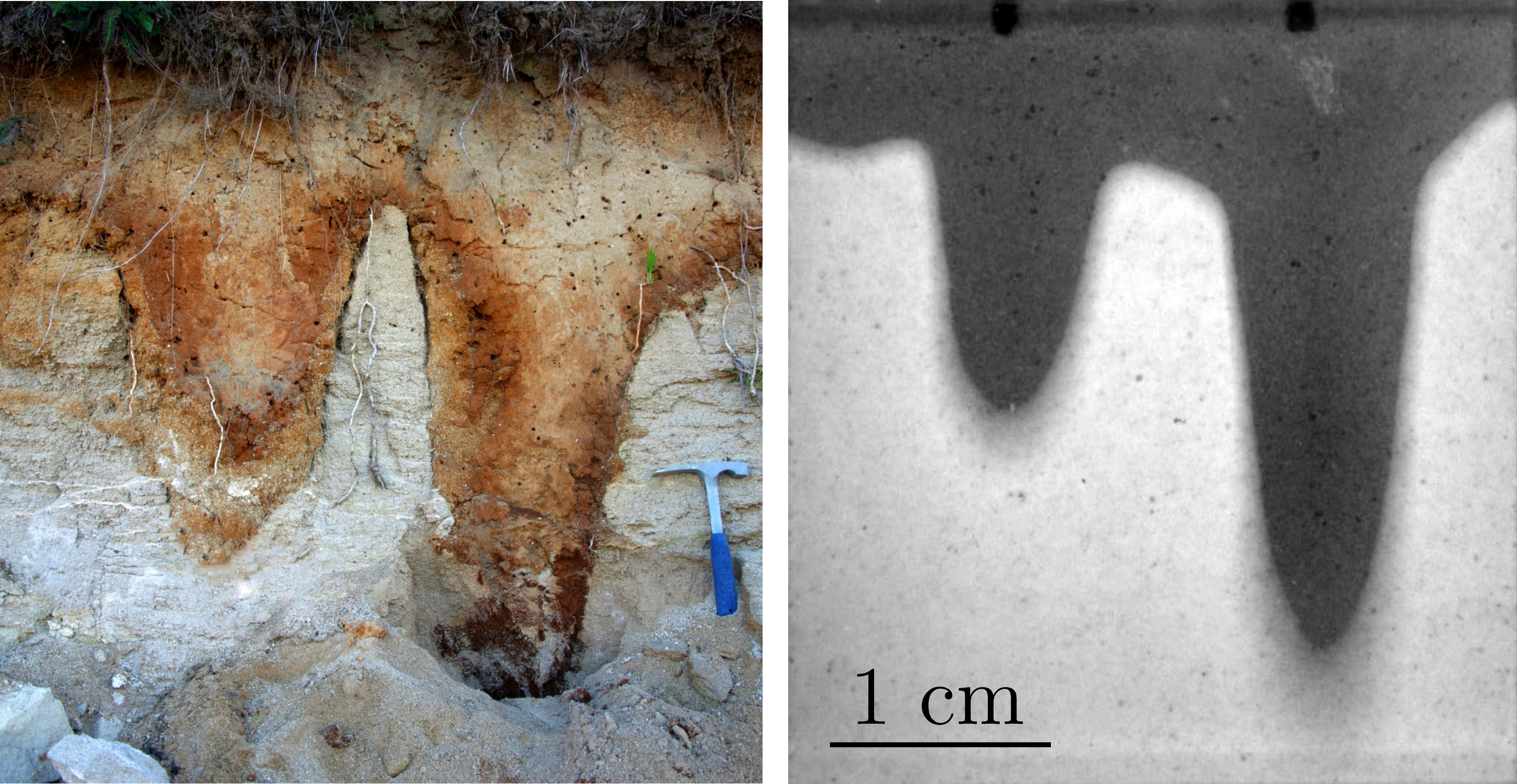
Water reshapes the Earth through slow, powerful erosion, carving intricate landscapes like caves and pinnacles in soluble rocks such as limestone. An international team from the Faculty of Physics at the University of Warsaw, the University of Florida, and the Institute of Earth Sciences in Orléans has discovered that vertical channels, known as karstic solution pipes, preserve a record of Earth’s climatic history. Their study, published in Physical Review Letters, reveals that these pipes evolve with time into an invariant shape, a fixed, ideal form that remains unchanged as the pipes deepen, encoding ancient rainfall patterns.

Using microfluidic experiments, the team mimicked this process in miniature, etching water into channels within gypsum-lined cells. “We observed something striking,” says StanisÅ‚aw Å»ukowski, pursuing PhD at the Faculty of Physics of the University of Warsaw and Université Paris Cité, the first author of the paper. “From a chaotic start, only a few channels survived, each settling into a stable, invariant shape that grew deeper without changing form. This mirrors the behavior of karstic pipes in nature.”

Deriving the mathematical formula for this shape was complex. “Capturing the invariant form required sophisticated mathematical tools, blending fluid dynamics and reactive transport to model how groundwater, driven by rainfall, shapes these pipes,” says Prof. Piotr Szymczak from the Faculty of Physics, University of Warsaw, the corresponding author. “The formula reveals how heavy precipitation accelerates groundwater movement, forming elongated pipes that record in their shape past rainfall conditions.”

Deciphering nature's plan

By studying these shapes, scientists can reconstruct Earth’s climatic past. Understanding these patterns is also crucial for predicting how water moves through underground reservoirs, which has implications for everything from groundwater management to CO₂ storage and even oil recovery.

This study is part of a broader effort to understand how simple physical laws give rise to complex natural structures. Just as snowflakes and river deltas follow mathematical rules, so too do the silent, hidden processes of rock dissolution. The discovery of an invariant shape for dissolution fingers is a step toward deciphering nature’s secret blueprint, one drop of water at a time.

This work was supported by the National Science Centre (NCN, Poland) under the CEUS UNISONO grant no. 2020/02/Y/ST3/00121.


Left: Solution pipes in limestone bedrock in Smerdyna quarry, Poland (photo by P. Szymczak, University of Warsaw). Right: dissolution channels formed in a microfluidic experiment. (photo: University of Warsaw).  

Credit

Left: (photo by P. Szymczak, University of Warsaw). Right: (photo: University of Warsaw).

Faculty of Physics of the University of Warsaw

Physics and astronomy at the University of Warsaw appeared in 1816 as part of the then Faculty of Philosophy. In 1825, the Astronomical Observatory was established. Currently, the Faculty of Physics at the University of Warsaw consists of the following institutes: Experimental Physics, Theoretical Physics, Geophysics, the Department of Mathematical Methods in Physics, and the Astronomical Observatory. The research covers almost all areas of modern physics on scales from quantum to cosmological. The Faculty's research and teaching staff consists of over 250 academic teachers. About 1,100 students and over 170 doctoral students study at the Faculty of Physics UW. The University of Warsaw is among the 300 best universities in the world, educating in the field of physics according to Shanghai’s Global Ranking of Academic Subjects.

SCIENTIFIC PUBLICATION:

StanisÅ‚aw Å»ukowski, Silvana Magni, Florian Osselin, Filip Dutka, Max P. Cooper, Anthony J.C. Ladd, and P. Szymczak, Invariant forms of dissolution fingers, Phys. Rev. Lett., 134, 094101, 2025doi:10.1103/PhysRevLett.134.094101

RELATED WEBSITES WWW:

https://www.fuw.edu.pl/faculty-of-physics-home.html
Website of the Faculty of Physics University of Warsaw

https://www.fuw.edu.pl/press-releases.html
Press service of the Faculty of Physics at the University of Warsaw

GRAPHIC MATERIALS:

FUW250528b_fig01
https://www.fuw.edu.pl/tl_files/press/images/2024/FUW250528b_fig01.jpg Figure 1:  Solution pipes from different locations: (A) Smerdyna, Poland (photo by P. Szymczak, University of Warsaw); (B) Guilderton, Australia (photo by P. Szymczak, University of Warsaw); and (C) Swanscombe, England (photo by J. Rhodes, courtesy of the British Geological Survey).

FUW250528b_fig02
https://www.fuw.edu.pl/tl_files/press/images/2025/FUW250528b_fig02.jpg  
Figure 2: Left: Solution pipes in limestone bedrock in Smerdyna quarry, Poland (photo by P. Szymczak, University of Warsaw). Right: dissolution channels formed in a microfluidic experiment. (photo: University of Warsaw).  


A hundred species, mostly new—first assessment of ribbon worm diversity and distribution in Oman


PeerJ

phylum Nemertea 

image: 

The phylum includes ~1300 described species, but the actual diversity is likely at least 10 times that number, judging from the rate at which we discover undescribed species. Nemerteans are ubiquitous in the marine in the marine environments, but most are cryptobiotic (hard to spot).

view more 

Credit: Svetlana Maslakova


A survey of Oman's marine waters has revealed over 100 species of ribbon worms (Nemertea), marking the first systematic study of these marine predators in Arabian waters. The research, conducted by scientists from the University of Oregon, Moscow State University, and the University of Florida, significantly expands our knowledge of marine biodiversity in the region. Using a combination of morphological studies and DNA barcoding the researchers identified 107 ribbon worm species, 98% of which are undescribed. The research team found that 93% of the discovered species appear unique to Arabian waters. The study effectively doubles the number of genetically characterized ribbon worm species known in the entire Indo-West Pacific — the largest marine biogeographic region on Earth.

"This highlights how much we still have to learn about marine biodiversity in this region, and the tropics, more generally," says lead researcher Dr. Svetlana Maslakova from the Oregon Institute of Marine Biology. The research revealed little species overlap between the Gulf of Oman and the Sea of Arabia.

These findings provide valuable insights into the region's marine biogeography and could inform future conservation efforts. The study's findings also have potential implications for biomedical research, as ribbon worms are known to produce various bioactive compounds.

The team's analysis suggests that Oman's marine ecosystems may harbor approximately 200 additional undiscovered nemertean species, particularly in unexplored soft-bottom habitats and the water column. This estimate emphasizes the importance of continued biodiversity research in the world’s oceans.

About the Research Team

The study represents a collaboration between scientists from the University of Oregon's Oregon Institute of Marine Biology, Moscow State University, and the Florida Museum of Natural History at the University of Florida.