Tuesday, June 03, 2025

As Tesla stalls across Europe, sales rise in Norway


By AFP
June 2, 2025


Norwegians have flocked back to Tesla as it offered zero-interest loans and a new Model Y - Copyright AFP/File Michael Tran

Tesla sales have rebounded in Norway this year, official figures showed Monday, bucking a broader European trend as consumers turn away from Elon Musk’s electric car brand.

Norwegians have flocked back to the US brand as it offered zero-interest loans and a new Model Y, the best-selling car in the country for three months running.

Norway is the country with the highest proportion of election vehicles (EV), making up 93.9 percent of new car registrations in May, according to the Norwegian Road Federation (OFV).

EVs made up 92.7 percent of new car registrations in the first five months of the year.

Tesla regained the title of leading car brand in the Scandinavian country in May, tripling its sales and accounting for 18.2 percent of new cars sold.

For the first five months of the year, Tesla sales increased by 8.3 percent — lower than the overall new car market which grew by 30.6 percent.

Over that period, Tesla had a market share of 12.9 percent, second to German auto giant Volkswagen.

Tesla sales fell by half in the European Union in April, according to the European Automobile Manufacturers’ Association (ACEA).

The company’s EU market share dropped to 1.1 percent amid growing competition from Chinese rivals and consumers protesting Musk’s politics and ties to US President Donald Trump.

“Looking at Tesla sales in Norway in May and for the year so far, we stand out from the rest of Europe, where sales of this brand have seen a noticeable decline,” OFV director Oyvind Solberg Thorsen said in a statement.

Jonathan Parr, an analyst at used-car dealer Rebil, told broadcaster TV2 that “ultimately, it’s the price that Norwegian motorists care about most.”

“Norwegians don’t like Musk but feel no shame owning a Tesla,” Parr explained.

In recent months, Norwegian media have nonetheless reported several stories of Tesla owners deciding to part ways with their cars or refrain from buying another Tesla.

Norway, the largest oil producer in Western Europe, has adopted a goal that this year all new cars should be zero-emission vehicles.


CRIMINAL CAPITALI$M

EU hits food delivery company Delivery Hero with 329 mn-euro-fine

PRICE FIXING IS PRICE GOUGING


By AFP
June 2, 2025


The EU said Delivery Hero and its subsidiary Glovo admitted their involvement in a cartel and said they would pay the fines to settle the case - Copyright AFP/File Michael Tran

The EU on Monday slapped German food delivery company Delivery Hero and its Spanish subsidiary Glovo with a fine worth 329 million euros ($376 million) after they violated antitrust rules.

EU regulators concluded Delivery Hero used its stake in Glovo between 2018 and 2022 to limit competition by exchanging sensitive information, agreeing not to poach each other’s employees, and to divide among themselves national markets for food delivery.

Based in Germany, Delivery Hero has held a 94 percent stake in Spain’s Glovo since July 2022, but the EU’s formal probe — launched last year — focuses on the period before it took sole control.

They are two of the biggest food delivery companies in Europe, delivering meals from restaurants, grocery shopping and other non-food products to customers at home ordering via their apps or websites.

The European Commission, which acts as the EU’s competition watchdog, said the two companies admitted their involvement in the cartel and agreed to pay the fines to settle the case.

“Cartels like this reduce choice for consumers and business partners, reduce opportunities for employees and reduce incentives to compete and innovate,” it said.

Delivery Hero will have to pay a fine worth 223 million euros, while Glovo must pay around 106 million euros, the commission said.

“This case is important because these practices were facilitated through an anticompetitive use of Delivery Hero’s minority stake in Glovo,” EU competition chief Teresa Ribera said in a statement.

The two companies had agreed not to actively steal each other’s employees, initially covering managers before it was extended to all staff including logistics experts.

Their agreement did not cover delivery drivers who were not employees at the time of the infringements, but classified as self-employed.

The EU’s decision is the first where the commission finds a cartel in the labour market and Ribera said it was “also the first time the Commission is sanctioning a no-poach agreement, where companies stop competing for the best talent and reduce opportunities for workers”.

– Cartel by WhatsApp –


The two companies exchanged commercially sensitive information regarding prices and costs via email as well as WhatsApp chats where, for example, officials would discuss which markets to enter.

The commission said Delivery Hero and Glovo agreed to avoid entering countries where one company was already present, and coordinated which one should enter in markets where neither had a presence yet.

As of July 2020, the two companies had fully ceased to compete with each other by carefully avoiding being present in the same markets, reducing consumer choice and thus contributing to higher prices.

Delivery Hero confirmed it had reached a settlement agreement with the commission in the antitrust probe, saying it had already set aside a provision for the fine.

“Today’s settlement allows Delivery Hero to address the European Commission’s concerns while allowing stakeholders to move on swiftly,” it said in a statement.

Delivery Hero provides its services in more than 70 countries worldwide including 16 from the European Economic area (EEA) including the EU’s 27 states as well as Iceland, Liechtenstein, and Norway.

Glovo, now Delivery Hero’s subsidiary, is present in over 20 countries worldwide, including eight in the EEA.


Amazon price rules anti-competitive: German regulator


By AFP
June 2, 2025


Amazon accounts for about 60 percent of online retail revenue in Germany, according to the country's competition watchdog - Copyright AFP/File Michael Tran

Amazon’s pricing rules are an abuse of its market power, Germany’s competition watchdog said Monday, paving the way for possible demands for changes to its business practices in Europe’s biggest economy.

Amazon forces third-party sellers who use its platform to keep prices within limits that the tech giant sets, the Federal Cartel Office said in a statement, reducing the visibility of products that do not keep to its rules or even removing them entirely.

“Since Amazon competes directly with other marketplace retailers on its platform, influencing competitors’ pricing, including in the form of price caps, is highly questionable,” said Andreas Mundt, head of the regulator.

“That is especially so when the traders concerned cannot cover their own costs.”

Amazon, which according to the cartel office accounts for about 60 percent of online retail revenue in Germany, now has the opportunity to respond to the regulator’s preliminary ruling.

A spokeswoman for Amazon said it strongly disputed the cartel office’s findings and that its rules helped its customers.

“Shopping on Amazon is designed so that customers who visit our store can trust that they will find the best deal based on price, availability and speed of delivery,” the spokeswoman said.

“That is why they keep coming back.”

Amazon is facing other allegations of anti-competitive behaviour, with US regulators accusing the online giant of preventing sellers from offering products at lower prices on other platforms.

Germany’s cartel office began investigating Amazon’s pricing rules in November 2022.
Homeless seek refuge at Madrid airport as rents soar


By AFP
June 2, 2025


A recent survey by a Catholic charity found that more than 400 people were sleeping rough in Madrid's airport - Copyright AFP OSCAR DEL POZO

Alfons LUNA

Victor Fernando Meza works during the day, but his salary is not enough to afford rent in the Spanish capital Madrid. So, once again, the 45-year-old Peruvian will spend the night at the airport.

On a sweltering May evening, Meza arrived at Barajas airport before 9:00 pm — just in time to get past security. Any later, and people without a boarding pass are not allowed in under a new policy implemented a week ago to deter the hundreds of homeless people staying overnight.

The measure aims to address the rising number of people sleeping in Spain’s busiest airport — a situation thrust into the spotlight by images showing rows of people lying on the floor among bags and shopping carts, sparking a blame game between government officials.

Those who call Barajas home say the increased scrutiny in Europe’s fifth busiest airport is unwelcome.

They doubt solutions will come and fear losing what they see as the safest place to sleep, compared to the streets or the metro in a city where homeless shelters have limited capacity.

“We just want to be left alone,” Meza told AFP. “To be treated like people, not animals.”

Meza blames Aena, the state-owned company that manages Spanish airports, for mishandling the humanitarian situation that has also occurred to a lesser extent in Barcelona, Gran Canaria, Malaga, Palma de Mallorca and Tenerife.

Aena argues its facilities were never meant to house hundreds of homeless people.


– ‘Look down on you’ –


Meza said the Barajas security guards know those who cause trouble in the airport.

“The ones who smoke, the ones who drink every day. They should be the ones kicked out, not all of us,” he said.

Meza works occasional moving jobs and is hoping to save enough to rent an apartment with his brother. But like elsewhere in Spain, housing prices in the capital have soared and social housing is scarce.

The average monthly rent for a 60-square-metre (645-square-foot) apartment in Madrid has almost doubled to 1,300 euros ($1,415) from about 690 euros a decade ago, according to figures from real estate website Idealista.

Sleeping in Madrid’s airport has taken a toll on Meza.

“People look down on you, there’s still a lot of racism here,” he said, adding that he plans to return to Peru when he turns 50.

Zow, a 62-year-old construction worker from Mali who spends his nights at Barcelona’s airport, is also weary of the stares he gets.

“I don’t like sleeping here. It’s awful, everyone looks at you like this,” he said, imitating a look of disdain.


– Blame game –


Around 421 people were sleeping rough at Madrid’s airport in March, a survey by a Catholic charity group counted. Most were men, half had been sleeping at the airport for over six months and 38 percent said they had a job.

Nearly all of them would leave the airport during the day.

The issue has exposed deep divisions among the institutions tasked with addressing homelessness.

City and regional governments in Madrid have clashed with Aena, which operates under the control of Prime Minister Pedro Sanchez’s Socialist administration.

“Primary social care is the responsibility of the local government,” Aena said in a statement, adding the city must fulfil its “legal duty to care for vulnerable populations”.

Madrid’s conservative Mayor Jose Luis Martinez-Almeida fired back, arguing that the central government controls Aena and “what’s happening depends on several ministries”.

The city insists that most of those sleeping in the airport are foreigners who should fall under Spain’s international protection system.

Despite the finger-pointing, both sides have agreed to hire a consultancy to count and profile those sleeping at the airport. The study results are expected by the end of June.

But Meza is sceptical.

“We don’t want help. We don’t want anything. We just don’t want to be bothered,” he said.


‘Moving forward’: the Gen-Z farmer growing Fukushima kiwis


By AFP
May 31, 2025


Takuya Haraguchi is hoping to revitalise agriculture in the Fukushima area by growing kiwi fruit - Copyright AFP Richard A. Brooks


Hiroshi HIYAMA

A short drive from the Fukushima nuclear disaster site, novice farmer Takuya Haraguchi tends to his kiwi saplings under the spring sunshine, bringing life back to a former no-go zone.

Haraguchi was 11 years old when Japan’s strongest earthquake on record struck in March 2011, unleashing a tsunami that left 18,500 people dead or missing.

The wall of water crashed into the Fukushima nuclear plant on the northeast coast, causing a devastating meltdown.

At the time the bookish young Haraguchi, who grew up far away in Osaka, feared that radiation would make the whole country uninhabitable.

But now, aged 25, the new resident of the rural town of Okuma says he believes in the future of Fukushima region.

“Everyone knows about the nuclear accident. But not many people know about this area, and how it’s moving forward,” Haraguchi, tanned from working on his farm, told AFP.

“By growing kiwis here, I want people to take an interest in and learn about what Fukushima is really like these days.”

The region of Fukushima is renowned for its delicious fruit, from pears to peaches, but the nuclear disaster led many people in Japan to shun produce grown there.

Just over 14 years later, following extensive decontamination work including stripping an entire layer of soil from farmland, authorities say food from Fukushima is safe, having been rigorously screened for radiation.

Last year Fukushima peaches were sold at London’s Harrods department store, while in Japan some consumers now choose to buy the region’s produce to support struggling farmers.

“The safety has been proven,” said Haraguchi, who often sports a kiwi-print bucket hat. “I think it’s important that we do it here.”


– Starting from ‘zero’ –


Haraguchi studied software engineering at university but dreamed of becoming a fruit farmer.

He first visited Okuma in 2021 for an event targeted at students, and met residents trying to bring back kiwi farming in an effort to rebuild their community.

He also met a veteran farmer, who moved away after the disaster and whose kiwis’ rich flavour left him stunned.

Inspired, Haraguchi returned many times for research before starting his venture, called ReFruits, with a business partner who recently graduated from university in Tokyo.

They manage 2.5 hectares (six acres) of land, and hope to harvest their first kiwis next year.

Haraguchi regards the destruction seen by the Fukushima region not as a blight, but an opportunity.

“Because it went to zero once, we can try and test all sorts of challenging new ideas,” he said.

After the disaster, nuclear fallout forced all of Okuma’s 11,000 residents to flee their homes.

Overall across Fukushima region, around 80,000 people were ordered to evacuate for their safety, while the same number again left voluntarily, authorities say.

Since then the stricken plant’s reactors have been stabilised, although decommissioning work is expected to take decades.

Sections of Okuma, previously a no-go zone, were declared safe for residents to start to return in 2019.

Only a fraction of its previous population has come back — but young outsiders like Haraguchi are moving there, taking advantage of government subsidies for things like housing and business assistance.

Now, of around 1,500 people living in Okuma, more than 1,000 are newcomers, including hundreds who work on the plant but also agriculture and even tech start-ups.


– Radiation tests –


Today dozens of sensors monitor radiation levels in Okuma, which are within officially set safety limits, but still higher than in areas far from the nuclear plant.

Some parts, such as unused hillsides, remain off-limits.

On Haraguchi’s farm, soil tests show a slightly elevated level of radiation that meets an internationally accepted food standard.

Tests on fruit from Fukushima have also shown that the radiation levels are low enough for consumption, the government says.

Kaori Suzuki, who leads the non-profit citizen science group “Mothers’ Radiation Lab Fukushima – TARACHINE”, warns however that risks could remain now and in the future.

Among other activities, her group conducts its own radiation tests on Fukushima’s soil and food to help residents who are choosing local products to consume.

Although “it’s up to individuals to decide what to eat… it’s better to be cautious, because people have become more relaxed”, she said.

Haraguchi, who is travelling internationally to share his story and that of the region, hopes his work could eventually ease concerns about Fukushima’s fruit.

“We don’t need to force our products on people who are uneasy about this place and its crops,” he said, adding that he was committed to transparency.

“We need to sell our products to people who understand.”

Recycling contaminated soil from Fukushima: Japan’s dilemma


By AFP
June 1, 2025


Topsoil was collected as part of large-scale decontamination efforts after the devastating meltdown at the Fukushima Daiichi nuclear plant - Copyright AFP Richard A. Brooks


Hiroshi HIYAMA

To reduce radiation across Japan’s northern Fukushima region after the 2011 nuclear disaster, authorities scraped a layer of contaminated soil from swathes of land.

Now, as young farmers seek to bring life back to the region once known for its delicious fruit, authorities are deliberating what to do with the mass of removed soil — enough to fill more than 10 baseball stadiums.

Here are some key things to know:

– Why was the soil removed? –

On March 11, 2011, Japan’s strongest earthquake on record triggered a huge tsunami that hit the Fukushima Daiichi nuclear plant, causing a devastating meltdown.

Topsoil was collected as part of large-scale decontamination efforts that also included blasting buildings and roads with high-pressure jets of water.

Almost all areas of Fukushima have gradually been declared safe, but many evacuees have been reluctant to return because they remain worried about radiation, or have fully resettled elsewhere.

Fukushima has, however, welcomed new residents such as 25-year-old kiwi farmer Takuya Haraguchi.

“I want people to become interested in and learn about what Fukushima is really like these days,” he told AFP.

– Where is the soil being stored? –

A vast quantity of soil — 14 million cubic metres — is being stored at interim storage facilities near the Fukushima Daiichi plant.

The government has promised residents of Fukushima region that it will find permanent storage for the soil elsewhere in the country by 2045.

For now, the huge mounds are kept inside guarded grounds, protected by layers of clean soil and a manmade sheet to prevent runoff into the environment.

– What will Japan do with it? –

The government wants to use the soil for building road and railway embankments among other projects.

It has vowed to do this outside Fukushima to avoid further burdening the region, where the crippled nuclear plant generated electricity not for local residents, but for Tokyo and its surrounding urban areas.

So far few takers have been found in other parts of Japan, and some local officials suggest that realistically, a portion of the soil may need to stay in Fukushima.

The prime minister’s office recently said it would symbolically recycle some of the soil to show it is safe, with reports saying it will be used in flower beds.

– How safe is the soil? –

Around 75 percent of the stored soil has a radioactivity level equivalent to or less than one X-ray per year for people who directly stand on or work with it, according to the environment ministry.

Asphalt, farm soil or layers of other materials should be used to seal in the radioactivity, said Akira Asakawa, a ministry official working on the Fukushima soil project.

In a test, the government has constructed roads and fields in Fukushima by using the contaminated soil as filling material.

Those locations did not show elevated levels of radioactivity, and there was no runoff of radioactive material to surrounding areas, Asakawa said.

– What pushback has there been? –

In 2022, local communities reacted angrily to plans floated by the national government to bring the Fukushima soil to a popular park in Tokyo and other areas near the capital.

That plan has not moved forward and other locations have not yet been secured, despite public sympathy for the people of Fukushima.

The environment ministry says it will step up efforts to explain the safety of its plan to the public from this year.

Review: Bernie Sanders bangs a rebellious drum in London


By Dr. Tim Sandle
May 31, 2025
DIGITAL JOURNAL


Senator Bernie Sanders speaking in London. Image by Tim Sandle

Technology has an uncertain future. If we leave it in the hands of the likes of Elon Musk and other oligarchs, it will be only to the benefit of billionaires. Whereas, if we gain control of its trajectory then it can be harnessed for the benefit of working people. This was one of the core messages that Senator Bernie Sanders delivered to a packed audience at London’s Westminster Hall on May 30, 2025.

Interviewed by broadcaster James O’Brien (LBC Radio), and with popular British left-wing independent politician Jeremy Corbyn in the audience, Sanders was in inspiring form, passionately discussing U.S. politics and the major situations affecting the world today.

Audience in London preparing to hear Bernie Sanders. Image by Tim Sandle

Sanders summarised his primary concerns as: “How can we accept an economic order that allows three billionaires to control more wealth than the bottom half of our society? How can we accept a political system that allows the super-rich to buy elections and politicians? How can we accept an energy system that rewards the fossil fuel corporations causing the climate crisis? How can we let it happen any longer? We must demand fundamental economic and political change.”

Bernie Sanders has served as a senator from Vermont since 2007. He is an independent and a self-described democratic socialist. During his run for the 2016 presidency, Sanders’ policies emphasised reducing economic inequality and expanding social programs and workers’ rights.

Sander’s most recent book is It’s OK To Be Angry About Capitalism, where he attempts to channel positivity against the forces that seek to wreck the lives of everyday people by championing social change.

The centre of the oligarchy in the U.S. today, stated Sanders, is Donald Trump. According to Sanders, Trump is simply in office to consolidate wealth and power according to his interests and for his associates.

Badges handed out at Bernie Sanders’ presentation in London – highlighting the risk Elon Musk presents to democracy. Image by Tim Sandle.

As well as charting the development of technology, Sanders also laid his wrath into Musk’s actions in the White House, notably the ‘obscene’ act of the world’s richest man laying of federal employees who spent their time trying to alleviate the woes of the majority working class population across the U.S.

The importance of protecting the environment also featured heavily. Sanders said that building a green future is possible if the agenda can be wrestled away from the big energy firms, claiming there was still time to build an alternative energy programme that would help to sustain the planet if the process ceased to be dominated by multinationals focused on short-term profits.

Sanders also discussed the actions of Israel, emphasising it was permissible to critique Israel’s government and her actions without being called out as anti-Semitic. With Benjamin Netanyahu’s government, and the situation in Ukraine, Sanders was especially critical of what he sees as the lies spouted by President Trump.


“In my view, the United States must seek partnerships not just between governments, but between peoples. A sensible and effective foreign policy recognizes that our safety and welfare is bound up with the safety and welfare of others around the world.”

Sanders’ critique was infused with hope – the potential exists to build a better world if Trump can be blocked (the best option being the Democrats regaining control of Congress in the mid-terms). However, to truly achieve change, Sanders said that social democratic parties – like the Democrats and the Labour Party in the UK – need to stop telling the populace that they can reform the status quo. Instead, a radical vision needs to be offered.

Bernie Sanders in conversation with LBC Radio’s James O’Brien. Image by Tim Sandle

This needs to start with parties of the left admitting that the system cannot deliver affordable healthcare and affordable homes, or protect jobs; instead, a new way of doing things is required. As presented by Sanders, this is an interventionist economy, pro-environment and pro-workers rights. In other words, what most would call socialism.


“We must stand tall against global oligarchy, authoritarianism, devastating attacks against the working class and the existential threat of climate change. This is a moment of enormous consequence in world history. If we stand together, we can win“.
Ecuador apologizes to farm workers deemed to live like slaves

By AFP
May 31, 2025


A man in Ecuador holds up a shirt with the slogan 'Furukawa, never again,' alluding to a Japanese textile firm found to have abused its workers - Copyright AFP Galo Paguay

Ecuador’s government apologized Saturday to some 300 people who worked as farmers for a Japanese textile firm in conditions which a court likened to modern-day slavery.

These people worked on plantations that produced abaca, a fiber used in textiles and the auto industry.

As of 2021, Furukawa’s plantations for abaca covered almost 23,000 hectares spread over three provinces on the Pacific coast, where the majority of the population is Black.

Some workers gave birth to children in unsanitary and overcrowded camps, while others were denied proper medical attention after work-related injuries, according to testimony given at a news conference in Quito back in December.

That month the Constitutional Court ordered Furukawa to pay $120,000 to each of 342 victims — a total of around $41 million. The company was also ordered to make a public apology to them. It has not complied with either order.

The court said that over the course of five years Furukawa had people living in conditions of modern-day slavery in its abaca fields.

It also ordered the government to apologize to the workers, and that is what happened Saturday.

The company violated “national and international regulations that affected, in essence, human dignity,” Labor Minister Ivonne Nunez said.

She said “the state, through the various ministries, as the sentence explains, turned a deaf ear” to the plight of the abused workers.

Nunez spoke at a ceremony with other government ministers at Quito’s Independence Plaza, as ex-Furukawa workers chanted slogans such as “reparations, reparations” and “modern slavery, never again.”

After the court ruling, Furukawa said it does not have the money to pay the damages ordered by the tribunal and called them disproportionate.

Back in December, at a meeting at a human rights group’s headquarters, plantation workers told horror stories of their lives raising abaca.

“We have been confronting the monster that is Furukawa,” Segundo Ordonez, a 59-year-old farmer, said at the meeting.
Donald Trump's corruption is all Ronald Reagan's fault

Thom Hartmann
June 2, 2025 
COMMON DREAMS


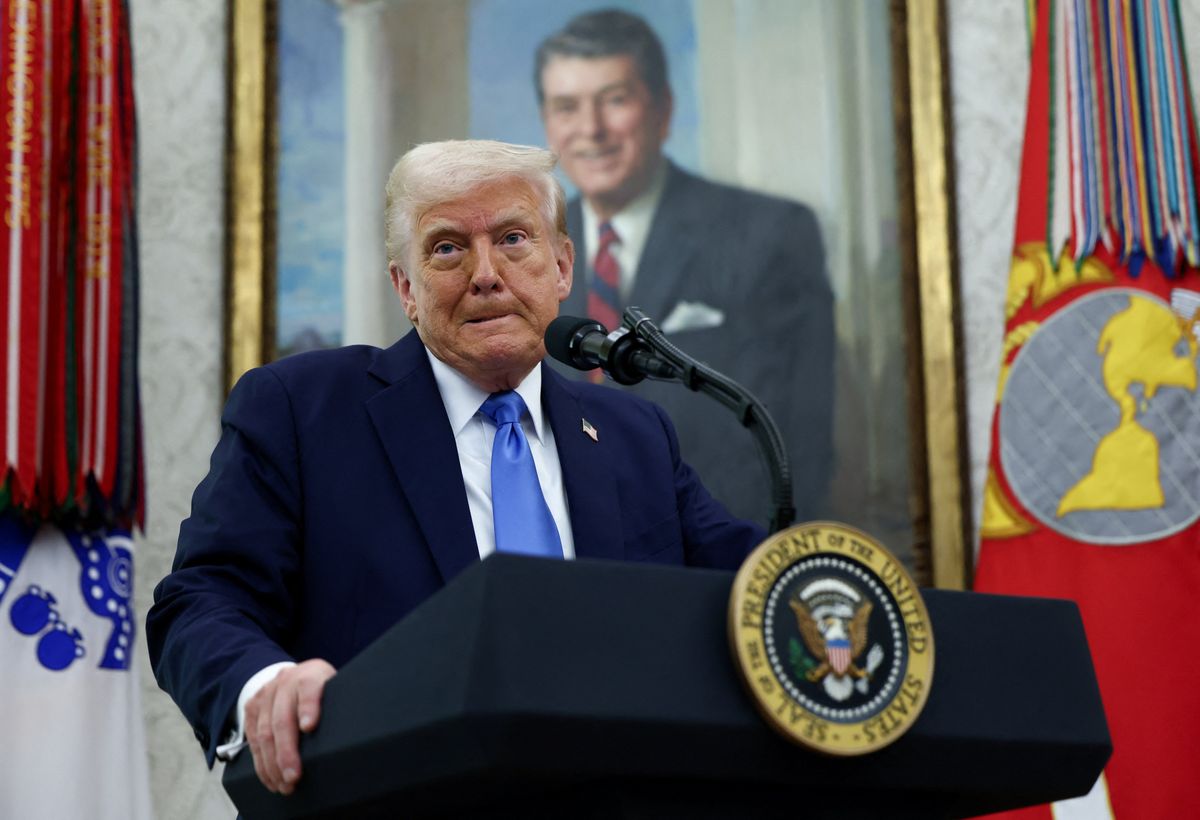
Donald Trump participates in a swearing-in ceremony in the Oval Office. REUTERS/Evelyn Hockstein

Recently, I wrote about how the mental illness of hoarding syndrome afflicting a few hundred of our nation’s rightwing billionaires has destroyed a large chunk of the American middle class and is threatening the health of our biosphere. But the overall story is larger than just that.

Donald Trump is embroiled in a bribery scandal that has the entire world agog. The potentates and dictators of the Middle East are openly contemptuous of his willingness to defy Congress and sell them advanced American weapons systems in exchange for billion-dollar Trump hotels in their countries.

Vladimir Putin and his state-owned media ridicules Trump daily, pushing his attacks on Ukraine in Trump’s face. And federal workers and our military are aghast at the incompetence, corruption, and even the alleged alcoholism of the people Trump has scraped off the floor of Fox “News” to run their agencies and make federal prosecutors.

All of this corruption and incompetence has one major goal: the enrichment of the Trump family and the people close to them. It’s an old, old story, that dates back to the earliest days of human prehistory.

There are basically two models for social organization, regardless of all the names. They are “me societies” and “we societies.”

Russia, for example, is today a classic example of a “me society.” The nation is run by a small cabal of “me-me-me” oligarchs, who own or control basically every major company and, in most cases, entire industrial, commercial, media, and retail sectors. Each is owned by one or more morbidly rich individuals and their families, who are looking out for their own “me” interests (profits) with little regard for the public good.

The country’s leader glorifies the individual above society, arguing that governance by hyper-masculine elites (“me”) willing to use state violence against those advocating democracy and the welfare of the general population (“we”) is simply The Way It’s Always Been. (Putin refers to this as “Russia’s historic greatness.”)

And in that, Putin is right. The majority of post-agricultural-revolution history (the past 7,000 or so years) has been a narrative of what Thomas Jefferson referred to as the three great tyrannies: warlord kings, the morbidly rich keeping average people in squalor and ignorance, and violence-enforced theocracies.

As Jefferson noted in A Summary View of the Rights of British America (1774):
“History has informed us that bodies of men, as well as of individuals, are susceptible of the spirit of tyranny.”


On the other hand, as I lay out in detail in my new book The Hidden History of American Democracy: Rediscovering Humanity’s Ancient Way of Living, the majority of those societies that emerged from tens of thousands of years of trial-and-error experimentation in governance were and even today still are explicitly “we societies.”


Native American societies that informed and inspired this nation’s Founders and the Framers of the Constitution, for example, considered the accumulation of great wealth — hoarding — to be a dangerous mental illness, right up there with forcible theft, rape, and murder.

People who hoarded food or other forms of wealth were disciplined and, if they continued, often banished from the tribe altogether (which could be a functional death sentence, as no other tribes would take such twisted people in).

The Algonquin people had a word for this mental illness, as I describe in The Last Hours of Ancient Sunlight. In today’s English, we could loosely translate their word “Wétiko” as “greed.”


The late Professor of Native American Studies at UC Davis Jack Forbes told me, when I was writing Last Hours, that Wétiko literally means “cannibal,” and Forbes uses it quite intentionally to describe European standards of culture: we “eat” (consume) other humans by conquering them, seizing their lands, and consuming their life-force by enslaving them either physically or economically.

For example, the Lakota term “Wasi’chu” described individuals who hoard resources, literally translating to “he who takes the fat.” The term critiques greed and the accumulation of wealth at the expense of communal well-being.

And this was common all over the world; the Batek, an Indigenous group in Malaysia, consider sharing food a moral duty. They believe all food belongs to the forest, and hoarding is socially unacceptable. If someone hoards food, others may take it without it being considered theft. Refusing to share can lead to communal anger and is believed to cause supernatural harm to the refuser.


In Aboriginal Australian communities, “humbugging” refers to making excessive demands on family or community resources, often leading to financial abuse. While sharing is a cultural norm, humbugging is viewed negatively and has prompted legal and community responses to protect vulnerable individuals, especially elders.

In my previous column, I noted how so many of America’s billionaires are infected with this mental illness which humanity once found disgusting: Today we call it “Hoarding Syndrome,” considered a subset of Obsessive Compulsive Disorder (OCD) until 2013 when the APA gave it its own specific descriptor in the Diagnostic and Statistical Manual (DSM).

Had they been born poor or not gotten a lucky break, they’d be living in apartments with newspapers and empty tin cans stacked floor-to-ceiling.


Instead, they’ve hoarded wealth beyond the imagination of most people. Estates all around the world, yachts, private jets: there’s never “enough” for them.

Society has known about this mental illness forever. Dante, Shakespeare, Gogol, Balzac, and Dickens all wrote of wealthy characters who disrupted society and the lives of those around them because of their own Hoarding Disorders.

Embracing that indigenous wisdom, many of the idealists who started this country explicitly rejected rule by the rich. None were dynastically wealthy: not a single one of our Founders' wealth lasted beyond a second or third generation, unlike today’s billionaires, whose families will carry their wealth for centuries to come. Several, like Jefferson and George Washington, died in or near bankruptcy.


The most outspoken in this regard were Benjamin Franklin, Tom Paine, Jefferson, and Benjamin Rush: they were clear that they were trying — within the social limits of their time — to create a “we society.”

The Constitution refers to “the general welfare” of Americans twice, once in the Preamble, defining it as one of the basic reasons for the Constitution itself, and once in Article 1, Section 8, defining the powers of Congress to raise taxes and spend money “to provide for … the general Welfare of the United States…”

Over the centuries the concept of a “we society” expanded here in America, as the voting franchise and individual human rights were expanded and extended beyond wealthy, land-owning straight white men.

Progressive Republican President Abraham Lincoln, for example, enthusiastically signed the Morrill Act on July 2, 1862, giving each of the states 90,000 acres of federal land to use to fund and build 76 tuition-free land-grant colleges so young people could climb out of poverty through free education. My mother’s alma mater, Michigan State University, was one of them.


But the “me society” rich of the day kept trying to corrupt politics to their own advantage. In his 1888 State of the Union address, President Grover Cleveland pointed out:
“We view with pride and satisfaction this bright picture of our country’s growth and prosperity, while only a closer scrutiny develops a somber shading. …

“We discover that the fortunes realized by our manufacturers are no longer solely the reward of sturdy industry and enlightened foresight, but that they … are largely built upon undue exactions from the masses of our people. The gulf between employers and the employed is constantly widening, and classes are rapidly forming, one comprising the very rich and powerful, while in another are found the toiling poor.”


And what was causing this crisis for America’s 19th-century working-class families? Cleveland laid it out with a surprisingly blunt vehemence in the next sentences:
“As we view the achievements of aggregated capital, we discover the existence of trusts, combinations, and monopolies, while the citizen is struggling far in the rear or is trampled to death beneath an iron heel. Corporations, which should be the carefully restrained creatures of the law and the servants of the people, are fast becoming the people’s masters.”


The people — and Congress — were listening to this critique of the “me society” that was emerging with the industrial revolution. Americans were outraged at the way corporations and the morbidly rich were behaving, and President Cleveland had given voice to their anger. A mere two years later the Sherman Anti-Trust Act of 1890 was passed, criminalizing monopolies (called “trusts” back then).


A short two decades later, progressive Republican presidents Teddy Roosevelt and William Howard Taft were using that same law to break hoarder John D. Rockefeller’s Standard Oil Trust into almost 30 pieces.

Roosevelt was clear that he wanted to move America closer to the “we society” that he believed the Founders envisioned and the times demanded. On August 31, 1910, he told an audience in Osawatomie, Kansas:
“The citizens of the United States must effectively control the mighty commercial forces which they have called into being. There can be no effective control of corporations while their political activity remains. To put an end to it will be neither a short nor an easy task, but it can be done.”


During Roosevelt’s tenure, with widespread public support, states and the US Congress began passing powerful laws to limit the corrupting power of the morbidly rich’s “me society” money in politics.

In 1905, for example, Wisconsin passed a law (Section 4489a, Sec. 1, ch. 492, 1905) that explicitly said:
“No corporation doing business in this state shall pay or contribute, or offer, consent or agree to pay or contribute, directly or indirectly, any money, property, free service of its officers or employees or thing of value to any political party, organization, committee or individual for any political purpose whatsoever, or for the purpose of influencing legislation of any kind, or to promote or defeat the candidacy of any person for nomination, appointment or election to any political office.” (emphasis added)


The penalty included a substantial fine, years in prison for individual executives, lawyers, or lobbyists, and the political death sentence of the corporation itself, ie being forbidden from doing business in Wisconsin.

Two years later, efforts to control “me society” bad behavior by rich people and corporations went federal with the Tillman Act of 1907. That law explicitly forbadeany corporation nationwide from giving any money to politicians:
“It is unlawful for any national bank, or any corporation organized by authority of any law of Congress, to make a contribution or expenditure in connection with any election to any political office…” (emphasis added)


By 1925, the Tillman Act had been incorporated into the Federal Corrupt Practices Act, further limiting money in politics, and in 1938 we got the Hatch Act which limited contributions from rich people to $5,000 per candidate and $3 million per party and made it an explicit crime for a president to use the White House to hawk commercial property like Teslas, meme coins, or Goya beans.

Following the Spiro Agnew and Richard Nixon bribery scandals we got another bunch of laws to regulate money in politics, including the 1971 Federal Election Campaign Act and the 1974 creation of the Federal Elections Commission, which promulgated rules further limiting “dark money” and other forms of political bribery.

These modern efforts to establish a “we society” had deep roots in Teddy Roosevelt’s presidency, and largely answer the question about why Congress got so much done for average working people (Social Security, Medicare, Medicaid, minimum wage, OSHA, EPA, right to unionize, etc.) between 1933 and 1978.

Expanding on the idea of that “we society,” in an August 1912 speech in Chicago, Roosevelt called for a national minimum wage and government programs for social security, saying working people shouldn’t earn so little that they must steal food and couldn’t provide for their families, deal with illness, or have a safe, comfortable retirement.

The fulfillment of his vision came a generation later when his distant cousin, Democrat Franklin D. Roosevelt, pushed through his New Deal. He legalized unions, passed a minimum wage law, and started Social Security, among other things.

Throughout the 1950s, Republican President Dwight Eisenhower expanded all of these “we society” laws and added massive national infrastructure projects with huge expenditures on highways, schools, and hospitals that jump-started the postwar economy.

In the 1960s, Democratic President Lyndon Johnson added Medicare, Medicaid, food stamps, housing supports, and increased support for education.

America was not only on the path to becoming a “we society”: we were more than halfway there. By 1980 two-thirds of Americans were solidly in the middle class with a single income, healthcare was affordable, union membership was widespread, college was free or very inexpensive in most of the country, and the morbidly rich hoarders were kept under control with a top 74 percent income tax bracket.

The rest of the world was imitating us back then as Western Europe, in particular, expanded on the “we society” programs of TR, FDR, Harry Truman, Ike, JFK, and LBJ. Even little Costa Rica provided healthcare to all its citizens with a Medicare For All type of program and nearly free college (maximum tuition $600 a year) for anybody who can pass the entrance exams.

But then came Ronald Reagan with his neoliberal “me society” sales pitch that “greed is good” and the only sure path to national and individual prosperity was to free corporations and the morbidly rich from the strictures of taxation and regulation.

With Reagan‘s help, the hoarder syndrome billionaires took over politics and began to systematically loot America’s economy.

In the forty-four years since his inauguration, America’s middle class has shrunk from two-thirds of us down to around 45 percent of us, and even at that today it takes two incomes to match the lifestyle a single income could sustain in 1980.

America’s richest people, however, have now reached a level of wealth never before seen in the history of the world, not even by kings, pharaohs, or popes.

I lay out how Reagan got there in detail in The Hidden History of Neoliberalism: How Reaganism Gutted America, but the main event that made the Reagan Revolution and Reagan’s neoliberal successors (including Bill Clinton and Barack Obama) possible was the Supreme Court overturning the Tillman Act and legalizing political bribery in a series of decisions that started in 1976 and peaked when Clarence Thomas cast the tie-breaking vote in Citizens United in 2010.

This betrayal by Republicans on the Supreme Court of America’s “we society” values, described in detail in The Hidden History of the Supreme Court and the Betrayal of America, has caused our country to fall far behind most of the rest of the world’s advanced democracies.

For America to fulfill her promise and become the nation the majority of our citizens want, voters and Congress must prioritize stripping out of law the Supreme Court-invented doctrines of “money is free speech” and “corporations are persons.”

In 2022, Democrats in Congress tried to overcome the power of the “me society’s” legalized big money bribery: the For The People Actpassed the House (without a single GOP vote), but was killed in the Senate when Joe Manchin and Krysten Sinema betrayed America by upholding a Republican filibuster.

Our job now, if we want America to ever again become a “we society” that produces the many social and economic benefits of democratic governance, is to get a large enough progressive majority in Congress and a Democrat in the White House, so that in 2029 we can actually pull off the revival of a truly democratic America.

That means becoming politically active, volunteering to get inside the Democratic Party so you can be a positive change agent, and spreading the good word in anticipation of elections this fall, next year, and beyond.

In other words, “Tag, we’re still it!”
A clerical slip just exposed the whole damn game of this Republican death cult


D. Earl Stephens
June 3, 2025 
RAW STORY


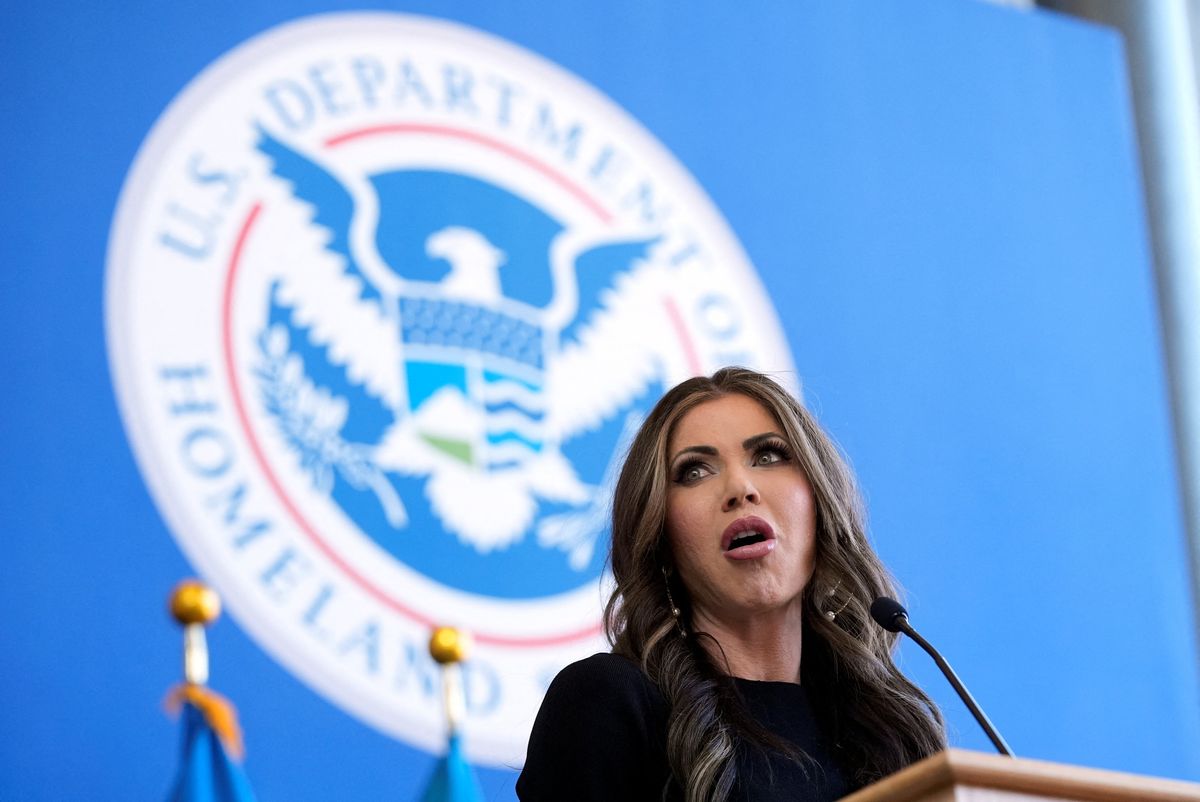
Homeland Security Secretary Kristi Noem speaks.
 Manuel Balce Ceneta/Pool via REUTERS

The other night, I slept like a bear.

Before the bomb hit November 8, 2016, that would not have merited public mention, but for too many of us sleep has come hard for the better part of the last decade.

We have seen a few things.

We have internalized those things.


And try as we might, many of those things have been impossible to process.

Violent insurrections … vivid and horrid bigotry … attacks on NATO, women, children, human rights, voting rights, and our environment … lies, lies and more lies …

We live in a morally declining country, where the disintegration started in earnest the minute white and orange people started shouting they were going to make the place “great” again.


We saw how great things ended up for the people who lived on our chunk of the earth before “the settlers” arrived, and for so many others since they decided to stay. We saw how these kind of great things started in Europe in the 1930s and climaxed in the 40s.

I’ve typed before that if you are searching for the through line that led to all of this hyper-hate and madness we’ve witnessed the past decade, you need only look at this country’s racist roots that are still being dutifully watered by the deviant in the White House and inside millions of our nation’s households, where bigotry is being spoon-fed to our children with the dark hope it will continue to flourish in the generations to come …

“They’re eating our dogs and cats …!”


As many of you know, I’m in Wisconsin these days. It’s easily the least diverse place I have ever lived. Still, there is an inordinate amount of enlightenment in significant pockets of this Upper-Midwest state, where urban areas teem with outdated things like museums, libraries and concert halls.

The arts flourish in these places. Not because they are great, but because they are honest.


They make us look hard at what we’ve done and where we are as a society. They remind us that people can be beautiful, ugly and imperfect. They paint a candid picture of a nation that has reached hard to achieve its highest ideals — “One nation under God, indivisible, with liberty and justice for all” — only to be dragged backwards by Republicans every time there’s a shot that “all” of us will ever get that justice.

If you’re looking for greatness then go stare at your bird feeder for five minutes; or lay down on your back and watch the sky. If you are lucky enough to find a wooded trail, quietly sneak through it.

You will encounter truly great things in these places.


And all these things — our wildlife, our air, our water — are under 24/7 attack by many of the very men and women who are blanketing us with all this noxious smoke from the smoldering, racist fires they have so eagerly rekindled …

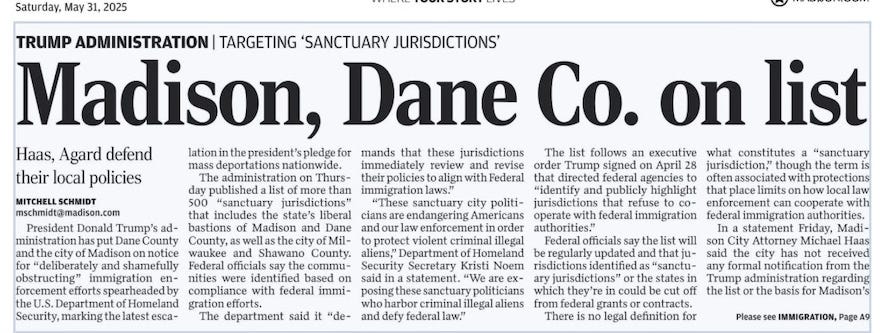
So one recent morning, fresh from that uncommon night of deep sleep, I cracked open the local paper on my computer screen and was hit with this eye-opening slammer:


Trump, and his puppy-killing, dead-inside Secretary of Homeland Security Kristi Noem have put us "on the list" for "deliberately and shamefully" obstructing immigration enforcement.

How do you spell N-A-Z-I?

I can report to you that as a Madison resident I feel safe in saying we wear our humanity as a badge of honor, and will be toasting our success at making this list just as soon as we can.


And while the story was yet another account of the state of things in this roiling country, it also gave away the whole gruesome Republican game.

From the story:
“The administration on Thursday published a list of more than 500 "sanctuary jurisdictions" that includes the state's liberal bastions of Madison and Dane County, as well as the city of Milwaukee and Shawano County.

The department said it "demands that these jurisdictions immediately review and revise their policies to align with Federal immigration laws."


One of these things is not like the other. So enter Jim Davel, an administrator for Shawano County, who couldn’t wait to point that out. Davel told the Associated Press that the inclusion of his heavily Republican community on this list “must be a clerical error.”

He breathlessly continued:

“We have no idea how we got on this list whatsoever right at this point. I think it was just a big mix-up, probably some paperwork or something.”


Relax, sport.

After digging around a bit in some low places, I’m only too happy to expose you for being even more rotten than you want to be, and remind you that that list is reserved for decent folks, not cowards like you.

Turns out, that in 2021, in the wake of Joe Biden’s 7 million-plus win over the America-attacking Trump, the County Board in Shawano that Davel is so proudly a part of declared by bending over and breaking wind it was something called a “Second Amendment sanctuary county.” Thanks to this insidious declaration, the county sheriffs office could no longer enforce any laws which “unconstitutionally impeded on their fundamental Second Amendment right to keep and bear arms.”

Because rather than accepting the results of an election that at least pointed us in the general direction of greatness in 2020, Republicans in places like Shawano went reaching for their guns in 2021.

It sure looks a lot to me like Republicans figure guns, not people, are what truly make America great, and why it’s a damn wonder any sane person can get a decent night’s sleep around here …

(D. Earl Stephens is the author of “Toxic Tales: A Caustic Collection of Donald J. Trump’s Very Important Letters” and finished up a 30-year career in journalism as the Managing Editor of Stars and Stripes. You can find all his work here, and follow him on Bluesky here.)
MAHA movement nears major win as Kennedy-backed bill targets Doritos

Erik De La Garza
June 2, 2025 
RAW STORY


FILE PHOTO: Robert Kennedy Jr., U.S. President-elect Donald Trump's nominee to run the Department of Health and Human Services, walks through the Dirksen Senate Office Building between meetings with senators on Capitol Hill in Washington, U.S., December 17, 2024. REUTERS/Benoit Tessier/File Photo

A Texas bill that could slap warning labels on popular snack foods like Doritos and M&Ms is one step away from becoming law – and is poised to be among “the most substantive victories yet for the Make America Healthy Again movement.

As Bloomberg reported Monday, Texas Senate Bill 25 would require that packaged foods sold in the Lone Star State display warning labels if they contain certain additives banned or restricted in other countries. The labels would warn consumers about ingredients “not recommended for human consumption” by other countries and would go into effect starting in 2027, Bloomberg added.

“The bill lists more than 40 ingredients, including synthetic food dyes and bleached flour. Many, but not all, of the additives are banned or require warnings in other countries,” the outlet said.

The bill’s sponsors in Texas said it has the full backing of Health and Human Services Secretary Robert F. Kennedy Jr., who personally called one of the bill’s sponsors, Republican state Rep. Lacey Hull, to congratulate her after the bill passed the Legislature.

“If approved, the impact on the packaged-food industry could be far reaching: When companies are forced to comply with state regulations, they have often opted to adopt those changes nationwide to streamline production,” according to Bloomberg. “It would also mark one of the most substantive victories yet for the Make America Healthy Again movement, Kennedy’s signature effort.”

The bill has now landed on Republican Gov. Greg Abbott’s desk, though he has not yet publicly stated whether he’ll sign it. But activists are already criticizing the bill – and the Texas governor.

“He will go down as a historical figure as the man who broke the food industry’s back on these chemicals,” said Vani Hari, a food activist and author also known as Food Babe, as reported by Bloomberg. “This is something that will spawn incredible change within the food industry.”
‘Why not?’: Broadway star shrugs off MAGA backlash over Jesus role

Erik De La Garza
June 2, 2025 
RAW STORY


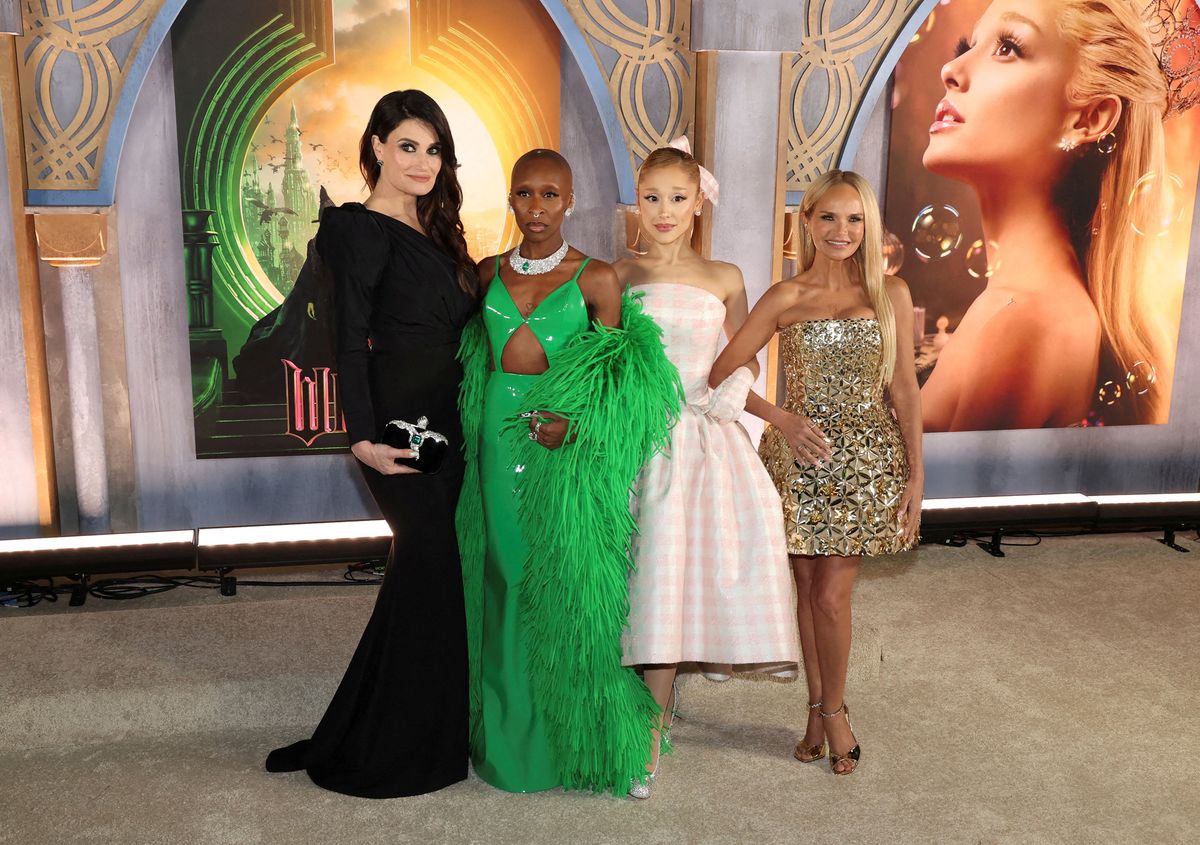
FILE PHOTO: Idina Menzel, Cynthia Erivo, Ariana Grande and Kristin Chenoweth attend a premiere for the film "Wicked" at Dorothy Chandler Pavilion in Los Angeles, California, U.S. November 9, 2024. REUTERS/Mario Anzuoni/File Photo


Wicked” star Cynthia Erivo is brushing off MAGA outrage over her casting as Jesus in an upcoming production of “Jesus Christ Superstar,” calling the backlash overblown before taking a swipe at President Donald Trump.

“You can’t please everyone,” Erivo told Billboard in a new interview where she responded to conservative anger – some of it driven by Elon Musk – after the Tony, Grammy and Emmy-winner was cast in the lead role for a three-night run at the Hollywood Bowl in August, according to The Daily Beast.

“It is legitimately a three-day performance at the Hollywood Bowl where I get to sing my face off,” Erivo said. “So hopefully they will come and realize, ‘Oh, it’s a musical, the gayest place on Earth.’”

Outrage erupted online earlier this year when news of Erivo’s role was first announced, with some critics calling her casting “blasphemy” and “anti-Christian bigotry” by “Hollywood,” The Daily Beast reported. Musk fanned the flames in an X post where he replied with a raised-eyebrow emoji to a user who wrote, “Imagine doing this to any other religion,” above a link to Erivo’s casting news.

“What seemed lost on several critics was the tone of the show itself,” according to The Daily Beast. “The 1971 Andrew Lloyd Webber rock opera has always been a provocative, at-times critical take on Christ’s life, that over time became a cult favorite among queer audiences.”

But many of Erivo’s detractors appear to have missed that detail.

“Why not?” Erivo said of taking the role. “The more yourself you are, the more you are in front of people who don’t necessarily understand, the better understanding starts to happen.”

She also took a swipe at Trump’s recent takeover of the Kennedy Center, telling Billboard, “I don’t know who gains what from that. I hope that it comes back. It’s really sad to have to watch this happen to it. The Kennedy Center is supposed to be a space of creativity and art and music for everyone.”

“I want to encourage people to not decide to just tuck away and start hiding and not being themselves anymore,” she added, “because that is exactly what they want.”

"Jesus Christ Superstar" runs August 1-3 at the Hollywood Bowl.