Thursday, June 05, 2025


Medieval murder: Records suggest vengeful noblewoman had priest assassinated in 688-year-old cold case


University of Cambridge

Image of the original coroner's report of the murder of John Forde 

image: 

The London Archives. Inquest number 15 on 1336-7 City of London Coroner’s Rolls (in CLA/041/IQ/01/006)

view more 

Credit: The London Archives.


A Cambridge criminologist has uncovered new evidence in the killing of a priest, John Forde, who had his throat cut on a busy London street almost seven centuries ago.

The case is among hundreds catalogued by the Medieval Murder Maps project at Cambridge University’s Institute of Criminology, a database of unnatural death in England during the 14th century. This one, however, has a few twists.  

Records traced by Prof Manuel Eisner suggest that John Forde’s slaying in 1337 was a revenge killing orchestrated by a noblewoman ordered to enact years of degrading penance after the Archbishop of Canterbury discovered the clergyman was her lover – possibly from Forde himself.

A letter written by the Archbishop five years earlier accuses the aristocrat Ela Fitzpayne of a wide variety of adultery, including with the priest John Forde, and demands she undertake barefoot walks of shame across Salisbury Cathedral.  

Another record found by Eisner shows that, around the time of these allegations, Ela Fitzpayne conspired with her husband and John Forde to lead a gang of extortionists that raided a church priory, breaking into buildings and holding livestock to ransom.

While explicit connections remain unclear, the records suggest that John Forde went from being in Ela Fitzpayne’s crime gang and possibly her bed, to a player in her denouncement by the church, and, years later, a murder victim – with one of Forde’s killers recognised as Ela Fitzpayne’s brother, and two others her recent servants.  

Eisner says the brazen murder of Forde near St Paul’s Cathedral, as early evening crowds milled about, was perhaps a brutal show of strength: reminding the clergy of the power of the nobility, and that Ela Fitzpayne doesn’t forget or forgive.

Digital copies of the coroner report and letters are published together for the first time on the University’s website. A new paper on the Medieval Murder Maps is published in Criminal Law Forum, and a series of podcasts are available, with each episode taking an in-depth look at an individual case, including that of Forde and Fitzpayne.

“We are looking at a murder commissioned by a leading figure of the English aristocracy. It is planned and cold-blooded, with a family member and close associates carrying it out, all of which suggests a revenge motive,” said Eisner.

“Attempts to publicly humiliate Ela Fitzpayne may have been part of a political game, as the church used morality to stamp its authority on the nobility, with John Forde caught between masters,” he said.

“Taken together, these records suggest a tale of shakedowns, sex and vengeance that expose tensions between the church and England’s elites, culminating in a mafia-style assassination of a fallen man of god by a gang of medieval hitmen.”

Eisner leads the Medieval Murder Maps project, a digital resource that plots crime scenes based on translations of the coroners’ rolls, mainly from the 14th century. The project has produced maps for London, Oxford and York to date.

Written in Latin, the rolls are records of sudden or suspicious deaths as investigated by a jury of local men called together by the coroner to establish facts and reach a verdict – a cornerstone of medieval justice.  

Most juries consisted of a dozen men, some of whom were witnesses. The jury for Forde’s killing totalled 33 men – one of the highest in all murders mapped by the project, and a sign that the sheriff and coroner considered this a high-profile case.

Westcheap – a homicide ‘hotspot’

The jury record that John Forde had been walking up Cheapside after vespers but before sunset on Friday 3rd May 1337 when a fellow priest, Hasculph Neville, distracted Ford with “pleasant conversation”.

As they approached St Paul’s, four other men, including Hugh Lovell, brother of Ela Fitzpayne, attacked Forde. Lovell used a 12-inch dagger to open Forde’s throat, while two other men – Hugh Colne and John Strong, who, until recently, had worked for the Fitzpaynes – stabbed Forde in the belly.

The jury, including a rosary-maker and a hatmaker, identified all assassins but claimed ignorance of their whereabouts. They also noted the Fitzpaynes were in a longstanding feud with Forde.

“Despite naming the killers and clear knowledge of the instigator, when it comes to pursuing the perpetrators the jury turn a blind eye,” said Eisner.

“A household of the highest nobility, and apparently no one knows where they are to bring them to trial. They claim Ela’s brother has no belongings to confiscate. All implausible. This was typical of the class-based justice of the day.”

Former Fitzpayne servant Colne was eventually indicted for the crime five years later in 1342, and imprisoned in Newgate – the only charge brought in the case. 

The area of Westcheap, where Forde was slain, was London’s most prominent medieval homicide “hotspot”, according to the latest paper from the research project.

Home to numerous markets, taverns and alehouses, and many powerful guilds, such as the goldsmiths and saddlers, it was a centre of trade and revelry, where events could get out of hand.

Common triggers for violence in Westcheap included quarrels between merchants or artisans, and group fights between guild apprentices akin to turf wars between gangs.

Records also show that the area hosted several premeditated revenge killings, such as the one that ended John Forde. “Westcheap was a site for displays of civic justice, such as the pillory or stocks,” said Eisner. “As a setting for public rituals of punishment, this appears to have included extrajudicial killings.” 

The Archbishop’s letters

Looking into the Forde case, Eisner found a letter from Archbishop of Canterbury Simon Mepham to the Bishop of Winchester, sent in January 1332, claiming Ela Fitzpayne conducted sexual liaisons with ‘‘knights and others, single and married, and even with clerics in holy orders’’.

Punishment for her behaviour included a ban on wearing gold, pearls or precious stones, and large sums to be paid to monastic orders and donated to the poor. 

The most public penance was a walk of shame in bare feet the length of Salisbury Cathedral – the longest nave in England – carrying a four-pound wax candle to the altar, which Fitzpayne was told she must do every autumn for seven years.

The letter indicates that Fitzpayne, led by a “spirit of pride” and the devil, is refusing, and has abandoned her husband, with a further letter sent in April claiming Ela is hiding in Rotherhithe – then in the Diocese of Winchester – and is excommunicated.

Only one alleged lover is named in the letters, John Forde, suggesting his involvement in alerting the Archbishop. At the time, Forde was the rector of the church of Okeford Fitzpaine, a village on the Fitzpayne family’s Dorset estate.

“The archbishop imposed heavy, shameful public penance on Ela, which she seems not to have complied with, but may have sparked a thirst for vengeance,” said Eisner. “Not least as John Forde appears to have escaped punishment by the church.”  

Priory raiders

Another record, from March of 1322, reveals Ela Fitzpayne and John Ford were both indicted by a Royal Commission. The pair had raided a Benedictine priory the previous year, along with the knight Sir Robert Fitzpayne – Ela’s husband and lord of Stogursey, the nearby castle.

The crew smashed priory gates and buildings, felled trees and robbed the quarry, seizing up to 18 oxen, along with 30 pigs and some 200 sheep and lambs, and driving them back to the castle.

Despite its location, the priory was an outpost of a French abbey. This was a time of increasing animosity between France and England, with recently crowned King Edward III working on a claim to the French throne. By 1337, when Forde is murdered, the Hundred Years’ War was beginning.   

Ford’s parish was around fifty miles from Stogursey. “Ela would have visited Okeford, and Forde may have spent significant time at the castle,” said Eisner. He suggests that Forde colluded with the Fitzpaynes to take advantage of diplomatic tensions by raiding the priory.

“John Forde may have had split loyalties,” said Eisner. “One to the Fitzpayne family, who were likely patrons of his church and granted him the position. And the other to the bishops who had authority over him as a clergy member.”

“We know that Archbishop Mepham was keen to enforce moral discipline among the gentry and nobility, and act against those who displayed moral failings,” said Eisner.

“Taking part in the raid would have shown Forde’s loyalty to the Fitzpaynes rather than the church, which would not have gone down well with the Archbishop.” 

Ford may have confessed his liaison with Ela, perhaps under pressure following the raid. The Archbishop then weaponised sexual slander to pronounce humiliating punishment on a high-ranking noblewoman who defied the moral authority of the church.

“Public humiliation can have poisonous effects, breeding hatred and revenge in humans both today and in the distant past,” said Eisner.

“Feeling humiliated motivates wars, extremism, mass killings, and here it's probably a motivation for assassination. Humiliation creates emotions of anger and shame in the short term. Over time this can harden into a desire for violence.”

The Archbishop dies in 1333, but Ela Fitzpayne waits a further four years before taking revenge on the betrayer John Forde, using her brother and other associates to cut him down in the shadow of St. Paul’s as the crowds watched.    

“The public execution style of Forde’s killing, in front of crowds in broad daylight, is similar to the political killings we see now in countries like Russia or Mexico. It’s designed to be a reminder of who is in control,” said Eisner.

“Where rule of law is weak, we see killings committed by the highest ranks in society, who will take power into their own hands, whether it's today or seven centuries ago.”

Interestingly, Eisner points out there is no evidence of acrimony between Ela and Robert Fitzpayne – a baron and early parliamentarian, and Ela’s second husband. Robert dies in 1354 still married to Ela, who then inherited all his property.  

Added Eisner: “A woman in 14th century England who raided priories, openly defied the Archbishop of Canterbury, and planned the assassination of a priest. Ela Fitzpayne appears to have been many things, including an extraordinary person.”


Image of the Archbishop of Canterbury's letters to the Bishop of Winchester on the subject of Ela Fitzpayne, from the register of John de Stratford. Reproduced with permission of Hampshire Archives and Hampshire County Council.

Image of the Archbishop of Canterbury's letters to the Bishop of Winchester on the subject of Ela Fitzpayne, from the register of John de Stratford. Reproduced with permission of Hampshire Archives and Hampshire County Council.

Credit

Register of John de Stratford. Reproduced with permission of Hampshire Archives and Hampshire County Council.

Location of the murder of John Forde, taken from the Medieval Murder Maps. University of Cambridge’s Institute of Criminology and the Historic Towns Trust.

Credit

Medieval Murder Maps. University of Cambridge’s Institute of Criminology and the Historic Towns Trust


Desert dust forming air pollution, new study reveals


Hidden driver of air pollution found to be aged dust particles acting as chemical reactors in sky, and could account for up to two thirds of SOA in dusty areas


University of Birmingham


Dust particles thrown up from deserts such as the Saraha and Gobi are playing a previously unknown role in air pollution, a new study has found.


The international study published in National Science Review has revealed that contrary to long-held scientific assumptions, aged desert dust particles which were once considered too big and dry to host significant chemical reactions actually act as "chemical reactors in the sky"—facilitating the formation of secondary organic aerosols (SOA), a major component of airborne particles.


Published in a collaborative effort led by scientists from China, Japan, the UK, and other nations, the study shows that during dust events such as those stemming from the Sahara and Gobi deserts, around 50% of water-soluble secondary organic aerosol, primarily considered as SOA, is found in coarse (supermicron) dust particles.


This finding challenges the conventional wisdom on its head as until now, scientists believed that such SOA is primarily formed in fine (submicron) particles or cloud droplets.


Co-lead author Professor Zongbo Shi from the University of Birmingham said:


“This discovery marks a major advance in understanding the chemistry of secondary organic aerosols. We’ve found that water-containing aged dust can act like a sponge and a reactor—absorbing gaseous pollutants and transforming them into particles that affect our health and the climate.


“This study sheds light on a key chapter in atmospheric chemistry but also reveals that the Earth's natural dust storms have a far more complex and impactful role in our air quality than previously known. It underscores the importance of including these new chemical pathways in climate and air quality models.”


Prof. Weijun Li from Zhejiang University and the study's first and co-lead author said: "Sandstorms are not just an environmental issue themselves —they are chemical triggers in the climate system."


Unexpected mechanism


The team found that the formation of secondary organic aerosols (SOA) occurs in water-containing coatings of aged dust, specifically those that have reacted with atmospheric nitric acid to form calcium nitrate. This compound absorbs water even in dry conditions (relative humidity as low as 8%), creating a micro-environment where gas-phase pollutants like glyoxal can dissolve, react, and form aqueous-phase secondary organic aerosol (aqSOA).


To validate their findings, the team combined cutting-edge microscopic analysis with global-scale computer modeling. They showed that these dust-driven reactions could account for up to two thirds of total secondary organic aerosol in some of the world’s dustiest regions, from North Africa to East Asia—orders of magnitude more than previous estimates.


Air pollution from fine particles is linked to millions of premature deaths annually and contributes to climate change. Understanding how and where these particles form helps improve forecasts, guide pollution controls, and ultimately protect human health.


Dr. Akinori Ito from the Japan Agency for Marine-Earth Science and Technology (JAMSTEC) said: "Unravelling the 'black box' of surface reactions on wet dust particles is key to expanding the current boundaries of knowledge for accurately assessing aerosol impacts on climate and the environment."

AI-tocracy Complete?

The AI regulatory moratorium threatens to obliterate America’s frayed social contract.


Many identical AI robots sit at desks in an office.
(Photo: Getty Images)

Adelaida Jasperse
Jun 05, 2025
Common Dreams

I grew up under Enver Hoxha’s totalitarian regime in Albania, where paranoia reigned supreme, propaganda was relentless, dissent was crushed, and concrete bunkers dotted the landscape. Now, as I witness the United States marching toward authoritarianism, I am struck by the haunting echoes of my past. The effort to reshape society through fear, intimidation, and division;the attack on independent institutions;the surveillance state; and the apocalyptic fever remind me so of the dynamics that once suffocated Albania. Beneath it all simmers a pervasive social malaise and a sense of moral decay.

Today’s crisis is not accidental. It’s a long time in the making and the result of powerful interests—Silicon Valley billionaires, MAGA ideologues, Christian nationalists, and Project 2025 architects—who have set aside their differences and coalesced to accelerate collapse, fuel division, and destroy democracy.

AI Regulatory Moratorium

A chief goal of this agenda is the race to build and deregulate artificial intelligence (AI). Since OpenAI launched ChatGPT, we’ve been subjected to the largest tech experiment in history. AI evangelists promise miracles—curing intractable diseases, solving climate crisis, even eternal life—while ignoring its insatiable appetite for water and energy, much of it still sourced from fossil fuels. Revealingly, some billionaires who once called for AI regulation now fund efforts to ban states from regulating AI for the next decade.

Tucked in over 1,000 pages of the recent Republican reconciliation bill is a sweeping moratorium which would ban states and municipalities from regulating AI for 10 years. The same bill slashes hundreds of billions from Medicaid, Medicare, and food aid—an unprecedented transfer of wealth upward that will gravely harm both the most vulnerable and the working class—while pouring over a billion dollars into AI development at the Departments of Defense and Commerce.

The real risk is not that the U.S. will lose to China by regulating AI, but that it will lose the trust of its own people and the world by failing to do so.

The impact would be immediate and profound. It would preempt existing state AI laws in California, Colorado, New York, Illinois, and Utah, and block pending state bills aimed at ensuring transparency, preventing discrimination, and protecting individuals and communities from harm. The broad definition of “automated decision systems” would undermine oversight in healthcare, finance, education, consumer protection, housing, employment, civil rights, and even election integrity. In effect, it would rewrite the social contract, stripping states of the power to protect their residents.

The “End Times Fascism” Forces and the “Network State”

Make no mistake—this isn’t an isolated effort. It’s what Naomi Klein and Astra Taylor call “the rise of end times fascism”—an apocalyptic project of convergent factions to accelerate societal collapse and redraw sovereignty for profit. Particularly, the Silicon Valley contingent merits closer scrutiny. Its ultra-libertarian and neo-reactionary wing, including Peter Thiel and Marc Andreessen has abandoned faith in democracy and invested in Pronomos Capital—a venture capital fund backing “network states” that can best be described as digital fiefdoms run by corporate monarchs. Existing enclaves include Próspera in Honduras and Itana in Nigeria where the wealthy bypass local regulation and often displace communities. Now, billionaires lobby for “Freedom Cities” within the U.S.—autonomous zones exempt from state and federal law, potentially enabling unregulated genetic experimentation and other risky activities.

Silicon Valley’s Ideologies


Animating this project is a bundle of techno-utopian ideologies permeating Silicon Valley’s zeitgeist—most prominently, longtermism and transhumanism. Longtermists believe our duty is to maximize the well-being of hypothetical future humans, even at today’s expense. These worldviews envision replacing humanity with AI or digital posthuman species as inevitable, even desirable. Elon Musk and OpenAI’s Sam Altman, who publicly warn of AI extinction, stand to benefit by positioning their products as humanity’s salvation. As philosopher Émile P. Torres warns, these ideologies spring from the same poisoned well as eugenics and provide cover for dismantling democratic safeguards and social protections in pursuit of a pro-extinctionist future.

DOGE

Musk’s Department of Government Efficiency (DOGE) exemplifies the risks. Operating as an unelected, extra legal entity, it has employed AI-driven systems to automate mass firings of federal employees, and deployed Musk’s X AI Grok chatbot to analyze sensitive government data, potentially turning millions of Americans’ personal information into training fodder for the model. Reports indicate DOGE is building a data panopticon pooling the personal information of millions of Americans to surveil immigrants and to aid the Department of Justice in investigating spurious claims of widespread voter fraud.

AI Harms and the Threat of Mass Unemployment

The perils of unregulated AI are not theoretical. Like any powerful technology, AI has enormous potential for both benefit and harm, depending on how it is developed, deployed, and regulated. Embedded within AI systems are the biases and assumptions of the training data and algorithmic choices, which—if left unchecked—can perpetuate and amplify existing social disparities at scale. AI is not merely a technical tool. Rather, it is part of a larger sociotechnical system, deeply intertwined with human institutions, infrastructure, laws, and social norms.

The states must “flip the script,” drawing on the strength of our democratic tradition and shared humanity, to build a future where people and not the “end times fascism” forces can flourish.

Documented AI harms include wrongful denial of health services;discrimination in housing, hiring, and lending; and the spread of misinformation and deepfakes, among others. Where Congress has failed to act, states have stepped in to fill the regulatory void. If they are now prevented from addressing these harms, without a federal framework to take their place, the consequences will likely be severe. Not only will known harms worsen, but new risks will emerge, including the specter of mass unemployment. Some tech CEOs, anxious on making good on their massive AI investments, boast about automating away people’s jobs and another warns of mass job losses, regardless of whether AI is up to the job.

The Purported China Threat

Supporters of the moratorium claim that state-level regulation impedes America’s ability to compete with China. But flooding the market with unregulated, potentially harmful AI risks eroding public trust and creating instability. Contrary to the perennial argument propounded by Big Tech, targeted regulation does not slow innovation. Rather, it creates the stability, predictability, and safety that allow American companies to thrive and lead globally. The real risk is not that the U.S. will lose to China by regulating AI, but that it will lose the trust of its own people and the world by failing to do so.

The Public Opinion Is for AI Regulation

The American public is not fooled. Polls show overwhelming bipartisan support for strong AI oversight. State attorneys general and civil society groups have also opposed the moratorium. In the Senate, the provision may face challenges under the Byrd Rule, which prohibits including provisions in budget reconciliation bills that are “extraneous” to fiscal policy. If enacted, the moratorium would likely be challenged as unconstitutional under the 10th Amendment, which reserves to the states all powers not specifically delegated to the federal government. Regardless of its fate, the intent of its supporters is clear: to harness AI without guardrails, in pursuit of a monarchical dystopian agenda.

The Way Forward

Americans do not aspire to a future of despotic power and unaccountable surveillance—akin to the unfreedom I experienced in communist Albania. We know where that road leads: oppression, corruption, mass brainwashing, and eventually the breakdown of social order. But America’s story isn’t written by those who surrender to fear, fatalism, or nihilism. As James Baldwin said, “Not everything that is faced can be changed, but nothing can be changed until it is faced.” Now is the time to face this challenge together. The states must “flip the script,” drawing on the strength of our democratic tradition and shared humanity, to build a future where people and not the “end times fascism” forces can flourish. Let us answer this moment not with resignation, but with courage and resolve, and ensure that a “government of the people, by the people, for the people, shall not perish from the Earth.”


Our work is licensed under Creative Commons (CC BY-NC-ND 3.0). Feel free to republish and share widely.


Adelaida Jasperse
Adelaida (Adele) Jasperse is a lawyer whose practice centers on health, privacy, and emerging technologies, and she is also a trained bioethicist. Her work explores how law, ethics, and policy can intersect to advance the common good and promote human flourishing in a democratic society.
Full Bio >
AMERIKA

Medication Abortion Is Safe—Political Attacks on Healthcare Are Not

If the FDA further restricts access to abortion pills, more people, especially those in marginalized communities, will die.


Abortion rights advocates gather in front of the J Marvin Jones Federal Building and Courthouse in Amarillo, Texas, on March 15, 2023.
(Photo: Moisés Ávila/AFP via Getty Images


Elise Warren
Jun 05, 2025
Common Dreams

Next to the abortion pills in my medicine cabinet lies a potentially risky drug: Tylenol. Ironically, while this common pain reliever is widely accepted, safer, life-saving drugs like mifepristone and misoprostol have been under relentless attack by Republican lawmakers.

For decades, these pills, Food and Drug Administration-approved after rigorous testing and proven safe through extensive studies, have been trusted by millions of physicians and pregnant people to treat miscarriages, carry out abortions, or address various medical issues. Yet, the necessity and widespread use of abortion pills seem to elude the wisdom of lawmakers and health secretaries, and highlight a troubling disconnect between the realities faced by patients and the decisions made by lawmakers.

For example, Robert F. Kennedy Jr. recently directed the FDA to review regulations based on a demonstrably flawed study funded by the organization responsible for overturning Roe v. Wade. This study has not undergone peer review or been published in any medical journal, highlighting its misguided methodology and analysis. For instance, it inappropriately cites bleeding and follow-up exams as adverse effects when, in reality, bleeding is an intended effect, and experts recommend follow-up exams.

The science and testimonies are clear: Abortion pills are normal, safe, and necessary.

My abortion saved my life. I am at high risk of death during pregnancy, and my sister, who shares the same medical syndromes, nearly died in childbirth. Mentally, I would have preferred to end my life rather than continue a pregnancy with my then-abusive boyfriend or pass down incurable, painful medical conditions. Emotionally, I could not handle the responsibilities of motherhood. I believe it is the most demanding and beautiful role on Earth, but it must remain a choice.

Every day that the government forces someone to remain pregnant against their will is another day the United States commits a crime against humanity, according to the United Nations. One in four people who can get pregnant will have at least one abortion in their lifetime, with nearly two-thirds of them relying on abortion pills.

I advocate for abortion patients daily and hear their harrowing stories of reproductive and medical distress. For many of them who want to save their life, preserve their liberty, or pursue happiness, abortion pills are their only option, solely due to their address and station in life. For example, consider two women who look down at a positive pregnancy test weeks after being diagnosed with cancer. One is an Oregonian; the other is a Floridian. The Oregonian can access abortion pills or have a D&C within a day or two, well past an unreasoned “heartbeat” law. Meanwhile, the Floridian may have no choice but to rely on abortion pills to protect her life, risking a future where her children could become orphans, as the majority of people who have an abortion are already parents.

If the FDA further restricts access to abortion pills, more people, especially those in marginalized communities, will die. Victims of abuse will be forced to carry pregnancies resulting from incest and rape. More people will drop out of college, and more unwanted children will be born into neglect. These are not mere possibilities; they are certainties based on the experiences of hundreds of thousands of people.

People in blue states may mistakenly believe the FDA’s decision wouldn’t impact their rights, but they would be wrong. Revoking or restricting access to abortion pills would have a ripple effect, overwhelming health centers in blue states with patients from red states. Worse yet, it could eliminate access to abortion pills entirely, effectively reducing abortion resources by 66%. Extremist Republican lawmakers are banking on rolling back our right to abortion pills as a stepping stone to enacting a nationwide abortion ban, followed by the restriction of contraception rights and the falsification or elimination of sex education. This “review” is all part of a plan to control our reproductive rights, finances, health, education, autonomy, and destiny.

Reproductive restrictions for anyone create reproductive restrictions for everyone. The science and testimonies are clear: Abortion pills are normal, safe, and necessary. More than 7 in 10 Americans support access to medication abortion, including half of Republicans.

Just as we should have been more vocal when the Trump administration withdrew from the World Health Organization and defunded cancer research, we must be vigilant about their strategy to roll back reproductive rights. I urge you to share your opinion, call your representatives, and demand that they use their leverage, platform, and influence to speak out and pressure the Department of Health and Human Services to end its misguided review of these safe and vital medications. Together, we can push back against these unjust restrictions and protect the human rights, health, and dignity of the people.


When Will Western Support for Israeli Genocide Finally Crack?


The U.S., U.K., Canadian, and other governments remain deeply complicit in Israel's atrocities and violations of international law. But the rhetoric is shifting and protest movement is growing louder.


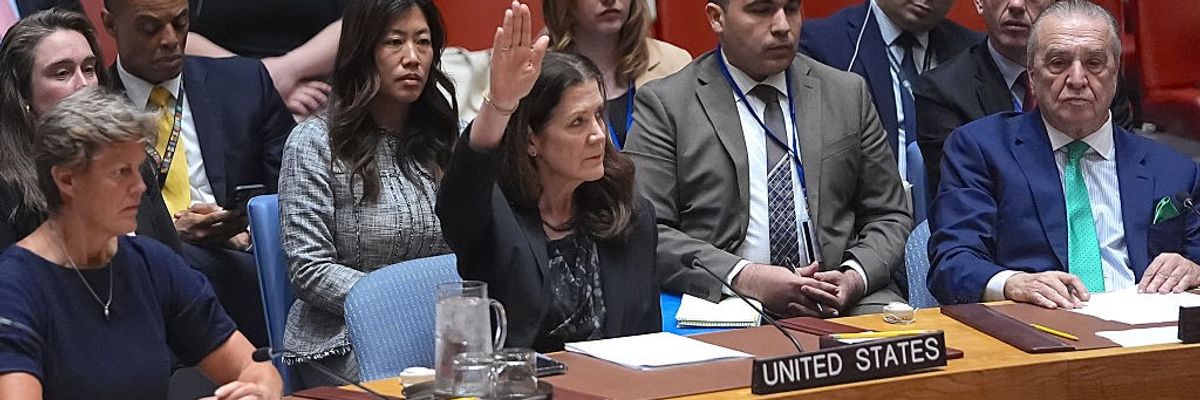
The United States again vetoes a U.N. Security Council resolution calling an 'immediate, unconditional and permanent ceasefire' between Israel and Hamas on June 04, 2025, in New York City, United States.
(Photo by Selcuk Acar/Anadolu via Getty Images)

Jun 05, 2025
Common Dreams


After 20 months of horror in Gaza, political rhetoric in Western countries is finally starting to shift—but will words translate into action? And what exactly can other countries do when the United States still shields Israel from efforts to enforce international law, as it did at the UN Security Council on June 5th?

On May 30th, Tom Fletcher, the UN Under-Secretary-General for Humanitarian Affairs, accused Israel of committing a war crime by using starvation as a weapon against the people of Gaza. In a searing interview with the BBC, Fletcher explained how Israel’s policy of forced starvation fits into its larger strategy of ethnic cleansing.

“We’re seeing food set on the borders and not being allowed in, when there is a population on the other side of the border that is starving,” Fletcher said. “And we’re hearing Israeli ministers say that is to put pressure on the population of Gaza.”

If the so-called international community were really “very, very clear on that,” the United States and Israel would not be able to wage a campaign of genocide for more than 600 days while the world looks on in horror.

He was referring to statements like the one from Finance Minister Bezalel Smotrich, who openly admitted that the starvation policy is meant to leave Palestinians “totally despairing, understanding that there’s no hope and nothing to look for," so that they will submit to ethnic cleansing from Gaza and a “new life in other places.”

Fletcher called on Prime Minister Benjamin Netanyahu to stop this campaign of forced displacement, and insisted, “we would expect governments all over the world to stand for international humanitarian law. The international community is very, very clear on that.”

Palestinians might wish that were true. If the so-called international community were really “very, very clear on that,” the United States and Israel would not be able to wage a campaign of genocide for more than 600 days while the world looks on in horror.

Some Western governments have finally started using stronger language to condemn Israel’s actions. But the question is: Will they act? Or is this just more political theater to appease public outrage while the machinery of destruction grinds on?

This moment should force a reckoning: How is it possible that the U.S. and Israel can perpetrate such crimes with impunity? What would it take for U.S. allies to ignore pressure from Washington and enforce international law?

If impoverished, war-ravaged Yemen can single-handedly deny Israel access to the Suez Canal and the Red Sea, and drive the Israeli port of Eilat into bankruptcy, more powerful countries can surely isolate Israel diplomatically and economically, protect the Palestinians and end the genocide. But they haven’t even tried.

Some are now making tentative moves. On May 19th, the U.K., France, and Canada jointly condemned Israel’s actions as “intolerable,” “unacceptable,” “abhorrent,” “wholly disproportionate,” and “egregious.” The U.K. suspended trade talks with Israel, and they promised “further concrete actions,” including targeted sanctions, if Israel does not end its offensive in Gaza and lift its restrictions on humanitarian aid.

The three countries publicly committed to the Arab Plan for the reconstruction of Gaza, and to building an international consensus for it at the UN’s High-Level Two-State Solution Conference in New York on June 17th-20th, which is to be co-chaired by France and Saudi Arabia.

They also committed to recognizing Palestinian statehood. Of the UN’s 193 member states, 147 already recognize Palestine as a sovereign nation, including ten more since Israel launched its genocide in Gaza. President Emmanuel Macron, under pressure from the leftist La France Insoumise party, says France may officially recognize Palestine at the UN conference in June.

Canada’s new prime minister, Mark Carney, claimed during his election campaign that Canada already had an arms embargo against Israel, but was swiftly challenged on that. Canada has suspended a small number of export licenses, but it’s still supplying parts for Israel’s 39 F-35s, and for 36 more that Israel has ordered from Lockheed Martin.

A General Dynamics factory in Quebec is the sole supplier of artillery propellant for deadly 155 mm artillery shells used in Gaza, and it took an emergency campaign by human rights groups in August 2024 to force Canada to scrap a new contract for that same factory to supply Israel with 50,000 high-explosive mortar shells.

The U.K. is just as compromised. The new Labour government elected in July 2024 quickly restored funding to UNRWA, as Canada has. In September, it suspended 30 out of 350 arms export licenses to Israel, mostly for parts used in warplanes, helicopters, drones, and targeting. But, like Canada, the U.K. still supplies many other parts that end up in Israeli F-35s bombing Gaza.

Declassified UK published a report on the F-35 program that revealed how it compromises the sovereignty of partner countries. While the U.K. produces 15% of the parts that go into every F-35, the U.S. military takes immediate ownership of the British-made parts, stores them on British air force bases, and then orders the U.K. to ship them to Texas for use in new planes or to Israel and other countries as spare parts for planes already in use.

Shipping these planes and parts to Israel is in clear violation of U.S., U.K. and other countries’ arms export laws. British campaigners argue that if the U.K. is serious about halting genocide, it must stop all shipments of F-35 parts sent to Israel–directly or indirectly. With huge marches in London drawing hundreds of thousands of people, and protests on June 17th at three factories that make F-35 parts, activists will keep applying more pressure until they result in the “concrete actions” the British government has promised.

Denmark is facing a similar conflict. Amnesty International, Oxfam, Action Aid, and Al-Haq are in court suing the Danish government and the nation's largest weapons company, Terma, to stop them from sending Israel critical bomb release mechanisms and other F-35 parts.

These disputes over Canadian artillery propellant, Danish bomb-release mechanisms, and the multinational nature of the F-35 program highlight how any country that provides even small but critical parts or materials for deadly weapons systems must ensure they are not used to commit war crimes.

In turn, all steps to cut off Israel’s weapons supplies can help to save Palestinian lives, and the full arms embargo that the UN General Assembly voted for in September 2024 can be instrumental in ending the genocide if more countries will join it. As Sam Perlo-Freeman of Campaign Against the Arms Trade said of the U.K.’s legal obligation to stop shipping F-35 parts,
“These spare parts are essential to keep Israel’s F-35s flying, and therefore stopping them will reduce the number of bombings and killings of civilians Israel can commit. It is as simple as that.”

Germany was responsible for 30% of Israel’s arms imports between 2019 and 2023, largely through two large warship deals. Four German-built Saar 6 corvettes, Israel’s largest warships, are already bombarding Gaza, while ThyssenKrupp is building three new submarines for Israel in Kiel.

But no country has provided a greater share of the tools of genocide in Gaza than the United States, including nearly all the warplanes, helicopters, bombs, and air-to-ground missiles that are destroying Gaza and killing Palestinians. The U.S. government has a legal responsibility to stop sending all these weapons, which Israel uses mainly to commit industrial-scale war crimes, up to and including genocide, against the people of Palestine, as well as to attack its other neighbors.

Trump’s military and political support for Israel’s genocide stands in stark contradiction to the image he promotes of himself as a peacemaker—and which his most loyal followers believe in.

Yet there are signs that Trump is beginning to assert some independence from Netanyahu and from the war hawks in his own party and inner circle. He refused to visit Israel on his recent Middle East tour, he’s negotiating with Iran despite Israeli opposition, and he removed Mike Waltz as National Security Advisor for engaging in unauthorized warmongering against Iran with Netanyahu. His decisions to end the Yemen bombing campaign and lift sanctions on Syria suggest an unpredictable but real departure from the neocon playbook, as do his negotiations with Russia and Iran.

Has Netanyahu finally overplayed his hand? His campaign of ethnic cleansing, territorial expansion in pursuit of a biblical “Greater Israel,” the deliberate starvation of Gaza, and his efforts to entangle the U.S. in a war with Iran have pushed Israel’s longtime allies to the edge. The emerging rift between Trump and Netanyahu could mark the beginning of the end of the decades-long blanket of impunity the U.S. has wrapped around Israel. It could also give other governments the political space to respond to Israeli war crimes without fear of U.S. retaliation.

The huge and consistent protests throughout Europe are putting pressure on Western governments to take action. A new survey conducted in Britain, Denmark, France, Germany, Italy and Spain shows that very few Europeans—between 6% and 16% in each country—find Israel’s assault on Gaza proportionate or justified.

For now, however, the Western governments remain deeply complicit in Israel’s atrocities and violations of international law. The rhetoric is shifting—but history will judge this moment not by what governments say, but by what they do.


Our work is licensed under Creative Commons (CC BY-NC-ND 3.0). Feel free to republish and share widely.


Medea Benjamin
Medea Benjamin is co-founder of Global Exchange and CODEPINK: Women for Peace. She is the co-author, with Nicolas J.S. Davies, of War in Ukraine: Making Sense of a Senseless Conflict, available from OR Books in November 2022. Other books include, "Inside Iran: The Real History and Politics of the Islamic Republic of Iran" (2018); "Kingdom of the Unjust: Behind the U.S.-Saudi Connection" (2016); "Drone Warfare: Killing by Remote Control" (2013); "Don't Be Afraid Gringo: A Honduran Woman Speaks from the Heart" (1989), and (with Jodie Evans) "Stop the Next War Now" (2005).
Full Bio >


Nicolas J.S. Davies
Nicolas J. S. Davies is an independent journalist and a researcher with CODEPINK. He is the co-author, with Medea Benjamin, of War in Ukraine: Making Sense of a Senseless Conflict, available from OR Books in November 2022, and the author of Blood On Our Hands: the American Invasion and Destruction of Iraq.
Full Bio >
Walmart's DEI Rollback is Dangerous for Workers Like Me

That's why I'm calling on shareholders to step up.


Wal-Mart employee Anna Hines walks through the parking lot of the soon-to-opened Wal-Mart September 21, 2006 in Chicago, Illinois.
(Photo by Tim Boyle/Getty Images)

Taneka Hightower
Jun 05, 2025
Common Dreams

For nearly seven years, I’ve clocked in and out at a Walmart in Memphis, Tennessee, where I stock shelves, help customers, and push myself through double shifts to make ends meet. Like so many of my colleagues, I’ve poured my time and energy into this company, and also like so many of them, that hard work has gone unnoticed.

I have more than 15 years of managerial retail experience, but I still find it extremely difficult to advance at Walmart. As a Black woman, this is unfortunately not a unique experience, especially at Walmart. Even though I’ve been working for the company for years, people who look like me are rarely given opportunities for growth. Management will keep you at the cash register for decades, with little hope for a raise or a promotion.

So when Walmart announced it was joining the wave of corporations that are rolling back their Diversity, Equity and Inclusion (DEI) policies, it felt like a punch to the gut, and makes me question if I still belong here.

While Walmart executives are granting themselves multi-million dollar raises, the Black and brown workers who make their company successful are struggling.

Walmart is the single largest private employer of Black workers in the United States, and as the biggest retailer in the country, Walmart is granted the opportunity to set the standard for other retailers across the nation. Their policies don’t just influence what happens inside its stores — they shape the lives of millions of working families across this country.

Nationwide, more than half of Walmart associates are women and people of color, yet the majority of leadership roles still go to white men.

But it’s not just limited opportunities for growth that are stifling Black Walmart employees. I can tell you from my experience, and the conversations I’ve had with colleagues, that inequities are taking place at stores across the country. We see who gets promoted and who doesn’t. Which employees get steady work hours, and which get sent home early by their managers. We see who gets ignored, and who gets a voice.

These discrepancies in how Walmart associates are treated too often seem to fall along racial and gender lines.

DEI initiatives were created to address these very problems by helping to promote fair treatment and put an end to racial and gender discrimination in the workplace. These are policies created to ensure everyone has a fair shot, and that every worker is treated with respect and dignity.

This common sense framework benefits not just workers, but also a company’s long-term success. A diverse and inclusive workplace is a stronger workplace. When employees feel valued and see opportunities for growth, regardless of their race or background, they are much more engaged, productive, and loyal.

With DEI now cast aside, Walmart workers are feeling the opposite. We feel left behind, jaded, and betrayed.

But shareholders have a powerful opportunity to step up and support Walmart's workforce. In June, I’ll be presenting a shareholder proposal, alongside United for Respect Education Fund, calling for a third-party independent racial equity audit at Walmart.

This proposal is not about pointing fingers. Instead it’s about seeking truth, accountability, and transparency so that we can begin to actually change the culture at Walmart.

For years, Walmart has stated its commitment to diversity and inclusion, and an audit would provide an objective assessment of whether these commitments translate into real equity within the company.

We cannot sit by as Walmart makes hollow promises, and we cannot roll back the clock on workplace equality. While Walmart executives are granting themselves multi-million dollar raises, the Black and brown workers who make their company successful are struggling. Walmart has the ability to level the playing field by setting the gold standard for employee treatment. This is a company that not only can afford to do better, but has a moral obligation to do better.

The proposal sends a clear message: we need transparency, accountability, and a genuine commitment to racial equity that goes beyond words. As someone who has dedicated years to this company, I urge shareholders to stand with the workers who make them profitable, and ensure that accountability isn’t lost with Walmart's abandonment of DEI.

Our work is licensed under Creative Commons (CC BY-NC-ND 3.0). Feel free to republish and share widely.

Taneka Hightower
TaNeka Hightower is a 7-year Walmart Associate based in Tennessee and a leader with United for Respect Education Fund.
Full Bio >