It’s possible that I shall make an ass of myself. But in that case one can always get out of it with a little dialectic. I have, of course, so worded my proposition as to be right either way (K.Marx, Letter to F.Engels on the Indian Mutiny)
Friday, June 06, 2025
Five things to know about Canada’s counter-tariffs on the U.S.
President Donald Trump speaks during an event to announce new tariffs in the Rose Garden at the White House, Wednesday, April 2, 2025, in Washington.
(AP Photo/Mark Schiefelbein)
OTTAWA — After U.S. President Donald Trump boosted steel and aluminum tariffs to 50 per cent, some industry groups and the Official Opposition have called on the federal government to retaliate in kind.
Here’s a look at the counter-tariffs Canada has imposed so far.
1. What do the counter-tariffs cover?
The Canadian government has imposed retaliatory tariffs on U.S. goods three times since Trump’s trade war began, aimed at what it says are imports worth $95.4 billion worth.
On March 4 — after the U.S. imposed 25 per cent tariffs on all Canadian goods, along with 10 per cent on energy products — then-prime minister Justin Trudeau announced the first raft of counter-tariffs on $30 billion worth of U.S. goods.
Those 25 per cent tariffs target things like orange juice, motorcycles, clothing and shoes, coffee, cosmetics and alcohol.
On March 12, the U.S. added a 25 per cent tariff on all steel and aluminum products, which was stacked on top of existing levies on Canadian goods.
Canada’s response a day later was 25 per cent reciprocal tariffs on another $29.8 billion of U.S. goods, including steel and aluminum, tools, computers and sport equipment.
On April 9, in response to another round of U.S. tariffs — this time targeting the Canadian auto industry — the federal government imposed 25 per cent duties on “non-CUSMA compliant vehicles” from the U.S. and 25 per cent tariffs on the content of CUSMA-compliant vehicles from the U.S.
The government says this covers $35.6 billion in auto imports from the United States.
2. What are the exemptions?
On April 15, in the midst of the federal election campaign, Prime Minister Mark Carney announced that the government was exempting some products from tariffs for six months to help Canadian businesses adapt.
The tariff holiday covers specific categories: goods used in Canadian manufacturing, processing and food and beverage packaging, as well as imports used to support public health, health care, public safety and national security objectives.
And when it comes to vehicle tariffs, the government said “companies that produce autos in Canada have been granted remission to ensure the ongoing viability of their Canadian operations,” but that it is “contingent on them maintaining production levels in Canada and on following through with planned investments.”
3. Does this mean all counter-tariffs have been dropped?
On Wednesday, Opposition House leader Andrew Scheer said the government “secretly dropped those tariffs to zero during the campaign.”
This line has been repeated often by the Conservatives since the release of a report by Oxford Economics on May 13, which said Canada paused counter-tariffs for six months “on nearly all U.S. goods imports.” The report said it estimated the exemptions would cover about 97 per cent of the tariffs.
The government said that’s not true.
A spokesperson for Industry Minister Mélanie Joly said the exemptions apply to 30 per cent of the $60 billion worth of goods that are subject to tariffs — a figure that doesn’t include the auto tariffs.
William Pellerin, a partner in international trade at McMillan LLP, said the exemption is not nearly as broad as what’s been reported.
“I think that report caused a lot of consternation within the trading community and the legal community. It is absolutely, certainly not zero impact on our clients,” he said, noting many of them are paying millions of dollars in duties already.
4. Where does all this leave Canadian businesses?
Pellerin said there’s a lot of confusion out there about what’s covered by the exemptions.
The Canada Border Services Agency has issued a customs notice explaining how to interpret the exemptions, “but in many circumstances it’s simply not obvious at all,” Pellerin said.
As an example, he said he has clients who have been told by the CBSA that imported agricultural equipment is not exempt.
“We actually think that that’s legally incorrect, that they’ve poorly interpreted the order-in-council,” he said.
That’s the kind of thing his firm is trying to sort out while it waits and hopes for a long-term resolution.
“Whatever actions need to be taken to get back to a tariff-free world (are) absolutely necessary,” he said.
5. How much tariff revenue has the government collected and where is it going?
Conservative MPs have been asking this question in the House of Commons all week.
On Tuesday, Conservative MP Dan Albas charged that “Liberals promised $20 billion in elbows-up U.S. tariffs, but later dropped them with no regard to affected Canadian workers or fiscal impacts.”
Prime Minister Carney responded to say that tariffs are still in effect and $1.7 billion has been collected so far.
The federal government’s latest fiscal monitor showed Canada collected an extra $617 million in import duties in March, as compared to the year before. Figures for April and May have not yet been published.
During the election campaign, the Liberals and the Conservatives both estimated Canada would collect $20 billion in tariff revenue this fiscal year.
In its election platform, the Liberal party pledged that “every dollar raised from these tariffs will support Canadian workers and businesses affected by the trade war.”
Officials at the Finance Department said in a statement that the money is going into the consolidated revenue fund and being used “to support those hardest hit by this economic disruption.”
The statement said that is happening through programs like employment insurance work-sharing, deferral of corporate income tax payments and GST/HST remittances, or by offering liquidity support through Export Development Canada, Farm Credit Canada, Business Development Canada and the Large Enterprise Tariff Loan Facility.
— With files from Craig Lord
This report by The Canadian Press was first published June 5, 2025.
Sarah Ritchie, The Canadian Press
Many Canadians losing confidence in future of trade relationship with U.S.: poll
President Donald Trump speaks to reporters in the Oval Office of the White House, Friday, May 23, 2025, in Washington. (AP Photo/Evan Vucci)
OTTAWA — Almost two in five Canadians say recent court rulings in the U.S., and the ongoing legal battle over President Donald Trump’s tariffs, have made them feel less confident in the future of trade relations, a new poll suggests.
The poll suggests that 38 per cent of Canadians say they feel less confident now about the future of Canada-U.S. trade as well as trade between the U.S. and other countries.
Sixteen per cent of Canadian respondents say they feel more confident, while 37 per cent say their level confidence in the future of the trade relationship hasn’t changed.
The Leger poll, which was conducted online and can’t be assigned a margin of error, surveyed more than 1,500 people between May 30 and June 1.
The poll also surveyed more than 1,000 Americans. Their responses to the poll were substantially similar.
Thirty-six per cent of American respondents said the recent court rulings and the ongoing legal battle over Trump’s tariffs made them feel less confident about the future of trade with Canada and with the rest of the world. Another 19 per cent reported feeling more confident and 31 per cent said their opinion hadn’t changed.
Trump’s tariffs are still hitting most countries around the world after a federal appeals court temporarily paused a decision last week by the U.S. Court of International Trade to block his tariffs.
The court said Trump went beyond his authority when he used the International Emergency Economic Powers Act of 1977 to take his trade war to the world.
A federal appeals court granted the Trump administration’s emergency motion for a temporary stay, allowing those tariffs to stay in place for now.
The poll suggests that Albertans are reporting the lowest level of confidence in the state of trade relations — 48 per cent of them told Leger they feel less confident about the future of Canada—U.S. and U.S.–international trade relations. That’s compared to 38 per cent of Quebecers, 37 per cent of Ontarians and 35 per cent of people in B.C.
Among Canadians 55 years of age and older, 43 per cent reported feeling less confident in trade relations; just 33 per cent of Canadians aged 18 to 34 said the same. More women than men said they were losing confidence.
While many Canadians expressed concern about the future of trade relationships, many also said the fact that U.S. courts are trying to limit Trump’s impact on trade policy increases their trust in America’s institutions.
The poll suggests that 45 per cent of Canadians say their trust in U.S. democratic institutions has increased, while 17 per cent say it has decreased. Almost a third of Canadians said it has had no impact on their opinion.
Quebecers were the most likely to say their trust had increased, at 54 per cent, compared to 45 per cent of people in B.C., 43 per cent of Ontarians and 39 per cent of Albertans.
Canadians aged 55 and over were more likely to say their trust had increased than younger Canadians.
Among the Americans surveyed, 38 per cent said the fact that U.S. courts are trying to limit Trump’s trade powers increases their trust in U.S. democratic institutions. Another 24 per cent said it decreases their trust and 26 per cent said it had no impact on their opinion.
Andrew Enns, Leger’s executive vice-president for Central Canada, said that if there had been only one ruling — the one that blocked the tariffs — the confidence levels recorded by the poll might have been higher.
“There was a second ruling and I think, if anything, it’s left people a bit uncertain about the situation,” Enns said, noting that levels of concern seemed to be higher earlier in the year.
“I think the confidence, it’s going to take some time to rebuild that.”
The polling industry’s professional body, the Canadian Research Insights Council, says online surveys cannot be assigned a margin of error because they do not randomly sample the population.
— With files from David Baxter and Kelly Geraldine Malone
This report by The Canadian Press was first published June 6, 2025.
Catherine Morrison, The Canadian Press
CANADA
Steel industry, labour leaders call for government action as U.S. tariffs spike
Steel coils cool at Algoma Steel Inc., in Sault Ste. Marie, Ont., Friday, April 25, 2025.
THE CANADIAN PRESS/Sean Kilpatrick
Canada’s steel industry needs the federal government to take swift action as it faces an existential threat from steeply increased U.S. tariff, said Catherine Cobden, head of the Canadian Steel Producers Association.
“We’re going to be a deeply weakened sector in a very short period of time,” she said after the U.S. doubled its tariffs on steel and aluminum imports to 50 per cent.
Industry players had hoped to get a last-minute reprieve on the U.S. metals tariffs, but when that didn’t happen it sent companies scrambling, said Cobden.
“Steel was already ready and loaded, locked and loaded, and some of it even in transport, so, completely chaotic.”
The higher tariffs not only make Canadian exports to the U.S. uneconomic, but will also mean Canada’s domestic market could be flooded by imports from other countries also shut out of the U.S., said Cobden.
“We’re going to be inundated with steel that was destined for the United States diverting into Canada. We already have an unfair trade problem here, so it’s going to get much worse very, very quickly.”
The industry association is calling on the federal government to expand an existing 25 per cent tariff on metal products finished in China to also include products from other countries made from steel melted and poured in China. The industry has long alleged that the Chinese government unfairly supports its industry to create artificially low prices.
It also called for the government to fully reinstate retaliatory tariffs on U.S. steel and match the latest escalation.
By reducing imports into Canada, producers here can recapture some of the domestic market, said Cobden.
“There’ll still be shrinkage in the industry. We’ll be weaker, but we won’t be, you know, collapsed, which is where I’m afraid we’re heading.”
Prime Minister Mark Carney said Wednesday on his way into the weekly Liberal caucus meeting in Ottawa that Canada is deep in talks with the U.S. on trade, and is still considering its response to Trump’s latest escalation.
“We will take some time — not much, some time — because we are in intensive discussions right now with the Americans on our trading relationship.”
Ontario Premier Doug Ford also called for full retaliatory tariffs, while Canadian Chamber of Commerce CEO Candace Liang said at a press conference that carefully considered retaliation is in order.
“In this moment it is absolutely understandable we would want to show fight,” she said in Ottawa.
“So we can look at the use of targeted counter tariffs, but be careful to maximize impact on the U.S., while minimizing impact on the home front.”
The aluminum industry is also being disrupted by the increased tariffs, though the higher price per kilogram of the metal makes it more economic to ship abroad.
The Aluminum Association of Canada said it strongly opposed higher rates, which effectively makes Canadian exports to the U.S. economically unviable, and that industry players may be forced to diversify trade toward the European Union.
The heightened tariffs will mean less demand across North America and threatens the security of the integrated supply chain, said Jean Simard, president and CEO of the association.
“It will impact workers on both sides of the border and disrupt key sectors including defense, construction and automotive,” he said in a statement.
Canada’s metal producers are already feeling the hit from both the initial 25 per cent tariffs imposed March 12, and the general uncertainty of what’s to come, said Canadian Labour Congress president Bea Bruske.
“The reality is we’ve already seen job losses in the steel and aluminum industry, because the uncertainty is just as bad as the reality of it,” she said at the same press conference as Liang.
“And we know within the next couple of days and weeks job losses will start to accumulate, so time is absolutely critically important,” said Bruske, noting that 23,000 people work across steel industries in Canada and another 9,500 in aluminum.
Cobden put the job losses at around 700 from the initial round of tariffs, while Canadian steel shipments to the U.S., where half of production goes, were down 30 per cent in April.
Algoma Steel said in a statement that it is deeply concerned with the increased tariffs, and is advocating swift government action to support the company and the wider industry during this volatile time.
Unifor said in a news release Wednesday that heightened tariffs on steel and aluminum are a direct threat to Canadian jobs and security, and also urged the federal government to act without delay to defend the industry.
“These tariffs are killing investment in our steel, aluminum, and auto sectors, and we are already seeing the consequences in lost jobs and economic instability,” said Unifor national president Lana Payne in a statement.
“We need immediate and forceful action to defend good jobs and safeguard our national economic security.”
Federal politicians are set to meet industry and labour leaders Thursday who are set to press their demands directly. Cobden said the government’s recent commitment to buy Canadian steel for infrastructure and defence projects is welcome, but more needs to be done.
“We applaud that, we’ve been looking for that for decades, but now we have the circumstance where we might not be around to serve those projects.”
By Ian Bickis
With files from David Baxter in Ottawa.
This report by The Canadian Press was first published June 4, 2025.
Lululemon shares tumble as yogawear firm warns tariffs will crimp profit
A woman leaves the Kitsilano Lululemon store in Vancouver
(Richard Lam / THE CANADIAN PRESS)
Lululemon Athletica’s shares fell as much as 21 per cent on Friday, as the maker of high-end leggings warned that tariff-related costs and uneven demand in key markets of North America and China will dent its profits this year.
The Canadian firm, whose popular Align yoga pants sell for up to US$128 apiece on its website, will take modest price hikes for a “small portion of the assortment” and ramp up discounts for the rest of the year, company executives said.
The company’s stock, which is down about 14 per cent this year, was trading at about $264 on Friday, on track for its worst day since March 2020. This has set Lululemon up to lose roughly $8 billion in market value, if losses held.
Lululemon has struggled to retain shoppers, despite its efforts to introduce fresh styles of sports bras and athletic jackets, as it faces intense competition from trendier and more affordable brands in North America and mainland China.
“Despite (Americas) decline, management continues to prioritize product newness and China expansion over addressing a pullback from core customers and evident traffic declines,” Jefferies analyst Randal Konik said in a note.
“We believe this misalignment is concerning.”
Lululemon joins sportswear rivals Nike and On in raising prices in the U.S. as erratic trade tactics under President Donald Trump rattle global markets and fuel fears of a recession.
Lululemon trimmed its 2025 earnings forecast and said it expects margins to come under pressure from the proposed tariffs, which will impact products from some of its largest sourcing hubs in Vietnam, Cambodia and Sri Lanka.
The company’s latest results suggest Lululemon might be facing deeper challenges given the slowdown in its domestic business over the past twelve months, UBS analyst Jay Sole said.
At least 12 brokerages cut their price targets on the stock, with J.P. Morgan slashing it the most, to $303 from $389.
Lululemon’s forward price-to-earnings multiple, a common benchmark for valuing stocks, is 21.46, compared to that of 31.37 for Nike and 9.54 for Gap.
By Savyata Mishra
(Reporting by Savyata Mishra in Bengaluru; Editing by Shreya Biswas)
Stellantis’ new CEO Filosa set to earn up to US$23 million a year
Stellantis’ new CEO Antonio Filosa will earn at least US$4 million annually in his first two years at the helm, rising to up to $23 million a year from 2028, including bonuses, a document showed, although his remuneration will be lower than predecessor Carlos Tavares.
Filosa officially becomes CEO of the owner of brands such as Chrysler, Peugeot and Jeep at the end of this month, tasked with turning around the carmaker’s performance and recovering lost U.S. market share. He will receive an annual base pay of $1.8 million, a company document issued ahead of a July 18 extraordinary general meeting showed, just below the 2 million euros ($2.3 million) granted to his predecessor Tavares.
On top of his starting salary, Filosa will pocket annual bonuses worth up to 400% of his base pay, based on the achievement of financial and business plan objectives set out by the company.
Filosa, formerly Stellantis’ North American chief, will also be granted shares as long-term incentives (LTI), based on the company’s performance, starting from up to 500% of his salary this year and up to a maximum of 780% from 2027.
Until the potential LTIs are paid, in 2028, the company will provide the top manager a cash award of $1.2 million each year.
Tavares, who abruptly resigned as CEO last December due to disagreements with the board over strategy, pocketed a final 35 million euro compensation package, despite a dramatic plunge in sales and profit and broken relationships with suppliers, dealers and investors.
In 2023, when Stellantis reported record results, Tavares earned a total of 36.5 million euros.
Filosa will also benefit from the company’s U.S. health care and retirement plans and tax equalization benefits, as well as having access to other fringe benefits such as the personal use of the company’s aircraft and vehicles, personal security and annual medical check-ups.
Filosa’s term will be for five years, “to ensure leadership stability and maximize the ability of the company to respond effectively to profound and prolonged industry change,” according to the document. Filosa will be appointed an executive board member at the July 18 EGM.
Tavares was also appointed CEO for five years but left after just under four years.
(Reporting by Giulia Segreti and Giulio Piovaccari; Editing by Susan Fenton)
Canada’s unemployment rate in May at almost 9-year high outside pandemic years
Construction workers on a new condo site in Saint John, New Brunswick on Tuesday, May 6, 2025.
THE CANADIAN PRESS/Graham Hughes
OTTAWA -- Canada’s unemployment rate in May jumped to its highest level in almost nine years, excluding the peak of the COVID-19 pandemic, with 1.6 million jobless people in the country, data showed on Friday.
The unemployment rate ticked up to seven per cent in May from 6.9 per cent in April, a third consecutive monthly increase, Statistics Canada said, adding that the total of jobless people in May was almost 14 per cent higher than a year ago.
This level of unemployment was last seen in September 2016 after the COVID-era unemployment numbers of 2020 and 2021 are excluded, StatsCan said.
“People are facing greater difficulties finding work in the current labour market,” it said.
However, the one-tick rise in the unemployment rate was primarily driven by almost flat employment growth even as the population increased. There were no mass layoffs which indicates that while hiring is low, the labor market is not in a dour state.
The total number of people employed grew by a slim 8,800. The employment number has a standard error margin of 32,000.
Analysts polled by Reuters had forecast the unemployment rate to be at this level due to the impact of U.S. tariffs on Canada. They had estimated the total employment number would drop by 12,500.
The Canadian dollar traded up by 0.04 per cent to 1.3667 to the U.S. dollar, or 73.17 U.S. cents. Bond yields on the two-year government bonds were up four basis points to 2.672 per cent.
Currency swap market bets show odds of a 25 basis point rate cut in July at just 33 per cent.
Economists expressed relief, as U.S. tariffs on Canada were in effect in May.
“On the surface it seems like a stable situation,” said Doug Porter, chief economist at BMO Capital Markets.
“It is early days to judge,” Porter said of the tariff impact, and added that only two sectors were mainly dealing with tariffs -- automobiles and metals.
Trump imposed tariffs in March on a variety of Canadian products, followed by duties on steel and aluminum, and later in April on automobiles. These have already led to fewer job additions and some layoffs.
The duration of unemployment has been consistently rising, with jobless people spending an average of 21.8 weeks searching for work last month, up from 18.4 weeks a year ago.
The average hourly wage growth of permanent employees, a metric closely watched by the Canadian central bank to gauge inflationary trends, was unchanged at 3.5 per cent in May.
The employment number was driven by an increase in wholesale and retail trade, a part of the services sector, but was offset by a drop in manufacturing and temporary government jobs reflecting the expiration of election-related temporary hiring.
Economists said one good sign in the job report was that there were around 57,700 additions in full-time employment.
However, that was largely offset by a loss of 48,800 people in part-time jobs.
By Promit Mukherjee
(Reporting by Promit Mukherjee; Additional reporting by Divya Rajagopal and Fergal Smith in Toronto; Editing by Dale Smith, Barbara Lewis and Andrea Ricci)
High Liner buying Mrs. Paul’s and Van de Kamp’s brands from Conagra for US$55M
A fishing boat heads past fish farm cages in Shelburne Harbour on Nova Scotia's South Shore
(Andrew Vaughan/The Canadian Press)
LUNENBURG — Frozen seafood company High Liner Foods Inc. has signed a deal to buy the Mrs. Paul’s and Van de Kamp’s brands of frozen breaded and battered fish from Conagra Brands for US$55 million in cash.
High Liner Foods currently co-manufactures products for Mrs. Paul’s and Van de Kamp’s brands at its U.S-based operations.
High Liner chief executive Paul Jewer called it a strategic and compelling opportunity that will help further growth in the U.S retail market.
The deal is expected to close at the end of the month, subject to customary closing conditions.
In addition to its namesake brand, High Liner sells under several brands in the U.S. and Canada including Fisher Boy, Mirabel, Sea Cuisine, and Catch of the Day in addition to the Mirabel, Icelandic Seafood and FPI labels for restaurants and institutions.
It is also a major supplier of private label seafood products to retailers and food service distributors.
This report by The Canadian Press was first published June 6, 2025.
CANADA
Carney gov’t tables bill to reduce interprovincial trade barriers, build national projects
Prime Minister Mark Carney leaves the West Block of Parliament Hill in Ottawa on Thursday, June 5, 2025. THE CANADIAN PRESS/Sean Kilpatrick
Prime Minister Mark Carney’s government tabled much-anticipated legislation on Friday, aimed at reducing interprovincial trade barriers, easing labour mobility, and advancing major projects.
Canada-U.S. Trade and Intergovernmental Affairs Minister Dominic LeBlanc tabled what’ll be known as Bill C-5 in the House of Commons, at 12:10 p.m. and is now standing alongside the prime minister and other key cabinet ministers on Parliament Hill to announce the new measures.
Interprovincial trade barriers – such as health and safety regulations, varying product standards, or incongruent trade and professional licensing standards – exist to protect jobs regionally, but can result in consumers paying 7.8 to 14.5 per cent more for the goods and services they buy, according to Statistics Canada.
Less than 20 pages in total, the legislation is being billed as the catalyst for Carney’s promise to create “one Canadian economy” by seeking to enact a new “Free Trade and Labour Mobility in Canada Act” and a “Building Canada Act.” Equivalency for standards on goods, services
In terms of internal trade limits, Carney’s efforts focus on adjusting federal rules and regulations, building on work already undertaken by many premiers to alleviate cross-province restrictions.
Bill C-5 provides “a framework to substantially reduce the burden of federal rules that apply to trade across provincial and territorial borders,” according to briefing materials provided to reporters.
This means that goods or services produced, used, or distributed in line with a province or territory’s standards would also meet the equivalent federal requirement.
One example given by officials ahead of the bill’s tabling was food. If a product meets one province’s organic standards, it would be treated as if it meets the national standard as well.
Similarly, should a washing machine meet provincial energy efficiency requirements, it would be approved federally.
The government says this change would make it easer for Canadian businesses to sell their products across the country, while expanding choice for consumers. Framework for labour mobility
In terms of easing labour mobility, the government bill seeks to “provide a framework to recognize provincial and territorial licenses and certifications for workers.”
In practice, should Bill C-5 pass, a worker approved by one provincial or territorial jurisdiction would be able to more easily and rapidly work in the same occupation, federally.
For example, it would be less burdensome for workers to receive a federal license, as their provincial certification would be recognized. The government says that would also provide employers with a broader candidate base for jobs.
The legislation also includes provisions to give cabinet the power to make regulations respecting the movement of labour within Canada.
Coming out of Monday’s First Ministers’ Meeting, an agreement was made to work together “towards a 30-day service standard for credential recognition,” an official said Friday. This would apply to professions such as doctors and skilled trades workers. New rules for projects of national interest
There is also a significant portion of this legislation that would change how new major projects can be built, building on Carney’s promise to develop a “one project, one review” approach.
Bill C-5 proposes to speed up the development of these projects, and streamline multiple decision points, seeing the federal government determine whether it is in the national interest. That determination – taken by cabinet – would be weighed by a few factors, including Indigenous and provincial consultation.
The other criteria the legislation outlines are whether a project: strengthens “Canada’s autonomy, resilience and security”; provides “economic or other benefits to Canada”; has “a high likelihood of successful execution”; advances “the interests of Indigenous peoples; and contributes “to clean growth and to Canada’s objectives with respect to climate change.”
“This bill seeks to get projects in the national interest built by focusing on a small number of executable projects and shifting the focus of federal reviews from ‘whether’ to build these projects to ‘how’ to best advance them,” according to the government.
The legislation also proposes to create “a more flexible process” for regulatory decisions about a project, by creating a “two-key” process that seeks to centralize some of the paperwork and decision-taking, such as around impact assessments, consultations and permits.
Carney’s aim, according to officials, is to remove uncertainty, build investor confidence, and shorten the amount of time it takes for approvals, from five years to two years.
When asked to put a dollar figure on the value of the projects that would be unlocked and become eligible under these changes, an official said it was “not possible to say.”
“There’s a lot of potential,” the official— speaking on a not-for-attribution basis – said. “You’ve seen discussions started with provinces through the First Ministers Meeting and initial meetings with Indigenous people. So those conversations have started. There’s a lot of potential, but there’s nothing in the legislation that defines a number of projects. So, it’s too hypothetical to say.” Removing more free trade exceptions by July
In addition to tabling this new legislation, the federal government is committing to remove further federal exceptions from the Canadian Free Trade Agreement, by July 2025.
Throughout the election campaign, Carney repeatedly pledged to eliminate interprovincial trade barriers by Canada Day, while his platform promised only to table the necessary legislation by July 1. He also vowed to “remove all federal exceptions under the Canadian Free Trade Agreement.”While the legislation does not do that, the Liberals made it clear today that they intend to follow-through, and that they do not require legislation to lift the remaining limitations, noting 20 federal exemptions were lifted by the federal government before the election.
According to an official, the remaining exceptions relate to national security or areas where there are “co-legislated frameworks,” with another province or territory.
“We’re continuing to do the analysis to see whether or not they can be dropped,” the official said. “My team and I continue work with other departments to see what do we really need to maintain and does it impact internal trade?”
According to the Committee on Internal Trade, in 2024 more than $530 billion worth of goods and services moved across provincial and territorial borders, representing almost 20 per cent of Canada’s gross domestic product.
Eliminating barriers – both at the federal and provincial levels – is estimated to potentially add up to $200 billion to the Canadian economy.
With files from CTV News’ Noah Watcher
This is a developing story, check back for updates... Rachel Aiello National Correspondent, CTV News
Activist investor Engine Capital plans to vote against US$9.1B Parkland-Sunoco deal
Pioneer gas station is shown in Carleton Place, Ont.
THE CANADIAN PRESS/Sean Kilpatrick
CALGARY — A major shareholder in fuel refiner and retailer Parkland Corp. says it plans to vote against its planned takeover by U.S. heavyweight Sunoco LP.
Engine Capital owns 2.5 per cent of Parkland’s shares, making it one of the Calgary-based company’s biggest investors.
In a letter to Parkland’s board of directors, Engine’s leadership argues the Sunoco deal was rushed, the price is too low and that there are likely better options available.
A month ago, Parkland and Sunoco announced a friendly cash-and-stock takeover deal valued at US$9.1 billion including debt
Shareholders are to vote on the transaction at a meeting set for June 24 in Calgary.
Engine says it has nothing against Sunoco and would happy to become a long-term investor in that company — but only if its offer is rejigged to better reflect Parkland’s value.
This report by The Canadian Press was first published June 6, 2025.
Canada begins public engagement on siting of second repository
Friday, 6 June 2025
Canada's Nuclear Waste Management Organization is seeking public input to "confirm and refine" its proposed approach ahead of the planned 2028 launch of the site selection process for a second radioactive waste repository.
(Image: NWMO)
In 2023, the Nuclear Waste Management Organization (NWMO) took on the responsibility to manage intermediate- and non-fuel high-level radioactive waste in a deep geological repository, after the Minister of Natural Resources endorsed the recommendations within Canada's Integrated Strategy for Radioactive Waste. This work is separate and distinct from the work NWMO has led since 2002 to plan for the safe, long-term management of Canada's used nuclear fuel, also in a deep geological repository.
NWMO has now released a discussion document on its proposed approach for siting a deep geological repository to be used for the disposal of intermediate and non-fuel high-level radioactive waste. It could potentially also hold used nuclear fuel from future nuclear reactors built in Canada.
"For the new project, we will continue our longstanding focus on technical safety and community willingness as primary site selection criteria," NWMO said. "For the next two years, we want to hear from a wide range of rightsholders, communities, industry and other groups with an interest in the project. Based on our experience so far, we are prioritising engagement with Indigenous communities."
"We are committed to seeking input from Indigenous Peoples from the very beginning of our site selection process for the next deep geological repository, and to forge relationships built upon trust and transparency," said Joanne Jacyk, the NWMO's Director of Site Selection for the second repository project.
NWMO President and CEO Laurie Swami added: "Like many countries with commercial nuclear power programmes, Canada is planning for the future. There is international scientific consensus that a deep geological repository is the safest way to manage intermediate and high-level waste over the long-term."
A deep geological repository comprises a network of highly-engineered underground vaults and tunnels built to permanently dispose of higher activity radioactive waste so that no harmful levels of radiation ever reach the surface environment. Countries such as Finland, Sweden, France, the UK and the USA are also pursuing this option.
Last year, the NWMO announced the selection of Wabigoon Lake Ojibway Nation and the Township of Ignace in northwestern Ontario as the host communities for the proposed deep geological repository for used nuclear fuel, following a consent-based siting process that had begun some 14 years earlier.
Construction of the facility will only begin once the repository has successfully completed the federal government's multi-year regulatory process and the Indigenous-led Regulatory Assessment and Approval Process, a sovereign regulatory process that will be developed and implemented by Wabigoon Lake Ojibway Nation.
Economic impacts of EU nuclear energy expansion assessed
Friday, 6 June 2025
A nuclear power generating capacity of 200 GWe would reap widespread economic benefits throughout the EU, sustaining almost two million jobs and hundreds of billions in additional economic output, tax revenues and household income, according to a report commissioned by Brussels-based nuclear trade body Nucleareurope.
(Image: Pixabay)
Nucleareurope commissioned Deloitte to analyse the contribution of the nuclear power sector to the overall economy of the European Union. It assessed current economic and social benefits generated directly through the nuclear industry and effects resulting from the nuclear sector's economic activities throughout the EU. The analysis was conducted to show both the current impact of the industry and provide a measurable outlook on its future benefits up to 2050.
Currently, with a generating capacity of around 106 GWe, the EU's nuclear sector contributes EUR251.2 billion (USD286.8 billion) per year to the bloc's economy and generates yearly public revenues of about EUR47.6 billion, the study says. In addition, more than 883,000 jobs are sustained in the EU each year through the nuclear sector.
The Economic and Social Impact Report focuses on the three installed nuclear capacity scenarios for 2050 included in the 2024 report developed on behalf of Nucleareurope by Compass Lexecon: 100 GWe, 150 GWe and 200 GWe.
If installed nuclear capacity in the EU was increased to 150 GWe by 2050, it would generate over EUR 330 billion in annual economic output and support nearly 1.5 million jobs across the EU, the study found. Increasing capacity to 200 GWe would generate over EUR383 billion in annual economic output and support nearly 1.6 million jobs across the EU.
"The decision-makers now have access to a reliable forecast of the benefits that would be derived from the deployment of a 200 GW nuclear power capacity throughout the Europe Union, while the results are dependent on the construction plan of the new nuclear reactors," Nucleareurope said.
"Nuclear is one of the few net-zero value chains that is anchored in Europe, and this is clearly reflected in the figures put forward by this report," said Nucleareurope Director General Emmanuel Brutin. "It shows how, by investing in nuclear, Europe can reap the benefits in terms of stimulating economic growth and job creation, alongside ensuring security of supply and meeting the decarbonisation targets. As such, it is important that the European Commission provides the right policy framework to stimulate long-term investment in nuclear through, for example, the Nuclear Illustrative Programme (PINC) and the next Multi-annual Financial Framework."
In April, the European Commission launched a four-week call for evidence related to the investment needs of the nuclear power sector in the EU. Seen as an important part of the consultative process and an opportunity for input from stakeholders and the public, the feedback received through this exercise will feed into the Commission's work in preparing the update of the PINC, which is expected to be published before the end of 2025.
Thorizon enlists French expertise for corrosion tests
Friday, 6 June 2025
Thorizon has announced a new research collaboration with Curium and INSA Lyon to support the development of its Thorizon One advanced small modular molten salt reactor. The collaboration includes corrosion testing of metals in contact with molten salt.
From left to right, MATEIS Director Bernard Normand, Thorizon COO Laure Claquin, and Curium General Director Stéphane Poncet (Image: Thorizon)
To support this effort, Curium brings its expertise in characterisation and experimentations with chemicals and radioactive materials, while MATEIS - a laboratory affiliated with INSA Lyon, CNRS and Claude Bernard Lyon 1 University - benefits from international recognition in surface engineering and corrosion.
A major focus of the partnership is the development of corrosion tests for metals in contact with molten salt. Thorizon said these tests are essential for understanding how different materials interact with molten salts, an area of research that is critical for ensuring the safety and durability of reactor components.
As the project evolves, the collaboration will scale from material samples to testing of full sub-systems. These system-level trials will help confirm the performance and reliability of the Thorizon One reactor's most critical parts, laying the groundwork for commercialisation and broader deployment.
Thorizon said this collaboration gives it access to dedicated research spaces in the Auvergne-Rhône-Alpes region of France, allowing the company to expand its R&D efforts.
"Collaborating with Curium and MATEIS allows us to benefit from their unrivalled expertise in materials and corrosion testing," said Thorizon CEO Kiki Lauwers. "It gives us access to specialised testing capabilities and will be a key step in closing the gap between concept and commercial readiness. This is just the latest in our transformative journey in France, where we are committed to growing our footprint, deepening local partnerships, and strengthening our roots in Europe's energy future."
Thorizon - a spin-off from NRG, which operates the High Flux Reactor in Petten in the Netherlands - is developing a 250 MWt/100 MWe molten salt reactor, targeted at large industrial customers and utilities. The molten salt fuel adopted by Thorizon uses a combination of long-lived elements from reprocessed used nuclear fuel and thorium. The reactor will be able to recycle long-lived waste from existing nuclear facilities. The Thorizon One concept is unique in that the core is composed of a set of cartridges that is replaced every five to ten years. This, the company says, overcomes two molten salt design obstacles: material corrosion and handling of used fuel volumes.
The company says it is conducting pre-feasibility studies at three nuclear-designated sites in France, Belgium and the Netherlands, targeting construction by 2030.
Thorizon was selected in March 2024 by the French government to receive EUR10 million (USD11.4 million) in funding through the France 2030 national investment plan. Launched by President Emmanuel Macron in October 2021, the France 2030 re-industrialisation plan is endowed with EUR54 billion in funding schemes to be deployed over five years.
Akkuyu to have real-time discharge water monitoring system
Friday, 6 June 2025
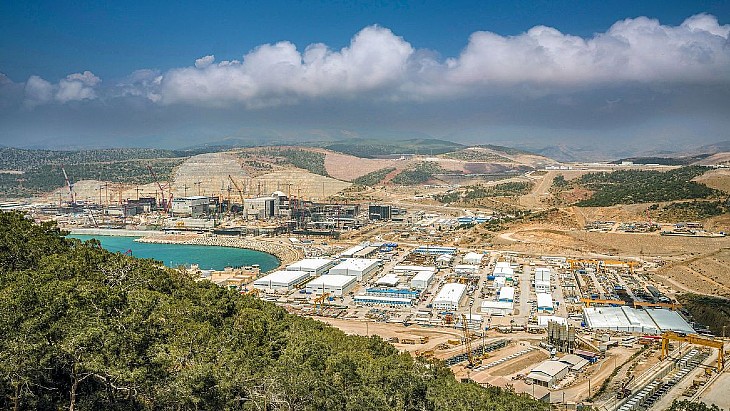
The Akkuyu nuclear power plant in Turkey will have an automated system installed to remotely monitor the cooling water discharged into the sea, to meet the requirements of Turkish environmental regulations.
(Image: Akkuyu Nuclear)
The four-unit Akkuyu plant will be cooled by water from the Mediterranean Sea. There will be one pumping station for each power unit, a drainage channel, siphon wells, a distribution chamber, a water intake and spillway structure and desalination processes. Rosatom says the total capacity in the normal operation of the power unit will be 260,000 cubic metres per hour and that the design "will reliably protect the pumping station equipment from any external factors including floods and tsunamis".
The start-up and testing phase of the on-shore pumping station for unit 1 began in February.
Work to integrate the water monitoring system into the existing design started about three years ago, Rosatom said, after Turkey's amended regulation was adopted, and the decision to include it has been confirmed.
The monitoring system, which will operate for the entire life of the plant, will "remotely monitor the purity and flow rate of the discharged water, suspended solids, dissolved oxygen, acid-base properties, chemical oxygen demand, temperature, conductivity, and other key indicators".
Sergei Butckikh,Akkuyu Nuclear JSC CEO, said: "The Akkuyu NPP project is being implemented in accordance with high environmental standards and principles of sustainable development. All environmental parameters are systematically monitored at the site and in the construction region of the nuclear power plant: conditions of the soil, air, flora, fauna and, of course, sea water. For us, this is not just a duty to comply with legal requirements but a part of the project's philosophy. All employees of the NPP will live with their families in this region, and each of them is aware of their personal responsibility for the environment."
Background
Akkuyu, in the southern Mersin province, is Turkey's first nuclear power plant. Rosatom is building four VVER-1200 reactors, under a so-called BOO (build-own-operate) model. According to the terms of the 2010 Intergovernmental Agreement between the Russian Federation and the Republic of Turkey, the commissioning of the first power unit of the nuclear power plant must take place within seven years from receipt of all permits for the construction of the unit.
The licence for the construction of the first unit was issued in 2018, with construction work beginning that year. Nuclear fuel was delivered to the site in April 2023. Turkey's Nuclear Regulatory Agency issued permission for the first unit to be commissioned in December, and in February it was announced that the reactor compartment had been prepared for controlled assembly of the reactor - and the generator stator had also been installed in its pre-design position.
The aim is for unit 1 to begin supplying Turkey's energy system in 2025. When the 4800 MWe plant is completed, it is expected to meet about 10% of Turkey's electricity needs, with the aim that all four units will be operational by the end of 2028.
Argentina aiming for SMR and uranium developments
Friday, 6 June 2025
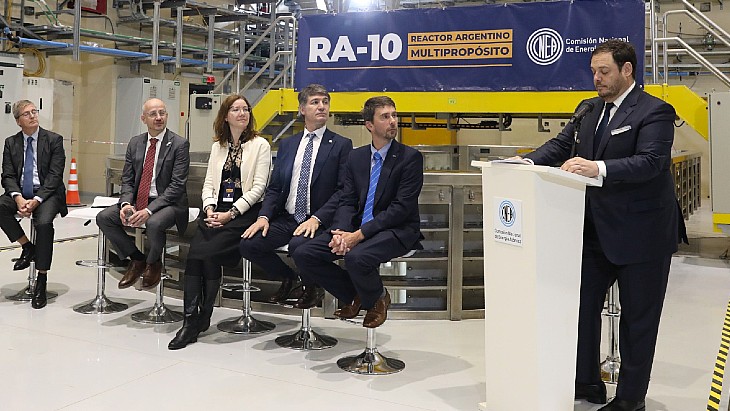
Plans for the deployment of four ACR-300 small modular reactors and restarting uranium mining and enrichment were among the priorities outlined as Argentina's National Atomic Energy Commission celebrated its 75th anniversary.
(Image: CNEA)
Demian Reidel, President of the Argentine Nuclear Council, told the event held at the site of the RA-10 multipurpose reactor: "With the development of the ACR-300, we will offer the world a clean, stable, and scalable source of energy. The ACR-300, a 300 MW technological marvel designed by Argentine engineers, is a centrepiece of the Nuclear Power Plan, which will position our country at the forefront of the new energy revolution.
"We are going to begin construction of four modules at the Atucha site, which will allow us to nearly double the country's installed nuclear capacity. This is only the first stage. Then, we will license this technology to the rest of the world. This will not only transform our energy mix, it will also change Argentina's export mix."
Germán Guido Lavalle, President of the National Atomic Energy Commission (CNEA), outlined the organisation's five key targets for the coming year: reaching criticality at the RA-10 plant; beginning the refurbishment of the Heavy Water Industrial Plant (PIAP); restarting uranium mining; launching the Argentine Proton Therapy Center; and resuming uranium enrichment to complete the nuclear fuel cycle.
He said: "We have a National Atomic Energy Commission that, through technological development and human resource training, has provided the platform for the emergence of nuclear sector companies that today compete globally, export, create jobs, and offer services in Argentina. This is a true success of state policy."
Reidel, a chief adviser to Argentina's President Javier Milei, told La Nacion last week that the aim was for Argentina to be the first country, or among the first, to be commercially selling small modular reactors (SMRs). He said that the National Nuclear Plan aimed to accelerate the development of the ACR-300, developed by INVAP with private capital, and "aims to have the four modules operational within five years".
He has also suggested that the SMRs could be sold with a commitment to purchase Argentine uranium, saying in a March interview with Infobae that it was "crazy" for the country to be importing uranium for its existing reactors despite having substantial reserves.
The anniversary ceremony was broadcast across all CNEA's centres. The commission, created in 1950, says its mission "is to consolidate Argentina's position as a leading nation in the peaceful and safe use of nuclear energy, having been committed to scientific and technological development since its inception".
The background
Argentina currently has three operable nuclear power units - Atucha 1, connected in 1974, Atucha 2, which was connected in 2014 and Embalse which was connected to the grid in 1983. Between them they generate about 5% of the country's electricity. There had been plans for a fourth unit, as Atucha III, but it appears that has been superceded by the SMR plans.
Argentina has already had an SMR in development: the CAREM SMR - the name comes from Central Argentina de Elementos Modulares - is a 32 MWe prototype and is Argentina's first domestically designed and developed nuclear power unit. First concrete was poured in 2014, but construction has since been suspended a number of times. It is currently estimated to be about two-thirds complete. With reports of funding uncertainty, a Critical Design Review was ordered for it in May last year.
Allseas aims for rapid SMR deployment
Thursday, 5 June 2025
Dutch offshore construction engineering contractor Allseas has launched a five-year plan to design, develop and deploy a small modular reactor tailored for integration into offshore vessels and for onshore use.
(Image: Allseas)
The company has selected high-temperature gas-cooled reactors (HTGRs), using tri-structural isotropic - or TRISO - particle fuel, with a power output of about 25 MWe. It said it selected this small modular reactor (SMR) technology "due to their inherently safe characteristics".
In the first year, Allseas aims to finalise initial design studies for offshore and onshore use. This will be followed by prototype development and pre-licensing discussions in consultation with key stakeholders, including regulators (such as the Dutch Authority for Nuclear Safety and Radiation Protection, the International Maritime Organization and the International Atomic Energy Agency (IAEA)) as well as safety and classification bodies (including Lloyd's Register), and in close collaboration with its research and innovation partners, including TNO, NRG-Pallas, Delft University of Technology (TU Delft), and the Royal Association of Netherlands Shipowners (KVNR).
"Our goal is to start production at a dedicated facility by 2030," said Stephanie Heerema, Project Manager Nuclear Developments at Allseas. "Initial deployment will likely begin on land while offshore regulations are finalised, followed by application on our own vessels and broader industry adoption. This aligns with our own sustainability targets – 30% emissions reduction by 2030, and net-zero operations by 2050."
Allseas said that responsible waste management was central to its long-term plan, so the company is exploring circular approaches, such as the reuse of graphite and reprocessing of used TRISO fuel, to "further reduce environmental impact, ensuring waste management remains a key consideration throughout the SMR lifecycle".
Jan Leen Kloosterman, Professor of Nuclear Reactor Physics and Department Head Radiation Science and Technology at TU Delft, said: "Delft University of Technology has been working on an inherently safe microreactor based on HTR technology for more than 10 years. We are therefore delighted to contribute to a practical application of this technology."
The shipping industry consumes some 350 million tonnes of fossil fuel annually and accounts for about 3% of total worldwide carbon emissions. In July 2023, the shipping industry, via the International Maritime Organization, approved new targets for greenhouse gas emission reductions, aiming to reach net-zero emissions by, or around, 2050.
According to Allseas, nuclear offers "unmatched energy density, combining zero emissions with stable, scalable power supply". For onshore industrial clusters, it says "SMRs can ease grid pressure while providing consistent, carbon-free power and heat – accelerating decarbonisation and boosting industrial resilience and long-term competitiveness."
"Nuclear is the next frontier, and Allseas is leading the way to deliver safe, clean and reliable offshore and onshore energy," Heerema said. "As pioneers of offshore innovation with a can‑do mentality, from single‑lift platform removal to dynamically positioned pipelay, we have a proven track record of turning groundbreaking concepts into reality."
Newcleo and JAVYS establish joint venture company
Thursday, 5 June 2025
Innovative reactor developer Newcleo and Slovak state-owned radioactive waste management company JAVYS have signed a joint venture shareholder agreement, paving the way toward the construction of up to four Newcleo lead-cooled fast reactors at the Bohunice site.
(Image: JAVYS)
The agreement to establish the Centre for Development of Spent Nuclear Fuel Utilisation (CVP) as a joint venture company was signed in Rome on 3 June by Newcleo CEO Stefano Buono and JAVYS Chairman Peter Gerhart. The signing was witnessed by Slovak Prime Minister Róbert Fico, Deputy Prime Minister and Minister of Economy of Slovakia, Denisa Saková, and Italy's Minister of Environment and Energy Security, Gilberto Pichetto Fratino.
The signing of the agreement follows Paris-headquartered Newcleo's signing of framework cooperation agreements with JAVYS and Slovak engineering company VUJE in January this year.
The newly established joint venture - of which JAVYS will own 51% and Newcleo 49% - will focus on developing a project to build up to four LFR-AS-200 reactors with a total output of 800 MWe on the site of the decommissioned Bohunice nuclear power plant in Slovakia. The units are to be powered with mixed uranium/plutonium oxide (MOX) fuel fabricated from existing Slovakian used nuclear fuel extracted from the country's current reactor fleet.
The aim is to reprocess the used fuel in France and assemble new fuel rods at Newcleo's planned French MOX facility which would then be used to power the LFR-AS-200 units creating a closed nuclear fuel cycle for the operation.
"This new operating model aims at shaping the future of the nuclear industry by establishing a complementary industrial synergy between thermal and fast reactors, by leveraging the latter's potential to utilise spent nuclear fuel and closing the fuel cycle," Newcleo said. "Newcleo intends to use this model as a blueprint for operations in other countries who have an existing nuclear fleet or legacy spent fuel as a way of managing what might otherwise be considered a waste product in a sustainable manner."
The first phase of the project is a feasibility study, which will be prepared over the next 12 months. After its completion, a feasibility decision will be made based on expert arguments, confirming or not the overall technical and economic feasibility of the project, including its financing, conceptual design, timetable and total costs. The following phases include site preparation, construction of the non-nuclear and subsequently the nuclear part, system tests and the actual operation of the reactors.
In parallel, Newcleo and JAVYS will continue cooperating with the French government and nuclear fuel supply chain to develop and deploy used nuclear fuel transportation and reprocessing solutions, as well as continuing to advance Newcleo's fuel manufacturing facility in France.
"Today we are at the dawn of a new model for the nuclear energy industry, where public and private firms collaborate to close the fuel cycle," Buono said. "This project demonstrates that the future of nuclear energy lies in the intelligent utilisation of existing resources. Spent nuclear fuel ceases to be a problem and instead becomes a solution for improving Europe's energy security and independence. Slovakia is thus becoming a pioneer in the field of closed nuclear fuel cycle."
Gerhart added: "Our goal is to create a solution that will not only strengthen Slovakia energetically but will also be a model for the entire European region in the field of safe and efficient use of spent nuclear fuel."
According to Newcleo's delivery roadmap, the first non-nuclear pre-cursor prototype of its lead-cooled fast reactor (LFR) is expected to be ready by 2026 in Italy, the first reactor operational in France by the end of 2031, while the final investment decision for the first commercial power plant is expected around 2029.


 Prime Minister Mark Carney leaves the West Block of Parliament Hill in Ottawa on Thursday, June 5, 2025. THE CANADIAN PRESS/Sean Kilpatrick

_92470.jpg)
_54866.jpg)
_36783.jpg)
_25577.jpg)
_14079.jpg)