Saturday, June 07, 2025

Malta jury finds two men guilty of supplying bomb that killed journalist Daphne Caruana Galizia


Copyright AP Photo

By Gavin Blackburn with AP
Published on 06/06/2025 

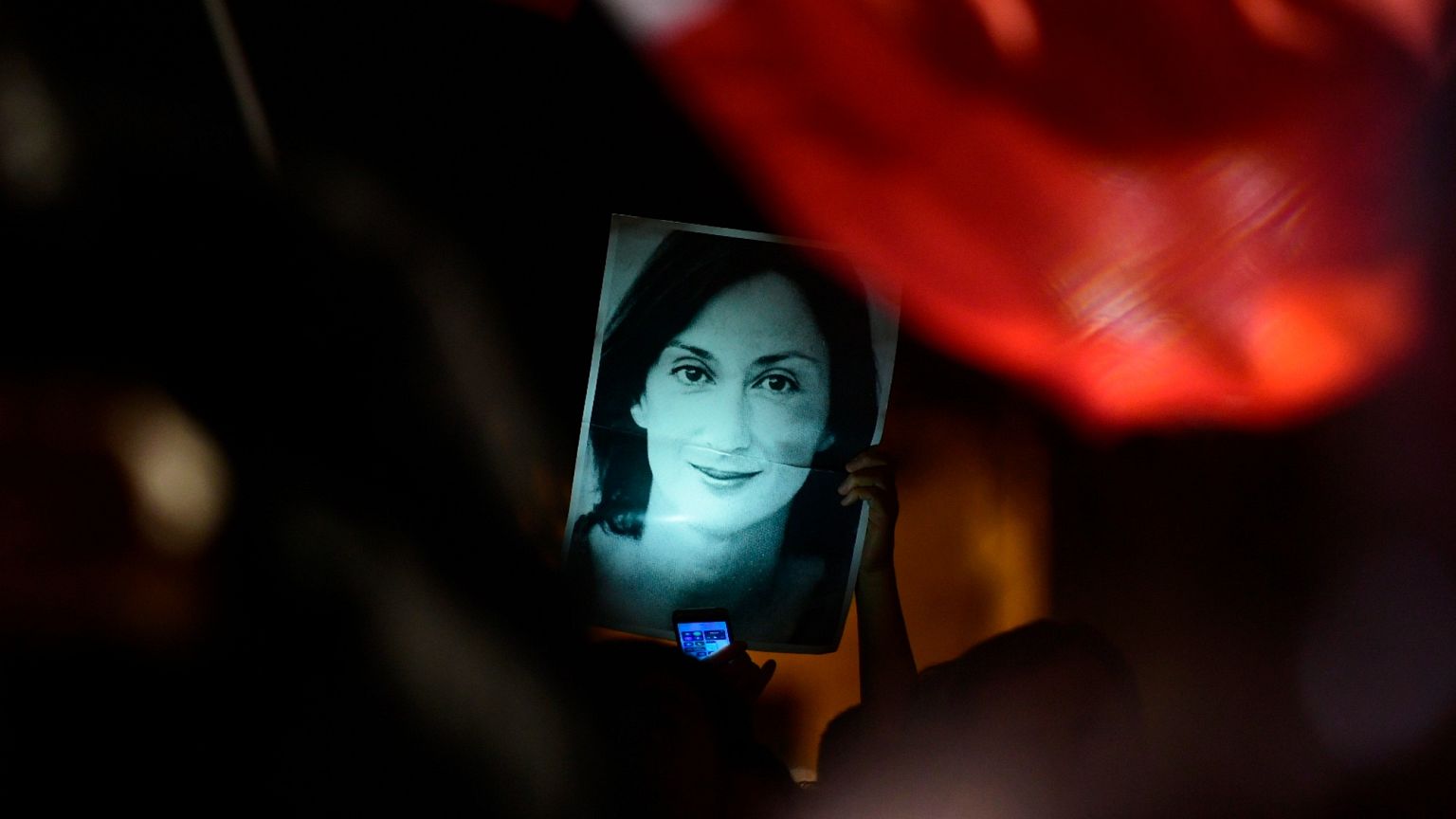
Daphne Caruana Galizia was murdered on 16 October 2017 by a car bomb that was detonated while she was driving near her home.


A jury in Malta found two men guilty on Friday of complicity in the murder of investigative journalist Daphne Caruana Galizia, after a six-week-long trial covering two homicides ended late on Thursday.

Jamie Vella and Robert Agius were found guilty of supplying the bomb that killed her.

Caruana Galizia was murdered on 16 October 2017 by a car bomb that was detonated while she was driving near her home.

In her career, she had written extensively about suspected corruption in political and business circles in Malta, and her murder shocked Europe and triggered angry protests in the Mediterranean island country.

Caruana Galizia's investigative reports had targeted people in then-Prime Minister Joseph Muscat's inner circle whom she accused of having offshore companies in tax havens disclosed in the Panama Papers leak.

She also targeted the opposition and at the time of her death was facing more than 40 libel suits.


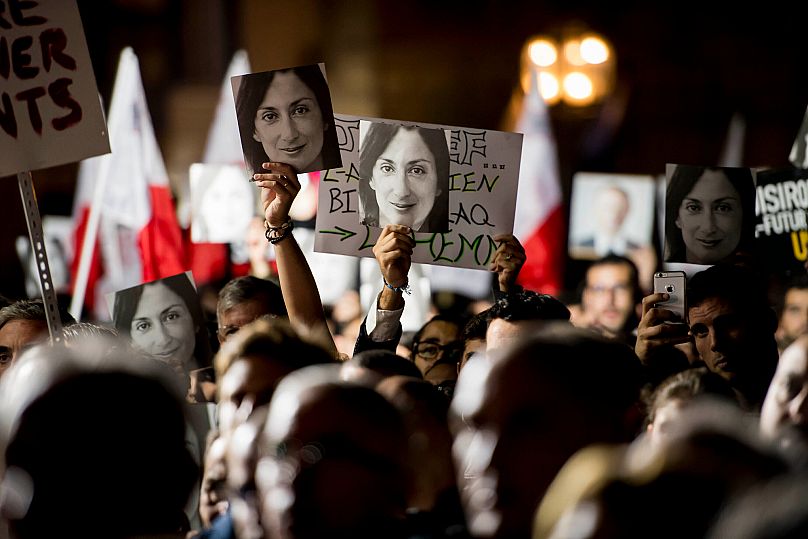
Protesters hold pictures of Daphne Caruana Galizia during a demonstration outside Malta's prime minister's office in Valletta, 29 November, 2019AP Photo

The Caruana Galizia family said in a statement that Thursday's verdict brings them a step closer to justice.

"Yet, eight years after Daphne's brutal assassination, the institutional failures that enabled her murder remain unaddressed and unreformed," the family added.

Vella and Robert Agius, together with two other men – George Degiorgio and Adrian Agius – also faced charges related to the separate murder of a lawyer, Carmel Chircop, who was shot and killed in 2015.

Vella, Degiorgio and Adrian Agius were found guilty of charges tied to the murder, while Robert Agius was found not guilty.

The judge will decide on sentencing at a later date.

George Degiorgio and his brother Alfred Degiorgio both pleaded guilty in 2022 to carrying out the murder of Caruana Galizia and were each sentenced to 40 years in prison.

A third man, Vincent Muscat, pleaded guilty in 2021 for his role in the Caruana Galizia murder and was sentenced to 15 years.

He testified in the recent jury trial after being granted a presidential pardon for his role in the Chircop murder on the condition that he tell the whole truth.

Yorgen Fenech, a prominent Maltese businessman, is currently out of jail on bail awaiting trial on charges of alleged complicity in Caruana Galizia's murder.

Pentagon watchdog probes if staff deleted Pete Hegseth's Signal chats about Yemen


Copyright AP Photo

By Gavin Blackburn with AP
Published on 06/06/2025 - 

Hegseth has already has faced questions over the installation of an unsecured internet line in his office that bypassed Pentagon security protocols and revelations that he shared details about US military strikes in multiple Signal chats.

The Pentagon's watchdog is looking into whether any of Defence Secretary Pete Hegseth’s aides were asked to delete Signal messages that may have contained sensitive military information that was shared with a reporter, according to two people familiar with the probe and documents reviewed by The Associated Press (AP).

The Inspector General of the Defence Department’s request focuses on how information about the 15 March US air strikes on Houthi targets in Yemen came to be shared on the messaging app.

Besides finding out whether anyone was asked to delete Signal messages, the inspector general is also asking some past and current staffers who were with Hegseth on the day of the strikes who posted the information and who had access to his phone.

Democratic lawmakers and a small number of Republicans have said that the information Hegseth posted to the Signal chats before the military jets had reached their targets could have put the pilots' lives at risk and that for any lower-ranking members of the military it would have led to their firing.

Hegseth has said none of the information shared was classified.

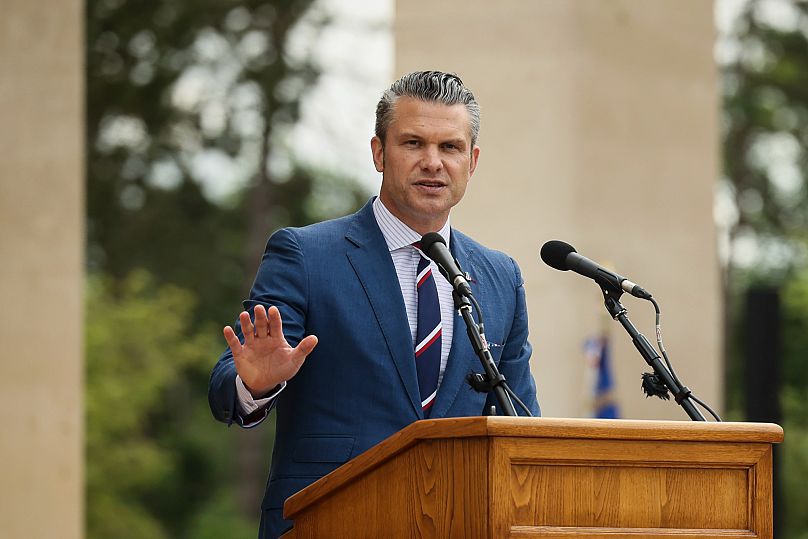
US Defence Secretary Pete Hegseth speaking at the US cemetery to commemorate the 81st anniversary of the D-Day landings in Normandy, 6 June, 2025 AP Photo

But current and former military officials have said there is no way details with that specificity, especially before a strike took place, would have been cleared to share on an unsecured device.

"I said repeatedly, nobody is texting war plans," Hegseth told Fox News in April after reporting emerged about the chat that included his family members.

"I look at war plans every day. What was shared over Signal then and now, however you characterise it, was informal, unclassified coordinations, for media coordinations and other things. That’s what I’ve said from the beginning."

News of the imminent probe comes as Hegseth is scheduled to testify before Congress next week for the first time since his confirmation hearing.

He is likely to face questions under oath not only about his handling of sensitive information but also the wider turmoil at the Pentagon following the departures of several senior aides and an internal investigation over information leaks.
Security issues at the Pentagon

Hegseth has already has faced questions over the installation of an unsecured internet line in his office that bypassed Pentagon security protocols and revelations that he shared details about US military strikes in multiple Signal chats.

One of the chats included his wife and brother, while the other included President Donald Trump's top national security officials and, inadvertently, The Atlantic's editor-in-chief, Jeffrey Goldberg.

Pentagon press secretary Kingsley Wilson made no comment on Friday, citing the pending investigation.

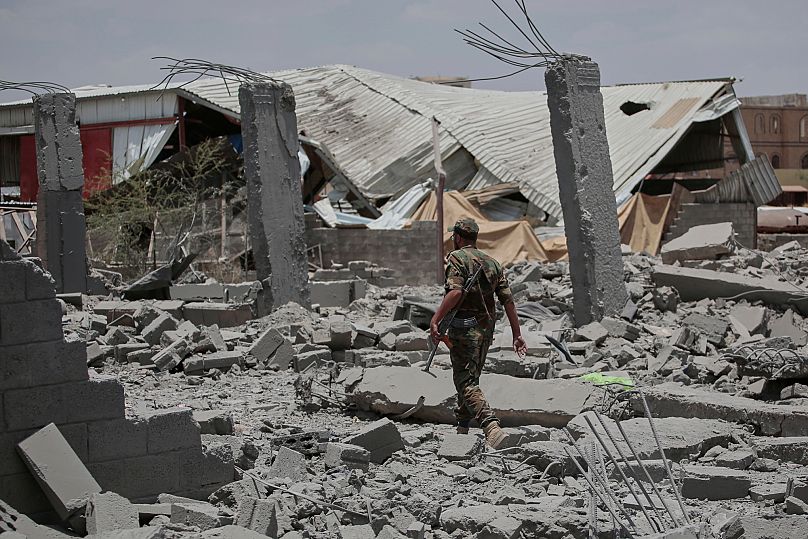
A Yemeni soldier inspects the damage reportedly caused by US air strikes in Sanaa, 27 April, 2025AP Photo

The inspector general's office didn't immediately respond to a request from the AP for comment.

US President Donald Trump has made clear that Hegseth continues to have his support, saying during a Memorial Day speech at Arlington National Cemetery in Virginia that the defence secretary "went through a lot" but "he's doing really well."

Hegseth has limited his public engagements with the press since the Signal controversy. He has yet to hold a Pentagon press briefing and his spokesperson has briefed reporters there only once.

The inspector general is investigating Hegseth at the request of the Republican chairman of the Senate Armed Services Committee, Senator Roger Wicker of Mississippi and the committee's top Democrat, Senator Jack Reed of Rhode Island.

Signal is a publicly available app that provides encrypted communications, but it can be hacked and is not approved for carrying classified information.

On 14 March, one day before the US strikes in Yemen, the Defence Department cautioned personnel about the app's vulnerability.

Trump has said his administration targeted the Houthis over their "unrelenting campaign of piracy, violence and terrorism."

He noted the disruption Houthi attacks caused through the Red Sea and the Gulf of Aden, key waterways for energy and cargo shipments between Asia and Europe through Egypt’s Suez Canal.

The Houthis attacked more than 100 merchant vessels with missiles and drones, sinking two vessels and killing four sailors, between November 2023 until January this year.

Their leadership described the attacks as aimed at ending the Israeli war against Hamas in Gaza.
MPs vote to recognise suffering of families brought to France from Indochina

In a historic step, France’s lower house of parliament has voted unanimously to recognise the suffering of people repatriated to the mainland from the colonies in Indochina in the 1950s. The bill, brought by the Socialists, proposes a national day of remembrance on 8 June, compensation and the creation of memorial sites.

Vietnamese families beside French army units on 11 March, 1954, waiting to reach the city of Qui Nhon. Operation Atlante-Phase-Axelle during the Indochina War. AFP - JENTILE

Issued on: 05/06/2025

The crushing defeat for the French at Dien-Bien-Phu in Vietnam in 1954 brought an end to France’s century-long colonial presence in Indochina, which included Vietnam, Laos, and Cambodia.

The Geneva Accords of 21 July of that year opened the door to the repatriation to mainland France of nearly 40,000 people of Asian and European heritage, between 1954 to 1965.

From 1954, around 5,000 people were accommodated in camps in Noyant-d’Allier (Auvergne), Sainte-Livrade (Lot-et-Garonne), or in Bias (Lot-et-Garonne), in difficult conditions, under a special status which did not give them the same rights as the rest of the population.

They included many women with mixed-race children who had been forced to flee the risk of reprisals in their native region, as well as those married to French officials. A great number were from Vietnam.


This picture taken 07 May 1954 shows a Vietnamese soldier waving a flag atop a French PC as others assault the area at the Dien Bien Phu battlefield, Vietnam. AFP - AFP


Forced into oblivion


Just over 70 years later, France’s National Assembly on Tuesday passed a law recognising the country’s "commitment to those repatriated from Indochina” who had been housed in “undignified conditions". It would compensate them, along with their families.

The bill – brought by Socialist Party MP and general secretary Olivier Faure – takes into consideration the "deprivations and violations of individual freedoms", sources of exclusion, suffering, and trauma felt across generations.


"Even for those who had chosen France as their homeland, it behaved like a colonial power, forcing those who had served it into oblivion," Faure told fellow MPs.

Beyond a lump sum for reparations, the bill would extend a national day of remembrance on 8 June to these repatriates, as well as the designation of memorial sites.

The proposed legislation still has to be voted by the Senate.

Vietnamese women photographed at the CAFI village (Reception Centre for French citizens of Indochina) in Sainte Livrade sur Lot, France. © Sainte-Livrade-sur-Lot City Hall

Culture shock

Guy Dauchat, deputy mayor of Noyant-d'Allier, is coordinating a museum project dedicated to this little-known part of France's history.

"In 1943, when the mines closed, dozens of miners' houses (known as ‘coron’) were emptied," he told RFI’s Marie Casadebaig.

The vacant dwellings transformed part of this Auvergne village into a camp for the Indochina repatriates.

Living conditions were very primitive, he explains. "But they were more dignified than at the other main reception centre in Sainte-Livrade-sur-Lot, where they were housed in a former German prison camp."

Specific laws governed the daily lives of these families. They couldn’t leave the camps without authorisation and many lived solely on family allowances. "They were housed for free, so in return, the state considered that they should live in modest conditions," Dauchat says.

"They weren't allowed to have television in the 1960s, for example, or to own their own car. Such things were considered outward signs of wealth."

Accustomed to living in Southeast Asia, the repatriates also faced a culture shock. The few surviving witnesses recall the cold of the first winter and their ill-adapted, traditional clothing.


Preserving family stories

The National Assembly vote follows decades of campaigning by several citizens’ groups for France to both officially acknowledge what happened and formally conserve those stories for future generations.

Julien Cao Van Tuat, the president of ARINA (Association of Repatriates of Noyant-d'Allier) arrived in France in 1960, at the age of 3.

He told public radio Franceinfo that living conditions were terrible and families were broken up.

"Men had to leave to look for work immediately, in Lyon, Paris, and the larger cities," he recalls. "After living in Marseille and Vienne, my mother arrived alone with her five children in Noyant-d'Allier on 21 June, 1962. She was lost."

Marie Dietrich Adiceam, co-president of ARINA remembers the dilapidated state of the miners’ house she lived in.

The floor was "made of earth, with terracotta tiles. It was very rustic. We were allowed a stove and a blanket per person," the 70-year old told Franceinfo.

Similar stories came from the Bias and Saint-Livrade camps, with reports of children working for a pittance in nearby farms to supplement their parents' meager incomes.

"When our parents arrived in France, they had a lot of hope. France was idealised", Cao Van Tuat continues.

"When they saw how they were treated, even as French citizens, they understood that they were second-class citizens. Our parents bowed down and sacrificed themselves so that their children could get ahead through education and assimilation."
Similiarity with Harkis' story

Parliamentary recognition comes after a similar law, passed in 2022, recognised France's responsibility in the treatment of Harkis repatriated from Algeria.

These soldiers, who fought on the side of the French during the Algerian war, were housed with their families in deplorable conditions in camps like Bias, which until 1962 had accommodated families from Indochina.

Harkis inside Bias camp in the south of France, a reception centre for returnees from Algeria, in August 1975. AFP

Adiceam says it’s only fair to be considered for reparations.

"From our generation, two or three have committed suicide, many have sunk into alcoholism", she says. "So these people deserve reparation. And above all not to be forgotten because otherwise, afterwards, there will be nothing left for us."

The Noyant-d'Allier camp officially closed in 1966. But Adiceam's parents stayed on, and like many families bought cottages from the town hall. "Where else could they go?" she wonders.

Her story of life is one of hundreds carefully archived on association websites like the CAFI (Centre d’Accueil de Français d’Indochine), with the hope that younger generations won't forget.
French judges order release of New Caledonian independence leader

French investigating magistrates have ordered the release of an independence leader from New Caledonia who was detained for a year over deadly riots in 2024, but he will not be freed immediately after prosecutors appealed the decision.


Issued on: 04/06/2025 - RFI

Christian Tein, from New Caledonia's indigenous Kanak group, has been held in custody in eastern France since June 2024. © AFP/Delphine Mayeur

Christian Tein, 57, from the indigenous Kanak group, has been held in custody in eastern France since June 2024.

He was charged over rioting on the Pacific archipelago that left 14 people dead, including two gendarmes, and caused more than two billion euros in damage.

Tein heads the Field Action Coordination Unit (CCAT), an organisation that prosecutors suspect was behind the unrest that broke out on 13 May 2024.

He has denied any role in organising violence and considers himself a political prisoner.


Insufficient evidence

The investigating judges questioned Tein in late May and on Tuesday ruled he should be released under judicial control.

A source close to the case told the French news agency AFP that the conditions include a ban on returning to New Caledonia and on contacting other individuals involved in the case.

The judges concluded that, at this stage, there is no evidence Tein was preparing an armed uprising against the French state. They also found no incriminating material during searches of his devices.

Prosecutors opposed the decision, arguing that Tein played a central role in planning violent action against the government. Prosecutors said he could try to flee with the help of supporters if released.

A Paris court of appeal is expected to decide within 48 hours whether the release order should be suspended.


Lawyers welcome decision


In a statement, Tein’s lawyers welcomed what they called the judges’ “new reading of the case”. They also said the Paris prosecutor’s office was “totally out of touch" with the evidence of the proceedings.

“The freedom of Mr Tein must now be recovered so that the judicial battle continues to convince of his absolute innocence,” they said.
Cameroon tops refugee NGO's list of most neglected displacement crises

A new report released by the Norwegian Refugee Council has placed Cameroon at the top of an annual list of the most neglected global displacement crises, highlighting a sharp decline in international support.


Issued on: 05/06/2025 - RFI

Fadimatou, an internally displaced woman living in Nyabi, Cameroon. 
© Norwegian Refugee Council


Despite hosting hundreds of thousands of refugees and internally displaced people, the situation in the country has received limited international attention, insufficient humanitarian funding and minimal political engagement, according to the NGO.

"It’s a case study in global neglect," Laila Matar, NRC's director of communications, told RFI. "There’s little media coverage, no meaningful diplomatic engagement and chronic underfunding. People are really struggling to survive."

Cameroon is grappling with humanitarian emergencies driven by three distinct situations – violence in the far north, ongoing conflict in the anglophone regions, and an influx of refugees from neighbouring Central African Republic.

These crises have left the country’s services overwhelmed and under-resourced.


According to the NRC’s report, covering 2024, 11 percent of Cameroon’s population now faces acute food insecurity.

"1.4 million children are crammed into poorly maintained and overcrowded classrooms," said Matar. "There’s simply no meaningful investment coming in from the global community."

Cameroon’s 2024 humanitarian response plan was only 45 percent funded, leaving a gap of more than $202 million (almost €178m).

Alongside Cameroon, the NRC’s report highlights nine other displacement crises suffering from similar neglect and lack of aid funding, including those in Ethiopia, Mozambique and Burkina Faso, each grappling with ongoing conflict.


'Inward-looking policies'

To explain this reduced support and lack of engagement, Matar says: "Donor fatigue is certainly a factor. But more worrying is the shift we’re seeing from international solidarity to more inward-looking, security-focused policies in countries that used to be generous donors."

Several developed countries have made significant cuts to their overseas aid budgets.

France announced it would reduce public development assistance by more than €2 billion – nearly 40 percent of its annual allocation.

The United Kingdom has cut its overseas development assistance from 0.5 percent to 0.3 percent of gross national income, while Germany and the Netherlands are amongst others to have announced substantial reductions in foreign aid.


This comes as the United States – formerly the worlds largest contributor to overseas relief funding – has shut down or drastically reduced several aid programmes, including USAID, amid accusations of inefficiency from the Trump administration.

These decisions carry serious consequences for the humanitarian work of NGOs such as the NRC.

"We’re layering compromise upon compromise," Matar told RFI. "And those compromises are deadly."

The NRC report also makes an impassioned plea for a shift in priorities, with the organisation's secretary-general Jan Egeland saying: "Displacement isn’t a distant crisis. It’s a shared responsibility. We must stand up and demand a reversal of brutal aid cuts which are costing more lives by the day."

While governments and institutions must lead the charge, Matar stressed that ordinary people also have a role to play.

"Humanitarian aid works. It helps people start to dream of a future again," she said. "We can write to our MPs, speak out, and demand that our governments stop cutting aid in our name. We don’t need these crises to come to our borders to care about them."
French dockers refuse to load cargo of machine gun parts bound for Israel

Dockworkers at the port of Marseille-Fos have refused to load a container allegedly containing parts for machine guns destined for Israel, citing opposition to the Israeli military’s actions in Gaza. The French defence ministry insists the components are sent to Israel for assembly and then sent back to France, or exported to other countries.


Issued on: 05/06/2025 - 12:53

Containers at the port of Marseille-Fos. AP - Claude Paris

The hard-left CGT union representing dockworkers and port personnel at Fos-sur-Mer says the the cargo contains 19 pallets of ammunition belt links manufactured by Eurolinks – a Marseille-based company which produces components for automatic weapons.

The container, which is scheduled to be shipped from the southern French port to the Israeli port of Haifa on Thursday, is currently blocked.

The union said it was able to locate the container after being alerted by several activist networks.

“We will not load it on to the vessel bound for Haifa,” the CGT said in a statement.

Eurolinks produces metallic links used to connect rounds in machine guns, allowing them to be fired in rapid succession.

“These Eurolinks links are spare parts for machine guns used by the Israeli army to continue the massacre of the Palestinian population,” the CGT stated. “The port of Marseille-Fos must not be used to supply the Israeli army... dockworkers and port employees at the Gulf of Fos will not be complicit in the ongoing genocide orchestrated by the Israeli government."

UN committee says Israel warfare in Gaza 'consistent with genocide'

The French Armed Forces Ministry rejects the union's claims. "France is not supplying weapons to Israel," it told public radio FranceInfo.

In line with the licence given to Eurolinks, the links are assembled in Israel, but the final product is then re-exported back to other countries, including France, the ministry said, adding that Israel remains "a partner".

"We're not going to deprive ourselves of either its technology or its skills," it stated.


Third delivery this year

This is the third shipment of this type to Israel this year, according to an enquiry by investigative websites Disclose and The Ditch, which had access to maritime data.

The first took place on 3 April, with 20 tonnes of war material, and the second, with 1 million M9 and 1 million M27 bullets, was on 22 May.

"The buyer of these parts is an Israeli arms manufacturer, one of the main suppliers to the Israeli army," Ariane Lavrilleux, a journalist at Disclose, told RFI.

In March 2024, Disclose and another online media outlet Marsactu, claimed the arms were "likely to be used against civilians in the Gaza Strip".

French Armed Forces Minister Sébastien Lecornu confirmed at the time that Eurolinks had sold similar parts to IMI Systems – an Israeli defence firm that identifies itself as a “sole supplier” to the Israeli military.

Lecornu stated that the parts could only be "re-exported" by Israel.

"France has no way of checking whether or not the Israeli manufacturer is re-exporting them," Lavrilleux insists. "There is no absolute proof that these links are being used in Gaza, but there is a serious risk insofar as we know that they are compatible with weapons used against civilians in Gaza."


Left-wing support

The dockers' action has received support from the left.

"Glory to the dockers in the port of Marseille-Fos... everywhere in the world, the fight is being organised against the genocide in Gaza," Manuel Bompard, an MP with the hard-left France Unbowed party, posted on X (formerly Twitter).

The party's leader, Jean-Luc Mélenchon, posted a similar message, calling for an "embargo now on the weapons of genocide".

Olivier Faure, head of the Socialist Party, also congratulated the dockers, posting on X that: "Humanism is not for sale."


RFI joins 135 NGOs and media groups in urging unrestricted press access to Gaza

The press freedom group Reporters sans frontières (RSF) has published an open letter signed by 136 human rights organisations and media groups, including RFI, calling for immediate, independent, and unrestricted access for international journalists to t
he Gaza Strip.


Issued on: 05/06/2025 

Journalists hold a banner reading "Gaza, stop the massacre of journalists, solidarity with our colleagues" during a demonstration in support of their Palestinian colleagues in front of the Opera Bastille in Paris, on April 16, 2025. AFP - STEPHANE DE SAKUTIN

The demand comes amid escalating military operations and mounting concerns over the safety of local j
ournalists and the suppression of information from the besieged territory.


Since October 2023, Israeli authorities have barred foreign journalists from entering Gaza—a move that media organisations describe as unprecedented in the context of modern warfare.

With access tightly controlled, the global media has been unable to independently verify events on the ground, raising serious concerns about transparency, accountability, and the public’s right to information


Palestinian journalists killed


Local journalists have borne the brunt of the conflict. According to press freedom monitors, nearly 200 Palestinian journalists have been killed since the start of the war, with many more injured or operating under constant threat.


Reporters inside Gaza are working amid widespread displacement, food shortages and communication blackouts, often risking their lives to document the unfolding crisis.

Journalist safety and press access are protected under international humanitarian law, including the Geneva Conventions, which classify journalists in conflict zones as civilians and prohibit targeting them.

Advocates are urging Israel to comply with these legal obligations and to open its borders to international media.


“At this pivotal moment, with renewed military action and efforts to resume the flow of humanitarian aid into Gaza,” the letter reads, “it is vital that Israel open Gaza’s borders for international journalists to be able to report freely and that Israel abides by its international obligations to protect journalists as civilians."

Independent reporting essential


The call for access comes as renewed military actions take place in the region and humanitarian agencies struggle to deliver aid to civilians.

Media organisations say that independent reporting is essential to understanding the scope of the crisis and ensuring global awareness of its human impact.

Despite the dangers, local journalists in Gaza continue to report from the ground, often using limited tools and under severe threat. Their work, say advocates, underscores the urgent need for global media presence to amplify their efforts and ensure accountability.

The international community is being urged to pressure Israeli authorities to lift restrictions and allow journalists to enter Gaza freely. Until then, concerns over censorship, misinformation, and the erasure of on-the-ground realities are likely to intensify.

French woman sues Israel over Gaza strike that killed two grandchildren


A French grandmother has filed a legal complaint in Paris accusing Israeli authorities of responsibility for the deaths of her two grandchildren in Gaza during an airstrike in October 2023. The case includes charges of murder and genocide and was lodged on Friday with the crimes against humanity division of the Paris Judicial Court.


Issued on: 06/06/2025 - RFI

According to Unicef, more than 50,000 children have reportedly been killed or injured in Gaza since October 2023. REUTERS - Hatem Khaled

The complaint relates to the deaths of Janna and Abderrahim Abudaher, aged 6 and 9, who were killed when their family home in northern Gaza was struck by two missiles on 24 October 2023.

The missiles were allegedly fired by Israeli F-16 jets.

The airstrike occurred 17 days after Hamas launched an unprecedented attack on Israeli soil.

The 48-page lawsuit was lodged by lawyer Arié Alimi on behalf of Jacqueline Rivault – the children's maternal grandmother.

The children are French nationals, which means the case could fall under the jurisdiction of French courts.

Israeli leadership targeted


Rivault accuses the Israeli authorities of murder, crimes against humanity, genocide and complicity in those crimes.

Although filed against unnamed persons – "X" – the complaint explicitly names Israeli Prime Minister Benjamin Netanyahu, the Israeli government and the country's military (IDF).

For Rivault, the case also highlights France’s failure to protect its own citizens. The French government "should have evacuated French nationals living in the Gaza Strip,” she told France Info public radio.

The complaint argues that the strike was not an isolated event but part of a broader campaign to “eliminate the Palestinian population and subject them to conditions intended to bring about the destruction of the group” – a core element in the legal definition of genocide.

According to the filing, the Abudaher family fled their apartment due to heavy bombing, seeking refuge in two other locations before settling in a house in northern Gaza, near Fallujah and Beit Lahia.

The house was hit by two missiles – one piercing the roof, the other striking the room where the family had gathered.

Abderrahim died instantly, Janna died shortly after being taken to the hospital. Their brother Omar survived with serious injuries. Their mother, Yasmine Z, was also wounded.

Yasmine Z, previously convicted in absentia in France for financing terrorism, remains in Gaza and is subject to a French arrest warrant.

Seeking accountability

Rivault's lawyer Alimi said the case aims to ensure accountability beyond Israeli borders. "It is necessary that those who were involved, in one way or another, in acts that could be classified as crimes against humanity or genocide, know that when they leave Israel's borders they can be arrested anywhere,” he told France Info.

Responsibility lies not only with leaders, he said, "but anyone who will have participated in one way or another".

The lawsuit joins a growing list of international efforts to hold Israeli officials accountable for alleged war crimes and genocide – charges Israel strongly denies, calling them "scandalous".

The International Criminal Court has issued arrest warrants for Netanyahu and former Israeli Defense Minister Yoav Gallant, on charges of crimes against humanity and war crimes.

The International Federation for Human Rights was the first to declare Israel’s actions as genocidal in December 2023. Amnesty International and Human Rights Watch followed suit in 2024.

In January, the International Court of Justice ordered Israel to take all measures to prevent acts of genocide. In mid-May, the UN's top humanitarian official called on world leaders to act to prevent a genocide in Gaza.

Similar legal actions have been initiated in Switzerland, the Netherlands and Germany.

In France, three complaints have recently been filed against dual French-Israeli citizens or IDF soldiers, accusing them of genocide or complicity in genocide – although none have gained traction so far.

(with AFP)

African Union condemns Trump travel ban amid strained Africa-US relations

The African Union has expressed deep concern over President Donald Trump's sweeping travel ban on citizens from seven African countries, warning that the restrictions will damage decades of carefully nurtured diplomatic and commercial ties between the United States and the continent.


Issued on: 05/06/2025

Ten African countries will face either an outright ban or restrictions on travel to the US from Monday, 9 June. © Rick Bowmer/AP

Seven of the 12 countries targeted by Trump's travel ban, announced on Wednesday, are on the African continent.

As of Monday, 9 June, citizens of Chad, Republic of the Congo, Equatorial Guinea, Eritrea, Libya, Somalia and Sudan will no longer be allowed entry to the US.

Burundi, Sierra Leone and Togo are among seven further nations subjected to partial restrictions.

In a statement released on Thursday, the African Union (AU) said it "remains concerned about the potential negative impact of such measures on people-to-people ties, educational exchange, commercial engagement, and the broader diplomatic relations that have been carefully nurtured over decades".

The AU, which represents all 55 nations on the African continent, called on Washington to "consider adopting a more consultative approach and to engage in constructive dialogue with the countries concerned," while appealing for "transparent communication" to address underlying issues.

Terrorism and visa overstays

The Trump administration has justified each country's inclusion on the list in a presidential proclamation. Equatorial Guinea and Republic of Congo have been targeted due to visa overstays, while Somalia and Libya face restrictions over terrorism concerns.

In a video posted on his Truth Social platform, Trump said an analysis of "high-risk regions" had found "the large-scale presence of terrorists, failure to cooperate on visa security, inability to verify travellers' identities, inadequate record keeping of criminal histories and persistently high rates of illegal visa overstays".

Trump linked the decision to a recent terror attack in Boulder, Colorado, which he said "underscored the extreme dangers posed to our country by the entry of foreign nationals who are not properly vetted, as well as those who come here as temporary visitors and overstay their visas – we don't want them".

Somali authorities have pledged to work with the US to resolve security issues, after the US described the country as a "terrorist safe haven". Dahir Hassan Abdi, the Somali ambassador to the United States, said in a statement: "Somalia values its longstanding relationship with the United States and stands ready to engage in dialogue to address the concerns raised."

Residents in Mogadishu were less diplomatic. "I totally disagree with the president of the United States' decision," Salad Abdullahi Mohamed told France's AFP news agency. "Somali immigrants reached there after a long hazardous trip to get a better life."

Ali Abdullahi Ali, another Mogadishu resident, argued that Somali migrants were simply looking "to make a better living and help their parents," adding: "I would call on the president to make this decision null and void and also give necessary documents to stay and continue living and working there."


US-Africa tensions


The travel ban is the latest blow to US-Africa relations under Trump's second administration. The president introduced travel restrictions during his first term, which he claimed were "one of our most successful policies" and had prevented terror attacks on US soil.

Earlier this year, Trump imposed tariffs on scores of African countries as part of his "Liberation Day" trade overhaul, with Lesotho facing a 50 percent tariff, Madagascar 47 percent, and Mauritius 40 percent. These have been temporarily reduced to a 10 percent universal levy, pending negotiations.

Relations were further strained in May, when Trump ambushed South African President Cyril Ramaphosa during a meeting at the Whitehouse, pushing theories about a "white genocide" in the country.

In its statement, the AU emphasised that "Africa and the United States share mutual interests in promoting peace, prosperity, and global cooperation," while acknowledging "the sovereign right of all nations to protect their borders and ensure the security of their citizens".

However, it appealed to the US to "exercise this right in a manner that is balanced, evidence-based, and reflective of the long-standing partnership between the United States and Africa".

Trump said that the strength of the restrictions depends on the "severity of the threat posed" and that the list could be revised depending on whether targeted nations made "material improvements".
Brazil fires drive acceleration in Amazon deforestation: report

Sao Paulo (AFP) – A record fire season in Brazil last year caused the rate of deforestation to accelerate, in a blow to President Luiz Inacio Lula da Silva's pledge to protect the Amazon rainforest, official figures showed Friday.


Issued on: 07/06/2025 -RFI

Illegal burning of the Amazon rainforest near Humaita, in the northern Brazilian state of Amazonas, in September 2024 © MICHAEL DANTAS / AFP/File

The figures released by the National Institute for Space Research (INPE), which tracks forest cover by satellite, indicated that deforestation rate between August 2024 and May 2025 rose by 9.1 percent compared to the same period in 2023-2024.

And they showed a staggering 92-percent increase in Amazon deforestation in May, compared to the year-ago period.

That development risks erasing the gains made by Brazil in 2024, when deforestation slowed in all of its ecological biomes for the first time in six years.

The report showed that beyond the Amazon, the picture was less alarming in other biomes across Brazil, host of this year's UN climate change conference.

In the Pantanal wetlands, for instance, deforestation between August 2024 and May 2025 fell by 77 percent compared to the same period in 2023-2024.

Presenting the findings, the environment ministry's executive secretary Joao Paulo Capobianco chiefly blamed the record number of fires that swept Brazil and other South American countries last year, whipped up by a severe drought.

Many of the fires were started to clear land for crops or cattle and then raged out of control.

© 2025 AFP
Ocean’s survival hinges on finding the billions needed to save it

The ocean supports food, jobs and the climate systems that keep global weather in balance – but only 8 percent of it is protected, and money to safeguard the rest is critically lacking. This weekend, finance leaders and marine experts are meeting in Monaco for what many say is a make-or-break moment to close the funding gap and secure the ocean’s future.


Issued on: 06/06/2025 - RFI


Countries have pledged to protect 30 percent of the ocean by 2030 – a target known as 30x30 – yet vast areas remain unmanaged or open to damaging activities. AP - Kirsty Wigglesworth


By: Amanda Morrow

The Blue Economy and Finance Forum (BEFF) is one of three high-level events leading into next week’s critical UN Ocean Conference in Nice (UNOC).

It brings together governments, investors and oceanographers to unlock new financing solutions to protect and restore ocean health and coastal livelihoods. Experts warn that without urgent action to close a multi-billion-dollar funding gap, these efforts could collapse.

Of the $175 billion needed each year, the forum’s organisers say, only $25 billion has been mobilised so far. That shortfall has made SDG 14 – the UN goal to conserve oceans – the least funded of all its Sustainable Development Goals.

Leaders from the Pacific, a region on the frontlines of ocean diplomacy, are among those pushing to get the cash flowing.

“We’ll be calling for more investment and more partnerships to fund the commitments we’ve all made to SDG 14,” Pacific Ocean Commissioner Filimon Manoni told a press briefing by National Geographic's Pristine Seas, a global marine conservation programme.

"We also want to share our success stories, especially the ones led by communities.”

From pledges to finance

Monaco has assembled a solid coalition to host BEFF. In charge are the government, the Prince Albert II Foundation and the Oceanographic Institute, with backing from France and Costa Rica. Global partners include the UN Global Compact and the World Economic Forum.

"Together, we will mobilise the necessary investments – both public and private – for a sustainable blue economy," Prince Albert promised ahead of the event, which has drawn some of the most influential voices in finance and ocean policy.

European Central Bank president Christine Lagarde will deliver a keynote address on financing ocean health, while International Maritime Organisation secretary-general Arsenio Dominguez will speak on decarbonising shipping and building more resilient ports.

The closing remarks will come from French President Emmanuel Macron and Costa Rican President Rodrigo Chaves Robles – co-hosts of next week’s UN Ocean Conference in Nice.

Panels will examine topics from blue bonds and biodiversity credits to venture capital and public-private partnerships. The forum also features a Blue Innovation Hall showing the latest advances in ocean technology, including tools for renewable energy, waste reduction and marine monitoring.

The forum’s timing is crucial, said Kristin Rechberger, founder of the non-profit Revive Our Ocean and CEO of the green consulting firm Dynamic Planet.

“We’re at an inflection point right now at the midpoint of this decade, where we can make conservation businesses the norm instead of the exception,” she said.

"There's a really exciting opportunity through the Blue Economy Finance Forum and UNOC to close the gap between the funding that's actually available – it's just misaligned – and the needs that are really hungry for a regenerative blue economy."

Pacific leading the way

The Pacific region is widely credited as a leader in ocean protection. Manoni said the region had been "walking the talk" for years, pointing to large marine sanctuaries now in place in countries including Palau, the Cook Islands and the Marshall Islands.

"The Pacific has not been sitting idle," he said. "The Pacific has been at work." The western and central Pacific, Manoni added, now supply more than half of the world’s tuna, helping to secure global food security.

But experts say efforts like these need to be scaled up dramatically. Countries have pledged to protect 30 percent of the ocean by 2030 – a target known as 30x30 – yet vast areas remain unmanaged or open to damaging activities.

Enric Sala, founder of Pristine Seas, said more protection must go hand in hand with better enforcement and long-term funding.

"We have only 8 percent of the ocean in protected areas, and only 3 percent in zones where damaging activities are banned," Sala told journalists. "We need to quadruple protection in the next five years."

He said destructive practices like bottom trawling must also be banned – pointing to the “crazy situation” in Europe, where such activities continue even in many so-called protected areas.

Sala cited research estimating the societal cost of bottom trawlingin Europe at up to €11 billion a year, largely owing to carbon emissions from churning up sea floor sediment.

"The abundance of vulnerable species like sharks and rays is lower inside these areas than outside," Sala added.


Investing in change

As harmful fishing practices continue to undermine conservation efforts, BEFF is also zeroing in on how improved financing can drive change.

Key financial tools under discussion include debt-for-nature swaps and blended finance models that combine public and private investment. Twenty side events called “Solution Hubs” will explore everything from marine algae to sustainable aquaculture.

"We need to make sure finance directly reaches the coastal communities working to safeguard our ocean," said Rita El Zaghloul, director of the High Ambition Coalition for Nature and People – a group of more than 100 countries pushing to protect biodiversity and expand access to conservation funding.

Some of that is starting to happen. The coalition has launched a fast-track fund to provide small grants for marine-protected area planning.

"A community marine reserve doesn’t need a giant World Bank loan," added Rechberger. "It needs the right money, at the right time, and the right amount."

Awareness through storytelling

The economic stakes are huge. The ocean feeds 3.2 billion people and contributes $2.6 trillion to the global economy. Yet destructive practices continue to erode these benefits.

The forum is also taking place against growing pressure to resolve the disconnect between bold conservation pledges and the persistence of harmful practices at sea.

To help raise awareness, a special screening of the documentary Ocean, narrated by Sir David Attenborough, will close Saturday’s programme. The film features the first underwater footage of bottom trawling in action.

"Now, for the first time, people can see what bottom trawling does underwater," said Sala. "People can see what this practice does and can make up their minds."

As the countdown continues to the UN Ocean Conference in Nice, from 9 to 13 June, organisers hope BEFF will help shape the tone of the week. With only five years left to quadruple ocean protection, the window for action is rapidly closing.

"This is not only about conservation," Rechberger said. "It’s about building a thriving, regenerative ocean economy that works for people and the planet."
Kazakhstan

Unity in a fragmented world: Dialogue, trade and climate action at the Astana Forum
Copyright Euronews

By Galiya Khassenkhanova
Published on 06/06/2025 -


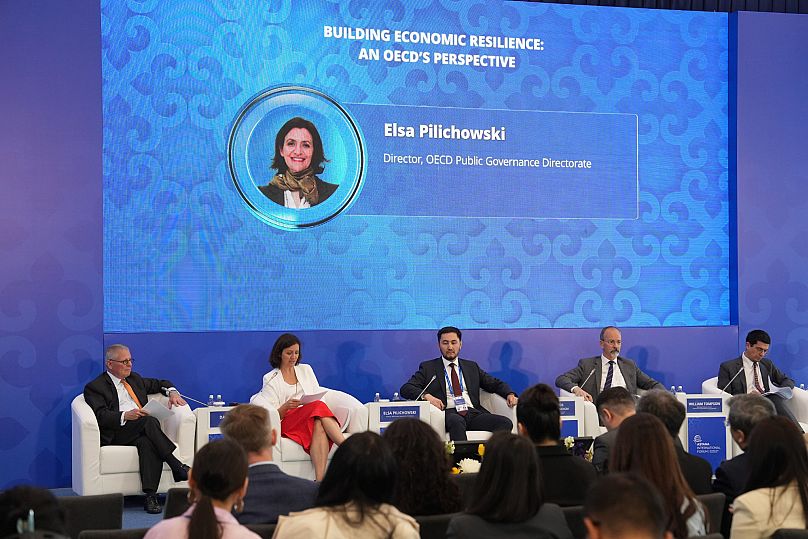
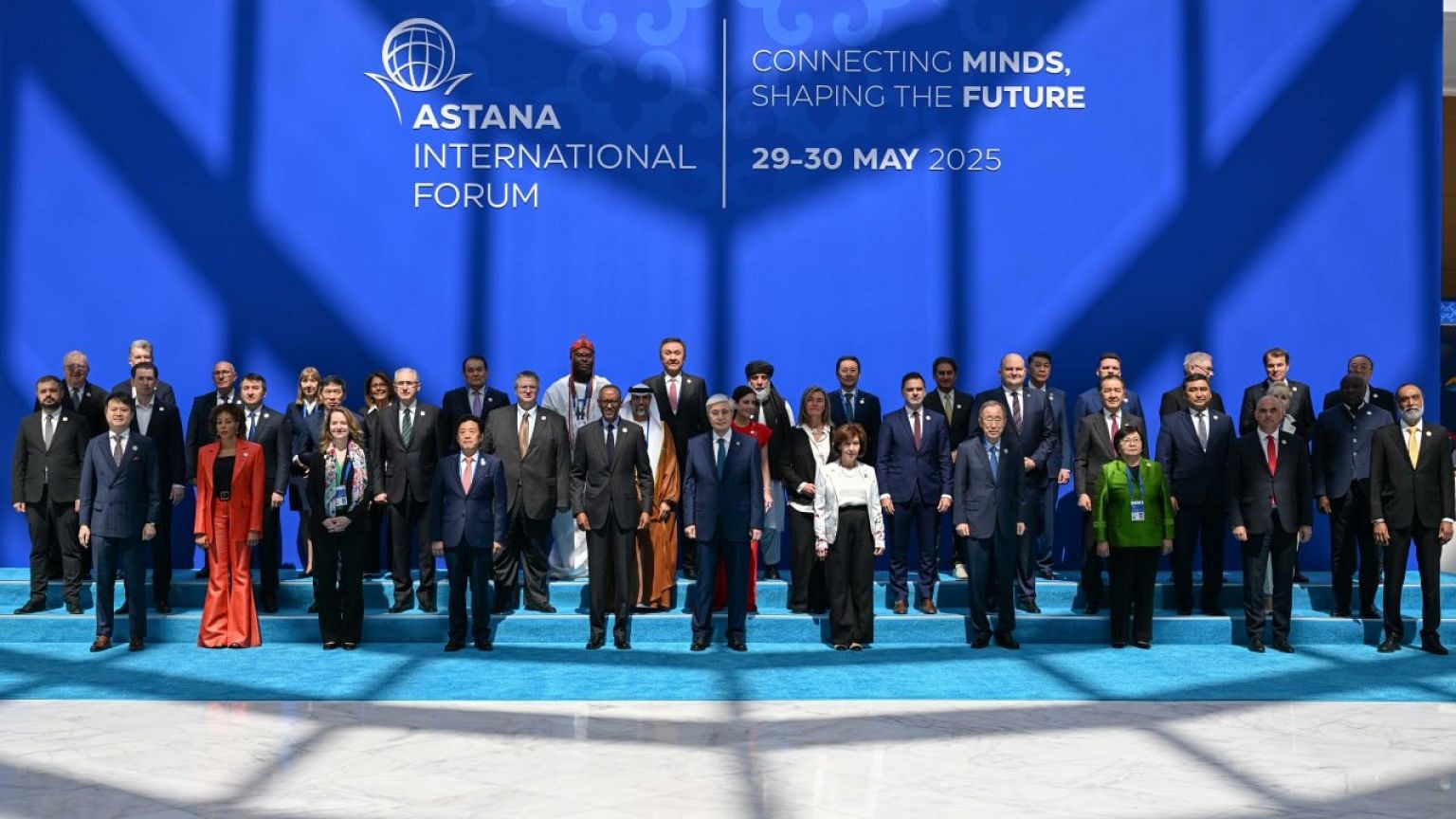
Titled “Connecting Minds, Shaping the Future,” the Astana International Forum (AIF) gathered over 160 international speakers and around 7,000 participants.

Global policymakers, international experts and business representatives came together at the Astana International Forum to discuss the way forward in a world full of uncertainties and conflicts.

Titled “Connecting Minds, Shaping the Future,” the Astana International Forum (AIF) gathered over 160 international speakers and around 7,000 participants.

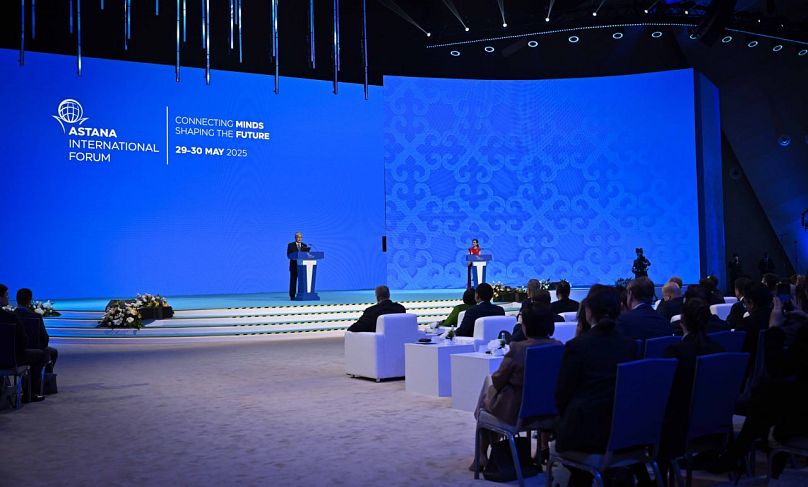
The event kicked off with a plenary session, where heads of state and high-ranking officials expressed worry over the state the world is in today.

President of Kazakhstan, Kassym-Jomart Tokayev, highlighted growing polarisation and increased confrontation between states. According to him, conflicts are brewing in 52 states, while their economic toll amounts to $19 trillion (€16 trillion), or 13.5% of global GDP.

Rwandan President, Paul Kagame, underlined that global challenges are interconnected and require integrated solutions. Vulnerabilities only get worse when external alignment occurs without internal stability.

Gordana Siljanovska-Davkova, President of North Macedonia, spoke about the need for reforms in the United Nations. The organisation’s bylaws were written 80 years ago and did not envisage the technology and complexity of the world in 2025.
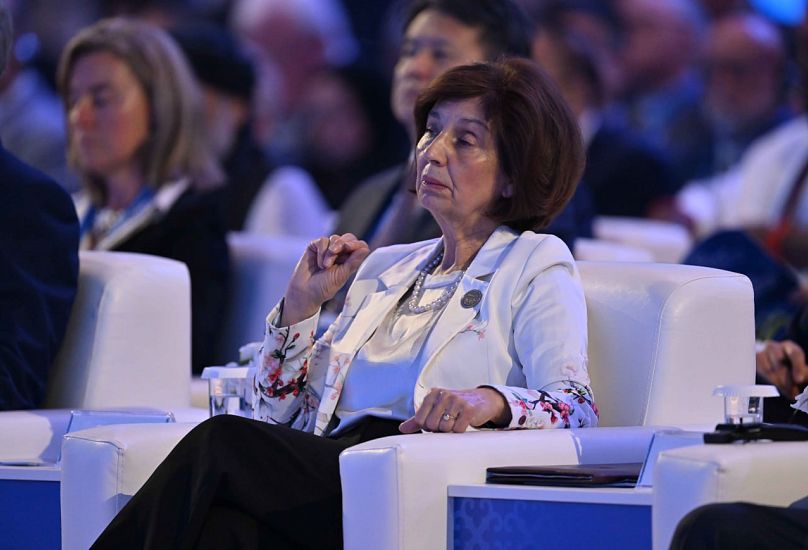
President of North Macedonia Gordana Siljanovska-Davkova at the Astana International Forum     Euronews

Ban Ki-moon, serving as the President and Chair of the Global Green Growth Institute, noted that climate change and deterioration of the environment can only be solved collectively, while Director-General of the Food and Agriculture Organization (FAO) Qu Dongyu highlighted that food is a basic human right and peace is a prerequisite for food security.

The plenary session was followed by around 40 panels, side events and one-on-one sessions covering trade, transportation, green energy, carbon neutrality, climate action, economy, finance, development of AI and more.


Trade: Positives and negatives


First and foremost, the Astana International Forum is a platform for connections and networking, including for business. As part of the forum, companies from France and Italy met with Kazakh businessmen and signed several agreements.

France signed 15 agreements with Kazakhstan, key among them being a €90 million (€78 million) project for the construction of a hydrogen production plant, which will help decrease carbon emissions.

Italy and Kazakhstan signed 10 memorandums for a total of €180 million (€157 million). The projects cover logistics, mechanical engineering, agricultural processing, industrial digitalisation and green energy.
Participants at the Astana International Forum in Kazakstan  Euronews

Negative effects of trade were also discussed at one the of the panels, where speakers considered how trade is weaponised today to serve egotistic goals.

If in the 2010s global powers were promoting free trade, the wind has changed in the last decade. Experts share that trade is an effective weapon, especially in short term, but what matters is the goal behind it.


Transportation: Middle Corridor’s significance

Central Asia’s role as a transit hub between China and Europe is undeniable today. The role of the Middle Corridor in this regard and its future development were also discussed during AIF.

“The turnover grew by 62 percent in 2024 and reached 4.5 million tonnes of cargo. The aim is to reach 10 million tonnes in 2027. About $15 billion (€13 billion) have already been invested in the development of infrastructure and transportation time sharply reduced to almost 14-18 days,” noted Director of Kazakhstan’s Institute for Strategic Studies, Yerkin Tukumov.

Participants at the Astana International Forum in Kazakhstan   Euronews

“The Middle Corridor will not solve all the problems because it is and will remain very expensive for certain goods to go over land. But it can be a medium-term solution, one of the alternatives,” countered Jurgen Rigterink, First Vice President of European Bank for Reconstruction and Development (EBRD).

Kazakhstan also announced a new transport initiative called Kazakhstan at the Crossroads of the Continents. Considering that almost 80% of goods from Asia to Europe travel through Kazakhstan, the country is trying to ease the process by consolidating all transportation related services and companies in one platform.


Climate change: Need for climate financing

While the temperatures in the rest of the world are projected to grow by 3.7°C by the 2090s, temperatures in Central Asia will rise by 5.8°C, almost twice as much. This will jeopardise a variety of sectors, including water security, food security, economic stability, employment rates and migration.

“Climate change is not a standalone problem. It rather multiplies the threats and the problems in many different sectors,” highlighted Zulfiya Suleimenova, Advisor to the President of Kazakhstan.

“Climate change is a huge problem in Central Asia and we cannot really be speaking about sustainable economic development in our region without addressing climate related challenges.”
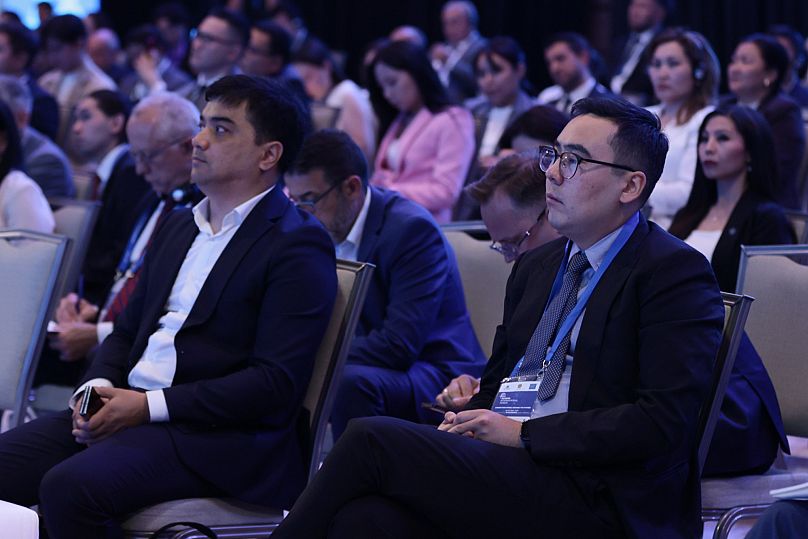
Participants at the Astana International Forum in Kazakstan Euronews

For the region to effectively combat the problem it requires robust funding, but so far has only attracted less than 1% of global climate financing.

One of the sessions at the forum directed attention to general accessibility and affordability of climate financing. The session was also able to bring together Central Asian ministries of economy and ecology to discuss acceleration of climate action.
Renewable energy: Relevance of rare earths

In the context of growing climate concerns, the importance of transition to green energy and diminishing of carbon emissions is underscored. Kazakhstan has set itself an ambitious goal of reaching carbon neutrality by 2060. So far, emissions reduced by only 6%.

To help the matter, the UAE-based company Masdar has pledged $1 billion (€880 million) for the development of renewable energy in Kazakhstan.

At one of the panels, speakers highlighted Kazakhstan’s potential in renewable energy, especially wind energy. The vast steppes can potentially generate 1 billion kW hours per year, which is eight times the need of the country, leaving the rest for export.

Experts also noted that development of renewable energy infrastructure has driven the demand for rare earth elements, which have become the “new gold.” In that sense, Central Asia has an advantage of rare earths reserves. Kazakhstan alone has 19 out of 34 rare earth metals.
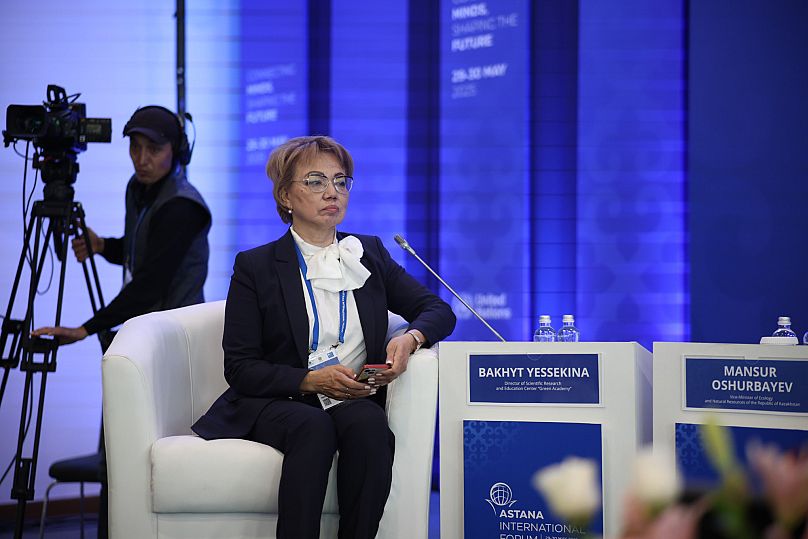

Participants at the Astana International Forum in Kazakhstani  Euronews
Artificial intelligence: Regulation of ethical use

No discussion on Friday happened without mentioning the benefits and threats of artificial intelligence. The forum participants deliberated on AI regulation in terms of ethical and safe use.

“Soon AI will know more about you than you know yourself. Are you ready for such information to be shared without your permission? Even with government agencies, let alone publicly. I think we need to prepare for a new era of AI, look at it positively, but prepare legislatively, organisationally, and personnel-wise,” noted Yerkin Tukumov, Director of Kazakhstan’s Institute for Strategic Studies.

At the same time, Kazakh Minister of Digital Development, Innovation and Aerospace Industry Zhaslan Madiyev noted that Kazakhstan is already preparing a law that will regulate AI use to prevent its abuse.

“The idea is not to overregulate, but to consider some of the ethical standards,” Madiyev said, noting that the law is under consideration by the parliament at the moment.

Over two days, the Astana International Forum pulsed with dialogue, exchange, and collaboration. From parallel sessions to high-level networking, participants sought common ground and fresh solutions, leaving with a shared commitment to shaping a more stable, sustainable future.