Monday, June 09, 2025

Tariffs on canola seen supercharging Canadian farmers’ shift to spring wheat

By Reuters
Published: June 09, 2025 

Pumpjacks draw out oil and gas from well heads surrounded by Canola fields near Cremona, Alta., Monday, July 15, 2024. Canada has the third largest oil reserves in the world and is the world's fourth largest oil producer. Canola is an important oilseed crop for Canadian farmers, forming the top three crops by average in 2019-2023 in Alberta, Saskatchewan and Manitoba, according to Agriculture and Agri-Food Canada.
 THE CANADIAN PRESS/Jeff McIntosh

In the U.S. Great Plains, where spring wheat once dominated fields, farmers are turning away from the crop. But across the border in Canada, the pinch and prospect of Chinese and U.S. tariffs on canola have prompted farmers to pick up the slack on wheat.

Farmers are still putting their crops in the ground, so it is not yet possible to know the extent of the acreage shift into wheat.

However, early signs, based on interviews with more than 20 Canadian and U.S. farmers, agricultural analysts, traders and industry organizations, show that the grain primarily used to bake bread is proving to be a big winner in this year’s global trade war.

China’s 100% tariffs on Canadian canola meal and oil and its threat to impose duties on canola seed, amid U.S. President Donald Trump’s broader global trade war, have rattled Canadian farmers, who since 1990 had nearly quadrupled their canola acres before paring back in recent years because of growing problems with drought, high production costs and crop diseases.

Now, tariffs are expected to accelerate the likelihood that thousands of farmers could further cut back, adding up to hundreds of thousands or even millions of acres less canola, and more wheat, farmers and analysts estimated.

“There is going to be a massive switch,” said Jerry Klassen, a Manitoba farmer and market analyst with Resilient Capital. He has switched hundreds of acres on his own farm from canola to spring wheat this year and thinks like-minded farmers will do the same.

Reuters’ reporting on fallout from tariffs in grain markets illustrates how global trade turmoil is causing the neighboring countries to diverge on spring wheat production.

Canada’s rebounding supply of wheat has kept prices down for millers who fuel global bread demand as well as consumers. The shift to Canadian fields has also offset some worry about the long-term decline in U.S. production area.

Politicians in Canada are funding and supporting the shift toward greater wheat production as a way to shield the thinly-populated agricultural export powerhouse of Western Canada from foreign pressure. And farmers have their own motivation: improved wheat varieties have boosted the grain’s profitability.

Adam Dyck of U.K. breadmaker Warburtons in Winnipeg said some Canadian farmers had tripled their production to 90 to 100 bushels per acre since the 1990s.

The shift toward wheat reflects canola’s vulnerability to tariffs. Most of the $14.5 billion (US$10.59 billion) 2024 Canadian canola exports go to the U.S. and China, with the U.S. biofuels market consuming most of Canada’s canola oil while China buys most of Canada’s seed exports to crush for edible oil and animal feed, while wheat is sold to dozens of countries around the world.

Some Canadian farmers are expecting that in a prolonged trade war, globally-diverse wheat is a safer bet than U.S. and China-dependent canola.

In 2024 Canada shipped two-thirds of its total canola seed exports to China, and 95% of total canola oil exports of 3.5 million tons to the U.S. But Canada’s wheat exports were “highly diversified,” the U.S. Department of Agriculture noted.

The world’s wheat and canola markets will be guessing for weeks about Canadian farmers’ final decisions on what to seed. Statistics Canada’s next report is scheduled for June 27, and the numbers for that report are being collected before farmers have finished planting.

‘Poverty grass’

Scott Huso, a farmer in Aneta, North Dakota, said that across the northern Great Plains, stretching from Minnesota to the Montana Rockies, farmers have been planting less wheat in favour of crops like corn and soybeans, which are generally more profitable.

University of Minnesota data found that last year, farmers in central Minnesota earned hundreds of dollars in operating profit per acre with corn and soybeans, but lost money on spring wheat in 2024.

“Wheat, you’re not making money on it,” Huso said.

U.S. total hard red spring wheat production hasn’t changed much since the mid-1990s because of substantial improvements in the amount grown per acre.

However, total acres are in long-term decline, dropping from 15-20 million acres in the mid-1990s to 13-15 million in the mid-2000s to 10-13 million in the mid-2010s. The U.S. Department of Agriculture said on March 31 that it expects hard red spring wheat acreage in 2025 to drop to 9.4 million acres -- the lowest since 1970.

Yet spring wheat is in great demand from the world’s millers and bakers. Its high protein content allows it to be used as the base for top-quality bread flour, or as something to blend with lower-quality, cheaper wheats. The U.S. and Canadian plains are the most reliable major source of the world’s high-quality spring wheat.

Yet that doesn’t always lead to the kind of premium prices U.S. farmers might need to justify growing the crop, with steady Canadian supplies and those from overseas competitors like Russia keeping millers comfortable enough to avoid bidding wars, a frustration for many U.S. farmers like Huso.

“You just can’t convince guys to love wheat these days,” said Huso, a member of the North Dakota Wheat Commission.

Committed wheat growers like him and organizations like the commission and export-focused U.S. Wheat Associates are trying to convince buyers to pay higher prices and breeders to produce better wheat crop varieties to help wheat compete for U.S. farmers’ fields.

It’s been an uphill struggle.

In Canada, the mood is different. Rather than getting knocked out of the crop roster, more farmers are warming to wheat.

In May, farmer Korey Peters finished seeding 1,700 acres of spring wheat on his farm near Winnipeg. With new varieties providing more crop per acre, and canola costly and hard to grow profitably in his area, he said he’s been putting more and more of his land into wheat and corn.

“I know some people call it ‘poverty grass,’ but it works for us,” Peters said.

(Reporting by Ed White; Editing by Emily Schmall and Anna Driver)
Canada’s Competition Bureau suing DoorDash over prices, discounts

By Reuters
Published: June 09, 2025 

A Doordash delivery bag is seen in New York City.
 (Andrew Kelly/Reuters via CNN Newsource)


Canada’s Competition Bureau said on Monday it was suing DoorDash and its Canadian subsidiary for allegedly advertising misleading prices and discounts.

The bureau said in a statement that it found that consumers were unable to purchase food and other items at the advertised price on DoorDash’s websites and mobile applications due to the addition of mandatory fees at checkout.

The bureau said it was suing to stop DoorDash from what it called deceptive price and discount advertising. It is seeking a penalty from the companies and wants them to offer restitution to affected consumers.

(Reporting by David Ljunggren; Editing by Mark Porter)

Nova Scotia’s ambitious ‘Wind West’ offshore energy plan wins support with conditions


By The Canadian Press
Published: June 08, 2025 

Turbines operate at the Block Island Wind Farm, Dec. 7, 2023, off the coast of Block Island, R.I. THE CANADIAN PRESS/AP-Julia Nikhinson

HALIFAX — Two leading environmental groups are giving a thumbs up to Nova Scotia’s ambitious plan to dramatically expand its fledgling offshore wind energy industry.

But both groups were quick to add caveats.

On Monday, Premier Tim Houston said the province’s plan to license enough offshore wind farms to produce five gigawatts of electricity would be increased eightfold to 40 megawatts, well beyond the 2.4 megawatts Nova Scotia needs. He called on Ottawa to help cover the costs of his new Wind West project, saying the excess electricity could be used to supply 27 per cent of Canada’s total demand.

“Nova Scotia is on the edge of a clean energy breakthrough,” the Progressive Conservative premier said in an online video, adding the province is poised to become an “energy superpower.”

Gretchen Fitzgerald, executive director of Sierra Club Canada, said the premier’s bold plan, which includes building transmission lines across the country, represents an exciting opportunity for the province.


“It could be a game-changer for the region and for Canada,” she said in an interview from Ottawa. “But it needs to be done correctly and with consultations.”

Fitzgerald said the Nova Scotia and Canadian governments must focus on securing long-term benefits from the nascent offshore wind industry because they did a poor job on that front when dealing with the offshore oil and gas sector.

“We have to make sure that we are not selling out what is a massive resource for less benefit than communities should have,” Fitzgerald said, adding that Nova Scotia continues to suffer from a high rate of energy poverty. In May of this year, utility affordability expert Roger Colton produced a report showing that 43 per cent of Nova Scotians were struggling to pay their energy bills — the highest proportion in Canada.

While Fitzgerald applauded Houston’s clean energy plan, she criticized what she described as the premier’s populist penchant for taking decisive action before consulting with experts and the public.

“Moving from a couple hundred turbines to thousands in the next decade needs to be done in a staged way so we learn how to do this right,” she said, adding Houston appears to have adopted a “‘move-fast-and-break-things mentality.”

“(That) can lead to unacceptable harm to sensitive ocean life,” she said. “From a community benefits and acceptance point of view, breaking trust can be the biggest barrier to getting to good climate solutions.”

In October 2023, the Public Policy Forum released a study saying Sable Island Bank, an ocean area about 180 kilometres south of Nova Scotia, is among the world’s best locations for wind energy generation.

“It and several other similarly endowed areas off the coast of Atlantic Canada hold the potential to place the region among the leading global hubs of offshore wind-powered energy development,” says the report from the independent non-profit think tank.

It goes on to say that as the world shifts from a dependence on fossil fuels to forms of energy that do not emit climate-changing greenhouse gases, Atlantic Canada is facing “a once-in-a-lifetime opportunity ... to recover an economic vitality comparable to the Age of Sail — fittingly built again on the power of wind at sea.”

The report says the installation of 15 gigawatts of offshore wind generation would create about 30,000 direct jobs annually.

Despite the hype, the industry must also earn acceptance from Nova Scotia’s fishing industry, which in 2023 contributed $2.5 billion to the province’s economy and employed 19,000 people.


In Halifax, a spokesman for the Ecology Action Centre called on the provincial government to build public trust, especially with coastal communities.

“There really needs to be a priority on stakeholder engagement for all ocean users,” said senior energy co-ordinator Thomas Arnason McNeil.

“We’re going to need to prioritize ecological safeguards and preserve the existing livelihoods that we have. That includes the fishing industry. That’s half the economy in Nova Scotia.”

Still, he said the province’s big push for clean energy is on the right track, especially when it comes to building out its electricity grid to better connect with the rest of the country.

If done right, the payoff would be enormous, Arnason McNeil said.

“We’re talking serious job creation here and a lot of revenue potentially,” he said. “The bottom line is that you have to do this right. (But) the prize at the end of the road is monumental in terms of the benefits.”

A call for bids to build enough offshore turbines to generate five gigawatts of electricity is expected as early as this year.

This report by The Canadian Press was first published June 8, 2025.

Michael MacDonald, The Canadian Press

Canada's  AtkinsRéalis signs nuclear collaboration agreement with France’s EDF


By The Canadian Press
June 09, 2025 

AtkinsRéalis headquarters are seen in Montreal 
THE CANADIAN PRESS/Christinne Muschi

MONTREAL — Engineering firm AtkinsRéalis Group Inc. has signed a nuclear collaboration with Électricité de France.

The company says the agreement with the French company expands an existing partnership in an effort to work together to respond to new nuclear reactor opportunities around the world.

The deal includes potential collaboration on engineering support, equipment, operations, installation and commissioning, and co-operation between the global technology centres of both organizations.

It also includes potential collaboration around waste management and fuel production.

The companies will continue to compete on reactor technology vendor selection processes where appropriate.

AtkinsRéalis’s nuclear business includes its Candu Energy Inc. subsidiary.

This report by The Canadian Press was first published June 9, 2025.


AtkinsRéalis, EDF enhance collaboration


Monday, 9 June 2025

Canadian engineering firm AtkinsRéalis announced it has signed an agreement with France's EDF to expand their existing global partnership to collaborate more closely and respond to new nuclear reactor opportunities around the world.

AtkinsRéalis, EDF enhance collaboration

Areas of potential collaboration will include engineering support, provisioning of equipment, sharing of operational excellence, installation and commissioning, and cooperation between the global technology centres of both organisations. The agreement also includes potential collaboration around waste management and fuel production.

"Both companies will continue to compete on reactor technology vendor selection processes where appropriate or when asked by governments and developers in support of global efforts to transition to low-carbon energy," AtkinsRéalis noted.

"This collaboration agreement with a world-class organisation like EDF is a gamechanger for the nuclear industry and makes good strategic sense," said AtkinsRéalis President and CEO Ian Edwards. "There is a global need for more cleaner, affordable and reliable energy that can only be achieved with nuclear power. Only by scaling up our efforts can we address the need for more low-carbon energy and for global market demand of 1000 large and small reactors."

Joe St Julian, AtkinsRéalis president, nuclear, added: "AtkinsRéalis is already working with EDF in the UK and France as a strategic partner in their new nuclear build programme. This collaboration strengthens our relationship and will enable both organisations to extend international capacity, while harnessing their collective expertise and technical capabilities, to support the next wave of nuclear generation in the coming years."

"The deepening of our partnership with AtkinsRéalis underscores EDF's commitment to steering progress in the nuclear industry alongside our valued Canadian partner," said Vakis Ramany, EDF's Senior Vice President International Nuclear Development. "By combining their global and complementary expertise, knowledge and skills, both our companies demonstrate their dedication to fostering innovation and bolstering both our nations' nuclear capabilities for enhanced energy sovereignty and security. The power of working together will drive us forward in Canada, in Europe and around the world."

AtkinsRéalis - parent company of Candu Energy Inc - is the sole commercial licensee of the Canadian-owned Candu intellectual property portfolio, and has taken a leading role in all Candu reactor life extension projects to date globally, including projects in already completed or currently under way in Asia, North America, Europe and South America.

World Nuclear News

UK nuclear workforce on the rise


Monday, 9 June 2025

Employment in the UK's nuclear power sector grew 35% between 2021 and 2024 to reach 87,000 workers, according to a report commissioned by the Nuclear Industry Association. Meanwhile, a study by the Engineering Construction Industry Training Board shows the nuclear sector workforce within the country's engineering construction industry could increase by 29% in the next five years.

UK nuclear workforce on the rise
The Hinkley Point C construction site (Image: EDF Energy)

Analysis of the UK's civil nuclear sector by Oxford Economics on behalf of the Nuclear Industry Association (NIA) shows that it contributes a range of benefits to the country's economy, from its provision of energy through to its investment in skills and innovation. The value created by the sector delivers billions of pounds worth of economic output, supports tens of thousands of jobs, and generates a substantial stream of tax revenues for the government.

Its report - Economic Impact of the Civil Nuclear Industry - shows Britain's nuclear power sector grew by a quarter in 2024 to GBP20 billion (USD27 billion) compared with three years ago. The total contribution is equivalent to 0.8% of the UK's total GDP in 2024. The sector generated an extra GBP4.2 billion in gross value added (GVA) in 2024 compared with 2021, when the last analysis was undertaken.

Each nuclear sector employee contributed an average of GBP92,000 in GVA to the economy, almost twice as high as the average UK worker, reflecting the highly skilled nature of the workforce. The total number of jobs supported by the sector is 256,000.

In the South West, where Hinkley Point C is being built, 27,000 direct jobs are supported, with the region seeing a 50% jump in GVA to GBP4 billion since 2021. In the East of England, home to the proposed Sizewell C plant, the regional GVA from nuclear grew by one-fifth to GBP1.2 billion, supported by a workforce of 2300, 27% bigger than in 2021.

The North West, home to Sellafield, the National Nuclear Laboratory and the Heysham power plant, as well as Urenco at Capenhurst and the Springfields fuel plant, continues to have the largest impact. Some GBP4.1 billion in GVA was contributed by the sector across the region in 2024.

“More nuclear means more jobs and sustainable growth right across the country," said NIA Chief Executive Tom Greatrex. "Now is the time for final decisions on Sizewell C, the first of a fleet of small modular reactors (SMRs) and a clear plan for further large-scale and advanced technologies, to boost our energy security, provide high quality long term jobs and reduce our reliance on foreign gas to keep the lights on.

"Countries around the world are advancing their nuclear programmes and without confirmation on projects soon the UK will risk being left behind. In short – we need to get on with it."

Sam Moore, Managing Director of Oxford Economics, added: "The nuclear industry makes a hugely significant contribution to the UK economy, creating opportunities for people and businesses right across the country. It also provides highly-paid, skilled jobs in areas which really need them, including in some of the most deprived areas of the country. That is on top of the vital role the sector plays in providing energy security and clean power, cutting Britain’s reliance on fossil fuels and strengthening its energy resilience."

The UK has nine reactors across five nuclear sites providing around 14% of the country's electricity from 5.9 GW of capacity. Of the current fleet, only Sizewell B will be in operation after March 2030. Hinkley Point C is due to come online by the end of the decade.

Increase in engineering opportunities
 

The Engineering Construction Industry Training Board (ECITB) says its Labour Forecasting Tool (LFT) provides insights into workforce numbers across regions and sectors, predicting trends and potential future demand for workers in the industry.

The tool, which was first launched in November 2023, has been updated using findings from the ECITB 2024 Workforce Census and publicly stated timescales on 3000 active and future engineering construction industry (ECI) projects across Great Britain. 

The ECITB's latest forecast states that the size of the ECI workforce in the nuclear sector could grow to more than 46,000 by 2030, up from 35,900 in 2025. Steel erectors, electrical technicians and welders are set to be among the roles most in demand.

It says this growth reflects the volume of workers needed at Hinkley Point C and Sizewell C, but is also dependent on the extent to which the development of SMRs is ramped up and the timescale for building work starting on the new nuclear power plant earmarked at Wylfa in Anglesey, North Wales.

The ECITB Workforce Census 2024 highlighted that the nuclear sector is now the largest engineering construction sector in terms of workforce, employing 39.2% of the total ECI workforce, up from 34.6% in 2021.

"The updates to the LFT reinforce the scale of the challenges facing industry that were outlined in our Workforce Census Report, which revealed that 91% of ECI employers in the nuclear sector are experiencing challenges hiring workers," said ECITB Chief Executive Andrew Hockey. "It also highlighted that employers in the sector estimate a 10% increase in headcount by 2027, although our latest LFT forecast puts this figure at 29% by 2030.

"We recognise that addressing skills shortages in the nuclear sector requires a collaborative, multi-agency approach that includes employers, governments, training providers and the ECITB. So, we're calling on all of the sector to work together to help increase the pool of people joining the industry, while continuing to train and upskill existing workers."

DARK TOURISM


Chernobyl looking to develop tourism post-war

Monday, 9 June 2025

The Chernobyl nuclear power plant and the Slavutych City authorities have signed a memorandum of cooperation with the goal of developing local tourism as part of the post-war revival of the region.

Chernobyl looking to develop tourism post-war
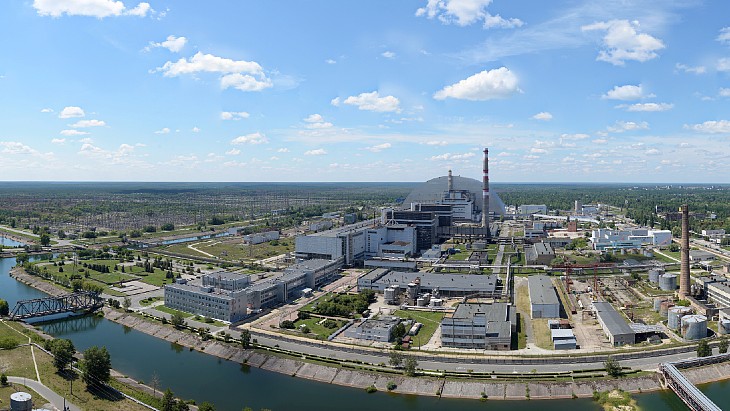
The former Chernobyl nuclear power plant is surrounded by an exclusion zone (Image: CHNPP)

According to the Chernobyl Nuclear Power Plant (ChNPP) state enterprise, "this will contribute to the development of the tourist attractiveness of the Slavutych community and the region as a whole, the preservation of historical memory, and the formation of a positive image both at the national and international levels".

Slavutych was the city built 45 kilometres east of Chernobyl to house its workers evacuated from Pripyat which was three kilometres from the plant, after the 1986 accident.

The framework of the memorandum includes support for the city museum of Slavutych, the tourist information centre and expanding exhibitions related to the history of the Chernobyl nuclear power plant and "the construction of the cities of Pripyat and Slavutych, as well as the elimination of the consequences of the accident, which will contribute to a deeper understanding of the events of 1986".

There are also proposals for "thematic excursions" and "joint tourist, cultural, educational and educational events - conferences, festivals, excursions, study tours for students, thematic events dedicated to the topics of Chernobyl, ecology and sustainable development with the involvement of specialists of the ChNPP State Enterprise and institutions and organisations of the city, scientists and tourists".

Education of future generations of people in Slavutych is also seen as a key goal of the cooperation and "provides for joint participation in training courses, seminars for guides and researchers specialising in the topics of Chernobyl, nuclear energy, and ecology".

The background

Following the Chernobyl accident in April 1986 (you can read more about it in the World Nuclear Association's Chernobyl Accident information paper) a 4200-square kilometre Chernobyl Exclusion Zone was established, which has been largely uninhabited since. A containment shelter was built at speed over the ruins of unit 4 after the accident and there has since been a giant new shelter - the New Safe Confinement built over it. The last operating unit at Chernobyl, unit 3 operated until 2000.

There was a developing tourist/visitor industry before the war with Russia began in 2022.

In 2019 a decree by Ukraine's President Volodymyr Zelensky titled "On the development of areas affected by radioactive contamination due to the Chernobyl disaster" aimed to begin turning the exclusion zone into one of the growth points of the new Ukraine.

It aimed to remove a ban on filming in the area and to "popularise" tourism in Chernobyl at international events. "We must give this territory of Ukraine a new lease of life. Until now, Chernobyl has been a negative component of the Ukrainian brand. It's time to change that. We must showcase this place to the world: to scientists, ecologists, historians, tourists," he said at the time.

As well as the historical and educational potential of the area, the exclusion zone has become what the United Nations' environment programme describes as "a haven for wildlife, with lynx, bison, deer and other animals roaming through thick forests" in "the third-largest nature reserve in mainland Europe and an iconic – if accidental – experiment in rewilding".

However tourism to the area halted after the Russian invasion in February 2022, which saw its forces taking control of the Chernobyl plant and area for two months before they withdrew. The war continues and in February the New Safe Confinement shelter was damaged by a drone strike.


Zaporizhzhia security, restart and US fuel discussed in IAEA-Russian talks


Monday, 9 June 2025

In the latest meeting between International Atomic Energy Agency Director General Rafael Mariano Grossi and Rosatom Director General Alexei Likhachev the two sides discussed the on-going security situation and issues relating to any future restart of the plant's units.

Zaporizhzhia security, restart and US fuel discussed in IAEA-Russian talks
The talks were held in Kaliningrad (Image: Alexander Podgorchuk/Strana Rosatom)

Grossi, who visited Russia following talks in Ukraine, described the talks on social media platform X as a "comprehensive and necessary" exchange "on the current safety, security and safeguards situation" at the Zaporizhzhia nuclear power plant "and the essential role" played by the International Atomic Energy Agency (IAEA) experts stationed at the plant "to prevent a nuclear accident".

At a press conference in Vienna on Monday as the IAEA board of governors met, Grossi said there was a "common view" between the Russian side and the IAEA that it would be inadvisable to restart the plant in the current military situation. He added: "There are other more technical aspects like, for example, the availability of enough water to cool down the reactors or also the availability of sufficient, stable, external power so you can rest assured that if it's started there will be no blackout and the plant will be able to operate."

"Apart from that we know that they have the intention to restart it at some point - some plans were shown to us - but that is a matter which has other interconnections with wider negotiations that are taking place."

The Russian Tass news agency's report of Likhachev's comments said the plant could only be restarted once there was no military threat, and quoted him as saying "we have already started construction of a floating modular pumping station with a capacity of up to 80,000 cubic metres per hour, which will address all problems related to water supply in the event that the units are brought to their design capacity".

Rosatom has already produced a plan for restarting the units in the future which is currently being considered by the Russian government.

One of the other topics covered was the issue of the rotation of the IAEA teams, which have been subject to delays because of security concerns. There was also a general discussion on how to ensure nuclear safety and security, and the general security situation at the plant, which has been under Russian military control since March 2022 and which is on the frontline of Ukrainian and Russian forces.

There has also been an issue with the US nuclear fuel at the plant, with Tass saying that Likhachev had asked Grossi to mediate discussions on the use of the US-manufactured fuel which are currently loaded into four of the six units with more in the fresh fuel storage facility and in the used fuel pools.

At his media conference on Monday, Grossi said the general situation at Zaporizhzhia nuclear power plant - which continues to rely on one external power line - "continues to be very fragile ... the level of military activity is increasing, not decreasing". He also noted that the erosion of infrastructure in Ukraine "continues to have an impact on nuclear safety".

Emergency core cooling system tank shipped for Xudabao 4


Monday, 9 June 2025

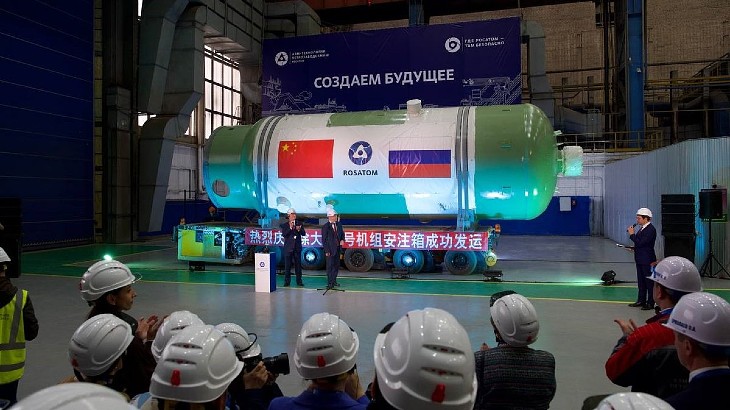
The 80-tonne tank, which has a capacity of 60 cubic metres, was produced at the Petrozavodskmash plant of Rosatom's machine-building division with the ceremonial shipment marking the plant's 65th anniversary.

Emergency core cooling system tank shipped for Xudabao 4
(Image: Rosatom)

The emergency core cooling system tank is a thick-walled high-pressure vessel about three metres in diameter and will be filled with an aqueous solution of boric acid which would be automatically fed into the reactor to cool the active zone in the event of a pressure drop in the primary circuit.

Each unit's emergency core cooling safety system includes four of the tanks, with the fourth and final one for unit 4 to be shipped during June.

The background

In June 2018, Russia and China signed four agreements, including for the construction of two VVER-1200 reactors at the new Xudabao (also known as Xudapu) site in China's Liaoning province. Agreements signed in June 2019 included a general contract for the construction of Xudabao units 3 and 4, as well as a contract for the supply of nuclear fuel.

Construction of Xudabao unit 3 began in July 2021, with that of unit 4 starting in May 2022. Commissioning of the units is scheduled for 2027 and 2028, respectively.

When completed, the two units are expected to generate more than 18 billion kWh of electricity per year, equivalent to saving about 6.4 million tonnes of coal and reducing carbon dioxide emissions by about 18.9 million tonnes per year.

The Xudabao plant is owned by Liaoning Nuclear Power Company Limited, a joint venture between China National Nuclear Corporation (70%), Datang International Power Generation Company (20%) and State Development and Investment Corporation (10%).

What they said

The head of the Rosatom Machine-Building Division, Igor Kotov, said: "Rosatom's machine builders have now manufactured 95% of the contracted equipment for the four new power units being built at the Tianwan and Xudapu nuclear power plants. In particular, main circulation pipelines, main circulation pump housings, equipment for safety systems and much, much more have been shipped from Petrozvodskmash. By the end of 2025, the manufacture of all products involved in the operation of the nuclear island will be completed."

Deputy Director General of the Rosatom State Corporation for Mechanical Engineering and Industrial Solutions, Andrey Nikipelov, said: "Petrozavodskmash produces equipment that is unique for the industry and participates in all Rosatom projects for the construction of nuclear power plants. In the coming years, the company will have a lot more work."

Artur Parfenchikov, the head of the Republic of Karelia in northwest Russia where the plant is located, said: "Petrozavodskmash makes a great contribution to the economy and industrial development of Karelia ... and in this anniversary year, we honour the veterans of the plant, talk about achievements ... it creates new jobs, increases the tax base of our budget ... [and] is an interesting and promising place to work for our Karelian youth."

World Nuclear News


The Autonomous Vehicle Race Has Well and Truly Begun

  • Waymo is leading the U.S. autonomous vehicle market, expanding its robotaxi fleet and services, while GM’s Cruise program is restarting after a high-profile setback.

  • Federal rule changes now allow for faster AV deployment and reduced reporting requirements, sparking both optimism and safety concerns.

  • Projections show U.S. AV sales rising slowly through 2034, while China’s market is expected to grow rapidly, highlighting global competition in autonomous mobility.

After several successful pilot projects, several cities across the United States are aiming to roll out more self-driving vehicles in 2025. Multiple automated car companies have announced new projects for this year. For decades, self-driving or automated vehicles (AVs) seemed like some futuristic technology that would be impossible to actually create. However, in recent years, several companies have tested their AVs in real-life conditions, as several car models make it out of the factory and onto our roads. In addition, recent innovations in sensors and artificial intelligence (AI) have made researchers more enthusiastic about what the future of automation might hold. 

There are five levels of automation, from vehicles with driver assistance to fully automated vehicles that do not require a human driver. In 2024, several ride-hailing companies incorporated AVs into their fleets as companies fixed the glitches that had been experienced in trials in previous years. The self-driving startup Waymo is currently the U.S. market leader in AVs, while several traditional automakers, such as General Motors (GM), play catch up. While progress has been slower than previously anticipated, largely owing to delays caused by the Covid-19 pandemic, greater AV adoption is expected for 2025.  

As AV sales grow slowly, the outlook for self-driving vehicles looks positive. U.S. AV sales are expected to reach around 230,000 autonomous mobility-as-a-service units a year by 2034, to contribute just under a 1.5 percent market share. In China, the market is expected to grow more rapidly to reach 1.5 million AVs being sold annually by 2034. Meanwhile, in Europe, sales are expected to reach just 37,000 units by 2034.

Market leader Waymo unveiled the sixth generation of its Waymo Driver autonomous driving system in 2024. The company operates a fleet of almost 800 self-driving vehicles in California, as well as another fleet in Phoenix. Last year, Waymo's parent company Alphabet announced plans to invest up to $5 billion in the startup. Earlier in 2024, Waymo commenced the testing phase of its robotaxi services on highways in San Francisco, fitted with its fifth-generation system. It also partnered with the electric vehicle company Zeekr to test a robotaxi on public roads in San Francisco in July 2024.

In May this year, Waymo was approved to expand its autonomous ride-hailing service to more parts of the San Francisco Bay Area. The company had submitted a request to the California Public Utilities Commission in March to access a broader area. San Jose Mayor Matt Mahan stated, “Waymo embodies our region’s spirit of innovation — so it’s about time they joined us here in the Capital of Silicon Valley,” in a post on social media. 

In April, Alphabet announced that Waymo is now providing more than 250,000 paid robotaxi rides per week across the U.S. That same month, Waymo and Toyota announced a preliminary partnership, with the aim of incorporating robotaxi tech into personally-owned vehicles.

Meanwhile, GM, which was on track to compete with Waymo, experienced a setback in October 2023 when one of its AVs was involved as a secondary vehicle in a pedestrian accident. GM halted its Cruise Automation programme for several months while it assessed its safety standards and changed much of the department’s leadership. Cruise has resumed operations as well as announced plans to launch its robotaxis on the Uber ride-hailing platform starting this year. 

In terms of the broader rollout of AVs across the U.S., the Secretary of Transportation Sean Duffy announced in April that the department had revised the AV rulebook to allow for faster deployment of self-driving cars. Duffy stated, “America is in the middle of an innovation race with China, and the stakes couldn’t be higher.” The new rules reduce the crash data that companies are required to send to regulators and focus on ensuring that U.S.-built robotaxis can compete with those from foreign firms.

The revision aims to trim “unnecessary burdens” on companies and reduce expenses while maintaining “safety benefits.” In addition, certain compliance measures will be waived for domestic vehicles under the new rules, to allow for testing on public streets, which could fast-track Tesla’s Cybercab and similar robotaxis. However, critics suggest reducing an engineer’s paperwork can result in a blind spot for analysts, which could prevent researchers from spotting patterns in AV driving. “Transparency and accountability about the performance of these vehicles on public roadways is essential,” explained the president of Advocates for Highway and Auto Safety Cathy Chase.

After a setback during the Covid-19 pandemic, several automakers are now on track to launch AV models with various levels of automation in cities across the U.S. Recent improvements in technology and a change in federal AV rules are expected to increase the rollout of AVs in 2025. Several companies are partnering with ride-hailing platforms to offer their AVs on restricted routes and, if successful, we could be seeing a lot more self-driving cars on the roads in the coming years. 

By Felicity Bradstock for Oilprice.com


U.S. Electric Vehicle Adoption Plummets

  • EV interest among U.S. drivers has dropped to 16%, the lowest since 2019.

  • Key deterrents include high upfront costs, limited charging infrastructure, and concerns over long-distance suitability.

  • Hybrid and plug-in hybrid vehicles are gaining favor as more practical alternatives.

Just 16% of American drivers say they are likely to buy an electric vehicle (EV) as their next car—the lowest share recorded in AAA’s annual surveys since 2019.

High battery maintenance costs, high purchase prices, and concerns about range continue to be major deterrents for U.S. consumers to consider buying an EV, according to AAA’s latest survey released earlier this month.

These key barriers have remained more or less the same in recent years.

But this year three other factors have also played a role to result in the smallest share of American drivers considering an EV purchase—lower gasoline prices, the increasingly uncertain future of EV incentives such as tax credits and rebates, and politics.

Only 16% of U.S. adults reported in AAA’s 2025 survey that they are “very likely” or “likely” to purchase a fully EV as their next car. This compares to 25% in 2022, when gasoline prices of $5 per gallon incentivized more buyers to consider an EV purchase.

This year, the percentage of consumers indicating they would be “unlikely” or “very unlikely” to purchase an EV rose to 63%, up from 51% last year.

“While the automotive industry is committed to long-term electrification and providing a diverse range of models, underlying consumer hesitation remains,” said Greg Brannon, director of automotive engineering for AAA.

Consumers cited high battery repair costs and purchase prices as key barriers to go fully electric, at 62% and 59%, respectively. Other top concerns identified in this year’s survey were the perceived unsuitability of EVs for long-distance travel (57%), a lack of convenient public charging stations (56%), and fear of running out of charge while driving (55%).

Other barriers cited by the Americans unlikely to buy an EV include safety concerns cited by 31%, challenges installing charging stations at their residences for 27%, and 12% who are concerned that the tax credits and rebates will be reduced or eliminated.

Saving on gasoline costs is a key reason for interest in EVs this year—77% of Americans likely to buy an EV cited gas savings as their top motivation to purchase.

The reason, of course, is quite simple. Gasoline prices this spring hit their lowest level ahead of Memorial Day weekend in four years. A large part of the strong demand over Memorial Day weekend was due to the fact that the typical seasonal spike in the spring didn’t materialize, because oil prices – the single-biggest driver of gasoline prices—have lingered in the low $60s per barrel for weeks.

Uncertainty about incentives for EV purchases has started to play a larger role in drivers’ hesitancy to consider fully-electric vehicle purchases. Interest in EVs to take advantage of tax credits and rebates has plummeted—from 60% of those saying last year they are likely to buy an EV to 39% this year, per the AAA survey.

Moreover, fewer Americans now believe that most passenger cars would be EVs within a decade. The share of U.S. drivers who believe that most cars will be electric within the next ten years has plunged from 40% in 2022 to 23% this year.

Despite the fact that the availability of EV models in the U.S. market has soared in recent years, with many legacy carmakers seeking to compete with Tesla, Americans remain hesitant about purchasing electric cars.

Public perception about the future of EVs remains uncertain, AAA says, despite the more than 75 EV models introduced in the past four years.

For many drivers, hybrid or plug-in hybrid vehicles could be more appealing than full battery EVs as they combine the advantages of traditional internal combustion engines with electric power, reducing range anxiety while providing an environmentally friendly alternative, AAA says. 

By Tsvetana Paraskova for Oilprice.com


INPEX Starts Blue Hydrogen and Ammonia Demo Project Commissioning in Japan

Japan’s largest energy company, INPEX Corporation (TYO: 1605), has initiated commissioning operations at its groundbreaking blue hydrogen and ammonia demonstration project in Kashiwazaki City, Niigata Prefecture. The milestone marks the start of natural gas introduction into the integrated clean energy facility, a first-of-its-kind development in Japan aimed at showcasing a full-cycle hydrogen-ammonia value chain, including CO? capture and storage.

Project Overview: Decarbonizing Domestic Gas Use

The project uses natural gas sourced from INPEX’s Minami-Nagaoka Gas Field as feedstock to produce hydrogen. To curb emissions, carbon dioxide generated during production is injected into depleted gas reservoirs in the Higashi-Kashiwazaki Gas Field using Carbon Capture Utilization and Storage (CCUS) technology. This allows the hydrogen to qualify as "blue," supporting Japan’s net-zero goals.

The hydrogen will supply local electricity generation, while a portion will be synthesized into ammonia via a low-temperature, low-pressure process developed in partnership with Tsubame BHB. The ammonia will also be distributed to consumers in Niigata Prefecture

Strategic Backing and Timeline

The demonstration is subsidized by Japan’s New Energy and Industrial Technology Development Organization (NEDO) under its fuel ammonia R&D program and features a joint CO? storage assessment with the Japan Organization for Metals and Energy Security (JOGMEC). Construction began in July 2023, and commissioning is expected to wrap up ahead of demonstration operations starting in fall 2025, including CO? injection and monitoring.

A Pillar of INPEX Vision 2035

This project is a central piece of INPEX Vision 2035, announced in February, which outlines the company’s strategy to become a leader in lower-carbon energy solutions, with a focus on hydrogen, ammonia, and CCUS. The Kashiwazaki initiative is positioned as a proof-of-concept for deploying blue hydrogen at scale, enhancing INPEX’s decarbonization credentials while leveraging Japan’s domestic gas reserves.

Regional and Sector Implications

With Japan seeking to diversify its clean energy sources beyond solar and nuclear, this project has the potential to serve as a model for hydrogen hub development, carbon storage using existing gas infrastructure, and local energy resilience. It also strengthens domestic supply chains in an area historically dependent on fossil fuel imports.