TROTSKY IN AMERIKA
Strains in a revolutionary leadership: Dobbs-Cannon tensions in the US Socialist Workers’ Party
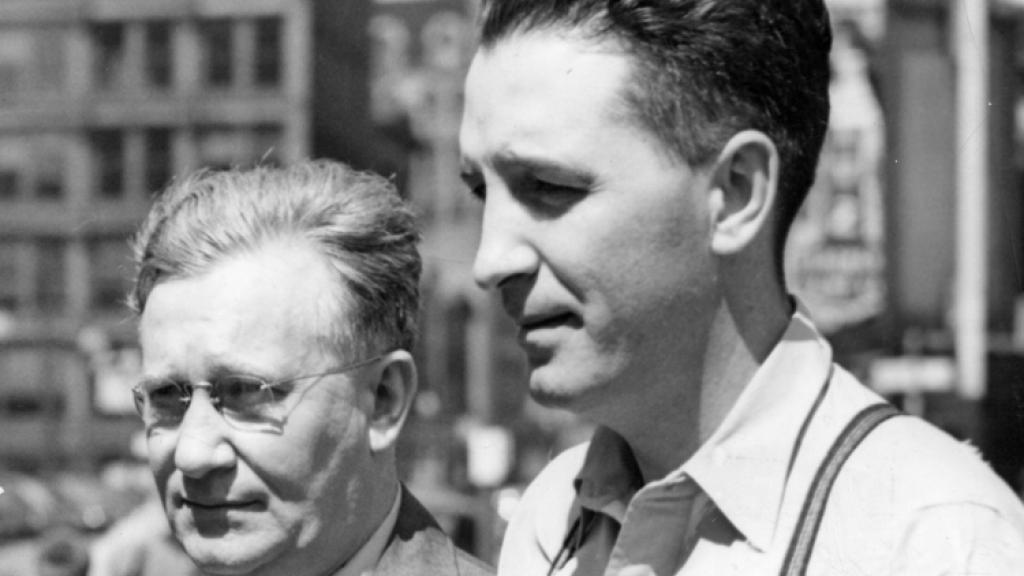
CANNON & DOBBS
First published at Historical Materialism.
James P. Cannon and Farrell Dobbs were outstanding historical figures in the socialist and communist movement of the United States.1
A member of the Socialist Party and Industrial Workers of the World prior to the First World War, Cannon was one of the central leaders of the Communist Party during the 1920s. He is most known by historians for founding the Trotskyist movement in the United States in 1928. Cannon was national secretary of the Socialist Workers’ Party (SWP) up to 1953, after which he became the party’s national chairman.
Farrell Dobbs joined the Communist League of America (predecessor of the SWP) in 1933 as a coal-yard worker in Minneapolis during the lead-up to the Minneapolis Teamster strikes of 1934, of which Dobbs became a central leader. Later in the 1930s Dobbs was architect of the Teamsters’ over-the-road organising drive in the Midwest. In 1953 Dobbs succeeded Cannon as SWP national secretary, a position he held until 1972.
Sam Gordon, an early leader of the Trotskyist movement in the US stated, “I believe it was after the very first Minneapolis strike [in 1934], the coalyard strike, that Jim [Cannon] met the young Dobbs. When he came back to New York and told some of us of the extraordinary young rebel, Jim had an expression in his eyes like that of a man hinting he had struck gold…. As the years passed and Farrell proved himself in the great struggles of the Minneapolis labor movement, it became clear from Jim’s references to him that in his own mind he had picked him as successor, that is, as the comrade to propose as national secretary when the time came.”2
Much has been written about the political careers and contributions of Cannon and Dobbs. Less known are the differences and tensions between the two within the SWP leadership.
In 1980, Dobbs wrote an outline for a projected history of the SWP and US Trotskyism. The unpublished outline, titled Schematic on Party History, is a valuable historical document in its own right. Of special interest, the Schematic outlines a number of areas of Dobbs-Cannon disagreements, primarily during the two-decade period when Dobbs was SWP national secretary in New York while Cannon was living in Los Angeles. The majority of the disagreements involved organisational issues and not political line, on which the two were usually in general agreement.
Given the Schematic’s cryptic nature, many of the references require background and context, which the present article seeks to provide to the extent possible. In doing so, the authors’ aim is not to express opinions on which one might have been right or wrong on any particular issue.
Not all disagreements or tensions mentioned in the Schematic are taken up in this article. A number of incidents Dobbs refers to are based on personal discussions, for which no supporting material has been found. In addition, a few of the issues that are addressed are not fully clear.
Why is this material of interest?
From a general standpoint, an examination of these issues of contention highlights questions of team leadership and leadership functioning within revolutionary organisations that can be of universal relevance. From a narrower standpoint, studying the Dobbs-Cannon relationship can help flesh out the history of the US Trotskyist movement and the SWP. Among other things, it dispels the myth of an entirely smooth and seamless leadership transition in the SWP, which the current leadership of the party has long sought to convey: from Cannon to Farrell Dobbs to Jack Barnes.
Below is background to eleven issues of contention mentioned in the Schematic.
Cochran fight, 1952-53
an open rift followed in the majority leadership
PC adopted my memo on the internal party situation
before that I had discussed the matter informally with Cannon
and then with Cochran
Cannon soon moved to California
more or less ignored the presidential campaign
concentrated on the circulation of onionskins
my talk with Cannon during the presidential campaign tour”
Dobbs Schematic, p. 26
In 1952-53, a faction fight occurred in the SWP between the party majority led by Cannon and Dobbs, and a minority whose main leaders were Bert Cochran, George Clarke, and Mike Bartell – who came to be known as the “Cochranites”. Composed largely of longtime trade union militants centred in Michigan, the Cochran minority believed that the party underestimated right-wing sentiments in the working class arising from the McCarthyite witch-hunt, and that, in such a political atmosphere, the emphasis on socialist propaganda work – from socialist election campaigns to sales of the socialist press and public forums – was misplaced and opened the party up to victimisation.
While Cannon and Dobbs were in agreement on the political issues in the debate, they differed on how to conduct the struggle, and on the corresponding organisational measures that were necessary.
In Sheppard’s words, “Cannon was convinced that Cochran and his group had given up on the struggle to build a revolutionary workers’ party in the US…. Cannon thought that Dobbs and others in the leadership were soft on the Cochran minority.” Sheppard added that “Dobbs did not disagree with Cannon fundamentally about the Cochranites, but favored a slower, less aggressive approach to try to save more of their base of support among the party trade unionists. Cannon was genuinely fearful that, in the increasingly unfavorable political situation, delay in opening a political fight against ‘Cochranism’ could result in losing not just the trade unionists in this group, but the party as a whole.”3
Cannon referred to his disagreements with Dobbs in a report to the party’s May 1953 National Committee plenum:
Now we had a falling out, Farrell and I did, over that question that involved a different appreciation of the political questions, how to handle the internal situation, and involved personal matters…. Anyhow, when Farrell came to L.A. in the election campaign, I reported we had a talk. We had a talk about the internal situation and about the political perspectives…. He said he agreed with [most of Cannon’s positions]. What he disagreed with was our opinion that the thing could be … was going into a faction fight and he thought it could be resolved in an objective manner.4
The perspective of Dobbs in the fight was expressed initially in his “Memorandum on the Internal Situation”, dated 11 August 1952, and addressed to the Political Committee. In it, Dobbs declared that no political justification for factional formations had yet been demonstrated. “If the time has come to go to the membership with whatever political differences may exist”, he stated, “it should be done openly, in accordance with well-established party procedure. Every comrade should have a full opportunity to hear all points of view before making up his mind.” The memorandum went on to call for concentration of attention on the presidential campaign and proposed that a statement along these lines be issued to the membership. This was done in a Political Committee letter to the party branches dated 27 August 1952.5
Dobbs repeated this perspective in a letter to Cannon in December 1952, stating that “we must make every possible effort to prevent a factional explosion in the party and press for [before] an open thorough-going political discussion of the differences. The party is much concerned about the internal situation, but the comrades want a clear understanding of the political issues involved before they are asked to make their decision as to the solution.”6 Several weeks later, Dobbs told Cannon that “Our policy has not been one of compromise, but one of trying to facilitate open crystallization and clarification of the fundamental differences.”7
Despite their different approaches to conducting the fight, Cannon made a point of stressing the overall political agreement of the two. “We don’t have to pretend that all the people in the National Committee majority arrive at the same opinions at the same time about everything. The important point is that these letters show that we agreed on a political basis for collaboration and they state specifically what this political basis is”, Cannon remarked.8
Other majority leaders gave their take on the disagreements.
Vincent R. Dunne, who supported the position of Cannon, wrote that Dobbs was “inclined to believe that the friction … came from the attitude common to so many leading comrades of that period, that is, the feeling that we were inclined unduly and prematurely toward an organizational rupture with what we knew but, which they did not see as the Cochran faction.”9
Arne Swabeck, who supported the position of Dobbs, wrote to the latter: “George [Novack] gave me a pretty clear picture of Jim’s thoughts on the unfolding of the present fight and the disagreements within the majority during its early stage. That Jim had interpreted this early stage as a lack of appreciation of the seriousness of the fight, if not outright weakness, by you and most of us, (Murray and Vincent not included) was not news, to me…. In that light the breach of collaboration between him and you must be understood. I believe, though, it is true, that Jim is quite satisfied with the manner in which the fight is being conducted now.”10
* * *
Cannon-Weiss began an election campaign maneuver in Los Angeles
not only a plot against the Cochranites
aimed simultaneously at the majority leaders in the party center
my telephone conversation with Cannon
Dobbs Schematic, p. 26
During the Cochran fight, an issue arose in the form of a proposed election campaign in Los Angeles, where Cannon had moved. In late 1952, the Los Angeles branch proposed an election campaign of Myra Tanner Weiss for mayor, and asked the Political Committee for approval to move ahead.
This proposal sparked heated opposition from the emerging Cochran faction, putting Dobbs in an awkward position. While supporting the political sentiment behind the proposed campaign, Dobbs apparently thought it was ill-timed, given his desire to prevent a factional blowup.
In response to the Los Angeles request, the PC adopted the following somewhat ambiguous motion on 30 December 1952: “The Political Committee permits the Los Angeles branch to make its own decision on the campaign, noting however that it should take into consideration the fact that the Party is in financial difficulties and is now working with a skeleton staff in the National Office.”11
Replying to the PC, the Los Angeles Local Executive Committee wrote angrily:
We consider the attitude of the PC completely false from a national point of view. It is not a question of finances but of the role and perspectives of the tasks…. Such a campaign at this time would have strengthened the position of the Party nationally in all respects, including its finances and the morale of its members as a fighting body of political revolutionists, who do not retire to the cloister after a defeat. Since we have no sentiments of local autonomy, but on the contrary as Leninists have deadly hostility to this Menshevik theory and practice of organization, we accept the decision of the Political Committee and cancel our plans to enter the election campaign.
Along these same lines, Cannon wrote to Dobbs:
The actions of our friends in the PC meeting on the LA election affair was a terrible mistake. In effect it was nothing less than a capitulation to the Cochranite line. The original motion of the Secretariat on the matter was bad enough, from our point of view. But the statement in the original motion that the proposed LA campaign was ‘politically justified’ could have given us a sufficient basis to proceed. The acceptance of the Gibbs compromise robbed it of even this merit, changed its political character and made the motion acceptable to the Cochranites. We, for our part, will have nothing more to do with this kind of politics, under any circumstances.
The proposed LA election campaign was not only politically justified but politically necessary. It would have given the party nationally a sense of participating in an important political action at an especially advantageous moment.…
I am quite ready to believe that our friends didn’t fully realize the qualitative concession they made. But that’s the trouble with the policy of conciliation and compromise. The concessions always go too far and finally end in a renunciation of the original intention…. The party is in a crisis. A very serious and deep crisis which threatens its right to live…. The PC erred in failing to give explicit political sanction and support to the proposed election campaign in LA as well as in raising the financial question as an obstacle. That’s the real issue.12
As referred to in the Schematic, Dobbs had several phone conversations with Cannon on the issue in January 1953 Dobbs records that he emphasised: “We are in political agreement on LA campaign proposal, on the basic issue involved in internal situation, and that the PC meeting marked turning point in internal crisis…. [W]e took [the Cochranites’] line as declaration of war” and that “our policy has not been one of compromise but one of trying to facilitate open crystallization and clarification of the fundamental differences.”13 A week later, Dobbs wrote, “After discussion Jim seemed satisfied with our tactical approach.”14
1952 elections
my letter on the importance of the 1952 presidential campaign
disagreement voiced in the PC …
Cannon spoke against the Illinois perspective in the PC
didn’t bother to consult me in advance
my trip to New York to register a protest
nature of extensive private discussion with Cannon
Dobbs Schematic, p. 24
In late November 1951, on the eve of the Cochran fight, Dobbs, then living in Chicago, wrote a letter to the Political Committee discussing the following year’s presidential campaign. In this letter, which would become an issue in the faction fight, he stated that “the party is not fully alive to the 1952 presidential campaign stem[ming] from two general observations: Signs of hesitation and doubt in the party that the campaign can be effective enough to warrant a maximum effort; and lack of adequate evidence that the Political Committee is really on top of this key problem.” Discussing the relationship of a revolutionary party and a future labour party, Dobbs continued:
Another question that needs clarification is the relationship of party election campaigns to the labor party tactic. I sense a line of thought among some comrades that implies the following conclusions: ‘The workers will make the initial break from the capitalist parties through the formation of a labor party, not by coming en masse direct to the revolutionary party. We can’t substitute our party for the labor party. It is alright to run our own candidates if we don’t expend too much time, energy and money.’ … I believe such wrong thinking arises in part from our one-sided treatment of the labor party question. We confine ourselves too exclusively to agitation for a labor party. We go off balance by failing to give sufficient explanation to the membership that, although one can argue the probability of a labor party development, it is not an indispensable step to the formation of a mass revolutionary party.15
The Dobbs letter became an early issue in the developing fight with the then coalescing Cochran faction in the SWP, described in the next section. A few months later, leaders of this opposition faction spoke of the Dobbs letter in their main document, “Roots of the Party Crisis”, written at the end of March 1953:
As reaction deepened in the country, and domestic conflicts were overshadowed by the cold war, a sectarian approach to the labor party and its corollary of illusions about the SWP became more marked. It remained for Comrade Dobbs to elaborate an election campaign strategy based upon a perspective which practically excluded the labor party from our program…. Comrade Cannon immediately seized upon this letter, proposed that the PC (December 11, 1951) adopt its general line…. The proposal was withdrawn, after objections by [George] Clarke…. Cannon had withdrawn his motion, but not his support of the line in Dobbs’ letter.16
The reference in the Schematic to Cannon’s disagreements with the “Illinois perspective” is not clear.
* * *
resignation of Grace Carlson from the party …
Cannon went to Minneapolis to help the comrades
he and Ray Dunne telephoned me in Detroit
asked me to support the nomination of Myra Weiss to replace Carlson as the SWP nominee for vice president
why I did not agree
nature of private talks later with Cannon and Dunne on the subject
PC nominated Joe Hansen for vice president and the matter seemed to be settled within the leadership
but a switch took place at the preconvention plenum
Hansen declined in favor of Myra
his action took me by surprise
Dobbs Schematic, p. 25
In May 1951, the Militant announced that the SWP candidates for president and vice president in 1952 would be Farrell Dobbs and Grace Carlson, the same candidates as in 1948, and both of them began national speaking tours. On 18 June 1952, however, Carlson announced that she was resigning from the party.17 To replace Carlson on the ticket, the SWP convention in July 1952 selected Myra Tanner Weiss as the new vice-presidential candidate.18
In the Schematic, Dobbs refers to his opposition to the nomination of Myra Tanner Weiss as vice-presidential candidate rather than Joseph Hansen. We have been unable to establish with any certainty the reasons for the switch Dobbs refers to.
Cannon-to-Dobbs leadership transition
Cannon’s pre-plenum trip to New York [in 1953]…
our personal talk about a switch in national posts
Cannon insisted upon being relieved as national secretary
evidence that it would prove a pseudo-transition in leadership
I would carry the central responsibility
but could not be sure of getting his objective support
would make it doubly hard to carry out my duties
why I accepted the proposed arrangement
Dobbs Schematic, p. 27
In May 1953, the SWP National Committee voted on a transition in leadership from Cannon to Dobbs. As Cannon put it:
A new leadership of the younger cadres has been consolidated, and has established its own authority, without which leadership is impossible… The new reality is the inauguration of a new regime in the party. I repeat that: A new regime in the party. The old regime – which I had something to do with, as has been said more than once – had its merits and its faults; but it now belongs to party history. Its duty now is to make way for the new. Not, of course, to withdraw from activity or from participation in the work of the new regime—but to withdraw from the central direction of the party into a supporting and advisory position to the new leadership consolidated at this plenum. The change of national officers, which you have already ratified – my transfer to the position of national chairman and Comrade Dobbs’ simultaneous transfer to the position of national secretary.19
In Dobbs’ words, “We are going to have a new division of labor. Comrade Cannon will continue to make suggestions and criticisms, objectively, in the most helpful manner, and in the best spirit of collaboration with the younger comrades who are carrying on the day-to-day work. We will welcome his suggestions and criticisms, and we shall seek to profit by them, as well as by the great contributions he will make in his writings.”20
But Dobbs soon objected to Cannon’s functioning, which appeared to centre on what he perceived as the latter’s failure to adequately support the elected party leadership, thereby undercutting its authority. “I would carry the central executive responsibility / but could not be sure of getting his objective support”, he wrote in the Schematic. Or, as Dobbs told Barry Sheppard around 1963, Cannon “wouldn’t get his dead hand off the steering wheel”.21
Tom Kerry was soon brought to New York to be national organization secretary, and the two established an effective division of labour. A “Dobbs-Kerry regime” led the party for a number of years.
1954 political resolution
our political resolution redrafted in the light of the election result
nature of Cannon’s intervention in this connection
his collaboration with Weiss; criticism of other party leaders
Dobbs Schematic, p. 29
During 1954, the SWP sought to wage a campaign against the anti-communist witch-hunt, analysing McCarthyism as an incipient fascist current.
The draft political resolution written for the party’s December 1954 convention opened with the following words:
Since the defeat of MacArthur’s armies at the Yalu river, the most important development in world politics has been the rise in the United States of the fascist movement headed by McCarthy. If this movement succeeds in taking power and smashing the American labor movement, it will signify the eclipse of civilization, for the outbreak of World War III – an inter-continental war waged with atomic weapons – would not then be long delayed. In such a war even humanity itself might suffer annihilation.
Analysing the rise of McCarthyism, the draft resolution stated:
[T]he witch-hunt drive has shown increasing sings of splitting into two fundamental segments – the witch hunt of the capitalist regime as such which develops organically so to speak for the old structure of bourgeois democracy towards a police state, and the witch hunt led by McCarthy that has as its fundamental aim replacing the bourgeois democratic structure with a fascist regime.22
Giving his reaction to the draft resolution, Cannon addressed a letter to Dobbs, writing of “my unfavorable reaction produced by the opening paragraph when I first read it. By its telescoped and oversimplified presentation of an extremely complicated and many-sided question, it can give rise to all kinds of misunderstandings and misinterpretations. I suppose the intention was to wake up the reader of the Resolution with a shock treatment at the very start, but I don’t think a political resolution is the place for such a technique.” Cannon continued:
Our main concern right now should be the thinking and orientation of our party members. They have got to understand that the fight against American fascism is not a shotgun affair. We need clear thinking and patient preparation for the long pull. I am apprehensive that some party comrades may construe the struggle against McCarthyism as a present do-or-die proposition, with the showdown imminent, instead of as a long-drawn-out struggle against capitalism which is now only in its preliminary stages. Such telescoped formulations as those employed in the introductory paragraph could indirectly foster this fatal misconception. Such a disorientation, which has elements of hysteria, could easily lead in the next stage to pessimism and prostration.23
Responding to Cannon’s note, Dobbs replied that “we don’t see any fundamental differences implied in the questions that have arisen about the draft political resolution. Your letters on the subject … seem to indicate nothing more than some secondary divergences of thought between us in evaluating current world trends and projecting our propaganda line.”24
Seeking a common position, Cannon travelled to New York to discuss the differences with members of the Political Committee. Writing to his partner Rose Karsner, Cannon summarised the initial results of these discussions:
We had a PC meeting last night and everybody got oriented to the line of estimating the election results + the new tactics it imposes as we discussed before I left L.A. Things have gone much better than I had hoped in this respect…. The PC meeting was preceded by extensive personal discussions with the members of the secretariat – Farrell, Moish [Morris Stein], Joe [Hansen] and Murry [Weiss]. I brought up everything pretty frankly – from election policy to the marked tendency – so dangerously fatal if persisted in – to allow the party to live a self-enclosed life.25
A week later, Cannon wrote to Karsner: “The PC, at its last meeting, decided to recast the political resolution + to make it solely a political resolution taking off from the international situation and from the political turn in this country as indicated by the election results…. Joe [Hansen] and I are working on the second draft.”26
Several weeks later, the Sixteenth National Convention in December 1954 adopted the general line of the second draft of the resolution, with its revised line on McCarthyism.27
Dual centre
dispute over Chinese communes
Cannon opposed the PC line in the name of the ‘Los Angeles NC Group’
PC asked him to come to New York prior to the pending convention
understanding reached on the handling of the Commune dispute
showdown between Cannon and me about the dual center problem …
[Cannon] proposed an advisory council of older NC members
concept involved the creation of a bicameral executive body
would have further aggravated the problem of a dual center
Dobbs Schematic pp. 34, 36
After his move to Los Angeles in the early 1950s, Cannon began organising meetings of the National Committee members living there, a pattern that continued into the early 1960s. Doing so may have reflected an underlying concern of Cannon’s regarding the ability of the Dobbs-Kerry leadership team in New York to transcend organisational routinism in order to respond adequately to new developments and opportunities in the world situation as well as the class struggle on the US home front. This relates to matters indicated in the Dobbs Schematic – some of those already examined in this article, as well as in others that we will consider.
Arne Swabeck refers in his memoirs to gatherings of “the five National Committee members, Cannon, [George] Novack, [Milt] Alvin, Liang [Frank Glass] and myself, then residing in Los Angeles.”28 Les Evans has explained it succinctly: “Cannon was in the habit of calling meetings of the Los Angeles NC members at his home and sending in lengthy written suggestions to New York on major national and international events.” He adds, “This began to be looked on by Farrell and Tom as an incipient second Political Committee.”29
Tim Wohlforth – at the time heading up youth work of the SWP, having been recruited in 1957 through left-wing “regroupment” efforts (which Cannon had helped initiate) – later commented on the “clout” possessed by the Los Angeles NC grouping:
Farrell Dobbs and the PC [Political Committee] prepared a tepid document for the 1959 party convention that simply restated the current party regroupment policy. On the very eve of the convention, Cannon’s West Coast National Committee (NC) group rejected the document and demanded that regroupment be ended. Farrell flew to Los Angeles for consultation, and a new draft was quickly written that put an end to regroupment.30
As Les Evans suggests, however, the patience of Dobbs and Kerry began to wear thin. Another youth leader, Barry Sheppard, recounts how they ultimately dealt with the matter:
After Peter Camejo moved to Berkeley [in 1965], he was invited as a member of the NC to one of these meetings in Los Angeles. Peter told the meeting why he didn’t think it was right to have these meetings of a geographical subset of the National Committee. He said he was leaving the meeting and wouldn’t attend future ones. This put a stop to the practice.31
Before the eventual evaporation of the “dual center”, however, the Los Angeles NC cluster around Cannon functioned as a significant factor in SWP discussions. Even in the absence of “lengthy written suggestions”, it undoubtedly influenced the thinking and actions of its participants, Cannon included – whose approach was sometimes out of step with the leadership of Dobbs and Kerry.
Weiss Group
FD made organizer of the Chicago branch [after 1948], while remaining national chairman …
experiences there with the Weiss group
it had been gestating for some time
essential nature of the formation
its method of operation …
[Cannon’s] collaboration with Weiss; criticism of other party leaders …
informal leadership session at the time of the [1954] convention
charge that Murry Weiss was organizing a clique in the party
Cannon’s attitude on the matter
question of who was using whom
Dobbs Schematic pp. 22, 29, 30
Murry Weiss was an early member of the Trotskyist movement in the United States, joining in 1932. He was elected to the SWP National Committee in 1939 and became a central party leader during the 1940s. In 1954, he and his partner Myra Tanner Weiss, who were in general agreement with party policy, were accused of forming a clique – that is, a grouping of party members and friends formed without a political basis. During the Cochran fight, Weiss had supported Cannon’s perspective.
“After the [Cochran] split”, Sheppard writes, “Cannon sought to maintain a balance between the Weiss group and the Dobbs leadership…. Cannon nominated Dobbs to be National Secretary [in 1953] when he stepped down to go to Los Angeles. But he also saw Weiss as a possible base of support for making sure that his own views got a hearing. For their part, the Weisses always sought Cannon’s approval in their conflicts with the Dobbs leadership, and they tended to see themselves as spokespersons for Cannon.”32
Max Geldman, a leading party cadre, had this to say, as recounted by Les Evans:
Farrell Dobbs and the other trade unionists were very reluctant to break with the Cochranites. They were pushed into it by Cannon, who had already moved out to Los Angeles. Murray and Myra Weiss, as the Los Angeles branch leaders, sided with Cannon and helped push through the expulsion. Officially the Dobbs-Kerry leadership in New York agreed with that but privately they never forgave Murray and Myra, or Cannon either for that matter. At the 1954 convention a motion was put on the floor that Murray should dissolve his group. He said he didn’t have a group but that to preserve party unity he would urge anyone who looked to him in particular as a leader to not do that.33
Regardless of whether Geldman’s assessment was correct, it is clear that Dobbs, seeking to maintain party unity and internal peace, made an effort to draw in Murry Weiss and his associates into party responsibilities.
“I have had several individual talks with Murry, Myra and Dan [Roberts]”, Dobbs wrote to Cannon in December 1954. “These talks have been marked by frankness and a conscious effort to grapple objectively with the problem of improving the internal situation. As you know, Murry will handle the desk on the paper for the next period. Dan will continue as Newark organizer and cooperate on the editorial staff to the maximum extent possible. By mutual agreement, Myra will have as her central party activity work on the editorial staff of the paper.”34
* * *
1963 party convention …
Cannon made behind-the-scenes charges against the central leaders
accused us of conducting a vendetta against the Weissites
and of rigging the NY delegation for that purpose
to defuse the stink bomb he had prepared
Kerry and I nominated Stevens [Dave Weiss] for regular membership on the NC
but the convention rejected the nomination
Dobbs Schematic, p. 39
In subsequent years, the Weiss group continued to operate, along with an anti-Weiss current. In Barry Sheppard’s words:
The Weiss group acted like a set of friends who held themselves somewhat apart from the rest of the party. They supported each other in elections for party posts, and considered themselves a little superior politically and theoretically. Dobbs and Kerry regarded the Weiss group as a clique, but were opposed to organizing a counter-grouping or acting in a vindictive fashion towards Murry and Myra or their supporters….
The people in the Weiss group tended to believe that they were being held back from rightful leadership roles in the party by a stodgy and somewhat unsophisticated grouping that had come out of the trade unions. This was their assessment of Farrell Dobbs and Tom Kerry, who were the party’s National Secretary and National Organization Secretary respectively. The Weiss grouping sometimes held private meetings of its members to discuss the situation in the party, even though the party’s organizational principles sought to discourage such behind-the-scenes functioning of party groupings in favor of open discussion of differences in the official party bodies.35
At least to some degree, the Weiss group had support from Cannon, who defended them from attack by the party leadership. According to Oscar Coover Jr., “Jim didn’t like the hostility toward Murray and Myra from New York.”36
And Les Evans concluded at the time that “whatever the Weiss group really consisted of, a good part of the hostility and organizational maneuvering against it was directed at the one the anti-Weissites dared not name, the party’s founder [Cannon].”
Federal troops to the South, 1956-1957
1957 SWP convention …
resolution on class struggle aspects of the Black movement …
Cannon voted against the troops slogan
Dobbs Schematic, p. 33
The SWP’s call for sending federal troops to the Jim Crow South, demanding the government enforce its own laws, was first raised in October 1955, when the Militant demanded federal intervention in Mississippi following the lynching of Emmett Till. This call was part of a broader program of demands focusing on the mobilisation of working people and their organisations.
After this demand was first raised, it provoked a debate within the SWP and its leadership, some of which is recorded in the SWP’s Discussion Bulletin. In response to this discussion, George Breitman wrote to the party leadership on 5 December 1956:
This year our election platform called for the immediate enforcement and implementation of the Supreme Court decision against segregation. This didn’t mean we want enforcement only after the social revolution; we want enforcement now. Enforcement by whom? By the labor movement, the Negro people and their allies; that’s the only kind of effective, complete and lasting enforcement we know of, and that’s what we are working to achieve in the last analysis. But in the meantime don’t we also want enforcement (partial and limited though it can be at best) by the capitalist state? I say we do, and that this is part of the meaning of our platform. If this is so, then I see nothing wrong in adding to such demands for enforcement the explanatory clause, ‘with troops if necessary.’ Especially when this addition serves to distinguish us from the liberals and to further expose the state’s opposition to genuine enforcement….
I understand that some of the NC members who considered the use of the slogan proper both in principle and tactics a year ago are inclined against its use at the present time because they think it conflicts tactically with the needs and possibilities of the mass movement resulting from the Negro struggles that have developed in the South this last year…. Those who agree on the principle of the matter should not have any great difficulty in reaching agreement on when and how to apply it.37
Expressing agreement with that proposal, Dobbs wrote to Cannon: “Enclosed is a copy of a letter from Breitman on the troops slogan. We consider his proposed motion acceptable provided it is understood that we are not proposing to apply the slogan under present objective conditions.”38
In the fall of 1957, application of the demand was decided on. Nine Black students in Little Rock, Arkansas, under a desegregation plan, began attending the previously all-white Central High School in Little Rock, Arkansas. School desegregation was the result of Supreme Court’s Brown v. Board of Education decision of 1954, which had ruled that “separate but equal” schools were inherently unequal. In response to the plan, racist mobs in Little Rock sought to keep the Black students out, while the Arkansas National Guard was sent in for the same purpose, but under the guise of “preserving the peace”. Given the resulting national outcry, President Dwight Eisenhower felt compelled to send in federal troops to enable the Black students to attend.
Highlighting the SWP decision to apply the slogan, the lead article in the 30 September 1957 issue of the Militant by George Lavan began: “An outraged world public opinion finally compelled President Eisenhower to send federal troops to escort the nine Negro school children into the Little Rock High School. He had repeatedly proclaimed before that he wouldn’t even dream of using federal troops to enforce school integration.”
The issue was discussed at the SWP’s Seventeenth National Convention in June 1957. A PC draft resolution titled “The Class Struggle Road to Negro Equality” included a statement endorsing the federal troops demand: “Labor should give militant backing to demands for Presidential enforcement of Negro rights, including the use of federal troops against the white supremacists where tactical conditions warrant such a demand”, it stated. “Full support must also be given the colored freedom fighters in taking measures for their own self-defense against white supremacist terror.”39
Delegates at the convention adopted the PC draft resolution by a vote of 33 to 5, with 1 abstention. In a statement attached to the minutes, Cannon “[a]sked that on the question of Federal troops to the South he be recorded as against this, but otherwise supports the PC Draft Resolution.”40
Chinese people’s communes
dispute over Chinese communes
Cannon opposed the PC line in the name of the ‘Los Angeles NC Group’
PC asked him to come to New York prior to the pending convention
understanding reached on the handling of the Commune dispute
Dobbs Schematic, p. 34
Arne Swabeck and Frank Glass (who also used the pen name John Liang), as residents of Los Angeles and members of the SWP National Committee, belonged – as previously noted – to the so-called “dual center” of NC members that in the late 1950s also included Cannon, George Novack, and Milt Alvin. Swabeck and Glass were both highly respected as experienced, knowledgeable, and independent-minded revolutionaries, with impressive credentials.
Swabeck, born in Denmark in 1890, evolved as a working-class intellectual and revolutionary activist in the Danish Social-Democratic Party before World War I. He emigrated to the United States in 1916, where he joined the Industrial Workers of the World and the left-wing of the Socialist Party of America, going on to participate in the 1919 Seattle General Strike. Inspired by the Russian Revolution, Swabeck joined with Cannon, John Reed, and others in the new-born Communist Labor Party, then helped forge a unified US Communist Party in 1921, chosen as a delegate to the Fourth World Congress of the Communist International. With Cannon and a handful of others, Swabeck rebelled against Stalinist influence in the Communist movement, helping to establish and lead the Communist League of America (CLA) around perspectives associated with Leon Trotsky. He had met with Trotsky in 1930 and was a mainstay of the Trotskyist movement for more than two decades, in the early 1930s even serving as CLA national secretary.41
Glass’s life was no less remarkable. Born in England in 1901, he moved to South Africa with his family at the age of 10. Radicalised by the racism and colonialism in his new homeland, and also by the dual impacts of the World War and the Russian Revolution, he became active in the socialist movement before becoming the youngest among the founders of the South African Communist Party in 1921, playing a prominent role in it during the early 1920s before turning his attention to trade-union activity. In 1928, Glass became one of the early founders of the South African Trotskyist movement. In 1930, he went to the United States and joined the Trotskyist movement there. In the same year he moved to China as a news correspondent. While there, under the name “Li Fu-jen”, he became involved in the Chinese Trotskyist movement, within which he assumed some leadership responsibilities and for which he became an ongoing liaison with Leon Trotsky – despite fierce repression from Chiang Kai-shek’s Nationalist dictatorship and the lethal assaults of Imperial Japan. Returning to the United States during World War II, Glass played an unheralded but significant role in the SWP leadership and served on its National Committee from 1944 until 1963, maintaining his membership in the SWP until his death in 1988.42
Owing to their records and experience, Swabeck and Glass carried considerable weight in discussions among Los Angeles NC members. This influence was registered in a dispute over the Chinese Revolution. As Swabeck later recalled:
We were all influenced by the description of Chinese developments presented to the founding conference of the Fourth International (1938). This description characterized the leadership of the Chinese Communist Party (CCP) as Stalinist. It was portrayed as having openly renounced the agrarian struggle, explicitly abandoned the class interests of the workers; and following Stalinist practice, it had become the enemy of the revolution.43
Yet the momentous 1949 Chinese Revolution, which established the People’s Republic of China, seemed to throw this judgment into question. Subsequent analyses by the SWP National Committee, Swaback notes, “followed in more elaborate form the above description”. He refers to “certain doubts in my mind” that “served as a forceful reminder of my own ignorance about the actual developments in China”, but he initially felt he had nothing to contribute to the discussion.44
Such was not the case with Frank Glass, however, who under the name of Li Fu-jen penned a lengthy and authoritative article entitled “China: A World Power” for the January-February 1951 issue of the SWP’s theoretical magazine, Fourth International. It presented a positive evaluation of the Chinese Revolution and strongly pressed for a more nuanced understanding of the Chinese Communist Party:
The fact of the mass entry of the Chinese people on to the political arena, with the corresponding class pressures, should be pondered by those who contend that Mao Tse-tung [Mao Zedong] is just a “puppet” of Moscow and the Peiping [Beijing] government merely a creature of the Kremlin. Such a view ignores the reciprocal relationship between party and class. It must be recognized that in recent times Mao has manifestly acted more in response to the pressure of his own popular support than in obedience to any Kremlin directives.45
This line of thought strongly influenced Cannon, Novack, Alvin, and most of all Swabeck, who began working closely with Glass to press for a fundamentally different approach to Chinese developments. The matter came to a head in 1959 around the question of the rural “People’s Communes”. The previous year, the Chinese Communist Party led by Mao had begun organising millions of peasants into tens of thousands of these collective farms, as part of Mao’s “Great Leap Forward”.
Reacting to a proposed article on the People’s Communes for the International Socialist Review written by Dan Roberts, the Los Angeles NC group argued:
The Communes are less than a year old and still in flux. Although we cannot give a definitive judgment on all their aspects, this much can be stated at this juncture to make our attitude plain: The weight of the available information indicates that the original impulse for the formation of the Communes came from the peasants themselves. The basis of the impulse was the urgent need to break through the too narrow framework of the collectives and provide that broader field required for the fullest mobilization and application of labor, in order to raise production and cope more effectively with other problems of the economy. The greater size and multiple functions of the Communes mark a qualitative advance of the Chinese Revolution….
As socialist partisans of the Chinese Revolution, we hail the Communes. We defend their progressive character against the host of class enemies who try to distort and diminish its significance. We do this in spite of Stalinist exaggerations and despite any bureaucratic distortions and repressions. The new developments manifestly testify to the creative initiative of the Chinese people emerging from destitution and endowed with new energy by their revolution.46
Writing of the reaction by the party leadership to the Los Angeles perspective, Swabeck later wrote, “When our article reached the Political Committee in New York it seemed as if all hell broke loose. The article was viewed as a peremptory challenge to the PC position, and summarily rejected.47
The Los Angeles position was responded to by the SWP Secretariat, a four-person executive body that met regularly between meetings of the Political Committee (PC), in the 1950s consisting of Dobbs, Kerry, Murry Weiss, and Morris Stein. Their draft resolution, quickly adopted by the PC, asserted:
We defend the Chinese revolution from the standpoint of the interests of the world socialist revolution. This requires us to analyze the social and economic forces and to determine their varying and often contradictory movement.… As in the Russian revolution we support those forces, phases and aspects that serve the cause of world socialism.…
We have never been partisans of the accompanying bureaucratic deformations. As our resolution “The Third Chinese Revolution and Its Aftermath”, adopted in 1955, states: “The contradiction between the conquests of the revolution and the bureaucratic rulers is the central internal contradiction of Chinese society, determining its movement. At the same time it is the point of departure for the Trotskyists to base their policy for China.”
This dialectical approach governs our attitude to the “rural people’s communes” sponsored by the Political Bureau of the Central Committee of the Chinese Communist Party in August 1958, with modifications approved by the Central Committee at its Sixth Plenary Session, Dec. 10, 1958.48
In a critical response by Liang [Glass], endorsed by the entire Los Angeles NC group, the Secretariat statement was criticised as having “the manner of a factional polemic against the Stalinists”. Liang added: “Notably absent from the draft is an explicit, unequivocal assertion of the progressive character of the Communes as superior forms of socio-economic organization, proven by the great productive increases already achieved and the smashing of outworn social and family relationships.” The commentary concluded:
Bare comparisons of the Soviet bureaucracy with the Peking regime are mechanical and misleading. Peking has shown itself to be much closer to the masses and more responsive to their demands and needs than the Stalin regime in the Soviet Union during the great collectivization. The fact that the Communes are administered by elected councils, not by bureaucratic edict, is an important fact demanding a place in the resolution. Peking pays heed to popular complaints and modifies policies and practices accordingly. Not to acknowledge this is to lay ourselves open to accusations of carping criticism and irresponsible factionalism.
The continuing drumfire of hostile comment on the Communes by capitalist propagandists places us squarely before the need to take a clear-cut position on what, essentially, is a class struggle: FOR or AGAINST the Communes? The draft resolution fails to take such a clear-cut position. There is no need to repeat our well-known opposition to “bureaucratic deformations” (Par. 4 of the draft resolution). There is a need to make clear our support of the developing Chinese revolution in all its stages, the present stage being the Communes.49
Cannon sought to defuse the situation, urging a go-slow approach, allowing for an extended educational discussion before the SWP took a formal position on such matters. In one letter to Dobbs, he emphasised: “We will render a great service to our international movement if we show that we know how to deal with a difference of opinion on a new question in a responsible manner, without permitting it to get out of hand and disrupt cooperation and solidarity in the general work of the party.”50
Cannon’s approach angered Swabeck, who later wrote that “Cannon made a 90 degree turn. Suddenly, without notice or explanation and with indecent haste, he went over to the PC position, Novack and Alvin at his heels…. Cannon found it easier to go along with them; to remain in opposition would mean a sharp conflict, which he was not prepared to face. In that case, the Chinese question was expendable.”51
As it turned out, Swabeck eventually was to conclude that a full-scale embrace of Maoism was called for – a position from which Cannon, Novack, Alvin, and, eventually, even Glass turned away.52 With this, the challenge of the “Los Angeles NC group” faded, and Swabeck found himself in relative isolation. In 1967, he was brought up on charges of sharing SWP internal documents with people outside of the SWP and expelled from the Socialist Workers’ Party – an action which drew a strong dissent from Cannon (as indicated later in this article).
Triple revolution
new Cannon moves to ‘save the situation’ politically
‘Triple Revolution’ ploy
angle on the trade union question
Dobbs Schematic, p. 40
As early as 1952, Cannon was alerting his comrades to dramatic changes taking place in US capitalism:
We have eleven years of unchanged prosperity. For us that is an episode, comrades. Why do we say it is an episode? Because we took the advice of Comrade [Murry] Weiss, and we studied Comrade Marx, and we think in historic terms and we know it is only an episode but that it is going to change and it must change as a result of the contradictions of the capitalist system itself. But how does it impress the ordinary worker? All he knows is that for eleven years he has been working more or less steadily and enjoying better wages and living conditions than he knew before. Do you mean to say that has not had a conservatizing effect on his psychology? I don’t think you read it correctly if you say it hasn’t.53
The general reality described by Cannon extended into the 1960s, with new developments coming into play. One was a global human rights movement – related to the massive anti-colonial and national liberation upsurges, in some ways to the crisis of Stalinism, and very definitely to the anti-racist struggle in the United States. A second was the development of automation (some used the term cybernation to emphasise the importance of computers in this development), which seemed destined to disrupt traditional employment patterns even as it seemed to ensure dramatic increases in productivity and wealth. A third was the ominous development and proliferation of nuclear weapons, linked with the Cold War power struggle between the United States and the Soviet Union, in ways that threatened the continued existence of humanity – seeming to render standard military strategy obsolete.
These developments were seen by some analysts of the time as constituting an interactive “Triple Revolution” – a notion that was explored by a fairly broad sampling of liberal and radical intellectuals, some prominently involved in the study of social and physical sciences, others involved in political and social activism, under the auspices of the Center for the Study of Democratic Institutions, a component of the prestigious Fund for the Republic. A statement was issued entitled “The Triple Revolution”, signed by thirty-four well-known individuals, mostly of liberal and social-democratic persuasion. This analysis captured the imagination of a significant number of people on the Left in 1964 and 1965, including Cannon.54
In a talk presented at the West Coast Vacation School of the SWP (4 September 1964), Cannon posed the question: “Now what should we radicals, revolutionists, and fighters for the rights of Negroes in the human rights movement, what should we do with this document that has been prepared from the other side of the fence, so to speak?” His answer: “I say we should grasp it with both hands without any further delay and put it to our own uses.” Cannon envisioned possibilities of a mass movement arising out of the combined issues discussed in the document, posing the question: “And who will lead it? Who will lead this movement?” His answer: “I say those will lead who can. Those will lead who think. Those will lead who see what’s new in the situation and what it portends for the future, and are able to learn and to change and to adapt themselves to new conditions and new possibilities.”55
In a brief formal letter to Cannon, Dobbs wrote: “We have just had the opportunity of listening to the tape recordings of your speech at the West Coast Vacation School on the Triple Revolution …” He emphasised that “the general tenor of your remarks on the Triple Revolution and its suggested implementation could be considered at variance with the consensus of the Political Committee in its discussion of the Triple Revolution document of the Ad Hoc Committee.” Also included in this letter is a complaint: “Unfortunately, the PC did not have before it your views on the significance of the Ad Hoc Committee document when it held its discussion.”56
Cannon devoted almost three typewritten pages to a reply. He first addressed Dobbs’ complaint:
Your statement that the PC did not have my views before it when it held its discussion on the “Triple Revolution” document does not accord with my recollection. When Tom [Kerry] was here about seven months ago, I had a couple of rather lengthy talks with him about the document and explained my opinion about how we should make use of it. I took it for granted that he reported these conversations in the course of your discussions. Then, in the Militant of May 11th, I noticed an article by a staff writer expressing support for the slogan of “jobs or wages” [a demand floated by the Triple Revolution document].
That’s all I had to go on when I agreed … to speak at the West Coast Vacation School near San Francisco. Consequently, I did not know that my views, as expressed there, could be considered “at variance” with the consensus of the Political Committee. The minutes of the Political Committee which I received contained no record of remarks made there on the subject of the Triple Revolution document.
Cannon added “I’m still somewhat in the dark about what the consensus really is.” This was a thought he repeated at the letter’s conclusion: “I personally would like to know more definitely and concretely what the consensus of the Political Committee is, before offering my own comments beyond what you already have in my speeches and in this letter.” He was reduced to speculating: “Tom’s article in the ISR [International Socialist Review] on the ‘White Backlash’, which came out after my speech, might seem to imply that the slogan of the sliding scale of wages should be counterposed to the slogan of work or compensation, although nothing is said about that explicitly in the article.” Cannon emphasised: “In my opinion, these two slogans do not contradict, but rather supplement and reinforce each other, and should be used with varying emphasis according to times, circumstances and conditions.”57
Kerry’s article focuses on what Dobbs refers to, in the Schematic, as “the angle on the trade union question”. Noting that “there are not enough jobs to go around” due to “the acceleration of automation”, Kerry warns this will “exacerbate the clash, not only between white and black worker, but between employed and unemployed, young and old, male and female, etc., etc.” Drawing from the Trotskyist classic The Transitional Programme, he emphasises the slogan of “a sliding scale of wages and hours”, for a shorter workday with no reduction in pay, which will unify the working class around the goal of jobs for all that provide decent income for all. While not mentioning the Triple Revolution by name, Kerry targets its primary author, Robert Theobald, as singing “a siren song” for a “Cybernation Utopia” that will provide “a guaranteed income for all without regard to who actually performs the little work involved”.58
In the Dobbs Papers at the State Historical Society of Wisconsin are nine pages of handwritten notes that would appear to relate to the Political Committee discussion in question. These notes indicate that two members of the Political Committee – Ed (Shaw) and Warde (George Novack) – were somewhat open to Cannon’s orientation. According to notes next to Shaw’s name, “slogan ‘jobs or compensation’ not in conflict with our demands.” Novack seems to add: “faced with prejudiced, conservative, inert union movement, how should new demands be related to transitional program … guidelines for economic and political perspectives and party work for next period, i.e., second half of ’60s.” Next to the initials TK are notes consistent with various points in the Kerry article for the International Socialist Review. In a page labelled simply “Notes” (presumably indicating Dobbs’ own views), we find the phrase “anti-Marxist connotations” being associated with the Triple Revolution, and an assertion: “no reason to modify basic approach of the transitional program”. Other notes from this page: “struggle at point of production, class struggle, political action … slogan shifts way from job-creating demands to compensation demands … dividing workers, problem to unify class … if compensation is not a dole, what is it … compensation demand would be seen as freezing status quo in jobs …”.59
With only these somewhat ambiguous notes available – seeming to indicate the thoughts of only four Political Committee members – it is not clear exactly what was the basis for the consensus to which Dobbs referred, and which Cannon seemed to question.
It must be noted, however, that there was an aspect – as Dobbs’s notes indicate in his Schematic – of Cannon utilising the Triple Revolution with the rationale of “saving the situation” politically within the SWP. In a 1964 conversation with Les Evans, as Cannon sought to secure Evans’ help in researching matters related to the Triple Revolution document, Cannon explained his underlying concerns:
The party is too ingrown. It has become intolerant of differences of opinion. It doesn’t work with real people in the world. All of its activities are self-generated – Militant sales drives, election campaigns for our own candidates, forums in our own hall of ourselves talking to ourselves. This isn’t a way to build a live organization. If this goes on much longer the party will cease to exist.60
Evans reports that he himself eventually concluded the Triple Revolution’s “economics didn’t hold water” (a contested matter going beyond the scope of this article) and that Cannon later became “reconciled to the New York leadership on account of their successes in building action coalitions with other forces in the [Vietnam] anti-war movement”, seeming to overcome the ingrown tendencies that he had feared – although “he still had some disagreements over the tightening up process” in the SWP’s organizational norms.61
Organizational norms
1965 convention codified the party’s organizational principles
Cannon tried unsuccessfully to slow down disciplinary action …
Swabeck expelled by the 1967 convention
Dobbs Schematic, p. 40
The 1965 SWP convention ado62pted a new organisational resolution following several years of internal struggle with various tendencies and factions. Commenting on this resolution, Dobbs later stated, “Only along this general line of organizational structure and principles can the party fulfill its historical tasks in the revolutionary struggle for socialism.”63
Discussing Cannon’s reaction to the 1965 organizational resolution, George Breitman later recounted:
Cannon was 75 years old and living in Los Angeles in 1965. He was national chairman of the party but no longer responsible for its day-to-day activity, which was handled by the Political Committee and national secretary Farrell Dobbs from the party center in New York. When the PC decided to submit a resolution on organizational principles to the 1965 convention, it chose a committee of Dobbs, George Novack, and Cannon to prepare a draft. Dobbs wrote it and Novack edited it. A copy was sent to Cannon, who sent it back without comment. He thought the draft was poorly written and too ambiguous on certain key points, but did not undertake to amend or redraft it. He did not attend the 1965 convention, which adopted the resolution by a vote of 51 to 8.
In 1968 Cannon discontinued direct correspondence with the party center in New York. But before that happened, he wrote and said some things in 1966 and 1967 which showed that he disagreed with PC members who were interpreting the 1965 resolution as a signal to “tighten” or “centralize” the party, which he believed could only damage it, perhaps fatally.64
Cannon’s organidational differences centred largely on two points.
First, Cannon’s opposition to any tendency he perceived as leading to an excessive tightening of the party’s internal regime.
The party (and the YSA) is too “tight” already, and if we go much further along this line we can run the risk of strangling the party to death…. At least ninety percent of the emphasis should be placed on the democratic side and not on any crackpot schemes to “streamline” the party to the point where questions are unwelcomed and criticism and discussion stifled. That is a prescription to kill the party before it gets a chance to show how it can handle and assimilate an expanding membership of new young people, who don’t know it all to start with, but have to learn and grow in the course of explication and discussion in a free, democratic atmosphere.65
Second was Cannon’s fear that the SWP would become overly ingrown and sectarian. In 1954 he wrote of “the marked tendency – so dangerously fatal if persisted in – to allow the party to live a self-enclosed life”.66 The following year he spoke of how “I am on the warpath against any sign or symptom of sectarianism…. Every tendency, direct or indirect, of a small revolutionary party to construct a world of its own, outside and apart from the real movement of the workers in the class struggle, is sectarian. Such tendencies can take many forms, and we should not delude ourselves that the well known illustrations exhaust the possibilities.”67
Barry Sheppard’s view of Cannon’s position on the organisational question reflected the opinion of many younger party leaders:
Cannon … advised against any tendency to take all our organizational concepts and norms of disciplined behavior and turn them into absolute principles, all enforceable by expulsion. ‘Don’t strangle the party,’ he warned.
He stressed the party’s organizational tradition, which went back way before the witch-hunt, of thoroughly debating and clearly resolving political questions before taking action against any who might refuse to live with the decision reached by the majority.
It seemed to me and other young leaders that the party had shown no weakness of the type Cannon warned against — just the opposite. Years of almost continual debate had settled a whole series of big political questions. The party now needed to continue in a basically activist direction and act in the unified manner that had been set by the organizational resolution.68
A concrete example of Cannon’s views on these questions came in 1967, when he opposed the expulsion of Arne Swabeck.
On 2 June 1967, Swabeck had sent a leader to Gerry Healy of the Socialist Labour League (SLL) in Britain expressing solidarity with the SLL’s position in giving critical support to Mao’s “Red Guards” during China’s Cultural Revolution. On 22 June, the SWP Political Committee termed Swabeck’s action a “violation of party discipline because it constitutes unauthorized correspondence with a non-party organization. His action is disloyal to the party because it constitutes fraternization with an opponent organization.” The PC called for Swabeck’s suspension from the party, preliminary to his expulsion.69
Writing to the Political Committee on 27 June 1967, Cannon explained the reasons for his opposition to disciplinary action:
My approach to the problem can be briefly summarized as follows:
- Since Swabeck’s letter to Healy deals with two questions of great world importance – Chinese developments and our policy and tactics in the struggle against the Vietnam war – which are now properly up for discussion in the international movement as well as in our party, any action of a disciplinary nature which we may propose should be closely coordinated with international comrades, particularly the comrades in England, and carried out in agreement with them.
- Since we are just now opening up our preconvention discussion, where the questions raised by Swabeck will properly have their place on the agenda, it would be rather awkward to begin the discussion by suspending the one articulate critic of the party’s positions and actions. A more effective procedure, in my opinion, should be simply to publish Swabeck’s letters (to Healy and Dobbs) with comprehensive and detailed answers. …
- In the course of discussion, during a number of years of opposition to party policy, Swabeck has managed to isolate himself to the point where the immediate effect of the party’s reaction to this new provocation will not be very great one way or the other. But the long-range effect on the political education of the party, and its preparation to cope with old problems in new forms, can be very great indeed.
It is most important that our party members, and the international movement, see the leadership once again in continuation of its great tradition – acting with cool deliberation to serve our larger political aims without personal favoritism or hostility.70
Leadership renewal
problem of making room for the youth on the NC
discussion of the subject with Cannon
he proposed an advisory council of older NC members
concept involved the creation of a bicameral executive body
would have further aggravated the problem of a dual center
action taken by the June 1962 plenum
volunteer acceptance of advisory membership status by older NC members
would have individual voice and consultative vote
Cannon declined to accept advisory status on the NC
that caused most of the older comrades to hold back
as a result the problem remained a difficult one
Dobbs Schematic, p. 36
Starting in the late 1950s, a number of young people began joining the SWP – the first stirrings of what would later be recognized as a worldwide youth radicalisation. By the early 1960s, a layer of capable youth leaders had emerged, posing the need to bring some of them onto the National Committee. In January 1963, Dobbs posed this challenge to the party leadership:
Politically, a private talk with Jim [Cannon] and broader consultations involving the other comrades present centered on the leadership question, our key problem. We reached basic agreement on the fundamental aspects of the problem and the general lines along which we should work toward a solution. We agreed that our central aim should be to open the way for younger comrades to come into the National Committee in significant numbers and to accelerate the entry of younger comrades into the leadership team at the party center….
Jim proposes to take the lead at the next party convention in resigning from regular membership on the N.C. and assuming advisory membership status along the lines worked out at the last plenum. His action can be expected to bring similar steps by other N.C. members in the higher age brackets who are no longer able to be active generally. This in turn will open the way for election of a significant number of younger comrades to the N.C.71
But Dobbs was soon to conclude that Cannon was stalling on implementing this perspective. According to Sheppard:
The younger generation was playing the central leadership role in the party branches by the end of the 1960s. Election of younger comrades to the National Committee lagged behind the real leadership the young members were playing in the branches. One reason for this was that there was resistance among some of the older comrades on the NC against stepping back to make room for the younger leaders. Throughout this period Farrell was the central force in carrying through the leadership transition to the younger generation. One problem was that James P. Cannon felt he was still needed on the NC. With Cannon balking, it was harder for Dobbs to convince other long-time leaders to step down…. Eventually Cannon agreed to leave the NC and become National Chairman Emeritus.72
* * *
discussion of my replacement as national secretary
Cannon proposed Feingold …
I disagreed
an effort to advance someone Cannon thought he could use
wrong to maneuver in Feingold’s favor behind the party’s back
on top of that he didn’t appear to be a qualified leader
Dobbs Schematic, p. 37
In the early to mid-1960s, Dobbs began planning a transition in leadership toward the younger generation of party cadres. Cannon’s opinion was that Carl Feingold was the indicated candidate among the younger cadres. This view, according to Oscar Coover, Jr., stemmed from the fact that “Finegold [sic] was Jim’s man”.73 Sheppard’s view is the following:
Carl Feingold was a member of the Weiss group, but his main allegiance was to Cannon. Cannon wanted Feingold to become the next National Organization Secretary…. Cannon was trying to get someone in the post of party National Organization Secretary whom he thought he could influence, as a stepping stone to Feingold replacing Dobbs as National Secretary when it became time for Farrell to step down from the post.74
Ultimately, in May 1972, Jack Barnes was unanimously elected SWP national secretary, nominated by Dobbs.75
Between 1972 and his death in 1983, Dobbs withdrew entirely from direct leadership responsibilities in the SWP, in order to avoid standing in the way of the new party leadership, clearly anxious to not function as he believed Cannon had done toward him. In these years, Dobbs took on writing assignments, and quietly advised the party leadership when asked to do so. Most other older party leaders followed Dobbs’s example and did the same.
In light of the subsequent evolution of the SWP, one can speculate whether such a blanket “hands-off” attitude might have borne at least some responsibility for the party’s later degeneration under Barnes. That question cannot be answered and is beyond the scope of this article.
Concluding reflections
In examining the relationship of Cannon and Dobbs over one and a half decades of SWP experience (1952–1967), we can gain insights into the dynamics of organisations in general and more specifically into some of the dynamics of Leninist organisational and leadership functioning. In more ways than one, this can shed light on the history of the SWP and US Trotskyism.
At the same time, it suggests that organisational success might involve a combined tension and balance, a dialectical interplay, of seemingly contradictory qualities: collective functioning vs. individual initiative, discipline vs. free development, stabilising routines vs. innovative outward orientation. Stated negatively, it involves an avoidance of the twin dangers of stultifying routinism (which Cannon commented on more than once) and organisational chaos (for example, Dobbs’ comment on page 31 of the Schematic that the mid-to-late 1950s constituted “a period of confused and contradictory internal party life”).
There are conflicting impressions of the Dobbs leadership that have been shared by those familiar with it. Some who were centrally located in the SWP leadership had quite divergent perceptions.
One of these was Morris Lewit, better known by his party name of Morris Stein. Since at least 1930, Lewit had been a leading activist of the SWP’s predecessor, the Communist League of America, serving on the SWP National Committee and Political Committee for over two decades – including as the SWP’s acting national secretary during World War II when Cannon was imprisoned under the Smith Act. Lewit’s view of the difference between the Cannon regime and the Dobbs-Kerry regime was stark: “With Cannon there was political leadership. With Dobbs and Kerry it was minutiae. You know, neither one of them brought political grasp.”76
In an interview in the mid-1990s, Lewit elaborated on this, asserting that Dobbs – shaped by militant union experiences in Minneapolis – had been pushed into the position of National Secretary for which he was ill-prepared. “He was really green.… I was sorry for him. He was a trade union man who never had a chance to participate in a political discussion in a branch.” Lewitt contrasted the Minneapolis and New York branch experiences:
In New York there was always political discussion. There were always disagreements, you always had to polemicize, and you sharpened your wits that way.… In Minneapolis they didn’t have much [disagreement]; they were all of one mind. So that was his weakness, you see. He wasn’t ready for political leadership.77
A completely different perception can be found in the recollections of Barry Sheppard:
The Dobbs team was able to recruit a new layer of young people as that became possible in the beginning of the mid-1950s, and especially in the 1960s. They were able to educate us, and give us room to develop and demonstrate our own leadership capabilities, and to gradually take over the reins.
Sheppard offers elaboration, insight, and opinion that provide additional dimensions to the picture. “I had always enjoyed Farrell’s willingness to sit down with me and discuss YSA [Young Socialist Alliance] problems when I was its National Chairman.… He put the interests of the party above his personal interests.… This was an important lesson for me that I tried to live up to.” He adds a critical comment on Cannon: “He did not give Farrell the support I am convinced Farrell richly earned in his job as chief executive officer of the party.”78
Regardless of these conflicting evaluations, a careful review of Dobbs’s Schematic on Party History makes clear that, throughout these years, Cannon and Dobbs maintained general political agreement and were able to achieve a degree of effective collaboration, even with occasional tension. Most disagreements centred on organisational questions and issues of leadership functioning; sometimes, disagreements appear to arise from the fact that Cannon and Dobbs approached the same problem from different angles.
Even though organisational differences frequently represent underlying political ones, the broad agreement between Cannon and Dobbs on the general political tasks facing the SWP enabled the two to continue collaborating while maintaining party unity and without the differences disrupting the party’s work. Nevertheless, a study of the Dobbs-Cannon disagreements and tensions can shed light on the challenges of revolutionary leadership, from the challenges of building a team leadership to the interwoven requirements of internal democracy and political centralisation.
Sources
Breitman, George, Paul Le Blanc, Alan Wald, Trotskyism in the United States: Historical Essays and Reconsiderations, Second Edition (Chicago: Haymarket Books, 2016).
Camejo, Peter, North Star: A Memoir (Chicago: Haymarket Books, 2010).
Cannon Papers 1919-1975, Wisconsin State Historical Society, Division of Library Archives and Museum Collections.
Cannon, James P., and George Breitman, Don’t Strangle the Party (New York: Fourth Internationalist Tendency, 1986), https://www.marxists.org/history/etol/document/fit/dontstrangle.htm.
Cannon, James P., Notebook of an Agitator (New York: Pathfinder Press, 1973).
Cannon, James P., Speeches for Socialism (New York: Pathfinder Press, 1969).
Cannon, James P., Speeches to the Party: The Revolutionary Perspective and the Revolutionary Party (New York: Pathfinder Press, 1973).
Dobbs Papers, 1928-1983, Wisconsin State Historical Society, Division of Library Archives and Museum Collections
Dobbs, Farrell, The Structure and Organizational Principles of the Party (New York: National Education Department, Socialist Workers Party, 1971), https://www.marxists.org/history/etol/document/swp-us/misc-1/dobbslectures.htm.
Evans, Les (ed.), James P. Cannon as We Knew Him (New York: Pathfinder Press, 1976.
Evans, Leslie, Outsider’s Reverie: A Memoir (Los Angeles: Boryana Books, 2009).
Le Blanc, Paul and Bryan Palmer, eds., US Trotskyism, 1928-1965, Part III: Resurgence (Chicago: Haymarket Books, 2019).
Le Blanc, Paul and Michael Steven Smith, “Morris Lewit: Pioneer Leader of American Trotskyism (1903-1998)”, in Paul Le Blanc and Thomas Barrett, eds., Revolutionary Labor-Socialist: The Life, Ideas, and Comrades of Frank Lovell (Union City, NJ: Smyrna Press, 2000).
Le Blanc, Paul, Bryan Palmer, and Thomas Bias, eds., US Trotskyism, 1928-1965, Part I: Emergence (Chicago: Haymarket Books, 2019).
Le Blanc, Paul, Bryan Palmer, and Thomas Bias, eds., US Trotskyism, 1928-1965, Part II: Endurance (Chicago: Haymarket Books, 2019).
Lubitz, Walter, “Bio-Bibliographical Sketch of C. Frank Glass”, at https://www.marxists.org/archive/glass/biog/bio-bibl_glass.pdf
Militant, 1928-1973, Marxist Internet Archive, https://www.marxists.org/history/etol/newspape/themilitant/index.htm
Sheppard, Barry, The Socialist Workers Party, 1960-1988, 2 vols. (Sydney, Australia: Resistance Books, 2005; London, UK: Resistance Books, 2012); both volumes available through Marxist Internet Archive: https://www.marxists.org/history/etol/writers/sheppard/index.htm
Socialist Workers Party Internal Documents Library, 1938-1976, Marxist Internet Archive, https://www.marxists.org/history/etol/document/swp-us/idb/index.htm
Socialist Workers Party, The Organizational Character of the Socialist Workers Party (New York: National Education Department, Socialist Workers Party, 1965), https://www.marxists.org/history/etol/document/swp-us/education/1970-07-jul-The-Org-Character-of-the-SWP-EfS.pdf.
Stone, Ben, Memoirs of a Radical Rank and Filer (New York: Prometheus Press, 1986).
Swabeck, Arne, From Marx to Mao: Autobiography of Arne Swabeck (Amazon/Kindle, 2019).
Trotsky, Leon, Joseph Hansen and George Novak, The Transitional Program for Socialist Revolution (New York: Pathfinder Press, 1974).
Wohlforth, Tim, The Prophet’s Children: Travels on the American Left (Atlantic Highlands, NJ: Humanities Press, 1994).
- 1
This article is based on an unpublished manuscript by Farrell Dobbs, his Schematic on Party History https://www.marxists.org/history/etol/writers/dobbs/1980/Dobbs-Schematic.pdf. Additional archival research was undertaken at the James P. Cannon Papers and Farrell Dobbs Papers at the State Historical Society of Wisconsin. Quotations from the Schematic begin each section of the article.
- 2
In Evans (ed.), James P. Cannon as We Knew Him, pp. 67-68.
- 3
Sheppard vol. 1., pp. 59-60.
- 4
Cannon, Speeches to the Party, pp. 155-56.
- 5
Ibid., p. 421.
- 6
Dobbs letter to Cannon, 12 December 1952.
- 7
Dobbs notes on phone discussion with Cannon, 7 January 1953.
- 8
Cannon letter to Dobbs, 21 April 1953.
- 9
Dunne letter to Cannon, 18 March 1953.
- 10
Swabeck letter to Dobbs, 15 April 1953.
- 11
PC motion, 30 December 1952.
- 12
Cannon letter to Dobbs, 6 January 1953.
- 13
Dobbs notes on phone discussion with Cannon, 7 January 1953.
- 14
Dobbs notes on phone discussion with Cannon, 12 January 1953.
- 15
Dobbs letter to Political Committee, 29 November 1951.
- 16
Cannon, Speeches to the Party, pp. 368-69.
- 17
Cannon, “How We Won Grace Carlson and How We Lost Her”, in the Militant, 7 July 1952. Reprinted in Cannon, Notebook of an Agitator.
- 18
The Militant, 28 July 1952.
- 19
Cannon speech to NC Plenum, 31 May 1953. From Speeches to the Party, p. 169.
- 20
Dobbs speech to National Committee, 1 June 1953.
- 21
Barry Sheppard, The Socialist Workers Party, 1960-1988 vol. 1, p. 224.
- 22
Draft resolution published in Discussion Bulletin, no. A-20, September 1954.
- 23
Cannon letter to Dobbs, 7 October 1954.
- 24
Dobbs letter to Cannon, 18 October 1954.
- 25
Cannon letter to Karsner, 3 November 1954.
- 26
Cannon letter to Karsner, 12 November 1954.
- 27
Published in Discussion Bulletin no. A-26, December 1954.
- 28
Swabeck, Autobiography, p. 183.
- 29
Evans, Memoir, p. 147.
- 30
Wohlforth, The Prophet’s Children, p. 91.
- 31
Sheppard, vol. 1, p. 224.
- 32
Sheppard vol. 1., p. 60.
- 33
Quoted in Evans, Memoir, p. 145.
- 34
Dobbs letter to Cannon, 17 December 1954.
- 35
Sheppard vol. 1, p. 58.
- 36
Cited in Evans, Memoir, p. 146.
- 37
Reprinted in SWP Discussion Bulletin, vol. 18, no. 13, October 1957, pp. 13-14.
- 38
Dobbs letter to Cannon, 18 December 1956.
- 39
From the adopted resolution, printed in the Militant, 26 August 1957.
- 40
Given in the name of “Walter”, one of Cannon’s pseudonyms. From “Statements of Reservations in Voting for PC Draft Resolution” at the 1957 convention, in SWP Discussion Bulletin, vol. 18, no. 11, September 1957, p. B.
- 41
Wohlforth, p. 91; Swabeck, Autobiography, pp.3-6.
- 42
Wolfgang Lubitz, “Bio-Bibliographical Sketch of C. Frank Glass”. Glass’s full name was Cecil Frank Glass, although he had various pseudonyms, including John Liang, Li Fu-jen, Frank Graves, and Ralph Graham.
- 43
Swabeck, Autobiography, p. 176.
- 44
Swabeck, Autobiography, p. 176.
- 45
Le Blanc, Palmer and Bias, eds., U.S. Trotskyism, Part II: Endurance, p. 460; also reprinted in Marxist Internet Archive, https://www.marxists.org/archive/glass/1951/01/chinapower.htm.
- 46
“The Chinese Communes (Proposal for a political line submitted to the Political Committee by the Los Angeles NC group)”, SWP Discussion Bulletin, vol. 20, no. 8, May 1959, pp. 10, 11; Marxist Internet Archive, https://www.marxists.org/history/etol/document/swp-us/idb/swp-1946-59/db/v20n08-may-1959-db.pdf.
- 47
Swabeck Autobiography, p. 185.
- 48
“Draft Resolution on the Chinese Communes (Submitted by Secretariat)”, SWP Discussion Bulletin, vol. 20, No. 3, May 8, 1959, p. 25; Marxist Internet Archive, chrome-extension: https://www.marxists.org/history/etol/document/swp-us/idb/swp-1946-59/db/v20n08-may-1959-db.pdf.
- 49
John Liang [Frank Glass], “The Draft Resolution on the China Communes, A Commentary”, SWP Discussion Bulletin, vol. 20, No. 3, May 8, 1959, pp. 35, 36. In Marxist Internet Archive, at: https://www.marxists.org/history/etol/document/swp-us/idb/swp-1946-59/db/v20n08-may-1959-db.pdf.
- 50
“Letter from J.P. Cannon to F. Dobbs (May 14, 1959)”, SWP Discussion Bulletin, vol. 20, No. 3, May 1959, p. 58. In Marxist Internet Archive, at: https://www.marxists.org/history/etol/document/swp-us/idb/swp-1946-59/db/v20n08-may-1959-db.pdf.
- 51
Swabeck Autobiography, p. 185.
- 52
John Liang, “Where I Differ with Comrade Swabeck on the China Question”, SWP Discussion Bulletin, vol. 24, no. 3, January 1963, pp. 16, 19; Marxist Internet Archive, https://www.marxists.org/history/etol/document/swp-us/idb/swp-1960-65/v24n03-jan-1963-db.pdf; Swabeck, Autobiography, pp. 183-86.
- 53
Cannon, Speeches to the Party, p. 47.
- 54
The Triple Revolution (Santa Barbara, CA: The Ad Hoc Committee on the Triple Revolution, 1964), at: https://scarc.library.oregonstate.edu/coll/pauling/peace/papers/1964p.7-01.html. The document was also published in the SWP magazine, International Socialist Review, vol. 24, no. 3, Summer 1964, (https://www.marxists.org/history/etol/newspape/isr/vol25/no03/adhoc.html)”, as a means of acquainting our readers with this widely discussed contribution to the fundamental problems of American economic, political and social development.”
- 55
Le Blanc and Palmer, US Trotskyism, Part III: Resurgence, pp. 256, 270. Cannon’s speech can be found in his Speeches for Socialism.
- 56
Dobbs letter to Cannon, September 29, 1964.
- 57
Cannon letter to Dobbs, 19 November 1964.
- 58
Tom Kerry, “Labor Leaders and the ‘White Backlash’”, International Socialist Review, vol. 25, No. 4, Fall 1964, at: https://www.marxists.org/history/etol/writers/kerry/1964/xx/backlash.htm; Trotsky, et al, The Transitional Program for Socialist Revolution, pp. 76-77.
- 59
Dobbs, “Notes on TR [Triple Revolution]”, pp. 8, 9.
- 60
Quoted in Evans, Memoir, p. 155. A brief discussion of later analyses of this matter, with citations of sources, can be found in Le Blanc and Palmer, US Trotskyism, Part III: Resurgence, pp. 144-48.
- 61
Evans, Memoirs, pp. 233-34. A brief discussion of later analyses of this matter, with citations of sources, can be found in Le Blanc and Palmer, US Trotskyism, Part III: Resurgence, pp. 144-48.
- 62
“The Organizational Character of the Socialist Workers Party.” Online at: https://www.marxists.org/history/etol/document/swp-us/education/1970-07-jul-The-Org-Character-of-the-SWP-EfS.pdf
- 63
Dobbs, The Structure and Organizational Principles of the Party. Online at: https://www.marxists.org/history/etol/document/swp-us/misc-1/dobbslectures.htm
- 64
Breitman, “Introduction”, Don’t Strangle the Party, https://www.marxists.org/history/etol/document/fit/dontstrangle.htm. Materials in this pamphlet include letters and texts of talks by Cannon in 1966 and 1967 that fully corroborate and explain (from Cannon’s point of view) the assertion of the Dobbs Schematic.
- 65
Cannon letter of 12 November 1966. In Le Blanc and Palmer, US Trotskyism, Part III, pp. 528, 531.
- 66
Letter from Cannon (in New York) to Rose Karsner, November 3, 1954.
- 67
Cannon letter to Vincent R. Dunne, 14 January 1955 (Socialist Workers Party Discussion Bulletin, June 1955).
- 68
Sheppard vol. 1, p. 148.
- 69
From SWP Political Committee minutes, 22 June 1967. These minutes can be found at: https://www.marxists.org/history/etol/document/swp-us/idb/swp-pc-min/index.htm
- 70
James P. Cannon, “The SWP’s Great Tradition”, in Don’t Strangle the Party, https://www.marxists.org/history/etol/document/fit/dontstrangle.htm
- 71
Dobbs letter of 22 January 1963, addressed to Joseph Hansen.
- 72
Sheppard vol. 1, p. 224.
- 73
Oscar Coover, Jr., quoted in Evans, p. 146.
- 74
Sheppard, vol. 1, p. 224.
- 75
“The Transition in Leadership of the Socialist Workers Party”, in SWP Discussion Bulletin, vol. 31, no. 4, May 1973.
- 76
Quoted in Le Blanc and Smith, p. 289.
- 77
Quoted in Le Blanc and Smith, p. 290.
- 78
Sheppard, vol. 1, pp. 222-23.