It’s possible that I shall make an ass of myself. But in that case one can always get out of it with a little dialectic. I have, of course, so worded my proposition as to be right either way (K.Marx, Letter to F.Engels on the Indian Mutiny)
Tuesday, June 10, 2025
SPACE/COSMOS
Supernovae may have kicked off abrupt climate shifts in the past, and they could again
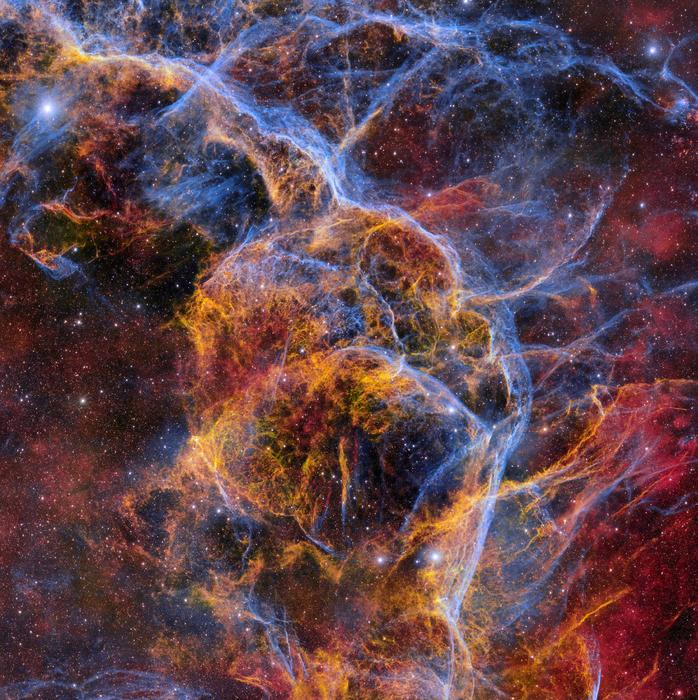
The Vela supernova remnant, the remains of a supernova explosion 800 light-years from Earth in the southern constellation Vela, as seen from the Dark Energy Camera on the Víctor M. Blanco Telescope at Cerro Tololo Inter-American Observatory.
When a star explodes, it sends high-energy particles out in all directions. This burst of energy can travel through space for thousands of light-years, traversing solar systems and even galaxies.
In a recent paper, published in the Monthly Notices of the Royal Astronomical Society, INSTAAR senior research associate Robert Brakenridge argues that supernovae may be the key to understanding a series of abrupt climate shifts in recent geologic history. The analysis models how such radiation could collide with Earth’s atmosphere, changing its composition. Brakenridge also matches a number of known supernovae to climate shifts preserved in geologic records.
“We have abrupt environmental changes in Earth’s history. That’s solid, we see these changes,” Brakenridge said. “So, what caused them?”
Brakenridge says that, if nearby supernovae caused such changes, further research could help scientists predict similar events in the future and prepare accordingly.
“When nearby supernovae occur in the future, the radiation could have a pretty dramatic effect on human society,” he said. “We have to find out if indeed they caused environmental changes in the past.”
Brakenridge’s recent paper is actually one of many he and others have published on the topic since the 1980s. But, in the past, the idea has rested mainly in the realm of theoretical physics. Brakenridge’s new publication is an effort to link the theory to empirical observations, both in space and here on Earth.
Telescopes and tree rings
In recent years, high-powered, orbital telescopes have offered unprecedented information about the contents and character of supernova radiation. Using these observations, Brakenridge created a more precise model of how this radiation might interact with Earth’s atmosphere than previously possible.
According to the model, a sudden influx of high energy photons from a supernova would thin the ozone layer, which shields the Earth from the Sun’s rays. Simultaneously, the radiation would degrade methane in the stratosphere, a major contributor to the greenhouse effect that keeps the Earth warm. Put together, these interactions would dampen greenhouse warming and increase the amount of ultraviolet radiation that reaches Earth from the sun. Brakenridge predicts that knock-on effects could include selective animal extinctions, increased wildfires and global cooling.
Since supernova radiation isn’t arriving on Earth today, the model can’t yet be tested in situ. Instead, Brakenridge looked to records of the past for further evidence. Specifically, he looked at tree rings. Because trees incorporate atmospheric carbon into their trunks as they grow, scientists can look to these records for a glimpse into ancient atmospheric conditions.
In the new paper, Brakenridge parses tree ring records spanning 15,000 years and identifies 11 spikes in radioactive carbon. He argues that these spikes may have been caused by 11 corresponding supernovae.
“The events that we know of, here on earth, are at the right time and the right intensity,” Brakenridge said.
For now, supernovae are just one possible explanation for these phenomena — solar flares are the most prominent alternative. But, Brakenridge says the evidence is mounting behind his argument. He hopes that further efforts can refine models of environmental effects and correlate them with geologic records — from ice cores to marine sediment to tree rings.
A better understanding of supernova radiation could do more than just satiate curiosity, it could help humans prepare for abrupt climate shifts that could arrive any day. For example, astronomers predict that Betelgeuse, a nearby red supergiant star perched on the shoulder of the Orion constellation, will meet its end in a supernova explosion sometime soon — it could be tomorrow, or any time in the next 100,000 years.
“As we learn more about our nearby neighboring stars, the capability for prediction is actually there,” Brakenridge said. “It will take more modeling and observation from astrophysicists to fully understand Earth’s exposure to such events.”
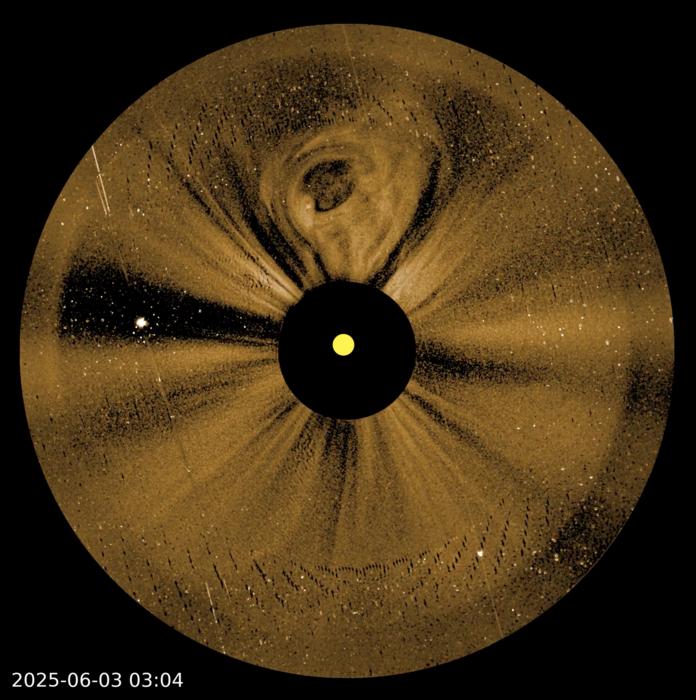
NASA’s PUNCH mission, led by SwRI, used its Narrow Field Imager to collectimages of solar activity. By blocking the Sun’s bright face, NFI captures the Sun’s atmosphere in unprecedented detail. The June 3 CME shown at the top of the image grew to enormous size, 100 times that of the Sun, as it traveled across the solar system.
SAN ANTONIO — June 10, 2025 — Southwest Research Institute’s Dr. Craig DeForest discussed the latest accomplishments of NASA’s PUNCH (Polarimeter to Unify the Corona and Heliosphere) mission during a media event at the 246th American Astronomical Society meeting in Anchorage, Alaska. As the spacecraft constellation completes commissioning, early PUNCH data showed coronal mass ejections, or CMEs, as they erupted from the Sun and traveled across the inner solar system.
“These preliminary movies show that PUNCH can actually track space weather across the solar system and view the corona and solar wind as a single system,” said DeForest, PUNCH principal investigator from SwRI’s Space Science and Exploration Division in Boulder, Colorado. “This big-picture view is essential to helping scientists better understand and predict space weather driven by CMEs, which can disrupt communications, endanger satellites and create auroras at Earth.”
PUNCH’s four small suitcase-sized spacecraft act as a single virtual instrument 8,000 miles across to image the solar corona, the Sun’s outer atmosphere, as it transitions into the solar wind that fills and defines our solar system.
“These first integrated images of our home in space are astonishing, but the best is yet to come,” DeForest said. “Once the spacecraft are in their final formation and the ground processing is fully sighted over the next few months, we’ll be able to track the solar wind and space weather in 3D throughout our neighborhood in space.”
The SwRI-developed and -led Wide Field Imagers aboard three of the four PUNCH spacecraft collected high-resolution images of entire CMEs in greater detail than previously possible. These instruments are designed to observe the faint, outermost portion of the Sun’s atmosphere and solar wind.
Images of a June CME from PUNCH’s coronagraph, the Narrow Field Imager, aboard the fourth spacecraft allow scientists to see the details of the Sun’s atmosphere by blocking the Sun’s bright face.
On March 11, PUNCH launched into polar orbit to make global, 3D observations of the Sun’s outer atmosphere and the inner solar system to help understand how material released from the Sun becomes the solar wind. The mission will also provide scientists with new data about how potentially disruptive events from the Sun, like solar flares and CMEs, form and evolve. This information could lead to more accurate predictions about the arrival of space weather at Earth and how it impacts assets and explorers in space.
Southwest Research Institute, based in San Antonio, Texas, leads the PUNCH mission and operates the four spacecraft from its facilities in Boulder, Colorado. The mission is managed by the Explorers Program Office at NASA Goddard Space Flight Center in Greenbelt, Maryland, for the Science Mission Directorate at NASA Headquarters in Washington.
A new study broadens the horizon of knowledge about how matter behaves under extreme conditions and helps to solve some great unknowns about the origin of the universe.
An international team of scientists has published a new report that moves towards a better understanding of the behaviour of some of the heaviest particles in the universe under extreme conditions, which are similar to those just after the big bang. The paper, published in the journal Physics Reports, is signed by physicists Juan M. Torres-Rincón, from the Institute of Cosmos Sciences at the University of Barcelona (ICCUB), Santosh K. Das, from the Indian Institute of Technology Goa (India), and Ralf Rapp, from Texas A&M University (United States).
The authors have published a comprehensive review that explores how particles containing heavy quarks (known as charm and bottom hadrons) interact in a hot, dense environment called hadronic matter. This environment is created in the last phase of high-energy collisions of atomic nuclei, such as those taking place at the Large Hadron Collider (LHC) and the Relativistic Heavy Ion Collider (RHIC). The new study highlights the importance of including hadronic interactions in simulations to accurately interpret data from experiments at these large scientific infrastructures.
The study broadens the perspective on how matter behaves under extreme conditions and helps to solve some great unknowns about the origin of the universe.
Reproducing the primordial universe
When two atomic nuclei collide at near-light speeds, they generate temperatures more than a 1,000 times higher than those at the centre of the Sun. These collisions briefly produce a state of matter called a quark-gluon plasma (QGP), a soup of fundamental particles that existed microseconds after the big bang. As this plasma cools, it transforms into hadronic matter, a phase composed of particles such as protons and neutrons, as well as other baryons and mesons.
The study focuses on what happens to heavy-flavour hadrons (particles containing charmed or background quarks, such as D and B mesons) during this transition and the hadronic phase expansion that follows it.
Heavy particles as probes
Heavy quarks are like tiny sensors. Being so massive, they are produced just after the initial nuclear collision and move more slowly, thus interacting differently with the surrounding matter. Knowing how they scatter and spread is key to learning about the properties of the medium through which they travel.
Researchers have reviewed a wide range of theoretical models and experimental data to understand how heavy hadrons, such as D and B mesons, interact with light particles in the hadronic phase. They have also examined how these interactions affect observable quantities such as particle flux and momentum loss.
“To really understand what we see in the experiments, it is crucial to observe how the heavy particles move and interact also during the later stages of these nuclear collisions”, says Juan M. Torres-Rincón, member of the Department of Quantum Physics and Astrophysics and ICCUB.
“This phase, when the system has already cooled down, still plays an important role in how the particles lose energy and flow together. It is also necessary to address the microscopic and transport properties of these heavy systems right at the transition point to the quark-gluon plasma”, he continues. “This is the only way to achieve the degree of precision required by current experiments and simulations”.
A simple analogy can be used to better understand these results: when we drop a heavy ball into a crowded pool, even after the biggest waves have dissipated, the ball continues to move and collide with people. Similarly, heavy particles created in nuclear collisions continue to interact with other particles around them, even after the hottest and most chaotic phase. These continuous interactions subtly modify the motion of particles, and studying these changes helps scientists to better understand the conditions of the early universe. Ignoring this phase would therefore mean missing an important part of the story.
Looking to the future
Understanding how heavy particles behave in hot matter is fundamental to mapping the properties of the early universe and the fundamental forces that rule it. The findings also pave the way for future experiments at lower energies, such as those planned at CERN’s Super Proton Super Synchrotron (SPS) and the future FAIR facility in Darmstadt, Germany.
Astrophysicists have gained precious new insights into how distant “exoplanets” form and what their atmospheres can look like, after using the James Webb Telescope to image two young exoplanets in extraordinary detail. Among the headline findings were the presence of silicate clouds in one of the planet’s atmospheres, and a circumplanetary disk thought to feed material that can form moons around the other.
In broader terms, understanding how the “YSES-1” super-solar system formed offers further insight into the origins of our own solar system, and gives us the opportunity to watch and learn as a planet similar to Jupiter forms in real time.
“Directly imaged exoplanets—planets outside our own Solar System—are the only exoplanets that we can truly take photos of,” said Dr Evert Nasedkin, a Postdoctoral Fellow in Trinity College Dublin’s School of Physics, who is a co-author of the research article just published in leading international journal, Nature.“These exoplanets are typically still young enough that they are still hot from their formation and it is this warmth, seen in the thermal infrared, that we as astronomers observe.”
Using spectroscopic instruments on board the James Webb Space Telescope (JWST), Dr Kielan Hoch and a large international team, including astronomers at Trinity College Dublin, obtained broad spectra of two young, giant exoplanets which orbit a sun-like star, YSES-1. These planets are several times larger than Jupiter, and orbit far from their host star, highlighting the diversity of exoplanet systems even around stars like our own sun.
The main goal of measuring the spectra of these exoplanets was to understand their atmospheres. Different molecules and cloud particles all absorb different wavelengths of light, imparting a characteristic fingerprint onto the emission spectrum from the planets.
Dr Nasedkin said: “When we looked at the smaller, farther-out companion, known as YSES 1-c, we found the tell-tale signature of silicate clouds in the mid-infrared. Essentially made of sand-like particles, this is the strongest silicate absorption feature observed in an exoplanet yet.”
“We believe this is linked to the relative youth of the planets: younger planets are slightly larger in radius, and this extended atmosphere may allow the cloud to absorb more of the light emitted by the planet. Using detailed modelling, we were able to identify the chemical composition of these clouds, as well as details about the shapes and sizes of the cloud particles.”
The inner planet, YSES-1b offered up other surprises: while the whole planetary system is young, at 16.7 million years old, it is too old to find signs of the planet-forming disk around the host star. But around YSES-1b the team observed a disk around the planet itself, thought to feed material onto the planet and serve as the birthplace of moons – similar to those seen around Jupiter. Only three other such disks have been identified to date, both around objects significantly younger than YSES-1b, raising new questions as to how this disk could be so long-lived.
Dr Nasedkin added: “Overall, this work highlights the incredible abilities of JWST to characterise exoplanet atmospheres. With only a handful of exoplanets that can be directly imaged, the YSES-1 system offers unique insights into the atmospheric physics and formation processes of these distant giants.”
In broad terms, understanding how this super-solar system formed offers further insight into the origins of our own solar system, giving us an opportunity to watch as a planet similar to Jupiter forms in real time. Understanding how long it takes to form planets, and the chemical makeup at the end of formation is important to learn what the building blocks of our own solar system looked like. Scientists can compare these young systems to our own, which provides hints of how our own planets have changed over time.
Dr Kielan Hoch, Giacconi Fellow at the Space Telescope Science Institute, said: “This program was proposed before the launch of JWST. It was unique, as we hypothesised that the NIRSpec instrument on the future telescope should be able to observe both planets in its field of view in a single exposure, essentially, giving us two for the price of one. Our simulations ended up being correct post-launch, providing the most detailed dataset of a multi-planet system to-date.”
“The YSES-1 system planets are also too widely separated to be explained through current formation theories, so the additional discoveries of distinct silicate clouds around YSES-1 c and small hot dusty material around YSES-1 b leads to more mysteries and complexities for determining how planets form and evolve.”
“This research was also led by a team of early career researchers such as postdocs and graduate students who make up the first five authors of the paper. This work would not have been possible without their creativity and hard work, which is what aided in making these incredible multidisciplinary discoveries.”
Urgent need to quantify role of fungal toxins in rising liver cancer rates in Ghana
..to curb global toll taken by the disease, especially in the rest of Africa and Asia High levels of aflatoxin contamination in dietary staples of maize and peanuts With one of the highest rates of liver cancer in Africa, Ghana represents case study
There’s an urgent need to quantify the role of fungal toxins (aflatoxins), found on agricultural crops, such as maize and peanuts (groundnuts), in the escalating rates of liver cancer in Ghana, as well as elsewhere in Africa and Asia, concludes a commentary published in the open access journal BMJ Global Health.
Maize and peanuts are dietary staples in many Asian and African countries. And with one of the highest rates of liver cancer in Africa, at 16/100,000 of the population. Ghana represents a critical case study in furthering international understanding of the link between aflatoxins and the rising global toll taken by liver cancer, say the authors.
Aflatoxins are produced primarily by Aspergillus flavus and Aspergillus parasiticus, which thrive in warm humid conditions, and can occur at any point during harvest and storage.
There are several known risk factors for liver cancer, explain the authors. These include chronic infection with hepatitis B and C viruses—the prevalence of which is high in Ghana—liver cirrhosis, heavy drinking and smoking, and genetic and metabolic conditions, such as diabetes and obesity.
While the International Agency for Research on Cancer (IARC) has classified naturally occurring aflatoxins as Group 1 human carcinogens, no study to date has specifically assessed the contribution of aflatoxin exposure to the high incidence of primary liver cancer in Ghana, despite the high consumption of foods contaminated with these toxins and the prevalence of hepatitis, point out the authors.
The Ghanaian government has taken several steps to curb contamination and public exposure to aflatoxins. These include promoting good agricultural practices, improved storage methods, solar drying techniques, pest control, regular monitoring of food and feed products, and raising public awareness of the hazards of aflatoxin exposure, note the authors.
But without solid evidence, it’s difficult to understand the exact extent of the exposure and its impact on public health, they add.
For example, few large scale epidemiological studies involving different demographic groups, geographic regions, and rural and urban populations in Ghana, have been carried out. And the combined effects of multiple risk factors on liver cancer development are still poorly understood, say the authors.
Improved surveillance and monitoring systems are needed to assess the effectiveness of current aflatoxin control measures in the country. And better understanding of socioeconomic and cultural factors could inform safer food practices at the household and community levels, they suggest.
“This research is vital to informing targeted interventions, refining existing policies, and ultimately reducing the burden of liver cancer in the country,” insist the authors.
If these research gaps are plugged, the benefits will be felt not only in Ghana, but elsewhere, including many countries in Sub-Saharan Africa and Asia, they add.
“Ghana can better protect its population from the deadly consequences of aflatoxin exposure and contribute to global efforts to curb the growing burden of liver cancer,” they write, highlighting that liver cancer ranks among the leading causes of cancer-related deaths worldwide.
There were over 700,000 deaths from liver cancer reported in 2022 alone, with the toll taken by the disease projected to keep on rising: between 2020 and 2040, new cases are expected to rise by 55%, with associated deaths increasing by more than 56%, emphasise the authors.
Aflatoxin exposure and primary liver cancer in Ghana
Article Publication Date
10-Jun-2025
Over half of doctors surveyed would consider assisted dying if they had advanced cancer or Alzheimer’s disease
And they mostly prefer symptom relief at end of life rather than prolongation of life but preferences vary according to their jurisdiction’s legislation on assisted dying
When it comes to advanced cancer or Alzheimer’s disease, over half of doctors would consider assisted dying for themselves, but preferences seem to vary according to their jurisdiction’s legislation on euthanasia, reveal the results of an international survey, published online in the Journal of Medical Ethics.
And most say they would prefer symptom relief rather than life sustaining treatment for their own end of life care, indicate the responses.
Previously published research suggests that doctors’ views on their own end of life care inform their clinical practice, and that their perceptions of their patients’ treatment wishes are influenced by their own preferences, note the researchers.
But most of the studies on physicians’ preferences for end of life practices are outdated and/or narrow in focus, added to which little is known about whether doctors would consider assisted dying for themselves, and whether this might be influenced by national or state legislation on the practice, point out the researchers.
To shed more light on these issues, the researchers surveyed doctors in 8 jurisdictions with differing laws and attitudes to assisted dying: Belgium; Italy; Canada; the US states of Oregon, Wisconsin, and Georgia; and the states of Victoria and Queensland in Australia.
Physician-assisted suicide law entered the statute book in Oregon in 1997, while Death with Dignity legislation has been introduced in Wisconsin numerous times over the past 20 years but remains illegal. It is also illegal in Georgia which is one of the most religious states in the US. In Canada, both physician-assisted suicide and euthanasia have been permitted since 2016.
In Belgium, assisted dying has been legal since 2002, but remains illegal in Italy, one of the most religious countries in Europe. The Australian state of Victoria implemented assisted dying legislation in June 2019. In Queensland, assisted dying legislation was passed in 2021, but had not yet come into force when the data for this study were collected (May 2022–February 2023).
Two hypothetical situations were included to probe doctors’ views on end of life care: advanced cancer and Alzheimer’s disease. Respondents were asked the extent to which they would consider various end of life practices for themselves These included cardiopulmonary resuscitation (CPR), mechanical ventilation, tube feeding, intensified alleviation of symptoms, palliative sedation, the use of available drugs to end life, physician-assisted suicide, and euthanasia.
Responses were sought from family doctors (GPs), palliative care doctors, and other medical specialists highly likely to treat patients at the end of their life, such as cardiologists, emergency medicine doctors, oncologists, neurologists, and intensive care specialists.
Of the 1408 survey responses received 1157 were included in the final analysis. These showed that doctors rarely considered life sustaining practices a (very) good option in cancer and Alzheimer’s, respectively: CPR 0.5% and 0.2%; mechanical ventilation 0.8% and 0.3%; tube feeding 3.5% and 3.8%.
Most (94% and 91%, respectively) considered intensifying symptom relief a good or very good option, while 59% and 50%, respectively, considered palliative sedation a good or very good option.
Respondents who considered palliative sedation for Alzheimer’s disease as a good or very good option ranged from just over 39% in Georgia to just over 66% in Italy.
About half of respondents considered euthanasia a (very) good option: just over 54% and 51.5%, respectively, for cancer and Alzheimer’s disease. The proportion of those considering euthanasia a (very) good option ranged from 38% in Italy to 81% in Belgium (cancer scenario), and almost 37.5% in Georgia, to almost 67.5% in Belgium (Alzheimer’s disease scenario).
Around 1 in 3 (33.5%) respondents said they would consider drugs at their disposal to end their own life (cancer scenario).
While sex, age, and ethnicity didn’t seem to influence doctors’ preferences for end of life practices, prevailing legislation in their jurisdiction did.
Doctors working in a jurisdiction with a legal option for both euthanasia and physician-assisted suicide were 3 times as likely to consider euthanasia a (very) good option for cancer and almost twice as likely to consider it a (very) good option for Alzheimer’s disease.
“This may be because these physicians are more familiar and comfortable with the practices and have observed positive clinical outcomes. It also suggests that macro-level factors heavily impact personal attitudes and preferences, and physicians are likely influenced by what is considered ‘normal’ practice in their own jurisdiction,” say the researchers.
GPs and other specialists were less likely to consider palliative sedation a good or very good option than palliative care doctors, and they were more likely to consider euthanasia, physician-assisted suicide, and the use of available medication to end their own life a (very) good option.
And doctors who weren’t religious were more likely to consider physician-assisted suicide or euthanasia a preferable option than those with a strongly held faith: physician-assisted suicide 65% vs 38%; euthanasia 72% vs 40%.
Due to the study design and nature of surveys the results can’t be considered fully representative, and those doctors with a particular interest in the subject may have been more likely to take part, acknowledge the researchers. While the overall recruitment of respondents was satisfactory in all jurisdictions, GPs were under-represented among the Canadian respondents.
But note the researchers: “Our findings show that across all jurisdictions physicians largely prefer intensified alleviation of symptoms and to avoid life-sustaining techniques like CPR, mechanical ventilation, and tube feeding.
“This finding may also relate to the moral distress some physicians feel about the routine continuation of treatment for their patients at the end of life.These findings warrant reflection on current clinical practice since life-prolonging treatment is still widely used for patients,yet is not preferred by physicians for themselves.”
Smartphone apps that track menstrual cycles are a “gold mine” for consumer profiling, collecting information on everything from exercise, diet and medication to sexual preferences, hormone levels and contraception use, according to a University of Cambridge report.
A report from Cambridge’s Minderoo Centre for Technology and Democracy argues that the financial worth of this data is “vastly underestimated” by users who supply profit-driven companies with highly intimate details in a market lacking in regulation.
The report’s authors caution that cycle tracking app (CTA) data in the wrong hands could result in risks to job prospects, workplace monitoring, health insurance discrimination and cyberstalking – and limit access to abortion.
They call for better governance of the booming ‘femtech’ industry to protect users when their data is sold at scale, arguing that apps must provide clear consent options rather than all-or-nothing data collection, and urge public health bodies to launch alternatives to commercial CTAs.
“Menstrual cycle tracking apps are presented as empowering women and addressing the gender health gap,” said Dr Stefanie Felsberger, lead author of the report from Cambridge’s Minderoo Centre. “Yet the business model behind their services rests on commercial use, selling user data and insights to third parties for profit.”
“There are real and frightening privacy and safety risks to women as a result of the commodification of the data collected by cycle tracking app companies.”
As most cycle tracking apps are targeted at women aiming to get pregnant, the download data alone is of huge commercial value, say researchers, as – along with home buying – no other life event is linked to such dramatic shifts in consumer behaviour.
In fact, data on pregnancy is believed to be over two hundred times more valuable than data on age, gender or location for targeted advertising. The report points out that period tracking could also be used to target women at different points in their cycle. For example, the oestrogen or ‘mating’ phase could see an increase in cosmetics adverts.
Just the three most popular apps had estimated global download figures of a quarter of a billion in 2024. So-called femtech – digital products focused on women’s health and wellbeing – is estimated to reach over US$60 billion by 2027, with cycle tracking apps making up half of this market.
With such intense demand for period tracking, the report argues that the UK’s National Health Service (NHS) should develop its own transparent and trustworthy app to rival those from private companies, with apps allowing permission for data to be used in valid medical research.
“The UK is ideally positioned to solve the question of access to menstrual data for researchers, as well as privacy and data commodification concerns, by developing an NHS app to track menstrual cycles,” said Felsberger, who points out that Planned Parenthood in the US already has its own app, but the UK lacks an equivalent.
“Apps that are situated within public healthcare systems, and not driven primarily by profit, will mitigate privacy violations, provide much-needed data on reproductive health, and give people more agency over how their menstrual data is used.”
“The use of cycle tracking apps is at an all-time high,” said Prof Gina Neff, Executive Director of Cambridge’s Minderoo Centre. “Women deserve better than to have their menstrual tracking data treated as consumer data, but there is a different possible future.”
“Researchers could use this data to help answer questions about women’s health. Care providers could use this data for important information about their patients’ health. Women could get meaningful insights that they are searching for,” Neff said.
In the UK and EU, period tracking data is considered “special category”, as with that on genetics or ethnicity, and has more legal safeguarding. However, the report highlights how in the UK, apps designed for women's health have been used to charge women for illegally accessing abortion services*
In the US, data about menstrual cycles has been collected by officials in an attempt to undermine abortion access.** Despite this, data from CTAs are regulated simply as “general wellness” and granted no special protections.
“Menstrual tracking data is being used to control people’s reproductive lives,” said Felsberger. “It should not be left in the hands of private companies.”
Investigations by media, non-profit, and consumer groups have revealed CTAs sharing data with third parties ranging from advertisers and data brokers to tech giants such as Facebook and Google.
The report cites work published last month from Privacy International showing that, while the major CTA companies have updated their approach to data sharing, device information is still collected in the UK and US with “no meaningful consent”.
Despite data protection improvements, the report suggests that user information is still shared with third parties such as cloud-based delivery networks that move the data around, and outside developers contracted to handle app functionalities.
At the very least, commercial apps could include delete buttons, says Felsberger, allowing users to erase data in the app as well as the company servers, helping protect against situations – from legal to medical – where data could be used against them.
“Menstrual tracking in the US should be classed as medical data,” said Felsberger. “In the UK and EU, where this data is already afforded special category status, more focus needs to be placed on enforcing existing regulation.”
The report stresses the need to improve public awareness and digital literacy around period tracking. The researchers argue that schools should educate students on medical data apps and privacy, so young people are less vulnerable to health hoaxes.
According to the British Pregnancy Advisory Service (BPAS), from 1967 to 2002 only three women were convicted of having an illegal abortion in England and Wales, but since then the number has increased drastically. Abortion provider MSI reports of almost ‘60 criminal inquiries in England and Wales since 2018, compared with almost zero before’.
The increased number of investigations does not mean more illegal abortions are taking place, but indicates increased police focus on miscarriages and unexplained cases of pregnancy loss, leaving judges ‘flabbergasted’ as to why some cases reached court.
Women suspected of illegal abortions are pushed into tests during hospital stays after procedures without legal representation. Police have also repeatedly requested data from abortion providers on people who have been turned away from a BPAS clinic because they were over the legal limit for an abortion (which the BPAS has refused to provide). Those under investigation routinely have their phones and other electronic devices confiscated. Police have also made requests for data from menstrual tracking applications in the course of police investigations.
Abortion civil rights organisations have raised their concerns over the use of CTA data in investigations. It is not only data from CTAs, but also text messages and search history that have been used in investigations. Nonetheless, the threat of CTA data being used in police investigations in the UK is of great concern to users. This is taking place in a context where the UK government has put pressure on tech companies to develop inbuilt backdoors into the encrypted services they offer.
**Case studies – US:
Tracking data as court evidence
In 2015, Jeannine Risley reported being sexually assaulted at her boss’ home where the police found a knife, overturned furniture, and a bottle of vodka. She informed police that she lost her FitBit in the struggle with the assailant. When her FitBit was recovered and its data downloaded, the tracker’s movement and heart rate data was taken as contradictory evidence to Risley’s testimony. Risley was charged with making a false report to the police and fabricating evidence.
Preventing abortion access in the United States
Two cases in the US have demonstrated the continuing use of menstrual data against those with periods. In Missouri, the state’s health department kept track of the menstrual cycles of patients in an attempt to investigate failed abortions. Officials also tracked medical ID numbers, gestational age of foetuses, and dates of medical procedures. The investigation led to the withholding of St. Louis’ Planned Parenthood license and led to a state hearing. During President Trump’s first administration, the Office of Refugee Resettlement tracked and monitored the menstrual cycles of unaccompanied minors seeking asylum as part of efforts to prevent them from accessing abortions, even in cases of rape. The spreadsheet containing dates of menstrual cycles, how long people had been pregnant, whether sex had been consensual, and if they had requested abortion access was made available to the public through a freedom of information request and published by MSNBC.
While in these examples the data did not come from menstrual trackers, but was compiled by others about people’s menstrual cycle, it illustrates how central menstrual tracking data is in efforts to prevent access to abortion services.
Article Title
The High Stakes of Tracking Menstruation
Article Publication Date
11-Jun-2025
Scientists find unusual build-up of soot-like particles in lung cells of COPD patients
As a result, cells grow abnormally large and cause inflammation
Alveolar macrophages under the microscope showing deposits of black carbon. L - smaller deposits in cells from a smoker, R - larger deposits in cells from COPD patient.
Cells taken from the lungs of people with chronic obstructive pulmonary disease (COPD) have a larger accumulation of soot-like carbon deposits compared to cells taken from people who smoke but do not have COPD, according to a study published today (Wednesday) in ERJ Open Research [1]. Carbon can enter the lungs via cigarette smoke, diesel exhaust and polluted air.
The cells, called alveolar macrophages, normally protect the body by engulfing any particles or bacteria that reach the lungs. But, in their new study, researchers found that when these cells are exposed to carbon they grow larger and encourage inflammation.
The research was led by Dr James Baker and Dr Simon Lea from the University of Manchester, UK. Dr Baker said: “COPD is a complex disease that has a number of environmental and genetic risk factors. One factor is exposure to carbon from smoking or breathing polluted air.
“We wanted to study what happens in the lungs of COPD patients when this carbon builds up in alveolar macrophage cells, as this may influence the cells’ ability to protect the lungs.”
The researchers used samples of lung tissue from surgery for suspected lung cancer. They studied samples (that did not contain any cancer cells) from 28 people who had COPD and 15 people who were smokers but did not have COPD.
Looking specifically at alveolar macrophage cells under a microscope, the researchers measured the sizes of the cells and the amount of carbon accumulated in the cells.
They found that the average amount of carbon was more than three times greater in alveolar macrophage cells from COPD patients compared to smokers. Cells containing carbon were consistently larger than cells with no visible carbon.
Patients with larger deposits of carbon in their alveolar macrophages had worse lung function, according to a measure called FEV1%, which quantifies how much and how forcefully patients can breathe out.
When the researchers exposed macrophages to carbon particles in the lab, they saw the cells become much larger and found that they were producing higher levels of proteins that lead to inflammation.
Dr Lea said: “As we compared cells from COPD patients with cells from smokers, we can see that this build-up of carbon is not a direct result of cigarette smoking. Instead, we show alveolar macrophages in COPD patients contain more carbon and are inherently different in terms of their form and function compared to those in smokers.
“Our research raises an interesting question as to the cause of the increased levels of carbon in COPD patients’ macrophages. It could be that people with COPD are less able to clear the carbon they breathe in. It could also be that people exposed to more particulate matter are accumulating this carbon and developing COPD as a result.
“In future, it would be interesting to study how this carbon builds up and how lung cells respond over a longer period of time.”
Professor Fabio Ricciardolo is Chair of the European Respiratory Society’s group on monitoring airway disease, based at the University of Torino, Italy, and was not involved in the research. He said: “This set of experiments suggest that people with COPD accumulate unusually large amounts of carbon in the cells of their lungs. This build-up seems to be altering those cells, potentially causing inflammation in the lungs and leading to worse lung function.
“In addition, this research offers some clues about why polluted air might cause or worsen COPD. However, we know that smoking and air pollution are risk factors for COPD and other lung conditions, so we need to reduce levels of pollution in the air we breathe and we need to help people to quit smoking.”