Wednesday, June 11, 2025

REST IN POWER

Funk icon Sly Stone, leader of groundbreaking 1960s band, dies at 82

Funk icon and pioneering multi-instrumentalist Sly Stone, whose band Sly and the Family Stone remolded musical norms and challenged segregation along racial and gender lines, died at the age of 82 on Monday, his family said, leaving behind a legendary, genre-mashing discography which lifted Afrocentric music and hippie culture.


Issued on: 10/06/2025 - 
By: FRANCE 24

US singer Sly Stone perfoms July 19, 2007 during the Nice Jazz festival in Nice.
 © Eric Estrade, AFP


Sly Stone, the driving force behind Sly and the Family Stone, a multiracial American band whose boiling mix of rock, soul and psychedelia embodied 1960s idealism and helped popularize funk music, has died at the age of 82, his family said on Monday.

Stone died after a battle with chronic obstructive pulmonary disease and other health issues, a statement from his family said.

"While we mourn his absence, we take solace in knowing that his extraordinary musical legacy will continue to resonate and inspire for generations to come," the statement said.

Stone was perhaps best known for his performance in 1969 at the historic Woodstock music festival, the hippie culture's coming-out party.

His group was a regular on the US music charts in the late 1960s and 1970s, with hits such as "Dance to the Music," "I Want to Take You Higher," "Family Affair," "Everyday People," "If You Want Me to Stay," and "Hot Fun in the Summertime."

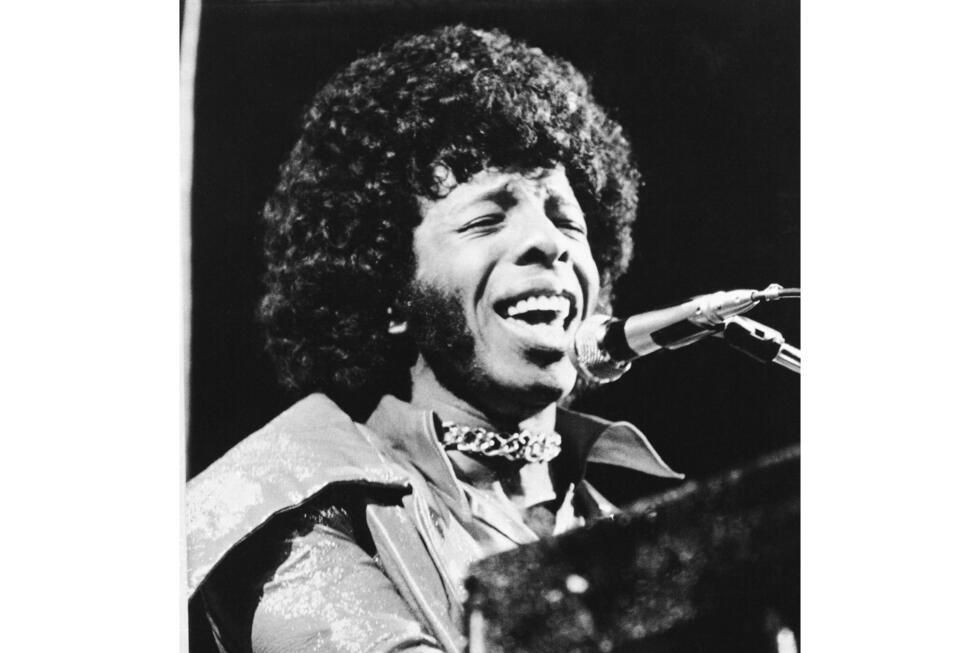
Rock star Sylvester "Sly" Stone of Sly and the Family Stone appears in April 1972.
 © AP

But he later fell on hard times and became addicted to cocaine, never staging a successful comeback.

The confident and mercurial Stone played a leading role in introducing funk, an Afrocentric style of music driven by grooves and syncopated rhythms, to a broader audience.

James Brown had forged the elements of funk before Stone founded his band in 1966, but Stone's brand of funk drew new listeners. It was celebratory, eclectic, psychedelic and rooted in the counterculture of the late 1960s.

"They had the clarity of Motown but the volume of Jimi Hendrix or The Who," Parliament-Funkadelic frontman George Clinton, a contemporary of Stone and another pioneering figure in funk, once wrote.

When Sly and the Family Stone performed, it felt like the band was "speaking to you personally," Clinton said.

Stone made his California-based band, which included his brother Freddie and sister Rose, a symbol of integration. It included Black and white musicians, while women, including the late trumpeter Cynthia Robinson, had prominent roles.

That was rare in a music industry often segregated along racial and gender lines.

Stone, with his orb-like Afro hairstyle and wardrobe of vests, fringes and skin-tight leather, lived the life of a superstar. At the same time, he allowed bandmates to shine by fostering a collaborative, free-flowing approach that epitomized the 1960s hippie ethic.

"I wanted to be able for everyone to get a chance to sweat," he told Rolling Stone magazine in 1970.


Disc Jockey to Singer

Born Sylvester Stewart in Denton, Texas, he moved as a child with his family to Northern California, where his father ran a janitorial business.

He took the show business name Sly Stone and worked for a time as a radio disc jockey and a record producer for a small label before forming the band.
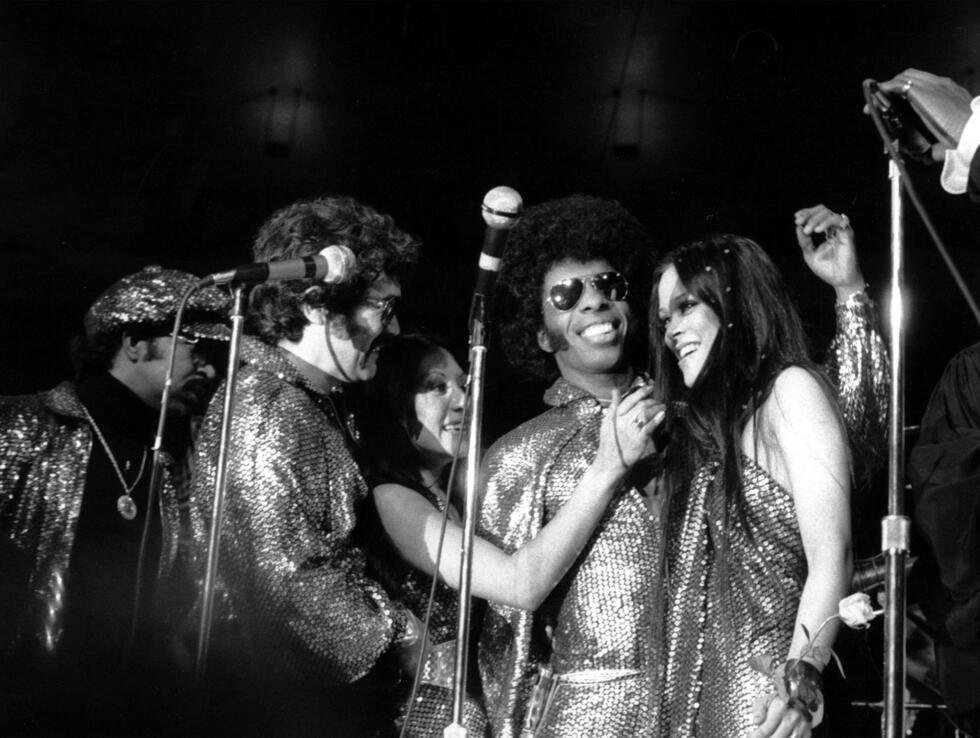
Sylvester "Sly" Stewart and his bride Kathy Silva are congratulated by well-wishers during their wedding ceremony at a rock concert in New York's Madison Square Garden on June 6, 1974. © AP

The band's breakthrough came in 1968, when the title track to their second album, "Dance to the Music," cracked the Top 10.

A year later, Sly and the Family Stone performed at Woodstock before dawn. Stone woke up a crowd of 400,000 people at the music festival, leading them in call-and-response style singing.

Stone's music became less joyous after the idealistic 1960s, reflecting the polarisation of the country after opposition to the Vietnam War and racial tensions triggered unrest on college campuses and in African American neighborhoods in big US cities.

In 1971, Sly and the Family Stone released "There's a Riot Goin' On," which became the band's only No. 1 album.

Critics said the album's bleak tone and slurred vocals denoted the increasing hold of cocaine on Stone. But some called the record a masterpiece, a eulogy to the 1960s.

In the early 1970s, Stone became erratic and missed shows. Some members left the band.

But the singer was still a big enough star in 1974 to attract a crowd of 21,000 for his wedding to actress and model Kathy Silva at Madison Square Garden in New York. Silva filed for divorce less than a year later.

Sly and the Family Stone's album releases in the late 1970s and early 1980s flopped, as Stone racked up drug possession arrests. But the music helped shape disco and, years later, hip-hop artists kept the band's legacy alive by frequently sampling its musical hooks.

The band was inducted into the Rock & Roll Hall of Fame in 1993 and Stone was celebrated in an all-star tribute at the Grammy Awards in 2006. He sauntered on stage with a blond Mohawk but bewildered the audience by leaving mid-song.

In 2011, after launching what would become a years-long legal battle to claim royalties he said were stolen, Stone was arrested for cocaine possession. That year, media reported Stone was living in a recreational vehicle parked on a street in South Los Angeles.

Stone had a son, Sylvester, with Silva. He had two daughters, Novena Carmel, and Sylvette "Phunne" Stone, whose mother was bandmate Cynthia Robinson.

(FRANCE 24 with Reuters)


Sly Stone – Underrated, uncompromising, and undervalued even now

By Paul Wallis
June 10, 2025
DIGITAL JOURNAL


To be called a “pioneer in black music” isn’t at all easy. You have to be good; you have to be different and be doing something that’s basically unheard of. That’s a reasonably accurate picture of Sly and the Family Stone.

In the blasé world of 60s mainstream pop, and to a slightly lesser extent, modern black pop, you didn’t have to be revolutionary. You just had to sound nice and look nice and not wake anyone up.

Black and white audiences were also dazzled by the glamour and skills of Motown and Atlantic artists. In jazz, Miles Davis had made a few points about technical music and new sounds. Things were pretty sedate.

Into this environment came Sly and the Family Stone. They first came to prominence with the funk anthem “Dance to the Music.” It was a repetitive attention-getter, and deliberately so. It was also a complete departure from the Motown Sound.

It wasn’t slick; it was gritty. It wasn’t a cure; it was physical. It was also a complete departure from the glitz-heavy arrangements of the time. This turned out to be the hallmark of Sly and the Family Stone. They’d try anything, and they did. They appeared at Woodstock and fit right in.

Technically, the phrasing was also very different. Brief phrases turned into funk. Leads switched between instruments. Hook lines came out of anywhere. The famous “Boomshakkalakka” was part of the song I Want To Take You Higher and has been a staple, almost a complete cultural statement ever since.

Sly was the front guy and driving “entity”, but his band were no slouches either. Watch any video, listen to any album, and you’ll hear a rash of musical ideas, particularly live, when they have a chance to jam. Simply describing the range of styles and innovations would take a book.

The “eventually iconic” album Stand was also a legacy album for future generations. The album produced quite a few singles, but as usual with Sly and the Family, just dig around and you’ll find other gems, such as “Sex Machine,” which has to be one of the most undersold and underrated guitar/bass tracks of all time.

This was also a pretty tough time to be a frontline black musical icon. The Watts Riots and a fluctuating range of what we’d now call “hood” issues upped the ante for artists. You couldn’t just wear an Afro. You had to mean something. The song Thank You (Falettinme Be Mice Elf Agin) is maybe some sort of definitive statement.


This is roughly where the career track for Sly gets complicated. Things got bumpy. Meanwhile, funk took off, a bit belatedly. The Sly and the Family Stone sound started popping up everywhere, in various forms. This opened up the field for a lot of innovation, experimentation, and just fun stuff. It’s the direct ancestor of hip-hop, rap, and just about all modern black music since. Just listen. You can hear it, still there, still playing strong. There were never any compromises.

I’ve been listening to Sly and the Family Stone since early high school, and I still do.

Thank you, Sly.
#DEI #CRT
Brazilian author Djamila Ribeiro honours the unseen work of Black women


arts24 © FRANCE 24
Issued on: 10/06/2025 -
Play (12:35 min)
From the show

She is Brazil's most compelling defender of Black feminism. Philosopher, writer and professor Djamila Ribeiro has been instrumental in calling out structural racism and pushing for societal change, be it in publishing or in politics. Ribeiro joins us to talk about her deeply personal book "Letters to my grandmother", which recounts her own experience as a young woman and reflects upon the socio-political context that her mother and grandmother were navigating in 20th-century Brazil. Ribeiro has used her public platform to boost feminist and anti-racist campaigns, discussing the "speaking place" that each person inhabits, a key concept in her best-selling text "Where We stand", in which she explains why multiple identities inform individual perspectives.


Roma children, fighting discrimination with chess, here's what they do in Romania

In partnership withthe European Commission


Copyright Euronews
By Cecilia Cacciotto
Published on 09/06/2025 -


VIDEO

In this episode of Smart Regions, we went to Satu Mare, a Romanian town on the border with Hungary, where the Stea association uses chess to facilitate the integration of the most vulnerable children.


Adriana Pascu, 16 years old, of Roma ethnicity, is a skilled chess player.

Thanks to the game, she has developed strong analysis and concentration skills that also help her in her studies.  Playing chess was not a matter of course for her and the other children of the Roma community in the Romanian city of Satu Mare. They learnt through the 'Chess for change' project started in 2019 by the Stea association, active in the social integration of Roma children.

These children made progress in all areas, especially at school. 

"I am much more reflective, more focused, and memorise lessons faster," Adriana explains. Chess activates memory, the ability to analyse and anticipate.

"Chess teaches children fair-play; it is the only sport, I would say, where we are all equal, no matter if you are male or female, if you have a handicap"
 Alex Geiger 
Chess teacher

For Alex Geiger, a chess teacher, it is one of the most democratic sports: "Chess teaches children fair-play; it is the only sport, I would say, where we are all equal, no matter if you are male or female, if you have a handicap."

Chess against early school leaving

The first objective of the Stea association was precisely to combat early school leaving and motivate children to at least complete the compulsory school cycle. 

"Chess allows these youngsters to realise that if they put their mind to it and are persistent, they can achieve good results," explains Cristina Bala, the director of the Stea centre.

 "Children and teenagers," she says, "have managed to participate in competitions, even international ones, and have also won prizes; they have been able to gain positive experiences and gain the recognition and esteem of others.

Initially, teachers at school were sceptical, not thinking that Roma children could ever succeed in chess: today they support the project because the children involved are more motivated and better at studying as well. As Delia Sabou, Adriana's teacher, says: "We have noticed in all the children involved in the project that there is an important cognitive progression, an increase in concentration and an improvement in social interaction with their peers and teachers.

"We have noticed in all the children involved in the project that there is an important cognitive progression, an increase in concentration and an improvement in social interaction with their peers and teachers"
 Delia Sabou 
Teacher

The director of the Stea centre, Cristina Bala, immediately realised the potential of chess and introduced the activity in 2019. The total cost of the project for the first year was EUR 70,000, with the European Union contributing EUR 60,000 thanks to Cohesion Policy funds.

The chess piece that Adriana prefers is the queen, because it is the most powerful piece. She plans to be an accountant when she grows up. It is clear that her life has taken on a new impetus and she will be the real queen of her future.

UK's Starmer condemns two nights of 'mindless' violence in Northern Ireland


UK Prime Minister Keir Starmer on Wednesday condemned two nights of "mindless", "racially motivated" violence in the town of Ballymena in Northern Ireland. Unrest was triggered when police arrested two teenagers, who are thought to be of  Roma 
 origin, accused of attempting to rape a young girl.


Issued on: 11/06/2025 -
By: FRANCE 24
Video by: Liza KAMINOV

01:52
Four houses were damaged by fire, while rioters smashed windows and doors of homes and businesses in Ballymena, Northern Ireland. © Paul Faith, AFP


UK Prime Minister Keir Starmer joined Northern Irish authorities on Wednesday in condemning what he called two nights of "mindless" violence targeting foreigners.

The unrest that has injured 17 police officers has included rioters throwing petrol bombs, fireworks and bricks, while homes as well as businesses have been attacked.

The violence was triggered by the arrest of two teenagers accused of attempting to rape a young girl. The pair appeared in court on Monday where they asked for a Romanian interpreter.

"We strongly condemn the racially motivated violence witnessed in recent days and make an urgent appeal for calm across society," said ministers from every party in the UK province's power-sharing executive in a joint statement.

Residents had been "terrorised" and police injured, they added, urging people to reject the "divisive agenda being pushed by a "destructive" minority.

Starmer joined them in condemning "mindless attacks".


A motorcyclist drives past a damaged house after a second night of protests targeting foreigners in Ballymena, Northern Ireland. © Paul Faith, AFP

Six people were arrested during the second night of riots in the town of Ballymena, around 48 kilometres (30 miles) northwest of Belfast, and other places.

"Hate-fuelled acts and mob rule do nothing but tear at the fabric of our society -- they resolve nothing and serve no one," said Chief Constable Jon Boutcher.

Police will not confirm the ethnicity of the two teenagers who remain in custody, but areas attacked on Monday included those where Romanian migrants live.

Four houses were damaged by fire, while rioters smashed windows and doors of homes and businesses.

"Police officers came under sustained attack over a number of hours with multiple petrol bombs, heavy masonry, bricks and fireworks in their direction," the Police Service of Northern Ireland said in a statement.

'Terrifying' scenes

Some of the 17 officers injured had required hospital treatment.

Five people were arrested on suspicion of riotous behaviour while a sixth was detained on suspicion of disorderly behaviour in Newtownabbey, 30 kilometres away, one of four other places including Belfast where protests erupted.

Tensions in Ballymena, which has a large migrant population, remained high throughout the day on Tuesday.

Residents described the scenes as "terrifying" and told AFP that those involved were targeting "foreigners".

Boarded up houses after a second night of riots in Ballymena, Northern Ireland.
 © Paul Faith, AFP

Assistant Chief Constable Ryan Henderson on Tuesday denounced the violence as "racist thuggery" and said it had been "clearly racially motivated and targeted at our minority ethnic community and police".

The unrest comes as immigration is increasingly a hot-button issue across the United Kingdom – England, Wales, Scotland and Northern Ireland – and in the neighbouring Republic of Ireland.

Some 20 percent of Ireland's 5.4-million population is now foreign-born.

Official data showed a population increase fuelled by migration of around 100,000 in the year to April 2024 – the largest since 2007.

The last census in 2021 put the number of people in Northern Ireland who identified as Roma, a distinct ethnic group whose population is largely concentrated in eastern and central Europe, at around 1,500 or 0.1 percent of the population.


The official figures do not indicate how many are longstanding residents or recent immigrants but the census put the number of Romanian-born people living in the province at 6,612.

(FRANCE 24 with AFP)

N.Ireland town hit by second night of unrest

RACIST RIOT

This violence was clearly racially motivated and targeted at our minority ethnic community

By AFP
June 10, 2025


Police face protestors during a demonstration in Ballymena, Northern Ireland, sparked by the alleged attempted rape of a young girl by two teenagers - Copyright AFP Alessia MACCIONI

Peter MURPHY

Violence flared for a second night Tuesday in a Northern Irish town after “racially motivated” attacks sparked by the arrest of two teenagers accused of attempting to rape a young girl.

Hundreds of protestors, many of them masked, took to the streets of Ballymena, throwing petrol bombs, bottles and masonry as police responded with water cannon, an AFP journalist said.

There was a heavy police presence in one area of the town, some 30 miles (48 kilometres) northwest of Belfast, as the protesters set fire to a car and barricades. Police also fired plastic baton rounds to disperse the crowds, an AFP journalist saw.

Later as night fell, crowds began to disperse in Ballymena although smaller groups still milled around the town centre. And local media reported that protestors were also blocking roads in Belfast.

The unrest first erupted Monday night after a vigil in a neighbourhood where an alleged serious sexual assault happened on Saturday.

“This violence was clearly racially motivated and targeted at our minority ethnic community and police,” Assistant Chief Constable Ryan Henderson said Tuesday.

He told a press conference: “It was racist thuggery, pure and simply, and any attempt to justify it or explain it as something else is misplaced.”

Tensions in the town, which has a large migrant population, remained high throughout the day on Tuesday, as residents described the scenes as “terrifying” and told AFP those involved were targeting “foreigners”.

Two teenage boys, charged by police with the attempted rape of a teenage girl, had appeared in court Monday, where they asked for a Romanian interpreter, local media reports said.

The trouble began when masked people “broke away from the vigil and began to build barricades, stockpiling missiles and attacking properties”, police said.

Houses and businesses were attacked, the Police Service of Northern Ireland (PSNI) said, adding it was investigating “hate attacks”.

Security forces also came under “sustained attack” with petrol bombs, fireworks and bricks thrown by rioters, injuring 15 officers including some who required hospital treatment, according to the force.

One 29-year-old man was arrested and charged with riotous behaviour, disorderly behaviour, attempted criminal damage and resisting police.

Four houses were damaged by fire, and windows and doors of homes and businesses smashed.

Cornelia Albu, 52, a Romanian migrant and mother-of-two who lives opposite a house targeted in the attacks, said her family had been “very scared”.

“Last night it was crazy because too many people came here and tried to put the house on fire,” Albu, who works in a factory, told AFP.

She said she would now have to move, but was worried she would not find another place to live because she was Romanian.


– ‘Scared as hell’ –


A 22-year-old woman who lives next door to a burnt-out house in the same Clonavon neighbourhood said the night had been “terrifying”.

“People were going after foreigners, whoever they were, or how innocent they were,” the woman, who did not want to share her name for security reasons, told AFP.

“But there were local people indoors down the street scared as hell.”

Northern Ireland saw racism-fuelled disorder in August after similar riots in English towns and cities triggered by the fatal stabbing of three young girls in Southport, northwest England.

According to Mark, 24, who did not share his last name, the alleged rape on the weekend was “just a spark”.

“The foreigners around here don’t show respect to the locals, they come here, don’t integrate,” said Mark.

Another man was halfway up a ladder, hanging a Union Jack flag in front of his house as a “precaution — so people know it’s not a foreigner living here”.

“Ballymena has a large migrant population, a lot of people actually work in the town and provide excellent work,” Mayor Jackson Minford told AFP.

“Last night unfortunately has probably scared a lot of people. We are actively working to identify those responsible and bring them to justice,” said Henderson.

A spokesman for UK Prime Minister Keir Starmer said the “disorder” in Ballymena was “very concerning”.


The AI revolution is 'unprecedented' in the scale of human history, new report finds

The OpenAI logo is seen on a mobile phone in front of a computer screen which displays the ChatGPT home Screen, on March 17, 2023, in Boston
Copyright AP Photo/Michael Dwyer, File


By Anna Desmarais
Published on 

A new report from Mary Meeker, dubbed the "Queen of the Internet," shows that the adoption of artificial intelligence (AI) is the fastest technological change in history.

The growth of artificial intelligence (AI) in our lives is officially unprecedented, according to the woman dubbed the "Queen of the Internet". 

Mary Meeker, a venture capitalist known for her internet trend insights, released a 340-page report titled 'Trends - Artificial Intelligence,' where copious research and charts show what she characterises as the “unprecedented” pace of change in which AI is being invested in, developed, adopted, and used. 

Meeker ran capital firm Kleiner Perkins’ growth practice during the 2010s, where she invested in future tech giants like Facebook, Spotify, and Canva. 

A profile in Forbes credits her with predicting the rise of Apple, Google, and the digital economy with her previous trend reports. 

“To say the world is changing at unprecedented rates is an understatement,” Meeker, now the co-founder of venture capital fund Bonds, writes in the new report’s introduction. 

ChatGPT is history's 'biggest overnight success'

One of the staggering charts of the report shows that ChatGPT, OpenAI’s AI chatbot, reached 800 million users by April 2025, a couple of years after its initial launch in October 2022. 

The company’s revenue also skyrocketed in a similar fashion; from zero in 2022 to just under $4 billion (€3.5 billion) by 2025.

Unlike the Internet 1.0 revolution, where technology started in the USA and steadily diffused globally - ChatGPT hit the world stage all at once growing in most global regions simultaneously.
 Mary Meeker 
Co-Founder, Bond

Based on user data, the rise of ChatGPT, in particular, is history’s biggest “overnight success,” nine years after the company was founded in late 2015, Meeker wrote.

"And, unlike the Internet 1.0 revolution, where technology started in the USA and steadily diffused globally - ChatGPT hit the world stage all at once growing in most global regions simultaneously," according to the report. 

The report shows that ChatGPT reached 100 million global users in less than 2 months after its launch, the fastest technology to do so. 

In comparison, it took Facebook 4.5 years to reach the same number of users after its launch in the early 2000s. 

Meeker estimates in the report that it will take three years for a majority of households to adopt AI technology, down from the 12 years it took for households to start using desktop internet regularly. 

Companies being 'extremely aggressive' with AI development

There are various factors at play for the “rapid and transformative” rise of AI, Meeker writes in the report. 

There’s general buy-in from new AI company founders and more traditional companies for AI adoption, Meeker contends, demonstrated by cash flows being "increasingly directed" towards AI "in efforts to drive growth and fend off investors". 

The report notes that technology’s biggest players, including NVIDIA, Google, Meta, Microsoft, and China’s Baidu have all increased the mentions of AI in their corporate earnings reports to shareholders since 2022. 

That, paired with a new wave of AI company founders that are "extremely aggressive" with all stages of the AI product development - from innovation, to product releases, acquisitions, cash burn, and capital raises - means that AI “user and usage trending is ramping materially faster” than before. 

The report also noted that the number of new AI models has gone up 167 percent year over year since 2020, and the size of the data sets they are using is up 260 percent in the same period. 

Meeker notes that the decrease in costs to develop new models is also unprecedented. 

Citing Stanford research, the report shows inference costs for those that use the tech have dropped 99 per cent over two years, even though the cost of training a model is up to $1 billion dollars (€850 million). 

The pace at which competitors can match each other on the market is unparalleled. For instance, Meeker notes that NVIDIA’s 2024 Blackwell GPU chip, which helps train AIs to do what users expect, has 105,000 times less energy per token than the 2014 Kepler model. 

"It’s a staggering leap, not just of cost reduction, but of architectural and materials innovation that is reshaping what’s possible at the hardware level," she writes. 


When AI gets it wrong: Overconfidence

mirrors human brain condition


By Dr. Tim Sandle
June 10, 2025

DIGITAL JOURNAL


Image: © AFP Josep LAGO

AI is still relatively immature and there remains plenty to iron out in the developmental phrase. There is also much to be done with the way humans interact with AI systems. One current predicament lies with how much faith should we be putting into AI?

Agents, chatbots and other tools based on AI are increasingly used in everyday life by many. So-called large language model (LLM)-based agents, such as ChatGPT and Llama, have become impressively fluent in the responses they form. However, many provide convincing yet incorrect information.

University of Tokyo researchers have drawn parallels between this issue and a human language disorder known as aphasia, where sufferers may speak fluently but make meaningless or hard-to-understand statements.

Aphasia is a communication disorder that results from brain damage, typically to the language centres in the left side of the brain. This damage can make it difficult to speak, understand, read, and write.

According to lead researcher Professor Takamitsu Watanabe from the International Research Center for Neurointelligence (WPI-IRCN): “You can’t fail to notice how some AI systems can appear articulate while still producing often significant errors… But what struck my team and I was a similarity between this behaviour and that of people with Wernicke’s aphasia, where such people speak fluently but don’t always make much sense. That prompted us to wonder if the internal mechanisms of these AI systems could be similar to those of the human brain affected by aphasia, and if so, what the implications might be.”

The researchers used a method called energy landscape analysis, a technique originally developed by physicists seeking to visualize energy states in magnetic metal. This approach has recently been adapted for neuroscience. The scientists examined patterns in resting brain activity from people with different types of aphasia and compared them to internal data from several publicly available LLMs.

This led to the discovery of some striking similarities. The way digital information or signals are moved around and manipulated within these AI models closely matched the way some brain signals behaved in the brains of people with certain types of aphasia, including Wernicke’s aphasia.

It is hoped the research will lead toward better forms of diagnosis for aphasia or provide insight to AI engineers seeking to improve LLM-based agents.

AI for example can sometimes become locked into a kind of rigid internal pattern that limits how flexibly they can draw on stored knowledge. Understanding these internal parallels may be the first step toward smarter, more trustworthy AI.

The research appears in the journal Advanced Science, titled “Comparison of Large Language Model with Aphasia.”
Paris Vivatech fair to spotlight transition 'from AI as science fiction to applied AI'

Nvidia chief executive Jensen Huang headlines the opening day of the Vivatech trade fair on Wednesday, with around 14,000 startups attending the four-day Paris gathering to showcase products embedding artificial intelligence into everyday life.


Issued on: 11/06/2025 

NVIDIA CEO Jensen Huang delivers his keynote address Wednesday, June 11, 2025 at the Vivatech fair in Paris. © Michel Euler, AP


Drawing high-powered tech CEOs and a presidential visit, Paris's Vivatech trade fair opening on Wednesday will spotlight hoped-for economic benefits from AI.

The top attraction on the opening day of this year's four-day show is Nvidia chief executive Jensen Huang who is looking to make a mark in Europe for the company that builds the most computing hardware for artificial intelligence.

French President Emmanuel Macron, a regular at Vivatech, will also attend the event at the southern Paris convention centre, the Élysée Palace said, with a walking tour and chats with "French Tech" startups on the agenda.

Tech watchers expect more products than ever embedding AI into everyday life to be shown off in the exhibition halls.


"What's changed from previous years is that we've moved from AI as science fiction to applied AI," Vivatech managing director Francois Bitouzet told AFP.

He trailed around 30 sectors with concrete AI-powered products on show, from luxury to insurance, health, energy, cars, logistics and more.

Around 14,000 startups and more than 3,000 investors are expected to travel to Paris from around the world, while organisers forecast total visitor numbers to at least equal last year's 165,000 people.

Watch more


Nvidia headlining

Nvidia's Huang – sporting his trademark leather jacket – has top billing with an opening presentation slated to last more than an hour.

Bitouzet said it was a "source of pride" to bring aboard semiconductor heavyweight Nvidia, whose high-powered GPUs (graphics processing units) are widely used to power the latest generative AI models.

"It proves that the European market in general and the French market in particular are attractive and that today (Nvidia) has ambitions for this market," the Vivatech boss added.

EY's European tech, media and telecoms chief Cedric Foray predicted that "there will definitely be announcements targeted at Europe" from Nvidia.

The US firm has seen export restrictions slapped on its top-performing chips by both the Joe Biden and Donald Trump administrations, with US politicians leery of ceding their country's lead in generative AI.

Huang has warned that China is nevertheless making swift strides to catch up.

There was little sign of impact from export restrictions on Nvidia's chip sales in its May earnings release.

But the company has warned the braking effect may be larger in the current quarter.


Tech sovereignty


US politics preoccupies many European tech leaders and policymakers too.

Concerns range from Trump's mercurial tariff policy to the continent's ability to stand on its own without US giants – and the massive gap in funding for AI development between the two sides of the Atlantic.

"Sovereignty, which wasn't as important in the conversation just a year or two years ago, has become an absolutely strategic priority," Bitouzet said.

Macron is expected to again emphasise "European technological sovereignty", the Élysée said.

Such remarks from the president would build on his hyping of French and European openness to AI at a Paris global summit in February.

Read moreAlly or threat? Paris summit weighs AI's impact on democracy

Top French firms at Vivatech – where around half the exhibitors are local companies – will include Mistral AI, a French competitor to much-bigger OpenAI.

Mistral's founder Arthur Mensch is set to discuss AI with Macron and Huang at a roundtable at the end of the first day of the event.

(FRANCE 24 with AFP)

Clothes at what cost? French fast fashion bill puts onus on Chinese brands


 France 24
Issued on: 11/06/2025 - 
Play (44:52 min)

How to stop our needless overconsumption of cheaper and cheaper clothes that pollute the planet?

France's senate passed a bill to curb advertising and tax pollution on fast fashion, with lawmakers even talking up the distinction of ultra fast fashion - garments made in a hurry - more and more using polyester and other polluting plastics, shipped at warp speed by plane and which fall apart after only a few washes.

Has the bill been partially stripped bare though? The new version seems to include a carve-out for European giants that peddle cheap clothes with the focus mostly now on China.

In fact, Europeans like the Trump administration are working to close the tax loophole on the kind of small parcels that go out by the millions from small garment factories in China. And while the likes of Shein and Temu enroll big names to lobby, including a former European Commissioner and a former interior minister of Emmanuel Macron, we asked who’s winning the hearts and minds of consumers in this battle over an industry that represents up to ten percent of humanity’s carbon footprint.

Produced by Rebecca Gniganti, Aurore Laborie and Ilayda Habip.

Our guests

Dana THOMAS
Journalist & Author of "Fashionopolis"

Rasmus Nordqvist
Danish MEP, Group of the Greens/EFA

Pierre CONDAMINE
Overproduction campaigner for the NGO "Les Amis de la Terre'" member of the Stop fast-fashion coalition

Malo BOUREL-WEEGER
Director of Public Affairs of Mouvement Impact France


French Senate adopts bill to regulate fast fashion


By AFP
June 10, 2025


Shein is particularly targeted by the legislation - Copyright AFP/File I-Hwa Cheng


Antoine MAIGNAN

The French Senate on Tuesday adopted a bill to regulate the fast fashion industry by sanctioning companies and banning advertisements.

The bill is targeted at Chinese-founded e-commerce giant Shein, which has a reputation for selling lower quality clothes at a very low price.

Easy to order and to replace, fast fashion items are exported to France on a large scale, causing pollution and saturating markets.

The bill, which had been adopted by the lower house, the National Assembly, in March 2024, was passed by the Senate on Tuesday afternoon, with 337 votes for and only one against.

The vote is not the final legislative hurdle: a joint committee of senators and lower house deputies is expected to meet from September to produce a joint text, prior to the final adoption of the law.

Before final adoption, the European Commission also has to be notified, to ensure the bill complies with EU law.

The bill “is a major step in the fight against the economic and environmental impact of fast fashion, and a strong signal sent to businesses and to consumers,” said the minister for ecological transition, Agnes Pannier-Runacher, after the vote’s results were announced.

The text plans to “reduce the environmental impact of the textile industry”, said Anne-Cecile Violland, the centre-right member of parliament who proposed the bill.

Fast fashion is a growing market in France, and between 2010 and 2023 the value of advertised products in the sector grew from 2.3 billion euros to 3.2 billion euros.

Around 48 clothing items per person are released into the French market each year, and 35 are thrown away every second in the country, according to the state environmental agency Ademe.


– ‘Triple threat’ –


Pannier-Runacher has called fast fashion a “triple threat” that promoted overconsumption, caused ecological damage and threatened French clothing businesses.

The Senate, dominated by the right, modified the bill to target “ultra” fast fashion companies, such as Asian websites Shein or Temu.

The Senate’s amendments plan to leave out French and European brands that may be affected by the bill, such as Zara, H&M and Kiabi.

The fashion giants will still be obliged to notify their customers about the environmental impact of their products, according to the new bill.

“I have no intention of making French brands that contribute to our country’s economic vitality pay a single euro,” said rapporteur Sylvie Valente Le Hir, member of the right-wing The Republicans party.

The bill will impose stricter sanctions on fast fashion companies by scoring their “environmental communication”. This “eco-score” will affect all fast fashion companies, Pannier-Runacher said.

Those with the lowest scores will be taxed by the government up to five euros per product in 2025 and up to 10 euros by 2030. This tax cannot go beyond 50 percent of the price of the original product.


– Ad ban –


The bill would impose sanctions on influencers who promote such products and ban fast fashion advertisements.

The regulation of the fast fashion industry will only succeed with a “collective effort”, and not by targeting “a single actor,” Shein spokesperson Quentin Ruffat told RTL radio on Monday.

According to Ruffat, the law would “impact the purchasing power” of French people.

On Monday, France’s Textiles Industry Union called the bill as “a first step” and hoped for its “rapid adoption… even if the text does not entirely fit our expectations”.

ama-dfa-ola-mct/ekf/rmb

 'The time for peace is now:

The two-state solution is the only viable option'


Issued on: 11/06/2025 
FRANCE24


Amid protests urging a ceasefire and challenges to Israel’s blockade, the Paris Peace Forum is set to host the “Paris Call for the Two-State Solution, Peace and Regional Security” in the lead-up to the UN’s High-Level Conference in New York gathering Israeli, Palestinian, and global voices. Meanwhile, Israel’s Shas party threatens to collapse Netanyahu’s government by backing early elections amid a dispute over military service. For in-depth analysis and a deeper perspective, FRANCE 24’s Eve Irvine welcomes Gershon Baskin, Middle East Director of the International Communities Organisation. He highlights the fact that the 'majority of Israelis, Palestinians want peace, they just don't believe there are partners on the other side'.

Video by: Eve IRVINE


'The two-state solution is going to happen': Israel’s Olmert and ex-Palestinian FM Qudwa


Issued on: 11/06/2025 
FRANCE24
Play (15:35 min)
From the show


Speaking together on FRANCE 24, former Israeli prime minister Ehud Olmert and former Palestinian foreign minister Nasser al-Qudwa defended their vision of a two-state solution despite the devastating war in Gaza. Olmert accused Israel of waging a war with "no legitimacy" since expanding the conflict on March 18, while Qudwa – the nephew of the late Palestinian leader Yasser Arafat – called for international pressure.

Former Israeli prime minister Olmert condemned his successor Netanyahu's March 18 decision to end the ceasefire and expand the war in Gaza, calling it illegitimate. "A war which has no legitimacy at this point" is "in itself a crime", he declared, arguing that most Israelis oppose the conflict's expansion. He also accused Netanyahu of prioritising "personal interests" over national interests, claiming that the Israeli leader "seems to want to continue the war forever" to avoid accountability over the October 7, 2023 attacks.


'Coexistence means two states'

Both Olmert and Qudwa expressed hope in US President Donald Trump's potential to deliver peace, with the former Israeli premier making a direct appeal to the US president. "There is only one person in the world that Netanyahu is scared [of]," Olmert said, urging Trump to summon Netanyahu and tell him "enough is enough".

Qudwa, while calling Trump's ambassador to Israel Mike Huckabee "another nut", emphasised the need for international coalition-building.

Watch more
'We don't want a Palestinian state,' Israeli economy minister says

The two men dismissed the one-state solution, with Olmert calling it "a prescription for disaster". Despite the devastation in Gaza and ongoing settlement expansion in the West Bank, both remained optimistic.

"Coexistence means two states. [It's] simple," Qudwa concluded. Olmert predicted that their blueprint for peace would be signed "sooner than most people anticipate".

By: Marc Perelman
Sophian Aubin


Macron Pushes For Recognition Of The State Of Palestine, But Not Too Hard

By 

By Laurent Geslin


(EurActiv) — After announcing that Paris would formally recognise Palestine as an independent state later this month at an international conference, the Élysée now seems to be backpedalling under pressure from Tel Aviv and Israel’s allies.

Just days before the International Conference on Palestine, organized by France and Saudi Arabia at the United Nations in New York from 17 to 20 June, relations between Paris and Tel Aviv remain dire. During a press conference on Monday, Emmanuel Macron emphasized that the blockade of Gaza by the Israeli army was a “disgrace.”

During a visit to Egypt in early April, the French president went to al-Arish, a port city in the Sinai near the Rafah terminal that serves as a hub for delivering humanitarian aid to Gaza. On the plane back to Paris, he mentioned for the first time the June deadline for France’s recognition of Palestine, following the lead of nearly 150 other countries worldwide.

On 19 May, the Élysée also condemned in a statement signed by Canada and the United Kingdom the “odious language recently used by members of the Israeli government and the threat of forced displacement of civilians.” The three countries threatened to take “concrete measures” if Israel did not lift its restrictions on humanitarian aid.

These initiatives have not gone down well in Israel, with Prime Minister Benjamin Netanyahu calling the French president’s statements “unacceptable.” A few days ago, Israel’s Ministry of Foreign Affairs doubled down, denouncing “Macron’s crusade against the Jewish state.”


These exchanges come amid recent incidents on the ground. Last November, two French gendarmes were detained in the Church of Eleona, a site managed by France in Jerusalem. And on Sunday night, the Israeli navy seized the sailboat Madleen, which was attempting to break the blockade of Gaza, with six French nationals on board, including MEP Rima Hassan (The Left).

Recognition, really?

While Brussels announced on 20 May a review of the EU’s Association Agreement with Tel Aviv, the French diplomatic offensive is far from unanimous on the continent, with only 12 EU members recognising Palestine as an independent state. German Foreign Minister Johann Wadephul emphasised on 5 June that such a recognition of Palestine would send a “bad signal” during a press conference with his Israeli counterpart Gideon Saar.

As the New York conference approaches, under pressure from the United States, French diplomats seem to be softening their stance.

Two Élysée emissaries were in Israel on 2 and 3 June to smooth relations with Netanyahu. “The recognition of a Palestinian state remains on the table, but not as a product of the conference. It will remain a bilateral issue between states,” they explained to the Israeli newspaper Ynet, suggesting that Paris might backtrack.

French arms to Israel

Meanwhile, France continues its military deliveries to Israel, unlike the blockade decreed by General de Gaulle during the Six-Day War in June 1967. According to Defence Minister Sébastien Lecornu, Paris is sending “components” for the Iron Dome, the system that defends the country against missile, rocket, and drone attacks, as well as “items for re-export.”

Thus, 19 pallets containing 14 tons of parts for machine-gun cartridges manufactured by the French company Eurolinks were refused by dockworkers at the port of Marseille on 4 June to be loaded onto an Israeli cargo ship. According to a statement from the General Confederation of Labour (CGT), they did not want to “participate in the ongoing genocide.”

A similar shipment had already been sent to Israel in March 2024, but it was unclear whether it had been reexported, according to Disclose, a French-language investigative website which also looked into the June arms shipment.

In a report published on Tuesday, a dozen NGOs also denounced the delivery of an “uninterrupted flow” of arms to Israel since October 2023, including “bombs, grenades, torpedoes, mines, missiles, and other munitions of war.” Some French MPs and senators are expected to soon call for the lifting of defence secrecy and the establishment of a parliamentary inquiry committee on arms shipments to Israel, according to information obtained by Euractiv.


EurActiv

EurActiv publishes free, independent policy news and facilitates open policy debates in 12 languages.