Wednesday, June 11, 2025

ABS Approves Ammonia Cracking Technology for Ships from Pherousa

ABS
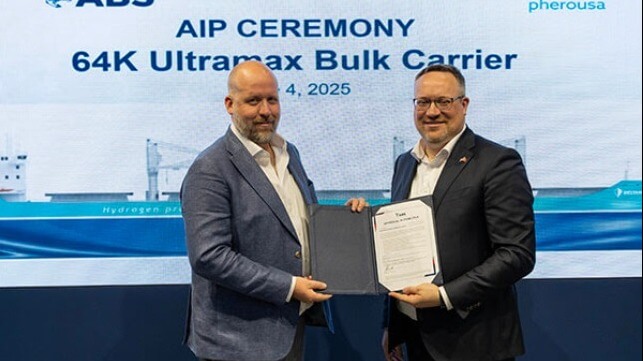
(L to R): Hans Bredrup, Chairman of Pherousa AS, with Patrick Ryan, ABS Senior Vice President and Chief Technology Officer, at the 2025 Nor-Shipping maritime trade fair.

Published Jun 10, 2025 12:21 PM by The Maritime Executive


[By: ABS]

ABS issued approval in principle (AIP) to Pherousa Shipping for its ammonia cracking technology onboard ships, featuring proton exchange membrane fuel cells and fuel gas supply system (FGSS) for fully electric propulsion.

The emissions-free propulsion system is targeted for application on Pherousa’s Ultramax 64,000 dwt bulk carrier to transport copper, a key material in solar panels and electric cars, in fully emissions free vessels.

“We are seeing rapid innovation and new developments around ammonia as an alternative fuel, whether as a carrier of hydrogen or as a fuel in its own right. Cracking ammonia to produce hydrogen for fuel cells is one that has the potential to accelerate the energy transition to low or no carbon emissions in the maritime industry. ABS is proud to share our deep insight into the safety aspects of ammonia as a marine fuel in supporting development of this capability,” said Patrick Ryan, ABS Senior Vice President and Chief Technology Officer.

“The approval in principle from ABS marks another important milestone for us in the development of a zero-emission scalable solution for the maritime industry. It allows us to continue the design and construction of our concept series of 64,000 dwt bulk carriers earmarked for the copper industry, to ensure that this specific commodity, so essential to global decarbonization, can be delivered across oceans without any carbon footprint at all,” said Hans Bredrup, Chairman of Pherousa AS.

Key partners in the project include the designers Deltamarin, the flag state Marshall Islands, Babcock International Group, which supplies the FGSS, as well as Metacon, the technology developer and shareholder of Pherousa.

ABS provides industry-leading guidance on the application of ammonia as a marine fuel. Learn more here and download a copy of the latest publication, ABS Safety Insights for Ammonia as a Marine Fuel here.

The products and services herein described in this press release are not endorsed by The Maritime Executive.


Nor-Shipping: Wind-Assisted Propulsion is Finally Taking Off

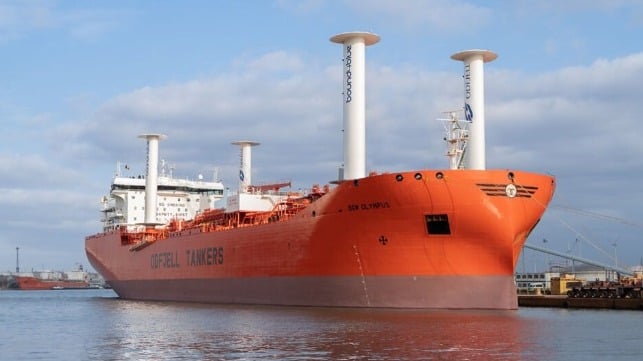
Bow Olympus
Courtesy Odfjell

Published Jun 11, 2025 1:17 PM by The Maritime Executive


Wind-assisted propulsion is having a moment in commercial shipping. On average, most systems on the market can reduce fuel consumption by about 10 percent for a tanker or bulker - or more, if the conditions on the route are right. Design maturity is increasing, along with economies of scale for manufacturing, bringing down capex and shortening payback times for the shipowner. It's not just a matter of whether it's the right thing to do; it is getting to the point where it makes economic sense, especially when factoring in carbon-pricing mechanisms like FuelEU Maritime and the IMO MEPC 83 fee structure. 

The latest example is the Brands Hatch, a new Aframax built by CSSC Shanghai Waigaoqiao, one of China's premier state-owned shipyards. Brands Hatch - built for UK-based Union Maritime - has three 40-meter fiberglass sails from BAR Technologies on deck. These giant "WindWings" are capable of generating enough propulsive force to save about 14 tonnes of fuel per day, naval architecture researcher Huang Yiming of Shanghai Waigaoqiao told CGTN. 

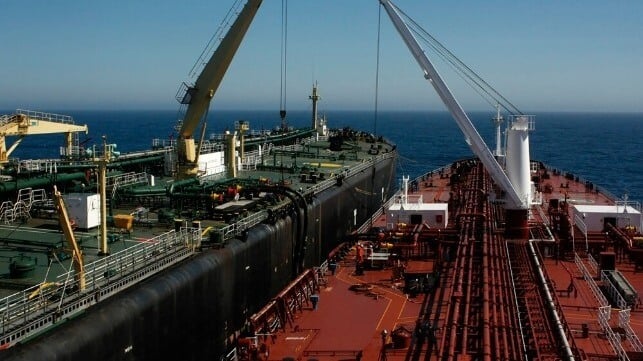
Union Maritime is far from the only owner experimenting with wind power. Odfjell recently installed four self-tending suction sails from Bound4Blue on the tanker Bow Olympus. The installation was easy, Odfjell board member Jan Kjaervik told TME at Nor-Shipping. The pedestal supports for the system were welding on at a yard in China during a shipyard period, and the sails themselves were mounted up in a matter of days at EDR Antwerp Shipyard. No physical changes were required to meet stability requirements after adding the additional mass and lateral force at deck level. 

So far, the Bow Olympus' operating experience shows that the system captures some amount of wind energy about 70 percent of the time. 

Bound4Blue CTO and co-founder David Ferrer emphasizes that suction sails are compact and comparatively simple, retaining the performance of a Flettner rotor in a less complex package. "Small size means that it can be built out of steel, without having an enormous cost, weight increase. It has greater simplicity, because there are no big moving parts, so maintenance should be reduced," he told TME. 
   
Crew feedback has been positive, in part because a vessel with sails experiences less rolling under most wind conditions. "It's more comfortable to be on board the vessel now. It has a stabilizing effect," said Kjaervik. "The vessel is rolling less than it used to do." 

For owners who are looking to follow this path, certification and data are essential, and that falls neatly into the role of class societies. In a recent study for rotor sail builder Anemoi, Lloyds Register - which has been evaluating sail-powered vessels since 1760 - validated the company's performance measurement process, providing assurance that owners can determine how well the system works in practice. 

"Owners understand that this is actually a viable option for them to reduce emissions and reduce costs and reduce penalties. So I think that higher fuel prices and the [carbon] taxes really start to bring us closer to the point where owners accept it on a broader basis," says Claes Horndahl, Commercial Director at Anemoi.  

Tankers are an easy use case for sail equipment because they have minimal cargo operations over the main deck level. Large bulkers on long-haul routes perform well on a return-on-investment basis, and for these vessels, sail system OEMs have developed a variety of methods for folding down or moving aside the equipment to enable cargo operations with cranes or grab buckets. In the industrial environment of a bulker in port, the sail equipment has to withstand the usual knocks and dings, like any other deck machinery. That moment of practical maturity has arrived, Horndahl says. "We have performed drop tests, and the GRP we are using is very resilient to falling pieces, if that were to occur," he says.  


At Nor-Shipping, U.S. Commercial Ties Outweigh U.S. Tariffs

Nor-Shipping conference panel
Wah Kwong executive chairman Hing Chao addresses the crowd at the Capital Link Oslo pre-conference event, June 2 (TME)

Published Jun 10, 2025 7:25 PM by The Maritime Executive


At Nor-Shipping 2025, delegates from Scandinavia and Europe were quick to mention the uncertainty created by the Trump administration's on-again, off-again trade war - and many were just as quick to express an interest in keeping their heads down as Washington and Beijing exchange rhetorical fire. Very few direct criticisms were heard in public, and most players - OEMs, shipowners, service providers - said that they have come to treat U.S. trade policy as a manageable disruption, no different than COVID or the Red Sea crisis. After all, this is shipping: business partnerships and commercial opportunities matter more than politics, and the United States is a big market. 

"The history of shipping for 300, 400 years [has been] about dealing with change. And I think the industry has been extraordinarily resilient in managing these shifts. So I think even though we struggle now, we've always been struggling," NYK Europe chief Carl-Johan Hagman said in a panel interview, echoing a common sentiment. "Yes, we are concerned. On the other hand, shipping does not stop."

Some executives predicted that the White House will likely soften its most dramatic tariff and fee proposals. "The regulatory changes that we have seen so far on import tariffs and on the USTR port fees show that the U.S. doesn't want to do self-harm," said the CEO of one prominent Scandinavian shipowner, speaking on the conference's sidelines. "It doesn't seem that it will substantially change the trade flows in either the tanker or the dry bulk markets. Maybe more for container ships and car carriers."

The only sharp objection to U.S. trade policy heard publicly last week came from a Chinese shipowner, Hing Chao, executive chairman of Wah Kwong Maritime Transport and chairman of the Hong Kong Chamber of Shipping. 

"From a Hong Kong and Chinese perspective, first of all, the [USTR port fees] are discriminatory. There is no reason why Chinese shipping and Chinese shipowners in particular should be targeted in that manner," said Hing at the Capital Link shipowners' panel. "We feel very much victimized by this U.S. policy. It is targeted, it is discriminatory, it is unfair and it is against the spirit of free trade."

While European owners and service providers were far quieter than Hing on the subject of U.S. trade policy, at least half a dozen voiced skepticism about America's hopes for a domestic shipbuilding revival. Many pointed to the challenge of building a heavy industry in an advanced economy with a skilled labor shortage - a challenge seen in the U.S. defense shipbuilding sector, but also in Korea and Japan. While this skeptical view would not be welcomed with open arms in American shipping circles, it was common in Oslo. 

"If you throw enough money at [U.S. shipbuilding], you can make it happen, but I think the U.S. will be very careful how it spends its tax dollars. I think there will be some financing schemes, but outright heavy subsidies - which I think would be required to make it a big thrust - I don't think that's happening," one European energy shipping executive said. "India is next [as a shipbuilding powerhouse], they have the people to join the workforce."

The opinions expressed herein are the author's and not necessarily those of The Maritime Executive.

 

Bulker Safety Improves as Sector Continues Strong Growth

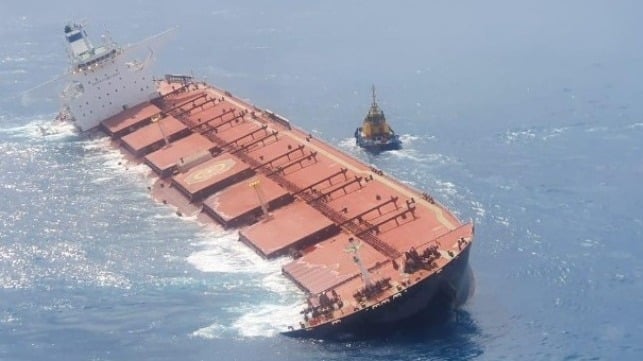
bulker aground
Stellar Banner aground in 2020 but most of the casualties were smaller vessels (Ibama)

Published Jun 10, 2025 5:38 PM by The Maritime Executive


A new report looking at the trends in bulker operations and causalities over the past decade points to what the trade group INTERCARGO calls “encouraging progress” in safety, vessel losses, and fatalities. The group points out that with over 12,500 bulk carriers in service globally and demand for dry cargo trade growing, the industry must continue to focus on safety improvements.

Over the past decade, the sector has recorded 20 causalities on vessels of 10,000 or greater dwt. While the number is down dramatically, INTERCARGO calculates it still resulted in 89 seafarers losing their lives or an average of nine fatalities per year, and many more put in harm’s way. By comparison, it however highlights that the losses have been on a steady decline since the 1980s and 1990s into the 2000s. Between 1990 and 2000, INTERCARGO reports the sector experienced annual losses of between five and 26 vessels and fatalities ranging between 23 and 186 per year.

The report attributes the decline in casualties to elements including better crew training, improved ship design, new technology, and stronger regulatory compliance. Yet it sees three factors as the most dangerous to the industry. It says cargo liquefaction is the greatest risk to lives having accounted for nearly two-thirds (62 percent) of the seafarers killed while the similar challenge of cargo shifting sank two other vessels and cost 12 lives. The greatest risk to vessels however is grounding, which accounted for nearly half (45 percent) of the vessels lost in the past decade.

While it notes there were several high-profile large vessel causalities, such as the Wakashio and Stellar Banner, each lost in 2020, most of the casualties come among the smaller (50,000 to 59,000 dwt) sector or smaller vessels under 35,000 dwt and over 80,000 dwt.

INTERCARGO however emphasizes that significant risks persist, particularly those related to improperly declared cargoes, navigational failures, and delays in the submission of accident investigation reports by flag States. It notes that the average reporting time remains over two years, which it says is severely hindering the industry’s ability to learn and implement timely corrective actions.

It also cites the fact that three of the vessels lost in the attacks by the Houthis were bulkers. It notes that four seafarers were lost in those attacks which it says also had a broader impact on the sector and shipping in general. It notes the safety concerns raised by the Houthi attacks led to difficulties in recruiting seafarers.

As a trade group, it commits to working with international bodies and others to continue the progress in the sector. It also reiterates its call for a collective industry commitment to achieving zero loss of life and ships.


Drew Marine Sets the Standard in Safeguarding Voyages

Drew Marine
(Jack Russel, Adobe Stock)

Published Jun 9, 2025 1:23 PM by Drew Marine


Your vessels, your crew, and their critical onboard systems are high-value assets under constant threat from corrosion, operational stress, harmful conditions, and unpredictable environmental factors. For almost a century, Drew Marine has been supporting successful ship operations.  Our innovative solutions safeguard all vital parts of a vessel to extend equipment life, optimize performance, reduce costly downtime, and safeguard crew wellbeing.

As a trusted partner for ship owners, operators, and crews worldwide, Drew Marine doesn’t just sell products, we deliver peace of mind. Our integrated approach spans water treatment, fuel management, maintenance cleaning solutions, cargo hold and tank cleaning, refrigeration, welding, crew health and safety, and advanced technical support, making us the premier provider of holistic maritime asset protection.

Defining Asset Protection in Maritime

Protection not only covers ship and machinery, but also its crew. In today’s maritime industry, safeguarding assets demands a proactive, science-driven approach. The most effective strategies prevent damage before it occurs, minimize environmental impact, and ensure peak performance while meeting the demands of tightening global regulations.

At Drew Marine, we understand that protecting your fleet is not a one-size-fits-all process. Each vessel’s operational profile, trade routes, fuel type, people, and onboard systems demand a tailored approach and that’s exactly what we deliver.

Comprehensive Solutions for Complete Protection

Drew Marine’s total lifecycle support for fleets span from newbuild planning and delivery through years of operation. Our solutions cover:

•    Water Treatment: Protecting boiler water, cooling water, fresh water, and wastewater systems from corrosion, scale, and microbiological fouling; ensuring safe potable water for crew with systems like H Drew O, while keeping boilers and cooling systems operating efficiently.

•    Maintenance Chemicals: Maintaining safer, well-kept engine rooms with cleaning and maintenance products that preserve surfaces, protect equipment, keep crews safe, and support essential onboard upkeep.

•    Fuel Treatments and Engineered Systems: Enhancing fuel and engine efficiency, protecting engines and fuel systems with onboard condition monitoring tools, and enabling compliance with proven measures for reducing emissions and improving carbon intensity rating.

•    Welding Solutions: Arc and gas welding applications on board support the crew’s ability to maintain shipboard equipment and structures, including safety and compliance integrity.  

•    Refrigeration: Refrigerant products and equipment to maintain refrigeration and air conditioning systems operating at high efficiency.  Supporting compliance and regulatory protocols globally while sustaining crew wellbeing in all environments. 

•    Cargo Hold & Tank Cleaning: Ensuring cargo holds and cargo tanks are properly cleaned for efficient turnaround with products that comply with MARPOL regulations. The new HOLDBRITE suite of cargo hold cleaning products minimizes chemical exposure risk for crews while maximizing cleaning power.

•    New Build Support: Developed programs to ensure vessels are equipped with fit-for-purpose systems and chemical programs from day one, reducing long-term asset risks.

Every Drew Marine product is developed with real-world maritime conditions and onboard crew operations in mind. This full-spectrum approach makes Drew Marine not just a supplier, but a strategic partner. Because protecting your ship means protecting your crew, too.

Expertise Beyond Products: Technical Service that Delivers

Drew Marine is your strategic, technical partner. Our global network of technical sales managers and service engineers provide onboard audits, training, and troubleshooting to ensure that every Drew Marine program is properly implemented and maintains compliance for maximum protection and performance.

ESG and Asset Protection: Sustainability Starts with Longevity

The longer a vessel, its crew, and its systems perform efficiently, the smaller its environmental footprint. Drew Marine’s solutions extend the life of fleets while improving fuel efficiency, reducing water consumption, and minimizing waste generation, aligning preservation with corporate ESG goals.

We also recognize that crew safety, health, and retention are essential to sustainable operation. Safer work environments, clean onboard drinking water, reduced exposure to harsh chemicals, and better training all contribute to a more resilient, operationally-fit crew.

The Drew Marine Difference

What sets Drew Marine apart isn’t just our product portfolio— it’s our deep expertise in critical systems and the tangible value we deliver to vessel performance and reliability. We know that every product applied onboard affects equipment performance, regulatory compliance, operational efficiency, and especially crew safety.

That’s why Drew Marine takes a collaborative approach, working directly with fleet managers, technical teams, procurement officers, and onboard crews to design personalized programs that truly work for the real-world challenges of global shipping.

Conclusion: Partnering for the Long Haul

For shipowners and operators looking for a proactive, integrated approach to fleet protection, Drew Marine is the proven choice. When your people are protected, your equipment lasts longer. When your systems run smoother, your crew works safer. With a history of innovation and a commitment to customer success, Drew Marine delivers protection you can count on.

Partner with Drew Marine to learn how we can protect what matters most: www.drew-marine.com.
 

This article is sponsored by Drew Marine.

The opinions expressed herein are the author's and not necessarily those of The Maritime Executive.

 

Iran Stops Fuel Smugglers as UKMTO Warns Tensions are High in the Region

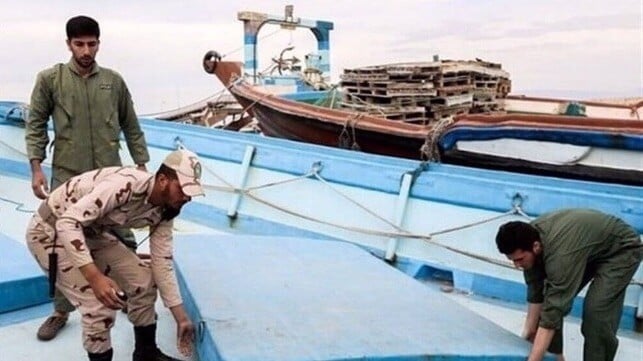
Iranians search fuel smugglers
Iran searched and seized four vessels for fuel smuggling (Mehr News Agency - CC BY 4.0)

Published Jun 11, 2025 3:19 PM by The Maritime Executive


Iran’s official news agencies are reporting a further crackdown on fuel smugglers operating in the Gulf saying that it stopped four vessels on Tuesday, June 10. The reports came as the UK Maritime Trade Operations monitoring operation for the region said it had been made aware of increased tensions within the region.

Iran is well-known for its low fuel prices. The government subsidizes the fuel price to aid the citizens, but it also creates a strong opportunity for smuggling into neighboring countries that have much higher fuel prices. The Iranians regularly report efforts to stop the smuggling and apprehend operations.

The Mehr News Agency is citing a statement from the prosecutor of Minab County in Hormozgan Province, Ebrahim Taheri, which said the operation was carried out by naval patrol officers, supported by a marine commando unit. 

During the operation, they reported stopping and searching suspect vessels. A total of four were apprehended and they discovered and confiscated thousands of liters of fuel. They said they located large fuel containers hidden on the vessels.

The vessels were handed over to the National Iranian Oil Products Distribution Company (NIOPDC). The individuals face jail sentences. In April, Iran reported that the captains of two vessels, along with two “deputies” from one of the vessels were each sentenced to five years in jail. A fine of more than $5 million was also ordered.

The UKMTO Ops Centre also posted an advisory today warning of the increased tensions, which it said “could lead to an escalation of military activity having a direct impact on mariners.”  It advised vessels to transit the region including the Arabian (Persian) Gulf, the Gulf of Oman, and the Straits of Hormuz with caution.

The tensions came as the United States and Iran appear to be at a stalemate in the nuclear talks. Donald Trump speaking to the media on Tuesday, June 10, accused Iran of becoming “much more aggressive” and said the terms were not acceptable. Iran’s media writes that a deal is still possible if the U.S. will accept commercial levels of nuclear enrichment. It announced it would be presenting the U.S. with new terms.


Israel Tells Citizens to Evacuate Houthi-Controlled Ports in Yemen

Houthi ports Yemen
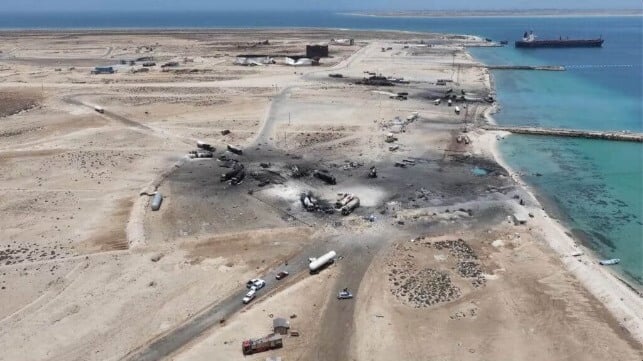
Image released by the Houthis showing damage after the U.S. air strike on Ras Isa ( Al-Masirah TV, Yemen)

Published Jun 9, 2025 6:25 PM by The Maritime Executive


For the second time in about a month, Israel has warned the citizens living in the near Houthi-controlled ports to evacuate for their own safety. Israel issued a similar warning on May 10 and a week dropped approximately 35 bombs on the Hodeidah and Salif ports, destroying infrastructure.

Today’s warning came in Arabic posted on social media by spokesman Col. Avichay Adraee of the Israel Defense Force. He called it an “important and urgent” warning everyone in and near Ras Isa, Hodeidah, and Salif ports. They were told to evacuate and stay away until further notice.”

He wrote that the warning was “Due to the terrorist Houthi regime's use of the seaports for its terrorist activities.” Israel has claimed in the past that the ports are being used to bring weapons into the country including the missiles and drones being launched toward Israel.

The Times of Israel reports the Houthis have fired seven ballistic missiles and at least one drone at Israel since the May 16 strikes on the ports. It reports that a missile fired earlier today fell short of reaching Israel.  Previous strikes have hit residential areas and at least once the area around Israel’s main airport, Ben Gurion International Airport, located southwest of Tel Aviv.


During the last series of strikes, Israel sent 15 fighter jets. The mission was supported with refueling planes and surveillance planes. After the strike, Israel said it believed it had severely damaged the port infrastructure and expected operations would not be possible for some time. Lloyd’s List had reported the first bulker entered the port Salif on May 31.

It is unclear how much vessel traffic has been able to return to the ports. The Houthis however contended that several vessels were damaged during the attack while reports have said they were not giving ships permission to leave the ports. Russia reported that its seafarers on one damaged vessel were evacuated in May after several seafarers were injured possibly in a U.S. attack on the seaports.

While the Houthis have not fired on merchant ships in the Red Sea area this year, they shifted operations to fire long-range missiles toward Israel. They have repeated threatened to attack the port of Haifa.

Israel after the last attacks said it would continue to retaliate. It also threatened the leaders of the Houthi movement citing similar assassinations of the leaders within Hamas and Hezbollah. 

In earlier attacks, Israel target power stations in Yemen, weapons storage areas, the Houthi stronghold of Sanaa and the city's airport. After the extensive U.S. strikes between March and May, there however were reports that with Iran's aid the Houthis were already starting to rearm.


Report: Cargo Ships Searched After Incidents with Unidentified Drones

surveillance drone
Unidentified drone sightings are on the rise with two suspicious incidents tied to Russian cargo ships (file photo)

Published Jun 10, 2025 8:05 PM by The Maritime Executive


The unexplained sightings of drones continue to rise with the latest reports coming from Dutch and German news outlets recounting how authorities recently searched two Russian-crewed cargo ships suspected of launching drones in the North Sea area. No evidence was found but the speculation continues that it could be the latest spying effort or a new form of hybrid warfare.

Drones have drawn attention in many places around the globe. Last year, there were nightly reports of unidentified drones in the Northeastern United States that drew extensive media coverage but were never explained. The Dutch news outlet Pointer (KRO-NCRV) and German news magazine Der Spiegel recount similar stories saying German law enforcement agencies have been seeing an increase in drone sightings over critical infrastructure such as ports, chemical facilities, and military installations. The Dutch Coast Guard also told Pointer that it was aware of unidentified drones being spotted at sea.

Two instances are being reported that happened in May 2025. In the first instance, it says drones were spotted near a military site near Kiel, Germany. Ten days later, Der Spiegel says the German patrol ship Potsdam reported it was being followed by a drone for three hours until just before it reached Dutch waters.

Around the same time the drone was spotted in Kiel, Pointer says German authorities identified a small cargo ship, HAV Dolphin (3,000 dwt) behaving suspiciously off the coast of Kiel. The vessel, which was built in 1993 and is registered in Antigua and Barbuda, Pointer reports had previously spent a month in the Russian port of Kaliningrad. It contends the vessel was spotted operating at times without its AIS signal.

According to the report, the authorities detained and searched the vessel when it reached the Volkerak locks. They report the inspectors did not find drones aboard the vessel.

The patrol ship BP 81 Potsdam was tracking a Russian freighter Lauga (3,200 dwt) in the North Sea reports Der Spiegel when it counted seven drones overhead tracking itself and the cargo ship. Because it was night, they could not identify the drones or where they were coming from. Lauga the news outlets highlight was used by Russia in Syria possibly carrying military cargo and has also operated at times without an AIS signal.

Der Spiegel says that the Federal Police asked Belgian authorities to inspect the freighter at its destination port. However, again the inspection found no evidence of drones on board.

Pointer reports the German authorities have informed European law enforcement agencies about both the incidents. Both outlets say that the police and other authorities do not have the resources to properly track and identify drones.

The drone sightings come as Northern Europe remains on alert after the incidents with vessels dragging anchors in the Baltic and damaging undersea cables. Russia has consistently denied involvement or knowledge of these incidents and points to the damage to its Nord Stream 2 pipeline which it claims the West refused to investigate. NATO and the Scandinavian and Baltic countries have increased monitoring and surveillance leading to tensions in the region.


Austal Questions Hanwha’s Statement of US Approval to Buy Shares

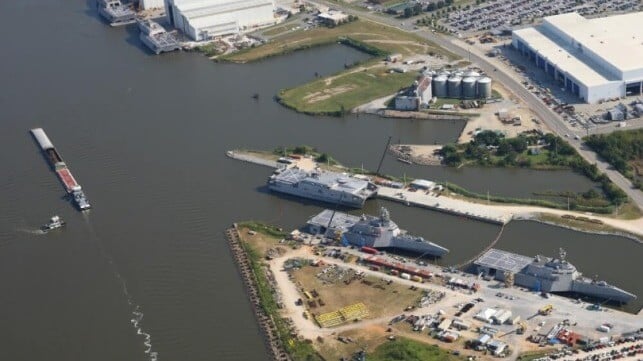
Austal shipyard in Mobile
Hanwha continues to pursue investments in Austal to expand its role in U.S. defense shipbuilding (Austal file photo)

Published Jun 10, 2025 2:55 PM by The Maritime Executive


The opposition from Australian shipbuilder Austal toward the proposed acquisition or investment by South Korea’s Hanwha Group continues. Austal filed a statement with the Australian Stock Exchange reporting it was seeking verification and written confirmation after Hanwha reported it had received U.S. approval to proceed with an investment in the Australian shipbuilder.

Hanwha Group issued a press release saying that it had received approval from the U.S. government “to acquire up to a 100 percent stake in Australia’s Austal.” Hanwha wrote that the U.S.’s Committee on Foreign Investment stated “there are no unresolved national security concerns,” with its proposal to acquire a 19.9 percent ownership stake in Austal. 

“This approval is a significant milestone that symbolizes Hanwha’s trust and support from the U.S. government,” the release said in a statement attributed to the CEO of Hanwha Global Defense Michael Coulter.

Austal however reports it “sought independent verification” after receiving the information from Hanwha about the CFIUS approval. It notes it has also seen Hanwha’s statements in the media.

“Based on informal discussions to date, Austal understands that the approval granted by CFIUS is different to that claimed by Hanwha,” Austal writes in its stock exchange filing dated June 10. The company reports it is “seeking written confirmation from CFIUS.”

Hanwha has been seeking to invest Austal after it was rebuffed by the Australian company in its attempts to acquire Austal. The Australian Financial Review reports Hanwha made its first approach to Austal in late 2023 proposing a takeover. The AFR says Hanwha presented three more non-binding bids and conducted preliminary approvals reviews in Australia and the United States. 

Austal rejected all the proposals and publicly questioned if Hanwha could receive approval due to Austal’s defense-related business and national importance to Australia. Austal said it would discuss the proposals if Hanwha could first obtain approvals in the U.S. and Australia while Hanwha asserted Austal had established onerous conditions for a due diligence review.

Hanwha Group in March 2025 reported it had acquired 9.9 percent of Austal’s shares in open market transactions and that it was entering into a swap agreement with an Australian investment firm to acquire an additional 9.9 percent of Austal’s shares. Hanwha declared its intent to hold a 19.9 percent position in Austal, which if approved would give the South Korean conglomerate the largest investment position in Austal, exceeding the 17 percent held by the Forrest family that became Austal’s largest investor in 2022.

Under both Australian and U.S. law, Hanwha can make up to a 10 percent passive investment in Austal without needing approval. Hanwha had said in March it chose the investment route because of the delays for its proposals, but it did not rule out further increasing its investment in Austal.

Hanwha writes that it plans to integrate its shipbuilding capabilities into Austal’s global business to enhance the competitiveness of both companies. It also plans to actively pursue joint business expansion in the U.S. and Australian defense markets.

“This is an example that shows the potential for high synergy when Korean shipbuilding technology and operational systems are combined with the U.S. defense industry,” Coulter says in Hanwha’s statement. It also says he emphasized, “We will contribute to strengthening the competitiveness of the U.S. shipbuilding industry through our collaboration with Austal.”

Australia’s Foreign Investment Review Board (FIRB) is yet to rule on the application from Hanwha to proceed with the increased investment in Austal. The reports are that the board has up to six months. Austal however highlights the final decision rests with the Australian Treasurer.

While the Australian government has sought to protect and strengthen its defense industry, the media reports in the past Australia’s Minister for Defense, Richard Marles, has said this was a matter for Austal as a private company. Marles said the government was not concerned by Hanwha’s efforts while Hanwha has cited its other projects with the Australian defense industry and the government. 


Singaporean Cargo Inspection Company Shuttered by U.S. Sanctions

CCIC Singapore was accused of facilitating Iranian STS oil transfers (Yuriy Gluzhetsky / iStock file image)

Published Jun 9, 2025 8:37 PM by The Maritime Executive


After the U.S. Treasury sanctioned a Singapore-based cargo inspection company last month, the firm has laid off most of its staff and is winding down operations, according to local media. 

On May 13, the U.S. Treasury's Office of Foreign Asset Control (OFAC) blacklisted Chinese-owned inspection company CCIC Singapore for allegedly facilitating Iranian oil shipping. According to the Treasury, CCIC Singapore provided the cargo inspection services for a ship-to-ship transfer of about two million barrels of Iranian crude from the sanctioned VLCC Siri (ex name Anthea). In addition, the firm allegedly provided the same services for the sanctioned tanker Hecate, and may have provided fake papers that falsely certified the oil cargo as "Malaysian" - a common fiction for Iranian-origin crude headed for the Chinese market. The Treasury asserted that Iranian government front company Sepehr Energy "consistently relied" on CCIC Singapore for inspections of Iranian crude cargoes. 

U.S. sanctions are a powerful deterrent for most potential customers, and can have drastic effects on a business. An OFAC designation also typically freezes some or all bank accounts belonging to the affected firm, with immediate effects on operations. Three former employees of CCIC Singapore told CNA that the company laid off about 300 people effective June 1, and that layoff notices had referenced a "pending liquidation." 

Salary payments for the month of May were also delayed because of frozen bank accounts, they said. Dismissal notices warned that payouts would occur only after the firm's liquidation was completed, likely in mid-2026. 

The firm confirmed to CNA that the impact of sanctions was greater than expected, and it said that it has been forced to cease operations in Singapore. "This decision was extremely challenging for the management team, but it is a rational choice that had to be made under the current circumstances," the company told CNA in a statement.


BC Ferries Selects China Merchants to Build Badly Needed New Ferries

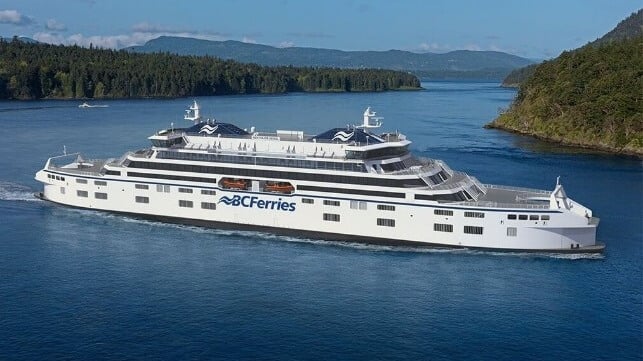
BC Ferries newbuild
Canada's BC Ferries selected a Chinese yard to build its newest ferries (BC Ferries)

Published Jun 10, 2025 6:50 PM by The Maritime Executive


Canada’s BC Ferries announced it has selected China Merchants Industry Weihai Shipyard to build four new large ferries after a four-year procurement process. The company needs to replace an aging fleet but the selection of a Chinese yard may still raise controversy despite the fact that no Canadian shipyard participated in the bidding.

The company has been forced to go overseas for its new ferries turning to Germany, Poland, and Romania to build new ferries. It currently has four new diesel-electric ferries under construction by Damen in Romania due for delivery in 2026. Seaspan which owns the largest shipyard in British Columbia said in the past it could not compete with the low-wage countries that have lower standards for the environment and safety.

BC Ferries is seeking to blunt some of the critics by highlighting that in the first 10 years of service, the company anticipates spending over C$230 million (US$168 million) locally on refits and maintenance and more than C$1 billion (US$730 million) over the vessel’s 45-year lifespan. 

“CMI Weihai is a global leader in passenger ferry construction, and shipbuilding more broadly,” said Nicolas Jimenez, CEO of BC Ferries. “It was the clear choice based on the overall strength of its bid, including its technical capabilities, high-quality and safety standards, ferry-building experience, proven ability to deliver safe, reliable vessels on dependable timelines, and the overall cost and value it delivers for our customers – all essential as we continue to experience growing demand and the urgent need to renew our aging fleet.”

BC Ferries references China Merchants' strong experience building passenger and vehicle ferries for large operations. It highlights the ongoing project with Stena RoRo for the E-Flexer class of RoPax ferries that are being deployed for companies including Corsica Linea, Brittany Ferries, and Canada’s Marine Atlantic ferry company. CMI is also working with Italy’s Grimaldi.

The new vessels are a critical component of BC Ferries’ strategic plan to replace aging vessels. They will take over from four vessels all over 50 years of age and in the case of the Queen of New Westminster 65 years. Last year, the company says its operation of the aging vessel cost it C$14 million (US$10 million) in repairs and lost revenues while the vessel was out of service after it lost a propeller.  

The new ships will start construction in late 2026 with the first vessel entering service in 2029. The fourth ship will enter service by 2031. They will be built with diesel-battery hybrid propulsion systems and designed with the capability to operate on full electric power in the future. They will also reduce underwater radiated noise. Critically they will have a greater capacity able to handle 52 percent more passengers and 24 percent more vehicles. BC Ferries declined to announce the cost for competitive reasons and future vessel procurement but said the contract is within the limits approved by the BC Ferries Commissioner.

The company highlights that it is also planning for a 15 percent growth in customers over the next decade. Since 2016, BC Ferries has added 10 new vessels to its fleet, including four mid-size Salish Class vessels and six smaller Island Class ships. With four more Island Class vessels arriving in 2026, and all four of the large new ferries expected to be in service between 2029 and 2031, BC Ferries remains on track to introduce 18 new vessels in 15 years.


China Leads Newbuild Orders Despite Threats of Port Fees and Slowing Market

Chinese shipbuilding
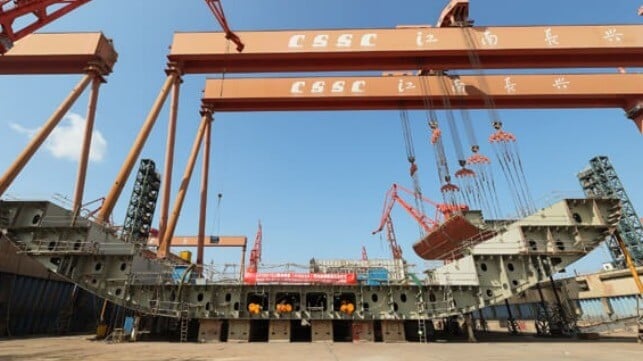
China continues to dominate orders despite the uncertainties from U.S. fees and tariffs (CSSC)

Published Jun 9, 2025 2:40 PM by The Maritime Executive


The threats of tariffs, port fees from the U.S. on Chinese-built ships, and a slowing overall market for newbuilds have yet to chip away at China’s leadership in shipbuilding. The latest data from Clarkson Research points to China’s continued dominance while South Korea and others look for new strategies to take advantage of the uncertainties in the market.

Shipbuilding orders overall are off dramatically in the first five months of 2025 compared to the record pace of 2024. Clarkson’s data shows that total orders were down by more than half (55 percent) with analysts commenting that it is the first sign of uncertainty, the issues in global trade, and falling freight rates. This is despite a record pace for containership orders which are at an all-time high with the total capacity on order up nearly 50 percent from a year ago.

Chinese shipbuilders continued to lead the orders in the first five months of the year with Clarkson calculating they booked 7.86 million compensated gross tons or nearly half the orders compared to 3.1 CGT for South Korea which represented 24 percent of the global market. Total orders worldwide were calculated at 15.92 million CGT.

While the U.S. released the details of its plan for port fees in mid-April, orders continued a similar pattern in May. China booked 39 percent of global orders (640,000 CGT) or a total of 42 ships. South Korea booked just 15 percent of the orders in May or 250,000 CGT for eight ships while in a market anomaly, France rivaled China with nearly a third of the orders, or 546,000 CGT, driven by MSC Cruises' large cruise ship order.

Korea’s shipbuilders however are working to make inroads and according to the media reports are planning to expand their aggressive bidding for containership orders. Last year, China held nearly 87 of the containership construction market share but the Koreans are highlighting their expertise in high-value shipbuilding such as methanol-fueled ships, LNG, and future technologies. The Korean media points to reports that Ocean Network Express (ONE) and Hapag-Lloyd are meeting with Korean shipbuilders, but Tradewinds reported that MSC Mediterranean Shipping Company told Nor-Shipping last week that the U.S.’s port fees would not be a barrier to orders in China.

The South Koreans also point to the fact that their CGT per vessel was nearly double China’s in May. They point to this as evidence that they are winning orders for more complex and larger ships. South Korea has traditionally dominated the high-value segment for LNG and other gas carriers and looks to use this also with containerships going forward.

Construction slots are booked three or more years ahead at some of the large shipyards, especially in South Korea, which some speculate might also be a reason the Korean yards are lagging behind their Chinese competitors. However, as global ordering has slowed, the backlog is starting to thin. South Korea currently has 22 percent of the total global orderbook, 36.3 million CGT versus China’s 96.4 million CGT backlog which equals 59 percent of the global order total.

The U.S. trade representative continues to push forward with the plan to launch port fees later this year on Chinese-built ships. Last week, it released revisions for the fees planned for all vehicle carriers arriving in the U.S., but so far, the threat of the fees seems to have done little to drive orders away from Chinese shipbuilders.