Thursday, June 12, 2025

Zionism is as Corrupt as Christian Nationalism


 June 12, 2025

Image by Shalev Cohen.

As the political and religious left continues to attack Christian nationalism, as a progressive Christian, I find myself increasingly uneasy. It is not that I believe Christian nationalism exists, or that it is dangerous to a pluralistic society with religious diversity and perspective, but the ire and critique is not applied across the board to other forms of ethnoreligious nationalism. There is a glaring absence on the political left and in the peace and justice movement to condemn Zionism with equal weight as is applied to Christian nationalism. Among nationalistic expressions of religion, expressions of narrow particularism, and obsessive focus on the justification of one religious/ethnic group over others Zionism escapes the condemnation for some reason that Christian nationalism is confronted with.

Christian nationalism asserts that a particular country is founded on “Christian” principles. Its founders or framers were divinely inspired, and therefore the impetus is to draw those countries back into line with the original framework intended by the founders of that nation. Christian nationalism is a worldwide phenomenon, with proponents in Europe, and particularly evident in the United States. The political/religious framework offered in the United States is that the founders of the country, and all of its original documents were divinely inspired through white men who authored them. You cannot escape the fact that the founders of the United States were white men who were landowners, and therefore an undercurrent exists where Christian nationalism is built upon white privilege and supremacy. This is true whether it is in the United States or Europe. The belief is that the malaise that exist in national boundaries is due to the straying or abandonment of those Christian principles, and the antidote for the national demise is to return to religious inception initiating all the blessings that will flow as a result of doing so. Hence, we have witnessed the push to place the Ten Commandments in schools, the turning back of the clock on Roe v. Wade, the continued push to publicly fund religious schools, attacks upon the LGBTQIA communities, and the demonizing of diversity, equity, and inclusion initiatives. It is presented as if all the problems and the failings of a nation is a result of eschewing “Christian” principles, affirming religious and ethnic pluralism, and because we have removed all the trappings, strictures, and images of so-called Christianity from public life. As a progressive Christian I unapologetically stand in opposition to Christian nationalism and all its forms of expression.

Zionism is akin to Christian nationalism. A difference in Zionism is that it existed originally as political/religious thought among a diverse population spread across national borders in Europe that identified religiously and culturally as an ethnoreligious group. Originally the argument of Jews pursuing a homeland in Palestine was met with skepticism as a political/religious philosophy and existed on the margins. However, the various European pogroms against Jews began to coalesce larger swarths of Jews to strategically reconsider Zionism.

Zionism emerged in the 19th century as an ethnocultural ideology. It sought to establish a national home for the Jewish people that they controlled and therefore were free from the ethnic cleansing that arose periodically in Europe. World War II and the atrocities carried out against Jews other groups in Europe became a major factor for the intellectual and emotional acceptability of the Zionist framework that would result in the colonialization of Palestine. As the acceptability of Zionism arose as a solution for Jewish security among larger segments of the Jewish population its political and religious tenets became more wedded to Judaism. This conflation of Zionism with Judaism has become problematic in terms of having any sober political discussions on the realities and consequences of Israel and the implications of Zionism without being accused of being antisemitic.

Zionism claimed that Palestine is the historical land of the Jews and therefore the Jewish right to the land outweighed anything that was Arab. The concept of “transfer”, or what we today would call “ethnic cleansing” is inherent to Zionism, believing that the security of Jews had to be based upon their majority, and to lessen any potential of uprisings in response to Jewish occupation. The idea of removing non-Jewish populations and affording non-Jews less rights than Jews evidently gained widespread support across a array of Zionist groups. The religious roots of Zionism focused upon the land of Palestine being promised by God to the Jewish people into perpetuity with the conquest and subjugation of non-Jewish people resulting. There are enough biblical narratives that justifies the subjugation, conquest, and killing of non-Jewish people. The political roots of Zionism are based upon what is presented as practical strategies of protection, security, and historical rights to the land. The religious justifications of Zionism are questionable given that Jews largely have appropriated and identified with the biblical narratives as stories of identity and belonging, just as Black people largely reinterpreted the biblical stories as our own identification with God and divine purpose. The political justification of Zionism is flawed in that it affirms the European colonialization and conquest of non-white lands, and the subjugation of non-white peoples. Zionism, though ethnic in character, is a nationalistic European expression of the stealing and conquest of the land of others and the extension of white supremacy in form and practice.

I am offering a brief summation of Christian and Jewish nationalism. I am also raising the ideological and political deficiencies of the left where it condemns Christian nationalism but fail in offering the same kinds of condemnation and critique of Jewish nationalism. One has to ask the question, why? Each form of religious nationalism is an apostasy to the spiritual and political concepts of Christianity and Judaism. Each nationalism avoids the declarations of justice, right treatment of neighbor, and welcoming the stranger as if it is foreign to the scriptural text. Instead, they turn to scriptures that seem to affirm their narrow and myopic points of view, conquest, and divine justification for subjugation and genocide. Each form of nationalism deserves and needs to be condemned. Peace and justice organizations on the left, liberal religious groups, and political secular groups need to apply their criticism of religious and political nationalism across the board and in a principled way. I am offering that all forms of nationalism are inherently evil because it strips non-conforming groups of their dignity, security, and freedom of expression. Zionism emerged because of nation-state nationalism, but the irony is that they formed another expression of nationalism to combat nationalism. This simply illustrates how one evil leads to another. Christian nationalism has been the backbone of all kinds of evils from enslavement to the Christianization and genocide of indigenous peoples. It must be condemned in all of its forms from the past to the present, and into any future expression. Zionism must also be subjected to the same types of criticism and analysis, and if we fail to apply the same standard of criticism across the board, in reference to Christianity, Judaism, and even Islam then we have certainly failed in being any moral voice at all.

Left fails to win its referendums in Italy

Wednesday 11 June 2025, by Dave Kellaway


These referendums were promoted by the main trade union confederation and the official left of centre opposition parties to limit some of the more repressive anti-trade union laws and to improve the citizenship process for immigrants

Results

ReferendumYesNo
Stopping sacking without justifiable cause89.0611.94
Legal compensation for workers in workplaces with less that 15 workers87.6013.40
Making short term contracts more difficult to impose89.0411.96
On subcontracting/Health and safety87.3512.65
On halving 10 year process for citizenship65.4934.51

Turnout: 14.07 million (registered electorate is 45.99 million) 30.59%

All five referendums were lost because none reached the quorum of 50% of the electorate. Around 88-89% who voted supported the progressive changes to the labour laws but this went down by 33 percentage points for the change to the citizenship process for immigrants.

Over the last thirty years only one out of nine referendums reached the quorum – in 2011 to defend water as a public good. Even then the government maneuvered to not implement the change demanded by the broad left and a vast grassroots campaign. As a democratic mechanism for change it worked effectively to legalise divorce and abortion rights in the seventies and eighties when Italy was a different country with a turnout of over ninety percent for many elections.
A more individualized country

I remember how different civil society was even in a town of 60,000 in the South near Naples. The local branch offices of the Italian Communist Party (PCI) were a hub not just for party members but anyone on the left. Then the piazza still was politically vibrant and the big well-organised factories more prevalent. The gains of the seventies had not been rolled back and neoliberal austerity was still ahead of us. Today, everything is more individualized and commodified.

Local fetes of the PCI (or of anybody) hardly happen now. Culture no longer has much of a budget from public bodies and is just a consumer spectacle controlled by big business. Walking around looking for a photo of referendum campaign posters for this article, I could not even easily find any. Voting in all elections has declined massively. People do not join political parties, unions or even civil society associations like they used to. The disconnect with the political process has helped the rise of hard right populist politics exemplified by the present government.

Meloni’s government coalition revels in the defeat of the referendums. The anti-working class labour laws implemented by a previous left of centre government (led by Matteo Renzi) will continue. The post-fascist premier and her ally Salvini are particularly exultant on the much smaller number of people who voted to support immigrants gaining citizenship faster. It will encourage them to reinforce their racist anti-migrant policies. Representatives of capital are happy their freedom to exploit working people continues without added restrictions.
The bosses are happy

Watching the post results TV coverage one comment from a so-called independent journalist stood out. He said this result shows you that all that old-style confrontation in the workplace the CGIL wants to stir up again with this referendum is over, we need to move on, focus on wages and productivity rather than all that stuff that is historically finished. This is the narrative the government and bosses want. Keep politics out of the workplace, let us discuss it as a technical matter, the people have shown they are not interested in resurrecting outdated talk about class struggle.

The government actively encouraged people to go to the seaside or for a walk in the mountains rather than to participate in the democratic process. Meloni herself was shown on the media going to a polling station and refusing to take a ballot paper. Legally it is a legitimate tactic and governments with different politics have done the same thing when the right wing have organised referendums. Still it reflects a refusal to engage in any discussion about these big workplace issues. One minister when questioned on TV could not even accurately say what the referendums were about.

The government denounced these referendums as a manoeuvre to challenge it and as an internal faction fight within the PD. The left of centre opposition were accused of being led by the main trade union confederation, the CGIL, which has strong links with the main opposition party, the social liberal, PD (Partito Democratico, Democratic Party).

Landini, CGIL leader,was the main promoter of the referendum. He mobilized the union structures to get the half million signatures and then crisscrossed Italy in the last months to get out the vote. The government and rightwing forces are falling over themselves in using these results to discredit him. Even though he has failed to really lead national strike action to defend workers living standards, they want to neutralize even the small possibility he will lead the unions in any confrontation with the government over the wage contracts in dispute.
Internal conflict in PD

Elly Schlein, the PD leader, beat the more moderate leadership challenger and the right wing of the party to secure her position two years ago. She has been keen to disown the worst anti-working class policies of a previous PD leader and prime minister, Matteo Renzi. He had proposed and implemented the Jobs Act, a so-called modernizing piece of legislation which was a sweetheart deal with neoliberal capital. It removed some of the progressive labour laws which allowed for limited protection, although in practice the bosses were not particularly restrained.

The rifromisti – the PD right wing minority who still support Renzi’s position, opposed the party line of 5 yes votes with 3 no votes on the Jobs Act changes. Although a smallish minority among the membership the riformisti has important elected respresentatives. For example Picerino, vice president of the European parliament, openly campaigned for three No’s. So on one level it is true the referendum were also part of an internal debate within the PD. For the PD this sort of institutional campaign, which the whole left supports, is the priority for political action. There was little of the mass campaigning the local committees organised for the 2011 water referendum. Schlein has not changed the overall social liberal policies of the PD and certainly not mobilized working people against the hard right Meloni government.

I was surprised that even before the referendum was over Schlein was already expectation managing saying that 30% would be a good result. In any sort of sporting contest – let alone a political one – it is hard to mobilize your people if you accept defeat in advance. Landini, to his credit, did not adopt this line. Her target figure of 30% was decided on because she wanted to say that if the referendums had more that 12.5 million voters it would be more than elected the Meloni government. The government opposed the referendums but more people voted in them than for her government so this would be a defeat for Meloni and Salvini. Nobody is buying this line.

Depending on how you add things up there may be about the same number of Yes voters as voted for Meloni. But you cannot toss in all the no votes or ignore the vote on citizenship (only 9 million Yes, and the centrist parties supported this) which is a main plank of the government’s programme. On citizenship the Yes vote was certainly less than those who elected Meloni. Migration will be a theme of any future election campaign much more than the Labour laws. Schlein will be facing angry reactions from the right of the party who are saying her referendum strategy and alliance with Landini has had a boomerang effect or gifted Meloni a victory.
Has much changed as a consequence of the votes?

The big question is whether the opposition or the government has gained or lost from the referendums. Clearly these numbers do not give the left of centre parties much hope that they will defeat the right wing coalition any time soon in an election. You cannot translate these results simply into general election, but voting intentions and the citizenship question spells bad news for the opposition.

It is true the campaign to get the referendums and the electoral process has put these issues on the table as Landini has argued since the defeat. However, it shows the limits of the left of centres parties’ implantation in the country and ability to mobilize a majority. It also exposed the divisions within the opposition compared to the government’s compact unity. Conte leads the Five Star Movement (M5S) and although he personally said he would vote Yes on the citizenship question there was no official party position. As for any broader electoral unity with the centrist parties like Renzi’s Italia Viva or Calanda’s Azione, both voted Nos except on citizenship.

Conte’s M5S has a lot of electoral support in the South but this is where the turnout was worse (low twenties), whereas in the PD fiefdoms in the North/Centre the turnout was above average (36-9%). As might be expected turnout was best in the big towns and urban areas. Working class areas turned out more for the votes on contracts while the more middle class historic centres voted most for the citizenship change. Small towns with less union structures and smaller influence of the left of centre parties turned out a great deal less than the larger urban areas. Women voted more than men.
landini, cgil trade union leader in press conference

Are referendums any use any more?

After the results there has been some discussion of the usefulness of the abrogative referendum system. It did bring some positive historic changes like on abortion and the left has generally supported using the process since, as with water one, you can use it to build a big campaign and even win. However with only one quorum since 1997 some people are arguing for reducing the quorum to encourage more participation. On the right there is talk of making it more difficult to hold a referendum by increasing the number of signatures needed.

These votes have reflected the relationship of class forces in Italy which is still very unfavourable to the working class. The struggle to defend workers rights and living standards will continue through the building of militant currents in the unions and workplaces. This continues through the rank and file unions and inside the CGIL.

10 June 2025

Source: [Anti*Capitalist Resistance: https://anticapitalistresistance.org/italy-left-fails-to-win-its-referendums/


Attached documentsleft-fails-to-win-its-referendums-in-italy_a9040.pdf (PDF - 918.1 KiB)
Extraction PDF [->article9040]


Dave Kellaway is a Socialist Resistance and Fourth International supporter within Anti*Capitalist Resistance.


International Viewpoint is published under the responsibility of the Bureau of the Fourth International. Signed articles do not necessarily reflect editorial policy. Articles can be reprinted with acknowledgement, and a live link if possible.


In support of ‘synchronized global disarmament’


war or peace?

First published in French at CQFD. Translated into English by International Viewpoint.

At a time when everything is spiralling out of control in the East, when alliances as evil as the Donald Trump and Vladimir Putin duo are being forged, and when our leaders are advocating rearmament, we wanted to take some time to think about it. With Gilbert Achcar, a specialist in international relations and professor at the University of London, we discussed ways of supporting Ukraine while rejecting a generalized war.

The United States, under President Trump, is threatening to withdraw from the Old Continent. Russia has no shortage of imperialist ambitions. The war in Ukraine has been going on for over three years. And Europeans are under pressure. How do you analyse the situation?

Indeed, it’s a major upheaval. The Russian invasion of Ukraine in 2022 had initially given NATO a new lease of life. But this revival can now be interpreted as the swan song of an organization that has been in decline for a decade. It does, however, cruelly underline dependence on the United States in this conflict. And this concerns Europeans and Ukrainians alike.

On Russia’s side, for the past three years, this immense country with its considerable military resources inherited from the Soviet Union  the only area where the USSR really rivalled the West  has still not managed to seize all the territories annexed in Ukraine. This is not a defeat, as Russian troops continue to advance at a snail’s pace, but it is clearly not a victory.

As for the Russian threat to Europe, let’s just remember that the European Union (EU) has more than three times the population, more than ten times the economy and three times the military spending (including the UK)  despite the fact that Russia is directly engaged in a large-scale war, and therefore at full capacity, unlike Europe. Under these conditions, it would be absurd to seriously consider a Russian invasion of Europe.

And yet, according to Emmanuel Macron, there is an “existential Russian threat”.

Emmanuel Macron’s idea is more a political manoeuvre aimed at positioning France as the strategic leader and exclusive protector of Europe. This positioning flatters his presidential role while directly benefiting the French military industry. But this rhetoric is dangerous, as it brings us closer to precisely the perils it claims to prevent.

But it’s true that Putin’s authoritarian Russia is multiplying its interference: cyber-attacks, attempts to influence the elections of European states... And on the other side of Europe, the Baltic states fear for their borders.

Moscow is waging psychological warfare and a disinformation campaign. But the best option would be a symmetric riposte: a campaign to set the record straight, aimed at the Russian population. As an imperialist power, Russia certainly has ambitions for the Baltic states. But Putin got his fingers burnt in Ukraine. Even in the event of US disengagement, he knows that he does not have sufficient means to confront Europe on the ground.

Another argument put forward to justify European rearmament is that it would reduce our dependence on the United States.

That’s true. And when you put it that way, it sounds positive. All the more so as the US administration is taking an increasingly worrying political turn, multiplying its interference by openly supporting Europe’s far right.

But the argument is hypocritical. Firstly, because those who talk most about relocating production to Europe are the countries that already have an advanced arms industry, like France. For them, this is a godsend! Secondly, the investments announced will not replace US weapons with European equipment. In reality, it takes more than a snap of the fingers to do without US components. These funds will therefore be used primarily to increase production!

Finally, the term “rearmament” is itself problematic. It falsely suggests that Europe is disarmed, which is far from the case: each country already spends an average of 2% of its GDP on defence  Poland and the Baltic States quite more.

A truly progressive approach would be to work towards synchronized global disarmament, as advocated by some fifty Nobel Prize winners in the natural sciences1, in order to invest in the fight against global warming and poverty.

Is Europe crossing a red line that could lead to a more direct confrontation with Russia?

Rhetorical escalation and the arms race increase tensions and the risk of incidents at one border or another. A missile trajectory error or an accidental airspace violation could quickly escalate.

But, more than an invasion, it’s the possibility of a nuclear confrontation that worries me. Faced with his difficulties in Ukraine, Putin has already threatened several times to use his nuclear arsenal. He knows that his country is the world’s leading nuclear power. On the other hand, Europe’s nuclear power is limited to the arsenals of France and Great Britain. No match for him. Putin could use tactical nuclear weapons (with more limited impact), believing that none of his adversaries would dare a strategic riposte (capable of destroying huge areas). When it comes to nuclear deterrence, it’s Russia that does the deterring!

You have called for a referendum in the annexed Ukrainian territories so that the people can decide their own destiny. Can you tell us more?

International law prohibits the acquisition of territory by force, which Russia nevertheless did in Crimea in 2014 and in eastern Ukraine in 2022. But on the ground, the situation is complex. In these regions, Russian speakers and Russians sometimes have a stronger sense of belonging to Russia than to Ukraine. In Crimea, for example, there was no significant popular resistance to the entry of Russian forces. To avoid further bloodshed, I am therefore in favour of a referendum on self-determination, organized under the aegis of the United Nations, with guarantees and based on the electoral register of the populations present before the invasion.

In concrete terms, Russian troops would have to withdraw to their barracks for the duration of the process, to be replaced by UN troops. It would be unrealistic to demand their prior return to the borders prior to 2022 or 2014: such a scenario would be unacceptable to Russia and would prevent a long-term political settlement of the conflict. Finally, the deployment of international observers would guarantee the transparency of the ballot. In my view, this is the only way to avoid the rancour that can lead to long-term irredentism. This approach is democratic and complies with international law.

How can we maintain a critical stance towards NATO while at the same time showing active solidarity with Ukrainian victims of the bombardments?

I think the first step is to recognize and support the legitimacy of the Ukrainians in defending their country. Recognize and support their right to arm themselves. Not oppose the delivery of defensive weapons. And I stress the word “defensive”: this means all “anti” weapons  anti-missile, anti-tank, anti-aircraft. Finally, to engage in international pressure for the organization of a referendum on self-determination for the regions of Eastern Ukraine and Crimea.

I would add that it’s time to stop ignoring the elephant in the room: China. China was quick to express its support for Ukraine’s sovereignty and territorial integrity. But Washington preferred to ignore this outstretched hand and immediately accuse China of being in league with Russia. Today, negotiations are taking place in Saudi Arabia between Russia, the United States and Ukraine. Volodymyr Zelensky is isolated, under pressure to accept far worse peace terms than those I have mentioned. But China, as a major importer of hydrocarbons, has no interest in seeing this conflict prolonged, and could be a major ally in encouraging the players to return to the UN table.


Why another world is possible: Comments at a socialist rally in Berlin

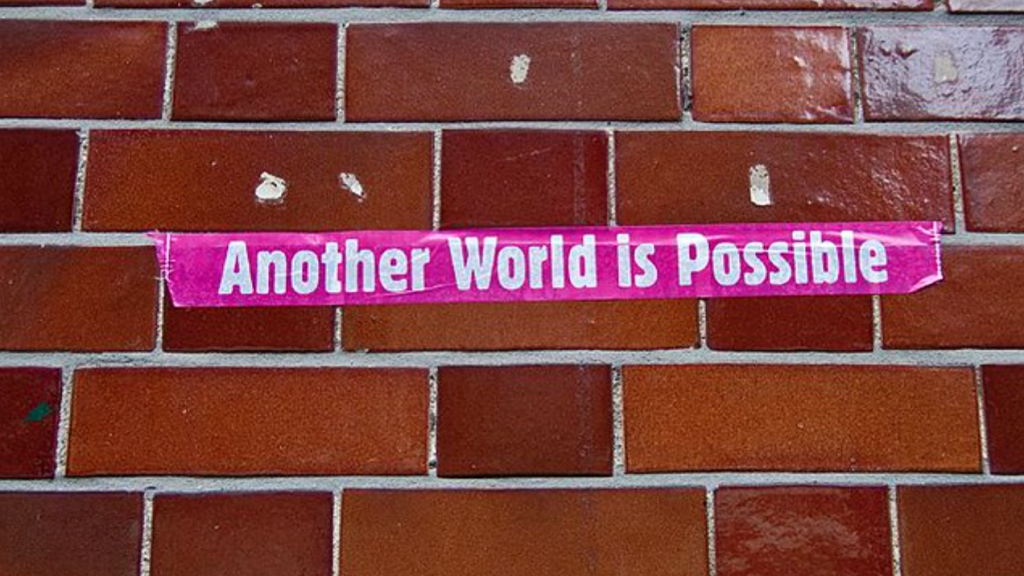
Another world is possible sticker

The following remarks by Paul Le Blanc kicked off the final session, on June 1, 2025, at the four-day das Marx is' Muss Kongress 2025, held in Berlin, organized by marx21, a left-wing current in Die Linke (the Left Party), and which drew 1200 activists. These remarks are now first appearing in digital form, with the author’s authorization, simultaneously on LINKS and Communis. Both sites previously published the text of Paul Le Blanc’s contribution to the event.

Here is the question I have been asked to address: “What makes us socialists believe that another world is possible?”

Two things frame the answer to this question: (1) the problems and crises of capitalism, and (2) essential qualities inherent in humanity. After elaborating on these, I will conclude with a few remarks on the relevance of Lenin and how we must, as Lenin urged, organize ourselves.

For the first key element in the answer about the possibility of revolutionary change, I want to offer a summary report from my homeland — the United States of America, which throughout my lifetime has been the center of global capitalism, “the belly of the beast,” as some put it. That system is increasingly in trouble, which means that more and more of us are in trouble. We all should know what is happening, because it is all over the news, day after day, at least in the US. 

First there is something which is always in the background of daily life, but more and more it is coming to the foreground: the weather. We have been experiencing increasingly odd weather. In various places, it is warmer than usual, colder than usual, rainier than usual, dryer than usual. This increasingly visible climate change now seems to be unfolding fast, furiously, extensively, with an unusual proliferation of floods, droughts, wildfires, high winds and tornados where generally such things have not been expected. We are told that this is worse in other parts of the world, but it is impacting more and more on the US people.

In our own lives and experience, we know that there have always been both grotesque inequality and visible corruption. But I do not think we have ever seen the kind of soaring inequality that has been increasing in recent times, accelerating to unimagined proportions. And corruption is becoming blatant in the very highest circles of power. Those who benefit from such things, with all their immense power, have contempt for us. They tell us lies, they disregard us, they laugh at us, they set us against each other while pretending to be our best friend.

Impacting all of us, however, even on those at the top, has been a growing economic instability. Those of us among the bottom 80% of US people are especially slammed by rising prices, the erosion of living standards, the increasing shakiness of employment, growing problems of housing and health care, the erosion of all things public — education, libraries, parks, transportation and more. This is generating an expansive anxiety, which is sharpening as we face declining social services and the dramatic slashing of programs that many depend on.

Such developments are now intimately related to the recent extraordinary shifts in “politics-as-usual”. The dominant faction of the US ruling class — stretching from liberal Democrats to old-line conservatives among the Republicans — is largely discredited in the eyes of many. Both of these factions have made glowing promises for years but failed to provide genuine solutions to the growing plight of our people. Effectively trashing these losers and promising drastic action to improve the lives of people in the US (while also playing on widespread biases and illusions), an erratic, ego-centric, powerful huckster named Donald Trump has now taken charge.

Trump claims he won the US presidency by a landslide, but in truth it was a very narrow and unstable margin, less than a majority. Through the new regime we are now being treated to an expanding and deepening authoritarianism. The Trump faction of the ruling class is, quite obviously, inclined to give up on the pretense of democracy and constitutional government. It is overseeing the dismantling of long-standing institutions, policies, norms. Along with this, it is elevating and expanding new layers of governmental strata that seem to be afflicted by an ideological narrowness blended with a breathtaking shallowness, ineptness, and rigidity.

Not surprisingly, there is declining public confidence in the viability of the status quo, and in the ability of any faction of our rulers to deal with the increasingly overwhelming problems that we face. This has contributed to a rise in unofficial violence — including traditional “criminal” activity but especially involving new increases of bullying, vigilante activity, mass shootings, and sometimes targeted assassinations.

Yet the social and political crises are also accompanied by the ominous rise in official violence — ranging from political repression to outright killing — for those deemed to be “problematical”. But this inward-directed violence is consistent with the dynamics of US foreign policy, with its increasing impacts of imperialism and militarism, support for genocide perpetrated by certain allies, and the growing threat of war.

There is certainly much more to be said — especially in regard to the unfolding of such dynamics across the face of our planet. But the bottom line is what Bertolt Brecht once told us: “Because things are as they are, they cannot stay as they are.” 

We now come to a second key element in the answer to the question we are wrestling with. It is the title of Carl Sandburg’s great poem of the 1930s, The People, Yes. Speaking of the laboring majority of humanity that has been long oppressed by a succession of exploiters, Sandburg says: “This old anvil laughs at many broken hammers.” He adds: “Time is a great teacher. / Who can live without hope?” 

Also from the experience of the 1930s is John Steinbeck’s novel The Grapes of Wrath, which was made into a wonderful motion picture in 1940. In it, a key character, Ma Joad, reflects in comments to her husband: “Rich fellas come up an' they die, an' their kids ain't no good an' they die out. But we keep a'comin'. We're the people that live. They can't wipe us out; they can't lick us. We'll go on forever … 'cause we're the people.”

Three decades earlier, in backward Russia, a novelist named Maxim Gorky, in his revolutionary novel Mother, put similar thoughts in what his characters had to say: 

The time will come when people will wonder at their own beauty, when each will be like a star to all the others… The earth will be peopled with those who are free, great in their freedom… 

Everything for all — all for everyone! That is how I see it. In very truth we are all comrades, all kindred spirits, all children of one mother, who is truth!

Of course, all of us have the many problems and limitations that people have, but in each human being we also find essential qualities for our survival. In the early 1840s, the young Karl Marx referred to these qualities as our “species-being,” involving an elemental striving for freedom, creative labor, and genuine community. Rosa Luxemburg — from her prison cell amid the catastrophe of the First World War — commented on this dynamic blend: “The psyche of the masses, like … the eternal sea, always bears within it every latent possibility: deathly stillness and raging storm, the basest cowardice and the wildest heroism. The masses … are always on the verge of becoming something totally different from what they seem to be.”

Within ourselves, among people we know, and among the vast number of people we do not know, we can find qualities of insightfulness, creativity, humor, collaborative inclinations, generosity, caring, heroism — a vibrant blend of individualism and collectivism. Out of this, there is hope for the future. This hope is grounded in thousands of years of human experience. It can be found in a variety of human traditions. We can find essential qualities in the best of our spiritual traditions — the best that is in Christianity, in Judaism, in Islam, in Buddhism, and more. I am, of course, speaking here not of the authoritarian and superstitious dogmas, but of the vibrant insight and energy animating these belief systems. 

It is very much present in the centuries of what have been called humanism and the scientific spirit. It permeates the many social movements and struggles engaged in the elemental quest for popular democracy and human rights. Such things have been absorbed into the heart of socialism and permeate the Marxist orientation that inspires some of us. Not the authoritarian and superstitious dogmas passing for Marxism in some circles, but that which is alive, creative, critical-minded, and free. Such qualities animate Lenin’s outlook. 

I have explored this in my recent book-length biographical account Lenin: Responding to Catastrophe, Forging Revolution. Lenin represents a way of understanding reality that is inseparable from an essential activist commitment, and inseparable from the kinds of sensibilities outlined here. His approach to the remarkable orientation developed by Marx is permeated by what he called revolutionary dialectics — which includes the interplay of complex and contradictory realities, and also (in Lenin’s words), “development by leaps, catastrophes, and revolutions.” This relates to the question of why and how we need to organize ourselves to bring about the changes we desire.

To put it simply, we need to organize ourselves because the terrible problems and people’s hopeful aspirations will not automatically result in positive outcomes. Mindful and activist elements of the population must, within that population, function as a leaven to enable the exploited, oppressed majority to rise and bring a revolutionary outcome. 

For this, we need coherent and outward-reaching democratic collectives — involving the key concept of cadre (the German word is Kader). Cadres are the activists who have learned how to size up a situation, how to write a leaflet that can be effective, how to organize a meeting in a way that effective decisions come out of it, how to help ensure that the decisions are carried out. They are the activists who know how to organize rallies, demonstrations, strikes and other actions. Not everyone can do this — but cadres can. Such cadres also help more and more people develop the same skills and abilities. 

This involves going beyond simple protests and self-expression around various discontents. It means the development and implementation of strategy and tactics — a program of step-by-step activity that can take us from the current situation to the goal we desire. We must help build and strengthen such a movement within the multi-faceted working class of our own time, pushing against all forms of oppression, and helping to bring a transition from capitalism to a society of the free and the equal.


Philippines as a Warring Nation

Not a day goes by in the Philippines without reports about new friction and arms sales. Elevated military spending is now undermining economic development, while fostering economic uncertainty and political volatility.

 Posted on

Last week, Philippine and US Marines demonstrated “lethal firepower in two separate live fire exercises” the Philippine Marine Corps portrayed as “defense partnership.” It went hand in hand with high-profile, high-cost military deals.

These follow Manila’s flirting with US Army Typhon missile systems. The deployment is part of US military’s strategic repositioning in the Pacific and a money-maker to the world’s largest weapons manufacturer, Lockheed Martin. In April, US also approved the potential sale of 20 F-16 fighter jets to the Philippines in a $5.6 billion deal.

The Marcos Jr government has also been busy negotiating a variety of military access deals not just with the US, but with Japan and European powers.

To defense contractors, Manila is now a prime weapons theater in Southeast Asia.

Deals heralding the showdown

In parallel, the Marcos Jr government, which is still licking its wounds after its weak performance in the recent mid-term elections, signed a $700-million contract with Korea Aerospace Industries (KAI) to acquire an additional batch of 12 FA-50PH light combat aircraft.

Days before, the government inked a $460-million deal with French shipbuilder OCEA for 40 fast patrol boats for the Philippine Coast Guard. In mid-2020, at the eve of the proxy war in Ukraine, the French OCEA also signed a $186 million deal with Ukraine to provide 20 fast patrol boats. It’s great business to France, which is today the world’s second-largest arms exporter.

Manila purchased four similar FPB-72 gun-boats already in 2018, quickly renamed as Boracay-class patrol vessels. In the past few years, these have played a key role in the Philippine-China incidents in South China Sea, thanks to Project Myoushu, a derivative of the US Naval Institute’s Maritime Counterinsurgency Project, and an initiative by a Stanford University think-tank.

Ever since President Marcos Jr agreed to a number of new rotating military bases for the US in the Philippines, Manila has become a model of militarization in the region – as verified by military spending and arms transfers.

Philippines as ASEAN’s fastest rising military spender   

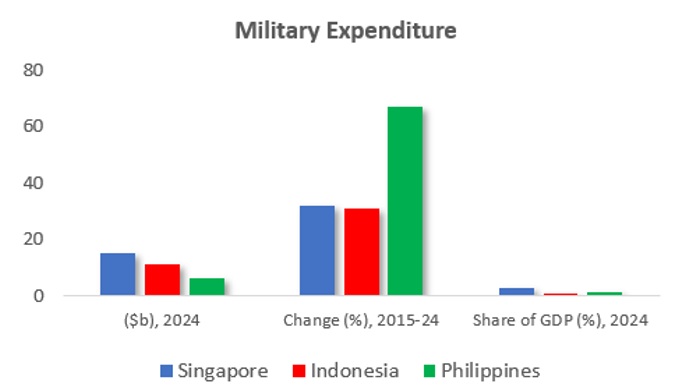
The ASEAN community features 10 nations. Today, only three of them are included in the Top-40 list of military spenders: Singapore, Indonesia and the Philippines. Unlike the first two that have fallen in rank, the Philippines is on the rise and made the list for the first time in 2025. It is right behind Iraq.

Source: SIPRI

The Philippines is investing increasingly in military spending. On per capita basis, it spends more in arms than Indonesia, which has a population of over 280 million as opposed to 115 million Filipinos.

Furthermore, the Philippines increase of military spending is on average twice as fast in comparison to Singapore and Indonesia. In the tiny city state, the share of military spending of GDP is 2.8%; and in Indonesia, 0.8%. But in the Philippines, it is 1.3% – in relative terms more than 50 percentage points higher than in Indonesia.

In the Duterte era, the Philippines was an aspiring BRIC-like economy. Today, it is an assertive military spender that is cannibalizing its economic futures.

Philippines as a major global arms importer            

The Philippines is one of the world’s largest importer of arms. In a gross mis-allocation of resources, Manila is boosting its arms imports faster than any other major ASEAN arms importer.

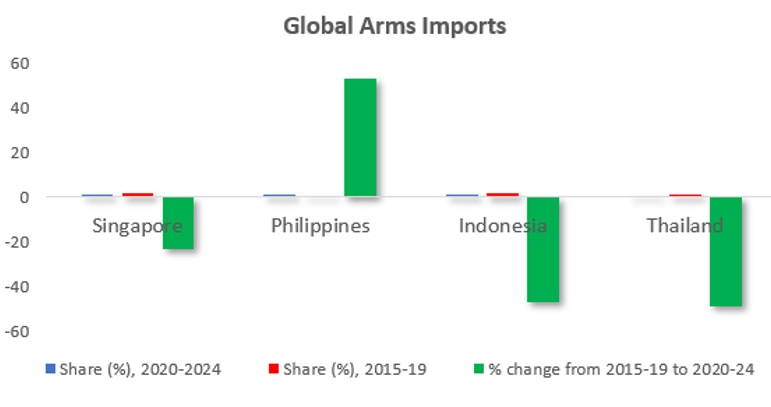
In the global top-40 list of the world’s largest arms importers, there are just four ASEAN countries: Singapore, the Philippines, Indonesia and Thailand. Although the tiny city-state has the largest share of global arms imports, the Philippines is second, ahead of both Indonesia and Thailand.

Source: SIPRI

In the past half a decade, these other ASEAN states have cut their arms imports by 20% (Singapore) to almost 50% (Indonesia, Thailand). They have tried to prepare for the economic headwinds that now drastically penalize global economic prospects. Unlike them, the Philippines has dramatically increased its share of global arms imports by more than 50 percentage points.

The ongoing militarization is dragging the Philippines into twisted alignments, which are undermining its foreign policy and diplomacy.

Atrocious alignments                  

Manila imports more than 80% of its arms from just three countries: South Korea (33%), Israel (27%) and the US (20%), which is also Ukraine’s main supplier (45%) and provides most arms imports to South Korea (86%) and Taiwan (98%).

The Philippines’ military suppliers are arms exporters cashing on mass atrocities. Gaza is the prime example. After 1.5 years of abject obliteration, some Western countries are stopping arming Israel. By contrast, South Korea raked in $6 million in arms exports to Israel in eight months of 2024 alone.

Despite some chill in bilateral ties, Manila has been a big client of the Israeli military exports (over 8% of Israel’s total exports), including Spyder air defense systems from Rafael, Sabra 2 light tanks from Elbit Systems, Shaldag boats from Israel Shipyards, and Hermes-type drones. As Israel’s largest weapons manufacturer, Elbit produces killer drones for Gaza, while its MPR 500 multi-purpose bombs contain 26,000 controlled fragments for “high kill probability.”

In the Philippines, Shaldag patrol gunboats are known as Nestor Acero-class. Off the coast of Gaza, they ensure nobody can escape the living hell in Gaza, while keeping aid flotillas away.

The failing economic promise

In the Philippines, self-rated poverty exceeds 55% of the population while 30% see themselves in the borderline of abject poverty. Militarization represents a massive misallocation of resources away from desperately-needed social spending.

Not so long ago, the Marcos Jr government boldly projected the country had potential for 7% economic growth in annual terms. Thanks to costly militarization, misallocated spending and the consequent political divides and volatility, the real growth rate in 2025 is likely to be slightly above 5.0%.

But when and if these weapons replace diplomacy in Southeast Asia, the worst is still ahead.

Dr. Dan Steinbock is an internationally recognized strategist of the multipolar world and the founder of Difference Group. He has served at the India, China and America Institute (USA), Shanghai Institutes for International Studies (China) and the EU Center (Singapore). For more, see https://www.differencegroup.net


Golden Dome Idiocy

Reprinted from Bracing Views with the author’s permission.

Donald Trump has a dream: a “golden dome” over America to defend the country against nuclear missiles. It’s a repeat of Ronald Reagan’s dream, the Strategic Defense Initiative, nicknamed “Star Wars” after the movie. The problem is that the dream represents a nightmare.

How so? Golden Dome would be dangerously escalatory, wildly expensive, and unlikely to work as a “shield” to America. It is worse than a mistake: it is a crime. It represents a massive theft from those who hunger and suffer in America. As Republican President Dwight D. Eisenhower said in 1953, wasting enormous resources on weapons systems is no way of life at all. It is humanity crucifying itself on a cross of iron. Crucifixion is not made more pleasant when the cross is golden.

Put differently, the Golden Dome is a golden idol, a false god, one that by making a massive nuclear strike more likely endangers all of us and God’s creation.

Golden Dome is a grotesque example of makework militarism and warfare as welfare for weapons makers. Though it’s unlikely to work, if it did (partially) it would make a massive nuclear strike more likely, not less, endangering the world with the ecocidal terror of nuclear winter.

Golden Dome and the so-called investment in America’s nuclear triad are both examples of socio-technological madness – America’s leaders are like the mutants in “Beneath the Planet of the Apes,” worshipping the bombs that twisted them and which can only destroy what’s left of civilization.

Some Christians today await the apocalypse when Christ is supposed to return – but the most likely apocalypse features not the second coming of a God-man but a third world war featuring bomb-gods of thermonuclear destruction.

As Daniel Ellsberg once noted, U.S. nuclear attack plans in the early 1960s envisioned 600 million killed, or 100 Holocausts (before we knew such an attack would lead to nuclear winter). We’re lucky this insanity never came to pass. The only sane policy is to cancel Golden Dome and end “investment” in a new nuclear triad. Disarmament, not rearmament, is what’s needed.

The Global Network Against Weapons & Nuclear Power in Space has released a statement against Golden Dome that you can read here. You can add your name to the statement, as I have. Here are some bullet points released along with the statement:

  • Golden Dome is financially reckless and unsustainable. Early cost estimates range from $550 billion to several trillion dollars over two decades. This dwarfs even the Pentagon’s annual budget and adds to the US’s $37 trillion national debt – a price tag that makes the project fiscally indefensible.
  • Experts overwhelmingly agree that 100% effective missile interception is a fantasy, especially against complex attacks involving decoys, hypersonic missiles, and maneuverable warheads. Even Israel’s Iron Dome has been bypassed by more rudimentary drone and missile attacks.
  • Golden Dome includes space-based interceptors – effectively weaponizing the Earth’s orbit and triggering an arms race. This violates the spirit of the Outer Space Treaty and pushes nations like China and Russia to accelerate space weapons development.
  • By giving the illusion of first-strike survivability, it runs counter to the Mutually Assured Destruction (MAD) doctrine that has prevented so far a nuclear holocaust and incentivizes other powers to retain or expand their nuclear arsenals, blocking disarmament efforts permanently.
  • Thousands of rocket launches for satellite interceptors would further damage the ozone layer, could generate dangerous orbital debris (Kessler Syndrome), and will harm our already fragile space environment.
  • The only guaranteed winners of Golden Dome are weapons giants like Lockheed Martin, Raytheon, and Palantir, which stand to profit enormously regardless of the system’s effectiveness or risks.
  • The trillions funneled into Golden Dome could be used for urgent domestic priorities – such as healthcare, infrastructure, climate action, and education, directly benefiting millions of Americans.

In short, Golden Dome is a massive, dangerous, and futile vanity project, cloaked in patriotism but driven by profit, politics, and illusion.

William J. Astore is a retired lieutenant colonel (USAF). He taught history for fifteen years at military and civilian schools. He writes at Bracing Views.

Czech president appoints a new justice minister amid a bitcoin scandal

By The Associated Press
 June 10, 2025 

Czech Republic's President Petr Pavel, right, appoints Eva Decroix, left, as new Justice Minister at the Prague Castle in Prague, Czech Republic, Tuesday, June 10, 2025. (AP Photo/Petr David Josek)

PRAGUE — Czech President Petr Pavel swore in a new justice minister on Tuesday, another step in a political crisis caused by a bitcoin-related scandal.

Pavel appointed Eva Decroix after her predecessor Pavel Blažek resigned from the post on May 30. He was under fire from the opposition because his ministry accepted a donation of bitcoins and sold them for almost 1 billion Czech koruna (US$46 million) earlier this year.

Blažek said that he wasn’t aware of any wrongdoing, but didn’t want the four-party coalition government led by Prime Minister Petr Fiala to be harmed by the scandal. Fiala said that he appreciated his resignation and believed that Blažek acted with goodwill.

Blažek was a close ally of Fiala in the government and also in his conservative Civic Democratic Party. The new minister is from the same party.

Decroix said she will order an independent probe into the ministry’s activities in the case.

“The public trust in the institutions and the state is at stake,” Pavel said.

The issue focused on the fact that the bitcoins were donated to the ministry by a person who was previously convicted of drug dealing and other crimes while it was not clear why he did it.

The opposition has accused Blažek of possible money laundering, because it wasn’t clear where the bitcoins originated.

The opposition parties demand the resignation of the entire government and are planning to request a parliamentary no-confidence vote. It could take place later in June.

The issue has been investigated by the national police’s organized crime unit.

The scandal is taking place just months before the Oct 3-4 parliamentary election. The main opposition ANO (YES) party led by former populist Prime Minister Andrej Babiš is predicted to win the vote.

The Associated Press