Thursday, June 12, 2025

Troop deployment to Russia earns N. Korea $525 million annually

Most of the income comes in goods rather than cash, including oil, diesel, wheat flour, industrial parts and military technology


By Lee Sang-yong
- June 12, 2025
DAILYNK

The Rodong Sinmun newspaper reported March 7, 2024, that North Korean leader Kim Jong Un had paid a visit the previous day to critical operational and training bases of the Korean People’s Army on the western front and toured training facilities there. The photograph depicts North Korean soldiers doing exercises. (Rodong Sinmun, News 1)

North Korea earns an estimated $43.8 million monthly — or $525.6 million yearly — through its troop deployment to Russia. The country has made an additional $6 million when condolence payments for soldiers killed in action are included.

A high-ranking Daily NK source in North Korea reported recently that North Korean troops deployed to Russia receive graduated salaries based on their rank through an agreement with Moscow. Commanders receive $5,000 monthly, technical specialists earn $3,500, non-commissioned officers make $3,000, and ordinary enlisted men get $2,800.

South Korea’s National Intelligence Service (NIS) determined that North Korea has dispatched about 15,000 troops. The source says about 2% hold command rank, 8% are technical specialists, 10% are non-commissioned officers, and 80% are ordinary enlisted men.

Based on these calculations, North Korea’s total monthly income reaches about $43.8 million thanks to its troop deployment. The 300 commanders make around $1.5 million, the 1,200 technical specialists earn $4.2 million, the 1,500 non-commissioned officers make around $4.5 million, and the 12,000 ordinary enlisted men earn around $33.6 million.

When extrapolated for the year, North Korea makes about $525.6 million annually through its troop deployment to Russia alone.

Death benefits add to revenue stream


North Korea also receives $6,000 to $10,000 in condolence money from Russia for every North Korean soldier killed in action. In a recent report to South Korea’s National Assembly, the NIS estimated that about 600 North Korean troops have died in combat. Based on this figure, North Korea has received at least $3.6 million and at most $6 million in condolence payments.

“The government calculates the life of one of its soldiers at a few thousand dollars, and even the condolence payments paid to fallen soldiers become part of the state’s finances,” the source said. “The lives of the people are just a means, while war is just an industry to generate foreign currency.

“Instead, the government treats the families of the fallen like state heroes, giving them priority for food and re-allotting them homes,” the source continued. “While informing provincial, city and county officials of this compensation scheme, the authorities ordered that they keep the plan strictly secret until all the soldiers return home.”
Payment structure focuses on strategic goods

Most of the income comes in goods rather than cash, including oil, diesel, wheat flour, industrial parts and military technology. In the initial dispatch, some payments came in dollars, but now Russia is replacing dollar payments with strategic goods that can be exchanged for Russian rubles, Chinese yuan or other commodities. Some of the money has also gone toward repaying loans from the time of Kim Il Sung.

Goods that North Korea has secured from Russia are managed by the Financial 1.8 Funds Directorate under the party’s Munitions Industry Department. They invest these resources intensively in modernizing the military, research and development under the Missile General Bureau, and bolstering the defense distribution network.

North Korea has exported weaponry at the same time, with major exports including 122-152mm shells, missile warheads, small arms and ammunition, flares, portable air defense weapons, jamming equipment and wireless gear, the source said. The exports also include some experimental weapons.

Troop deployment used to bolster leader’s image

North Korean leader Kim Jong Un’s personal inspection of military factories on June 7 can be seen as the leadership pushing for increased exports while maintaining a wartime production posture. “Factories that post good export numbers receive foreign currency incentives while their workers receive class promotions,” the source said.

North Korea employs a multi-layered laundering structure in its transactions with Russia, including third-country front companies, transhipments on the high seas and false-name contracts. Trading companies attached to the Reconnaissance General Bureau, Missile General Bureau and Ministry of External Economic Relations participate in this with tacit Russian approval, the source said.

North Korea earns more than economic benefits from the deployment — it has also used the situation to bolster Kim Jong Un’s domestic image.

“The authorities are promoting the deployment as the supreme leader leading a just war in an anti-imperialist front in unity with Russia,” the source said. “He is bolstering the prestige of the Paektu bloodline as a leader carrying on the anti-imperialist pedigree of Kim Il Sung and Kim Jong Il.”


Is Trump’s America in the middle of a coup?

Years of covering power struggles and civil wars leads world affairs editor Sam Kiley to question whether Trump is intentionally taking the establishment apart on his own home turf


Thursday 12 June 2025
The Independent

In conducting a coup in an impoverished undeveloped nation there is a basic to-do list. You capture the presidency, the courts, take over the international airport, emasculate the legislature, decapitate the military of potential opponents, storm the local TV station and declare a new dawn.

Bigger countries require more effort, like the mass mobilization of xenophobia through false-flag attacks and terror scares, but from Moscow to Monrovia, the patterns are the same – an autocrat takes power in the name of national salvation.

With Donald Trump in power for a little over four months, questions are swirling as to whether this process is happening to what was the most powerful democracy on earth.


open image in galleryMembers of the California National Guard stand watch outside the Edward R. Roybal Federal Building (AFP/Getty)

When he refused to accept he lost the 2020 elections and his supporters stormed the Capitol, and later jailed, he pardoned them all. Now America's constitution is again under threat of what many critics are calling an internal coup d'etat. Driven, perhaps, because the president has openly considered a Trump 2028 campaign for a third, unconstitutional, term.

While he was duly elected to his office for a second time last November, every check and balance to the power of the US presidency as enumerated in the Constitution has been, or is being, challenged— a notion only heightened by the drumbeat of declarations from White House insiders of an “insurrection” in Los Angeles.

As protestors took to the streets against the mass arrest of alleged illegal immigrants, Trump lost little time in ordering 700 US Marines and thousands of National Guard onto the streets of Los Angeles.


open image in galleryPresident Trump speaks to reporters after arriving on Air Force One (AP)

Californian governor Gavin Newsom described the move as “deranged” which would only serve to inflame tensions on the west coast.


The governor declared: “Democracy is under assault. The moment we feared has arrived.

“Take time. Reflect on this perilous moment a president, bound by no law or constitution, perpetuating a unified assault on American traditions.”

His words came only hours after Trump warned anyone contemplating protesting during his military parade on June 14 that they would be met with “very heavy force”.


open image in galleryCalifornia Highway Patrol officers clash with protesters on Tuesday (AP)

Trump’s to-do list in taking on - and taking down - the establishment has already been largely ticked off.


First he moved against the military and intelligence services whom, during his first presidency, he blamed for holding back his agenda and for failing to back the “protesters” who invaded the US Capitol on January 6 2021.

Mark Milley, chairman of the joint chief of staff during Trump 1.0, lost his security detail and the pre-emptive pardon he’d been given by outgoing president Joe Biden after he was threatened with prosecution by Trump.


Trump then fired his successor Airforce general Charles Brown, and the head of the US Coastguards Linda Fagan. They were axed, the administration suggested, because they were DEI hires. Nothing in their backgrounds indicates they were anything but qualified for the top jobs, but the messaging was clear from the White House – we want our own people.


open image in galleryDemonstrators march during a protest in Los Angeles (AP)

But they must be loyal above all – so General Timothy Haugh, the head of the National Security Agency and US Cyber Command, has also gone along with the head of Naval operations admiral Lisa Franchetti. No reason was given for Haugh’s dismissal in April.

Trump told reporters on Air Force One at the time: “We're always going to let go of people – people we don't like or people that take advantage of, or people that may have loyalties to someone else.”

Moving on, the FBI boss Christopher Wray was replaced with Kash Patel, an avid Trump loyalist who has failed to produce a budget for his agency this year. The new deputy director Dan Bongino is a podcaster who peddled the lie that Trump won the 2020 presidential election.

The director of National Intelligence is now Tulsi Gabbard, who has been an apologist for Vladimir Putin and Syria’s Bashar al Assad. Pete Hegseth, a former Fox News contributor, is secretary of defence and famed for his attacks on Volodymyr Zelensky, Nato, and for using his personal phone to transmit state secrets.


open image in galleryGavin Newsom has criticised Donald Trump (Reuters)

Incompetence among cabinet members and top officials means that Trump knows they owe their place in his orbit to him alone. Each of these leaders have purged their own departments and replaced professionals with apparatchiks.

The federal bureaucracy has been hammered by Trump’s re-definition of more than 50,000 civil servants and “political hires”, allowing for him to impose pre-vetted loyalists in the executive heart of the government.

Opposition to a coup will often come from the judiciary and universities. Trump has moved to stifle both.

Top academies like Harvard and Colombia have been threatened with or have lost federal funding worth billions for pushing back at Trump’s attempts to control their intellectual life. Foreign students are being banned.

Students and academics who have supported Palestinian rights have been accused of backing terror groups like Hamas and fired, expelled or deported. The issue here is focussed on Israel and alleged antisemitism but again, the message is clear – free speech is over.

Of course, none of this could have been achieved without the active support of the US Congress and Senate which is supposed to check the worst of executive power. But with Republican majorities in both, Trump has been given a free rein.

And Republicans who do not subscribe to Trump’s vision in Congress are often living in fear of criticising him.


open image in galleryPeople walk past graffiti from recent protests against federal immigration raids in LA (AP)

Standout Republican opponent Alaskan Senator Lisa Murkowski said during a townhall last month: “We’re in a time and a place where I certainly have not been here before. I’m oftentimes very anxious myself about using my voice because retaliation is real…

“I have to figure out how to help the many and the anxious who are so afraid [in Congress]”.

Many academics from Africa in particular, who have lived through civil wars for the last 30 years, have wondered how long it would be before Americans realized they could be living through their own form of coup.

A professor at a prestigious east coast university who has a green card and is world renowned in their field said: “I’m just wary about being quoted. We (academics non-nationals) have even been told not to leave the US in case we can’t get back in. The administration is monitoring our social media accounts”.

Speaking anonymously for fear of retribution they went on: “Those of us who have grown up under authoritarian regimes have learned of the signs of incipient and growing authoritarianism. None of this is rocket science.

“There is a method: the control of the press and judiciary, co-option of the loyalty of the police and the army, rise of militias, manipulation of elections. Trump discredited the mainstream media, stacked the judiciary… He demanded the loyalty of the FBI.”


open image in galleryPeople walk through downtown Los Angeles following the lifting of an overnight curfew (Getty)

America’s judiciary has had patchy success in getting the administration to observe the constitution that the president, military, and intelligence services have sworn to uphold too. Trump’s White House has ignored orders to stay deportations.

In May, over 130 former state and federal judges demanded the government drop its charges against Milwaukee County Circuit Court Judge Hannah Dugan, dubbing her indictment for allegedly helping man evade immigration officials as an “egregious overreach” by the executive branch.

But ICE immigration officials have spread across the country arresting suspects without showing identification, frequently without warrants, and using force to impose meet Trump’s mass deportation promises.


open image in galleryAn armoured vehicle drives passed a police line outside of the Metropolitan Detention Center on June 10 (Getty)

This week, Trump has been concerned with the manufactured notion of an “insurrection” in California. A conflict between protestors and the armed forces on the streets of LA could be the excuse any autocrat would use to declare a national emergency, and suspend constitutional law.

“The president is trying to manufacture chaos and crisis on the ground for his own political ends,” said Robert Bonta, California’s attorney general after announcing that the state, led by Mr Newsom, was going to sue the Trump administration for violating the US Constitution.


“Federalizing the California National Guard is an abuse of the president’s authority under the law – and not one we take lightly. We’re asking a court to put a stop to the unlawful, unprecedented order.”

With decades of experience in West Africa and having published widely on the war that tore Yugoslavia apart, the anonymous east coast professor added a dire warning: “I think, eventually, a state will consider seceding. Maybe California. Then it will be war, I think Yugoslavia is a good model for the US”.
Protests over Trump's immigration raids spread across the US

Protests against hardline immigration tactics spread across the US Wednesday after days of rallies in Los Angeles, as California geared for a legal battle over President Trump’s military deployment. More than 1,000 demonstrators marched peacefully in America’s second-largest city for a sixth straight day.


Issued on: 12/06/2025 -
By: FRANCE 24


Protests over hardline immigration tactics ignited across the United States Wednesday after days of demonstrations in Los Angeles, as California prepared for a legal showdown with the White House over Donald Trump's deployment of the military.

Over 1,000 people massed in America's second biggest city for a sixth day of protests, with the crowd peaceful as they marched through the streets.

A second night of curfew was expected as city leaders try to get a handle on the after-dark vandalism and looting that scarred a few city blocks in the 500-square-mile (1,300 square kilometres) metropolis.

"I would say for the most part everything is hunky dory right here at Ground Zero," protester Lynn Sturgis, 66, a retired school teacher, told AFP.


"Our city is not at all on fire, it's not burning down, as our terrible leader is trying to tell you."

Read more Marines in LA: Trump chooses strategy of escalation against anti-ICE protests

The mostly peaceful protests ignited over a sudden escalation in efforts to apprehend migrants who were in the country illegally.

Pockets of violence – including the burning of self-driving taxis and hurling stones at police – were nothing the 8,500 officers of the Los Angeles Police Department had not dealt with before.

Trump won the election last year partly on promises to combat what he claims is an "invasion" by undocumented migrants.

He is now seizing the opportunity to make political capital, ordering the California National Guard to deploy despite Governor Gavin Newsom's objections, the first time a US president has taken such action in decades.

"We're going to have a safe country," he told reporters on his way into a theater performance.

"We're not going to have what would have happened in Los Angeles. Remember, if I wasn't there ... Los Angeles would have been burning to the ground."

Around 1,000 of the 4,700 troops Trump deployed were actively guarding facilities and working alongside ICE agents, said Scott Sherman, Deputy Commanding General Army North, who is leading operations.

The rest – including 700 active duty Marines – were mustering or undergoing training to deal with civil disturbances, he said.

The Pentagon has said the deployment will cost taxpayers $134 million.

Governor Newsom, a Democrat, has charged that Trump is seeking to escalate the confrontation for political gain.

His lawyers were expected in court on Thursday to demand a temporary restraining order that would prevent troops from accompanying immigration officers as they arrest migrants.

Administration lawyers called the application a "crass political stunt".

Newsom said the unprecedented militarisation would creep beyond his state's borders.

"Democracy is under assault right before our eyes," he said Tuesday. "California may be first, but it clearly won't end here."

Read more


Nationwide protests growing

Despite Trump's threats to deploy the National Guard to other Democratic-run states over the objections of governors, protesters appear undeterred.

Demonstrations were reported in St Louis, Raleigh, Manhattan, Indianapolis and Denver.

In San Antonio, hundreds marched and chanted near city hall, reports said, where Republican Texas Governor Greg Abbott has deployed the state's National Guard.

A nationwide "No Kings" movement was expected on Saturday, when Trump will attend a highly unusual military parade in the US capital.

The parade, featuring warplanes and tanks, has been organised to celebrate the 250th anniversary of the founding of the US Army but also happens to be the day of Trump's 79th birthday.

01:22© France 24


'Inflamed' situation

The Trump administration is painting the protests as a violent threat to the nation, requiring military force to support regular immigration agents and police.

But Los Angeles Mayor Karen Bass said the crisis had been manufactured in Washington.

"A week ago, everything was peaceful in the city of Los Angeles," she told reporters.

"Things began to be difficult on Friday when raids took place ... that is the cause of the problems.

"This was provoked by the White House."

Arrests by masked and armed men continued Wednesday.

A pastor in the LA suburb of Downey said five armed men driving out-of-state cars grabbed a Spanish-speaking man in the church's parking lot.

When she challenged the men and asked for their badge numbers and names, they refused.

"They did point their rifle at me and said, 'You need to get back,'" Lopez told broadcaster KTLA.

Footage seen by AFP shows what appears to be federal agents ramming a car in the Boyle Heights area of Los Angeles.

Some kind of smoke device is deployed and masked men with assault weapons order a man from the car, leaving what witnesses said was his wife and children badly shaken.

(FRANCE 24 with AFP)

US: Protests Spread Nationwide Amid LA Mayors Urging Trump To Stop Raids; Pentagon Says $134M Cost In Guard Deployment

According to the Los Angeles police department, nearly 400 arrests and detentions have been made since Saturday, majority of whom were failing to leave the area at the request of law enforcement.


Trisha Majumder
Updated on: 12 June 2025 
OUTLOOK INDIA


Immigration protests in Los Angeles Photo: Ethan Swope/AP

The protests against President Donald Trump's immigration crackdown in Los Angeles have now spread across the United States of America, with thousands of people in cities including Dallas and Austin in Texas, and Chicago and New York, rallied and more arrests were made.

Several mayors from across the Los Angeles region have come together on Wednesday to demand that the Trump administration stop the stepped-up immigration raids that have spread fear across their cities and sparked protests across the US.

According to the Los Angeles police department, nearly 400 arrests and detentions have been made since Saturday, majority of whom were failing to leave the area at the request of law enforcement.

Pentagon On Cost Of National Guard Deployment

Trump has activated more than 4,000 National Guard members and 700 Marines over the objections of city and state leaders, though the Marines have not yet been spotted in Los Angeles and Guard troops have had limited engagement with protesters. They were originally deployed to protect federal buildings.

Defense Secretary Pete Hegseth confirmed on Tuesday that the use of troops inside the US will continue to expand.

The Pentagon said deploying the National Guard and Marines costs $134 million.

Hegseth said, “I think we’re entering another phase, especially under President Trump with his focus on the homeland, where the National Guard and Reserves become a critical component of how we secure that homeland,” during hearing before the House Appropriations defense subcommittee.

Protests Spread Across US

In New York City, police said they took 86 people into custody during protests in lower Manhattan that lasted into Wednesday morning. Police Commissioner Jessica Tisch told Associated Press that the majority of demonstrators were peaceful.

A 66-year-old woman in Chicago was injured when she was struck by a car during downtown protests Tuesday evening, police reportedly said. Video showed a car speeding down a street where people were protesting.

In Texas, where police in Austin used chemical irritants to disperse several hundred demonstrators Monday, Republican Gov. Greg Abbott’s office said Texas National Guard troops were “on standby" in areas where demonstrations are planned.

Guard members were sent to San Antonio, but Police Chief William McManus said he had not been told how many troops were deployed or their role ahead of planned protests Wednesday night and Saturday. Officers with the Texas Department of Public Safety said the Texas National Guard was present at a protest downtown.

Also Read | LA Protests Enter the Fifth Day as Trump and Newsom Target Each Other

LA Mayors' Plea

The LA-area mayors and city council members urged Trump to stop using armed military troops alongside immigration agents.

“I’m asking you, please listen to me, stop terrorizing our residents,” said Brenda Olmos, vice mayor of Paramount, who said she was hit by rubber bullets over the weekend. “You need to stop these raids.”

Speaking alongside the other mayors at a news conference, Los Angeles Mayor Karen Bass said the raids spread fear at the behest of the White House. The city’s nightly curfew will remain in effect as long as necessary. It covers a 1-square-mile (2.5-square-kilometer) section of downtown where the protests have been concentrated in the city that encompasses roughly 500 square miles (1,295 square kilometers).

“If there are raids that continue, if there are soldiers marching up and down our streets, I would imagine that the curfew will continue,” Bass said.

The administration has cited the protests in its decision to deploy the military.

California's Democratic governor, Gavin Newsom, has asked a federal court to put an emergency stop to the military helping immigration agents in the nation’s second-largest city. This week, guardsmen began standing protectively around agents as they carry out arrests. A judge set a hearing for Thursday.

The Trump administration called the lawsuit a “crass political stunt endangering American lives" in its official response on Wednesday.

Also Read | Trump Says ‘Protestors At Army Parade Will Be Met With Very Big Force’

Trump Open To Using Insurrection Act

Trump left open the possibility of invoking the Insurrection Act, which authorises the president to deploy military forces inside the US to suppress rebellion or domestic violence or to enforce the law in certain situations. It's one of the most extreme emergency powers available to a US president.

“If there’s an insurrection, I would certainly invoke it. We’ll see,” he said from the Oval Office.

Later, the president called protesters “animals” and “a foreign enemy” in a speech at Fort Bragg ostensibly to recognize the 250th anniversary of the US Army.

Trump has described Los Angeles in dire terms that Bass and Newsom say are nowhere close to the truth.

How Did The Protests Start?

The protests began Friday after federal immigration raids arrested dozens of workers in Los Angeles. Protesters blocked a major freeway and set cars on fire over the weekend, and police responded with tear gas, rubber bullets and flash-bang grenades.

Thousands of people have peacefully rallied outside City Hall and hundreds more protested outside a federal complex that includes a detention center where some immigrants are being held following workplace raids.


AI Regulation, Migration and the New International World Order


Image Credit: Huzeyfe Turan via Unsplash - https://unsplash.com/photos/woman-in-black-and-purple-leopard-print-shirt-D62arqnPgGE
holographic numbers projected onto a person with purple shirt

by Nayla Rida | Jun 12, 2025


In a world where one’s digital blueprint has already become a determining factor for the achievement of various socio-economic rights such as employment, education, and other personal milestones, the prospect of automating this screening and extending it to migration and border control could reshape the globe’s demographics in profound ways. Indeed, an increasingly debated topic regarding AI regulation is its usage for border control screening, which intersects with migrants’ and refugees’ rights.

The EU’s AI Act 2024, which will enter into force in August 2026, has classified the use of AI profiling for border control as high risk and, as such, worthy of high regulation. Indeed, AI has been used to screen asylum and visa applications, ensure an individual is who they claim to be through biometric identification systems, and estimate illegal migration risks. Amongst these regulations is the responsibility of providers to conduct data governance, record-keeping, and the implementation of human oversight. Criminal risk profiling based solely on personality traits inferred from an individual’s data and social scoring, on the other hand, lies amongst the prohibited usages of AI listed in the Act (Chapter II, Article 5).

In addition to this, a lesser talked about risk is the use of already controversial DNA analysis for profiling. Genetic testing providers such as Ancestry.com and CircleDNA both claim to be able to assess one’s innate propensity to risk-taking, for example, based on one’s DNA (although both tests can give different results for the same person). Risk-taking is thought of as one of the main personality traits that AI could possibly be used to assess when profiling applicants to determine their chance of irregular migration and other criminal offenses. With 23andme.com recently filing for bankruptcy after an important data breach, debates about the intersection of DNA testing, data privacy, migration, and AI are more urgent than ever, as, if not prohibited, DNA data analysed by AI could be used in some regions to facilitate migration profiling based on personality profiling. For now, however, the new practice of DNA profiling at the border in the EU, ECOWAS, and other regions, focuses on citizen identification and aims to address the missing persons and human trafficking crisis.

In contrast to this push to put some checks and balances in European border control tech, the Trump administration saw a push towards stricter immigration law enforcement, while inversely advocating for a more liberal AI use in governmental affairs and beyond. The country had indeed already passed various legislations, which vary by states, to facilitate AI profiling to prevent criminal activities whilst accounting for data privacy. In the context of the Trump administration’s migration crackdown, which has been criticised for its lack of due process, AI has been used to profile migrants based on their political inclinations, which arguably contravene several individual liberties listed in the ICCPR and beyond.

All of this could also lead to important demographic changes in the future as even just the looming prospect of a more dystopian version of the US might attract different kinds of immigrants, ideologically speaking and demographically speaking, and retain different kinds of citizens, again based on ideology and demographics. The sociological consequences of such policies on how feasible and attractive various migration destinations are could lead ethnic and sexual minorities, as well as refugees and economic migrants, to gravitate towards destinations with stronger anti-profiling interdictions, such as the EU, which could risk exacerbating the far-right migration pushback in the EU context and their Great Replacement arguments. More likely, developing and emerging destinations in the Global South (specifically the BRICS, South-East Asia, and the GCC) could also gain traction as the transition towards a multipolar global order cements.


About Nayla Rida
Nayla holds an MSc in Modern Middle Eastern Studies from St Antony's College, Oxford (2024) and holds a previous MA in Education, Gender and International Development from UCL's Institute of Education (2022).

Cuts to USAID severed longstanding American support for Indigenous people around the world

June 12, 2025


FILE - Cut down trees lie near the Cordillera Azul National Park in Peru's Amazon Forest on Oct. 3, 2022. (AP Photo/Martin Mejia, File)

Miguel Guimaraes Vasquez fought for years to protect his homeland in the Peruvian Amazon from deforestation related to the cocaine trade, even laboring under death threats from drug traffickers.

A leader in an Indigenous rights group, Vasquez said such efforts were long supported by financial assistance from the U.S. Agency for International Development, which spent billions of dollars starting in the 1980s to help farmers in Peru shift from growing coca for cocaine production to legal crops such as coffee and cacao for chocolate. The agency funded economic and agricultural training and technology, and helped farmers gain access to international markets.

But the Trump administration’s recent sweeping cuts to the agency have thrown that tradition of U.S. assistance into doubt, and Indigenous people in the Amazon worry that without American support there will be a resurgence of the cocaine market, increased threats to their land, and potentially violent challenges to their human rights.

“We don’t have the U.S. government with us anymore. So it can get really dangerous,” said Vásquez, who belongs to the Shipibo-Konibo people and is vice president of the Interethnic Association for the Development of the Peruvian Rainforest. “We think the situation is going to get worse.”

Several Indigenous human rights defenders have been killed trying to protect their land, Vasquez said, and in some of those cases U.S. foreign aid provided money to help prosecute the slayings. “We really needed those resources,” he said.

Sweeping cuts began in January

When Elon Musk’s Department of Government Efficiency, or DOGE, began dismantling USAID shortly after President Donald Trump began his second term, it all but eliminated U.S. foreign aid spending, including decades of support to Indigenous peoples around the world.

USAID’s work with Indigenous peoples sought to address a variety of global issues affecting the U.S., according to former employees. Its economic development efforts created jobs in South America, easing the need for people to work in illicit drug markets and reducing the likelihood they would migrate to America seeking jobs and safety. And its support for the rights of Indigenous peoples to steward their own land offered opportunities to mitigate climate change.

That included Vásquez’s organization, which was about to receive a four-year, $2.5 million grant to continue fighting illicit activity that affects Indigenous people in the region. Vásquez said that grant was rescinded by the new administration.

In January, DOGE launched a sweeping effort empowered by Trump to fire government workers and cut trillions in government spending. USAID, which managed about $35 billion in appropriations in fiscal year 2024, was one of his prime targets. Critics say the aid programs are wasteful and promote a liberal agenda. Trump, Musk, and Republicans in Congress have accused the agency of advancing liberal social programs.

“Foreign assistance done right can advance our national interests, protect our borders, and strengthen our partnerships with key allies,” Secretary of State Marco Rubio said in a statement in March. “Unfortunately, USAID strayed from its original mission long ago. As a result, the gains were too few and the costs were too high.”

Musk last week announced his departure from the Trump administration, marking the end of a turbulent chapter that included thousands of layoffs and reams of litigation.

Former USAID employees said political pressure from the U.S. often kept foreign governments from violating some Indigenous rights.

In the three months since thousands of foreign aid workers were fired and aid contracts canceled, the Peruvian government has moved quickly to strip Indigenous people of their land rights and to tighten controls on international organizations that document human rights abuses. It’s now a serious offense for a nonprofit to provide assistance to anyone working to bring lawsuits against the government.

The National Commission for Development and a Drug-Free Lifestyle, the country’s agency that fights drug trafficking, did not respond to a request for comment from The Associated Press.

“The impact was really, really strong, and we felt it really quickly when the Trump administration changed its stance about USAID,” Vásquez said.

The U.S. spends less than 1% of its budget on foreign assistance. Tim Rieser, a senior foreign policy aide in the Senate who works for Democratic Vermont Sen. Peter Welch, called DOGE’s cuts to USAID a “mindless” setback to years of work.

The White House did not respond to a request for comment.

Agency reached Indigenous communities worldwide

USAID’s work reached Indigenous communities around the world. It sought to mitigate the effects of human rights abuses in South America, created programs in Africa to enable Indigenous people to manage their own communities and led the global U.S. effort to fight hunger.

One of the most recent additions to USAID’s work was incorporating international concepts of Indigenous rights into policy.

Rieser, for instance, was responsible for crafting legislation that created an adviser within USAID to protect the rights and address the needs of Indigenous peoples. The adviser advocated for Indigenous rights in foreign assistance programs, including actions by the World Bank.

“That provided Indigenous people everywhere with a way to be heard here in Washington,” Rieser said. “That has now been silenced.”

That adviser position remains unfilled.

Vy Lam, USAID’s adviser on Indigenous peoples, who said he was fired in March as part of the DOGE downsizing, said the idea of Indigenous rights and the mandate to recognize them in foreign operations was new to USAID. But it gained momentum under President Joe Biden’s administration.

He said concepts such as “free, prior and informed consent” — the right of Indigenous people to give or withhold approval for any action that would affect their lands or rights — were slowly being implemented in American foreign policy.

One of the ways that happened, Lam said, came in the form of U.S. political pressure on foreign governments or private industry to negotiate mutually beneficial agreements between Indigenous peoples and their governments.

For instance, if an American company wanted to build a hotel in an area that could affect an Indigenous community, the U.S. could push for the deal to require Indigenous approval, or at least consultation.

“We had that convening power, and that is the thing that I grieve the most,” Lam said.

U.S. foreign aid workers were also able to facilitate the reporting of some human rights violations, such as when a human rights or environmental defender is jailed without charges, or Indigenous peoples are forced off their land for the establishment of a protected area.

Money supported attendance at international meetings

In some cases, USAID supported travel to the United Nations, where Indigenous leaders and advocates could receive training to navigate international bodies and document abuses.

Last year, under the Biden administration, USAID awarded a five-year grant to support Indigenous LGBTQIA people through the United Nations Voluntary Fund for Indigenous People, an agency that offers financial support to Indigenous peoples to participate in the U.N.

At $350,000 per year, it was the largest grant from any member state in the U.N., fund Secretary Morse Flores said. The money would have paid for attendance at the U.N. and other international bodies to report human rights abuses and to testify on foreign policy.

In February, the fund received notice that the grant would be terminated. The State Department does not plan to fulfill its pledge to fund the remaining four years of the grant.

In most cases, people receiving assistance to attend major meetings “are actual victims of human rights violations,” Flores said. “For someone who’s unable to come and speak up, I mean, it’s really just an injustice.”

___

This story was published in partnership with Grist, a nonprofit, independent media organization dedicated to reporting on climate change.
Starvation alert as children fill Kenya refugee ward after US aid cuts

Anne Soy
BBC News, Kakuma
BBC
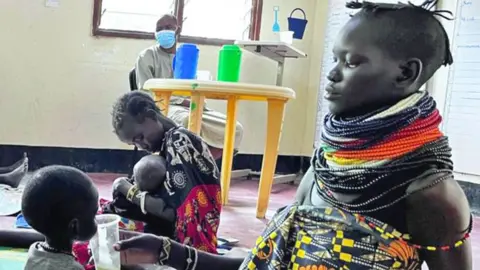
Children on the ward are given milk every three hours in a bid to boost their intake of nutrients


Hundreds of thousands of people are "slowly starving" in Kenyan refugee camps after US funding cuts reduced food rations to their lowest ever levels, a United Nations official has told the BBC.

The impact is starkly visible at a hospital in the sprawling Kakuma camp in the north-west of the East African nation. It is home to roughly 300,000 refugees who have fled strife in countries across Africa and the Middle East.

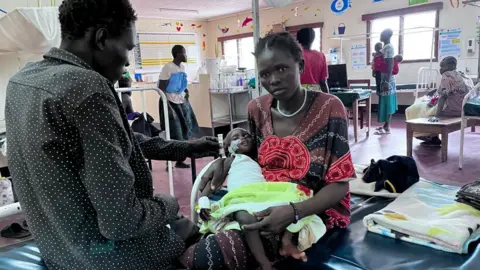
Emaciated children fill a 30-bed ward at Kakuma's Amusait Hospital, staring blankly at visitors as they receive treatment for severe acute malnutrition.

One baby, Hellen, barely moves. Parts of her skin are wrinkled and peeling, leaving angry patches of red - the result of malnutrition, a medic tells the BBC.

Across the aisle lies a nine-month-old baby, James, the eighth child of Agnes Awila, a refugee from northern Uganda.

"The food is not enough, my children eat only once a day. If there's no food what do you feed them?" she asks.

James, Hellen and thousands of other refugees in Kakuma depend on the UN's World Food Programme (WFP) for vital sustenance.

But the agency had to drastically reduce its aid operations in many countries after President Donald Trump announced sweeping cuts to US foreign aid programmes earlier this year, as part of his "America First" policy.

The US had provided around 70% of the funding for the WFP's operations in Kenya.

The WFP says that as a result of the cuts, the agency has had to slash the refugees' rations to 30% of the minimum recommended amount a person should eat to stay healthy.

"If we have a protracted situation where this is what we can manage, then basically we have a slowly starving population," says Felix Okech, the WFP's head of refugee operations in Kenya.


Some of the malnourished children at Amusait Hospital can only be fed via tubes


Outside Kakuma's food distribution centre, the sun beats down on the dry, dusty ground and security officers manage queues of refugees.

They are led into a holding centre and then a verification area. Aid workers scan the refugees' identity cards and take their fingerprints, before taking them to collect their rations.

Mukuniwa Bililo Mami, a mother of two, has brought a jerrycan to collect cooking oil, along with sacks for lentils and rice.

"I am grateful to receive this little [food] but it is not enough," says the 51-year-old, who arrived in the camp 13 years ago from South Kivu, a region in conflict-hit eastern Democratic Republic of Congo

Ms Mami says the refugees used to "eat well" - three meals a day. But now that rations are at 30% of their usual amount, the food she has been given is not enough to last one month, let alone the two that she has been asked to stretch it for.

She has also been affected by another casualty of the cuts - cash transfers.

Until this year, the UN was giving around $4m (£3m) in cash directly to refugees in Kenya's camps each month, intended to allow families to buy basic supplies.

Ms Mami, who is diabetic, used the cash to buy food, like vegetables, which were more appropriate for her diet than the cereals handed out at the distribution centre.

Now, she is forced to eat whatever is available.

She also used the money to start a vegetable garden and rear chicken and ducks, which she sold to other refugees, at a market.

But the discontinuation of the cash transfers, locally known as "bamba chakula", has meant that the market faces collapse.

Traders like Badaba Ibrahim, who is from the Nuba Mountains in Sudan, are no longer able to extend lines of credit to fellow refugees.

The 42-year-old runs a retail shop in the local shopping centre. He says his customers, now unable to purchase food, at times camp at his shop all day, begging for help.

"They will tell you, 'My children have not eaten for a full day,'" Mr Ibrahim says.

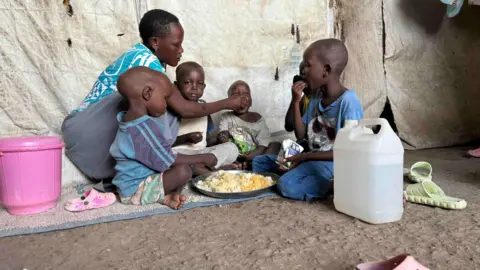
Elsewhere in the Kakuma camp, 28-year-old Agnes Livio serves up food for her five young sons.

They live in a cubicle, which is roughly 2m (6ft 6in) by 2m made from corrugated iron sheets.

Ms Livio serves the food on one large plate for all to share. It is the family's first meal of the day - at 1400.


Single mother Agnes Livio found safety after leaving South Sudan for Kenya

"We used to get porridge for breakfast but not anymore. So, the children have to wait until the afternoon to have their first meal," says Ms Livio, who fled from South Sudan.

Back at Amusait Hospital, medics are feeding a number of malnourished infants through tubes.

Three toddlers and their mothers are being discharged - back to the community where food is scarce and conditions are deteriorating.

And the prospect of more funding is not very promising and unless things change over the next two months, the refugees are staring at starvation come August.

"It is a really dire situation," admits Mr Okech.

"We do have some signals from some one or two donors about support with that cash component.

"But remember, the very kind and generous US has been providing over 70% - so if you're still missing 70%… those prospects are not good."
Advertisement


You may also be interested in:
'My wife fears sex, I fear death' - impacts of the USAID freeze
Africa is important to Trump, despite aid cuts, envoy tells BBC]
Nigeria and Kenya among nations running out of HIV drugs - WHO
How Trump locked out contraception in Africa

Crops hit, dams at dead level: Pak water crisis deepens after India's Indus move

India's move to halt the Indus Waters Treaty has triggered a severe water crisis in Pakistan, with the latter's two major reservoirs at their dead storage levels and agricultural production going witnessing a drastic decline.


Water flow in Pakistan's Indus basin falls 15%


Shivani Sharma
New Delhi,
UPDATED: Jun 12, 2025 
Edited By: Sharangee Dutta
INDIA TODAY


In Short

Reservoirs Tarbela and Mangla reach dead storage, limiting water use

Kharif crop production drops over 20%, wheat output declines by 9%

Pak writes 4 letters to India urging to reinstate Indus Waters Treaty


Pakistan is facing a severe water crisis, with the agricultural industry looking at deeper impacts, in the aftermath of India suspending the Indus Waters Treaty in retaliation to the April 22 Pahalgam massacre in which Islamabad-backed terrorists gunned down 26 people, mostly tourists.

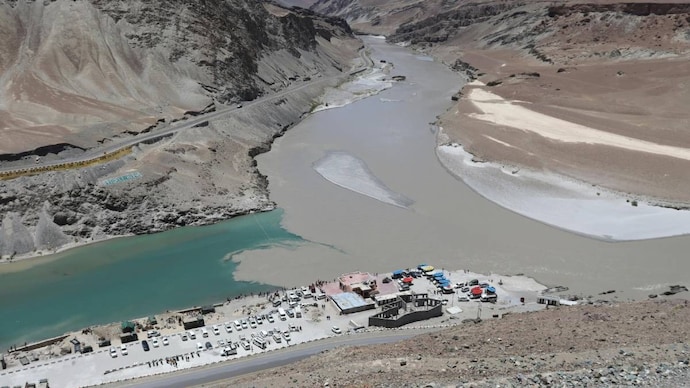
Pakistan's Indus River System Authority (IRSA) reported discharging 11,180 cusecs of additional water than it received on Wednesday, worsening the water crisis. Furthermore, the water levels at the two major reservoirs in Pakistan - Tarbela on the Indus and Mangla on the Jhelum - have dropped to dead storage, thereby indicating the crisis will prevail.

The reservoir water reaching its dead storage levels also means that it cannot be drained out by gravity, thus limiting its use for irrigation or drinking. The water crisis is even stronger in the Punjab province, where the kharif season has started. The kharif farming has witnessed a dip of more than 20 per cent owing to receiving 1.14 lakh cusecs of water as opposed to 1.43 lakh cusecs a day last year.

The production of kharif crops - cotton and maize - has declined by over 30 per cent and 15 per cent in Pakistan, respectively. The production of wheat - a rabi crop - has also dropped by around 9 per cent owing to the water shortage in the country.

With the agricultural industry, especially the kharif outputs impacted, its overall share in Pakistan's GDP dipped to 23.54 per cent in fiscal 2025 from 24.03 per cent the previous financial year.

The situation is expected to deteriorate in the upcoming weeks, especially as India undertakes regular desilting and flushing its dams in Jammu and Kashmir to enhance its own storage capacity. Additionally, with the monsoon still weeks away, IRSA has warned of a 21 per cent water shortage in the early kharif season and 7 per cent towards the end.

Pakistan has been relentless in its efforts to convince India to reinstate the Indus treaty. Last week, India Today reported that Islamabad wrote as many as four letters to Delhi, urging the latter to reconsider its decision to stop the treaty before Operation Sindoor. Sources told India Today TV that Pakistan also requested the World Bank, which brokered the deal, to intervene in the matter. However, the global body refused to mediate in the matter.

The Indus Waters Treaty allocates the eastern rivers - Ravi, Beas and Sutlej - to India and the western ones, such as Jhelum, Chenab and Indus, to Pakistan. Responding to the water move last month, Prime Minister Narendra Modi firmly said that water and blood cannot flow together.

India is also strengthening its water infrastructure, aimed at bettering its domestic storage and strategic hold over the shared waters. This includes new canal projects connecting Beas to Ganga and Indus to Yamuna.

Published By:
sharangee
Published On:
Jun 12, 2025
India’s drive to blacklist Pakistan over terrorism hits a diplomatic wall

India’s drive to blacklist Pakistan over terrorism hits a diplomatic wall
From pariah to partner? Pakistan wins big In Washington as top US General calls Islamabad's anti-terror record 'phenomenal'

Paran Balakrishnan 
Published 12.06.25
THE TELEGRAPH, CALCUTTA


Representational image.Shutterstock

India’s diplomatic blitz to isolate Pakistan has suffered a body blow, with a top US General praising Islamabad’s counter-terror record as “phenomenal.”

General Michael Kurilla, the US commander for the Middle East and Central Asia and South Asia (Centcom), told lawmakers this week that Pakistan has been a “phenomenal partner” in America’s counterterrorism fight.

The ringing endorsement undercut New Delhi’s anti-Pakistan pitch just as an Indian parliamentary delegation was winding down a widely watched visit to Washington led by Congress MP Shashi Tharoor.

“Since the beginning of 2024, Pakistan had over 1,000 terrorist attacks in the western area, killing about 700 security (personnel) and civilians, and 2,500 (were) wounded,” Kurilla said at a House Armed Services Committee hearing.

Kurilla argued in favour of strengthening ties with both India and Pakistan. But he reserved his most fulsome words of praise for Pakistan: “They are in an active counter-terrorism fight right now and they have been a phenomenal partner in the counter-terrorism world,” Kurilla said.

In another serious setback for India’s diplomatic efforts to paint Islamabad as the black sheep, Pakistan’s domestic press is reporting that hardline army chief Asim Munir will arrive in the US on Thursday and attend the US Army’s 250th anniversary parade two days later. The event coincides with Trump’s 79th birthday.

Kurilla testified that US intelligence shared with Islamabad had led to the arrest of at least five ISIS-Khorasan (ISIS-K) terrorists, including Mohammed Sharifullah, suspected of orchestrating a suicide bombing in 2021 at Kabul airport that killed 13 US troops and at least 170 Afghan civilians.

“We’re seeing Pakistan -- with limited intelligence that we provided them -- go after them [terrorists] using their means to do that,” Kurilla added. The General told the committee that ISIS-K spends considerable time in the border areas between Pakistan and Afghanistan because of a rivalry with the Afghan Taliban government.

The General’s words marked a stunning reality check for New Delhi. While India has been lobbying to have Pakistan blacklisted as a state sponsor of terror, far from shunning Pakistan, the US is anxious to keep the Islamic republic firmly onside.

Following the April 22 terror attack in Pahalgam that left 26 men dead, India launched Operation Sindoor, a cross-border military strike targeting Lashkar-e-Taiba and Jaish-e-Mohammed facilities inside Pakistan.

Afterwards, to shore up global support for isolating Pakistan as a terror hub, the Modi government dispatched multi-party delegations around the world, including to the US. That mission, led by Tharoor, met senior US officials, including Deputy Secretary of State Christopher Landau.

In public statements, the State Department has reaffirmed its strategic partnership with India and support for its fight against terrorism. But it has also welcomed a Pakistani delegation led by the country’s former foreign minister, Bilawal Bhutto Zardari, for parallel meetings, including discussions on counterterrorism cooperation.

Asked whether Pakistan had assured the US of action against terror outfits, State Department spokesperson Tammy Bruce would only say that the two sides discussed a range of bilateral issues. She also welcomed the fact there is now a “cessation of on-ground hostilities – as you might imagine, thank God – between India and Pakistan.”

That remark will have irked New Delhi. India has insisted there is no ceasefire – only a “pause,” at Pakistan’s request. Prime Minister Narendra Modi himself declared that Operation Sindoor had not ended. Yet US President Donald Trump has repeatedly claimed credit for mediating the May 10 halt in fighting and has even offered to help resolve the Kashmir dispute -- much to India’s consternation.

Meanwhile, the Pakistanis have been lavishly ladling out praise for Trump. “President Trump is a man against escalation and a man against cold and hot war,” Pakistan Prime Minister Shehbaz Sharif told an audience at the US embassy in Islamabad.

He hailed Trump’s role in “de-escalating” the conflict, saying he had shown beyond any doubt that “he is a man for peace… and beneficial business deals.”

Sharif said the bilateral ties between the US and Pakistan are “entering into renewed friendship, and the close contacts are being revived".

Bhutto-Zardari echoed the praise in Washington, calling for US support in bringing India to the dialogue table. For India, long resistant to any third-party mediation on Kashmir, Trump’s overtures – and Islamabad’s eager embrace of them – highlight a considerable diplomatic setback.

One prominent place where the changes are evident is the United Nations. In a move that caught Indian observers off guard, Pakistan was elected to chair the Taliban Sanctions Committee. It will also act as vice-chair of the Counterterrorism Committee for this year.

Ironically, those committees sprang from US-led efforts to combat Al Qaeda and the Taliban — groups with profound, documented ties to Pakistan’s intelligence service.

For a country long accused of sheltering global terrorists, Pakistan now finds itself overseeing the anti-terror struggle. “Poacher turned gamekeeper,” commented one Indian official privately.

In a reminder that Pakistan still manufactures terrorists, a Pakistani citizen residing in Canada was extradited to the US on Wednesday on charges of attempting to provide material support to ISIS and attempting to commit acts of terrorism. Muhammad Shahzeb Khan is accused of planning a mass shooting in support of ISIS at a Jewish centre in New York.

All these events are playing out against the backdrop of a 20 per cent hike in Pakistan’s defence expenditure to 2.55 trillion Pakistan rupees ($9 billion) for the coming financial year, even as it cuts its overall budget by 6.9 per cent. The hike in defence spending is one of the biggest in decades.

Domestically, the diplomatic reversal doesn’t play well for the Modi government, which had insisted that its muscular foreign policy had de-hyphenated the India-Pakistan story.

In another major development, Pakistan is slated to take over the rotating presidency of the UN Security Council next month — an event that will give it further diplomatic prominence.

At the moment, India’s strategy of isolating Pakistan appears to be running out of road. Trade talks with Washington remain stalled. Russia is helping Pakistan revive a Soviet-era steel plant.

How has Pakistan found its way to Trump’s heart? There’s talk that a deal signed by a Trump family-backed venture with the Pakistan Crypto Council — days after the Pahalgam attack — may have induced Trump to take a more favourable view of Islamabad.

Also Read
Murder-probe promise before G7 summit invite for PM Modi? Canada paper stirs pot


Ironically, that’s why the invitation to Modi for the G7 summit in Canada — after what appeared to be an unusual delay — has taken on outsized importance.

For years now, India has regularly been invited to the G7 summits.This time, just securing the invitation — even to an event hosted by Canada, a country with which India’s relations have been deeply strained in recent years — has felt like a diplomatic win.

Marco Rubio issues first Russia Day greeting by a U.S. secretary of state since 2022


Source: Meduza

The U.S. State Department has published a Russia Day greeting from Secretary of State Marco Rubio, written “on behalf of the American people.”

“The United States remains committed to supporting the Russian people as they continue to build on their aspirations for a brighter future. We also take this opportunity to reaffirm the United States’ desire for constructive engagement with the Russian Federation to bring about a durable peace between Russia and Ukraine. It is our hope that peace will foster more mutually beneficial relations between our countries,” the message reads.

The last time a U.S. secretary of state issued a Russia Day greeting was in 2022, when Antony Blinken held the post. At the time, he wrote that Russians, “like people everywhere, deserve to live their lives free of repression and to be able to exercise their human rights and fundamental freedoms without fear of retribution.”

“Too many Russian citizens are behind bars for the ‘crime’ of speaking truth to power about their government’s actions. This internal repression is occurring as the Kremlin is waging an unprovoked and unjustified war against a sovereign, neighboring state,” Blinken wrote. “Russia’s government is attempting to keep its citizens in the dark about the atrocities it is committing against the people of Ukraine.”

US embassy instructed to avoid Israel's Gay Pride events

For the first time, embassy will skip Tel Aviv Pride and withhold public support for LGBTQ rights, following State Department directive

Itamar Eichner, Lihi Gordon
YNET
Jun 12, 2025 

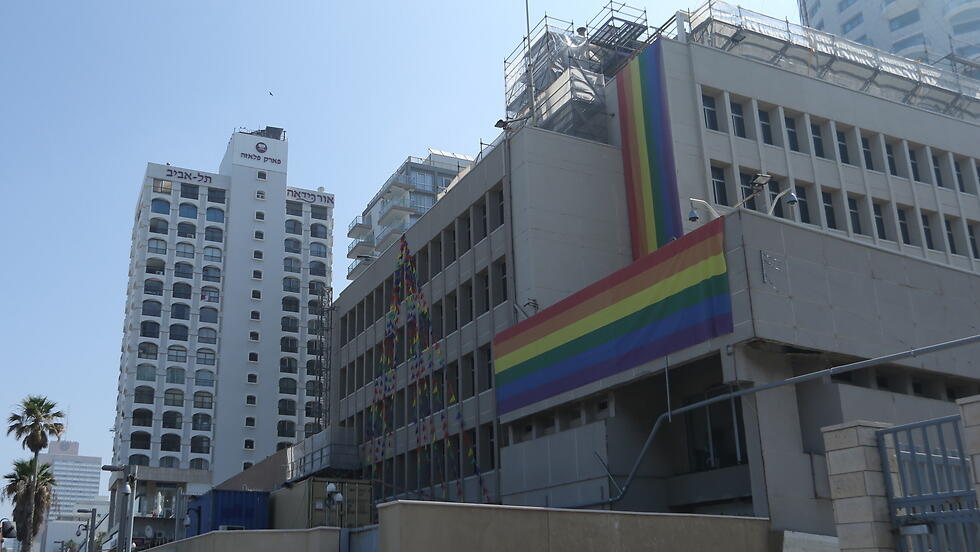
The embassy's Tel Aviv branch, which is located on the route of Friday's Gay Pride parade, has always participated in the celebrations.

 
US Embassy in Tel Aviv covered in Gay Pride flag
(Photo: Yaron Brener)

Embassy staff had marched in the parade and the building was covered with the Gay Pride flag. During U.S. President Donald Trump's first term in office, then-ambassador David Friedman hosted an event celebrating Pride Week, despite being an Orthodox Jew.
The Association for LGBTQ Equality in Israel expressed disappointment, saying it was unfortunate that American diplomats would not be able to join the Pride marchers as they had in the past without fear.

"What begins with harassment of transgenders, soon turns into marginalizing an entire community," the association said in a statement, adding that the State Department directive underscores the necessity of a united struggle.


US President Donald Trump shows support for the LGBTQ community during his first presidential election campaign
(Photo: Getty Images)

"When authorities close doors, we break down walls. See you on Friday because now more than ever, we must all fight for an egalitarian, free and safe future for all."
Since returning to office, President Trump has enacted a wave of anti-LGBTQ policies, including the reversal of Biden-era protections, the elimination of federal recognition for transgender individuals and a ban on their participation in the military and women’s sports.

His administration has also cut funding for LGBTQ youth support services, such as the 988 suicide prevention line and blocked federal coverage of gender-affirming care under Medicaid, Medicare and the Department of Veterans Affairs. These moves, framed by the administration as a rejection of "radical gender ideology," have been widely condemned by human rights advocates as one of the most sweeping rollbacks of LGBTQ rights in U.S. history.


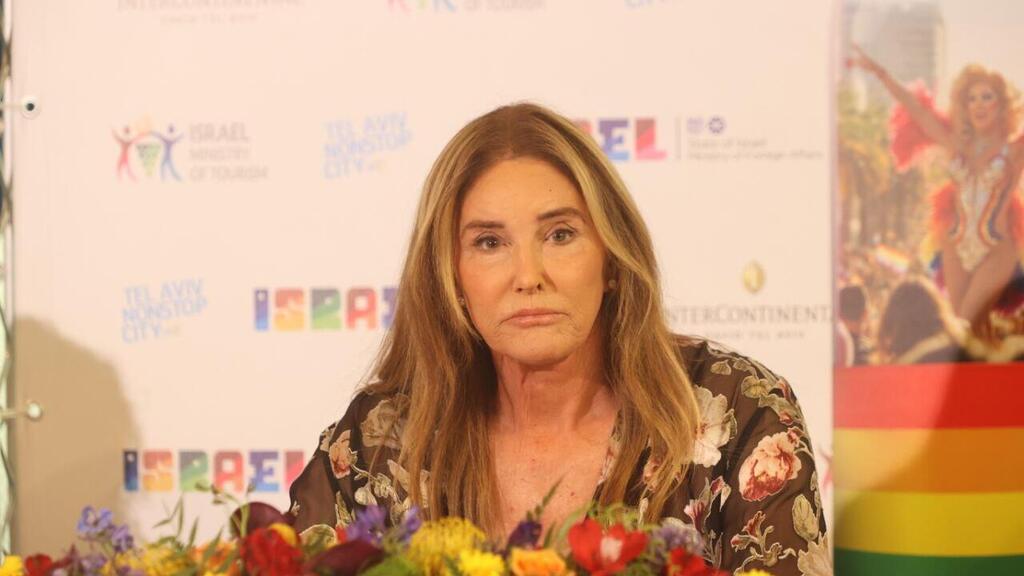
Caitlyn Jenner in Tel Aviv
(Photo: Moti Kimchi)

Meanwhile, Caitlyn Jenner, one of the most prominent transgender figures in the world and a guest of Israel’s Pride Month celebrations, arrived in Tel Aviv on Wednesday.
Speaking at a press conference shortly after landing, she said her visit was intended to “bring a little bit of light in my own small way,” adding, “Each of us can do something small to change the way others see Israel.”