It’s possible that I shall make an ass of myself. But in that case one can always get out of it with a little dialectic. I have, of course, so worded my proposition as to be right either way (K.Marx, Letter to F.Engels on the Indian Mutiny)
Friday, June 13, 2025
SPACE/COSMOS
Revealing the lives of planet-forming disks
New observations of 30 planet-forming disks reveal how gas and dust behave over time and shape the evolution of exoplanet systems
Artist’s concept of a planet-forming disk, like the thirty studied for the ALMA AGE-PRO survey. The lifetime of the gas within the disk determines the timescale for planetary growth.
An international team of astronomers including researchers at the University of Arizona Lunar and Planetary Laboratory has unveiled groundbreaking findings about the disks of gas and dust surrounding nearby young stars, using the powerful Atacama Large Millimeter/submillimeter Array, or ALMA.
The findings, published in 12 papers in a focus issue of the Astrophysical Journal, are part of an ALMA large program called the ALMA Survey of Gas Evolution of PROtoplanetary Disks, or AGE-PRO. AGE-PRO observed 30 planet-forming disks around sunlike stars to measure gas disk mass at different ages. The study revealed that gas and dust components in these disks evolve at different rates.
Prior ALMA observations have examined the evolution of dust in disks; AGE-PRO, for the first time, traces the evolution of gas, providing the first measurements of gas disk masses and sizes across the lifetime of planet-forming disks, according to the project's principal investigator, Ke Zhang of the University of Wisconsin-Madison.
"Now we have both, the gas and the dust," said Ilaria Pascucci, a professor at planetary sciences at the U of A and one of three AGE-PRO co-principal investigators. "Observing the gas is much more difficult because it takes much more observing time, and that's why we have to go for a large program like this one to obtain a statistically significant sample."
A protoplanetary disk swirls around its host star for several million years as its gas and dust evolve and dissipate, setting the timescale for giant planets to form. The disk's initial mass and size, as well as its angular momentum, have a profound influence on the type of planet it could form – gas giants, icy giants or mini-Neptunes – and migration paths of planets. The lifetime of the gas within the disk determines the timescale for the growth of dust particles to an object the size of an asteroid, the formation of a planet and finally the planet's migration from where it was born.
In one of the survey's most surprising findings, the team discovered that as disks age, their gas and dust are consumed at different rates and undergo a shift in gas-to-dust mass ratio as the disks evolve: Unlike the dust, which tends to remain inside the disk over a longer time span, the gas disperses relatively quickly, then more slowly as the disk ages. In other words, planet-forming disks blow off more of their gas when they're young.
Zhang said the most surprising finding is that although most disks dissipate after a few million years, the ones that survive have more gas than expected. This would suggest that gaseous planets like Jupiter have less time to form than rocky planets.
ALMA's unique sensitivity allowed researchers to use faint, so-called molecular lines to study the cold gas in these disks, characteristic wavelengths of a light spectrum that essentially act as "fingerprints," identifying different species of gas molecules. The first large-scale chemical survey of its kind, AGE-PRO targeted 30 planet-forming disks in three star-forming regions, ranging from 1 million to 6 million years in age: Ophiuchus (youngest), Lupus (1-3 million years old), and Upper Scorpius (oldest). Using ALMA, AGE-PRO obtained observations of key tracers of gas and dust masses in disks spanning crucial stages of their evolution, from their earliest formation to their eventual dispersal. This ALMA data will serve as a comprehensive legacy library of spectral line observations for a large sample of disks at different evolutionary stages.
Dingshan Deng, a graduate student at LPL who is the lead author on one of the papers, provided the data reduction – essentially, the image analyses needed to get from radio signals to optical images of the disks – for the star-forming region in the constellation of Lupus (Latin for "wolf").
"Thanks to these new and long observations, we now have the ability to estimate and trace the gas masses, not only for the brightest and better studied disks in that region, but also the smaller and fainter ones," he said. "Thanks to the discovery of gas tracers in many disks where it hadn't been seen before, we now have a well-studied sample covering a wide range of disk masses in the Lupus star-forming region."
"It took years to figure out the proper data reduction approach and analysis to produce the images used in this paper for the gas masses and in many other papers of the collaboration," Pascucci added.
Carbon monoxide is the most widely used chemical tracer in protoplanetary disks, but to thoroughly measure the mass of gas in a disk, additional molecular tracers are needed. AGE-PRO used N2H+, or diazenylium, an ion used as an indicator for nitrogen gas in interstellar clouds, as an additional gas tracer to significantly improve the accuracy of measurements. ALMA's detections were also set up to receive spectral light signatures from other molecules, including formaldehyde, methyl cyanide and several molecular species containing deuterium, a hydrogen isotope.
"Another finding that surprised us was that the mass ratio between the gas and dust tends to be more consistent across disks of different masses than expected," Deng said. "In other words, different-size disks will share a similar gas-to-dust mass ratio, whereas the literature suggested that smaller disks might shed their gas faster."
Funding for this study was provided by the National Science Foundation, the European Research Council, the Alexander von Humboldt Foundation, FONDECYT (Chile) among other sources. For full funding information, see the research paper.
The AGE-PRO program observed 30 protoplanetary disks around sun-like stars to measure how gas disk mass changes with age. The top row illustrates the previously known trend: the fraction of young stars with disks declines over time. The AGE-PRO study, for the first time, shows that the median gas disk mass of the surviving disks also decreases with age. Disks younger than 1 million years typically have several Jupiter masses of gas, but this drops rapidly to below 1 Jupiter mass in older systems. Interestingly, the surviving disks in the 1–3 million and 2–6 million-year age ranges appear to maintain similar median gas masses.
Credit
Carolina Agurto-Gangas and the AGE-PRO collaboration
For the first time, scientists have used Earth-based telescopes to look back over 13 billion years to see how the first stars in the universe affect light emitted from the Big Bang.
Using telescopes high in the Andes mountains of northern Chile, astrophysicists have measured this polarized microwave light to create a clearer picture of one of the least understood epochs in the history of the universe, the Cosmic Dawn.
“People thought this couldn’t be done from the ground. Astronomy is a technology-limited field, and microwave signals from the Cosmic Dawn are famously difficult to measure,” said Tobias Marriage, project leader and a Johns Hopkins professor of physics and astronomy. “Ground-based observations face additional challenges compared to space. Overcoming those obstacles makes this measurement a significant achievement.”
Cosmic microwaves are mere millimeters in wavelength and very faint. The signal from polarized microwave light is about a million times fainter. On Earth, broadcast radio waves, radar, and satellites can drown out their signal, while changes in the atmosphere, weather, and temperature can distort it. Even in perfect conditions, measuring this type of microwave requires extremely sensitive equipment.
Scientists from the U.S. National Science Foundation’s Cosmology Large Angular Scale Surveyor, or CLASS, project used telescopes uniquely designed to detect the fingerprints left by the first stars in the relic Big Bang light—a feat that previously had only been accomplished by technology deployed in space, such as the U.S. National Aeronautics and Space Administration Wilkinson Microwave Anisotropy Probe (WMAP) and European Space Agency Planck space telescopes.
The new research, led by Johns Hopkins University and the University of Chicago, was published today in The Astrophysical Journal.
By comparing the CLASS telescope data with the data from the Planck and WMAP space missions, the researchers identified interference and narrowed in on a common signal from the polarized microwave light.
Polarization happens when light waves run into something and then scatter.
“When light hits the hood of your car and you see a glare, that’s polarization. To see clearly, you can put on polarized glasses to take away glare,” said first author Yunyang Li, who was a PhD student at Johns Hopkins and then a fellow at University of Chicago during the research. “Using the new common signal, we can determine how much of what we’re seeing is cosmic glare from light bouncing off the hood of the Cosmic Dawn, so to speak.”
After the Big Bang, the universe was a fog of electrons so dense that light energy was unable to escape. As the universe expanded and cooled, protons captured the electrons to form neutral hydrogen atoms, and microwave light was then free to travel through the space in between. When the first stars formed during the Cosmic Dawn, their intense energy ripped electrons free from the hydrogen atoms. The research team measured the probability that a photon from the Big Bang encountered one of the freed electrons on its way through the cloud of ionized gas and skittered off course.
The findings will help better define signals coming from the residual glow of the Big Bang, or the cosmic microwave background, and form a clearer picture of the early universe.
“Measuring this reionization signal more precisely is an important frontier of cosmic microwave background research,” said Charles Bennett, a Bloomberg Distinguished Professor at Johns Hopkins who led the WMAP space mission. “For us, the universe is like a physics lab. Better measurements of the universe help to refine our understanding of dark matter and neutrinos, abundant but elusive particles that fill the universe. By analyzing additional CLASS data going forward, we hope to reach the highest possible precision that’s achievable.”
Building on research published last year that used the CLASS telescopes to map 75% of the night sky, the new results also help solidify the CLASS team’s approach.
"No other ground-based experiment can do what CLASS is doing," says Nigel Sharp, program director in the NSF Division of Astronomical Sciences which has supported the CLASS instrument and research team since 2010. "The CLASS team has greatly improved measurement of the cosmic microwave polarization signal and this impressive leap forward is a testament to the scientific value produced by NSF's long-term support."
The CLASS observatory operates in the Parque Astronómico Atacama in northern Chile under the auspices of the Agencia Nacional de Investigación y Desarrollo.
Other collaborators are at Villanova University, the NASA Goddard Space Flight Center, the University of Chicago, the National Institute of Standards and Technology, the Argonne National Laboratory, the Los Alamos National Laboratory, the Harvard-Smithsonian Center for Astrophysics, the University of Oslo, Massachusetts Institute of Technology, and the University of British Columbia. Collaborators in Chile are at the Universidad de Chile, Pontificia Universidad Católica de Chile, Universidad de Concepción, and the Universidad Católica de la Santísima Concepción.
The observatory is funded by the National Science Foundation, Johns Hopkins, and private donors.
From Earth, we always look towards the Sun's equator. This year, the ESA-led Solar Orbiter mission broke free of this ‘standard’ viewpoint by tilting its orbit to 17° – out of the ecliptic plane where the planets and all other Sun-watching spacecraft reside. Now for the first time ever, we can clearly see the Sun’s unexplored poles.
This video starts with the Sun as viewed from Earth. The grey images were taken by the SWAP extreme ultraviolet telescope on ESA’s Proba-2 spacecraft. The dashed red-green lines show the solar latitudes and longitudes (Stonyhurst grid), while the solid yellow lines show the centre of Earth’s view.
We then rotate to Solar Orbiter’s tilted view, shown in yellow, and zoom in to the Sun’s south pole. Solar Orbiter used its Extreme Ultraviolet Imager (EUI) instrument to take these images.
What you see is million-degree charged gas moving in the Sun’s outer atmosphere, the corona. Every now and then, a bright jet or plume lights up this gas.
On 23 March 2025, Solar Orbiter was viewing the Sun from an angle of 17° below the Sun’s equator. Each orbit around the Sun, the spacecraft swings between solar latitudes of -17° and +17°, so it can study both the Sun’s south and north poles, and everything in between.
Solar Orbiter is a space mission of international collaboration between ESA and NASA. The Extreme Ultraviolet Imager (EUI) instrument is led by the Royal Observatory of Belgium (ROB). ESA’s Proba-2 is a space mission dedicated to the demonstration of innovative technologies. Its extreme ultraviolet telescope (SWAP) is led by the Royal Observatory of Belgium.
Credit: ESA & NASA/Solar Orbiter/EUI Team, D. Berghmans (ROB) & ESA/Royal Observatory of Belgium
Thanks to its newly tilted orbit around the Sun, the European Space Agency-led Solar Orbiter spacecraft is the first to image the Sun’s poles from outside the ecliptic plane. Solar Orbiter’s unique viewing angle will change our understanding of the Sun’s magnetic field, the solar cycle and the workings of space weather.
Any image you have ever seen of the Sun was taken from around the Sun’s equator. This is because Earth, the other planets, and all other modern spacecraft orbit the Sun within a flat disc around the Sun called the ecliptic plane. By tilting its orbit out of this plane, Solar Orbiter reveals the Sun from a whole new angle.
The video titled 'EUI video SolarOrbiter Sun south pole' compares Solar Orbiter’s view (in yellow) with the one from Earth (grey), on 23 March 2025. At the time, Solar Orbiter was viewing the Sun from an angle of 17° below the solar equator, enough to directly see the Sun’s south pole. Over the coming years, the spacecraft will tilt its orbit even further, so the best views are yet to come.
“Today we reveal humankind’s first-ever views of the Sun’s pole” says Prof. Carole Mundell, ESA's Director of Science. “The Sun is our nearest star, giver of life and potential disruptor of modern space and ground power systems, so it is imperative that we understand how it works and learn to predict its behaviour. These new unique views from our Solar Orbiter mission are the beginning of a new era of solar science.”
All eyes on the Sun’s south pole
The collage titled 'Collage_SolarOrbiter_FirstPolarObservations' shows the Sun’s south pole as recorded on 16–17 March 2025, when Solar Orbiter was viewing the Sun from an angle of 15° below the solar equator. This was the mission’s first high-angle observation campaign, a few days before reaching its current maximum viewing angle of 17°.
The images shown in the collage were taken by three of Solar Orbiter’s scientific instruments: the Polarimetric and Helioseismic Imager (PHI), the Extreme Ultraviolet Imager (EUI), and the Spectral Imaging of the Coronal Environment (SPICE) instrument. Click on the image to zoom in and see video versions of the data.
“We didn’t know what exactly to expect from these first observations – the Sun’s poles are literally terra incognita,” says Prof. Sami Solanki, who leads the PHI instrument team from the Max Planck Institute for Solar System Research (MPS) in Germany.
The instruments each observe the Sun in a different way. PHI images the Sun in visible light (top left of the collage) and maps the Sun’s surface magnetic field (top centre). EUI images the Sun in ultraviolet light (top right), revealing the million-degree charged gas in the Sun’s outer atmosphere, the corona. The SPICE instrument (bottom row) captures light coming from different temperatures of charged gas above the Sun’s surface, thereby revealing different layers of the Sun's atmosphere.
By comparing and analysing the complementary observations made by these three imaging instruments, we can learn about how material moves in the Sun’s outer layers. This may reveal unexpected patterns, such as polar vortices (swirling gas) similar to those seen around the poles of Venus and Saturn.
These groundbreaking new observations are also key to understanding the Sun’s magnetic field and why it flips roughly every 11 years, coinciding with a peak in solar activity. Current models and predictions of the 11-year solar cycle fall short of being able to predict exactly when and how powerfully the Sun will reach its most active state.
Messy magnetism at solar maximum
One of the first scientific findings from Solar Orbiter’s polar observations is the discovery that at the south pole, the Sun’s magnetic field is currently a mess. While a normal magnet has a clear north and south pole, the PHI instrument’s magnetic field measurements show that both north and south polarity magnetic fields are present at the Sun’s south pole.
This happens only for a short time during each solar cycle, at solar maximum, when the Sun’s magnetic field flips and is at its most active. After the field flip, a single polarity should slowly build up and take over the Sun’s poles. In 5–6 years from now, the Sun will reach its next solar minimum, during which its magnetic field is at its most orderly and the Sun displays its lowest levels of activity.
“How exactly this build-up occurs is still not fully understood, so Solar Orbiter has reached high latitudes at just the right time to follow the whole process from its unique and advantageous perspective,” notes Sami.
PHI’s view of the full Sun’s magnetic field puts these measurements in context (see 'PHI_south-pole-Bmap' and 'PHI_global-Bmap_20250211-20250429'). The darker the colour (red/blue), the stronger the magnetic field is along the line of sight from Solar Orbiter to the Sun.
The strongest magnetic fields are found in two bands either side of the Sun’s equator. The dark red and dark blue regions highlight active regions, where magnetic field gets concentrated in sunspots on the Sun’s surface (photosphere).
Meanwhile, both the Sun’s south and north poles are speckled with red and blue patches. This demonstrates that at small scales, the Sun’s magnetic field has a complex and ever-changing structure.
SPICE measures movement for the first time
Another interesting ‘first’ for Solar Orbiter comes from the SPICE instrument. Being an imaging spectrograph, SPICE measures the light (spectral lines) sent out by specific chemical elements – among which hydrogen, carbon, oxygen, neon and magnesium – at known temperatures. For the last five years, SPICE has used this to reveal what happens in different layers above the Sun’s surface.
Now for the first time, the SPICE team has also managed to use precise tracking of spectral lines to measure how fast clumps of solar material are moving. This is known as a ‘Doppler measurement’, named after the same effect that makes passing ambulance sirens change pitch as they drive by.
The resulting velocity map reveals how solar material moves within a specific layer of the Sun. By comparing the SPICE doppler and intensity maps, you can directly compare the location and movement of particles (carbon ions) in a thin layer called the 'transition region’, where the Sun's temperature rapidly increases from 10 000 °C to hundreds of thousands of degrees.
The SPICE intensity map reveals the locations of clumps of carbon ions. The SPICE doppler map includes the blue and red colours to indicate how fast the carbon ions are moving towards and away from the Solar Orbiter spacecraft, respectively. Darker blue and red patches are related to material flowing faster due to small plumes or jets.
Crucially, Doppler measurements can reveal how particles are flung out from the Sun in the form of solar wind. Uncovering how the Sun produces solar wind is one of Solar Orbiter’s key scientific goals.
“Doppler measurements of solar wind setting off from the Sun by current and past space missions have been hampered by the grazing view of the solar poles. Measurements from high latitudes, now possible with Solar Orbiter, will be a revolution in solar physics,” says SPICE team leader, Frédéric Auchère from the University of Paris-Saclay (France).
The best is yet to come
These are just the first observations made by Solar Orbiter from its newly inclined orbit, and much of this first set of data still awaits further analysis. The complete dataset of Solar Orbiter's first full ‘pole-to-pole' flight past the Sun is expected to arrive on Earth by October 2025. All ten of Solar Orbiter’s scientific instruments will collect unprecedented data in the years to come.
“This is just the first step of Solar Orbiter's 'stairway to heaven': in the coming years, the spacecraft will climb further out of the ecliptic plane for ever better views of the Sun's polar regions. These data will transform our understanding of the Sun’s magnetic field, the solar wind, and solar activity,” notes Daniel Müller, ESA’s Solar Orbiter project scientist.
Notes for editors
Solar Orbiter is the most complex scientific laboratory ever to study our life-giving star, taking images of the Sun from closer than any spacecraft before and being the first to look at its polar regions.
In February 2025, Solar Orbiter officially began the ‘high latitude’ part of its journey around the Sun by tilting its orbit to an angle of 17° with respect to the Sun’s equator. In contrast, the planets and all other Sun-observing spacecraft orbit in the ecliptic plane, tilted at most 7° from the solar equator.
The only exception to this is the ESA/NASA Ulysses mission (1990–2009), which flew over the Sun's poles but did not carry any imaging instruments. Solar Orbiter's observations will complement Ulysses’ by observing the poles for the first time with telescopes, in addition to a full suite of in-situ sensors, while flying much closer to the Sun. Additionally, Solar Orbiter will monitor changes at the poles throughout the solar cycle.
Solar Orbiter will continue to orbit around the Sun at this tilt angle until 24 December 2026, when its next flight past Venus will tilt its orbit to 24°. From 10 June 2029, the spacecraft will orbit the Sun at an angle of 33°. (Overview of Solar Orbiter's journey around the Sun.)
Solar Orbiter is a space mission of international collaboration between ESA and NASA, operated by ESA. Solar Orbiter's Polarimetric and Helioseismic Imager (PHI) instrument is led by the Max Planck Institute for Solar System Research (MPS), Germany. The Extreme Ultraviolet Imager (EUI) instrument is led by the Royal Observatory of Belgium (ROB). The Spectral Imaging of the Coronal Environment (SPICE) instrument is a European-led facility instrument, led by the Institut d'Astrophysique Spatiale (IAS) in Paris, France.
Solar Orbiter's world-first views of the Sun's south pole
This collage shows Solar Orbiter's view of the Sun's south pole on 16–17 March 2025, from a viewing angle of around 15° below the solar equator. This was the mission’s first high-angle observation campaign, a few days before reaching its current maximum viewing angle of 17°.
Until now, spacecraft (and ground-based telescopes) have never been able to clearly see the Sun's poles, because none ever reached further than 7° from the Sun's equator. (The ESA/NASA Ulysses mission (1990–2009) flew over the Sun's poles but did not carry any imaging instruments.)
These data were recorded by three of Solar Orbiter’s scientific instruments: the Polarimetric and Helioseismic Imager (PHI), the Extreme Ultraviolet Imager (EUI), and the Spectral Imaging of the Coronal Environment (SPICE) instrument. The instruments each observe the Sun in a different way.
PHI captures the visible light sent out by iron particles (617.3 nanometre wavelength, top left), revealing the Sun's surface (photosphere). PHI also maps the Sun’s surface magnetic field along the spacecraft's line of sight (top centre). In this map, blue indicates positive magnetic field, pointing towards the spacecraft, and red indicates negative magnetic field.
EUI images the Sun in ultraviolet light (17.4 nanometre wavelength, top right), revealing the million-degree charged gas in the Sun’s outer atmosphere, the corona. This high-energy light is sent out by charged iron particles.
The SPICE instrument (various wavelengths, bottom row) captures light coming from different layers above the Sun's surface, from the chromosphere right above the Sun's surface all the way to the Sun's corona. Each image captured by SPICE shows different temperatures of charged gas, at 10 000 °C, 32 000 °C, 320 000 °C, 630 000 °C and 1 000 000 °C.
By comparing and analysing the complementary observations made by these three imaging instruments, we can learn about how material moves in the Sun’s outer layers. This may reveal unexpected patterns, such as polar vortices (swirling gas) similar to those seen around the poles of Venus and Saturn.
These groundbreaking new observations are also key to understanding the Sun’s magnetic field and why it flips roughly every 11 years, coinciding with a peak in solar activity. Current models and predictions of the 11-year solar cycle fall short of being able to predict exactly when and how powerfully the Sun will reach its most active state.
Solar Orbiter is a space mission of international collaboration between ESA and NASA. Solar Orbiter's Polarimetric and Helioseismic Imager (PHI) instrument is led by the Max Planck Institute for Solar System Research (MPS), Germany. The Extreme Ultraviolet Imager (EUI) instrument is led by the Royal Observatory of Belgium (ROB). The Spectral Imaging of the Coronal Environment (SPICE) instrument is a European-led facility instrument, led by the Institut d'Astrophysique Spatiale (IAS) in Paris, France.
Credit
ESA & NASA/Solar Orbiter/PHI, EUI and SPICE Teams
PHI sees mixed-up magnetism at the Sun's south pole
Since 2025, Solar Orbiter is the first Sun-watching spacecraft to ever get a clear look at the Sun's poles. It discovered that at the south pole, the Sun’s magnetic field is currently a mess.
This image shows a magnetic field map from Solar Orbiter's Polarimetric and Helioseismic Imager (PHI) instrument, centred on the Sun's south pole. Blue indicates positive magnetic field, pointing towards the spacecraft, and red indicates negative magnetic field.
There are clear blue and red patches visible right up to the Sun's south pole, indicating that there are different magnetic polarities present (north and south). This happens only for a short time during each solar cycle, at solar maximum, when the Sun’s magnetic field flips and is at its most active. After the field flip, a single magnetic polarity should slowly build up and take over the Sun’s poles.
Solar Orbiter will be watching the Sun throughout its calming-down phase. In 5–6 years from now, the Sun will reach its next solar minimum, during which its magnetic field is at its most orderly and the Sun has the lowest levels of activity.
Solar Orbiter is a space mission of international collaboration between ESA and NASA. Solar Orbiter's Polarimetric and Helioseismic Imager (PHI) instrument is led by the Max Planck Institute for Solar System Research (MPS), Germany.
Credit
ESA & NASA/Solar Orbiter/PHI Team, J. Hirzberger (MPS)
PHI's pole-to-pole view of the Sun's magnetic field
This video shows a magnetic map of the Sun's surface, recorded by the ESA-led Solar Orbiter mission between 11 February and 29 April 2025. Thanks to its newly and uniquely tilted orbit, the spacecraft got its first-ever clear views of the Sun's south and north pole in this period.
The darker the colour (red/blue), the stronger the magnetic field is along the line of sight from Solar Orbiter to the Sun. These maps were recorded by the mission's Polarimetric and Helioseismic Imager (PHI) instrument.
The strongest magnetic fields are found in two bands on either side of the Sun’s equator. The dark red and dark blue regions highlight active regions, where magnetic field gets concentrated in sunspots on the Sun’s surface.
Meanwhile, both the Sun’s south and north poles are speckled with red and blue patches. This demonstrates that at small scales, the Sun’s magnetic field has a complex and ever-changing structure.
Typically, you would expect to see a single magnetic polarity (north/south) dominate at each pole. The fact that both polarities are visible right up to the poles is thanks to the Sun being at ‘solar maximum’, the phase of the solar cycle where the Sun's magnetic field flips.
Over the next few years, Solar Orbiter will witness how the Sun's magnetic field calms down to a more ordered state.
Solar Orbiter is a space mission of international collaboration between ESA and NASA. Solar Orbiter's Polarimetric and Helioseismic Imager (PHI) instrument is led by the Max Planck Institute for Solar System Research (MPS), Germany.
Credit
ESA & NASA/Solar Orbiter/PHI Team, J. Hirzberger (MPS)
Why Solar Orbiter is angling towards the Sun's poles
All images you have ever seen of the Sun were taken from near the Sun's equator, from within the ecliptic plane where all planets and nearly all spacecraft orbit the Sun. In February 2025, Solar Orbiter became the first Sun-watching spacecraft ever to tilt its orbit out of the ecliptic plane.
In June 2025, the ESA-led mission to provided humanity with the first-ever clear views of the Sun's south pole. All ten of Solar Orbiter’s scientific instruments will collect unprecedented data in the years to come.
As we've never clearly seen the poles before, Solar Orbiter may uncover unexpected structures or movements, including polar vortices (swirling gas) similar to those seen around the poles of Venus and Saturn. Additionally, more of the Sun's magnetic field at the poles opens up to space, and Solar Orbiter will be able to see how this changes throughout the solar cycle.
Solar Orbiter’s groundbreaking high-latitude observations are key to understanding the Sun’s magnetic field and why it flips roughly every 11 years, coinciding with a peak in solar activity. Current models and predictions of the 11-year solar cycle fall short of being able to predict exactly when and how powerfully the Sun will reach its most active state.
Additionally, particle and magnetic field detectors on the spacecraft will be the first to track the movement of solar material – including solar wind, bursts of charged particles called coronal mass ejections, and particles moving close to the speed of light – away from the Sun’s equator. This can inform and improve space weather forecasts, important for reducing its impact on Earth.
Finally, measurements of the Sun’s magnetic field at higher latitudes allow Solar Orbiter to map more of the Sun’s global magnetic field as it changes throughout the solar cycle. While the Polarimetric and Helioseismic Imager (PHI) instrument can measure local magnetic fields at the Sun’s surface, Solar Orbiter’s magnetometer (MAG) instrument measures the magnetic field near the spacecraft. The latter can reveal the large-scale structure of the Sun’s magnetic field.
Solar Orbiter is a space mission of international collaboration between ESA and NASA.
Credit
ESA & NASA/Solar Orbiter Acknowledgements: ATG Europe. Sun images based on data from ESA & NASA/Solar Orbiter/EUI and SPICE Teams.
SPICE sees the Sun's south pole
The Spectral Imaging of the Coronal Environment (SPICE) instrument on the ESA-led Solar Orbiter spacecraft got its first good look at the Sun's south pole in March 2025.
With this intensity map, and the associated doppler map, we compare two of SPICE's views of the Sun's south pole, both based on measurements of the light sent out by charged particles (ions) of carbon at a temperature of 32 000 °C. These ions live in the transition region, a thin layer around the Sun where the temperature rapidly increases from around 10 000 °C to hundreds of thousands of degrees.
This intensity map reveals the locations of clumps of carbon ions.
Solar Orbiter is a space mission of international collaboration between ESA and NASA. The Spectral Imaging of the Coronal Environment (SPICE) instrument is a European-led facility instrument, led by the Institut d'Astrophysique Spatiale (IAS) in Paris, France.
Credit
ESA & NASA/Solar Orbiter/SPICE Team, M. Janvier (ESA) & J. Plowman (SwRI)
SPICE sees the Sun's south pole
The Spectral Imaging of the Coronal Environment (SPICE) instrument on the ESA-led Solar Orbiter spacecraft got its first good look at the Sun's south pole in March 2025.
With this doppler map and the associated intensity map, we compare two of SPICE's views of the Sun's south pole, both based on measurements of the light sent out by charged particles (ions) of carbon at a temperature of 32 000 °C. These ions live in the transition region, a thin layer around the Sun where the temperature rapidly increases from around 10 000 °C to hundreds of thousands of degrees.
This velocity map uses blue and red to indicate how fast the carbon ions are moving towards and away from the Solar Orbiter spacecraft, respectively. Darker blue and red patches are related to plasma flowing faster due to small plumes or jets.
Solar Orbiter is a space mission of international collaboration between ESA and NASA. The Spectral Imaging of the Coronal Environment (SPICE) instrument is a European-led facility instrument, led by the Institut d'Astrophysique Spatiale (IAS) in Paris, France.
Credit
ESA & NASA/Solar Orbiter/SPICE Team, M. Janvier (ESA) & J. Plowman (SwRI)
NASA’s CODEX captures unique views of Sun’s outer atmosphere
The Sun continuously radiates material in the form of the solar wind. The Sun’s magnetic field shapes this material, sometimes creating flowing, ray-like formations called coronal streamers. In this view from NASA’s CODEX instrument, large dark spots block much of the bright light from the Sun. Blocking this light allows the instrument's sensitive equipment to capture the faint light of the Sun’s outer atmosphere.
NASA’s CODEX Captures Unique Views of Sun’s Outer Atmosphere
Article Publication Date
10-Jun-2025
Disclaimer: AAAS and EurekAlert! are not responsible for the accuracy of news releases posted to EurekAlert! by contributing institutions or for the use of any information through the EurekAlert system.
NASA missions use coronagraphs to study the Sun in various ways, but that doesn’t mean they all see the same thing. Coronagraphs on the joint NASA-ESA Solar and Heliospheric Observatory (SOHO) mission look at visible light from the solar corona with both a wide field of view and a smaller one. The CODEX instrument’s field of view is somewhere in the middle, but looks at blue light to understand temperature and speed variations in the background solar wind.
In this composite image of overlapping solar observations, the center and left panels show the field-of-view coverage of the different coronagraphs with overlays and are labeled with observation ranges in solar radii. The third panel shows a zoomed-in, color-coded portion of the larger CODEX image. It highlights the temperature ratios in that portion of the solar corona using CODEX 405.0 and 393.5 nm filters.
NASA’s Coronal Diagnostic Experiment, or CODEX, has just delivered its first images — and they’re stunning! Mounted on the exterior of the International Space Station, CODEX is a solar coronagraph designed to block out bright light from the Sun to reveal our star’s outer atmosphere, or corona.
This mission gives scientists an unprecedented look at solar dynamics right from low Earth orbit. Watch the video to see these amazing images and find out what makes CODEX so unique!
Credit
Video Credit: NASA/Beth Anthony Music Credit: “Aglow and Just So – Instrumental” by Jay Price [PRS] via Universal Production Music Sound Effects: pixabay.com Additional Graphics: vecteezy.com
Rice students develop an award-winning adaptive exercise harness for astronauts to use in space
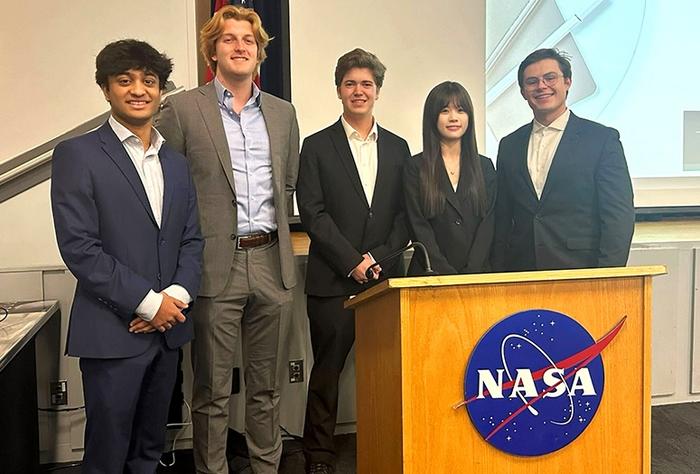
A team of Rice engineering students has designed an innovative space exercise harness that won this year's Technology Collaboration Center’s Wearables Workshop and University Challenge. Their design answered a challenge posed by the HumanWorks Lab and Life Science Labs at NASA and Johnson Space Center.
In the reduced-gravity space environment, human muscles and bones atrophy faster than they do on Earth. To slow down that process, astronauts need several hours of vigorous exercise each day they are on a space mission. This requirement for regular rigorous exercise is expected to become more stringent in future manned space missions, which are expected to last longer, involve more challenging conditions and require astronauts to perform more demanding and complex spacewalks.
A team of Rice University students mentored by Vanessa Sanchez at the George R. Brown School for Engineering and Computing have designed an innovative space exercise harness that is comfortable, responsive and adaptable to new exercise modalities.
“Exercise harnesses that astronauts use now have notable limitations — they are uncomfortable and can cause chafing and bruising. So a primary goal of this challenge was to design an adaptive harness with better fit and comfort,” said Sanchez, assistant professor of mechanical engineering. “Our student-led team addressed this issue by adding pneumatic padding that offers a customized fit, distributes pressure over a large surface area to reduce discomfort or injuries and also seamlessly adapts to load shifts — all of which together improved astronauts’ performance.”
Current space-based exercise harnesses also have outdated technology. The team of undergraduates Emily Yao, Nikhil Ashri, Jose Noriega and Ben Bridges and graduate student Jack Kalicak had a secondary goal to modernize the exercise harness with sensors for astronauts to customize their workouts using real-time data and feedback. The Rice researchers added two sensors to measure astronauts’ comfort and exercise performance: The first measures temperature and humidity changes during exercise, while the second measures load distribution at common pressure points such as the shoulder and hips.
“Taking the lead on the electrical hardware and software systems and working closely with the rest of the team to seamlessly integrate them gave me a great introduction to collaborative engineering and how different parts come together to build a unified system,” Ashri said.
As space missions get longer and more complex, it is expected that astronauts will need a variety of new kinds of exercise routines to counteract the negative effects of reduced or no gravity. Future spacecrafts are also expected to be more compact with more weight restrictions. Thus, an important goal of the challenge was to design a lighter harness that can be adapted to new exercise modalities in the future. The team did this by adding more modular attachments and increased attachment points to target more muscle groups and better balance the load distribution.
The Rice engineering students developed this new harness in response to a challenge posted by the HumanWorks Lab and Life Science Labs at NASA and Johnson Space Center for the 2025 Technology Collaboration Center’s (TCC) Wearables Workshop and University Challenge.
“The TCC University Challenge is a highly anticipated annual competition organized by TCC, a multi-institutional coalition that facilitates industry, government and academic collaborations to solve real-world problems,” Kalicak said. “It was exciting and enriching to participate and compete with more than a dozen teams from other universities around the country to develop novel design solutions to 11 real-life technical challenges identified by industry leaders like ExxonMobil and NASA.”
This spring, experts from diverse fields ranging from biotech and oil and gas to space gathered at the Johnson Space Center in Houston for the competition and chose this adaptive harness as the winner for the Best Challenge Response Award.
“This challenge gave us the freedom to innovate and explore possibilities beyond the current harness technology,” Yao said. “I’m especially proud of how our team worked together to build a working prototype that not only has real-world impact but also provides a foundation that NASA and space companies can build and iterate upon. This makes the entire experience incredibly rewarding. It’s moments like these that remind me why I love designing with and for people.”
“It was very fulfilling to watch these young engineers work together to find innovative and tangible solutions to real-world problems,” Sanchez said. “They did impressive work researching the challenge, exploring potential approaches and coming up with creative design solutions to address a challenge that NASA and other space agencies around the world face. This innovative adjustable exercise harness transforms how astronauts exercise in space and will significantly improve their health and safety during spaceflights.”
This project was funded by the National Science Foundation and Rice’s Office of Undergraduate Research and Inquiry.
- By Raji Natarajan, science writer for the George R. Brown School of Engineering and Computing
The Apollo astronauts didn’t know what they’d find when they explored the surface of the moon, but they certainly didn’t expect to see drifts of tiny, bright orange glass beads glistening among the otherwise monochrome piles of rocks and dust.
The beads, each less than 1 mm across, formed some 3.3 to 3.6 billion years ago during volcanic eruptions on the surface of the then-young satellite. “They’re some of the most amazing extraterrestrial samples we have,” said Ryan Ogliore, an associate professor of physics in Arts & Sciences at Washington University in St. Louis, home to a large repository of lunar samples that were returned to Earth. “The beads are tiny, pristine capsules of the lunar interior.”
Using a variety of microscopic analysis techniques not available when the Apollo astronauts first returned samples from the moon, Ogliore and a team of researchers have been able to take a close look at the microscopic mineral deposits on the outside of lunar beads. The unprecedented view of the ancient lunar artifacts was published in Icarus. The investigation was led by Thomas Williams, Stephen Parman and Alberto Saal from Brown University.
The study relied, in part, on the NanoSIMS 50, an instrument at WashU that uses a high-energy ion beam to break apart small samples of material for analysis. WashU researchers have used the device for decades to study interplanetary dust particles, presolar grains in meteorites, and other small bits of debris from our solar system.
The study combined a variety of techniques — atom probe tomography, scanning electron microscopy, transmission electron microscopy and energy dispersive X-ray spectroscopy — at other institutions to get a closer look at the surface of the beads. “We’ve had these samples for 50 years, but we now have the technology to fully understand them,” Ogliore said. “Many of these instruments would have been unimaginable when the beads were first collected.”
As Ogliore explained, each glass bead tells its own story of the moon’s past. The beads — some shiny orange, some glossy black — formed when lunar volcanoes shot material from the interior to the surface, where each drop of lava solidified instantly in the cold vacuum that surrounds the moon. “The very existence of these beads tells us the moon had explosive eruptions, something like the fire fountains you can see in Hawaii today,” he said. Because of their origins, the beads have a color, shape and chemical composition unlike anything found on Earth.
Tiny minerals on the surface of the beads could react with oxygen and other components of Earth’s atmosphere. To avoid this possibility, the researchers extracted beads from deep within samples and kept them protected from air exposure through every step of the analysis. “Even with the advanced techniques we used, these were very difficult measurements to make,” Ogliore said.
The minerals (including zinc sulfides) and isotopic composition of the bead surfaces serve as probes into the different pressure, temperature and chemical environment of lunar eruptions 3.5 billion years ago. Analyses of orange and black lunar beads have shown that the style of volcanic eruptions changed over time. “It’s like reading the journal of an ancient lunar volcanologist,” Ogliore said.
One of the most interesting galaxies of the study, dubbed 41028 (the green oval at center), has an estimated stellar mass of just 2 million Suns — comparable to the masses of the largest star clusters in our own Milky Way galaxy.
Credit: NASA/ESA/CSA/Bezanson et al. 2024 and Wold et al. 2025
Astronomers using data from NASA’s James Webb Space Telescope have identified dozens of small galaxies that played a starring role in a cosmic makeover that transformed the early universe into the one we know today.
“When it comes to producing ultraviolet light, these small galaxies punch well above their weight,” said Isak Wold, an assistant research scientist at Catholic University of America in Washington and NASA’s Goddard Space Flight Center in Greenbelt, Maryland. “Our analysis of these tiny but mighty galaxies is 10 times more sensitive than previous studies, and shows they existed in sufficient numbers and packed enough ultraviolet power to drive this cosmic renovation.”
Wold discussed his findings Wednesday at the 246th meeting of the American Astronomical Society in Anchorage, Alaska. The study took advantage of existing imaging collected by Webb’s NIRCam (Near-Infrared Camera) instrument, as well as new observations made with its NIRSpec (Near-Infrared Spectrograph) instrument.
The tiny galaxies were discovered by Wold and his Goddard colleagues, Sangeeta Malhotra and James Rhoads, by sifting through Webb images captured as part of the UNCOVER (Ultradeep NIRSpec and NIRCam ObserVations before the Epoch of Reionization) observing program, led by Rachel Bezanson at the University of Pittsburgh in Pennsylvania.
The project mapped a giant galaxy cluster known as Abell 2744, nicknamed Pandora’s cluster, located about 4 billion light-years away in the southern constellation Sculptor. The cluster’s mass forms a gravitational lens that magnifies distant sources, adding to Webb’s already considerable reach.
For much of its first billion years, the universe was immersed in a fog of neutral hydrogen gas. Today, this gas is ionized — stripped of its electrons. Astronomers, who refer to this transformation as reionization, have long wondered which types of objects were most responsible: big galaxies, small galaxies, or supermassive black holes in active galaxies. As one of its main goals, NASA’s Webb was specifically designed to address key questions about this major transition in the history of the universe.
Recent studies have shown that small galaxies undergoing vigorous star formation could have played an outsized role. Such galaxies are rare today, making up only about 1% of those around us. But they were abundant when the universe was about 800 million years old, an epoch astronomers refer to as redshift 7, when reionization was well underway.
The team searched for small galaxies of the right cosmic age that showed signs of extreme star formation, called starbursts, in NIRCam images of the cluster.
“Low-mass galaxies gather less neutral hydrogen gas around them, which makes it easier for ionizing ultraviolet light to escape,” Rhoads said. “Likewise, starburst episodes not only produce plentiful ultraviolet light — they also carve channels into a galaxy’s interstellar matter that helps this light break out.”
The astronomers looked for strong sources of a specific wavelength of light that signifies the presence of high-energy processes: a green line emitted by oxygen atoms that have lost two electrons. Originally emitted as visible light in the early cosmos, the green glow from doubly ionized oxygen was stretched into the infrared as it traversed the expanding universe and eventually reached Webb’s instruments.
This technique revealed 83 small starburst galaxies as they appear when the universe was 800 million years old, or about 6% of its current age of 13.8 billion years. The team selected 20 of these for deeper inspection using NIRSpec.
“These galaxies are so small that, to build the equivalent stellar mass of our own Milky Way galaxy, you’d need from 2,000 to 200,000 of them,” Malhotra said. “But we are able to detect them because of our novel sample selection technique combined with gravitational lensing.”
Similar types of galaxies in the present-day universe, such as green peas, release about 25% of their ionizing ultraviolet light into surrounding space. If the low-mass starburst galaxies explored by Wold and his team release a similar amount, they can account for all of the ultraviolet light needed to convert the universe’s neutral hydrogen to its ionized form.
The James Webb Space Telescope is the world's premier space science observatory. Webb is solving mysteries in our solar system, looking beyond to distant worlds around other stars, and probing the mysterious structures and origins of our universe and our place in it. Webb is an international program led by NASA with its partners, ESA (European Space Agency) and CSA (Canadian Space Agency).
White diamonds show the locations of 20 of the 83 young, low-mass, starburst galaxies found in infrared images of the giant galaxy cluster Abell 2744. This composite incorporates images taken through three NIRCam filters (F200W as blue, F410M as green, and F444W as red). The F410M filter is highly sensitive to light emitted by doubly ionized oxygen — oxygen atoms that have been stripped of two electrons — at a time when reionization was well underway. Emitted as green light, the glow was stretched into the infrared as it traversed the expanding universe over billions of years. The cluster’s mass acts as a natural magnifying glass, allowing astronomers to see these tiny galaxies as they were when the universe was about 800 million years old.
At left is an enlarged infrared view of galaxy cluster Abell 2744 with three young, star-forming galaxies highlighted by green diamonds. The center column shows close-ups of each galaxy, along with their designations, the amount of magnification provided by the cluster’s gravitational lens, their redshifts (shown as z — all correspond to a cosmic age of about 790 million years), and their estimated mass of stars. At right, measurements from NASA’s James Webb Space Telescope’s NIRSpec instrument confirm that the galaxies produce strong emission in the light of doubly ionized oxygen (green bars), indicating vigorous star formation is taking place.
Credit
NASA/ESA/CSA/Bezanson et al. 2024 and Wold et al. 2025
In the belly of the beast: massive clumps reveal star factories from a bygone era of the cosmos
Surveying luminous infrared galaxies in the local universe, astronomers have obtained a rare glimpse into processes shaping galaxies in the very early universe and possibly the Milky Way a few billion years from now.
This artist's illustration shows a stage in the predicted merger between our Milky Way galaxy and the neighboring Andromeda galaxy, as it will unfold over the next several billion years. In this image, representing Earth's night sky in 3.75 billion years, Andromeda (left) fills the field of view and begins to distort the Milky Way with tidal pull.
Credit: NASA; ESA; Z. Levay and R. van der Marel, STScI; T. Hallas; and A. Mellinger
Astronomers have surveyed massive, dense star factories, unlike any found in the Milky Way, in a large number of galaxies across the local universe. The findings provide a rare glimpse into processes shaping galaxies in the very early universe and possibly the Milky Way a few billion years from now.
Known as luminous and ultra-luminous infrared galaxies, or LIRGs and ULIRGs, these galaxies are relatively rare in the local universe, with only 202 known within 400 megaparsecs (1.3 billion light-years) from Earth, according to Sean Linden, a research associate at the University of Arizona Steward Observatory, who presented the findings during a press briefing at the 246th meeting of the American Astronomical Society on June 11.
LIRGs and ULIRGs differ from spiral galaxies like the Milky Way in that they are in the process of merging with other galaxies. Most exhibit features such as two galactic nuclei instead of one or extended "tails" as gravity stretches and deforms the two objects. And unlike "modern" galaxies, they contain "clumps" – dense regions brimming with newborn stars, much more massive than anything found in "typical," evolved galaxies that are not undergoing mergers.
"These galaxies are very clumpy, very different from the beautiful spiral galaxies that we see now, such as the Milky Way," Linden said. "And we know from cosmological simulations that these clumps were the building blocks of galaxies in the early universe."
Astronomers are interested in LIRGs and ULIRGs because they serve as windows into a distant past when the universe was much younger and galaxies were much less evolved and crashed into each other much more frequently than today.
This is where the Great Observatories All-sky LIRG Survey comes in, or GOALS for short. It combines imaging and spectroscopic data from NASA's Spitzer, Hubble, Chandra and GALEX spaceborne observatories in a comprehensive study of more than 200 of the most luminous infrared-selected galaxies in the local universe. Now, infrared observations with NASA's James Webb Space Telescope have provided the most complete census of these galaxies. Running from October 2023 until September 2024, the survey is the only of its kind. The team plans to publish the results in a forthcoming issue of The Astrophysical Journal.
"You can imagine a million suns forming in one small, compact region, and within one of those galaxies, there are hundreds of thousands of such clumps," Linden said.
For comparison, the most massive young clumps in the Milky Way have masses of about 1,000 suns and, on average, one star is born each year.
When two galaxies collide and merge, star formation rates increase dramatically, Linden explained, resulting in the massive clumps that are not seen in other galaxies that are not undergoing mergers.
"These clumpy structures build up over time until they become incredibly massive, and if we want to understand them and how they actually contribute to galaxies evolving throughout cosmic time, we need to study them in detail," Linden said.
Although star-forming clumps had already been observed with the Hubble Space Telescope, only the infrared capabilities of JWST allowed astronomers to pull aside the veils of thick dust that had prevented them from obtaining a more detailed look at these features.
The survey results also confirm predictions of galaxy evolution based on simulations done by supercomputers, which predicted that "typical," disk-like galaxies contain fewer clumps of star formation, and most of the star formation happens in small clumps, as seen in the Milky Way today. Mergers produce bigger clumps, and more of them, and more of the star formation takes place in the massive clumps.
"We're now finding these massive clumps in the local universe," Linden said. "We are beginning to complete the picture by comparing for the first time observations of massive clumps from both the nearby and the distant universe."
Being able to discern previously hidden details in these unusually massive star-forming clumps helps researchers better understand how these features and their host galaxies evolved over time, essentially providing a natural laboratory for a type of galaxy that for the most part no longer exists in the universe except for its most distant, outer regions.
"In a sense, you look at the local universe, and it gives you information about what would have happened 10 billion years ago," said Linden, whose work focused on imaging the clumps and the star clusters, and who led the data acquisition, reduction and analysis.
The early universe was much denser, he explained, and mergers between galaxies happened much more frequently, producing massive star-forming clumps. As the universe evolved and space expanded, the galaxies became more and more like the Milky Way and the mature spiral galaxies we see today.
"The universe used to be much more violent and extreme in the past, and it's now settling down," Linden said. "That's why these rare examples of extreme galaxies no longer exist in the local universe, because, by and large, most galaxies have settled down as well."
In addition to providing windows into the past, the surveyed galaxies also hint at the future, Linden said. At some point, the Milky Way and Andromeda galaxies are going to collide, over the course of several billions of years, and when that happens, the merger could ignite another round of massive star formation in both galaxies.
"As Andromeda gets closer and the pressure in the interstellar medium goes up, all of a sudden, the clumps that you will find that the Milky Way is forming will be more and more massive."
Two interacting luminous infrared galaxies, designated as IRAS 09111-1007, from the survey. The galaxies already passed through each other once and are coming back on a second approach.
A selection of luminous infrared galaxies from the GOALS survey. These objects are very common in the early but rarely found in the "local" universe.
Credit
Great Observatories All-sky LIRG Survey
SETI Institute names first William J. Welch Postdoctoral Fellow
The Welch Postdoctoral Fellowship supports exceptional early-career scientists to answer fundamental questions in astronomy and astrophysics, with a particular focus on the search for extraterrestrial intelligence
June 11, 2025, Mountain View, CA – The SETI Institute is pleased to announce Dr. Karen I. Perez as the inaugural recipient of the William J. Welch Postdoctoral Fellowship at the SETI Institute. Beginning in the Fall of 2025, Perez will develop real-time, machine-learning-enabled and GPU-accelerated analysis pipelines for detecting single-pulse transients, as well as narrowband and broadband technosignatures, using the Allen Telescope Array (ATA) in Hat Creek, CA and other telescopes around the world.
Her research will bridge science and engineering, advancing the field of radio astronomy through the integration of NVIDIA accelerator technology, which is crucial for advancing the SETI Institute's data-intensive search for signals from intelligent life.
“Working at the SETI Institute and contributing to the search for intelligent life has been a dream of mine since I was 15,” said Perez. “I’ve had the privilege of crossing paths with many of the field’s pioneers—including Jack Welch, Jill Tarter, and Frank Drake. I’m honored to be the first Welch Postdoctoral Fellow and grateful for the opportunity to be a part of what I believe is the coolest, most exciting endeavor in history!”
Perez earned her B.A. in Astronomy with a concentration in Astrophysics at Cornell University. She joined the Berkeley SETI Research Center's REU (Research Experience for Undergraduates) program under the mentorship of SETI Institute Scientist Dr. Vishal Gajjar. Her work on pulsar search pipelines and the Breakthrough Listen (BL) Galactic Center Survey helped develop new strategies for identifying astrophysical and technosignature signals. This work earned her the SETI Institute’s 2020 SETI Forward Award.
She completed her PhD in Astronomy at Columbia University and continued to collaborate with the BL team, co-mentoring REU students using observatories including the Green Bank Telescope, the Parkes Radio Telescope and the Sardinia Radio Telescope.
“Dr. Perez has already demonstrated tremendous accomplishment as an early career scientist,” said Dr. Andrew Siemion, Bernard M. Oliver Chair for SETI at the SETI Institute. “The combination of her tenacity and creativity, paired with the world-class resources available at the SETI Institute, sets the stage for some very exciting developments in the future.”
“Karen brings a rare combination of technical fluency and scientific vision that is perfectly suited to the Allen Telescope Array,” said Dr. Wael Farah, Project Scientist for the ATA. “Her work will not only advance our ability to detect fast transients and technosignatures in real-time, but also contribute to shaping the next generation of SETI instrumentation and data analysis. Just as importantly, her dedication to mentoring young researchers ensures that her impact will extend well beyond her own discoveries, helping to cultivate a vibrant and inclusive future for the field.”
The William J. Welch Postdoctoral Fellowship supports exceptional early-career scientists in developing and employing cutting-edge instrumentation to answer fundamental questions in astronomy and astrophysics, with a particular focus on the search for extraterrestrial intelligence or technosignatures. This research program will significantly advance the SETI Institute's mission to lead humanity's quest to understand the origins and prevalence of life and intelligence in the universe—and to share that knowledge with the world.
The Welch Fellowship will accept applications annually.
Karen Perez visiting the Allen Telescope Array, 2025
Credit
Karen Perez
About the SETI Institute Founded in 1984, the SETI Institute is a non-profit, multi-disciplinary research and education organization whose mission is to lead humanity’s quest to understand the origins and prevalence of life and intelligence in the universe and share that knowledge with the world. Our research encompasses the physical and biological sciences and leverages data analytics, machine learning, and advanced signal detection technologies. The SETI Institute is a distinguished research partner for industry, academia, and government agencies, including NASA and the National Science Foundation.
Contact information Rebecca McDonald Director of Communications SETI Institute rmcdonald@seti.org
How scientists fixed orbit errors in China’s beidou satellites
Aerospace Information Research Institute, Chinese Academy of Sciences
Demonstration of DYB (sun-oriented) frame, XYZ (body-fixed) orthogonal frame, the elevation angle of the Sun above the orbital plane β, orbital angle μ, and sun-elongation angle ε.
Two BeiDou-3 satellites, once plagued by puzzling orbit errors, are now operating with newfound precision thanks to a breakthrough modeling strategy. Researchers discovered that standard models underestimated how solar radiation pressure (SRP) interacted with the satellites’ structure—especially those equipped with special rescue payloads. By integrating a physically informed Adjustable Box-Wing (ABW) model with the widely used extended Empirical CODE Orbit Model (ECOM2) method, they slashed laser ranging residual errors by over 60%. This hybrid strategy not only corrects the problem but also offers a flexible framework for improving orbit accuracy in real time—crucial for applications that rely on precise satellite positioning.
Since 2020, the BeiDou-3 system has become a global pillar of satellite navigation, offering precise services across a wide range of applications. However, the addition of Medium Earth Orbit Satellite-based Search and Rescue (MEOSAR) payloads to some of its satellites introduced unexpected orbit modeling challenges. These payloads disrupt satellite symmetry and affect how sunlight pushes against their surfaces—leading to inconsistent Satellite Laser Ranging (SLR) data, particularly for satellites C223 and C222. Previous empirical models, such as ECOM2, struggled to capture these subtle forces, leaving researchers with unexplained errors. Due to these challenges, more adaptive and physically grounded modeling approaches became necessary to ensure orbital reliability.
In a study (DOI: 10.1186/s43020-025-00166-9) published on June 2, 2025, in Satellite Navigation, a research team from Chang’an University unveiled a new approach to precise orbit modeling for BeiDou-3 satellites. The study focused on satellites C223 and C222, which had shown persistent laser tracking anomalies. By combining the Adjustable Box-Wing (ABW) model with the empirical ECOM2 approach, the team created a hybrid strategy that more accurately captures how solar radiation affects these complex satellite structures—resulting in significantly enhanced orbit predictions and real-time tracking reliability.
The team explored multiple modeling configurations, accounting for how the MEOSAR payload is mounted—either on the +X or −X side of the satellite. These structures cause self-shadowing effects that distort how sunlight applies force to the satellite body. Using these insights, researchers developed two ABW-based configurations (ABWX and ABWMX), which were tested alongside the ECOM2 model. While ECOM2 alone produced high residual errors and poor alignment with real SLR data, the ABW-enhanced models dramatically reduced residuals and improved stability.
To maintain both real-time applicability and model consistency, the team introduced four hybrid strategies (S1–S4), integrating ABW-derived solar force estimates into ECOM2's framework. These strategies not only reduced residual standard deviations from 7.8 cm to 3 cm but also improved daily orbit boundary continuity and 6–12 hour orbit prediction accuracy. Notably, the configuration assuming the payload is on the +X side yielded the most stable and accurate results. To further streamline implementation, the researchers also created deployable a priori SRP models based on Fourier-transformed ABW data, fixing the orbit errors without added orbit determination complexity. This flexible solution bridges the gap between physical realism and operational efficiency in satellite orbit modeling.
“This study resolves a long-standing problem in satellite orbit modeling,” said Prof. Guanwen Huang, corresponding author of the paper. “By identifying the root cause of the anomalies and developing a strategy that updates with each orbit arc, we’ve significantly enhanced the reliability of BeiDou-3. Our approach doesn’t just improve one or two satellites—it sets a precedent for how we model satellites with complex or asymmetric payloads going forward.”
The new strategy has far-reaching implications for satellite navigation and space-based Earth observation. By enabling more accurate real-time tracking of satellites with complex payloads, it enhances precision applications such as autonomous navigation, earthquake monitoring, and global positioning in remote areas. The orbit determination and a priori models developing strategies proposed in this work can also be adapted for future Global Navigation Satellite Systems (GNSS) missions, including Galileo or Global Positioning System (GPS) upgrades, where satellite structures are increasingly complex. For operators and agencies generating daily orbit products, this method offers a practical balance between physical accuracy and computational efficiency—paving the way for more resilient and adaptable space navigation systems.
Satellite Navigation (E-ISSN: 2662-1363; ISSN: 2662-9291) is the official journal of Aerospace Information Research Institute, Chinese Academy of Sciences. The journal aims to report innovative ideas, new results or progress on the theoretical techniques and applications of satellite navigation. The journal welcomes original articles, reviews and commentaries.
Study of the SRP model for BDS-3 satellites SVN C223 and C222 to mitigate SLR residual anomalies
Article Publication Date
12-Jun-2025
What’s really in our food? A global look at food composition databases and the gaps we need to fix
To build healthier food systems, we need better food data. A new research shows where the gaps are—and how innovations like PTFI are helping to close them
The Alliance of Bioversity International and the International Center for Tropical Agriculture
In today’s world, we hear a lot about what we should eat: more vegetables, less sugar and salt, and to obtain locally sourced, sustainable, and nutrient-rich food. But there’s a fundamental question most people don’t think about: How do we actually know what is in our food? The answer lies in food composition databases (FCDBs), which are collections of data about the nutritional content of different foods, from macronutrients like protein and fat, to vitamins, minerals and specialized biomolecules like antioxidants and phytochemicals.
But a new global review, published in Frontiers in Nutrition, reveals that many of these databases are outdated, inconsistent, or difficult to access altogether—especially in the places that need them most.
The study, titled The state of food composition databases: Data attributes and FAIR data harmonization in the era of digital innovation, reviewed 101 FCDBs across 110 countries to assess their quality and usefulness. These databases are supposed to help everyone, from dietitians and researchers to governments and consumers, understand food diversity and improve food systems. But the review found that while most databases can be found online (meeting the “Findability” standard), they often fall short in key areas:
Only 30% of databases were truly accessible—meaning users could retrieve and use the data.
Just 69% were interoperable, or compatible with other systems.
Only 43% met the standard for reusability, limiting their long-term value.
More troubling, the databases were not evenly spread across the world. While Europe, North America, and parts of Asia had well-developed food data systems, many countries in Africa, Central America, and Southeast Asia had outdated or incomplete data—or no database at all.
Why does this matter? FCDBs play a vital role in public health, agriculture, and nutrition policy. Without accurate, up-to-date data, it’s impossible to make informed decisions about nutrient deficiencies in national populations; school feeding programs or dietary guidelines; crop breeding strategies for more nutritious foods or labeling laws and food safety regulations.
The lack of coverage also poses a deeper threat: it hides the richness of local diets and traditional foods, particularly in Indigenous and rural communities. If those foods aren’t included in official databases, they risk being ignored in nutrition programs or policy discussions, and eventually not being cultivated anymore, posing a threat to agricultural biodiversity.
What’s missing from today’s databases?
The review outlined several serious gaps that limit the effectiveness of most food composition databases: Instead of analyzing local foods directly, many FCDBs borrow data from other countries. That’s a problem because nutrients can vary depending on climate, soil, cooking methods, and crop variety. Another challenge is that there’s no unified global system for naming foods, defining nutrients, or measuring content. Without standardization, it’s hard to compare or combine data across countries.
On the other hand, across all 101 databases, only 38 food components were commonly reported—meaning that most databases only track basic information like calories and protein. Modern science shows food contains thousands of biomolecules that can affect health, but most FCDBs don’t include them.
Another limitation is that databases aren’t regularly updated: About 39% of the databases hadn’t been updated in more than five years (in Ethiopia and Sri Lanka, their database has not updated since its creation, more than 50 years ago). That means they don’t reflect how food systems—and diets—are changing due to climate, migration, and new technologies. Maintaining high-quality FCDBs requires labs, experts, and funding—which many low- and middle-income countries lack. This contributes to a growing gap between regions with the most food data and those with the least.
Unprecedented Molecular Detail: PTFI goes far beyond the 38 commonly tracked nutrients. Using advanced techniques like metabolomics and mass spectrometry, food is analyzed for over 30,000 biomolecules.
Truly Global Scope: Unlike most databases focused on national diets, PTFI is profiling foods from every continent, with special attention to underrepresented and Indigenous foods that are often left out of traditional systems.
100% FAIR-Compliant: PTFI is designed to be Findable, Accessible, Interoperable, and Reusable—the gold standard for data sharing and transparency.
Open and Standardized: All of PTFI’s data is freely available online, using globally accepted protocols so that anyone—from a government to a food startup—can use it.
This study makes one thing clear: we can’t fix food systems if we don’t know what’s in our food. The current patchwork of food composition databases leaves too many people—and too many foods—out of the conversation. We need global collaboration, smarter technology, and above all, equity in data access and representation. Everyone, everywhere, deserves access to the kind of food knowledge that helps nourish people and the planet. Initiatives like PTFI aren’t just updating databases, they’re redefining how we understand food itself—as a complex, diverse, and dynamic source of health, culture, and resilience.
FAIR Data Principles criteria for FCDBs. Bar graph illustrating the percentage of databases meeting the criteria for each principle
Presence of 13 food groups across the evaluated food composition databases, presented as the percentage of databases that include each food group.
A timeline illustrating the creation dates (blue dots) and most recent updates (red dots) for the 97 FCDBs analyzed. Lower graph: A timeline displaying the last update dates for the 97 FCDBs, categorized by database interface: Table (green), Web interface (purple), or both Table and Web interface (blue).
Researchers obtained second-harmonic-generation (SHG) images of more than 300 tumor samples. Their analysis found significant racial differences in a prognostic marker known as the forward-to-backward scattering ratio (F/B), which is associated with risk of tumor metastasis.
Credit: T. Elias et al., doi 10.1117/1.BIOS.2.2.022703
In cancer care, accurate tools for predicting whether a tumor will spread (metastasize) can help patients receive the most appropriate treatments. But existing prediction methods don’t always work equally well for everyone. In particular, Black patients with breast or colon cancer often experience worse outcomes than White patients, despite receiving similar care. A new study from researchers at the University of Rochester, published in Biophotonics Discovery, suggests that differences in the structure of collagen—the main protein in connective tissue—may help explain part of this disparity.
The study focused on two types of cancer: invasive ductal carcinoma (a common form of breast cancer) and stage I colon adenocarcinoma. Researchers used a special imaging technique called second-harmonic generation (SHG) to examine collagen fibers in tumor samples from over 300 patients. This technique allowed them to measure how collagen is organized in and around tumors—information that could be used to predict the risk of metastasis.
Two features were of particular interest: the ratio of light scattered forward versus backward by the collagen fibers (known as the F/B ratio), and how varied the angles of the fibers were (fiber angle variability, or FAV). Prior studies have shown that these measurements are associated with the likelihood of metastasis.
In this study, researchers found that the F/B ratio differed significantly between Black and White patients. Among breast cancer patients, the F/B ratio in the tumor-stroma interface—a key region where cancer cells interact with surrounding tissue—was lower in Black patients. This pattern has previously been associated with a higher risk of metastasis. In colon cancer patients, Black individuals tended to have higher F/B ratios, which may also indicate a more aggressive tumor behavior based on earlier research.
Interestingly, the variability in fiber angle (FAV) did not differ by race in either type of cancer. This suggests that not all collagen-based features are influenced by racial differences.
The findings raise important questions about how race-related biological differences—possibly influenced by genetics, environment, or other factors—could affect cancer progression and the effectiveness of diagnostic tools. They also point to the need for more diverse patient representation in clinical trials. If prognostic tools are developed using mostly data from White patients, they may not work as well for others.
The researchers recommend that future clinical studies include more participants from underrepresented groups to ensure that new prediction methods are accurate for all patients. They also emphasize the importance of continuing to study how tumor biology may differ across racial lines to improve health outcomes for everyone.
Exploring racial differences in second-harmonic-generation–based prognostic indicators of metastasis in breast and colon cancer
Museomics highlights the importance of scientific museum collections
At a symposium in Paris, a University of São Paulo professor of zoology explains how new technologies allow for the use of degraded DNA from specimens preserved for decades, contributing to the advancement of scientific knowledge and conservation
Fundação de Amparo à Pesquisa do Estado de São Paulo
In 1831, Charles Darwin embarked on a five-year voyage to South America aboard the HMS Beagle, which was conducting hydrographic surveys. During the expedition, Darwin explored remote regions of the continent, collecting plants, animals, and fossils and recording detailed observations. These materials were fundamental to the development of his ideas on evolution by natural selection, which are a pillar of modern scientific development. Today, the collection Darwin gathered on his most famous voyage is in the care of the Natural History Museum in London, where it has been organized and preserved for two centuries.
Natural history museums have played a fundamental role in preserving scientific memory. However, many of these museums’ scientific collections have remained underutilized in recent decades. The emergence of sequencing techniques that require recent tissues and intact DNA has made historical collections irrelevant. But this scenario is changing, driven primarily by museomics.
“Museomics can be defined as the application of molecular biology, genomics, and bioinformatics techniques to the study of specimens preserved in museum collections, involving the extraction, sequencing, and analysis of degraded DNA from historical samples [hDNA] from museums, enabling investigations into evolution, biodiversity, population genetics, phylogeny, taxonomy, and conservation,” said Taran Grant, who is a full professor at the Department of Zoology at the Institute of Biosciences and an associate curator of amphibians at the Museum of Zoology, both at the University of São Paulo (USP).
Grant is one of the speakers at the France-Brazil Museology Seminar, which began on June 12th at the Museum of Man in Paris. The seminar was organized by the National Museum of Natural History (MNHN) of France in partnership with FAPESP and the University of São Paulo (USP). It is part of the program for FAPESP Week France 2025.
Grant spoke about how museomics is revolutionizing the way scientific collections are used and valued. By enabling the extraction and analysis of DNA from historical specimens, it opens up possibilities for research in areas such as evolution, extinction, adaptation, environmental change, and biodiversity conservation. “With museomics, we can access genetic information from materials collected over a hundred years ago,” Grant said.
The scientist says he started extracting and sequencing DNA from old museum samples in the 1990s, but he faced major technological limitations in his work. At the time, the 0 method was used, which required long, well-preserved DNA fragments. This was difficult because the genetic material in museum specimens is often highly fragmented and degraded.
“DNA degradation is linked to the age of the sample and the conditions of the museum. In the alcohol used to preserve specimens, the problem is the water content. DNA’s worst enemy is water, which corrupts genetic material. In museums located in warmer regions with high temperatures and no air conditioning, evaporation is greater, so the alcohol must be changed more frequently,” Grant explained to Agência FAPESP.
Technological advances, particularly with the Illumina platform and other next-generation sequencing technologies, have made it possible to work with fragmented or degraded DNA, favoring the use of museum material. However, a new challenge has emerged: the amount of endogenous DNA – that is, authentic DNA from the organism – in tissue samples is extremely small. This makes the samples highly susceptible to contamination from environmental DNA or from handling. Therefore, controlled environments, such as clean room laboratories with sterile conditions, are required for the extraction and analysis of this material to prevent contamination and loss of original genetic information.
With support from FAPESP, Grant and his colleagues set up a clean room at the Department of Zoology at USP. “As far as I know, it’s the only facility of its kind in Latin America dedicated to taxonomy studies. Without FAPESP’s support, this advancement in our research wouldn’t have been possible. This equipment allows us to develop museomics and bring natural history museums back to the epicenter of biodiversity studies,” he said.
DNA collections
“For two centuries, museums were the place where biodiversity research was conducted. Now, museomics allows us to study entire collections that previously had no genetic value. It is estimated that at least 3 billion specimens are preserved in museums worldwide, and now we can access the DNA of many of them,” said Grant.
In the article, the authors describe how they used museomics to answer a decades-old question about the classification of amphibians in the Atlantic Rainforest. By sequencing portions of genomes extracted from tiny amounts of ancient DNA preserved in museum specimens, the scientists reclassified rocket frogs into 12 species, three of which are extinct, and proposed a new genus. Previously, it was believed that they were a single species.
“We knew from acoustic and molecular data that there were more species, but we couldn’t compare them with specimens described in the past because there was no way to extract DNA from them. Now this is possible,” said Grant.
The field of taxonomy, which was previously paralyzed by a lack of reliable genetic data from preserved specimens, is moving forward again. With it, the ability to formulate effective conservation policies is advancing as well.
“Without knowing how many and which species exist, there’s no way to protect what’s at risk. Historical material is extremely important for resolving taxonomy, and without taxonomy, there’s no conservation. Because the paradigm for conservation is species, not populations or individuals. If we don’t know how many and which species exist, we can’t formulate conservation policies and strategies,” the USP professor pointed out.
“With advances in technology, we’ve gained a much more accurate picture of diversity over time, which informs not only conservation actions but also biodiversity-related policies.”
According to Grant, the work published in the Bulletin of the American Museum of Natural History began in 2018. It involved collaborating with collections in Brazil and abroad, particularly with the University of Potsdam in Germany.
“The first step was to gain experience with pioneering laboratories. My main collaborator in hDNA is Mariana Lyra, who helped set up our clean room laboratory. Today she works at New York University in Abu Dhabi, but maintains strong ties with Brazil. Her work in Potsdam was fundamental in ensuring the quality and credibility of our work,” he said.
Grant said that, in addition to scientific advancement, museomics represents a symbolic and practical revaluation of natural history museums. “For a long time, museums were seen as exhibition spaces or warehouses. But the true value of museums lies in their collections, which are invisible to the public but now have a new scientific role.”
Not only does museology rekindle the role of natural history museums, it also poses new challenges in terms of preservation, infrastructure, and funding. “We need to think of specimens as sources of DNA, not just as specimens for morphological study. Conserving genetic material must be a priority from the beginning,” he said.
“This requires adequate infrastructure, such as climate control, to prevent the degradation of genetic material. We also need to start extracting and preserving tissue samples from the specimens already in our collections. A ten-year-old specimen will be 110 years old in a century. If we preserve the samples properly, we can halt the process of DNA degradation. And museomics is just getting started,” said Grant.
FAPESP’s participation in VivaTech is part of the FAPESP Week France program. For more information, visit: fapesp.br/week/2025/france.
Global mercury levels in rivers have doubled since Industrial Revolution
Mercury levels in the world's rivers have more than doubled since the pre-industrial era, according to new research from Tulane University that establishes the first known global baseline for riverine mercury pollution.
The study, published in Science Advances, developed a process-based model to simulate mercury transport in rivers and found that global rivers carried approximately 390 metric tons of mercury to oceans annually before 1850. Today, that figure has jumped to about 1,000 metric tons per year.
Primary drivers of the increase are wastewater discharge, soil erosion and mercury releases from industrial activities and mining, said lead author Yanxu Zhang, associate professor of Earth and environmental sciences at Tulane School of Science and Engineering.
“Human activities have disrupted the global mercury cycle in every aspect,” Zhang said. “While previous studies have focused on mercury concentrations in the atmosphere, soils and seawater, they have largely overlooked rivers, a major pathway for mercury that has effectively become a pipeline for wastewater from both municipal and industrial sources.”
The findings have significant implications for human health and wildlife, as mercury compounds are potent neurotoxins that can accumulate in fish and pose health risks through consumption. The researchers noted that rivers near critical wildlife habitats, including major bird migration flyways in East Asia and North America, have experienced concerning increases in mercury levels.
"The establishment of a baseline for riverine mercury during the pre-industrial era can serve as a key reference point," said Zhang, noting that it could provide targets for international agreements like the Minamata Convention on Mercury, which aims to reduce global mercury pollution.
The Tulane research team includes postdoctoral associate Tengfei Yuan, collaborating with scientists Dong Peng from Nanjing University and Zeli Tan from the Pacific Northwest National Laboratory.
They created a detailed computer model called MOSART-Hg to simulate pre-industrial mercury transport from land to oceans through river systems. Their findings closely matched mercury concentrations found in dated sediment core samples from coastal areas around the world, validating their approach.
Regional patterns revealed the most dramatic increases in mercury pollution occurred in North and South America, which contribute 41% of the global growth in riverine mercury since 1850, followed by Southeast Asia (22%) and South Asia (19%).
The study identified artisanal and small-scale gold mining (ASGM) as a particularly significant contributor to mercury pollution in South America, Southeast Asia and parts of Africa. In the Amazon region, for instance, mercury levels have soared due to both increased soil erosion from deforestation and mercury releases from mining activities.
"The Amazon River's mercury budget now exceeds 200 metric tons per year, with three-quarters of this originating from human activities and primarily ASGM," Zhang said.
Industrial mercury releases were identified as the main driver of increases in regions like East Asia, where rivers in China contribute more than 70% of the regional mercury. The Yangtze River's mercury flux has more than doubled from pre-industrial levels.
Not all regions saw increases, however. The Mediterranean region experienced lower mercury levels compared to pre-industrial times, which researchers attribute to the construction of dams like the Aswan High Dam on the Nile River that trap mercury-laden sediment.
Riverine mercury concentrations could serve as a rapid-response metric to assess the effectiveness of mercury pollution governance as countries work to reduce mercury emissions and restore polluted environments, he said.
The study also involves international collaborators from the University of California San Diego, Beijing Forestry University, the U.S. Geological Survey and Géosciences Environnement Toulouse.