Sunday, June 15, 2025

Slow Justice For (One of ) Europe’s Travelling People – Analysis
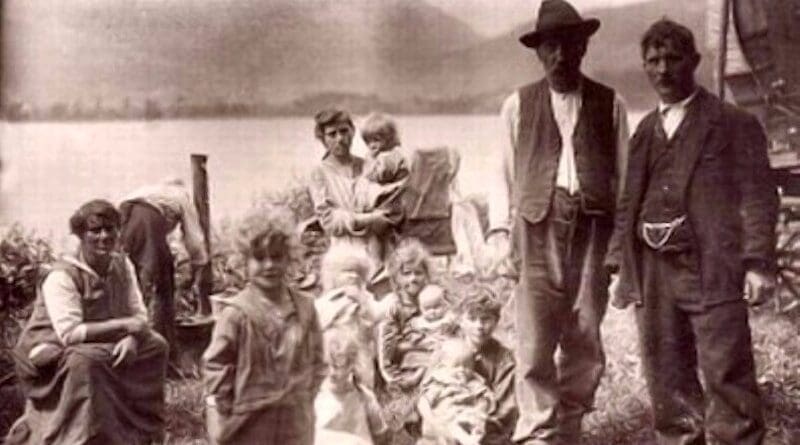
Yenish at Lake Lauerz, Schwyz, Switzerland, 1928. Photo Credit: Author unknown, Wikipedia Commons

By 

The Swiss government has officially recognised as a “crime against humanity” its persecution of the nomadic group known as the Yenish. Such an admission has not yet been made in Norway or Scotland, where similar injustices happened. But even in Switzerland decades of advocacy were required to get to this step.  


By Janine Schneider 

Forcible removal of children from Yenish families by the State between 1926 and 1973 constituted a crime against humanity. This was the conclusion of a government-sponsored research report by law professor Oliver Diggelmann. Switzerland accepts this finding. 

The federal interior ministry commissioned Diggelmann about a year ago to determine whether the wholesale removal of children from their families met the definition of genocide or a “crime against humanity”. Two advocacy organisations had called for the episode to be recognised as a case of genocide.

Crime against humanity 

In late February the federal government published the report and accepted the finding that there had been a crime against humanity. The report established that the removal of children and the intended destruction of family bonds had to be regarded as such a crime. To call it a genocide, however, would require the presence of an intention to bring about the “physical destruction” of the group, and there wasn’t enough evidence for that. 

The report also emphasised that the persecution of the Yenish as a group would not have been feasible without the involvement of the state.


Switzerland is one of the first European countries to recognise its past treatment of nomadic cultural groups as a crime against humanity. 

No more than an apology 

Experience has shown that European countries are reluctant to recognise their own history of injustice towards the nomadic populations traditionally known as Gypsies and to offer compensation to the victims, notes Neda Korunovska of the Roma Foundation for Europe. The extermination of half a million Roma and Sinti under Nazism was recognised only in 1982 as a genocide by the German Federal Republic. 

“Most countries have gone no further than issuing an official apology – even where the injustices are well documented,” adds Korunovska. A rare exception is the Czech Republic, which has been compensating Roma since 2022 for compulsory sterilisation schemes that happened between 1966 and 1990. 

In other countries where the travelling people were victims of state persecution, organisations advocating for victims have noted with approval the recognition now provided by Switzerland. 

It makes a “huge difference” whether a government just apologises for its past behavior or admits it to be a crime against humanity, says Lillan Støen, secretary of the organisation of Norwegian Roma, Taternes Landsforening. 

An important aspect of this recognition is that crimes against humanity are not subject to any statute of limitations. Offenders may be prosecuted even decades after the events. 

Compensation and apology in Norway 

Norway has not so far recognised persecution of travelling people as a crime against humanity. It may yet happen. The issue was publicised in Norway later than in Switzerland. Whereas in Switzerland the first advocacy organisations of Yenish and Sinti were founded as early as the 1970s and 1980s, this happened in Norway only in the 1990s. Pressure from these groups and media exposure eventually resulted in historical study and efforts at compensation. 

In 1986, the then Swiss president Alphons Egli made an initial apology for the government’s involvement in the notorious operation known as “Children of the Roads”, whereby Yenish children were taken from their parents and placed with non-Yenish settled families. As late as 1998, on the other hand, the Norwegian government and the then established Church of Norway made their initial apology for the injustices done to their own travelling people. 

Both countries passed legislation to provide for financial compensation. In Switzerland, in 1988 and 1992, parliament budgeted CHF11 million ($13.3 million) for compensation of victims – up to CHF20,000 per person. Norway decided on a similar measure in 2004. There, however, affected individuals received no more than 20,000 kroner each – the equivalent of about CHF1,600. A fund was also established to support projects for compensatory efforts favouring the minority as a group, such as the exhibition on Romany history and culture Latjo Drom in the open-air Glomdal Museum. 

In both countries comprehensive historical research into the topic has been published since that time. In Switzerland in 2007, three projects reported on their findings. In Norway in 2015, it was the turn of the “Tater/Romani committee” especially set up for this purpose. 

It can hardly be said that these studies were immune to criticism. Some  Traveller organisations such as the Taternes Landsforening have complained that funding of projects beginning in 2019 was now the prerogative of the government’s cultural advisory council. Previously the Cultural Fund Foundation controlled by members of the minority administered funding – until the government took away the powers of the foundation due to irregularities. 

Switzerland’s recent decision on the “crime against humanity” itself got off to a rather shaky start. An apology from the government already planned was cancelled again in the course of the bureaucratic process, as the left-wing weekly Wochenzeitung (WOZ) revealed to the public. 

Instead, Interior Minister Elisabeth Baume-Schneider did no more than repeat the apology made in 2013, which was addressed to all past victims in general of social welfare “scoops” and child removals. Some advocacy groups were displeased that no specific apology for persecution of Yenish and Sinti was made. 

Scotland: rethinking under way 

n Scotland, the historical reappraisal of the removal of  children from their families is – in contrast with Norway and Switzerland – only beginning. 

It was only in the past five years that victims of the removal of children and the grimly-titled “Tinker experiments” to settle travelling people in compulsory housing began to call for an official apology for this dark chapter in the country’s history. As a result, in 2023 the Scottish government commissioned the University of St. Andrews to carry out a research project to document the matter. 

The project was inadequately funded – and funding was withdrawn from a follow-up oral history project to record the stories of victims. The research team took critical aim at this decision in their final report: “It is important to be aware that even today there are victims of this policy still living, whose stories need to be heard and themselves compensated in some way.“ 

This view is shared by Dr. Lynne Tammi-Connelly, a Traveller activist, who has been campaigning in Scotland for research, an official apology, and financial compensation of victims. “What happened is not just something in the past, it lives on in the present”, she told SWI swissinfo.ch.

This activist came in for media attention last February, when she put the unpublished research project on the Internet. She justified her action by saying that the report, completed in September 2024, had been so far suppressed by the government. She fears that officialdom may want to delete unfavourable elements in the report. 

A Scottish parliamentarian told The Times last February that the government would work with the researchers but that they “had not agreed yet on a final version”. This suggests that the Scottish government has its own agenda, whatever the findings of independent research.

Meaning for the present day 

Whether the Scottish government will ever admit to the injustices of the past and take action on compensation is an open question at the moment. Even when the report becomes available, the official response could take quite a while. As Switzerland and Norway show, the process can be long-drawn-out. 

Yet an appropriate response is called for, so that the errors of the past are not repeated and there is a better understanding of the current situation of these minority groups. “We are not talking about some policy that was in place centuries ago,” emphasises Korunovska of the Roma Foundation for Europe. In the memory of the Roma themselves, the campaigns to eradicate them are still a painful memory. 

The same holds true for Yenish, Norwegian Romani and other Travelling people. Those who had their children taken away, or who were subjected to forcible sterilisation and assimilation, and the children themselves are still living with the consequences. The traumas are handed on from generation to generation, along with a deep mistrust of officialdom. 

Korunovska says: “The structural and systemic persecution and discrimination against Roma and other [Traveller] groups, which went on until very recent times, need to be brought to awareness among the general public.” Only with this awareness can there be a shifting of attitudes and real change in society. 

Edited by Benjamin von Wyl/ds 

Adapted from German by Terence MacNamee

SwissInfo

swissinfo is an enterprise of the Swiss Broadcasting Corporation (SBC). Its role is to inform Swiss living abroad about events in their homeland and to raise awareness of Switzerland in other countries. swissinfo achieves this through its nine-language internet news and information platform.

By 

Can CARICOM effectively face this geopolitical moment, insofar as the bloc is divided on issues of foreign policy pertaining to the two Chinas?      


In a show of concern over growing geopolitical tensions that was broad in its reference to the contemporary “geopolitical landscape” but light on detail, once again, Caribbean Community (CARICOM) bloc foreign ministers recently placed a spotlight on the current geopolitical moment. They did so last month in a broader effort to advance their respective countries’ national interests.                              

This is against a backdrop where the second Trump administration has taken a foreign policy-related hatchet to the liberal international order—whose advent the United States largely engineered. In the closing months of World War II, transatlantic leaders framed the organizing principles and institutions for the postwar world. 

A particular emphasis was placed on multilateral institutions, laying the groundwork for intergovernmental organizations such as the United Nations (UN), which is the subject of a wide-ranging, reform-related debate. In his famous Sinews of Peace speech, the late Sir Winston Churchill, one of the principal architects of the postwar world, underscored the importance of “adher[ing] faithfully” to the UN Charter as the community of nations emerged from World War II seemingly intent on “walk[ing] forward in sedate and sober strength seeking no one’s land or treasure.” 

In the eight decades since the Allied victory in respect of the Second World War, this high-minded idealism was belied by the messy reality of the West’s liberal internationalist ethos. Notwithstanding, in the second half of the twentieth century, the world was “dominated” by the U.S.-led liberal international order. Over the course of the two decades following the end of the Cold War, it entrenched itself further still.      

Until recently, the United States was the principal driver of this order. Since his return to the U.S. presidency, Donald Trump’s multi-dimensional bid to dislodge the multilaterialist moorings of that order has troubled CARICOM no end. 


What is especially worrying are Trump’s strong-arm tactics in the Western Hemisphere and beyond—e.g. Trump’s diatribes against Panama, Canada and Greenland, to name but a few, and his global trade war—which have roiled CARICOM. As small states, the bloc’s member states are sticklers for the postwar rules-based international order. This mindset hinges on their foreign policy-related mantra that ‘might is not right’, in the vein of a well-known line from The Melian Dialogue (part of Thucydides’ History of the Peloponnesian War).  

They worry about Trump’s apparent foreign policy-related pursuit of spheres of influence, which—as I argued recently in an article for The Diplomat magazine—Washington has timed in such a way as to visit early setbacks for Chinese soft power in the wider Latin America and Caribbean region. As an approach to statecraft, the spheres of influence stratagem has also been embraced anew by the world’s two other great powers. 

In this regard, Russian President Vladimir Putin’s full-scale invasion of and war of aggression against Ukraine is noteworthy. So, too, is Chinese aggression and gray-zone gambits in the South China Sea, along with China’s Taiwan-focused provocations.  

As President Xi Jinping and his Chinese Communist Party (CCP)-led government continually rachet up cross-strait tensions between America’s strongest competitor and Taiwan, greenlighting increasingly daring Chinese military exercises around Taiwan, Washington recently sounded the alarm again about “[t]he threat China poses.” Regarding the Ukraine war, though, the Trump administration is deferential to the Kremlin—at least for now.   

These circumstances are indicative of an international system that, at the hands of the great powers, is in flux. On a global scale, the U.S.’s geopolitical edge is slipping away. In a sign of Washington’s shift in focus for the exercise of U.S. power, according to the U.S. Department of Defense, the Trump administration is doubling down on America’s strategic pivot to the Indo-Pacific.  

Indeed, among International Relations-related scholarly and practitioner circles, it is now widely accepted that U.S.-led unipolarity is giving way to greater multipolarity. According to the Munich Security Report 2025, “recent trends suggest that [multipolarity’s] negative effects [as it gains ground] … are prevailing as divides between major powers grow and competition among different order models stands in the way of joint approaches to global crises and threats.” 

With the UN ensnared by the geopolitical fallout, to CARICOM’s dismay, UN-vested multilateralism is being sidelined in the process. This moment does not augur well for the international community’s smaller nations. Even so, it is not the first time that Caribbean countries have had such a concern.     

There were notable Cold War-related moments—e.g. the Cuban Missile Crisis and the U.S. invasion of Grenada—that had deleterious effects on the region. The height of post-Cold War, American-centric unipolarity also gave CARICOM pause. For instance, in a context where the heavily criticized U.S.-led invasion of and war in Iraq undermined the UN and international norms, CARICOM voiced its disapproval of the Iraq War. 

That said, and as I argued in an article for Geopolitical Monitor, the Gaza and Ukraine wars are pushing the UN towards its tipping point in this interstices of the aforesaid international system-related transformation. This is deeply worrying for CARICOM. After all, CARICOM member states have long bound themselves to “the framework of the United Nations to promote multilateralism as the guiding principle of international relations.”  

Calls for Attention to the Geopolitical Moment Grow Louder 

At a two-day meeting in May of this year, in St. Kitts and Nevis, CARICOM foreign ministers resolved that it is in the bloc’s interest to place greater emphasis on current geopolitical developments. The last time these foreign ministers made a comparable set of pronouncements was in February of this year, when they met in the margins of a CARICOM summit and paid special attention to “geopolitical issues.” The occasion was a specially convened meeting of the Council for Foreign and Community Relations (COFCOR), a regional body that coordinates the foreign policies of CARICOM member states.  

At their May meeting, the regional grouping’s foreign ministers followed the lead of CARICOM Heads of Government, who—at their February 2025 summit—“discussed current geopolitical developments.” At the COFCOR meeting held last month, Foreign Minister of St. Kitts and Nevis Denzil Douglas painted a concerning picture of the mooted geopolitical landscape, whose transformation comes amid the war in Ukraine à la Russian revanchism and now that China has positioned itself as a near-peer competitor to the United States. 

Owing to its role in the war in Ukraine—against the backdrop of its “no limits” partnership with Russia that Xi affirmed on the third anniversary of Russia’s full-scale invasion of Ukraine—China has far more cards to play in this geopolitical moment than it had in recent years. Some look on with concern; others not so much. 

In Douglas’ assessment, the geopolitical landscape “represents an inflection point for CARICOM that requires unity of vision and mission.” Notably, in his capacity as the new chair of COFCOR, he has expressed concern over the dynamics of the international environment. 

This assessment marked another important step in CARICOM’s diplomatic approach to seeing a way forward in a world confronted by intensifying great power competition. To put this into perspective consider that it also telegraphed a response to meet the current geopolitical moment, calling attention to the need for unity. 

In the context of the said landscape, this is easier said than done. Nowhere is this more visible than the matter of diplomatic relations as regards the two Chinas.        

Mind the Gap

Of the 14 independent CARICOM member states, nine have diplomatic relations with China. The remainder side with Taiwan, which—in the 1940s—General Chiang Kai-shek’s Nationalist Party or Kuomintang relocated to and ruled over for decades. On the heels of the end of the Chinese Civil War between Kuomintang forces and Mao Zedong’s CCP, in 1949, under the leadership of Chairman Mao, the People’s Republic of China was established.  

Likened to “an anti-communist fortress,” decades ago, Taiwan staked a claim to representation of China as a whole. By the 1970s, however, Taiwan had lost the U.S.’s diplomatic recognition, losing—in the process—its de jure standing among the community of nations. (Refer to United Nations Resolution 2758 (XXVI), passed by the UN General Assembly.)   

It is hard to imagine any official CARICOM attempt to flesh out—against that backdrop—a geopolitical landscape-related narrative in the public domain. The regional foreign policy establishment knows full well that there is no chance of a bloc-wide unified foreign policy agenda on this score, and that is why there was no specific mention of the aforesaid landscape in the communiqué issued following last month’s COFCOR meeting.   

For this foreign policy establishment, given the divided regional diplomatic allegiances on China, the main question now is what, if any, encumbrances may stand in the way of moving the needle on the highlighted COFCOR chair’s charge (above). In proffering an answer, a good place to start is a reference to The Rose Hall Declaration on ‘Regional Governance and Integrated Development’ and the Revised Treaty of Chaguaramas establishing the Caribbean Community including the CARICOM Single market and Economy, respectively. For our purposes, interest is in how sovereignty is understood in each of these landmark documents.

On the matter of regional governance, the so-called Rose Hall Declaration reaffirms that “CARICOM is a Community of Sovereign States, and of Territories able and willing to exercise the rights and assume the obligations of membership of the Community, and that the deepening of regional integration will proceed in this political and juridical context.” What is more, the Revised Treaty of Chaguaramas commits the CARICOM bloc to “establish measures to co-ordinate the foreign policies of the Member States of the Community;” as distinct from any notion of harmonization of such policies. 

The passages from the two documents that I pointed to (above) clearly show that sovereignty takes precedence in the regional integration enterprise. Scholars of Caribbean affairs have argued that “the youthfulness of sovereignty in the Caribbean has been a powerful force, acting to undermine moves toward greater regional integration.”   

The sheer weight of sovereignty in the CARICOM bloc-related intergovernmental construct suggests national interests trump the regional interest, not least on the highly sensitive foreign policy matter of diplomatic relations with one of the two Chinas over the other. Beyond this matter, there is a twofold additional insight.  

First, above all else, diplomatic relations between China and the nine CARICOM member states in question are multi-pronged, with prominence given to the Belt and Road Initiative, trade and bilateral diplomacy, respectively. Beijing leverages its diplomatic relations with those Caribbean countries as part of its strategyà la Xi’s so-called “community of shared future for mankind” line of thinking—to meet the geopolitical moment.     

For the five independent CARICOM member states that have diplomatic relations with Taiwan, their calculus about China is markedly different. Behind the scenes, they are concerned about the broader implications of China’s geopolitical manoeuvres. There are signs that—as I outlined in another article for The Diplomat magazine, published in 2022—at least one country in their ranks has not shied away from investing political capital in and weighing in on high-stakes diplomatic episodes involving China and Taiwan. 

Second, China and Taiwan have a history of tussling for recognition in the Caribbean. For China, its recognition-related gains in the Caribbean serve to undermine Taiwan’s sovereigntist-like playbook. Given its de facto international status, Taiwan’s primary foreign policy goal is state recognition in international politics.  

Taiwan’s sovereignty-driven aspirations resonate with some in CARICOM—a regional grouping that comprises postcolonial states that also faced struggles of their own for self-determination and independence. In addition, Taiwan has a strong focus on development aid and technical assistance, partly geared towards those in the CARICOM fold who diplomatically back Taipei. 

Though this grouping’s Anglophone members achieved independence between the 1960s to the 1980s, as scholars of Caribbean studies note, “the idea of sovereignty has always been compromised in the region, both in terms of pressures from external forces and the system of hierarchy and domination embedded within postcolonial systems of governance.” In this view, independent CARICOM member states are all too familiar with laws, norms and practices of a great power-dominated international system that can work against the interests of smaller nations. 

In stark contrast, having regard to its rise over the course of the late twentieth century, China’s diplomatic approach to the Caribbean is reflective of its strategic path to challenge the international system as a great or global power in the twenty-first century. The one-China principle, which deems Taiwan to be an “inalienable part” of China, is but one facet of this path.

Taiwan, of course, roundly rejects China’s claim over it. Similarly, those CARICOM member states that have diplomatic relations with Taiwan dismiss China’s assertion of sovereignty over the island nation. For their part, the nine CARICOM member states that recognize China subscribe to the one-China principle.    

An important metric of the success of Chinese power projection in CARICOM is the diplomatic positioning of the bloc’s independent member states vis-à-vis the one-China principle, which decidedly tilts toward Beijing’s favour qua foreign policy ambitions. Both Beijing and Taipei understand that, in terms of their historical rivalry and the geopolitical imperative behind this rivalry, diplomatic recognition is the foreign policy prize. 

For decades, such diplomatic recognition has been wielded as an instrument of foreign policy. Importantly, it has always hewed more closely to geopolitics.  

The Bottom Line

In the decade-plus since Xi’s China has steadily altered the balance of power in the international system, accelerating this global player’s decades-old rise, it has also significantly expanded its footprint on the geopolitical landscape of the Caribbean—i.e. the United States’ “third border.” (Meanwhile, as rising tensions between China and Taiwan have raised cross-strait stakes, the perception is that China has Taiwan and its relative influence in the region on the back foot.) In my recent article for India’s World magazine, I delved into China’s success in that regard. This success is seen differently in the CARICOM fold, depending on whether the member states in question diplomatically recognize China or Taiwan.   

In addition, as I argued in an article for the Trinidad & Tobago Guardian that was published on May 15, this moment of uncertainty for U.S.-CARICOM relations makes it harder for CARICOM member states to rely on America—a longtime partner. After months of the second Trump administration’s transactional dealings with governments of Caribbean countries, as it was all smiles for the photo op, the prospect of a rift between the two sides looks a real possibility. 

This is at a time when China is name-checking certain Caribbean countries with which it is deepening partnerships, as I contended in an article for The Diplomat magazine that was published last month. Such Beijing-backed diplomatic efforts have not been met with the same enthusiasm among those in the CARICOM fold who diplomatically align with Taiwan.       

Amid a renewed debate on this geopolitical moment’s impact on the Caribbean, then, trying to effect regional unity is complicated by divergent foreign policy approaches to the two Chinas. The CARICOM bloc comprises like-minded countries, within limits. As Caribbean leaders and foreign policy chiefs focus more on current geopolitical developments and associated power dynamics, eyeing regional unity, do not expect a narrowing of the diplomatic gap in relation to the two Chinas.               If Taiwan loses diplomatic ground altogether within CARICOM, by extension, the gap would be no more.

That said, notwithstanding recent setbacks for Taiwan within the wider Caribbean and in other parts of the world, such a scenario is likely a bit of a stretch. (“Fence sitters,” comprising some countries in Latin America and elsewhere, bring yet another dimension to Beijing and Taipei-targeted diplomatic dealings.) There is a widespread recognition that, at least for now, this gap is here to stay.     

Accordingly, despite a greater emphasis on the “geopolitical landscape,” arriving at a collective CARICOM security qua power in international society-related posture in this geopolitical moment will likely prove elusive. All the more so, as China continues to play an outsize role in the emergent multipolar international system, CARICOM’s ability to cohesively navigate the prevailing geopolitical landscape will likely be repeatedly tested. 


Dr. Nand C. Bardouille

Dr. Nand C. Bardouille is Manager of The Diplomatic Academy of the Caribbean in the Institute of International Relations at The University of the West Indies (St. Augustine Campus), Trinidad and Tobago.