Sunday, June 15, 2025

We Have a Choice: Weapons and War or Food and Health Care


 June 13, 2025

Photograph by Nathaniel St. Clair

For weeks, Congress has been wrapped up in passing President Trump’s big, brutal budget — the one that pays for tax cuts for the wealthy and a trillion-dollar Pentagon budget by taking food stamps and Medicaid away from people struggling to get by.

The GOP-controlled House of Representatives just barely passed this bill — it squeaked through by a single vote. Now the Senate is considering it.

Alongside trillions in tax cuts for the wealthy, the bill also gives big handouts to the Pentagon and the president’s plans to separate immigrant families. It would result in the country’s first-ever trillion-dollar Pentagon budget — and triple annual spending on the mass detention of immigrants.

There’s an army of contractors ready to profit — from the wasteful military contractors who vacuum up more than half the Pentagon budget to the private prison companies that warehouse soccer momspediatric cancer patients, and other immigrants caught up in the administration’s dragnet.

To fund those cruel contractors, the president’s big brutal bill cuts Medicaid and food stamps, among other programs that benefit regular people.

The human costs could be staggering. Researchers have found that the cuts to Medicaid and other health programs could lead to 51,000 preventable deaths a year. And millions of Americans who rely on food stamps could go hungry, including four million children.

None of this needs to happen.

I recently co-authored a report looking at what we could fund instead with that extra money for the Pentagon and this anti-immigrant agenda. If lawmakers just rolled back those increases alone, we could more than cover the annual cuts to Medicaid, food stamps, and the Child Tax Credit combined.

In other words, by just letting the Pentagon and deportation budgets stay where they are now, we can save all of those programs — and potentially save lives.

Nationally, we found that these massive increases would be more than enough to cover the 13.7 million people at risk of losing health care — and the 11 million people at risk of losing food stamps.

That report also looked at what the bill does in every state and congressional district. In Maine, for example, the first year of additional spending on the Pentagon and deportations could keep 107,000 people on Medicaid. In Alaska, 87,000 people could stay on food stamps.

In Arizona’s 5th Congressional District, the increase just for the President’s dream of a “Golden Dome” missile shield could keep 7,500 people on Medicaid. In Kentucky’s 4th district, 6,200 people could stay on Medicaid.

Experts have said that the president’s promises for the system are too good to be true. That’s not worth risking lives by cutting medical benefits in any congressional district.

Then there’s the billions set aside for “killer robots,” drones that can use AI to target and kill people — a nightmare that could lead to more deaths in war and kill more civilians.

In California’s 5th district, the money for these dangerous weapons could instead keep more than 13,600 people on food stamps for a year. In Ohio’s 8th district, more than 11,300 people could keep their SNAP benefits.

This is truly a situation of trading life for death: we can feed hungry people, or we can create new dystopian weapons.

There’s an exceedingly simple solution to all of this: drop the extra money for the Pentagon and attacking immigrants — and keep Medicaid and food stamps available to as many people who need them as possible.

In 2024, the average U.S. taxpayer paid $3,804 for the Pentagon and war, deportations, and border militarization — an already astounding figure. We shouldn’t ask people to pay any more to line the pockets of military contractors and private prison CEOs while Americans go hungry and without health care.

Lindsay Koshgarian directs the National Priorities Project at the Institute for Policy Studies. She’s the lead author of the new report State of Insecurity: The Cost of Militarization Since 9/11.


'Up in Arms': Ben & Jerry's Co-Founder Launches New Campaign Against Bloated Pentagon Budget


"If we take half the money budgeted for the Pentagon and invested in the things people need and want," said Ben Cohen, "the American Dream can become a reality again."
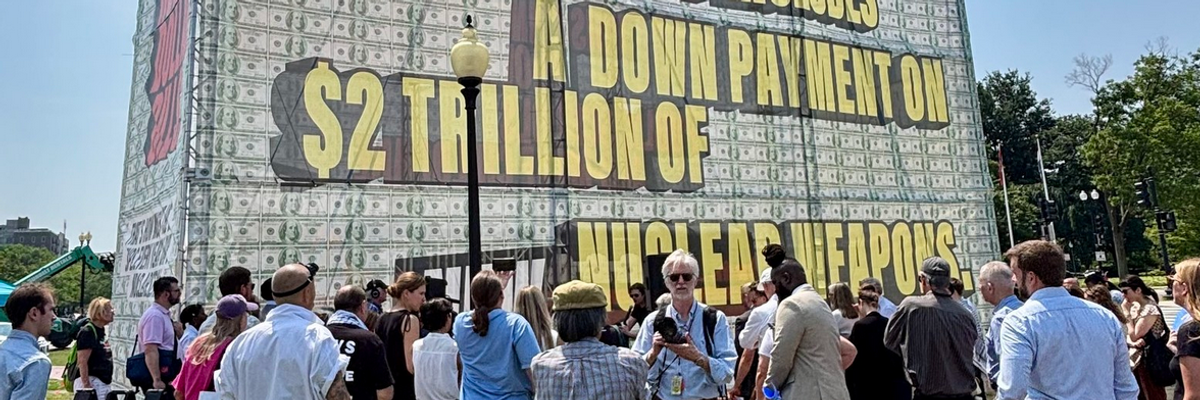


Participants gather for the launch of the Up in Arms campaign against military and nuclear weapons spending on June 12, 2025 in Washington, D.C.
(Photo: Ploughshares)


Brett Wilkins
Jun 14, 2025
COMMON DREAMS


Joined by retired military officers and national security experts, Ben & Jerry's co-founder Ben Cohen on Thursday launched a campaign targeting the nearly $900 billion Pentagon budget and the $100 billion spent on nuclear weapons and "to get our country to start funding the American Dream instead of the death of millions of people."

Standing near Union Station in Washington, D.C. beside a towering sculpture showing what $100 billion looks like, supporters of the Up in Arms campaign—a planned four-year public education and advocacy project "to bring common sense to the Department of Defense and the country's budgetary bottom line"—chanted, "Money for the poor, not nuclear war!"

"There will be no peace, there will be no security, until we start using our resources to provide for the needs of our people at home and around the world," Cohen said at the event. "And we have the money to do it, at no additional taxpayer expense. If we take half the money budgeted for the Pentagon and invested in the things people need and want, the American Dream can become a reality again."


The peace group Ploughshares, which moderated a press conference for the launch of Up in Arms, said that the faux-$100 billion installation could be the tallest protest structure ever erected in Washington, D.C.

"This is a structure that represents the $100 billion that our country spends each year on nuclear weapons," Cohen said while standing in front of the tower and embracing Medea Benjamin, the co-founder of the peace group CodePink. "Fifty percent of that is for a whole new generation of nuclear weapons."

"Ice cream not bombs!" Benjamin said next. "Ice cream not nuclear weapons!"


The $100 billion figure includes spending on modernizing the nuclear arsenal, supporting its infrastructure, and addressing legacy issues like nuclear waste.

"Congress could make it easier for Americans to buy homes and save on gas or they could tackle the opioid epidemic–but those are clearly NOT their priorities," Up in Arms says on its website. "We have all the money we need to create a good life for all Americans. For half the money we spend on nuclear bombs, we could stop poisoning kids with lead, provide funding for public schools, and make childcare affordable."

Former U.S. military officers-turned-peace defenders Dennis Laich, Lawrence Wilkerson, Ann Wright, Karen Kwiatkowski, William Astore, and Dennis Fritz, as well as FBI whistleblower Coleen Rowley and former CIA officer Ray McGovern, are taking part in the Up in Arms campaign.

"We're here today to say we don't want our money spent this way, we want our money spent… on things that keep people alive, not on things that kill people," said Wright, a former U.S. Army colonel and current member of the Eisenhower Media Network and Veterans Against Genocide.

"We're up in arms and down on these damn nuclear weapons," she added, "and We the People have to be able to go to each one of these congresspeople and say, 'We don't care how much money you're getting from all of these companies that make a killing out if killing with these nuclear weapons.'"

Laich, a former U.S. Army general also with the Eisenhower Media Network, noted that the U.S. military budget "is larger than the next 10 countries combined, and what do we get for it?"

"Since World War II, we tied in Korea, we lost in Vietnam, we won the first Gulf War, we lost in Iraq, and we lost in Afghanistan," he said. "They always say we have the greatest military on earth; I don't buy it."

President Donald Trump is proposing a record $1 trillion Pentagon budget for fiscal year 2026 while backing legislation that would dramatically slash spending on vital social programs in order to fund a massive tax break that would overwhelmingly benefit the rich and corporations.

On Friday, the International Campaign to Abolish Nuclear Weapons—which earned the 2017 Nobel Peace Prize for spearheading the landmark Treaty on the Prohibition of Nuclear Weapons—published an analysis showing the world's nine nuclear powers spent a combined baseline $100 billion on their arsenals last year, an 11% increase from 2023. The United States alone accounted for well over half of that amount.

Cohen is a longtime anti-war activist. Last month, he was arrested after disrupting a Senate hearing, shouting, "Congress kills poor kids in Gaza by buying bombs and pays for it by kicking kids off Medicaid in the U.S." as he was hauled off by police.


War Profiteers Benefit as Nuclear Weapons Spending Soared Above $100 Billion Last Year

New analysis reveals that global nuclear weapons spending "could feed all of the 345 million people currently facing the most severe levels of hunger globally, including starvation, for nearly two years."
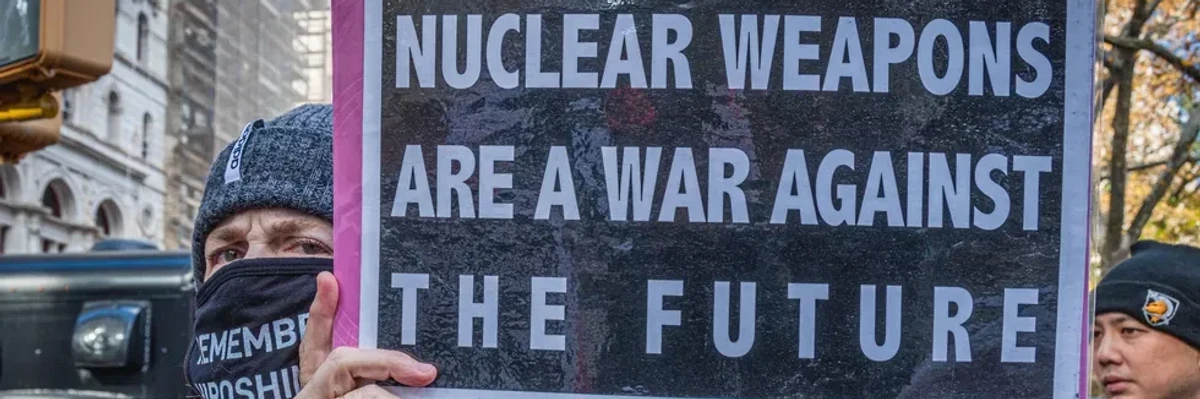


A protester holds a sign reading, "Nuclear weapons are a war against the future" at a demonstration in New York City 
(Photo: Erik McGregor/LightRocket via Getty Images)


Brett Wilkins
Jun 13, 2025
COMMON DREAMS


The world's nine nuclear-armed nations spent more than $100 billion on their atomic arsenals last year—up 11% from 2023—with the United States accounting for both the largest share and biggest increase in expenditures, a report published Friday by the International Campaign to Abolish Nuclear Weapons reveals.

The new ICAN analysis identifies a $9.9 billion increase in global nuclear weapons spending in 2024, with the U.S.—the only country to ever carry out a nuclear attack on another nation—spending $56.8 billion, more than the combined expenditures of the eight other countries with nukes. In addition to the U.S., Russia, China, France, the United Kingdom, India, Pakistan, Israel, and North Korea have nuclear arsenals. The $5.3 billion annual spending increase by the U.S. was also more than any other nuclear power.


All that spending on doomsday weapons padded the profits of major arms makers. According to the report:
In 2024, at least twenty-six companies working on nuclear weapons development and maintenance held significant contracts for their work. These companies earned at least $43.5 billion in the year and hold at least $463 billion in outstanding contracts. In 2024, new contracts worth around $20 billion were awarded to these companies. The companies identified in this report paid lobbyists in France and the United States more than $128 million to represent their interests last year. They also had 196 meetings with high-level U.K. officials including 18 with the prime minister's office in 2024.

"Nuclear-armed countries could have paid the United Nations' budget 28 times with what they spent to build and maintain nuclear weapons in 2024," the report states. "They could feed all of the 345 million people currently facing the most severe levels of hunger globally, including starvation, for nearly two years."

Noting that "98 countries have signed, ratified, or acceded" to the Treaty on the Prohibition of Nuclear Weapons (TPNW), ICAN—which was awarded the 2017 Nobel Peace Prize for its work on the landmark accord—asserted that "it is up to each government, and the citizens of that country, to decide which path they will choose."

ICAN asserted that the stakes are higher than at any time in a generation.

"With two major wars involving nuclear-armed states in Ukraine and Gaza, as well as nuclear tensions escalating between India and Pakistan and on the Korean Peninsula, the risk that nuclear weapons could be used in combat is widely regarded as the highest it has been since the Cold War and possibly ever," the group warned Friday in a separate statement. "In response, the nuclear-armed states are clinging to the doctrine of deterrence which is based on brinkmanship and the threat to use nuclear weapons, exacerbating the risk of conflict."

Susi Snyder, ICAN program coordinator and report co-author, said Friday that the global crisis of nuclear proliferation and out-of-control spending can be solved, but that "doing so means understanding the vested interests fiercely defending the option for nine countries to indiscriminately murder civilians."

"The good news," she added, "is a majority are going in another direction. Ninety-eight states, supported by over 700 civil society organizations, have either signed, ratified, or directly acceded to the... TPNW that came into force four years ago."


This year's ICAN report highlighted the "hidden costs" of nuclear weapons.

"It's an affront to democracy that citizens and lawmakers in countries that boast of their democratic credentials are not allowed to know that nuclear weapons from other countries are based on their soil or how much of their taxes is being spent on them," ICAN policy and research coordinator and report co-author Alicia Sanders-Zakre said. "It is time for these democratically elected leaders to heed the call of their people to remove nuclear weapons from their countries and work for their total elimination."

Responding to the report, Oliver Meier, policy and research director at the European Leadership Network, a London-based think tank, said, "At a time when better transparency and accountability of nuclear weapon states range high on the agenda of many non-nuclear weapon states, the absolute secrecy and lack of engagement on the costs of Russian and NATO nuclear sharing arrangements are an anachronism."

"In democratic societies, legislators and other stakeholders must have opportunities to review these arrangements, including relevant expenditure," he added.

The day before ICAN published the report, Ben Cohen, co-founder of Ben & Jerry's ice cream, was joined by retired military officers and national security experts in Washington, D.C. for the launch of Up In Arms, a four-year campaign "to bring common sense to the Department of Defense and the country's budgetary bottom line."

"There will be no peace, there will be no security, until we start using our resources to provide for the needs of our people at home and around the world," said Cohen. "And we have the money to do it, at no additional taxpayer expense. If we take half the money budgeted for the Pentagon and invested in the things people need and want, the American Dream can become a reality again."









A catastrophe called Israel

Published June 15, 2025
DAWN

The writer is a former editor of Dawn.


ANY military campaign must have clearly defined objectives, and Israel said its main aim of starting a war with Iran, through its ongoing massive air attacks with tacit backing from US and Western governments, was to stop Tehran’s march towards the acquisition of nuclear weapons.

It may not have been so openly stated, but one important objective is regime change in Iran in order to try and usher in a regime more like Israel’s other Middle Eastern/ regional neighbours, who are happy to be friends with Tel Aviv. That is why they offer only perfunctory condemnation of Israel’s ethnic-cleansing of Palestinians not just in Gaza, but also the West Bank.

A wider war also helps shift the focus from the worst ethnic cleansing of this century in Gaza by relentless bombing, other military means, and mass starvation. It is the food blockade which was beginning to create a little unease among at least Israel’s European allies, who have so far offered unconditional material and diplomatic support to it on Gaza.

At least the European allies, I say, because the US administration solidly supports the apartheid state, which is executing the American president’s Gaza Riviera Plan. It visualises beachside resorts after the forceful displacement of two million Palestinians to unspecified countries, presumably Muslim.

The Gaza genocide has really not been about Israeli hostages taken during the October 2023 atrocity. Ample evidence of this can be found in the conduct of presidential envoy Steve Witkoff, whose family members are crypto business partners with the Trump family. He has walked away twice, if not more times, from deals that could have secured the release or exchange of the remaining hostages in Hamas captivity. Meanwhile, hundreds of Palestinians remain in Israeli captivity who are no more than hostages.

How long can Iran’s arsenal of reportedly 2,000 ballistic missiles last?

Despite this unconditional support to Israel, President Donald Trump so far seems unprepared to commit US forces in any open confrontation. Over the coming days, Israeli Prime Minister Benjamin Netanyahu’s efforts will be directed towards somehow sucking in the US to commit forces into the war with Iran.

After the Iranian missile retaliation against the Israeli air campaign, which killed several senior Iranian military commanders, leaders of the Islamic Revolutionary Guard Corps, and targeted nuclear sites, former Israeli prime minister and military chief Ehud Barak picked off some of these objectives one by one in an interview with CNN’s Christiane Amanpour.

Ehud Barak was categorical in saying that Israel’s air campaign may have ‘delayed’ by a few weeks Iran’s acquisition of a nuclear weapon but, he said, even if the US joined the air campaign, it would delay it by no more than a few months at best. “They have 400 kilograms of 60 per cent enriched uranium and it can be enriched to 90pc in a garage with the right equipment and they will have a crude bomb,” he said.

Quoting the chief of the IAEA (the internati­o­nal nuclear watchdog), who said that many of Iran’s key facilities are “hundreds of yards” und­erground in old mines, etc, Mr Barak maintained these were “out of our reach”. “I have no illusions we’ll do anything more than damage or hurt them.”

The former IDF chief said the initial successes of the air campaign, which exceeded expectations, should be used to push through a nuclear deal with Iran, stop the war in Gaza, and go for peace in the wider region, including Saudi Arabia, which would take time and won’t be easy but still needs to be done.

He said going further for Israel without US logistics support will be difficult, so it should say ‘we have done all we could do, now it is up to you’. At a time when Israeli intelligence’s targeting of the Iranian military’s key leaders is being seen as a manifestation of internal divisions, Ehud Barak also addressed the issue of regime change.

Saying it did not appear possible without US ground troops on Iranian soil, he listed wars from Korea to Vietnam to Afghanistan that the US entered but was unable to win: “How did those wars go?” he asked, while doubting that President Trump, or any other US leader or the American public for that matter, would have the appetite to commit US boots to the ground.

It is true that in 2018, Trump unilaterally scuppered an Obama-led deal that stopped Iran’s nuclear weapons march in exchange for sanctions relief. But the scrapping pushed Tehran back to restarting its enrichment levels closer to weapons grade. So, in a sense, this war hasn’t been about Iran’s nuclear arms quest but more about getting it to bow to Israeli-US will.

Therefore, it is important to see who is eventually likely to get the upper hand in this conflict. With the US and entire Western production, stores and supplies of modern weaponry at its disposal, it would be safe to assume Israel can outlast Iran in a war of attrition. For all practical purposes, Iran has no air force, and its air defence system appears inadequate.

How long can its arsenal of reportedly 2,000 ballistic missiles last? What happens beyond that? These are some of the questions that need to be answered. So far, Iran has taken massive hits and yet has been able to remain defiant and retaliate. Can it sustain this in the medium to long term, and will there be any third-party mediation to stop the war?

Or, if cornered further, will Iran lash out dire­c­tly at US bases and assets in the region and even nations hosting them in order to expand the conflict as a means of stopping it? The impact of any such eventuality will not only be on millions of lives in the region but also on the global economy.

abbas.nasir@hotmail.com

Published in Dawn, June 15th, 2025


Deepening conflict

June 15, 2025
DAWN


AS hostilities between Iran and Israel continued for the second day on Saturday, following Tel Aviv’s provocative strikes against the Islamic Republic on Friday, many around the world worried about the diminishing chances of de-escalation.

While Israel had struck multiple sites and killed several senior Iranian military leaders and scientists on Friday, Tehran hit back, sending barrages of drones and missiles towards the Zionist state later in the day.

As the conflict grinds on, there are dangers it may expand, particularly if the US gets involved. Such a development would be devastating for the region, sending shockwaves across the globe.

Some media reports say that the US had shipped hundreds of missiles to Israel before the attack on Iran, while there are also indications that American forces helped shoot down Iranian missiles headed for Israel. Tehran has said it will hit American as well as British and French bases if these states defend Tel Aviv.

In the midst of conflict, President Donald Trump must be asked why he did not do more to stop Israel’s attack on Iran. Tel Aviv’s justification that it is waging ‘pre-emptive’ strikes to prevent Iran from acquiring a nuclear bomb rings hollow, coming from a state believed to have a clandestine nuclear programme itself, and which has violated the sovereignty of nearly all its neighbours.

Mr Trump had billed himself a ‘man of peace’, but in this instance he is standing by as Israeli warmongers, flush with American cash and arms, have embarked on a destructive adventure that can set the Middle East alight.

Even some of Mr Trump’s ardent supporters in the MAGA movement have criticised the Israeli war and potential American involvement. The US president’s calls for Tehran to resume dialogue on the nuclear issue are laughable, especially at a time when Iran is facing an onslaught from America’s key ally.

Similarly, Prime Minister Benjamin Netanyahu’s appeals for Iranians to rise up against their government and seek ‘freedom’ are the stuff of black humour, as Israel has killed and injured numerous ordinary Iranians in the ongoing aggression. Mr Netanyahu, so concerned about Iranians’ freedom, clearly does not feel Palestinians are also entitled to life and liberty, as the Gaza genocide has shown.

With prospects for peace looking dim, the world, particularly Iran’s neighbours — including Pakistan and the Middle East states — must be prepared for prolonged geopolitical turbulence and economic tremors. The region is amongst the world’s trade and energy hubs, and if the conflict continues and intensifies, the global order will feel the heat.

Pakistan, as a neighbour of Iran, is particularly vulnerable, and the state must be ready for what lies ahead, while also making efforts to safely bring home Pakistani zaireen and visitors in Iran.

Published in Dawn, June 15th, 2025


‘Declaration of war’

Editorial 
Published June 14, 2025 
DAWN


ISRAEL’S provocative behaviour has, once again, brought the Middle East to the precipice of a full-blown war.


The Zionist state’s attack on Iran, which began early on Friday morning and was continuing at the time these lines were being written, has the potential of setting the already fragile region on fire, and sending the global economy into a tailspin. A large number of fatalities have been reported, including women and children, and residential areas have been hit along with military targets.

Among the victims have been the Iranian army’s chief of staff, as well as the head of the powerful Pasdaran, along with several senior scientists. Several Iranian cities have been attacked, indicating that Israel had deep intelligence about key Iranian facilities and personnel. It is no wonder that Tehran has termed Israel’s reckless attack a ‘declaration of war’.

Tel Aviv has said it attacked Iran because of the supposed threat it posed to “Israel’s very survival”. This is contrary to the facts. It has been Israel that has constantly been provoking Iran. The bombing of Iranian diplomatic facilities in Damascus as well as the assassination of Hamas leader Ismail Haniyeh in Tehran last year, which resulted in two separate Iranian missile and drone barrages targeting Israel, are proof.

In fact, Israel has continuously been threatening regional peace for decades by attacking and pillaging other countries. Over the last few years, along with the murderous rampage in Gaza, Israel has attacked SyriaLebanonYemen and now Iran. So Tel Aviv’s ‘self-defence’ alibi is hardly believable. The plain truth is that Israeli behaviour is a threat to world peace.

There has been condemnation of the Israeli attacks from several states, particularly the Muslim bloc. The Pakistani leadership as well as parliament have denounced Tel Aviv’s aggression and expressed solidarity with Tehran.

Yet others see the aggression differently; for example, US President Donald Trump says the offensive was “excellent” and has boasted that there is more in store. But he has also perplexingly asked Iran to return to the negotiating table. It is unlikely Iran will negotiate with a gun to its head. The Iranian leadership has promised to avenge the attack. It should be remembered that Iran has survived a brutal eight-year war with Iraq, and the Iranians are adept at playing the long game.

Israel has threatened that the attacks will continue for as long as needed; the Iranians may just take them up on the ‘offer’. The world stands at a very dangerous crossroads here. If the US joins in the ‘defence’ of Israel, matters may spiral out of control. The UNSC is meeting to address the issue, and though expectations should be modest, full efforts are needed to stop this new war.

Published in Dawn, June 14th, 2025
Israel, Iran, and the War Machine’s Global Lust for the Rapture

Donald Trump, like Joe Biden before him, was unable—or unwilling—to restrain Israel from genocide, lawlessness, and slaughter.


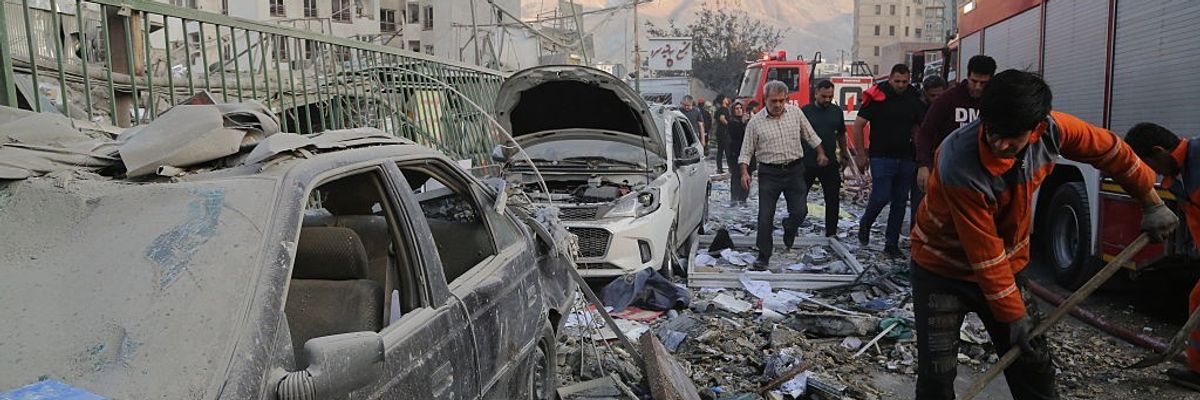
A view of a damaged building in the Iranian capital, Tehran, following an Israeli attack, on June 13, 2025. Firefighting teams are dispatched to the area. Israeli Defense Minister Israel Katz has announced that Israel conducted strikes on Iran.
(Photo by Fatemeh Bahrami/Anadolu via Getty Images)


Richard Eskow
Jun 15, 2025
Common Dreams


For a while, at least, Donald Trump talked a good game about diplomacy, including negotiations with Iran and Israel. But Israel is America’s id. We can’t restrain Israel because Israel is the skull beneath the American mask.

The “id” was Sigmund Freud’s term for the hidden reservoir of passions and desires that fuels the personality. The ego—“what we call reason and sanity,” as Freud phrased it—tries to restrain those passions by riding them “like a man on horseback.”

The horse has thrown its rider once again.

Read the newspaper today. Watch cable news tonight. See if they mention the plain fact that Israel’s attack is a violation of international law.

“Monsters from the id!” That's what Dr. Morbius shouts at the end of the 1956 science-fiction movie Forbidden Planet, as he tries to shut down the all-powerful alien engines he’s learned to control with his thoughts. His subconscious urges and desires have begun to destroy his deep-space paradise, and he’s powerless to stop them. The vast machinery is serving his true self, not the civilized veneer he presents to himself and others.

So it is with military might. Just as Israel is the American id, America is the id for a financialized planet driven by greed and exploitation. American war machinery is global lust made manifest: lust for power, lust for wealth, lust for more.

Donald Trump, like Joe Biden before him, was unable to restrain Israel from genocide, lawlessness, and slaughter. Both presidents aided and abetted snuff-movie violence on a massive scale, because that violence reflects the shadow self of the nation they represent.

If “the sleep of reason produces monsters,” we’ve been in a coma for a long time.

John F. Kennedy may have been an imperfect vessel for change, but he spoke often and well about the need for international law and world institutions. “We must create even as we destroy (nuclear arms),” he said, “creating worldwide law and law enforcement as we outlaw worldwide war and weapons.”

Read the newspaper today. Watch cable news tonight. See if they mention the plain fact that Israel’s attack is a violation of international law. The mass assassination of another country’s leaders and the under-reported deaths of civilians will be debated in tactical terms, while moral and legal questions receive little (if any) attention.

These attacks may temporarily serve Israeli and U.S. interests, but their benefits won’t last. Iran isn’t Gaza, impoverished and defenseless and populated primarily by women and children. Iran is home to 91 million people and possesses considerable resources. Trump was already forced to back down from a confrontation with the Iran-allied Ansar Allah (the Houthis) in the Red Sea, and they’re essentially desert fighters. This attack may weaken Iran, but what will happen if, and when, it regroups and retaliates?

The Israeli state isn’t acting rationally; neither is the American national security state. But how could it be otherwise?

Like the passions of Dr. Morbius, the drive to kill inevitably becomes self-destructive. “In 20 of the 24 countries surveyed,” Pew Research reports, “around half of adults or more have an unfavorable view of Israel.” That’s from a poll published June 3. Those figures may well be even lower now. Pew continues, “Around three-quarters or more hold this view in Australia, Greece, Indonesia, Japan, the Netherlands, Spain, Sweden, and Turkey.”

In the United States, the percentage of adults with a negative view of Israel has risen 11 points since March 2022; 53% of Americans polled now hold “a somewhat or very unfavorable opinion of Israel.”

This trend represents an existential threat to both the Jewish state and the American military empire. The political consensus in Washington, however, remains unchanged.

The Israeli state isn’t acting rationally; neither is the American national security state. But how could it be otherwise? They are the manifestation of our own cravings. Our warlike impulses are leading us down the path of conflict and confrontation, seemingly oblivious to peaceful alternatives. By refusing to cooperate with China and the rising nations, we are surrendering our future to them.

That is, if we even have a future.

The head of the International Atomic Energy Agency tried to remind the world that “armed attacks on nuclear facilities could result in radioactive releases with grave consequences within and beyond the boundaries of the State which has been attacked.”

The world didn’t seem very interested.

Evangelical Christians—some of them, at least—are undoubtedly thrilled. With this development From the Bible (Matthew 24:6-7):
And ye shall hear of wars and rumors of wars: see that ye be not troubled: for all these things must come to pass, but the end is not yet.

For nation shall rise against nation, and kingdom against kingdom: and there shall be famines, and pestilences, and earthquakes, in diverse places.

Meanwhile, Americans have forgotten the words of their fallen president. “Mankind must put an end to war,” said John Kennedy, “or war will put an end to mankind.”

Some Americans consider Matthew’s prophecy a harbinger of deliverance—for them, not for the rest of us. They’re counting on eventual, if selective, salvation through rapture.

The rest of us, believers and nonbelievers alike, will have to conclude with the verse that follows:

All these are the beginning of sorrows.


The Ignorance That Pervades Us


The uncalled for attack on Iran by the most insane group of people who ever inhabited this planet is expected; what do the insane do, they do the insane. Not expected is that recognized people do not recognize the insanity of the action. Put in simple. Iranians are not eager to have a nuclear bomb. Why would they when knowing Israel cannot be attacked with a weapon that will release radioactivity in Egypt, Saudi Arabia, Lebanon, Jordan, and Syria, and they will be labelled as international killers. An attempt to nuke anyone will be retaliated by a devastation that will erase their ancestral Persian land and its inhabitants from the Earth. It is obvious to their educated minds. Why isn’t it obvious to the rest of the world?

The only reason that the Islamic Republic might pursue a nuclear weapon is for the same reason the U.S. and the Soviet Union rattled against one another, for deterrence. Only Iran stands in the way of genocidal Israel’s constant attacks on humanity. If Iran stalls Israel’s belligerent efforts, assuredly, Israel, who has shown contempt for the entire human race, and would even use the atomic bomb against the United States, will drop “Big Boy” on the Islamic Republic, but only if the Mullahs do not have a reprisal weapon.

Unlike media portrayals, history shows that Iran has never been and is not now a threat to any nation. Iran has not attacked another nation and has built only defensive positions. Compared to the United States and Israel, who have started several wars and slaughtered millions of innocents throughout the globe, Iran is a cherub.

Israel did not attack Iran to prevent Iran from developing a bomb it could never use and whose progress in attainment was at a time when Iran was years away from having something workable, tested, and mated to a workable and tested delivery system. Israel attacked Iran because it knew it had the military power to subdue Iran and could get away with the nefarious deed by reciting the usual, “we were ready to be attacked by anti-Semites and had to defend ourselves.” Now, Israel can carry on with the genocide of the Palestinians, seize the oilfields of the Gaza coast, take over the Haram al-Sharif, push the Palestinians out of the West Bank and all the way to Amman while it takes the East Bank of the Jordan River, move its checkerboard boundaries to the Litany River in Lebanon, and close to Damascus in Syria, and seize all the remaining aquifers in the Levant.

Summarizing the previous paragraphs — Iran cannot use atomic weapons for an offensive purpose and might need them as a defensive measure to deter a nuclear attack by Israel. Israel has no defensive need for atomic weapons and has developed them for offensive tactics.

Not realizing that Israel has attacked a sovereign nation that has not posed a threat to its people and has continued on its merciless onslaught against the civilized world emphasizes the ignorance that pervades us. No call for a Security Council meeting to defend a nation’s sovereignty. Instead we have an American president gloating over his deception, telling ABC News Chief Washington Correspondent Jonathan Karl, “I think it’s been excellent.” We gave them a chance and they didn’t take it. They got hit hard, very hard. They got hit about as hard as you’re going to get hit. And there’s more to come, a lot more.”

What chance did Trump give Iran; the same chance he took away from the Islamic Republic when he terminated United States participation in the JCPOA, a treaty that already prevented Iran from enriching Uranium and would be renegotiated, but could not after Trump had unilaterally terminated it. Trump’s termination of the JCPOA initiated the havoc, another mindless scheme from an unstable derelict.

Added to the distress is media interpretation of the attack, with nobody, from what I have read, attributing the purpose to Israel knowing it had the military power to subdue Iran, could get away with the nefarious deed, and then accelerate its war against civilization.

As an example, New York Times columnist, Bret Stephens, headlines an article with “Israel Had the Courage to Do What Needed to Be Done,” and continues with “All the other options have run their course.” His closing paragraph,

But for those who worry about a future in which one of the world’s most awful regimes takes advantage of international irresolution to gain possession of the most dangerous weapons, Israel’s strike is a display of clarity and courage for which we may all one day be grateful.

Reworded for clarity and reality,

Now we must worry about a future in which the world’s most awful regime, Israel, takes advantage of international ignorance to maintain unique possession of the most dangerous weapons. Israel’s strike is a display of scheming madness for which we should all be fearful and will one day regret.

Not knowing where this madness will lead, except to know the madness will not be calmed and will lead into more madness, I will calm myself by closing Word and playing a game of online scrabble.

Dan Lieberman publishes commentaries on foreign policy, economics, and politics at substack.com.  He is author of the non-fiction books A Third Party Can Succeed in AmericaNot until They Were GoneThink Tanks of DCThe Artistry of a Dog, and a novel: The Victory (under a pen name, David L. McWellan). Read other articles by Dan.
ECOCIDE

What Israel’s attacks on Iran’s oil, gas facilities could mean for the global industry

Any disruption in Iran's oil production may impact global prices as Saudi Arabia and UAE are the only Opec+ members that can boost output.


Published June 15, 202

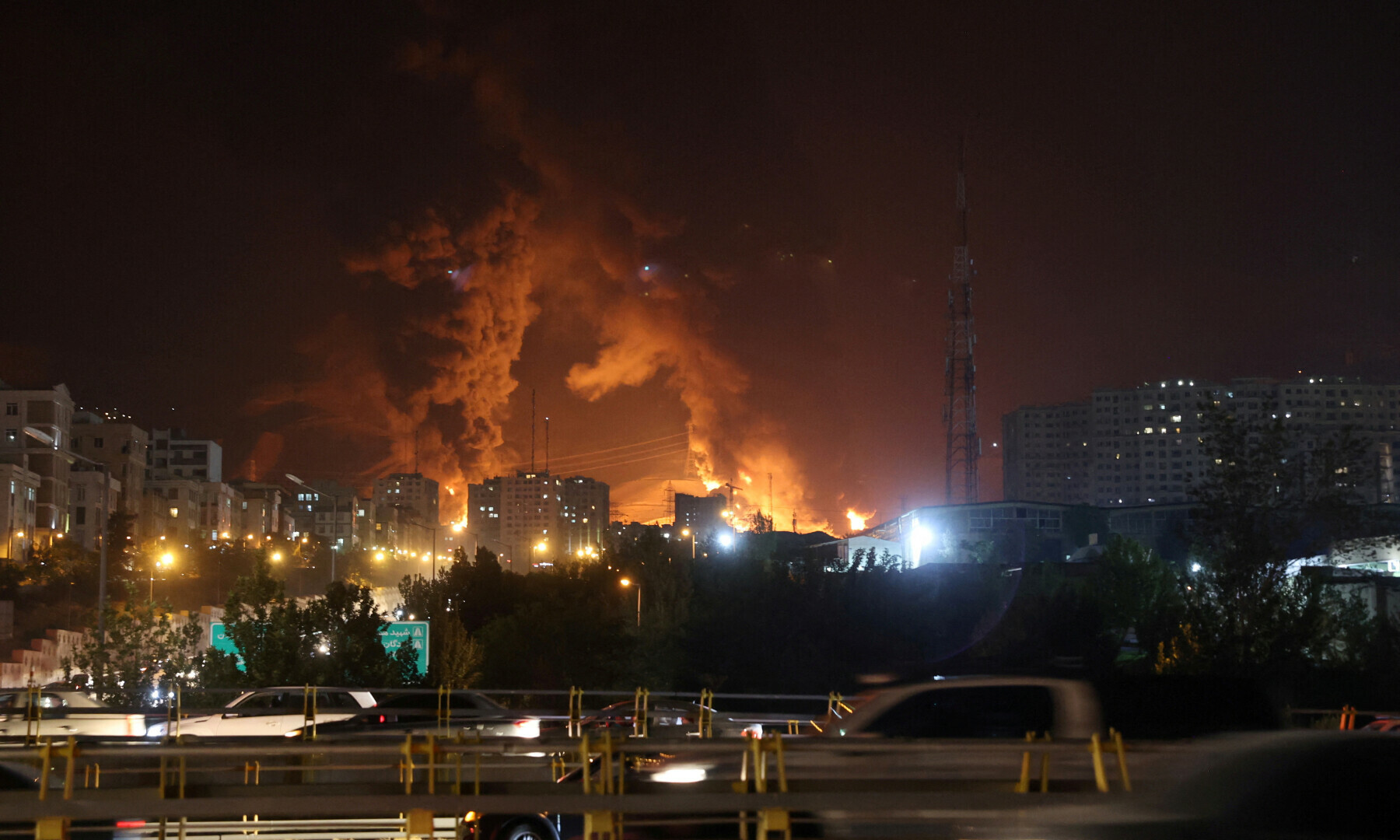
As Israel set Iran’s oil and gas sites ablaze for the first time on Saturday night, triggering another exchange of strikes between the two countries, experts detailed how it could impact the global petroleum industry.

The recent military exchange began on Friday when Israel launched an air offensive against Iran, killing commanders and scientists and bombing nuclear sites in a stated bid to stop Tehran building an atomic weapon. Iran has consistently denied that, saying its uranium enrichment programme is for civilian purposes.

After an Israeli strike caused a fire at the South Pars gas field, Iran partially suspended production there, Tasnim news agency said. The fire broke out in one of the four units of Phase 14 of South Pars, halting production of 12 million cubic metres of gas.

According to Al Jazeera, the South Pars gas field accounts for nearly 20 per cent of known global reserves. It is located offshore in Iran’s southern Bushehr province and is responsible for the lion’s share of gas production in Iran — the world’s third-largest gas producer after the United States and Russia.

Iran shares the field with Qatar, which calls it the North Field. Qatar produces 77 million tonnes of liquefied gas from the field with the help of global majors such as Exxon and Shell, supplying the gas to Europe and Asia.

While the fire at the field was extinguished, according to the Iranian oil ministry, concerns about its impact on the global oil industry remain.


A fire burns at South Pars gas field, in Tonbak, Bushehr Province, Iran, in this screen grab from a handout video released on June 14, 2025. — Social Media/via Reuters

The Hindustan Times noted there could be a potential disturbance in the global oil pricing as the attack heightened the risk to the oil infrastructure in Iran — third-biggest producer of the Organisation of the Petroleum Exporting Countries (Opec) — and to shipments from elsewhere in the region.

Jorge Leon, an analyst at Rystad Energy who previously worked at the Opec secretariat, termed it a “significant escalation” in a Bloomberg report.

“This is probably the most important attack on oil and gas infrastructure since Abqaiq,” Leon said, referring to the 2019 strike that briefly crippled one of Saudi Arabia’s key oil-processing plants.

“It’s going to be pretty significant,” Richard Bronze, head of geopolitics at consultant Energy Aspects Ltd, said about the attacks.

“We appear to be in an escalatory cycle,” he observed, adding there would be “questions about whether Israel is going to target more Iranian energy infrastructure”.

Threat to global oil supply

Meanwhile, Iran has also threatened to close off the Strait of Hormuz, a crucial point for global energy transportation.

An Iranian general, Esmail Kosari, said yesterday that Tehran was reviewing whether to close the Strait of Hormuz, controlling access to the Gulf for tankers.

The Strait is the exit route from the Middle East Gulf for around 20pc of the world’s oil supply, including Saudi, UAE, Kuwaiti, Iraqi and Iranian exports.

“If Iran responds by disrupting oil flows through the Strait of Hormuz, targeting regional oil infrastructure, or striking US military assets, the market reaction could be much more severe, potentially pushing prices up by $20 per barrel or more,” said former Opec official Leon.

Jamal Abdi, the president of the National Iranian American Council, described the threat as “Iran’s trump card”.

“The view is [that] this would sort of strangle the global economy, have massive economic impacts, and it’s a very small body of water, so the type of sabotage necessary to make that a choke point, Iran likely does have,” he told Al Jazeera.

After Israel attacked Iran and Tehran pledged to retaliate on Friday, oil prices jumped as much as 13 per cent to their highest since January, even though Israel spared Iran’s oil and gas on the first day of its attacks.

Part of the reason for the rapid spike was that spare capacity among Opec and allies to pump more oil to offset any disruption is roughly equivalent to Iran’s output, Reuters reported, citing analysts and Opec watchers.

Iran produces more than 3 million barrels per day (bpd) of crude oil.

Saudi Arabia and the United Arab Emirates are the only Opec+ members capable of quickly boosting output and could pump around 3.5m bpd more, analysts and industry sources said.

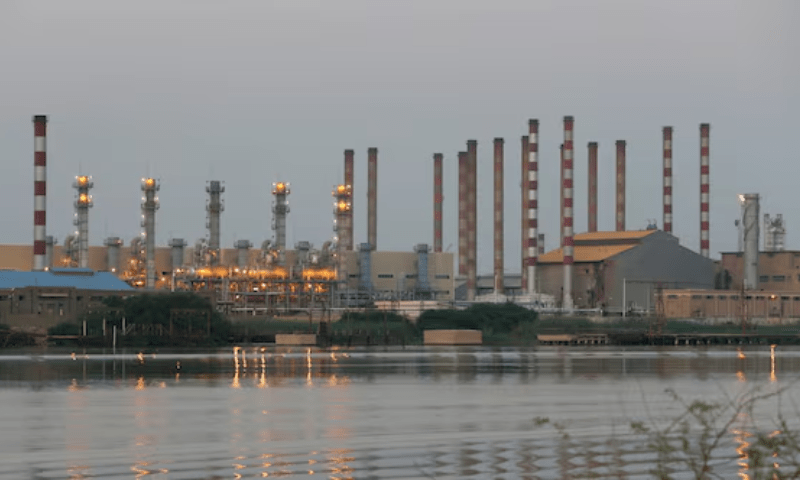
A general view of Abadan oil refinery in southwest Iran, is pictured from Iraqi side of Shatt al-Arab in Al-Faw south of Basra, Iraq on Sept 21, 2019. — Reuters/Essam Al-Sudani/File

“Following the July hike, most Opec members, excluding Saudi Arabia, appear to be producing at or near maximum capacity,” J.P. Morgan said in a note.

Outside of Saudi Arabia and the UAE, spare capacity was negligible, said a senior industry source who works with Opec+ producers.

“Saudis are the only ones with real barrels, the rest is paper,” the source said. He asked not to be named due to the sensitivity of the matter.

Russia, the second-largest producer inside Opec+, claims it can pump above 12m bpd.

J.P. Morgan estimates, however, that Moscow can only ramp up output by 250,000 bpd to 9.5m bpd over the next three months and will struggle to raise output further due to sanctions.

Iran produces around 275 billion cubic metres (bcm) of gas per year or some 6.5pc of global gas output. However, it consumes the produce domestically because of US sanctions on exports.

Yet despite the US-led sanctions, Iran has been able to increase crude exports since the first Trump administration imposed full US sanctions in May 2019.

China is the largest importer of Iranian oil, raising concerns of a possible impact on it if Israel further attacks Iran’s oil and gas industry.

Teapot refiners are private Chinese refineries that are the primary purchasers of Iranian oil, with one being sanctioned by the US this year and another in 2022.
Which Iranian sites were attacked?

Israel also attacked the Shahran depot and the Fajr Jam Gas Refining Company, the Iranian petroleum ministry said, according to Al Jazeera.

Smoke from an Israeli attack rises from Shahran Oil depot, following Israeli strikes on Iran, in Tehran on June 15, 2025. — Majid Asgaripour/Wana via Reuters


Major fires broke out at two opposing ends of Tehran — the Shahran fuel and gas depot to the northwest, and one of Iran’s biggest oil refineries in Shahr Rey to the south, the report added.

While Iran’s Student News Network denied that the Shahr Rey refinery had been struck by Israel, and claimed it was still operating, it said that a fuel tank outside the refinery had caught fire.

With nearly 260m litres of storage capacity across 11 tanks, the Shahran oil depot is one of Tehran’s largest fuel storage and distribution hubs, Al Jazeera noted.

It termed it a “vital node” in Tehran’s urban fuel grid, distributing petrol, diesel and aviation fuel to several terminals in the capital.

The report quoted experts as warning that any disruption to the state-owned Tehran Oil Refinery could strain fuel logistics in Iran’s most populous and economically significant region.


This illustration by Al Jazeera shows the locations of Iranian oil and gas facilities that came under Israeli attacks on June 14, 2025. — Al Jazeera Labs based on Reuters


Header image: A plume of heavy smoke and fire rises over an oil refinery in southern Tehran, after it was hit in an overnight Israeli strike, on June 15. — AFP
Bernie Sanders (DSA) Senator,
 Says US Must Not Be 'Dragged Into Another Netanyahu War'

The independent U.S. senator condemned the "illegal unilateral attack on Iran" by Israel that "risks a full-blown regional war."


A rescuer carries an injured girl on his back in an area hit by a missile fired from Iran, in Ramat Gan near Tel Aviv on June 13, 2025. Iran fired a barrage of ballistic missiles at Israel in a counter-strike in the evening on June 13, after an unprovoked onslaught hammered nuclear facilities, bases, and residential targets in Iran.
(Photo by Jack Guez / AFP via Getty Images)


Jon Queally
Jun 13, 2025
EDITOR
COMMON DREAMS

As Iranian missiles were being shot down over Israel on Friday following the IDF's unprovoked bombings of Iranian targets earlier in the day, Sen. Bernie Sanders (I-Vt.) condemned the government of "extremist" Prime Minister Benjamin Netanayahu for his "ongoing deviance of international law" that has made the "world more dangerous and unstable" and trying to drag the United States into dangerous new war in the Middle East.

"First, he uses the starvation of children in Gaza as a tool of war, a barbaric violation of the Geneva Conventions," declared Sanders in a statement. "Now, his illegal unilateral attack on Iran risks a full-blown regional war."

Sanders said Israel's Friday bombings and assassination attacks against Iranian targets, including nuclear program facilities, "directly contravened the express wishes of the United States, which was seeking a diplomatic resolution to the long-standing tensions around Iran's nuclear program."

While a new round of diplomatic talks between the U.S. and Iran were slated to begin Sunday, said Sanders, "Netanyahu chose instead to launch an attack"—a move seen by critics as an overt effort to sabotage a negotiated agreement.

"The U.S. must make it clear that we will not be dragged into another Netanyahu war," said Sanders. "Along with the international community, we should do everything possible to prevent an escalation of this conflict and bring the warring parties to the negotiating table."
House GOP Vote to Take Back Funds for NPR/PBS Imperils 'Future of Public Broadcasting'

"President Trump is determined to destroy any news outlets that hold him accountable for his actions," said one free press advocate.

THIS A CONSERVATIVE WET DREAM FOR FIFTY YEARS
THEY HATE PUBLIC BROADCASTING


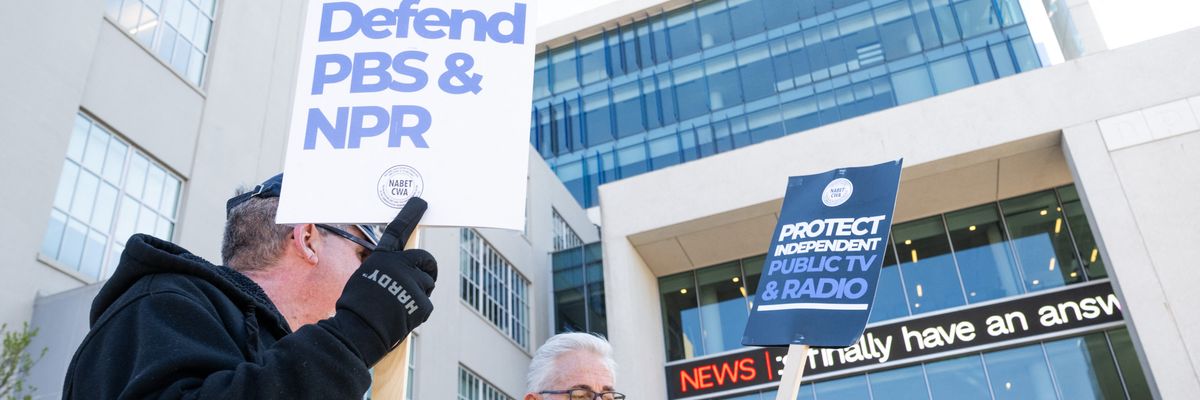
People participate in a rally to call on Congress to protect funding for U.S. public broadcasters, Public Broadcasting Service (PBS) and National Public Radio (NPR), outside the NPR headquarters in Washington, D.C., on March 26, 2025.
(Photo: Saul Loeb/AFP via Getty Images)


loise Goldsmith
Jun 13, 2025
COMMON DREAMS

The U.S. House of Representatives on Thursday narrowly approved a rescission package that would take back funding for PBS and NPR, as well international aid programs—a move that supporters of public media quickly decried.

Earlier in June, the Trump White House formally asked Congress to rescind over $9 billion in approved spending, the vast majority of which would go toward foreign aid programs. However, it also includes a take back of more than $1 billion in already approved funding for the Corporation for Public Broadcasting (CPB), the congressionally funded and created company that supports public media in the United States. CPB distributes nearly all of those funds to local television and radio stations, according to NPR. The funding clawback impacts funding for the next two fiscal years.

"Public media delivers unmatched value to the American taxpayer," said Patricia Harrison, president and CEO of CPB, in a statement on Thursday. "It serves every family in every part of America."

The package passed with a 214 to 212 vote. All House Republicans except for four voted in favor of the measure, and all Democrats voted against it. It now heads to the Senate.

"From life-saving emergency alerts to local reporting and storytelling, and educational resources that support families, job seekers and teachers—these services exist because public media is committed to serving everyone, regardless of income or zip code. In many rural and underserved areas, the loss could be total," Protect My Public Media, a grassroots advocacy campaign focused on preserving federal funding for public media stations, wrote in response to the House vote. The group is driving emails to the Senate to urge lawmakers to vote against the package.

Co-CEO of the advocacy group Free Press Action, Craig Aaron, said Thursday that there is broad support for federal funding for public broadcasting.

"President [Donald] Trump is determined to destroy any news outlets that hold him accountable for his actions. As they prepare to vote on his request, senators need to know that supporting public media is healthy for their communities and our democracy. Publicly funded news outlets act as counterbalances to a commercial media system that too often puts profits before the public interest," Aaron said.

Big picture, Free Press Action says that the House vote puts the "future of public broadcasting in doubt."

In addition to slashing federal funding for NPR and PBS, the package would cut money for peacekeeping efforts, dollars for health programs that fund activities related to child and maternal health, HIV/AIDS, and infectious diseases, and funding for climate projects.

Lisa Gilbert, co-president of the watchdog group Public Citizen, highlighted some of these other cuts, as well as those to public media, and added that "Republican senators should reflect on how the rescission package threatens to blow up the annual appropriations process."

"The minority party has no reason to agree to bipartisan appropriations legislation if the president and one party alone can undo the deal," she said.
Horror in Minnesota is all on Trump


D. Earl Stephens
June 14, 2025 
RAW STORY


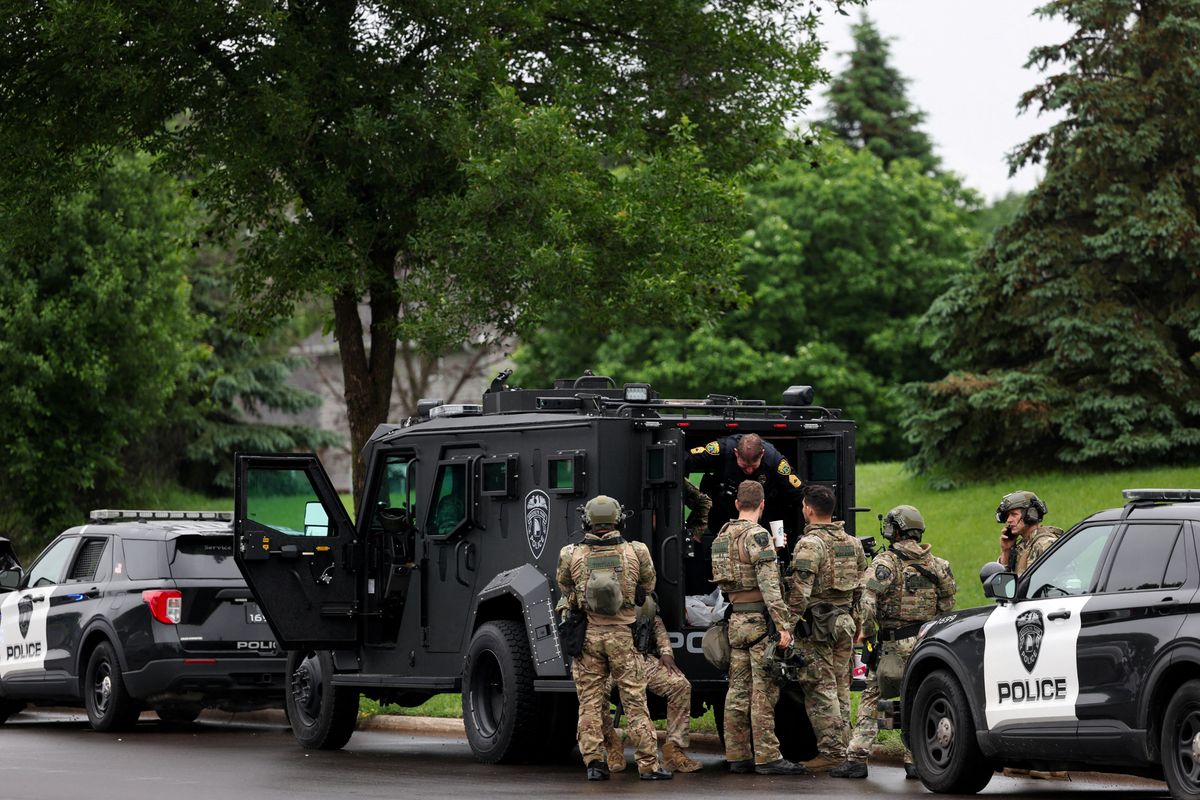
Officers gather after the shooting of Democratic lawmakers in Minneapolis. REUTERS/Ellen Schmidt TPX

As I was typing a piece on Saturday morning, endeavoring to stitch together Flag Day, our army’s birthday, and the peaceful marches against tyranny that were going off all over the United States of America, I got a chilling news bulletin — that two Minnesota lawmakers and their spouses had been shot in their homes by a madman impersonating a police officer.

This is what I knew as my fingers hit the keyboard:
State Representative Melissa Hortman and husband, Mark, have died in the attack at their home in the Minneapolis suburbs. State Senator John A. Hoffman and his wife, Yvette, were also shot multiple times at their house in a nearby suburb, but remain alive.

Minnesota Gov.Tim Walz has called this a “political assassination.”

This will be a developing, gruesome, and very American story for some time to come. I want to be careful to honor the victims while channeling my sadness and rage at the state of things in my country in as precise a manner as possible.


So let me start here:
What happened in Minnesota can surprise ABSOLUTELY NOBODY who has been paying even the slightest amount of attention to the sickly state of America in 2025.


It is perhaps the most predictable thing I have seen coming in the roiling wake of a week in which we have seen a U.S. senator — a son of Los Angeles — tackled and handcuffed for simply asking a puppy-shooting, ineffectual wax figure to explain herself, and to stop lying about the reason for her agency’s invasion of the city he grew up in. There were no apologies for this disgusting incident.

We have watched helplessly while human beings, one after another, have been swept off our streets by masked monsters, who may or may not be impersonating government law enforcement officers.


We have watched as this grotesque president whipped young, impressionable soldiers into a frenzy and made sure to empty their pockets and fill his by selling them his warped MAGA memorabilia on one of our army bases.

We have gone so far past the unimaginable, it is impossible to know where to begin to connect with the normal.

But let me be crystal clear on this: ALL OF IT lies at the fat little feet of the convicted felon, who attacked this country on January 6, 2021, did nothing to stop that attack for hours and instead rooted for its success, and has continued to intentionally throw gasoline on the raging fires he has so eagerly stoked, starting in the vicinity of 2010 when he questioned President Obama’s citizenship.


THAT was the catalyst for everything that has followed, and has lead us to lawmakers and their families now being slaughtered in their homes.

IT IS ALL ON HIM.

Perhaps I am not helping right now, but like so many of you I have grown weary and disgusted waiting for people with heft and alleged status to say what we all know to be true.


The gaslighting has gone on long enough.

My God, this mess of a man stood in our nation’s capital in that odd way he does … ample ass out, jutted, orange chin forward … and did his best Mussolini impression by keeping the tanks running on time on their way down our streets.

Are you reading this????????


TANKS.

All this to honor himself on his 79th birthday. If there is any good news here, and you have to squint hard to see it, he has climbed another notch on the actuarial life table.

I have said enough for now, my friends. Like you I am aching inside. My fury wringing out tears …

I took part in our march here in Madison, Wisconsin, joining tens of thousands of other hearty souls who love their country enough to assemble peacefully on her behalf.

We are still the lucky ones. Nobody has turned their guns on us — yet.

(D. Earl Stephens is the author of “Toxic Tales: A Caustic Collection of Donald J. Trump’s Very Important Letters” and finished up a 30-year career in journalism as the Managing Editor of Stars and Stripes. You can find all his work here.)


THE ONLY AMENDMENT TRUMP ABIDES BY


'Humiliating': Onlookers mock Trump's 'sad little tank parade' for low turnout

David McAfee
June 14, 2025 
RAW STORY


U.S. President Donald Trump listens to remarks during a swearing-in ceremony for Administrator of the Centers for Medicare and Medicaid Services Mehmet Oz in the Oval Office in Washington, D.C., U.S., April 18, 2025. REUTERS/Nathan Howard

Donald Trump was ridiculed on Saturday for a "sad little tank parade" with a purportedly low turnout rate.

The New York Times was one of the first major outlets to flag what could be considered signs of failure for the MAGA event. One reporter noted that "hordes" of people were trying to leave before Trump even spoke, while another called the parade and crowd "listless."

But the Times wasn't the only one to get in on the action.

On social media, several commentators and observers circulated images of the less-than-expected MAGA crowd.

Comedian and writer Mike Drucker shared a video from the event, and wrote, "This is genuinely humiliating to see."

Drucker in a separate post added a photo of Trump, and said, "It’s your birthday. It’s Saturday night. But you made one critical mistake: You threw a $45 million parade for yourself without realizing you’d be bored out of your mind."

Democratic strategist Mike Nellis said, "America's army won WWI and WWII, and this is the best they could f------ do with $45 million for this parade?"

"I get the weather, but this is embarrassing," he added.

NBC reporter Mark Segraves said, "The #Army250 parade starting 30 minutes early due to incoming weather. Crowd nowhere near the 200,000 expected," to which former GOP lawmaker Barbara Comstock said, "Newsmax is saying about 10,000 there. That’s small for some protest rallies today and a huge waste of our military $$$ when the world is on fire."

Conservative Tim Miller gave his "main takeaway" from the event.

"Lame and embarrassing Trump having a sad little tank parade while Israel is wrecking the entire IRGC with precision strikes just underscores our decline," the strategist added.


All hail the king


Rafia Zakaria 
Published June 14, 2025  
 DAWN

The writer is an attorney teaching constitutional law and political philosophy.


MILITARY parades are not uncommon in many parts of the world. Lines of tanks, contingents of marching soldiers, missiles, along with fighter jets and helicopters flying overhead, create just the sort of martial theatre that makes watching crowds feel nationalistic and strong. When the fates of leaders and their armies rely on such a spectacle, it follows that they are not infrequent.

This is not the case in the US, at least not until now. Since the end of the Cold War, America has projected itself as the world’s diplomat. Even as it has waged wars all over the world, the domestic population remains largely disconnected from the military and its hardware. It may also be the case that when you know you are the superpower and have the deadliest weapons in the world, you need not show them off. It would not be incorrect to say that American projections of power have not been parades but actual decades of wars and occupations.

This is about to change. On Saturday, a military parade is supposed to take place in Washington, D.C. The timing is portentous; it is the 250th anniversary of the US Army. It is also American President Donald Trump’s birthday. The confluence may have made it possible for Trump to stage the $45-million parade that will include 6,600 soldiers. Even Republicans have smelled the rancid odour coming from a wannabe authoritarian holding a military parade on his birthday. To use the lingo of Gen Z, it’s giving dictatorship, it’s giving Dear Leader, it’s giving a man who thinks he is king.

If the stench of the parade was not terrible enough, the timing adds to the mess. For the entire preceding week, the Trump administration almost gleefully cracked down on protesters in Los Angeles, who have been thwarting deportation raids by ICE officers.

In the first few days of the protests, angry demonstrators confronted by masked Immigration and Customs Enforcement officials armed with military equipment grew violent and burned some businesses and cars.

The administration, which has been chomping at the bit to have a confrontation of just this sort; began to reiterate its line about all migrants being criminals and, in the words of Secretary of Homeland Security Kristi Noem, Los Angeles itself being a “city of criminals”.


Over 1,600 protests are expected against Trump’s military parade.

To drive home this point, Trump who has a long-standing enmity with California Governor Gavin Newsom, decided to call out the National Guard to assist ICE officials in California against the state’s wishes. The move, no doubt motivated by Trump’s contempt for California (a Democratic state), where the majority are racial minorities, was seen as overreach. Then, even though the protests had been quelled and were restricted to a couple of blocks in a city of millions, Trump insisted on deploying the Marines in California.

It is important to understand the consequence of such a move. While those who have lived under authoritarian regimes may be attracted to Trump and his strongman moves, the American public is less tolerant of such exercises.

First, protest is a protected right under the First Amendment. Second, the idea that the Marines, a force trained to kill, would be called out against unarmed protesters is the sort of overkill that Trump loves and everyone else detests. Finally, the cost itself — Americans point out that the parade is simply not good use of money.

Over 1,600 protests are expected to take place in the US against Trump’s military parade. Saturday has been dubbed ‘No Kings Day’, alluding to Trump’s predilection for believing that he is indeed the King of the United States of America. His constant allusions to contesting elections for a third term and his infatuation with the kings he encounters in the Middle East do not help in this regard. Even those who do not protest are beginning to dislike him. Polls show that his appro­val ratings plunged to an 80-year-low recently. Trump has also lost public confidence in his handling of immigration as the travel bans, ICE raids, border harassment and general rounding up of anyone thought to be a migrant have unfolded.

Saturday’s parade is seen as the use of presidential power to stage a spectacle whose only real purpose is to nourish the ego of a man who will turn 79 on that day. No one is impressed. The fact that he has decided to call out the military in Los Angeles, forcing troops trained to kill to crack down on unarmed protesters, creates a ghastly image of the downfall of America that is visible to all but Trump. The poorly thought-out move, and the price tag attached, may well be the beginning of the end of Trump’s honeymoon period. Six months into his presidency, Americans have not seen the economic gains that he promised, while the things he is delivering on are ones that no one wants.


rafia.zakaria@gmail.com

Published in Dawn, June 14th, 2025