Sunday, June 15, 2025

Student protest in Serbia: “either we stop or there will be a civil war”

Thursday 12 June 2025, by Gaëlle Guehennec

Since November 2024, Serbian students have been leading an unprecedented revolt against Vučić’s corrupt government. Along with two Belgian comrades from the Gauche Anticapitaliste, I went to Belgrade to meet them.

In front of Belgrade’s Faculty of Philosophy, a table and camping chairs were set up. A dozen or so students wrapped up in duvets were watching the entrance. On the table were sudokus and packets of cigarettes to pass the time. The students take 8am shifts to secure the faculty, which has become both a dormitory and a People’s Assembly. Several times a week, classes are organized and open to all. There are also decision-making assemblies where the future of the movement is shaped. The students greet us with a smile, taking turns to speak, then all at once. They say they’ve been there since day 0, six months already.

As a reminder, on 29 November last year, the canopy of Novi Sad station collapsed, killing 15 people. [1] The students quickly mobilized against the authoritarian regime of Aleksandar Vučić, who was accused of awarding the work to corrupt and incompetent companies. [2] .]] In a country where it is difficult to criticize the government in power, the students have succeeded in a tour de force: they have “depoliticized” the movement and refused to turn it into a partisan struggle in a country riven by deep divisions. This strategy enabled them to bring people together across ideological lines. They are framing the movement around four simple demands:

1. Publication of all documents relating to the reconstruction of Novi Sad station, which are currently inaccessible to the public.

2. Confirmation by the competent authorities of the identity of all those reasonably suspected of having physically assaulted students and teachers, and the initiation of criminal proceedings against them.

3. The charges against the students arrested during the demonstrations be dropped, and all criminal proceedings suspended.

4. A 20% increase in the budget allocated to higher education.

The response to these demands was massive. The students succeeded in rallying a large part of the country, using various mobilisation techniques such as nationwide marches to thwart state propaganda. The mobilisation reached its peak on 15 March 2025, when 400,000 people poured into the capital. [3]

But what has happened since then? Why have the media stopped reporting on the Balkans?

The government plays the attrition card in the face of exhausted young people

Faced with this persistent protest, the government was quick to react by playing for time and using the university calendar to its advantage. It is the end of May and the exams are approaching. The government is using the calendar to its advantage to put pressure on the students. Their decision was made: they would sit the exams, knowing that they were going to fail. They decided to sacrifice a year of learning for the future of their country.

In response to a potential widespread failure at the end-of-year exams, the Serbian government is threatening to privatize the universities on the pretext that the public sector is insufficient to guarantee the success of these students. Faced with this game of failure, the dwindling numbers of students testify to their general exhaustion: “at the beginning people came, now we are burnt out”. Although still supported by a majority of the population, the number of active activists is dwindling: “we are not enough people, now our shifts are from 8 to 11”. Fewer and fewer of them are coming to staff the university barricades: “we are the bravest soldiers” say the last remnants.

In addition to the pressure from the government, they have to deal with the government’s shenanigans, which use propaganda and discrediting techniques that are hardly fair play. The students denounce the “Studenti koji žele da studiraju”, literally students who want to study, which refers to a government-orchestrated group camped out in front of parliament to thwart the protesters. [4]

Despite the fatigue and the vicious political strategies, the movement resisted, thanks in particular to a well-honed horizontal structure.
The movement claims to be non-hierarchical, apolitical and non-partisan

Students take it in turn to speak outside the university, none of them really standing out from the others. At the beginning of the movement, some students tried to impose themselves but were quickly pushed aside. The movement claims no leader. In the media, it is never the same faces: “we want to promote the demands, not people”. The movement claims to be totally horizontal: “we are against hierarchy”. They also claim to be apolitical and non-partisan in order to bring together as many people as possible and prevent attempts by the political opposition or even by certain professors who want to take advantage of the movement to obtain posts in a possible government of experts.
In reality, the movement is riven by deep political divisions

Behind this apolitical façade, however, a more assertive ideological line was emerging. Students from the philosophy faculty explain: “this is a communist movement by essence”. They defend the idea of a Social Front that would give power to the people: “let the people decide”. The Social Front does not yet exist as a formal entity in Serbia, but it is a political proposal emanating from the student movement. The idea is to create a broad, horizontal network of students, workers, farmers and other social groups, united by a common opposition to the corruption and authoritarianism of the Vučić government. The project aims to transcend traditional divisions, rejecting partisan manipulation and promoting direct, participatory democracy. [5]

The philosophy faculty to which the students interviewed belong, which is anchored on the left, openly criticises other establishments for being too accommodating to liberal institutions. They defend an anti-European and sovereignist line, convinced that the EU holds Serbian youth in contempt. On several occasions, they hold the EU responsible for the 1999 bombings, ‘we are not fond of the EU’. [6] Conversely, other universities remain Brussels-oriented and seem to be waiting for a response from the European Union, wishing to reproduce liberal societies modelled on other European countries. In mid-May, around twenty students ran 2000 km from Novi Sad to Brussels in the hope of a response from the European institutions, which are discreetly supporting the Vučić government. [7]

How do Europe and France negotiate human rights and democracy?

France, or the “great European democracy” selling rafales to an autocrat

On 9 April, Emmanuel Macron received President Vučić, without a word about the student movement or the country’s autocratic drift. [8] How can it be that, faced with such an obvious denial of democracy, European countries look the other way?

France’s silent complicity could be explained in terms of economic and geopolitical interests. Since 2019 and its reintegration into the Balkans, France’s strategy has been to prioritise cooperation on security and the economy, to the detriment of democratic requirements. Paris prefers to open up a new market for its investors, rather than fight corruption. In July 2023, Vučić signed a historic contract with Macron: the purchase of twelve Rafale fighter jets worth €3 billion. At the time, the French president hailed it as a “demonstration of the European spirit”.

A colossal sum for a country where the minimum wage is no more than 400 euros a month, but one that strengthens the military-industrial links between Paris and Belgrade. And France is not stopping there. It is involved in a number of strategic projects in Serbia: Vinci operates Belgrade airport, Michelin has a tyre factory in Pirot, and discussions are under way for the construction of nuclear power stations in partnership with EDF and Framatome.

This policy is part of a wider framework known as “stabilocracy” [9], i.e. tacit support for authoritarian regimes as long as this guarantees political security and access to markets. By preferring its contracts to its principles, French diplomacy is fuelling a geopolitical status quo that entrenches an authoritarian regime at the expense of a civil society calling for democracy.

Europe of the market, not of the people

French silence is echoed only by European silence. The Serbian president was even publicly congratulated by Commission President Ursula von der Leyen, praising his “sense of responsibility” and the country’s “economic potential’” without a word for the regime’s democratic violations and corruption. In 2023, under the guise of ”ecological transition”, the European Union relaunched Rio Tinto’s highly controversial mining project, which had been suspended in 2022 thanks to environmental and public protests. A lithium extraction project to supply European industry, with no regard for local ecosystems or the people directly affected. Serbia’s young people are being sacrificed on the altar of Europe’s ‘green’ transition. [10] In the same year, Serbia received the biggest European subsidy in its history, more than half a billion euros for the renovation of the Belgrade-Niš rail corridor.

Serbia is also a strategic point for Brussels. It lies on the Balkan route and enables migration control to be outsourced. Serbia acts as a buffer and allows itself illegal refoulement, police violence and the denial of human rights. [11] In this way, Europe does not get its hands dirty and Vučić, by playing the guardian of the “fortress”, buys himself political indulgence from Brussels. The EU also fears a shift towards Russia, an economic partner and potential market. Despite its status as a candidate country, Serbia refuses to align its sanctions with those of the European Union against Moscow. By maintaining economic ties with Russia, Vučić is skilfully playing on this “non-aligned” position, oscillating between promises of European integration and an assumed closeness to the Kremlin. This double game worries Brussels, which fears that Belgrade is becoming a Russian Trojan horse in the heart of the continent. All these economic and geostrategic interests justify European leaders turning a blind eye to an illiberal government and authoritarian practices. One might well ask what purpose the EU serves if it sacrifices its young people in the name of free trade, security and geopolitical relations? [12]
What next? Is “history over”?

The mobilization is running out of steam. [13] Vučić tells his supporters that “the story is over”. Lucid about the situation, the students at the Faculty of Philosophy could only envisage two options: “either we stop or there will be civil war”. They insist once again that their main objective is to mobilize the Serbs first and foremost: “we want to mobilize our people”. They do not just want to change the government, they want to change the whole system. At a time when Serbian students are reminding us that emancipation will come neither from governments nor from institutions, but from peoples in struggle, we can ask ourselves what our role is in this internationalist solidarity that has yet to be built.

5 June 2025

Translated by International Viewpoint.

Attached documentsstudent-protest-in-serbia-either-we-stop-or-there-will-be-a_a9039.pdf (PDF - 899.4 KiB)
Extraction PDF [->article9039]

Footnotes


[1] Euronews, 30 December 2024 “Serbian prosecutors indict 13 over deadly canopy collapse that sparked mass protests”.


[2] For more context see “Serbian students cycle to Strasbourg, Macron prefers to receive the autocrat Vučić”, “Chronology of the struggle in Serbia”, “Student protests in Serbia: "The movement cannot afford to stop now"”, “Serbia’s Mass Protests Against a Crony-Capitalist Government”.


[3] BBC, 16 March 2025, “Serbia’s largest-ever rally sees 325,000 protest against government”.


[4] See Ćaciland Protest Camp.


[5] Contretemps, 25 February 2025 “Mouvement étudiant en Serbie : « Un État-providence, c’est ce dont notre pays a besoin »”, Cerises la Coopérative, 4 April 2025, “Serbie : un nouveau front étudiants-travailleurs”.


[6] Modern Diplomacy, 18 March 2025, “Remembering 1999: How the NATO Bombing Shaped Serbian National Identity”.


[7] Brussels TImes, 13 May 2025, ‘From my village to Brussels’: Serbian student protest reaches Belgium.


[8] Euronews, 10 April 2025 “President Vučić gets strategic support from France for Serbia’s ‘European destiny’”.


[9] Fondation Jean-Jaurès, 2 June 2022, “Sortir de la ‘stabilocratie’: repenser l’approche française des Balkans occidentaux”.


[10] Reporterre, 13 May 2025, “En Serbie, la lutte contre le lithium alimente une révolte historique”.


[11] Amnesty International “Human rights in Serbia”.


[12] Fondation Jean-Jaurès, 20 January 2025 “En Serbie, une ultime bataille pour la démocratie fait rage dans l’indifférence de l’Europe”.


[13] RFI, 22 May 2025, “Serbie: malgré des résultats, les manifestations anti-Vucic perdent de leur ampleur”.


Gaëlle Guehennec is a member of the NPA-A in France.

International Viewpoint is published under the responsibility of the Bureau of the Fourth International. Signed articles do not necessarily reflect editorial policy. Articles can be reprinted with acknowledgement, and a live link if possible.
Ukraine at war, Ukraine in struggle...

Friday 13 June 2025, by Gin Vola, Elias Vola


Resistance to the Russian invasion has not erased class divisions within Ukrainian society. The inequalities of our capitalist societies and the brutal neoliberalism applied by the Zelensky government are significantly affecting the population of Ukraine. The popular classes thus fight on a "double front", against anti-social policies and imperialist aggression.


In Kyiv, on the initiative of some forty organisations, pickets against land corruption in the city were organised last month. The protesters are demanding the dismissal of the 17 officials involved in these cases and have initiated the establishment of public oversight boards. [1] In Odessa, the Centre for Civil Liberties organizes citizen control of the city’s bomb shelters, in order to check their condition and accessibility for the population.
Battle against health sector privatisation

For its part, the Free Trade Union of Health Workers is organising a campaign against the ongoing medical reform, which aims to further privatize the sector and "turn patients into customers of the private medical sector". In Kyiv, a rally was held to protest against street attacks on LGBT people. Under the slogan "My tradition is love", the protesters are demanding that Parliament pass a law against hate crimes. A few weeks earlier, the far right had tried, unsuccessfully, to prevent a queer festival.

In western Donbass, the Regional Union of the Independent Union of Miners of Ukraine has organised a delivery of equipment to support soldiers at the front. Among the objects delivered, which soldiers often lack, are metal parts for the manufacture of anti-drone barbecues. The same union recalls that "[the aid given] to those who defend Ukraine against the Russian enemy invasion, could become much more important if miners who are on the front lines of work receive decent and high wages".
Fight for wages and democratic rights

At the Derazhny City Multipurpose Hospital, the Soyez trade union was successful in convicting the director of non-payment of wages and securing their payment. The health staff and their union believe that the director should be removed from his position. In the village of Slavske, 20 municipal councillors were dismissed following a meeting organised by the inhabitants. The latter consider that "[they] ignore their duties towards the voters and [point] to the lack of working meetings with them".

These are just a few examples of the myriads of initiatives in war-torn Ukraine. They reveal the vitality of a population that, through its resistance to Putin’s invasion as well as to the policies of the Ukrainian oligarchy, continues to fight for its social and democratic rights. It is to them, above all, that we bring our unconditional solidarity.

29 May 2025

Translated by International Viewpoint from l’Anticapitaliste.

Attached documentsukraine-at-war-ukraine-in-struggle_a9041.pdf (PDF - 905.5 KiB)
Extraction PDF [->article9041]

Footnotes

[1] Insights into the struggles in Ukraine drawn from the daily reports made by Patrick Le Tréhondat, RESU activist and member of the Editorial Solidarity Brigades.


Elias Vola

Gin Vola


International Viewpoint is published under the responsibility of the Bureau of the Fourth International. Signed articles do not necessarily reflect editorial policy. Articles can be reprinted with acknowledgement, and a live link if possible.

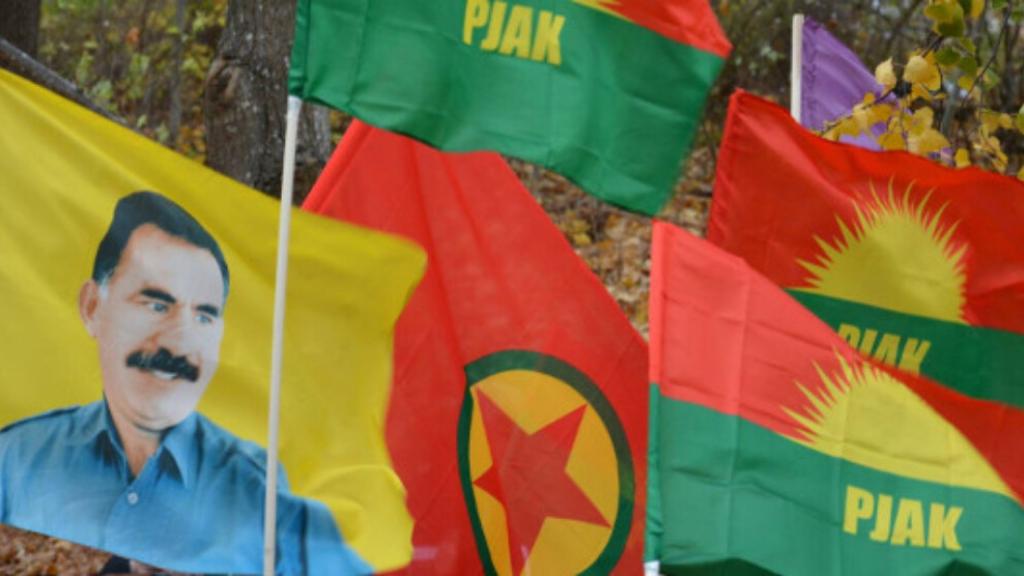
Kurdish left: ‘The people of Iran should not be forced to choose between war or dictatorship’

PJAK PKK flags

Statements by the Kurdistan Democratic Communities Union, an umbrella organisation of Kurdish left organisations, and the Kurdistan Free Life Party, based in Iranian/Eastern Kurdistan, also known as Rojhelat. 


Kurdistan Democratic Communities Union: No solution can be achieved through war

Last night [June 13], Israel launched a wide-ranging airstrike operation against Iran. Unfortunately, this attack has further deepened the war that escalated on October 7, 2023, and which has already caused great harm to the people, leading to destruction and great suffering. The war, developed by states for the sake of power, authority, and hegemony, does not solve any problems and solely causes great harm to the people. Its only result is great suffering, death, loss, and destruction. The fact that war does not solve anything and only deepens and exacerbates the existing problems has been sufficiently demonstrated by the history of the Middle East, which has been marked by uninterrupted war for over a century. We condemn this war, which caused so much harm for the people. It must be realized by everyone that war is not a method to develop any solution. War policies must be abandoned.

As the Kurdish freedom movement, we act with awareness of this historical reality and truth. We believe that all the prevailing problems can and must be solved through democratic politics. Like the current way of democratic negotiation put forward by Kurdish people’s leader Abdullah Öcalan. We call on everyone to reason with this understanding and act on this basis. The tactic of war must be abandoned, and instead the path must be paved for democratic politics, dialogue, and negotiations.

We reiterate that the solution to the problems in the Middle East can only be achieved through Democratic Modernity and the concept of ‘Democratic Nation’ put forward by Kurdish people’s leader Abdullah Öcalan. It is a proven reality that with the Capitalist Modernity’s concept of a unitary nation-state, and with the greed for power, authority, and hegemony, it is impossible to establish a peaceful life in the Middle East, which has always been like a colorful garden of rights, beliefs, and cultures. This understanding, which has been pursued for over a century, has placed the Middle East in a major impasse. It is well known that Kurdish people’s leader Abdullah Öcalan is making great efforts to overcome this historical impasse in the Middle East. His ‘Call for Peace and Democratic Society,’ developed on February 27, 2025, was aimed at overcoming this historical impasse. The deepening war and the harm it has caused to the people have once again highlighted the importance of this historical call. Based on this historical reality, we call on the people, particularly the women, and all democratic and social forces to further deepen their understanding of Kurdish people’s leader Abdullah Öcalan and his historical call, to strengthen their organizations, and to unite firmly to develop a democratic solution.

Co-Presidency, KCK Executive Council

June 13, 2025


Kurdistan Free Life Party (Iran): Concerning the conflict between Iran and Israel

Since June 13, 2025, Israel has launched heavy attacks on the nuclear, military, and command centers of the Islamic Republic of Iran, targeting facilities and figures associated with the IRGC. The Islamic Republic’s subsequent retaliatory attacks against Israel are insufficient to deter its deadly strikes. This war is a final ultimatum from the global power system to the Iranian regime and will continue until the regime is completely restructured and neutralized.

This is undoubtedly not a short-term process but rather a crucial part of implementing the "New Middle East" project, which is a consequence of the Islamic Republic's policies of execution, repression, discrimination, corruption, impoverishment, and desperation. These policies have resulted in deep public resentment in Iran, driving Iranian society toward a radically oppositional and rejectionist stance against the current regime.

The Iranian people's joy at the weakening of the regime does not mean that they are pinning all their hopes on the outcome of the war. This is a war of power and conflicting interests, not a war of liberation for peoples and nations. It erupted as a result of the Islamic Republic’s expansionist and warmongering policies, showing no regard for the suffering of the Iranian people. The rulers initiated this war, and the costs are being borne by a population already struggling with social and economic crises. The high number of civilian casualties, especially women and children, in Iran and Israel during these attacks highlights the grim reality that states hold little value for people's lives.

The people of Iran should not be forced to choose between war and accepting a dictatorial regime. The Free Life Party of Kurdistan (PJAK), which opposes the imposition of war on the people of Iran, emphasizes the principle of democratic struggle. It is the people’s democratic struggle and the unique "Jin, Jiyan, Azadi" (Woman, Life, Freedom) revolution that will bring freedom to Iran. Achieving the goals of our democratic revolution undoubtedly requires unity and collaboration among freedom-seekers, democratic forces, national fighters, women, and identity movements.

During this critical and decisive phase, we view the cooperation of Kurdish parties and the transition from party-based rule to popular self-governance in Kurdistan as a historic duty. We call on all forces, parties, and civil society organizations — with Iranian women at the forefront — to launch a new phase of the "Jin, Jiyan, Azadi" revolution. We declare our readiness to help initiate it.

We believe that transitioning to a Democratic Republic of Iran requires shifting perspectives and departing from power-seeking, nationalism, patriarchy, and centralism. We affirm our duty to defend our people and the other peoples of Iran against any form of repression or threat of massacre. We will fulfill this duty within the framework of legitimate self-defense of our rights and existence.

We call on all the people of Iran, especially those in Kurdistan, to organize within democratic, popular structures. Through complete solidarity, they can minimize the destructive impact of war on each other. Vital steps toward building a self-managed, democratic society include forming support groups for victims of war, establishing local rescue committees and financial cooperation committees, and preventing state mercenaries from infiltrating the population. In this regard, we invite all patriots, freedom seekers, and our party members to join us.

Council of the Free Life Party of Kurdistan

June 14, 2025.


INDO-PAK WAR

Asim and Shehbaz in the Same Row but …


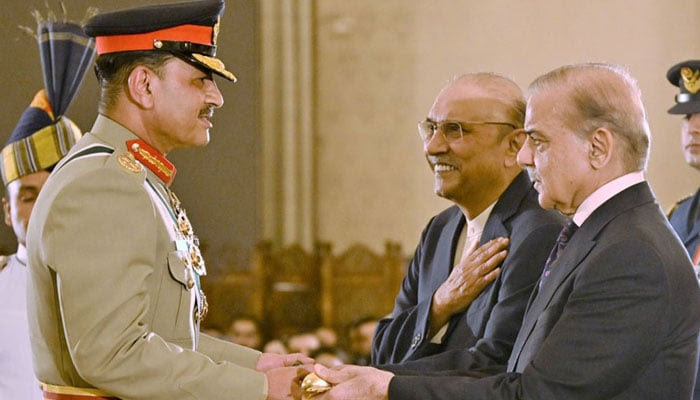
Pakistan’s COAS Field Marshal General Asim Munir (second from right) and Prime Minister Shehbaz Sharif (far right) offering prayers at Kaaba in Saudi Arabia during their reent visit IMAGE/Dawn

In 1909, the renowned poet Muhammad Iqbal wrote Shikwa or Complaint to Allah.1

The poem is a lament that Allah has neglected his followers, Muslims, the very people who spread Islam and gave Him global exposure.

A couplet refers to Mahmud Ghazni,2 an eleventh century ruler, and his “slave” Ayaz:

ek hee saf meiN khaDe ho gaye mahmud o ayAz
na koi bandA rahA aur na koi bandA-nawAz

— Muhmmad Iqbal, Shikwa or The Complaint to Allah in Bang-e-DaraRekhta

they stood in the same row: Mahmud (the lord) and Ayaz (the slave)
(praying to Allah), no more was there distinction of master and slave

Malik Ayaz, according to Majid Sheikh, was not a slave but was a white European from Gerogia who was Mahmud’s “‘lakhtay’, a Pushtun polite word for ‘boy partner’.” According to S. Jabir Raza, there have been many other nobles with the name Ayaz. Many poets and authors, including Jalaluddin Rumi, have written about Ayaz.

Anyways, proceeding forward to this 21st century, Asim Munir and Shehbaz Sharif also rule the area which was once under Mahmud’s rule. Sharif is neither “lakhtay” nor a “slave” of Munir. But nonetheless, the reltionship between COAS (Chief of Army Staff) General Munir and Prime Minister Sharif is not even that of equals.

The parliamentary system of government in Pakistan officially endows the most power in the prime minister’s office and all others, including Chief of the Army Staff, work under the premier. However, since the 1950s, military has usurped the power and so the civilian governments rule at the mercy of the army — which gets a significant portion of the country’s budget, but also runs several businesse, and has overthrown and installed governments.

Between May 7 and 10, 2025, India and Pakistan went to war. Both claimed victory. Munir and Sharif thanked Allah for the “victory,” by going to Saudi Arabia in the first week of June to perform Umrah, and to pay homage to the Saudi ruler Crown Prince Mohammed bin Salman or MbS.

Like in Iqbal’s couplet, Munir and Sharif in the picture above, are standing as equal in front of their Allah. But a quick analysis clearly shows the contentment and happiness on them is not equal — more correctly, it is totally missing on Sharif’s face, who seems worried and frustrated. On the other hand, Munir seems very satisfied and delighted.

What was Munir praying to Allah:

“Ya Allah, I am going to thank you but first let me thank my enemy Narendra Damodardas Modi. I am here in Saudi Arabia, at this time, because of him. It’s due to him that my reputation, that was on a downward trajectory, suddenly picked up and went so high that I have now become a hero in Pakistan. Allah, you won’t believe but I feel like a superman, I have so much power. Please Allah, don’t be scared of me — I am not like Ayub Khan.3.

“Allah, one more thing I have to tell you. Recently, I was made field marshal and was granted the baton of field marshal by President Asif Zardari and Prime Minister Shehbaz Sharif. I am the second field marshal, Ayub Khan was the first one. Allah, isn’t it strange that both Sharif’s and Zardari’s parties [Pakistan Muslim League (N) and Pakistan People’s Party] have suffered at the hands of the army and yet they’re givng me more prestige. I tell you, now any if these two guys try to be clever with me, I’m going to use this very baton to spank their rears. By the way, the Pakistan Tehreek-e-Insaf leader, Imran Khan, is already rotting in prison.

“Now Allah, before I part, I should thank you from the bottom of my heart.”

President Asif Ali Zardari (centre) and Prime Minister Shehbaz Sharif (right) jointly confer baton of field marshal upon Chief of Army Staff Asim Munir on May 22, 2025. IMAGE/Radio Pakistan/The News International

(Munir received an invitation to attend the US army’s 250th anniversary on June 14, 2025. He is going to attend King Trump’s extravaganza. He must be feeling very happy but will also be very worried because commercial-animal that Trump is, will push him to be on the US side instead on China’s side.)

What was Shehbaz praying to Allah:

“Ya Allah, what is happening in your world? Why is it that I can’t exercise my due power as a prime minister? You can see the worry on my face, I can’t even close my eyes or at least pretend to close while offering prayers. Allah, look at this guy standing next to me — he seems to be in a post orgasmic state — calm, relaxed, and satiated.

In 1959, Ayub Khan became Pakistan’s first field marshal and now Munir has become one. Everyone knows, the minute my government will try to carve our own policy, he’ll shove the baton we awarded him, up my you know what.

Allah, please guide me as to how can we get rid of him. Should we put a case of mangoes in his plane or find some other way?” Please!

ENDNOTES:

1 Several poems of Iqbal in Urdu with English translation are at Dr. Allama Muhmaad Iqbal. Khushwant Singh, journalist and author, translated both “Complaint” and “Answer” in a book form with introduction and can be found here. See also Frances W. Pritchett critiquing Singh’s couple of stanzas.

2 Extremist Hindus use many excuses to disriminate against Muslims. One of those excuses is Muslim invader Mehmud Ghazni’s raid of temple of Somnatha and destrution of an idol in 1026 CE But that lacks historical truth. See eminent historian Romila Thapar’s “Somanatha and Mahmud,” in Frontline magazine.

3 In the 1960s, during military dictator Field Marshal General Ayub Khan’s rule, a joke circulated about Ayub’s love for power. On the Day of Judgement, Pakistan’s leaders lined up to see Allah. Allah would rise from his throne and pat Pakistani leaders but would not arise when Ayub Khan came. A question was raised as to why? Allah’s reply: “He would have grabbed my throne.”

B.R. Gowani can be reached at brgowani@hotmail.comRead other articles by B.R..

Project 2025: Five Months in, Trump’s Shock Doctrine Is Delivering

Project 2025 is hollowing out government--and it’s just getting started


Cartoon describing a few of the extremist plans in Project 2025

Project 2025 is hollowing out government — and it’s just getting started 

As we approach the fifth month of Donald Trump’s second term, you might be asking: “What’s up with Project 2025?” According to GPAHE (Global Project Against Hate and Extremism), “Data compiled by the Project 2025 Tracker reveals a presidency operating with methodical precision, adhering to the Heritage Foundation’s Project 2025 playbook. Of the 313 total objectives identified in Project 2025, 98 have been completed as of June 2025, representing a 42 percent completion rate in just five months of governance. This rapid-fire execution creates one of the most striking paradoxes of the early Trump presidency: a policy framework the candidate repeatedly disavowed during his campaign has become the most reliable predictor of his administration’s priorities.”

In short, despite the Trump administration denial that it is following the Heritage Foundation’s playbook, Project 2025 is aggressively strip mining government agencies, providing rebar for an authoritarian takeover of democracy.

Let’s review. Project 2025 is the 920-page blueprint for authoritarianism in the U.S., spearheaded by the powerful and extreme far-right Heritage Foundation. More than 100 far-right organizations were involved in crafting the document, which, according to GPAHE “is proving to be the source for Trump’s anti-democratic policies, despite his repeated disavowal of Project 2025 during his campaign.” In addition, “Dozens of members of the new administration have direct ties to the effort.”

Project 2025’s playbook turns back the clock on civil rights and deprives people of their hard-won constitutional rights, while “pushing for the erosion of environmental and education protections. It also advocates for a frightening centralization of power in the executive branch, something Trump is keen to achieve.” [Full analysis of Project 2025]

So what is up with Project 2025?  

In a June 1 interview with Russell Vought, the Office of Management and Budget director, CNN’s Dana Bash asked him about DOGE, presidential power potentially overruling Congress, and the “woke” administrative state, among other topics. Vought was smoothly responding until the conversation turned to Project 2025, when things got a little frosty.

According to GPAHE, “Bash asked him about the unmistakable convergence between Trump’s governing agenda” and Project 2025 — “a document for which Vought himself had served as a key architect and co-author — and his denial came swiftly and absolutely.”

“‘No, of course not,’ Vought declared when asked whether his current work represented an enactment of Project 2025. ‘The only people that are delusional about whether the president is the architect, the visionary, the originator of his own agenda that he was very public about throughout the campaign … are his adversaries.’”

Here are excerpts from GPAHE’s reporting on Project 2025:

The chronological record tells the story that Vought seemed determined to obscure during his CNN appearance. Within hours of his January 20 inauguration, Trump had executed 25 distinct Project 2025 recommendations, ranging from deploying active-duty military personnel to the southern border to eliminating diversity offices across federal agencies. The systematic nature of implementation becomes particularly apparent when examining agency-specific progress rates.

The personnel enacting these policies also tell the story. A report by DeSmog reveals that 70 percent of Trump’s cabinet maintains direct ties to Project 2025 organizations — more than 50 high-level officials bound to the very groups that authored or co-sponsored Project 2025, the blueprint they are now executing. Vice President JD Vance connects to five Project 2025 entities, Secretary of State Marco Rubio to four, Veterans Affairs Secretary Doug Collins to three. This represents the Heritage Foundation’s ultimate victory: the architects have become the executors.

The Commodity Futures Trading Commission has achieved 100 percent completion of its single objective: to reduce regulations on cryptocurrency. Meanwhile, all six of Project 2025’s objectives regarding USAID have been completed. The White House itself has completed 88 percent of its 13 objectives, while the Department of State has finished 75 percent of its 10 Project 2025 objectives.

Environmental policy offers the most vivid illustration of this systematic execution. Project 2025 called for eliminating “the use of the social cost of carbon” in federal decision-making — Trump’s January 20 executive orders accomplished precisely that objective. Project 2025 recommended immediate withdrawal from the Paris Climate Agreement and the UN Framework Convention on Climate Change — both withdrawals were announced within hours of the inauguration. When Project 2025 suggested abolishing the Office of Domestic Climate Policy, Trump dissolved it before the inaugural celebrations had concluded. The Environmental Protection Agency has proven exceptionally responsive to Project 2025’s policies.

In May, the agency repealed energy efficiency standards for appliances, with Trump signing four Congressional Review Act resolutions to roll back energy efficiency rules while the Energy Department simultaneously rolled back 47 efficiency regulations. Earlier, the EPA had fired 388 probationary employees and terminated grant agreements worth $20 billion.

Project 2025 has been methodically checking off the boxes of its agenda. ICE, under “border Czar” Tom Homan is cranking up its activities; private prison corporations and companies providing infrastructure for ICE are profiting handsomely; and, the Department of Homeland Security eliminated its Office for Civil Rights and Civil Liberties, while also dissolving the Office of Immigration Detention Ombudsman and the Office of the Citizenship and Immigration Services Ombudsman. Media companies and individual journalists are under attack.

GPAHE noted that when Bash When Bash “pressed Vought about pending Project 2025 recommendations — ‘eliminating the Fed, privatizing Fannie and Freddy, banning medication abortion’ — his response carried the careful ambiguity of calculated evasion. ‘What’s on the agenda is what the president has put on the agenda, most of which he ran on,’ he replied, neither confirming nor denying while maintaining the fiction of presidential originality. Vought’s Sunday CNN performance was pure political theater designed to obscure systematic policy execution of a document designed to foment authoritarianism and Christian nationalist policies.”

The Trump administration and its allies have been working at breakneck speed to implement Project 2025. The administration’s work is serving as a rallying cry for Trump’s White supremacist allies, who see the Project’s successes as a much-welcomed blueprint for authoritarianism and an attractive recruiting tool.

Bill Berkowitz is a longtime observer of the conservative movement. Read other articles by Bill.
Silicon Valley to Westminster: How the tech-right’s crypto crusade is crossing the Atlantic

Yesterday


These ideas are no longer confined to obscure books or fringe tech summits, they're entering mainstream politics.


Nigel Farage’s recent announcement to make Britain a “global crypto powerhouse” might sound like a typical macho Farage campaign stunt, but it’s part of a much bigger, increasingly influential transatlantic movement to radically reshape the relationship between technology, finance and the state. And one we need to watch.

Whatever governments can do, tech can do better, or so claims Balaji Srinivasan, Silicon Valley venture capitalist and serial tech entrepreneur. In 2023, speaking at a conference in Amsterdam, Srinivasan laid out his vision for a radical, tech-driven future.

“We start new companies like Google; we start new communities like Facebook; we start new currencies like Bitcoin and Ethereum; can we start new countries?” he asked.

Described as a ‘rockstar’ of the crypto world, Srinivasan is a champion of disruption, part of a growing movement of tech elites who see disruption not as a phase but as a governing principle. Having already transformed industries from media to finance, these entrepreneurs now have their sights set on governance itself.

“Imagine a thousand different startups, each of them replacing a different legacy institution,” Srinivasan told the audience.

If tech can reinvent everything else, why not the nation-state?

Tech ‘Zionism’


At the heart of this vision lies Srinivasan’s concept of the Network State, a kind of digital-first, crowdsourced nation, inspired, he says, by the founding of Israel.

“What I’m really calling for is something like tech Zionism – when a community forms online and then gathers in physical space to form a ‘reverse diaspora’,” he explained.

Far from being a sci-fi fantasy, projects like Praxis, a proposed city on the Mediterranean backed by Srinivasan and significant investment, are already in development. Founded by Dryden Brown and Charlie Callinan, the idea is that Praxis is a crypto city for tech bros and tastemakers. Brown has raised $19.2 million for his crypto state project, which, as the New York Times notes, is a “paltry amount in the worlds of venture capital and urban development.” Praxis’ government relations team reportedly includes Stephen Harper, the former Conservative Party prime minister of Canada, who the BBC described as having a “conservative record that would make an American Republican proud.”

Praxis embodies the ideals of techno-libertarianism: Bitcoin over central banks, AI over human courts and judges, start-ups over civil service. As Srinivasan put it, it’s for “those who want Silicon Valley without San Francisco.”

Afropolitan


Then there’s the concept of Afropolitan. When the COVID-19 pandemic hit, the company behind Afropolitan began to focus on digital media, quickly building a 50,000-member community. Since then, it has launched its own podcast and is now executing a four-stage plan to transform this online community into a physical nation for the African diaspora, including the release of a Non-Fungible Tokens (NFT) campaign that will serve as a digital passport.

“African countries were put together by accident and force. We have suffered the consequences of that decision with no light at the end of the tunnel,” said Echeme Emole founder of Afropolitan. “We believe that by working with the best minds and leveraging current technology, we can build a country by reflection and choice; A nation people opt into, launched first as an online community before materialising physically on land after reaching critical mass.”

But critics believe the concept promotes a Westernised, commodified image of Africa and its people, potentially erasing complex historical and cultural contexts.

“Critics—and the term has so many critics—will say that the Afropolitan is all empty style, a crass and shallow effort to make African identity into a fashion accessory, skin-deep at best, exoticising at worst,” warns Aaron Bady, who teaches 21st-century African literature at the University of Texas.

Of the wider crypto-state movement, critics believe these ideas are not just disruptive, they’re destabilising. The New Republic described the movement a “cultish tech phenomenon,” aiming to replace governments in much the same way crypto aims to replace traditional currency.

But the anti-state ideology is also gaining traction in broader reactionary circles. Groups like the Alliance for Responsible Citizenship (ARC), whose backers include Jordan Peterson, ex-Brexit financiers, and far-right figures, are supportive of Silicon Valley’s radical futurism.

Amy Westervelt, executive editor of Drilled, warns that the group’s fusion with Silicon Valley ideals creates a toxic mix.

“You’ve got your pro-natalists, your white supremacists, your anti-immigration nationalists, your anti-trans fanatics, your climate denialists all in one big “saving Western values tent.”

The Network State project, reflects, argues Westervelt, “Silicon Valley’s elite desire to replace democracy with techno-feudalism,” with a “mix of artificial intelligence, crypto, biohacking and longevity.”

The Sovereign Individual


For Westervelt and others, the roots of this technocrat movement and the Network State stem from a late 90s book called The Sovereign Individual, co-written by none other than William Rees-Mogg, former editor of the Times and father of Jacob Rees-Mogg and US investor James Dale Davidson. The authors argue that there is no such thing as the common good or public interest, only various competing self-interests, and that democracy is dumb and needs to be replaced by something better in much the same way as the Enlightenment enabled science to replace religion.

But what is perhaps most alarming is that these ideas are no longer confined to obscure books or fringe tech summits, they’re entering mainstream politics.

During his 2024 campaign, Donald Trump proposed building “freedom cities” on federal land, echoing the Network State principles. In May, Trump’s media and technology company announced a $2.5 billion push into bitcoin.

“We view bitcoin as an apex instrument of financial freedom,” said Trump Media CEO Devin Nunes, hailing the move as a “big step forward” in the company’s plan to acquire “crown jewel assets consistent with America First principles.”

Eric Trump, Trump’s third child, famously said that he “would love to see some of the big banks go extinct.”

Trump’s vice president, JD Vance has long been a crypto-loving, bitcoin holder, who’s well-connected to the conservative-libertarians of Silicon Valley. Vance’s most prominent supporter is PayPal founder Peter Thiel, who employed Vance at his global investment firm in 2017. He then nurtured Vance’s political rise, donating $15 million to his 2022 Ohio Senate campaign and helping him win a closely fought GOP primary before going on to capture the seat in the general election.


What was once a decentralised, anti-establishment fringe project is now a key plank in right-wing politics. And now, the American-born crypto crusade is crossing the Atlantic.

Enter Nigel Farage.

At a Las Vegas crypto conference last month, Farage announced that Reform had become the first in Britain to accept crypto donations from eligible donors. He also outlined a policy proposal to make London a “global crypto powerhouse.”

And this wasn’t Farage’s first foray into the crypto world. At a similar event in Amsterdam earlier this year, he praised crypto as an “economic insurgency” led by those “worried about the size and scale of big government.” He called bitcoin “the ultimate freedom, the ultimate liberty,” citing his own experience being “debanked” by Coutts and NatWest as a catalyst for his interest in decentralised finance.

Ahead of the general election last year, Farage said: “The idea that you can be debanked, the idea that with increased regulation the banks can control how you spend your money, whether you even have access to your money, again, there’s quite a feeling here amongst the whole crypto community that this is a form of individual sovereignty.”


Farage’s embrace of crypto, perhaps ironic given that he made his fortune the old-fashioned way, through a career linked to the London Metal Exchange, mirrors the enthusiasm of his counterparts in the US, where cryptocurrency is increasingly becoming a partisan issue.

As economist and journalist Dominik Leusder observed in Jacobin last October: “Donald Trump’s embrace of cryptocurrency, which is dominated by the most reactionary and stupid representatives of the tech industry, has made it a partisan issue.” Leusder argued that the Trump campaign’s alliance with right-wing tech billionaires could ultimately prove to be a liability.

True to form, the marriage between the technocrat movement and populist politics is volatile, as seen by the colossal fallout between Trump and Elon Musk. Trump has warned of “serious consequences” if the tech billionaire, who spent more than a quarter of a billion dollars to back Trump and other Republican candidates in 2024, funds his political rivals.

Even so, markets have surged on Republican crypto enthusiasm. Musk continues to amplify claims that bitcoin could replace the US dollar as the world’s reserve currency if Washington doesn’t reduce its ballooning debt.

“If the electorate doesn’t hold Congress accountable to reducing the deficit, and start paying down the debt, bitcoin is going to take over as reserve currency,” Brian Armstrong, the chief executive of crypto exchange Coinbase, posted to X, which was shared by Elon Musk.

The impact of cryptocurrency on the nation-state

As crypto adoption grows, its implications for sovereignty, governance, and policy enforcement will become increasingly profound.

The European Policy Centre (CPU) warns that cryptocurrencies may erode democratic institutions by shifting power from public bodies to private actors, pushing societies toward governance models where digital tokens matter more than democratic votes.

“By hyping crypto-assets and hollowing out public institutions, the US is drifting toward a public-private governance model in which digital tokens are more important than democratic votes.”

Tax systems may struggle to keep pace with the decentralised and anonymous nature of crypto assets. New reporting rules are expected to come into force in the UK from January 1 2026, which will introduce additional risks for digital asset platforms and crypto exchanges including corporate criminal prosecution if they fail to prevent tax evasion by their investors.

Additionally, the energy-intensive nature of some cryptocurrency mining processes raises concerns about resource allocation and environmental impacts.

What we’re witnessing is the rise of the crypto tech right, a strange but increasingly powerful coalition of tech billionaires, libertarian ideologues, and populist politicians. Once confined to Silicon Valley elite, their vision is now being imported into British politics, with Nigel Farage its loudest ambassador. I wouldn’t be surprised if, at the next general election, bitcoin isn’t just a talking point, but a battle line. All of which brings two things to mind: George Orwell’s ‘Big Brother’ seems positively cosy compared with what is now coming down the line. And Winston Churchill’s famous assertion that ‘democracy is the worst form of government except for all the others.’ Well I’ve got news for Winston: the tech bros certainly think they’ve got something better than democracy.


Gabrielle Pickard-Whitehead is author of Right-Wing Watch
New Reform UK director Charlton Edwards shared conspiracy theory and far right content online

13 June, 2025 


Reform’s mask just keeps slipping. It’s been revealed that the party’s new director and secretary, Charlton Edwards, has a history of promoting conspiracy theory and far right content online.

Despite Farage’s insistence that Reform is now ‘professionalising’ its operations and carrying out strict due diligence on party members, its staff and candidates continue to be found to have posted bigoted, hateful and conspiratorial content.

In the latest example, Hope not Hate, the anti-extremist campaign group, reveals that after Zia Yusuf sensationally quit as party chairman, he was removed as director of Reform UK Party Limited, with Edwards replacing him. His occupation is listed as Party Treasurer and Secretary in the official documents.

Hope not Hate reports: “On a now deleted X/Twitter account, Edwards shared an array of posts propagating conspiracy theories about Covid vaccines and climate change.

“In December 2022, for instance, the now Reform party treasurer shared a post which thundered: “The Satanic WEF [World Economic Forum] Leaders around the World forced their Citizens to submit to a BIOWEAPON VACCINE that has killed millions… and NOT ONE of these Motherfuckers have been arrested and it makes me fucking sick.”

On 27 November 2022, Edwards himself posted: “COVID has been an absolute con to cover the largest robbery in history assisted by MSM & social media hysteria.”

And in keeping with other Reform colleagues, Edwards has also claimed that climate change is a myth and tried to claim there is no evidence of it taking place.

Edwards wrote in November 2022, “Climate Change is a Malicious, Dangerous Myth,” and promoted a post which declared: “There is no ‘Climate emergency’ there is a Global transfer of wealth emergency! You are being manipulated again.”

He has also promoted posts by the far-right politician and Reclaim party leader Laurence Fox claiming that there is ‘no climate emergency.’

Basit Mahmood is editor of Left Foot Forward
Firm linked to Tory peer ‘should pay back £122 million for faulty Covid PPE’

12 June, 2025 
Left Foot Forward

A PPE company linked to Tory peer Michelle Mone supplied faulty surgical gowns


The High Court has heard that a PPE firm linked to Conservative peer and millionaire entrepreneur Michelle Mone should pay back £122 million for breaching a government covid contract.

During the pandemic, PPE Medpro, a company owned by Mone’s husband, businessman Doug Barrowman, was awarded £200 million in government contracts to supply personal protective equipment (PPE).

For one contract, PPE Medpro supplied 25 million surgical gowns.

The Department for Health and Social (DHSC) is suing PPE Medpro, which is owned by Mone’s husband, businessman Doug Barrowman, for supplying gowns which their lawyers say were ‘faulty’ as they were not sterile.

Mone approached ministers, Michael Gove and Theodore Agnew to recommend her husband’s firm for the contracts.

Court documents from May this year state that the gowns were delivered to the UK in 72 lots between August and October 2020, with £121,999,219.20 paid to PPE Medpro between July and August that year.

DHSC rejected the gowns in December 2020 and told PPE Medpro it would have to repay the money, but this has yet to occur. Meanwhile, the gowns remain in storage, unable to be used.

Under the terms of the contract, Paul Stanley KC for the DHSC said that 99.9% of the gowns were required to be sterile, and the contract also specified that PPE Medpro must use a “validated process” for sterilisation. However, this didn’t happen.

A PPE Medpro spokesperson said the company “categorically denies breaching its obligations” and will “robustly defend” the claim.

The trial is due to last five weeks, with a judgement expected in writing at a later date.

Olivia Barber is a reporter at Left Foot Forward
10,000 ex-Wilko workers will get £2 million pay out after GMB union wins legal case


12 June, 2025

The case was taken on by GMB on behalf of thousands of members who lost their job when the discount store went into administration.


TweetShareWhatsAppMail


The fight for better rights and conditions for workers against exploitative employers is continuing, with the GMB union securing a massive payout for former Wilko workers, after the company failed to properly consult with them before going bust.

The GMB says that almost 10,000 former Wilko workers will share a pay out of £2 million after it won a legal case.

A judgement handed down by the Employment Tribunal this week ruled that Wilko had failed to properly consult with workers prior to going bust in 2023.

As a result, around 9,000 former staff who worked in a store with 20 or more people will get 4 days pay, while roughly 1,100 who worked in a distribution centre or support centre role will get 13 days pay.

The case was taken on by GMB on behalf of thousands of members who lost their job when the discount store went into administration.

David Bartlett, former Wilko worker and GMB rep, said: “It has been a long, hard, slog getting this money – the very least Wilko workers deserve after the way they were treated.

“In no way will this make up for the stress and anxiety they faced during those dark days in 2023.

“But GMB hopes it will give them a much-needed boost as they move on with their new lives and careers.”

Wilko crashed into administration back in 2023, closing 400 stores and leaving thousands without a job.

Basit Mahmood is editor of Left Foot Forward