Monday, June 16, 2025


65,000 Years: A short history of Australian art
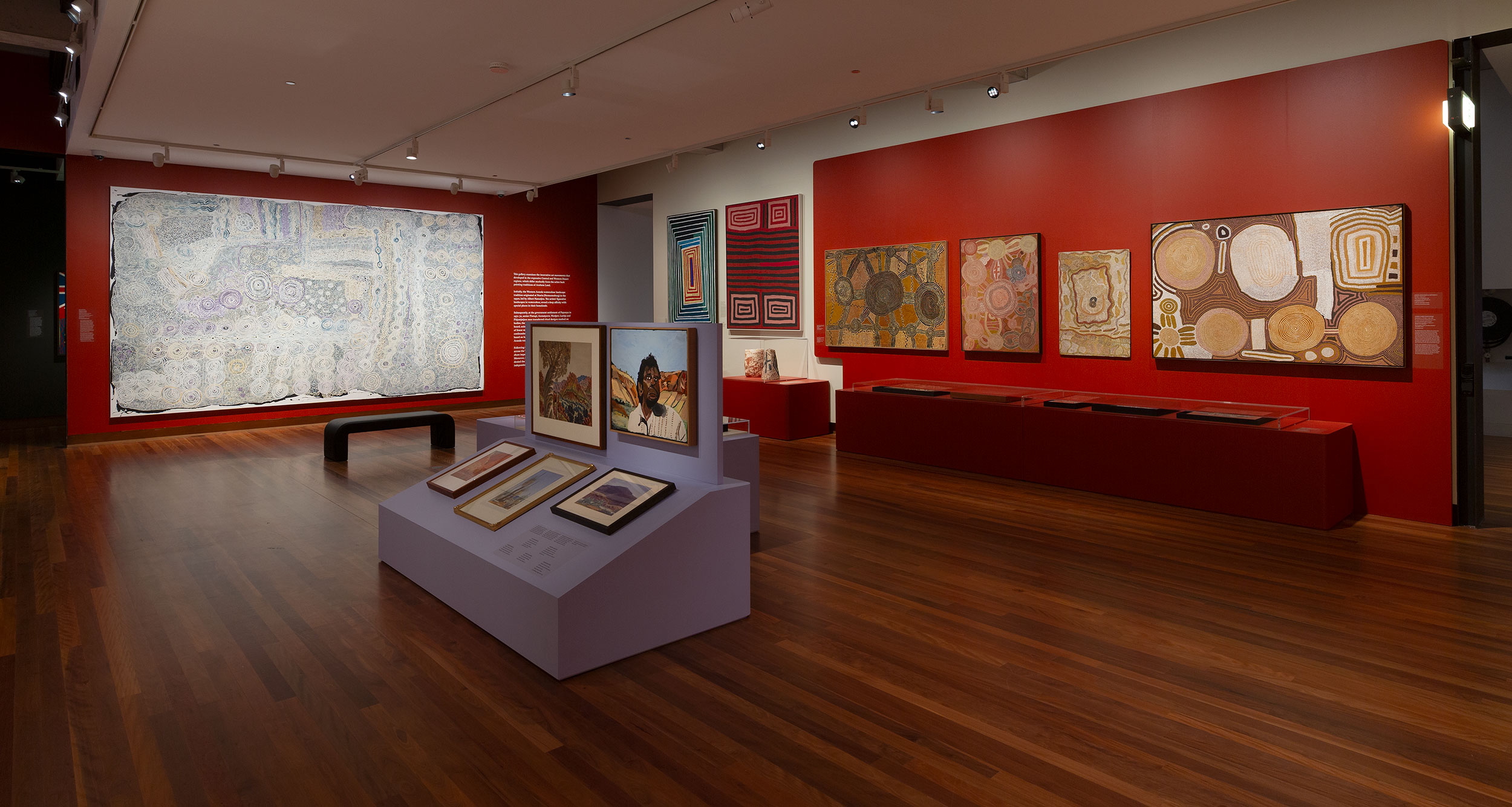
Picture: Christian Capurro
  • A new exhibition celebrating the brilliance of Aboriginal and Torres Strait Islander art, while confronting the dark heart of Australia’s colonial history, has opened at the University of Melbourne’s Potter Museum of Art

    By Professor Marcia Langton AM, University of Melbourne

    Professor Marcia Langton AM

    Published 16 June 2025

    Ten years ago, work began on creating a testament to the duration, resilience and ingenuity of artists of the First Peoples.

    The vision was to showcase the significance and brilliance of Aboriginal and Torres Strait Islander art created from time immemorial, throughout Australia’s colonial history and into the twenty-first century.
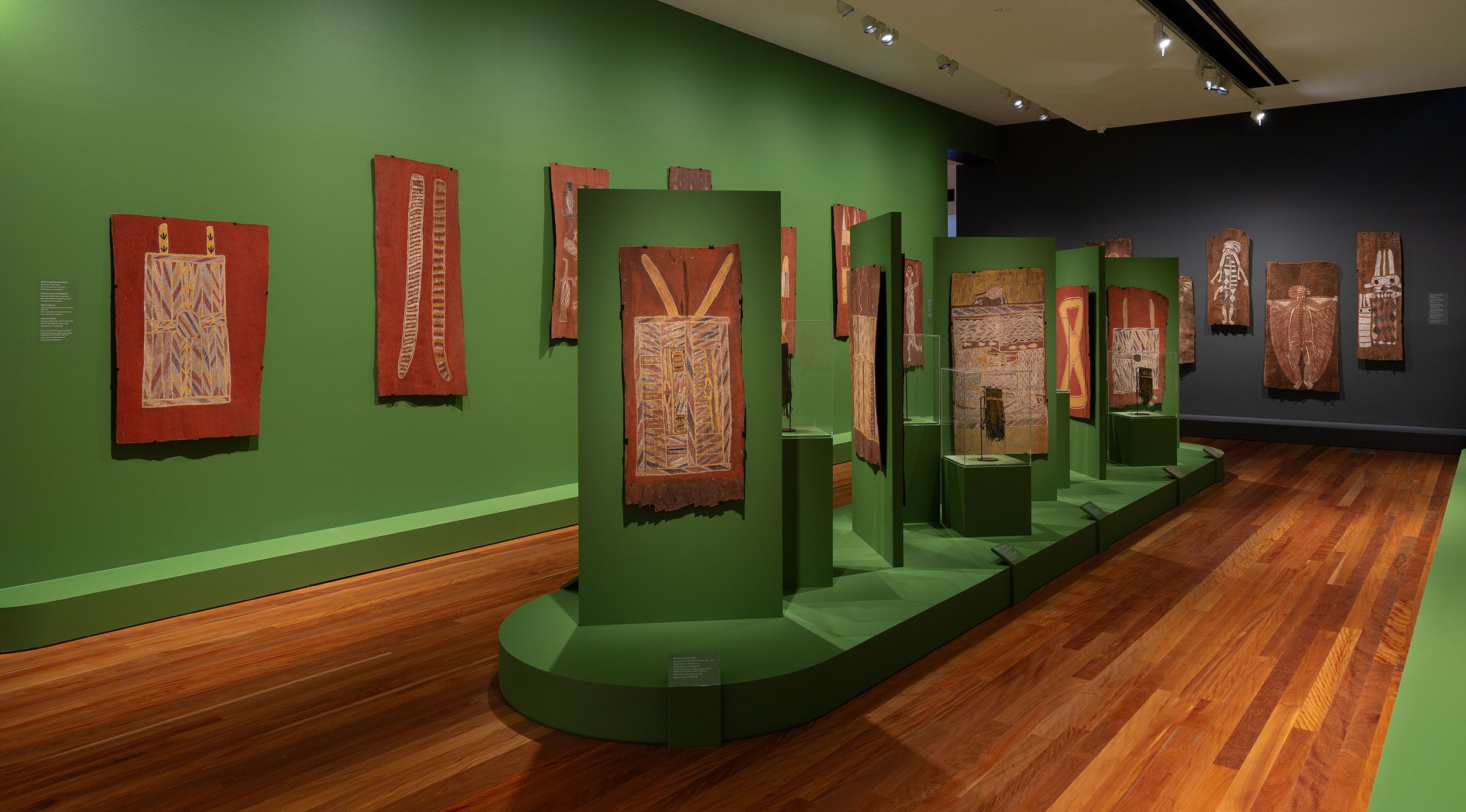
    65,000 Years_Potter_Art of Arnhem Land_ Christian Capurro
    Bark painting and weaving traditions developed by generations of Aboriginal artists across Arnhem Land. Picture: Christian Capurro

    Working with Senior Curator Judith Ryan AM and Associate Curator Shanysa McConville, we have brought together works that feature the diversity of art genres, styles and media of First Peoples.

    The exhibition 65,000 Years: A Short History of Australian Art has now launched at the newly renovated University of Melbourne’s Potter Museum of Art.

    The ironic title and conceptual framework of this exhibition and accompanying publication take their inspiration from the unique antiquity of Aboriginal design traditions.

    65,000 years is the earliest established date for human occupation of the Australian continent.

    The evidence is clear from archaeological excavations at Madjedbebe in Arnhem Land in the Northern Territory, led by archaeologist Professor Chris Clarkson, whose study notes: "Human occupation began around 65,000 years ago, with a distinctive stone tool assemblage including grinding stones, ground ochres, reflective additives and ground-edge hatchet heads".

    The works in 65,000 Years address not only ancient design and art traditions but also the contemporary world of the artists during colonial and postcolonial periods.

    Some are uplifting and engaging, showing the pleasurable, beautiful and exuberant in cultural and social aspects of the artists’ lives, often as a statement of defiance against the burden of their history.

    Others present a vision of the Australian wars that is searing and disturbing. The primary anti-colonial message of the works is simply – ‘This is art’.

    This was not always evident, and hence the phrase ‘A Short History of Australian Art’ in the title highlights that the recognition of the artists themselves and their distinctly Australian styles and forms of art has come about only very recently.

    We may be confounded by the belated and very reluctant acceptance of Aboriginal art into the fine art canon in the last few decades of the twentieth century. How this occurred is explained by Professor Ian McLean in his book, How Aborigines Invented the Idea of Contemporary Art.

    He states, “The artworld’s hesitant curiosity about Papunya Tula painting quickly became an embrace. It grew into the most significant development of late-late-twentieth-century Australian art”.

    65,000 Years Exhibition_Celebration of Women Artists_woven work
    A selection of contemporary women’s works from Arnhem Land, Groote Eylandt and South East Australia. Picture: Christian Capurro

    Acknowledging this significance, the artworks of nineteenth, twentieth and twenty-first-century Aboriginal and Torres Strait Islander artists deserve to be exhibited in a major exhibition that examines the art that is unique to this continent.

    Moreover, it is by addressing this art history in the context of Australia’s colonial history of invasion, dispossession, extermination and racist scientific experimentation that we will begin to fathom why, for so long, it has been denigrated and overlooked by the Australian art establishment.

    In curating 65,000 Years: A Short History of Australian Art, working closely with the artworks brought about an understanding of the artists, their contexts and histories – and a relentless witnessing of the radical changes to their world that colonisation and modernity wrought.

    The anti-colonial remembrance and truth-telling intentions of many of the works are evident, as are the religious and existential motivations of the artists refusing to give up their practices of honouring ancestors and ancestral places.

    Artworks are instances of remembrance, memorialisation and continuity.

    What emerges is the persistence of the artists to make art, whatever their circumstances, during wars, displacements to administered settlements and missions, and with few resources, but always with an eye to the sacred past, the duty to continue their cultural traditions, practices and belief systems, and above all to exercise their agency.

    Despite the loss of population and land, Aboriginal traditional relationships with land and the ritual expressions of these affiliations were difficult to suppress.

    This is due in no small part to the artists represented in 65,000 Years, whose rich ceremonial lives involve painting the inherited ancestral designs on bodies and sacra.

    We also owe the survival of our traditions to those artists who have spoken back to the colonial system with images that force us to question the presumed authority of the British and the governmental systems they introduced to replace ours, the racism and the attempts to eradicate our cultures and knowledge systems.

    What we know now is that we must find a way of writing and speaking about these art traditions and the artists that give justice to their own logic.
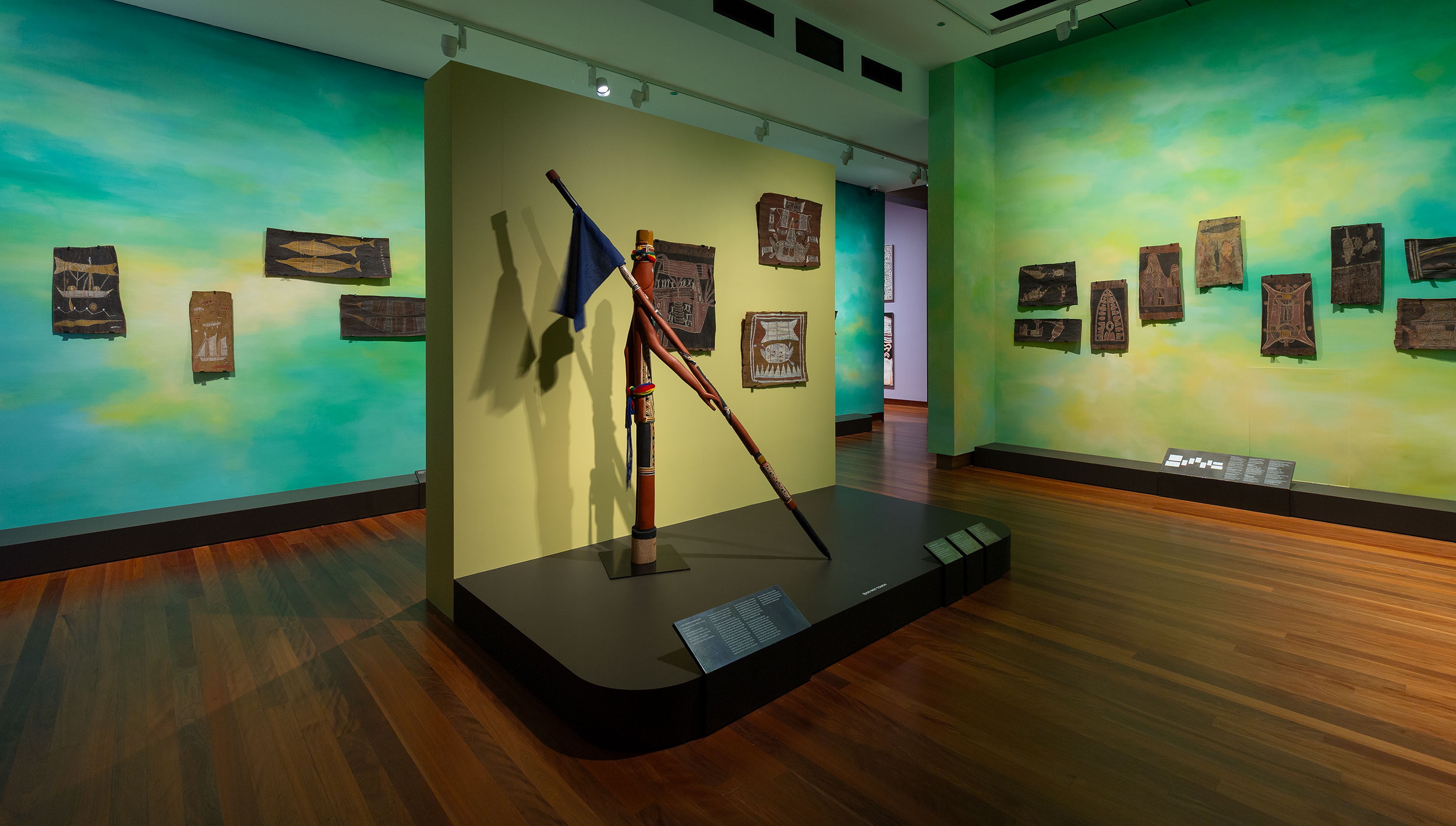
    rare works by Anindilyakwa artists from Groote Eylandt held in the Leonhard Adam Collection
    Rare works by Anindilyakwa artists from Groote Eylandt held in the Leonhard Adam Collection. Picture: Christian Capurro

    The introduced European art criticism failed until late in the twentieth century to acknowledge the art of the First Peoples and it struggled to understand it.

    This is why the agency of the artists themselves is fundamental; only they can communicate their meanings and intentions.

    They question and interrogate attitudes, histories, people, events, ideas and ideologies.

    For those whose voices were not recorded, it is right and just to accord them the dignity of having intent, to give their works the correct historical context.

    For those whose voices are recorded, they have provided a precious part of our history, telling us what the historians largely ignored or belittled until the force of their art traditions could no longer be ignored.

    These art traditions have sustained the First Peoples throughout the history of Australia, our deep history across the thousands of generations since our ancestors first arrived here and throughout the short history of colonialism and nationhood that is yet to find an honourable place for us.

    This is why the artworks in this publication and exhibition are profoundly significant: they are proof of our existence and our humanity. This is art.

    The exhibition, 65,00 Years: A Short History of Australian Art is curated by the University’s Associate Provost Distinguished Professor Marca Langton, Senior Curator Judith Ryan AM and Associate Curator Shanysa McConville. It will open to the public at the University of Melbourne’s Potter Museum of Art on 30 May 2025 and run until 22 November 2025. Entry is free.

    This is an edited excerpt from the publication also titled 65,000 Years: A Short History of Australian Art, which was released by the University of Melbourne with Thames & Hudson. Featuring new writing by 25 leading thinkers across generations and disciplines, this publication further examines the history of Indigenous art across time and space. It is edited by Distinguished Professor Marcia Langton and Senior Curator Judith Ryan. The publication can be purchased here.

    The effect of business regulations, property rights, and legal system on CO2 emissions: empirical evidence from the BRICS-T countries

    Abstract

    Global CO2 emissions have continued to rise, although the rate of increase has begun to slow down due to environmental measures implemented at both international and national levels. Therefore, the results of empirical studies on the drivers of CO2 emissions have been crucial for design of the appropriate environmental policies. This research article explores the interaction amongst business regulations, property rights, legal system, income, urbanization, and CO2 emissions in the BRICS-T countries for the 2000–2021 duration by means of the novel causality and cointegration tests sensitive to heterogeneity and cross-section dependence. The results of the causality test reveal a mutual interplay amongst business regulations, property rights, urbanization and CO2 emissions and a unidirectional causality from income to CO2 emissions. Furthermore, the results of the long-run analysis also indicate that improvements in legal quality and property rights decrease CO2 emissions while business regulations, real GDP per capita, and urbanization increase CO2 emissions. Therefore, improvements in property rights and the legal system are vital for decreasing CO2 emissions. However, negative environmental effects of market-oriented business regulations, income, and urbanization should be balanced by stringent environmental policies.


    The fictionalization of morality police in Saudi novel: a new historicist approach


    Abstract

    The morality police have always inspired different, often conflicting, feelings in Saudi society. While many have supported the morality police, others saw their old privileges as problematic. Representations of and attitudes toward the morality police have been reflected in Saudi fiction in a broad multitude of works. However, research on the contextualization of the morality police in Saudi literature is often overlooked by literary critics. This study adopts a New Historicist approach and consults select literary works to examine fictional depictions of the morality police. The focus will be limited to three Saudi novels spanning from 2005 to 2009: Abdo Khal’s Immorality (2005), Samar Almogren’s Women of Vice (2008), and Yousef Al-Mohaimeed’s Where Pigeons Don’t Fly (2009/2014). The study attempts to show how Saudi literature offers representations of the morality police that can allow for a more profound insight into their role and its many implications.

    Across China: Scientists witness first wild reproduction of Yangtze sturgeon after decades of conservation


    Source: Xinhua
    Editor: huaxia
    2025-06-16 


    GUIYANG, June 16 (Xinhua) -- The video footage was simple but extraordinary -- a tiny, half-translucent grey larva, no bigger than a grain of rice, wriggled out of its egg casing in the shallow waters of the Chishui River in southwest China's Guizhou Province.

    To an untrained eye, it might have looked like just another fish hatching. But for the team of scientists watching anxiously, this fragile creature represented something far greater: the first successful natural reproduction of the critically endangered Yangtze sturgeon in the wild in over two decades.

    This breakthrough was the culmination of years of painstaking efforts by researchers from the Institute of Hydrobiology (IHB) of the Chinese Academy of Sciences, the Chinese Sturgeon Research Institute under the China Three Gorges Corporation, and other institutions, organized by the Ministry of Agriculture and Rural Affairs. Their ultimate goal is to revive a species on the brink of extinction.

    The Yangtze sturgeon, a nationally protected first-class animal, was once a vital part of the river's ecosystem. However, by the early 2000s, water pollution, overfishing and other factors had pushed it to the edge. In 2022, the International Union for Conservation of Nature declared the species extinct in the wild. The last known natural reproduction occurred in 2000.

    Yet, scientists refused to give up. They spent years developing techniques to restore the sturgeon's spawning grounds. They experimented with reconstructing water flow patterns and riverbed conditions, first in controlled environments, then in a side branch of the Yangtze River in Jiang'an County, southwest China's Sichuan Province, in 2023 and 2024.

    "Due to the lack of historical data, at first we didn't know what environmental conditions were needed for the reproduction of the Yangtze sturgeon. However, after repeated experiments, this problem has been basically solved," said Liu Huanzhang, an IHB researcher whose study focuses on fish conservation biology.

    Those small successes gave them hope -- but the real test would be whether the fish could reproduce in a completely natural setting, since no hatched larvae had been found in these experiments.

    Their eyes turned to the Chishui River, one of the tributaries of the upper Yangtze. Unlike much of the mainstream of the Yangtze River, the Chishui River is relatively untouched by industrial development and remains undammed in its mainstream.

    In early 2025, the team began its most ambitious project. At a site near Chishui City, they meticulously reshaped a stretch of the riverbed, using drones, sonar and hydrological modeling to recreate the exact conditions sturgeons need for spawning.

    "We dug channels to mimic natural currents, carefully selected gravel and sand for the river bottom, and created an 8,000-square-meter spawning ground tailored to the fish's needs," said Liu Fei, an associate researcher at the IHB.

    On April 3, they released 20 adult sturgeons -- 10 males and 10 females -- into the modified habitat. Then came the waiting. For days, scientists monitored the fish around the clock using underwater cameras and sonar, watching for any sign of mating behavior.

    On the night of April 12, the signals lit up -- the sturgeons were gathering in the channels. By dawn, the team had spotted fertilized eggs and estimated that over 200,000 eggs were scattered in the spawning ground. Under microscopic analysis, researchers confirmed the eggs were developing normally.

    On April 16, the first hatchlings emerged -- tiny, wriggling proof that the Yangtze sturgeon could still reproduce in the wild.

    The success of the test has proven that mature individuals in the artificially bred Yangtze sturgeon population have the ability to reproduce in the wild, said Liu Huanzhang. "This lays the foundation for the full restoration of the species' natural reproduction in the river."

    "This isn't just about saving one species," said Liu Fei. "The sturgeon is rather giant in waters, and adults may reach over one meter in length. Its survival reflects the health of the entire ecosystem. This success gives us a model for restoring other endangered aquatic species."

    The breakthrough in the Yangtze sturgeon's natural reproduction in the Chishui River marks a pivotal achievement in conservation efforts, though it represents just the beginning of a long-term recovery process.

    The researchers stated that they will continue to monitor the growth of the young sturgeons in their natural habitat while refining protection strategies.

    "These efforts will not only restore the Yangtze sturgeon population but also contribute to the overall health and stability of the Yangtze River ecosystem," Liu Huanzhang added. ■

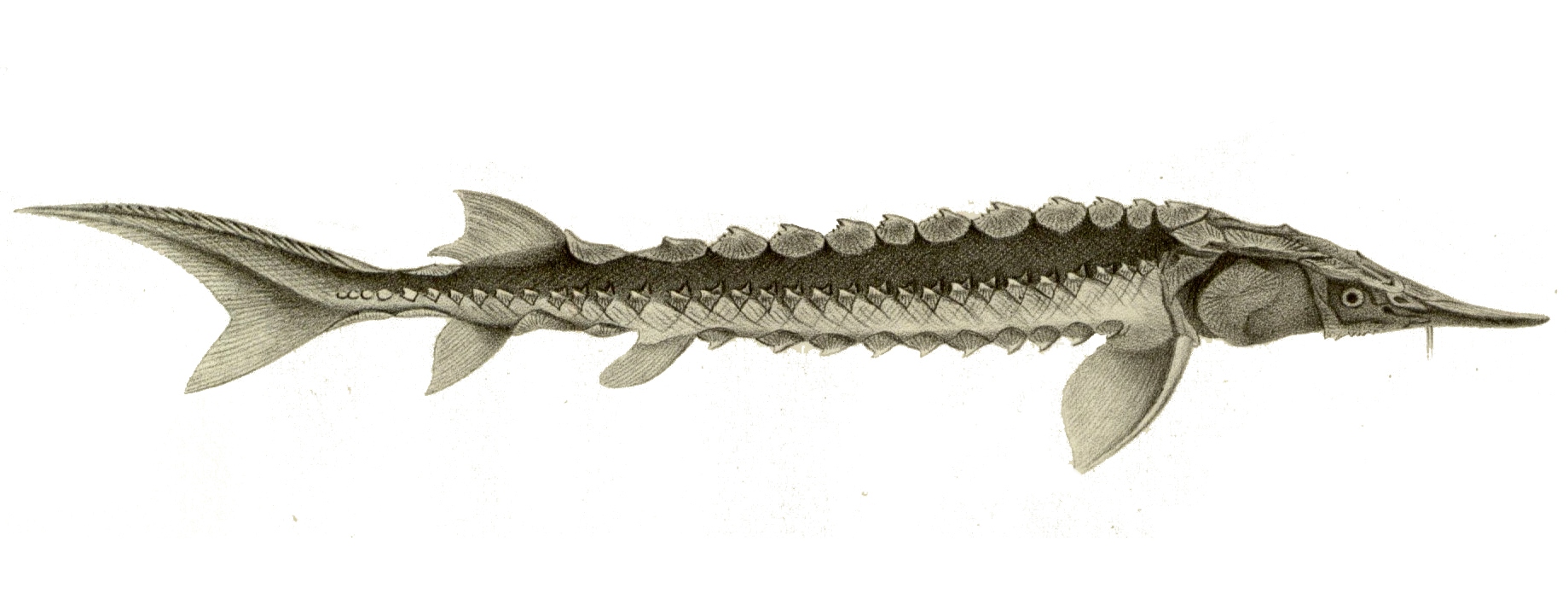
    Dabry's sturgeon

    Species of fish

    Dabry's sturgeon, also known as the Yangtze sturgeon, Changjiang sturgeon and river sturgeon, is a species of fish in the sturgeon family, Acipenseridae. It is endemic to China and today restricted to the Yangtze River basin, but was also recorded from the Yellow River basin in the past. It was a food fish of commercial importance. Its populations declined drastically, and since 1988, it was designated an endangered species on the Chinese Red List in Category I and commercial harvest was banned. It has been officially declared extinct in the wild by the IUCN as of July 21, 2022.
    Dabry's sturgeon
    Wikimedia archive asset
    Conservation status
    Wikimedia archive assetExtinct in the Wild (IUCN 3.1)
    CITES Appendix II (CITES)
    Scientific classificationWikimedia archive asset
    Domain:Eukaryota
    Kingdom:Animalia
    Phylum:Chordata
    Class:Actinopterygii
    Order:Acipenseriformes
    Family:Acipenseridae
    Genus:Sinosturio
    Species:S. dabryanus
    Binomial name
    Sinosturio dabryanus(Duméril, 1869)
    Synonyms
    • Acipenser dabryanus Duméril 1869