Saturday, June 21, 2025

Trump Is Inspiring a Historic Wave of Protests


There's no need to wait for resistance. It is happening now.
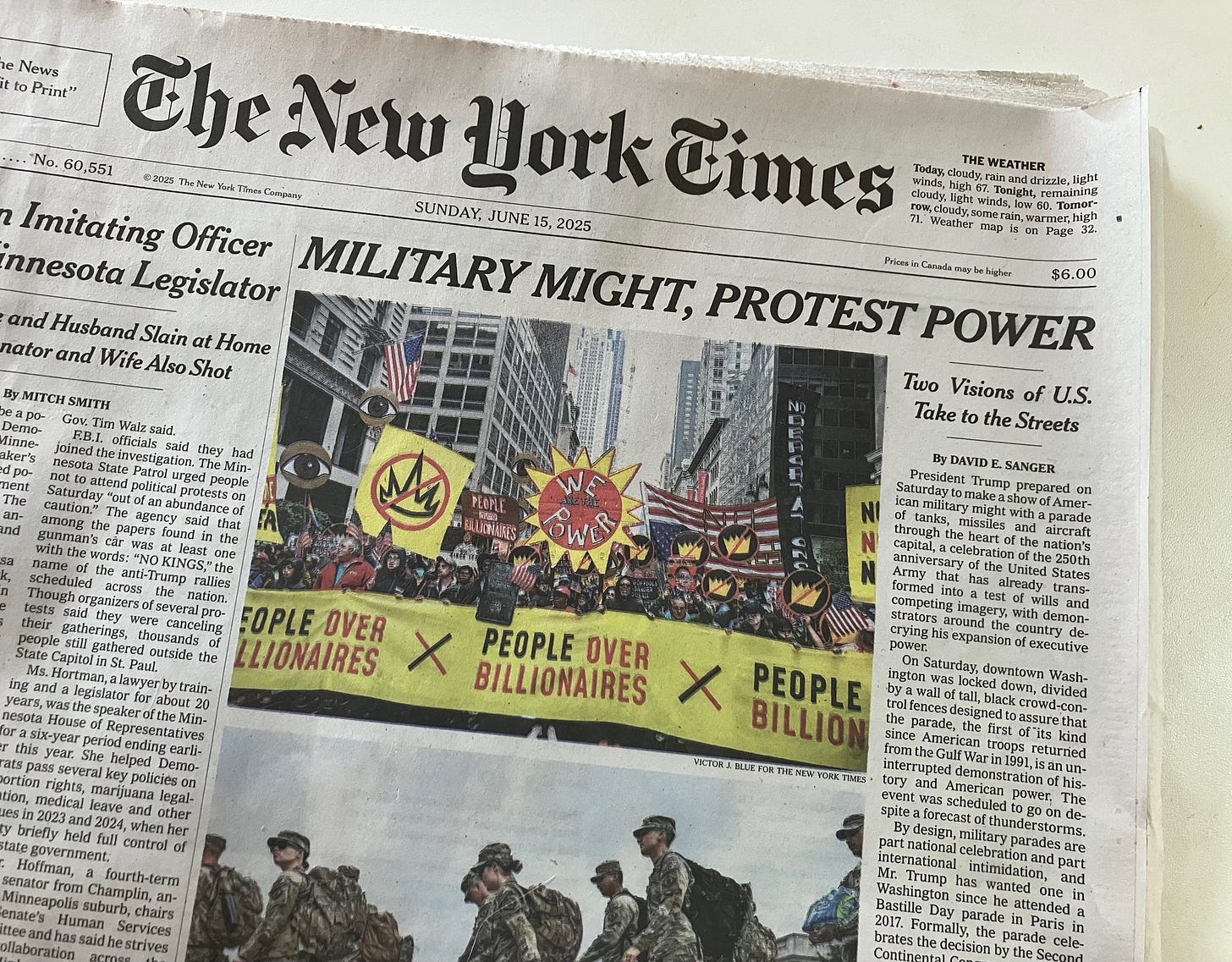
All those who have been wondering when mass resistance to Trump 2.0 would materialize need wait no longer. It is here. It is happening. It is now.

In truth, the new wave of defiance has been swelling for some time.

Following last November’s presidential election, media outlets such as the New York Times steadily pushed a story of progressive demobilization. The narrative went something like this: back in 2016, Trump opponents were fired up and ready to fight back, but this time around, in 2024, those who voted against his return were merely dispirited and resigned, hardly in the mood to take to the streets again. Oftentimes, commentators piled on by expressing skepticism about whether protesting was even worth it to begin with.

This story was flawed from the start.

Sure, in the immediate aftermath of the election, progressives took time to grieve Trump’s return. But already in November, mass organizing calls led by groups including the Working Families Party were drawing upwards 50,000 participants. (I don’t know about you, but for me anything over 10,000 people counts as being larger than my typical Zoom session.)

Within a week after Trump’s inauguration, protests were fomenting in earnest. We saw rallies outside of federal buildings and weekly boycott vigils at Tesla dealerships. Soon, there were calls for nationwide days of action, first taking the form of the 50501 protests in February. Then, on April 5, the Hand’s Off rallies took place at locations across the 50 states.

Erica Chenoweth and Jeremy Pressman, leaders of an effort called the Crowd Counting Consortium, reported in March that “our research shows that street protests today are far more numerous and frequent than skeptics might suggest.” They also noted that in February “we’ve seen more than twice as many street protests than took place during the same period eight years ago.” Last week, they released an updated tally, stating that “protest has been surging” since then and that “Overall, 2017’s numbers pale in comparison to the scale and scope of mobilization in 2025 — a fact often unnoticed in the public discourse about the response to Trump’s actions.”

All of this came before the events of the past two weeks, which further augmented the size and scale of anti-Trump mobilization. First came large demonstrations in Los Angeles against ICE immigration raids and the deployment of the National Guard. (Manuel Pastor has a very nice report from the frontlines of the protests over at Dissent.) Then came the No Kings actions last Saturday, which were massive and took place at as many as 2,000 locations, organizers told NPR. Data journalist G. Elliot Morris, formerly of FiveThirtyEightestimated the total number of participants at No Kings events between 4 and 6 million.

These are historic numbers.

By way of comparison, gigantic protests against the Iraq War on February 15, 2003 drew possibly 3 million demonstrators in the U.S. (along with between 12 and 30 million worldwide). The Crowd Counting Consortium estimated that the original Women’s March on January 21, 2017, acknowledged as a gargantuan mobilization, attracted between 3.3 million and 5.6 million protestors. In another historic deployment, Black Lives Matter protests may have drawn many millions more in 2020, but with the caveat that actions were spread out over multiple weeks.

In terms of single-day events, No Kings may not have reached the heights of the first Earth Day celebration, in 1970, which is sometimes cited as the largest day of action in U.S. history, but it’s up there with all the big ones.

Our team witnessed strong turnout in Philadelphia (around 80,000) and in New York City (upwards of 100,000). Organizers reported crowds of as many as 500,000 in Boston, 70,000 in Seattle, 200,000 in Los Angeles, and 100,000 in Chicago, among gatherings in other major cities. On his Facebook page, organizer Chris Crass did a wonderful job of compiling photos of No Kings protests from around the country. The images are inspiring: People swarming intersections in Evanston, Illinois, braving the rain in Little Rock, Arkansas, filling Liberty Plaza outside the state capitol in Atlanta, Georgia, and lining roads in Indianapolis, Indiana and Gainesville, Florida. All this stood in stark contrast to Trump’s gloomy, expensive, and under-attended military parade the same weekend.

Now, if you will allow a digression, there are a variety of quirks to consider when talking about the size of any mobilization. Crowd-counting numbers can be notoriously flexible and politicized. In Armies of the Night, his Pulitzer Prize winning “history as a novel” narrating a fall 1967 March on the Pentagon, author Norman Mailer jokingly suggested a rule of thumb for triangulating protest attendance: “[T]he police estimate multiplied by four might be as close to the real number as the Left Wing estimate divided by two and a half,” he wrote. “Thus a real crowd of 200,000 people would be described as 50,000 by police and a half million by the sponsors.”

Even when the numbers are reliable, comparisons between protests are not always apples to apples. For at least five decades after the 1963 March on Washington, the dominant model for a national day of action was to try to get everyone to a single location, often Washington, DC. Success was measured by how many people you could rally in that one spot. In some instances, such as the 2003 Iraq war protests, there might be one leading location on the West Coast (say, San Francisco) and another in the East (New York City), but the general model held. If the protest was to be a success, organizers needed to spend a lot of time thinking about filling buses and transporting people significant distances to join in a collective mass gathering.

By the time of the Women’s March in 2017, this dominant model was being replaced with something different. There was indeed a large central event in Washington, DC for the Women’s March. But there were also sizable events in other big cities such as New York City and Philadelphia, and even gatherings in smaller cities like Harrisburg and many points in between. Previously, the going wisdom had been that sending people by bus to the main event would be mutually exclusive with getting decent turnout locally. But that was not the case for the Women’s March. The big numbers in DC did not really seem to eat into crowds in smaller cities. Success was no longer measured by the numbers of people who showed up in one location, but how many events across the country could be hosted and what the cumulative attendance might be.

As it turns out, having protests everywhere is conducive to participation. Regarding last weekend’s No Kings demonstrations, famed Rabbi Arthur Waskow wrote about attending a modest event in the Germantown neighborhood of Philadelphia:

“Why did my beloved life-partner… and I choose to join about 200 people at the Lovett Library to say ‘No Kings!’ Instead of 80,000 demonstrators downtown where they swallowed up and liberated whole neighborhoods? Because I am 91 years old and my life partner is 82. We were sure that the massive downtown crowd, impressive as it was for demanding change, would make it impossible for the two of us to navigate. The library was one of countless small gatherings across the country and in big and even middle size cities the turnout was enormous.”

Lowering the bar for participation is undoubtedly positive in this respect. Of course, there are trade-offs. Because it’s easier to show up to your local town square than it is to spend a day or a weekend bussing back and forth to DC, participants are investing less time in the collective experience of traveling and assembling with others, things that can be good for cultivating further commitment. And, as I have written elsewhere with my brother Paul, the success of civil resistance often involves demonstrating the hardship voluntarily taken on movement participants—meaning that actions which require people to make higher levels of sacrifice can have their own benefits.

All this is to say that the size of any given crowd is not the only thing that matters.

In some ways, a variety of the smaller No Kings gatherings may have been more politically significant than the largest metropolitan ones. A friend of mine estimated that upwards of 5000 people turned out in his South Jersey town of Collingswood, a huge number for that area—arguably more impressive as drawing twenty times as many in nearby Philadelphia. Another organizer friend went to a protest in a small Pennsylvania town about an hour outside of Philly’s blue bubble. There, she reported, between 500 to 700 people lined a major roadway for a long stretch, encouraging passing drivers to sound their car horns in support. The steady, if intermittent, stream of honks gave courage to neighbors whose town borders a county that went solidly for Trump in 2024.

In Jacobin, Branco Marcetic argued that the presence of events deep into MAGA country signals a notable shifting of political energies. “[There is an] important point to be made here,” he wrote:

“The turnout in liberal cities and even in Trump-voting towns and counties doesn’t necessarily mean that anti-Trump voters outnumber the president’s supporters in these areas or their states—in many cases, they don’t. But it does suggest that voters opposed to Trump’s agenda—who across the country were met with few to no counterprotesters, even in deep red parts of the country—are vastly more energized than his supporters, and that despite his having won the popular vote…that Trump’s public support is a lot softer and more passive than his 2024 victory made it seem.”

In an article a couple of months ago, Paul and I outlined the key characteristics that define “moments of the whirlwind”—or periods of intensified social movement upsurge. It is clear that the current moment exhibits these qualities: Demonstrations are sparked by highly publicized “trigger events” (think ICE raids at Home Depot or a U.S. Senator in handcuffs), and participation is decentralized, not driven through pre-established organizational structures. The No Kings events of last weekend were led or sponsored by groups including Indivisible, the American Federation of Teachers, and the ACLU. All of the 200 organizations that signed on for the protests, especially the more established ones, deserve credit for refusing to bow to the authoritarian impulses of the Trump administration—especially when we have seen some leading law firms, media organizations, and universities fail to muster such bravery. Nevertheless, recruitment of the millions of people to the protests did not come through organizational phone trees or people’s individual relationships with organizers, but through momentum driven by widespread outrage at Trump’s actions.

Wired magazine published an article this week contending that defiance this time around, aided by new technologies, is far more decentralized than the Women’s March in 2017 and other resistance in Trump’s first term. The article reflects the magazine’s techno-fetishism, and its argument is a bit comical, given that the Women’s March itself was no august and long-standing institution but rather an ad hoc formation that swiftly coalesced in the whirlwind following Trump’s first election. Nevertheless, the article showed how abundant dissident energy is bubbling up in countless places and often has yet to be absorbed by formal organizations.

The article also pointed to a third common trait of whirlwinds: In addition to drawing in new participants from unexpected quarters, these moments spur a wealth of activity among these newcomers that is not dictated by any centralized command. As Wired reported, “the Tesla Takedown protests began with a single Bluesky post that exploded in large part thanks to social media posts, including protesters’ pictures and videos outside dealerships.” (Even Elon Musk himself ultimately acknowledged the success of demonstrations in shrinking Tesla’s earnings, although he blamed the impact on “paid protesters.”)

Or, as another example, the magazine profiled a couple in the Deep South that got involved by creating a website that allows people to order free stickers that they can post in high-traffic areas in their neighborhoods. The stickers display a QR code that directs users to resources about the warning signs of fascism: “What began with 500 stickers posted all over their small town,” reporter David Gilbert wrote, “quickly grew—with the help of an appeal on Reddit—to a campaign that has so far seen the couple and their children send 750,000 stickers to more than 1,000 people in all 50 states.”

All this raises the question: What should we do now that the whirlwind has arrived?

Paul and I hope to write on this in more depth, but there are many things that can be noted at least in passing: First, people should contribute however they can, and they should work to convince organizations that they are a part of to join in as well. Many established groups are still hesitant to throw down, yet the addition of their credibility and resources can make an important difference. It is hardly too late to get started: The most sweeping whirlwinds form not when a single trigger event gives rise to protest, but when a succession of triggers result in a series of escalating civil resistance. Along these lines, we can be sure that Trump will present more provocations, giving more opportunities for creative responses.

Protests are polarizing, meaning that they make people who might otherwise have been undecided or inattentive choose a side. Movements should focus on maximizing positive polarization and minimizing the negative. As we have previously argued, this means being smart in framing the demands of an action, highlighting sympathetic protagonists and unsympathetic oppressors, and heightening the contrast between the inventiveness and determination of resistance and the repressive violence of the state.

Trump is unpopular. There is clear evidence—from public opinion polling to pushback on the streets—that he is wildly overreaching his mandate. It is important to remember that Trump’s 2024 election victory was a narrow one: he carried 49.8% of the popular vote, as opposed to 48.3% for Kamala Harris (and even his electoral college win was nowhere close to the commanding totals amassed by Ronald Reagan in 1984, Richard Nixon in 1972, or LBJ in 1964). Since November, Trump’s popularity has tanked, even on issues where he once enjoyed an edge, such as the economy and immigration. The rank cruelty of his ICE raids is becoming increasingly clear, and Republicans have touched a third rail of American politics by slashing programs like Medicare.

Civil resistance plays an important role in solidifying this unpopularity and—as Trump perpetually lies about the impact of his policies—in educating the public about what is really going on. It helps to generate momentum for backlash at the polls, not just in the midterms or the next presidential elections, but in a plethora of state and local contests already taking place. And, in the interim, mass demonstrations encourage noncooperation at many levels that make the implementation of the White House agenda more difficult.

In short, popular resistance boosts the costs of overreach. Let us hope that we can watch the defiance grow.
Mark Engler is a writer based in Philadelphia, an editorial board member at Dissent and co-director of the Whirlwind Institute, a social change strategy center. He is author, with Paul Engler, of This Is An Uprising: How Nonviolent Revolt Is Shaping the Twenty-first CenturyRead other articles by Mark, or visit Mark's website.
June 20, 2025

Photograph by Nathaniel St. Clair

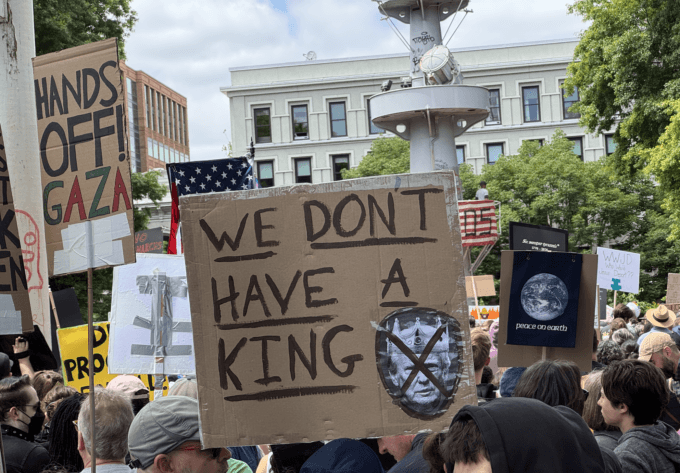
What a hopeful sight! My social media on June 14 and 15 was filled with people sharing pictures from “No Kings” gatherings.

Aerial photos of massive crowds in big cities. Snapshots of surprisingly large turnouts in small conservative communities. Sidewalk gatherings by residents of an assisted living center.

Millions of Americans signed up, made funny and serious signs, and came together around a basic principle: No Kings.

No Kings means no one-person rule. Our president must abide by the Constitution, follow the law, and respect the other branches of government.

No Kings means no government by edict or tweet. No president can unilaterally rewrite the law, take away due process, and impose his will on the rest of us.

No Kings means no king. Other government officials, including those who serve in our armed forces, do not swear loyalty to a ruler but to the Constitution.

These aren’t radical ideas. They are foundational American ideals. They are being severely tested right now. But research from around the world shows that autocracies do not survive sustained nonviolent resistance.

The rallies came after a week in which the president mobilized the military against American protesters in Los Angeles. Americans declared “No Kings” on the same weekend as a military parade demanded by the president and held on his birthday rumbled through our capital city.

The parade was resisted by military leaders during the president’s first term. It came after a political purge of generals and military lawyers who might say no. And it came after the president made intensely partisan speeches at West Point and Fort Bragg that suggested he views the American military as an arm of his political movement. That’s scary.

If the president hoped the military parade would provide some kind of boost to his strongman self-image, he was sorely disappointed. Despite the millions of dollars wasted shipping tanks and troops to Washington, D.C., the crowd fell far short of expectations. It was a stark contrast with the energized turnout for No Kings.

That energy must be sustained.

Corruption and abuse of power continue to threaten American families and communities as politicians vote to cut people’s access to food, education, and healthcare so they can give tax breaks to influential billionaires.

The president is surrounded by people urging him to ignore our checks and balances.  His worst impulses are being enabled by too many members of Congress who fear his wrath more than they respect the Constitution and their oath to uphold it.

The president’s habit of demeaning and dehumanizing his opponents and political targets makes violence more likely. So did his decision to pardon people who attacked Capitol Police on January 6.

The danger posed by our poisoned political climate became horrifyingly clear with the assassination and attempted assassination of Democratic leaders in Minnesota by a gunman with a list of pro-choice politicians, Planned Parenthood locations, and a flyer for local No Kings events.

A rally goer in Utah was killed accidentally when a security guard opened fire to stop a man moving toward the crowd with a rifle. That same day, police arrested a man with a concealed handgun and two full ammunition magazines as he tried to get past security at a Pride event in Florida.

It’s important that we remain vigilant — and important that we not let violence or intimidation keep us from the duty we owe ourselves, each other, and our country. If we want to keep “No Kings” a reality as well as a rallying cry, that will require ongoing commitment and action from “We, the people.”




Swiss Re SONAR 2025 Report: Global Heat Kills 480,000/Yr


Extreme heat is one of the world’s leading killers, outdistancing worldwide conflicts of 233,000 deaths in 2024 by more than double the count at 480,000 people dead from extreme heat. All indications suggest the death count via extreme heat is headed much higher because global warming is not appreciably slowing down as global CO2 emissions in the atmosphere increase every year like clockwork, setting new record levels every year, blanketing/retaining more heat every year. It’s stifling.

Current CO2 readings at Mauna Loa Observatory, Hawaii, as of June 15, 2025: 430.07 ppm, which is the highest daily average on record. Excessive atmospheric CO2 is the primary source of extreme heat. One needs to go back millions of years to find higher levels. In 2016, according to the Intergovernmental Panel on Climate Change (IPCC) a global body of climate scientists stated: “CO2 at 430 ppm would push the world beyond its target for avoiding dangerous climate change.” We are there!

No business or government on Earth is impacted by climate change more so than the insurance industry. It’s the biggest canary in the coal mine. Swiss Re Ltd (founded 1863) is one of the world’s largest reinsurers. The company’s 2025 SONAR Report essentially puts the world on notice that global warming has become one of the world’s biggest killers.

Swiss Re says “extreme heat,” is the designated killer, to wit: “Extreme heat events can have a large impact on human health. Recent data show that around 480, 000 deaths per year can be attributed to extreme heat events.” (“Extreme Heat More Deadly Than Floods, Earthquakes and Hurricanes Combined, Finds Swiss Re’s SONAR Report,” Swiss Re Group, Media, Press Release, June 12, 2025)

According to Jérôme Haegeli, Swiss Re Group Chief Economist: “Extreme heat used to be considered the ‘invisible peril’ because the impacts are not as obvious as other natural perils… With a clear trend to longer, hotter heatwaves, it is important we shine a light on the true cost to human life, our economy, infrastructure, agriculture and healthcare system,” Ibid.

The SONAR 2025 Report claims extreme heat threatens industry as well as human life. For example, “the telecommunications industry faces significant risks from failing cooling systems in data centers or damage to terrestrial cables.”

Trump Administration re Extreme Heat

According to Time magazine: “What’s At Stake This Summer As Trump Targets Heat and Climate Experts,” June 16, 2025:  “Heat experts at the National Institute for Occupational Safety and Health (NIOSH) and the National Integrated Heat Health Information System (NIHHIS) were told in early April that their positions would be eliminated as part of the cuts made by the Trump Administration’s Department of Governmental Efficiency. The Centers for Disease Control and Prevention’s (CDC) entire environmental health unit was cut, though some jobs were restored … What was lost there is just a giant value to communities, according to V. Kelly Turner, associate professor of urban planning at University of California, Los Angeles.”

Trump does not recognize climate change as a threat to humanity, dropping out of the Paris Agreement of 2015, cutting $4 billion in prior pledges, no longer submitting carbon-cutting plans to the UN, removing electric vehicle mandates, and destroying Biden administration climate change mitigation plans while over-emphasizing and directing national attention to burning fossil fuels. These are sure-fire ways to increase the global warming hazard, in turn, leading to more severe extreme heat, thus, putting Trump in opposition to Swiss Re’s warnings about the death count of “extreme heat.”

According to the National Oceanic and Atmospheric Administration’s (NOAA) Climate Prediction Center, the entire country will see above-normal temperatures—with the only difference being in severity. Across the contiguous United States, average temperatures have already risen about 60% more than the global average since 1970 (US EPA). In due course, the American South and Southeast will feel like the Persian Gulf countries of today, where it is currently too hot to safely work outside during the day for much of the summer.

On a global basis, America’s extraordinary push for fossil fuel emissions contributes to atmospheric CO2 build up, thus impacting the world climate system by trapping more planetary heat. This direct relationship between increasing CO2 emissions and increased global warming is established scientific fact. According to WMO (World Meteorological Organization) Deputy Secretary-General Ko Barrett: “We have just experienced the ten warmest years on record. Unfortunately, this WMO report provides no sign of respite over the coming years, and this means that there will be a growing negative impact on our economies, our daily lives, our ecosystems and our planet.”

Richard Betts, head of Climate Impacts Research at the UK Met Office and a professor at the University of Exeter, May 28, 2025, informed the Associated Press. “With the next five years forecast to be more than 1.5 degrees C warmer than preindustrial levels on average, this will put more people than ever at risk of severe heat waves, bringing more deaths and severe health impacts unless people can be better protected from the effects of heat. Also, we can expect more severe wildfires as the hotter atmosphere dries out the landscape.”

Swiss Re’s SONAR Report warns the world of existential dangers of climate change by focusing, in part, on deaths caused by extreme heat, but the report goes on to suggest a threat to the entire infrastructure of economies. Swiss Re endorses policies to limit climate change, which are diametrically opposite Trump policies, to wit: Swiss Re suggests a multi-pronged approach to climate change mitigation: (1) reducing greenhouse gas (GHG) emissions (2) investing in carbon removal technologies (3) increasing climate resilience through adaptation measures (4) emphasize the importance of the Paris-aligned carbon reduction path (5) complemented by carbon removal strategies, and (6) advocate for collaboration and knowledge sharing to accelerate action.

Trump’s policies don’t jive with any, not even one, of the six suggestions by one of the world’s oldest most prestigious insurance companies. If his administration is not listening to one of the world’s leading providers of insurance coverage that’s on the front line of climate change, then who?

It’s shameful that the US government fails to recognize the most rapidly developing threat to existence, especially in the face of alarms set off by the staid insurance industry, as premiums go sky-high with claims choking the biggest players. The economy can’t handle it; homeowners can’t handle it; businesses can’t handle it. Solution: Stop burning fossil fuels oil, gas, and coal.

Robert Hunziker (MA, economic history, DePaul University) is a freelance writer and environmental journalist whose articles have been translated into foreign languages and appeared in over 50 journals, magazines, and sites worldwide. He can be contacted at: rlhunziker@gmail.comRead other articles by Robert.

Spanish state


Because it won’t be the last blackout: What energy model and distribution system for the ecological transition?


Tuesday 17 June 2025, by Daniel Albarracín

The blackout of April 28 shook the Iberian Peninsula and southern France for several hours. Everyone who lives there was affected in some way. It has been a topic of conversation that, to avoid remaining an anecdote, requires some in-depth analysis, given the systemic risks of a repeat. We must draw lessons for the future.

Introduction

In this sense, it’s worth noting that the energy system is at a historic crossroads. Climatic crisis, geopolitical fragility, and resource scarcity force us to rethink how we produce, distribute, and consume energy. In this context, expanding energy capacity based on renewable energy appears to be a crucial opportunity.

But not just any deployment will do: many reproduce the logic of the fossil fuel system they claim to replace, because the current energy transition model is being led by large private companies, with profitability as their objective. A private oligopoly, which has penetrated and monopolised all sources and technologies, including renewables, is protected by the State and an artificial marginal pricing system that guarantees profit for the most profitable sector of the Spanish economy. In the face of this inertia, it is urgent to defend a fair, democratic, and planned eco-social transition that puts life and collective well-being at the center.

How does the electrical system work?

The electrical system, which is merely one of the secondary sources of energy we receive—accounting for only 24% of the total, while the rest are fossil fuels used for mobility or heating—requires a complex infrastructure that allows the electricity generated to reach consumption points instantly, continuously, and safely. To understand its current challenges and the decisions involved in its transformation, it is important to understand its key elements and how they interact with each other.

The electrical system is made up of four major phases:


1. Generation: Electricity production in power plants (thermal, nuclear, hydroelectric, solar, wind, etc.)

2. Transmission: High-voltage transportation of electricity over long distances through a network of transmission lines.

3. Distribution: Distribution of medium- and low-voltage electricity to homes, businesses, and services.

4. Consumption: Final use of electrical energy by domestic, industrial, or public users.

The centralised electricity system requires that generation and consumption be balanced at all times. This requires continuous, usually automated, technical control to adjust supply to actual demand, and generation to consumption, second by second. Meeting this requirement requires not only adequate supervision and coordination, but also a combination of very diverse technologies with distinctive characteristics, some of which are more difficult to manage when they are the majority, as is the case with renewables, within the generation that contributes to the electrical grid system.

Power generation technologies: characteristics


In summary, the characteristics of the main current technologies are as follows:

1. Fossil thermal power plants (gas, coal, fuel oil)

Their advantage is that they contribute to the management of the current centralised electrical grid system and can be switched on or off based on demand. They also have high installed capacity and inertia, a characteristic that provides stability to the system.

However, they are highly polluting, emitting large amounts of CO₂ and other gases, not to mention the external dependence caused by reliance on imported sources, their volatility subject to geopolitics, and other severe environmental and health risks.

2. Nuclear Power Plants

This technology is often credited with continuous production and its contribution to grid stability due to its inertia. But it must be kept in mind that this continuity is not an advantage, but rather a sign of inflexibility, because although power plants can be shut down if necessary, restarting them is very slow and highly costly. Having to produce continuously is exactly the opposite of what a centralised power grid system requires. Nuclear lobbies try to promote their technology, using the mantra of stability, but accepting this means limiting the system and other energy sources.

It is also true that they do not emit CO₂ directly, but their high investment costs, which make them unprofitable (even though their operating costs are low), their limited lifespan of just a few decades (and the resulting costs of dismantling and reinvestment), the geological timescale management of radioactive waste (no drum can withstand corrosion for more than a century), and the risks (despite safety improvements) that in the long term turn the improbable into a certain danger, as Ulrich Beck could say, without forgetting the expenditure of cooling water they require, make them completely unsuitable for the medium and long-term ecological transition process.

3. Renewable energy

Renewable energy represents the alternative, but it is not without its limitations.

First, the centralised electricity grid system is poorly suited to renewable energy.

Wind power is clean. Solar photovoltaic is also clean, and it is modular and easy to install. Both have low operating costs. But both are intermittent, more difficult to manage, require a large available surface area, and don’t generate inertia with the current technological model. To increase compatibility with the current system in a stable environment, they require accumulation or backup solutions, which are currently insufficient. In countries with high water availability, such as Scandinavia, hydroelectric plants work well, but in others with recurrent droughts, such as ours, the alternative is batteries. These are also expensive, both in terms of money and critical materials (lithium, cobalt, nickel)—with their resulting ecological footprint—while hydrogen is inefficient as a battery and its uses will be limited.

The more intermittent renewable energies are integrated, the greater the technical complexity of the electricity grid. Therefore, alongside renewable generation, it is essential to promote a decentralised and distributed model, prioritising self-consumption in energy communities, which reduces pressure on the central grid, and to implement demand management policies, encouraging consumption during peak production times. In this regard, some things can already be done. While the electricity grid system requires synchronisation between generation and consumption, what’s the point of having the most expensive consumption periods in spring and summer during daylight hours? The point is to make consumption cheaper during the sunniest hours of the day during these months.

What’s going wrong with the current expansion of renewables?

Far from being a comprehensive alternative to the fossil fuel system, the current deployment of renewable energy is guided by market criteria, not by social or ecological needs. Private companies invest haphazardly, prioritising areas where grid connection is more accessible and profitable or where there is greater consumption capacity, without considering the impact on the land and the conflict with the needs of rural communities, which are often located near those same connection points.

This logic of extractive renewables does not necessarily reduce the use of non-renewable sources: in many cases, it simply adds to them, keeping fossil and nuclear systems active as long as they continue to generate profits. Furthermore, the centralisation of the system—replicating the fossil model—with mega-solar and wind installations, and a centralised electricity grid that requires a high percentage of dirty energy to be stable, often conflicts with rural populations, traditional agricultural uses, and biodiversity.

Instead of moving toward reducing consumption and reorganising the energy model, a productivist model is being reproduced that clashes head-on with the planet’s ecological limits.

Towards a fair and sustainable energy model

Energy is an essential common good and, as such, must be managed through public planning and democratic community participation, not as a niche business. It is essential that public authorities regain the initiative in the design of the energy system, moving toward a model that combines:

• Renewables as the primary source, progressively reducing and replacing fossil and nuclear energy sources

• Decentralised and community-based distribution, with self-consumption systems, local grids, and energy storage adapted to each territory.

• Collaboration with rural and urban communities, integrating social, environmental, and landscape criteria in the selection of locations and management models.

• Democratic participation in energy decisions, recognising energy as a right and not a commodity.

This model requires sustained public investment, not only in production infrastructure, but also in smart distribution networks, storage, energy efficiency, and technical and civic education. Public investment cannot be limited to infrastructure from which private companies ultimately reap meager profits, but rather to society as a whole. For example, the mass leasing of batteries and storage systems, while it may contribute to stabilising the electricity grid, also entails lowering costs for private companies that should have assumed such investment. If the public sector leases batteries on a large scale, it would also be appropriate for the entire system to be public, socialising this strategic sector. The cost, without a doubt, although high, would be 5% less than defense spending will entail between now and 2030. It would undoubtedly be a much better option.

Now, this exercise in socialisation is not enough. It must include planning for the redeployment of infrastructure and technology in other terms. Based on renewable energy, and only in a minority and instrumental way with gas for emergency situations, it must replace other technologies and sources, deploy a distributed and decentralised model, and adapt the sources to be used according to the land, democratically agreeing with each community on the location of the facilities. Likewise, it seems essential that the reorganisation and redeployment of infrastructure be carried out in a transition that, with the help of research, development and innovations so that infrastructure is increasingly supported by low-tech technologies (which some call modest and others light) not dependent on the fossil industry, and capable of minimising the use of materials, energy and expanding the logic of a spiral economy. This would allow reintegrating materials into the cycle of nature to the extent possible — knowing how stubborn thermodynamics is in this regard, and as the expert José Manuel Naredo often points out— while providing a sufficient service to the entire population.

Energy sovereignty and the environment

In a world increasingly under pressure for resource control, energy self-sufficiency is becoming a key element of sovereignty. The Iberian Peninsula, and especially its southern counterparts, has enormous potential to cover a large part of its demand with renewables. But this requires a change of model: simply changing sources is not enough if the power relations that structure the system are not transformed.

True energy sovereignty involves collectively deciding what energy is produced, how, where, for whom, and with what impacts. It requires recognising that energy is not neutral, that unequal access to it shapes all aspects of life, and that any transformation must be accompanied by territorial and social justice, starting with including the eradication of energy poverty on the agenda, guaranteeing basic energy supplies for the entire population, and addressing the limits of our biosphere.

This justice also entails, as we have indicated, agreeing on the location of facilities based on criteria that do not displace the capacities and needs of agricultural production, the needs of rural municipalities, and that include technical adaptation of the required infrastructure. For example, developing bladeless wind turbines that transfer energy through vortex-induced vibration—since birds follow the same path as the wind they harness—or locating solar panel farms in parking lots, building rooftops, industrial areas, and rural areas with a lesser impact on populations, agriculture, and biodiversity.

Let’s also consider that we need to double these renewable-based infrastructures, not to add them to fossil and nuclear technologies, but rather to replace them for the most part.

Biophysical limits: the forgotten face of the transition

We cannot talk about energy transition without recognising the planet’s material limits. The electrification of the economy—necessary in many ways—cannot be seen as an unlimited growth in renewable generation. It seems necessary to further double the current installed capacity, provided that this is not done in a haphazard manner and based on market criteria, but rather in response to social, environmental, and technical needs and conditions. But we must be aware that this requires access to vast quantities of materials such as copper, lithium, and rare earths, whose availability is limited and whose life cycles pose formidable ecological challenges. It will also require continued scientific research and the development of infrastructure that can utilise other abundant materials, such as aluminium, which, although a poorer conductor than copper, could provide adequate service in certain activities.

Current renewable infrastructures depend indirectly on fossil fuels: in their extraction, manufacturing, transportation, and maintenance. Their useful life is limited, no more than 30 years; they must be remanufactured and also generate waste. Therefore, it is not enough to simply change energy sources: it is essential to transform the economic model toward a sober and fair economy that selects the energy demand to be met, avoiding conspicuous and unnecessary consumption, instead of trying to maintain the same level of consumption.

This implies:

• Promoting austere, efficient, and shared lifestyles and consumption patterns, which do not necessarily mean renouncing the meeting of needs linked to well-being and a dignified way of life.

• Committing to public, collective, and electrified mobility, prioritising rail and tram transportation, as well as buses and subways, and using electric cars in urban areas for essential services (taxi, ambulance, fire brigade) and developing municipal shared-hire transportation systems to reach rural areas without other coverage.

• Prioritising energy use to cover basic needs and activities of high social value.


What economic policy for what energy model?


A sustainable energy transition requires an economic policy that serves the common good. It’s not just about changing the energy mix, but about building a different development model. A model that doesn’t seek unlimited growth, but rather balances natural limits and social equity.

This requires:

• Long-term public planning, based on technical, social, and ecological criteria.

• Negotiation and democratic participation of communities in strategic decisions.

• Restructuring employment and vocational training toward sustainable sectors.

• Decentralisation of generation and distribution systems, maintaining coordination between systems so that diversification becomes a virtue that does not renounce the potential synergies between the different formulas found.

Faced with this prospect, global economic and political elites appear to have opted for a different path: an authoritarian and antisocial transition based on the control of strategic resources, extractivism, the increasing use of force, inequality, and exclusion. It’s a model where fossil fuels, nuclear energy, and large centralised renewables coexist in an increasingly unstable, extractive, and militarised system. A model that shields itself from protest, curtails rights, and consolidates the privileges of a few.

This course of action is not only socially unjust, but also ecologically unviable and politically unsustainable. It clashes with the interests of the social majority, especially the working classes and the peoples of the Global South, and blocks any possibility of a real transition toward a livable future.

The energy model is not merely a technical matter: it is profoundly political. It determines what kind of life is possible and for whom. Therefore, the struggle for a new energy system is also a struggle for democracy, justice, and a dignified life. At the same time, the electricity system is not just a technical framework: it is also a field of political, social, and ecological decisions. Each technology has its conditions, advantages, and limitations, and none—not even renewables—is free from impacts. Therefore, a just energy transition requires not only more renewables, but also conscious democratic planning, from the public and community levels, where socially necessary uses are prioritised, impacts are minimised, and energy power is distributed more democratically.

Avoiding future blackouts doesn’t depend solely on installing more panels or more wind turbines, but on fundamentally rethinking our way of living, producing, and organising ourselves. We need a public, democratic, sufficient, sustainable, and fair model. And we need to develop it now, given that the current one is increasingly insecure and dangerous.

6 June 2025

Translated by David Fagan for International Viewpoint from vientosur.

Attached documentsbecause-it-won-t-be-the-last-blackout-what-energy-model-and_a9047.pdf (PDF - 900 KiB)
Extraction PDF [->article9047]

Daniel Albarracín is an economist and sociologist. Professor in the Department of Applied Economics II at the University of Seville. He serves on the Advisory Board of Viento Sur.

International Viewpoint is published under the responsibility of the Bureau of the Fourth International. Signed articles do not necessarily reflect editorial policy. Articles can be reprinted with acknowledgement, and a live link if possible.
Spanish state

Miguel Urbán: "There are still set-ups like the one I suffered. There are police infiltrating social movements."


Saturday 21 June 2025, by Miguel Urbán Crespo


Miguel Urbán is a veteran activist in the anti-establishment left. A veteran of the Occupy Movement and a long-standing member of Anticapitalistas, his name is once again making headlines, something he had become less accustomed to since his party split with Podemos in 2020, in disagreement over its participation in the government.


[In May] elDiario.es, an on-line newspaper in Spain, revealed details of a secret investigation against him by the Anti-Drug Prosecutor’s Office in 2016, sponsored by powerful police commissioners. Urbán was falsely implicated in an alleged Venezuelan cocaine operation intended to illegally finance Podemos. Urbán gave this interview to eldiario.es from Sao Paulo, where he travelled to present his book "Trumpisms: Neoliberal and Authoritarian."


Why you? What was the objective in implicating you in the drug ring and financing of Podemos?

I don’t think they had any special interest in me as a person. Just as I don’t think they had any special interest in Iglesias [1] as a person. What they wanted was to destroy a group and destroy ideas. It could have been that I was one of the most recognised figures in Anticapitalistas and one of the best-known public figures in Podemos. Investigating me was an excuse to investigate the Anticapitalistas group and Podemos as a whole. I think it’s absurd to think they were investigating me as an excuse to investigate Pablo because there were already other cases involving Pablo.

Why in the first half of 2016?

This is a key moment for the politics of change. I think the establishment got a shock in the European elections, but the biggest shock comes when we suddenly win in Madrid, we win in Barcelona, in Zaragoza, in Cádiz, we win in Valencia, in Santiago de Compostela, we win in Oviedo and in A Coruña. And they think, ’This could be serious.’ That’s where I think they activate this crazy operation. It coincides with the two general elections, those of December 2015 and June 2016, in which we could have overtaken the Socialist Party. In fact, other plots were also being developed during those months, such as the Grenadines account or the alleged PISA report. [2] These were frantic months of operation by the gutter press, by the state apparatus, but also by the media and economic powers, all trying at any cost to prevent us from becoming the country’s leading electoral force. That was the key element.

How did it feel to find out you were the target of a secret investigation so many years later?

At first, I felt intense anxiety. The first thing I knew was that they were linking me to a drug exchange, and that’s why they’d broken into Pablo Iglesias’s accounts and others. I thought, ’What could they have come up with?’ When you know more details, you see the crude, the comical, even some surreal aspects… That takes some of the tension off. But you’re more anxious about not knowing than about what you do know.

It was also a very difficult time for me personally. My mother was dying. She passed away two weeks after I first learned about this. I’d been feeling bad for several weeks, and things were all mixed up. I also felt fragile. You say, ’These guys could have screwed up my life.’ And then there’s the impunity they enjoy: the perpetrators aren’t just anyone. There are a lot of fascists in the state security apparatus, but these weren’t just nobodies; they were the bosses, with all that that implies.

They want to create fragility, to make you not try anything again, to not move, to want it to be all over. It creates a mixed feeling. On the one hand, you think: ’Well, it happened ten years ago. Let’s let it go. I don’t want to stir up any more trouble.’ Because in the end, it hurts you. But this can’t be ignored. We must speak out and point out that we have a problem with democracy in our country. They weren’t attacking a group that was planning a power grab. Podemos was a party that was running in the elections. So you question how far they’re capable of going, how far they would have been capable of going.

Are you going to take legal action?

This needs to be discussed with my Anticapitalistas comrades. I’ve spoken with Iglesias about contacting Podemos’s lawyers; they’re involved in the case at the National Court and we need to see if we can get involved there. But we have to decide this collectively within Anticapitalistas. Politics is a collective pursuit. I will advocate for our action. We can’t let it go unchallenged.

Could something like this happen again?

Obviously. The Zaragoza Six have been in prison for a year. The kids haven’t done anything. They’re innocent but they are being punished. When you see that the police had someone involved, infiltrated, in Madrid’s social movements for 20 years; when you have infiltrators in environmental organisations, in neighbourhood movements, against logging, in groups like District 14 in Cartagena, neighbourhood groups... It’s not just something that can happen, it’s something that is happening.

The problem of the sewers, the problem of the state apparatus... the flaws in the democratic system remain, and the seams in the 1978 regime and the seams in our liberal democracy, which we are told is perfect, are showing. And it isn’t perfect. Not all ideas are permitted. The right to protest, the right to dissent, is not allowed. We have the six CNT comrades from the Suiza company who will surely go to jail for their union activity. It’s a real shame.

To think this can’t happen is naive, because it’s already happening, and that’s the serious thing, and that’s why I don’t want to let it go. They weren’t against me, they were against some ideas. And it will continue if we do nothing.

20 May 2025

Translated by David Fagan for International Viewpoint from eldiario.es.https://www.eldiario.es/politica/miguel-urban-sigue-habiendo-montajes-sufri-policias-infiltrados-movimientos-sociales_1_12315657.html


Attached documentsmiguel-urban-there-are-still-set-ups-like-the-one-i_a9063.pdf (PDF - 911.8 KiB)
Extraction PDF [->article9063]

Footnotes


[1] Pablo Iglesias co-founder of Podemos and member from 2014 until 2021.


[2] Pablo Iglesias Sociedad Anónima or Pablo Iglesias Pty Ltd report published by right-wing media spreading false information on Podemos.


Miguel Urbán Crespo
Miguel Urbán is a leading member of Anticapitalistas in the Spanish state and a former European MP on the Podemos list 2015-2024.

International Viewpoint is published under the responsibility of the Bureau of the Fourth International. Signed articles do not necessarily reflect editorial policy. Articles can be reprinted with acknowledgement, and a live link if possible.


Turning Political Repression into Movement

Building


My first years of progressive activism and organizing took place during the presidency of Richard Nixon, who, without a doubt, led one of the most repressive presidential administrations we have experienced in the United States in the modern era, prior to this Trump regime. It was under Nixon that the Republican Party, with its “southern strategy,” began to move toward becoming the kind of regressive entity that allowed pathological liar, racist, and convicted sexual abuser Donald Trump to be elected president in November 2016 and again in 2024.

During Nixon’s first term, from 1969 to 1973, he oversaw the use of government agencies to attempt to destroy groups like the Black Panther Party, the American Indian Movement and the Young Lords, including armed attacks by police that resulted in deaths. Newly enacted conspiracy laws were used to indict leaders of the peace movement and other movements. An entirely illegal and clandestine apparatus was created to sabotage the campaigns of his political opponents in the Democratic Party, leading to the midnight break-in at the Watergate Hotel that eventually led to the exposure of this apparatus and Nixon’s forced resignation from office in 1974.

I learned several things during those Nixon years about how to deal with government repression. Unfortunately, given Trump/MAGA’s attempts to replace US democracy with a fascist regime, those are very relevant lessons for today.

One critical lesson is that there is a disparity in the government treatment of people of color—Black, Latino/a, Indigenous and Asian—compared with the treatment of people of European descent—white people. The historical realities of settler military aggression, broken treaties, slavery, Jim Crow segregation, assumed white dominance, and institutionalized racism continue to have their negative, discriminatory impacts.

We are seeing this play out right now with the Trumpist arrests of Brown and Black immigrants, over 90% of whom, according to AI, have no criminal record. There can be little doubt that the intention is to use this racist campaign to establish a wholly new “justice” system which will increasingly come after not just immigrants but anyone who is consistently resisting their efforts to overturn democracy and install an authoritarian, repressive regime.

Those of us of European descent must be conscious of these realities and act accordingly, prioritizing right now the defense of immigrant rights. Very big numbers of us are stepping up, demonstrating and engaging in nonviolent action, risking and getting arrested, in opposition to what is happening with ICE in particular.

Government repression can’t be allowed to paralyze or divide organizations or movements. This is one of the objectives of an unjust government trying to repress those who challenge its policies and practices. That is one of the reasons why we need to be about the development of a movement culture that is respectful and healthy. Such a supportive cultural environment can help us weather this storm we are in and emerge from it stronger and better both as individual activists and organizers and as a mass progressive movement.

This is one of the necessary elements for successful resistance to government repression.

When I say “successful” I don’t mean that there won’t be casualties on our side, people behind bars, some for months or years, or people physically attacked and injured or worse, or deportation, job losses or greater economic hardship. It is clear that under a Trump/MAGA regime this is already happening and will continue and likely get worse, particularly for immigrants, people of color and low-income people generally.

Other things which can defend our rights and our movements are these:

-effective legal representation in court. It is good to see the way that many lawyers and progressive legal organizations are stepping up to defend immigrants and challenge the Trump executive orders issued so far;

-broad community support when repression happens. There are instances when ICE has attempted to arrest people and, on the spot, neighbors and others have prevented those arrests or, by their actions, have brought media attention to what is being attempted and, over time, have gotten people released from jail. It is a fact that there is a strong and extensive network of organizations nationally which is having an impact.

All of this can immediately or over time serve to undercut support for the Trumpists, strengthen our justice movement and hasten the time when the power of the organized people overcomes them on the way to the worldwide social, economic, environmental and cultural changes needed for humanity and all life forms to avoid ecosystem and societal breakdown.

Ultimately, what I have learned is that government repression can have a disruptive impact on our work, but we can turn a negative into a positive. The extent to which we can creatively, intelligently, and fearlessly demonstrate the truth of what we are about when responding to what they are doing to us is the extent to which we can have confidence that yes, we will win. Si, se puede!

Ted Glick works with Beyond Extreme Energy and is president of 350NJ-Rockland. Past writings and other information, including about Burglar for Peace and 21st Century Revolution, two books published by him in 2020 and 2021, can be found at https://tedglick.com. He can be followed on Twitter at twitter.com/jtglickRead other articles by Ted.

Down with imperialist wars!
No! to the Paris Air Show!

Thursday 19 June 2025, by Antoine Larrache


With Israel’s attack on Iran, the situation in the Middle East is accelerating again, while the international movement for Palestine is growing, especially in France, where the next stop is at Le Bourget airport in northern Paris. The massacre in Gaza gets more unbearable every day, with the murders of Gazans during humanitarian aid distributions, starvation, images of emaciated children and examples of the absolute horror experienced by the people.

Concrete action against the blockade

The inaction of the "international community" is leading people to look for a way to break the blockade of Gaza. This is what the Freedom Flotilla in which French MEP Rima Hassan and environmental activist Greta Thunberg participated, intended to symbolize. It is also this blockade that the march to Gaza, in particular the Al Soumoud caravan ("perseverance" in Arabic), is trying to break.

Several thousand people from Morocco, Algeria (including feminist groups), Tunisia and Libya were arrested trying to reach Al Arish, the last Egyptian city before Rafah, sometimes beaten and then forcibly deported. Activists, including our fellow MP from the Irish organization People Before Profit, Paul Murphy, have been arrested in Cairo. Other people were attacked in Ismailia (just before the Suez Canal). Part of the caravan was stopped near Sirte, in Libya, using the same methods: repression by the army and police, participation of armed gangs paid by the government. This shows the complicity of the Arab regimes, while the activists all report the solidarity and help of the local people.

A revival of mobilization in France?

The resistance finally seems to be experiencing a new dynamic in France, encouraged by the symbolic action of the Flotilla and by the success of the mobilization against the ban on the solidarity group “Urgence Palestine.” On 4 and 5 June, dockers in Fos-sur-Mer blocked three containers containing cannon tubes made by Aubert and Duval and parts for machine guns produced by Eurolinks.

The demonstrations of 14 June 2025 saw a resurgence of participation everywhere, including in medium-sized and small towns (600 in Angers, 850 in Romans, 200 in Dreux, 1,000 in Gennevilliers and so on). However, there is a lot of work to be done to ensure that this mobilization is not temporary — especially since the attack on Iran is changing the situation again.

New stakes with attack on Iran

We had foreseen this attack when Israel bombed Lebanon last October. There is indeed a logic in this headlong rush: the far-right government wants to achieve Greater Israel, to control — on behalf of the United States — all the regimes around it and to break up all dissent, including Israeli mobilizations such as those that have emerged in recent weeks in Haifa and Tel Aviv for negotiations and against massacres.

And, in an obscene provocation, Macron immediately announced his support for Israel, claiming that the attack on the nuclear sites, the Iranian leaders and the more than two hundred deaths were a “right to defend oneself,” and offering France’s support for the war. It therefore modifies our tasks: we must oppose Israel’s war against Iran, reject French participation, demand Israel’s disarmament, sanctions, and the complete severance of economic, military, commercial, academic, cultural relations and so on.
Mobilization against the Paris Air Show

The next step in this battle is the mobilization against the Paris Air Show at le Bourget on 21 and 22 June. Indeed, with its 2,000 exhibiting companies and 290 delegations, this show is a real market of death. Israel Aerospace Industries, Elbit Systems and Rafael Advanced Defense Systems will exhibit their machines. [1] These companies, with a turnover of billions, manufacture drones, missiles, and combat boats.

Demonstrating against the Paris Air Show, participating in meetings, concerts and demonstrations should allow us to give visibility to the fight for Palestine, against Israel’s genocidal policy and against global imperialist militarism in general — which we also observe with Russia’s attack on Ukraine.

15 June 2025

Translated by International Viewpoint from l’Anticapitaliste.


Attached documentsdown-with-imperialist-wars-no-to-the-paris-air-show_a9057.pdf (PDF - 908.5 KiB)
Extraction PDF [->article9057]

Footnotes


[1] The French government finally did not allow this. The Guardian, 16 June 2025 “Israeli stands at Paris airshow shut down ‘by order of French government’”.


Antoine Larrache is editor of Inprecor and a member of the leadership of the Fourth International

International Viewpoint is published under the responsibility of the Bureau of the Fourth International. Signed articles do not necessarily reflect editorial policy. Articles can be reprinted with acknowledgement, and a live link if possible.
Under the yoke of the militias in Libya

Friday 20 June 2025, by Paul Martial


A month ago, the detonations of automatic weapons and heavy artillery resounded in Tripoli, the capital of Libya, putting an end to the illusion of a stabilisation of the country. The responsibility of prime minister Abdul Dbeibah in triggering conflicts between militias to protect his corruption network has aroused popular condemnation.


Abdel Ghani Al-Kikli, leader of the Stability Support Apparatus (SSA) — one of the militias officially integrated into Dbeibah’s Government of National Accord (GNA) — was assassinated at the headquarters of Brigade 444, another armed group that immediately took advantage of the situation to attack SSA positions, causing most of the fighters to flee.

Conflict between mafia clans

Dbeibah said that the time for militias was now over. He then tried to attack the Special Deterrence Forces, often called the Rada Force, a Salafist group responsible to Osama Njeem, indicted by the ICC (International Criminal Court) for crimes against humanity. Njeem was arrested in Italy and then released and exfiltrated to Libya with the blessing of Meloni’s government.

Not only did the 444 brigade not succeed in defeating the Rada Force, but this attack greatly weakened the GNA, since half of its members resigned and militias from the city of Zawiya especially supported the Rada Force. These inter-militia clashes testify to Dbeibah’s desire to obtain absolute power in the image of his rival General Haftar, who with his sons controls the eastern part of the country with an iron fist.

Dbeibah, a businessman from Misrata, made his fortune thanks to the good relations that his family clan had with Muammar Gaddafi. His accession to power in 2021 was linked to the organisation of elections that were to be held within eight months. Four years later, there are still no elections. Dbeibah, for his part, has not wasted his time in consolidating his network of corruption, which is in strong competition with Al-Kikli, and is much more effective in plundering state resources fed by the oil windfall.

Poverty on the rise

Following the ceasefire signed between the two militias, a precarious calm reigns again in the Libyan capital. But these clashes have exacerbated popular discontent. Demonstrations were organised in several neighbourhoods of Tripoli. The latter converged on the Martyrs’ Square bringing together more than 4,000 people, and these mobilizations continued in the following days despite repression. Slogans against Dbeibah and for the unification of the country were chanted.

While the political and military elites join forces or clash to siphon off the state’s wealth, the situation of the population is deteriorating greatly. Mohamed El Hajoui, the GNA’s Minister of Economy, says that nearly 40% of Libyan women are below the poverty line. The inter-militia clashes have at least had the merit of revealing the rejection of the leaders by a large part of the Libyan population.

14 June 2025

Translated by International Viewpoint from l’Anticapitaliste.


Attached documentsunder-the-yoke-of-the-militias-in-libya_a9061.pdf (PDF - 904.9 KiB)
Extraction PDF [->article9061]


Paul Martial is a correspondent for International Viewpoint. He is editor of Afriques en Lutte and a member of the Fourth International in France.

International Viewpoint is published under the responsibility of the Bureau of the Fourth International. Signed articles do not necessarily reflect editorial policy. Articles can be reprinted with acknowledgement, and a live link if possible.