It’s possible that I shall make an ass of myself. But in that case one can always get out of it with a little dialectic. I have, of course, so worded my proposition as to be right either way (K.Marx, Letter to F.Engels on the Indian Mutiny)
Saturday, June 21, 2025
From Capitalist Control to Working-Class Power
by Andrew Lehrer / June 20th, 2025
Introduction
With growing disillusionment in capitalist “democracy,” more and more people are looking towards alternatives to provide the answers they need. As Marxists, our role is to guide others out of the darkness of liberalism and toward the liberating path of Socialism. With that in mind, one of the first steps is to clear up the confusion, which mainly stems from propaganda and anti-communist movements, about a concept at the very core of our ideology: the dictatorship of the proletariat. I aim to be brief, clear, and accessible to all readers as I do my best to make understood the meaning of dictatorship and how it is not about oppression, but liberation of all people currently being oppressed.
The dictatorship of the proletariat is one of the more controversial topics within Socialist and Communist politics. The word ‘dictatorship’ strikes fear in the hearts of many, and can stoke the flame of a million skeptics with a single blow. Discussions of the dictatorship of the proletariat tend to fixate on the word ‘dictatorship’ while ignoring the class content—’of the proletariat.’ This superficial reaction, shaped by decades of propaganda, demands correction.
Marx, from the very first mention of the dictatorship of the proletariat, repeatedly clarified what exactly this meant, repeatedly fought against opportunism (that is to say so-called representatives of the working-class collaborating with the very forces that dominate us)–a term he knew would invite distortion. Yet, the opportunist still persists. Our struggle continues to fight against this, to guide people onto the path of proletarian dictatorship, to clear up all confusion and purposeful slandering of the truly freeing vision behind the term. In order to fight against those who weaponize this idea, one must first understand its conception, i.e., the material and historical womb from which it was born.
The Origins of the Dictatorship of the Proletariat
…the proletariat rallies more and more around revolutionary socialism, around communism, for which the bourgeoisie has itself invented the name of Blanqui. This socialism is the declaration of the permanence of the revolution, the class dictatorship of the proletariat as the necessary transit point to the abolition of class distinctions generally, to the abolition of all the relations of production on which they rest, to the abolition of all the social relations that correspond to these relations of production, to the revolutionizing of all the ideas that result from these social relations.
— Karl Marx, The Class Struggles in France, 1848-1850, 1850, Marxists.org
Louis Auguste Blanqui, from whom Blanquism derives, was a revolutionary that was imprisoned for over thirty years. His ideology was heavily focused on the revolution itself, and not so much as to what society would look like after the revolution. Blanquists believe that a very small group should lead the revolution and establish a temporary dictatorship in order to redistribute wealth in a just manner. This marks a clear break from the class-conscious foundation of Marxist ideology, which sees revolution not as the task of a small elite, but of the organized working-class.
The first mention of proletarian dictatorship by Marx traces all the way back to 1850, to the early stages of his and Engels’ work. From its earliest days, Marxism has emphasized the necessity of proletarian dictatorship. The quote above from Marx’s The Class Struggles in France, 1848-1850, is the earliest mention by Marx of proletarian dictatorship, and what is even more outstanding than its age in relation to Marxism is how fleshed out this necessary idea already is: “…the class dictatorship of the proletariat as the necessary transit point to the abolition of class distinctions generally…”, from the first mention of it, Marx makes it very clear that proletarian dictatorship is necessary in abolishing all class distinctions and antagonisms entirely from society, i.e., in realizing Communism.
There is no revolution without a revolutionary change in who controls the state. From the minority using state apparatuses to oppress the majority to the majority building new state machinery as the mechanism for suppressing counter-revolutionism. This, in essence, is the dictatorship of the proletariat — power wielded by the hand of the majority for the first time in all the history of class society.
Proletarian vs Bourgeois Dictatorship
In order to inspire a change in society toward proletarian dictatorship we must first educate the masses, help them see that we already live under a dictatorship, dominated by the very rich who hold immense political power, on top of their inhumane amounts of wealth, and have control over every aspect of political, social, and economic life. Democracy is not a form of governance, but a measure of what class of people benefit from the government in charge. The control over the majority by a tiny minority is the essence of capitalism, i.e., bourgeois dictatorship, or, if you like, liberal democracy, the form of control and oppression that we’ve lived under and been subjected to for far too long.
The first step is to clearly expose the countless injustices perpetuated daily by the bourgeois dictatorship—those who claim to represent you and me while serving their own class interests. Let no travesty wither away in silence, let no misstep go unchecked, let no politicians consider themselves invincible. We must take on the role of the microscope in examining the current government and that of the megaphone in relaying their constant mistakes and wrongdoings to the people.
A workers’ government is one in which no official, no parliamentarian, no representative, officer, leader, etc. makes more than the average worker’s wage. The natural remuneration weeds out those who seek those positions for their wealth, privilege, influence, etc. This government brings to the forefront leaders who are dedicated in their service to the people with whom they share a class background, who know the struggles of the people and are better fit to deal with them than any politician born in the bourgeois cradle. This is the manifestation of proletarian dictatorship, which very clearly shows the striking differences between it and the dictatorship of the bourgeois class.
What we need is a government that is created by the working-class, for the working-class, and constituted of those who belong to the working-class. This government has the interests of the majority rather than current governments that exist to serve corporations and a handful of billionaires. A government made up of the people it governs is true representation.
A government of and for the people, that is proletarian dictatorship; a government not of the people, but for profiting off the suffering of the people, that is bourgeois dictatorship, that is capitalist government, that is your government, and that is my government.
The dictatorship of the proletariat is not about oppression, but liberation—the transfer of power from the few to the many, the unlocking of the chains that hold us down. It is a necessary phase in building a world free of class domination.
Andrew Lehrer is a writer and political educator who creates video essays, commentates on, and writes about Marxist theory, history, and politics. He runs the YouTube channel: Comrade Drew. He can be reached at: ComradeDrew@protonmail.com. Read other articles by Andrew.
Scuttling International Humanitarian Assistance
by Lawrence S. Wittner / June 21st, 2025
Since the return of Donald Trump to the White House, he and his Republican allies have worked to destroy the U.S. government’s overseas humanitarian aid programs.
This action flies in the face of the U.S. government’s lengthy record of humanitarian assistance to people of other nations whose lives had been blighted by war, poverty, and illness. From the Marshall Plan to rebuild war-devastated Europe, to Senator George McGovern’s Food for Peace project to feed the hungry, to massive international public health campaigns to eradicate global diseases, U.S. aid programs have played an important role in alleviating human suffering around the world.
Of course, these actions were not unique. Other wealthy nations also developed overseas humanitarian aid programs. In 2023, when the U.S. government allocated 0.24 percent of its gross national income to humanitarian aid, Britain allocated 0.58 percent and Norway allocated over 1 percent.
Behind the support for the U.S. international aid program lay two key factors―a desire to reduce human misery and a desire to win friends for the United States in foreign lands.
But such concerns were ignored by the Trump administration. On January 20, 2025, the day of his return to the White House, Donald Trump ordered a 90-day freeze on U.S. foreign assistance. Three days later, the State Department issued a “stop work” order while the aid program received what it called a “comprehensive review.”
Elon Musk, the arrogant, eccentric, and drug-addled multibillionaire, took the lead in this review process. Unleashing his DOGE minions on the U.S. Agency for International Development (USAID), which administered most of the federal government’s humanitarian aid programs, Musk proclaimed that the agency was a “viper’s nest of radical-left Marxists who hate America.” USAID, he announced, “is a criminal organization. Time for it to die.”
Trump apparently shared this warped perspective and, consequently, most of USAID’s vital signs rapidly plummeted. In response to the president’s orders, its staff was decimated, its website was shut down, and its budget was slashed. After USAID’s shattered remains were transferred to the State Department, Secretary of State Marco Rubio cut 83 percent of its international humanitarian programs, reducing them from 6,200 to about 1,000.
As the distinguished historian Alfred McCoy reported this May, when USAID’s “skilled specialists in famine prevention, public health, and governance stopped working, the pain was soon felt around the world, particularly among mothers and children.” In Asia, the end of USAID’s funding forced the World Food Program to cut by half the pathetic food rations it provided to a million Rohingya refugees residing in miserable camps in Bangladesh, with food support shrinking to $6 a month per person.
In Africa, as McCoy noted, departing USAID officials estimated that the aid cuts would likely produce a 30 percent spike in tuberculosis, a disease that kills over a million people worldwide every year, and that 200,000 more children would probably be paralyzed within a decade. In the Congo, 7.8 million war refugees were likely to lose food aid and 2.3 million more children were predicted to suffer from malnutrition. Thanks to cutbacks in USAID health programs, a half-million AIDS patients were projected to die in South Africa, while, in the Congo, an estimated 15,000 could die within a month. In West Africa, the end of USAID’s Malaria Initiative virtually ensured that, within a year, there would be 18 million more malaria infections and 166,000 more likely deaths.
Malnutrition, as journalist Nicholas Kristof recently reported, already “leaves more than one-fifth of children worldwide stunted, countless millions cognitively impaired, and vast numbers … weak from anemia. Malnutrition is a factor in 45 percent of child deaths worldwide.”
Nevertheless, in early June, the Trump administration and its Republican allies took further action toward dismantling U.S. overseas humanitarian aid programs. In response to a request by the President, the Republican-controlled House of Representatives voted to claw back billions of dollars Congress had already appropriated for such aid. This included $500 million for activities related to infectious diseases and child maternal health, $400 million to address the global HIV epidemic, and $800 million for a program providing emergency shelter, water and sanitation, and family reunification for people forced to flee their countries.
Before the House vote, the president of Oxfam America, a leading humanitarian aid organization, appealed to the assembled legislators, arguing that the measure “would do irreversible harm” to millions of people. “We are already seeing women, children and families left without food, clean water and critical services after earlier aid cuts,” she declared, “and aid organizations can barely keep up with rising needs.” Nevertheless, despite unanimous Democratic opposition, the House Republican leadership pushed the bill through by a vote of 214 to 212.
Applauding GOP passage of the measure, Mike Johnson, the Republican Speaker of the House, promised “more of this in the days to come.” John Thune, the Republican Senate Majority Leader, pledged Senate action on the House bill this July.
As the United States, the world’s wealthiest nation, is the largest financial contributor to the United Nations, the drastic reductions in U.S. humanitarian aid are already having a devastating impact on UN assistance programs that provide life-saving food, medicine, and shelter to the world’s poorest, most desperate people. In mid-June, the UN Office for the Coordination of Humanitarian Affairs said that it was being forced to drastically scale back these programs due to “brutal funding cuts.” The UN Under-Secretary-General for Humanitarian Affairs and Emergency Relief commented gloomily: “We have been forced into a triage of human survival.”
Calling for aid “to help 114 million people facing life-threatening needs across the world,” the UN Office for Humanitarian Affairs said that “this isn’t just an appeal for money―it’s a call for global responsibility, for human solidarity, for a commitment to end the suffering.”
Thus far, there’s no indication that the Trump administration has that commitment.
There's no need to wait for resistance. It is happening now.
by Mark Engler / June 21st, 2025
All those who have been wondering when mass resistance to Trump 2.0 would materialize need wait no longer. It is here. It is happening. It is now.
In truth, the new wave of defiance has been swelling for some time.
Following last November’s presidential election, media outlets such as the New York Times steadily pushed a story of progressive demobilization. The narrative went something like this: back in 2016, Trump opponents were fired up and ready to fight back, but this time around, in 2024, those who voted against his return were merely dispirited and resigned, hardly in the mood to take to the streets again. Oftentimes, commentators piled on by expressing skepticism about whether protesting was even worth it to begin with.
This story was flawed from the start.
Sure, in the immediate aftermath of the election, progressives took time to grieve Trump’s return. But already in November, mass organizing calls led by groups including the Working Families Party were drawing upwards 50,000 participants. (I don’t know about you, but for me anything over 10,000 people counts as being larger than my typical Zoom session.)
Within a week after Trump’s inauguration, protests were fomenting in earnest. We saw rallies outside of federal buildings and weekly boycott vigils at Tesla dealerships. Soon, there were calls for nationwide days of action, first taking the form of the 50501 protests in February. Then, on April 5, the Hand’s Off rallies took place at locations across the 50 states.
Erica Chenoweth and Jeremy Pressman, leaders of an effort called the Crowd Counting Consortium, reported in March that “our research shows that street protests today are far more numerous and frequent than skeptics might suggest.” They also noted that in February “we’ve seen more than twice as many street protests than took place during the same period eight years ago.” Last week, they released an updated tally, stating that “protest has been surging” since then and that “Overall, 2017’s numbers pale in comparison to the scale and scope of mobilization in 2025 — a fact often unnoticed in the public discourse about the response to Trump’s actions.”
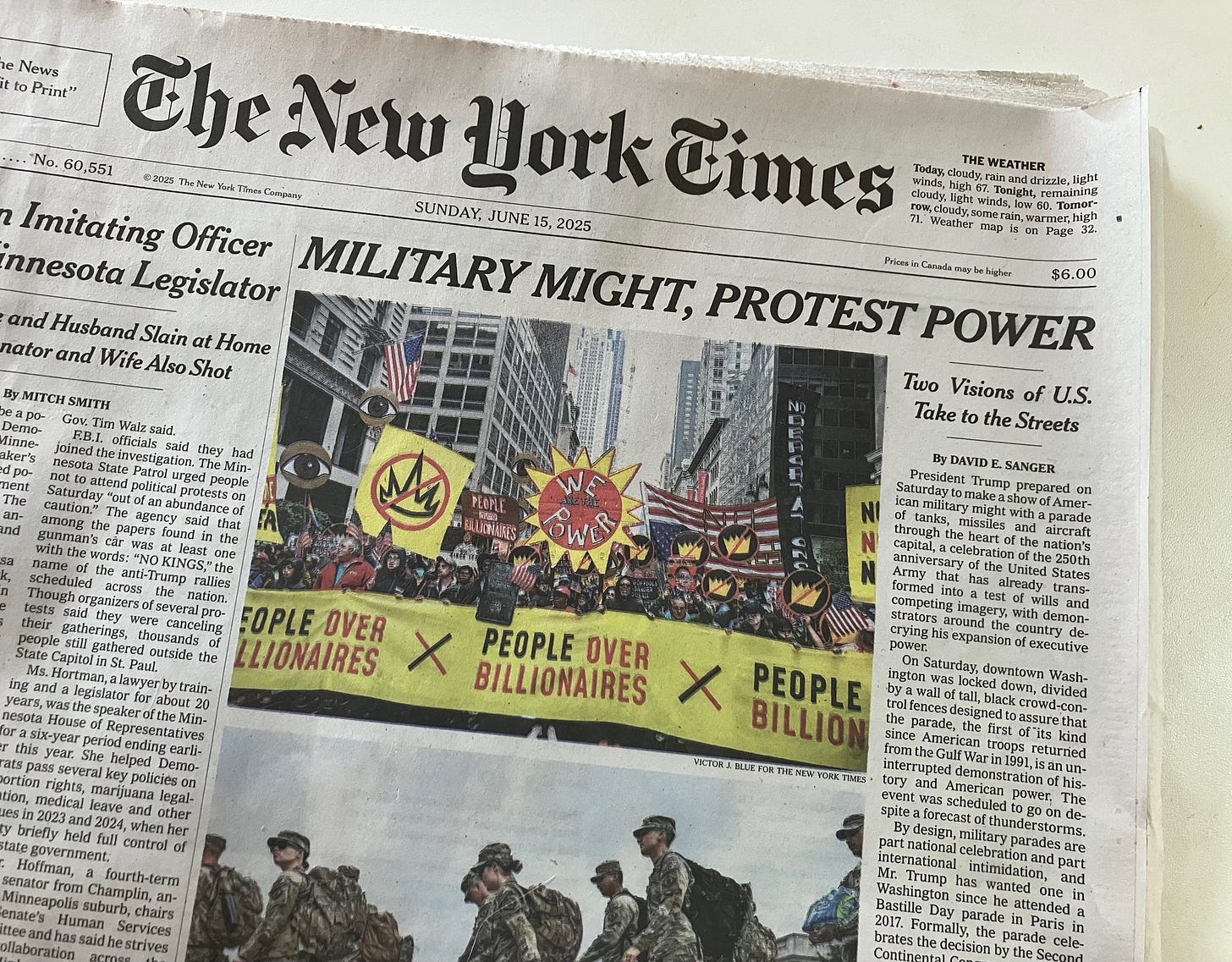
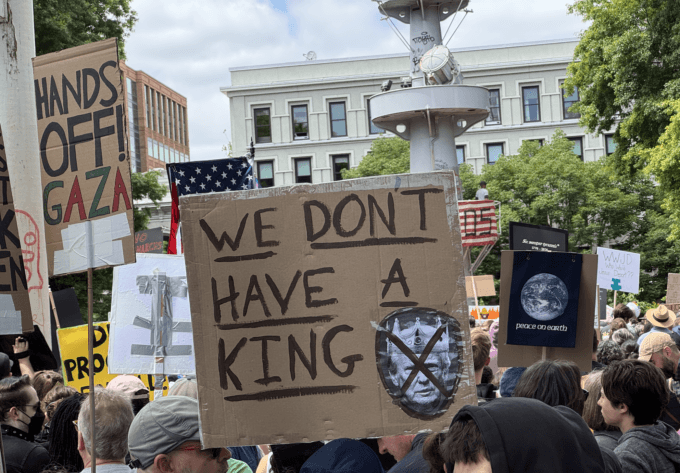
All of this came before the events of the past two weeks, which further augmented the size and scale of anti-Trump mobilization. First came large demonstrations in Los Angeles against ICE immigration raids and the deployment of the National Guard. (Manuel Pastor has a very nice report from the frontlines of the protests over at Dissent.) Then came the No Kings actions last Saturday, which were massive and took place at as many as 2,000 locations, organizers told NPR. Data journalist G. Elliot Morris, formerly of FiveThirtyEight, estimated the total number of participants at No Kings events between 4 and 6 million.
These are historic numbers.
By way of comparison, gigantic protests against the Iraq War on February 15, 2003 drew possibly 3 million demonstrators in the U.S. (along with between 12 and 30 million worldwide). The Crowd Counting Consortium estimated that the original Women’s March on January 21, 2017, acknowledged as a gargantuan mobilization, attracted between 3.3 million and 5.6 million protestors. In another historic deployment, Black Lives Matter protests may have drawn many millions more in 2020, but with the caveat that actions were spread out over multiple weeks.
In terms of single-day events, No Kings may not have reached the heights of the first Earth Day celebration, in 1970, which is sometimes cited as the largest day of action in U.S. history, but it’s up there with all the big ones.
Our team witnessed strong turnout in Philadelphia (around 80,000) and in New York City (upwards of 100,000). Organizers reported crowds of as many as 500,000 in Boston, 70,000 in Seattle, 200,000 in Los Angeles, and 100,000 in Chicago, among gatherings in other major cities. On his Facebook page, organizer Chris Crass did a wonderful job of compiling photos of No Kings protests from around the country. The images are inspiring: People swarming intersections in Evanston, Illinois, braving the rain in Little Rock, Arkansas, filling Liberty Plaza outside the state capitol in Atlanta, Georgia, and lining roads in Indianapolis, Indiana and Gainesville, Florida. All this stood in stark contrast to Trump’s gloomy, expensive, and under-attended military parade the same weekend.
Now, if you will allow a digression, there are a variety of quirks to consider when talking about the size of any mobilization. Crowd-counting numbers can be notoriously flexible and politicized. In Armies of the Night, his Pulitzer Prize winning “history as a novel” narrating a fall 1967 March on the Pentagon, author Norman Mailer jokingly suggested a rule of thumb for triangulating protest attendance: “[T]he police estimate multiplied by four might be as close to the real number as the Left Wing estimate divided by two and a half,” he wrote. “Thus a real crowd of 200,000 people would be described as 50,000 by police and a half million by the sponsors.”
Even when the numbers are reliable, comparisons between protests are not always apples to apples. For at least five decades after the 1963 March on Washington, the dominant model for a national day of action was to try to get everyone to a single location, often Washington, DC. Success was measured by how many people you could rally in that one spot. In some instances, such as the 2003 Iraq war protests, there might be one leading location on the West Coast (say, San Francisco) and another in the East (New York City), but the general model held. If the protest was to be a success, organizers needed to spend a lot of time thinking about filling buses and transporting people significant distances to join in a collective mass gathering.
By the time of the Women’s March in 2017, this dominant model was being replaced with something different. There was indeed a large central event in Washington, DC for the Women’s March. But there were also sizable events in other big cities such as New York City and Philadelphia, and even gatherings in smaller cities like Harrisburg and many points in between. Previously, the going wisdom had been that sending people by bus to the main event would be mutually exclusive with getting decent turnout locally. But that was not the case for the Women’s March. The big numbers in DC did not really seem to eat into crowds in smaller cities. Success was no longer measured by the numbers of people who showed up in one location, but how many events across the country could be hosted and what the cumulative attendance might be.
As it turns out, having protests everywhere is conducive to participation. Regarding last weekend’s No Kings demonstrations, famed Rabbi Arthur Waskow wrote about attending a modest event in the Germantown neighborhood of Philadelphia:
“Why did my beloved life-partner… and I choose to join about 200 people at the Lovett Library to say ‘No Kings!’ Instead of 80,000 demonstrators downtown where they swallowed up and liberated whole neighborhoods? Because I am 91 years old and my life partner is 82. We were sure that the massive downtown crowd, impressive as it was for demanding change, would make it impossible for the two of us to navigate. The library was one of countless small gatherings across the country and in big and even middle size cities the turnout was enormous.”
Lowering the bar for participation is undoubtedly positive in this respect. Of course, there are trade-offs. Because it’s easier to show up to your local town square than it is to spend a day or a weekend bussing back and forth to DC, participants are investing less time in the collective experience of traveling and assembling with others, things that can be good for cultivating further commitment. And, as I have written elsewhere with my brother Paul, the success of civil resistance often involves demonstrating the hardship voluntarily taken on movement participants—meaning that actions which require people to make higher levels of sacrifice can have their own benefits.
All this is to say that the size of any given crowd is not the only thing that matters.
In some ways, a variety of the smaller No Kings gatherings may have been more politically significant than the largest metropolitan ones. A friend of mine estimated that upwards of 5000 people turned out in his South Jersey town of Collingswood, a huge number for that area—arguably more impressive as drawing twenty times as many in nearby Philadelphia. Another organizer friend went to a protest in a small Pennsylvania town about an hour outside of Philly’s blue bubble. There, she reported, between 500 to 700 people lined a major roadway for a long stretch, encouraging passing drivers to sound their car horns in support. The steady, if intermittent, stream of honks gave courage to neighbors whose town borders a county that went solidly for Trump in 2024.
In Jacobin, Branco Marcetic argued that the presence of events deep into MAGA country signals a notable shifting of political energies. “[There is an] important point to be made here,” he wrote:
“The turnout in liberal cities and even in Trump-voting towns and counties doesn’t necessarily mean that anti-Trump voters outnumber the president’s supporters in these areas or their states—in many cases, they don’t. But it does suggest that voters opposed to Trump’s agenda—who across the country were met with few to no counterprotesters, even in deep red parts of the country—are vastly more energized than his supporters, and that despite his having won the popular vote…that Trump’s public support is a lot softer and more passive than his 2024 victory made it seem.”
In an article a couple of months ago, Paul and I outlined the key characteristics that define “moments of the whirlwind”—or periods of intensified social movement upsurge. It is clear that the current moment exhibits these qualities: Demonstrations are sparked by highly publicized “trigger events” (think ICE raids at Home Depot or a U.S. Senator in handcuffs), and participation is decentralized, not driven through pre-established organizational structures. The No Kings events of last weekend were led or sponsored by groups including Indivisible, the American Federation of Teachers, and the ACLU. All of the 200 organizations that signed on for the protests, especially the more established ones, deserve credit for refusing to bow to the authoritarian impulses of the Trump administration—especially when we have seen some leading law firms, media organizations, and universities fail to muster such bravery. Nevertheless, recruitment of the millions of people to the protests did not come through organizational phone trees or people’s individual relationships with organizers, but through momentum driven by widespread outrage at Trump’s actions.
Wired magazine published an article this week contending that defiance this time around, aided by new technologies, is far more decentralized than the Women’s March in 2017 and other resistance in Trump’s first term. The article reflects the magazine’s techno-fetishism, and its argument is a bit comical, given that the Women’s March itself was no august and long-standing institution but rather an ad hoc formation that swiftly coalesced in the whirlwind following Trump’s first election. Nevertheless, the article showed how abundant dissident energy is bubbling up in countless places and often has yet to be absorbed by formal organizations.
The article also pointed to a third common trait of whirlwinds: In addition to drawing in new participants from unexpected quarters, these moments spur a wealth of activity among these newcomers that is not dictated by any centralized command. As Wired reported, “the Tesla Takedown protests began with a single Bluesky post that exploded in large part thanks to social media posts, including protesters’ pictures and videos outside dealerships.” (Even Elon Musk himself ultimately acknowledged the success of demonstrations in shrinking Tesla’s earnings, although he blamed the impact on “paid protesters.”)
Or, as another example, the magazine profiled a couple in the Deep South that got involved by creating a website that allows people to order free stickers that they can post in high-traffic areas in their neighborhoods. The stickers display a QR code that directs users to resources about the warning signs of fascism: “What began with 500 stickers posted all over their small town,” reporter David Gilbert wrote, “quickly grew—with the help of an appeal on Reddit—to a campaign that has so far seen the couple and their children send 750,000 stickers to more than 1,000 people in all 50 states.”
All this raises the question: What should we do now that the whirlwind has arrived?
Paul and I hope to write on this in more depth, but there are many things that can be noted at least in passing: First, people should contribute however they can, and they should work to convince organizations that they are a part of to join in as well. Many established groups are still hesitant to throw down, yet the addition of their credibility and resources can make an important difference. It is hardly too late to get started: The most sweeping whirlwinds form not when a single trigger event gives rise to protest, but when a succession of triggers result in a series of escalating civil resistance. Along these lines, we can be sure that Trump will present more provocations, giving more opportunities for creative responses.
Protests are polarizing, meaning that they make people who might otherwise have been undecided or inattentive choose a side. Movements should focus on maximizing positive polarization and minimizing the negative. As we have previously argued, this means being smart in framing the demands of an action, highlighting sympathetic protagonists and unsympathetic oppressors, and heightening the contrast between the inventiveness and determination of resistance and the repressive violence of the state.
Trump is unpopular. There is clear evidence—from public opinion polling to pushback on the streets—that he is wildly overreaching his mandate. It is important to remember that Trump’s 2024 election victory was a narrow one: he carried 49.8% of the popular vote, as opposed to 48.3% for Kamala Harris (and even his electoral college win was nowhere close to the commanding totals amassed by Ronald Reagan in 1984, Richard Nixon in 1972, or LBJ in 1964). Since November, Trump’s popularity has tanked, even on issues where he once enjoyed an edge, such as the economy and immigration. The rank cruelty of his ICE raids is becoming increasingly clear, and Republicans have touched a third rail of American politics by slashing programs like Medicare.
Civil resistance plays an important role in solidifying this unpopularity and—as Trump perpetually lies about the impact of his policies—in educating the public about what is really going on. It helps to generate momentum for backlash at the polls, not just in the midterms or the next presidential elections, but in a plethora of state and local contests already taking place. And, in the interim, mass demonstrations encourage noncooperation at many levels that make the implementation of the White House agenda more difficult.
In short, popular resistance boosts the costs of overreach. Let us hope that we can watch the defiance grow.
Mark Engler is a writer based in Philadelphia, an editorial board member at Dissent and co-director of the Whirlwind Institute, a social change strategy center. He is author, with Paul Engler, of This Is An Uprising: How Nonviolent Revolt Is Shaping the Twenty-first Century. Read other articles by Mark, or visit Mark's website.
What a hopeful sight! My social media on June 14 and 15 was filled with people sharing pictures from “No Kings” gatherings.
Aerial photos of massive crowds in big cities. Snapshots of surprisingly large turnouts in small conservative communities. Sidewalk gatherings by residents of an assisted living center.
Millions of Americans signed up, made funny and serious signs, and came together around a basic principle: No Kings.
No Kings means no one-person rule. Our president must abide by the Constitution, follow the law, and respect the other branches of government.
No Kings means no government by edict or tweet. No president can unilaterally rewrite the law, take away due process, and impose his will on the rest of us.
No Kings means no king. Other government officials, including those who serve in our armed forces, do not swear loyalty to a ruler but to the Constitution.
These aren’t radical ideas. They are foundational American ideals. They are being severely tested right now. But research from around the world shows that autocracies do not survive sustained nonviolent resistance.
The rallies came after a week in which the president mobilized the military against American protesters in Los Angeles. Americans declared “No Kings” on the same weekend as a military parade demanded by the president and held on his birthday rumbled through our capital city.
The parade was resisted by military leaders during the president’s first term. It came after a political purge of generals and military lawyers who might say no. And it came after the president made intensely partisan speeches at West Point and Fort Bragg that suggested he views the American military as an arm of his political movement. That’s scary.
If the president hoped the military parade would provide some kind of boost to his strongman self-image, he was sorely disappointed. Despite the millions of dollars wasted shipping tanks and troops to Washington, D.C., the crowd fell far short of expectations. It was a stark contrast with the energized turnout for No Kings.
That energy must be sustained.
Corruption and abuse of power continue to threaten American families and communities as politicians vote to cut people’s access to food, education, and healthcare so they can give tax breaks to influential billionaires.
The president is surrounded by people urging him to ignore our checks and balances. His worst impulses are being enabled by too many members of Congress who fear his wrath more than they respect the Constitution and their oath to uphold it.
The president’s habit of demeaning and dehumanizing his opponents and political targets makes violence more likely. So did his decision to pardon people who attacked Capitol Police on January 6.
The danger posed by our poisoned political climate became horrifyingly clear with the assassination and attempted assassination of Democratic leaders in Minnesota by a gunman with a list of pro-choice politicians, Planned Parenthood locations, and a flyer for local No Kings events.
A rally goer in Utah was killed accidentally when a security guard opened fire to stop a man moving toward the crowd with a rifle. That same day, police arrested a man with a concealed handgun and two full ammunition magazines as he tried to get past security at a Pride event in Florida.
It’s important that we remain vigilant — and important that we not let violence or intimidation keep us from the duty we owe ourselves, each other, and our country. If we want to keep “No Kings” a reality as well as a rallying cry, that will require ongoing commitment and action from “We, the people.”