Thursday, June 26, 2025

Venice activists (and their inflatable crocodiles) claim victory as Jeff Bezos changes wedding venue


Copyright AP Photo - Greenpeace

By David Mouriquand
Published on 25/06/2025 -

Protesters in Venice are claiming an "enormous victory" after Amazon billionaire Jeff Bezos and his A-list wedding guests are forced to change the wedding location.

Amazon founder Jeff Bezos' Venice wedding to Lauren Sánchez has been triggering several protests in the historic sinking city, with activist groups staging demonstrations and aiming to obstruct access to the city’s famed canals.


While activists belonging to the “No Space For Bezos” group do not have an issue with the marriage itself, the common feeling is that Venice is being privatized and exploited, and that the “wedding of the century” only highlights the growing disparity between the haves and have-nots.

The protests were even galvanized this week by Greenpeace and their huge banner on St Mark’s Square, which read: “IF YOU CAN RENT VENICE FOR YOUR WEDDING YOU CAN PAY MORE TAX.”



Greenpeace’s initiative aimed to highlight the “social and climate injustice” of such events, adding that Bezos “embodies an economic and social model that is leading us towards collapse.

The organisation stated that lifestyles fuelled by “the arrogance of a few billionaires” are devastating for the planet.

Photo released by Greenpeace showing a large banner against Jeff Bezos' planned wedding, in St. Mark Square, in Venice - 23 June 2025AP Photo

The local activists had planned a protest for Saturday, aiming to obstruct access to canals with boats – in order to prevent guests from reaching the wedding venue.

However, these plans were modified after they claimed an "enormous victory".

Indeed, their actions have pressured organisers to change the lavish wedding venue from the Scuola Grande della Misericordia to the Arsenale - the famous complex of shipyards beyond Venice's congested centre, which is surrounded by fortified walls.

According to local press reports, the venue switch has been described as a necessary change because of security concerns, after the US joined the war between Israel and Iran – and with Ivanka Trump being on the guest list.

Regardless, the group “No Space For Bezos” are celebrating and have ditched their plans to use inflatable crocodiles to fill the canals, in order to block their celebrity guests from entering.

It would have been a brilliant visual... Instead, activists said that they will organise a “no Bezos, no war” march.

“It will be a strong, decisive protest, but peaceful,’’ said Federica Toninello, an activist with the Social Housing Assembly network. “We want it to be like a party, with music, to make clear what we want our Venice to look like."

Another important change of plan concerns Bezos' superyacht Koru and its support vessel Abeona, which is equipped with a helicopter deck and dedicated staff. The vessels have remained anchored in the Upper Adriatic Sea, between Croatia and Slovenia. No entry into the lagoon is expected.

Lauren Sánchez and Jeff BezosAP Photo

As mentioned in our Everything You Need To Know About The Bezos Wedding article, private jets are expected to jam up Venice airport, while five of Venice’s most luxurious hotels have been booked for the guests.

Bezos is said to be spending between $7million - $10 million for the three-day celebrations, and among the 200 carefully selected guests, A-list stars like Oprah Winfrey, Katy Perry, Leonardo DiCaprio and Kim Kardashian will be in attendance.

The most anticipated moment will be the ceremony on Friday 27 June on the island of San Giorgio Maggiore. The guests will visit the historic cloisters that now house the Cini Foundation, and then head to the Teatro Verde, an open-air amphitheatre made of white Vicenza stone with boxwood hedges. There, Bezos and Sánchez will say "yes".

The evening will reportedly end with a fireworks display that will light up the stretch of water in front of St Mark's Square.

The following day, on 28 June, a party will take place at the Arsenale... All with reinforced security. There have been rumours that Lady Gaga and/or Elton John will be providing the entertainment.

No Space For BezosAP Photo

The mayor of Venice, Luigi Brugnaro, has tried to reassure protesters regarding the extravagance of the wedding, stating that Venice is more than capable of hosting the event. He cited the Venice Film Festival and G7 Summit as examples.

Brugnaro also said he was “ashamed of those who behave like this” - in reference to the protesters.

For more information on the Bezos- Sánchez wedding, including details on celebrity guests, the fashion of the event and more on the protests, clickhere for the full lowdown


Bezos wedding venue disruption 'a symbolic victory for people power', activist group says


Issued on: 25/06/2025 - 


FRANCE 24's Sharon Gaffney speaks to the spokesperson for the 'Everyone Hates Elon' activist group, which unfurled a giant banner reading “If you can rent Venice for your wedding, you can pay more tax” on Piazza San Marco, in protest against plans to shut down parts of the city for Jeff Bezos' celebrity wedding. He says the group 'wanted to make a point that it's just obscene that any one person can do that at a time when most of us are struggling to pay the bills'.

Video by:  Sharon GAFFNEY


'Victory for Working People': Judge Blocks Trump Attack on Public Employee Unions

"We applaud this ruling as a critical defense of our communities and our rights at work," said the head of the American Federation of State, County, and Municipal Employees.


Lee Saunders, president of the American Federation of State, County, and Municipal Employees (AFSCME), speaks during a news conference outside the AFL-CIO headquarters on July 15, 2021 in Washington, D.C.
(Photo: Drew Angerer/Getty Images)


Eloise Goldsmith
Jun 26, 2025

Common Dreams 

A federal judge on Tuesday issued a preliminary injunction blocking the Trump administration from ending collective bargaining rights for federal employees whose work the administration says includes national security aspects. The union plaintiffs in the case hailed the decision as a "victory for working people."

"This executive order is a direct effort to silence federal workers' voice on the job—an essential freedom that helps maintain the integrity of our democracy," wrote Lee Saunders, the president of the American Federation of State, County, and Municipal Employees, one of the unions that brought the lawsuit.


"Federal workers serve every community, and targeting them through political retribution threatens the freedom of all working people to fight for fair treatment. We applaud this ruling as a critical defense of our communities and our rights at work," Saunders said.

On March 27, U.S. President Donald Trump issued an executive order with the aim of terminating collective bargaining with federal labor unions across many federal agencies, including the U.S. State Department, the Department of Justice, the Federal Communications Commission, and the General Services Administration. These agencies, according to the executive order, are "determined to have as a primary function intelligence, counterintelligence, investigative, or national security work."

Under federal law, the president is authorized to exclude agencies and subdivisions of agencies if those are the agency's primary function.

In an accompanying fact sheet, the White House called out "certain federal unions" which have "declared war on President Trump's agenda."

According to the American Federation of Government Employees (AFGE), the executive order impacts nearly a million federal employees.

In April, six unions that represent federal workers, including AFGE, filed a lawsuit in the U.S. District Court for the Northern District of California, arguing that that the executive order unconstitutionally retaliates against the union plaintiffs for their activities opposing Trump, which they argue is protected First Amendment activity.

In their complaint, the unions said that the Trump administration erred when it applied the national security exemption to workers whose jobs are not related to national security.

In his ruling, U.S. District Judge James Donato highlighted the White House fact sheet published alongside the order: "The fact sheet called out federal unions for vocal opposition to President Trump's agenda. It condemned unions who criticized the president and expressed support only for unions who toed the line. It mandated the dissolution of long-standing collective bargaining rights and other workplace protections for federal unions deemed oppositional to the president."

"All of this is solid evidence of a tie between the exercise of First Amendment rights and a government sanction," he wrote.

Donato also noted Trump "applied the national security label to an unprecedented swath of federal agencies, including whole cabinet departments for the first time in history."

David J. Holway, national president of National Association of Government Employees, another plaintiff, said that "this executive order isn't about national security. President Trump is punishing NAGE and other unions for protecting the rights of workers and standing up to the administration’s unlawful actions. The court made it clear: national security cannot be used as a smokescreen to silence federal workers. No president is above the law."

According to CNN, the judge's decision on Tuesday clashes with a ruling by the D.C. Circuit Court of Appeals, which in May lifted a different judge's block on the same executive order, in a case brought by a separate union.
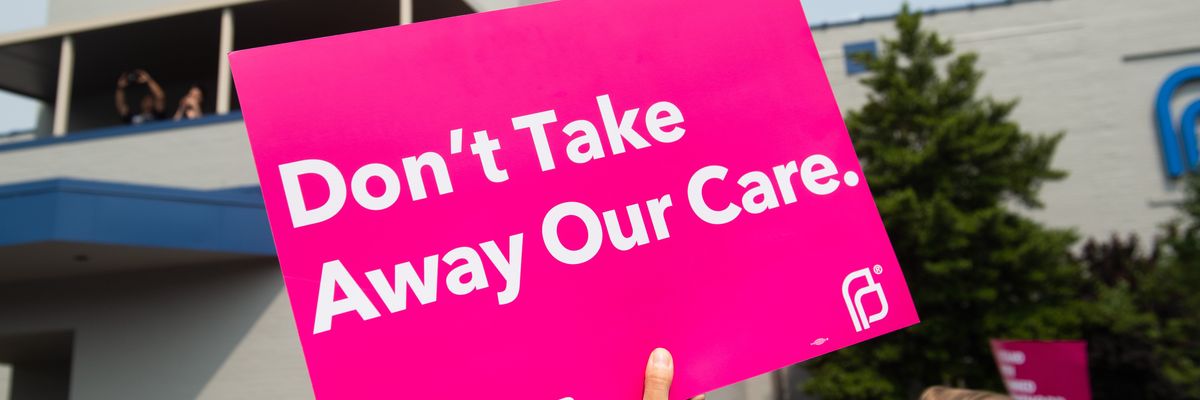
'People Will Die,' Warn Progressives as U.S. Supreme Court Lets States Defund Planned Parenthood

"This is a systematic decimation of access to reproductive healthcare and a signifier of what else is likely to come," warned one critic.


A protester holds a sign outside a Planned Parenthood clinic in St. Louis on May 31, 2019.
(Photo: Saul Loeb/AFP via Getty Images)

Brett Wilkins
Jun 26, 2025
 Common Dreams 

In its latest blow to reproductive healthcare in the United States, the Supreme Court's right-wing supermajority on Thursday blocked Planned Parenthood and one of its patients from suing South Carolina over its defunding of the medical provider because it performs abortions—a decision that critics say will cost lives as more Republican-controlled states follow suit.

At question in Medina v. Planned Parenthood South Atlantic was whether Medicaid beneficiaries can sue in order to secure healthcare services under a law that allows patients to choose any qualified provider. The high court ruled 6-3 that they cannot, with liberal Justices Sonia Sotomayor, Elena Kagan, and Ketanji Brown Jackson dissenting.

"The decision whether to let private plaintiffs enforce a new statutory right poses delicate questions of public policy. New rights for some mean new duties for others," Justice Neil Gorsuch wrote for the majority. "And private enforcement actions, meritorious or not, can force governments to direct money away from public services and spend it instead on litigation."

"The job of resolving how best to weigh those competing costs and benefits belongs to the people's elected representatives, not
unelected judges charged with applying the law as they find it," Gorsuch added.

Concurring with the majority, far-right Justice Clarence Thomas wrote that the ruling invites further scrutiny of Section 1983, the federal law empowering individuals to sue state and local government officials for violating their constitutional rights.


In a furious dissent, Jackson wrote that "the court's decision today is not the first to so weaken the landmark civil rights protections that Congress enacted during the Reconstruction era."

"That means we do have a sense of what comes next: As with those past rulings, today's decision is likely to result in tangible harm to real people," she continued. "At a minimum, it will deprive Medicaid recipients in South Carolina of their only meaningful way of enforcing a right that Congress has expressly granted to them."

"And, more concretely, it will strip those South Carolinians—and countless other Medicaid recipients around the country—of a deeply personal freedom: the 'ability to decide who treats us at our most vulnerable,'" Jackson added. "The court today disregards Congress' express desire to prevent that very outcome."

More than 70 million Americans rely upon Medicaid, the federal government's primary health insurance program for lower-income people. The program is facing the prospect of major cuts under a Republican budget proposal that critics warn could cause millions of people to lose their healthcare coverage in service to a massive tax break backed by President Donald Trump that would disproportionately benefit the rich and corporations.

According to Planned Parenthood Federation of America president and CEO Alexis McGill Johnson, "currently, 20% of South Carolinians—over 1 million—receive healthcare services through the Medicaid program, and approximately 5% of those recipients sought sexual and reproductive health care services at Planned Parenthood South Atlantic (PPSAT) so far this year."

Responding to Thursday's ruling, McGill Johnson said that "the consequences are not theoretical in South Carolina or other states with hostile legislatures."

"Patients need access to birth control, cancer screenings, STI testing and treatment, and more. And right now, lawmakers in Congress are trying to 'defund' Planned Parenthood as part of their long-term goal to shut down Planned Parenthood and ban abortion nationwide," she added. "Make no mistake, the attacks are ongoing and Planned Parenthood will continue to do everything possible to show up in communities across the country and provide care."

Under tremendous Republican-led pressure, Planned Parenthood has closed or announced plans to close at least 20 locations across seven states since the beginning of the year.

"Today's decision is a grave injustice that strikes at the very bedrock of American freedom and promises to send South Carolina deeper into a healthcare crisis," PPSAT president and CEO Paige Johnson said following Thursday's decision. "Twice, justices of this court denied to even hear this case because [South Carolina Gov. Henry] McMaster's intent is clear: weaponize anti-abortion sentiment to deprive communities with low incomes of basic healthcare."

"Planned Parenthood South Atlantic will continue to operate and offer care in South Carolina, including for people enrolled in Medicaid," Johnson added. "To our patients, we will do everything in our power to ensure you can get the care you need at low or no cost to you. Know that we are still here for you, and we will never stop fighting for you to reclaim the rights and dignity you deserve."

Destiny Lopez, co-president and CEO of the Guttmacher Institute, called the ruling "a grave injustice."

Lopez continued:
At a time when healthcare is already costly and difficult to access, stripping patients of their right to high-quality, affordable healthcare at the provider of their choosing is a dangerous violation of bodily autonomy and reproductive freedom.

Specifically targeting Planned Parenthood has long been a strategy of the anti-abortion movement. Planned Parenthood health centers are an irreplaceable part of the U.S. healthcare system; Guttmacher data show that among the 4.7 million contraceptive patients served by publicly supported clinics in 2020, one in three received care from Planned Parenthood.

"In the face of attempts to 'defund' Planned Parenthood and attack Medicaid, Title X, and other pillars of reproductive healthcare, the court's actions cannot be considered in a vacuum," Lopez asserted. "This is a systematic decimation of access to reproductive healthcare and a signifier of what else is likely to come. Everyone deserves choice in their healthcare provider and access to the family planning they need."

Progressive groups and individuals also condemned Thursday's ruling, with the Freedom From Religion Foundation lamenting that "Christian nationalists win, women and low-income patients lose."

"This isn't justice," FFRF added. "It's religious favoritism at the highest level."


Meagan Hatcher-Mays, senior adviser at United for Democracy, said in a statement that "millions of Medicaid patients across the country rely on Planned Parenthood health centers for their primary and reproductive care, and people who face systemic racism and discrimination—Black, Latino, and Indigenous communities, as well as LGBTQ+ people and women—are more likely to be covered by Medicaid."

"It's ironic that the MAGA justices issued this ruling today, almost three years to the day that they overturned Roe v. Wade and threw abortion access into chaos across the country," Hatcher-Mays added. "Today's ruling is a further attack on healthcare, bodily autonomy, and our freedoms. This ruling clearly harms communities in South Carolina, and it's a matter of time before we see that harm expand further into the country."


Study shows controlled burns can reduce wildfire intensity and smoke pollution


Stanford University


As wildfires increasingly threaten lives, landscapes, and air quality across the U.S., a Stanford-led study published in AGU Advances June 26 finds that prescribed burns can help reduce risks. The research reveals that prescribed burns can reduce the severity of subsequent wildfires by an average of 16% and net smoke pollution by an average of 14%.

“Prescribed fire is often promoted as a promising tool in theory to dampen wildfire impacts, but we show clear empirical evidence that prescribed burning works in practice,” said lead author Makoto Kelp, a postdoctoral fellow in Earth system science at the Stanford Doerr School of Sustainability. “It’s not a cure-all, but it’s a strategy that can reduce harm from extreme wildfires when used effectively.”

Experts consider prescribed burns an effective strategy to reduce the threat of wildfires, and nearly $2 billion of federal funding had been set aside to conduct these and similar treatments to reduce hazardous fuel. Still, the use of prescribed burning in western states has expanded only slightly in recent years. Little research exists to quantify its effectiveness, and public opinion remains mixed amid concerns that prescribed burns can lead to smoky air and escaped fires.

Data-driven fire strategy

At Stanford, Kelp is working with climate scientist Noah Diffenbaugh and environmental economist Marshall Burke through the National Oceanic and Atmospheric Administration Climate and Global Change Postdoctoral Fellowship Program. Using high-resolution satellite imagery, land management records, and smoke emissions inventories, the research team compared areas treated with prescribed fire between late 2018 and spring 2020 to adjacent untreated areas that both later burned in the extreme 2020 fire season. The analysis found that areas treated with prescribed fire burned less severely and produced significantly less smoke.

That finding is particularly important given the growing recognition of wildfire smoke as a major public health threat. Fine particulate matter (PM2.5) from wildfires has been linked to respiratory and cardiovascular problems and is increasingly driving poor air quality across the U.S.

“People often think of wildfires just in terms of flames and evacuations,” said Burke, an associate professor of environmental social sciences in the Doerr School of Sustainability. “But the smoke is a silent and far-reaching hazard, and prescribed fire may be one of the few tools that actually reduces total smoke exposure.”

Not all treatments are equal

The study also highlights a key nuance: the authors found that prescribed fires were significantly more effective outside of the wildland-urban interface (WUI)—the zones where homes meet wildland vegetation—than within it. In WUI areas, where agencies often rely on mechanical thinning due to concerns about smoke and safety, fire severity was reduced by just 8.5%, compared to 20% in non-WUI zones.

“We already know that population is growing fastest in the areas of the wildland-urban interface where the vegetation is most sensitive to climate-induced intensification of wildfire risk,” said Diffenbaugh, the Kara J Foundation Professor in the Stanford Doerr School of Sustainability and the Kimmelman Family Senior Fellow at the Stanford Woods Institute for the Environment. “So, understanding why the prescribed fire treatments are less effective in those areas is a key priority for effectively managing that intensifying risk.”

Smoke tradeoffs and policy implications

The study addresses concerns about smoky air from prescribed burning, finding that the approach produces only about 17% of the PM2.5 smoke that would be emitted by a wildfire in the same area. The researchers estimate that if California met its goal of treating one million acres annually with prescribed fire, it could cut PM2.5 emissions by 655,000 tons over five years—more than half of the total smoke pollution from the state’s devastating 2020 wildfire season.

The authors note that their findings likely represent a conservative estimate of the benefits of prescribed fire, as such treatments can have protective spillover effects on surrounding untreated areas.

“This kind of empirical evidence is critical for effective policy,” said Kelp. “My hope is that it helps inform the ongoing conversation around prescribed fire as a potential wildfire mitigation strategy in California.”


Coauthors of the study also include Minghao Qiu of Stony Brook University, Iván Higuera-Mendieta, a PhD student in Earth system science at Stanford; and Tianjia Liu of the University of British Columbia.

Burke is also a senior fellow at the Stanford Woods Institute for the Environment, the Freeman Spogli Institute for International Studies, and the Stanford Institute for Economic Policy Research (SIEPR); an associate professor (by courtesy) of Earth system science; and a member of Bio-X and the Wu Tsai Neurosciences Institute.

The study was funded by the National Oceanic and Atmospheric Administration and Stanford University.


Tribocatalytic recycling of lithium-ion batteries


Tsinghua University Press


With the rapid advancement of global energy storage technologies, lithium battery-based energy storage systems have experienced particularly swift development. Concurrently, the growing number of retired lithium-ion batteries (LIBs) has increased annually, posing significant environmental challenges; improper disposal may lead to severe ecological contamination. Retired LIBs contain various valuable materials, such as cobalt and lithium. Therefore, the development of efficient and environmentally friendly recycling processes for the treatment of spent LIBs has become a focal point of global academic research.

Researchers utilized a novel catalytic technology—tribocatalysis—which was applied for the first time to achieve the recycling and reuse of cathode materials from spent lithium-ion batteries. The integration of theoretical calculations (including electrostatic potential, adsorption energy, and electron density difference) with experimental results confirmed that the tribocatalytic weak-acid leaching process is an effective method for ion leaching. Furthermore, ESR and free radical trapping experiments demonstrated that reactive species generated during the friction process play a crucial role in the efficient leaching of various ions from lithium-ion batteries.

Currently, pyrometallurgy and hydrometallurgy are the two most commonly employed methods for the recovery of valuable materials from spent lithium-ion batteries (LIBs). The conventional pyrometallurgical process typically involves the complete incineration of acetylene black, organic electrolytes, and binders, which results in significant energy consumption. In contrast, hydrometallurgy offers advantages such as milder reaction conditions and higher recovery efficiency. However, toxic gases including Cl₂, SO₃, and NOₓ are often released during the process. Moreover, the recovery procedure becomes more complex due to multiple separation and purification steps required between cobalt, lithium, and other components, potentially leading to secondary environmental pollution. As stated by Professor Changzheng Hu from the College of Materials Science and Engineering at Guilin University of Technology (China).

However, tribocatalysis effectively addresses these limitations and enables the efficient recovery of metal ions from spent lithium-ion batteries. This method holds significant potential for both reducing and leaching metal ions, thereby helping to alleviate the scarcity of valuable resources while efficiently managing waste lithium-ion power batteries. Such capabilities contribute to the promotion of sustainable and healthy development within the lithium-ion battery industry.

The research team published their findings in the Journal of Advanced Ceramics in June 23, 2025.

This study was supported by the Guangxi Science and Technology Plan (Grant Nos. AA25069001, AD25069100).


About Journal of Advanced Ceramics

Journal of Advanced Ceramics (JAC) is an international academic journal that presents the state-of-the-art results of theoretical and experimental studies on the processing, structure, and properties of advanced ceramics and ceramic-based composites. JAC is Fully Open Access, monthly published by Tsinghua University Press, and exclusively available via SciOpen. JAC’s 2024 IF is 16.6, ranking in Top 1 (1/33, Q1) among all journals in “Materials Science, Ceramics” category, and its 2024 CiteScore is 25.9 (5/130) in Scopus database. ResearchGate homepage: https://www.researchgate.net/journal/Journal-of-Advanced-Ceramics-2227-8508


New Chesapeake Bay Watershed stream maps double documented stream miles


Novel AI-supported mapping technique reduces costs, increases accuracy, speeds up mapping and will help prioritize restoration projects


University of Maryland Baltimore County

New high-resolution Chesapeake Bay Watershed stream maps 

image: 

A newly released hydrography data set for the Chesapeake Bay Watershed identified many more streams than the previous dataset. This example shows the new data in blue compared to the older maps in red. The new stream maps doubled documented stream miles in the watershed and used a novel, AI-supported method that is faster, costs less, and is more accurate than previous methods.

view more 

Credit: Courtesy of Matthew Baker


A dataset unveiled today more than doubles the documented stream miles in the Chesapeake Bay Watershed, elevating the total from approximately 150,000 to nearly 350,000 miles. The Hyper-Resolution Hydrography Data used to generate the new stream maps stems from a collaboration between the University of Maryland, Baltimore County (UMBC), the Environmental Protection Agency’s Chesapeake Bay Program (CBP), and the Chesapeake Conservancy (CC), including UMBC alumni at CBP and CC. 

The project lays a robust foundation for sustainable management of one of North America’s most critical ecosystems, which spans six states and supports millions of residents and iconic wildlife, such as blue crabs and migrating shorebirds. The new, high-resolution dataset offers the clearest picture yet of how water moves through both pristine landscapes and altered terrain throughout the watershed. 

The novel, AI-supported mapping method the research team used also dramatically reduces costs, time, and labor required for stream mapping, making it easy to update as additional data becomes available or apply in other watersheds to amplify its impact. 

“The landscape is shaped by running water. Stream networks are the primary conduit between the watershed and the Bay, and now we can characterize that connection in ways that we've never been able to before,” says Matthew Baker, UMBC professor of geography and environmental systems, and a lead on the mapping project. In addition to locating streams and tracing their flow paths with a high degree of precision, the mapping process also allowed the team to report estimates of each channel’s width and depth along its entire length. 

“When you spend a lot of time looking at hillshade relief maps, you begin to recognize the extent of human manipulation of terrain and how dramatically we have shaped how water flows across the landscape,” Baker adds. The new data will allow individuals and organizations to improve efforts to mitigate any harms from human disruption. 

A resource for restoration

Environmental groups and government agencies, including the CC and CBP, can use the data to prioritize restoration projects, like targeted streamside tree plantings that can mitigate excessive erosion—detected as unusually steep banks or deep channels relative to a stream’s width—and filter pollutants to improve water quality. Farmers and urban planners are likely to find it useful as well, to decrease the detrimental effects of agricultural runoff or wisely manage development to avoid flooding and minimize detrimental effects on wildlife habitat, for example.  

“These maps represent over six years of hard work, and I can't wait to see what people do with this highly anticipated dataset,” says David Saavedra, senior geospatial technical lead at the Chesapeake Conservancy. 

What to leave in, what to leave out?

This project is the first to harness high-resolution LiDAR data and artificial intelligence for large-scale, automated stream mapping. LiDAR, a laser-based system deployed via aircraft, captured elevation data with centimeter-level accuracy, generating a three-dimensional portrait of the terrain. AI algorithms, leveraging resources at UMBC’s High-Performance Computing Facility (HPCF), then processed the data, employing computer-vision techniques to identify channels. 

The HPCF computers mapped the entire watershed in a mere two weeks—a feat that traditional methods might take years to accomplish. The results achieved 94 percent accuracy for streams represented in existing data, and between 67 and 82 percent accuracy for previously unmapped streams, as validated by Saavedra against two other datasets, aerial imagery and LiDAR-derived topographic maps.

“I led a painstaking process of manually evaluating over 7,000 stream reaches across the watershed to conduct a thorough accuracy assessment on this novel dataset,” Saavedra says. Now that the methodology has been demonstrated effective, that level of manual validation shouldn’t be necessary if the technique is applied elsewhere.  

The algorithm needed some tweaks along the way, however. Initially, it included channel-shaped features that made less sense to include on a stream map, like detention ponds, green swales, gutters, and crop furrows. That necessitated modifications to the algorithm to remove those features.  

“Part of the challenge in interpreting the terrain was to make distinctions between those features and more natural channels,” Baker says. “So in our model, we had to eliminate some features that were mapped initially. That was unexpected.”

Eye-opening opportunities

The resulting maps offer a tenfold boost in resolution, moving from a 1:24,000 map scale to a 1:2,400 map scale with each pixel representing one square meter. The new stream maps align with recently-developed land cover maps produced at the same resolution, which are being released at the same time. 

“I think when people begin using our hyper-resolution hydrography in conjunction with the one-meter land use data, it will be eye-opening to see just how connected the landscape is to our waterways,” Saavedra says. “There are so many opportunities to improve our region's water quality, many of which may not have been readily apparent with previous data.” 

“The lack of consistent high-resolution hydrography data has always been a challenge, as it is critical for numerous outcomes outlined in the Chesapeake Bay Watershed Agreement, such as mapping forest buffers, non-tidal wetlands, species habitats for brook trout and black duck, and defining stream health,” says Labeeb Ahmed, a geographer in the Chesapeake Bay Program at the EPA. “This data release will enable novel and interesting research and scientific inquiries. I’m excited to see how other researchers and stakeholders will use this data in their conservation and restoration efforts.”