Friday, June 27, 2025

Documentary ‘A River Out Of Time’ Probes Green Economy Projects In Indonesian Borneo


 Screenshot of “A River Out of Time” documentary poster (Benar News)


By 

A documentary short from BenarNews explores concepts of the “green economy” in Indonesia’s North Kalimantan province. 

]

Through conversations with people living along the river, environmental activists, and project developers, “A River Out of Time” focuses on some of Indonesia’s latest and most ambitious development projects: its still-under-construction capital city, Nusantara; a sprawling “green” industrial zone; and a cascade of five dams planned along the Kayan River.

Indonesia’s central government is also forging ahead with plans to construct five dams along three rivers in North Kalimantan province as part of Southeast Asia’s largest hydropower project. Scheduled for completion in 2035, the cost of the cascade is estimated at more than $20 billion and could yield a generation capacity of 9,000 megawatts.

The documentary short film "A River Out of Time"
The documentary short film “A River Out of Time” (BenarNews) 

“The sense of uncertainty shared by Kayan River communities depicted in the film mirrors that of countless others around the world in today’s era of climate change,” said BenarNews Managing Editor Kate Beddall. “‘A River Out of Time’ allows us to reflect on what we lose as we alter the natural world and our own place in it.”

“Every film I have worked on aims to paint a complete picture of a unique, personal experience. ‘A River Out of Time’ does the same,” said director Roger M. Richards, best known for Sarajevo Roses. “As our team traveled along the Kayan, we built an interactive, multimedia travelogue of our journey: an elegy for a once-wild, doomed river.” 

The documentary short film is available in both English language and Bahasa Indonesia.


Why Sri Lanka Should Team Up With India For Oceanographic Exploration – Analysis

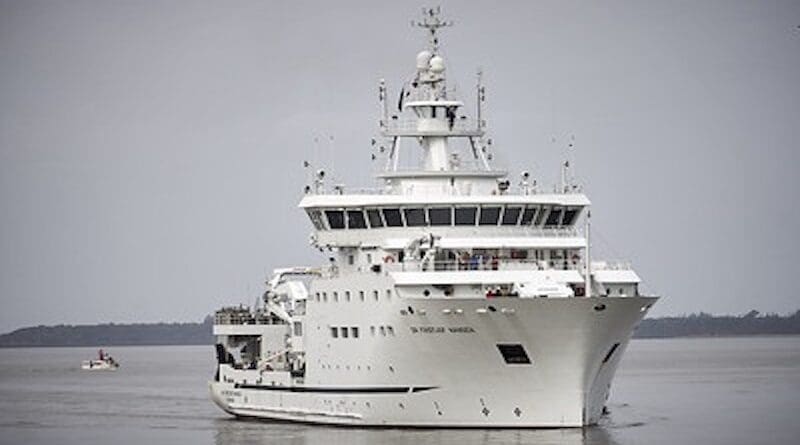
File photo of research vessel Dr. Fridtjof Nansen. Photo Credit: FAO


By 

India’s expertise and also geopolitical compulsions arising from the India-China conflict over the Indian Ocean dictate Indo-Lankan collaboration in preference to collaboration with other countries or entities. 


Recently, the Food and Agricultural Organization (FAO) of the UN had failed in its bid to send the state-of-the art oceanic research vessel “Dr Fridtjof Nansen” (F. Nansen) to Sri Lanka for exploration. 

The visit was to be in response to a request for its services made by Sri Lanka in November 2023. 

But the mission had to be abandoned because the Sri Lankan government said that it was yet to work out a Standard Operating Procedure (SOP) for allowing foreign research vessels.      

By rejecting the visit, Sri Lanka may have lost a good opportunity to explore the seas around it and acquire the skills for doing so. 

According to the UN, the technology on board F.Nansen would have helped “uncover the dynamics of life below water, guiding decisions for responsible ocean stewardship, safeguarding fish stocks, diversifying through underutilized marine resources, fulfilling global sustainability and climate commitments under the SDGS, and maintaining and expanding export markets and preserving marine biodiversity.” 


To reinforce its case, the UN said that Sri Lankan fisheries experts and scientists from the National Aquatic Resources Research and Development Agency as well as officers from the Sri Lankan Navy were to be closely working with the F. Nansen technical team, in full adherence with all pertinent national legislation. All data collected would have been published only with the government’s prior clearance, it assured.

But Sri Lanka was in a quandary about allowing the foreign vessel, albeit a UN ship, as the geopolitical situation in the Indian Ocean had changed between 2023 and 2025. 

Sri Lanka’s efforts to host Chinese research vessels had been an irritant for regional power India and the United States. Every time, there was a Chinese research vessel waiting to come, New Delhi would raise the red flag, Colombo would dilly dally, and finally allow the ships in only for logistical purposes not for research. 

To dodge the problem and buy time, Sri Lanka announced a one-year moratorium on visits by all foreign research ships, including India’s and China’s. The moratorium ended at the end of 2024, but the Standard Operating Procedure (SOP) for giving permission to foreign research vessels was not drawn up. 

When the F.Nansen sought permission to work, Colombo sought two weeks’ time to finalize the SOP. When it was still not worked out, government rejected the UN’s request, only allowing F.Nansen  to dock for logistical requirements. 

The absence of the SOP had enabled Colombo to reject the application of the UN application for “F.Nansen” and avoid any geopolitical complications with India.  

UN Disappointed        

A disappointed UN wrote to the government saying that the cancellation of the visit would result in direct losses of over US$ 1 million for Sri Lanka that was to accrue from the FAO. It would also reduce the efficacy of upcoming programs financed by the Green Climate Fund which would heavily rely on the data generated by F. Nansen.  

The UN warned that, “If the current visit should be cancelled, another would not be feasible until after 2030. Moreover, cancelling the visit would deprive the country of critical data essential to the government’s decision making, damaging the prospects for economic development in a key sector of the economy.”

Alternative Avenue

But all is not lost for Sri Lanka. Both India and China are interested in exploiting the ocean for their benefit. Both are offering to be an alternative provider of hydrographic services to many countries. 

India is deeply involved in hydrographic studies. Dr.David Brewster of the Lowy Institute says that India has seven hydrographic vessels and has conducted approximately 100 foreign hydrographic surveys, including in Maldives, Mauritius, Kenya, Tanzania, Myanmar, Sri Lanka and Seychelles in the last few years. India also builds local capabilities, including training for around 800 foreign nationals from countries throughout the Indian Ocean, Asia and Africa.

India has a short-term target of increasing its renewable energy capacity to 500 gigawatts by 2030, and meeting 50% of its energy requirements from renewables by then. The long-term goal is achieving net zero emissions by 2070. To meet these targets, India will need to secure critical minerals from all possible sources, on  land and the deep seabed. 

In 2022, India’s National Institute of Ocean Technology conducted trials of its mining machine at a depth of 5,270 metres in the central Indian Ocean basin and collected some polymetallic nodules from the seafloor that are rich in manganese, cobalt, nickel, and copper. 

The National Institute of Ocean Technology is designing and developing the 4th Generation deep-ocean human scientific submersible named “Matsya-6000,” as part of the Samudrayanproject. This cutting-edge submersible is engineered to accommodate three humans within its compact 2.1 meter diameter spherical hull, marking a significant milestone in India’s ocean exploration capabilities.

Meanwhile, India has been making diplomatic manoeuvres to gain influence in Sri Lanka’s maritime affairs. Singapore-based scholar Chulani Attananake points out in a piece in East Asia Forum that In March 2022, India and Sri Lanka signed agreements to enhance maritime security, including a US$6 million grant for the Maritime Rescue Coordination Centre. This builds on the existing Indo-Lankan maritime collaboration, including military exercises, capacity building initiatives and also a tripartite maritime cooperation pact with the Maldives.

“These efforts have proven effective in several instances. During Cyclone Ockhi in 2017, India’s Coast Guard and Navy played a crucial role in rescuing Sri Lankan fishermen stranded at sea. In 2021, India provided vital assistance in firefighting and containment during the X-Press Pearl disaster off Sri Lanka’s coast,” Attanayake says. 

It has been suggested by some that given the growing capabilities of India and increasing geopolitical complications, Sri Lanka could consider working with India in ocean exploration and exploitation.   

For years, Sri Lanka has been attempting to extend its maritime limits with a view to exploit it. In 2009, Colombo applied to extend its continental shelf beyond the 200 nautical mile limit as permitted by the United Nations Convention on the Law of the Sea (UNCLOS). In 2022, India objected to this, arguing that Sri Lanka’s claims would prejudice its rights over parts of the continental shelf. India wanted to be able to meet a growing challenge in this area from the Chinese. A decision on the continental shelf issue is still pending.  

Sri Lanka has also been claiming the “Afanasy Nikitin” seamount in the Central Indian Ocean. The seamount has cobalt-rich ferromanganese crusts covering a total area of 3,000 km2. In January 2024, India too submitted an application to the International Seabed Authority (ISA) seeking permission to explore the “Afanasy Nikitin” Seamount. India too wanted to bring Afanasy Nikitin seamount under its control before the Chinese got there. This matter too is pending settlement.

Under the circumstances, it would make sense for Sri Lanka to come to an agreement with India and co-opt it in its bid for seabed exploration and exploitation. India is developing expertise in the field and more importantly, geopolitical compulsions dictate that Indo-Lankan collaboration be explored rather than Sino-Lankan collaboration.



P. K. Balachandran

P. K. Balachandran is a senior Indian journalist working in Sri Lanka for local and international media and has been writing on South Asian issues for the past 21 years.


Why Venice Hates Jeff Bezos


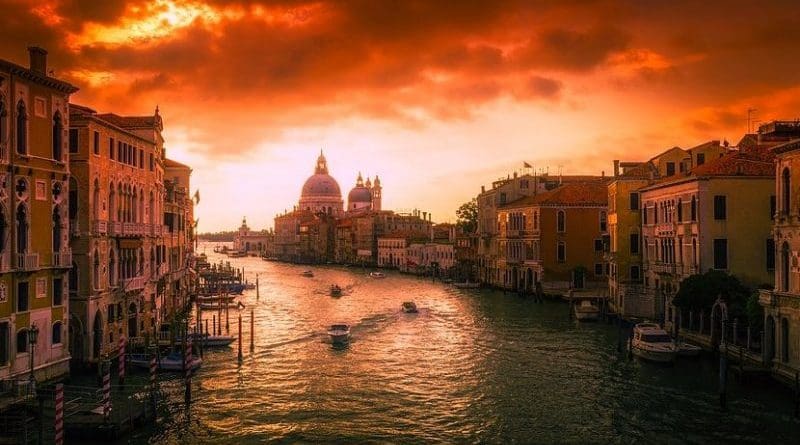
Venice, Italy.


By 

By Alessia Peretti

\

(EurActiv) — The lavish multimillion-euro marriage of Amazon’s Jeff Bezos and Lauren Sánchez in Venice has sparked protests about over-tourism,  environmental decay and bad taste. 

This week, the floating city is playing host to a multi-day celebration for the Amazon founder and his partner, a former local television anchor turned space-suit model – an event Italian media have described in superlative terms. The “wedding of the century” is said to have cost around €30 million.

More than 250 VIP guests – including Ivanka Trump, Bill Gates, Leonardo DiCaprio and Lady Gaga – are expected to arrive in the city by private jet and luxury yacht. Over the course of three days, they will cruise the lagoon in water taxis and gondolas, attending a series of exclusive events scattered across Venice’s smaller islands.

But behind the glamour, the celebrations have sparked growing unrest.

A city hollowed out

While some argue the festivities benefit local businesses, many Venetians see the wedding as the latest example of their city being reduced to a billionaire’s playground.


Once home to a vibrant community, Venice’s historic center has lost over half its population in recent decades. With short-term rentals skyrocketing, over-tourism has accelerated an exodus that has left the population below 50,000 for the first time  – even as the city hosts millions of tourists annually, the vast majority of whom stay only a few hours.

In this context, Bezos’ wedding becomes more than a private affair. Protesters argue it epitomizes the alienation of residents from their own city.

“If you can rent Venice for your wedding, then you can pay more taxes,” read a banner unfurled by activists in Piazza San Marco.

The ‘No Space for Bezos’ ecosystem

The grassroots campaign No Space for Bezos has been at the forefront of the resistance, organising demonstrations for months. Protesters stress that their outrage is systemic, not personal.

“There’s already a lot of anger, which spills over into this issue with Bezos and his 250 guests arriving in a city that is disappearing due to the climate crisis,” said Gianluca Esposito, one of the demonstrators.

Environmental degradation lies at the heart of the movement. Venice, known in Italy as la città che scompare – “the disappearing city” – faces an existential threat from rising sea levels.

According to Italy’s national geophysics institute, INGV, rising sea levels and land subsidence could leave large parts of the city submerged by 2150. Activists highlight the irony of billionaires gathering in one of the world’s most fragile cities while their carbon footprints and corporate practices are accelerating the very crisis that is endangering it.

“He’s a pretext to wake people up,” said Giulia, a member of Extinction Rebellion. “What we’re really fighting is the system that enables this level of inequality, injustice and climate destruction.”

On Tuesday, four activists climbed a crane beside the luxury Hotel Danieli – where some wedding guests are staying – and unfurled a banner reading, “Tax the rich to give back to the planet.” The group spent the night in police custody.

With open arms

The demonstrations, however, did not find an echo in higher circles. Venice’s mayor, Luigi Brugnaro, called for an apology to Jeff Bezos, while Luca Zaia, the president of the Veneto region, also defended the billionaire.

“I want Jeff Bezos to be welcomed with open arms”, Zaia said. “Protesting against someone who brings visibility and wealth to our region is a disgrace.”

Nevertheless, amid rising tensions, the wedding organisers have reportedly moved the main reception from the central Scuola Grande della Misericordia to the more secluded Arsenale complex. Officials cited security concerns linked to the protests.

EurActiv

EurActiv publishes free, independent policy news and facilitates open policy debates in 12 languages.


Do Not Forget The Crimean Tatars – Analysis

Protestors with the Crimean Tatar flag


By 

By Luke Coffey


President Donald Trump seemed confident he could quickly end Russia’s invasion of Ukraine. But more than 150 days into his second term, peace seems no closer than it did on day one. Although headlines focus on high-stakes diplomacy and Moscow’s nightly aerial bombardment of Ukrainian civilians, policymakers in the United States should not overlook the Kremlin’s mistreatment of ethnic minorities under its control—particularly the continued persecution of the Crimean Tatar community.

The Crimean Tatars are the indigenous people of the Crimean Peninsula. They are ethnically Turkic and religiously Sunni Muslim, with a rich but often tragic history. From 1441 to 1783, they lived under the Crimean Khanate, the longest-lasting successor state to Genghis Khan’s Golden Horde. For more than three centuries, the Crimean Tatars maintained their own political and cultural institutions while serving as a vassal of the Ottoman Empire. This era defined much of their national identity—until Catherine the Great annexed the khanate in 1783, marking the beginning of Russian imperial domination. Amid the chaos of the Russian Revolution and subsequent civil war, Crimea was absorbed into the Soviet Union.

Soviet rule was even more brutal for the Crimean Tatars. In the 1920s, Vladimir Lenin reportedly stated, “We will take them, divide them, subjugate them, and digest them.” Under Joseph Stalin, conditions worsened. Because a small percentage of Crimean Tatars had sided with Nazi Germany during World War II, the Soviets branded the entire community as traitors and subjected the group to collective punishment. The vast majority of Crimean Tatars either sympathized with or actively fought for the Soviet Union against the Nazis, with many serving in the Red Army. At least eight were awarded the title Hero of the Soviet Union, the highest honor in the USSR. One of them, fighter pilot Ahmet-Khan Sultan, received the title twice—an extraordinary feat achieved by only about 1 percent of all recipients of the award.

Still, Stalin carried out a mass deportation in 1944. Around 180,000 Crimean Tatars were forcibly removed from their homes and shipped to Central Asia. Many settled in Uzbekistan; others were scattered across Siberia. Tens of thousands died of starvation and disease during the journey or shortly after.

There is a direct line from Stalin’s repression to today’s war in Ukraine. The current Ukrainian defense minister, Rustem Umerov, is a Crimean Tatar born in exile in Uzbekistan because of the 1944 deportation. During Mikhail Gorbachev’s perestroika reforms in the late 1980s, the Soviet Union allowed Crimean Tatars to return to their homeland. Umerov’s family was among those who made the journey back to Crimea in the 1990s, and they remained there until Russia’s 2014 invasion forced many Tatars to flee once again. By the time the Soviet Union collapsed in 1991, Crimea had become part of an independent Ukraine—a status that the Russian Federation formally recognized at the time.


But Russia’s 2014 annexation of Crimea marked a return to repression. At the time, Crimean Tatars made up about 13 percent of the peninsula’s population. Today, it is unclear how many remain. Thousands fled to mainland Ukraine or to neighboring countries, especially Turkey. Russian authorities banned the Mejlis, the political organization that represents the Crimean Tatars. Those of the community who stayed behind face serious restrictions, including surveillance of their mosques, suppression of the Tatar language in schools, and arrests of prominent community leaders. Many have been barred from reentering Crimea or imprisoned on dubious charges.

Some Russian voices have even called for the “de-Turkification” of Crimea—an effort to replace Turkic place-names with those used in ancient Greek times. For example, Crimea would become Taurida, Kerch would become Pantikapaion, Feodosia would become Theodosia, and Sevastopol would become Sevastoupoli. This is a deliberate attempt to erase the Crimean Tatars’ cultural and historical presence on the peninsula. Such acts of cultural vandalism would be condemned in any other context and should not go unnoticed in Crimea.

June 26 marks Crimean Tatar Flag Day. Their flag—a light blue field with a golden tamÄŸa (the Taraq)—often flies alongside the Ukrainian flag as a symbol of history, honor, and resistance. The light blue represents the Turkic identity of the Crimean Tatars, while the golden Taraq in the upper-left corner is the tamÄŸa of the Giray dynasty, which ruled the Crimean Khanate for more than 300 years. In traditional Turkic culture, a tamÄŸa served as the seal or emblem of a powerful family, tribe, or ruling house. The word taraq is a linguistically Turkic word for “comb”—a fitting name, as the symbol resembles a three-pronged trident turned upside down. Though simple in design, the flag carries a powerful message: the survival and resilience of a people determined to reclaim its rights and homeland.

The Trump administration should focus on ending Russia’s invasion of Ukraine and achieving a fair and just peace. But the US needs to account for the situation of the Crimean Tatars. First, the administration should consistently highlight religious freedom violations in occupied Crimea, especially the persecution of the Tatar Muslim community in addition to other non–Russian Orthodox groups. Second, Washington should work closely with Turkey and other ethnically Turkic nations to raise international awareness of the Tatars’ plight. Third, when senior US officials or congressional delegations travel to Kyiv, they should make time to meet with representatives of the Crimean Tatar community.

The Crimean Tatars have endured centuries of persecution at the hands of Russia. But they also have a proud history and a vibrant cultural identity. The goal should be for all Crimean Tatars—whether in exile or under occupation—to one day return to their homeland and live freely, practicing their language, culture, and faith in a peaceful and independent Ukraine.

Their struggle is only one part of the broader war, but it is a vital one that US policymakers should not ignore.

  • About the author: Luke Coffey is a senior fellow at Hudson Institute. His work at Hudson analyzes national security and foreign policy, with a focus on Europe, Eurasia, NATO, and transatlantic relations.
  • Source: This article was published by the Hudson Institute\

Hudson Institute

Hudson Institute is a nonpartisan policy research organization dedicated to innovative research and analysis that promotes global security, prosperity, and freedom.