Why Sri Lanka Should Team Up With India For Oceanographic Exploration – Analysis
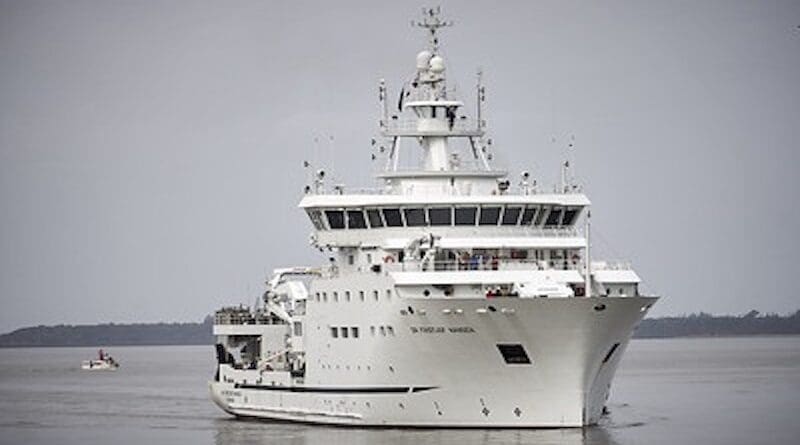
File photo of research vessel Dr. Fridtjof Nansen. Photo Credit: FAO
India’s expertise and also geopolitical compulsions arising from the India-China conflict over the Indian Ocean dictate Indo-Lankan collaboration in preference to collaboration with other countries or entities.
Recently, the Food and Agricultural Organization (FAO) of the UN had failed in its bid to send the state-of-the art oceanic research vessel “Dr Fridtjof Nansen” (F. Nansen) to Sri Lanka for exploration.
The visit was to be in response to a request for its services made by Sri Lanka in November 2023.
But the mission had to be abandoned because the Sri Lankan government said that it was yet to work out a Standard Operating Procedure (SOP) for allowing foreign research vessels.
By rejecting the visit, Sri Lanka may have lost a good opportunity to explore the seas around it and acquire the skills for doing so.
According to the UN, the technology on board F.Nansen would have helped “uncover the dynamics of life below water, guiding decisions for responsible ocean stewardship, safeguarding fish stocks, diversifying through underutilized marine resources, fulfilling global sustainability and climate commitments under the SDGS, and maintaining and expanding export markets and preserving marine biodiversity.”
To reinforce its case, the UN said that Sri Lankan fisheries experts and scientists from the National Aquatic Resources Research and Development Agency as well as officers from the Sri Lankan Navy were to be closely working with the F. Nansen technical team, in full adherence with all pertinent national legislation. All data collected would have been published only with the government’s prior clearance, it assured.
But Sri Lanka was in a quandary about allowing the foreign vessel, albeit a UN ship, as the geopolitical situation in the Indian Ocean had changed between 2023 and 2025.
Sri Lanka’s efforts to host Chinese research vessels had been an irritant for regional power India and the United States. Every time, there was a Chinese research vessel waiting to come, New Delhi would raise the red flag, Colombo would dilly dally, and finally allow the ships in only for logistical purposes not for research.
To dodge the problem and buy time, Sri Lanka announced a one-year moratorium on visits by all foreign research ships, including India’s and China’s. The moratorium ended at the end of 2024, but the Standard Operating Procedure (SOP) for giving permission to foreign research vessels was not drawn up.
When the F.Nansen sought permission to work, Colombo sought two weeks’ time to finalize the SOP. When it was still not worked out, government rejected the UN’s request, only allowing F.Nansen to dock for logistical requirements.
The absence of the SOP had enabled Colombo to reject the application of the UN application for “F.Nansen” and avoid any geopolitical complications with India.
UN Disappointed
A disappointed UN wrote to the government saying that the cancellation of the visit would result in direct losses of over US$ 1 million for Sri Lanka that was to accrue from the FAO. It would also reduce the efficacy of upcoming programs financed by the Green Climate Fund which would heavily rely on the data generated by F. Nansen.
The UN warned that, “If the current visit should be cancelled, another would not be feasible until after 2030. Moreover, cancelling the visit would deprive the country of critical data essential to the government’s decision making, damaging the prospects for economic development in a key sector of the economy.”
Alternative Avenue
But all is not lost for Sri Lanka. Both India and China are interested in exploiting the ocean for their benefit. Both are offering to be an alternative provider of hydrographic services to many countries.
India is deeply involved in hydrographic studies. Dr.David Brewster of the Lowy Institute says that India has seven hydrographic vessels and has conducted approximately 100 foreign hydrographic surveys, including in Maldives, Mauritius, Kenya, Tanzania, Myanmar, Sri Lanka and Seychelles in the last few years. India also builds local capabilities, including training for around 800 foreign nationals from countries throughout the Indian Ocean, Asia and Africa.
India has a short-term target of increasing its renewable energy capacity to 500 gigawatts by 2030, and meeting 50% of its energy requirements from renewables by then. The long-term goal is achieving net zero emissions by 2070. To meet these targets, India will need to secure critical minerals from all possible sources, on land and the deep seabed.
In 2022, India’s National Institute of Ocean Technology conducted trials of its mining machine at a depth of 5,270 metres in the central Indian Ocean basin and collected some polymetallic nodules from the seafloor that are rich in manganese, cobalt, nickel, and copper.
The National Institute of Ocean Technology is designing and developing the 4th Generation deep-ocean human scientific submersible named “Matsya-6000,” as part of the Samudrayanproject. This cutting-edge submersible is engineered to accommodate three humans within its compact 2.1 meter diameter spherical hull, marking a significant milestone in India’s ocean exploration capabilities.
Meanwhile, India has been making diplomatic manoeuvres to gain influence in Sri Lanka’s maritime affairs. Singapore-based scholar Chulani Attananake points out in a piece in East Asia Forum that In March 2022, India and Sri Lanka signed agreements to enhance maritime security, including a US$6 million grant for the Maritime Rescue Coordination Centre. This builds on the existing Indo-Lankan maritime collaboration, including military exercises, capacity building initiatives and also a tripartite maritime cooperation pact with the Maldives.
“These efforts have proven effective in several instances. During Cyclone Ockhi in 2017, India’s Coast Guard and Navy played a crucial role in rescuing Sri Lankan fishermen stranded at sea. In 2021, India provided vital assistance in firefighting and containment during the X-Press Pearl disaster off Sri Lanka’s coast,” Attanayake says.
It has been suggested by some that given the growing capabilities of India and increasing geopolitical complications, Sri Lanka could consider working with India in ocean exploration and exploitation.
For years, Sri Lanka has been attempting to extend its maritime limits with a view to exploit it. In 2009, Colombo applied to extend its continental shelf beyond the 200 nautical mile limit as permitted by the United Nations Convention on the Law of the Sea (UNCLOS). In 2022, India objected to this, arguing that Sri Lanka’s claims would prejudice its rights over parts of the continental shelf. India wanted to be able to meet a growing challenge in this area from the Chinese. A decision on the continental shelf issue is still pending.
Sri Lanka has also been claiming the “Afanasy Nikitin” seamount in the Central Indian Ocean. The seamount has cobalt-rich ferromanganese crusts covering a total area of 3,000 km2. In January 2024, India too submitted an application to the International Seabed Authority (ISA) seeking permission to explore the “Afanasy Nikitin” Seamount. India too wanted to bring Afanasy Nikitin seamount under its control before the Chinese got there. This matter too is pending settlement.
Under the circumstances, it would make sense for Sri Lanka to come to an agreement with India and co-opt it in its bid for seabed exploration and exploitation. India is developing expertise in the field and more importantly, geopolitical compulsions dictate that Indo-Lankan collaboration be explored rather than Sino-Lankan collaboration.

P. K. Balachandran
P. K. Balachandran is a senior Indian journalist working in Sri Lanka for local and international media and has been writing on South Asian issues for the past 21 years.

No comments:
Post a Comment