Tuesday, July 01, 2025

Ocean campaigners hail French move to snuff out cigarette butt pollution

A sweeping ban on smoking in outdoor public spaces is expected to help stub out the scourge of cigarette butts – France’s most common form of litter – from beaches, parks and bus stops.


Issued on: 01/07/2025 - 


A discarded cigarette butt lies on the sand at La Ciotat beach near Marseille, southern France. A new outdoor smoking ban aims to keep beaches like this free of littered filters. AP - Jacques Brinon


By: Amanda Morrow

The new rules, which came into effect at the weekend, prohibit smoking on beaches during bathing season, in public parks, and at bus stops during operating hours.

Smokers are also barred from lighting up near schools, libraries, swimming pools and sports grounds. Anyone caught breaking the ban faces a fine of €135, which can rise to €750 for serious cases.
Tonnes of waste

Each year French smokers toss away up to 25,000 tonnes of cigarette butts – more than twice the weight of the Eiffel Tower.

The filters are made of plastic, not cotton, and break apart into tiny fibres that leach chemicals into soil and water.

By stopping cigarette litter at the source, the ban should make a noticeable difference, said Chris Dorsett, vice president of conservation at Ocean Conservancy.

The US-based non-profit, which works to protect the world’s oceans, has run its International Coastal Cleanup – a global network of volunteers who collect rubbish from beaches and waterways – since 1986.

Calls for France to follow UK with generational tobacco ban

In that time more than 63 million cigarette butts have been collected worldwide. In Europe alone, more than 320,000 were picked up from coasts and waterways last year.

“Cigarette butts are unfortunately a problem across the globe in terms of the number we find,” Dorsett said.

“The two big problems are that they are made up of microplastics that break down into smaller pieces and pose a problem for marine wildlife.

“Microplastics can interfere with the digestive systems of fish species.”

The butts also leak nicotine, heavy metals and other toxic chemicals into sand and water. According to the French Ministry of Ecological Transition, a single cigarette butt can contaminate up to 500 litres of water.

France’s new outdoor smoking ban aims to keep beaches and parks free of discarded filters like this. AP - Denis Poroy


Single-use plastic


The filters in cigarette butts are classed as single-use plastics under EU rules.

While the EU has not banned cigarette filters outright, it does make tobacco companies pay for clean-ups under the “polluter pays” rule.

France was the first EU country to force this cost onto the industry, but local councils still spend about €100 million each year clearing up discarded butts.

Environmental groups say many smokers still see filters as harmless waste rather than plastic pollution – something Ocean Conservancy wants to change.

Cigarette butts, the plastic pollution that's hiding in plain sight

Few people realise that filters are plastic waste, said Anja Brandon, Ocean Conservancy’s director of plastics policy.

“Many people are surprised to learn that cigarette butts are also single-use plastics. In fact, they are the most common single-use plastic found polluting beaches and waterways worldwide,” Brandon said.

Bans can be an effective tool – especially when combined with other awareness measures, she added.

“When it comes to preventing plastic pollution, we know that bans work. A recent study that analysed plastic bag bans showed these policies lead to a 25 to 47 percent reduction in plastic bag pollution on beaches and waterways where they are implemented.”
'Smoke-free generation'

France wants to create a “smoke-free generation” by 2032 – meaning fewer than 5 percent of 18-year-olds smoking daily. The main aim of the ban is to protect children from second-hand smoke, said French Health Minister Catherine Vautrin.

France has one of the highest smoking rates in Europe, with about 23 percent of adults lighting up every day and around 15 percent of 17-year-olds smoking regularly.

In Paris alone, about two billion cigarette butts end up on the streets each year. Despite the “polluter pays” rule, clean-up costs remain high and awareness is still lacking.

French smokers give up on quitting as 12 million people light up daily: study

“It’s easy to toss a cigarette butt on the beach or into the water,” Dorsett explained. “But when people know these generate microplastics, leach chemicals and that children play on the beach, that’s when we see changes in behaviour.”

Environmental groups, however, want France to go further. Café terraces are not included in the new ban and electronic cigarettes are still allowed.

Dorsett said he hopes France’s move will push other countries to act too.

“When countries or municipalities have the courage to take these kinds of measures, you tend to find that others will as well,” he said.


France rethinks smoking as new public ban comes into effect

France is rolling out sweeping new restrictions on smoking in public spaces in a bid to tackle one of the country’s most stubborn health challenges.


Issued on: 29/06/2025 - RFI


A man stubs out a cigarette in a public ashtray in Paris. France will see smoking banned in all public parks, beaches, sports grounds and at bus stops from this Sunday, 29 June 2025. AP - Jacques Brinon

More than 200 people die each day in France from tobacco-related illness, Health Minister Catherine Vautrin said on Saturday – a stark figure that underlines the government’s latest push to clear the air.


A new decree, published at the weekend, will see smoking banned in all public parks, beaches, sports grounds and at bus stops from this Sunday.

The rules will also apply near schools and in other public areas where children might gather.

The move is part of a wider effort to reduce smoking-related harm, with Vautrin describing tobacco use as a major public health challenge.

France currently sees around 75,000 tobacco-related deaths each year.

Posting on X, Vautrin stated: "Starting this Sunday, new tobacco-free zones will be officially established throughout France ... This is a decisive step in our commitment to protecting our children and building a tobacco-free generation."


Calls for France to follow UK with generational tobacco ban
Tackling the sterotype

The new rules come as part of a broader campaign to curb smoking in a country where tobacco has long been culturally embedded – glorified in cinema and often associated with a certain French flair.

Despite existing bans in bars, restaurants and public buildings since 2007–2008, smoking remains common, with over 30 percent of adults still lighting up regularly – among the highest rates in Europe.

The Health Ministry is particularly concerned about young people. Around 15 percent of 17-year-olds still smoke, and black-market sales of cigarettes continue to be a problem.

Philippe Bergerot, president of the French League Against Cancer, said the aim is not to punish smokers, but to “denormalise” the habit. “In people’s minds, smoking is normal,” he said. “We’re not banning smoking altogether – just in certain places where it could affect people’s health or influence young people.”

French cinema still addicted to on-screen smoking, survey shows
Mixed reactions

Still, reactions to the new measures have been mixed. In a Paris park, Natacha Uzan said she supported the ban in restaurants but felt the move outdoors might be going too far. “Now outside, in parks, I find it becoming a bit repressive.”

But for Anabelle Cermell, mother to a 3-month-old baby, the change is welcome. “I tell myself, oh, it’s really not ideal for him,” she said. “But there’s not much I can do about it, unless I avoid the bus or parks altogether.”

The government had initially announced the new rules would take effect on 1 July, but Saturday’s decree makes it official ahead of that date, with further guidance on the specific zones to follow shortly.

Importantly, electronic cigarettes will not be covered by the new restrictions.

Elsewhere in Europe, some countries have gone further still.

The UK and Sweden have already tightened public smoking rules, while Spain is planning to ban smoking on café and restaurant terraces – areas not included in France’s latest measures.

(With Wires)

FASCIST REGIME


Turkey arrests more than 120 city hall members in opposition stronghold Izmir


Turkish police on Tuesday arrested more than 120 city hall members in the western city of Izmir, a known stronghold for opposition to Turkey's President Recep Tayyip Erdogan. The detainees arrested on corruption charges include a former mayor and the regional president of the opposition Republican People's Party.


Issued on: 01/07/2025 -
By: FRANCE 24
Turkish police stand guard as they stop protesters attempting to march to Taksim Square during a rally marking International Workers' Day, Istanbul, on May 1, 2025. © Kemal Aslan, AFP

Turkish police have arrested more than 120 city hall members in the opposition bastion of Izmir, local media and the CHP opposition party said on Tuesday.

The arrests, on charges of alleged corruption, came after a similar operation in opposition-run Istanbul on March 19 that saw the arrest of its popular mayor, Ekrem Imamoglu, the main political rival of Turkey's President Recep Tayyip Erdogan.

Read moreNearly 200 students, journalists go on trial in Turkey over Istanbul protests

In Izmir, Turkey's third-largest city that the opposition has run for years, a former mayor and numerous "senior officials" were among those detained, Murat Bakan, the vice president of the opposition Republican People's Party (CHP) wrote on X.

In total, some 157 arrest warrants were issued in the operation, local media reported.

"We are faced with a process similar to that in Istanbul," Bakan wrote, adding that Tunc Soyer, a former mayor, and Senol Aslanoglu, the party's regional president, were among those detained.

"These dawn arrests were not a legal obligation, but a clear political choice," Bakan wrote, saying that many of those detained had already been under investigation.

"If they had been called to testify, they would have done so," he said.

(FRANCE 24 with AFP)


Turkish journalists arrested over alleged 'Prophet Mohammed' cartoon that inspired angry mob


Istanbul police on Monday fired rubber bullets and tear gas to break up a mob of protesters who attacked a bar frequented by staffers from LeMan satirical magazine following its publication of a cartoon believed to be of the Prophet Mohammed. Authorities detained the artist and two staffers despite the magazine's insistence the cartoon had been "misinterpreted".


Issued on: 01/07/2025 - 
By: FRANCE 24
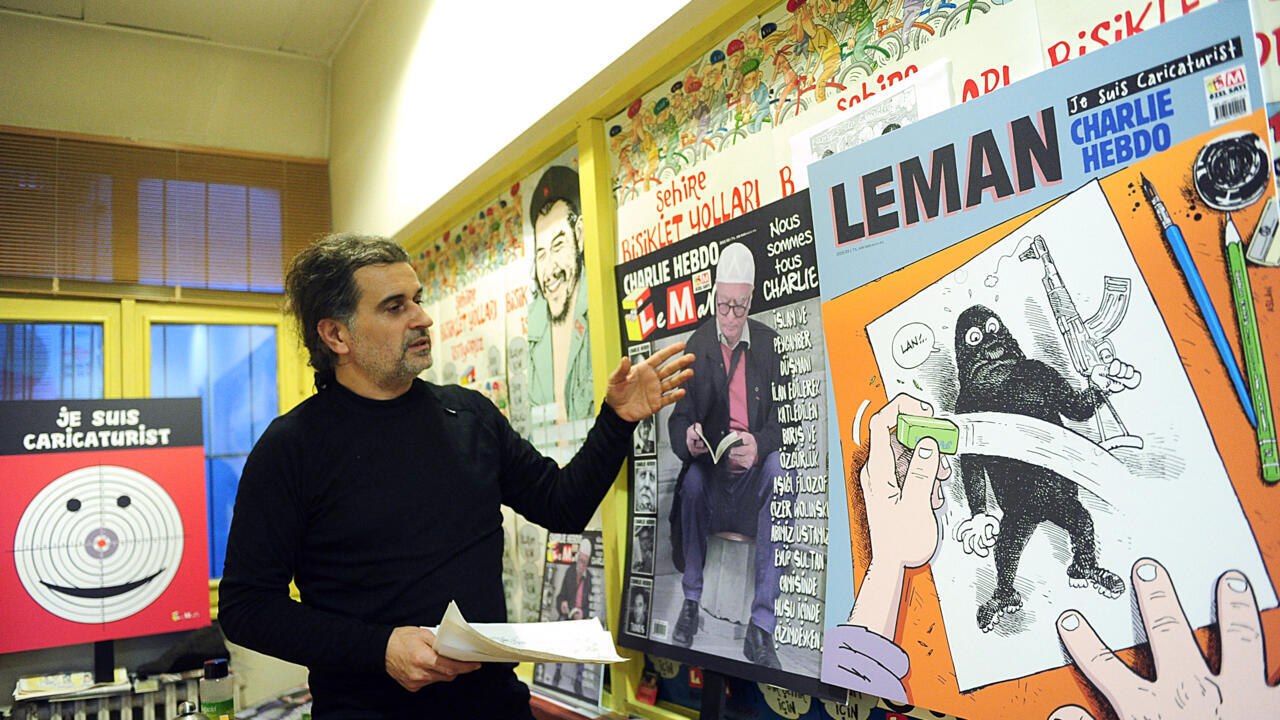
File photo: The director of satirical Turkish magazine LeMan stands in his office next to a poster of the French satirical weekly Charlie Hebbo on January 12, 2015, Istanbul, Turkey. © Ozan Kose, AFP


Clashes erupted in Istanbul Monday with police firing rubber bullets and tear gas to break up an angry mob after allegations that a satirical magazine had published a cartoon of the Prophet Mohammed, an AFP correspondent said.

The incident occurred after Istanbul's chief prosecutor ordered the arrest of the editors at "LeMan" magazine on grounds it had published a cartoon which "publicly insulted religious values".

"The chief public prosecutor's office has launched an investigation into the publication of a cartoon in the June 26, 2025 issue of LeMan magazine that publicly insults religious values, and arrest warrants have been issued for those involved," the prosectors office said.

A copy of the black-and-white image posted on social media showed two characters hovering in the skies over a city under bombardment.


"Salam aleikum, I'm Mohammed," says one shaking hands with the other who replies, "Aleikum salam, I'm Musa."

But the magazine's editor-in-chief Tuncay Akgun told AFP by phone from Paris that the image had been misinterpreted and was "not a caricature of Prophet Mohammed".

"In this work, the name of a Muslim who was killed in the bombardments of Israel is fictionalised as Mohammed. More than 200 million people in the Islamic world are named Mohammed," he said, saying it had "nothing to do with Prophet Mohammed".

"We would never take such a risk."

As the news broke, several dozen angry protesters attacked a bar often frequented by LeMan staffers in downtown Istanbul, provoking angry scuffles with police, an AFP correspondent said.

The scuffles quickly degenerated into clashes involving between 250 to 300 people, the correspondent said.

Cartoonist, two others held

In several posts on X, Interior Minister Ali Yerlikaya said police had arrested the cartoonist responsible for "this vile drawing", the magazine's editor-in-chief and its graphic designer.

Police had also taken over the magazine's offices on Istiklal Avenue and arrest warrants had been issued for several other of the magazine's executives, presidential press aide Fahrettin Altin wrote on X.

In a string of posts on X, LeMan defended the cartoon and said it had been deliberately misinterpreted to cause a provocation.

"The cartoonist wanted to portray the righteousness of the oppressed Muslim people by depicting a Muslim killed by Israel, he never intended to belittle religious values," it said.

Akgun said the legal attack on the magazine, a satirical bastion of opposition which was founded in 1991, was "incredibly shocking but not very surprising".

"This is an act of annihilation. Ministers are involved in the whole business, a cartoon is distorted," he said.

"Drawing similarities with Charlie Hebdo is very intentional and very worrying," he said of the French satirical magazine whose offices were stormed by Islamist gunmen in 2015.

The attack, which killed 12 people, occurred after it published caricatures lampooning the Prophet Mohammed.

Read more

'A very systematic provocation'

"There is a game here, as if we were repeating something similar. This is a very systematic provocation and attack," Akgun said.

Justice Minister Yilmaz Tunc an investigation had been opened on grounds of "publicly insulting religious values".

"Disrespect towards our beliefs is never acceptable," he wrote on X.

"No freedom grants the right to make the sacred values of a belief the subject of ugly humour. The caricature or any form of visual representation of our Prophet not only harms our religious values but also damages societal peace."

Istanbul governor Davut Gul also lashed out at "this mentality that seeks to provoke society by attacking our sacred values".

"We will not remain silent in the face of any vile act targeting our nation's faith," he warned.

(FRANCE 24 with AFP)


Turkey lifts Deutsche Welle ban

Turkey lifts Deutsche Welle ban
Germany’s new chancellor, Friedrich Merz (left), joking with Turkey’s president, Recep Tayyip Erdogan, in The Hague. / bne IntelliNews
By bne IntelliNews July 1, 2025

Turkey’s media watchdog RTUK has lifted a ban that was introduced to block Deutsche Welle Turkish back in 2022, the watchdog said on June 27.

In 2019, Turkey introduced a legislation to push foreign news outlets to establish offices in the country.

After Deutsche Welle and Voice of America (VOA) refused to comply with the legislation, both services were blocked in June 2022. They used alternative domains but they had to close Turkey offices.

Dwturkce.com, which was blocked by a court order in 2023, meanwhile, still remains blocked.

The ban on VOA, which is targeted by Donald Trump, also remains in effect.

Christian democrats are back

Between 2021 and May 2025, social democrat party SDP led the ruling coalition in Germany. German social democrats hesitate to pose in good manners with the Erdogan regime on the media albeit the Turkey-Germany partnership continued undeterred during the SDP-led government.

On May 6, Christian democrat CDU’s Friedrich Merz, a former employee of BlackRock (New York/BLK, the dominant asset manager in the world), took over the chancellor post.

German Christian democrats are not shy when it comes to their alliance with the Erdogan regime.

On June 25, Merz and Turkey’s president, Recep Tayyip Erdogan, exhibited their close relationship before cameras in The Hague in the Netherlands on the sidelines of a Nato summit.

Two days after the meeting RTUK lifted the Deutsche Welle ban.

Turkey’s EU accession path ended in the Middle East

In 2002, when Erdogan took over the government in Turkey, then German chancellor Gerard Schroeder, a SDP member, was among the champions of Turkey’s EU accession along with Jacques Chirac in France, Silvio Berlusconi in Italy and Tony Blair in the UK.

The next generation of elites in Europe led by CDU’s Angela Merkel, who held the chancellor post in Germany between 2005 and 2021, blocked Turkey’s membership process while supporting the Erdogan regime’s slide to autocracy.


By 

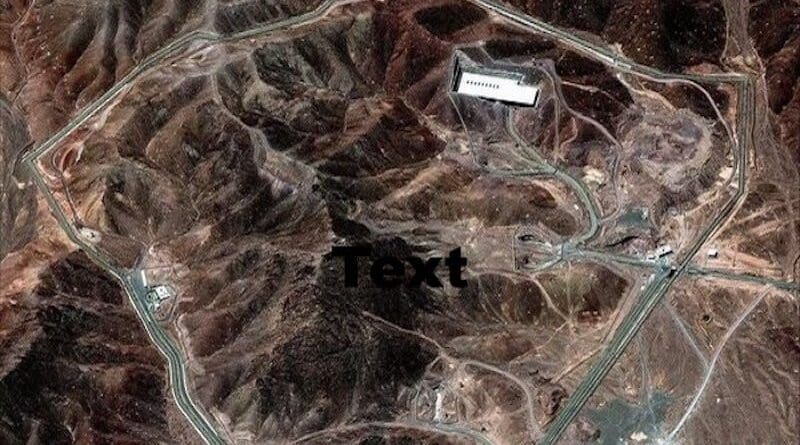
The aftermath of Operation Midnight Hammer, a strike by the US Air Force on three nuclear facilities in Iran authorised by President Donald Trump on June 22, was raucous and triumphant.  But that depended on what company you were keeping.


The mission involved the bombing of the Fordow Fuel Enrichment Plant, the uranium-enrichment facility at Natanz, and the uranium-conversion facility in Isfahan.  The Israeli Air Force had already attacked the last two facilities, sparing Fordow for the singular weaponry available for the USAF.  

The Fordow site was of particular interest, located some eighty to a hundred metres underground and cocooned by protective concrete.  For its purported destruction, B-2 Spirit stealth bombers were used to drop GBU-57 Massive Ordnance Penetrator “bunker buster” bombs.  All in all, approximately 75 precision guided weapons were used in the operation, along with 125 aircraft and a guided missile submarine.

Trump was never going to be anything other than optimistic about the result.  “Monumental Damage was done to all Nuclear sites in Iran, as shown by satellite images,” he blustered.  “Obliteration is an accurate term!”

At the Pentagon press conference following the attack, Defense Secretary Pete Hegseth bubbled with enthusiasm.  “The order we received from our commander in chief was focused, it was powerful, and it was clear.  We devastated the Iranian nuclear program.”  The US Chairman of the Joint Chiefs of Staff Air Force Gen. Dan Caine was confident that the facilities had been subjected to severe punishment.  “Initial battle damage assessments indicate that all three sites sustained extremely severe damage and destruction.”  Adding to Caine’s remarks, Hegseth stated that, “The battle damage assessment is ongoing, but our initial assessment, as the Chairman said, is that all of our precision munitions struck where we wanted them to strike and had the desired effect.”

Resort to satellite imagery was always going to take place, and Maxar Technologies willingly supplied the material. “A layer of grey-blue ash caused by the airstrikes [on Fordow] is seen across a large swathe of the area,” the company noted in a statement.  “Additionally, several of the tunnel entrances that lead into the underground facility are blocked with dirt following the airstrikes.”


The director of the Central Intelligence Agency, John Ratcliffe, also added his voice to the merry chorus that the damage had been significant.  “CIA can confirm that a body of credible intelligence indicates Iran’s Nuclear Program has been severely damaged by the recent, targeted airstrikes.”  The assessment included “new intelligence from a historically reliable and accurate source/method that several key Iranian nuclear facilities were destroyed and would have to be rebuilt over the course of years.”

Israeli sources were also quick to stroke Trump’s already outsized ego.  The Israel Atomic Energy Commission opined that the strikes, combined with Israel’s own efforts, had “set back Iran’s ability to develop nuclear weapons by many years.”  IDF Chief of Staff Lt. Gen. Eyal Zamir’s view was that the damage to the nuclear program was sufficient to have “set it back by years, I repeat, years.”

The chief of the increasingly discredited International Atomic Energy Agency, Rafael Grossi, flirted with some initial speculation, but was mindful of necessary caveats.  In a statement to an emergency meeting of the IAEA’s 35-nation Board of Governors, he warned that, “At this time, no one, including the IAEA, is in a position to have fully assessed the underground damage at Fordow.” Cue the speculation: “Given the explosive payload utilised and extreme(ly) vibration-sensitive nature of centrifuges, very significant damage is expected to have occurred.” 

This was a parade begging to be rained on.  CNN and The New York Times supplied it.  Referring to preliminary classified findings in a Defense Intelligence Agency assessment running for five pages, the paper reported that the bombing of the three sites had “set back the country’s nuclear program by only a few months”.  The entrances to two of the facilities had been sealed off by the strikes but were not successful in precipitating a collapse of the underground buildings.  Sceptical expertise murmured through the report:  to destroy the facility at Fordow would require “waves of airstrikes, with days or even weeks of pounding the same spots.”  

Then came the issue of the nuclear material in question, which Iran still retained control over.  The fate of over 400 kg of uranium that had been enriched up to 60% of purity is unclear, as are the number of surviving or hidden centrifuges.  Iran had already informed the IAEA on June 13 that “special measures” would be taken to protect nuclear materials and equipment under IAEA safeguards, a feature provided under the Non-Proliferation Treaty.  Any transfer of nuclear material from a safeguarded facility to another location, however, would have to be declared to the agency, something bound to be increasingly unlikely given the proposed suspension of cooperation with the IAEA by Iran’s parliament.  

After mulling over the attacks over the course of a week, Grossi revisited the matter.  The attacks on the facilities had caused severe though “not total” damage.  “Frankly speaking, one cannot claim that everything has disappeared and there is nothing there.”  Tehran could “in a matter of months” have “a few cascades of centrifuges spinning and producing enriched uranium.”  Iran still had the “industrial and technological” means to recommence the process.

Efforts to question the effacing thoroughness of Operation Midnight Hammer did not sit well with the Trump administration.  White House spokeswoman Karoline Leavitt worked herself into a state on any cautionary reporting, treating it as a libellous blemish.  “The leaking of this alleged report is a clear attempt to demean President Trump and discredit the brave fighter pilots who conducted a perfectly executed mission to obliterate Iran’s nuclear program,” she fumed in a statement.  “Everyone knows what happens when you drop 14 30,000-pound bombs perfectly on their targets.”

Hegseth similarly raged against the importance placed on the DIA report.  In a press conference on June 26, he bemoaned the tendency of the press corps to “cheer against Trump so hard, it’s like in your DNA and in your blood”.  The scribblers had to “cheer against the efficacy of these strikes” with “half-truths, spun information, leaked information”.  Trump, for his part, returned to familiar ground, attacking any questioning narrative as “Fake News”.  CNN, he seethed, had some of the dumbest anchors in the business.  With malicious glee, he claimed knowledge of rumours that reporters from both CNN and The New York Times were going to be sacked for making up those “FAKE stories on the Iran Nuclear sites because they got it so wrong.”  

A postmodern nonsense has descended on the damage assessments regarding Iran’s nuclear program, leaving the way clear for over remunerated soothsayers.  But there was nothing postmodern in the incalculable damage done to the law of nations, a body of acknowledged rules rendered brittle and breakable before the rapacious legislators of the jungle.  


Binoy Kampmark

Binoy Kampmark was a Commonwealth Scholar at Selwyn College, Cambridge. He lectures at RMIT University, Melbourne. Email: bkampmark@gmail.com

A perfect storm as Israel’s war on Iran pushes the Taliban towards total collapse

A perfect storm as Israel’s war on Iran pushes the Taliban towards total collapse
Afghans being forced out of Iran due to mass arrests of collaborators with Israel. / CC: DEFA

By bnm Gulf bureau June 30, 2025

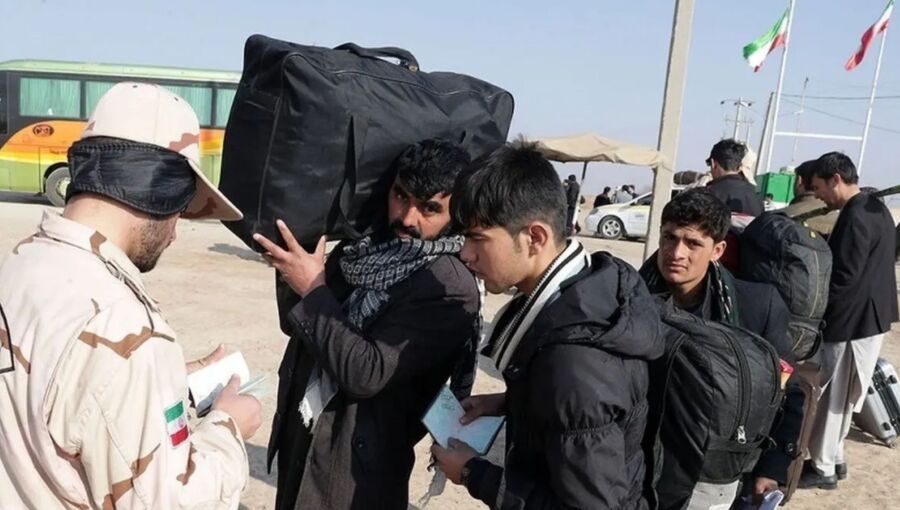
Israel’s military strikes on Iran and now Tehran’s knee-jerk expulsion of Afghan residents have created a catastrophic domino effect that threatens to unravel the Taliban’s fragile governance in Afghanistan, according to the number of people being forced across the border in recent days.

The Islamic Republic, previously reluctantly hosting an estimated 3.8mn displaced Afghans – the largest refugee population globally – has shifted from decades of relative tolerance to aggressive deportation policies in a matter of weeks. This accelerated reversal stems partly from Israel’s June 2025 strikes, which exacerbated Iran’s economic strain and fuelled the scapegoating of Afghans.

Following the Israeli strikes across Iran, Tehran is now enforcing draconian residency rules on the millions of Afghans residing in the country. Census documents granting minimal protection to 2mn Afghans were revoked in early 2025, and services like healthcare, education and property transactions are denied to undocumented migrants. The Interior Ministry explicitly ordered that only six narrow categories of Afghans may remain – primarily those with formal employment ties or political status – while all others "must leave the country."

Iran’s crackdown has triggered a humanitarian tsunami. So far, 88,000 Afghans were deported in a single week in June 2025, with border crossings such as Islam Qala processing 10,000 returnees daily. This is a prelude to the looming expulsion of up to 4mn undocumented Afghans by July 6, dwarfing the 1.3mn already deported from Pakistan. Returnees arrive destitute; Iranian authorities confiscate their savings and belongings during deportation, while Taliban officials lack even basic reception infrastructure.

The economic toll on Afghanistan – already reeling from a 30% GDP contraction since 2021 – is unsustainable. The regime cannot feed its current population, let alone absorb millions of penniless returnees. Compounding this, Iran’s abrupt termination of education for Afghan children with census documents has barred over 610,000 students from schools, including girls who fled the Taliban’s own education bans. This deliberate severing of lifelines deepens despair among families who migrated specifically for schooling or safety.

The Taliban’s legitimacy, already eroded by international isolation and internal fragmentation, faces three existential pressures from this crisis. First, the demographic deluge overwhelms its skeletal governance. With no capacity to provide food, water or shelter at border crossings, scenes of starvation and disease will shatter the regime’s religious pretensions. Secondly, security fractures as former soldiers, police and officials – targeted by the Taliban in 2021 – are forcibly returned. These groups form a natural recruitment pool for armed resistance movements like the Afghanistan Freedom Front, which warns of "chaos and instability." Thirdly, Iran’s charge that Afghans collaborated with Israel during the strikes has subjected returnees to Taliban suspicion, turning them into internal enemies.

Israel’s role in this chain reaction cannot be understated. The strikes on Iran’s nuclear and military infrastructure from June 12-24, 2025, inflicted tens of billions in damages, deepening Tehran’s economic crisis. The Islamic Republic responded by turning on the Afghan population following the sheer number of arrests of Afghans during the 12-day war with Israel. Within days of the ceasefire, Prosecutor General Mohammad Movahedi Azad explicitly linked deportations to alleged Afghan "collaboration with Israel," following reports of Israel paying Afghans a few thousand dollars each to take part in the assault, Iran claims.

The Taliban now confronts an impossible equation: Iran’s expulsions – propelled by Israeli-inflicted wounds – will flood Afghanistan with 2-4mn traumatised citizens while the regime lacks resources to support 10% of that number. Many of those returning were not even born in Afghanistan and have resided in Iran for at least two generations, when the Taliban controlled Kabul before the US invasion of the country in 2001. 

As families starve in border camps and former officials potentially regroup for insurgency, the Taliban’s coercive control will disintegrate. The International Organisation for Migration’s warnings of "coercive regimes of forced returns" underscore a regional race to the bottom, with Pakistan, Turkey and Tajikistan accelerating deportations. Afghanistan’s implosion, once unthinkable, now appears inevitable within months – a grim testament to how Israel’s beef with Iran is now a ticking time bomb for the entirety of west, south and central Asia. Where the dominoes fall is anyone’s guess, but the unrecognised government in Kabul, still requesting its funds to be unfrozen, now faces the biggest challege of its short tenure.

Afghanistan: Surging Returns From Iran Overwhelm Fragile Support Systems, UN Agencies Warn

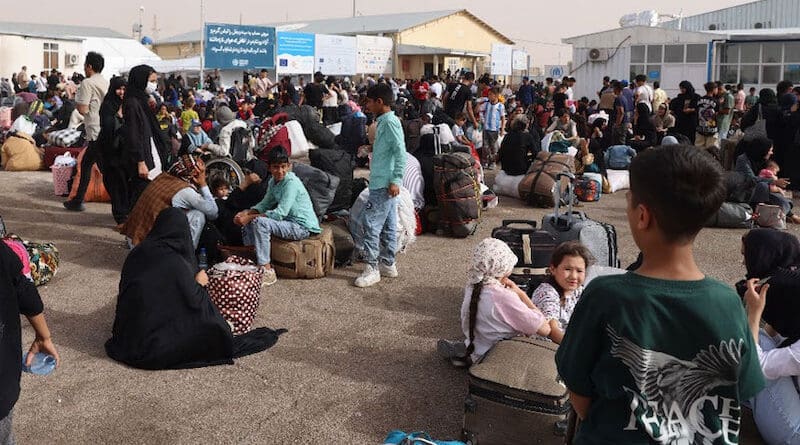
Afghans who have been deported from Iran gather at the Islam Qala border crossing in western Afghanistan. Photo Credit: UNHCR/Faramarz Barzin


By 

More than 700,000 Afghan migrants have returned from Iran so far this year, including 256,000 in June alone, the UN International Organization for Migration (IOM) reported on Monday, warning of immense pressures on Afghanistan’s overstretched support systems.   


Ninety-nine per cent of the returnees were undocumented, and 70 per cent were forcibly returned, with a steep rise in families being deported – a shift from earlier months, when most returnees were single young men, according to the UN agency.

The rise follows a March decision by the Iranian Government requiring all undocumented Afghans to leave the country.

Conditions deteriorated further after the recent 12-day conflict between Iran and Israel, which caused the daily refugees crossings to skyrocket from about 5,000 to nearly 30,000, according to Arafat Jamal, the UN refugee agency (UNHCR) representative in Afghanistan.

“They are coming in buses and sometimes five buses arrive at one time with families and others and the people are let out of the bus and they are simply bewildered, disoriented, and tired and hungry as well,” he told UN News, describing the scene at a border crossing.

“This has been exacerbated by the war, but I must say it has been part of an underlying trend that we have seen of returns from Iran, some of which are voluntary, but a large portion were also deportations.” 


Strain on aid efforts

Afghanistan, already grappling with economic collapse and chronic humanitarian crisis, is unprepared to absorb such large-scale returns.

The 2025 Humanitarian Needs and Response Plan calls for $2.42 billion in funding, but only 22.2 per cent has been secured to date.

“The scale of returns is deeply alarming and demands a stronger and more immediate international response,” said IOM Director General Amy Pope, “Afghanistan cannot manage this alone.”

Meanwhile, UNHCR alongside partners is working to address the urgent needs of those arriving – food, water, shelter, protection. However its programmes are also under severe strain due to limited funding. 

The agency had to drastically reduce its cash assistance to returnee families at the border from $2,000 per family to just $156.

“We are not able to help enough women, and we are also hurting local communities,” added Mr. Jamal.

Some relief, but not enough

In response to growing crisis, the UN Central Emergency Response Fund (CERF) has allocated $1.7 million to the World Food Programme (WFP) to support drought-affected families in Faryab Province.

The funds will provide cash assistance to some 8,000 families in the region, where over a third of the rural population is already facing crisis or emergency levels of acute food insecurity.

“Acting ahead of predicted hazards to prevent or reduce humanitarian impacts on communities is more important than ever,” said Isabelle Moussard Carlsen, Head of OCHA Afghanistan, adding “when humanitarian action globally and in Afghanistan is underfunded…we must make the most of every dollar.”