Wednesday, July 02, 2025


Trump Flip-Flops On Iran, Again: Why? – OpEd

US President Donald Trump. Photo Credit: POTUS, X

By 

The US President Donald Trump’s latest Truth Social post on Iran nuclear issue reads as follows: “Tell phony Democrat Senator Chris Coons that I am not offering Iran ANYTHING, unlike Obama, who paid them $Billions under the stupid “road to a Nuclear Weapon JCPOA (which would now be expired!), nor am I even talking to them since we totally OBLITERATED their Nuclear Facilities.” 


Trump’s post suggests that the Iran question threatens to move to the centre court of American party politics. Trump is upset by Senator Coon’s criticism, who is a senior lawmaker in the Senate from Delaware (Joe Biden’s ‘eyes and years’, as New York Times once put it) for the past 15 years. 

Interestingly, Senator Coon is an ordained elder with West Presbyterian Church, who continues to preach regularly at houses of worship across Delaware and, importantly, is committed to bipartisan engagement in politics aiming to bring Americans of all backgrounds, faiths, and political parties together through a celebration of spirituality and prayer. Coon has an evangelical base, regularly participates in the weekly Senate Prayer Breakfast, and is one opposition politician who can attract a hefty breakaway wing of MAGA movement if it were to splinter over Trump’s abandonment of campaign pledge on farewell to arms. 

Coon has trenchantly criticised Trump’s handling of the Iran question. In doing so, he aligned with four other senior Democratic senators — Senate Minority Leader Chuck Schumer (D-N.Y.), Senate Appropriations Ranking Member Patty Murray (D-Wash.), Senate Armed Services Ranking Member Jack Reed (D-R.I.), and Senate Intelligence Committee Vice Chairman Mark Warner (D-Va.) 

They have issued a statement on the Iran question on June 18 which argued that: 1. The eruption of Israel-Iran conflict represented “a dangerous escalation that risks igniting a broader regional war” 2.  Trump should “prioritise diplomacy and pursue a binding agreement that can prevent a nuclear-armed Iran. 3. Trump should not expand US engagement in the war, given the “lack of preparation, strategy, and clearly defined objectives, and the enormous risk to Americans and civilians in the region.” 4. Trump administration is yet to provide answers to fundamental questions, such as 

  • Intelligence Community’s current assessment of Iran’s nuclear program, its leaders’ intent, and its capabilities; 
  • the objective of US military intervention in Iran, especially Trump’s call for “UNCONDITIONAL SURRENDER” by Iran; 
  • the estimated scope and duration of any US military campaign;
  • the risk to US forces across its bases in the region; 
  • evacuation plans for US citizens; and, most important, 
  • the constitutional or statutory authority that would underpin the military intervention. 

On the last point, in a stinging rebuke, the five senators reminded  Trump that “Congress is an equal partner in preserving and defending US national security around the world, and Congress has not provided authorisation for military action against Iran… The United States cannot sleepwalk into a third war in as many decades. Congress has a critical role to play in this moment.”

Trump is unused to checks and balances. What made Trump particularly furious would be that Sen. Coon also happens to be a member of the Senate Foreign Relations committee and a staunch supporter of Israel and a guest speaker at AIPAC events. 

Coon is an interesting politician who can take bold positions. Last year, for example, he opposed a resolution proposed by Senator Bernie Sanders that would have applied human rights norms to US assistance for Israel, while on the other hand, urging the Biden administration to recognise a “non-militarised” Palestinian state after the end of the Gaza war! 

The bottom line is that a groundswell of opinion is building up in the US, reminiscent of the undercurrents after President Kennedy’s assassination that eventually swept America as Lyndon Johnson accelerated the Vietnam War, ultimately turning it into a tsunami that forced him to retire from politics. 

In reality, Trump’s options are limited. He is insisting that the air strikes of June 22 “obliterated” Iran’s nuclear sites. That is to say, the Iranian bomb is no longer a compelling reality.  

On the other hand, Israel is mighty upset that Iran has given it such a battering that its economy is in shambles and it cannot hope to take on Iran directly. It expects the US to do the heavy lifting, which, to my mind — and, perhaps, special envoy Steve Witkoff’s mind too— Trump is loathe to do. (More about Witkoff later.)

If Trump embarks on the war path regardless, he needs a mandate from the UN Security Council and the US Congress. But neither is likely forthcoming. That aside, if Iran inflicts serious damage to the US interests in a military confrontation, it can potentially become a hot button issue in the mid-term elections next year that could mean an ignominious end to MAGA movement and Trump’s legacy. 

What is the alternative? I would go back to Trump’s default position and do ground work to negotiate the so-called Comprehensive Peace Agreement, which Witkoff had promised as recently as last week in a CNBC interview. 

Trump should have known that Iran’s political rhetoric at the level of the Supreme Leader is mostly meant for the domestic audience of observant Muslims. Any Iran expert at the Quincy Institute for Responsible Statecraft could have compiled a list of past instances in such volatile moments in the US-Iran standoff during the past 47 years and someone in the White House could have prepare a bulky document and got Trump to glance through it.

The problem with the White House all along has been that it eats out of Israeli hands — with a new exceptions such as Barack Obama. But that habit is no longer viable, since a point has come when the US and Israeli interests no longer converge.

Simply put, Trump had no conceivable reason to name calling Grand Ayatollah Ali Khamenei on the eve of the funeral ceremony for top military commanders and nuclear scientists martyred during Israel’s 12-day war against Iran, which he could not even attend due to security considerations.

What would Trump have done in a similar situation at the Cathedral Church of Saint Peter and Saint Paul in the City and Episcopal Diocese of Washington if body bags were to arrive from Middle East? A Fox News interview? A post on Truth Special?

Life moves on. Trump should return to a priori history and let Witkoff negotiate the agreement that he promised. Let things cool down meanwhile  through the multiple back channels that are available.


M.K. Bhadrakumar

M.K. Bhadrakumar is a former Indian diplomat.


Russia’s FSB Increasingly Playing Ever More Roles Similar To Soviet Union’s KGB – Analysis

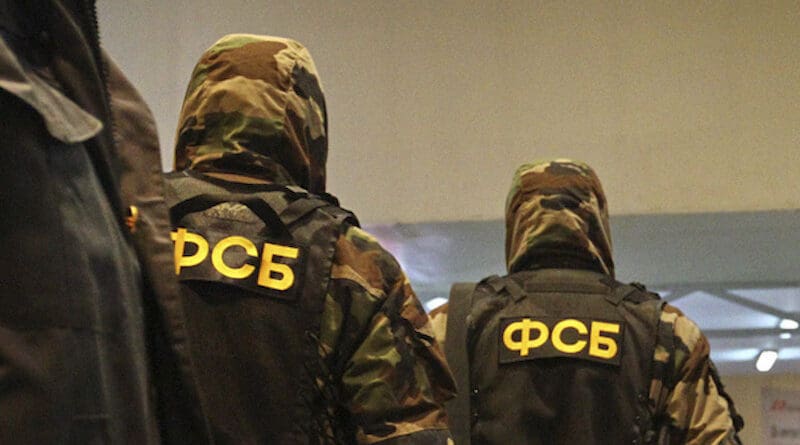
Members of Russia's Federal Security Service (FSB). Photo Credit: RIA Novosti archive, Andrey Stenin, Wikipedia Commons


By 

Russian President Vladimir Putin has moved to reimpose totalitarianism on Russia. The Federal Security Service (FSB) is increasingly playing the roles its Soviet predecessors did in the suppression of Russian society.


Last week, Andrey Soldatov and Irina Borogan, two of the most distinguished investigators of the Russian security services, published an article gaining traction in Russian independent media in which they argued that “Russia’s FSB is working to build a new Gulag” (CEPA, June 23; Agentura.ru, June 24; The Moscow Times, June 25). Because many associate the Gulag more closely with Soviet leader Joseph Stalin than any other institution, their warning is attracting attention in Russia and abroad, far more than the series of steps the FSB has already taken, which have put in place much of the rest of Stalin’s system.

These other moves are already having a significant impact on Russian society at home and Moscow’s behavior abroad. Perhaps even more seriously, however, this restored security behemoth, given the FSB’s ideological flexibility and technical sophistication, shows every sign of being even more dangerous than the Soviet security agencies from which Putin himself sprung, both now and in the future.

In their report, Soldatov and Borogan note that the Duma is set to pass three bills this month that will effectively revive the Gulag. One will allow the FSB to set up its own pretrial detention centers, something Moscow promised in the 1990s never to allow. A second directive instructs the Russian Federal Penitentiary Service (FSIN) to schedule “special carriages” that can be attached to regular trains to transport prisoners to the camps. A third gives the FSB “the power to investigate and punish in-house those who cause trouble within detention facilities”(CEPA, June 23;Agentura.ru, June 24; The Moscow Times, June 25). These steps, most of which formalize and extend powers that the FSB had previously arrogated to itself behind the scenes, are making the Russian security service again a law unto itself, with its own agenda that it presses its nominal master in the Kremlin to follow.

The restoration of the Gulag certainly marks an important turning point. It suggests that Moscow is planning for a major expansion in the number of Russians behind bars if not now, then when Russian President Vladimir Putin’s war against Ukraine ends. Both Soldatov and Borogan, along with other investigators, have, however, documented how the FSB has been reclaiming a variety of functions that the Committee for State Security (KGB) and earlier Soviet security agencies had previously played, in ways that merit close attention.

First, the FSB has promoted the idea that Western governments destroyed the Soviet Union rather than its collapse being the result of Moscow’s mistakes. This is a self-serving position that feeds the paranoia and policies of the Kremlin. At the same time, it has been granted more power to control the history of its own predecessors than perhaps any other Russian institution (Sakharov Review, July 25, 2024).


Second, the FSB has taken the lead in penetrating and controlling both traditional and new electronic media in the Russian Federation, using highly sophisticated means, and suborning and/or arresting those who express views different than the ones the Kremlin prefers. It has penetrated all opposition parties and religious groups (Verstka, August 22, 2022; Vazhniye Istorii, June 10).  

Third, the FSB is pushing for a new law, one that the Russian Education Ministry has cleared, that will give it the power to approve or disapprove any plans by Russian scholars to cooperate with their colleagues abroad. This step may presage efforts by the FSB to regain the power Soviet security services had to determine which Russians can travel abroad and which cannot, despite the popularity of among Russians of their constitutional right to make their own decisions in this context (Ekho Rossii, Mach 22, 2022; Vedomosti, February 3).

Fourth, the FSB has been behind the rebirth of punitive psychiatry in Russia, an echo of the horrific practices of the Soviet past (Radio Svoboda, October 16, 2022; see EDM, January 30).

Fifth, the FSB has become the most active player in Moscow’s nationality policy, controlling both the number of nations in Russia and who can or cannot be a member of each (Window on Eurasia, June 26). It has penetrated or closed ethnic organizations, and it has designated 172 of them “terrorist” groups and moved to close them (Mediazona, January 10; Govorit Nemoskva, January 11; Cherta, January 23).

Sixth, the FSB has promoted the use of prison labor to reduce both Russia’s dependence on migrants and the costs of developing and maintaining its own empire within the empire (Radio Svoboda, June 23, 2021).

Seventh, the FSB has expanded its activities abroad to penetrate and even take control of Russian émigré groups with operations that resemble those the Cheka and other Soviet security agencies did in the past (Government of Independent Tatarstan; Anti-imperial Block of Nations, March 25, 2024; Idel.Realii, December 9, 2024).

Eighth, since the start of the war against Ukraine, the FSB has taken the lead in pursuing deserters and monitoring the military, which the Kremlin has long feared might be used against it (Mediazona; Govorit Nemoskva, February 29, 2024; Sakharov Review, July 25, 2024).

Ninth, the FSB has behaved far more brutally toward prisoners under its direct control than have other Russian penal institutions. This pattern suggests that if it gains greater control over the prison population, an ever-greater number of Russians will suffer (Vertska, June 29, 2023).

This list could be expanded almost at will. Lying behind all of these developments, however, are two characteristics that set the FSB apart from its Soviet predecessors and make it even more dangerous now and in the future, according to Aleksandr Skobov, one the last surviving Soviet-era dissidents who is now behind bars for his penetrating criticism of the FSB (Kholod, May 16, 2023; Window on Eurasia, April 6, 2024). He argues that the FSB is especially dangerous because it is not limited by ideology as the KGB was and because its officers are animated by a desire to repress rather than to use repression to achieve any larger goal. Skobov also states that, having survived the demise of the Soviet Union and even flourished in the new Russia, the officers of the FSB are confident that they will be able to do the same in the future (Kholod, May 16, 2023). 

Today, Russian analysts are exploring what this will mean for Russia after Putin. None think the FSB will support liberalization, and most say its officers will support the continuation of an authoritarian, repressive, and aggressive Russia (Window on Eurasia, August 26, 2023). Such predictions seem likely, but Dmitry Khmelnitsky, a Russian investigator with the FSB, argues that its officers may surprise everyone not by becoming liberals, but by playing a role similar to that of the Communist Party of the Soviet Union (CPSU) apparatus did in 1991. Some may stay with Moscow, while others may decide that their best course is to move in and dominate any regions or republics that achieve independence (Cyprus Daily News, August 2, 2023). Given the FSB’s desire to repress and its lack of ideological scruples, that possibility is also real. It could mean that the growth in the power of the FSB now may not help keep Russia together as Putin expects, but rather lead to its demise in what would likely be a far more violent way than the dissolution of the Soviet Union in 1991. 


Dalai Lama’s Expected Announcement Might Impede Chinese Control Of His Succession

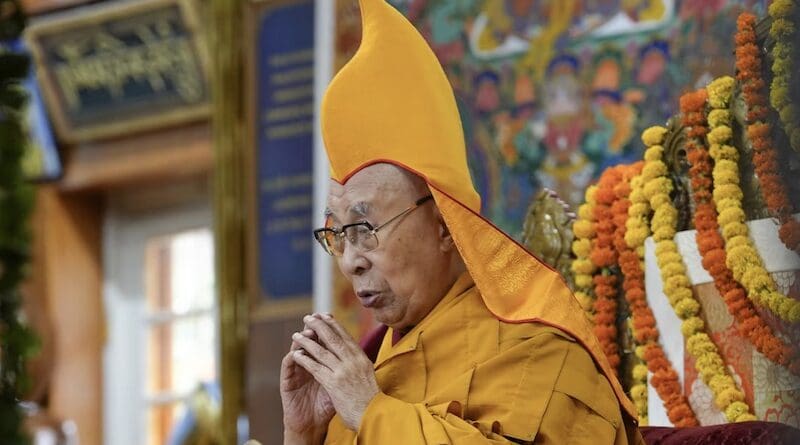
The Dalai Lama attends a Long Life Prayer Offering to him by the Tibetan community at the Main Tibetan Temple in Dharamsala, India, June 4, 2025. (Tenzin Woser/RFA Tibetan)


By 

By Tenzin Pema


As the Dalai Lama approaches his 90th birthday on July 6, the world awaits the Tibetan spiritual leader’s decision on whether there will be a next Dalai Lama – an announcement the head of Tibetan Buddhism promised to unveil when he is 90 in what may serve as a definitive move to thwart the Chinese government’s efforts to exert control over his succession. 

The announcement is set to be the most consequential in modern Tibetan history, one that will shape the future of Tibetans’ seven-decade-long struggle to preserve their religious and cultural freedoms in the face of Chinese oppression and the continuation of the 14th Dalai Lama’s legacy as a global icon of compassion, peace, democracy and human dignity. 

At a conference of Tibetan religious leaders scheduled for July 2-4 in Dharamsala, just days before his 90th birthday, the global Buddhist leader is expected to announce if the institution of the Dalai Lama will continue and confirm whether formal responsibility for the recognition of the 15th Dalai Lama should rest with the Gaden Phodrang Trust, his private office. 

In 2011, at the conclusion of a similar convention of the heads of all Tibetan religious traditions, the Dalai Lama issued a formal statement saying that when he turns 90, he would consult with Tibetan religious leaders and the public on whether there should be a next Dalai Lama. 

“If it is decided that the reincarnation of the Dalai Lama should continue and there is a need for the Fifteenth Dalai Lama to be recognized, responsibility for doing so will primarily rest on the concerned officers of the Dalai Lama’s Gaden Phodrang Trust (the Office of the Dalai Lama),” the Buddhist leader said in his Sep. 24, 2011, statement


“They should consult the various heads of the Tibetan Buddhist traditions and the reliable oath-bound Dharma Protectors who are linked inseparably to the lineage of the Dalai Lamas… and carry out the procedures of search and recognition in accordance with past tradition. I shall leave clear written instructions about this,” he added.

At the time, the Dalai Lama also made clear that “…apart from a reincarnation recognized through such legitimate methods, no recognition or acceptance should be given to a candidate chosen for political ends by anyone, including those in the People’s Republic of China.”

If China does intervene, it wouldn’t be the first time. On May 17, 1995, the Chinese government abducted a then-6-year-old boy named Gedhun Choekyi Nyima, just days after he was officially recognized by the Dalai Lama as the 11th Panchen Lama, the second-highest spiritual leader in the largest sect of Tibetan Buddhism.

Rights groups say his continued disappearance and China’s installation of another boy, Gyaltsen (in Chinese, Gyaincain) Norbu, in his place, highlights the Chinese government’s long-held plan to control the recognition of the next Dalai Lama, given the two lamas have historically recognized the other’s successive reincarnations and served as the other’s teacher.

The Chinese government, for its part, believes it can appoint the reincarnation of the 14th Dalai Lama under Chinese law. 

“The reincarnation of Living Buddhas is unique to Tibetan Buddhism. It must comply with Chinese laws and regulations as well as religious rituals and historical conventions, and follow the process that consists of search and identification in China, lot-drawing from a golden urn, and central government approval,” Liu Pengyu, a spokesperson for the Chinese embassy in Washington D.C., told RFA last month.

In 2007, Beijing decreed that the Chinese government would begin overseeing the recognition of all reincarnate Tibetan lamas, or “living Buddhas,” including the next incarnation of the Dalai Lama. China plans to use its own Beijing-appointed Panchen Lama to endorse their choice – a move the Dalai Lama has said contradicts the Chinese Communist Party’s political ideology.

“It is particularly inappropriate for Chinese communists, who explicitly reject even the idea of past and future lives, let alone the concept of reincarnate Tulkus (or Buddhist incarnated beings), to meddle in the system of reincarnation and especially the reincarnations of the Dalai Lamas and Panchen Lamas,” the Dalai Lama said in 2011. 

“Such brazen meddling contradicts their own political ideology and reveals their double standards. Should this situation continue in the future, it will be impossible for Tibetans and those who follow the Tibetan Buddhist tradition to acknowledge or accept it,” he added. 

The Dalai Lama’s statement on his reincarnation may, therefore, serve to preempt Beijing’s efforts to interfere in the recognition of the 15th Dalai Lama. 

It is expected to come just days before the U.S. Congress is likely to formally designate July 6 as “A Day of Compassion” through a bipartisan resolutionintroduced by U.S. lawmakers in the U.S. House of Representatives and the Senate in recognition of the Dalai Lama’s “outstanding contributions to peace, nonviolence, human rights, and religious understanding.”


RFA

Radio Free Asia’s mission is to provide accurate and timely news and information to Asian countries whose governments prohibit access to a free press. Content used with the permission of Radio Free Asia, 2025 M St. NW, Suite 300, Washington DC 20036.


Paramount pays Trump $16 million to settle ‘60 Minutes’ lawsuit

CRAVEN COWARDICE & CAPITULATION
The CBS Television City studio is pictured in Los Angeles. 3 July 2020.
Copyright Chris Pizzello/AP/Invision


By Eleanor Butler
Published on 

The payout comes after Trump sued CBS News for the editing of an interview with then-Vice President Kamala Harris in October.

Paramount will pay $16 million (€13.57mn) to settle a defamation case against US President Donald Trump, the company said in a statement late on Tuesday.

Minus the legal fees, the money will be paid to Mr. Trump’s future presidential library.

Trump sued for $20 billion (€16.98bn) in damages, claiming that Paramount’s CBS News in November edited a “60 Minutes” news programme with then-vice president Kamala Harris in a way that was deliberately deceptive.

The settlement from Paramount does not include an apology although the show will now release transcripts of future interviews with US presidential candidates after they air.

Harris had responded to a question about the US relationship with Israeli Prime Minister Benjamin Netanyahu. A preview of the interview included one answer, while the full episode featured a different, edited response.

The US’ First Amendment gives publishers wide freedoms to determine how to present information. Despite this, Trump argued in a court filing that the editing of Harris’ response was “doctored to confuse, deceive, and mislead the American People in order to try and interfere in the election”.

Discussions around a settlement prompted the resignation of the “60 Minutes” executive producer, Bill Owens, earlier this year. The CEO of CBS News and Stations and CBS Media Ventures, Wendy McMahon, also stepped down.

“[It has] become clear that I would not be allowed to run the show as I have always run it," said Owens in a note to staff.

The settlement comes ahead of Paramount’s annual shareholders’ meeting on Wednesday.

The firm is at a crucial moment as it seeks to merge with Skydance Media before a 7 July deadline, a sale that requires federal approval. The companies can benefit from an automatic 90-day extension if needed.

Paramount said in a statement that the settlement with Trump was “completely separate from, and unrelated to, the Skydance transaction and the FCC approval process”. 

The settlement of the “60 Minutes” lawsuit marks the second time that Trump has won compensation from a major news organisation since his election.

In December, Disney-owned ABC News paid $15mn (€12.74mn) to settle a defamation case filed by Trump against the network and one of its anchors, George Stephanopoulos.

Trump alleged that Stephanopoulos defamed him when he said during an interview that Trump had been found “liable for rape”.

A jury found Donald Trump liable in a civil case for sexually abusing writer E. Jean Carroll in the mid-1990s and for defaming her by claiming she was lying to promote her book.

Turkish police detain cartoonist over Prophet Muhammad caricature

Copyright Screengrab X

By David Mouriquand & AP
Published on 01/07/2025 


Leman magazine's cartoon, depicting Prophet Muhammad and Prophet Moses exchanging greetings as missiles rain down from the sky, has led to the arrest of the cartoonist and several protests.

Turkish police have detained a cartoonist for Leman magazine over a caricature depicting the Prophet Muhammad greeting Moses in a war zone.

Interior Minister Ali Yerlikaya announced on X that Leman magazine's cartoonist was taken into custody for questioning.

The minister also shared a video of the cartoonist - identified only by his initials DP - being taken into custody on a stairwell, with hands cuffed behind the back. 

“I once again condemn those who are trying to sow discord by drawing a caricature of our Prophet (Muhammad),” wrote Yerlikaya. “The person named DP who made this vile drawing has been caught and detained.”

He added: “I repeat once again: These shameless people will be held accountable before the law.” 

Earlier, the country's justice minister said an investigation was launched into the magazine, citing possible charges of “publicly insulting religious values”. 

The caricature sparked protests outside the Istanbul office of the satirical magazine, with groups of youths, reportedly belonging to an Islamist group, hurling stones at Leman's headquarters.

The cartoon depicting Prophet Muhammad and Prophet Moses exchanging greetings in mid-air as missiles rain down from the sky has been circulating online.

One post reads: “For those who haven't seen or come across it, this is the cartoon. What we call a cartoon is a drawing that depicts a person, event or situation in an exaggerated, often humorous and critical way. I don't think this cartoon is intended to be a mockery or insult.” 

Yilmaz Tunc, the justice minister, said that cartoons or drawings depicting Prophet Muhammad harmed religious sensitivities and social harmony. 

“No freedom grants the right to make the sacred values of a belief a subject of humour in an ugly way,” he wrote. 

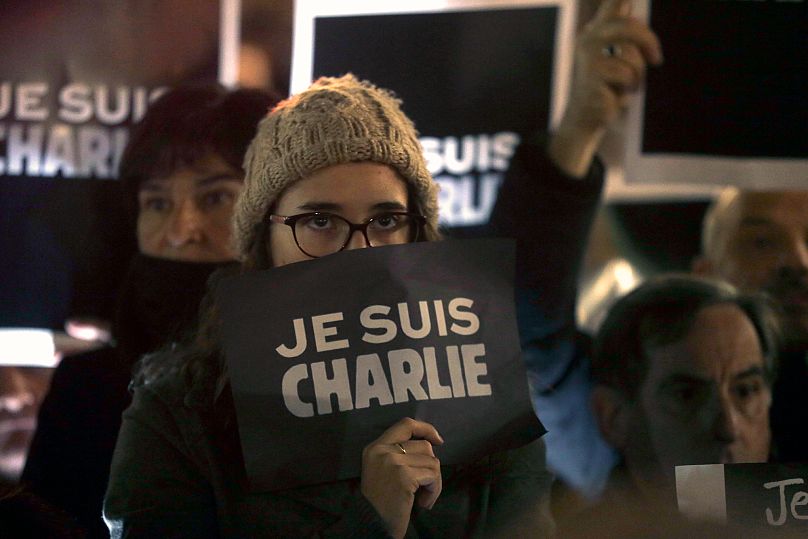
Je Suis Charlie - 7 January 2015
Je Suis Charlie - 7 January 2015AP Photo

The incident evokes memories of the 2015 Charlie Hebdo shootings in Paris, when two armed gunmen stormed the offices of the French satirical magazine known for its provocative cartoons, including depictions of the Prophet Muhammad.  

The attackers killed 12 people, including prominent cartoonists. 

On 7 January, which marked 10 years since the extremist attack that shocked the country and led to fierce debate about freedom of expression and religion, President Emmanuel Macron and Paris Mayor Anne Hidalgo led commemorations by laying wreaths at the site of the weekly's former offices. 

"We have not forgotten them," Macron wrote on social media alongside pictures of the murdered newspaper staff including famed cartoonists Cabu, Charb, Honore, Tignous and Wolinski, who were holding an editorial meeting at the time of the assault. 

Some Sunni Muslims believe in a strict interpretation of Islamic texts, according to which graphic depictions of prophets, but also other people or animals, are completely banned and considered a sin.