Wednesday, July 02, 2025


Fact check: What we know about the link between climate change and heatwaves

The sun shines over the the Eiffel Tower during a heat wave, Monday, June 30, 2025 in Paris
Copyright Christophe Ena/Copyright 2025 The AP. All rights reserved.

By Mared Gwyn Jones
Published on 

As extreme heat lingers across swathes of Europe, Euroverify looks at the evidence linking human-driven climate change with hotter and more persistent heatwaves.

Several European countries are set to see the mercury soar again on Wednesday as high-pressure zones persist across the continent. Experts are warning that sweltering temperatures are becoming the norm.

“Extreme heat is no longer a rare event - it has become the new normal,” UN Secretary General António Guterres said earlier this week. 

The abnormally high temperatures gripping Europe are caused by a heat dome, a phenomenon where high pressure lingers over a large area, trapping hot air.

But the extent to which human-induced global warming — driven by decades of fossil fuel pollution — is exacerbating such episodes of extreme heat has also come under scrutiny.

Scientists warn against directly attributing individual weather events to climate change: these episodes happen regardless. 

But there is a scientific consensus that global warming is making heatwaves more frequent, intense and longer-lasting, with potentially dire consequences for people's health.

Hotter heatwaves here to stay

Researchers at Carbon Brief recently mapped every published scientific study detailing how climate change has influenced extreme weather.

This analysis covered 116 heat-related events in Europe. Of this total, scientists deemed 110 (95%) were made more severe or more likely because of climate change.

June heatwaves are around ten times more likely to occur now compared to pre-industrial times because of the impact of climate change, scientists at World Weather Attribution estimate.

Others say atmospheric events driving heatwaves have almost tripled in strength and duration since the 1950s.

Heatwaves are defined as a prolonged period — usually lasting at least three days — of higher-than-usual temperatures. This means that the threshold temperatures for a heatwave vary between countries and even within borders.

For example, temperatures need to climb to 39°C over a prolonged period in Athens for a heatwave to occur. In Helsinki, just 25°C is required for the criteria to be met.



The thermometer of a drugstore shows the temperature of 39 degrees Celsius (102 degrees Fahrenheit) during a heat wave, in Rome, Tuesday, July 1, 2025. AP Photo

These events happen more frequently because the mean temperature is generally higher due to climate change, making it more likely for the conditions of a heatwave to occur.

Valerio Lucarini, a climate scientist at the University of Leicester, explains that deviations from the expected weather patterns are now also much more “persistent".

“As we have changing dynamics in the atmosphere, we have a higher probability of so-called blocked flows,” Professor Lucarini explains, referring to stationary high-pressure systems that lead to prolonged heat. “These patterns allow for the occurrence of large temperature anomalies, and persistent ones.”

European heatwaves are potentially up to 2.5°C hotter and drier than other similar events in recent years due to human-driven climate change, according to a study led by Professor Lucarini and a group of European academics for ClimaMeter.

“We're seeing a record-breaking continental heatwave at the moment, and it's warmer than it otherwise would have been due to climate change,” Samatha Burgess, Deputy Director of the EU's Copernicus Climate Change Service, told Euronews

"This heatwave is remarkable for three reasons: the intensity of the maximum temperatures forecast over large areas, the geographical extent of the warm anomaly and how early this is in the summer period," she explained.

Burgess added that periods of extreme heat exceptionally early and late in the summertime are becoming more common, prolonging the time of the year when there are risks of severe heat stress.

Europe is particularly vulnerable

Europe is the fastest-warming continent, seeing average temperatures rise at around 0.5°C per decade compared to 0.2°C globally. 

Its proximity to the Arctic, which is by far the fastest-warming part of the planet, contributes to this rapid warming, making it more vulnerable to heat waves.

Of the 30 most severe heatwaves to hit Europe between 1950 and 2023, 23 of them occurred since 2000, according to the World Meteorological Organisation’s (WMO) Europe Regional Climate Centre.

Scientists also believe southern Europe and the Mediterranean are particularly exposed due to their geographical location between the dry subtropics of North Africa and the wetter parts of northern Europe.

A 2020 study concludes that this brings unusually high surface pressure over the Mediterranean Sea, as well as hot and dry air from the Sahara towards Morocco and southwestern Europe. This results in more frequent dry springs and favours summer drought and heatwaves.

Scientists also say the changing behaviour of the jet stream — the rapid currents encircling the planet from west to east — could explain why Europe and North America are increasingly exposed to heatwaves, sometimes happening concurrently.

A phenomenon known as the ‘double jet stream’ — where the current of air splits, leaving hot air lingering over the continent — is largely responsible for the rise in Western Europe’s heatwaves, German researchers said in 2022.

What about ocean heat waves?
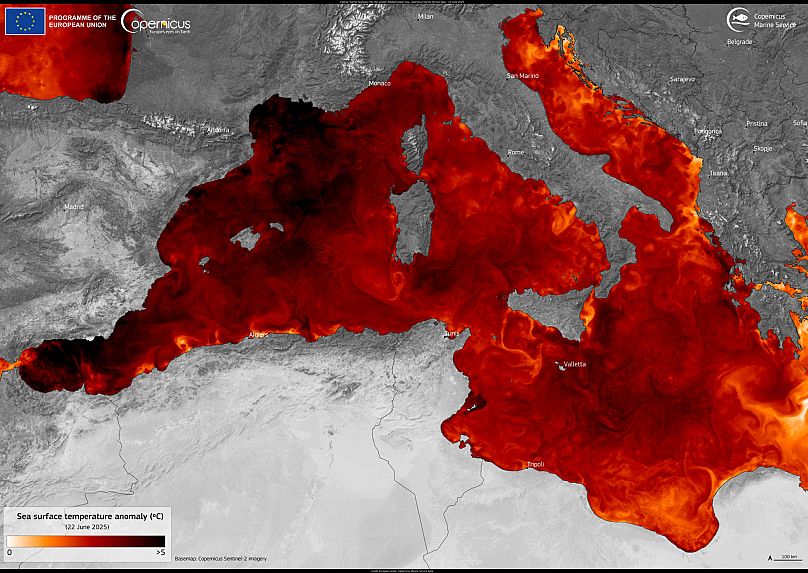


Intense marine heatwave hits the western Mediterranean Sea
Credit: European Union, Copernicus Sentinel-2 imagery

Land areas in Europe are warming up faster than the ocean, but the Mediterranean is currently seeing record-breaking sea surface temperatures, including for June.

“When seawater is warm, it evaporates more and heats the atmosphere above it. And with that evaporation, it generates more potential energy for storms. So there's this feedback between the atmosphere and the ocean,” Samantha Burgess explained.

Professor Lucarini pointed out that the current heatwave has coincided with a period of abnormally high temperatures — 4 to 5°C higher than average — in parts of the Mediterranean.

“We are seeing huge sea surface temperature anomalies all across the Western Mediterranean Sea and the East Atlantic,” he explained.

“Take France, it’s surrounded by ultra-hot waters, so obviously, it's much more prone to having long and persistent temperature anomalies on the land, as well as very strong thunderstorms.”

Far-reaching consequences

Cold weather is estimated to cause as many as ten times more deaths in Europe than the heat. But shifting climate conditions could drive up heat-related deaths.

A study by the European Commission estimates that, without climate mitigation and adaptation, the death toll from extreme heat in the European Union and the United Kingdom could multiply thirtyfold by the end of this century.

By the same time, heat-related deaths in southern Europe are expected to be 9.3 times more frequent than in northern Europe, compared to six times more frequent now.

Extreme heat can also trigger other extreme weather events, such as subtropical storms, drought and wildfires.

"The hotter the temperature is, the more evaporation we get from soil moisture. And the drier the soil is, the drier the vegetation is above it, which means we've got a much greater risk of fires," Burgess said, adding that this "doesn't necessarily mean we'll get a fire because we still need that ignition source".

This all means Europe needs to be increasingly prepared for hot episodes and their repercussions, both from a health and public safety point of view.

Short-term forecast for global offshore wind downgraded, says industry report

THANKS TO TRUMP

Short-term forecast for global offshore wind downgraded, says industry report
Fundamentals for the global offshore wind power sector look positive in the long term, but an industry report has downgraded its forecast by 24% in the short term. / US Department of Energy

By bne IntelliNews July 1, 2025

The Global Wind Energy Council (GWEC) has downgraded its short-term forecast by 24% for 2025-2029 compared with its prediction last year.

GWEC Market Intelligence expects more than 350 GW of new offshore wind capacity to be added over the next decade (2025-2034), bringing total offshore wind capacity to 441 GW by the end of 2034.

However, only one-third of this projected new volume will be added in 2025–2029, the first half of the forecast period, said the industry group in its annual offshore wind report.

The last few years have been marked significant economy-wide headwinds, said Feng Zhao, GWEC’s chief research officer. “The sector now faces a perfect storm of macroeconomic factors, geopolitical tensions and industry-specific challenges,” he said.

The series of setbacks includes failed tenders, persistent supply chain challenges, and increasing policy volatility, particularly in the United States where President Donald Trump – with the backing of his administration – appears to be on mission to halt all new wind development.

In addition, delays in expected commissioning dates in APAC are pushing capacity additions further into the forecast period.

Yet most governments and developers remain committed to offshore wind, said GWEC, and the global medium-term outlook remains resolutely optimistic. The sector will see a compound average annual growth rate of 28% until 2029 and 15% up to 2034.

Global offshore wind annual capacity additions are expected to sail past the milestones of 30 GW in 2030 and 50 GW by 2033, forecast the report.

The world’s offshore wind sector installed 8GW of new capacity in 2024, making it the fourth strongest year on record. This pushes the total global offshore capacity to 83 GW – enough to supply electricity to around 73mn homes.

In a year of significant industry activity, 56 GW of fresh capacity was awarded through global government auctions – the highest ever. Another record was set with 48 GW of offshore wind currently under construction worldwide.

While most immediate growth is concentrated in established hubs such as Europe and China, GWEC identifies growing momentum in Latin America and Asia-Pacific. Governments in Vietnam, Australia, Brazil and Colombia are now developing supportive policy frameworks in partnership with industry players, helping to prepare the ground for wider regional expansion.

The report also points to notable policy advances in emerging markets such as Japan, South Korea and the Philippines, indicating a shift there towards regulatory frameworks that support long-term deployment.

“China and Europe will continue to dominate offshore wind growth going forward but their global market share in cumulative installations is expected to drop to 89% in 2029 and 84% in 2034, because of growth in markets outside the two key markets in APAC, North America and Latin America,” said GWEC.  

The GWEC report cautions that the sector is approaching a pivotal juncture. While the case for offshore wind remains robust, the industry faces growing pressure to reform auction models and share risks more effectively between public and private stakeholders, it says.

 Such reforms, it argues, are essential if the sector is to meet its potential in delivering reliable and large-scale clean energy.

“Offshore wind is powering into a new era. The fundamentals of offshore wind remain rock solid, and countries around the world – from Brazil to Australia – are backing offshore wind to deliver clean, secure, home-grown energy at scale,” said Rebecca Williams, deputy CEO of GWEC. “In doing so, they are putting themselves at the leading edge of the next Industrial Revolution, one where growth and prosperity will be built through widespread electrification.”

Acknowledging recent challenges, Williams continued: “Of course, the sector has faced challenges, and in particularly policy instability in the US has had a significant impact, as well as failed auctions in mature markets. But the path forward is clear and achievable – smarter auctions, better policies, and faster delivery.”

She concluded: “With record levels of construction and auctions, 2025 is a pivotal year. This is the moment for industry and governments to come together, knuckle down and deliver the next stage of offshore wind’s growth.”

SAS orders 45 Brazilian Embraer jets worth $4bn in largest fleet deal since 1996

 COMPETITION FOR BOEING & AIRBUS


SAS orders 45 Embraer jets worth $4bn in largest fleet deal since 1996
The Brazilian-made E195-E2 aircraft are powered by Pratt & Whitney's advanced PW1900G GTF engines, delivering 29% better fuel efficiency and 62% noise reduction compared to previous-generation aircraft. / embraer
By bne IntelliNews July 1, 2025

Scandinavian airline SAS plans to buy up to 55 aircraft from Brazilian manufacturer Embraer in a deal worth approximately $4bn, said CEO Anko van der Werff in a press release.

SAS will take delivery of 45 Embraer E195-E2 jets starting in late 2027, with purchase rights for ten more. The aircraft deliveries will extend over approximately four years and will serve routes across Scandinavia and Europe, optimising SAS' operations and enhancing connectivity through more frequencies and better network flexibility.

"This is a defining moment for SAS," said van der Werff, calling it the airline's largest direct manufacturer order since 1996. "The Embraer E195-E2 is a world-class aircraft, combining outstanding performance with excellent fuel efficiency and comfort. This aircraft is key to enabling future growth and improved connectivity across Scandinavia and beyond."

The order comes as the Nordic airline, whose main shareholders are Denmark, Sweden and Air France-KLM group, emerges from restructuring under US Chapter 11 protection, which began in July 2022 and concluded in August 2024. The deal was facilitated by Skyworks Holding and supports SAS' long-term fleet renewal strategy focused on increasing efficiency, reducing emissions, and unlocking growth opportunities from its Copenhagen hub.

The E195-E2 aircraft are powered by Pratt & Whitney's advanced PW1900G GTF engines, delivering 29% better fuel efficiency and 62% noise reduction compared to previous-generation aircraft. The E2 family has been tested with 100% sustainable aviation fuel (SAF) and is being certified for full SAF operation, though current blends of up to 50% SAF are already achievable.

"We are thrilled to deepen our partnership with SAS through this landmark deal," said Arjan Meijer, President and CEO of Embraer Commercial Aviation. "The E195-E2 is a game-changer in terms of efficiency, performance, and passenger comfort, and will play a crucial role in SAS' fleet renewal and expansion strategy."

SAS was recently ranked as the world's most punctual airline, placing first out of 660 airlines globally for on-time performance in April and May 2025, according to Cirium.

The announcement adds to recent gains for Embraer. In June, at the Paris Air Show, Embraer confirmed an order for 60 E175 jets from SkyWest, worth $3.6bn. SkyWest holds purchase rights for 50 more. "The E175 aircraft is the cornerstone of regional aviation in North America," said Meijer. SkyWest already operates 263 E175s.

Separately, Paraguay's president Santiago Peña this week received four of six Super Tucano aircraft from Embraer in a $105mn deal to strengthen border security. "They are part of the air forces of 20 countries, including the United States," said military historian Antonio Sapienza. Peña said the aircraft will help intercept small planes crossing Paraguay to reach Brazil, Argentina and Europe.

Serbia gripped by civil unrest as road blockades continue

Serbia gripped by civil unrest as road blockades continue
/ X
By Tatyana Kekic in Belgrade July 1, 2025

Civil disobedience and student-organised road blockades continued across Serbia on July 1 as anti-government protests entered their third consecutive day, causing widespread disruptions and social tension in several cities.

Thousands of demonstrators, led by student groups, have blocked key roads and intersections nationwide since June 29. The protests were triggered by a confrontation with riot police during a mass rally in Belgrade late on June 28.

Student organisers had previously issued an ultimatum to the government to call early elections, warning of renewed civil disobedience if their demands were not met. With no response from authorities, demonstrations escalated.

The latest unrest coincides with the eight-month anniversary of the fatal canopy collapse in Novi Sad that killed 16 people. Citizens gathered at the site of the collapse on July 1, while activists staged a protest outside the offices of the ruling Serbian Progressive Party (SNS), toppling garbage bins marked “ballot box”.

Protesters are demanding the release of individuals detained during the June 28 Vidovdan demonstration and the calling of early parliamentary elections. Student leaders have called on citizens to suspend work and continue peaceful disobedience until the demands are addressed.

Tensions flared on July 1 in the Belgrade municipality of Zemun when a car attempted to force its way through a blockade. According to video footage, a passenger exited the vehicle, removed metal barriers and toppled bins standing in his way. The car then advanced, hitting a woman, who fell but appeared uninjured and quickly got back on her feet.

While the movement has received support from various segments of society, some residents have grown weary of the disruptions to their everyday life and have voiced frustration over the daily blockades, which have made commuting in temperatures exceeding 30 degrees Celsius increasingly difficu

Poland ends the last of Russian oil imports

Poland ends the last of Russian oil imports
After 60-years of dependency, Poland has cut off the last of its oil imports via the Soviet-era Druzhba pipeline. / bne IntelliNews
By bne IntelliNews July 1, 2025

Poland’s largest energy company, state-owned Orlen, has ended its last contract for Russian crude oil and halted these imports, declaring finally that it has “freed the region from Russian crude oil”.

The oil imports were used to feed one of the company’s refineries in Czech in a relationship that has been working since Soviet times. However, since the war in Ukraine started more than three years ago, Warsaw has actively worked to end its dependence.

The job has been made easier thanks to Poland’s long-standing mistrust of the Kremlin that led to the investment of a gas pipeline link with Norway, the Baltic pipeline, which came online in October 2022, allowing the immediate end of gas imports from Russia. Sourcing crude oil for its refinery was harder, with Norwegian crude arriving in Poland via tankers to the Naftoport terminal in GdaÅ„sk,.

The termination of the last Russian crude imports is part of a wider plan floated by the EU to end gas imports from Russia by 2027, but as bne IntelliNews reported, that will be difficult, as the EU still doesn’t have an adequate alternative to replace Russia’s LNG, which still accounts for some 19% of the European energy mix. Direct oil imports were already ended with the introduction of twin sanctions on crude and oil products at the end of 2022.

“Money from Russian oil will no longer be used against those whom it should not be used against,” Orlen chief executive Ireneusz FÄ…fara said on June 30, as cited by Notes from Poland. “People in Ukraine will not die thanks to money from Russian oil.”

The oil arrived by the traditional Soviet-built Druzhba (“Friendship”) pipeline to Orlen’s Czech refinery in Litvinov under a 12-year contract with Russia’s state oil producer Rosneft, which has now expired.

The pipeline, which delivered crude to landlocked Central European countries including Slovakia and Hungary, had been exempted from the EU’s embargo on Russian oil due to the lack of alternative supplies for several nations in Central Europe. As the Druzhba pipeline supplied these countries for decades during Soviet times, there is no pipeline infrastructure linking the Central European states to the Baltic or North Sea coasts.

Orlen had already ended imports of Russian oil to its refineries in Poland and Lithuania in March 2023. However, its Czech subsidiary, Unipetrol, continued to receive Russian crude under the legacy contract, which even saw the volume of imports increase in 2023.

Orlen’s Ireneusz credited the decision to strong coordination with the Polish government and regional infrastructure partners. “Ending Orlen’s dependence on Russian energy resources was possible primarily thanks to the support of the Polish government and good cooperation with our partners, in particular transmission system operators,” he said. “It is thanks to this that we can import oil and gas from alternative directions.”

Orlen pointed to the expanded capacity of the Transalpine Pipeline (TAL), which now supplies oil from the Italian port of Trieste to the Czech Republic via Austria and Germany, as a key enabler of the transition. The Czech pipeline operator MERO used the EU-granted exemption to upgrade the system, allowing it to replace Russian volumes with seaborne crude.

In April, Czech Prime Minister Petr Fiala hailed the arrival of non-Russian supplies. “After roughly 60 years, our dependence on Russia [for oil] has ended,” Reuters reported him as saying.

Orlen has also reconfigured its Litvinov refinery – until now reliant solely on Russian blends – to process a wider range of crude grades, further enhancing its ability to source oil globally.


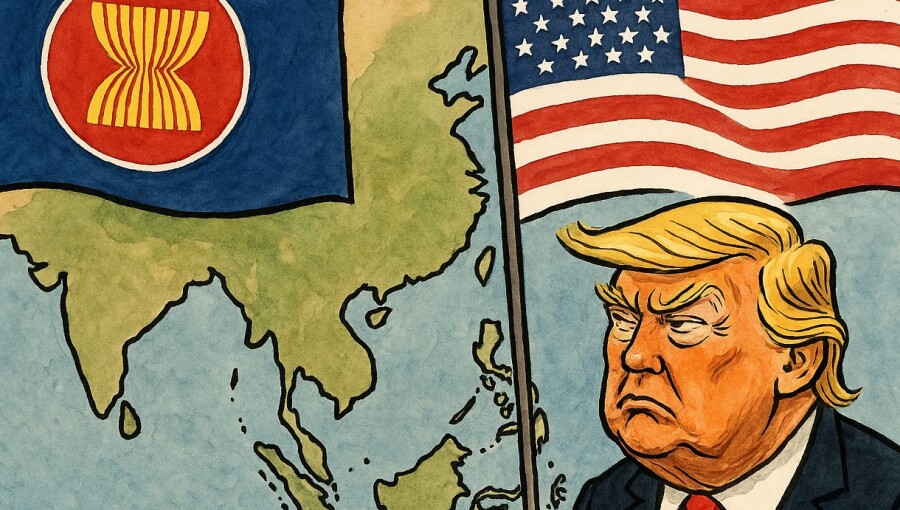
ASIA BLOG: Southeast Asia should pivot away from Trump’s America and steer in the direction of Europe

ASIA BLOG: Southeast Asia should pivot away from Trump’s America and steer in the direction of Europe
/ bno IntelliNews
By bno - Taipei Office July 2, 2025

As the United States stumbles around the global stage in a state of economic bewilderment of sorts, Southeast Asia finds itself at a crossroads. While American influence has long loomed large across the region, from military alliances to soft power and trade, the growing capriciousness of US politics, especially under Trump’s erratic leadership, compels government across the region to consider a recalibration of global partnerships.

Simply put, Southeast Asia in particular and increasingly so the Northeast part of Asia too, must look more closely to Europe for long-term, stable engagement, and not allow business sectors and markets to be buffeted about by the shifting winds of American domestic turmoil.

This is not a concept being considered purely out if US-targetted criticism, but of the version of the US that has emerged through the lens of Trumpism: one that is increasingly transactional, inward-looking, and disturbingly volatile. Trump’s “America First” foreign policy has already proven damaging to multilateralism and international cooperation. His disdain for regional alliances, his threats to withdraw from long-established security pacts, and his willingness to weaponise tariffs at the drop of a hat all point to a man - and a political movement - whose interests rarely extend beyond his own immediate gain.

Following Trump’s January return to the White House, Southeast Asia has often been treated as a mere pawn in his zero-sum geopolitical game. His confrontational approach to China, while superficially aligned with concerns within ASEAN, is neither strategic nor consultative. It is built more on spectacle than substance, more on division than dialogue.

Under Trump, nowhere in Asia is seen as a partner, but as leverage - a buffer zone in his economic and ideological war with Beijing. And this is dangerous terrain.

Asia is not a battlefield for great powers to clash upon – the ‘Great Game’ ended in 1907. Today Asia is a community of diverse nations with our individual but intertwined aspirations, cultures, and trajectories. To rely on an erratic US administration that openly undermines global institutions is to gamble with economic and geopolitical stability.

Europe, on the other hand, offers a more stable and principled alternative – at least on the surface.

Though not without its own challenges, the European Union has demonstrated a consistent commitment to multilateralism, sustainable development, and constructive diplomacy. The EU’s partnerships with ASEAN have grown steadily, from green investment and digital cooperation to human rights and educational exchange. These are not mere words on a press release, but tangible collaborations that align more closely with Southeast Asia’s long-term development goals.

As a continent-wide experiment of unity and solidarity though, Europe has largely failed and that must be borne in mind.

For now though, where Trump sows division, Europe seeks cooperation. Where he threatens to walk away from climate accords and trade agreements, Europe leans in with frameworks like the Green Deal and Digital Decade, encouraging sustainable partnerships that benefit both sides even if its member nations must abide by EU rulings that are not seen as satisfactory by all.

While the US under Trump may reduce its commitment to regional infrastructure or technology transfer unless immediate political gains are assured, the EU offers mechanisms for predictable and long-term growth.

Importantly, Europe respects identity. Unlike the heavy-handedness often associated with American cultural exports and the tendency to ‘Americanise’ wherever influence is felt, Europe engages with partners without diluting their essence. A prime example would be how EU-supported programmes in Southeast Asia embrace local culture, knowledge systems, and languages, working with rather than over what is already in place. Europe does not arrive with a megaphone or a missionary complex.

This is essential. Southeast Asia is not, and should not become, an extension of any other region’s strategic priorities – and in the case of the US, problems.

Southeast Asia is a region of more than 700mn people, with dynamic economies, ancient civilisations, and fast-evolving democracies. Preserving these unique identities is not a side concern, it is foundational to how the region should engage with the world. A pivot to Europe need not come at the cost of sovereignty or cultural richness.

The EU, for all its imperfections regarding integration, demonstrates in many ways how diverse nations can work together without losing their individual character. Southeast Asia’s own ASEAN project has taken steps in that direction, but more can be done. Deeper ties with Europe can offer institutional support, political inspiration, and policy templates, particularly in areas like cross-border regulation and environmental standards.

The region should, however, always remain open to cooperation with Washington regardless of who occupies the White House when such cooperation is mutually respectful and predictable. But Asia must not become overly reliant on a nation where key foreign policy decisions could once again be dictated by the whims of one man viewed as unstable by billions around the word who views the planet as a business deal, or worse, a television show.

Southeast Asia stands at a moment of opportunity. The region can continue to be shaped by the whims of a volatile superpower headed by a man history will not remember fondly, or we can build a future with partners who respect our autonomy and share our aspirations. In choosing the latter, we are not abandoning the US. Instead, we are asserting our agency in engaging with the world on our own terms, proudly Southeast Asian, confidently global, and no longer beholden to the daily chaos of Trumpism.


Azerbaijan arrests eight Russians as diplomatic crisis deepens over Yekaterinburg killings

Azerbaijan arrests eight Russians as diplomatic crisis deepens over Yekaterinburg killings
The crisis between Azerbaijan and Russia was triggered by the killings of two Azerbaijani brothers by the Russian Federal Security Service (FSB) in Yekaterinburg on June 27. / Andrew_Flowers via Pixabay
By Cavid Aga in Sarajevo July 2, 2025

Azerbaijan has arrested eight Russian citizens on drug trafficking and cybercrime charges whilst delivering a formal diplomatic protest over the Yekaterinburg killings, as the ongoing crisis escalates into the most serious confrontation between Baku and Moscow since independence.

The crisis was triggered by the killings of two Azerbaijani brothers by the Russian Federal Security Service (FSB) in Yekaterinburg on June 27. The deaths of Ziyaddin and Husein Safarov prompted a strong diplomatic response from Baku, including the arrests of several journalists. It follows a previous rise in tensions between the two countries over the downing of an Azerbaijani AZAL aeroplane by Russian air defences in December 2024. 

Russian authorities maintain that the Yekaterinburg operation targeted an ethnic criminal organisation active since the late 1990s, though they have not explained why lethal force was necessary for historical cases or addressed torture allegations.

The latest arrests on July 1 targeted alleged members of two organised criminal groups suspected of narcotics transit from Iran, online trafficking of prohibited substances and cybercrime, according to the press release from the Internal Affairs Ministry. Sabail District Court imposed four-month detention orders on all eight suspects following evening hearings. 

In courtroom photographs, several suspects appeared with visible bruises and swollen faces; one had a bloodied head wound. 

At least three of the detainees were confirmed to be Russian refugees who escaped mobilisation in Russia against Ukraine. Journalists from iStories identified three of the suspects as 41-year-old IT entrepreneur Anton Drachev, 30-year-old programmer Dmitry Bezugly from St. Petersburg, and 23-year-old programmer Sergey Sofronov from Cherepovets.

Meanwhile, Azerbaijan's foreign ministry delivered a note verbale of protest to Russia over the "murder and injury of our compatriots in Yekaterinburg" during a meeting where ambassador Rahman Mustafayev was summoned to the Russian foreign ministry.

Formal diplomatic protest

Azerbaijan's protest note expressed "firm protest against the use of torture and degrading treatment by Russian law enforcement agencies during the interrogation of our compatriots," according to foreign ministry spokesman Aykhan Hajizada.

The note stated these actions violated "legal norms of the Russian Federation and internationally recognised fundamental human rights and freedoms”. It demanded that Russia conduct a "thorough and objective investigation of these attacks" and take urgent measures to prosecute perpetrators.

The diplomatic confrontation intensified when Russia protested Azerbaijan's arrest of Sputnik journalists. Hajizada responded that, unlike Russian actions, Azerbaijan's measures were "completely legal" and called for "non-interference in the internal affairs of Azerbaijan”.

"It was stated that the said activities and actions carried out by Russia contradict the bilateral relations between the two countries," the foreign ministry confirmed.

Ukraine offers condolences

Ukrainian President Volodymyr Zelensky telephoned President Ilham Aliyev on July 1 to convey condolences over the Yekaterinburg killings, marking a rare direct Ukrainian involvement in Azerbaijan-Russia tensions.

"President Zelensky conveyed the condolences of the Ukrainian public regarding the killing of Azerbaijanis in raids in the Russian city of Yekaterinburg," the presidential press service confirmed. The leaders agreed to hold an Azerbaijan-Ukraine Intergovernmental Commission meeting in Baku soon.

Ukraine also added the arrested Sputnik journalists Igor Kartavykh and Yevgeny Belousov to its "Mirotvorets" database as "undesirable persons" for alleged war propaganda activities, according to APA.

AZAL evidence emerges

New evidence has emerged regarding the December downing of an AZAL aircraft, as Minval.az published an alleged explanatory note by Russian air defence Captain Dmitry Paladichuk, describing the incident on December 24, 2024.

The document claims Russian forces opened fire on the Embraer E190 passenger aircraft twice by telephone order, despite the target being invisible due to heavy fog. Audio recordings allegedly captured the moment of the "Fire!" command being transmitted.

The Insider confirmed Paladichuk's identity and that he wrote the handwritten report "after shooting at the plane" because he was "required" to do so. The captain reportedly serves in military unit №75564, and his voice matches audio from the incident, according to the outlet.

Diaspora leader detained and released

Azerbaijani diaspora leader Shahin Shikhlinski was arrested near Yekaterinburg's Baku Plaza shopping centre on July 1 but released the same evening as a witness in the historical murder cases that prompted the raid on the Safarov brothers.

His son, Mutvali Shikhlinski, described violent treatment during the arrest, claiming police smashed their car windows without explanation. "I think this is abuse of official authority. At first, I thought it was an attack, I was scared and pulled back," he told APA.

Local media E1.ru reported Shikhlinski's detention related to investigations into the 2001 murder of Yunis Pashayev and the 2011 killing of Ikram Hajiyev — the same cases that prompted the deadly June 27 raids on the Safarov family.

Russian media revealed extensive details about the original crimes. E1.ru reported that Pashayev, an Azerbaijani-origin Yekaterinburg resident, was "stabbed with kitchen knives by a crowd" in May 2001 on Blucher Street near a café.

"The dying Yunis managed to name their names," E1.ru quoted sources saying about the Safarov brothers. The Caspian café, owned by the family, had "scandalous fame" and frequently appeared in criminal news, with multiple attempts to close it failing.

Acquaintances told E1.ru that the brothers "complained of poor health during detention" and were hospitalised. "One of them started having heart problems, and they tried to resuscitate him but failed. The arrival of police may have been too much stress for them," sources stated, aligning with the official Russian autopsy report.

Azerbaijan opens criminal case as autopsy exposes torture

Azerbaijan's prosecutor general has opened a criminal case on charges of torture and deliberate murder of Azerbaijani citizens by Russian law enforcement officials, following forensic evidence contradicting Russian autopsy findings, according to a press release from the prosecutor general.

The criminal case covers multiple charges, including premeditated murder by a group, murder with special cruelty, murder of two or more persons, abuse of office causing grave consequences, and torture resulting in death, according to the prosecutor general's press service.

Independent autopsy results released by Professor Adalat Hasanov, director of the Health Ministry's Forensic Medical Examination and Pathological Anatomy Union, directly contradict Russian findings. "The Azerbaijani forensic opinion does not match the forensic opinion provided by the Russian side," Hasanov confirmed to APA.

The victims showed extensive trauma from blunt force weapons rather than the natural causes claimed by Russian authorities. "Both persons killed in Yekaterinburg were not struck with sharp objects or firearms; they were beaten with blunt objects," Hasanov stated.

Ziyaddin Safarov's Russian death certificate listed heart failure as the cause, but the Azerbaijani examination revealed massive trauma. "Russian doctors showed that his illness was the cause of Ziyaddin Safarov's death. But in our internal examination, the changes we detected were no different from the first brother," Hasanov said.

The autopsy found bilateral skull fractures, multiple rib breaks, chest deformation, internal bleeding and widespread tissue damage. "All ribs were broken on the left front and right rear. There were crude fractures. We couldn't even find one rib; they had taken it," the professor revealed.

Both victims died from "severe post-traumatic shock" caused by multiple injuries, with evidence of systematic beating including facial trauma, broken nasal bones and extensive bruising across their bodies.

Russian senator Andrey Klishas made inflammatory comments about ethnic diasporas following the crisis, according to TASS. "No diasporas can dictate their rules to the Russian state and our citizens. Everyone will live according to Russian laws; those who disagree will continue their lives in FSIN institutions," he wrote on Telegram.


The Role Of Cross-Cultural Communication In Sustainable Development Practices – OpEd

Photo Credit: The High Atlas Foundation

By 

Intercultural communication and overall cultural expansion are growing fields of research for those focused on development studies. Recent literature has highlighted cultural heritage as a strategy for fostering social cohesion and economic development in communities worldwide.


Currently, there is little empirical evidence directly linking tenets of sustainable development to positive societal outcomes. However, intercultural communication is essential for conserving national and regional diversity, integrating vulnerable demographics, and promoting social empowerment that can contribute to conflict reduction and economic improvement. The Budapest Declaration of 2002 echoes a similar sentiment: preserving culture through dialogue and education is integral to future development.

It is important to emphasize the importance of interfaith dialogue within the context of cultural preservation and development. In the context of Moroccan development, interfaith dialogue between Moroccan Muslims and Jewish people has played a crucial role in agricultural

development. Programs that integrate diverse communities through program development are effective in fostering favorable outcomes in cultural and economic progress.

Within Morocco, a long history of intercultural and interfaith reconciliation has created an environment amenable to these efforts today. Land in Morocco has been shared between Muslims, Jews, and other groups for over 2,000 years. Although the presence of Jewish communities in Morocco has declined in modern years, a strong bedrock of communication and trust has facilitated advantageous programs today, such as the House of Life program. Launched in 2012 with the support of King Mohammed VI, the House of Life program has since restored 167 Jewish graveyards, including 12,600 graves across 40 provinces throughout the country.

Moreover, by securing land grants near the cemeteries of the Jewish communities, the High Atlas Foundation plants fruit tree nurseries that benefit Muslim farmers in the production and cultivation of much-needed sustainable agriculture. The program ensures that these sites are maintained, fostering trust between communities that support development goals in economic, social, and cultural sectors.

Similar practices, albeit through different methods, have been adopted in Bali to facilitate social interchange and communication between Hindu and Muslim populations there. In a Muslim-majority Indonesia, Bali is unique in that the island is home to a majority Hindu population. Cross-cultural communication has thus been vital to the sanctity and duration of the community.


In the Cemagi Village of the Menwi District in Bali, the Kramat Ratu Mas Sakti Temple is an extraordinary example of this practice, as the Temple serves as both a destination for Muslim pilgrimages and a site sacred within the Hindu religion. The Temple is a locus of inter-faith dialogue, both through direct communication between religious pilgrims and worshipers, and through the dissemination of secondary media (print and digital) that emphasize these behaviors.

The harmony between Muslim and Hindu practitioners at Kramat Ratu not only preserves the religious and cultural spirit of the Temple, but also lends itself to increasing interest in cultural tourism, spurring the economic gains associated with the tourism industry. Through interactions between Muslim and Hindu individuals in the Temple, the region witnesses an expansion and strengthening of religious and cultural identities through increased dialogue and interchange between the Muslim and Hindu faiths.

Similarly, in Karangasem, Bali, the Muslim population lives alongside the Hindu population, and exchanges between these faiths are often required in communal and societal procedures. The two groups have coexisted peacefully for a long time, with very few recorded conflict incidents. Exemplified by a mosque and a temple standing adjacent in the center of a Hindu community, the Karangasem district is characterized by profound tolerance.

The development of Bali, specifically the Karangasem district, cannot be attributed solely to its Muslim or Hindu population, but rather to the symbiosis between them. Karangasem, renowned for its commitment to sustainability and ecotourism, has been lauded as a destination where tourists can explore the region’s unique cultural identity while upholding sustainable practices. It is impossible to imagine that this commitment to authenticity and sustainability would be possible without the cooperation of a multitude of partnerships, including interfaith collaboration, at the heart of the Karangasem district.

The cases, as mentioned above, focus on cases of successful cross-cultural communication, serving not only as a possible frontier in sustainable development, but also as a societal norm that should be strived towards. As Morocco increasingly becomes interested in embracing its multicultural identity, there are several opportunities where interfaith efforts could be leveraged to support and enhance the goals of each affected party. The previously mentioned House of Life program is an excellent example where both parties mutually benefit, as Moroccan Jewish people ensure their historical land and heritage are protected, and Moroccan Muslims, acting as custodians of this land, have the opportunity to cultivate the land to produce prosperous fruit-tree agriculture.

As the world looks to enact development that is both sustainable and profitable, the value of culture has become an ever-more precious commodity. In an era of globalization, culture and society have become increasingly homogenous, and authenticity has become a resource with marked scarcity, skyrocketing cultural value in the eyes of investors (mainly within the tourism and travel industries).

Efforts to develop interfaith and cross-cultural communication are essential in defending the survival of diverse cultures, which are beneficial for both communities in terms of identity preservation and as a means to facilitate further economic and social development. A crucial caveat is that development should be fostered sustainably and inclusively. While inclusivity is inherent within cross-cultural dialogue, efforts to ensure sustainably must be purposeful in execution. To ensure that targeted communities benefit from development, sustainability and longevity must be key requirements in any purported development efforts.

Nevertheless, cross-cultural and interfaith dialogues have become incredibly important in encouraging inclusivity in development practices and are, therefore, an essential component

when looking to the future of development practices. The participatory approach emphasizes welcoming diverse perspectives in community planning and projects, where communication across diverse stakeholders is imperative to accurately representing communities. Participatory development thus has the opportunity to strengthen relationships between community stakeholders, offering a pathway towards more inclusive and tolerant communities.

Cultural heritage can serve as a “glue” between the different components of development practices, allowing individuals to both identify themselves within development movements and foster a sense of responsibility for the projects that follow. Thus, cross-cultural communication can serve as an essential foundation for development works, implying that a stronger focus should be placed on culture’s relevance in development frameworks and practices.


Amelia Vineyard is a student at the University of Virginia and an Intern at the High Atlas Foundation in Morocco.