Wednesday, July 02, 2025

Thailand’s political chaos: what happens now?

Thailand’s Constitutional Court suspended PM Paetongtarn Shinawatra on Tuesday as it considers a petition filed by 36 senators seeking her removal. The senators have accused the 38-year-old premier of dishonesty and breaching ethical standards in violation of the constitution over a leaked telephone conversation with Cambodia's former premier Hun Sen.


Issued on: 02/07/2025 - 
By: FRANCE 24


Thailand's Prime Minister Paetongtarn Shinawatra speaks during a press conference following her suspension by the country's Constitutional Court at Government House in Bangkok on July 1, 2025. © Lilian Suwanrumpha, AFP

Thai Prime Minister Paetongtarn Shinawatra has been suspended by the Constitutional Court pending a probe into her ethics during a diplomatic spat with Cambodia.

The development comes at the same time as a cabinet reshuffle, setting the scene for a remarkably rapid rotation schedule at the prime minister's office.

Here is what we know about the crisis:

Who's in charge?


Thai analysts say transport minister and deputy prime minister Suriya Jungrungreangkit, from Paetongtarn's own Pheu Thai party, will initially take charge as acting prime minister.

But just hours before Paetongtarn's suspension, Thailand's king approved a cabinet reshuffle after her biggest coalition partner quit the government over the diplomatic row.

Transport minister and deputy prime minister Suriya Jungrungreangkit began his engagements by attending a ceremony in Bangkok celebrating the longevity of the prime minister's office.

Read more'Thailand is an autocracy: The system is loaded against progressive parties'

The event marked the 93rd anniversary of an institution Suriya is set to command for far fewer than 93 hours as Thailand reels from the suspension of Paetongtarn, heiress of the country's dominant political dynasty.

During a brief ceremony open to media Suriya declined to respond to queries asking how he felt about his ephemeral leadership, which caps a decades-long political career.

He said his most urgent business had been to "sign a paper" ensuring a smooth transition to his successor on Thursday.

The new office holders will be sworn in on Thursday, when outgoing defence minister Phumtham Wechayachai will be sworn in as interior minister. He will also resume his previously-held role as deputy prime minister.

He is also expected to step into the role of acting premier, two analysts told AFP, the third person to control the office in three days.

But Paetongtarn's father and the family patriarch Thaksin Shinawatra is said to remain the true driving force of the Pheu Thai party, even as its fortunes fade.


Thailand's former Prime Minister Thaksin Shinawatra, hugs his daughter, the now suspended Prime Minister Paetongtarn Shinawatra before the royal endorsement ceremony appointing Paetongtarn as Thailand's new prime minister at Pheu Thai party headquarters in Bangkok, Thailand, on August 18, 2024. © Sakchai Lalit, AP


What happens next?


The path forward is unclear. There is no set time limit for the Constitutional Court's investigation, but if it finds Paetongtarn has breached ministerial ethics she could be removed from office permanently.

In the cabinet reshuffle Paetongtarn assigned herself the portfolio of culture minister, meaning she may keep a perch in the upper echelons of power.

But her position and her coalition are severely weakened, even though they still command a parliamentary majority which reduces the chance of an imminent election.

Another Thai analyst, Thitinan Pongsudhirak, said Paetongtarn's suspension plunged her into "a prolonged political limbo".

"Thailand will have a rudderless government with policy inertia and murky directions ahead," he told AFP.

"With Pheu Thai's weak grip on power, infighting and squabbling will likely characterise the coalition government."


What caused this?


The court case was brought against the heiress of the powerful Shinawatra dynasty by conservative lawmakers accusing her of breaching a requirement for "evident integrity" during a diplomatic call with Cambodia.

Thailand and Cambodia have long been at loggerheads over a territorial dispute, which intensified into a cross-border clash in May that left one of Phnom Penh's troops dead.

When Paetongtarn called Cambodian ex-leader Hun Sen to discuss the row she called him "uncle" and referred to a Thai military commander as her "opponent", sparking widespread backlash over her rhetoric.

The Constitutional Court said there was "sufficient cause to suspect" Paetongtarn may have breached ministerial ethics in the conversation, a recording of which was leaked in Cambodia.

Paetongtarn said she accepts the court's decision to suspend her. "I will do my best to explain my intention," she told reporters. "It's always been my intention to do the best thing for my country."

The suspended premier – who came into power only last August – assigned herself the culture minister position in the new cabinet before she was suspended, meaning she is set to keep a perch in the upper echelons of power.

She, Suriya and Phumtham are all members of Pheu Thai, which came second in the 2023 election but secured power by forming an unsteady coalition with its former enemies in pro-military parties.

But analysts say Paetongtarn's pause from office represents a dramatic waning of the Shinawatras' influence, even though the acting prime ministers are still considered their loyal lieutenants.

Tuesday also saw the second day of Thaksin's criminal trial for royal defamation, in which he faces a possible 15-year sentence if convicted.

(FRANCE 24 with AFP and Reuters)
Philippines biodiversity hotspot pushes back on mining

Brookes Point (Philippines) (AFP) – A nickel stockpile towers over farmer Moharen Tambiling's rice paddy in the Philippines' Palawan, evidence of a mining boom that locals hope a new moratorium will tame.


Issued on: 02/07/2025 

Locals in the Philippines' Palawan hope a moratorium will stop a nickel mining boom


PHOTO FEATURE    
© Ted ALJIBE / AFP

LONG READ

"They told us before the start of their operations that it wouldn't affect us, but the effects are undeniable now," Tambiling told AFP.

"Pangolins, warthogs, birds are disappearing. Flowers as well."

A biodiversity hotspot, Palawan also holds vast deposits of nickel, needed for everything from stainless steel to electric vehicles.

Once the world's largest exporter of the commodity, the Philippines is now racing to catch up with Indonesia. In 2021, Manila lifted a nine-year ban on mining licences.

Moharen Tambiling (C), his sister Alayma (R) and their mother stand on their farm next to stockpiled nickel ore in Palawan province 

Despite promised jobs and tax revenue, there is growing pushback against the sector in Palawan.

In March, the island's governing council unanimously passed a 50-year moratorium on any new mining permits.

"Flash floods, the siltation of the sea, fisheries, mangrove areas... We are witnesses to the effects of long-term mining," Nieves Rosento, a former local councillor who led the push, told AFP.

Environmental rights lawyer Grizelda Mayo-Anda said the moratorium could stop nearly 70 proposed projects spanning 240,000 hectares.

"You have to protect the old-growth forest, and it's not being done," she said.


'Fearsome' flooding


Mining company Ipilan says increased production will result in greater royalties for Indigenous people and higher tax revenues 

In southern Palawan's Brooke's Point, a Chinese ship at a purpose-built pier waits for ore from the stockpile overlooking Tambiling's farm.

Mining company Ipilan says increased production will result in greater royalties for Indigenous people and higher tax revenues, but that means little to Tambiling's sister Alayma.

The single mother-of-six once made 1,000-5,000 pesos ($18-90) a day selling lobster caught where the pier now sits.

"We were surprised when we saw backhoes digging up the shore," she told AFP, calling a one-time compensation offer of 120,000 pesos ($2,150) insulting.

"The livelihood of all the Indigenous peoples depended on that area."

On the farm, Tambiling stirred rice paddy mud to reveal reddish laterite he says is leaking from the ore heap and poisoning his crops.

Swathes of the Mantalingahan mountains have been deforested, producing floods

Above him, swathes of the Mantalingahan mountains have been deforested, producing floods he describes as "fearsome, deep and fast-moving."

Ipilan has faced protests and legal challenges over its logging, but its operations continue.

Calls to parent company Global Ferronickel Holdings were not returned.

For some in Palawan, the demand for nickel to power EVs has a certain irony.

"You may be able to... eliminate pollution using electric vehicles," said Jeminda Bartolome, an anti-mining advocate.

"But you should also study what happens to the area you are mining."


'First-class municipality'


Workers armed with brooms, goggles, hats and scarves sweep an access road that carries 6,000 tonnes of ore destined for China each day 

In Bataraza, the country's oldest nickel mine is expanding, having secured permission before the moratorium.

Rio Tuba employees armed with brooms, goggles, hats and scarves are barely visible through reddish dust as they sweep an access road that carries 6,000 tonnes of ore destined for China each day.

Company senior vice president Jose Bayani Baylon said mining turned a barely accessible malarial swamp into a "first-class municipality".

"You have an airport, you have a port, you have a community here. You have a hospital, you have infrastructure which many other communities don't have," he told AFP.


Thousands of trees have been cleared since January, according to locals 

He dismisses environmental concerns as overblown.

With part of its concession tapped out, the company is extending into an area once off-limits to logging but since rezoned.

Thousands of trees have been cleared since January, according to locals, but Baylon said "under the law, for every tree you cut, you have to plant 100".

The company showed AFP a nine-hectare plot it spent 15 years restoring with native plants.

But it is unclear to what degree that will be replicated. Baylon concedes some areas could become solar farms instead.


'Four kilos of rice'


A fifth of the Philippines' Indigenous land is covered by mining and exploration permits 

Nearby, Indigenous resident Kennedy Coria says mining has upset Mount Bulanjao's ecosystem.

"Honeybees disappeared where we used to find them. Fruit trees in the forest stopped bearing fruit," the father-of-seven said.

A fifth of the Philippines' Indigenous land is covered by mining and exploration permits, according to rights group Global Witness.

Legally, they have the right to refuse projects and share profits, but critics say the process is rarely clear.

"There are Indigenous peoples who have not received any royalties for the past 10 years," said Rosento.

Legally, Indigenous residents have the right to refuse projects and share profits, but critics say the process is rarely clear 

Coria, who can neither read nor write, said he must sign a document each year when accepting what he is told is his share of Rio Tuba profits.

"We get about four kilos of rice from the community leader, who tells us it came from the company," he said.

Rio Tuba said funds are distributed in coordination with the National Commission on Indigenous People (NCIP), which is meant to represent the communities.

But some say it acts in the interests of miners, attempting to persuade locals to accept concessions and the terms offered by companies.

The NCIP referred questions to multiple regional offices, none of which replied. The government's industry regulator declined interview requests.


While Palawan's moratorium will not stop Rio Tuba's expansion or Ipilan's operations, supporters believe it will slow further mining 

While Palawan's moratorium will not stop Rio Tuba's expansion or Ipilan's operations, supporters believe it will slow further mining.

There are looming legal challenges, however.

A recent Supreme Court decision struck down a mining ban in Occidental Mindoro province.

Backers remain confident though, and Rosento said the council would stand firm.

"Responsible mining is just a catchphrase," she said.

© 2025 AFP
'Society totally collapsing': Civilians in war-torn Gaza 'desperate, they feel alone and abandoned'


Issued on: 02/07/2025 - FRANCE24


Over 170 international charities and humanitarian groups are calling for an end to the deadly Israeli and US backed system to distribute aid to starving people in Gaza. Hundreds of displaced civilians have been shot dead. The Israeli army systematically claims they were neutralising a threat. So far, over five hundred people have been killed at those aid sites. As Israel continues to bomb every inch of Gaza and block any real amount of aid getting to people we can get more insight on the situation now from the Head of Mission for the Palestinian Territories for MSF/Doctors Without Borders, Marie-Elisabeth Ingres.


Video by:  Eve IRVINE


PUTIN'S PUPPET

Pentagon halts some weapons shipments to Ukraine, Kyiv summons US diplomat


The United States is pausing some weapons shipments to Ukraine over concerns about declining US stockpiles, officials said Tuesday, marking a setback for Kyiv as it faces intensifying Russian attacks. Kyiv reacted to the military aid cuts by summoning the deputy chief of the US embassy in Kyiv to a meeting on Wednesday.


Issued on: 02/07/2025 - 
By: FRANCE 24
Video by: Emmanuelle CHAZE

02:12
Ukrainian President Volodymyr Zelensky stands in front of a US Patriot anti-missile missile battery on June 11, 2024, at a military training camp in the Mecklenburg-Western Pomerania region of Germany. 
© Jens Büttner, Pool, AFP Archives


The US is halting some shipments of weapons to Ukraine amid concerns that its own stockpiles have declined too much, officials said Tuesday, a setback for the country as it tries to fend off escalating attacks from Russia.

Kyiv reacted to the delay in military aid on Wednesday by summoning the deputy chief of the US embassy in Kyiv to a meeting Wednesday and warned him any delays in US military aid to Ukraine would "encourage" Russia, the foreign ministry said.

"John Ginkel was invited to the Ukrainian foreign ministry ... The Ukrainian side stressed that any delay or procrastination in supporting Ukraine's defence capabilities would only encourage the aggressor to continue the war," the ministry said in a statement.

Certain munitions were previously promised to Ukraine under the Biden administration to aid its defences during the more than three-year-old war. The pause reflects a new set of priorities under President Donald Trump and came after Defence Department officials scrutinised current US stockpiles and raised concerns.

“This decision was made to put America’s interests first following a review of our nation’s military support and assistance to other countries across the globe,” White House spokesperson Anna Kelly said in a statement. “The strength of the United States Armed Forces remains unquestioned – just ask Iran.”

That was a reference to Trump recently ordering US missile strikes against nuclear sites in Iran.

The Pentagon review determined that stocks were too low on some weapons previously pledged, so pending shipments of some items won’t be sent, according to a US official who spoke on condition of anonymity to provide information that has not yet been made public.

Read more Macron urges Putin to accept Ukraine ceasefire in first phone call since 2022

The Defence Department did not provide details on what specific weapons were being held back.

“America’s military has never been more ready and more capable,” spokesman Sean Parnell said, adding that the major tax cut and spending package moving through Congress “ensures that our weapons and defence systems are modernised to protect against 21st century threats for generations to come".

The halt of some weapons from the US is a blow to Ukraine as Russia has recently launched some of its biggest aerial attacks of the war, in an escalating bombing campaign that has further dashed hopes for a breakthrough in peace efforts championed by Trump. Talks between the sides have ground to a halt.

The US stoppage was first reported by Politico.

To date, the US has provided Ukraine more than $66 billion worth of weapons and military assistance since Russia invaded its neighbour in February 2022.

Over the course of the war, the US has routinely pressed for allies to provide air defence systems to Ukraine. But many are reluctant to give up the high-tech systems, particularly countries in Eastern Europe that also feel threatened by Russia.

Trump met with Ukrainian leader Volodymyr Zelensky on the sidelines of the NATO summit last week and had left open the possibility of sending Kyiv more US-made Patriot air defence missile systems, acknowledging they would help the Ukrainian cause.

Read more Russia ramps up attacks on Ukraine in biggest air offensive since war began

“They do want to have the antimissile missiles, OK, as they call them, the Patriots,” Trump said then. “And we’re going to see if we can make some available. We need them, too. We’re supplying them to Israel, and they’re very effective, 100% effective. Hard to believe how effective. They do want that more than any other thing.”

Those comments reflect a change of thinking about providing weapons to Ukraine across the administration in recent months.

In testimony before lawmakers in June, Defence Secretary Pete Hegseth said he has moved quickly to quash wasteful programmes and redirect funding to Trump’s top objectives.

Hegseth said a negotiated peace between Russia and Ukraine, which has been promoted for months by Trump, makes America look strong, even though Moscow is the aggressor in the conflict. He also said the defence budget includes hard choices and “reflects the reality that Europe needs to step up more for the defence of its own continent. And President Trump deserves the credit for that.”

The defence secretary told lawmakers last month that some US security spending for Ukraine was still in the pipeline, without providing details. But he said such assistance – which has been robust for the past two years – would be reduced.

05:25© France 24


“This administration takes a very different view of that conflict,” Hegseth said. “We believe that a negotiated peaceful settlement is in the best interest of both parties and our nation’s interests.”

The change comes after Hegseth skipped a meeting last month of an international group to coordinate military aid to Ukraine that the US created three years ago. Hegseth’s predecessor, Lloyd Austin, formed the group after Russia attacked Ukraine, and Hegseth's absence was the first time the US defence secretary wasn’t in attendance.

Under Austin’s leadership, the US served as chair of the group, and he and the chairman of the Joint Chiefs of Staff attended monthly meetings, which were both in person and by video.

Hegseth had previously stepped away from a leadership role of the Ukraine Defense Contact Group – turning that over to Germany and the United Kingdom – before abandoning the gathering altogether.

(FRANCE 24 with AP)

OUR WORD IS OUR BOND

US halting some shipments of military aid to Ukraine

Washington (AFP) – The White House said Tuesday it is halting some key weapons shipments to Ukraine that were promised under the Biden administration for Kyiv's battle against the Russian invasion.


Issued on: 02/07/2025 -

The US is halting some shipments of military aid to Ukraine 
© OLEG PETRASIUK / 24th Mechanized Brigade of Ukrainian Armed Forces/AFP/File

Stopping the delivery of munitions and other military aid including air defense systems likely would be a blow to Ukraine as it contends with some of Russia's largest missile and drone attacks of the three-year-old war.

"This decision was made to put America's interests first following a DOD (Department of Defense) review of our nation's military support and assistance to other countries across the globe," White House Deputy Press Secretary Anna Kelly told AFP in an email.

The curtailment of military aid signals a possible shift in the priorities of US President Donald Trump, who has pressed for Russia and Ukraine to speed up stalled peace talks.

The Republican has moved on to playing a greater role in orchestrating a possible ceasefire in Gaza and toning down Iran-Israel tensions after a deadly 12-day conflict between the arch foes.

The Pentagon review determined that stocks had become too low on some previously pledged munitions, and that some pending shipments now would not be sent, said a US official who spoke on condition of anonymity, according to Politico, which first reported the halt of military aid.

"The strength of the United States Armed Forces remains unquestioned -- just ask Iran," Kelly said, making a reference to the recent US bombings and missile strikes against the Islamic republic's nuclear facilities.

Politico and other US media reported that missiles for Patriot air defense systems, precision artillery and Hellfire missiles are among the items being held back.

Michael McFaul, who was the US ambassador to Russia from 2012 until just before the Crimea conflict began in 2014, said on X: "The Trump administration is even stopping delivery of Patriots? So disgusting and embarrassing as the 'leader of the free world.' I guess we are done with that."

Last week at a NATO summit in the Netherlands, Ukrainian President Volodymyr Zelensky met with Trump and appeared to get a vague response from the US leader on Patriot air defense systems.

"We're going to see if we can make some available," Trump said of the missiles that Kyiv desperately seeks to shoot down Russian attacks.

"They're very hard to get," Trump added.


Thousands of drones


A Russian drone attack on Ukraine's Kharkiv region killed one person and wounded another, its governor said early Wednesday.

The attack follows Ukrainian drone strikes which killed three people and wounded dozens in the Russian city of Izhevsk on Tuesday, striking more than 620 miles (1,000 kilometers) from the front line -- one of the deepest attacks inside Russia to date.
An AFP analysis published Tuesday found that Russia dramatically ramped up aerial attacks in June, firing thousands of drones as Ukraine's stretched air defense systems and exhausted civilian population felt the Kremlin's increased pressure.

An April report from the Stockholm International Peace Research Institute (SIPRI) found that Ukraine is being outgunned by Russia, despite spending more of its GDP on defense than any other country in the world.

Ukraine's military expenditure in 2024 was $64.7 billion, SIPRI said, and Kyiv has relied heavily on its allies in Europe and the United States for weapons and aid.

Russian leader Vladimir Putin blamed the West for fanning the flames of war with that support, telling French president Emmanuel Macron Tuesday that the West has "for many years ignored Russia's security interests."

The White House's tone has openly shifted on Ukraine with the Trump presidency.

Back in 2022, then president Joe Biden affectionately embraced Zelensky at the White House as his administration announced another $2 billion in weapons for Ukraine.

During Zelensky's Washington visit earlier this year, he was belittled on-camera by Trump and Vice President JD Vance during an Oval Office meeting, who ganged up to accuse the Ukrainian leader of ingratitude.

Asked by AFP for comment on the halt of shipments and why it was occurring, the Pentagon did not respond directly.

But its chief spokesman Sean Parnell said "America's military has never been more ready and more capable thanks to President Trump and Secretary (Pete) Hegseth's leadership."

© 2025 AFP


Demining Ukraine: from drones to risking it with a rake

Kamyanka (Ukraine) (AFP) – There were so many mines on Larisa Sysenko's small farm in Kamyanka in eastern Ukraine after the Russians were pushed out that she and her husband Viktor started demining it themselves -- with rakes.


Issued on: 02/07/2025 -  RFI

Pereverzev uses his tractor to clear mines in fields in Korobchyne village, Kharkiv region © Ivan SAMOILOV / AFP

SPECIAL FEATURE     

LONG READ


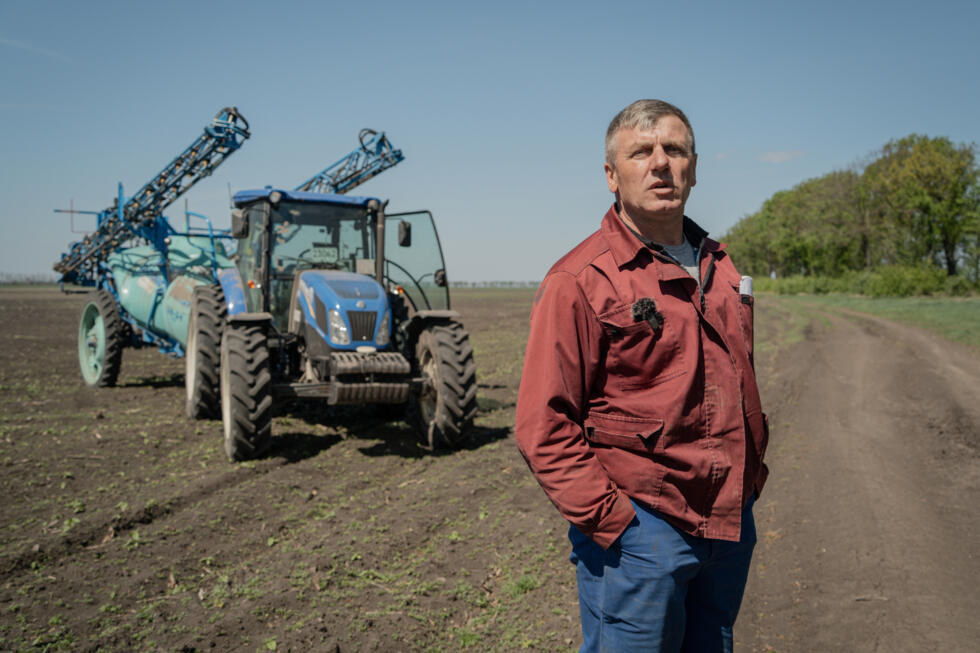
Further along the front line at Korobchyne near Kharkiv, Mykola Pereverzev began clearing the fields with his farm machinery.

"My tractor was blown up three times. We had to get a new one. It was completely unrepairable. But we ended up clearing 200 hectares of minefields in two months," he said.

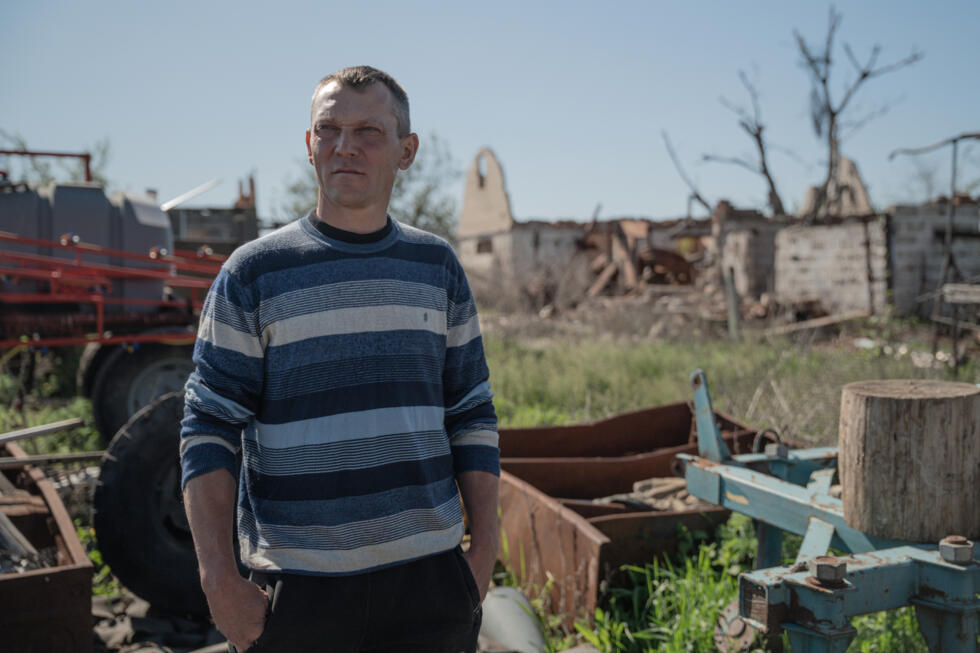
"Absolutely everyone demines by themselves," declared Igor Kniazev on his farm half an hour from Larisa's.

Ukraine is one of the great bread baskets of the world, its black earth so rich and fertile you want to scoop it up in your hands and smell it.


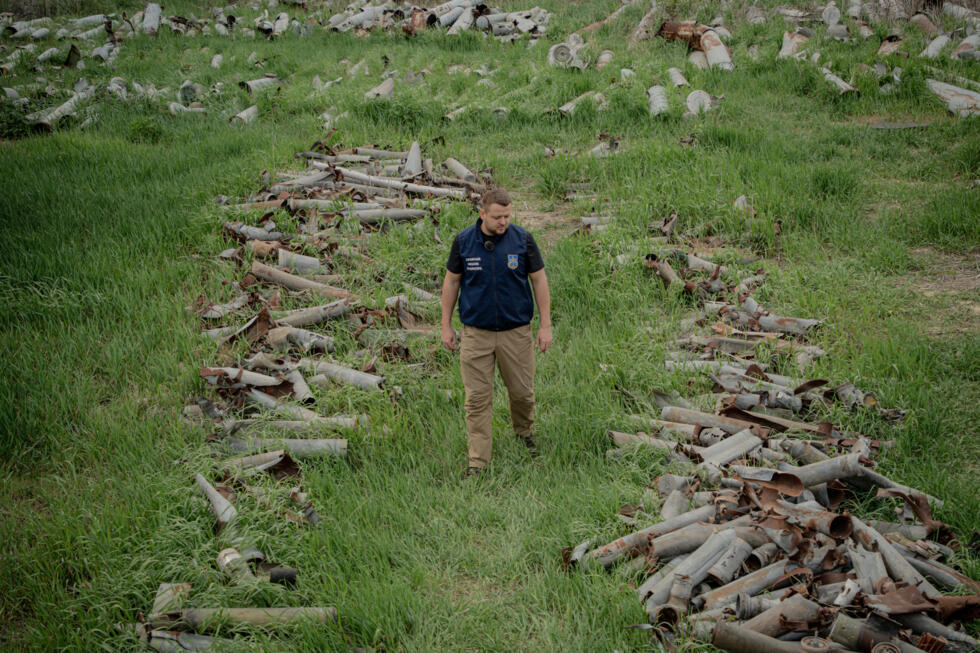
Ukrainian official Dmytro Chubenko with piles of Russian shells fired into the Kharkiv region © Ivan SAMOILOV / AFP

But that dark soil is now almost certainly the most mined in the world, experts told AFP.

More than three years of unrelenting artillery barrages -- the biggest since World War II -- have sown it with millions of tons of ordnance, much of it unexploded.

One in 10 shells fail to detonate, experts estimate, with as much as a third of North Korean ordnance fired by Russia failing to go off, the high explosives moulding where they fall.

Yet the drones which have revolutionised the way war is fought in Ukraine may also now become a game-changer in demining the country.

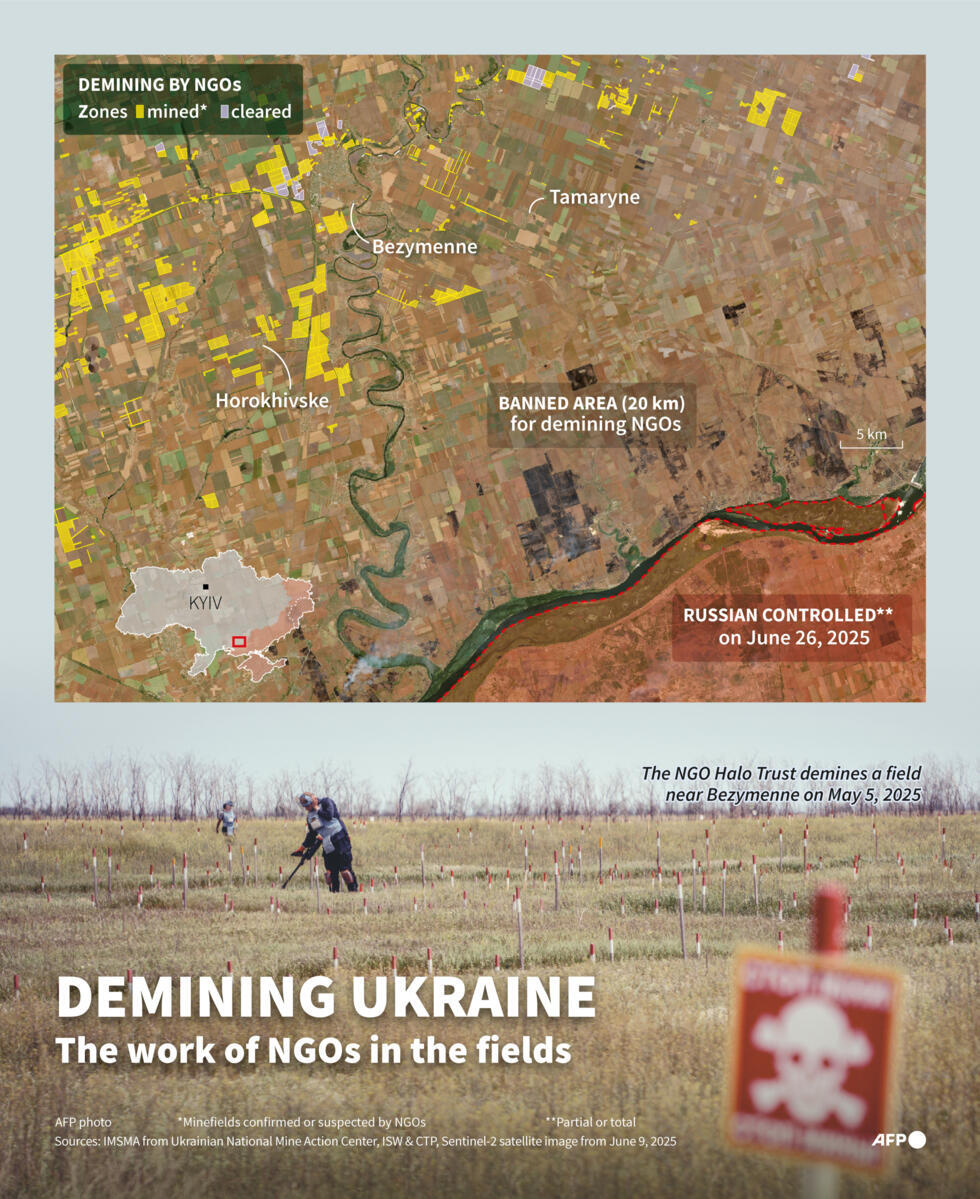
Ukraine itself and some of the more than 80 NGOs and commercial groups working there are already using them to speed the mammoth task of clearing the land, with the international community pledging a massive sum to the unprecedented effort.
Gallows in the garden

But on the ground it is often the farmers themselves -- despite the dangers and official warnings -- who are pushing ahead on their own.

Like the Sysenkos.
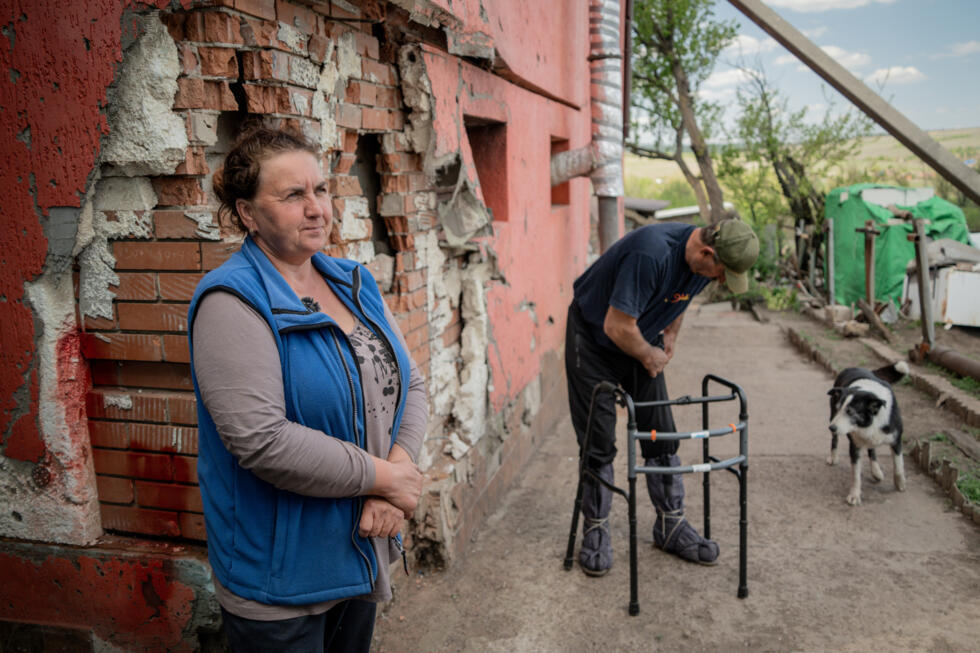
The Sysenkos began demining their battle-scarred fields with rakes 
© Ivan SAMOILOV / AFP

They were among the first to return to the devastated village of Kamyanka, which was occupied by the Russian army from March to September 2022.

Two weeks after its recapture by Ukrainian soldiers, Larisa and Viktor went back to check their house and found it uninhabitable, without water or electricity.

So they let the winter pass and returned in March 2023 to clean up, first taking down the gallows Russian soldiers had set up in their yard.

And they began demining. With their rakes.

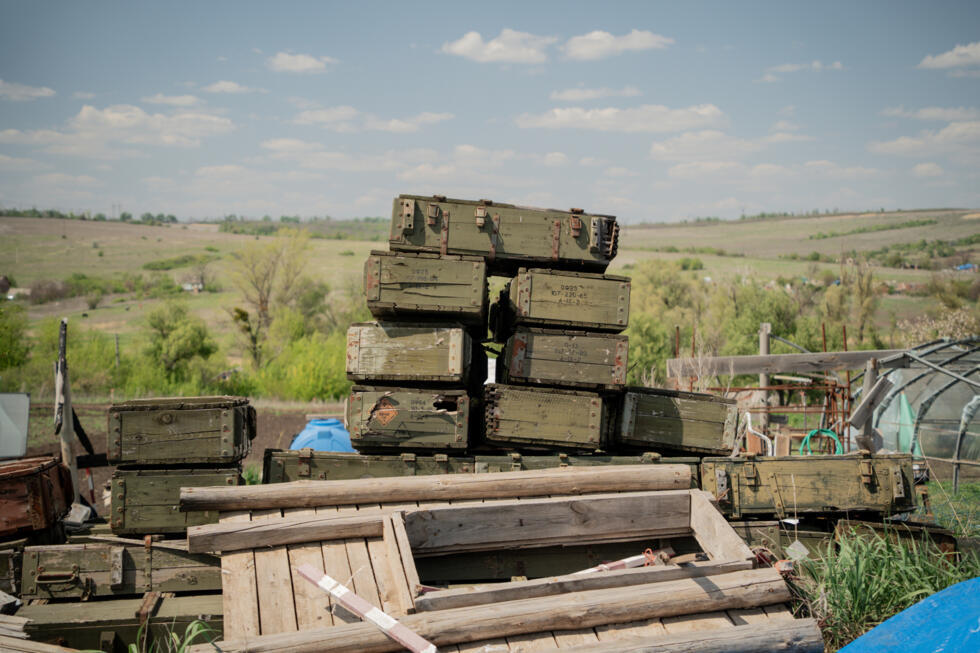
Russian shell boxes left in the Sysenkos's yard 
© Ivan SAMOILOV / AFP

"There were a lot of mines and our guys (in the Ukrainian army) didn't have time to take care of us. So slowly we demined ourselves with rakes," said Larisa cheerily.

Boxes of Russian artillery shells are still stacked up in front of their house -- 152mm howitzer shells to be precise, said Viktor with a mischievous smile.

"I served in the artillery during Soviet times, so I know a bit," the 56-year-old added.

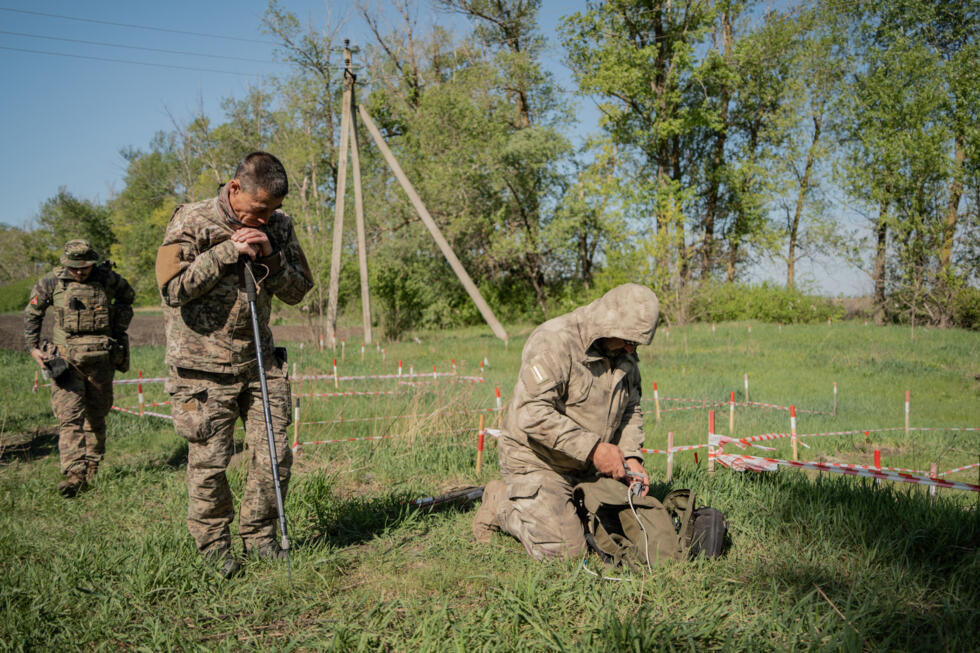
That summer a demining team from the Swiss FSD foundation arrived and unearthed 54 mines in the Sysenkos's field.

They were probably laid to protect a 2S3 Akatsiya self-propelled gun -- which looks like a big tank -- with which the Russians could hit targets up to 24 kilometres (15 miles) away.

Deadly 'flowers'


The PFM-1 anti-personnel mines they found are sensitive enough to detonate under the weight of a small child, exploding under only five kilograms of pressure.


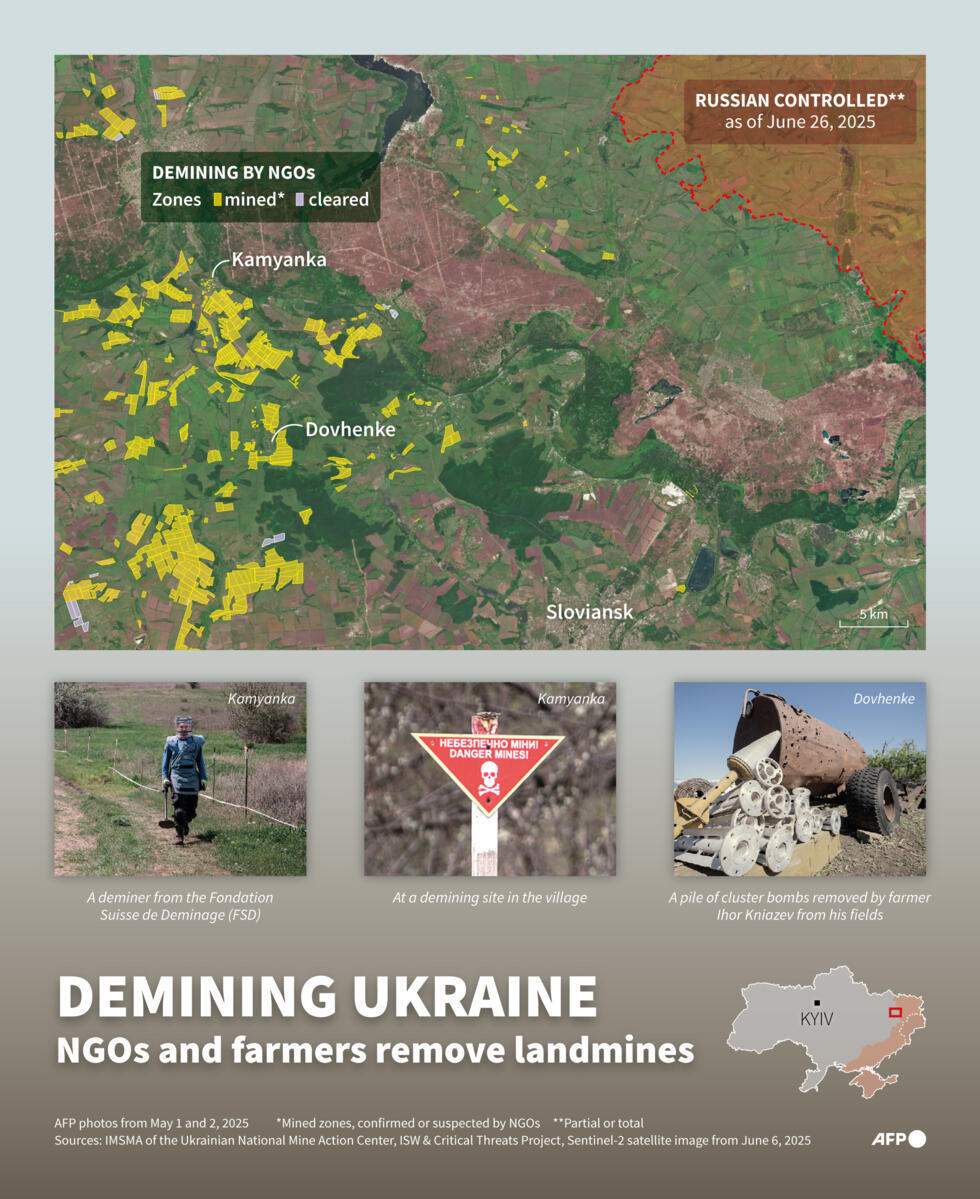
Demining Ukraine: NGOs and farmers remove landmines 
© Nalini LEPETIT-CHELLA, Valentina BRESCHI / AFP

Known as the "flower petal" or "butterfly" mine, they blend horrifyingly well into fields and forests, with their petal shape and khaki colour.

They are banned under the 1997 Ottawa International Convention, to which Russia never signed up.

Ukraine said on Sunday it was withdrawing from the treaty.

The deminers told the Sysenkos "to evacuate the house".

"Under their rules, we couldn't stay there. So we obeyed. The demining machine went back and forth and there were tons of explosions und
er it."


Pereverzev's tractor was blown up three times when he demined fields himself near Kharkiv © Ivan SAMOILOV / AFP

With its gutted homes, Kamyanka still looks like a ghost village but about 40 people have moved back. (Its pre-war population was 1,200.)

Many fear the mines and several people have stepped on them -- "99 percent on the flower petal ones", said Viktor.

Yet farmers cannot afford to wait and are back at work in the vast fields famous for Ukraine's intensely black and fertile "chernozem" soil, which is rich in humus.

"If you look at the villages around here, farmers have adapted tractors themselves to clear their land and they are already planting wheat and sunflowers," Viktor added.

- Most mined land -

Ukraine's "cereal production fell from 84 million tons before the war to 56 million tons" last year, a drop of one-third, agriculture minister Vitaliy Koval told AFP.


A Ukrainian police unit prepare to demine a field at Korobochkino near Kharkiv 
© Ivan SAMOILOV / AFP

"Ukraine has 42 million hectares (103 million acres) of agricultural land. On paper, we can cultivate 32 million hectares. But usable, uncontaminated land not occupied by Russia -- (we have) only 24 million hectares," he added.

A fifth of Ukraine's total territory (123,000 square kilometres, 48,000 square miles) is "potentially contaminated" by mines or explosives, according to government data.

That's an area roughly the size of England.

So does that make Ukraine the most mined country in the world?


An FDS deminer working near the Sysenkos's home in Kamyanka 
© Ivan SAMOILOV / AFP

"I think that is probably true in terms of the most unexploded bombs and shells and the most mines in the ground," said Paul Heslop, the United Nations Mine Action Service adviser in Ukraine.

Like all experts AFP talked to, he said it was impossible to make an accurate count in a country at war with a front line stretching 1,000 kilometres (620 miles) and its Russian-controlled areas inaccessible.

"(But) if you have got maybe four to five million unexploded shells or munitions, and three to five million mines, you potentially have 10 million explosive devices in the ground."

Pete Smith, who leads the HALO Trust's 1,500 staff in Ukraine, is a veteran of demining Iraq and Afghanistan.

But "I can say with a large degree of certainty" that no other country has been strewn with so many explosives, he said.


Tractors blown up


Some semblance of normal life has returned for the Sysenkos.

Their two dogs frolic around a sign marked "Danger Mines".

Birds now nest in the bullet and shell holes in the peach-coloured walls of their farmhouse.


Kniazev is slowly getting back on his feet despite losing much of his farm machinery
 © Ivan SAMOILOV / AFP

But the demining will be going on for some time around them.

To get some idea of how thankless it can be, the Swiss FSD team found only the remnants of three explosives after two years of searching a nearby 2.6-hectare plot (about the size of three football fields).

"Metal contamination was so intense that our detectors became unusable. They were constantly going off," their site chief told AFP.

But after checking the thousands of metal fragments they had found, almost all turned out not to be dangerous.

The snail's pace of the meticulous process exasperates farmer Kniazev, who rattles off his gripes with the demining groups at machine gun pace.

"Every year they promise: 'Tomorrow, tomorrow, we'll clear all the fields.'" So in the end, he did it himself.

Like the Sysenkos, Kniazev went back to his land as soon as the Russians withdrew and has since demined 10 hectares by himself.

He hopes to finish the final 40 within a year.

How?

"I took a metal detector and cleared the mines," he shot back.

"I was on my tractor when the harrow (being dragged behind) hit a mine and it exploded."

Lost leg, went back to work


Demining Ukraine: the work of NGOs in the fields 
© Nalini LEPETIT-CHELLA, Valentina BRESCHI / AFP

Kniazev managed to repair the tractor but the harrow was a write-off.

"I was lucky," he said with a twinkle in his steel blue eyes.

Others not so much. "Demining will take a long, long time because people keep detonating mines," he said.

"Dozens (of farmers) around here have already hit TM anti-tank mines. Many of our folks also stepped on OZM mines."

These Soviet-era "jumping" anti-personnel mines are particularly dangerous, leaping up a metre (three feet) when triggered and spraying 2,400 bits of shrapnel at everything within 40 metres.

Kniazev has been turning the remnants of Russian shells into pipes.

"I'll make a lamp" with that empty cluster bomb on the floor, he said.

A prosperous farmer before the war, he is slowly getting back on his feet despite losing a large part of his agricultural machinery.


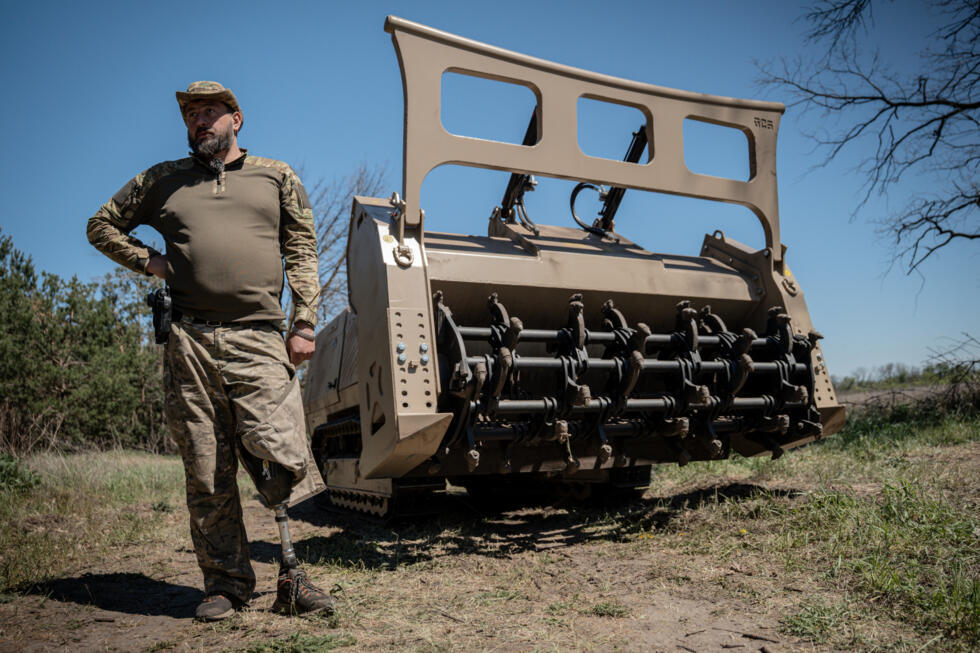
Ilkiv lost a leg below the knee when a mine exploded under his foot 
© Ivan SAMOILOV / AFP

He had just planted wheat after growing potatoes last year. He plans to diversify into mushrooms, which are highly profitable, he said.

Andriy Ilkiv lost his left leg below the knee when an anti-personnel mine exploded under his foot on September 13, 2022.

"I returned to work about four months later," said the head of a Ukrainian Interior Ministry demining team, even though the father-of-five was eligible for an office job because of his disability.

"I'm used to this work, I like it," he told AFP.

"Staying in an office isn't for me," he added, his colleagues gently ribbing him as they begin their day's work, the engine of their huge 12.5-ton German-made excavator already humming.


Hairdresser turned deminer


Kniazev said many Ukrainians work in demining for the good pay and to avoid conscription.

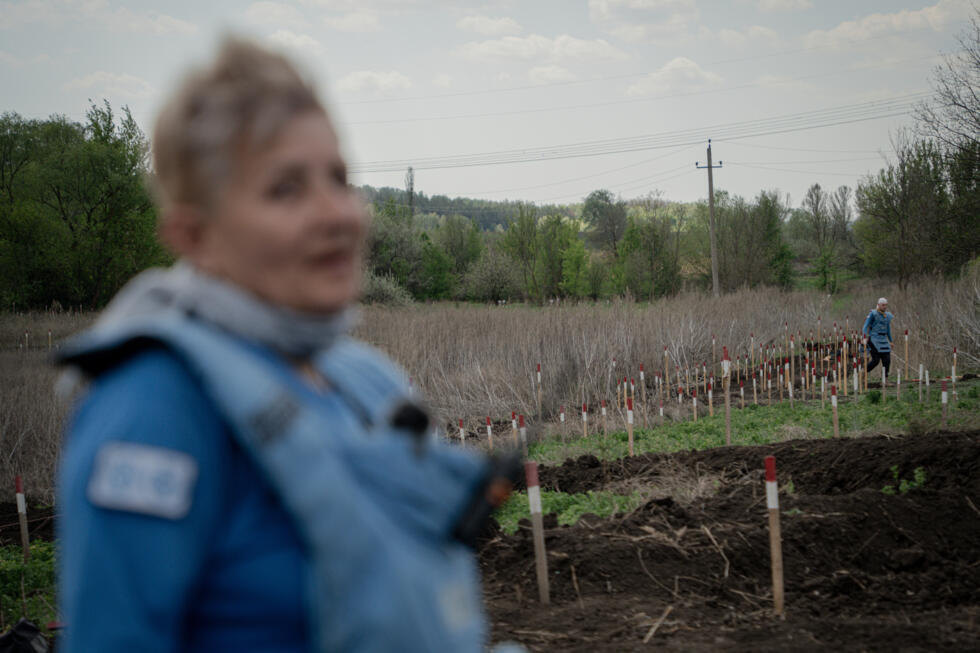
Former hairdresser Viktoria Shynkar has been working for HALO Trust, the world's biggest non-governmental demining group, for a year.

And she happily admitted the pay was one part of what drew her to this field in Tamaryne near Mykolaiv, not far from the Black Sea.

Viktoria Shynkar says demining is much less tiring than being a hairdresser 
© Ivan SAMOILOV / AFP

The 1,000 euros ($1,180) monthly wage she gets after the three weeks of training is as much as a young doctor is paid.

And despite the heavy body armour and helmet, it is much less tiring than being a hairdresser, where she hated making small talk with customers and was always on her feet.

"Before I used to cut hair. Now I cut grass (looking for mines). Before I cut to the millimetre. Now it's to the centimetre," the 36-year-old said.

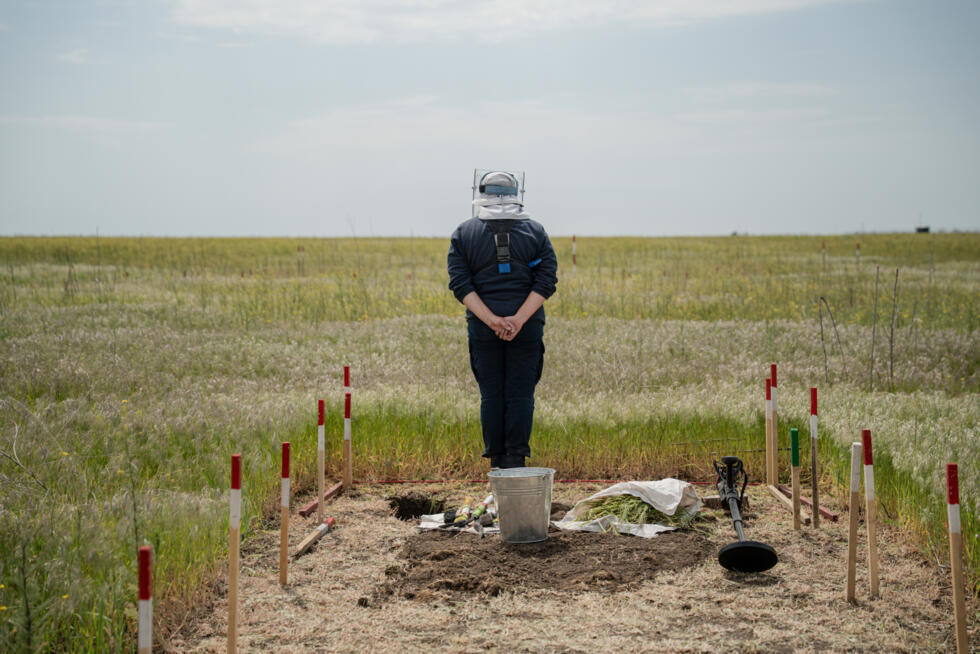
You need to be precise. In a field nearby, Shynkar and her colleagues uncovered 243 TM-62 Russian landmines, each armed with enough high explosive to blast through the armour of a battle tank and kill its crew.

The Ukrainian government wants to clear 80 percent of its territory by 2033, despite some questioning how the work will be funded and coordinated, never mind problems with corruption.

"I've seen contracts worth millions that made no sense," a foreign expert, who asked to remain anonymous, told AFP.

"So there are clearly things going on under the table."

Drones armed with AI


But some "of the most significant innovations in mine clearance in 20 to 30 years" are also happening in Ukraine, said Smith of the HALO Trust.
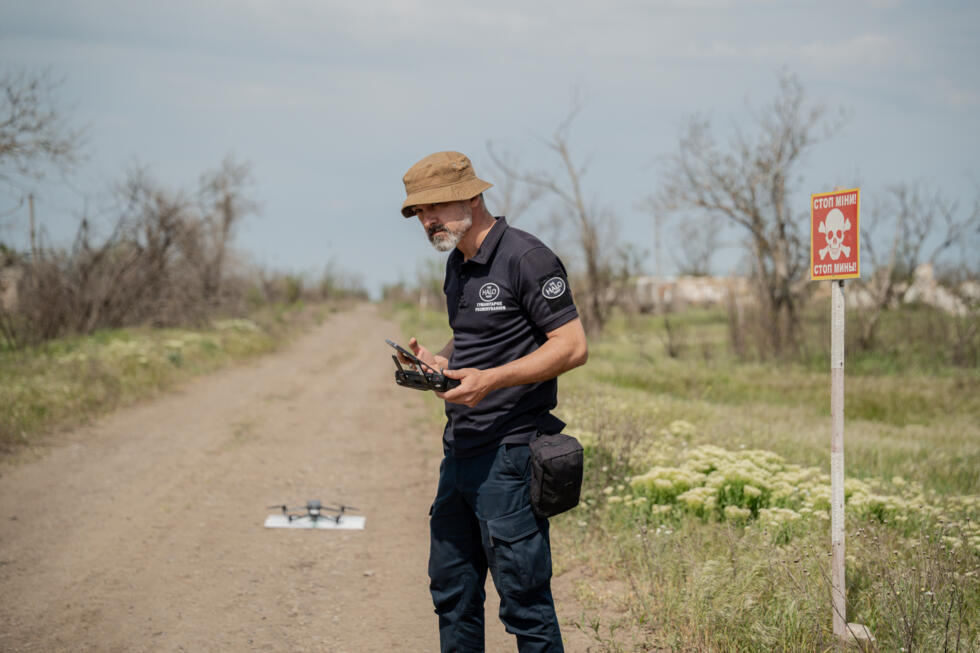
HALO Trust uses drones to detect mines in areas too dangerous for humans to walk 
© Ivan SAMOILOV / AFP

"Drones have been incredibly useful, particularly in areas we can't enter safely but they still allow us to survey the area," said Sam Rowlands, the trust's survey coordinator in Ukraine.

It uses 80 drones with various sensors depending on the ground conditions.

The images are sent to their headquarters near Kyiv to map out the minefield and are used to train AI in detecting different types of mines.

Volodymr Sydoruk, a data analyst there, works on the algorithms from partner company Amazon Web Services.

He enters multicoloured code for each type of mine that appears on his giant screen.

It is still early days for their machine learning but it is "already around 70 percent accurate, which is not bad", said Sydoruk.

A police unit demines a field near Korobochkino using a remote-controlled digger
 © Ivan SAMOILOV / AFP

And AI is likely to make drones a lot more effective in the future, experts say.

"One day we will see demining robots working 23 hours a day, with no risk to human lives," the UN's Heslop said.

"In five or 10 years, everything will be much more automated, thanks to what is happening today in Ukraine," he added.

Then Viktor and Larisa will finally be able to retire their rakes.

© 2025 AFP
Dalai Lama says he will have successor after his death

FU CHINA

McLeod Ganj (India) (AFP) – The Dalai Lama said Wednesday that the 600-year-old Tibetan spiritual institution would continue after his death, reassuring Buddhist followers around the globe and saying his office "exclusively" would name his successor, even as China insisted it would.

ANTI IMPERIALIST STRUGGLE


Issued on: 02/07/2025 - RFI

Tenzin Gyatso is the 14th reincarnation of the Dalai Lama, according to his followers 
© Biju BORO / AFP

Followers of the Dalai Lama laud his tireless campaign for greater autonomy for Tibet, a vast high-altitude plateau in China about the size of South Africa.

It is a landmark decision for Tibetans, many of whom had feared a future without a leader, as well as for global supporters who see the Dalai Lama as a symbol of non-violence, compassion and the enduring struggle for Tibetan cultural identity under Chinese rule.

According to Tibetans, Tenzin Gyatso is the 14th reincarnation of the Dalai Lama.

He and thousands of other Tibetans have lived in exile in India since Chinese troops crushed an uprising in the Tibetan capital Lhasa in 1959.

The charismatic Nobel Peace Prize-winning Buddhist had previously said the institution of Dalai Lama would continue only if there was popular demand.

He said Wednesday he had received multiple appeals over the past 14 years from the Tibetan diaspora, Buddhists from across the Himalayan region, Mongolia and parts of Russia and China, "earnestly requesting that the institution of the Dalai Lama continue".

The Dalai Lama is lauded by his followers for his tireless campaign for 
greater autonomy for Tibet, a vast high-altitude plateau in China about the size of South Africa
NO LONGER INDEPENDENCE
 © Sanjay BAID / AFP

"In particular, I have received messages through various channels from Tibetans in Tibet making the same appeal," he said in a video broadcast at the start of a meeting of religious leaders in the Indian Himalayan town where he has lived for decades.

"In accordance with all these requests, I am affirming that the institution of the Dalai Lama will continue," he added, according to an official translation.

The announcement was made ahead of his 90th birthday on July 6.
'Historic'

While China condemns him as a rebel and separatist, the internationally recognised Dalai Lama describes himself as a "simple Buddhist monk".

Many exiled Tibetans fear China will name its own successor to bolster control over a territory it poured troops into in 1950.

The Dalai Lama and thousands of other Tibetans have lived in exile in India since Chinese troops crushed an uprising in the Tibetan capital Lhasa in 1959 
© Sanjay BAID / AFP

But the Dalai Lama said Wednesday that responsibility for identifying the 15th Dalai Lama "will rest exclusively" with the India-based Gaden Phodrang Trust, the office of the Dalai Lama.

Samdhong Rinpoche, a senior Tibetan leader from the Gaden Phodrang Trust, told reporters that the Dalai Lama was "in excellent health" and that, at this time, there were "no further instructions for succession".

However, Rinpoche said the next Dalai Lama could be of "any nationality", and would come from a place where there is "access to freedom".

China said on Wednesday that the reincarnation of the Dalai Lama "must be approved by the central government" in Beijing, and that it would be carried out "by drawing lots from a golden urn", foreign ministry spokeswoman Mao Ning told reporters.

That urn is held by Beijing, and the Dalai Lama has already warned that, when used dishonestly, it lacks "any spiritual quality".

The Dalai Lama handed over political authority in 2011 to an exiled government chosen democratically by 130,000 Tibetans globally.


The Dali Lama says the institution of the role will continue © Sanjay BAID / AFP

At the same time, he warned that the future of his spiritual post faced an "obvious risk of vested political interests misusing the reincarnation system".

In 1995, Beijing selected a Panchen Lama, another influential Tibetan religious figure, and detained a Dalai Lama-recognised six-year-old, described by rights groups as the world's youngest political prisoner.

The Dalai Lama's announcement about the continuation of the role was welcomed with relief by Tibetans, including by Jigme Taydeh, a civil servant with the India-based Tibetan government.

"Whilst we rejoice at this confirmation of its continuation, we stringently object to China's interference and plans to install a puppet Dalai Lama", he said. "Neither the Tibetans nor the world would recognise such mischief."

burs-pjm/lb


China says Dalai Lama successor must be approved by Beijing

Tibetan spiritual leader the Dalai Lama on Wednesday affirmed that the centuries-old institution of the Dalai Lama will continue after his death. China, which considers the current Dalai Lama as a separatist, countered that Beijing has the final say on who the successor will be.


Issued on: 02/07/2025 - 
By: FRANCE 24

02:32
Tibetan spiritual leader the Dalai Lama (C) attends a Long Life Prayer offering ceremony at the Main Tibetan Temple in McLeod Ganj, near Dharamsala on June 30, 2025. 
© Sanjay Baid, AFP


Exiled Tibetan spiritual leader the Dalai Lama said Wednesday that the 600-year-old institution will continue after his death, a decision that will have profound impact on his Buddhist followers.

It is a landmark decision not only for Tibetans, but also for global supporters who see the Dalai Lama as a symbol of non-violence, compassion and the enduring struggle for Tibetan cultural identity under Chinese rule.

However, China said on Wednesday that the reincarnation of the Dalai Lama "must be approved by the central government".

"The reincarnation of the Dalai Lama, the Panchen Lama and other great Buddhist figures must be chosen by drawing lots from a golden urn, and approved by the central government," foreign ministry spokeswoman Mao Ning told a regular news briefing, referring to a method introduced by a Qing dynasty emperor in the 18th century.


"The Chinese government implements a policy of freedom of religious belief, but there are regulations on religious affairs and methods for managing the reincarnation of Tibetan living Buddhas," Mao said.

According to Tibetans, their current spiritual leader is the 14th reincarnation of the Dalai Lama, and his statement was released ahead of his 90th birthday on July 6.

He said he had received multiple appeals over the past 14 years from Tibetan diaspora in exile, Buddhists from across the Himalayan region, Mongolia and parts of Russia and China, "earnestly requesting that the institution of the Dalai Lama continue".

"In particular, I have received messages through various channels from Tibetans in Tibet making the same appeal," he said in a video broadcast at the start of a meeting of religious leaders in the Indian Himalayan town where he has lived for decades.

"In accordance with all these requests, I am affirming that the institution of the Dalai Lama will continue," he added, according to an official translation.

He and thousands of other Tibetans have lived in exile in India since Chinese troops crushed an uprising in the Tibetan capital Lhasa in 1959.

His advanced age has also sparked concern over the future of Tibetan leadership and the delicate question of his succession.

While China condemns him as a rebel and separatist, the internationally recognised Dalai Lama describes himself as a "simple Buddhist monk".

Many exiled Tibetans fear China will name a successor to bolster control over a territory it poured troops into in 1950.

But the Dalai Lama said Wednesday that responsibility for identifying the 15th Dalai Lama "will rest exclusively" with the India-based Gaden Phodrang Trust, the office of the Dalai Lama.

"I hereby reiterate that the Gaden Phodrang Trust has sole authority to recognise the future reincarnation; no one else has any such authority to interfere in this matter," he added.

(FRANCE 24 with AFP)
TORY AUSTERITY

Fire that closed Heathrow traced to unrepaired transformer

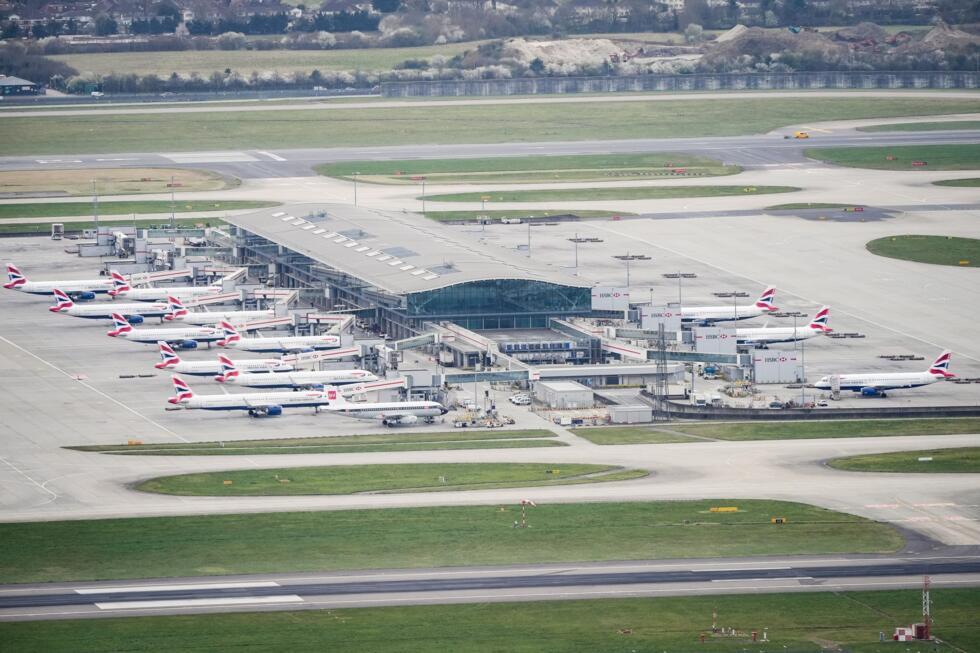
London (AFP) – A fire at an electrical substation that forced a shutdown at London's Heathrow Airport in March was likely caused by moisture entering electrical components, a problem first flagged in 2018, a report said Wednesday.


Issued on: 02/07/2025 - RFI

The fire broke out at the North Hyde substation in West London on March 20, 2025
 © STR / AFP

Water entering a transformer and causing a short circuit "most likely" started the fire, according to the National Energy System Operator (NESO) report, adding that elevated moisture readings were detected in July 2018 but "mitigating actions appropriate to its severity were not implemented".

The fire broke out at the North Hyde substation in West London, around two miles (3.2 km) north of Heathrow, at 11:21 pm on March 20, resulting in a complete loss of power supply to part of the airport's private internal electrical distribution network.

The airport was closed for most of March 21, affecting around 270,000 journeys and raising serious questions about the reliability of one of the UK's most critical pieces of infrastructure.

Using forensic analysis from the National Grid Electricity Transmission and London Fire Brigade, the government-commissioned report concluded that "a catastrophic failure" on high voltage "bushing" components caused a fire to ignite on the transformer.

"This was most likely caused by moisture entering the bushing causing a short circuit. The electricity likely then 'arced' (causing sparks) which combined with air and heat to ignite the oil, resulting in a fire," it added.

An elevated moisture reading in one of the bushings had been detected in oil samples taken in July 2018, indicating "an imminent fault and that the bushing should be replaced".


Flights were grounded and the airport shut after the substation fire © STR / AFP

However, "controls in place were not effective and failed to identify subsequently that action had not been taken in relation to the elevated moisture reading," it said.

"This includes an opportunity in 2022 when a decision was taken to defer basic maintenance. The issue therefore went unaddressed," added the report.
'Risks were not addressed'

Energy Minister Ed Miliband called the report "deeply concerning".

"Known risks were not addressed by the National Grid Electricity Transmission, and (energy regulator) Ofgem has now opened an official enforcement investigation to consider any possible licence breaches," he said in a statement.

The National Grid responded in a statement that "we fully support the recommendations in the report" and that "we will also cooperate closely with Ofgem's investigation".

Around 230,000 passengers use Heathrow every day -- 83 million a year -- making it one of the world's busiest airports. Planes from Heathrow serve around 80 countries.

The airport welcomed the report, which it said "sheds further light on the external power supply failure".

"A combination of outdated regulation, inadequate safety mechanisms, and National Grid's failure to maintain its infrastructure led to this catastrophic power outage," a spokesperson said.

"We expect National Grid to be carefully considering what steps they can take to ensure this isn't repeated."

© 2025 AFP
POLITICAL PRISONER

Algeria court upholds writer Boualem Sansal's five-year jail term


An Algerian court on Tuesday upheld a five-year prison sentence against writer Boualem Sansal for after he was found guilty of undermining Algeria's territorial integrity. The French Prime Minister said he hoped the Algerian president would "grant Sansal a pardon".


Issued on: 01/07/2025 
RFI

A banner in support of detained Franco-Algerian writer Boualem Sansal, is displayed on a bridge in Beziers, southern France. © AFP - Gabriel Bouys

Sansal, 80, was first sentenced to five years behind bars on 27 March on charges related to undermining Algeria's territorial integrity over comments made to a French media outlet.

The appeals court confirmed the sentence after prosecutors sought to double his jail term, a French news agency AFP journalist reported from the hearing.

Sansal was informed he has eight days to file a further appeal before Algeria's supreme court.

His newly appointed French lawyer, Pierre Cornut-Gentille, said he would consult with his client before deciding whether to pursue another legal challenge.

The case against him arose after he told the far-right outlet Frontières that France had unjustly transferred Moroccan territory to Algeria during the colonial period from 1830 to 1962 – a claim Algeria views as a challenge to its sovereignty and that aligns with longstanding Moroccan territorial assertions.

Sansal was detained in November 2024 upon arrival at Algiers airport. On 27 March, a court in Dar El Beida sentenced him to a five-year prison term and fined him 500,000 Algerian dinars ( 3,160 euros).


French-Algerian writer Boualem Sansal sentenced to five years in prison


'Unacceptable'

Following the verdict, French Prime Minister François Bayrou said he hoped Algerian President Abdelmadjid Tebboune would grant Sansal a pardon.

"Now that the sentence has been handed down, we can imagine pardon measures, particularly in view of our compatriot's health, will be taken," said Bayrou, calling the situation "unacceptable".

French President Emmanuel Macron has also urged Tebboune to show "mercy and humanity" to the author.

Some of Sansal's relatives have voiced hope he could be pardoned on Saturday, the 63rd anniversary of Algeria's independence.

Appearing in court without legal counsel on 24 June, Sansal said the case against him "makes no sense" as "the Algerian constitution guarantees freedom of expression and conscience".

He defended his remarks by citing the African Union's post-independence declaration that colonial borders should remain inviolable.

When questioned about his writings, Sansal asked: "Are we holding a trial over literature? Where are we headed?"
Diplomatic rift

Sansal's family has expressed fears prison could jeopardise his health, noting he is receiving treatment for prostate cancer.

Authorities in the North African country maintain that due process is being respected.

Commenting on his health on Tuesday, Cornut-Gentille said he saw Sansal a day earlier and that "he is fine".

The writer's conviction further strained already tense France-Algeria relations, which have been complicated by issues such as migration and Macron's recent recognition of Moroccan sovereignty over Western Sahara, a disputed territory claimed by the Algeria-backed Polisario Front.

Last month, the French National Assembly passed a resolution calling for Sansal's immediate release and linking future EU-Algeria cooperation to respect for human rights.

(with AFP)
THE LAST COLONY   VIVA INDEPENDENCE
Macron meets New Caledonian leaders to discuss future after riots

President Emmanuel Macron is bringing together political and economic leaders from New Caledonia for a summit starting Wednesday to talk about the French overseas territory’s future, one year after it was hit by deadly violence.


Issued on: 02/07/2025 - 08:17

1 minReading time
Unrest broke out in May 2024 in New Caledonia.
 © Delphine Mayeur/AFP

New Caledonian elected officials, along with economic and civil society representatives, have agreed to join the talks at the president’s invitation.

Macron said last week the discussions would last “as long as necessary” to deal with major issues.

“Beyond major institutional topics, I would like our discussions to touch on economic and societal matters,” Macron said.

New Caledonia has been ruled by France since the 1800s. Many indigenous Kanaks still resent Paris’s control and want more autonomy or independence.

Key dates in New Caledonia’s history

Unrest broke out in May 2024 after Paris planned to give voting rights to thousands of non-indigenous, long-term residents – something Kanaks fear would leave them in a permanent minority, crushing their chances of winning independence.

The riots – the most violent since the 1980s – led to the death of 14 people and caused billions of euros in damage.

The president's decision to host talks alongside the overseas minister Manuel Valls comes after a French court freed independence leader Christian Tein in June.

Tein, who is a Kanak, had been held in custody in eastern France since June 2024 over the rioting.

Investigating magistrates concluded there was no proof that Tein was preparing an armed uprising against the government, according to a source close to the case.

The last independence referendum in New Caledonia was held in 2021, and was boycotted by pro-independence groups over the impact of the Covid-19 pandemic on the Kanak population.

The referendum was the last of three since 2018, all of which rejected New Caledonian independence.

Anniversary of French occupation exposes rifts over New Caledonia's future
'Future of the territory'

Since the 2021 referendum – which pro-independence campaigners had wanted to be rescheduled – the political situation in the archipelago has been in deadlock.

Valls led negotiations in May between pro-independence and anti-independence groups, but they did not reach an agreement about the institutional future of the territory.

The president declared in early June that he wanted a "new project" for New Caledonia.

(with AFP)
Abuse ignored at French Catholic school while Bayrou was minister, inquiry finds

A French parliamentary inquiry has found that physical and sexual abuse went unchecked for years at a Catholic boarding school while Prime Minister François Bayrou was education minister in the 1990s.


Issued on: 02/07/2025 - RFI

A view of the Notre-Dame-de-Bétharram boarding school in Lestelle Bétharram, southwestern France. 
AFP - GAIZKA IROZ

The 330-page report, released on Wednesday, says children at the Notre-Dame de Bétharram school suffered violence “in the absence of action that the former education minister had the means to take”, Violette Spillebout and Paul Vannier, the two co-rapporteurs, wrote.

Bayrou, who served as education minister from 1993 to 1997, has denied any wrongdoing and called the accusations a campaign of “destruction” against him.

His office told BFMTV he ordered an inspection “the day after a complaint for a slap" appeared. They said the inspection “resulted in a positive report for the school” and claimed “all documents are online on Bayrou.fr”.


‘Absolute sadism’

Fatiha Keloua Hachi, who led the commission of inquiry, said lawmakers heard shocking testimony over three months from 135 people, including survivors of abuse at schools across France.

“This commission of inquiry was a thorough investigation into the unthinkable – children, all over France, subjected to monstrous acts,” Keloua Hachi said.

She said survivors described sexual violence and “physical violence too, sometimes of an unprecedented severity, of absolute sadism”.

Since February last year, around 200 legal complaints have been filed accusing priests and staff at Bétharram of abuse between 1957 and 2004. Some former boarders said priests visited boys at night.

Bayrou’s eldest daughter, Hélène Perlant, has said a priest beat her at a summer camp linked to Bétharram when she was 14. She said her father did not know about the incident.


Systemic failings


The report found the violence at Bétharram could not be reduced to isolated incidents and said it was – at least in part – kept in place by influential supporters, including some in government.

The co-rapporteurs said Bétharram was far from unique and that similar violence still happens in other schools, especially private Catholic ones, where a strong culture of silence remains.

Lawmakers described France’s system of checks as virtually non-existent and said efforts to prevent abuse remain inadequate.

The report said many victims were ignored for decades and left with lasting anger because so few adults took action while abusers went unpunished.


Proposals for reform


The commission recommended 50 measures to address the violence. These include creating a compensation fund for victims and recognising the state’s failings that allowed the abuse to continue.

It also proposed annual inspections of boarding schools, stricter checks in private schools at least every five years and a nationwide hotline for staff and parents to report abuse outside the usual school channels.

Other ideas include a clear ban on corporal punishment and humiliating treatment, criminal checks for all staff every three years and lifting the secrecy of confession when priests hear of abuse against children under 15.

The commission called for better training for teachers, nurses and school counsellors and regular reminders that staff must report suspected violence.

Bayrou survived a vote of no confidence on Tuesday. His position could come under more pressure as France’s minority government faces tough budget talks later this year.