It’s possible that I shall make an ass of myself. But in that case one can always get out of it with a little dialectic. I have, of course, so worded my proposition as to be right either way (K.Marx, Letter to F.Engels on the Indian Mutiny)
Wednesday, July 02, 2025
Regional Ban on Scrubber Wash Among Environmental Steps Adopted by OSPAR
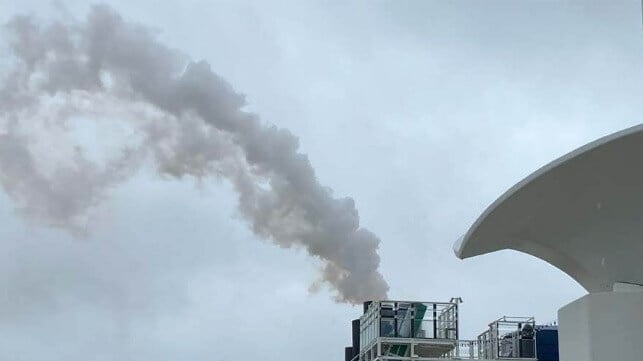
White vapor is a telltale sign of scrubbers in use to clean a vessel's exhaust (Allan Jordan)
Representatives from 16 countries meeting in Virgo, Spain, announced today, June 27, that they had adopted the first regional ban on the discharge of scrubber wash water among a series of new environmental actions. NGOs hailed the action, which expands on localized bans, but said the ministers failed to take the action far enough to the full extent of territorial seas.
Ministers expressed serious concern about hazardous discharges from all types of exhaust gas cleaning systems aboard ships. Activists such as the NGO Seas at Risk contend scrubbers, which use seawater to wash sulfur from a vessel’s exhaust, discharge wash that contains contaminants including polycyclic aromatic hydrocarbons and heavy metals. The NGO was advocating for a total ban on the discharge into all coastal waters.
“Turning air pollution into ocean pollution is not an acceptable trade-off,” said Maarten Verdaasdonk, Project Manager, North Sea Foundation. “It is vital that all OSPAR Members support the proposal to extend the ban to territorial waters, especially as cleaner, widely available alternatives exist. Such a ban will improve water quality and protect marine life in the coastal areas of the entire North-East Atlantic.”
The members adopted a two-stage ban starting with the wash from open-loop scrubbers starting in July 2027 for the region known as the North-East Atlantic, covering the coastline from Spain to Norway and west to Greenland. Further, while closed-loop scrubbers produce less volume, it however also contain hazardous material, so the ministers adopted a discharge ban on this wash water to be in effect by January 2029.
The ban as adopted, however, only covers internal waters and the areas in and around ports. The NGO wanted the ban on all territorial waters within the 12 nautical mile range from the coastline. OSPAR members agreed to discuss the range of the ban in 2027 after receiving further studies on the impact in territorial seas.
The ban is seen as a critical action as the shipping industry looks to all methods to extend the life of ships and meet emerging environmental regulations. With the strict emissions regulations already adopted, many ships installed scrubbers to continue the use of less expensive sulfur fuels, and many new ships are being built with a range of exhaust wash systems.
The minister took other actions, including expanding the organization's maritime area by over 2.5 million square kilometers. They are going to include the waters of Macaronesia, the Azores, Madeira, and the Canary Islands. They said it would bring additional biodiversity-rich areas under OSPAR protection while recognizing the importance of regional cooperation.
Other decisions included new actions on marine litter, a ban on plastic pollution from pontoons and buoys, and a new regional plan on underwater noise. They also moved to strengthen protection in the Arctic, including beginning to identify potential Marine Protected Areas. They also reiterated their 1998 statement not to treat the seas as a dumping ground and reiterated the requirement to remove disused offshore installations.
OSPAR was formed in the 1970s coming from UN-sponsored conventions in Oslo and Paris to reduce marine pollution. The member countries include Belgium, Denmark, Finland, France, Germany, Iceland, Ireland, Luxembourg, Netherlands, Norway, Portugal, Spain, Sweden, Switzerland, and the United Kingdom.
Hanwha Ocean to Build New Polar Research Vessel for South Korea
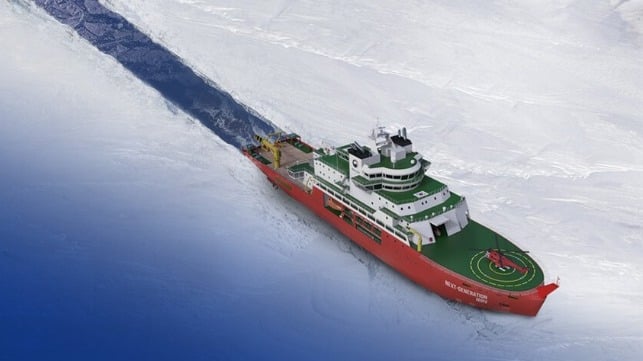
Korea selected Hanwha Ocean to build a larger, more capable polar research vessel (Hanwha Ocean)
Hanwha Ocean has been selected as the preferred bidder for the construction of a new government-owned polar research vessel. The contract comes as more nations race to expand their presence in the polar regions, which the shipyard notes is creating a new business opportunity.
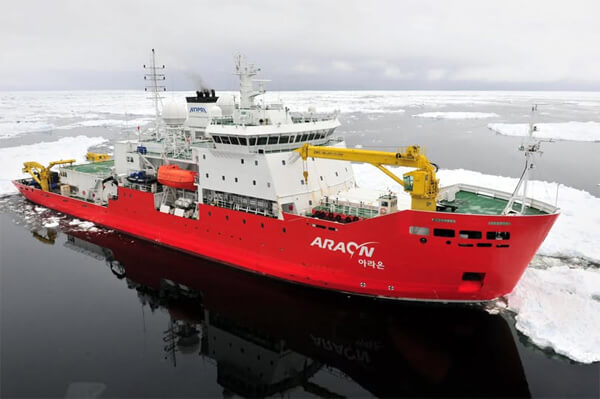
Korea built its first polar research vessel, Araon (6,950 GT), starting in 2008 and at Hanjin Heavy Industries and commissioned the vessel in 2012 for year-round polar research between the Arctic and Antarctic. The vessel was built at a cost of over 100 billion won (US$74 million at current exchange rates). It can accommodate 85 people, including 25 crew and 60 researchers, and has 25 key pieces of research equipment.
The vessel has a range of 17,000 nautical miles and can break flat ice of 1 meter thickness at a speed of 3 knots. It carries 31 TEU for equipment and supplies. It is currently completing regular maintenance and will soon depart for the Arctic, where it will remain till September. After another quick overhaul, it will depart in October and remain till April 2026 in Antarctica.
Korea has operated Araon for more than a decade as its first polar research vessel (KOPRI)
The Ministry of Oceans and Fisheries led the search for a shipyard to undertake the project for the next-generation vessel, which will be operated by the Korea Polar Research Institute. Hanwha Ocean was selected and the government expects to complete a contract this month. Design work will begin for the new vessel, which will be completed by December 2029 to expand Korea’s polar research efforts.
Hanwha Ocean reports that the next-generation icebreaking research vessel will have a total tonnage of 16,560 tons, more than twice that of the Araon. It will be equipped with an LNG dual-fuel electric propulsion system, and will be a PC (Polar Class) 3 vessel with a bidirectional icebreaking capability that can break through 1.5 meter thick ice, and has a cold resistance of -45 degrees Celsius. For the comfort and productivity of the staff working on board, the project calls for the accommodations to be designed to the standards of a “top-class passenger ship.”
Korean officials stress the importance of adding the new vessel as the scope of research capacity expands, caused by changes in the polar environment. Hanwha Ocean notes the increasing interest in the polar regions for commercial operations. Japan recently launched its first dedicated ice-class Arctic research vessel while India announced an agreement with Norway and Japan for its first polar research vessel.
The shipbuilder, which was formerly Daewoo Shipbuilding and Marine Engineering, highlights that it began working on icebreaking designs in 2008 in anticipation of the possibility of the Arctic route. It became a leader in icebreaking LNG carriers, having built a total of 21 vessels, including 15 in 2014 and six in 2020.
Hanwha Ocean plans to devote more effort to the research and construction of icebreakers. It sees emerging opportunities in the capability as a possible future growth engine for the business.
Korea’s move in the sector comes as others, including Canada and Finland, look to leverage their capabilities in icebreaking ship construction. The Trump administration continues to highlight the U.S.’s desire for more icebreaking vessels, which is seen as a potential driver for the market.
Canada Becomes LNG Exporter as First Gas Ships from BC Project
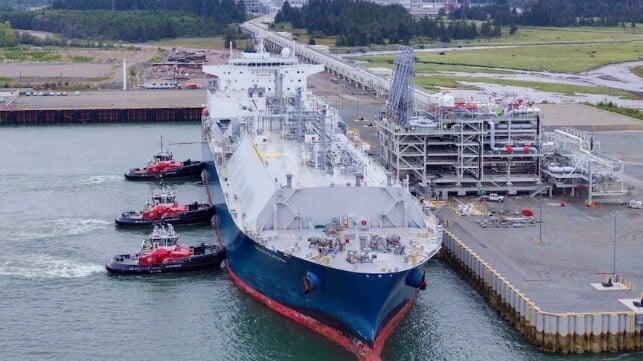
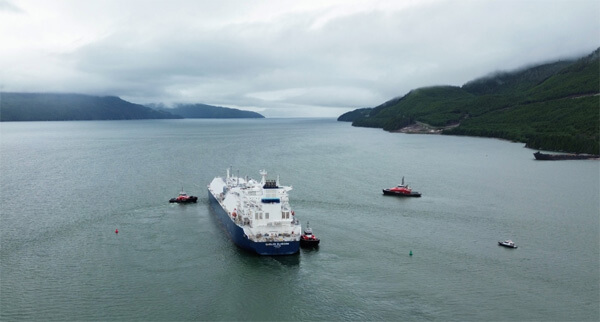
GasLog Glasgow took the first LNG cargo from Canada to Asia (Shell)
The first LNG gas carrier, GasLog Glasgow (112,764 dwt) departed the LNG terminal at Kitimat, Canada, on June 30, officially marking Canada’s entry into the export market. The LNG Canada project had been gearing up in recent weeks and began the first loading over the weekend, which opens a critical market for Asia to obtain LNG from Canada.
The project is led by Shell and includes partners PETRONAS, PetroChina, Mitsubishi Corporation, and Korea Gas. Each of the participants in the project will provide its own natural gas supply and individually offtake and market their respective share of liquified natural gas from LNG Canada. The project has two trains with an initial capacity of 14 million tonnes per annum (mtpa) and plans to double capacity in the future.
The first shipment is aboard the Greek-owned vessel, which is operating under charter to Shell. The vessel’s AIS signal currently shows it bound for Incheon, South Korea, where it is scheduled to arrive on July 20.
“With LNG Canada’s first shipment to Asia, Canada is exporting its energy to reliable partners, diversifying trade, and reducing global emissions — all in partnership with Indigenous peoples,” said Prime Minister of Canada Mark Carney. “By turning aspiration into action, Canada can become the world’s leading energy superpower with the strongest economy in the G7.”
Historically, Canada’s only LNG market was to the United States by pipeline. The concept of opening to the Asian markets began more than 15 years ago with various projects proposed to Canada’s federal government. Shell, however, highlights that the timing is right now as Asia moves away from coal. Shipping LNG from Canada’s West Coast provides shorter distances and will result in lower prices for the Asian buyers.
Largely driven by economic growth in Asia, Shell in its 2025 annual forecast for LNG predicted that global demand is set to rise by around 60 percent by 2040. Shell is targeting 4 to 5 percent per year growth in its LNG sales through at least 2030.
LNG Canada reports the investment to develop the facility, which is located northeast of Vancouver, topped C$40 billion (US$29 billion). Of that, it says it invested more than C$5.8 billion (US$4.25 billion) locally in Canada.
GasLog Glasgow starting the journey toward the Pacific Ocean (Canada LNG)
The deep water port at Kitimat is more than 180 miles from the coast of British Columbia, requiring the tankers to make a 15-hour journey. Arrangements were made with British Columbia Pilots, who said two pilots were aboard the GasLog Glasgow, and the location gave rise to a new tugboat operation. Canada is requiring escort tugs, and they are being operated by HaiSea Marine, which is a partnership with the local indigenous people and Seaspan. It boasts of the “world’s greenest tugboat fleet,” all purpose-built and powered by batteries or dual-fuel LNG vessels.
Two additional LNG export projects are currently under construction on Canada’s West Coast, Cedar LNG and Woodfibre. They are scheduled to start operations in 2027 and 2028. A third one, Ksi Lisims LNG is preparing for its final financial decision.
NTSB Releases First Report on Mexican Navy Training Ship Accident
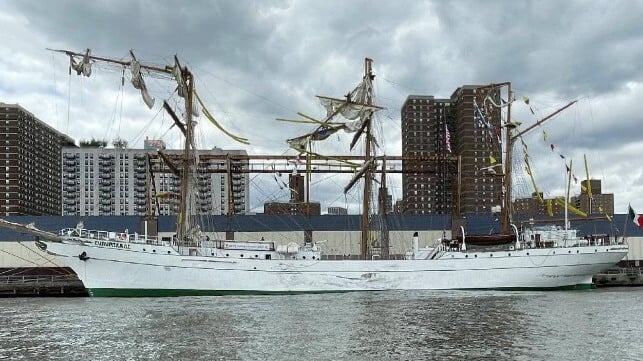
The National Transportation Safety Board has released the preliminary results of its investigation into the allision of the Mexican Navy training vessel Cuauhtémoc with the Brooklyn Bridge last month. The report covers the known facts of the incident, and does not provide any conclusions about the probable cause - typically a later part of the investigation. It also does not provide any factual findings about the propulsion system, which is still being examined.
On the evening of May 17, a bar pilot and a docking pilot boarded the Cuauhtémoc at Manhattan's Pier 17, preparing to get under way for an outbound voyage. They both conducted a master-pilot exchange, and the master told them that propulsion, steering and ships' systems were all in good working order. Winds were westerly at about 10-15 knots, towards the bridge.
At about 2016 hours, Cuauhtémoc slipped her mooring lines and got under way from the pier. The docking pilot had the conn, as is standard in New York Harbor for the initial minutes of a departure. A twin-screw assist tug helped her off the pier as the docking pilot ordered astern thrust to back her out into the East River.
Unusually, the transfer of engine and rudder commands from the docking pilot passed through multiple people on the way to the person at the helm. The docking pilot would give a command to the captain on the conning deck, who would then translate it into Spanish and relay it to a second crewmember on the deck below. This crewmember would then relay the command to other crewmembers in the navigation bridge, and these individuals would execute the command.
From 2020-2022 hours, the Cuauhtémoc moved astern from the pier, as ordered. Once the ship was clear, the docking pilot ordered all stop, then dead slow ahead, and ordered the tug to reposition to the starboard bow, where it would be best positioned to help with a turn to port. The tug took its line in and disconnected to effect this maneuver.
As this was in process, the docking pilot gave additional engine commands in the ahead direction. Despite this, the stern of Cuauhtémoc began to swing towards the Brooklyn Bridge, and the vessel accelerated astern. From 2023-2024, the speed astern increased to about six knots, culminating in the allision of the Cuauhtémoc's upper masts with the underside of the Brooklyn Bridge. She then drifted stern-first into a seawall on the east side of the river.
No appreciable damage to the bridge's structure occurred, though a traveling platform system for maintenance beneath the bridge received minor damage from the impact. The ship's three masts were all seriously damaged, and there was scraped paint on the port quarter, where Cuauhtémoc made contact with the seawall. The rudder was also damaged: the rudder post was deformed, and the rudder itself was stuck at 90 degrees to the centerline, oriented towards the port side.
NTSB is still examining the propulsion system, operating control system, and crew experience and training, among other factors.
Vessel Rerouting Contributed to Increase in Containers Lost at Sea
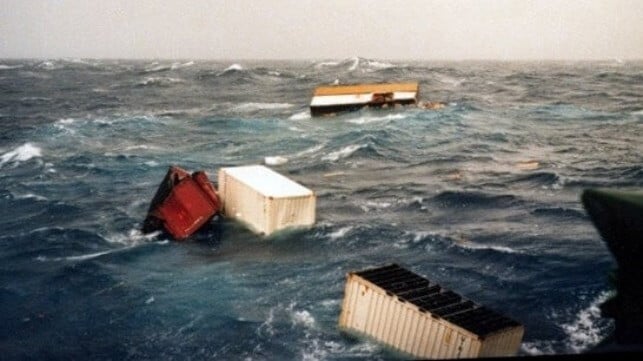
Number of containers going overboard increased in 2024 as more vessels rerouted around South Africa (IMO file photo)
While the overall trend continues to show improvement in the number of containers going overboard, the World Shipping Council reports that in 2024, rerouting of vessels to avoid the hostilities in the Red Sea directly contributed to an increase in boxes lost at sea. The trade group points to the industry’s continuing efforts, highlighting that in the absence of a large casualty, the rate of losses continues to improve.
In 2024, the World Shipping Council estimates that 576 containers were lost at sea out of approximately 250 million transported. The number was up by 221 containers from the prior year, but most of the increase is directly traced to a number of incidents off the Cape of Good Hope as containerships avoided the Red Sea and encountered strong winter weather. WSC points out that even with the increase, it was significantly below the 10-year average of 1,274 containers lost at sea.
“Despite continued loss-prevention efforts by the industry, the re-routing of transits away from the Red Sea and around the Cape of Good Hope to keep global commerce moving has ocean carriers navigating one of the world’s most challenging routes, as highlighted in this report,” said Joe Kramek, President & CEO of the World Shipping Council.
The South African Maritime Safety Authority (SMSA) tracked three major incidents between July and September 2024; CMA CGM Benjamin Franklin lost 44 containers, CMA CGM Belem lost 99 boxes, and MSC Antonia lost 46 boxes, all while encountering heavy weather off South Africa. MSC Taranto in October lost five empties also in the region.
WSC highlights the area as “well-known for hazardous maritime conditions,” while reporting that the number of vessels taking the route spiked by 191 percent compared to 2023. It calculates that 35 percent of 2024’s losses at sea were due to routing around South Africa.
Over the past 17 years, there have been three major spikes in including in 2013 when MOL Comfort was lost with over 7,000 TEU. The numbers spiked again in 2020 and 2021 as vessels including ONE Apus, ONE Aquila, APL England, Maersk Eindhoven, and Maersk Essen all lost or damaged boxes in heavy seas. The industry linked many of the problems to a phenomenon known as parametric rolling and increased efforts to warn seafarers and to manage the uncontrolled and sudden violent rolling.
World Shipping Council supports new efforts that include the mandatory reporting for lost containers coming into effect in 2026 from the International Maritime Organization, as well as enhanced cargo safety screening, and further scientific research into loss prevention. Participating with MARIN, WSC says a report will be sent to the IMO in September on major advancements in improving container safety. It identifies the reasons for losses, develops tools to prevent incidents, and provides recommendations for the IMO’s revised regulation.
This year has been a challenging one for the industry with SM Portland losing 115 boxes overboard during a Pacific storm in March. However, fire is emerging as the key issue with Maersk Frankfurt struggling with a fire that killed seafarers in 2024, and currently, a fire has been burning for three weeks aboard Wan Hai 503, which also claimed the lives of seafarers. MSC Elsa 3 was also lost off India last month and MSC Baltic III grounded off Canada in a winter storm.
The trade group emphasizes that safety is a shared responsibility pointing to new efforts to address mis or undeclared dangerous goods, including the first industry-wide system for screening. It reiterates basic issues such as conscientiously and correctly packing, declaring, and weighing containers and their contents. WSC, in partnership with the National Cargo Bureau, has developed a new safety program with industry best practices that will be rolled out this year. It also points to changes in safety regulations, including declaring charcoal shipments as dangerous goods and new treatment, packing, and stowage requirements.
Philippines Intervenes for Crew Stranded for Months on Unseaworthy Vessel
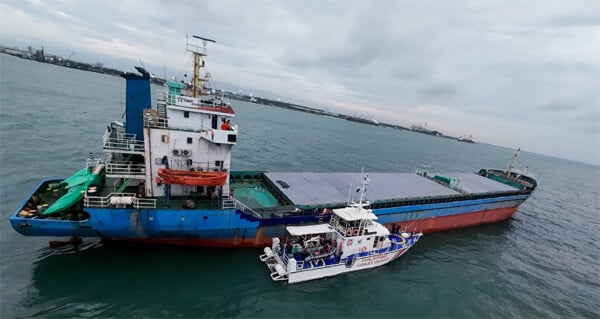
Crew was stranded aboard since April without pay and without food and water for the past month (Jam Jam Baronda)
The Philippines authorities worked with local crewing agencies and others to resolve a pay dispute and release a crew that had been stranded on a small cargo ship anchored in the Iloilo Strait. The crew, which had been signed on in April, was in a standoff with the owners who were refusing their pay, and provisions, until the ship departed, while the crew contended the vessel was unseaworthy.
A newly elected representative for Iloilo City, Julienne “Jam Jam” Baronda took an interest in the crew’s plight and intervened to negotiate the resolution. Six Filipino crew were removed from the vessel on June 30 and taken to a hotel, and are receiving medical evaluation before their repatriation, while seven Indian crewmembers were expected to leave the vessel on Tuesday, July 1.
The crew was signed on at the beginning of April by apparently a new owner of the 6,749 dwt general cargo ship. The vessel, which was built in 2005, was operated by Chinese owners till possibly 2024. Philippine media reports that the owner is now in the UAE, and the vessel is showing the name of Hirman Star, registered in the Comoros. Equasis and other databases show the vessel as Dong Hong Shun and the flag and manager as unknown.
The vessel arrived in the Philippines in August 2024 transporting bags of rice from Vietnam. The Philippines undertook a Port State Inspection and listed 27 deficiencies in a broad range of categories and issued a detention order. Reports indicate they questioned the seaworthiness of the vessel and found expired certificates.
The crew was changed twice, with the current crew coming aboard on April 3 and told to prepare for a voyage to Singapore. The Philippines lifted the detention order in April, and the Port Authority granted port clearance on May 7.
According to the media reports, the vessel was preparing to depart when the gyro compass malfunctioned. The captain contends the owners told the vessel to sail using just a magnetic compass, but the master refused, citing concerns. The crew also reported the vessel was listing and attempting to rectify the list, said they found a crack in the bulbous bow causing water ingress.
The standoff began with the crew refusing to sail saying the ship was unseaworthy. The owners stopped the delivery of food and water on May 12. Further, the reports said they only paid partial wages in April and none in May, saying the crew would not be paid until the vessel departed.
Philippine authorities were permitted to board the vessel to begin the reparation process (Jam Jam Baronda)
Baronda convened a meeting with the Philippines’ Department of Migrant Workers, the Overseas Workers Welfare Administration, as well as the Philippine Coast Guard, the Bureaus of Immigration and Customs, and MARINA on Monday, June 30. She also spoke with the crewing agencies and the vessel owner, who reportedly had a representative from the UAE in the Philippines.
An agreement was reached to settle the pay issues and to immediately provide provisions to the vessel. Baronda and other officials went to the vessel to meet with the crew. The Philippines is also providing financial assistance to the crewmembers and assisting with the reparations for the Filipinos. The Indian Embassy is assisting the Indian crew.
Multiple groups, including the International Transport Workers’ Federation (ITF), have been pushing for more action over issues of crew abandonment and enforcement of the terms of the master labor contract for seafarers. ITF warned in May that the industry is on track for a record number of abandonments unless action is taken.
New VDR Transcript Sheds Light on Xpress Pearl Disaster
The BBC World Service has obtained a previously unreported VDR transcript of what may be a series of conversations between the master of the burned-out container feeder XPress Pearl and shoreside managers. The document was filed by Sri Lanka's government in a case before Colombo's Supreme Court; the shipowner disputes the document's accuracy and completeness, and is contesting it in court proceedings.
The BBC's report appears to confirm initial accounts of a slow-rolling catastrophe that began long before XPress Pearl reached Sri Lanka in May 2021. It provides new details of the crew's attempts to respond to a leaking container of nitric acid, and the Russian master's growing frustration with the lack of a solution.
"About one liter an hour [leak rate from the container]. Remain the same. We're washing deck continuously by fire pump, seawater, because main deck too much corrosion . . . very strong chemical, very strong chemical," Russian master Vitaly Tyutkalo said. "If you will read my email, I sent to everybody, right, already three days fire pump running. But leakage remain on deck and maybe more and more corrosion."
After the call with the home office, he complained to a crewmember on the bridge that "they don't take any action, don't give me any advice," and claimed that company officials wouldn't take responsibility, the VDR transcript suggests.
Port officials at Hamad, Qatar and Hazira, India refused to provide a port-of-refuge service to unload the leaking boxes from Xpress Pearl, so the container ship sailed onwards to Colombo, Sri Lanka, a voyage of some 1,000 nautical miles southeast from Hazira. After arrival off Colombo, a container on deck caught fire, but local authorities refused to allow XPress Pearl to berth for firefighting operations. It burned and sank, releasing acids, caustic soda, 9,700 tonnes of epoxy resin and 1,680 tonnes of plastic pellets into the water (minus any amounts consumed by the fire). It is believed to be the largest plastic spill in history.
The master faces criminal charges in connection with the disaster and remained in Sri Lanka at least as recently as last year, free to live on the island but unable to leave until court proceedings have finished.
Wan Hai 503 is Structurally Compromised and Moved Out of Indian EEZ
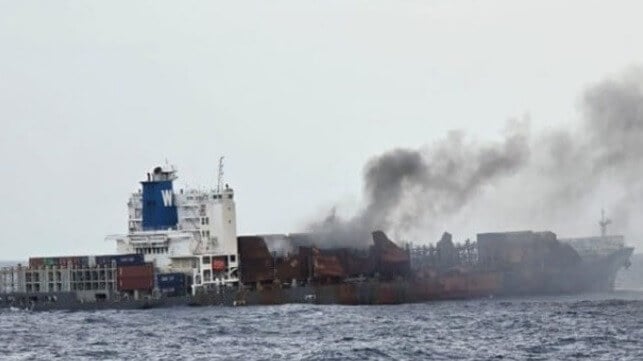
Wan Hai 503 is structurally compromise and has settled at the stern with flooding in its engine room (DSG)
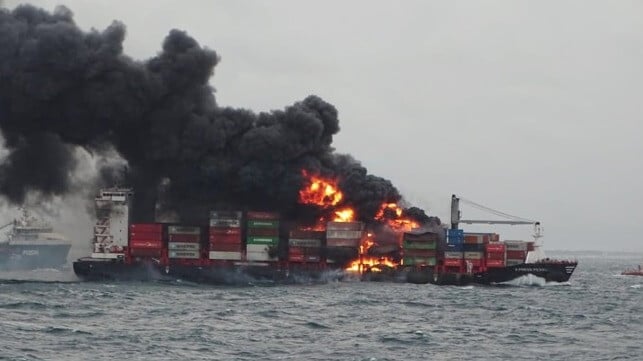
Weather concerns and the inability to stop the smoldering fire prompted the Indian authorities working with the private salvage team to move the Wan Hai 503 containership further away from the coastline. The vessel had been taken to a distance about 130 nautical miles west of the coast and over the weekend was due, weather permitting, to leave the Indian Exclusive Economic Zone (EEZ).
“The vessel remains in a structurally compromised but stable condition, with primary risks stemming from the persistent smoldering fire in Cargo Hold No. 4, the residual flooding within the engine room, and unpredictable weather patterns,” reports the Directorate General of Shipping. “High winds and swells have severely limited boarding operations, complicating firefighting and dewatering efforts.”
Three weeks after the fire was reported and the ship was abandoned on June 9, the fire is still burning in the area of Cargo Hold No. 4, with reports saying the deck area and cargo holds have collapsed permitting an airflow that continues to fuel the fire. Further complicating the situation in the area are collapsed containers. They are continuing boundary cooling and additional firefighting materials were due to reach the vessel today, June 30. Monitoring is showing persistent elevated temperatures within Hold No. 4.
The salvage team had been able to board the vessel and using portable equipment, pumped out approximately 500 to 800 cubic meters of water from the flooded engine room. The concern is that the stern continues to sit low in the water and the vessel is listing toward port, but they believe it still has about 76 percent structural stability of allowable sea forces.
The hope is to conduct further dewatering, but an attempt to board the vessel on Saturday, June 28, was unsuccessful due to unsafe conditions. The DGS reports moderate to rough sea conditions, winds ranging from 25 to 28 knots, and gusts to 42 knots in squalls.
India refused a port of refuge for the hulk and there was talk it would be towed to Colombo, Sri Lanka, but it is still pending formal clearance. Concerned about the environmental dangers, the Indian Authorities ordered the hulk towed further away from the coast, and as of Saturday, they had approximately 54 nautical miles remaining to exit the Indian EEZ.
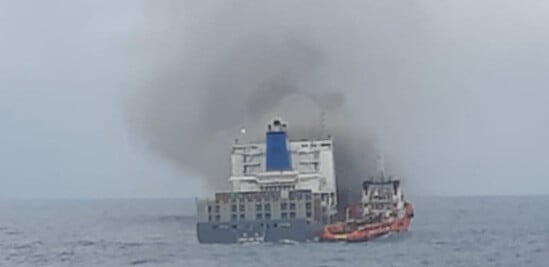
The vessel Offshore Warrior has two soft towlines attached and was making 2.9 knots. Pending improved weather conditions, they were also planning to add wire towlines. Also, with the additional firefighting material and improved weather, the goal was to enhance the fire suppression efforts and resume dewatering the hull.
Once the vessel clears the Indian EEZ, the efforts will depend mostly on the private salvage company hired by the owners. Indian’s Directorate General of Shipping says it will be reducing its role while providing routine updates to Singapore’s MPA as the flag state of the vessel.
Crewmember Dies Trying to Reach Shore After Tug Grounding Off Sulawesi
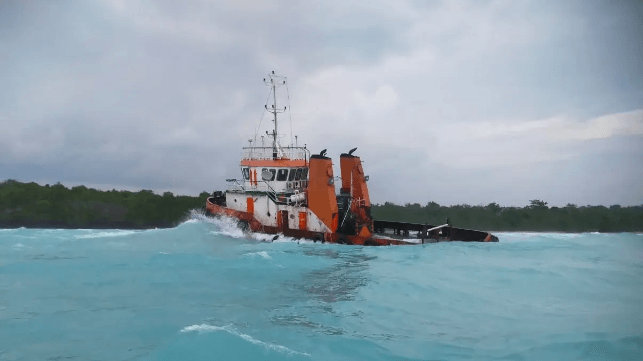
Waves batter Iska 1165 just off Buton Island, Indonesia (Basarnas Kendari)
One crewmember lost his life after a tug went aground at a remote beach in Southeast Sulawesi, according to rescue agency Basarnas.
On Friday night, the tug Iska 1165 was swept aground in foul weather and high waves just off the coast of Tanjung Goram, on the north end of the island of Buton. The vessel was swamped by heavy wave action, and the crew took action to get help.
At about 2230 hours, three crewmembers jumped over the side and attempted to swim ashore. One made it safely to dry land, another turned back to the tug because of the rough conditions and climbed aboard, and the third died in the attempt. His body was recovered in the early hours of the next morning.
The nearest SAR station was about 33 nautical miles away, and authorities received first word of the grounding at about 0200 hours Saturday morning. A team with a RIB got under way and arrived on scene at about 0540 hours.
Initial attempts to reach the six remaining crewmembers on the tug were not successful because of severe surface conditions, which prevented the RIB crew from approaching. The waves abated at about 0830, and all six crewmembers were safely evacuated. All were taken to a nearby health center for evaluation. The remains of the deceased crewmember - identified as Antonius Parantuan, 44 - were delivered to a hospital morgue.
Trump's Finnish Icebreaker Identified as the 32-Year-Old Fennica
THE GRIFTER GOT GRIFTED
Fennica (file image courtesy Marcusroos / CC BY SA 3.0)
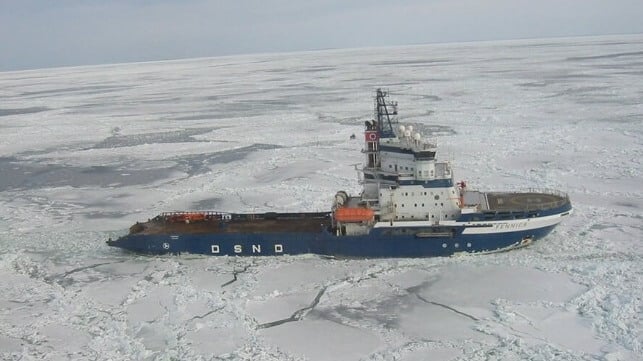
When President Donald Trump revealed that he is in negotiations with Finland's president to buy an "old" icebreaker, many observers assumed that he was considering the powerful and capable Polaris. It turns out that Polaris is not for sale, and the vessel under discussion is actually the 32-year-old Fennica - a well-known icebreaker that has worked previously off Alaska and has transited the Northern Sea Route. However, Fennica is six years older than the Coast Guard's own USCGC Healy, the aging medium icebreaker that the service wants to augment with another hull.
Fennica was delivered in 1993 for the Finnish Maritime Administration. Fitted with two azimuthing thrusters and four engines developing up to 28,000 horsepower, she is capable of breaking 30 inches of ice at nine knots, and can continuously break ice up to six feet thick without ramming. With a long open back deck, Fennica can carry up to 4,800 dwt worth of cargo and supplies. Her hull form is specially adapted for better seakeeping and less snap rolling than traditional icebreakers (known for a lack of seakindliness in open ocean).
As a working vessel, Fennica has a moderately successful history in the offshore sector, aided by her OSV-style layout and a massive 230 tonnes of bollard pull for rig repositioning. She has an endurance of about 45-65 days at sea, and can hold position in DP mode. However, her commercial prospects have been limited by her higher fuel consumption compared to conventional, non-icebreaking offshore service vessels.
According to Finnish outlet IS, U.S. officials are still in talks with their Finnish counterparts over the terms of a lease or purchase agreement for Fennica. As part of a package deal, the United States would also order two new icebreakers that would be built in Finland, according to the outlet.
Finnish employment minister Reko-Antti Suojanen told IS that the sale of the newer Polaris is not up for discussion.
Any acquisition plan for Fennica would require a budget appropriation from Congress; a used icebreaker acquisition is not currently in the White House's budget request, nor in the reconciliation bill currently before the Senate.
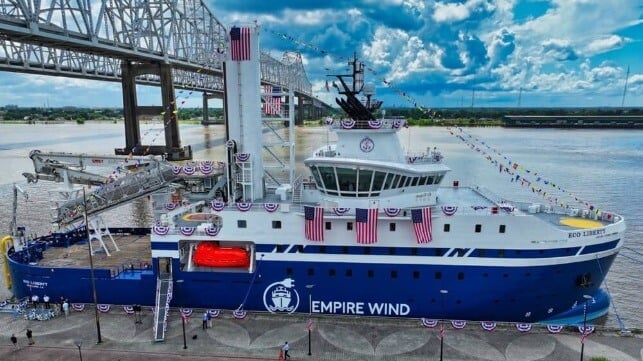
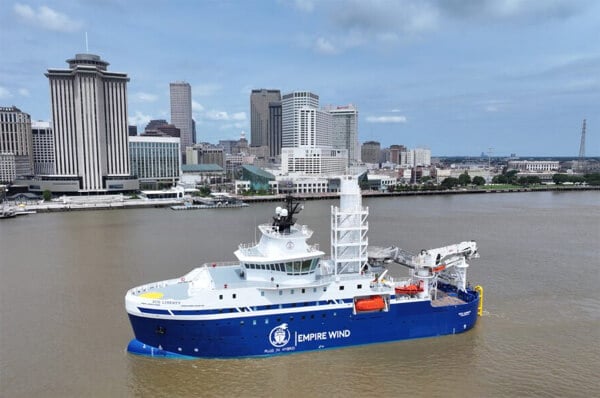
The next offshore service operation vessel (SOV), ECO Liberty, was christened to officially enter the U.S. fleet in support of the offshore wind sector. The vessel, which was completed in May, has been in jeopardy after the Trump administration suspended work on the Empire Wind project, but with work back underway, the vessel was named in New Orleans, Louisiana on June 28 by Louisiana’s First Lady Sharon Landry.
The 262-foot (80-meter) hybrid-powered ECO Liberty will be homeported at New York’s South Brooklyn Marine Terminal, where more than 2,000 workers are constructing the staging facility, O&M base, and control center for Empire Wind. The ECO Liberty will be deployed to support ongoing marine construction in the lease area and eventually serve as the floating home for Empire Wind’s skilled workers when stationed offshore.
The vessel is 5,700 GT. It provides accommodations for up to 60 workers and is designed to remain offshore at the site to support the construction and later maintenance operations.
The vessel was built by Edison Chouset Offshore, which continues to own the vessel through its offshore division. It will be operating on a long-term charter to Empire Wind, which is being developed by Equinor. Empire Wind is located 15 to 30 miles southeast of New York’s Long Island and spans 80,000 acres, with water depths of between approximately 75 and 135 feet. Offshore work started this spring for the project, which will have a capacity for 810 MW when completed.
ECO Liberty is the seventh U.S. registered vessel built for the Empire Wind project (Empire Wind)
The project had been placed in jeopardy when the Trump administration suspended its permits just as offshore work was due to begin. There was more than a month of political jockeying which included New York’s government Kathy Hochul and Norwegian government officials. The permit was restored after an agreement with New York for a new onshore energy pipeline.
Empire Wind highlights that the ECO Liberty is the seventh new US-flagged vessel added to the U.S. Jones Act-compliant fleet, because of the wind project. She has a sister ship, ECO Edison, which was completed a year ago and is operating under a long-term charter to Ørsted to play an integral part in the operation and maintenance of the South Fork Wind, Revolution Wind, and Sunrise Wind projects.
In 2023, President Joe Biden attended the first steel cutting at the Philly Shipyard for a future rock installation vessel to support the offshore wind industry. At the time, the president highlighted that companies had announced 18 offshore wind shipbuilding projects as well as investments of nearly $3.5 billion across 12 manufacturing facilities and 13 ports to strengthen the American offshore wind supply chain. The vessels ranged from the first Jones Act-compliant installation vessels to SOVs and crew transfer vessels. They are being built at shipyards ranging from Florida to Louisiana, New York, Massachusetts, Michigan, Rhode Island, Wisconsin, and Pennsylvania.
In addition to the SOVs at Edison Chouset, Fincantieri Bay in Wisconsin is building an SOV that will support Dominion's offshore wind farm in Virginia. Dominion is also preparing for the delivery of Charybdis, the massive turbine installation vessel being built by Seatrium AmFELS shipyard in Brownsville, Texas. The vessel began sea trials and jack up testing in early 2025. It will be used to install the turbines at the Coastal Virginia Offshore Wind (CVOW) project, which began offshore installation in 2024.
Denmark Grants Life Extension for Two Pioneering Wind Farms
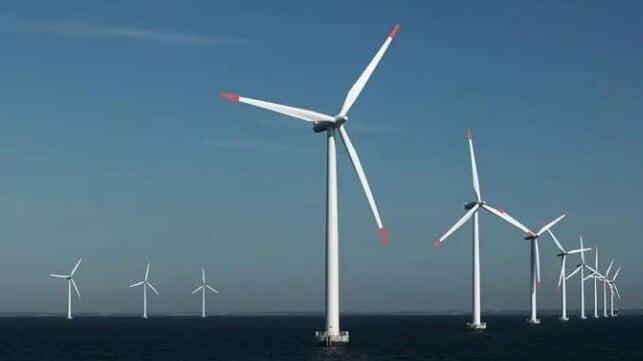
Denmark granted operating permit extensions for two pioneering offshore wind farms (Orsted)
Two of the pioneering offshore wind farms, which at the time were also the largest in the world, have been granted life extensions by the Danish Energy Agency. This marks the third offshore wind farm that Demarn was licensed for continued operations and represents a critical step for the industry, changing the economics of the properties and the sustainability of the industry.
The Danish Energy Agency has notified the owners of Nysted Offshore Wind Farm south of Lolland and Middelgrunden Offshore Wind Farm in Øresund that they will have their permit for electricity production extended. The owners of the properties had applied for the extensions, and after a review that required an impartial analysis of the remaining service life to be obtained. In addition, the owners are required, as part of the extension, to carry out an extended service inspection annually.
"It is positive that offshore wind turbines that are over 20 years old will have the opportunity to continue producing green electricity for many years to come," said Stig Uffe Pedersen, Deputy Director General of the Danish Energy Agency. “It is also sustainable from a resource perspective that the plant can continue to operate safely and responsibly for a longer period of time.”
These wind farms are seen as pioneering in the industry. They are considered to have laid the foundation for the development of the modern industry with its much larger capacity.
The Middelgrunden Offshore Wind Farm, owned by HOFOR and the Middelgrundens Vindmøllelaug, has, according to the agency, become a permanent part of the view for Copenhageners. Launched in 2000, just nine years after the first offshore wind farm was started by Ørsted, Middlegrundens at the time was the largest offshore wind farm with a location just 3.5 km off the coast of Copenhagen.
The owners applied for and have received a 25-year extension of the permit. The park's 20 turbines, each just 2 MW, supply a total of 40 MW.
It was surpassed three years later by the Nysted Offshore Wind Farm. It is 10 km south of?Nysted and has a total of 72 wind turbines. Nysted’s turbines are each 2.3 MW with a total output of approximately 166 MW. Nysted offshore wind farm is owned by Ørsted, PensionDanmark, and Stadtwerke Lübeck, which had applied for a 10-year life extension.
The Danish Energy Agency marks these steps as another advancement in the maturation of the industry and expanding its contributions. Earlier in June, the Danish Energy Agency approved the first-ever extension granted to the Samsø Offshore Wind Farm. This extension is valid for ten years.
When the Samsø Offshore Wind Farm was established in 2002, the industry standard for the electricity production permit was limited to 25 years. The ten-turbine park has a total capacity of 23 MW and was granted an extension to operate until 2037.
At the beginning of June, the Agency said it had also received applications from Rønland offshore wind farm (17.2 MW) and Horns Rev 1 offshore wind farm for life extensions. Horns Rev 1 was expanded in three phases to become one of the largest offshore wind farms, and together, all these farms still play a key role in energy generation for Denmark. Today, the country has 2.7 GW of installed offshore wind power generation and an ambitious goal to reach 14 GW by 2030.