Wednesday, July 02, 2025

'Matter of Life and Death': New Tracker Exposes Trump Regime's Attack on Disaster Preparedness


"It's only a matter of time before Trump and Musk's reckless assault on disaster response and preparedness kills people in the United States," said a researcher with government watchdog The Revolving Door Project.
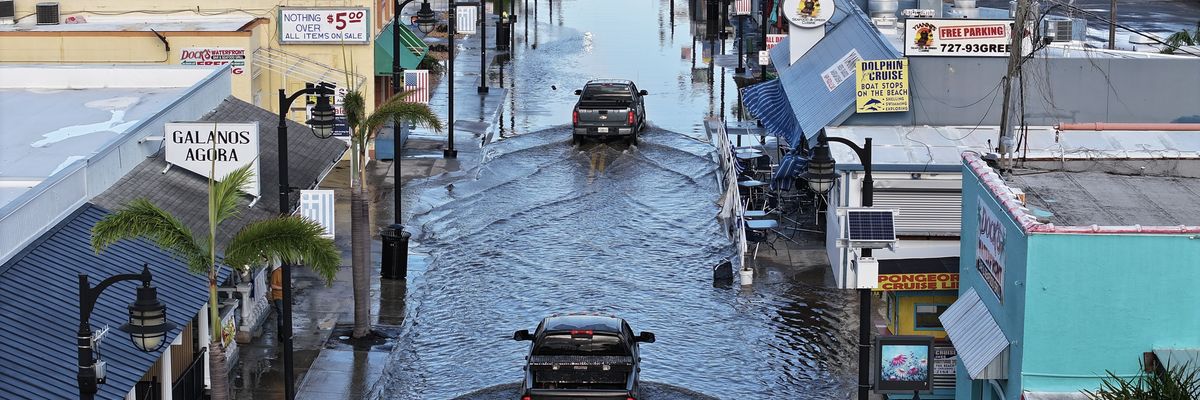


Flood waters inundate the main street after Hurricane Helene passed offshore on September 27, 2024 in Tarpon Springs, Florida. (Photo: Joe Raedle/Getty Images)

Brad Reed
Jul 02, 2025
COMMON DREAMS

President Donald Trump has openly stated his desire to dismantle the Federal Emergency Management Agency—a move that has left some experts fearful about how the United States will handle natural disasters such as hurricanes in the coming months.

The Revolving Door Project, a government watchdog group, has now put together a tracking tool to keep tabs on how much the administration's attacks on both FEMA and the National Oceanic and Atmospheric Administration have worsened the nation's disaster preparedness.

The tool has two components: An interactive map showing all of the state disaster aid requests that the Trump administration has outright denied or only partially approved and an interactive timeline documenting all of the times that the administration has undermined the functionality of America's disaster preparedness agencies through actions such as placing agency employees on administrative leave and disbanding key bodies such as FEMA's National Advisory Council and its National Dam Safety Review Board.

All of these disruptions and cuts, argued Revolving Door Project senior researcher Kenny Stancil, are likely to come back to bite America in a big way when another natural disaster strikes.

"It's only a matter of time before Trump and Musk's reckless assault on disaster response and preparedness kills people in the United States," he said in explaining the need for the initiative. "It nearly happened in mid-May in Kentucky, where a DOGE-damaged NWS forecast office had to scramble for staff before a tornado. Amid last week's heatwave, low-income households across the country were missing the federal support they need to keep the air conditioning on. And when a major hurricane arrives, Trump, Musk, OMB Director Russell Vought, Commerce Secretary Howard Lutnick, and DHS Secretary Kristi Noem will almost certainly have blood on their hands."

Revolving Door Project executive director Jeff Hauser issued a similarly dire warning about the administration's actions on U.S. disaster preparedness and he described the actions being taken by the administration as "a matter of life-and-death." He also accused the administration of "preventing forecasters and emergency managers at all levels from doing what is necessary to prepare for and respond to disasters."

Trump in the past has tried to use federal disaster relief money as a cudgel against his political opponents, such as when he threatened to withhold funding from California during catastrophic wildfires unless the state did a better job of "raking" its forests.

Hurricane expert sounds alarm that Trump's admin killed key weather satellites

Sarah K. Burris
June 26, 2025    
RAW STORY


Hurricane Milton as seen from the International Space Station (Screen cap via NASA)

Hurricane and storm surge expert Michael Lowry penned a column on Thursday, warning of a recent decision by President Donald Trump's administration to kill three weather satellites just as hurricane season is ramping up.

He wrote that on Monday, the U.S. Department of Defense announced it would "stop ingesting, processing, and transmitting data essential to most hurricane forecasts."

By Tuesday, the National Oceanic and Atmospheric Administration (NOAA) confirmed the news in a "a service change notice to all users," which included those monitoring the Atlantic's skies at the Hurricane Center.


"By next Monday, June 30th, they would no longer receive real-time microwave data collected aboard three weather satellites jointly run by NOAA and the U.S. Department of Defense," wrote Lowry.

The Atlantic's hurricane season begins June 1, but this week was the first time a named storm popped up in the ocean. Lowry noted on X that the accumulated cyclone energy (ACE) was extremely low and it dissipated by Wednesday. Being able to chart that information in the future might be more difficult without access to the data gathered by the three satellites. Those three provide about half of all forecasters with scans needed to track and predict hurricanes.

The specific information gathered comes from the Special Sensor Microwave Imager Sounder (SSMIS), wrote Lowry. The loss of information runs the risk of forecasters missing an increase in hurricane severity when the sun comes up.

"Since hurricanes form and strengthen over the open water where direct observations are scarce or nonexistent, forecasters rely largely on data remotely gathered from satellites," explained Lowry. "While hurricane hunting airplanes help to close that gap, they’re only available for about 1 in every 3 hurricane forecasts in the Atlantic and virtually none – except for a handful of stronger storm exceptions – in the Pacific.

Traditional satellites lack the capability for forecasters to look beneath the clouds and access the key data necessary to make accurate predictions. Lowry described it as similar to an MRI scan for the storm. Sometimes an X-ray or physical exam is fine, while other injuries or diseases require more information.

Retired National Hurricane Center branch chief James Franklin, told Lowry, “Their loss is a big deal."

Until his retirement in 2017, Franklin oversaw all of the hurricane forecasters in the NHC/

“Without this imagery, there will be increased risk of a ‘sunrise surprise,’ the realization from first-light images that a system had become much better organized overnight, but it wasn’t recognized because structural details are so hard to discern from [infrared satellite]," he said.

At the start of hurricane season earlier this month, Miami meteorologist John Morales‬ showed a clip of a 2019 storm where he assured those on the east coast of Florida that the hurricane would turn. Given the budget cuts at NOAA and the NHC, Morales warned his audience that he would not have enough information to be certain.

"I'm here to tell you I'm not sure I can do that this year. Because of the cuts — the gutting, the sledgehammer attack on science, in general, and I could talk about that for a long, long time and how that's affecting the leadership and science over the years and how we're losing that leadership, and that is a multi-generation impact on science in this country," he said.

This year, more meteorologists will be forced to tell their audiences that, due to budget cuts, they have a lack of certainty. Information like that helps people decide whether or not they should flee the area.

Those at the National Hurricane Center are now preparing to suddenly handle the next few months without the critical forecast data they need for predictions. Now, Lowry wrote, the weather and climate community is "scrambling to understand the rationale behind the abrupt termination." No one seems clear on why the real-time data would be cut.

All of the states along the Gulf Coast and the Southeast Coast are states that supported Donald Trump in the 2024 presidential election. They will now be the states most impacted by the budget cuts, according to experts.

Read Lowry's full column on his Substack here.
'It's insane': Family of Texas 4-year-old hit with $1.4K bill for measles shot

 KFF Health News
June 30, 2025 


As the West Texas measles outbreak spread, Thang Nguyen of Galveston worried about his 4-year-old son, Anh Hoang, who had received only the first of the measles vaccine’s two doses. Nguyen took his family to a primary care clinic, where his son got his second shot. He was surprised when his insurer did not cover the vaccine — and its $1,400 price tag. (Scott Dalton for KFF Health News)

In the early days of the West Texas measles outbreak, Thang Nguyen eyed the rising number of cases and worried. His 4-year-old son was at risk because he had received only the first of the vaccine’s two doses.

So, in mid-March, he took his family to a primary care clinic at the University of Texas Medical Branch in Galveston.

By the end of the visit, his son, Anh Hoang, had received one shot protecting against four illnesses — measles, mumps, rubella, and chickenpox. He also received a second shot against tetanus, diphtheria, and whooping cough, as well as a flu shot. His twin daughters, who had already had their measles vaccinations, got other immunizations.

Nguyen, who is a UTMB postdoctoral fellow in public health and infectious disease, said he asked clinic staff whether his family’s insurance would cover the checkups and immunizations. He said he was assured that it would.

Then the bills came.

The Medical Procedure

The first measles vaccine was licensed in 1963 and became part of the combination measles, mumps, and rubella, or MMR, vaccine in 1971. Today the vaccine against chickenpox, or varicella, is sometimes combined into what is known as the MMRV vaccine.

A first dose of the measles vaccine is usually given between 12 and 15 months, with a second between ages 4 and 6. Experts may recommend vaccinating children at younger ages during an outbreak — like the ongoing U.S. measles outbreak, which has led to more than 1,200 cases, 750 of them in Texas. According to the Centers for Disease Control and Prevention, 95% of the cases have occurred in unvaccinated people or those whose vaccine status is unknown.

Recommendations affecting administration and insurance coverage are made by the Advisory Committee on Immunization Practices. In mid-June, Health and Human Services Secretary Robert F. Kennedy Jr. replaced the committee, adding vaccine skeptics. The new panel, which met last week, is expected to scrutinize past recommendations, including for the MMR vaccine.


The Final Bill

UTMB billed $2,532 for the boy’s office visit and three shots. The MMRV shot alone was billed at $1,422, plus $161 for administering it.

The Billing Problem: Coverage Gaps and Provider ‘Errors’

There are guardrails in the U.S. health system intended to prevent recommended vaccines from being prohibitively expensive. They did not help the Nguyen family.

Their health plan, purchased from insurance broker TaiAn for Nguyen’s wife and children and administered by the International Medical Group, does not cover immunizations. And, initially, the family was not offered assistance under the Vaccines for Children Program, a federally funded effort, created after a measles outbreak more than 30 years ago, that provides free immunizations for uninsured and underinsured children.

So the family was exposed to the sticker shock of U.S. medical care without insurance, with providers setting prices. In this case, UTMB’s price for the child’s MMRV shot was about $1,400, more than five times what the CDC says it costs in the private sector.


Nguyen was surprised when their insurer did not pay anything, leaving bills for his three children’s checkups that, combined, were close to $5,000.

He said the family’s income, from his job in UTMB’s labs, is less than $57,000 a year. Nguyen’s job provides him health insurance, but he balked at the $615 a month it would cost to cover his family, too, and instead purchased the one-year policy from TaiAn, which totaled $1,841. The policy covers certain types of office visits, emergency room care, hospitalization, and chemotherapy, but not immunizations or checkups.

Nguyen and his wife, who are from Vietnam, are living in the country on temporary visas while he completes his studies. In Vietnam, Nguyen said, the total cost of the preventive care his family received at the clinic would probably be no more than $300.

He was concerned about the high prices set by the clinic for the vaccines, particularly during a measles outbreak.

“It’s insane,” he said.

Carly Kessler, a spokesperson for International Medical Group, confirmed in an email to KFF Health News that the family’s plan does not cover preventive care, including immunizations.

After UTMB was contacted by KFF Health News, its vice president of clinical contracting strategies, Kent Pickering, looked into the matter. “This situation should not have happened” but did so because of “a series of errors,” he said in an interview.

Most insurance offered in the U.S. must cover, without copays, a variety of preventive care services — including the measles vaccine — under rules in the Affordable Care Act. But some plans are exempt from those rules, including short-term plans or travel insurance. International students on temporary visas do not have to buy an ACA-compliant plan during their first five years in the country.

But what about the cost of the vaccines?

Hospitals and other providers may set their own prices for services, creating price lists called chargemasters. Insurers negotiate discounts for services they agree to cover. People with no insurance coverage are generally on the hook for the full amount.

“One of the most frustrating parts of our health care system is that people who don’t have health insurance coverage have to pay far more than even a health insurance company would pay,” said Stacie Dusetzina, a professor of health policy at Vanderbilt University Medical Center.

While prices can vary, the CDC’s Vaccines for Children Program price list shows the MMRV vaccine — also known by the brand name ProQuad — costs about $278 in the private sector. Consumer prices for ProQuad at Galveston-area pharmacies range from about $285 to $326, according to the prescription cost-tracking website GoodRx.

UTMB’s Pickering told KFF Health News that, initially, the Nguyen family’s insurance was entered incorrectly by the clinic staff, so they did not pick up that his plan didn’t cover vaccines. If they had, UTMB likely would have checked whether the Texas Vaccines for Children Program would cover the cost of the shots, charging only the program’s small administration fee.

A second error was uncovered when Pickering looked into the bill. He said UTMB’s chargemaster had been updated a few months earlier and the vaccine prices for those who do not receive shots through the children’s vaccine program were listed at incorrectly high amounts, resulting in the price Nguyen’s son was charged.

Pickering said the prices had been corrected, though he declined to cite exact figures.

The Resolution

In addition to contacting the insurer, Nguyen reached out to the financial offices at UTMB, asking for a reduction or waiver of the fees.

In mid-May, UTMB sent Nguyen a revised bill for his son’s office visit. It applied a 50% self-pay discount, which its website says is offered to those who are uninsured. His revised total was $1,266, $711 of which was for the MMRV vaccination.

“I expected them to waive the vaccination cost for my children or at least reduce it more, especially for MMRV vaccine,” said Nguyen, noting that his family would still be strapped trying to pay their bills.

After Pickering spoke with KFF Health News, a customer service representative reached out to Nguyen, waiving the cost of the vaccines. His new bill was $202.75 for his son’s office visit, as well as similarly smaller amounts for his daughters’ medical care.

The Takeaway

More Bill of the Monmth
A Medicaid Patient Had a Heart Attack While Traveling. He Owed Almost $78,000.May 29, 2025
The Patient Expected a Free Checkup. The Bill Was $1,430.Apr 30, 2025
He Had Short-Term Health Insurance. His Colonoscopy Bill: $7,000.Mar 28, 2025More from the series

Medical billing experts say it’s always a good idea to check with your insurer before elective treatments like checkups or vaccinations to find out what is covered and how much you might owe.

International students and others who purchase non-ACA-compliant plans, such as short-term coverage, should carefully review their benefits, because there are often limitations.

For some services, including vaccinations, there may be lower-cost options.

Constance Almendarez, the immunization manager for the Galveston County Health District, said in an email that many public health departments, including Galveston’s, offer free vaccinations through the children’s vaccine program to those 18 and under who are eligible, including people without insurance or whose insurance does not cover vaccines.

But those programs are potentially threatened as the Trump administration institutes layoffs of federal workers and moves to cancel grants to health departments.

Finally, you can ask for a discount. Medical providers may offer self-pay discounts for patients who are uninsured or underinsured, or charity care policies to those who meet specified income requirements.

Bill of the Month is a crowdsourced investigation by KFF Health News and The Washington Post’s Well+Being that dissects and explains medical bills. Since 2018, this series has helped many patients and readers get their medical bills reduced, and it has been cited in statehouses, at the U.S. Capitol, and at the White House. Do you have a confusing or outrageous medical bill you want to share? Tell us about it!KFF Health News is a national newsroom that produces in-depth journalism about health issues and is one of the core operating programs at KFF—an independent source of health policy research, polling, and journalism. Learn more about KFF.

Subscribe to KFF Health News' free Morning Briefing.

This article first appeared on KFF Health News and is republished here under a Creative Commons license

.
'Downright Orwellian': In Midst of Planetary Emergency, Trump Admin Takes Down Website Hosting Influential US Climate Report

"This is the modern version of book burning," said one scientist.


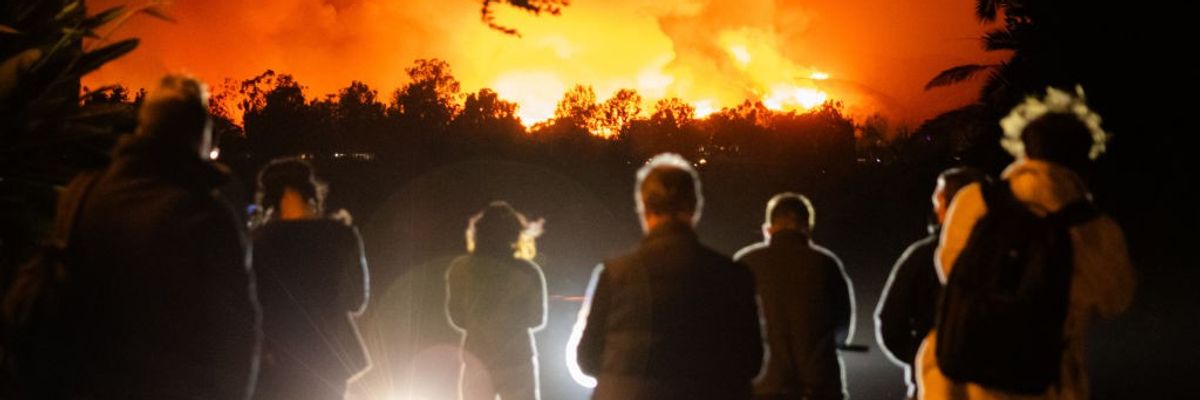
People watch the smoke and flames from the Palisades Fire in the Pacific Palisades neighborhood on January 7, 2025 in Los Angeles, California.
(Photo: Tiffany Rose/Getty Images)


Eloise Goldsmith
Jul 02, 2025
COMMON DREAMS

Amidst an ever-worsening climate emergency, the Trump administration this week took down the website hosting the U.S. government’s preeminent climate assessment, sparking outcry from experts who have worked previous versions of the report.

Considered the definitive body of research about how planetary warming is transforming the nation, the National Climate Assessment—which is required by Congress to be published every few years—gives a rundown of how global warming is impacting different sectors of the economy, ecosystems, and communities.

The five assessments that have been published so far were previously available through the website globalchange.gov, but the address stopped working Monday afternoon, according to The New York Times. As of Wednesday morning the website was still down.

However, it is still possible to access some of the climate research. The fifth assessment is available through the National Oceanic and Atmospheric Administration. An archived version of the fifth assessment is also available via Internet Archive's Wayback Machine. According to a NASA spokesperson who spoke to NPR, all five editions of the assessment will also be available on NASA's website, though it's not clear when.

"It's critical for decision-makers across the country to know what the science in the National Climate Assessment is. That is the most reliable and well-reviewed source of information about climate that exists for the United States," Kathy Jacobs, a University of Arizona climate scientist who coordinated the 2014 version of the assessment, toldThe Associated Press.

"This is evidence of serious tampering with the facts and with people’s access to information, and it actually may increase the risk of people being harmed by climate-related impacts," she added.

“They're public documents. It's scientific censorship at its worst," said Peter Gleick, a California water and climate scientist who worked on the version of the assessment published in 2000, toldThe Los Angeles Times. "This is the modern version of book burning."

Howard Crystal, legal director of the Center for Biological Diversity's energy justice program, said in a statement on Tuesday that "it's downright Orwellian for the Trump administration to take the nation's premier climate reports and just yank them offline."

"Hiding these congressionally mandated reports won't make climate change go away, but it will leave Americans uninformed and unprepared," he said.

Earlier in April, the Trump administration enacted cuts to the U.S. Global Change Research Program, which oversees the production of the National Climate Assessment, and later that month dismissed hundreds of scientists and experts working on the next version of the report, the 6th National Climate Assessment.

Meanwhile, a new budget document outlining fiscal year 2026 spending for the National Oceanic and Atmospheric Administration (NOAA) details deep cuts to climate research at the agency, including the elimination of the Office of Oceanic and Atmospheric Research, though some of its activities would be transferred to the National Ocean Service and the National Weather Service.

The budget proposal "eliminates all funding for climate, weather, and ocean Laboratories and Cooperative Institutes. It also does not fund Regional Climate Data and Information, Climate Competitive Research, the National Sea Grant College Program, Sea Grant Aquaculture Research, or the National Oceanographic Partnership Program," according to the document.

With the termination of Climate Competitive Research, which funds academic institutions to do climate-related research, "NOAA will no longer support climate research grants," the document also states.

"That's it—with that statement, the administration signals its intent to have NOAA, arguably the world's leading oceanic and atmospheric governmental organization, completely abandon climate science," wrote Alan Gerard, a meteorologist who previously worked for NOAA.
Rights Defenders Denounce Trump-DeSantis Alligator Alcatraz as 'Direct Assault on Humanity'

"This facility echoes some of our nation's darkest history," said a civil liberties advocate.


U.S. President Donald Trump and Florida Gov. Ron DeSantis tour a migrant detention center dubbed “Alligator Alcatraz” in Ochopee, Florida on July 1, 2025. (Photo: Andrew Caballero-Reynolds/AFP via Getty Images)

Brad Reed
Jul 02, 2025
COMMON DREAMS

Civil liberties advocates expressed horror on Tuesday after President Donald Trump and Florida Gov. Ron DeSantis held a joint press event at a massive new detention facility in the Florida Everglades known as "Alligator Alcatraz."

The facility was first announced last month when Republican Florida Attorney General James Uthmeier unveiled a plan to renovate the Dade-Collier Training and Transition Airport and transform it into a mass detention center for immigrants. During a press event touting the new facility, DeSantis boasted that detainees being held at the facility had little hope of ever escaping given that it was surrounded by miles of alligator-infested swamps.

"What'll happen is you'll bring people in there, they ain't going anywhere once they're there unless you want them to go somewhere, because, good luck getting to civilization," he explained. "So the security is amazing—natural and otherwise."

Civil liberties advocates were appalled by the new facility, which is lined with razor-wire fence and is projected at least initially to house 5,000 beds for immigrants awaiting deportation. Bacardi Jackson, the executive director of the American Civil Liberties Union of Florida, accused Trump and DeSantis of engaging in wanton cruelty with their touting of the new facility and said it harkened back to dark chapters in American history.

"Building a prison-like facility on sacred indigenous land in the middle of the Everglades is a direct assault on humanity, dignity, indigenous sovereignty, and the constitutional protections we all share," she said. “Our laws—both U.S. and Florida—prohibit cruel and unusual punishment. Yet, this facility echoes some of our nation's darkest history, all while trampling the very land that indigenous communities have long fought to protect."

She added that "the facility's opening also comes as Congress is poised to authorize $45 billion in funding to expand the harmful mass immigration detention machine, right on the heels of multiple deaths in detention facilities" and further said that the project "dehumanizes people, strips them of their rights, and diverts public dollars from the services our communities need."

Guardian correspondent Robert Tait, meanwhile, described the press event surrounding the facility's opening as a "calculatedly provocative celebration of the dystopian" in a place that was designed to be "a location of dread to those lacking documentary proof of their right to be in the U.S."

Former CNN anchor Jim Acosta delivered an even more scathing denunciation of the facility on his Substack page, labeling it a "gulag in the swamp" that was intended to distract Trump supporters from the Republican Party's efforts to take an axe to Medicaid spending in their budget bill.

"Trump knows he can salvage a bad news cycle in conservative media if he can find new and, in this case, medieval ways to torment immigrants," Acosta explained. "Distract the base from Medicaid coverage they're going to lose or the skyrocketing deficits plaguing future generations by conjuring up the fantasy of terrified migrants being eaten by alligators—a prospect that seemed to delight Trump when speaking with reporters Tuesday morning."

Amid growing condemnation of the facility, Trump adviser Stephen Miller encouraged other states to pitch their own ideas for migrant detention facilities during a Tuesday night Fox News appearance. What's more, Miller said that accepted proposals from states would receive funding from the very same GOP budget bill that is projected to slash Medicaid spending by over $1 trillion over a 10-year period.

Stop Alligator Alcatraz Now, Before They Build Another in a Remote Area Near You

America stands at a crossroads. Down one road lies the fragile promise of democracy: messy, imperfect, but built on the belief in human dignity and the rule of law. Down the other lies the swamp—where cruelty is policy, and fear is law.


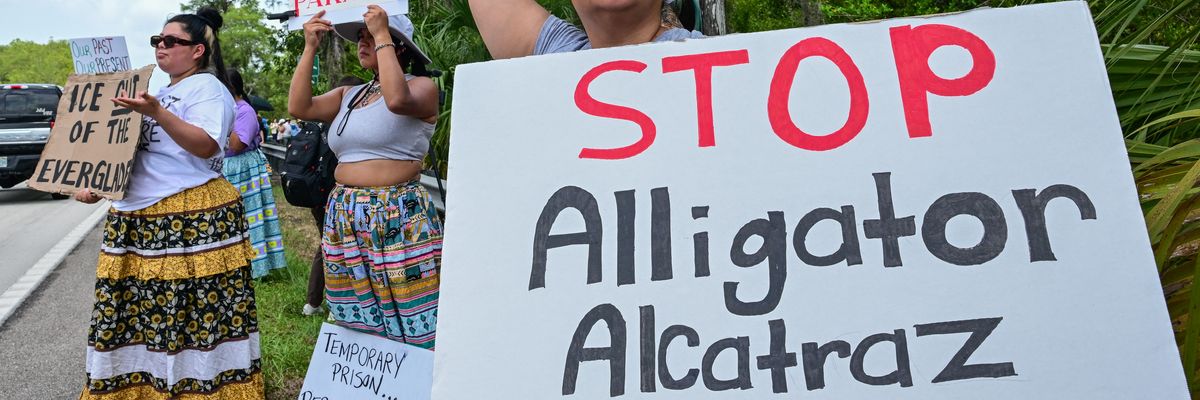
Demonstrators protest the construction of an immigrant detention center, dubbed "Alligator Alcatraz," in the Everglades near Ochopee, Florida, on June 28, 2025.
(Photo: Giorgio Viera/AFP via Getty Images)


Thom Hartmann
Jul 02, 2025
Common Dreams

When Louise and I lived in Germany in 1986-87, we visited Dachau with our family. The crematoriums shocked our children, but even more so because this was simply a “detention facility” and not one of Hitler’s death camps. The ovens were for those who had been worked to death or killed by cholera.

The death camps, it turns out, were all located outside of Germany so Dear Leader could deny responsibility for them. You know, like Gitmo.

Trump’s “Big Beautiful Bill” (aka the “GOP Donor Fellatio Act”) contains a 13-fold increase in Immigration and Custom Enforcement’s budget, turning it into the largest single (secret, masked) police force in America, along with, in aggregate, close to $100 billion to build a new series of “detention facilities” all across America.

The most dangerous thing about Alligator Alcatraz isn’t the alligators. It’s the message.

If this passes, soon the country will pockmarked by concentration camps. As Trump said yesterday:
Well, I think we'd like to see them in many states, really, many states. This one, I know Ron’s doing a second one, at least a second one, and probably a couple of more. And, you know, at some point, they might morph into a system where you’re going to keep it for a long time.

Let’s stop pretending. Let’s stop dancing around the language, around the morality, and around the history.

What’s being built in the Florida Everglades, for example—what they’re calling “Alligator Alcatraz”—is not just another immigration facility. It’s a political prison engineered not merely to detain, but to humiliate, dehumanize, and broadcast terror.

It’s America’s first open-air symbol that our democracy is not just dying: it is being dissected publicly, cruelly, and with calculation.

Donald Trump is back in the White House. The Republican Party controls Congress. And with a permanent “immigration emergency” in place, Florida Gov. Ron DeSantis is running point on an experiment in authoritarian governance.

Alligator Alcatraz is the proof-of-concept.

Rising in a remote wildlife preserve in Big Cypress National Preserve—Indigenous land, no less—Alligator Alcatraz is expected to hold thousands of undocumented migrants. Some reports say 1,000 at launch; others say 5,000. Either way, it is the largest civilian detention project built on U.S. soil in a generation.

It’s surrounded by dense marshland, home to pythons and alligators.
“Let them try to escape,” Trump smirked at a recent rally. “They better know how to run from an alligator.”

This isn’t just cruelty. It’s performance. It’s state-sponsored sadism, broadcast as patriotism. DeSantis and Trump are now competing in a bizarre effort to show who can be more cruel.

But it’s not unprecedented. If you want to understand what’s happening in Florida, you have to travel back to 1933, to a small, remote town in Bavaria.

When Adolf Hitler seized power in Germany, the first thing he built wasn’t a tank or a warship. It was a “detention facility.”

The Dachau concentration camp, opened in March 1933 just three months after he became Chancellor, was described at the time as “the first concentration camp for political prisoners.” As the Dachau memorial site explains,
From the very beginning, the camp was a place of brutality. During the first years, most prisoners were political opponents of the Nazi regime.

They weren’t criminals. They weren’t traitors. They were “undesirable immigrants.” Trade unionists. Communists. Jews. Catholics. Writers. Teachers. Students. They were anyone the regime considered a threat or a convenient enemy.

The Nazis didn’t hide Dachau. They advertised it. It was a warning. A message. Step out of line, and this is where you go.

Sound familiar?

Alligator Alcatraz is not Dachau. It’s not exterminating people. Yet. But Dachau didn’t begin as a death camp either. It began as a “protective custody” facility, built on the idea that “certain people” posed a threat to the national body simply by existing.

That’s what Florida’s new facility represents. Not immigration enforcement. Not public safety. Protective custody for political purposes.

Under Trump’s new national emergency framework, virtually anyone deemed “unlawfully present” can be detained indefinitely without trial.

That means asylum-seekers. Victims of trafficking. Children.

And if you believe this won’t expand—if you believe this power will remain solely focused on brown-skinned migrants fleeing violence in Central America—then you haven’t read a history book lately.

Stripping people of their citizenship is called denaturalization, and it was one of Hitler’s favorite tools against his enemies and Jews, who were referred to as “undesirable foreign elements” and denaturalized en masse in 1935.

Trump’s DOJ just updated their guidelines relating to the 25 million American citizens who first came to this country as immigrants and then obtained citizenship through the naturalization process. It used to be that you could only lose your citizenship if you committed a serious enough crime.

And, yesterday, Trump said:
Many of them were born in our country. I think we ought to get them the hell out of here, too, if you want to know the truth. So maybe that'll be the next job that we'll work on together.


So now, the DOJ says, Trump can choose to denaturalize anybody and then immediately send them to Alligator Alcatraz:
“Any other cases referred to the Civil Division that the Division determines to be sufficiently important to pursue [may be stripped of citizenship]. These categories are intended to guide the Civil Division in prioritizing which cases to pursue; however, these categories do not limit the Civil Division from pursuing any particular case, nor are they listed in a particular order of importance. Further, the Civil Division retains the discretion to pursue cases outside of these categories as it determines appropriate. The assignment of denaturalization cases may be made across sections or units based on experience, subject-matter expertise, and the overall needs of the Civil Division.” (emphasis added)


And as a special bonus, the memo notes that stripping American citizens of their citizenship is a civil, not criminal, process so you are not entitled to have a lawyer or any of the other normal aspects of legal procedure like a trial that we generally think of as our rights. Franz Kafka would be proud.

Dachau didn’t just hold communists. Over time, it expanded to include denaturalized Jews, homosexuals, Jehovah’s Witnesses, Roma, and anyone who opposed Nazi policy. It became a national crucible of cruelty. It normalized the idea that “certain people do not deserve legal protections.”

That is the fire that Alligator Alcatraz is stoking today.

How is this being done? Through a cunning abuse of emergency powers.

Florida has been under a rolling immigration “state of emergency” since 2023, a legal status that allows the governor to bypass environmental protections, override public procurement processes, and redirect funds without oversight.

Sound familiar? It should. The Nazis used the 1933 Reichstag Fire Decree to grant themselves emergency powers in perpetuity. One crisis, one convenient boogeyman, and suddenly all democratic guardrails are removed.

Today, DeSantis is using Federal Emergency Management Agency funds intended for hurricane victims to build migrant cages. Tomorrow, it could be protesters. Journalists. Teachers. You.

This isn’t alarmism. It’s precedent.

Let’s talk about the location, because it matters.

Big Cypress is a remote and largely inaccessible swamp, home to endangered species, sacred Indigenous land, and—now—a prison surrounded by natural predators.

Human rights lawyers and journalists will find it hard to access. Escapes will be all but impossible. Oversight will be nonexistent. That’s by design.

Dachau, too, was deliberately chosen for its isolation. As the memorial website explains:
The camp was constantly expanded and served as the prototype and model for all later concentration camps.


It became a template. A blueprint. And its very existence reshaped what the German public considered “normal.”

Alligator Alcatraz is the same. A testing ground. If it succeeds—not as a legal institution, but as a political spectacle—there will be more. One in Texas. One in Arizona. One in Arkansas. Maybe even one in your backyard.

The most dangerous thing about Alligator Alcatraz isn’t the alligators. It’s the message.

The message that some people are less than human. That caging them is acceptable. That they deserve no rights, no hearing, no compassion. Just mud and barbed wire.

That was the logic behind Dachau.

And it’s becoming the logic behind Trump’s America.

This facility is being built not to solve a problem, but to create one. To manufacture outrage. To train the public to see brown-skinned immigrants not as workers or families or survivors but as invaders. Intruders. Animals.

And that’s when the door opens for something far worse.

We cannot afford to wait. We cannot afford to be polite. The time for half-measures and technocratic rebuttals and “strongly worded letters” is over.

America stands at a crossroads. Down one road lies the fragile promise of democracy: messy, imperfect, but built on the belief in human dignity and the rule of law. Down the other lies the swamp—literal and figurative—where cruelty is policy, and fear is law.

Alligator Alcatraz isn’t just a prison. It’s a mirror. And it’s asking us: Who are we, really?

The answer, as always, is up to us.

We must engage:Lawsuits: Civil liberties groups and Indigenous tribes must continue challenging this facility in court. Environmental statutes, tribal treaties, and international human rights laws can still be leveraged.
Documentation: Journalists must risk everything to document the construction, conditions, and policies of Alligator Alcatraz. We need eyes in the swamp, or darkness will reign.
Direct Action: Peaceful protest, civil disobedience, and national mobilization must become central. This is a fight for the moral compass of our country.
Language: Stop calling this a “detention center.” Call it what it is: a political prison. A migrant concentration camp. Words matter.
History: Teach your neighbors about Dachau. Show them how it started. Not with mass extermination, but with silence. With a single camp, surrounded by a fence, where people were put “for their own protection.”

Democracy doesn’t fall all at once. It decays from the inside. It erodes at the margins. It disappears not with a bang, but with a shrug.

The United States of America has reached a threshold. We can step back and reaffirm our commitment to human dignity, to due process, to liberty and justice for all.

Or we can cross into the swamp. And never come back.

Dachau was the beginning of something monstrous. Let Alligator Alcatraz be the end of something: the end of our innocence, the end of our complacency, and the start of a renewed resistance.

Because if we wait too long, we may wake up one day and discover we are no longer the land of the free, but only the home of the caged.

Our work is licensed under Creative Commons (CC BY-NC-ND 3.0). Feel free to republish and share widely.


Thom Hartmann
 is a talk-show host and the author of "The Hidden History of Monopolies: How Big Business Destroyed the American Dream" (2020); "The Hidden History of the Supreme Court and the Betrayal of America" (2019); and more than 25 other books in print.
Full Bio >

'People are going to die': Rain floods 'hurricane proof' Alligator Alcatraz

Jennifer Bowers Bahney
July 2, 2025 
RAW STORY


U.S. President Donald Trump visits a temporary migrant detention center informally known as "Alligator Alcatraz" in Ochopee, Florida, U.S., July 1, 2025. REUTERS/Evelyn Hockstein


New video showed a "garden-variety South Florida summer rainstorm" flooding tents and drowning out Gov. Ron DeSantis (R) as he touted the "Alligator Alcatrez" detention facility he claimed was ready to house deportees, according to The Miami Herald.

Rain began shortly after President Donald Trump finished up his tour of the Everglades facility that the White House claimed needed little security due to pythons and alligators surrounding it, the report said.

"The water seeped into the site — the one that earlier in day the state’s top emergency chief had boasted was ready to withstand the winds of a 'high-end' Category 2 hurricane — and streamed all over electrical cables on the floor," wrote reporters Syra Ortiz Blanes, Ana Ceballos, and Alex Harris.


They quoted Kevin Guthrie, executive director of the Florida Division of Emergency Management, as saying, “For those people that don’t think we’re taking that into consideration. This is Florida, by the way. We have a hurricane plan.”

But The Herald reported "that at one point the roof was shaking as the rain pounded down, drowning out Gov. Ron DeSantis’ voice as he spoke to reporters."

Spectrum News reporter Jason Delgado posted video of the flooding, and of DeSantis trying to talk over the cacophony.


"A good lil storm passed over us here at 'Alligator Alcatraz,’" Delgado posted. "Here's what it looks & sounds like inside one of these tents. The state says the sites here are rated to withstand a category two hurricane (~120mph winds)."

Liberal commentator Christopher Webb also posted video of the flooding, writing, "It’s costing taxpayers $450 million annually and Alligator Alcatraz concentration camp is already flooding. Imagine a hurricane. People are going to die. There’s always enough money to hurt folks, but when it comes to public transit, low-income housing, schools, or public healthcare, 'Sorry, we’re broke.'”

In a follow-up post, Delgado included a statement by the Florida Division of Emergency Management, saying "they’ve taken action to address the water leaks that happened Tuesday during a thunderstorm at ‘Alligator Alcatraz.’"

The statement read, “Overnight, the vendors went back and tightened any seams at the base of the structures that allowed water intrusion during the heavy storm, which was minimal.”


'Magical thinking': Ex-treasury secretaries tear into Trump over 'chaos' policy
Adam Nichols
July 2, 2025 
RAW STORY


U.S. President Donald Trump gestures towards the crowd at an event about the economy, at the Circa Resort and Casino in Las Vegas, Nevada, U.S., January 25, 2025. REUTERS/Leah Millis

A pair of former treasury secretaries who served President Bill Clinton came out swinging Wednesday, furious at Donald Trump’s reckless handling of the nation’s economy.

Robert E. Rubin and Lawrence H. Summers unleashed on the president in a column in the New York Times, alarmed by what they see happening.

Though Clinton inherited massive debt, it was turned around with a “strategy of hoping for the best, while planning conservatively,” they wrote.

Trump, however, is throwing “chaos and a lack of discipline” at the problem, while spewing empty words about the nation’s march to greatness.

“We paired policies that reduced the deficit with others that stimulated investment,” they wrote.

“That set off a virtuous economic cycle of growth, deficit reduction, lower interest rates and thus more investment and growth. Fiscal responsibility helped contain inflation because it was accompanied by respect for the independence of the Federal Reserve and recognition of the importance of a strong dollar.”

Trump, however, has undertaken a very public war with Federal Reserve chair Jerome Powell, dubbing him “too late” and trying to force his hand while making it clear he wants him out of the job.

Meanwhile, he ignores expert advice against imposing tariffs and forces through a budget bill that will leave a massive deficit, they added.

“The country’s debt is the same size as its entire economic output, and if this legislative package passes, it could grow to 135 percent or more, with an annual budget deficit equaling 8 percent of gross domestic product, by 2035,” they wrote.

They concluded that Trump’s economic policy seems to be “magical thinking.”
'Bizarro': Military leaders aghast as Zuckerberg strolls into secret WH meeting

Adam Nichols
July 2, 2025 
RAW STORY


FILE PHOTO: Meta CEO Mark Zuckerberg tries on Orion AR glasses at the Meta Connect annual event at the company's headquarters in Menlo Park, California, U.S., September 25, 2024. REUTERS/Manuel Orbegozo/File Photo

A bizarre security breach unfolded in the Oval Office when Meta CEO Mark Zuckerberg unexpectedly wandered into a classified meeting about the Air Force's new F-47 fighter jets, according to insiders who talked to NBC News.

The intrusion left high-level defense experts alarmed — and revealed the Trump administration's increasingly casual approach to national security protocols, the report stated.

According to NBC, Zuckerberg wandered in unannounced, shocking White House staffers who leapt to remove the tech billionaire from the sensitive military briefing. The report doesn't say when the meeting happened.

Sources described the incident as taking place in a "bizarro world" environment, with military leaders "mystified and a bit unnerved" by the apparent lack of security.

The meeting, which involved Trump and Defense Secretary Pete Hegseth, among others, was punctuated by additional unusual interruptions. A young aide casually entered the room to show Trump something on a laptop, while the president's phone continuously buzzed with incoming calls.

One meeting attendee expressed particular concern about the potential for "spillage" — a term indicating the risk of classified information being compromised.

Zuckerberg, who has reportedly been dubbed "MAGA Mark" by some Meta staffers, was reportedly asked to wait outside after officials realized he lacked the necessary security clearance to be there. The incident highlights growing questions about the Trump administration's approach to confidential government proceedings.

Neither Meta nor the White House commented to NBC News about the security lapse


Big Oil Bids in Libya’s First Exploration Tender in 18 Years

Supermajors ExxonMobil, Chevron, TotalEnergies, and Eni are competing in Libya’s first oil bid round in 18 years, ‏Masoud Suleman, chairman of Libya’s National Oil Corporation (NOC), told Bloomberg in an interview published on Wednesday.

Libya earlier this year launched its first oil and gas exploration tender since 2007, which is also the first since the civil war erupted in the country in 2011 after the toppling of Muammar Gaddafi.

Exxon, Chevron, TotalEnergies, and Eni are among the 37 international companies that have expressed interest in Libyan acreage for oil and gas exploration, NOC’s Suleman told Bloomberg.

“Almost all well-known international companies” are competing for the 22 offshore and onshore blocks on offer, the executive added.

Libya aims to sign contracts with the successful bidders by the end of this year, Suleman told Bloomberg.

Libya will offer production sharing agreements to the successful bidders in its first oil and gas exploration bid round in 18 years, top Libyan oil officials said earlier this year.

Libya is offering a total of 22 blocks for exploration and development,

11 offshore and 11 onshore blocks, including areas with undeveloped discoveries.

Libya holds an estimated 91 billion barrels of oil equivalent in undiscovered oil and gas resources, NOC says.

The country’s crude oil production is currently around 1.3-1.4 million barrels per day (bpd).

The national corporation looks to boost oil production to 2 million bpd within the next three years, “contingent on sufficient funding.”

Foreign majors have also made steps to return to operations in Libya.

BP and Eni, for example, returned to Libya last year after a decade of avoiding the country amid its civil war.

Per a statement by the NOC of Libya, Italy’s Eni resumed exploratory drilling in the Ghadames Basin in October. The company operates the exploration block where it is drilling in partnership with BP and the Libyan Investment Authority—the country’s sovereign wealth fund.

After a 10-year hiatus, U.S. oilfield services provider Weatherford also returned to work in Libya earlier this year.

By Charles Kennedy for Oilprice.com


Bismuth: The Next Critical Metal Supply Squeeze

  • China has imposed strict export limits on bismuth, causing a significant reduction in global supply and a substantial increase in its market price.

  • Bismuth is a crucial metal used in various industries, including electronics, pharmaceuticals, and safety equipment, making its scarcity a significant concern for manufacturers.

  • The situation underscores the vulnerability of countries like the United States, which no longer produce bismuth domestically, and highlights the broader geopolitical implications of critical metal control.

Unless you are a hobbyist or technician who solders things on a regular basis, your only acquaintance with the metallic element bismuth is probably through Pepto Bismol, the main ingredient of which is bismuth subsalicylate, a pinkish substance sold, not surprisingly, under the name of pink bismuth.

The fact that you can ingest pink bismuth and it will soothe your stomach should tell you something about its toxicity; it's quite low. And, that's why bismuth is  favored over lead for soldering. It is now widely used for soldering of circuit boards and other electronic equipment, lens production for high precision equipment, alloys with low melting points (for example, in automatic sprinklers to activate them when fire breaks out) and, of course, pharmaceuticals.

All of those products are at risk as supplies of bismuth have dwindled. Those of you who read my pieces regularly can almost surely guess who is holding those supplies back. It's China. Bismuth is one of five metals on which China placed strict export limits back in February. Now those restrictions are beginning to bite.

Early this year the price of bismuth shot up from $6 per pound to $40 per pound in Europe and $55 per pound in the United States. The price has since eased and is now being quoted at $17.50 per pound in Europe. That's still three times above the price earlier in the year.

Why does China have so much market power? China controls 80 percent of the bismuth supply in the world. Bismuth metal exports from China have plunged more than 93 percent since the restrictions were put in place.

The United States is especially vulnerable. It stopped producing bismuth domestically in 1997.

The trouble with mineral deposits is that they are not evenly distributed across the globe. That truism have been brought into focus by this year's export restrictions imposed by China which has an embarrassment of riches when it comes to critical metals. The old neoliberal idea is that it does not matter where commodities and manufactured products are extracted or produced. Trade will allow the most efficient producers to supply the world...that is, until those producers decide not to for political reasons.

That is the emerging new world trade order, the arrival of which the Trump administration has hastened through its aggressive tariff policy, but one which was already coming into view before the current administration took office. We know this because China has reduced exports of critical materials before. And, the United States has for over a decade restricted export of advanced technologies to China, a strategy which the Biden administration built on after the first Trump administration embraced it.

Well, it turns out it does matter where commodities and manufactured goods come from. If they come from a country you are increasingly at odds with, you better figure out how to become less dependent by finding other sources or developing your own, preferably before you get cut off.

PS. I know that the United States and China have just agreed to further ease trade tensions in a notoriously vague agreement—the details of which have yet to be released—that appears to allow increased shipments of critical minerals. But in the murky, zigzag world of Trump administration trade policy, we should not be quick to judge the content nor the longevity of such an agreement. In any case, the long-term problem of China's domination of critical metals markets and its ability to cut off supplies whenever it wishes will not be solved.

By Kurt Cobb via Resource Insights