It’s possible that I shall make an ass of myself. But in that case one can always get out of it with a little dialectic. I have, of course, so worded my proposition as to be right either way (K.Marx, Letter to F.Engels on the Indian Mutiny)
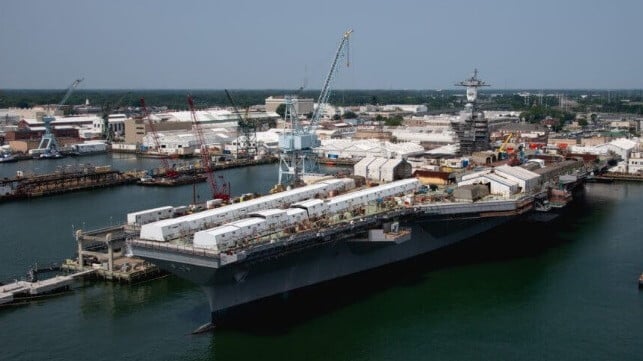
A report to the U.S. Congress in the U.S. Navy’s budget revealed that the new carrier John F. Kennedy is now scheduled for delivery in March 2027. Bloomberg highlighted the 20-month delay in the program, reporting that shipbuilder Newport News is still working to resolve issues with the Advanced Weapons Elevator system and complete certification of the Advanced Arresting Gear.
During Congressional hearings in April, the U.S. Navy confirmed that a further delay was expected for the massive carrier, which had been scheduled for delivery this month without specifying the new date. Bloomberg quoted Navy Secretary John Phelan telling Congress, “All our programs are a mess.” HII highlighted that Phelan visited the Kennedy in April along with a Congressional delegation and witnessed topside testing of the electromagnetic aircraft launch system (EMALS).
It is not the first delay for the carrier or challenge HII has faced with these systems. The first ship of the class, Gerald R. Ford, was delivered in 2017, but it took till 2021 for all the elevators to be fully certified. In 2023, the Navy cited a change in strategy for the carriers and authorized additional work and budget to HII for the Kennedy. The Navy reported an additional $400 million in its budget to allow HII to complete more "baseline work" on the ship before it delivers, rather than catching up after delivery in the post-shakedown availability period. They said that would push back delivery for June 2024 to July 2025.
The Navy also altered the plan for the Kennedy in 2020, adding two years to the schedule to allow for modifications. This included fixing problems identified during the construction of the Ford, the substitution of a different radar system, and changes to accommodate the F-35C stealth fighter.
Bloomberg quotes a Navy spokesperson saying it is, “exploring opportunities for preliminary acceptance of the vessel prior to formal delivery and is coordinating closely with stakeholders to ensure the fastest possible transition to fleet operations,” for the Kennedy.
Since the pandemic, HII has been citing supply challenges, delays in material availability, staffing shortages, and supply chain performance for the carrier program. The new budget document again cites these issues reporting delivery of the third carrier, Enterprise, is being delayed from September 2029 to July 2030. The report does not indicate if dates will be impacted for the fourth carrier, Doris Miller, which began dry dock work this year. She is scheduled to be commissioned in 2032.
HII told Bloomberg that it was learning from the early phases of the program, especially with the Ford, but that the Kennedy was in a “fairly advanced stage,” making it difficult to incorporate all the lessons learned. The hope is that the lessons learned will improve the process for the later carriers. In addition, HII reported last week that it was testing a new approach, including the use of Artificial Intelligence (AI) in a partnership with C3 AI to employ advanced algorithms for its yards' work scheduling and planning.
The delays present challenges for the Navy and the Trump administration, which has promised a strengthening of the armed forces. The U.S. Navy needs the new carriers to replace the aging Nimitz class, which is approaching its scheduled end of service. The USS Nimitz was commissioned in May 1975 and is scheduled to be decommissioned in 2026. The urgency is magnified as the sistership Dwight D. Eisenhower is likely to follow the Nimitz in 2027, and the Carl Vinson is only five years younger.
Strained by War, the Russian Navy is a Shadow of its Former Self
A Ukrainian suicide drone hits a Russian Navy corvette in the Black Sea, 2024 (GUR)
Russia’s Navy is facing huge pressures, primarily as a byproduct of President Putin’s over-ambitious attempts to claim great power status.
The most obvious pinch-point is in the Black Sea, where Russia’s fleet has pulled back out of danger and forced into distant ports, primarily by the effectiveness of Ukrainian drone attacks. Even more astonishing because Ukraine lost most of its obsolescent naval vessels in early rounds of the conflict, the net effect is that Russia has lost control of the Black Sea, and Ukraine has now been able to resume imports and exports through Odesa and other ports in the south-west of the country. The residual capabilities which the depleted Black Sea Fleet retains are the ability to launch cruise missiles from the Eastern Black Sea, and to deter offensive naval operations which Ukraine might otherwise have sought to mount along the Crimean coast.
In the Mediterranean, it is a similar story. The Russian Navy has lost the homeport for what was once its Mediterranean Flotilla in Tartus, where it perhaps retains a foothold but not apparently the right to dock and support warships. This loss is compounded by the Russian Navy’s inability to support its flotilla in the Mediterranean by rotating warships though the Bosporus, which Turkey has unilaterally closed to all warships, as is its right in times of war under the 1936 Montreux Convention. The net effect has seen Russia’s naval presence reduced from a standing force of about five warships and a submarine operating out of Tartus, to the occasional deployments to the Mediterranean of one or two frigates and a submarine drawn from the Baltic and Northern Fleet, along with a lingering presence of a couple of oilers and intelligence collection vessels operating solo.
While the situation in the Black Sea and Mediterranean has been evident for some time, the Russian Navy’s predicament has worsened considerably in recent months. The new pressure has been a concerted and coordinated international campaign to clamp down on Russian oil exports using dark fleet tankers.
In March 2023, Lloyd’s List defined dark fleet tankers as being vessels “aged 15 years or over, anonymously owned and/or having a corporate structure designed to obfuscate beneficial ownership discovery, solely deployed in sanctioned oil trades, and engaged in one or more of the deceptive shipping practices outlined by US State Department guidance issued in May 2020.” Shipment of Russian oil by accurately registered tankers operated by established owners and agencies does not necessarily qualify a tanker for this dark fleet status, as such vessels can legitimately ship Russian oil purchased below the $60 per barrel price above which Russian oil is sanctioned. Nonetheless, over 700 tankers have been formally sanctioned by the US, UK and EU authorities, a dark fleet that Lloyd’s List estimates to be about 10% of global tanker tonnage.
Action to curb dark fleet tanker operations has been stepped up in recent months.
Denmark, without referencing dark fleet membership, has begun to challenge the insurance status of dark fleet tankers in the Skagen anchorage and the Øresund. Under the 1857 Treaty of Copenhagen, vessels have the right of innocent passage through the Danish Straits. But the Danish Maritime Authority is now asserting that it will board ships if it has information “that the safety or working conditions of the seafarers are not in compliance with international regulations including obligatory insurance requirements.” It justifies such action by the need to protect seafarers and the environment, especially in confined waterways where the consequences of an accident or oil spill incident could be horrendous. The United Kingdom is pursuing a similar approach in the English Channel, and sanctions vessels that fail to respond adequately to an average of 40 radio challenges for proof of insurance status made per month. In April, Estonia detained the Djibouti-registered tanker Kiwala (IMO 9332810, now the Malawi-registered Pushpa) off Tallinn while safety deficiencies were rectified, before allowing the tanker to continue on to the Russian port of Ust-Luga.
These actions are probing the right of innocent passage provisions of the UN Convention on the Law of the Sea, and their success or otherwise have still to be legally - and practically - proven. But Russia is heavily dependent on the sale of its oil to fund its war economy. This fiscal need is becoming ever more acute as signs of economic weakness emerge; for the first time since 2022, Russia’s quarterly GDP declined (by 0.6%) in 1Q25. So Russia has had to take steps to defend its economic interests and dark fleet earnings at sea.
In April, the Baltic Fleet carried out an exercise with 11 warships, a submarine and fighter aircraft, practicing drills to prevent the boarding of civilian vessels under escort. The Finnish Ministry of Defense reported in May that Russian naval vessels had begun to escort dark fleet tankers transiting the Gulf of Finland. The Russian Steregushchy Class corvette Boiky (F532) escorted the tankers Sierra (IMO 9522324) and Naxos (IMO 9336426) through the English Channel in late June. These and other such escort duties are in themselves a further drain on the availability of Russian naval vessels, and an additional overhead cost on the shipment of oil. But a further difficulty is that the presence of dark fleet tankers is worldwide, and Russian Navy cannot be everywhere at the same time. There are choke points across the globe through which the dark fleet needs to transit and where the Russian Navy would find it difficult to maintain an escort presence.
While the legality of interceptions is probed, the dark fleet also faces a more immediate threat. In late June, the tanker Vilamoura (IMO 9529293, registered in the Marshall Islands) was damaged by an explosion off Benghazi. The Vilamoura has within the last year been seen loading at two Russian oil terminals, Ust-Luga in the Baltic and Novorossiysk in the Black Sea. She is the fifth foreign-flagged oil tanker to be hit by explosions after visiting such Russian ports. These attacks, because they would weaken Russia economically and would mirror Russian attacks on Ukraine’s economic interests, might be considered legitimate by many in the context of the war between Russia and Ukraine.
As yet, there has been no major kinetic incident stemming from attempts to close down the activities of the dark fleet trading Russian - and also Iranian - oil. On the balance of probability, such an incident is likely to occur in the not too distant future, and the pressure is being felt most immediately by the stretched and struggling Russian Navy.
The opinions expressed herein are the author's and not necessarily those of The Maritime Executive.
Davie Buys Second Finnish Shipyard to Integrate Operations
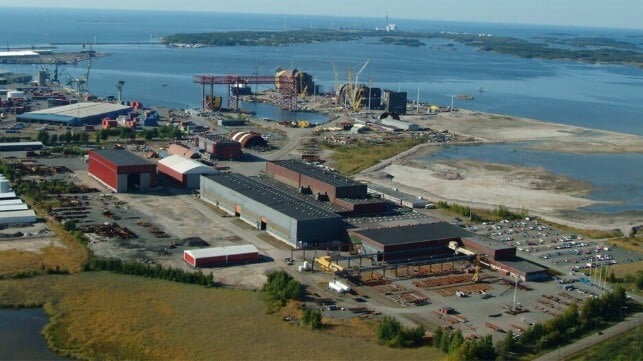
Davie looks to integrate the steel capabilities of the yard in Pori to expand overall production capacity (Pori Offshore Construction)
Canada’s Davie shipbuilding is buying a second, smaller shipyard in Finland as it looks to integrate its operations, focusing on Arctic projects, including large icebreakers. The Mantyluoto shipyard in Pori, Finland, will be integrated with the Helsinki Shipyard, which David acquired at the end of 2023.
The shipyard is being acquired from Finnish energy company Enersense at a cost of €7.5 million, with the acquisition expected to be completed by the end of September 2025. Enersense acquired the yard in 2021, highlighting its expertise in steel constructions for the Arctic. The yard had previously delivered the frame for the world’s first floating offshore wind turbine and built a pilot offshore wind power project for deployment in icy conditions. Known as Enersense Offshore, the company emphasized the opportunities in offshore wind development.
Media reports indicate the yard employs about 100 people. However, currently, the operations are furloughed.
“The Enersense Marine and Offshore Unit possesses unique expertise in steel production for the Arctic marine industry,” said Kim Salmi, CEO of Helsinki Shipyard. The companies emphasize by integrating operations, Helsinki Shipyard will become Finland’s only specialized shipbuilder with capacities ranging from design to final assembly. The plan calls for the Mantyluoto yard to focus on block production, which will be supplied to the yards in Helsinki and Canada.
Davie made the acquisitions in Finland, emphasizing the opportunities to tap the deep expertise in icebreakers as opportunities were emerging in Canada, the United States, and elsewhere.
In March 2025, Davie entered into an agreement with the Canadian government to build a Polar Max vessel based on Aker Arctic’s original Aker ARC 148 hull form. The vessel, which will be 22,800 tonnes with a length of 138.5 meters, will be an icebreaker functioning as a research vessel and capable of performing oil spill response operations and emergency towing.
Block production for the first vessel will begin as soon as possible as soon as possible reports Helsinki Shipyard, with the first phase at Mantyluoto. The hull assembly and completion will be undertaken at the Helsinki Yard before the vessel transfers to Davie in Canada for final outfitting and commissioning.
Using this new model, Davie is strengthening its capabilities to build multiple special-purpose vessels simultaneously.
Last month, Davie announced it would also acquire facilities in Galveston and Port Arthur, Texas, from Gulf Cooper & Manufacturing. It will gain a shipbuilding capability in the United States as it looks to bid for future U.S. icebreaker projects.
Former STX Shipyard For Sale as Investors Seek to Cash Out After Turnaround
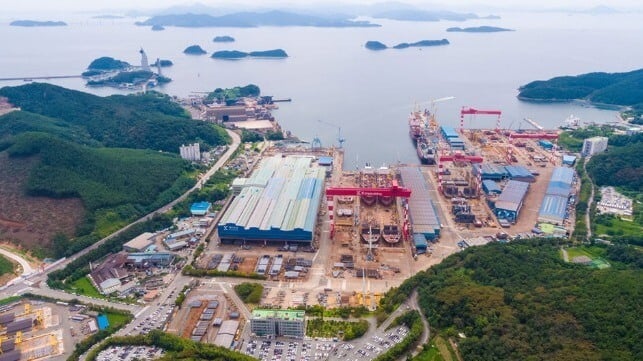
Former STX revived as K Shipbuilding is for sale (K Shipbuilding)
Once one of the leading shipbuilders in South Korea, the former STX Yard, which was relaunched as K Shipbuilding, is celebrating a remarkable turnaround. According to a report in The Korean Economic Daily, after having posted its first profit in 14 years, the investment group with revived the shipbuilder is now looking to cash out.
KHI Investment and United Asset Management Company (UAMCO), South Korea's biggest bad debt investor, took control of the troubled shipbuilder in 2021, paying more than $180 million for the company. Timing was ideal as shipbuilding was entering a strong upcycle, and although they were a smaller mid-sized yard, the business, renamed K Shipbuilding, was able to grow quickly.
The investment group believes that despite the slowing in orders, it is still a good time to cash out with the news report saying they are seeking as much as $732 million for the company. As part of the sale, KED reports that UAMCO also seeks a debt refinancing of more than $100 million in financing provided to restore K Shipbuilding. The investors have also decided to exclude bids from foreign private equity investors instead seeking a Korean buyer for the company, which it views as a strategic asset for Korea.
STX was a thriving company with 1,500 employees in Korea in 2017, shortly before it collapsed. It had grown quickly, adding international operations, but suffered badly from the downturn in shipbuilding at the end of the 2000s and into the 2010s. After a series of refinancing and asset sales, STX went into receivership in 2016.
The Korean Economic Daily reports that the company last year posted its first profit in 14 years. The forecast is that the yard could exceed 1 trillion won ($735 million) in revenues in 2025. It would be the first time the company has reached those levels since 2019.
The Korean shipbuilding looks to new emerging opportunities as the Trump administration looks to counter China’s dominance of shipbuilding. Last year, Hanwha Ocean also broke into the U.S. Navy repair sector, and reports are that Korea’s midsized shipbuilders are looking to follow, also bidding for U.S. Navy projects.
In addition to its investment in K Shipbuilding, KHI also joined an investor consortium that acquired another midship shipbuilder, Daehan Shipbuilding. Like STX, it had fallen on hard times and went through more than a decade of debt refinancing. KHI is the last remaining investor, and it has announced plans for Daehan to go public on the Korean Stock Exchange later this month.
HD Hyundai Partners Up With Indian Shipbuilder Cochin
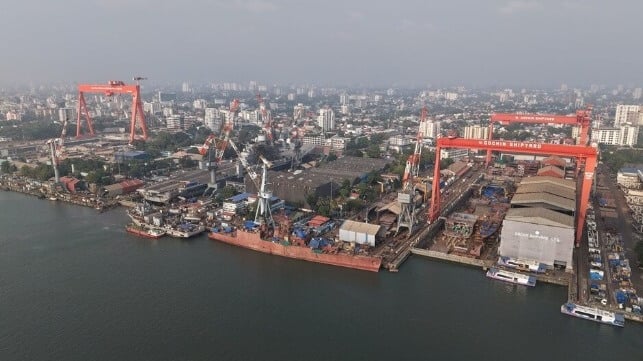
South Korean shipbuilding leader HD Hyundai has signed up with Indian shipbuilding giant Cochin Shipyard on a deal to share design work, technology and equipment supply chains. The agreement also provides for workforce training programs.
South Korea has some of the world's most advanced shipyards, but a shortage of skilled labor is a constant hurdle, and the nation's shipbuilders are increasingly dependent upon foreign workers recruited from Vietnam and Thailand. Some Korean shipbuilders are experimenting with foreign yard locations, like Samsung's block-building yard in China or HD Hyundai's newly reopened facility in Subic Bay. These ventures use Korean shipbuilding know-how and technology, but located in areas where there is a large available workforce.
Like other foreign partnerships, the objective of the deal with Cochin is to "transplant Korean shipbuilding DNA" into India, HD Hyundai said in a statement. Cochin is majority state-owned, and is the largest government yard in India. It can build complex vessels, including India's aircraft carriers, and has delivered 70 ships of various sizes over the past five years (including 10 warships).
In addition to technical and training cooperation, the two parties have agreed to look for new shipbuilding orders together on the international market, as partners. This would bring together HD Hyundai's market presence and reputation with Cochin's capacity for expansion.
In the United States, HD Hyundai has signed similar agreements with defense leader Huntington Ingalls and with offshore vessel builder/operator Edison Chouest, each for different market segments. The objective of the Chouest partnership is to target orders for LNG-fueled container ships, taking advantage of Chouest's infrastructure and HD Hyundai's extensive experience in LNG technology.
ALT. TECH
HGK Launches First Inland Cargo Vessel Capable of Sailing With Solar Power
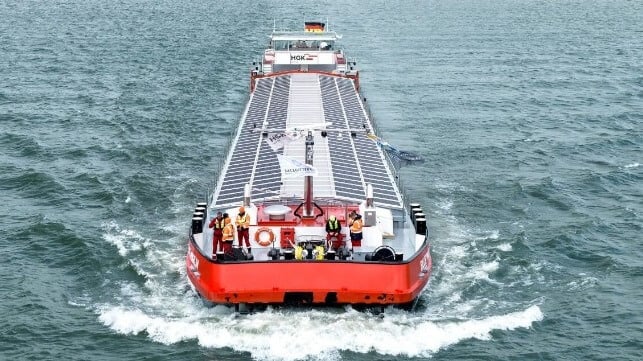
Blue Marlin's solar system provides power to the propulsion system and in optimal conditions will entirely power the vessel (HGK)
A newly built inland dry goods vessel, Blue Marlin, was named last week in Hamburg, Germany, and became the world’s first hybrid solar-power inland shipping vessel, as well as receiving a designation for remote-controlled operations. The solar system aboard the ship advances on prior low-voltage systems that are supplying power for onboard systems and provides the first capability to contribute solar power to propulsion.
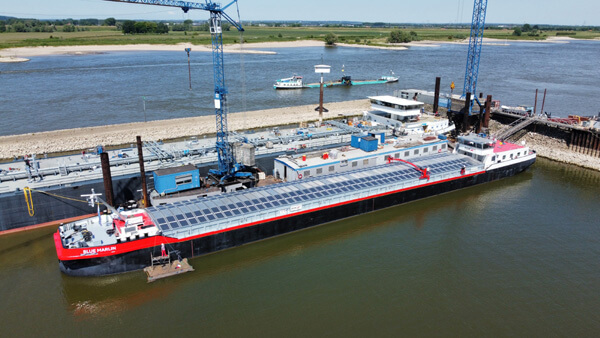
The vessel has several unique capabilities, starting with its 192 solar panels, which are expected to generate up to 37,500 kilowatt hours annually. The system developed by the Netherlands’ Wattlab is more advanced than a system deployed just a year ago and is fully integrated, giving it the capability of contributing power directly to the ship’s high-voltage electric propulsion.
Delivering up to 35 kilowatts under optimal conditions, Wattlab says the Blue Marlin’s solar power system will operate in conjunction with four diesel generators powering the electric propulsion system. This fully integrated setup enables “peak shaving,” where the combination of solar energy and batteries will prevent the need for activating an additional generator during high-demand periods. The system’s automated energy management will distribute electrical energy where and when it is required, increasing efficiency and reducing fuel consumption.
“Furthermore, in situations where the ship is lightly loaded and travelling downstream, we anticipate that it may even sail using only solar power for limited periods—an unprecedented achievement in the inland shipping sector,” said Wattlab co-founder and COO David Kester.
Blue Marlin has 192 solar panels (Wattlab)
The hull of the vessel was built in Romania at the Orsova Shipyard and outfitted in the Netherlands at De Gerlien van Tiemm. It is homeported at Cologne, Germany, and will run for HGK Shipping, a Germany-based European inland shipping company with a fleet of 350 vessels. It will be employed for the German steel company Salzgitter, mainly transporting steel and bulk materials along the network of canals in north-west Germany.
SEAFAR developed technology for the vessel to be operated remotely. After several trial voyages, the German General Directorate of Watersways and Shipping (GDWS) issued a permit for remotely controlled navigation on the canal between Salzgitter and Friedrichsfeld.
In addition to its advanced solar power capabilities, the vessel features a powerful diesel-electric, future-fuel-ready drive concept. Its dimensions (86 meters in length, 9.5 meters wide, and navigation capability with 1.1 meters of draft) were optimized for the canals. It employs two Veth rudder propellers and has a bow thruster. It can also be coupled with a push barge to transport weights up to 3,110 tonnes.
“The Blue Marlin is a strong symbol of what industry and logistics can achieve when they work in tandem,” said Florian Bleikamp, the Managing Director of HGK Dry Shipping. “As we work together, we’re able to put innovative ideas into practice: ranging from emission-free solar technology to remote-controlled navigation for the vessels and even resource-saving drive systems in our fleet.”
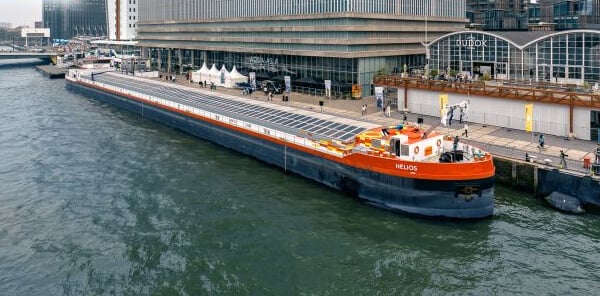
Helios launched in 2024 hold the record with 312 solar panels supplying low voltage onboard systems (HGK)
The companies highlight that the solar system is an advancement on the record-setting 312 solar panels installed last year aboard another HGK dry goods inland vessel, the Helios. The vessel is 135 meters in length and has a capacity for 5,570 cubic meters, and its 27 hatch covers are equipped with solar panels. They generate as much as 90 megawatt hours of electricity per year, with the power being fed to the low-voltage onboard systems. It was recognized as the largest system of its kind by the Guinness Book of Records.
Wattlab, which was founded in 2017 as a maritime solar energy specialist, highlights it has completed installations on than 30 ships. Its goal is to reduce fuel consumption, cut carbon dioxide emissions, and improve operational efficiency as part of the efforts to accelerate the maritime sector’s transition to clean, more sustainable energy.
Anemoi Unveils State-of-the-Art Rotor Sail Production Facility in China
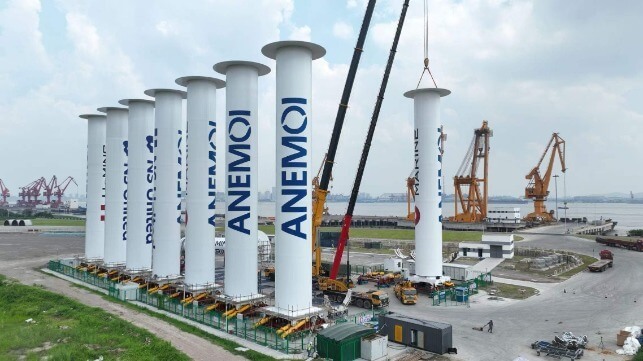
Anemoi’s Rotor Sails in final assembly at the new Jingjiang production facility, strategically located along the Yangtze River for efficient delivery and installation
Anemoi Marine Technologies, a global leader in wind propulsion solutions, is proud to announce the official opening of its new Rotor Sail production facility in China. This landmark development significantly enhances Anemoi’s manufacturing capabilities and underscores its commitment to accelerating the maritime industry’s transition to zero emissions.
Strategically located on the banks of the Yangtze River, Anemoi’s facility is located in Jingjiang City, Jiangsu Province, within Daming Heavy Industry’s manufacturing base. The facility provides direct access to port infrastructure, enabling seamless logistics for import, export, and delivery. With barge transport available on-site, Rotor Sails can be transported efficiently and installed directly at nearby major shipyards, streamlining operations and minimising environmental impact.
"This is more than just a new site," said Clare Urmston, CEO of Anemoi. "It’s a fully integrated, end-to-end production hub where every stage, from steel fabrication and precision assembly to rigorous testing and quality assurance, is handled under one roof. That means faster turnaround, uncompromised quality, and complete oversight by our expert team, on site, from start to finish. Anemoi’s strategy is quality first and this site enables exactly that.”
Anemoi has been working in China since its pilot installation in 2018, and subsequently established its Chinese entity, ANEMOI Marine Technologies (Changzhou) Co., Ltd., ???????????????, in 2021. The company has built strong strategic partnerships over time. For example, Anemoi has maintained close cooperation and formed a strategic partnership with CRRC Qishuyan Institute Co., Ltd., a first-tier subsidiary of CRRC, the world's largest rail transit equipment manufacturer. With a strong foundation in materials science, key manufacturing processes, key components, and intelligent manufacturing of high-end equipment, the two parties have forged a deep cooperative relationship across the entire value chain, from key component production and system assembly to testing and technical services. Together, they have jointly established this state-of-the-art facility which serves as an advanced manufacturing platform, integrating both production and verification capabilities. The site has been co-designed to enable full speed testing, commissioning and balancing of our Rotor Sails prior to delivery to the Customer to minimise the risk during vessel installation and operation. The site can accommodate Anemoi's full suite of Deployment Systems including Fixed, Folding and Rail types.
This collaboration not only enhances Anemoi’s industrial footprint but also brings the quality assurance associated with China’s high-speed rail to Anemoi’s Rotor Sails. Importantly, Rotor Sails align seamlessly with the CRRC Qishuyan Institute’s development strategy of “High-end Transportation Equipment + Clean Energy Equipment” in the clean energy sector. Moving forward, both parties are committed to advancing global efforts in maritime energy conservation and emissions reduction.
“We are proud to support this milestone project, which reflects the power of international cooperation. By combining British innovation in wind propulsion with China’s advanced manufacturing expertise, we are delivering impactful solutions on a global scale,” Shared by Mr Fang Jun, Vice General Manager of CRRC Changzhou Tech-Mark Industrial Co.,Ltd.
Anemoi has also built a long-term, successful collaboration with Lianyungang Zhongfu Lianzhong Composite Material Group Co., Ltd. (Zhongfu) to produce its composite rotor skins using Anemoi’s patented filament winding manufacturing process. This method, which is unique to Anemoi, ensures additional strength, durability, and uniformity across every product, which is vital for high-performance and withstanding cargo operations. Composite skins are thoroughly tested, painted, and inspected before being transported to Anemoi’s facility in Jingjiang for Rotor Sail assembly.
Ms. Xu Xiuming, Marketing Director of Zhongfu, a leading manufacturer of wind turbine blades, said “We are proud to be contributing to the shipping industry’s decarbonisation journey through our close partnership with Anemoi since 2020, producing high-quality composite Rotors at scale.”
Now, Anemoi has partnered exclusively with Daming Heavy Industries, a global leader in high-end precision manufacturing services for steel fabrication and port services. The collaboration strengthens Anemoi’s position, drives consistent quality in delivery and provides flexibility to scale as global demand for wind-assisted propulsion grows.
Mr. Ren Lei, Marketing Director of Daming said: “Our partnership with Anemoi reflects a shared commitment to quality, efficiency, safety, and timely delivery. With our one-stop, fully integrated facility, we are confident in our ability to support Anemoi’s vision and contribute to a more sustainable maritime future.”
With an annual production capacity of 250 Rotor Sails, and the option to expand further and store units for fast turnaround, the new site positions Anemoi to meet surging global demand and support its customers in achieving critical decarbonisation goals. The scale and capabilities of this facility make it the first of its kind for wind propulsion, cementing Anemoi’s leadership in this transformative sector.
“Our presence in one of China’s key shipping hubs not only strengthens existing strategic relationships but also paves the way for new collaborations,” added Nick Contopoulos, Chief Commercial Officer of Anemoi “Getting to zero emissions requires forward-thinking action and partnerships like these. Together, we are shaping the future of sustainable shipping.”
The products and services herein described in this press release are not endorsed by The Maritime Executive.
RINA Secures World Bank Project to Advance Green Hydrogen at Port of Pecém
RINA, the global engineering consulting, inspection and certification company, has secured a high-profile World Bank-funded assignment to help accelerate Brazil’s transition to a low-carbon industrial economy. RINA will deliver a comprehensive water assessment study for securing industrial water for green hydrogen production at the Complexo Industrial e Portuário do Pecém (CIPP), a flagship low-carbon development hub in Brazil. The project will not only support industrial innovation but also contribute to social and environmental equity, improving water access for nearby communities in the state of Ceará.
A Strategic Step Toward Green Hydrogen at Scale
To support large-scale green hydrogen production, the study explores two key water sourcing strategies: reuse of treated effluent from sewage treatment plants in Fortaleza’s western region and seawater desalination. Both options will be assessed for their technical feasibility, economic viability, environmental impact, and compatibility with local infrastructure and regulation.
The water assessment study, to be delivered by RINA in partnership with local firm Krypton, will provide:
A comparative feasibility study of reclaimed water reuse vs. seawater desalination.
A detailed environmental impact analysis Assessment of water demand at the CIPP over the next 5–10 years, aligned with anticipated industrial growth.
A regulatory and infrastructure evaluation, ensuring compliance with Brazilian standards and effective use of existing water systems.
Crucially, the study will also evaluate how the proposed infrastructure could enhance water access for surrounding communities, ensuring that industrial progress contributes to broader regional sustainability.
This award follows RINA’s successful delivery of the first consultancy at World Bank Group, focused on industrial decarbonisation. That assignment encompassed developing a comprehensive GHG inventory, energy balance, and decarbonisation roadmap for the region’s energy-intensive industrial cluster. The continuity between both projects positions RINA as a key contributor to the development of the project in the Port of Pecem, as one of Brazil’s premier clean energy and green export hub.
“This project reflects the power of RINA’s global knowledge base and our ability to apply it in support of sustainable industrial development,” said Andrea Pestarino, IFI and Organizations Engineering Commercial Management Director at RINA. “As a knowledge-led organisation, we bring together experience across sectors and geographies to deliver tailored, high-impact solutions. This World Bank contract reinforces our long-term commitment to the region and to Brazil’s clean energy future.”
The products and services herein described in this press release are not endorsed by The Maritime Executive.
Product Tanker Ripped Apart by Explosion off Coast of India
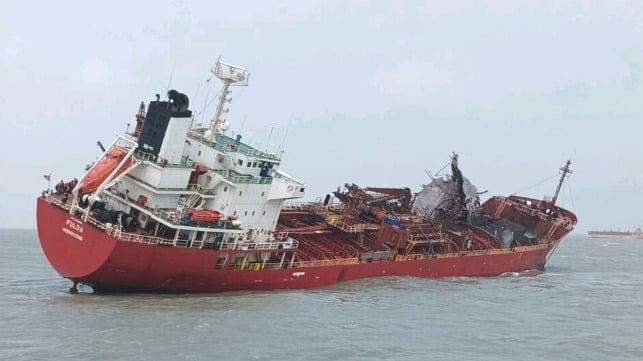
Fuldia had begun venting its tanks after offloading methanol in India (DGS)
A 25-year-old product tanker owned and managed from Hong Kong was ripped apart by a forceful explosion shortly after the vessel completed offloading and departed the Indian port of Kandla. The Directorate General of Shipping and the port authority are reporting that all 21 crewmembers were safely evacuated and brought to the port of Kandla.
The Hong Kong-flagged Fulda (19,477 dwt) had completed the offloading of a cargo of methanol at the Deendayal terminal in Kandla and departed at mid-morning on July 6 for a trip to Oman. The vessel was built in 1999 and is managed by a shipping firm in Hong Kong.
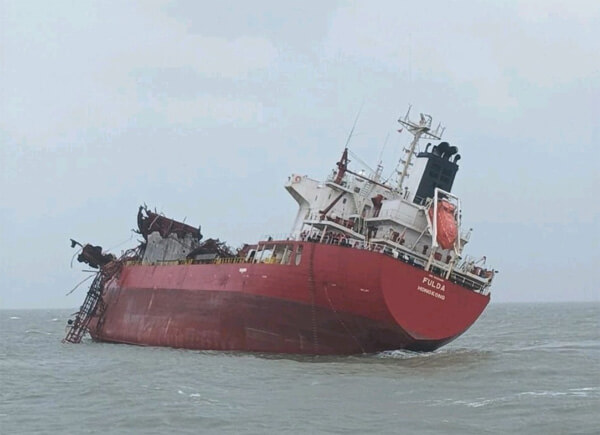
The port authority received a report from another vessel in the anchorage that there had been an explosion aboard the product tanker around 1300 on Sunday afternoon. Two tugs from the port, along with a pollution control vessel, were dispatched, and they found the vessel with a 22-degree list and a large section of the forward deck ripped open. There was no report of a fire or smoke from the vessel.
Fuldia is drifting off the coast of India after an explosion ripped open its forward tank (DGS)
By 1900, the captain had requested the evacuation of the crew. The media reports that there were 11 Chinese, two from Bangladesh, one from Indonesia, and seven from Myanmar aboard. The tug Orchid Star returned them to port.
The Directorate General reports initial interviews showed the vessel had begun a gas-freeing operation to vent its tanks after the discharge. The authorities are investigating the improper handling of flammable vapors and possibly inadequate flushing and purging of the tanks. They believe a flammable vapor-air mixture had built up in the tanks.
The Fulda is reported to have more than 384 metric tons of fuel aboard. The pollution control vessel was standing by, but so far, there were no reports of a fuel discharge.
Fire Aboard Boxship Wan Hai 503 Under Control at Last
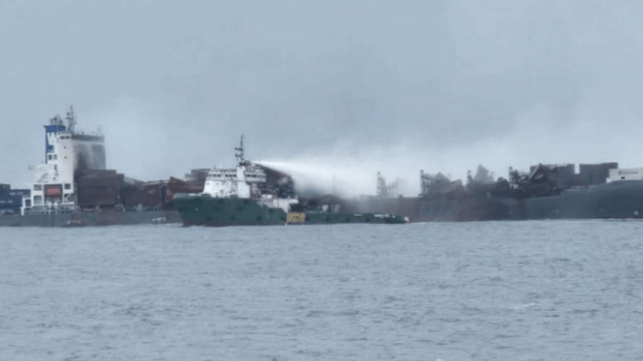
Atlantic Virgo applies Pyrocool to Wan Hai 503's holds (KSDMA)
The burned-out boxship Wan Hai 503 is still under tow off the southeastern coast of India, holding position near the Indian EEZ boundary while salvors complete their work to stabilize the situation on board.
The vessel's burned holds continue to smolder and light smoke is still visible, according to local media, but the vessel remains stable. Fires flared up again Friday, but as soon as wind and surface conditions allowed for it, salvors applied an extinguishing foam called Pyrocool to the holds to suppress the flames. The tug Advantis Virgo applied about 12,000 liters of the foam substance (mixed with water), and kept enough in reserve for another 3,000 liters. Responders are looking to source more and have plans in place to fly in another 15,000 liters from a supplier in Singapore if it is required.
For now, the fire is contained, and salvors are monitoring the temperature of the holds using thermal imaging cameras. Response tugs SCI Panna and Advantis Virgo remained on scene to provide boundary cooling and fire suppression as needed. The tug Offshore Warrior is keeping up the tow, and the tug Saksham is expected to rejoin the operation after a crew change.
Dewatering efforts continued to address previous flooding: a malfunctioning hydraulic power pack was restored to service, and as of Saturday, the team had reduced the water level in the engine room to about six feet. The team hoped to further reduce the water level in order to identify the source of the water ingress. The flooding could be linked to runoff from previous firefighting efforts, according to the response command.
The responders are still working out the possibilities for a port of refuge. Though a port in Sri Lanka was originally planned, alternative options in Africa are now under consideration, according to local media. Before Wan Hai 503 is towed anywhere, salvors are putting a priority on replacing the vessel's synthetic towline with a steel wire rope as soon as possible, before rough weather arrives.
Australia Ships Decaying FPSO to Denmark for Dismantling
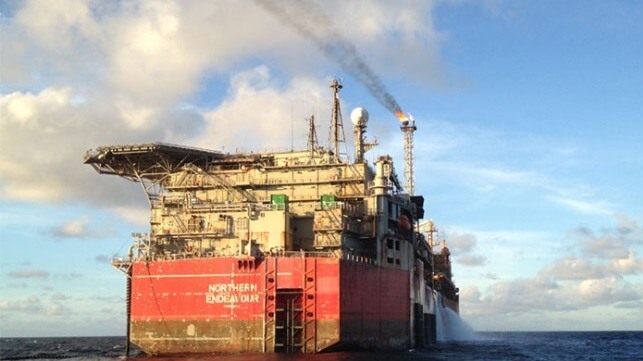
Northern Endeavour in better days, when the FPSO was still operating (Australian gov't file image)
An obsolete and decaying Australian floating production storage and offtake (FPSO) vessel will be recycled in Denmark, despite local criticism over the selection of a foreign contractor.
Five years after taking over the decommissioning process of the Northern Endeavour FPSO, the Australian government has finally awarded the recycling contract to Danish company Modern American Recycling Services Europe (MARS).
Following the award of the contract late last month, the 274-meter long FPSO is set to be towed to the MARS ship recycling facility in Frederikshavn for dismantling. COSCO Shipping Heavy Transport has been contracted to transport the FPSO to Denmark using its semi-submersible heavy transport vessel, the Hua Rui Long.
The Australian government reckons that dry towing is the safest and most reliable method to transport the vessel owing to its massive size and condition. The FPSO weighs over 43,000 tonnes, the equivalent of just over four Eiffel Towers. Hua Rui Long is the third largest semi-submersible heavy transport vessel in the world, making her among the few vessels that are large enough to carry something as long and heavy as Northern Endeavour.
The defunct Northern Endeavour has been moored between the Laminaria and Corallina oil fields, about 550 kilometers northwest of Darwin in the Timor Sea. Her decommissioning has been a subject of controversy, with workers’ unions and legislators demanding that an Australian company be awarded the A$325 million dismantling contract.
The Maritime Union of Australia (MUA) and the Australian Workers’ Union have been on record calling on the government not to send the FPSO abroad, contending that recycling the vessel locally would be critical in building the capacity of domestic facilities. They reckon that sending Northern Endeavour abroad is a direct contradiction to the government’s policy commitments to build a sovereign decommissioning and green metals industry under the “Future Made in Australia” agenda.
“This should have been the cornerstone of a new era of green manufacturing in Australia, we should be feeding that steel into an Australian electric arc furnace, not shipping it to Scandinavia on a foreign-flagged vessel,” said Thomas Mayo, MUA National Assistant Secretary last month.
However, the Australian government has decided to move the deteriorating FPSO over 15,000 nautical miles to Denmark because there are no purpose-built facilities in Australia equipped to recycle a vessel as large and complex as the Northern Endeavour.
Under the contract, MARS will recycle the FPSO and manage the waste streams, including hazardous waste, with the priority being completion of the work to high safety and environmental standards meeting all Australian and international requirements. One factor that went into contracting MARS is the fact that the yard meets the European Union’s Ship Recycling Regulation that aims to prevent, reduce and minimize accidents, injuries and other negative effects on human health and the environment when recycling ships. Over five decades, the company has recycled close to 10 million tonnes of offshore oil & gas structures.
The Australian federal government was forced to bear the burden of decommissioning the FPSO after its former owner went into liquidation in 2020. Northern Oil and Gas Australia (NOGA) had bought the vessel from Woodside in 2016 as the Laminaria and Corallina oil fields were nearing their end of life.
The government contends that recycling of Northern Endeavour accounts for less than two percent of the overall cost of the Northern Endeavour decommissioning program. This means vast opportunities remain for Australian companies, including in permanently plugging the Laminaria and Corallina wells and removing the remaining subsea infrastructure, recycling and waste management.
Belgian Pilot Critically Injured in Fall From Pilot Ladder
[Brief] In the early hours of Monday morning, a marine pilot was seriously injured while boarding a vessel from a pilot boat.
At about 0015 hours Monday, a 66-year-old pilot was transferring from a boat of the Belgian Pilotage Service to a ship. While climbing the pilot ladder, he fell a distance of about 20 feet back onto the pilot boat, sustaining severe injuries.
The pilot was evacuated to a hospital in the town of Goes for urgent treatment, and was reportedly in critical condition. He was later transferred to another hospital in Antwerp.
The cause of the accident is under investigation. Belgian media services report that the victim was set to retire next month.
The climb from a moving pilot boat up the side of a moving ship involves risk, and tragic pilot ladder accidents are all too frequent. SOLAS V Regulation 23 provides specific measures for pilot ladder arrangements and equipment, but many marine pilots report that these rules are not always followed.
India Detains MSC Ship as it Seeks $1B in Compensation for MSC Elsa 3
MSC Elsa 3 heeled over and sank off the coast of India (DGS)
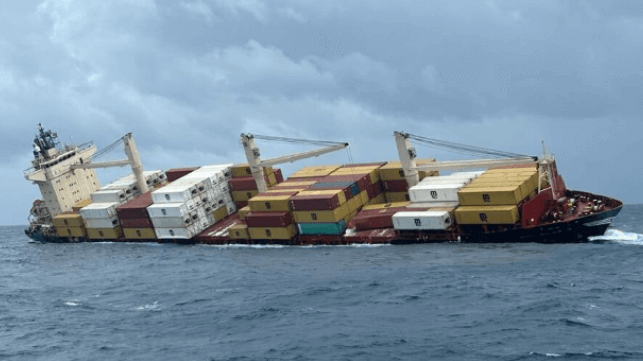
The Kerala State Government in India followed through on its earlier assertions and filed a compensation claim in the courts against MSC for damages as a result of the loss of the MSC Elsa 3 off the coast in late May. As part of the claim, the High Court ordered the MSC Akiteta II, which was in port in India, detained until the company can post a bond in the case.
The admiralty court case seeks damages, citing the impact on the economy, environment, and the livelihood of fishermen following the sinking of the ship. In addition to the direct costs, the state claims a loss of confidence, which will have a long-term impact on business.
The total claim is for $1.1 billion, with the bulk, $1 billion, for damages as a result of pollution. It is also seeking $44 million to restore the environment and a further $61.3 million in economic loss for the fishing community.
While there has been a minimal release of oil that was stopped by divers who capped the tanks, media reports cite a range of impacts. A total of 61 containers have been retrieved from the 643 that were aboard the ship when it went down. The Directorate General of Shipping reported that as of the beginning of July, an estimated 450 to 500 tonnes of nurdles have been collected from the shoreline. Volunteers continue to comb the beaches.
The media also reports that six large carcasses have been retrieved, including a dolphin and a whale. They are suspected of having died due to exposure to the microplastics or other toxic substances from the vessel.
MSC Akiteta II (30,592 dwt) happened to be the vessel in the Vizhinjam port when the case was filed. Built in 2001 and with a capacity of 2,226 TEU, it is slightly larger than the MSC Elsa 3 (1,730 TEU). The court ruled it was acceptable collateral and that it would be held pending MSC posting a bond. The court has permitted the vessel to continue to load and unload containers, but it is not permitted to depart. A hearing was scheduled for July 10.
The court followed a similar pattern with some of the individual claims that have already been filed. Other MSC vessels were detained until bonds were posted.
The case was filed while the investigation into possible safety lapses is ongoing. Previously, the Indian authorities contended the containers were improperly handled and secured. The media writes that an interim report has been sent to the Directorate General of Shipping, but it is still pending information from the VDR. The equipment was retrieved last month by divers and was taken ashore to be analyzed. The captain and crew of the ship remain in Kochi facing charges from the local police related to negligence in handling of the vessel and the dangerous cargo aboard.
Clean-up efforts for the vessel are also stalled pending a change in salvage companies. After the first phase was completed, which included capping the oil leaks, MSC elected to change salvage companies for the next phase. SMIT has filed a new plan with the government and reports that its equipment and divers will be arriving in India later this month. Weather permitting, they hope to begin diving on the wreck in August, and the plan calls for siphoning the fuel from the vessel’s tanks.