Tuesday, July 08, 2025


LNG Boom Hits a Snag in Louisiana’s Crowded Waterways

  • The expansion of U.S. LNG exports faces a potential bottleneck in the crowded Calcasieu Ship Channel along the Louisiana coast, where numerous operational and proposed LNG projects are located.

  • Operators like Venture Global are expressing concerns to the Federal Energy Regulatory Commission about vessel traffic and access prioritization due to the increasing number of LNG facilities utilizing the same waterway.

  • Despite these potential domestic constraints, U.S. LNG exports have significantly increased and are projected to continue growing, with several new projects targeting final investment decisions that could triple export capacity by the end of the decade.

As U.S. LNG exporters expand plants and propose new facilities along the Texas and Louisiana coasts, an unlikely domestic bottleneck could delay capacity expansions and growth in America’s LNG exports. 

Crowded waterways along the Louisiana coast, where many new projects will be located, could create constraints to shipping LNG cargoes out of the U.S. Gulf Coast, potentially undermining the Trump Administration’s strong support for boosting LNG exports. 

Six LNG export projects in total are either operational or proposed along or near the Calcasieu Ship Channel, a waterway that connects the city of Lake Charles, Louisiana, with the Gulf of Mexico.  

One LNG exporter, Venture Global, has an operational plant, Calcasieu Pass, on the east bank of the waterway, and plans another project, CP2 just north of it. On the west bank of the waterway, directly across Venture Global’s facilities will be another proposed export plant, Commonwealth LNG. 

North of these projects is the Sempra Infrastructure-led operational Cameron LNG, 18 miles north of the Gulf of Mexico on the Calcasieu Ship Channel. 

Woodside’s proposed Louisiana LNG and Energy Transfer’s Lake Charles LNG projects are planned not too far north of Cameron LNG.

The waterway is becoming crowded and has already raised concerns among operators about how they would share and prioritize access and shipping along the channel to the Gulf.  

Venture Global has called on the Federal Energy Regulatory Commission (FERC) in a letter to review the proposed waterway suitability assessment of the Commonwealth LNG project. 

The FERC “should ensure that the construction and planned operations of Commonwealth do not adversely impact existing LNG export terminals like Calcasieu Pass or other facilities utilizing the same or overlapping waterways,” Venture Global said in the letter carried by Bloomberg

Venture Global expressed concerns about vessel traffic and what would happen if the channel needs to be closed to allow vessels to and from the Commonwealth LNG project. 

Representatives for Commonwealth LNG told Bloomberg that its waterway suitability assessment and its Coast Guard letter of recommendations “comply with all applicable regulations.” No changes to the waterway suitability assessment are required, the company behind the project added. 

Commonwealth LNG targets a final investment decision (FID) in the third quarter of this year and production start-up in the first quarter of 2029. 

Yet, bottlenecks on the Calcasieu Ship Channel, with several projects competing for access and cargo shipping lanes, could constrain U.S. LNG exports later this decade if all projects begin commercial operations as planned.  

Supply from America is growing with the start-up of Venture Global’s second facility, Plaquemines LNG, in Louisiana, and the commissioning of Cheniere’s Corpus Christi Stage 3 project. Both Plaquemines LNG and Corpus Christi Stage 3 achieved first gas in late December 2024 and are ramping up operations and exports throughout this year. 

LNG exports from the United States have increased every year since 2016, rising from 0.5 billion cubic feet per day (Bcf/d) in 2016 to 11.9 Bcf/d in 2024, making the United States the world’s largest LNG exporter in both 2023 and 2024. 

U.S. LNG gross exports are expected to further increase by 19% to 14.2 Bcf/d in 2025, and by 15% to 16.4 Bcf/d in 2026, according to estimates from the U.S. Energy Information Administration (EIA). 

Developers of U.S. LNG export projects have started taking final investment decisions on new facilities this year, with several plants expected to add in 2025 to Woodside’s Louisiana LNG approval, despite rising construction costs due to President Trump’s steel and aluminum tariffs. 

Developers of at least seven U.S. LNG projects have recently said that they are targeting FID on these this year. If these projects go ahead, they could triple U.S. LNG export capacity by the end of the decade, adding to projects already under construction after FIDs taken in previous years.   

By Tsvetana Paraskova for Oilprice.com


Banks channeled $385 billion into coal sector since COP26

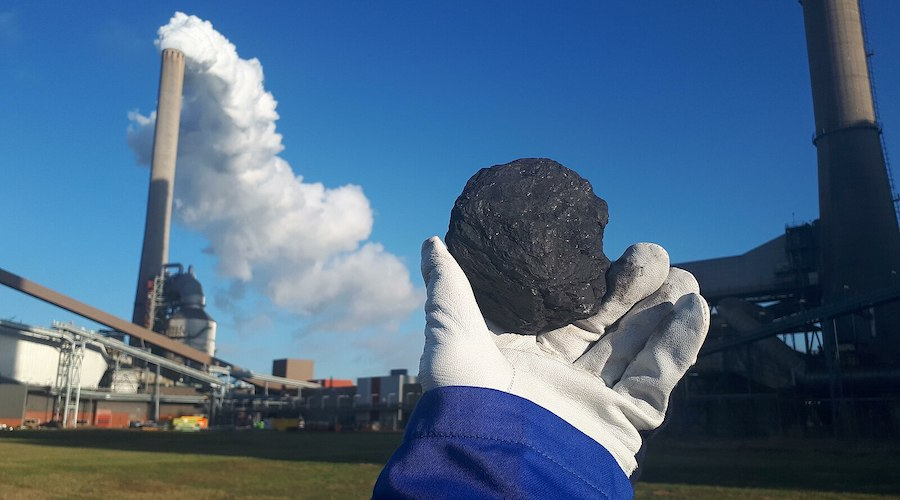
Worker holding up a piece of coal in front of a coal firing power plant in the Netherlands. (Reference image by Adrem68, Wikimedia Commons.)


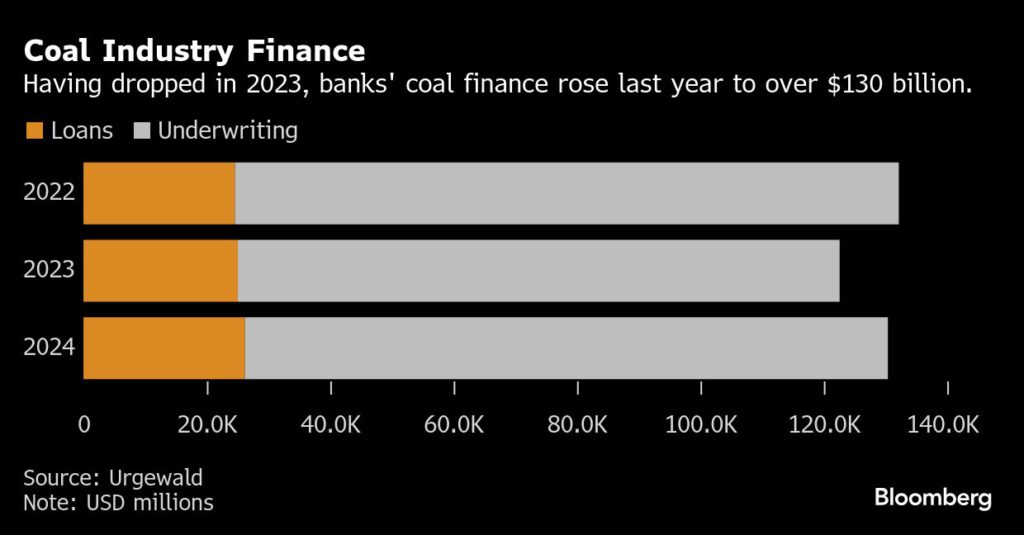
Global banks channeled more than $385 billion to the coal power industry over the past three years, with annual flows increasing last year from 2023, according to analysis by a group of nonprofits.

At the COP26 climate summit in Glasgow in 2021, almost 200 governments agreed to phase down coal and many of the world’s largest commercial banks committed to decarbonize their portfolios. Four years on, those pledges have failed to make a dent on financial flows.

“It’s as if Glasgow never happened,” said Katrin Ganswindt, financial research director at Urgewald, a German nonprofit that co-authored the analysis.

Coal, the world’s most-polluting energy source, powers over one-third of the world’s electricity generation, according to the International Energy Agency. If coal power plants continue to operate as they are, that alone would push the world past the Paris Agreement target of limiting global warming to 1.5C.

While the pipeline of new coal projects is dwindling, the existing fleet of coal plants isn’t, Urgewald reported.

“The earlier we bring down emissions, the higher our chances of avoiding a breakdown of our climate system,” Ganswindt said.

Closing coal plants early is complicated, particularly in developing countries where they’re often just a few years old. As a result, not only do new clean energy sources need to be readily available, financial backers need to  be compensated along the way. Meantime, existing efforts to shut plants early have been beset by delays, as well as political and financial hurdles.

Donald Trump’s return to the White House has further buoyed the coal industry. Earlier this year, he signed a raft of measures aimed at expanding the consumption and production of coal inside the US.

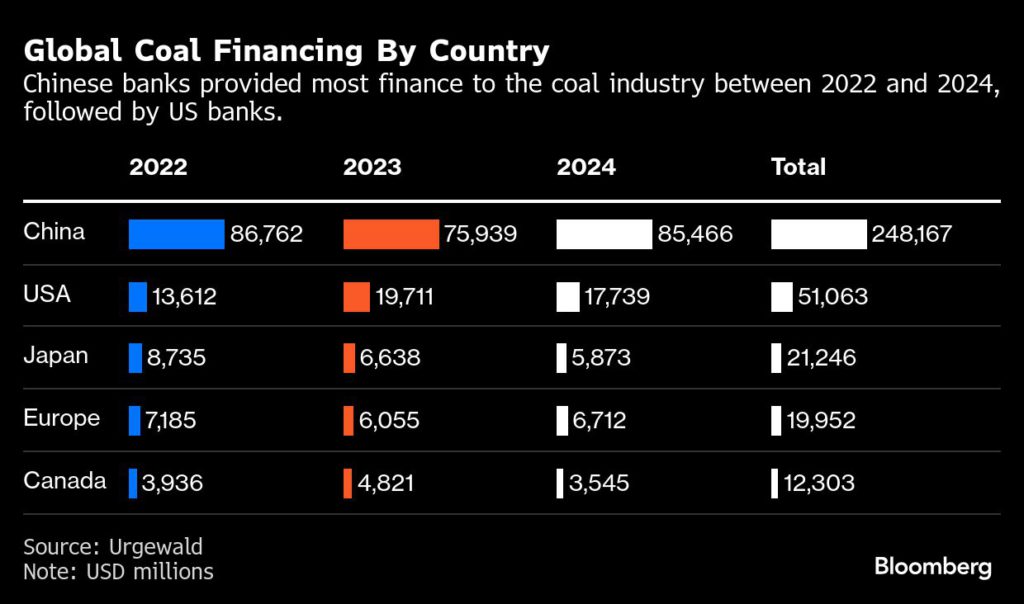
Chinese banks are the top providers of coal-related financing, allocating almost $250 billion to the industry between 2022 and 2024, according to Urgewald. US banks are second with just over $50 billion in total, led by Bank of America Corp., JPMorgan Chase & Co. and Citigroup Inc.

New York-based Jefferies Financial Group Inc. has the fastest-growing coal portfolio, having increased its funding by almost 400% in the three-year period, Urgewald reported. In Europe, Barclays Plc and Deutsche Bank AG issued the most coal finance during that time.

A spokesperson for Deutsche Bank said the firm has reduced its engagement in carbon-intensive sectors over the past 10 years and, in 2024, it cut the emissions associated with its lending and investment in the coal mining industry by 42% from 2021 levels. 

for JPMorgan and Citigroup declined to comment. Spokespersons for Bank of America, Jefferies and Barclays haven’t responded to requests for comment. 

After an initial flurry of action to pare back their financing, some banks have relaxed their coal restrictions in recent years. In late 2023, Bank of America replaced a pledge not to finance new thermal coal mines with a requirement for enhanced checks ahead of doing so. Last year, Sydney-based Macquarie Group Ltd. loosened its rules around the financing of coal used to make steel.

In all, just 24 of the 99 largest banks globally have a plan to phase out coal finance by 2040, which is the IEA’s climate-safe deadline. Many of those focus solely on coal used to generate electricity and overlook the more-polluting steelmaking coal that they argue is critical for the infrastructure underpinning the energy transition – a distinction that overlooks trading patterns in the market.

There are signs that the reappraisal of coal by some lenders is having an impact, said Barry Tudor, chief executive officer of Australian miner Pembroke Resources Ltd.

Between 2020 and 2022, the number of funders willing to finance the miner’s Olive Downs steelmaking coal project in Queensland fell to about three from roughly 20. Now, that’s beginning to reverse.

“Institutions have realized that it’s a little bit more nuanced,” Tudor said.

(By Natasha White)


Column: London Metal Exchange reaps the rewards of tariff turmoil

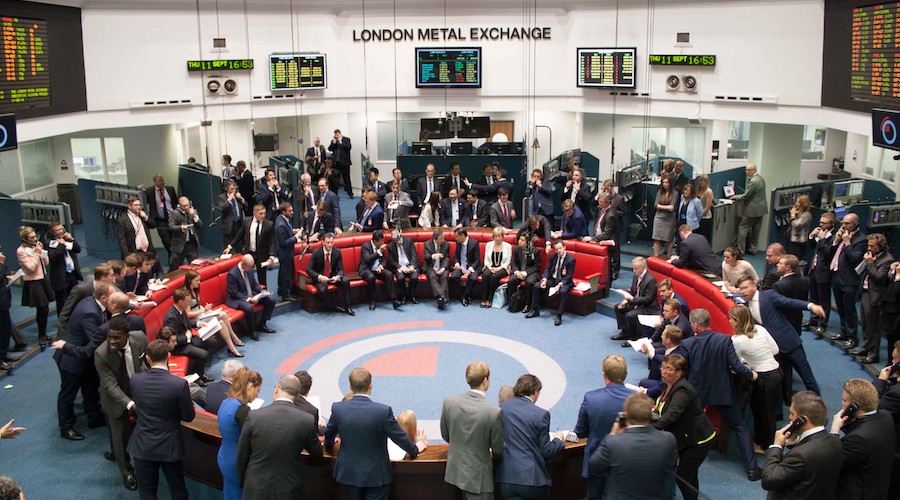
London Metal Exchange. (Image by HM Treasury, Flickr.)

The London Metal Exchange (LME) has recorded its highest quarterly volumes since 2014 thanks to the market turmoil that followed US President Donald Trump’s “Liberation Day” tariffs.

The LME Index basket of base metals plunged 11% after the blanket tariffs were announced on April 2 as metal markets took fright at the prospect of a full-blown trade war.

The wholesale unwind of positions and subsequent re-engagement as prices staged a partial recovery resulted in record daily volumes on April 7 and all-time high monthly trading action.

Chaos tends to be good business for the 148-year old London market, which has been owned by Hong Kong Exchanges and Clearing since 2012. Activity last spiked in April 2024, when the United States and UK announced sanctions on Russian metal.

A more nuanced tariff impact on the CME exchange in the United States suggests the heightened trading activity has been driven by the physical supply chain rather than funds.

LME average daily volumes

Back from the brink

Trump’s tariffs’ blizzard has accelerated the LME’s recovery from the 2022 nickel crisis, when it risked what then head of LME Clear Adrian Farnham described as “a death spiral”.

It took almost a year for volumes to recover after the exchange’s decision to suspend its nickel contract and cancel trades, a call that was ultimately vindicated in the London High Court.

Nickel volumes returned to pre-crisis levels last year and average daily volumes surged another 25% in the first half of this year despite the price spending most of the time treading heavy water around four-year lows.

It helps that there is a lot of nickel to be financed. LME stocks have risen from 34,000 metric tons in the middle of 2023 to over 200,000 with another 71,000 tons sitting off warrant in LME warehouses.

Low prices and an oversupplied market have also combined to revive the LME’s dormant cobalt contract.

First-half volumes of 6,089 lots were the highest since 2019 and there are currently over 1,000 tons of the battery metal in LME warehouses, most of it off warrant.

The LME, however, is still playing catch-up with its US counterpart in the battery metals space. CME’s first-half cobalt volumes jumped by 86% year-on-year and those of lithium hydroxide by 76%.

CME copper money manager positioning

Who’s afraid of Doctor Copper?

The copper market has been particularly tumultuous ever since the Trump administration announced an investigation into US imports back in February.

The focus has been on the arbitrage between the CME’s US contract and the international price traded on the LME.

However, that’s not been reflected in trading volumes on the CME futures contract which fell by 40% year-on-year in the first half of 2025.

It’s been a highly volatile trade and one dominated by physical traders moving metal to the United States to beat the possible imposition of import tariffs.

The investment community which normally populates the CME copper contract has evidently been scared off.

Money manager positioning is historically light with outright long positions flat-lining since early April and outright short positions falling to three-year lows.

Chinese investors have become equally risk-off with copper activity on the Shanghai Futures Exchange falling sharply in May and June. Copper trading activity shrank by 14% year-on-year over the first half of the year.

Physical aluminum boom

CME’s physical aluminum premium contracts, by contrast, saw activity mushroom after Trump lifted US import duties to 25% in March and then doubled them to 50% in June.

Since the CME’s futures contract mirrors the LME’s international product, the arbitrage has been traded in the US Midwest premium , which has unsurprisingly rocketed to record highs.

So too have volumes, which surged by 69% year-on-year to over 1.7 million tons in January-June.

The other leg of the physical arbitrage is evidently the CME’s European duty-paid contract . Volumes more than doubled to 48,142 contracts in the first half of 2025, almost matching last year’s full 12-month tally.

These contracts are by their nature aimed at meeting the needs of the physical supply chain and it’s clear that industrial hedgers have been actively using them to mitigate risk as global flows of metal readjust to US tariffs.

Tiny tin has new friends

Tin has historically been the smallest and least liquid of the LME’s core base metals contracts, but has been steadily attracting more interest over the last couple of years.

LME volumes increased by 16% in both 2023 and 2024 and they were up another 17% in the first half of this year.

A total 902,965 lots traded in January-June, equivalent to four and a half million tons. It’s the highest level of activity in the first half of any year since 2014.

The LME market was carrying high stocks of over 12,000 tons back then. Current inventory is around a third of that, split between on and off-warrant stocks.

Fund participation, though, has been rising with investors holding record-sized long positions on the LME contract in March.

They got rewarded with an April price meltdown. But tin’s combination of bullish electronics demand story and a structurally challenged supply chain has put it firmly on the investment radar.

(The opinions expressed here are those of the author, Andy Home, a columnist for Reuters.)

(Editing by Susan Fenton)


South African-owned palladium mine in Canada to close in 2026

Lac des Iles mine. (Image courtesy of Implats.)

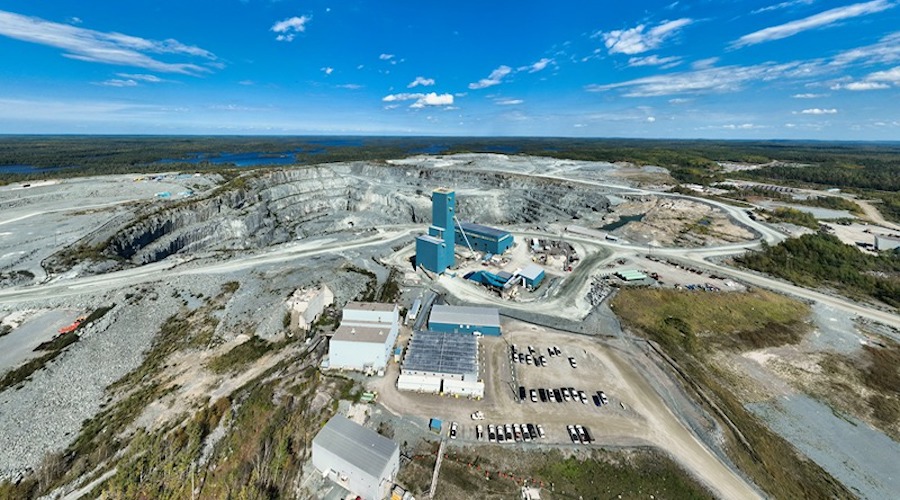
Low palladium prices are forcing Impala Platinum Holdings Ltd. to shut down its mine in Canada, putting 750 jobs at risk.

The Lac des Iles mine is about 1,500 kilometers (930 miles) northwest of Toronto.

Impala Canada expects to end production by May 31, 2026, chief executive officer Timothy Hill told workers in an email seen by Bloomberg News, but “the final date of operations is dependent on several factors, including available tailings capacity and our ability to meet production targets.”

“We’ve been in a prolonged period of low prices, and as a result, the business is not generating the cash flow required to sustain the operation despite the team’s strong performance,” an Impala Canada spokesperson said Tuesday in an email.

The price of palladium — a metal mostly used to curb emissions from gasoline vehicles — has fallen over the past three years because demand from auto manufacturers has weakened. Electric vehicles have captured a larger share of the global auto market, and they don’t need catalytic converters to filter exhaust fumes.

In 2024, Impala Canada cut 95 jobs, also citing lower palladium prices.

Parent company Implats, based in Johannesburg, acquired the Ontario mine in 2019 through its purchase of North American Palladium Ltd. The mine closure was first reported by online publication TBnewswatch.

(By Chaimae Chouiekh)


Mali to sell $107M in gold from Barrick to fund mine restart


The Loulo-Gounkoto complex in Mali. Credit: Barrick Gold

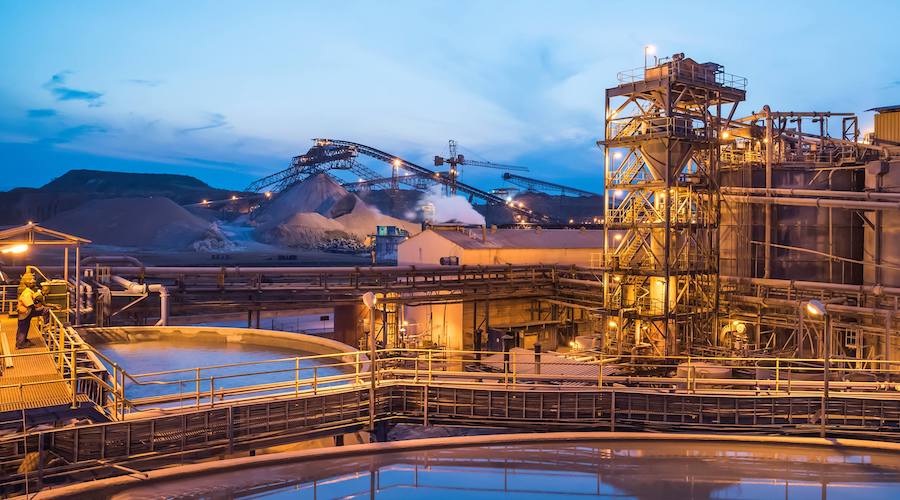
The court-appointed administrator of Barrick Mining’s (TSX: ABX; NYSE: B) Loulo-Gounkoto complex in Mali is reportedly planning to sell some of the gold from the mine site to fund an operation restart.

Citing multiple sources, Reuters said on Tuesday that Soumana Makadji, acting as temporary administrator of the mine operation, intends to sell one metric ton of the gold from the site’s storeroom.

Funds from the planned gold sale could be worth about $107 million and are expected to be used to finance operational expenses, including salaries, fuel and unpaid dues to contractors, the report said.

In addition, Reuters sources have indicated that Makadji has enlisted the state mining company’s chairman and former Loulo-Gounkoto executive Samba Toure to support the mines’ restart, and the plant has already resumed operations.

Battle for control

Loulo-Gounkoto represents one of Barrick’s most significant assets, accounting for about 15% of its total output up until its suspension this January.

The gold complex has become the subject of intense dispute between the Canadian miner and the Malian state for the past two and a half years following the introduction of a new mining code in 2023.

The situation escalated in late 2024 as Mali’s military-led government, which held a 20% in Loulo-Gounkoto, looked to stamp its authority by blocking Barrick’s gold exports, seizing its stockpiled production and detaining company staff. These actions eventually led to its suspension earlier this year.

Eyeing a restart of operations under its control, the Malian state asked the commercial court in Bamako to intervene in the dispute in May and place the gold mines under provisional administration. That request was met last month, with the court appointing Makadji as administrator for six months.

In late June, Bloomberg report came out stating that Makadji wants to restart gold mining at Loulo-Gounkoto for its potential contributions to the Malian economy.

However, Reuters‘ report on Tuesday noted that challenges could surface given the scale of Loulo-Gounkoto and complexity of running the operation. “Even if production starts, we would need at least four months to get back to normal pace,” one of its sources said.

Barrick response

In response to the potential restart under Malian control, Barrick’s CEO Mark Bristow told Reuters that he will challenge the government’s moves in international courts.

“We will use every legal measure at our disposal to hold the state and the individuals involved accountable for these unlawful actions to protect our people and to defend our investments,” Bristow said, adding that Mali had not acted in good faith.

Bristow also expressed doubts about Mali’s ability to operate the gold mines. “We are concerned that such attempts will cause severe damage to the long-term prospects of the complex,” he said.

For the quarter ended December 2024, Loulo-Gounkoto’s all-in sustaining cost was about $100 million.

Barrick did not respond to MINING.COM’s request for comments at the time of writing.


Ghana launches task force to curb gold smuggling losses

Adobe stock image.

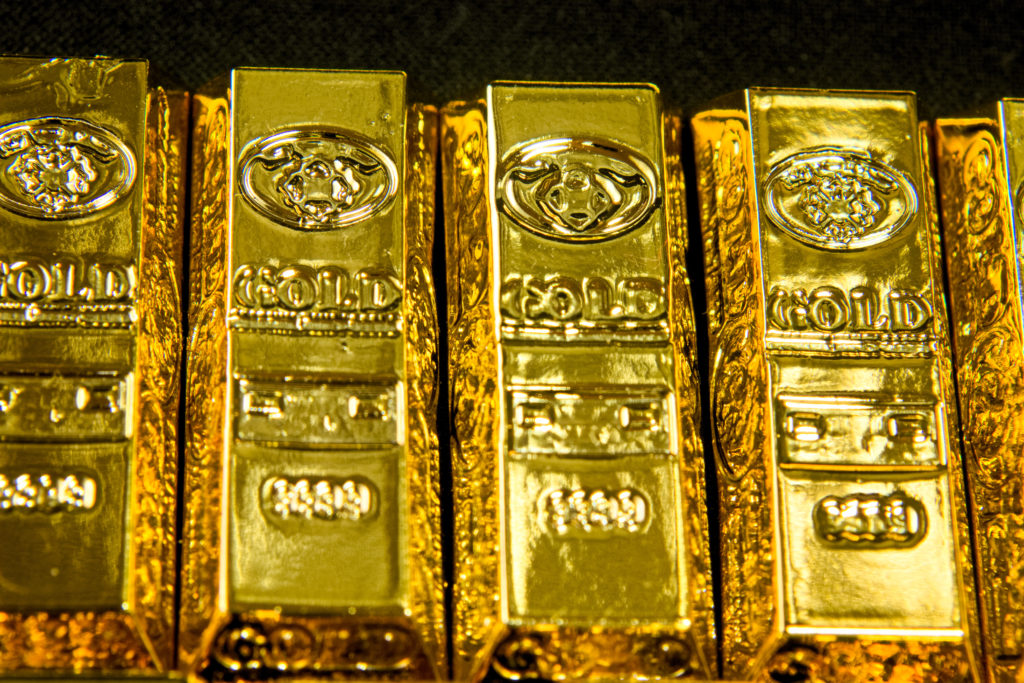
Ghana President John Dramani Mahama on Tuesday launched a task force backed by security forces to address illegal gold trading, as Africa’s top producer seeks to recover billions of dollars lost to smuggling.

The task force is Ghana’s first national anti-gold smuggling initiative. The government has previously launched efforts to sanitize artisanal mining but these were unsuccessful in curbing illegal extraction and preventing revenue losses that plague most African gold producers.

Ghana this year created the new gold board known as GoldBod to centralize gold trading. This has led to record official exports of 55.7 metric tonnes of gold valued at $5 billion in the first five months of 2025, Mahama said at the inauguration of the new task force.

“This is money that would not have come back to Ghana because traders would have taken it and kept the foreign exchange outside,” Mahama said.

To encourage public cooperation with the new anti-smuggling task force, which will involve both soldiers and police officers, informants will receive 10% of the value of gold seized as a result of their tips, Mahama said.

Ghana plans to implement a nationwide gold traceability system and transition to refined gold exports by 2026, Mahama added. The country will also seek to capture more value from gold through an assay laboratory, certified by the International Organization for Standardization to guarantee quality, and a specialized manufacturing hub.

West African governments are striving to capture more revenue from surging commodity prices. Military-led nations are adopting aggressive policies, including rewriting mining codes, seizing assets and renegotiating contracts, while democracies like Ghana and Ivory Coast are pursuing measured reforms through higher royalties and enhanced revenue-sharing deals.

Gold prices have jumped 25% this year to date, and peaked at $3,500 per ounce in April, according to Reuters data.

(By Emmanuel Bruce; Editing by Maxwell Akalaare Adombila, Robbie Corey-Boulet and Franklin Paul)


China’s PBOC keeps buying gold as reserves grow for eighth month

China’s central bank. Credit: Adobe Stock

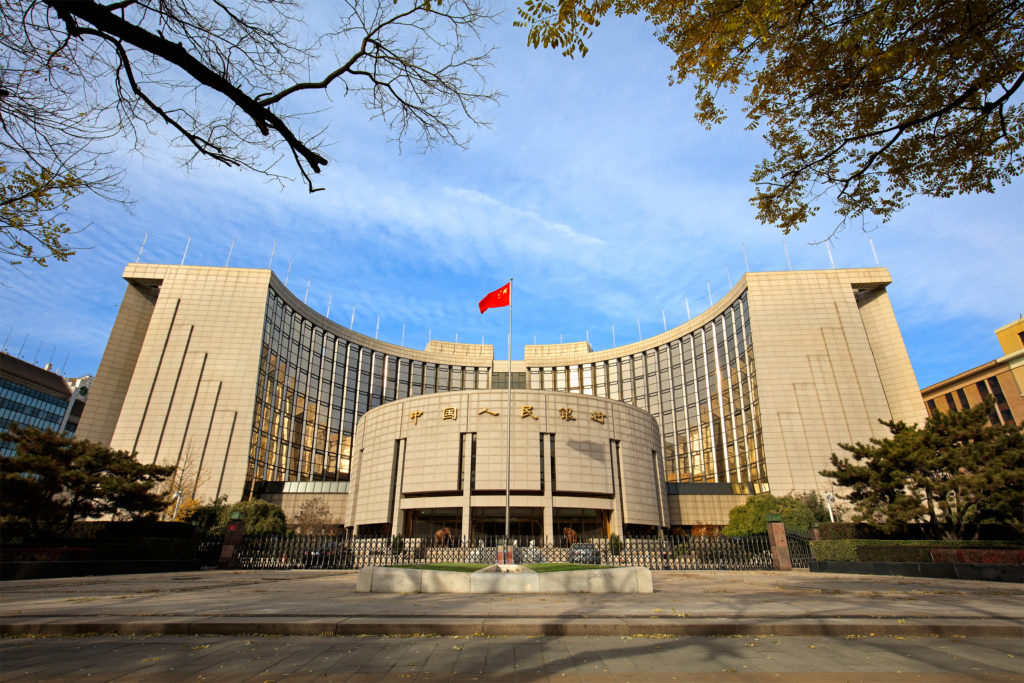
China added to its official gold reserves for an eighth straight month in June, as prices of the precious metal traded near a record high.

Bullion held by the People’s Bank of China rose by 70,000 troy ounces last month, according to data on Monday. Its gold reserves have climbed by 1.1 million troy ounces — or about 34.2 tons — since the current run of purchases began in November last year.

Gold has climbed more than a quarter year to date, underpinned by robust demand from global central banks, as well as safe-haven flows amid an escalating conflict in the Middle East and US President Donald Trump’s aggressive economic and trade agendas.

While the rally showed signs of cooling in June, with prices ending the month little changed, ongoing official-sector buying is likely to remain a strong support. Persistent concerns about the ballooning US fiscal deficit and a perceived weakening of the dollar are prompting some countries to rethink their reliance on US assets.

The PBOC has been among the most enthusiastic official buyers of gold in recent years as authorities have long sought to diversify their holdings from the dollar. The current run of purchases follows a six-month hiatus that ended an 18-month buying spree in 2024.

(By Sybilla Gross)


Canadian mining magnate seeks US projects as Trump deregulates

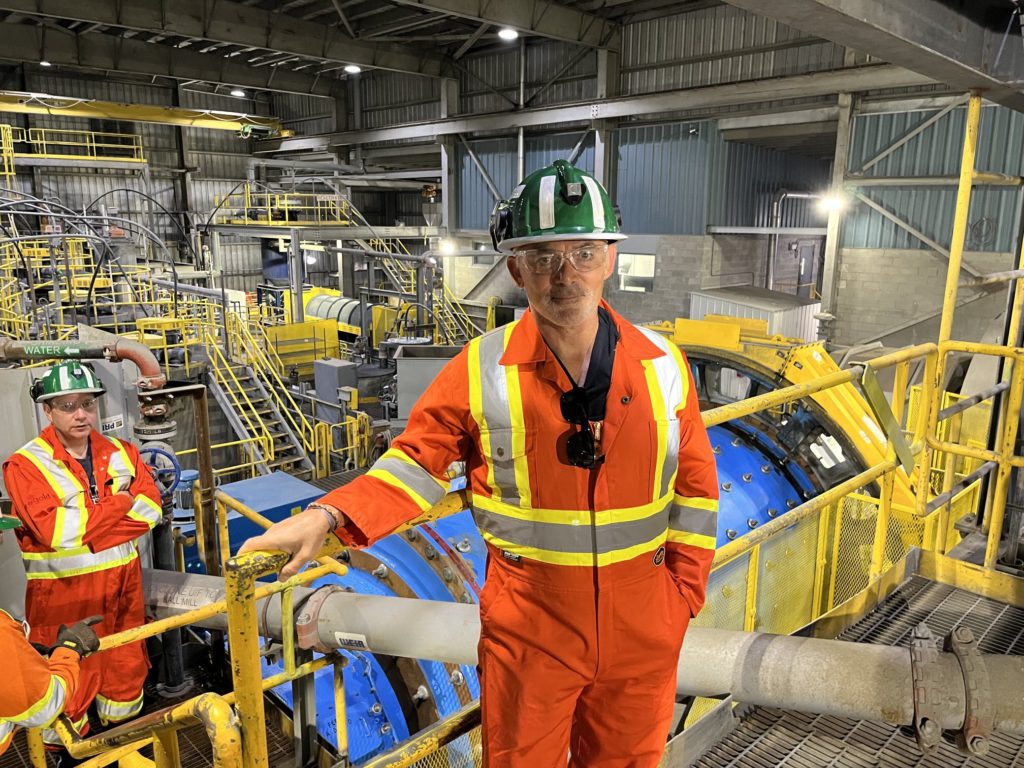
Frank Giustra visiting the Madsen mine in Red Lake Ontario. Image: Frank Giustra’s official X account

Canadian mining magnate Frank Giustra is scouring for projects in the US as President Donald Trump cuts red tape and the outlook for metals like copper and gold remains bright.

Giustra — a key figure in the creation and development of Endeavour Mining Corp., Goldcorp and Leagold Mining Corp. over the past quarter century — has built up another stable of projects from Colombia to Botswana. Now, his office staffed by 75 to 80 people is exploring opportunities in US copper-gold deposits, among others.

“I haven’t nailed one down yet, but yes, we’re looking,” he said in an interview. “The US under Trump has finally figured out that they’re way behind the eight ball on critical minerals, and they’re trying to secure those supply chains.”

In the US, it takes an average of 29 years from the discovery of a copper deposit to the start of production — the longest development time in the world after Zambia. The current administration has invoked emergency powers to boost the ability of the US to produce critical minerals, vowing to speed up permitting and prioritize production on federal land.

Giustra’s search for his next mining investments isn’t limited to the US, with only a handful of countries ruled out. Asked about his preference of metals, he said: “I love gold. I love copper. I love silver. I love uranium. I’m not that crazy about lithium right now, there’s just too much of it.”

While bargains are getting harder to find as more money flows into mining, Giustra’s approach is different to most in that he identifies distressed assets that can be turned around.

Gold, he says, is his favorite topic. Giustra sees the precious metal — up about 40% in the past year — at just the beginning of a bull run amid a nascent de-dollarization trend as US debt piles up.

“I just can’t see how they can turn the ship around,” he said, referring to America’s mounting debt. “There has to be, at some point, a global monetary system reset, and I believe that is already in the works.”

Besides mining, Giustra founded film studio Lionsgate and is heavily engaged in philanthropy. He’s also into technology, investing in and advising Streamex, a tokenization firm focused on commodities. The unit of BioSig Technologies Inc. just entered into agreements for $1.1 billion in financing as it looks to become a major holder of gold.

“I know very little about technology, but I do understand that tokenization of real world assets is where the world is going,” Giustra said. “This is going to allow a much bigger audience to participate in gold, which is the part that got my attention.”

(By James Attwood)


Copper price soars to record as Trump announces 50% tariff

US President Donald Trump. (Stock Image)

Copper prices jumped by double digits on Tuesday after US President Donald Trump announced plans to implement a 50% tariff on the industrial metal.

“I believe the tariff on copper we’re going to make it 50%,” Trump said when asked by a reporter what the rate on those products would be.

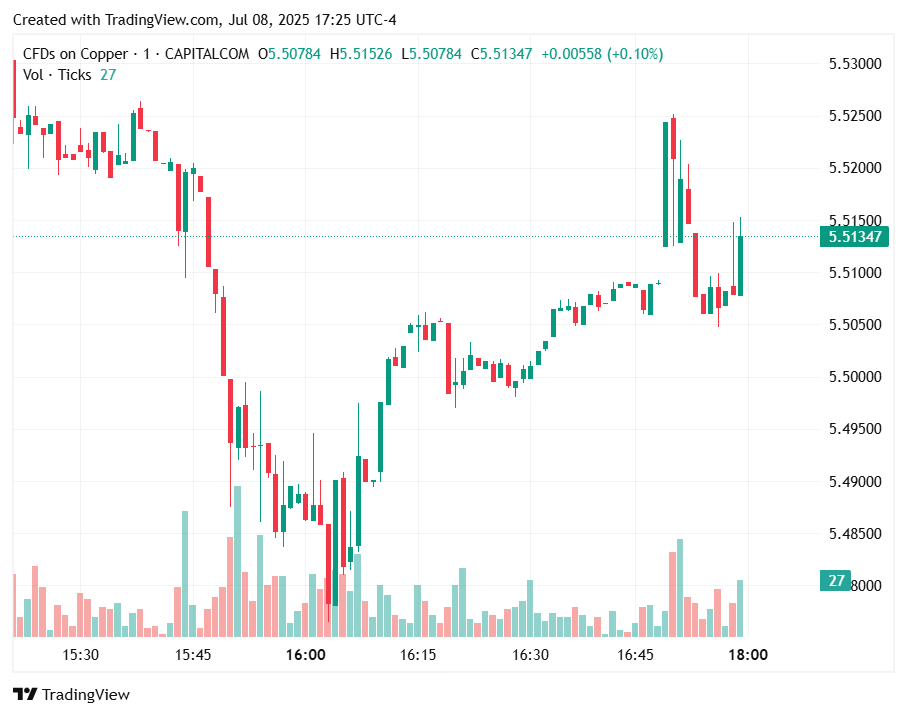
In New York, the most-traded copper futures soared to a record $5.9535/lb. following Trump’s announcement, for an intraday gain of nearly 17%. By 2 p.m., the contracts had settled to around $5.5495/lb.

The copper levy is part of a set of looming sectoral tariffs the US President has planned on select industries. Other sectors that may be impacted include drugs and semiconductors.

In late February, Trump directed the Commerce Secretary to open an investigation into foreign copper imports under Section 232 of the Trade Expansion act.

Third of chip production could face copper supply disruptions by 2035, PwC report says


Arid landscape of the Atacama Desert. Stock image.

Some 32% of global semiconductor production could face climate change related copper supply disruptions by 2035, quadrupling from today’s levels, advisory firm PricewaterhouseCoopers (PwC) said in a report for business leaders on Tuesday.

Chile, the world’s largest copper producer, already grapples with water shortages that are slowing down production. By 2035, most of the 17 countries supplying the chip industry will be at risk of drought, PwC said.

The last global chip shortage, fueled by a pandemic-driven demand spike that coincided with factory shutdowns, crippled the automotive industry and halted production lines across other chip-dependent sectors.

“It cost the US economy a full percentage point in GDP growth and Germany 2.4%,” PwC project lead Glenn Burm said in the report, citing the US Department of Commerce.

Copper miners from China, Australia, Peru, Brazil, the US, Democratic Republic of Congo, Mexico, Zambia and Mongolia will also be affected, sparing none of the world’s chipmaking regions from risk, PwC said.

Copper is used to make the billions of tiny wires inside every chip’s circuit. Even if alternatives are being researched, there is currently no match for its price and performance.

The risk will only increase over time if innovation on materials does not adapt to climate change, and a more secure water supply is not developed in the affected countries, PwC said.

“Around half of every country’s copper supply is at risk by 2050 – no matter how fast the world reduces carbon emissions,” the report says.

Chile and Peru have taken steps to secure their water supply by increasing mining efficiency and building desalination plants. This is exemplary, PwC says, but may not be a solution for countries with no access to large bodies of sea water.

PwC estimates that 25% of Chile’s copper production is at risk of disruptions today, rising to 75% within a decade and to between 90% and 100% by 2050.

(By Nathan Vifflin; Editing by Milla Nissi-Prussak)


Chile’s biggest copper windfall in years signals higher output

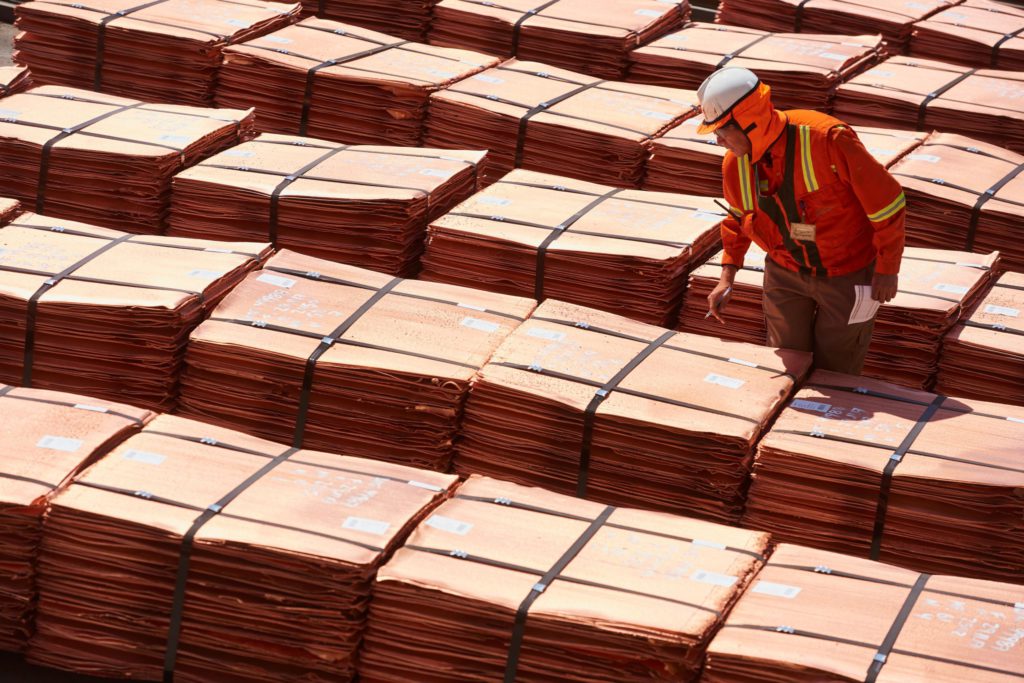
Copper anodes. Image from Glencore.

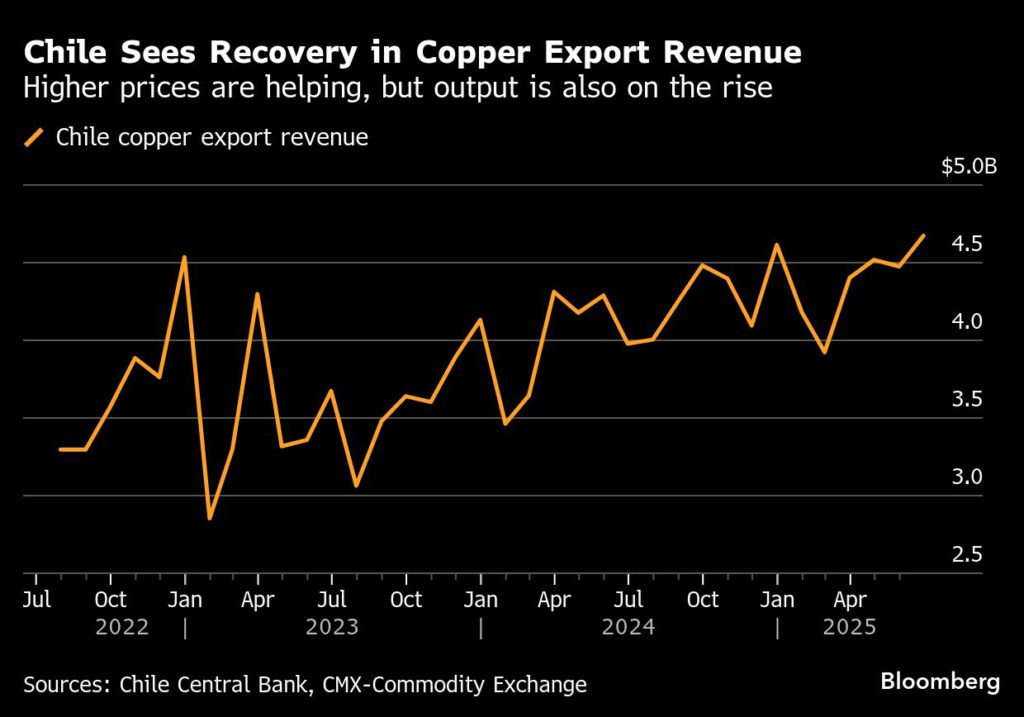
Chilean copper mines had their best month of export revenue in more than three years in June, with the increase in value outstripping price gains in a sign of rising production.

The country that accounts for about a quarter of the world’s mined copper shipped $4.7 billion worth of the metal last month, the biggest haul since December of 2021, according to data released by the Chilean central bank on Monday. That’s 17% more than the same month last year, signaling that at least part of the increase was the result of higher volume given prices rose 11% on average over the same period. Chile is yet to report June production.

In May, Chile had its best month of copper output this year, delivering some relief to a tight global market, as mines recover from operational setbacks and declining ore quality that had sent production to 20-year lows.

(By James Attwood)


Copper Prices Skyrocket 17% After Trump Announces 50% Tariff

Copper futures soared as much as 17% on Tuesday, their largest intraday gain in at least three decades, after former President Donald Trump announced a 50% import tariff on the industrial metal. Speaking at a Cabinet meeting, Trump confirmed plans to impose new duties on copper, part of a broader tariff push targeting metals, semiconductors, and pharmaceuticals.

“We’re going to make it 50%,” Trump said when asked about the copper rate. The announcement immediately jolted markets, highlighting how sensitive the global copper supply chain is to U.S. trade policy.

Commerce Secretary Howard Lutnick later told CNBC that the Commerce Department had completed its Section 232 investigation into copper, and that the new tariff could be implemented as soon as late July or August 1. “We’ve studied the market, the president now has the ability to set the tariff,” Lutnick said.

The proposed tariff threatens to reshape a vital industrial supply chain at a time when global copper demand is expected to surge, driven by the clean energy transition. The U.S. consumed around 1.6 million tons of refined copper in 2024, relying on imports for 36% of its total needs. Chile remains the top supplier, followed by Canada and Mexico.

The U.S. produced roughly 850,000 tons of primary copper last year, but domestic production alone isn’t enough to meet demand for electric vehicles, grid expansion, and renewable infrastructure.

Trump’s copper move mirrors his first-term actions on steel and aluminum, which shook global trade. Copper, until now, had been spared.

In the same meeting, Trump hinted at a potential 200% tariff on foreign-made pharmaceuticals, though with a grace period of up to 18 months for companies to relocate production to the U.S.

Still, it was copper that sent shockwaves through markets. With the U.S. gearing up for an electrified future and global demand intensifying, a 50% copper tariff could have massive consequences — not just for prices, but for the energy transition itself.

By Tom Kool for Oilprice.com