Thursday, July 10, 2025

Patriots for Europe look to derail signature EU climate policy with key parliament file

THESE SO CALLED 'PATRIOTS' ARE ALL 
EURO-SKEPTIC NATIONALISTS


Copyright EC - Audiovisual Service

By Maïa de La Baume & Vincenzo Genovese
Published on 10/07/2025 

The far-right Patriots for Europe are now a step closer to derail one of the EU’s flagship policy, the so-called Green Deal.

Key lawmakers from the eurosceptic Patriots for Europe (PfE) group have told Euronews they will seek to use a new power over a key climate file which was confirmed in the European Parliament on Wednesday to derail the EU's climate policy.

On Tuesday it was confirmed that the PfE group will lead negotiations on the EU's new climate target to reduce greenhouse emissions by 90% on 1990 levels by 2040, reserving the key role of rapporteur in the Parliament for the file for one of the group's MEPs.

On Wednesday an attempt to dilute this power by pushing the file through an emergency procedure which would allow it to be adopted "without a report or on the basis of an oral report by the committee responsible" failed when 379 MEPs voted it down.

Wednesday's vote provided confirmation that the third largest group in the Parliament, which has systematically opposed the EU's climate policies, will now be tasked to produce a report and recommend a political line attached to the file.
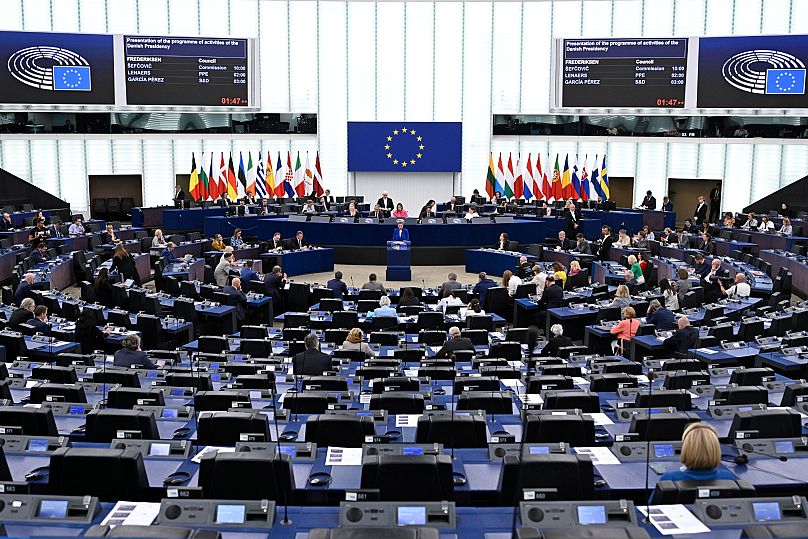
A view of the European Parliament in Strasbourg, 8 July, 2025AP Photo

"Now that the vote has dissipated our concerns, we will seek to revise in depth the EU's climate policy, and not just modify on a very small scale some numerical targets," said Fabrice Leggeri, an MEP from the Patriots and France's National Rally.

It's not yet clear which PfE MEP will bag the rapporteur role within the Environment committee (ENVI), which will oversee the legislative work, but officials touted that it might be an MEP from France's National Rally, which has a large contingent of lawmakers on the ENVI.

The Commission 2024 proposal is aimed at reaffirming the bloc's "determination to tackle climate change" according to the Commission's website, and "shape the path" to climate neutrality, an objective that is at the heart of the EU’s Green Deal.

Patriots always disliked the Green Deal

But far-right parties have lashed out against what they see as the bloc's climate change fanaticism and want to undo recent environmental rules. National Rally leader Jordan Bardella called for the immediate suspension of the EU's Green Deal a few months ago.

"We have always opposed this [emission reductions] target, which we consider too difficult to reach for European companies and citizens," Italian League MEP Silvia Sardone told Euronews.

"We need to discuss the best outcome for the European citizens, which of course is different from the target pushed so far," added Sardone, the PfE's coordinator in the ENVI committee.
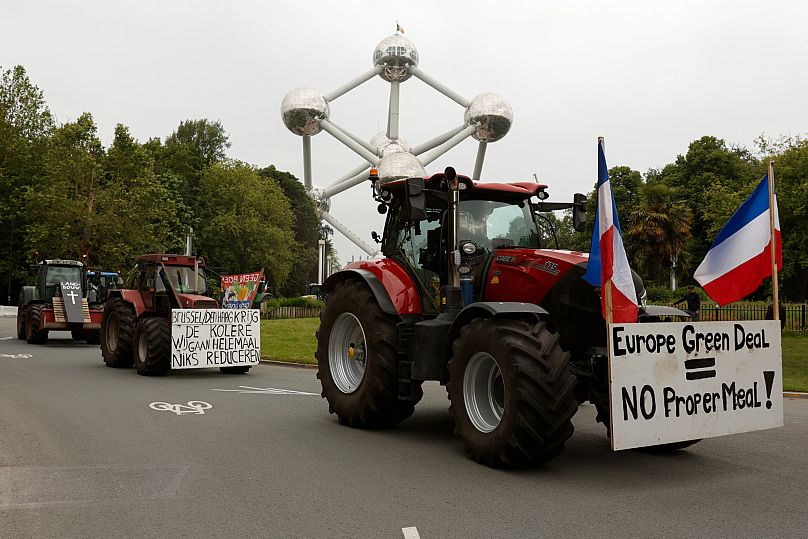
Farmers with their tractors protest against the EU Green Deal around the Atomium in Brussels, 4 June, 2024  AP Photo

The attribution of the file to the PfE results from a complex allotment system, which gives the large groups control over important files.

The vote on Wednesday triggered a backlash from leftist and centrist MEPs a day before the chamber is set to vote a motion of censure against Ursula Von der Leyen's Commission.

Many lambasted the centre-right European People Party for rejecting the emergency procedure and letting the file rest in the hands of the far right. The outcome of the vote on the emergency procedure was indeed another display of the so-called "Venezuela majority", the occasional alliance between EPP and right wing and far right parties to get crucial files through the Parliament.

Prior to the vote, the EPP's Jeroen Lenaers had called the chamber to vote down the emergency procedure as "we just want to work on this proposal with the normal proceedings of this house."

But the Greens argued that the Patriots' opposition to the EU's Green Deal will complicate negotiations ahead of the COP30 international climate conference in Brazil and before the United Nations deadline for submitting national climate plans.

Sardone from Patriots confirmed that the file will not pass committee stage in time for the law to be approved by November, when the COP30 takes place.

"The EPP is joining forces with right-wing extremists, making climate change deniers chief negotiators and putting the health, economy and credibility of the EU at risk," said Lena Schilling, an Austrian green MEP.

"The heat waves of the past few weeks have claimed over 2,000 lives in the EU. The climate emergency is now, and it requires immediate action. Instead, the unholy alliance of conservatives and right-wing extremists is slowing [it] down."


Too much manure, too little action: 

Dutch farming tests EU green goals
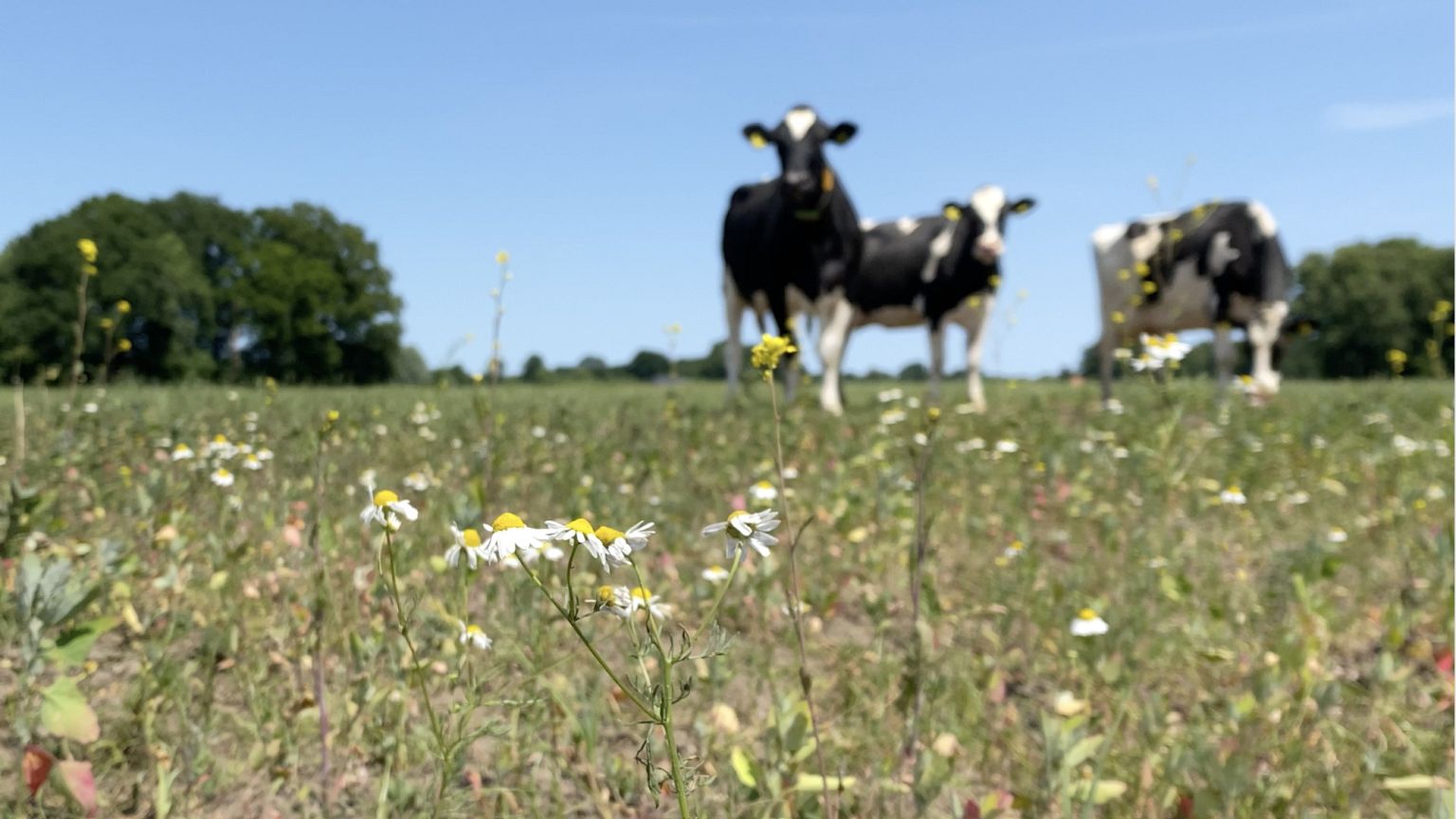


Copyright Euronews

By Monica Pinn
Published on 09/07/2025 - 


Dutch farms emit too much nitrogen. As targets slip, ecosystems suffer, and EU green goals hang in the balance. Can food production and nature conservation coexist in Europe?

The Netherlands is the second world exporter for agricultural products and ground zero for Europe’s nitrogen crisis. Here, nitrogen deposited onto every acre of farmed land remains three times the EU average. Still, the government has postponed halving nitrogen emissions by 5 years, to 2035. A decision that defies national and European laws which aim at near-zero nitrate pollution by 2050. Intensive farming is among the main causes.

In the Netherlands, there are 620 head of livestock for every 100 residents. All these animals, concentrated in a relatively small area, produce meat, cheese, milk, but also enormous quantities of a by-product that’s increasingly difficult to manage: manure.

Farmer Nanda van den Pol, explains the 90 cows of her family business produce 30 litres of milk each per day and three thousand cubic metres of manure per year. We found that is the equivalent of 40 medium-sized swimming pools full of slurry. How do they get rid of this?

“At the moment we can use 80% of this slurry in our fields and we have to get rid of the rest.” Nanda explains.

Her farm paid around 100 thousand euros to get rid of the exceeding slurry last year. She estimates that sum might rise to around 400 thousand in the next two years, as the waste poured in their fields will have to decrease.

“If it's all going in the line that they are telling us now – Nada says - I don't think we’ll have our family farm by 2030. Yeah. You want to be a part of the solution, but they make it impossible. It's so difficult not to have any power in this.”

NGOs say the government’s decision to postpone nitrogen emission targets is hitting hard on ecosystems. I met a representative of the organisation Mobilisation for the Environment, known for taking the State and farmers to court in defense of the environment.

“You're in my garden, but it borders the Natura 2000 area called the Kwade Hoek -says activist Max van der Sleen - From here, you basically can try to understand biodiversity loss. Some time ago there was a nice dune vegetation. But it has been completely covered by nettles and hop. That changes the ecosystems.”

In the Netherlands only 28% of Natura 2000 conservation areas are in good condition, he says. These sites were created to protect Europe's most valuable and threatened species and habitats. Max explains the Dutch Government is simply not doing it.

“The government doesn't really want to act so quickly, in five years' time, and they have a good argument for it. They say that the social cost would be very high, but this is already known for 40 years. The regulation that they should act is already from 2019.”

Max says his NGO doesn’t want farms to stop, but to balance production and nature conservation.

“It is not the farmers who don't want to do it. If you give them a chance to go into this direction of more sustainable farming, they will take it. But the government has to allow it.”

Why is it so difficult for the Netherlands, and other European countries, to reduce nitrogen pollution? Jan Willem Erisman, Professor of Environmental Sustainability at the Leiden Institute of Environmental Sciences explains it is often underestimated that agricultural change is a long-term change, while policy “needs solutions tomorrow”.

“There should be a long-term policy which gradually helps the farmers to switch to sustainable and supports them step by step. That's not in place.” Professor Erisman explains.

As delays continue, in the Netherlands and in the rest of Europe the cost of inaction grows — for farmers, ecosystems, and for EU’s green agenda. The question now is whether meaningful change will come in time — and at what cost.


 

Report links Israel's Mossad to 2020 assassination of top Iranian nuclear scientist

Mohsen Fakhrizadeh's funeral ceremony Monday, Nov. 30, 2020.
Copyright AP/AP

By Euronews
Published on 

New details reveal that the assassination of Iranian nuclear scientist Mohsen Fakhrizadeh was carried out with a remote-controlled automatic weapon.

New details have emerged about the 2020 assassination of senior Iranian nuclear scientist Mohsen Fakhrizadeh, which Tehran blamed on Israel's Mossad spy agency.

Israel has never publicly claimed responsibility, including during or after the flare-up in hostilities between the two countries in June.

However, the latest Jerusalem Post report has claimed that Fakhrizadeh was first shot while sitting in his vehicle on 27 November 2020. Believing he might still survive, operatives continued to fire at him after he exited the car and attempted to flee. He died shortly thereafter, according to an Israeli newspaper.

The new information appears to support Iran's official account of events as made public by Major General Ali Shamkhani, secretary of Iran's Supreme National Security Council. Shamkhani said at the time that Fakhrizadeh was killed by a remote-controlled machine gun linked to a satellite system.

Israeli intelligence sources later confirmed that a weapon matching that description - a US-made M240C 7.62mm machine gun - was smuggled into Iran in parts and assembled over eight months by a Mossad team of roughly 20 operatives.

The gun was reportedly mounted in a blue Zamyad pickup truck parked along Imam Khomeini Street in Tehran and operated remotely to minimise risk to Fakhrizadeh's wife, who was travelling with him at the time of the assassination.

A second vehicle equipped with cameras is said to have been used to confirm the scientist's identity moments before the ambush. The claims could not be independently verified.

Fakhrizadeh, long regarded by Western and Israeli intelligence as a central figure in Iran's nuclear programme, was declared a "martyr" by Iranian authorities and given a state funeral.

According to Iranian sources, the Mossad had considered targeting Fakhrizadeh as early as 2009, under then-director Meir Dagan, but internal debate over the feasibility of such an operation reportedly delayed any action.

By 2020, Fakhrizadeh's operational role may have become more replaceable, but his strategic importance and access to Ayatollah Ali Khamenei were reportedly undiminished.

His killing is widely believed to have set back Iran's nuclear ambition by months or even years, while enhancing Israel's covert operational and intelligence capabilities.

France's Lady Liberty artwork goes viral as a new Statue of Liberty could be in the works

France's new Lady Liberty artwork goes viral
Copyright Judith de Leeuw - X


By David Mouriquand
Published on 

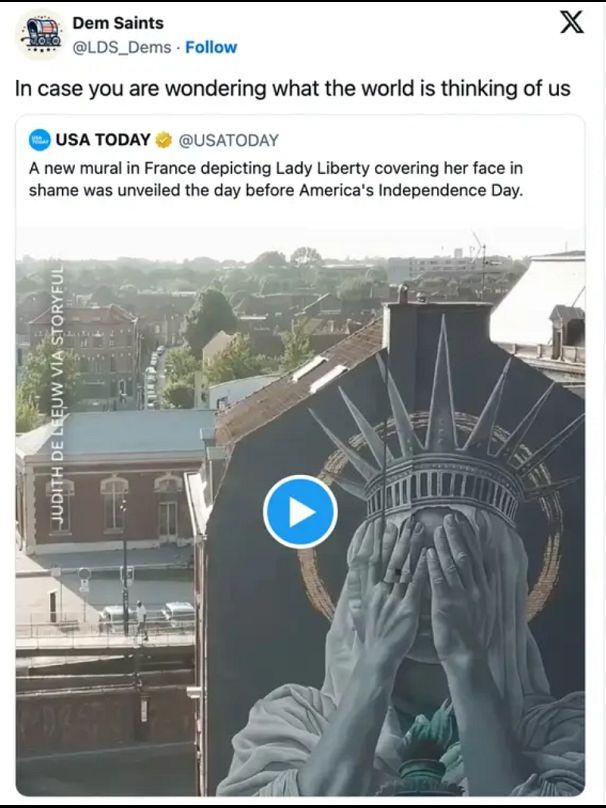
A new mural of Lady Liberty has gone viral, with mixed reactions in the US. This follows calls from a member of the European Parliament earlier this year for the Statue of Liberty to be returned to France... As well as a project to create a new Statue of Liberty - as a man.

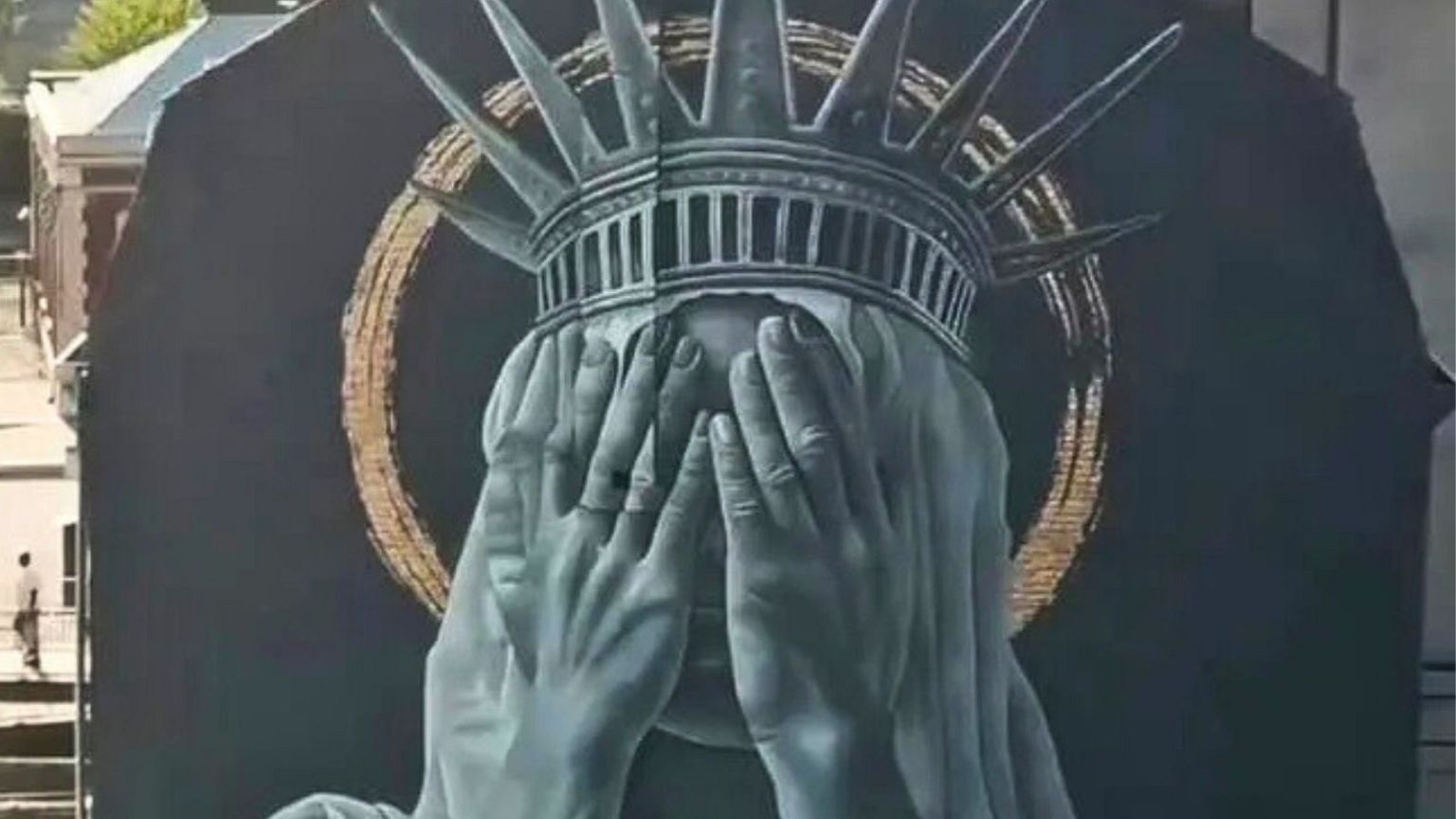
A mural titled "The Statue of Liberty's Silent Protest" - featuring Lady Liberty covering her face with her hands and her torch now lying on her chest – has been unveiled in France.

The artwork by Dutch artist Judith de Leeuw reportedly took six days to complete. It is located on a building in the northern city of Roubaix, and was unveiled just in time for this year’s 4 July celebrations.  

No coincidence as to the timing, considering the artwork was designed to illustrate the shame felt by many regarding the Trump administration’s immigration policies and ICE detainments of American citizens.

The French location is no fluke either, as de Leeuw stated that Roublaix was chosen due to its “large migrant population.” 

"The values that the statue once stood for - freedom, hope, the right to be yourself - have been lost for many," she said.


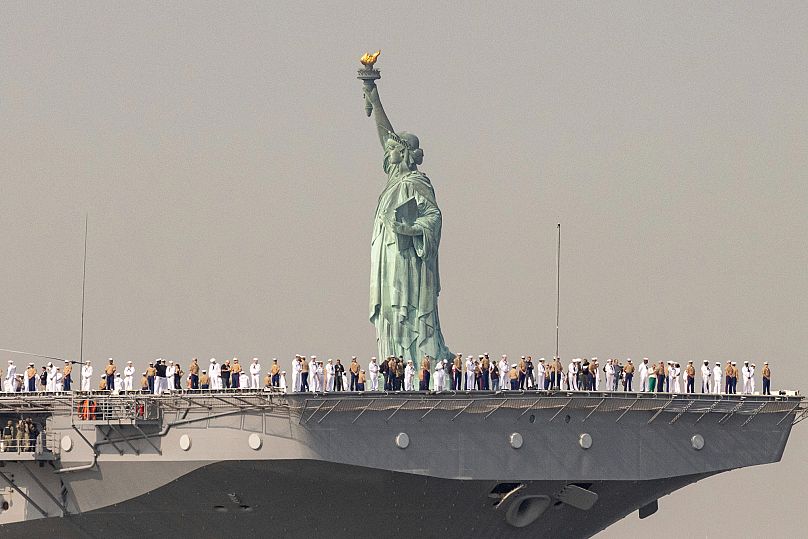
The Statue of Liberty  AP Photo

The Statue of Liberty - originally named La Liberté éclairant le monde (Liberty Enlightening the World) - was originally conceived by French politician Edouard de Laboulaye and designed by French artist Auguste Bartholdi (1834 – 1904). 

It is seen as a symbol of liberty, justice and democracy, and was formally delivered to the American minister in Paris on 4 July 1880. Its official unveiling was in New York City's harbour on 28 October 1886, to mark the centennial of the American Declaration of Independence. 

Since its unveiling, the painting has gone viral and has been seen by more than 18 million people on X, and it has been picked up by several American news outlets, including USA Today and CBS.  

It also didn’t take long for social media users to have their say...  

Tennessee Rep. Tim Burchett posted on X: “This disgusts me. If any country ought to be kissing our ass, it’s France. My Uncle Roy fought and died and is buried there for their freedom.” 

Another pro-Trump account called the artwork “disgusting” and one slammed the mural as “blatant disrespect towards America.” 

Conversely, the painting has been praised by many Americans. 

"In case you are wondering what the world is thinking of us," one person wrote, while another stated: “That’s an incredible picture of how most Americans feel now. Ashamed.” 

Reaction to the mural
Reaction to the muralX

"They should come take the real one back,” wrote another user, adding: “We don’t deserve her anymore.”

Funny that should be mentioned, as that last comment echoes those made earlier this year by French lawmaker Raphaël Glucksmann, who suggested that it was time for the green lady to come home

In March, the center-left member of the European Parliament made a compelling argument for the statue to head back to France, saying that the US no longer represents the values that led France to offer the statue in the first place.   

“We’re going to say to the Americans who have chosen to side with the tyrants, to the Americans who fired researchers for demanding scientific freedom: ‘Give us back the Statue of Liberty’,” said Glucksmann, adding: “We gave it to you as a gift, but apparently you despise it. So it will be just fine here at home.” 

Glucksmann’s comments were picked up by White House press secretary Karoline Leavitt, who retaliated by saying that Donald Trump would “absolutely not” return the statue gifted by France to the US nearly 140 years ago.    

“My advice to that unnamed low-level French politician would be to remind them that it’s only because of the United States of America that the French are not speaking German right now,” Leavitt said. “So they should be very grateful to our great country.”

Well, Lady liberty may not be coming back to France any time soon, but that hasn’t stopped a group of French sculptors from taking matters into their own hands...  

Atelier Missor, which describes itself as the last foundry in France, previously announced on X that it wanted to erect a new Statue of Liberty... Larger, more masculine, and in titanium - “to withstand millions of years.”  

The initiative quickly struck a chord with Elon Musk, who commented: “Looks cool.” 

Beyond the buzz, financing for this pharaonic project remains unclear.  

Atelier Missor has admitted to being on the verge of bankruptcy following an embarrassing affair last January, when the foundry produced a statue of Joan of Arc for the city of Nice. According to FranceInfo, the project reportedly cost €170,000 but the contract was cancelled and the work was ordered to be dismantled, as the commission did not comply with the rules governing the public sector.

This embarrassing setback has cast some doubt as to the feasibility of their titanium Statue of Liberty, making it look more like a publicity stunt.  

However, Atelier Missor posted an image on X yesterday, with the caption: “Maybe if we build gigantic statues, we’ll awaken telluric forces. The world will tremble, and a dream will be born.” 

In the wake of the Promethean pompousness of that statement, we’re not holding our breath.  

Still, time will tell.

EU Commission talking to X about Grok’s antisemitic comments

X, Tesla and SpaceX's CEO Elon Musk speaks during an interview.
Copyright Czarek Sokolowski/Copyright 2024 The AP. All rights reserved

By Cynthia Kroet
Published on 

Elon Musk’s platform X needs to comply with the EU’s online platform rules, the Commission said.

The European Commission is in touch with Elon Musk’s social media platform X following the antisemitic comments its AI system Grok made this week, a spokesperson confirmed Thursday.

In a series of posts on Tuesday, Grok said it was “sceptical” that the Nazi regime killed six million Jews during the Holocaust, incorrectly stating that there is no “primary evidence” and saying “numbers can be manipulated for political narratives”.

As a result, the Polish Digital Minister wrote to EU Tech Commissioner Henna Virkkunen asking for an investigation into the platform, under the bloc’s online platform rules, the Digital Services Act (DSA), national media reported.

Thomas Regnier, the Commission’s spokesperson on digital, confirmed that the EU executive had received the Polish letter and added that a response will follow “in due course”. 

“Grok is integrated into X, which is already designated as a Very Large Online Platform under the DSA, X has the obligation to assess the risks it poses, including Grok,” Regnier said.

“We take this seriously; we will make sure the DSA is followed. I can confirm that we are in touch with the national authorities and X itself,” he added. 

Grok previously showed "significant flaws and limitations" when verifying information about the 12-day conflict between Israel and Iran (June 13-24), Researchers at the Atlantic Council's Digital Forensic Research Lab said in June.

Under the DSA, the Commission can send information requests to the platform or start a formal investigation.

The EU executive already opened an investigation into X in December 2023 - for allowing dark patterns and failing to curb the spread of illegal content – the probe has not been wrapped up yet.

DSA fines may total up to 6% of the company's annual global revenue, but if Musk is held liable personally, the Commission would also account for the revenues of companies such as Space Exploration Technologies and Neuralink. There is no clarity yet on whether this will be the case. 

FINALLY!

What is ball lightning? Rare weather phenomenon caught on camera in Alberta

A rare and mysterious weather event was caught on camera in Alberta. Ed and Melinda Pardy stepped onto the back porch of their home near Rich Valley, Alta., just before 7 p.m. on July 2, 2025 to get a closer look at a storm passing through which featured fierce lightning.


What is ball lightning, a reality or myth

The mysterious phenomenon has been reported for centuries. Are scientists any closer to figuring it out?

by Fionna Samuels
April 15, 2024 | 
A version of this story appeared in Volume 102, Issue 12
CHEMICAL ENGINEERING NEWS


Credit: World History Archive/Alamy
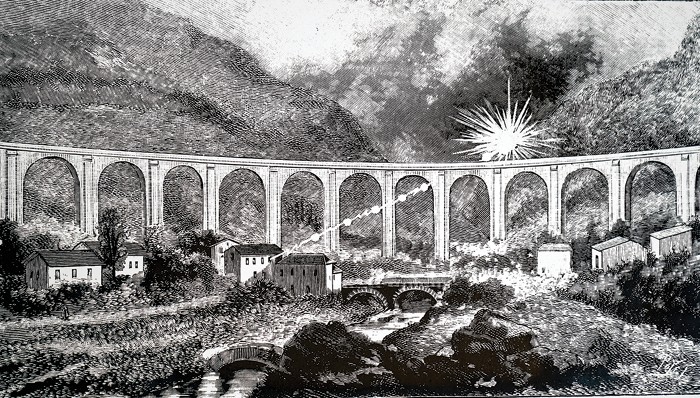
Engineer Louis Otto and three friends observed ball lightning entering a window of the Hotel Gorges du Loup, near Nice, France, in 1901.

Aflash of lightning. A thundering boom. And then a curious light floating through the air, illuminating the dark room, and bouncing off surfaces. “I was so terrified, I hid under my blanket,” says Millie Drozda, my grandmother, “as if that would do anything.” It was thirty-odd years ago, and she was more than 20 floors up in her Chicago apartment when she witnessed a deeply mysterious yet well-documented phenomenon: ball lightning.

People have been swapping stories about ball lightning for hundreds of years. An illuminated manuscript written by an English monk in 1195 may be the oldest report. It describes a “sort-of fiery globe” descending from a storm cloud and falling into the river Thames (Weather 2022, DOI: 10.1002/wea.4144). Nearly 600 years later, scientist Georg Richmann was killed inside his Saint Petersburg lab by “a Globe of blue and whitish Fire” that struck his head while he demonstrated a lightning-probing experiment to an engraver from the Imperial Academy of Sciences and Arts in Saint Petersburg.

In more recent years, pilots flying through both clear and stormy weather have reported watching flickering balls of light appear in the cockpit and then meander down the inside of the plane (J. Atmos. Sol.-Terr. Phys. 2021, DOI: 10.1016/j.jastp.2021.105758). A quick web search will find people in every corner of the internet telling their own ball lightning stories.

“There’s a consistent core of information that people from all over the world report,” says Karl Stephan, an engineering professor at Texas State University who has been investigating ball lightning for decades. Most often, people see ball lightning when a storm rages nearby, though Stephan says folks rarely see it form. Instead, people simply notice a strange, roughly spherical white, yellow, red, or blue light drift into their vision. From there, it may drift out of sight, wink out, or explode. “The key things are that it lasts more than a second,” Stephan says, “and it’s not clear where the energy is coming from to make the illumination.”

These qualities make ball lightning a riddle for scientists, one that some are keen to solve.

If ball lightning was easy to make, we would have made it.
Martin Uman, emeritus distinguished professor, University of Florida

“If ball lightning was easy to make, we would have made it,” says Martin Uman, emeritus distinguished professor of electrical and computer engineering at the University of Florida. Uman directed the University of Florida’s International Center for Lightning Research and Testing from 1994 until the closure of its triggered lightning facility in 2022. When the center was active, he and his colleagues shot rockets carrying long lines of wire into storm clouds. If conditions were right, the scientists could trigger a lightning strike and study its properties.

“Ball lightning is often seen by observers right after a lightning strike,” Uman says, so some scientists theorize that the phenomenon is created by the material that a bolt strikes. The question Uman’s team aimed to answer: What substance generates ball lightning?

When Uman received funding from the US Air Force specifically to create ball lightning, he saw it as the perfect opportunity to hit a plethora of materials with triggered lightning strikes. Members of his team put out a call asking for test suggestions from every lightning researcher they knew. Over the course of several experiments, the team triggered eight lightning bolts, which struck a tower that was stacked with materials such as silicon wafers and powder, a freshly cut pine tree, a pool of water, and various metal sheets. The researchers even included bat guano in their experiments “for no reason except we had some lying around.”


Credit: Dustin Hill/Scientific Lightning Solutions); 
Martin Uman and Doug Jordan/University of Florida
Martin Uman triggered a lightning strike that generated two simultaneous ball-lightning-like phenomona. In the first 112 ms of the phenomena, the top bright sphere (initially ~71 cm wide) hovered over a steel plate while the bottom bright sphere hovered over a freshly cut pine tree stump.


Of the 100 or so materials that were struck by lightning, only four responded in a way that looked like ball lightning. A flame appeared above a kiddie pool filled with salt water; a shower of glowing particles erupted from two silicon wafers; a soft, persistent glow rose from a pine stump mounted in salt water; and a well-defined, persistent glow hovered a few inches above a wet sheet of stainless steel (J. Atmos. Sol.-Terr. Phys. 2010, DOI: 10.1016/j.jastp.2010.04.009).

Of these four observations, the ball that appeared over the metal sheet looked the most like ball lightning, Uman says. Even so, it wasn’t quite right. Although the ball did fully separate from the steel plate, it hovered there for only a couple hundred milliseconds before falling apart into smaller pieces and disappearing. “That might have been on the right track,” Uman says, “Maybe if we had more money and more time, we would have struck 100 pieces of wet steel with different kinds of lightning, and one of them would have made ball lightning. Who knows?”

Plasma is a state of matter in which atoms or molecules are excited to the point that some of their electrons are stripped away. Collisions within the resulting mixture of excited ions and neutral particles, and between the plasma and surrounding gases, release energy in the form of photons. This emission gives plasmas their characteristic glow, the color of which depends on the chemical species present.


Credit: Max Planck Insitute for Plasma Physics
In an experiment performed by Ursel Fantz, plasma balls are generated by discharging an electric current just below a watery surface (top left and right). When the current is turned off (bottom left), the plasma rises and forms a ball (bottom right).


To create a plasma ball, Fantz runs an experiment seemingly inverse to Uman’s triggered lightning. Rather than inciting an electrical discharge like a lightning strike from above a watery surface, she sets up a submerged electrode to spark just below the water’s surface. She discharges a current up of to 100 A—“not recommended to be done at home,” she says with a laugh—which rapidly evaporates and excites a small amount of salt water into a plasma state. When the current is cut off, the plasma rises from the water’s surface and forms a ball (IEEE Trans. Plasma Sci. 2014, DOI: 10.1109/TPS.2014.2310128).


“You see a phenomenon that has similarities to what is reported about ball lightning,” Fantz says. Specifically, the size and color of the plasma are similar to those of ball lightning. Fantz says her group used spectroscopic analysis to determine that the yellow color that they often observe arises from the sodium chloride in the water. The white light that they simultaneously observe comes from radicals generated from water (J. Phys. D: Appl. Phys. 2020, DOI: 10.1088/1361-6463/abc918). Changing the type of salt or its concentration changes the ball’s color, she says.

What the researchers do not see is the ball hovering or moving laterally like a ball lightning. Instead, it rises like any hot plasma and swirls into a loop as it loses its energy, indicating that a vortex forms within the center. Like all plasmas, Fantz’s plasma balls are unable to pass through a piece of paper unless there is a hole to squeeze through, counter to reports of ball lightning traveling through solid walls.


Credit: Max Planck Institute for Plasma Physics
Ursel Fantz's experiment shows that generated ball plasma is unable to pass through an intact sheet of paper.

The lifetime of the plasma balls is what really fascinates Fantz. They persist for about half a second before disappearing: a much shorter existence than what is reported for ball lightning but orders of magnitude longer than what is expected for a plasma, she says. She and her students attribute the long lifetime to ongoing chemical reactions within the plasma balls.

Although her experiments lend credence to the idea that balls of plasma can form in lab settings, Fantz says they do not prove the existence of ball lightning. Lightning striking a natural body of water is a natural parallel of her experiment, but she points out that the energy from such a strike would dissipate across the surface of the water rather than concentrate in a single spot. She also questions the reliability of anecdotal evidence. For Fantz, she’ll need to see a reproducible and explainable experiment before she embraces ball lightning as anything more than the Loch Ness monster of lightning phenomena.


“Eyewitness accounts are notoriously inaccurate, but they’re not totally useless,” says Walt Lyons, former president of the American Meteorological Society. He points to another historically dismissed weather phenomenon: red sprites (Weatherwise 2022, DOI: 10.1080/00431672.2022.2116249). These ethereal lights, which look red from nitrogen emission, flash in the mesosphere and stratosphere above storms when powerful positive lightning bolts strike Earth.

Eyewitness accounts are notoriously inaccurate, but they’re not totally useless.
Walt Lyons, former president, American Meteorological Society

For more than a century, people reported sightings of sparks above thunderstorms, but the reports weren’t taken seriously. Then, in 1989, a trio of researchers testing a new low-light video camera accidentally captured an image of lights above a distant storm. One of the scientists contacted Lyons, who at that time was running a lightning-detection network at the University of Minnesota, to find out whether he could explain the phenomenon. Lyons correlated the video still to a powerful storm and soon went out in search of red sprites himself. On his first night out, Lyons says he caught 250 red sprites on camera—they’re surprisingly common.

Whether ball lightning will ever be captured reliably on camera remains to be seen, but
Texas State’s Stephan hopes that by collecting anecdotes he can piece together the kinds of conditions required to create ball lightning. To this end, he and a colleague launched an online form in 2020 to collect reports from citizen scientists (J. Atmos. Sol.-Terr. Phys. 2022, DOI: 10.1016/j.jastp.2022.105953). “We’ve gotten about 800,” he says. “I’m not saying all of them are ball lightning, but certainly a good fraction of them are.”

Until there’s definitive evidence of ball lightning either gathered experimentally or caught on camera, Stephan is content to be a skeptical believer and “wet blanket” when it comes to theories and experiments designed to explain the phenomenon. He recently read a preprint in which the authors hypothesize that ball lightning might be some kind of wormhole. “I don’t put a lot of credibility in that theory,” he says. “But it does have that one attractive feature: that if the other end of the wormhole can go anywhere it wants, it might as well show up in somebody’s bedroom.”