Friday, July 11, 2025

Alberta to hold nuclear power consultations as reactor companies weigh opportunities


By The Canadian Press
Updated: July 07, 2025

Alberta Premier Danielle Smith says the province will hold consultations on nuclear power and whether it should be added to Alberta's energy sector.

Alberta plans to hold public consultations this fall on adding nuclear power to the province’s energy mix, Premier Danielle Smith said Monday.Sign up for breaking news emails from CTV News Edmonton, right at your fingertips

There have long been discussions about building reactors in Alberta — including ones that could power oilsands operations — but the province is currently reliant on greenhouse-gas emitting natural gas for electricity.

Those conversations are to begin anew around September or October, when Chantelle de Jonge, parliamentary secretary for affordability and utilities, plans to hold nuclear consultation sessions.

“We want to talk to Albertans, because it’s new for us,” Smith told reporters alongside Ontario Premier Doug Ford after the two flipped pancakes at the Alberta premier’s annual Stampede breakfast.

“It’s not new for Ontario. Ontario gets 60 per cent of their power, I understand, on their grid from nuclear energy.”

Small modular reactors probably make the most sense at remote rural sites that are heavy energy users, the premier added.

“Our oilsands projects are perfect for it, if you can get both the power and steam, power and heat.”

Small modular reactors, or SMRs, generate about one-third of the power of traditional nuclear plants and can be prefabricated elsewhere before being shipped to site.

Ontario Power Generation is building an SMR at its Darlington site east of Toronto, which would make it the first power company in North America to connect such a plant to the grid. There are plans to build three more SMR units there.

Ford said SMRs don’t themselves employ a lot of people when they’re up and running, but they could enable tech giants like Amazon or Google to set up shop with electricity-hungry artificial intelligence data centres.

“And that’s where the jobs are created because they just suck an endless amount of energy, these data centres,” Ford told reporters.

“So that’s the way of the future. We’re leading the world and we’re gonna make sure we share that technology right across the country.”

At least one U.S. developer of SMRs has a keen eye on Alberta as a growth market.

“We have designed a small modular reactor that is perfectly suited for Alberta,” Clay Sell, CEO of X-Energy Reactor Co., said in an interview last month.

The problem with conventional reactors has been their complexity, he said on the sidelines of the Global Energy Show in Calgary.


“If you ever get one built, you’ll run it for the next 80 years, but they’re hard to build and they’re capital intensive to build,” Sell said.

“So our whole approach has been from the beginning: ‘How do we make it simpler? How do we make it smaller? How do we have fewer components?’”

X-Energy is pursuing opportunities to add power to Alberta’s grid in general, as well as to link to steam-assisted gravity drainage oilsands projects that pull bitumen from deep underground through wells rather than mine it.

“Our plant is perfectly suited to perform that same mission on a small footprint,” Sell said.

OPG is looking at using X-Energy plants at industrial sites in Ontario.

A much larger conventional plant is also in the works in northwestern Alberta.

Energy Alberta is working on a power station in the Peace River area that would have two to four Candu reactors and a capacity of up to 4,800 megawatts. That would represent up to a quarter of the province’s existing electricity generation.

“We initially thought, ‘Wow, that would swamp our power grid,’” Smith said.

“And now with all the demands for AI data centres, we’re thinking, ‘Hmm, that’s maybe exactly what we need.’”

An initial project description was filed in April for the Peace River Nuclear Power Project, kicking off the federal review process.

In a speech to the Global Energy Show in June, Candu Energy senior vice-president Carl Marcotte said Alberta would benefit from adding nuclear to the mix.

“Whatever Albertans decide to build, you will. But you need a lot more power to do it — reliable power that runs 24/7, power that works in great weather and when it’s -45 C ... and it must be affordable — it really must,” he said.

“So yes, of course Alberta’s abundant natural gas resources can and should do all that ... But wouldn’t it benefit from having a powerful, cleaner, reliable ally in that growth, providing important baseload electricity with low emissions?”

Scott MacDougall, program director of electricity for the green think-tank Pembina Institute, said nuclear could have a role to play as a clean power source, both to feed the grid and to reduce the carbon footprint of the oilsands.

But there is lower hanging fruit.

“If the problem that they’re trying to solve is delivering that reliable, affordable, non-emitting power right away, there should be a much more all-of-the-above approach taken in Alberta, where we think renewable energy ought to be a more central pillar in that system,” said MacDougall.

“That’s partly because renewables are much quicker to deploy and lower cost as well, and their costs are coming down every year as are the costs of battery and energy storage.”

This report by The Canadian Press was first published July 7, 2025.
Lauren Krugel, The Canadian Press


World Nuclear News


Clinch River application accepted for review


Friday, 11 July 2025
The US Nuclear Regulatory Commission has accepted for review the construction permit application from Tennessee Valley Authority for a BWRX-300 small modular reactor at the Clinch River site in Tennessee. The regulator said it expects to complete its review within 17 months.
Clinch River application accepted for review
An illustration of a BWRX-300 plant (Image: GVH/TVA)

The Tennessee Valley Authority (TVA) submitted its application for Clinch River to the NRC in May, making it the first utility in the USA to submit a construction permit application for GE Vernova Hitachi Nuclear Energy's BWRX-300 technology.

"This is an exciting step to bringing the nation’s first utility-led SMR online," said TVA President and CEO Don Moul. "As the first utility in the United States to have a construction permit application under review by the Nuclear Regulatory Commission for the BWRX-300 reactor, this will create a path for other utilities to deploy the reactor - ensuring energy security and reliable electricity for all."

TVA anticipates preliminary site preparation work could begin as early as next year while the NRC reviews the company's construction permit application.

TVA has invested in the standard design of the BWRX-300 as part of a technical collaboration agreement with Ontario Power Generation, Polish company Synthos Green Energy and GE Vernova Hitachi Nuclear Energy. It is also leading a coalition of utility companies and supply chain partners that has applied for a grant of USD800 million from the US Department of Energy to accelerate construction of the USA's first small modular reactor, and a USD8 million grant to support the cost of the licence review.

Small modular reactors - SMRs - are reactors with a smaller and more modular design than the USA's currently operating commercial nuclear fleet. As well as offering safety enhancements, their smaller footprint and modular design means they can potentially be built more quickly, are easier to operate and better fit into the landscape due to their compact size, TVA said.

TVA already holds an early site permit for SMRs at the Clinch River site, certifying that the site near Oak Ridge, Tennessee, is suitable for the construction of a nuclear power plant from the point of view of site safety, environmental impact and emergency planning. It has also completed and submitted an Environmental Report for the project to the Nuclear Regulatory Commission, and says site preparation for the SMR could begin as soon as 2026.

The BWRX-300 design is a 300 MWe water-cooled, natural circulation SMR with passive safety systems that leverages the design and licensing basis of the ESBWR boiling water reactor developed by GEH. In May, the Canadian province of Ontario approved OPG to start construction of the first of four BWRX-300 units planned at the Darlington New Nuclear Project site.

Holtec ready for Palisades to enter operational mode

Friday, 11 July 2025
Holtec has submitted a letter to the US Nuclear Regulatory Commission indicating it has completed the necessary licensing activities to transition the Palisades nuclear power plant from decommissioning to operational status. Holtec is proposing the transition happens on 25 August.
Holtec ready for Palisades to enter operational mode
The Palisades plant (Image: Holtec)

The single-unit pressurised water reactor on the shores of Lake Michigan permanently ceased operations on 20 May 2022, and its licence was transferred from previous operator Entergy Nuclear Operations to Holtec Decommissioning International, LLC and Holtec Palisades, LLC, for decommissioning. Holtec later announced it would pursue a restart of the shuttered unit, and in late 2023 began the process to obtain the licensing approvals needed to return the plant to operational status for the remainder of its licensing term.

To restart the plant, Holtec would need to gain approval from the Nuclear Regulatory Commission (NRC) to restore the licensing basis of the plant to an operational status; return plant components to a status that supports safe operation; and make any upgrades necessary to meet the proposed operational licensing basis. As well as reviewing the regulatory and licensing documents for the plant, the NRC will also inspect new and restored components necessary to operate safely, and continue ongoing oversight to ensure sufficiency of all plant systems and programmes. The regulator has set up a dedicated Palisades Nuclear Plant Restart Panel to oversee this effort.

In an update issued in early April, Holtec said work at Palisades remains on schedule and on budget, targeting a restart in the fourth quarter of this year.

Holtec said the regulatory path to the reauthorisation of power operations at Palisades "is tied collectively to a suite of licensing and regulatory requests that require NRC approval and subsequent implementation by Holtec".

It noted that the associated licensing actions and activities define the regulatory scope to transition Palisades "from decommissioning to an operational 'No Mode' status under the Palisades Renewed Facility Operating License. Entry into 'No Mode' status will allow Palisades Energy to receive, possess, and use source and special nuclear material as reactor fuel, in accordance with the limitations for storage and amounts required for operation".

In a 1 July letter to the NRC, Holtec reports the six licensing and regulatory requests and its readiness to implement the associated licensing actions and activities required to support the transition of Palisades to the "power operations licensing basis".

The NRC said it is still reviewing Holtec's licensing actions. 

Last month, the NRC issued its final environmental assessment and finding of no significant impacts for Holtec's request to return the Palisades Nuclear Plant to an operational status.

At the time it was taken out of service, Palisades was licensed to operate until 2031. Holtec notified the NRC last year that it intends to apply for a second, or subsequent, licence renewal for the plant during the first quarter of 2026. This would extend the plant's operating period by a further 20 years, to 2051.

Energoatom signs Westinghouse and Holtec agreements

Friday, 11 July 2025
Energoatom is pushing ahead with plans with Westinghouse to create a plant for the production of fuel assemblies in Ukraine, and with Holtec for manufacturing plants for small modular reactors and for storage containers for used nuclear fuel.
Energoatom signs Westinghouse and Holtec agreements
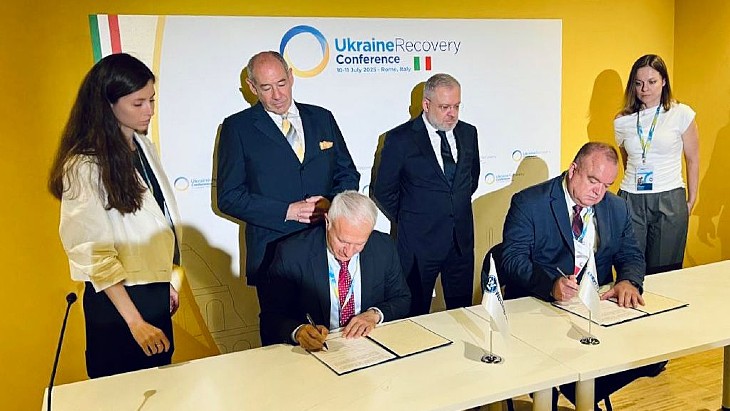
The signing ceremony with Westinghouse (Image: Ukraine's Energy Ministry)

The agreements were signed at the Ukraine Recovery Conference in Italy, and are described as steps helping the country's energy independence.

The cooperation agreement with Westinghouse - which is already planning to supply nine of its AP1000 units in Ukraine - is for a joint project to pursue fuel assembly capability in Ukraine.

Earlier this year Westinghouse approved Ukraine’s AtomEnergoMash "as a qualified supplier for the manufacturing of top and bottom nozzles for Westinghouse’s VVER-1000 fuel assemblies in Ukraine, paving the way for this new advanced fuel assembly capability in the country".

Energoatom CEO Petro Koptin said: "We are continuing our path to establishing our nuclear fuel assembly line in Ukraine by implementing advanced Westinghouse technologies. I am very grateful to our partners for their trust, based on many years of successful cooperation. Step by step, Energoatom is moving towards becoming the centre of nuclear energy in Eastern Europe."

Tarik Choho, Westinghouse Nuclear Fuel President, said: "We are proud to extend our strong partnership and shared commitment to energy security in Ukraine. Westinghouse has an excellent track record of VVER nuclear fuel design used in VVER-1000 and VVER-440 nuclear power plants in Ukraine, with two decades of exceptional operational performance."

Agreement with Holtec

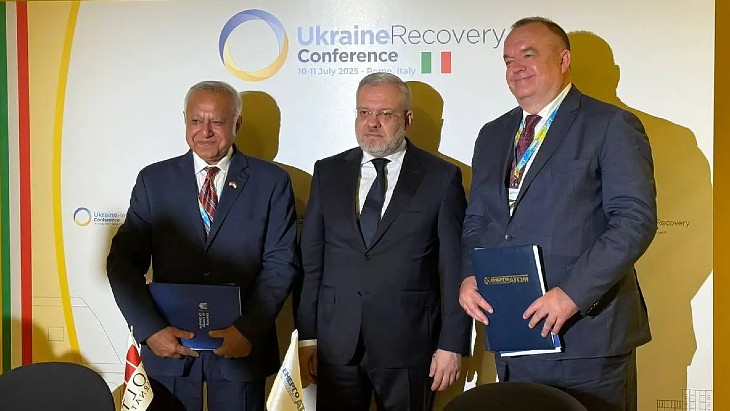
Energoatom and Holtec International signed a document outlining the current areas of cooperation between the two companies as well as outlining their intention to implement joint projects to create a plant in Ukraine for the production of components for Holtec small modular reactors and an agreement for Holtec technology to be used by Energoatom for manufacturing containers for storing used nuclear fuel.

(Image: Energoatom)

The two companies already have long-standing links - notably with the Holtec-built Centralised Spent Nuclear Fuel Storage Facility, which uses the Holtec containers, which are manufactured in the USA.

Ukraine’s Energy Minister Herman Halushchenko was present for the signing of both agreements with the energy ministry saying the memorandum also envisaged steps towards the future deployment of Holtec’s SMR-300 small modular reactors in Ukraine "in particular through capacity building and technical training with the participation of Ukrainian specialists in the SMR-300 programme at the Palisades nuclear power plant" - Holtec is aiming to have two of its SMRs in operation at Palisades in 2030.

Preparation stage begins for BN-1200M construction
Friday, 11 July 2025
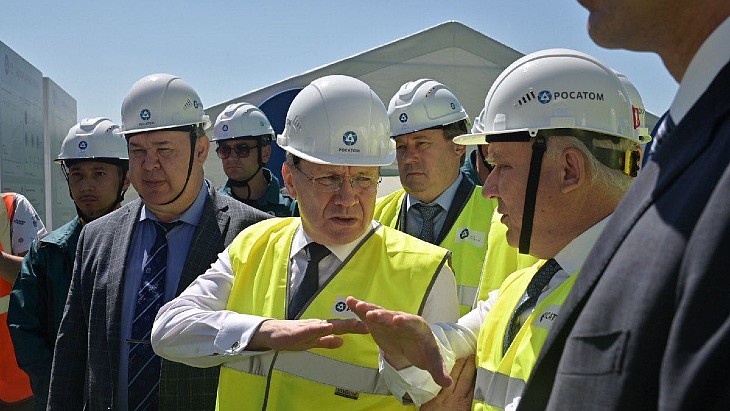
The fast neutron BN-1200 reactor planned as Beloyarsk Nuclear Power Plant’s fifth unit has entered the preparation stage for construction.
Preparation stage begins for BN-1200M construction
(Image: Rosatom)


The sodium-cooled BN-series fast reactor plans are part of Rosatom's project to develop fast reactors with a closed fuel cycle whose mixed-oxide (MOX) fuel will be reprocessed and recycled. In addition to the BN-600 reactor at Beloyarsk unit 3, which began operation in 1980, the 789 MWe BN-800 fast at Beloyarsk unit 4 entered commercial operation in October 2016. This is essentially a demonstration unit for fuel and design features for the larger BN-1200, which will be unit 5 at Beloyarsk.

Russia's nuclear regulator Rostechnadzor issued a licence in April for the unit which has a target completion date of 2034, and which would be the world’s most powerful operating fast neutron reactor.

Alexei Likhachev, visiting the site, said: “With the launch of work on power unit No 5, the Beloyarsk Nuclear Power Plant strengthens its status as a leader in the development of fast reactor technology.”

He said it would help in hitting the target of nuclear generating 25% of Russia’s energy by 2045, and would also be combined with development plans for the wider Sverdlovsk region.

An agreement with the acting governor of the Sverdlovsk region Denis Pasler was signed on the development of master plans for the city of Zarechny, Novouralsk and Lesnoy which are intended to be the basis “for creating a comfortable urban environment, developing the economy, and implementing youth and social initiatives … and the attraction of federal funding for the most significant infrastructure projects”.

Pasler said: “For the Sverdlovsk region, these are new opportunities to make people's lives more harmonious, prosperous and safe. Most of the station's employees live in Zarechny. They create families here, raise children. Therefore, it is important that both at work and outside of it, each person sees and feels the prospects and opportunities for the development of their children, for the prosperous and comfortable life of their family.”

The master plans are drawn up by a combination of architects, economists, urbanists, sociologists, residents and the city leaderships, and are intended to provide a detailed image of the city in the future, which can then be implemented, Rosatom said.

Final stage of IMSR graphite irradiation testing starts

Thursday, 10 July 2025
Terrestrial Energy and NRG-Pallas are starting the final phase of the graphite irradiation testing programme for Terrestrial's molten salt reactor at the High Flux Reactor in Petten, the Netherlands.
Final stage of IMSR graphite irradiation testing starts
The graphite irradiation programme is being carried out in the HFR reactor (Image: NRG)

NRG-Pallas is providing technical services to support Terrestrial Energy for "in-core" materials testing and development of its Integral Molten Salt Reactor (IMSR) power plant. The testing programme at NRG is designed to confirm the predicted performance of selected graphite grades throughout the seven-year cycle of the IMSR. Its scope simulates IMSR core conditions, encompassing the full range of IMSR operating temperatures and of the neutron flux. The programme aims to enable Terrestrial to select the most suitable graphite grade for use in the IMSR reactor, as well as qualifying graphite for IMSR use. 

The company sourced multiple graphite grades from suppliers of nuclear graphite in western markets, including the USA, to commence the test programme in November 2020.

"Comprehensive irradiation tests are essential for advanced reactor development and reactor licensing, as they validate the performance of critical materials under actual operating conditions," said Terrestrial Energy CEO Simon Irish. "Our pioneering work with NRG-Pallas is providing the data needed to make our final graphite grade selection for the IMSR, marking another important milestone in our supply chain development.

"NRG-Pallas' technical expertise and research capabilities are unparalleled in the world of advanced reactor development, and this work will be a major step toward Terrestrial Energy's goal of achieving early fleet deployment."

Arjan Vreeling, manager of R&D Nuclear Fuels and Materials at NRG-Pallas added: "NRG-Pallas is committed to leveraging its test reactor and research capabilities to support advanced reactor development. We have been collaborating with Terrestrial Energy now for five years and are delighted to be moving to the final stage of in-core irradiation testing of IMSR graphites, the first developer to commence such testing."

Terrestrial's IMSR is a 4th generation reactor that uses molten salt as both fuel and coolant, with integrated components, which can supply heat directly to industrial facilities or use it to generate electrical power. The use of molten salt as both fuel and coolant also enables passive, or inherent, safety features to be built into the reactor design. The design integrates the primary reactor components, including the graphite moderator, into a sealed and replaceable reactor core unit with an operating lifetime of seven years. The reactor uses about 125 tonnes of graphite as a neutron moderator.

Lithuania to consider deployment of Newcleo SMRs

Thursday, 10 July 2025
Lithuania's State Enterprise Ignalina Nuclear Power Plant is to collaborate with France-headquartered innovative reactor developer Newcleo on assessing the possibilities of applying advanced fast reactor technology in the Baltic state.
Lithuania to consider deployment of Newcleo SMRs
(Image: Ignalina NPP)

Through a memorandum of understanding signed in Rome on 9 July by Newcleo founder and CEO Stefano Buono and Ignalina NPP CEO Linas Baužys, the partners will consider the potential role of Newcleo's small modular lead-cooled fast reactor in providing economically viable, safe, reliable, and efficient energy solutions in Lithuania and for the safe handling of the country's used nuclear fuel.

The MoU - signed in the presence of the Lithuanian Energy Minister Žygimantas Vaičiūnas - paves the way for feasibility studies to be carried out on areas including: siting evaluations; reprocessing of Lithuania's stocks of used nuclear fuel; potential industrial applications in connection to hydrogen and ammonia production; and the creation of local nuclear supply chains. The project also aims to evaluate the feasibility of integrating small modular reactors (SMRs), such as Newcleo's design, into an energy system prioritising renewables – the aim being to enhance grid stability while contributing to the broader objective of decarbonisation.

Last month, Newcleo and Slovak state-owned radioactive waste management company JAVYS signed a joint venture shareholder agreement, paving the way toward the construction of up to four Newcleo lead-cooled fast reactors at the Bohunice site. The units would be powered with mixed uranium/plutonium oxide (MOX) fuel fabricated from existing Slovakian used nuclear fuel extracted from the country's current reactor fleet.

Newcleo said it is "seeking to expand this operating model to other territories with existing nuclear operations or legacy spent fuel, which include many Eastern European countries, as a way of sustainably managing waste while promoting energy independence".

"This agreement marks another step in our aim to deliver sustainable solutions for waste and in delivering energy security across Europe," Newcleo's Stefano Buono said. "I'm delighted that Lithuania, a country with a strong nuclear energy background is open to the model we can provide, and I thank Minister Vaičiūnas for his engagement and vision. This agreement could mark the first step in Lithuania unlocking potentially decades worth of sustainable energy from its legacy spent fuel and, like our partnership in Slovakia, showcases the power of European collaboration in the nuclear sector."

Ignalina NPP CEO Linas Baužys added: "This memorandum of understanding represents an important step in exploring innovative solutions for managing Lithuania's nuclear legacy. By working with Newcleo, we are looking at the future of nuclear technology - one that is safer, more sustainable, and capable of unlocking long-term energy value from existing resources. This cooperation also reflects our strategic commitment to strengthening Lithuania's energy security and independence, developing local expertise, and contributing to European technological leadership in advanced nuclear solutions."

"The Ignalina nuclear power plant has been a strategic pillar of the Lithuanian energy system for many years, along with the high competence of nuclear energy specialists, which is now used only for the decommissioning activities of the INPP," Minister of Energy Žygimantas Vaičiūnas said. "We aim not only to preserve this competence, but also to use it for the development of advanced nuclear technologies. Although the implementation of such projects is not fast, we should not miss the opportunity to assess the possibilities of such technologies to reduce the volume of spent nuclear fuel in the future, and this agreement allows us to start evaluating innovative solutions now."

Two large RBMK reactors at the Ignalina nuclear power plant provided 70% of Lithuania's electricity until their closure in 2004 and 2009 as a condition of the country joining the European Union. The power plant is being decommissioned by Ignalina NPP, which has removed fuel from the reactors and placed it into dry casks for interim storage at the site. The decommissioning process is due to last until 2038.

Last week the Lithuanian government announced it has decided to establish a working group to report on nuclear energy development opportunities in the country, with small modular reactors seen as a likely option. The working group, within the Ministry of Energy, will involve experts from the shut-down Ignalina plant, with the State Nuclear Energy Safety Inspectorate due to submit safety regulation proposals.

Lithuania's National Energy Independence Strategy - published in 2024 - called for a decision on the installation of SMRs to be made by 2028 with the first operating by 2038.

TerraPower awards Natrium supplier contracts


Thursday, 10 July 2025
TerraPower has announced three more supplier contracts as part of the fifth round of procurement awards for the Natrium project in Kemmerer, Wyoming, in the USA.
TerraPower awards Natrium supplier contracts
A rendering of a Natrium plant (Image: TerraPower)

Natrium technology features a 345 MWe sodium-cooled fast reactor using high-assay low-enriched uranium fuel, with a molten salt-based energy storage system that can boost the system’s output to 500 MWe for more than five and a half hours when needed. TerraPower plans to build the Natrium demonstration plant near a retiring coal facility at Kemmerer.

The three supplier contracts are for: AVANTech LLC, to design advanced sodium processing system modules and supporting skids for the Natrium plant; Structural Integrity Associates, to design and fabricate the Sodium Cover Gas Gamma Spectroscopy Analysis Cabinet radiation monitoring system; and PAR Systems to design and fabricate the Pool Handling Machine, a specialised crane system to safely handle and transport used fuel assemblies with the used fuel pool for storage, inspection and maintenance purposes.

Chris Levesque, TerraPower President and CEO, said: "A resilient and diverse domestic supply chain is crucial to completing our Natrium plant and bringing the first, commercial-scale advanced reactor online in the United States. Each supplier award for the Natrium project reflects our readiness and resolve to deliver reliable, advanced nuclear energy, and I am proud of our entire TerraPower team as we continue to make key project awards."

Terrapower, the first developer to submit a construction permit application for a commercial advanced reactor to the US Nuclear Regulatory Commission (NRC) in March 2024, says it has already secured 100% of the long-lead items for the project as well as the entire Natrium reactor enclosure system.

The NRC said last week that it now expects to complete its review of TerraPower's construction licence application for the Natrium advanced reactor demonstration project by the end of 2025, ahead of the original August 2026 date.

Last month NVentures, the venture capital arm of multinational technology company NVIDIA, was among investors in a USD650 million capital raise, which TerraPower said would support the first Natrium plant as well as the company’s plans to rapidly deploy additional units in the US and abroad. Current investors, including TerraPower-founder Bill Gates and South Korean conglomerate HD Hyundai, also participated.

A ground-breaking ceremony was held in June last year to mark the start of non-nuclear construction at the site in Wyoming.


‘A tax on the American people’: Danielle Smith reacts to Trump threat to bump up tariffs on Canada

U.S. President Donald Trump promised to strike Canada with a 35 per cent blanket import tariff on Aug. 1

By Stephen Hunt
Published

Alberta premier Danielle Smith issued a statement about Donald Trump's threat to increase tariffs on Canada to 35 per cent (Photo: X@ABDanielleSmith)

Alberta Premier Danielle Smith doesn’t think Donald Trump’s most recent threat to increase Canadian tariffs will help Americans, let alone how much they might damage Canada’s economy.

Smith took to social media Friday morning to post her thoughts following Trump posting on his Truth Social platform a letter threatening to add 35 per cent tariffs to Canadian products

U.S. President Donald Trump's open letter to Prime Minister Mark Carney on July 10, 2025. (Truth Social)

In an open letter to Prime Minister Mark Carney, the U.S. president wrote “if for any reason you decide to raise your tariffs, then, whatever the number you choose to raise them by, will be added onto the 35 per cent that we charge.”

Trump claimed the tariffs were originally imposed on Canada because of the U.S. fentanyl crisis, which he said were partly due to “Canada’s failure to stop the drugs from pouring into our country.”

“If Canada works with me to stop the flow of fentanyl, we will, perhaps, consider an adjustment to this letter,” Trump wrote. “These tariffs may be modified, upward or downward, depending on our relationship with your country.”


“The threatened increase to U.S. tariffs on Canadians goods would be a tax on the American people,“ Smith posted. ”They would also hurt Canadian and American businesses and workers, and damage one of the most important trading and security alliances on earth.


“Retaliatory tariffs by the federal government to this escalation would constitute a tax on Canadian consumers and businesses and only weaken Canada’s economy further.”

Smith suggested that the way out of the mess is for Ottawa to peel back some of the legislation it has implemented in recent years that she believes puts the brakes on the ability of Alberta energy producers to economically produce energy.

“In addition to continuing trade negotiations with the U.S. Administration in hopes of a resolution to this trade dispute, the federal government must also immediately drop the Trudeau-era anti-resource development laws holding our economy back and work at all haste to approve multiple pipelines, rail expansions and transmission lines going west, east and north to diversify and grow our export markets around the world.

“We need to become an economically stronger and more independent country without further delay or excuse.

“It’s time to repeal these terrible laws that continue to weaken our economy, make us dependent on a single customer, and hold back the prosperity of our country.”

Thursday night, Prime Minister Mark Carney responded on social media, saying that Canada would work towards a revised deadline of Aug. 1 in reaching a new trade deal with the U.S., updating the July 21 deadline set last June during the G7 Leaders’ Summit.

“Canada has made vital progress to stop the scourge of fentanyl in North America,” Carney wrote. “We are committed to continuing to work with the United States to save lives and protect communities in both our countries.”


CTV News is reaching out to other Albertans for their reaction to Trump’s latest tariff threat and will be updating this story throughout the day.

With files from CTV’s Hunter Crowther

Stephen Hunt

Digital Producer, CTV News Calgary


Ford says Carney has agreed to first ministers’ meeting amid Trump’s latest tariff threat

By Phil Tsekouras
Updated: July 11, 2025 at 4:23PM EDT

Ontario Premier Doug Ford says Prime Minister Mark Carney has agreed to a first ministers’ meeting following U.S. President Donald Trump’s latest tariff threat.

In a post on social media Friday, Ford announced Carney will meet with provincial and territorial leaders on July 22 in Huntsville ahead of the Council of the Federation meeting with Canada’s premiers, of which Ford is chair.

“In the face of President Trump’s latest threat, we need to come together. We need a plan on how Canada will respond and how we’ll protect our workers, businesses and communities,” he wrote.

“Together, we’re going to remain united as we protect Ontario and protect Canada.”

On Thursday, Trump published a letter addressed to Carney on Truth Social in which he threatened to slap a 35 per cent tariff on Canadian goods starting Aug. 1.

Trump justified the new tariffs by saying Canada’s “failure to stop the drugs from pouring into” the U.S. has contributed to its fentanyl crisis. He has previously cited the spread of the synthetic opioid as a reason for launching his trade war with Canada and Mexico earlier this year.

Following the announcement, Ford’s office pushed Ottawa to “work around the clock to secure a deal” with the U.S. and avoid the new levies.

For Carney’s part, he said Ottawa will continue to “steadfastly” defend workers and businesses in the face of Trump’s latest threat as his government negotiates with the White house.


“Canada has made vital progress to stop the scourge of fentanyl in North America. We are committed to continuing to work with the United States to save lives and protect communities in both our countries,” Carney wrote in a post on social media.

While Trump said that his administration may consider a tariff adjustment if Canada works to stop the flow of fentanyl into the U.S., he also threatened to match any retaliatory tariffs and add them to the 35 per cent tax.

The White House has confirmed that the 35 per cent tariff will only be applied to goods already subject to the 25 per cent import tax Trump introduced at the start of the trade war. Goods exempt under the North American trade pact are not expected to be impacted.

Tariffs on Canadian steel, aluminum and vehicles remain in place and Trump has said a tariff on copper will start on Aug. 1

Trump’s new tariff ‘not grounded in economic logic’: Toronto trade board

The head of Toronto’s trade board said Trump’s latest tariff threat is “not grounded in economic logic” as he pushed Ottawa to continue to negotiate the “best deal it can” for Canadians.

“Our members are deeply frustrated by yet another disruptive turn in U.S. trade policy,” Toronto Region Board of Trade president and CEO Giles Gherson said in a statement issued Friday, calling the latest development in Trump’s ongoing trade war with Canada a “bargaining tactic.”

“It also comes at a time when Canadian businesses are already navigating the competitive pressures created by the United States’ new industrial strategy, the so-called ‘One Big Beautiful Bill,’” he said.

Before the new Aug. 1 deadline was announced on Thursday, Trump and Carney had agreed to a negotiate a deal by July 21. Those talks were briefly halted after Canada imposed—and then removed—a digital services tax on U.S. tech companies.
Businesses must ‘urgently’ accelerate productivity: Gherson

As the Aug. 1 deadline approaches and as trade negotiations continue, Gherson urged businesses to “urgently” accelerate productivity, strengthen internal economic cohesion and expand Canada’s global trade footprint.

“This is how we build the long-term economic resilience Canada needs, no matter who occupies the White House,” he said.

Meanwhile, Canada’s largest private sector union, Unifor, urged Carney to “push back-hard” against Trump.

“Canada must use every bit of leverage we have. Workers are counting on our government to defend their jobs and industries. Concessions won’t stop a bully, but collective strength will,” National President Lana Payne said in a news release on Friday.


Phil Tsekouras

CTVNewsToronto.ca Journalist


Carney to meet with cabinet, premiers following Trump’s latest tariff threat


By The Canadian Press
Updated: July 11, 2025 at 1:47PM EDT

Prime Minister Mark Carney will be meeting with his cabinet and Canada’s premiers to discuss U.S. President Donald Trump’s new threat to slap 35 per cent tariffs on Canadian goods next month.

The Prime Minister’s Office announced there will be a cabinet meeting on Tuesday to discuss ongoing Canada-U.S. trade negotiations. Carney’s office said he also will meet with the premiers on July 22 as they gather for the annual Council of the Federation conference in Huntsville, Ont.

Carney said Thursday his government will “steadfastly” defend workers and businesses. In a late night post on social media, Carney said Canada will continue to work to secure a trade deal with the U.S. by a revised deadline of Aug. 1.

In a letter to Carney on Thursday, Trump threatened to impose 35 per cent tariffs on Canadian goods by that date - evidently setting a new deadline for the trade talks that were supposed to wrap up by July 21.

A White House official said the 35 per cent tariff rate is only expected to be applied to goods already hit with a 25 per cent import tax. This would exempt goods compliant with the Canada-U.S.-Mexico Agreement on trade, called CUSMA, plus energy and potash imports that face a 10 per cent tariff rate.

The official said no final policy paper has been drafted and Trump has not yet made a final decision.

Canada also faces additional U.S. tariffs on steel, aluminum and automobiles, as well as a U.S. plan to introduce tariffs on copper on Aug. 1.

Asked about the tariff threat while leaving the White House Friday morning, Trump told reporters that “it was sent yesterday. They called. I think it was fairly well received.”

A spokeswoman for the Prime Minister’s Office said Carney and Trump did not speak Thursday night. She said that while officials from both countries meet daily as trade talks continue, Thursday’s meeting took place before Trump sent his tariff letter.

Trump’s letter said if Canada works to stop the flow of fentanyl into the United States, he may consider a tariff adjustment. U.S. government data shows the volume of fentanyl seized at the United States’ northern border is minuscule compared to the amounts recovered at the border with Mexico.

Trump declared an emergency at the northern border in order to use the International Economic Emergency Powers Act of 1977, or IEEPA, to slap Canada with economywide tariffs in March. He partially paused the duties a few days later for imports compliant under CUSMA.

It’s not clear whether Trump’s use of IEEPA to hit nearly every nation with duties will survive a looming legal challenge. The United States Court of Appeals for the Federal Circuit is scheduled to hear arguments on July 31 - a day before the tariffs are set to return.

The U.S. Court of International Trade said in May that Trump does not have the authority to use the national security statute for the fentanyl and so-called “reciprocal” tariffs. Trump’s administration promptly appealed the decision and it’s expected to go all the way to the Supreme Court.

Trump has continued to use the tariff lever to pressure countries to sign trade deals. Canada was the latest nation to receive correspondence from Trump this week outlining higher duties.

Marty Warren, national director of the United Steelworkers, said the government needs to take “urgent measures” to keep workers employed and industries running.

The steel and aluminum sectors have been hard hit by Trump’s 25 per cent tariffs on those metals, invoked under a national security rationale separate from the IEEPA tariffs.


“This is clearly about power and control. It has nothing to do with public safety or fair trade,” Warren said in a media statement.

“Canada cannot cave to blackmail. Our government must stand up for Canadian workers, enforce trade rules and protect our industries before it’s too late.”

Federal Industry Minister Melanie Joly said at a time of uncertainty, Canada must strengthen its economic relationships with other nations.

“We are not alone in this world,” she said in Ottawa during a Friday news conference with Stephane Sejourne, the visiting European Commission executive vice-president for prosperity and industrial strategy. “We need to be closer to our allies.”

When asked about plans for retaliation, Joly said Canada and China are the only nations that have taken such a stance so far.

“We have had already a very strong response,” Joly said

Alberta Premier Danielle Smith discouraged Ottawa from imposing further retaliatory tariffs in a post on social media, saying it would “constitute a tax on Canadian consumers and businesses and only weaken Canada’s economy further.”

Smith said the federal government should also drop “Trudeau-era anti-resource development laws.”

In a social media post, Ontario Premier Doug Ford said “we need to come together” and develop a plan to protect Canadian workers, business and communities.

Saskatchewan Premier Scott Moe said in a media statement that while Trump’s tariff escalation is “concerning, it should not have much impact on Saskatchewan” because “about 95 per cent” of the province’s exports are covered by the current free trade agreement.

Ontario Conservative MP Adam Chambers sent a letter to the chair of the House of Commons international trade committee Friday afternoon asking for a meeting so MPs can discuss and debate Canada’s negotiating position.

Chambers wrote that trade-exposed businesses “deserve” a chance to tell Parliament about the “direct impacts of U.S. actions and Canadian countermeasures.”

“This is particularly urgent, as Parliament has not offered such a forum since it adjourned after a brief spring session,” Chambers wrote.

Bloc Quebecois Leader Yves-Francois Blanchet said on social media that his party supports increasing trade ties with the European Union. He also accused Carney of “failing” by focusing on investments in the oil and gas sector, which he said would only affect trade “well after Donald Trump’s departure.”

In Washington, Sen. Jeanne Shaheen said the latest tariff threat against America’s northern neighbour undermines the Trump administration’s own negotiations to reach a trade deal, while the “consistent attacks” on Canada have damaged a “vital relationship.”

The Democrat from New Hampshire said she’s heard many complaints about tourists not coming from Canada and lost business due to Trump’s trade war.

“The American people and the overwhelming majority of my colleagues in Congress reject this short-sighted and costly trade war with Canada,” Shaheen said in a news release.

By David Baxter and Kelly Malone.


Business leaders lament latest U.S. tariff threat as experts play down risks

By The Canadian Press
Updated: July 11, 2025 at 1:59PM EDT

A forklift moves a container around a freight terminal, in St. John's, Sunday, June 25, 2023. THE CANADIAN PRESS/Adrian Wyld

TORONTO — The latest tariff threat from U.S. President Donald Trump is drawing condemnation from business leaders, though more because of the added uncertainty than the potential direct impact that experts played down.

Trump threatened to impose a 35 per cent tariff on all Canadian goods On Aug. 1 in a letter released late Thursday, only for White House officials to later clarify it would only apply to non-CUSMA compliant goods.Trade War coverage on BNNBloomberg.ca

The narrowed application makes it mostly meaningless, said Joseph Steinberg, an economics professor at the University of Toronto

“The CUSMA exemptions remaining in place mean that all of this is pretty much all just talk, and nothing that’s really going to materially affect our economy,” he said.

“I can’t imagine that this is anything other than just some kind of tough negotiating talk to try to extract some concessions.”

Canadian exports for May paid overall a two per cent tariff rate, showing how little effect the existing headline tariff rates on non-compliant goods, metals and autos is having, he said. Some companies have stockpiled goods and held back shipments, partially explaining the low number, but overall he said even boosting the broad rate to 35 per cent would increase the effective rate by only a fraction of a per cent.

Added uncertainty was the main effect that Derek Holt, head of capital markets economics at Scotiabank, highlighted from the latest salvo.

“This historic uncertainty surrounding the rules of commerce will damage confidence to spend, hire, and invest in the world economy including in America. It is a total own-goal by a U.S. administration whose policies are needlessly damaging the U.S. and world economies,” he said in a note.

Canadian exporters who didn’t previously bother have been rushing to become complaint, said Holt. About half are already approved, and expectations are that 80 to 90 per cent of exporters will be able to get there, leaving an effective tariff rate of between four and seven per cent, he said.

“If he were to go ahead, it could still be a meaningful hit.”

The tariffs are in addition to the existing tariffs on metal and automotive exports, which makes it all the more important Canada manages to get those lifted, said Dennis Darby, head of Canadian Manufacturers & Exporters.

“It’s better than it could be, but of course it puts more pressure on that negotiation that the Prime Minister announced back at Kananaskis.”

Prime Minister Mark Carney had set a 30-day deadline to reach deals on the various tariffs, but he said in a statement that Canada will continue to work to secure a trade deal with the U.S. by a revised deadline of Aug. 1.

The delay is just part of a longer waiting game that businesses are having to navigate, said Darby.

“Nobody in our sector wants to make a decision that ultimately, as a result of the president’s capriciousness, will suddenly will be the wrong decision in a month.”

He said some kind of deal on tariffs would provide some degree of certainty, at least a window until full renegotiations of the CUSMA trade deal launch.

“That would be the best of a bad lot.”

Candace Laing, head of the Canadian Chamber of Commerce, said in a statement that the tariffs would continue to damage the “most productive trade relationship two countries have ever had” and urged both sides to reach a real and reliable deal.

Giles Gherson, CEO of the Toronto Region Board of Trade, says members are “deeply frustrated” by yet another turn in U.S. trade policy that is not grounded in economic logic.

He says the federal government must keep negotiating for the best deal possible, while the business community needs to focus on what it can control.

---

Ian Bickis, The Canadian Press

This report by The Canadian Press was first published July 11, 2025.


Trade war with U.S. has not dampened foreign investors’ appetite for Montreal

By The Canadian Press
Published: July 11, 2025 at 10:18AM EDT

Foreign companies invested more money than last year in the greater Montreal area despite threats from U.S President Donald Trump. "Bonjour Montreal" in giant letters in front of downtown on July 6, 2023.
 THE CANADIAN PRESS/Ryan Remiorz

MONTREAL — Foreign investment is on the rise in Montreal despite Canada’s trade war with the United States.

A Montreal economic development agency says the value of investment from foreign companies rose 55 per cent to $1.69 billion in the first six months of the year compared to the same period in 2024.

Preliminary data from Montréal International says the agency this year supported 29 projects in the greater Montreal area that created 1,866 jobs with an average salary of $101,000.

And despite tariffs imposed by U.S. President Donald Trump — and his recent threats to impose more — 46 per cent of foreign investment in Montreal so far this year is from American companies.

Stéphane Paquet, CEO of Montréal International, says the uncertainty around immigration is hurting investment in the city more than the trade war is.


Paquet says companies are looking for more stability in provincial and federal immigration policies so that firms can better predict labour market trends.

---

Stéphane Rolland, The Canadian Press
This report by The Canadian Press was first published July 11, 2025.


Trump says ‘the friends have been worse than the foes’ after announcing new tariffs on Canada
Updated: July 11, 2025 at 2:23PM EDT

U.S. President Trump bringing ‘bully pulpit’ approach to tariff negotiations: Holmes


Trump tariff threats a ‘roller coaster ride’ for Canadian small businesses

U.S. President Donald Trump promised to strike Canada with a 35 per cent blanket import tariff on Aug. 1 in a letter to the prime minister published on Truth Social.

It’s an escalation to the two nations’ enduring, months-long trade war. Both countries, which share deeply connected supply chains, have levied tariffs on billions of dollars in goods against each other.

Here’s how Friday unfolded.


2:07 p.m. EDT: Joly: ‘Economic diplomacy is more important than ever’

Industry Minister Mélanie Joly says “economic diplomacy is more important than ever” in the wake of U.S. President Donald Trump’s ongoing tariff threats.

Joly made the remarks in a joint media availability in Ottawa with European Commissioner Executive Vice-President for Prosperity and Industrial Stéphane Séjourné, aimed at highlighting the new partnership between Canada and the European Union to strengthen trade and economic security ties.

“We’re not in normal times and economic diplomacy is more important than than ever, and that’s why we need to make sure that while the U.S. is closing its market and really taking its own path regarding protectionism, that we as a stable and democratic country continue to have open markets, including with the E.U.,” Joly said to reporters.

When asked directly about what new measures the federal government is willing to take moving forward to counter the U.S., Joly said, “We won’t negotiate in public, and we’ll let the Prime Minister negotiate.”

“Fundamentally, while these negotiations are happening, we need to realign ourselves with trusted partners, and today what you’re seeing is a realignment between trusted partners,” she added.

Stephanie Ha, Supervising Producer, Ottawa News Bureau


1 p.m. EDT: Changing tariff timelines are ‘toxic’

While a new tariff deadline may provide more room for Canada to get a deal with the U.S., the moving timelines are creating other problems, the Canadian Chamber of Commerce (CCC) says.

“What this letter to Canada does in effect is further lengthen the time for negotiations,” said CCC Chief of Public Policy Matthew Holmes. But “the uncertainty for business, the constant changing of the goal posts, and the deadlines, and the numbers, continues – and that’s quite toxic for business.”

Trump’s letter to Prime Minister Mark Carney has the 35% tariffs on Canadian imports coming into effect August 1, rather than the July 21 deadline set last month at the G7 Leaders’ Summit in Alberta.

Holmes says the letter is also part of Trump’s negotiation strategy.

“There’s a bully pulpit happening here for sure, and I think we are all getting too familiar with the approach and the tone and style of the president”

Canada must “hit back hard” against the U.S. or risk losing domestic jobs, says Canada’s largest private sector union, Unifor.

“Trump’s playbook is clear, implement and threaten sky-high tariffs to condition us into accepting a lower baseline tariff as the new normal. We must never fall for it,” said Unifor National President Lana Payne.

“That’s not negotiation—that’s coercion. We will not settle for a future where Canadian jobs are held hostage to the U.S.”

In his letter to Prime Minister Mark Carney, Trump said companies could avoid tariffs if they manufacture their products in the U.S. He also vowed to “get approvals” for those companies in a matter of weeks.

Unifor also wants Ottawa to stockpile aluminum, critical minerals and other items as part of a national reserve strategy.

Luca Caruso-Moro, CTVNews.ca journalist

Unifor national president Lana Payne prepares to appear before the Standing Committee on Human Resources, Skills and Social Development and the Status of Persons with Disabilities, in Ottawa, on Thursday, March 21, 2024. THE CANADIAN PRESS/Justin Tang


11:25 a.m. EDT: Carney calls in cabinet after Trump’s threats

Prime Minister Carney will convene his cabinet to talk trade next week.

The roundtable will take place on Tuesday with U.S. negotiations as its centrepiece, according to the Prime Minister’s Office. It precedes Carney’s meeting with premiers the following week.

In a post on social media Friday, Ford announced Carney will meet with provincial and territorial leaders on July 22 in Huntsville, Ont. ahead of the Council of the Federation meeting with Canada’s premiers, of which Ford is chair.

“Together, we’re going to remain united as we protect Ontario and protect Canada,” he said.


Luca Caruso-Moro, CTVNews.ca journalist, Phil Tsekouras, CTVNewsToronto.ca journalist


The First Minister’s Meeting in Saskatoon on Monday, June 2, 2025. THE CANADIAN PRESS/Liam Richards


11:20 a.m. EDT: Tariff threat ‘not grounded in economic logic’


The head of Toronto’s trade board says U.S. President Donald Trump’s latest tariff threat is “not grounded in economic logic” as he pushed Ottawa to continue to negotiate the “best deal it can” for Canadians.

“Our members are deeply frustrated by yet another disruptive turn in U.S. trade policy,” Toronto Region Board of Trade president and CEO Giles Gherson said in a statement issued Friday, calling the latest development in Trump’s ongoing trade war with Canada a “bargaining tactic.”

“It also comes at a time when Canadian businesses are already navigating the competitive pressures created by the United States’ new industrial strategy, the so-called ‘One Big Beautiful Bill,’” he said.

Phil Tsekouras, CTVNewsToronto.ca journalist

The Bay Street Financial District is shown with the Canadian flag in Toronto on Friday, August 5, 2022. THE CANADIAN PRESS/Nathan Denette


10:55 a.m. EDT: Canadian border ‘not an important part’ of fentanyl fight: U.S. think tank

According to a July report from U.S. think tank the Manhattan Institute, barely any of the fentanyl seized in the United States originates from Canada.

Trump has cited fentanyl as a reason for imposing tariffs on Canada.

“These data call into question tariffs and other policies and policy justifications that treat the threat from the northern border as comparably severe (to the U.S.-Mexico border),” the report reads.

By weight, about 99 per cent of fentanyl pills, capsules or tablets and 97 per cent of powder, resin or tar gathered in large, land-boundary seizures between 2013 and 2024 were discovered in U.S.-Mexico border counties, according to the report.

And U.S. Customs and Border Protection (CBP) data show that of the 4,376 total fentanyl seizures counted by CBP between October 2021 and February 2025, just 241 occurred at Canada-U.S. boundaries, and only 162 of those were along the land border between the two countries.

“Counties along the Canadian border are not an important part of this story,” the report concludes.

“Whatever the merits or drawbacks of tariffs on imports from Canada … such actions cannot be justified as part of a pragmatic and data-informed response to the threat of fentanyl to the United States.”

Charlie Buckley, CTVNews.ca journalist


10:20 a.m. EDT: Trump: ‘We’ve been taken advantage of’

Asked for his advice to countries ahead of tariff deadlines, Trump told reporters those nations should “just keep working hard,” and that “it’s all going to work out.”

Trump was asked shortly before taking off for a trip to central Texas to survey damage from recent floods.

U.S. President Trump speaks on America being ‘taken advantage of’ by Canada and other trade partners in the past.

“We’ve been taken advantage of for many, many years by countries, both friend and foe,” he said Friday. “Frankly, the friends have been worse than the foes, in many cases.”

Charlie Buckley, CTVNews.ca journalist

President Donald Trump speaks with reporters before departing the White House, Friday, July 11, 2025, in Washington. (AP Photo/Evan Vucci)


9:35 a.m. EDT: CUSMA-compliant goods likely won’t be hit: official

A White House official speaking to CTV News says Trump’s new 35 per cent tariff threat likely won’t impact Canadian imports that are compliant under the Canada-U.S.-Mexico Agreement (CUSMA).

It means goods already tariffed at 25 per cent and not protected under CUSMA could be tariffed by 35 per cent on Aug. 1. Tariffs on some energy-related products and potash are expected to remain at 10 per cent.

But the official also tells CTV News that Trump has made “no final decisions” and “no final paper has been drafted.”

Stephanie Ha, CTV News journalist

CTV’s Jeremie Charron says even though U.S. President Trump has declared he will add 35 per cent tariffs on Canadian good, nothing is official as of yet.

9 a.m. EDT: Canada needs to ‘work around the clock’: Ford

Ontario’s premier called on the federal government to act with urgency to strike a deal with U.S. in the face of new looming tariffs.

“Now more than ever, we need the federal government to work around the clock to secure a deal that is right for Canada and eliminates all American tariffs,” Ontario Premier Doug Ford’s office said in a statement.

Bryann Aguilar, CP24.com journalist

FILE: Premier of Ontario Doug Ford speaks to media prior the First Minister’s Meeting in Saskatoon on Monday, June 2, 2025. THE CANADIAN PRESS/Liam Richards

Read Trump’s letter

Trump posted the following letter, addressed to Prime Minister Mark Carney, on Truth Social Thursday evening.

“Dear Mr. Prime Minister:

“It is a Great Honor for me to send you this letter in that it demonstrates the strength and commitment of our Trading Relationship, and the fact that the United States of America has agreed to continue working with Canada, despite Canada having financially retaliated against the United States. As you will recall, the United States imposed Tariffs on Canada to deal with our Nation’s Fentanyl crisis, which is caused, in part, by Canada’s failure to stop the drugs from pouring into our Country. Instead of working with the United States, Canada retaliated with its own Tariffs. Starting August 1, 2025, we will charge Canada a Tariff of 35% on Canadian products sent into the United States, separate from all Sectoral Tariffs. Goods transshipped to evade this higher Tariff will be subject to that higher Tariff. As you are aware, there will be no Tariff if Canada, or companies within your Country, decide to build or manufacture product within the United States and, in fact, we will do everything possible to get approvals quickly, professionally, and routinely – In other words, in a matter of weeks.

“If for any reason you decide to raise your Tariffs, then, whatever the number you choose to raise them by, will be added onto the 35% that we charge.

“Also, I must mention that the flow of Fentanyl is hardly the only challenge we have with Canada, which has many Tariff, and Non-Tariff, Policies and Trade Barriers, which cause unsustainable Trade Deficits against the United States. Canada charges extraordinary Tariffs to our Dairy Farmers – up to 400% – and that is even assuming our Dairy Farmers even have access to sell their products to the people of Canada. The Trade Deficit is a major threat to our Economy and, indeed, our National Security!

“If Canada works with me to stop the flow of Fentanyl, we will, perhaps, consider and adjustment to this letter. These Tariffs may be modified, upward or downward, depending on our relationship with you Country. You will never be disappointed with The United States of America.

“Thank you for your attention to this matter!

“With best wishes, I am,

“Sincerely,

“DONALD J. TRUMP

“PRESIDENT OF THE UNITED STATES OF AMERICA”

Canada's Prime Minister Mark Carney, left, and U.S. President Donald Trump leave after a family photo session during the G7 Summit, in Kananaskis, Alberta, Monday, June 16, 2025. (Suzanne Plunkett/Pool Photo via AP)


Carney responds

In response to Trump’s letter, Carney published the following post on X.

“Throughout the current trade negotiations with the United States, the Canadian government has steadfastly defended our workers and businesses. We will continue to do so as we work towards the revised deadline of August 1.

“Canada has made vital progress to stop the scourge of fentanyl in North America. We are committed to continuing to work with the United States to save lives and protect communities in both our countries.

“We are building Canada strong. The federal government, provinces and territories are making significant progress in building one Canadian economy. We are poised to build a series of major new projects in the national interest. We are strengthening our trading partnerships throughout the world.”

The “revised deadline” is in reference to a shift from July 21, the date by which the two leaders agreed to ink a trade deal.

Prime Minister Mark Carney holds a closing press conference following the NATO Summit in The Hague, Netherlands on Wednesday, June 25, 2025. THE CANADIAN PRESS/Sean Kilpatrick (Sean Kilpatrick)

Edited by CTVNews.ca’s Luca Caruso-Moro
Demand is the ‘wildcard’ for oil prices as supply increases, expert says

By Jordan Fleguel
Published: July 10, 2025

As the world’s petroleum producers increase the global supply of oil, one market watcher says resilient demand for crude could push prices higher than traders expect in the second half of this year.

The Organization of Petroleum Exporting Countries (OPEC) is reportedly going ahead with planned production increases next month, though the cartel is also considering a pause in subsequent supply hikes due to fears of an oversupplied global market.

As OPEC weighs its options, the focus of experts like Rebecca Babin, senior energy trader at CIBC Private Wealth, is on demand, which is typically lower in the fall months compared to the summer.

“The wildcard here is what happens with demand,” Babin told BNN Bloomberg in an interview Thursday afternoon.

“We know that supply is likely coming and we’re seeing it, it’s on the horizon, we’re pricing it, we’re putting it down in our models, but does demand, which actually has been really resilient for the first half of the year kind of really take that downward slope that I think many analysts are penciling in?”

Babin said there could be an “upside surprise” to oil prices in the coming months if demand remains stronger than anticipated. “I just don’t think that’s on anyone’s radar,” she said.

Seasonal demand changes are particularly important to note in the Middle East, Babin explained, where localized oil demand has been “very high” in recent months due to the need for cooling systems powered by crude.

“As that subsides, more of those barrels that they have on their quota will be hitting the market,” she said, referring to Middle East oil giants like Saudi Arabia.

OPEC’s three previous monthly production increases have not had a meaningful impact on crude prices this year so far, said Babin, however if August’s supply hike goes ahead as planned, prices could move significantly lower by September.

Babin said that when she looks at the downside for oil prices in the second half of 2025, she sees crude falling as low as the high-US$50s or low $60s as markets absorb the increased supply.

“But I don’t see this massive pullback to the low $50s because the positioning in this is so well telegraphed that I think the market is somewhat set up and ready for it,” she said.

West Texas Intermediate fell on Thursday to under $67 a barrel, while Brent crude was also lower, hovering below $69.


Jordan Fleguel

Journalist, BNNBloomberg.ca

Alaska Sinks to Bottom of Business Rankings on Oil Price Woes

  • Alaska ranked 50th in CNBC’s 2025 Top States for Business due to economic weakness tied to oil dependence.

  • Oil revenues account for up to 73% of Alaska’s budget, leaving it vulnerable to price swings.

  • The state is pursuing a $44-billion LNG project that could further entrench its reliance on volatile energy markets.

The high dependence on oil for state revenues is squeezing Alaska’s budget when oil prices decline and making its economy grow below the national average. The struggling economy amid volatile oil prices is the key reason why Alaska has been rated as the worst state for doing business in America in 2025 by CNBC.

Alaska ranks 50th in CNBC America’s Top States for Business rankings in 2025. The state of the economy has the biggest weight in compiling the rankings, but workforce, infrastructure, the cost of doing business, and technology and innovation also play a role in the methodology.

The 2025 ranking is CNBC’s 19th year of studying state competitiveness by analyzing a record-high number of 135 metrics to see how states are navigating opportunities and risks. Economy is the top-weighted category—and here Alaska ranks 50th out of 50 states.

North Carolina leads the rankings this year, thanks to its economy, workforce, business friendliness, and above-average infrastructure and technology. Texas and Florida rank second and third, respectively.

But Alaska – despite paying an annual dividend to residents from the Alaska Permanent Fund from surplus oil and gas revenues – has long been heavily dependent on petroleum revenues for its economic growth and state revenues.

With lower crude prices this fiscal year from a year earlier, revenues are expected to decline. The price of Alaska North Slope crude averaged $85.24 per barrel in the 2024 fiscal year, according to data from the Alaska Department of Revenue. The department projects the price to fall to $74.48 a barrel for the 2025 fiscal year, and further down to $68 in FY 2026 and $67 per barrel in FY 2027. 

Excluding Permanent Fund earnings to the general fund, petroleum is expected to provide between 69% and 73% of unrestricted revenue for the state of Alaska over the next 10 years, the Alaska Department of Revenue said in its Spring 2025 Revenue Forecast. 

The heightened volatility in oil prices in recent years makes forecasts even more guesswork than before Covid and the war in Ukraine. 

“Over the past several years, we have seen a global pandemic, extreme volatility in investment and oil markets, wars and other geopolitical issues, and economic concerns ranging from negative interest rates to a return of inflation,” the Alaska Department of Revenue said. 

“Given the uncertainty, it remains a challenge to make predictions on the stock market, oil prices, or revenue with certainty.”

In the absence of predictability, Alaska’s budget revenues and economy remain at the mercy of the volatile oil prices and the supply-demand and geopolitical factors behind them. 

Yet, Alaska is doubling down on unleashing its natural resources, with the strong support of the Trump Administration. 

State firm Alaska Gasline Development Corporation (AGDC) seeks to advance the Alaska LNG project, designed to deliver North Slope natural gas to Alaskans and export LNG to U.S. allies across the Pacific. An 800-mile pipeline is planned to transport the gas from the production centers in the North Slope to south-central Alaska for exports. In addition, multiple gas interconnection points will ensure meeting in-state gas demand. 

U.S. officials toured Asia earlier this year in search of potential Asian investors in the LNG project estimated at $44 billion. The LNG export facility is strongly supported by the Trump Administration, which has also been pressing Japan and South Korea to buy more LNG as a way to reduce America’s trade deficit with its Asian allies. 

The proposed $44-billion Alaska LNG project, if it proceeds, is set to contribute to the economy and hydrocarbon exports of the state. But it will also further tie Alaska’s economy and state revenues to the price of another energy commodity—natural gas.    

By Tsvetana Paraskova for Oilprice.com