Sunday, July 13, 2025

Over 70 arrested in UK at protests in support of banned Palestine Action group

More than 70 people were arrested Saturday at protests over the use of anti-terror laws to ban activist group Palestine Action following a break-in and vandalism at a Royal Air Force base. In London, it was the second straight week protesters gathered to support the pro-Palestinian group.


Issued on: 13/07/2025 -
By: FRANCE 24
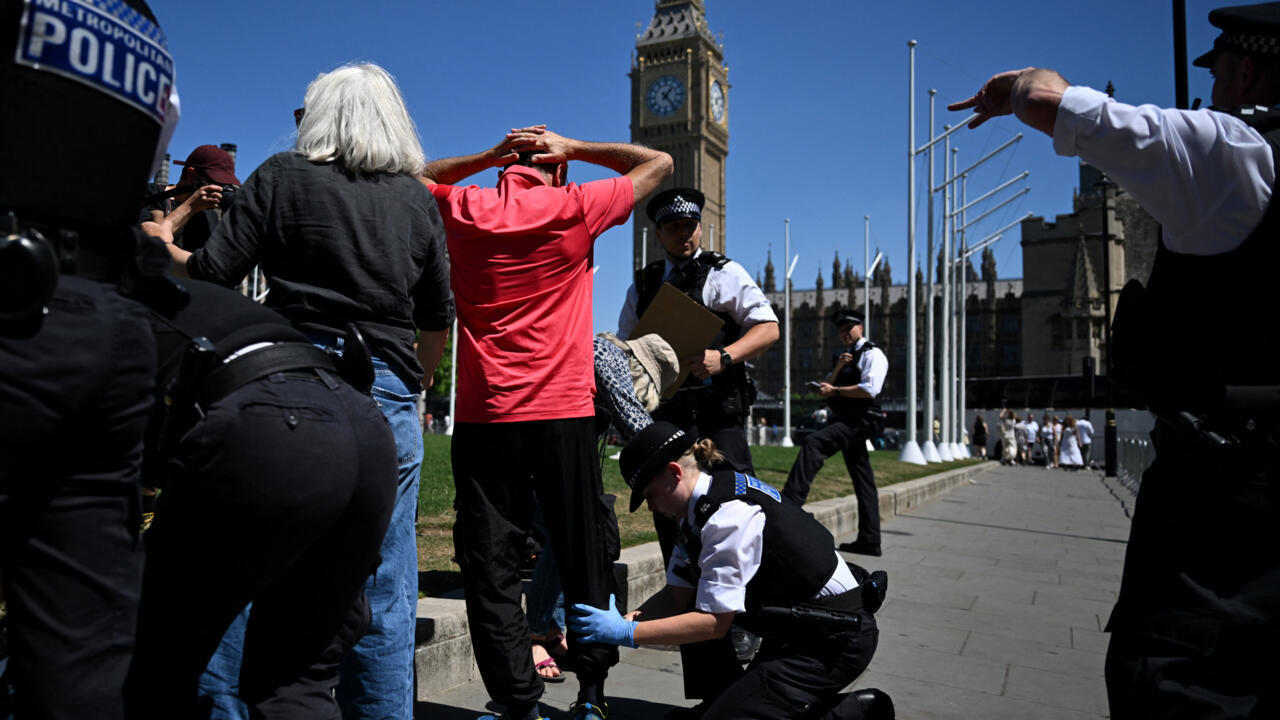
A Protester is searched before being arrested as people gather in support of the pro-palestinian group "Palestine Action", in Parliament Square, London on July 12, 2025. © Justine Tallis, AFP

More than 70 people were arrested Saturday at protests in the UK against the Palestine Action group being proscribed a terrorist organization by the British government following a break-in and vandalism at a Royal Air Force base.

In London, the Metropolitan Police said 42 people had been arrested by late afternoon. All but one of the arrests were for showing support for a proscribed organization, which police have said includes chanting, wearing clothing or displaying articles such as flags, signs or logos. Another person was arrested for common assault.

A further 16 arrests were made in Manchester, according to Greater Manchester Police, while South Wales Police said 13 people were also held in Cardiff.

In London, it was the second straight week protesters gathered to support the pro-Palestinian activist group. Its outlawing has meant support for the organization is deemed a criminal offense. Police arrested 29 people at a similar protest last weekend.


© France 24
10:06


Two groups gathered underneath both the statues of Indian independence leader Mahatma Gandhi and South Africa's first post-apartheid president, Nelson Mandela, in Parliament Square.

Signs with the wording “I oppose genocide, I support Palestine Action,” were held aloft in silence as the protesters were surrounded by police officers and members of the media.

Some demonstrators could be seen lying on top of each other on the ground as police searched their bags and took away signs.

Officers could then be seen carrying away a number of protesters who were lying down, lifting them off the ground and into waiting police vans parked around the square.

The official designation earlier this month of Palestine Action as a proscribed group under the Terrorism Act 2000 means that membership in the group and support for its actions are punishable by up to 14 years in prison.

Read more
Family of US-Palestinian beaten to death in West Bank seeks State Department probe

Some 81 organizations are already proscribed under the UK act, including the militant groups Hamas and al-Qaida.

The government moved to ban Palestine Action after activists broke into a Royal Air Force base in Brize Norton in Oxfordshire, England, on June 20, damaging two planes using red paint and crowbars in protest at the British government's ongoing military support for Israel in its war in Gaza.

Police said that the incident caused around 7 million pounds ($9.4 million) of damage.

Four people between 22 and 35 years old were charged with conspiracy to commit criminal damage and conspiracy to enter a prohibited place for purposes prejudicial to the interests of the UK The four are scheduled to appear on July 18 at the Central Criminal Court in London, better known as the Old Bailey.

(FRANCE 24 with AP)

UK

Andrew Pakes MP: ‘We need blue-collar Labour, not Blue Labour’

 10th July, 2025

Taking pride in where you live and work defines our sense of place.

Its opposite – the lack of pride – was one of the driving forces behind Labour’s victory last year.

There was the sense that Britain was broken after the psychodrama of the Tory years: fly tipping, insecure work, antisocial behaviour, unaffordable housing, 8am scramble for a GP appointment and control of our borders, the list went on.

Yet the sense of despair goes deeper than a decade of decline and Brexit. Britain has a broken social contract. The promise for working class families, like my parents’ generation, was that hard work would ensure your children would have better life opportunities.

Blue Labour isn’t entirely wrong

But whether it is looking at the data or knocking on doors, the story in Peterborough, and too many other places around the country, is the same.

The pace of change and failure of politics has created insecurity that too many people are ill-equipped to ride, whether that is immigration, low-pay and rising inequality.

The ‘Blue Labour’ answer to this maelstrom of change is social conservatism, nostalgia and rear-view mirror ideology. The world is changing even in left behind communities where expectations, especially among a new generation are changing. Blue Labour isn’t entirely wrong.

It has done good work in attempting to re-fashion Labour and to engage with the great challenges of our age. Too often, however, it confuses social conservatism as the answer to economic disruption.

That’s why we should be talking about an agenda for blue-collar Labour and the centrality of economic pride, apprenticeships and rebuilding communities through work.

Certainly, the challenges are manifold. Who can doubt that Putin poses a serious threat to western democracy, that technology is recasting the relationship between individual, society, and state, and that the looming threat of climate catastrophe forces upon us changes to our economic life.

For a Labour government to be sustained beyond a single term of office we need a constant flow of challenge, new ideas, new influences, and willingness to engage the intellect as well as to wear out the shoe leather.

So many are living to work, not working to live

British socialism is the product of many disparate forces and influences: from Marxism to Methodism, from utopianism to cooperation, from feminism to trade unionism.

Blue-collar Labour rose through the trade union movement and social democratic traditions of economic reward through secure, safe and good work. Trickle-down economics without a steer towards people and place helped to strip pride out of communities through creating economic deserts.

This isn’t nostalgic, trade unions fought hard to life conditions and create better jobs but for too many of our communities the pride in powers, moving and making Britain better has been replaced by zero-hours, low-paid jobs. So many are living to work, not working to live.

The new government is making progress on this through its employment rights reforms, industrial strategy and reindustrialisation, often in new green collar industries that will create prosperity and apprenticeships across the country. But we don’t make enough of this in our national story.

Labour best traditions have always been patriotic and made that a driving force of our economic renewal, for example Wilson’s white heat of technology. Economic pride, good jobs and investment in our communities is how we take on Reform and demonstrate Labour can make Britain better.

We need, not only growth to fix the NHS, our libraries and parks, but also lasting prosperity to give economic security, and reboot the social contract that connects work to getting on life.

Blue Labour risks missing the role of industrial and economic pride. It says that the sweet spot in politics is between social conservatism and economic leftism.

This leads the Blue Labour adherents to various conclusions: a robust focus on the nation, advocacy of the primacy of the family, and nationalisation of key industries such as steel and water.

This is not identity politics

This central analysis ignores the rapidly changing nature of our society. For example, families are important but we must recognise they come in all shapes and sizes.

Our purpose should be in creating ways for families to thrive not making moral judgements on how people live their lives. Labour can be a party of equality and at the same time be a party for the working people.

This is not ‘identity politics’, but instead our age-old egalitarian impulse.

And what about nationhood? In these desperate times it is right that we focus like a laser on defence of the realm, and boosting our armed forces.

We must play a full role within NATO and the western alliance. The threats we face from Russia, China, Iran and others who seek to harm us, are real and present.

In the famous formula of Orwell, you can love your country without hating other people’s. Labour’s patriotism is never nationalistic. You can have a close affinity with your own place, community, and family without fearing and hating others’.

Our internationalism is not in contradiction to our patriotism.

On the economy, there is nothing inherently Social Democratic about state control of industries. This is an ongoing and unresolved debate within the left, often seen through the prism of Labour’s founding Clause 4 and its subsequent revision after the fall of the Berlin Wall.

As a proud member of the Cooperative Party, I have never seen state control as synonymous with social democracy. Indeed, the part of our tradition that I revere most highly, and believe offers the best options for the future, is the mutual tradition – the tradition of locally-owned locally run, cooperative ventures and industries.
This runs counter to Blue Labour’s seeming advocacy of the postwar Morrison monolithic approach.

This may have suited the 1940s command economy but is not necessarily the best solution in our modern complex economy.

Marc Stear makes more eloquent points around this and more widely in Prospect magazine.

Appeasers get eaten

Then there is the dominant issue of our age: immigration. Labour must construct a firm and fair system of both legal migration into the United Kingdom, and also a system of asylum for those escaping persecution and war. But this cannot be wrapped up in the language of xenophobia.

As Neil Kinnock pointed out in his Prospect interview this week, appeasers get eaten.

Our approach must be about the efficiency and fairness of the system, recognising our international duties, and also making the case that migration brings strength to the economy.

We simply cannot win a rhetorical arms race with Farage. We can, however, show that we are competent and we can make the system work.

In the spirit of Hegelian discourse let me offer my own mini-manifesto: we must reskill the UK. That means a revolution in the way we teach our young people new skills and offer new pathways into work.

The factors that we don’t need a glut of university-educated 21-year-olds when the tasks ahead are so clear. To build the houses we need brickies, chippies, sparks and labourers.

To care for the growing numbers of older people we need people skilled in social care. As with previous generations we are going to need young people to enter the armed services in greater numbers than we have seen since the 1950s.

This skills revolution must be backed by enhanced apprenticeship schemes in every part of the country and investment in technical colleges and FE colleges like never before.

Labour must appeal directly to the spirit of ambition and aspiration innate in every working-class community. We must make the case for skilled jobs with decent pay and sound prospects. In short, we need less Blue Labour and more blue-collar labour.

UK

New intake Labour MPs: ‘Why we set up the Living Standards Coalition’

Everyone being able to live a decent life. This is the core of our Labour values.

But people in every corner of our country, no matter how hard they work, cannot afford a decent life. This is both an affront to our values and will damage our electoral prospects.

That is why we have launched the Living Standards Coalition of over 100 MPs to help support the government in making our constituents better off.

The Living Standards Coalition will help us keep the political focus on living standards while putting forward supportive ideas that will get bills down and incomes rising.

Getting living standards rising is how we build a country true to our Labour values and win re-election.

Affording a decent life is core to Labour values

Our party was founded to give everyone, not just some, the chance to live a decent life. Being able to afford a home, bring up a family, and pay the bills without having to worry about a perpetually overdrawn bank account. Being able to afford a decent life is core to our Labour values. 

The Living Standards Coalition will support the government in building that country. We come from every part of our party, as well as every region and nation. We are here to keep the political focus on living standards and help provide ideas to make sure everyone can afford a decent life.

Making sure everyone can afford a decent life is what sets us apart from our political opponents. Our political opponents want only some of us to be able to afford a decent life, and this makes us all poorer.  The Conservatives left over a third of households and workers unable to afford a decent life. Their cuts led to the worst fall in wages since the Napoleon, followed by the worst cost-of-living crisis of any high-income nation.

We had the highest energy bills and inflation because they failed to invest in cleaner, cheaper nuclear and renewable energy. We have some of the highest housing costs with soaring rents because they refused to build the affordable homes young people need. Childcare costs are crippling because they didn’t invest in the skilled nursery workers we needed. 

This government has already made a good start in fixing these problems to get incomes rising and getting bills down. We are proud of the Warm Homes Plan, proud of our historic investment in clean energy, proud of the planning reforms so we can build 1.5 million homes, as well as the expansion of breakfast clubs and Best Start Family Hubs. All of this is concrete action that will get bills down and make everyone better off.

We need to go further and faster now

But we need to go further and faster to make people better off now. Voters are tired of being unable to afford the basics and are turning away from us as a result. We need ideas that pay off in the next couple of years, so our voters see the benefits of a Labour government before the next election.

When incumbent governments make people better off, they win. When they don’t, they lose. The cost of living remains the most important issue by some way, and it is voters who were hit hardest by the cost-of-living crisis that were the most likely to switch to us at the last election.

For us in government, making sure we make people better off is how we, as individual MPs and a government, win re-election. The voters that are finding it hardest to afford a decent life are the ones that are leaving us. Economically insecure voters are around 50% more likely to be leaving us for radical alternatives.

Lower-income non-graduates, who can’t find a good job and see little future for them in the places they live in are leaving us for Reform. Young renters, who see their rent go up and up with no prospect of owning their own home are leaving us for the Greens. We need to win them back.

But this is about more than elections. It is also about or values and the country we are trying to create. As people are finding it harder to afford a decent life. This is what Reform is banking on. Blaming some other group for families finding life unaffordable. They seek only to divide and tear things down.

Their plan to cut clean energy investment is one small example. And when their strategy of destruction doesn’t work, and it never does, it leads only to more fear and anger as their spiral of blame continues.

The task before us is make people better off before the next election. People need to feel the benefits of a Labour government in their pockets.

The Living Standards Coalition is about celebrating this government’s achievements on living standards, keeping the political focus on them, and providing ideas to help make voters better off. It is core to our Labour values 

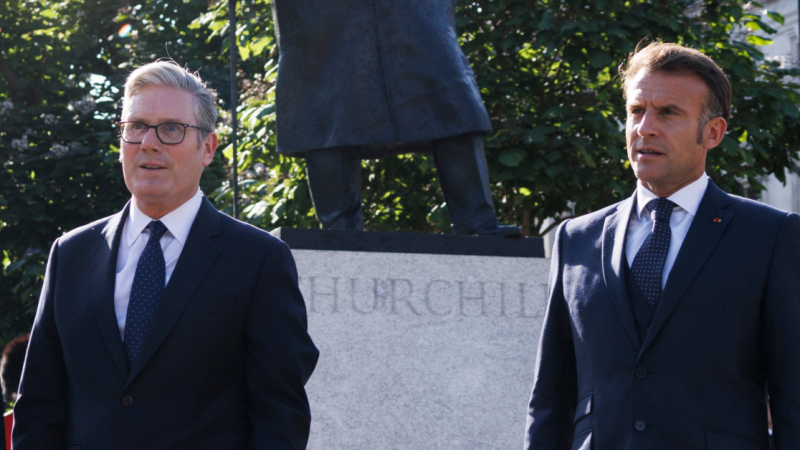
Ex-Cooper aide: ‘Keir’s ground-breaking deal with France suggests his migration approach could be bearing fruit’

Photo: UK Goverment/Flickr

At yesterday’s UK-France Summit, Prime Minister Keir Starmer achieved what his three predecessors have failed to do since Brexit: a one-in-one-out migration deal with France. Although the numbers will initially be modest, the dogged diplomacy of Starmer and Home Secretary Yvette Cooper has delivered a ground-breaking policy that contains all the ingredients for success.

We know just what a breakthrough this is, having worked with asylum seekers in Calais and researched what has worked in other countries. Equally important, this deal offers a way forward for the Prime Minister, whose instincts here are progressive, but who is facing insistent calls for Labour to get even tougher on migration to counter the challenge of Reform.

This deal is certainly deeply pragmatic: rooted in evidence of what works, and acknowledging the role of realistic deterrents in the shape of returns to France. But it is also fundamentally progressive in recognising the UK’s shared responsibility to provide protection in a safe and fair way to people with a valid claim for asylum and family in the UK. Indeed, Starmer addressed this directly yesterday when making a principled and pragmatic case for the deal: “We accept genuine asylum seekers – Because it is right that we offer a haven to those in most dire need. But there is also ..something more practical…we simply cannot solve a challenge like stopping the boats… By acting alone and telling our allies that we won’t play ball.”

This progressive realism is a major departure from previous attempts to ‘smash the gangs’ we’ve seen from successive governments. Until now, efforts to prevent people from crossing the Channel have focused largely on the ‘supply-side’ of people smuggling by increasing enforcement activities to raise the operating costs for smugglers. But while this is part of the solution, evidence suggests that the impact of this cat-and-mouse approach can be short-term on its own. To permanently shift the incentives, countries need to directly address the demand for smuggling routes.

Without the commitment to provide access to asylum in alternative, safe and orderly ways, an enforcement-only approach also signals to our closest neighbours that we are unwilling to help share the load in protecting those most in need.

International cooperation was critical to former President Joe Biden’s policy success in the US, when he effectively broke the business model of smuggling gangs in his final years in office. While it came too late to gain credit with voters, he reduced irregular crossings at the US-Mexico border by over 90% for key nationalities by combining increased cooperation with Mexico on enforcement, with managed visa entry for people in need of protection.

Starmer’s one-in-out-deal could work in a similar way. For the first time since Brexit, it allows the UK to return people who have crossed irregularly back to France – reducing the incentive to board a small boat. And it combines this with UK processing of people from France who may otherwise try to cross the Channel – diverting people into legal systems and away from irregular routes. By both deterring people from taking smuggling routes and diverting people into legal channels, the government could start to reduce the numbers of people crossing the Channel. And just as importantly, visibly show the Labour government regaining control of our borders.

The approach also implicitly acknowledges that if asked what’s more important between control and numbers, the public will consistently prioritise control. While overall numbers of people being admitted to the UK asylum system could remain the same under a one-in-one-out deal, the way in which people arrive, through orderly processing and transfer, allows the UK to exercise far greater control.

So what’s the catch? While this pilot establishes the principle, our research suggests that to really impact numbers this approach needs to operate at scale.

We propose that the aim of the UK and French governments should ultimately be to open up managed, capped access to UK asylum processing from France, alongside continued returns. By establishing new ‘Asylum Management Centres’, as The Future Governance Forum proposes, the UK could identify those who have a valid claim to asylum without them having to risk the journey to the UK in a small boat. Such an approach would directly address the ‘demand’ for smuggling routes from people fleeing persecution and conflict. Importantly, it could also allow the UK to achieve scale with readmissions over time, which is needed if it hopes to make a major impact on the number of people crossing.

Contrast this with the fantasy politics of populists calling for the UK to turn boats around in the Channel (to where?) or pull out of international treaties that have protected millions of people and guarantee our involvement in mutually beneficial agreements, including the Good Friday/Belfast Agreement securing peace in Northern Ireland and our trade deal with the EU. While Ministers will be keen to manage expectations about the immediate impact of this deal, there should be no doubt about its political significance.

On entering No.10 last year, the Prime Minister pledged to reset the government’s approach on tackling people smuggling: “In pursuit of solutions that will actually deliver results. And more than that… we will approach this issue with humanity. And with profound respect for international law.” One year on, this ground-breaking deal with France suggests this approach could finally be bearing fruit.

UK

What We Know About the New Left Party So Far

Source: Novara


Last week, former Labour MP Zarah Sultana announced she would be seeking to form a new leftwing party with Jeremy Corbyn. 8pm on a Thursday is not the usual moment for such an announcement, but time was of the essence.

The appetite for a new left party is clearly there. A subsequent call from Sultana for supporters to “join Team Zarah” has effectively broken (one very small part) of the internet: the counter on her website is apparently down. A poll seen by the New Statesman a fortnight ago also put a prospective Corbyn-led party polling at 10% of the electorate – not a 400 seat majority, sure, but not something to be sniffed at.

But why launch it now? Well, there are the obvious reasons. Last week was the one-year anniversary of Labour’s loveless landslide. Keir Starmer’s personal approval ratings at an all-time low. The rebellion over the government’s welfare reform bill has unsettled the image of drone-like Labour MPs, all simply doing the leadership’s bidding. And the proscription of Palestine Action, despite its passing through the House of Commons with minimal difficulty, has been widely condemned as a misuse of terrorism law.

There’s also a much wider context. Reform UK, Nigel Farage’s new party, has surged in the polls. A new party launched ahead of the 2029 general election is too long to wait for people who will be a full decade older and, in many cases, less engaged than they were in 2019.

But there was a problem: Sultana’s announcement was met with silence from her supposed co-leader. Corbyn stayed schtum until the following afternoon, and what his much-delayed statement didn’t say was more notable than what it did. There was no confirmation of a new party beyond the fact that “discussions are ongoing”, which we already knew. There was no confirmation that he or Sultana would lead it. Instead, there were vague promises of the kind that we’ve been hearing for a very long time.

What’s going on? How did we get into such a confusing, anticlimactic and – frankly – embarrassing situation in which announcements and non-announcements seem to cancel each other out? And beyond the bickering, what are the points of political disagreement that actually matter?
How did we get here?

Here’s what we know about what got us to this point.

Not long before Sultana published her statement, a meeting took place of around 30 people from various parts of the British left. This was a broad, coalitional group that had, despite its internal differences, been moving slowly towards the formation of a new party. Given the acrimony on the British left since 2019, the mere existence of such a group is something of a feat.

So, who has been involved in the discussions around a new party? Both Corbyn and Sultana, of course, but also many others.

Discussions about the new party have been largely organised by Collective, a group headed by Karie Murphy and Pamela Fitzpatrick which coordinated 18 independent candidates in last year’s election. Murphy and Fitzpatrick are both veterans of Corbyn’s political camp, the former having been executive director of the leader of the opposition’s office, the latter now the director of Corbyn’s Peace & Justice Project.

Then there’s the group founded by Jamie Driscoll, the former North of Tyne mayor. That’s called Majority, and is a local campaign to run candidates in the 2026 Newcastle council elections. Strategically speaking, Driscoll is close to Andrew Feinstein, the former African National Congress MP who challenged Starmer in his constituency last year and is now building the Camden Community Alliance. Both Driscoll and Feinstein want to develop their local campaigns from the ground up.

Then there are the Independent Alliance MPs, who won election in 2024. Their campaigns were largely seen as a show of disgust for Labour’s position on the Gaza genocide, although one of them – Shockat Adam – has been keen to point out that there was much more to his victory than that.

There was, perhaps, good reason for the caution the group forming a new party had shown until recently. For a party to be a mass party, it will need, at the very least, to coordinate between the various parts of the British left. Corbyn is a famously patient coalition builder, unwilling to cut anyone out of the process. And there are certainly substantial disagreements to deal with.
Where are the battlelines?

First, there’s the question of leadership. Sultana’s post implied she will co-lead the new party, but others want Corbyn as the sole figurehead, reasoning that only he has the widespread credibility both on the left and among the wider public. He was, after all, the person who secured almost 13 million votes for the Labour party at the 2017 election. Speaking to me on Novara FM in May, Fitzpatrick was adamant that Corbyn’s leadership was an essential part of the formation of a new party.

One key function of a leader is to act decisively. Corbyn has long been criticised in this department, albeit often being under a pressure that’s difficult for most of us to imagine. Sultana’s announcement, whatever else you think of it, was clearly decisive. Together, their advocates say, they could be a serious force.

Driscoll, for his part, told me “an old-model left party around one individual” didn’t interest him. “I want to see lots of ground-up campaigns working together and winning in 2026,” he explained. “New leaders will emerge. Then have a founding conference and elect a new generation of leaders – plural – who can take us into the 2029 general election and convince the public they could run the country.”

Parliamentary politics also involves fighting the media war – the battle for attention and ideas – which any new party will have to contend with. Although we live in an age of decentralised media, it’s still necessary to have a group of strong and reliable media performers to go on TV and radio and put forward the party’s message. Adam, also speaking on Novara FM, argued that if the point is to offer something new to the electorate, it can’t come entirely in the shape of Corbyn, one of the best-known politicians in the country. Perhaps no one is more widely trusted on the left – but for the public at large, no one comes with more baggage.

Then there’s the question of democracy. Everyone agrees that the new party should be democratic. But democracy can mean many things.

Certainly, the idea of democracy as being just about elections is an impoverished one. Many of the people I spoke to said that the new party should not only be democratic by holding elections for leaders, but also in its form, striving to represent as fully as possible its constituencies.

Something like a democratic infrastructure is emerging within Collective. Some of the candidates that the group backed in 2024 have set up new local parties since then. Sean Halsall, of Southport Community Independents, told me that members of his group “have the structures in place” and have “ingrained ourselves in our community”. But Halsall also told me he thought they needed a national party to provide “a recognised brand and infrastructure,” and that his and the other local parties are bound by Collective’s constitution to fold into a new national left party when it emerges.

This echoes the mode of democracy proposed by James Schneider, Corbyn’s former director of strategic communications and another important player in the discussions around the new party. In discussion with Green leadership candidate Zack Polanski on Novara FM in February, Schneider argued that a new party should be at once bottom-up and top-down – a vision not, in fact, dissimilar from Polanski’s own hopes for an eco-socialist Green party.

From the bottom-up, Schneider’s strategy is about tying together the parts of society through which we can exert social power. What are those parts? Unions, naturally (although when I asked if any of them would jump ship to a new party, I got an understandably swift round of “no comment”). But Schneider’s vision is broader: “We’re talking libraries, we’re talking working men’s clubs. We’re talking bands, football teams, all of this stuff – the rich tapestry of life that is social power, which could then have political power on top of it.” For him, the new party could be an articulation of this power from below, a coalition of working class communities, asset-poor, downwardly mobile graduates, and racialised people.

Others argue that more radical forms of democracy are available. Driscoll has pushed for local campaigns to pursue people’s assemblies, whereby regular people are invited to collectively write policy. These people get advice from experts, and are often paid for their time, and then the party infrastructure is tasked with implementing what they choose. Majority has been using assemblies to source its policies, and while the party’s political values are explicitly anti-racist and pro-public ownership, it also uses the language of participatory democracy, which Driscoll says is more likely to cut through with the public than leftwing tubthumping.
Collective hopes.

If the past week has proved anything, it’s that the British left is brimming not just with energy and ideas, but impatience. This looks at one level like chaos and infighting, but it’s precisely the raw material out of which new movements are forged. The challenge now is to turn overlapping hopes into a shared project that is bigger than any one organisation, personality or tactic.

Corbyn, Sultana, community independents and eco-socialist Greens all speak to constituencies others can’t. Instead of asking which single vision will prevail, and who will lead it, the more useful, practical question is to ask how they can work together, whether that be through co-endorsed local candidates, joint campaigning infrastructure, an agreed minimum programme on climate, wages and public ownership, and a clear protocol for resolving disputes before they become headlines.

A new party with the organisation, breadth and moral imagination to meet the moment is within our collective grasp. Creating it will mean overcoming the inane factionalism that has too often plagued the British left. But this is what’s owed to millions of people who have already waited too long for politics that is finally on their side.

UK

Unite votes to re-examine relationship with Labour and suspend Angela Rayner


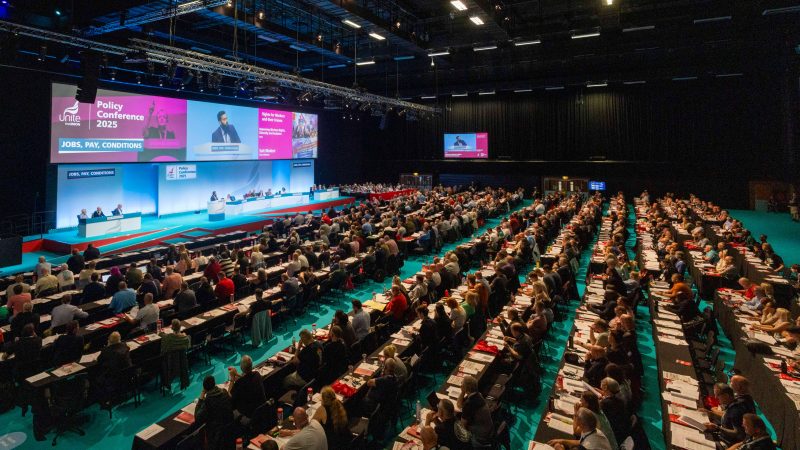
Trade union Unite has voted to re-examine its relationship with the Labour Party and suspended Angela Rayner’s membership over her role in the Birmingham bin strike.

Members of the union are in a standoff with the Labour-run city council in Birmingham over an ongoing dispute over pay and redundancies.

Delegates at the union’s policy conference in Brighton “overwhelmingly” backed an emergency motion that condemned the government for its “support to the council and the commissioners, originally appointed by the Tories and maintained by Labour”. It committed the union to “discuss our relationship with Labour” if the redundancy process is forced through.

Along with Angela Rayner, Birmingham council leader John Cotton and other Birmingham councillors who are members of the union have been suspended.

Unite general secretary Sharon Graham said: “Unite is crystal clear it will call out bad employers regardless of the colour of their rosette. Angela Rayner has had every opportunity to intervene and resolve this dispute but has instead backed a rogue council that has peddled lies and smeared its workers fighting huge pay cuts.

“The disgraceful actions of the government and a so-called Labour council, is essentially fire and rehire and makes a joke of the Employment Relations Act promises.

“People up and down the country are asking whose side is the Labour government on and coming up with the answer not workers.”

Angela Rayner and the Labour Party have been approached for comment.

Latest available figures show Unite has 1.2 million members, making it Britain’s second largest union and the second largest Labour-affiliated union, behind Unison.

The union donated the most money to Labour MPs in the run-up to the general election last year, with 88 MPs and candidates receiving more than £500,000.

20 years of UK solidarity: the fight against Yankee aggression continues

Give Venezuela back it's gold protest
“Give Venezuela back it’s gold” protest in London.

“(Carlos Ron) said it was an honour to celebrate the VSC’s history of solidarity, and paid tribute to all who have decided to take up the cause of Venezuela and help the struggle to protect the lives of the Venezuelan people.”

By Susan Grey

The Venezuela Solidarity Campaign’s online rally Sanctions Kill – US out of Venezuela & Latin America! saw a range of speakers from across the world mark the organisation’s 20th anniversary and discuss the importance of continuing its work in the face of crippling US sanctions introduced by Obama and intensified under Trump- themes which were outlined by the Chair (Bakers, Food and Allied Workers Union General Secretary Sarah Woolley) after welcoming participants.

The first speaker was Kate Hudson, Campaign for Nuclear Disarmament Vice President and a member of the VSC for 20 years. She recalled attending the World Social Forum in Caracas in 2006 during Chavez’s time as President – a seminal moment that highlighted the importance of international solidarity. It was inspiring to understand that progressive movements can work with the state, to oppose war and support the oppressed, including Palestine. The constitution, developed under Chavez, committed Venezuela to opposition to nuclear weapons, and that commitments has continued under President Maduro. Chavez’s vision was for peace through democracy, and central to this was the democratisation of institutions, such as ALBA. These represented a powerful move towards a multipolar world and that move remains in place today. 

Fiona Sim from the Black Liberation Alliance spoke next. She had recently visited Venezuela as part of a delegation to take part in the International Anti-fascist Festival and attend the inauguration of President Maduro. She noted that we are currently living in tumultuous times, with widespread conflict and many examples of exploitation and oppression. However, she pointed out that we should resist the idea that such exploitation is inevitable and that Venezuela provides a significant force against imperialism and fascism. There is an economic war being waged against the country and it is vital that we fight against it. She remarked on how refreshing it was to be in Venezuela and meet campaigners against fascism from all over the global south and people from so many sectors of society out on the streets to join the celebrations on the streets for President Maduro’s inauguration. Finally, she emphasised how the fight against imperialism and fascism must continue and we should and stand side by side with anti-fascist organisations and show our solidarity with Venezuela. 

At this point Matt Willgress from the VSC spoke briefly to remind the meeting of the work done in solidarity with Venezuela- in particular the campaign against US sanctions and the withholding of Venezuela’s gold by the Bank of England. The campaign can only function through the support of its members and the work of its volunteers, so participants at the meeting were urged to join the VSC, ask their trade union branches to affiliate, and if possible make a donation towards the cost of the meeting. 

Dáire Hughes, Sinn Fein MP for Newry and Armagh, spoke next. He reminded the meeting how the Irish have felt the sting of occupation and feel an affinity with all who struggle against colonialism. Sinn Fein stands in support of self-determination and the right of democratically elected governments to govern in the interests of the people. The sanctions imposed on Venezuela go against these principles and cause great damage to the people of Venezuela. He called for an end to imperialism and the exploitation of people and reiterated the importance of standing firm against foreign interference. 

The next speaker was Carlos Ron, Former Vice-Minister, Foreign Affairs and President of the Simon Bolivar Institute for Peace and Solidarity Among Peoples. He said it was an honour to celebrate the VSC’s history of solidarity, and paid tribute to all who have decided to take up the cause of Venezuela and help the struggle to protect the lives of the Venezuelan people. He commented on the many attempts that have been made to derail Venezuela, but emphasised that Venezuelans are a proud and strong people and that our work in Britain is in solidarity with an ongoing process of deepening democracy and promotion of national unity. He also emphasised how, despite sanctions and attempted destabilisation, Venezuela is a force for peace. This position has been taken strongly by President Maduro in his recent call to end aggression and hold a global summit for peace, including the dismantling of Israel’s nuclear arsenal, and for the right of the Palestinian State to exist. 

Alicia Castro, former Argentinian Ambassador to Venezuela and the UK, was next to speak.  She remembered the early days of VSC when she was in Britain and worked with the International Transport Workers Federation. A constant problem over the years has been the misinformation spread about Venezuela and she urged everyone to go to Venezuela if possible and find out the truth for themselves.  She recalled a conversation with Julian Assange in which he showed her an NSA document from 2007 disclosed by Edward Snowden. The document listed six countries, including Venezuela, identified by the USA as “enduring targets”. It was clear even then that the intention of the US was to prevent Venezuela’s leadership and influence in the region. The regime change agenda was established very early.  Alicia went on to discuss how the Venezuelan people reacted. As mentioned by other speakers, the Venezuelan people are very aware of their history. At President Maduro’s inauguration it was clear that the people are aware of the ongoing struggle and believe that the values of Hugo Chavez live on and the fight continues, as it does elsewhere, including her own country of Argentina. She said she hopes we could build an anti-fascist programme in the UK and continue the struggle for a multi-polar world, united against fascism.

The next speaker was Gawain Little, General Secretary of the General Federation of Trade Unions. He recalled attending the Youth Festival in Venezuela 20 years ago, as a Youth Member of the National Union of Teachers (now part of the National Education Union). There were about 16,000 visitors to the festival, and accommodation was provided for them in partially built houses that were part of an ongoing project to address Venezuela’s housing problem. It was clear that the government was also tackling other social issues, such as literacy and access to medical care, as well as cultural projects and improvements to democratic processes. At the time the population was also heavily involved with discussion of the new constitution. He remarked on how this contrasts with the current situation in the UK where activists are targeted and silenced. Venezuela does have an active opposition, but it is important to note that many of those opposition groups are far right extremists. He echoed President Maduro’s call for a world forum for peace and reminded the meeting that we can learn a lot from Venezuela and how it stands up to imperialism. He emphasised the importance of solidarity with Venezuela, which he sees as an issue for trade unions as well as individuals.

Vijay Prashad, author and director of Tricontinental, was unable to participate live but sent a video to the meeting. He began by pointing out that what to US is doing to Venezuela is not sanctions, but illegal unilateral coercive measures, contrary to the UN Charter of 1945. According to the Charter measures should be backed by UN resolutions and a country cannot force other countries not to trade with Venezuela. The whole system of US sanctions is illegal. Venezuela is the victim of a hybrid war. The US may not be dropping bombs, but it is waging economic war, preventing normal basic trade with other countries. What is happening to Venezuela is similar to the blockade against Cuba, and is repeated in other countries sanctioned by the US. However, he emphasised that Venezuela is entitled to resist this illegal economic war. 

The final speaker was Francisco Dominguez, Secretary of Venezuela Solidarity Campaign. He began with an anecdote about an early delegation to Venezuela. While there he bought some black beans in a subsidised supermarket and noticed that on the back of the package there were printed excerpts from the Venezuelan constitution. He was struck by how these small measures contributed to the politicisation of the people. 

Turning to the 20 years of VSC campaigning, he highlighted three important principles. First, to defend the right of Venezuela to determine its future. The VSC does not try to tell Venezuela what to do. Second, to demand the lifting of all unilateral coercive measures. Third, to produce articles explaining the issues to the people. Over the years VSC has produced hundreds of fact sheets, articles and other material. One early pamphlet spelled out the nature of the Bolivarian Revolution, combining social projects and increased democracy. Other publications included a pamphlet on the Venezuela Labour Law, detailing many improvements in workers rights. When US plans emerged to install military bases around Venezuela another pamphlet was produced to explain the history of US militarisation in Latin America and the threat it posed in the region. VSC’s information campaign has also focused on the harm done to the Venezuelan people by the US’s coercive measures, including deaths caused by lack of access to medication. The economy has also suffered, with sanctions causing the loss of 99% of Venezuela’s revenue. 

Reflecting on Venezuela’s experience since the death of Hugo Chavez, Francisco commented that President Maduro has been through tough times, taking on the leadership at a time of extreme crisis but somehow managing to restore economic stability. The country used to be dependent on imports for food, but since Maduro became president this has turned around and the country is now 97% self-sufficient in food and the economy is starting to grow. He noted that the US cannot tolerate Venezuela’s success. Extreme right activists have not given up their attempts at destabilisation. Recent examples include attempting to implicate Venezuela in providing weapons to Iran, and trying to persuade the US to attack militarily. So the work to counter US interference goes on. Venezuelan grassroots organisations provide a vital resistance within Venezuela and VSC will continue to provide international solidarity from the UK.