Sunday, July 13, 2025

India separatist group says Indian army killed leaders in Myanmar strikes
Published July 13, 2025

Separatist militants in northeastern India said the Indian army carried out cross-border drone strikes on the group’s camps in neighbouring Myanmar on Sunday, killing three of its leaders.

Some separatist groups in northeastern India have ethnic, linguistic and cultural ties with minorities across the border in Myanmar and maintain a presence there.

A top commander of the United Liberation Front of Asom-Independent (ULFA-I) was killed and 19 others wounded in a drone attack in Myanmar near the border, the separatist group said in a series of statements.

According to Indian outlet The Hindustan Times, the ULFA-I claimed over 150 Israeli-made drones were used in the attack.

“Two more senior commanders were killed” in subsequent strikes, the ULFA-I said, adding: “Several other members and civilians were also wounded.”

Indian daily The Hindu reported that, according to the group, the subsequent strikes were carried out with missiles and struck a funeral for the commander killed in the drone attack.

Indian authorities have yet to confirm the strikes.

Camps belonging to another rebel group, the People’s Liberation Army (PLA), were also targeted, the ULFA-I added.

The ULFA-I is one of several insurgent groups in India, and wants independence for the northeastern state of Assam, while the PLA advocates for the secession of Manipur state.

One faction of the ULFA laid down arms and signed a peace deal with the Indian government in 2023. According to the Indian outlet The Deccan Herald, the group was split, with those against talks making up the ULFA-I faction.

Separatist attacks have drastically reduced in recent years, but the violence has killed thousands of people, mostly civilians, over the last three decades.
FRANCE24  Investigation

Stocamine: French toxic waste site threatens Europe's key water source


Thousands of tonnes of toxic waste lie buried beneath one of Europe’s most important groundwater reserves in the town of Wittelsheim in France’s Alsace region. French authorities decided in June to permanently seal waste from the former Stocamine potash mine at the site, claiming there was not sufficient time to remove it safely. But scientists and advocacy groups strongly oppose the decision, fearing the chemicals could seep into the water supply of the Upper Rhine aquifer.


Issued on: 12/07/2025 - 
By: Vitoria Barreto


Employees walk in a mining gallery in the Stocamine hazardous waste storage centre in Wittelsheim, eastern France, on January 24, 2019. Some 42,000 tons of industrial hazardous waste are stored in a former potash mine in the StocaMine storage centre in Wittelsheim. © Sebastien Bozon, AFP

For more than 25 years, thousands of tonnes of toxic waste have lain buried beneath the old industrial town of Wittelsheim in France’s northeastern region of Alsace.

Some 42,000 tonnes of toxic waste currently lie buried 500 metres below the site, which contains 125km of tunnels.

On June 17, a Strasbourg court ruled that there was not sufficient time to remove toxic waste safely from the former potash mine, known as Stocamine, at the site. The court argued that the risk that the galleries could deteriorate or collapse made removal of the waste extremely dangerous.

A press release from the Strasbourg court on May 15 stated that the studies presented in the file demonstrated that the site would only be accessible in “sufficiently safe conditions until 2027/2028”.

After examining all the possible options in terms of environmental risks, the public rapporteur ordered that the waste should be permanently sealed underground, and that it be smothered in thick concrete walls to prevent it from leaking out.

Stocamine employee Eric Pupka looks at waste isolation cell in a mining gallery of the Stocamine hazardous waste storage centre in Wittelsheim, eastern France, on July 13, 2021. © Sebastien Bozon, AFP


But scientists and advocacy groups fear that the toxic waste risks seeping into Alsace’s water table, one of the most important groundwater resources in Europe.

Swiss geologist Marcos Buser, tasked with guiding studies and decision-making about the future of the mine’s toxic waste storage in a 2011 committee of experts on Stocamine, predicts that if water seeps into the mining sites, “pollution in the form of a contaminant plume could extend several kilometres long into the water table, hundreds of metres wide and 30-40 metres high".

Buser added, "In 20, 30, 50 years, people will say: they were crazy not to remove this waste when they could have done so."

The geologist stressed that it is still possible to remove the chemicals. He believes the real reason French authorities don’t want to do so is due to undeclared chemical waste inside the mine.

The committee had already recommended and approved a partial destocking of heavy metals such as mercury in 2011. This took place between 2014 and 2017 as a compromise between non-retrieval and full retrieval of the deposited inventory.

Employees walk in a mining gallery of the Stocamine hazardous waste storage centre in Wittelsheim, eastern France, on July 13, 2021. © Sebastien Bozon, AFP

According to Buser, during that period of between 2014 and 2017, engineers and Stocamine employees discovered that about 20 percent of the big chemical waste bags that were torn contained chemicals that didn't match their labels – that they were falsely declared waste.

Buser thinks that economic considerations led to the acceptance of the undeclared chemicals. “The managers of Stocamine simply accepted any waste to keep the company alive," according to an investigation published in 2023 by Investigative Journalism for Europe.

The geologist, who has worked in various destocking projects, such as the Sainte-Ursanne case in Switzerland, said that removing chemicals from the mine in Alsace is possible and that the current decision of permanent confinement is unacceptable while safe access to the mine is still possible

'It also concerns Switzerland, Germany'

Alsace Nature and the Collectivité européenne d'Alsace (CEA) have since appealed the Strasbourg court's decision to the Nancy court, where the case is now pending. Both groups told FRANCE 24 that they are not backing down from their fight to have the waste removed from the site.

In an email, CEA President Frédéric Bierry said that several mechanisms are still available for making appeals, including referral to European courts – specifically the European Court of Human Rights or the Court of Justice of the European Union – on the basis of the right to a healthy environment.

Alsace Nature, the advocacy group that previously filed an appeal with the European Court of Human Rights – rejected under the emergency procedure – says its complaint remains under review and maintains that the Stocamine case goes well beyond a regional issue.

“It goes much further,” said the group’s director Stéphane Giraud, pointing to cross-border risks. “It concerns Switzerland, Germany and several million [people] who live off this water table.”

Giraud warns that the long-term consequences of waste confinement are unpredictable, affecting not just water quality but the entire environmental and economic fabric of the region.

As to health risks for Stocamine employees, no link has been officially established. “We don’t know what’s really in the mine,” Giraud said, adding that workers live “in a world of mining", which makes the risks difficult to confront.

An employee passes by a testing containment wall in the Stocamine hazardous waste storage centre in Wittelsheim, eastern France, on January 24, 2019. Some 42,000 tons of industrial hazardous waste are stored in a former potash mine in the Stocamine storage centre in Wittelsheim. © Sebastien Bozon, AFP

Even those opposed to burying the waste permanently are hesitant to speak publicly. “It’s a bit of a betrayal of their lives,” Giraud explained, noting that the mine was once a celebrated social model in the Haut-Rhin region.

In 1997, the French government authorised the conversion of the mine into a waste repository to keep the economy of the town going, as it was suffering after the decline of potash mining.

The project was presented as a job-creating initiative for former miners, but only 24 jobs were created and a 2002 underground fire in block 15 of the structure put an end to the reception of new waste, further eroding public trust in the facility.

FRANCE 24 contacted Céline Schumpp, Secretary General of Les Mines de Potasse d’Alsace (MDPA), the company which succeeded Stocamine, for further comment on its position regarding the permanent sealing of the site.

She referred to documents already available on the company’s website, the Conseil d'Etat's decision on 2024, a report from Cour de Comptes – France's top court for auditing public funds – on the case and stated that, “MDPA does not comment on court decisions; it enforces them.”

The company maintains that due to the ongoing convergence of the mine leading to the gradual collapse of its tunnels, there is no longer a safe window to completely remove the waste and therefore supports that it be permanently sealed.


'Surviving the heat': Navajo Nation's long struggle for electricity

Issued on: 13/07/2025 - 

Workmen plant electricity poles in the rust-orange earth of the Navajo Nation and run cables to Christine Shorty's house – finally giving her power against the searing Arizona desert heat. It will be a luxury in the vast Native American reservation, the largest in the United States, where more than 10,000 families are still without electricity and therefore air conditioning.

Video by: FRANCE 24


Lesotho declares 'state of disaster' as it struggles with US policy changes

Lesotho's reliance on the United States has left the country on the brink of disaster following the Trump administration's decision to cut off aid. Its manufacturing sector too is under threat, thanks to uncertainty around the renewal of the African Growth and Opportunity Act.

Issued on: 12/07/2025 - RFI


Workers in a garment factory in Maseru, Lesotho. © AP/Neo Ntsoma

By: Zeenat Hansrod

Lesotho has declared a national state of disaster for the next two years, amid the fallout from tariffs and aid cuts imposed by the US.

With unemployment already around 30 percent, the government is warning of an additional 40,000 job losses in the textile sector if the US African Growth and Opportunity Act (AGOA) is not renewed by the end of September.


AGOA gave preferential access for African goods to the US markets, under certain conditions. Lesotho was one of its biggest beneficiaries, exporting textiles to the US.

In April, US President Donald Trump announced 50 percent tariffs – higher than any country – on goods from Lesotho. The tariffs have since been paused and a flat 10 percent rate is currently being applied to most countries.

Oscar van Heerden, senior research fellow at the Centre for African Diplomacy and Leadership at the University of Johannesburg, told RFI that the Trump administration is weaponising trade through its use of tariffs.

Africa braces for economic hit as Trump’s tariffs end US trade perks

"Trump doesn't care about the consequences for Lesotho. What he wants is a good deal for the United States and to recalibrate what he considers to be trade deficits for the US," he said. "There is clearly something – but we don't know what – he wants from Lesotho and that’s why he has slapped it with such a high tariff. The 50 percent tariffs makes no sense."

'Master-servant era'


Van Heerden called the policies adopted by the Trump administration a step back into colonial times.

"The Trump administration with the weaponisation of tariffs are taking us back to the master-servant colonial era, where the weak must suffer and the strong will decide. That’s precisely what is happening with Lesotho," he said.


He added that Lesotho must think outside the box. The country's Prime Minister Sam Matekane said in June that the solution for unemployment lies in intensive labour and sectoral transformation.

"We are not only investing in traditional sectors but also embracing innovation and creativity. We aim to empower mostly women and young Basotho with meaningful jobs and entrepreneurial opportunities," Matekane said.

Finance minister Retselisitsoe Matlanyane described youth unemployment as a "significant" challenge for Lesotho. According to a coalition of youth organisations, 48.8 percent of young people in the country cannot find a job.

Global aid in chaos as Trump proposes to slash funds and dismantle USAID

AGOA in question

According to Van Heerden, the US administration – through Secretary of State Marco Rubio and Defence Secretary Pete Hegseth – has made it clear that it is not interested in AGOA.

"There's no way that AGOA is going to be renewed," he said. "The Trump administration is talking with a forked tongue. It gives the impression that there is room for negotiation, but the truth is they've made up their mind.

"They will negotiate with countries in Africa where they can benefit in terms of critical, strategic minerals and other sectors of interest to them. They're not really interested in doing business with Lesotho."

He added that it will be an uphill battle for the Lesotho government.

"I suspect they are going to turn to SACU [the Southern African Customs Union] and the Southern African Development Community (SADC) for loans and bailouts, and where that fails, they will have to turn to the International Monetary Fund (IMF) to try and recover some funds, if indeed they have some collateral to bargain with in order to secure loans."

Violence simmering


The abolition of USAID programmes to Lesotho, including the crucial Emergency Plan for AIDS Relief, combined with the unemployment crisis, has compounded the risk of violence among young people, according to Van Heerden.

"There is potential for the pot to explode, given the level of dissatisfaction among the population. And that's why I think in preparation for any eventuality, the Lesotho government decided to declare a state of emergency to handle this situation.

"It is trying to keep the [heat] contained for now, if it is at all possible, while at the same time looking at alternatives, in terms of loans and markets."

In July last year, Lesotho declared a state of National Food Insecurity Disaster after a historic drought triggered by El Niño led to the lowest crop yields since the 2018-19 agricultural season.

 Turkey's leader says PKK disarmament opens 'new page in history' after group lays down arms


Copyright Markus Schreiber/Copyright 2025 
The AP. All rights reserved

By Euronews with AP
Published on 12/07/2025 - 

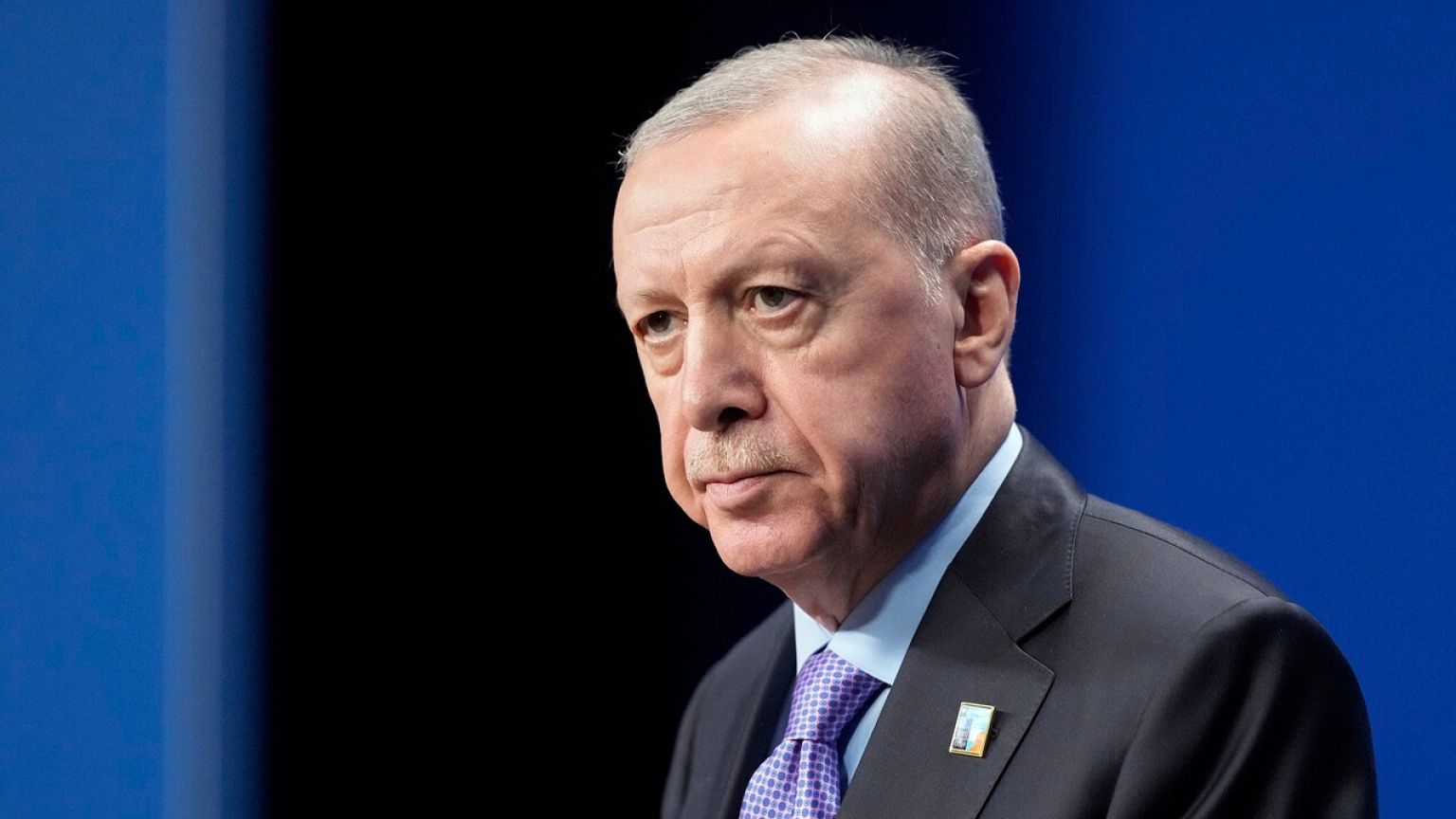
Recep Tayyip Erdogan claimed the disarmament of the Kurdish PKK militant group as a victory for his country after its members began laying down their weapons in a symbolic ceremony on Friday.


Turkish President Recep Tayyip Erdogan said a “new page in history” has turned, after the Kurdish PKK militant group that has waged a decades-long insurgency in the country began laying down their weapons.

The Kurdistan Workers’ Party, or PKK, held a symbolic ceremony on Friday in northern Iraq. It was the first concrete step toward a promised disarmament, as part of a peace process.

Speaking at a meeting of his ruling Justice and Development Party on Saturday, Erdogan hailed the event as a victory.

“Turkey has won, my nation has won. Every single one of our 86 million citizens, Turkish, Kurdish, and Arab has won,” he said.

"We will not participate in, nor will we engage in, any attempt to threaten our unity, our integrity, our homeland, our state, our nation, our peace, our honour and our pride," Erdogan added.

The PKK announced in May that it would disband and renounce armed conflict, ending four decades of hostilities.

"As of yesterday, the 47-year scourge of terrorism has entered the process of ending, God willing," Erdogan said. "As of yesterday, Turkey began to close a long, painful and tear-filled chapter."

The move came after PKK leader Abdullah Öcalan, who has been imprisoned on an island near Istanbul since 1999, urged his group in February to convene a congress and formally disband and disarm.

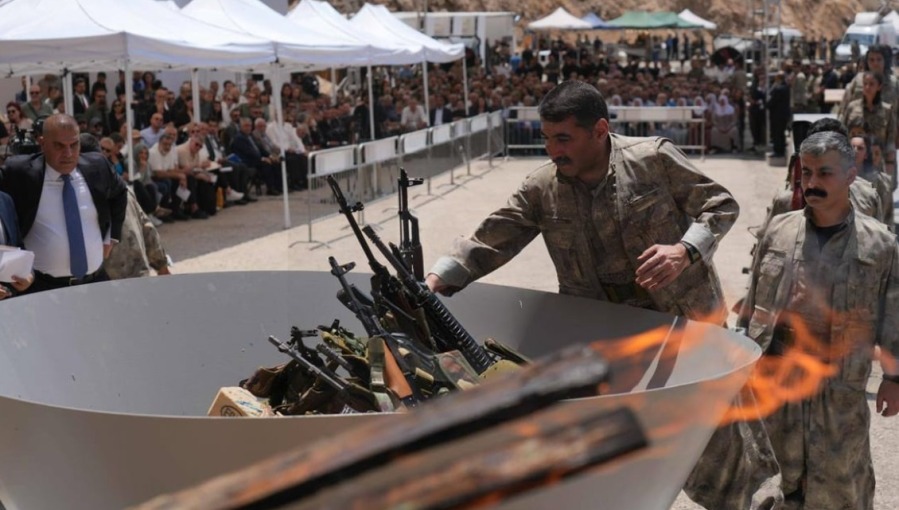
Footage from Friday's event showed fighters — both men and women — casting rifles and machine guns into a large cauldron, where they were then set ablaze.

The PKK issued a statement from the fighters who were laying down their weapons, saying that they had disarmed “as a gesture of goodwill and a commitment to the practical success” of the peace process.

“We will henceforth continue our struggle for freedom, democracy, and socialism through democratic politics and legal means,” the statement said.

The state-run Iraqi News Agency reported that 30 fighters had disarmed “symbolically” on Friday, and that the continuing disarmament process “will take place in stages.” The process is expected to be completed by September, the agency reported.


Kurdistan Workers' Party begins historic weapon destruction in Iraq

Kurdistan Workers' Party begins historic weapon destruction in Iraq
Iraqi Kurds hand in weapons in historic demilitarisation. / 964 Media.


By bnm Gulf bureau July 11, 2025

The Kurdistan Workers' Party (PKK) has begun destroying its weapons in an unprecedented move to end armed struggle and transition to peaceful political resistance, responding to a call from imprisoned leader Abdullah Öcalan.

The Kurdistan Workers' Party (PKK) is a cross-border Kurdish militant organisation founded by Abdullah Öcalan in 1978 that has waged an insurgency against Turkey since 1984, initially seeking an independent Kurdish state but later shifting to demands for greater cultural and political autonomy within Turkey. 

The Peace and Democratic Society Group announced the start of disarmament ceremonies by PKK fighters in a symbolic step representing the third phase of implementing the party's decision to withdraw from armed action, 964 media reported on July 11.

"We destroy our weapons before you, by our free will, in realisation of our ideology, and on the basis of enacting laws of democratic integration," the group said in a statement from Sulaymaniyah.

The fighters said they came in response to Öcalan's call issued on June 19, and his peace and democratic society appeal announced on February 27, along with decisions from the PKK's 12th congress held on May 5-7.

The group said it would continue its struggle for freedom, democracy and socialism through democratic politics and legal means as a gesture of good faith and determination for the practical success of the peace and democratic society process.

"We completely agree with leader Abdullah Öcalan's saying: 'I believe in the power of politics and social peace, not in the power of weapons, and I call on you to apply this principle'," the statement said.

The fighters acknowledged that nothing had been easy or free without struggle, with everything achieved by paying a high price daily and fighting with all available strength. They said the future would continue with hard struggle. The group called on all regional and global forces responsible for their people's suffering to respect legitimate national and democratic rights and support the peace process and democratic solution.

They appealed to all peoples, especially women, youth, workers, democratic and socialist forces, intellectuals, writers, academics, lawyers, artists and politicians to understand the historic step correctly and show solidarity.

Designated as a terrorist organisation by Turkey, the United States, European Union and other countries, the group operates from mountainous bases in northern Iraq and has been involved in a conflict that has killed an estimated 30,000-40,000 people over four decades. Öcalan was captured in 1999 and imprisoned for life, and in February 2025 he called on the PKK to lay down its arms and dissolve itself.

Erdogan rejoices as Kurdish PKK fighters destroy weapons at disarmament ceremony

Turkish President Recep Tayyip Erdogan said on Saturday his country had achieved victory after Kurdish rebels destroyed their weapons, ending their decades-long armed struggle against Ankara.

Issued on: 12/07/2025 - RFI

A fighter with the Kurdistan Workers' Party (PKK) puts his weapon into a pit during a ceremony in Sulaimaniyah, in Iraq's autonomous Kurdistan region, on July 11, 2025. Thirty PKK fighters destroyed their weapons at a ceremony in Iraqi Kurdistan on July 11, two months after the Kurdish rebels ended their decades-long armed struggle against the Turkish state. AFP - SHWAN MOHAMMED

Friday's symbolic weapons destruction ceremony in Iraqi Kurdistan marked a major step in the transition of the Kurdistan Workers' Party (PKK) from armed insurgency to democratic politics -- part of a broader effort to end one of the region's longest-running conflicts.

"Turkey has won. Eighty-six million citizens have won," Erdogan said. "We know what we are doing. Nobody needs to worry or ask questions. We are doing all this for Turkey, for our future".

Armed struggle

Thirty PKK fighters destroyed their weapons at a symbolic ceremony in Iraqi Kurdistan on Friday, two months after the Kurdish rebels ended their decades-long armed struggle against the Turkish state.

Analysts say that with the PKK weakened and the Kurdish public exhausted by decades of violence, Turkey's peace offer handed its jailed founder Abdullah Ocalan a chance to make the long-desired switch away from armed struggle.

The PKK's disarmament also grants President Recep Tayyip Erdogan the distinction of being the Turkish leader who managed to draw a line under a conflict that has cost more than 40,000 lives and wrought havoc in Turkey and beyond.

Outside the ancient cave of Casene, a group of 30 PKK fighters, men and women, gathered on a stage in khaki fatigues, their faces uncovered, in front of an audience of around 300 people, an AFP correspondent reported.

PKK ends 40-year fight but doubts remain about the next steps

One by one, they walked down to lay their weapons in a cauldron in which a fire was lit. Most were rifles but there was one machine gun and a rocket-propelled grenade launcher.

As they looked on, people in the crowd started cheering while others could be heard weeping.

After the ceremony, the fighters returned to the mountains, a PKK commander said.

France's foreign ministry said it welcomed Friday's ceremony, adding it hoped the PKK's dissolution would "be effective and verifiable", bring an end to the violence, and "give rise to an inclusive political process".

Dissolution


The PKK was formed in 1978 by Ankara University students, with the ultimate goal of achieving the Kurds' liberation through armed struggle.

It took up arms in 1984, beginning a string of bloody attacks on Turkish soil.

But more than four decades on, the PKK in May announced its dissolution and said it would pursue a democratic struggle to defend the rights of the Kurdish minority in line with a historic call by their leader, Abdullah Ocalan, who is in a Turkish jail since 1999.

A demonstrator holds a picture of jailed Kurdish militant leader Abdullah Ocalan during a rally in Diyarbakir, Turkey, February 27, 2025. REUTERS - Sertac Kayar

Earlier this week, Ocalan said the disarmament process would be "implemented swiftly".

In recent months, the PKK has taken several historic steps, starting with a ceasefire and culminating in its formal dissolution announced on May 12.

The shift followed a historic appeal at the end of February by Ocalan, 76, who has spent the past 26 years behind bars.

(With newswires)


Carnac Megaliths get UNESCO World Heritage status

The megalithic sites of Carnac and the shores of Morbihan in Brittany, western France, have been officially inscribed on UNESCO’s World Heritage list, the international organisation announced on Saturday.


Issued on: 12/07/2025 - RFI

This general view shows the Megaliths of the "Carnac Alignments" in Carnac, western France on July 4, 2025. AFP - DAMIEN MEYER

These ancient monuments, erected over more than two thousand years during the Neolithic period, cover an area of 1,000 square kilometres. The site includes more than 550 monuments across 28 towns and villages in Morbihan.

Among the most famous are the Carnac alignments, with their long, straight rows of menhirs (meaning ‘long stones’ in Breton) of all sizes. The origins and purpose of these stones remain a mystery, but they attract nearly 300,000 visitors each year.

Unesco described the megaliths as “an exceptional testimony to the technical sophistication and skill of Neolithic communities.” The organisation highlighted the ability of these ancient people to extract, transport and position huge stones and earth to create a complex symbolic landscape. This, Unesco said, reveals a unique relationship between the population and their environment.

This is the first site in Brittany to be fully inscribed on the World Heritage list. The Vauban Tower in Finistère is already listed, but as part of a group of 12 Vauban fortifications across France.

A picture taken on August 5, 2019 shows the Vauban tower on Tatihou island, northwestern France. AFP - JOEL SAGET

France now has 54 sites on the World Heritage list. Spain and China each have 60, and Germany has 55.

This year, the World Heritage Committee, meeting in Paris until Sunday, is considering 30 nominations. These include King Ludwig II’s castles in Bavaria, genocide memorial sites in Cambodia, and cultural landscapes in Cameroon and Malawi.

The inscription not only acknowledges the cultural and historical significance of these ancient monuments, but also seeks to ensure their preservation and protection for future generations.

A management plan for the site, developed in partnership with local authorities and stakeholders, will guide conservation efforts in the coming years.

(With newswires)
Enhanced Games: how the 'doping Olympics' could change sport forever

In May 2026, Las Vegas will play host to the Enhanced Games – a competition where doping is not just allowed, it's required. Behind the project are libertarian investors – including Donal Trump Jr – and athletes motivated by million-dollar prizes.

DOPE ENHANCEMENTS 
JUST LIKE NIKE, OR SHARK SWIM SUITS ENHANCEMENTS

Issued on: 13/07/2025 - RFI

Greek swimmer Kristian Gkolomeev breaks the world record for the 50m freestyle in February, having used performance enhancing drugs. © Screen capture Enhanced Games

In February 2025, in an empty aquatic centre in North Carolina, USA, Kristian Gkolomeev is about to break the 50 metre freestyle world record held for 16 years by César Cielo.

But this Greek swimmer – the European champion over this distance in June 2024, who came fifth in the race at the Paris Olympic Games – will never see this record ratified. Because the 32-year-old took banned substances in order to achieve this feat, becoming in the process the figurehead of a new sporting movement: the Enhanced Games.

A video of his performance posted on Instagram on 26 May garnered almost 7 million views, and Gkolomeev declared himself on his own profile to be the "fastest swimmer in history".

Five days earlier he had posted on his own account: "I’m excited to share that I’ll be representing myself and competing in the Enhanced Games – a new competition built on science and safety, aiming to reimagine the future of sport."


This "future" is one in which doping takes centre stage – not just permitted but encouraged, in the pursuit of what the Enhanced Games organisers call "superhumanity". Behind the project is 40-year-old Australian entrepreneur Aron D'Souza. For him, doping is not cheating but rather the “liberation” of human potential, made possible by science.

The Enhanced Games will see their first edition held from 21 to 24 May, 2026 at a Las Vegas resort. Three sports are on the programme: athletics (100m, 60m, 110m hurdles), swimming (50m and 100m freestyle and butterfly) and weightlifting.

Performance enhancing substances such as erythropoietin (EPO, a hormone which increases red blood cell production), testosterone and anabolic steroids – all of which are banned by the World Anti-Doping Agency (WADA) – will be permitted. The only caveat is that any drugs used can be prescribed by an American doctor.

Million-dollar prizes

Béatrice Bourgeois, president of the French Anti-Doping Agency (AFLD) is unequivocal that the event is not a sporting competition: "Using doping products is clearly no longer sporting performance, it's no longer sport."

And she has another concern. Athletes at the Enhanced Games will be rewarded with generous prize money – up to $500,000 per event, with a $1m bonus for record-breaking performances, according to The Guardian.

Gkolomeev has made no secret of the fact that it was the money that attracted him to the Enhanced Games. For (unofficially) beating the 50-metre freestyle record, he received a cheque for a million dollars. "That's 10 times more than I've earned in 10 years,” he told French sports newspaper L'Équipe.

Australian swimmer James Magnussen, world champion in the 100m freestyle in 2011 and 2013, who has signed up for the May 2026 event and has been preparing by taking banned substances including testosterone and the growth hormone ipamorelin, his newly inflated physique causing a stir in the swimming world, has said he is “willing to dope myself to the bone to earn a million dollars".

“Won't some athletes find themselves forced to enter this doping process out of necessity, out of a need for money?” asks Bourgeois, who describes the Enhanced Games as "a political project with libertarian overtones".

Behind the event's major financial incentives are a number of wealthy investors, including Donald Trump Jr via his company 1789 Capital, and venture capitalist and right-libertarian activist Peter Thiel, co-founder of PayPal and Facebook's first investor, as well as investors from the Middle East.

Unanimous condemnation

Participating in the Enhanced Games is not without risk – both physical and in terms of career and credibility.

In a press release, the international swimming federation World Aquatics announced that: "Individuals who support, endorse or participate in sporting events that adopt the use of scientific advances or other practices that may include prohibited substances and/or prohibited methods will not be eligible to hold positions within World Aquatics or to participate in World Aquatics competitions, events or other activities."

For WADA, these games "endanger athletes' health and trivialise the abuse of powerful substances".

Anti-doping agencies also fear that the encouragement of medicalised doping could influence younger people.

"Today, through social media, we also have another audience that may be completely uneducated about anti-doping, may not see the problem with taking doping products, and may not see the health risks," said Jérémy Roubin, secretary-general of the AFLD, speaking on RTL radio.


These sentiments have been echoed by athletes. In a statement, the International Olympic Committee (IOC) Athletes' Commission described the Enhanced Games as "a betrayal of everything we stand for" – adding that "such substances can have serious long-term health consequences, even death, and encouraging athletes to use them is totally irresponsible and immoral. No sporting success justifies such a cost".

France's four-time Olympic swimming champion Léon Marchand commented on Gkomoleev's world record video, simply saying: "It's sad."

'A doping Olympics'

Despite such condemnation, Bourgeois firmly believes that these games will not be an isolated event, saying: "We must not think that... once this event is over, we will go back to business as usual."

Planned to take place every year, the Enhanced Games intends to expand the number of disciplines included in each edition, aiming to create a parallel Olympic Games for doped athletes.

To counter any normalisation of doping in sport, Bourgeois hopes to see governments take a more central role in the fight against it. Regulatory bodies operate within "the perimeter of the federations. When we go beyond this perimeter, we have lawless areas with this type of private competition, where the Olympic movement has much less power than governments," she said.

While the scale and potential success of the project remain unclear – D'Souza claims more than 500 athletes are in discussion with the organisation for the 2026 games, but only four are currently involved – it has already raised fundamental questions.

In challenging sporting institutions and the values they uphold, the Enhanced Games could well redraw the boundaries of what the general public considers sport to be.

This article was adapted from the original version in French.
RFI EXCLUSIVE

You still can't sink a rainbow, Greenpeace boss says 40 years after bombing

Forty years after the Rainbow Warrior bombing, Greenpeace International’s executive director Mads Christensen says the attack only made the movement stronger and proved that “you can’t sink a rainbow”. He tells RFI how one act of violence inspired generations of activists and continues to fuel their fight for the planet.

Issued on: 13/07/2025 - RFI


File photo from 1 August 1985 shows the bombed hull of Greenpeace’s Rainbow Warrior, sabotaged by the French secret service in Auckland on 9 July to stop protests against nuclear tests at Mururoa Atoll. © ROSS WHITE / AFP

By: Jan van der Made

RFI: What did the bombing of the Rainbow Warrior mean for you personally?

MC: It’s something I remember very clearly. In 1985, I was in my sixth grade at school, I was 13 years old. This was a moment that inspired me. It symbolised the courage of a few individuals trying to stop nuclear testing that, even at that young age, I knew was dangerous and an existential threat during the Cold War.

Here was a group of people who crossed the world’s biggest ocean to put a stop to that threat on behalf of all of us. The French nuclear testing in the Mururoa Atoll symbolised that threat. I found it courageous – and unfair and evil to stop that with a bomb that cost the life of a photographer.

RFI: How did the bombing inspire you?

MC: It meant I joined Greenpeace as a supporter at that time. Like many others, I think Greenpeace grew its supporter and donor numbers substantially then. It showed in practice that the French government’s strategy was wrong. It blew wind into the sails of an organisation and a movement instead of silencing it.

Mads Christensen, executive director of Greenpeace International. 
© RFI/Jan van der Made

RFI: At the time of the Rainbow Warrior bombing, Greenpeace was just 14 years old. What did it mean for the organisation?

MC: It proved what many in Greenpeace said then and still say – first they ignore you, then they laugh at you, then they fight you, then you win. That kind of resistance does not work.

It has the opposite effect. It builds strength. “You can’t sink a rainbow” was the slogan that came out of the bombing. That’s true. It was much more than just a ship that was bombed – they tried to silence a movement and an opposition to nuclear testing in the Pacific. The aftermath showed Greenpeace only grew stronger, as did the wider movement.

RFI: When it became known that the order to bomb the Rainbow Warrior went up to the highest authorities in France, what effect did that have?

MC: When it became known who was behind it, how high it went, when the court looked at it and accountability was finally awarded against the French government, we saw some justice and a backlash against their actions. Hopefully it deterred similar acts in the future.

Forty years after the Rainbow Warrior bombing, activists still under attack

RFI: How did this incident shape Greenpeace’s identity and mission in the years afterwards?

MC: Greenpeace’s mission and identity were there before the bombing too. But it showed that Greenpeace was an effective organisation taken seriously by governments.

As we remember the bombing and the murder of Greenpeace photographer Fernando Pereira 40 years ago, it’s important to remind ourselves why the French government committed such an extreme act of violence. They targeted our ship and the campaign to stop nuclear testing because it was effective. We posed a threat to the French government’s military programme and its colonial power in the Pacific – and they failed to silence us.

They failed to intimidate us. They confirmed that you can’t sink a rainbow. We showed that courage is contagious and Greenpeace only grew stronger as a movement and an organisation afterwards. Our continued success in stopping nuclear testing in the Pacific is proof of that.

That lesson is important now because 40 years on, we are just as effective. Now it’s the fossil fuel industry and billionaires using legal attacks – legal bullying that could threaten Greenpeace’s very existence in the US and beyond. But just like in 1985, we cannot be intimidated and we will not back down.

Des commandos français en direction « Rainbow Warrior » le 9 juillet, après son entrée dans la zone d’exclusion autour de l’atoll de Mururoa. Le navire a quitté la zone le lendemain, à 1 000 mètres du site d’essais nucléaires. Photo d'archive. © MARCEL MOCHET / AFP


RFI: How did the incident affect your relationship with governments, especially France?

MC: We saw accountability delivered in the bombing. It was clear this was not a good move by the French government – it backfired massively and damaged France’s reputation. It sent a clear message not only to the French government but to other governments too – that’s not how you fight movements or ideas.

Right now we’ve seen the French government take responsibility for the environment and oceans in the global political arena. For example, their work on the Global Oceans Treaty is remarkable. But like so many other countries they are still failing to take all the steps needed for a sustainable future for all of us.

French Rainbow Warrior bomber breaks 30-year silence

RFI: A North Dakota jury found Greenpeace liable for defamation, ordering it to pay more than 660 million dollars to Energy Transfer for its role in anti-fossil fuel protests. How does this legal attack compare to the bomb attack?

MC: The lesson from 1985 is important now because 40 years later we are just as effective. This time they do not use bombs but armies of lawyers and legal attacks that could threaten Greenpeace’s existence in the US.

Energy Transfer, a multi-billion dollar oil pipeline company, has brought two back-to-back SLAPP suits against Greenpeace International and Greenpeace US after Greenpeace US showed solidarity with the 2016 peaceful indigenous-led protest against the Dakota Access Pipeline. The first case was dismissed in court. Greenpeace organisations continue to defend against the second one, which is ongoing in North Dakota, where a jury awarded 660 million in damages.

This is just one example of many SLAPP suits that organisations, individuals and journalists face as the fossil fuel industry fights to silence dissent.

The Rainbow Warrior Memorial at Matauri Bay, New Zealand. © Wikimedia Commons


RFI: Where are you now with this case?

MC: We are fighting it in court. We are appealing it and we’ll see what the appeal court says. We’re also challenging Energy Transfer in a Dutch court, using the strong European anti-SLAPP legislation that exists in the EU, to show this was a clear SLAPP suit. We’re seeking compensation for the costs and harm we’ve suffered due to this completely unfounded case in the US.

Of course we hope to win in the legal sphere, but in the public and moral sense this is a crystal clear example of fossil fuel giants trying to silence opposition.

RFI: Forty years after the incident, what message do you have for young activists fighting climate change?

MC: Keep fighting. The bombing in 1985 showed exactly that – first they ignore you, then they laugh at you, then they fight you, then you win. Be mindful these fights can take a long time. This was a fight we won in 1996 when France stopped all nuclear testing and has not resumed since. So we can win the difficult fights too.


French deal on New Caledonia 'state' hits early criticism

An accord between France and New Caledonia, creating a state within a state and hailed by President Emmanuel Macron as "historic", hit immediate fierce criticism in the Pacific territory on Sunday.


Issued on: 13/07/2025 -
RFI

President of the French National Assembly Yael Braun-Pivet (L), France's Prime Minister Francois Bayrou, France's President Emmanuel Macron, France's Minister of Overseas Manuel Valls, President of the French Senate Gerard Larcher and Private secretary of the French President Patrice Faure attend a session of a summit on New Caledonia at the Elysee Palace in Paris on July 2, 2025. AFP - LUDOVIC MARIN


Following deadly protests that rocked New Caledonia last year, Macron called for talks to break a deadlock between forces loyal to France and those seeking independence.

After 10 days of negotiations near Paris, French officials and a delegation of 18 New Caledonian pro-independence and anti-independence representatives reached agreement on Saturday to create a "State of New Caledonia" within the French Republic.

The text, which still requires French parliamentary approval and to pass a referendum in the territory, provides for the creation of a Caledonian nationality and the sharing of powers.

But it won few supporters in the archipelago.


The signatories of the draft agreement admitted during a meeting with Macron on Saturday evening that they were struggling to win over opponents of the deal that will be submitted to a referendum in February 2026.

New Caledonia’s political leaders sign historic agreement to shape territory’s future

Joel Kasarerhou, president of civil society group Construire Autrement (Build Differently), called the agreement "stillborn", describing it as a "poor" replica of previous agreements and "lacking ambition and vision".

Kasarerhou said the youth at the heart of the May 2024 uprising had been "forgotten or barely mentioned". He feared another "May 13" -- the date the 2024 riots began.
Crossing a 'red line'

Home to around 270,000 people and located nearly 17,000 kilometres (10,500 miles) from Paris, New Caledonia is one of several overseas territories that remain an integral part of France.

It has been ruled from Paris since the 1800s but many indigenous Kanaks resent France's power over the islands and want more autonomy or independence.

Could nickel reserves be the key to independence for New Caledonia?

Unrest broke out in May 2024 after Paris planned to give voting rights to thousands of non-indigenous long-term residents. Kanaks feared this would watere down their influence, crushing any chance of securing independence.

Philippe Blaise, the pro-France first vice-president of Southern Province government, distanced himself from the accord, saying on social media he had discovered the contents of the agreement "like all Caledonians" after it was signed.

Manuel Valls shakes hands with Alcide Ponga at a military honours ceremony in Noumea, New Caledonia, on 22 February. AFP - DELPHINE MAYEUR

Blaise said the text "crossed a red line" with the recognition of a "Caledonian state" and a "distinct nationality" -- incompatible, in his view, with French unity.
'Betrayal'

Several pro-independence figures said the accord was signed without a clear mandate from their base.

Several social media posts by pro-independence activists condemned their representatives' signing of the deal.

Brenda Wanabo-Ipeze, a leader of the pro-independence group CCAT, currently incarcerated in France, said: "This text was signed without us. It does not bind us."

Melanie Atapo, president of the pro-independence USTKE union, which represents Kanak people, told AFP she was "surprised" by the agreement and that the signatories should "come back to share with the bases before signing".

Another pro-independence leader with links to the pro-independence FLNKS party, speaking on condition of anonymity, called it a "betrayal", saying pro-independence negotiators have "given in on essential points" without militant approval.

(With newswires)


New Caledonia’s political leaders sign historic agreement to shape territory’s future

New Caledonia’s political leaders have signed what is being described as a “historic” agreement near Paris, outlining a new institutional future for the territory. The deal, reached after ten days of negotiations, establishes an “État de Nouvelle-Calédonie” (State of New Caledonia) to be enshrined in the French Constitution, and introduces Caledonian nationality alongside French citizenship.


Issued on: 12/07/2025 - RFI

LFrance's President Emmanuel Macron shakes hands with officials as he attends a summit on New Caledonia at the Elysee Palace in Paris on July 2, 2025. © Ludovic Marin / Reuters

The agreement still requires local ratification but represents a significant step forward after years of tension, including deadly riots in 2024 over electoral reforms.

Under the new terms, the local electoral roll will be opened to residents who have lived in New Caledonia for at least ten years, starting with the 2031 provincial elections — a key demand following previous restrictions that sparked unrest.

Both pro- and anti-independence groups have welcomed the accord as a turning point. Loyalist parties have praised it for ushering in “a new era of stability” and respecting the results of three previous independence referendums, while pro-independence leaders highlight the recognition of Caledonian nationality and the promise of increased economic support, particularly for the vital nickel industry.

P
rotesters wave flags of the Socialist Kanak National Liberation Front (FLNKS) during a demonstration in New Caledonia, in Noumea, on April 13, 2024. © AFP - THEO ROUBY

The French Parliament is expected to convene in Versailles later this year to constitutionalise the agreement, with a local referendum planned for February 2026 and crucial provincial elections scheduled for mid-2026.

Leaders on all sides say the deal offers renewed hope for dialogue, economic recovery, and a more stable future for New Caledonia.

(With newswires)

France announces ‘historic’ deal creating New Caledonia state that stays French

France and New Caledonia on Saturday announced a "historic" accord in which the overseas territory would remain French, but be declared a new state. The 13-page agreement announced Saturday calls for a New Caledonian nationality, and the possibility for residents there to combine that status with the French nationality.


Issued on: 12/07/2025 - 
By:   FRANCE 24

French President Emmanuel Macron, French PM François Bayrou and senior officials at the opening ceremony of a summit on New Caledonia in Paris on July 2, 2025.
 © Ludovic Marin, AFP

France on Saturday announced a "historic" accord with New Caledonia in which the overseas territory, rocked by deadly separatist violence last year, would remain French but be declared a new state.

President Emmanuel Macron had called for talks to break a deadlock between forces loyal to France and those wanting independence, asking New Caledonian elected officials, as well as political, economic and civil society leaders to gather near Paris to hammer out a constitutional framework for the territory.

After 10 days of talks, the parties agreed that a "State of New Caledonia" should be created.

The archipelago is to retain "a status within France, with Caledonians who will remain French", said Nicolas Metzdorf, an anti-independence deputy.


"No more referendums are planned, with the exception of the one confirming this agreement," he said in a message sent to AFP.

The archipelago's Kanak population has pushed for increased autonomy, or independence from France. © Theo Rouby, AFP

The priority now was New Caledonia's economic recovery after last year's violence that killed 14 and is estimated to have cost the territory two billion euros ($2.3 billion), shaving 10 percent off its gross domestic product (GDP), he said.

Prime Minister François Bayrou said Saturday's deal -- which still requires parliamentary and referendum approval -- was of "historic dimensions".

Home to around 270,000 people and located nearly 17,000 kilometres (10,600 miles) from Paris, New Caledonia is one of several overseas territories that remain an integral part of France.

It has been ruled from Paris since the 1800s, but many indigenous Kanaks still resent France's power over their islands and want fuller autonomy or independence.

© France 24
06:05


Unrest broke out in May 2024 after Paris planned to give voting rights to thousands of non-indigenous long-term residents, something Kanaks feared would leave them in a permanent minority, crushing their chances of winning independence.

As part of the agreement, New Caledonia residents will in future only be allowed to vote after 10 years of living on the archipelago.

The last independence referendum in New Caledonia was held in 2021, and was boycotted by pro-independence groups over the impact of the Covid-19 pandemic on the Kanak population.

The referendum was the last of three since 2018, all of which rejected New Caledonian independence.

Since the 2021 referendum the political situation in the archipelago has been in deadlock
.
New Caledonia could gets its own nationality 
© Sebastien Bozon, AFP

Macron declared in early June he wanted a "new project" for New Caledonia.

The 13-page agreement announced Saturday calls for a New Caledonian nationality, and the possibility for residents there to combine that status with the French nationality.

According to the deal, a "State of New Caledonia" will be enshrined in France's constitution, and other countries could recognise such a state.

The deal also calls for an economic and financial recovery pact that would include a renewal of the territory's nickel processing capabilities.

Both chambers of France's parliament are to meet in the fourth quarter of this year to approve the deal, which is then to be submitted to New Caledonians in a referendum in 2026.

(FRANCE 24 with AFP)

Why Vietnam’s To Lam Moved So Quickly To Restructure The Government – Interview


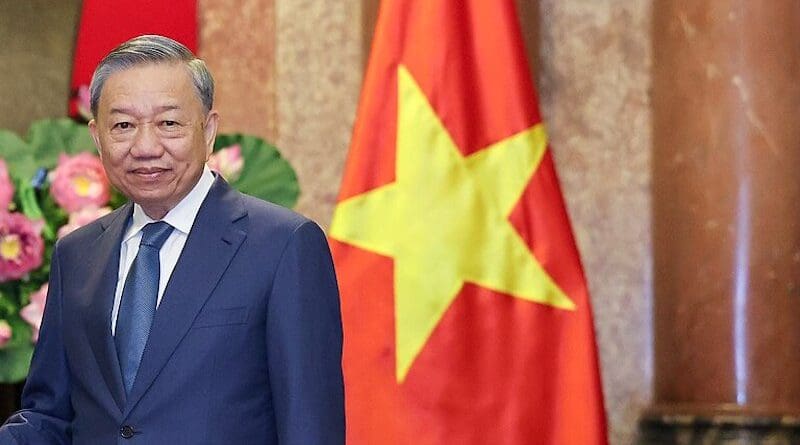
Vietnam's President To Lam. Photo Credit: European Union, Wikimedia Commons


July 12, 2025 
By RFA
By Truong Son


In less than a year as general secretary of the Communist Party of Vietnam, To Lam has made moves likened to the drastic cuts that U.S. President Donald Trump and Elon Musk have implemented to U.S. federal agencies through the Department of Government Efficiency (DOGE).

To Lam has merged ministries and central government agencies, reduced the number of provinces and cities by half, and dismantled district-level administrative units.

Why did To Lam move so fast with reforms, and what are the political, social, and economic impacts?

Zachary Abuza is a professor at the National War College in Washington and an adjunct at Georgetown University. The views expressed here are his own and do not reflect the position of the U.S. Department of Defense, the National War College, Georgetown University, or Radio Free Asia.

Below is a transcript of an interview with Zach Abuza by Truong Son from the RFA Vietnamese service:

RFA: What are your thoughts on the administrative reform in Vietnam that Secretary General To Lam just carried out? How significant is the government reshuffle in terms of its social, economic, and political impact, because we know that this is a massive change in Vietnam?

Zach Abuza: The changes in the government are really significant and they shouldn’t be underestimated. And we have to understand that they’re happening at multiple levels. There was the reform of central government ministries. Five were folded in, and some hundred thousand civil servants were either fired or retired.

At the provincial level, they went from 63 provinces or provincial-level cities down to 34. So that’s almost a 50% reduction — a huge consolidation there. And then they eliminated an entire level of governance at the district level. So it used to go province, district, and then down to the commune level. And they got rid of that mid-level. So they’re hoping for more efficiency.

Now, all three of those reforms at each level of government have important economic, social, and political implications. Let’s start with the government. Those reforms were done in part because the government is notoriously bureaucratic. It’s slow. And I think the general secretary really feels that Vietnam has to just be much more responsive, much more accountable, to respond to a rapidly changing international environment, in order to grow the economy, to attract foreign investment. Just had to get rid of red tape.


Some of the ministries that were eliminated really were legacy issues. They reflected much more of the government structure at the time of Doi Moi, not all these years into it. You know, the Vietnamese economy is fundamentally different than it was before.

And that’s why I think you really start to see some of the consolidation, especially in the economic ministries. I think now there are really three key ministries to pay attention to. The Ministry of Public Security, the Ministry of National Defense, and the Ministry of Finance. These are kind of the three heavy hitters.

At the provincial level, it’s important to understand that this consolidation will have economic effects. And I think one thing that maybe we need to think about is, with the exception of the provinces

in the northwest which is landlocked, you know, bordering Lao and the Chinese frontier, almost every other province now has a piece of coastline.

And this is important because it was always the coastal provinces that were more advanced because they had access to ports, harbors and it was easier to get products to international markets. And so the reorganization at that level, certainly makes it easier. No province now, other than those northwestern landlocked ones, has an excuse that they cannot get goods to market anymore.

Now, I think the provincial reforms have very significant political implications. And let me explain this at several levels. The first is the Central Committee of the Communist Party in the era of Doi Moi has basically had about one third of their members coming from, you know, the provinces.

So provincial party chiefs, all of a sudden that is going to change. And we might see at the next Party Congress expected in January 2026 that we see a smaller central committee overall. And that’s one thing that I am looking for.


There are other political implications. And that is, you now have almost a 50% reduction in the number of governors in the number of party chiefs.


And so the general secretary, through this consolidation actually got to choose winners and losers, right? Going into the next Party Congress, To Lam clearly has the support of those who have kept their jobs. They owe him, right? They could have lost everything.

But, more importantly, the year before a party congress, normally nothing happens. And I mean, nothing happens. People are afraid to make decisions. People are afraid to make investments. Often, provinces or cities have funding allocated to them, but they’re afraid to use it because they just don’t know what’s going to happen at the Party Congress.

They don’t know who’s going to emerge on top. They’re afraid of implementing policies that then get reversed. So there’s traditionally a lot of caution. To Lam has completely thrown that off. He has pushed through the most radical reforms I can think of.

And he did it right ahead of a Party Congress. So that to me, says he is very confident that he has the full backing of the Central Committee and that he is very confident that he will be reelected to a full term at the 14th Party Congress.

Let me just make one quick point about eliminating the district level of administration. I think this is going to have an interesting impact down the line.

I don’t see it having a short term political impact, but for Communist Party cadres — they might have been in the cities working their way up, but, you know, all of a sudden you’ve eliminated a very important pathway to be selected and to be noticed, by the higher echelons of the party.

And I think that there is going to be a lot of unhappiness that this real, important level, maybe not administratively, maybe it’s not the most important for the functioning of government and efficiency, but for people looking for their career pathway to senior party membership. That is an important stepping stone that has been eliminated.

RFA: You just said that Secretary General To Lam is certainly very confident politically. That’s why he’s carried out this unprecedented reform, I must say, the year before the party Congress, and as you said, which traditionally has been a very quiet year.

And not just that he did this in the year prior to the Congress, but also, if we look into the manner in which he carried out this reform, which was really quick. The finish line was achieved within a few months.

So, if we look at the scale of the project and the pace it was done this begs the question: Why did he do it in such a manner? Why do you think he has to achieve this reform within such a short period of time?


Zach Abuza: The Vietnamese government and Communist Party are not known for quick decision making. They tend to be very slow, deliberative, and cautious. But these reforms happened at lightning speed. And I think that pace took everyone by surprise.

Part of the answer is it took everyone by surprise. He made the announcement. And for the government ministries, for example, they had less than three months to implement these major restructuring, government reshuffle, 100,000 civil servants, either being retired or found redundant.

Part of the reason he moved quickly is before there could be real resistance to it. He wanted to make sure that no one had time to kind of dig in their heels and resist these reforms, because people, these reforms, create winners and losers, and that was clearly a concern of his.

I think that To Lam — and while I certainly find the way he came to power, as the minister of Public Security who completely weaponized the anti-corruption campaign, eliminated all of his rivals on the Politburo in just absolute Machiavellian fashion — I actually think that he is maybe the right man for the job right now.

I think he really does understand that Vietnam has this very narrow window of opportunity to push through major economic restructuring and reforms.

Vietnam’s demographics have peaked. The country will start to see its population decline and fairly rapidly, especially with the rapid urbanization, the increased number of women in the workforce, higher education levels.

All those three factors always lead to sharp declines in demographics. So Vietnam has the challenge of soon it’s going to start getting old before it gets rich. You know, it’s one thing for Japan to get old because it’s already rich.

Thailand has had a little harder time, and I think Vietnamese policymakers do look to Thailand as a country that has gotten old before it got rich. The second thing is that To Lam is very fearful of being caught in the middle income trap, where Vietnam simply assembles. It does not produce; it doesn’t have those ecosystems there.

In the current trade negotiations with the United States, the Americans always pointed to the fact that Vietnam’s trade deficit with China was very close to its trade surplus with the United States. Now, the United States’ thinking was that Vietnam was simply being used as a transshipment point for Chinese goods.

To a degree, yes, but that doesn’t explain all of it. What explains it is the fact that things that are produced in Vietnam, whether it’s Samsung, mobile phones or VinFast cars, are made with components imported from China. So Vietnam hasn’t developed that ecosystem.


To Lam is very interested in getting the higher value added foreign investment. We hear a lot about semiconductors and other high-end manufacturing.

He needs a much more efficient government structure to attract foreign investment. One of the reasons we know foreign investors — there’s often a delta between pledged investment and actual shovel in the ground building something is because of bureaucratic red tape.

I think To Lam is really concerned that foreign investors are going to get frustrated and move on to the next place because Vietnam’s labor costs are going up. It has shortages of electricity. You know, it’s been a darling of foreign investors, but that is not a given. That foreign investors can be very fickle. We have watched them leave Vietnam in the past.

And let me just make one last point about why he did it so fast. I think this is To Lam really asserting himself politically. He has done what many of us probably would have said, “Impossible.”

No way is he going to get through such momentous restructuring in a quick period of time. There will be too much, you know, resistance to it. He really showed that he has full control over the Central Committee. Now, he still has his former deputy minister, now the Minister of Public Security. He’s got another former deputy minister of Public Security in charge of the Central Inspection Commission.

He has many levers of power that he can wield against people who are opposed to him. He can still investigate corruption and destroy careers, but I think he really has won over this Central Committee with his vision.

One last point we should probably make about these reforms. There is going to be a major shift in power to the South.

You have created a huge megacity now. Ho Chi Minh City, all the way out to Vũng Tàu around Bien Hoa.

This is now a massive place. Under the former General Secretary Nguyễn Phú Trọng there was a real attempt to crush any southern autonomy. I think we understand that the South is the driver of the economy. To Lam knows that he has to empower the South. He knows that legitimacy is coming from economic development.

RFA: I guess he got what he wanted. He restructured the entire governance system not just at the central level, but also the local level as well.

So the entire country now is basically governed under a new system that looks very different from when he took power in August 2024. But I’m curious because we understand that this kind of project has massive implications and consequences. And usually people do it with great caution because they need to study.

They need to experiment to find the best model. But the way To Lam carried it out was that it was just too quick, too rapid. There was no opportunity for experimentation, for research at all. He just said, “This is what we are going to do,” and he achieved that within a few months.

So what do you think would be the consequences and the challenges that he has to face, given that he has done this too quickly and gave no room for deliberation, for experiment, for research, for debate.

Zach Abuza: No doubt there will be growing pains. And a lot of this was rushed. And I imagine in many cases, you are not going to only see some resistance to this and kind of pushback.

But just complications and everything from accounting and getting bank accounts and tax collection and all these things are going to be very different. Now, from the central government’s position, this is hopefully easier. There are now almost 50% fewer provinces to basically negotiate with. And should make some coordination a little bit easier. But without a doubt this was pretty rushed.

Now, I would go back to a point I made earlier, and that is the party chiefs that are in power today after the restructuring owe To Lam — they owe him their jobs and I imagine they will be very responsive, because they’re all interested in climbing up the ladder and those who do not perform well and have problems are going to find their political careers might not last much longer than January.

So I think he’s using the clock very effectively, you know, like a good football coach uses the clock in a game. I think he is doing that. But yeah, there will be problems, and we just haven’t seen them yet.

There are going to be issues with spending and infrastructure development. You now have these party chiefs that are going to think about which part of the province, these larger provinces to invest in.

You know, there are going to be rural communes that are going to feel they’re being left behind because the emphasis will be on more development to the coast and where industry is. And so, yeah, without a doubt, we will see how this plays out.


RFA  GOING OFF AIR SOON 

Radio Free Asia’s mission is to provide accurate and timely news and information to Asian countries whose governments prohibit access to a free press. Content used with the permission of Radio Free Asia, 2025 M St. NW, Suite 300, Washington DC 20036.