It’s possible that I shall make an ass of myself. But in that case one can always get out of it with a little dialectic. I have, of course, so worded my proposition as to be right either way (K.Marx, Letter to F.Engels on the Indian Mutiny)
Sunday, July 13, 2025
Turkey's Shipbuilders Face Economic Headwinds in Export Market
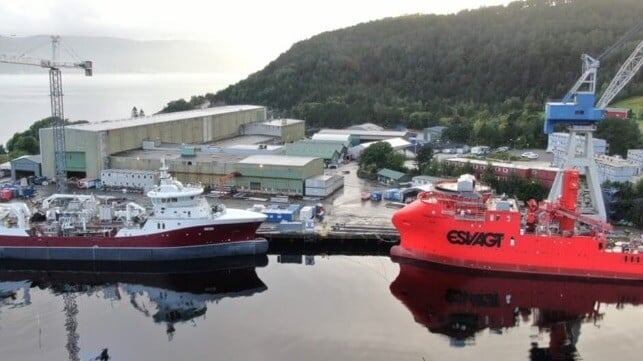
Some big-name Turkish shipbuilders are now setting up shop abroad instead, like Tersan, which recently bought Havyard Leirvik in Norway (above, courtesy Tersan)
Turkey's shipbuilding sector has been a dominant force in the specialty-vessel market for years, but it appears to be losing ground, based on a string of disappointing sales numbers.
Last month, sales of Turkish ships and yachts fell by more than 60 percent year on year, the latest data from the Turkish Exporters' Assembly (TIM) shows. Just $84 million in orders came in for the month, making shipbuilding the sector that lost the most export business in the Turkish economy. Eexport numbers are expected to shrink by 15 percent for the full year, and payrolls are already on the decline.
The problem, according to Ship, Yacht and Services Exporters' Association (GYHIB) chairman Cem Seven, is the high inflation rate that has afflicted Turkey's economy for years, alongside a weak exchange rate, limited access to finance and high interest rates on loans. These factors make it hard to keep costs down, and Turkish builders now have a hard time competing on price with premium yards in Norway.
He told Turkish outlet Ekonomim that some big names in Turkey are now looking to invest in shipbuilding abroad, given the obstacles at home. Specialist shipbuilder Tersan has already done so with the acquisition of Havyard Leirvik Shipyard.
Turkey's central bank is taking strong action to rein in runaway inflation through tight monetary policy, pushing its benchmark rate to an astonishing 49 percent in recent months (making bank lending expensive in the process). Though Turkey's domestic economy is strengthening, exporters like shipyards face headwinds for the next few years, according to the World Bank.
"Export growth is likely to be limited by the real appreciation of the [Turkish] lira, subdued euro area demand, and uncertainty surrounding trade policies in major economies," the World Bank said in its 2025 forecast.
Vancouver Pushes Forward with Controversial Roberts Bank Terminal 2 Project
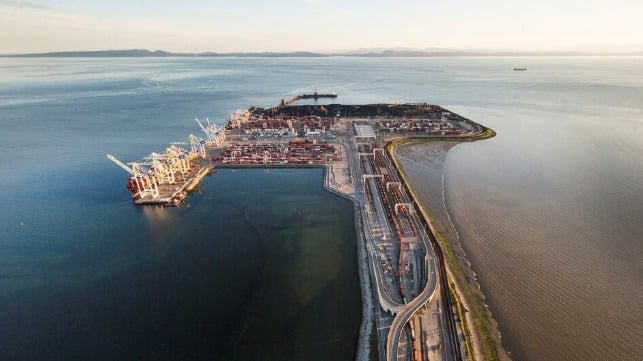
Roberts Bank would expand the current facility with a new island and three additional berths ( Vancouver Fraser Port Authority)
The Vancouver Fraser Port Authority is taking the next key step in its plans to add a major new container terminal to expand Vancouver’s capacity and efficiency. They announced that the search has begun for a contractor for the mega terminal with the goal of selecting a firm with the financial and technical expertise to undertake the massive project by the end of this year.
While the controversial Roberts Bank Terminal 2 (RBT2) project continues to face obstacles, the port authority is pursuing a major step in the implementation of the $3.5 billion project. Implementation of the project has faced unending opposition since its approval by the Canadian government in April 2024.
RBT2 entails the construction of a new man-made island and a three-berth marine container terminal near existing port terminals at Roberts Bank in Delta, B.C. When completed, the terminal is designed to deliver an additional 2.4 million TEU of capacity, ultimately increasing Canada’s west coast container capacity by approximately one-third.
Promoted as a game changer for the port of Vancouver’s long-term growth plans, RBT2 is expected to bolster Canada’s national supply-chain resilience and deliver significant economic benefits. These include more than 18,000 jobs during construction, more than 17,300 ongoing jobs, and support for trade diversification goals by unlocking over $100 billion in new trade capacity and contributing $3 billion in gross domestic product annually.
Since the project was first announced, it has faced opposition from local groups and environmentalists. Last year, several conservationist groups filed a suit opposing its implementation on the basis that it poses adverse risks to endangered species.
Despite the opposition, the port authority is advancing implementation of the massive project that includes the delivery of an approximately 100-hectare marine landmass, a 35-hectare widened causeway, a 1,300-meter wharf structure and berth pocket, and an expanded tug basin. The contract also includes the construction of a marine terminal fish passage to support juvenile salmon migration, and the civil works for onsite habitat enhancement and the South Arm Jetty Tidal Marsh project.
Interested companies have until the end of September to present the bids, with the port authority intending to shortlist three companies before the end of November. They will then be invited to submit a proposal.
“To meet Canada’s needs in today’s quickly evolving trade landscape, we have accelerated our efforts to deliver Roberts Bank Terminal 2, a project that will strengthen Canada’s economic security and deliver trade resilience,” said Victor Pang, Vancouver Fraser Port Authority CFO. “The terminal will be a catalyst for economic transformation nationally, from supporting Prairie grain exports and B.C.’s forestry sector, to communities who depend on reliable and affordable access to essential goods on store shelves.”
Construction of the terminal is planned to begin in 2028 and is expected to be in operation by the mid-2030s. Conceived in 2013, RBT2 has been marketed as a critical infrastructure project addressing challenges as Canadian ports are forecast to hit peak capacity by the early 2030s.
The Port of Vancouver remains Canada's gateway to diverse markets, enabling trade of approximately $300 billion with up to 170 countries annually. This makes the Pacific Gateway the country’s most important trade corridor. Last year, a record 158 million metric tonnes (MMT) of cargo moved through the port, a five percent increase from 150 MMT recorded in 2023.
The West Coast is projected to play an increasing role in Canada’s future trade as it looks to build ties to Asia. Canada looks to build new international opportunities, which kicked off this month with the opening of its first LNG export terminal north of Vancouver and which will be used to supply Asian customers.
Syria's New Rulers Hand Operatorship of Port of Tartus to DP World
DP World Group CEO Sultan Ahmed bin Sulayem (left) with Syria's new leader, former jihadist Ahmed Al-Sharaa (right)
After booting out the previous Russian operator of the port of Tartus, the newly-installed government of Syria has handed its operation to blue-chip ports concessionaire DP World. The announcement follows just five days after the U.S. formally lifted its longstanding Foreign Terrorist Organization (FTO) designation on Syria's current rulers, the former jihadist militia Hay’at Tahrir al-Sham (HTS), also known as al-Nusrah Front.
The new concession agreement between the HTS-led government's port authority and DP world will bring in $800 million in investment in the facility's infrastructure. The country's decade-long civil war and stringent Western sanctions prevented any major revamps under the previous operator, and the fresh support will help modernize the port. According to DP World, it will become a regional trade hub connecting Europe, the Mideast and North Africa.
The deal with DP World is a new high point for Syria's post-revolution economic revival. In early December, the U.S.-designated terror group Hay'at Tahrir al-Sham (HTS) ousted Syrian dictator Bashar al-Assad, along with Assad's Russian and Iranian backers. Under Assad, Syria had awarded a 49-year operating lease for Tartus to Stroytransgaz, an oil and gas construction company based in Moscow; HTS canceled that contract shortly after taking power, and it curtailed the Russian Navy's port access as well.
Ahmed Al-Sharaa, the former al-Qaeda member who led HTS to victory over Assad last year, was present at the signing ceremony with DP World this weekend. Al-Sharaa - who has renounced the global jihadist movement - had previously met in person with President Donald Trump to press the case for normalized relations with Syria; the lifting of the terrorist-group designation on his group was supported by the government of the UAE, which owns DP World.
Hamburg to Invest €1.1B to Expand Port and Modernize Operations for Growth
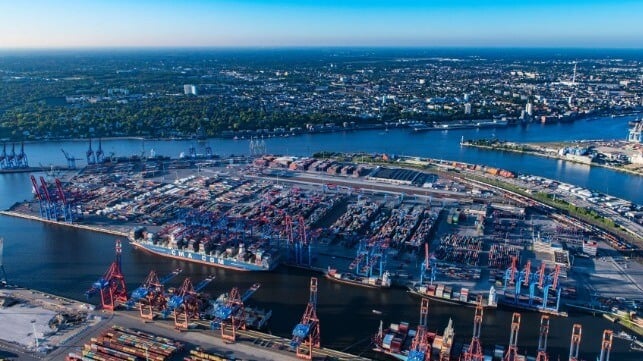
Hamburg will create a larger turning basin and other improvements to support ultra-large containerships and modernize operations (HPA file photo)
The Port of Hamburg announced a series of new projects that will be undertaken to enhance operations and modernize and expand terminal operations, especially for the largest containerships. It comes as the port continues to experience strong competition and needs to support the growth in the size of containerships.
"Today, we are laying the groundwork to ensure that Hamburg is well-prepared to meet the challenges of tomorrow,” said Hamburg’s Minister for Economic Affairs, Senator Dr Melanie Leonhard. “This infrastructure will help ensure that large vessels will be handled reliably and efficiently in the Port of Hamburg. It also strengthens Hamburg's service capacity and reinforces its role as a key hub on major international shipping routes."
The Elbe approach to the Waltershofer Hafen is to be enhanced to accommodate the largest containerships. The port highlights that around 90 percent of the ultra-large container vessels calling at Hamburg are currently handled at the Waltershofer Hafen.
The turning basin will be widened from its current 480 meters to 600 meters (1,575 feet to 1,968 feet). Port officials explained that vessels will have a larger water surface available for turning maneuvers, ensuring optimal performance and safety. They said it will enhance navigational safety and operational efficiency for current and future vessel sizes at Hamburg’s busiest container throughput area, while improving navigability and resilience along the River Elbe. All berths in the Waltershofer Hafen will benefit from this measure, which is expected to increase throughput efficiency.
Navigation towards the port’s two other large container terminals, Container Terminals Buchardkai (CTB) and Container Terminal Hamburg (CTH), will also be easier and faster.
The creation of additional berths will also improve terminal workflows, the operators noted. They said going forward, processes can be automated and electrified. The project will also provide for additional terminal yards. New land for terminal operations will create additional capacity and enable further modernization of container throughput operations.
"The urgently needed expansion of the turning basin, along with the enlargement and modernization of throughput facilities, are key decisions that will help secure a positive future for the Port of Hamburg,” said Tom Eckelmann, Managing Director of EUROKAI and Chairman of the Group Management Board of EUROGATE. “With the enlargement and modernization, we are initiating the transition from manual operations to an automated terminal concept at the Hamburg site. We will design superstructure, heavy equipment, and IT infrastructure, starting with the existing terminal, to support a fully automated throughput system across the entire terminal, including the expansion area.”
The bulk of the project will be completed with public funding. Preliminary estimates indicate a total cost in the region of EUR 1.1 billion (nearly $1.3 billion). The infrastructure works are to be completed by the Hamburg Port Authority (HPA) by the mid-2030s.
In addition to the public investment, Eurogate has signed a preliminary lease agreement for the new areas and will invest at least EUR 700 million ($820 million) in expanding the existing container terminal, with completion planned within two years of the handover of the newly developed land. It will lease the land from the Hamburg Port Authority, and these areas will be integrated into the road and rail networks. The area will be created by infilling the existing basin along the Bubendey bank.
Canada Grants Investigational Permit for West Coast Offshore Wind Farm
Located west of Prince Rupert, the wind farm could power the port as it expands (Prince Rupert file photo)
Canada granted an investigative Use Permit to Oceanic Wind Energy for what could become the country’s first offshore wind farm. The company, which is in partnership with a First Nation company, Coast Tsimshian Enterprises, is calling the permit a milestone in its effort to advance offshore energy to power the growing industrial areas of Northwest British Columbia.
The plan calls for developing a 600 to 700 MW offshore wind farm that would be just west of Stephens Island on the Hecate Strait. It would be approximately 20 miles from Price Rupert and not far from the border with Alaska. The company highlights the energy demands of the Port of Prince Rupert, which is expanding operations, and the growing industrial and resource sectors in the northern reaches of British Columbia. Among the developing industries in the region is the LNG export operations.
While the location is in a sheltered strait, the companies highlight that it is a strong location for offshore wind power development. They highlight that the Hecate Strait is home to one of the world’s most powerful and consistent wind resources.
“With Class 7 wind conditions, low shear and turbidity, average annual wind speeds exceeding 10 m/s, and a winter capacity factor of over 65%, the area offers an unparalleled opportunity to generate clean, reliable energy—especially during BC’s peak demand season,” said Mike O’Connor, President of Oceanic Wind Energy.
Issuing the Investigative Use Permit is the latest in a series of approvals the project has gained. In January, the company reported its Crown Land Tenure Application for Windpower Investigation had also been approved. At the end of 2024, the British Columbia Ministry of Water, Land and Resource Stewardship advised that they had also completed their initial review and the application was accepted, launching a comment period that was due to end in February.
Oceanic calls these approvals the first phase of its plan. It will continue to proceed with the investigation to define the project. The company is in a race with other projects that also look to develop Canada’s offshore wind power industry. Efforts are also underway to define the industry on the Atlantic coast between Nova Scotia, Newfoundland, and Labrador.
The Nova Scotia Department of Energy and Natural Resources in May 2025 outlined five potential zones. Four would be along the Atlantic coast, while the fifth would be to the north in the Cabot Strait. Nova Scotia has outlined a target to offer leases for 5 GW of offshore wind energy by 2030
RINA Secures World Bank Project to Advance Green Hydrogen at Port of Pecém
RINA, the global engineering consulting, inspection and certification company, has secured a high-profile World Bank-funded assignment to help accelerate Brazil’s transition to a low-carbon industrial economy. RINA will deliver a comprehensive water assessment study for securing industrial water for green hydrogen production at the Complexo Industrial e Portuário do Pecém (CIPP), a flagship low-carbon development hub in Brazil. The project will not only support industrial innovation but also contribute to social and environmental equity, improving water access for nearby communities in the state of Ceará.
A Strategic Step Toward Green Hydrogen at Scale
To support large-scale green hydrogen production, the study explores two key water sourcing strategies: reuse of treated effluent from sewage treatment plants in Fortaleza’s western region and seawater desalination. Both options will be assessed for their technical feasibility, economic viability, environmental impact, and compatibility with local infrastructure and regulation.
The water assessment study, to be delivered by RINA in partnership with local firm Krypton, will provide:
A comparative feasibility study of reclaimed water reuse vs. seawater desalination.
A detailed environmental impact analysis Assessment of water demand at the CIPP over the next 5–10 years, aligned with anticipated industrial growth.
A regulatory and infrastructure evaluation, ensuring compliance with Brazilian standards and effective use of existing water systems.
Crucially, the study will also evaluate how the proposed infrastructure could enhance water access for surrounding communities, ensuring that industrial progress contributes to broader regional sustainability.
This award follows RINA’s successful delivery of the first consultancy at World Bank Group, focused on industrial decarbonisation. That assignment encompassed developing a comprehensive GHG inventory, energy balance, and decarbonisation roadmap for the region’s energy-intensive industrial cluster. The continuity between both projects positions RINA as a key contributor to the development of the project in the Port of Pecem, as one of Brazil’s premier clean energy and green export hub.
“This project reflects the power of RINA’s global knowledge base and our ability to apply it in support of sustainable industrial development,” said Andrea Pestarino, IFI and Organizations Engineering Commercial Management Director at RINA. “As a knowledge-led organisation, we bring together experience across sectors and geographies to deliver tailored, high-impact solutions. This World Bank contract reinforces our long-term commitment to the region and to Brazil’s clean energy future.”
The products and services herein described in this press release are not endorsed by The Maritime Executive.
USA
Obesity-associated cancers tripled nationwide over past two decades
SAN FRANCISCO—Cancer deaths linked to obesity have tripled in the United States over the past two decades, according to a study being presented Sunday at ENDO 2025, the Endocrine Society’s annual meeting in San Francisco, Calif.
The study, which examined more than 33,000 deaths from obesity-associated cancers, revealed sharp increases in cancer deaths, especially among women, older adults, Native Americans and Black Americans.
“Obesity is a significant risk factor for multiple cancers, contributing to significant mortality,” said lead researcher Faizan Ahmed, M.D., of Hackensack Meridian Jersey Shore University Medical Center in Neptune City, N.J. “This research underscores the need for targeted public health strategies such as early screening and improved access to care, especially in high-risk rural and underserved areas.”
Obesity is a common condition. According to the U.S. Centers for Disease Control and Prevention (CDC), 40.3% of adults have obesity. Obesity is a complex disease resulting from multiple genetic, physiological, hormonal, environmental and developmental factors.
In addition to certain types of cancer, obesity raises the risk of developing serious chronic conditions such as high blood pressure, high cholesterol, prediabetes, type 2 diabetes, heart disease, and chronic and end-stage kidney disease.
Obesity is associated with a higher risk of developing 13 types of cancer, according to the CDC. These cancers make up 40% of all cancers diagnosed in the United States each year.
They are:
Adenocarcinoma of the esophagus
Breast (in women who have gone through menopause)
Colon and rectum
Uterus
Gallbladder
Upper stomach
Kidneys
Liver
Ovaries
Pancreas
Thyroid
Meningioma (a type of brain cancer)
Multiple myeloma
Faizan used mortality data from the CDC to analyze 33,572 U.S. deaths from obesity-associated cancers between 1999 and 2020. He found age-adjusted mortality rates increased from 3.73 to 13.52 per million over two decades, with steep increases among women, older adults, Black people, Native Americans and rural populations.
Regionally, the Midwest had the highest rate of obesity-related cancer deaths, while the Northeast had the lowest. State-level analysis revealed that Vermont, Minnesota and Oklahoma had the highest rates, while Utah, Alabama and Virginia had the lowest.
# # #
Endocrinologists are at the core of solving the most pressing health problems of our time, from diabetes and obesity to infertility, bone health, and hormone-related cancers. The Endocrine Society is the world’s oldest and largest organization of scientists devoted to hormone research and physicians who care for people with hormone-related conditions.
The Society has more than 18,000 members, including scientists, physicians, educators, nurses and students in 122 countries. To learn more about the Society and the field of endocrinology, visit our site at www.endocrine.org. Follow us on Twitter at @TheEndoSociety and @EndoMedia.
Consuming certain sweeteners may increase risk of early puberty
SAN FRANCISCO—Consuming certain sweeteners commonly found in foods and beverages may increase the risk of early puberty in children, particularly among those who are genetically predisposed, according to a study being presented Sunday at ENDO 2025, the Endocrine Society’s annual meeting in San Francisco, Calif.
The researchers found that consuming aspartame, sucralose, glycyrrhizin and added sugars was significantly associated with a higher risk of early puberty, especially in children with certain genetic traits. The more of these sweeteners the teens consumed, the higher their risk of central precocious puberty.
“This study is one of the first to connect modern dietary habits — specifically sweetener intake — with both genetic factors and early puberty development in a large, real-world cohort,” said Yang-Ching Chen, M.D., Ph.D., of Taipei Municipal Wan Fang Hospital and Taipei Medical University in Taipei, Taiwan. “It also highlights gender differences in how sweeteners affect boys and girls, adding an important layer to our understanding of individualized health risks.”
A type of early puberty known as central precocious puberty is increasingly common. It can lead to emotional distress, shorter adult height, and increased risk of future metabolic and reproductive disorders.
Chen’s previous research found that certain sweeteners can directly influence hormones and gut bacteria linked to early puberty. For example, one artificial sweetener called acesulfame potassium or AceK was shown to trigger the release of puberty-related hormones by activating “sweet taste” pathways in brain cells and increasing stress-related molecules. Another sweetener, glycyrrhizin—found in licorice—was found to change the balance of gut bacteria and reduce the activity of genes involved in triggering puberty.
“This suggests that what children eat and drink, especially products with sweeteners, may have a surprising and powerful impact on their development,” Chen said.
The new findings come from the Taiwan Pubertal Longitudinal Study (TPLS), begun in 2018. The study included data from 1,407 teens. Central precocious puberty was diagnosed in 481 teens. The researchers assessed teens’ sweetener intake through validated questionnaires and testing of urine samples. Genetic predisposition was quantified using polygenic risk scores derived from 19 genes related to central precocious puberty. Early puberty was diagnosed based on medical exams, hormone levels and scans.
Sucralose consumption was linked to a higher risk of central precocious puberty in boys and consumption of glycyrrhizin, sucralose and added sugars was associated with a higher risk of central precocious puberty in girls.
“The findings are directly relevant to families, pediatricians and public health authorities,” Chen said. “They suggest that screening for genetic risk and moderating sweetener intake could help prevent early puberty and its long-term health consequences. This could lead to new dietary guidelines or risk assessment tools for children, supporting healthier development.”
# # #
Endocrinologists are at the core of solving the most pressing health problems of our time, from diabetes and obesity to infertility, bone health, and hormone-related cancers. The Endocrine Society is the world’s oldest and largest organization of scientists devoted to hormone research and physicians who care for people with hormone-related conditions.
The Society has more than 18,000 members, including scientists, physicians, educators, nurses and students in 122 countries. To learn more about the Society and the field of endocrinology, visit our site at www.endocrine.org. Follow us on Twitter at @TheEndoSociety and @EndoMedia.
Grandfather’s environmental chemical exposures may influence when girls get first period
SAN FRANCISCO—A grandfather’s exposure to endocrine-disrupting chemicals may impact the age when his granddaughter starts her first period, according to preliminary data being presented Sunday at ENDO 2025, the Endocrine Society’s annual meeting in San Francisco, Calif.
“Girls are starting puberty earlier than ever before, which can raise their risk for health problems later in life,” said lead researcher Xin Hu, PhD, of Emory University’s Rollins School of Public Health in Atlanta, Ga.“We wanted to explore why this might be happening by looking at how environmental exposures from grandparents can influence when girls get their first period.”
Endocrine-disrupting chemicals (EDCs) are substances in the environment (air, soil, or water supply), food sources, personal care products, and manufactured products that interfere with the normal function of the body’s endocrine system. Since EDCs come from many different sources, people are exposed in several ways, including air, food and water. EDCs also can enter the body through the skin.
The researchers used data from the Child Health and Development Studies (CHDS), a long-term study that began in the 1960s. They measured thousands of small molecules in blood samples taken from 249 couples in the 1960s. The researchers linked the couples’ chemical and metabolic profiles to the timing of puberty in their daughters and granddaughters.
The researchers studied the age at which their daughters (247 girls) and granddaughters (139 girls) started their periods. They found that while the median age of having a first period was stable between the grandmothers and their daughters, it dropped a full year from the daughters to the granddaughters, whose median year of birth was 1990.
They discovered that certain chemicals in both the mother’s and father’s blood were linked to when their descendants began puberty, with stronger effects seen in the granddaughters’ than in the daughters’ generation. Some chemicals such as phenoxyethanol, a common preservative in personal care products and foods, were linked to earlier puberty, especially when both parents had similar exposures.
“While we found that both the mother’s and father’s exposures were linked to when their daughters and granddaughters began puberty, the father’s influence was surprisingly strong,” Hu said. “Paternal exposure to environmental chemicals may play an unrecognized but critical role in shaping offspring endocrine health.”
She said this is the first population-based study to show that a father’s environment can affect reproductive development in both his daughter and granddaughter. “These findings highlight that prevention is possible if we identify mechanisms to protect future daughters and granddaughters, which cannot be effective if we do not consider the male line,” she said.
“Our results highlight the role of endocrine-disrupting chemicals during the vulnerable period of conception and pregnancy,” said senior author Barbara Cohn, PhD, MPH, of the Public Health Institute in Berkeley, Calif. “This research emphasizes the lasting impact of environmental exposures on reproductive health across generations.”
# # #
Age at woman’s first period can offer clues about long-term health risks
SAN FRANCISCO—The age at which a woman has her first period can offer valuable clues about her long-term risk for conditions like obesity, diabetes, heart disease and reproductive health issues, according to a study being presented Sunday at ENDO 2025, the Endocrine Society’s annual meeting in San Francisco, Calif.
The Brazilian study found that both early and late menarche—the age when women first get their period—are linked to different health risks. Women who had their first period before age 10 were more likely to develop obesity, high blood pressure, diabetes, heart problems and reproductive issues like pre-eclampsia later in life. Women who started their period after age 15 were less likely to be obese but had a higher risk of menstrual irregularities and certain heart conditions.
“We now have evidence from a large Brazilian population that confirms how both early and late puberty can have different long-term health impacts,” said study author Flávia Rezende Tinano of the University of Sao Paulo in Sao Paulo, Brazil. “While early menarche increases the risk for multiple metabolic and heart problems, late menarche may protect against obesity but increase certain heart and menstrual issues. Most women can remember when they had their first period, but they might not realize that it could signal future health risks. Understanding these links can help women and their doctors be more proactive about preventing conditions like diabetes, high blood pressure and heart disease.”
Tinano said the study is one of the largest of its kind in a developing country, providing valuable data on a topic that has mostly been studied in wealthier countries. “It highlights how early and late puberty can affect a woman’s long-term health, especially in underrepresented populations like those in Latin America,” she said.
The study was part of the Brazilian Longitudinal Study of Adult Health (ELSA-Brazil) and evaluated data from 7,623 women ages 35 to 74. The age of their first period was categorized as early (less than 10 years old), typical (ages 10 to 15) or late (older than 15). They assessed the women’s health through interviews, physical measurements, lab tests and ultrasound imaging.
“Our findings suggest that knowing a woman’s age at her first period can help doctors identify those at higher risk for certain diseases,” Tinano said. “This information could guide more personalized screening and prevention efforts. It also emphasizes the importance of early health education for young girls and women, especially in developing countries.”
# # #
Endocrinologists are at the core of solving the most pressing health problems of our time, from diabetes and obesity to infertility, bone health, and hormone-related cancers. The Endocrine Society is the world’s oldest and largest organization of scientists devoted to hormone research and physicians who care for people with hormone-related conditions.
The Society has more than 18,000 members, including scientists, physicians, educators, nurses and students in 122 countries. To learn more about the Society and the field of endocrinology, visit our site at www.endocrine.org. Follow us on Twitter at @TheEndoSociety and @EndoMedia.
Early-life exposure to endocrine-disrupting chemicals may fuel food preferences
Animal study finds exposure linked to higher preference for sugary and fatty foods
SAN FRANCISCO—Exposure to endocrine-disrupting chemicals in early life, including during gestation and infancy, results in a higher preference for sugary and fatty foods later in life, according to an animal study being presented Sunday at ENDO 2025, the Endocrine Society’s annual meeting in San Francisco, Calif.
Endocrine-disrupting chemicals are substances in the environment (air, soil or water supply), food sources, personal care products and manufactured products that interfere with the normal function of the body’s endocrine system. To determine if early-life exposure to these chemicals affects eating behaviors and preferences, researchers from the University of Texas at Austin conducted a study of 15 male and 15 female rats exposed to a common mixture of these chemicals during gestation or infancy.
“Our research indicates that endocrine-disrupting chemicals can physically alter the brain’s pathways that control reward preference and eating behavior. These results may partially explain increasing rates of obesity around the world,” said Emily N. Hilz, Ph.D., a postdoctoral research fellow at the University of Texas at Austin in Austin, Texas. “Understanding the harmful health impact that exposure to these types of chemicals can have on eating patterns may help inform public health recommendations and personal efforts to improve diet-related health complications.”
Researchers administered behavioral studies throughout the rats’ lifespans, including into adulthood, to observe preferences for high-fat foods and a sucrose solution. Findings showed that male rats with early-life exposure to endocrine-disrupting chemicals had a temporary preference for the sucrose solution, while female rats showed a strong preference for high-fat food that resulted in weight gain. In addition, testosterone was reduced in exposed males, while estradiol in females remained unchanged.
During the study, areas of the brain were sequenced to determine if early-life exposure to endocrine-disrupting chemicals resulted in physical changes to the regions important to controlling food intake and responding to reward. Researchers observed changes to gene expression throughout all areas sequenced in male rat brains, and varying changes to gene expression in the region of female rat brains associated with reward. These physical changes were predictive of changes to eating behavior and food preferences.
“It’s important that people understand that there are negative impacts associated with consuming or being near endocrine-disrupting chemicals early in life. With this knowledge in hand, consumers may want to consider reducing personal interaction with environments, food and other types of products containing these chemicals during pregnancy and early childhood to reduce the risk of developing obesity later in life,” Hilz added.
This research was supported by the National Institute of Health’s National Institute of Environmental Health Sciences.
# # #
Endocrinologists are at the core of solving the most pressing health problems of our time, from diabetes and obesity to infertility, bone health, and hormone-related cancers. The Endocrine Society is the world’s oldest and largest organization of scientists devoted to hormone research and physicians who care for people with hormone-related conditions.
The Society has more than 18,000 members, including scientists, physicians, educators, nurses and students in 122 countries. To learn more about the Society and the field of endocrinology, visit our site at www.endocrine.org. Follow us on Twitter at @TheEndoSociety and @EndoMedia.