Sunday, July 13, 2025

After Delaying FEMA Response for Three Days, Noem Calls to 'Eliminate' Agency Due to Slow Texas Response

Congressional Democrats want investigations "at every level of government of what went wrong" and to "stop the dismantling of federal agencies."
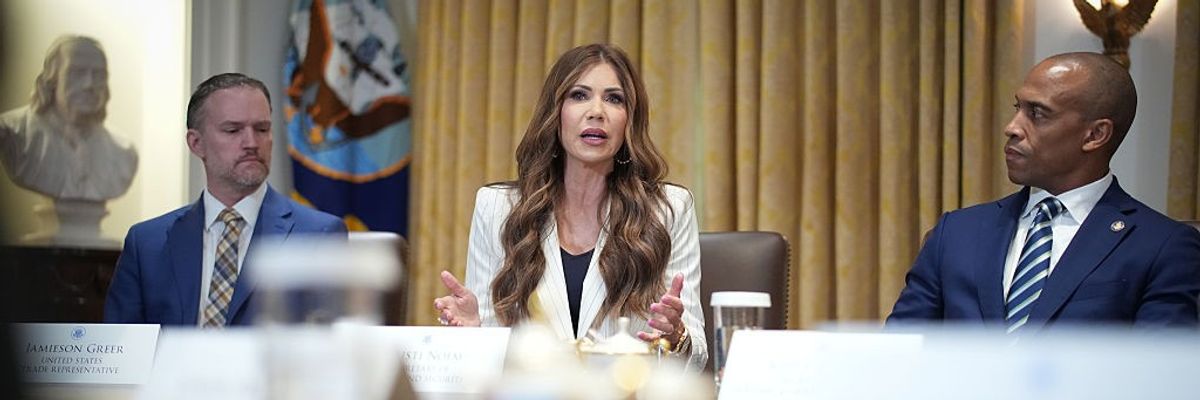

Department of Homeland Security Secretary Kristi Noem (C) discusses the flash flooding tragedy in Texas during a Cabinet neeting with U.S. President Donald Trump at the White House on July 8, 2025.
(Photo: Andrew Harnik/Getty Images)

Stephen Prager
Jul 11, 2025
COMMON  DREAMS

U.S. Secretary of Homeland Security Kristi Noem renewed her call Wednesday to "eliminate" the Federal Emergency Management Agency, calling it "slow to respond" to the deadly floods that have killed more than 120 people in Texas over the past week.

But that "slow" response was the direct result of a policy put in place by Noem herself, according to four FEMA officials who spoke to CNN.

Last month, the network reported on a new policy introduced by Noem that required any contract or grant above $100,000 to cross her desk for approval.

The administration billed the move as a way of "rooting out waste, fraud, [and] abuse." But multiple anonymous officials, including ones from FEMA, warned at the time that it could cause "massive delays" in cases of emergency, especially as hurricane season began to ramp up.

That appears to be what happened in Texas. According to the four officials who spoke to CNN, "FEMA ran into bureaucratic obstacles" as a result of this requirement. Compared to the billions that are typically required to respond to disasters, officials said $100,000 is essentially "pennies."

FEMA officials said they were left to ask for Noem's direct approval on virtually every action they took in response to the catastrophic flood, which created massive delays in deploying Urban Search and Rescue Teams.

The sources told CNN that "in the past, FEMA would have swiftly staged these teams, which are specifically trained for situations including catastrophic floods, closer to a disaster zone in anticipation of urgent requests."

Multiple sources said Noem waited until Monday to authorize the deployment of these search and rescue teams, more than 72 hours after the flooding began. Aerial imagery to aid in the search was also delayed waiting for Noem's approval.

On Wednesday, Noem used these very delays to justify her calls to disband FEMA entirely.

"Federal emergency management should be state and locally led, rather than how it has operated for decades," she said. "It has been slow to respond at the federal level. It's even been slower to get the resources to Americans in crisis, and that is why this entire agency needs to be eliminated as it exists today, and remade into a responsive agency."

President Donald Trump said last month he is in the process of beginning to "phase out" FEMA and that it would begin to "give out less money" to states and be directed out of the White House.

He first took a hatchet to FEMA back in February using the Department of Government Efficiency (DOGE), which eliminated 2,000 permanent employees, one-third of its total staff.

Noem has also boasted about using FEMA funds to carry out Trump's mass deportation crusade, including allocating hundreds of millions from the agency to build the so-called "Alligator Alcatraz" immigrant internment camp in Florida, as well as other detention facilities.

Before a House panel last month, former FEMA Administrator Deanne Criswell noted that the administration's cuts have made it harder for FEMA to respond in disaster areas.

"It just slows down the entire response and delays the recovery process from starting," Criswell said. "If the state director asks for a resource, then FEMA needs to be able to quickly respond and mobilize that resource to come support whatever that is. They still need the staff that are going in there. And so when you have less people, you're going to have less ability to actually fill those senior roles."

The revelation that Noem's policy may have contributed to the slowdown has only amplified calls by congressional Democrats to investigate how Trump administration cuts to FEMA and other services like the National Weather Service may have contributed to the devastation.

"During disasters, every second matters," said Rep. Joaquin Castro (D-Texas). "Noem must answer for this delay."

Congressman Greg Casar (D-Texas) said this disaster in his home state highlighted the need for federal agencies like FEMA.

"Year after year, Texans face deadlier fires, freezes, and floods." Casar said. "As we continue to support first responders and grieving families after the terrible flooding, we will need investigations at every level of government of what went wrong and what could save lives in future."

"We must stop the dismantling of federal agencies that are supposed to keep us safe from the next disaster," he added.


'These Deaths Are on Trump's Hands': Texas Flooding Spotlights Assault on Climate Science

"The Trump regime is gutting scientific research into climate and atmospheric science for political reasons, at the very time we need a much better understanding of it," said one environmentalist. "This is so reckless and dangerous."


Kerrville residents document the aftermath of deadly flooding at Louise Hays Park near the Guadalupe River in Kerrville, Texas on July 6, 2025.
(Photo: Jorge Salgado/Anadolu via Getty Images)


Jake Johnson
Jul 07, 2025
COMMON DREAMS

Deadly flooding caused by torrential rain in central Texas late last week called attention to U.S. President Donald Trump's full-scale assault on the climate research and monitoring agencies tasked with studying and predicting such weather catastrophes, as well as his ongoing attacks on disaster preparedness and relief.

Though local National Weather Service (NWS) forecasters did issue warnings in the lead-up to Friday's flooding—which killed at least 82 people, including dozens of children—key roles were reportedly vacant ahead of the downpour, prompting scrutiny of the Trump administration's mass firings and budget cuts, in addition to years of neglect and failures by Republicans at the state level.

Asked whether he believes the federal government should hire back terminated meteorologists in the wake of the Texas flooding, Trump responded in the negative and falsely claimed that "very talented people" at NWS "didn't see" the disaster coming.

"This is an absolute lie," replied meteorologist and climate journalist Eric Holthaus. "Worse, this is the person responsible for making those kids less safe and he's trying to deny the damage he caused."

Holthaus wrote Sunday that Trump's staffing cuts "have particularly hit the National Oceanic and Atmospheric Administration's Environmental Modeling Center, which aims to improve the skill of these types of difficult forecasts."

"Though it's unclear to what extent staffing shortages across the NWS complicated the advance notice that local officials had of an impending flooding disaster," he added, "it's clear that this was a complex, compound tragedy of a type that climate warming is making more frequent."

"Republicans have fired meteorologists, cut emergency disaster aid, and given an extra $18 billion to the fossil fuel corporations causing this crisis."

Under the guise of "government efficiency," the Trump administration has taken an axe to staff at federal climate agencies and is trying to go even further with its budget for the coming fiscal year. The Washington Post noted Sunday that "a budget document the Trump administration recently submitted to Congress calls for zeroing out climate research funding for 2026, something officials had hinted at in previous proposals but is now in lawmakers' hands."

"But even just the specter of President Donald Trump's budget proposals has prompted scientists to limit research activities in advance of further cuts," the Post noted. "Trump's efforts to freeze climate research spending and slash the government's scientific workforce have for months prompted warnings of rippling consequences in years ahead. For many climate scientists, the consequences are already here."

Since the start of his second term, Trump has dismissed the hundreds of scientists and experts who were working on the National Climate Assessment, moved to slash NOAA's workforce, and announced a halt to climate disaster tracking, among other changes—all while working to accelerate fossil fuel extraction and use that is supercharging extreme weather events. One NOAA veteran warned that Trump's cuts could drag the agency back to "the technical and proficiency levels we had in the 1950s."

"The Trump regime is gutting scientific research into climate and atmospheric science for political reasons, at the very time we need a much better understanding of it," environmentalist Stephen Barlow wrote on social media on Sunday. "This is so reckless and dangerous, which is why I suggest we call these tragedies Trump events."

Aru Shiney-Ajay, executive director of the Sunrise Movement, said over the weekend that "Republicans have fired meteorologists, cut emergency disaster aid, and given an extra $18 billion to the fossil fuel corporations causing this crisis."

"These deaths are on Trump's hands," she added.


As Flood Deaths Rise, Texas Officials Blast Faulty Forecast by DOGE-Gutted National Weather Service

"Experts warned for months that drastic and sudden cuts at the National Weather Service by Trump could impair their forecasting ability and endanger lives during the storm season," said one critic.
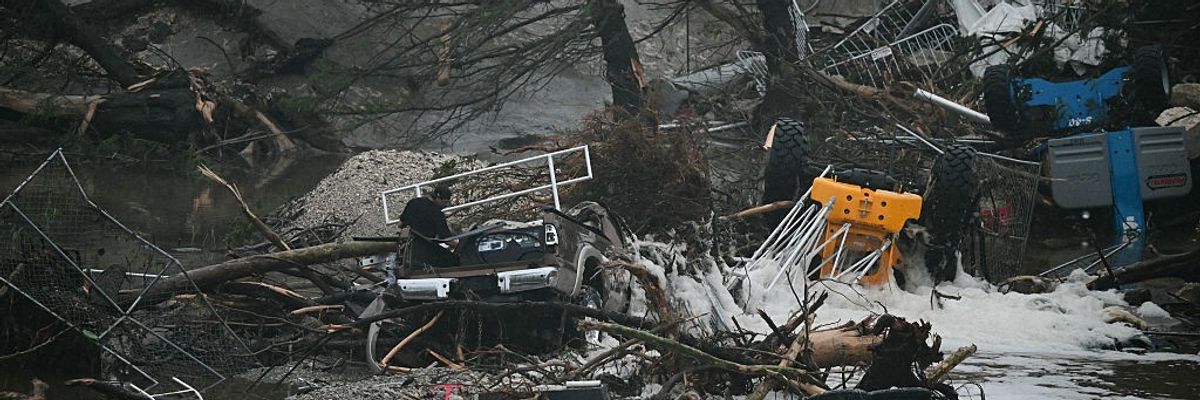

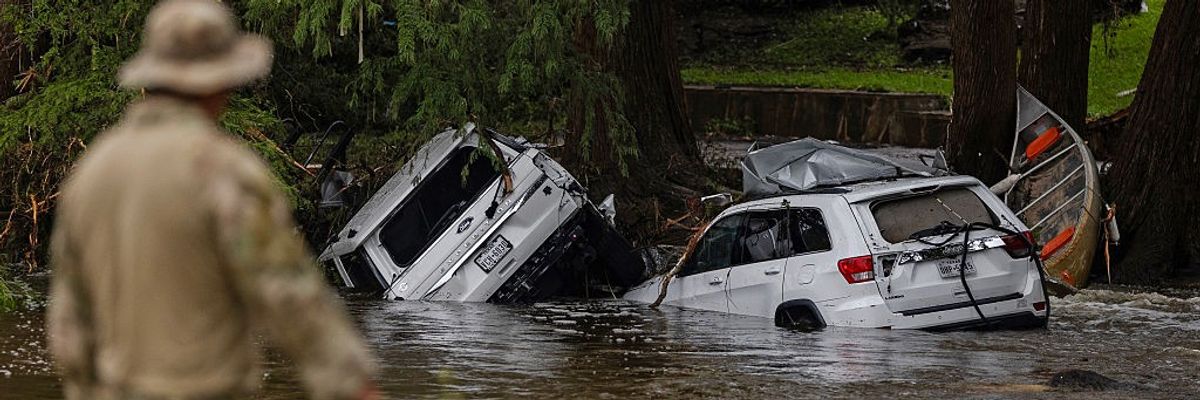
A photo shows overturned vehicles and broken trees after flooding caused by a flash flood at the Guadalupe River in Kerrville, Texas, on July 5, 2025.
(Photo: Ronaldo Schemidt/AFP via Getty Images)

Brett Wilkins
Jul 05, 2025
COMMON DREAMS

As catastrophic flooding left scores of people dead and missing in Texas Hill Country and President Donald Trump celebrated signing legislation that will eviscerate every aspect of federal efforts to address the climate emergency, officials in the Lone Star State blasted the National Weather Service—one of many agencies gutted by the Department of Government Efficiency—for issuing what they said were faulty forecasts that some observers blamed for the flood's high death toll.

The Associated Press reported Saturday that flooding caused by a powerful storm killed at least 27 people, with dozens more—including as many as 25 girls from a summer camp along the Guadalupe River in Kerr County—missing after fast-moving floodwaters rose 26 feet (8 meters) in less than an hour before dawn on Friday, sweeping away people and pets along with homes, vehicles, farm and wild animals, and property.

"Everybody got the forecast from the National Weather Service... It did not predict the amount of rain that we saw."

"The camp was completely destroyed," Elinor Lester, 13, one of hundreds of campers at Camp Mystic, told the AP. "A helicopter landed and started taking people away. It was really scary."

Kerr County Sheriff Larry Leitha said during a press conference in Kerrville late Friday that 24 people were confirmed dead, including children. Other officials said that 240 people had been rescued.

Although the National Weather Service on Thursday issued a broad flood watch for the area, Texas Division of Emergency Management Chief Nim Kidd—noting that the NWS predicted 3-6 inches of rain for the Concho Valley and 4-8 inches for the Hill Country—told reporters during a press conference earlier Friday that "the amount of rain that fell in this specific location was never in any of those forecasts."


"Listen, everybody got the forecast from the National Weather Service," Kidd reiterated. "You all got it; you're all in media. You got that forecast. It did not predict the amount of rain that we saw."

Kerrville City Manager Dalton Rice also said during the press conference that the storm "dumped more rain than what was forecasted" into two forks of the Guadalupe River.

Kerr County judge Rob Kelly told CBS News: "We had no reason to believe that this was gonna be anything like what's happened here. None whatsoever."

Since January, the NWS—a branch of the National Oceanic and Atmospheric Administration (NOAA)—has reduced its workforce by nearly 600 people as a direct result of staffing cuts ordered by the Department of Government Efficiency, or DOGE, as part of Trump's mission to eviscerate numerous federal agencies.

This policy is in line with Project 2025, the Heritage Foundation-led blueprint for a far-right overhaul of the federal government that calls for "dismantling" NOAA. Trump has also called for the elimination of the Federal Emergency Management Agency, arguing that states should shoulder most of the burden of extreme weather preparation and response. Shutting down FEMA would require an act of Congress.

Many of the fired NWS staffers were specialized climate scientists and weather forecasters. At the time of the firings, Rep. Jared Huffman (D-Calif.), the ranking member of the House Natural Resources Committee, was among those who warned of the cuts' deadly consequences.

"People nationwide depend on NOAA for free, accurate forecasts, severe weather alerts, and emergency information," Huffman said. "Purging the government of scientists, experts, and career civil servants and slashing fundamental programs will cost lives."

Writing for the Texas Observer, Henry D. Jacoby—co-director of the Massachusetts Institute of Technology Joint Program on the Science and Policy of Global Change—warned that "crucial data gathering systems are at risk."

"Federal ability to warn the public is being degraded," he added, "and it is a public service no state can replace."

On Friday, Trump put presidential pen to congressional Republicans' so-called One Big Beautiful Bill Act, a $4 trillion tax and spending package that effectively erases the landmark climate and clean energy provisions in the Inflation Reduction Act signed by then-President Joe Biden in 2022.

As Inside Climate News noted of the new law:

It stomps out incentives for purchasing electric vehicles and efficient appliances. It phases out tax credits for wind and solar energy. It opens up federal land and water for oil and gas drilling and increases its profitability, while creating new federal support for coal. It ends the historic investment in poor and minority communities that bear a disproportionate pollution burden—money that the Trump administration was already refusing to spend. It wipes out any spending on greening the federal government.

Furthermore, as MeidasNews editor-in-chief Ron Filipkowski noted Saturday, "rural areas hit hardest by catastrophic storms are the same areas now in danger of losing their hospitals after Trump's Medicaid cuts just passed" as part of the budget reconciliation package.

At least one congressional Republican is ready to take action in the face of increasing extreme weather events. Rep. Marjorie Taylor Greene (R-Ga.)—who once attributed California wildfires to Jewish-controlled space lasers—announced Saturday that she is "introducing a bill that prohibits the injection, release, or dispersion of chemicals or substances into the atmosphere for the express purpose of altering weather, temperature, climate, or sunlight intensity."

"It will be a felony offense," she explained. "We must end the dangerous and deadly practice of weather modification and geoengineering."
While Congress Abandons Climate Safety, Cities and States Must Lead

The One Big Beautiful Bill Act may be putting profits ahead of people and the planet, but real climate leadership remains possible—and urgently needed—at the local level.


Vehicles sit submerged as a search and rescue worker looks through debris for any survivors or remains of people swept up in the flash flooding on July 6, 2025 in Hunt, Texas.
(Photo: Jim Vondruska/Getty Images)


Anne Jellema
Jul 11, 2025
Common Dreams

On July 4, as rescue teams searched for children swept away by flash floods in central Texas, U.S. President Donald Trump signed the One Big Beautiful Bill Act into law—a legislative package that represents a catastrophic retreat from climate safety precisely when Americans need protection most.

The cruel irony was impossible to ignore: As the floodwaters rose in San Antonio, the federal government was rewarding fossil fuel companies driving the climate crisis while pulling protection away from those in its path.

The OBBBA delivers a devastating one-two punch to American families. First, it guts the very programs designed to keep us safe from extreme weather. The Federal Emergency Management Agency's disaster prevention funding faces a 40% cut. The National Weather Service—already dangerously understaffed—will see deeper cuts to the National Oceanic and Atmospheric Administration that cost lives. Texas' recent floods tragically illustrated how staffing gaps in weather offices directly translate to preventable deaths.

Wildfire prevention efforts have already been halted by White House funding freezes ahead of peak fire season, and the OBBBA eliminates another $100 million in firefighting capacity. Meanwhile, toxic waste cleanups face defunding, exponentially increasing health risks for the 1 in 5 Americans living within three miles of contaminated sites.

By supercharging this growing insurability crisis, the act risks unleashing a climate-fueled version of the 2008 financial meltdown—but this time driven by underinsured climate risk, not subprime mortgages.

The social safety net that helps the most vulnerable disaster victims avoid permanent destitution is being shredded too. The act slashes federal assistance with energy bills by 34%, strips an estimated 6.2 million people of Medicaid, and denies over 3 million people food assistance—the largest Supplemental Nutrition Assistance Program cuts in program history.

Adding fuel to the fire, 350.org's analysis shows that oil, gas, and coal companies are set to receive over $200 billion in OBBBA handouts over the next decade. This includes bargain-basement royalty rates for extraction on public lands and the restoration of controversial tax loopholes. At the same time, OBBBA kneecaps renewable energy competition, forcing families to rely on expensive fossil fuels and pushing up annual utility bills by hundreds of dollars.

The math is simple: We need to halve fossil fuel emissions by 2030 to keep America livable. Instead, U.S. emissions will spike by 8-12%, making it less likely that other countries will agree to reduce their own oil and gas consumption, and driving more extreme weather.

Main Street and family farms will pay the price. Insurance companies rely on predictive weather data and disaster prevention programs that the OBBBA undermines. Premiums have already surged over 35% nationwide since 2020, with the steepest hikes in the places most exposed to extreme weather. State Farm and Allstate have withdrawn completely from fire- and flood-prone regions of California, Florida, and Louisiana.

By supercharging this growing insurability crisis, the act risks unleashing a climate-fueled version of the 2008 financial meltdown—but this time driven by underinsured climate risk, not subprime mortgages.


Fortunately, cities and states still hold powerful tools to fight back and build clean and safe futures for their residents.Vermont and New York have passed Climate Superfund Acts requiring fossil fuel companies to pay for climate damages. Honolulu, Baltimore, New York City, and dozens more are suing polluters to recover costs. Other states and cities should follow.
Local leaders can reform utilities to prioritize affordability and clean energy, ban utility shutoffs during extreme weather, promote public or cooperative models, and remove barriers to community solar.
Michigan's climate law, mandating 100% clean electricity by 2040, is already driving billions in private investment and creating jobs while lowering utility bills.

Steps like these will help to protect communities from the worst of the climate chaos that OBBBA unleashes. They can also build national momentum that political parties will not be able to ignore come 2026 and 2028.

The OBBBA prioritizes fossil fuel profits over public safety and future generations' survival. But this story isn't over. While Congress may be putting profits ahead of people and the planet, real climate leadership remains possible—and urgently needed—at the local level.

Cities and states must lead now. Our lives depend on it.


Our work is licensed under Creative Commons (CC BY-NC-ND 3.0). Feel free to republish and share widely.


Anne Jellema is the executive director of 350.org.

At Home and Abroad, Starbucks is Failing the People it Calls 'Partners'

Despite our different languages and cultures, Starbucks workers around the world are saying the same thing: We want to be treated with respect and dignity.


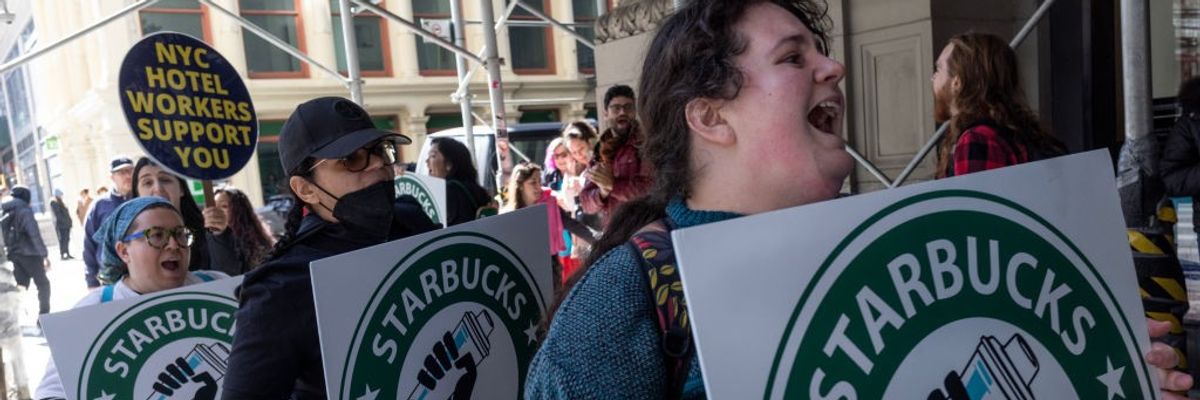
Starbucks union members and their supporters, including baristas who have just walked off the job, effectively closing a local branch, picket in front of the store, on February 28, 2025 in New York City.
(Photo: Andrew Lichtenstein/Corbis via Getty Images)


Dachi Spoltore
Jul 11, 2025
Common Dreams

For five years, I've been brewing coffee and serving customers at Starbucks. I love connecting with people, crafting creative drinks, and learning about coffee. But what I've witnessed behind the green apron tells a different story than the one Starbucks executives want you to hear.

At the Workers United convention in Ohio earlier this year, I had the privilege of meeting Starbucks workers and the unions that represent them from Brazil, Chile, and the United Kingdom. Despite our different languages and cultures, Starbucks workers around the world are saying the same thing: We want to be treated with respect and dignity. We all shared stories of a company that talks about caring for its partners while systematically failing to support the people who make their business possible in the first place.

The barista from Chile I spoke with described conditions that were heartbreaking. They said they are required to work in extreme heat with no support to address the dangerous working conditions. When they went to bargain for better pay, they told me what Starbucks offered wouldn't even cover basic bills and food. The pay increase they were fighting for—literally less than a dollar—put into perspective just how little this multibillion dollar company values its workers.

Starbucks' issues in Latin America extend beyond how it treats its workers in the stores and into its supply chains, as it is now the target of allegations in a new lawsuit claiming their Brazilian coffee is made under slavery-like conditions. And the pressure campaign has grown as local unions and human rights groups recently demanded the Brazilian retail brand FARM Rio end its partnership with the coffee giant. These aren't just abstract allegations—the allegations involve real workers, real families, and real human suffering in the coffee giant's supply chain.

Starbucks executives can improve operations and public perception right now by listening to union baristas who are committed to building a better company.

This international scrutiny isn't limited to Latin America. In the U.K., workers described navigating complex bureaucratic channels just to organize. Everywhere I looked, I saw the same pattern: Starbucks partners demanding respect, safety, and fair treatment, while the company prioritizes all the wrong things.

Here in the United States, we're experiencing our own version of this neglect. Customers wait 30 minutes for lattes while we're understaffed, underpaid, and undersupported. Mobile orders pour in while only two people work an entire shift. We're forced to enforce policies that put us in danger—like denying the bathroom or water to people seeking shelter—while fearing for our jobs if we speak up. Meanwhile, Starbucks executives are focusing on what color T-shirts we wear instead of bargaining in good faith with the union and addressing real operational problems. The contradiction is stark: a company that claims to care about its partners while baristas rely on Medicaid because we can't get guaranteed hours to qualify for health insurance.

I can't imagine how many more stories there are just like mine that go unheard. Starbucks is under fire around the globe due to allegations of forced Uyghur labor in their Chinese supply chains, exploitation in Mexico, and its use of a Swiss subsidiary to avoid taxes. Yet, CEO Brian Niccol—who made $96 million in just four months last year and commutes to work in a private jet—has failed to address these serious issues abroad, all while the company has committed hundreds of unfair labor practices in the U.S. and he's ignoring union baristas' demand for fair contracts at home.

Starbucks won't turn this business around by allegedly violating labor law internationally and domestically, and failing to finalize fair union contracts. Fighting with baristas—whether in Seattle or São Paulo—is bad for business. We're the ones who open stores every morning, greet customers, make the coffee, and remember favorite orders. We're central to their turnaround strategy, and I have yet to see them address our concerns. We've been bargaining since April 2024 for a fair contract, but Starbucks continues to drag its feet.

But workers aren't staying silent. Just this month, we won our 600th union election in the U.S.. We're growing stronger, and we're building solidarity with Starbucks workers and customers across borders.

Starbucks executives can improve operations and public perception right now by listening to union baristas who are committed to building a better company. We've been ready to consider proposals that include actual improvements in staffing, guaranteed hours, and take-home pay.

The choice is yours, Starbucks. You can continue fighting the people you call "partners" while facing mounting international scrutiny, or you can finally live up to your claims about being the best place to work. The world is watching, and we're organizing.


Our work is licensed under Creative Commons (CC BY-NC-ND 3.0). Feel free to republish and share widely.


Dachi Spoltore is a five-year Starbucks barista and member of Starbucks Workers United.
Full Bio >
Trump's GOP Megabill Slams Door on Progress of the 20th Century


It’s not enough that Trump slashes taxes on the rich. He partially pays for those cuts in ways that punish poor and working-class people. Now we must fight like hell to regain what we've lost—and go further.


Burk Ketcham, who turned 100 years old in March, sits on his rolling walker holding a protest sign against President Trump at the corner of Nott Terrace and Eastern Avenue in Schenectady in June of 2025.
(Photo: Paul Nelson/Albany Times Union via Getty Images)

Amy Hanauer
Jul 11, 2025
Common Dreams

As Republican Senators moved their megabill through the Senate, I was celebrating the life of my father-in-law who died at 91 earlier this spring. Born during the Great Depression, he lived a long, prosperous, healthy life because of work and luck, but also because of doors opened by policies enacted between 1900 and 1980. This country’s biggest historical challenge has been delivering this progress to all Americans, but Republicans have cut it back for everyone, retreating from many 20th century achievements in ways that will slam doors, rather than opening them, for the next generation.

Lawmakers established the individual income tax in 1913, the corporate income tax in 1909, and the estate tax in 1916. The new tax law weakens all three. These taxes, combined with the payroll tax created in the 1935 New Deal, enabled poverty to plunge, education levels to soar, and lifespans to nearly double over the course of the 20th century. The roads and railroads, schools and colleges, and pipes and power sources that our tax dollars funded catalyzed industrial, educational, and health advancements that transformed our world.

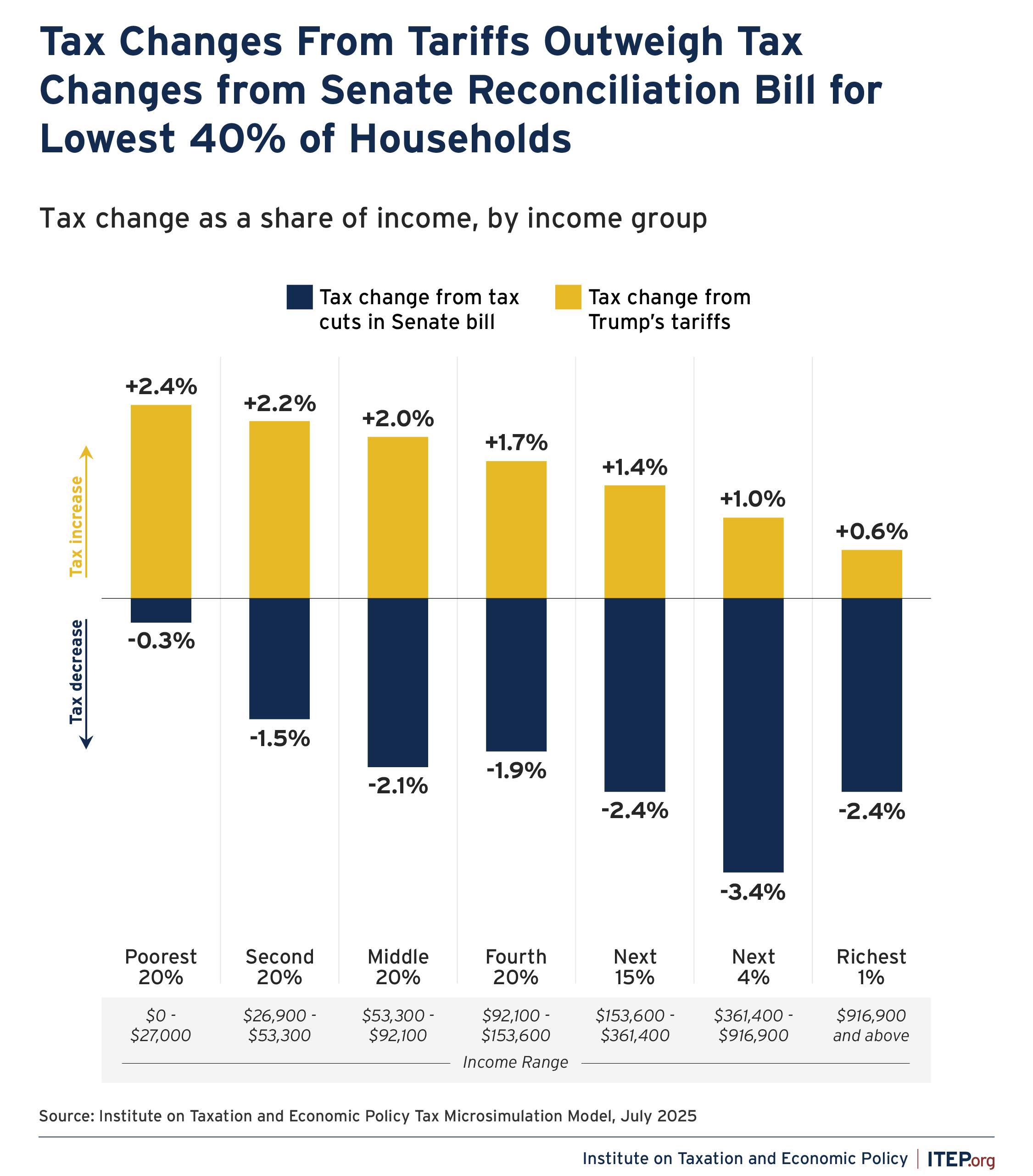
The income tax, corporate tax, and estate tax raise revenue for our collective needs and do so progressively, falling most heavily on those most able to pay. These are the funding sources Republicans chose to attack in their megabill. That’s why the law’s huge giveaways go so resoundingly to the uber-rich. All told, the richest 1 percent – a group with incomes exceeding $916,900 per year – will get a trillion dollars in tax cuts over the next decade. Find the average annual gift to the wealthiest 1 percent in your state here.

More than 70 percent of this law’s tax cuts go to the richest fifth of people, while middle-income Americans get just 10 percent and the poorest fifth get less than 1 percent. And for 80 percent of Americans, Trump’s tariffs will offset most or all of the tax cuts by raising prices on things we all buy.

Make no mistake, President Trump and his Congress have guaranteed that fewer Americans will have health insurance, more children will go hungry, and states will have less federal funding to deliver good schools, affordable college, and quality roads and bridges.

It’s not enough that Trump slashes taxes on the rich. He partially pays for those cuts in ways that punish poor and working-class people. The new law makes the biggest reductions to health care in American history – stripping insurance coverage from 17 million Americans by kicking them off of Medicaid and taking away their Affordable Care Act subsidies. On top of booting people off health care, this will force near immediate closure of more than 300 rural hospitals.

The second major funding source literally takes food from hungry families by slashing the Supplemental Nutrition Assistance Program (SNAP) (once known as food stamps), a program that provided a meager but essential $2.84 per person per meal last year. These are the biggest attacks on food aid in history, abandoning a core federal commitment to provide at least minimal nutrition to the elderly, disabled people, and the very poorest children.

The final major spending cuts end incentives that were sparking jobs and investments in the green energy economy. This threatens 4,500 clean energy projects, imperils hundreds of thousands of jobs, and is projected to add billions of dollars to Americans’ annual energy costs. The subsidies were reducing the carbon emissions that contribute to climate change. Gutting them is a baffling choice as hurricane season bears down on coastal regions. They also were strengthening domestic energy production, making the U.S. less dependent on oil suppliers in the middle east and elsewhere.

Despite spending cuts, the bill will add trillions over the next decade to the national debt. This will shift costs onto the next generation, making it more expensive to borrow to buy a home, finance college, or even purchase the basics.

My father-in-law lived a great life in part because of taxes. His generation – particularly white men in his generation – benefitted from growing investments in public schools, affordable college, a GI bill that made housing and higher education even more manageable, a skyrocketing economy, and plentiful jobs often with unions, wage growth, and sometimes, as in his case, great health insurance and a full pension.

None of the benefits of the boomer generation were distributed equally and Black Americans were particularly left out. And starting with Ronald Reagan’s assault on unions, job quality deteriorated, with health coverage and pensions eroding particularly for workers without a college degree. But make no mistake, President Trump and his Congress have guaranteed that fewer Americans will have health insurance, more children will go hungry, and states will have less federal funding to deliver good schools, affordable college, and quality roads and bridges.

A hard-working, devoted, optimistic man, my father-in-law had unyielding confidence that America would keep its promise to the next generation. This week Republicans reneged on that promise. We can collectively reclaim it, so every baby born today has the chance at upward mobility and achievement that many in previous generations did. America’s future just got dimmer. We have an obligation to restore its brightness.


Our work is licensed under Creative Commons (CC BY-NC-ND 3.0). Feel free to republish and share widely.


Amy Hanauer  joined ITEP in 2020, bringing nearly 30 years of experience working to create economic policy that advances social justice. As executive director of both ITEP and Citizens for Tax Justice, Amy provides vision and leadership to promote fair and equitable state and national tax policy.
Full Bio >


'Indefensible': Trump Budget Law Subsidizes Private Jet Owners While Taking Healthcare From Millions

A provision of the budget law that President Donald Trump signed last week will leave taxpayers to "pick up the tab for the private jet industry and billionaire high flyers."


Private jets were seen on the tarmac at Friedman Memorial Airport ahead of a business conference on July 5, 2022 in Sun Valley, Idaho.
(Photo: Kevin Dietsch/Getty Images)


Jake Johnson
Jul 07, 2025
COMMON DREAMS

The Republican budget measure that U.S. President Donald Trump signed into law late last week contains a provision that analysts say will allow private jet owners to write off the full cost of their aircraft in the first year of purchase, a boon to the ultra-rich that comes as millions of people are set to lose healthcare under the same legislation.

FlyUSA, a private aviation provider, gushed in a blog post that with final passage of the unpopular budget reconciliation package, "business jet ownership has never looked more fiscally attractive or more fun to explain to your accountant."

The law, crafted by congressional Republicans and approved with only GOP support, permanently restores a major corporate tax break known as 100% bonus depreciation, which allows businesses to deduct the costs of certain assets in the first year of purchase rather than writing them off over time.

Forbes noted that the bonus depreciation policy "applies to a slew of qualified, physical business expenses which depreciate over time, such as machinery and company cars, but the policy is often associated with big-ticket luxury items, such as private aircraft, and its institution last decade led to a boom in jet sales."

"Trump and congressional Republicans have certainly delivered for the billionaire class."

Chuck Collins, director of the Program on Inequality at the Institute for Policy Studies, called bonus depreciation "a massive tax break for billionaires and centi-millionaires that use the most polluting form of transportation on the planet."

"A corporation purchasing a $50 million private jet could potentially deduct the entire $50 million from their taxes in the year of the purchase, rather than spreading the deduction over many years," Collins wrote. "This amounts to a massive taxpayer subsidy, as ordinary taxpayers pick up the tab for the private jet industry and billionaire high flyers."

"Subsidizing more private jets on a warming planet is reckless and indefensible," he added.

The National Business Aviation Association, a lobbying group for the private aviation industry, celebrated passage of the Republican legislation, specifically welcoming the bonus depreciation policy as "effective for incentivizing aircraft purchase." (The Institute for Taxation and Economic Policy argues that "depreciation tax breaks have never been shown to encourage more capital investment.")

Meanwhile, communities across the United States are bracing for the law's deep cuts to Medicaid and federal nutrition assistance, which are expected to impose damaging strains on state budgets and strip food benefits and health coverage from millions of low-income Americans.

"Trump and congressional Republicans have certainly delivered for the billionaire class," said Robert Weissman, co-president of Public Citizen. "This is certainly one of the cruelest bills in American history, backtracking on the country's painfully slow history of expanding healthcare coverage and, equally remarkably, taking food away from the hungry."

"That's a lot of needless suffering just to make the richest Americans richer," he added.


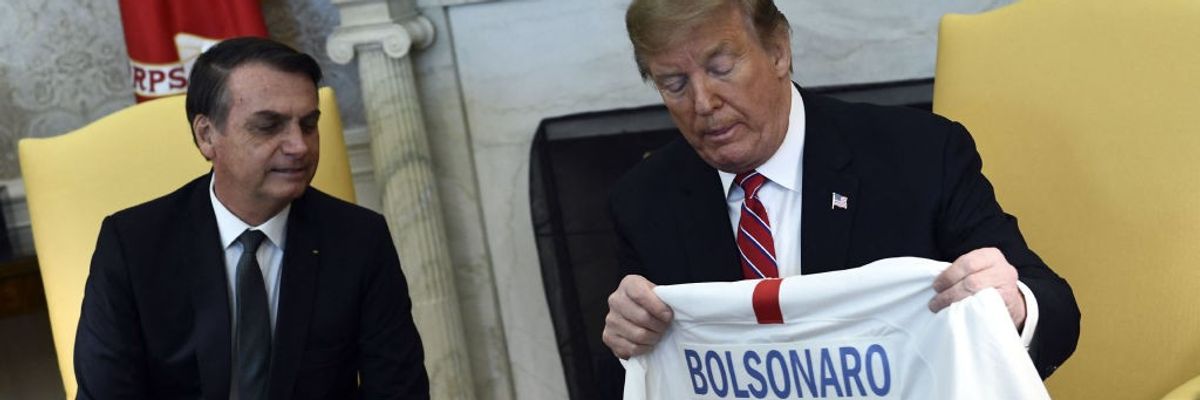
U.S. President Donald Trump (R) and then-Brazilian President Jair Bolsonaro exchange team jerseys as they meet in the Oval Office at the White House on March 19, 2019 in Washington, D.C.
(Photo: Brendan Smialowski / AFP via Getty Images)

Trump’s Bizarre, Authoritarian, Big, Tech-Friendly Tariffs on Brazil
Trump’s actions are not motivated by any real economic or legal factors, but are instead about pushing his authoritarian agenda and doling out favors to Big Tech companies and other corporate cronies.

Melinda St. Louis
Jul 11, 2025
Common Dreams

On July 9, 2025, President Donald Trump announced that the U.S. would impose tariffs of 50% on all imports from Brazil. In line with the latest round of tariffs announced over the past few days, these tariffs are to take effect on August 1, 2025.

Trump also announced the initiation of an investigation by the U.S. Trade Representative (USTR) into Brazil’s digital economy regulations, under Section 301 of the Trade Act.

Trump’s social media post outlines three ostensible reasons for the imposition of such high tariff rates. First, the supposed “Witch Hunt” against his friend Jair Bolsonaro, the right-wing former president of Brazil, who is currently being prosecuted for allegedly initiating a coup following his electoral loss in 2022. Second, recent rulings by Brazil’s Supreme Court have sought to cast greater responsibility for content moderation on social media companies. And, third, a supposed trade deficit with Brazil caused by “many years of Brazil’s Tariff, and Non-Tariff, Policies and Trade Barriers.” However, a cursory analysis of these reasons makes it clear that Trump’s actions are not motivated by any real economic or legal factors, but are instead about pushing his authoritarian agenda and doling out favors to Big Tech companies and other corporate cronies.


President Trump, given his predilection for authoritarian strongmen, has long supported Brazil’s controversial ex-president Jair Bolsonaro, described by some as the “Trump of the tropics.” Notably, Trump hosted Bolsonaro in the White House in 2019, while also endorsing his run for reelection in 2021 and 2022, describing him as “one of the great presidents of any country in the world.” Importantly, however, Bolsonaro, in addition to sharing a scant regard for human rights, also embraced a “strongly neoliberal agenda” during his time in office, initiating many regulatory actions that mirror Trump’s in the U.S., such as weakening environmental protections, gutting labor regulations, and the like. In contrast, Brazil’s current President Luiz Ignacio Lula de Silva has been vocal in calling out Israel’s war on Gaza, while also seeking to strengthen BRICS—something President Trump is not particularly happy about, given the broader geostrategic challenge this represents to the U.S.

Bolsonaro is currently on trial in Brazil for allegedly instigating a coup that led to violent mobs seeking to take over critical institutions following his loss in the 2022 national elections. Trump appears to see parallels in the case against Bolsonaro with the January 6 insurrection of 2021. Trump’s seemingly blatant interference with domestic political and judicial processes has been strongly condemned by President Lula, who quite rightly insists that Brazil’s sovereignty must be respected.

The second reason cited by Trump pertains to Brazil’s recent attempts at regulating the digital ecosystem in the public interest. Brazil has been at the forefront of countries seeking to find new models of regulation for the digital economy. U.S. Big Tech companies hate Brazil’s proposals to implement a network usage fee and a new digital competition law. It also recently enacted a privacy law that has been called out in an annual U.S. government report that lists supposed non-tariff trade barriers (together with privacy laws in a number of other jurisdictions, such as the E.U., India, Vietnam, etc). This report, which Trump waved around at his April 2 tariff announcement event, is essentially “Project 2025” for trade policy.

It’s clear that the Trump administration will continue to threaten tariffs to countries around the world for standing up for their people’s rights on behalf of his billionaire buddies.

More pertinently, Brazil has been engaged in a standoff with a number of social media companies over the last few years, particularly given the problems of misinformation linked to Brazil’s last election cycle. A number of studies demonstrate how the use of misinformation was widespread during Brazilian elections over the last few years, with Bolsonaro supporters in particular said to have been targeted by propaganda. Brazil’s state institutions have been grappling with how best to address this maelstrom of misinformation, including by threatening to ban X, also known as Twitter, for failing to comply with domestic laws.

More recently, however, Brazil’s Supreme Court has ruled that social media companies have a responsibility to police their platforms against unsafe or illegal content. This goes directly in the face of a model the U.S. has long sought to propagate through the rest of the world—one that replicates its laissez-faire attitude to social media regulation under Section 230 of the Communications Decency Act. American law provides a “safe harbor” to platforms for carrying illegal user content, arguably reducing the incentive for social media companies to regulate illicit content (while others argue that the provision reduces privatized censorship). There has been a rigorous debate around Section 230 even in the United States, while a number of countries have or are seeking to move away from this model, as the scale of harm that can be caused by social media becomes more apparent and real. This threatens the profits of big companies such as Meta and X. By directly linking the imposition of tariffs to Brazil’s attempts at regulating social media, Trump is merely helping out his billionaire tech-bro buddies—part of his shakedown on behalf of Big Tech.

We have seen similar demands aimed at a number of countries that are seeking to regulate the digital ecosystem. For example, a number of digital regulations in the E.U., such as the General Data Protection Regulation, Digital Services Act, and Digital Markets Act, are reported to be under threat in trade negotiations between the U.S. and the E.U. Trump also recently strong-armed Canada to revoke its Digital Services Tax under threat of suspending trade negotiations. The tax was estimated to cost Big Tech companies in the region of CAD 7.2 billion over five years.

Most laughably, Trump reproduces language used in tariff letters sent to a number of other countries, claiming that he needed to impose the 50% tariff as Brazil has a trade deficit with the U.S. As pointed out by numerous analysts, this is patently wrong. The New York Times notes that “for years, the United States has generally maintained a trade surplus with Brazil. The two countries had about $92 billion in trade together last year, with the United States enjoying a $7.4 billion surplus in goods.” Brazil was even not on Trump’s own list for higher “reciprocal tariffs” announced in April, as the data published by the USTR noted the U.S. trade surplus with Brazil. Trump’s justification for enacting so-called “reciprocal” tariffs on dozens of countries was that their trade deficits with the U.S. constitute an emergency, granting him sweeping powers. This claim has been rejected by a federal court, with appeals still underway. Brazil’s lack of any deficit, let alone an emergency-justifying one, makes these tariffs on Brazil even more legally questionable.


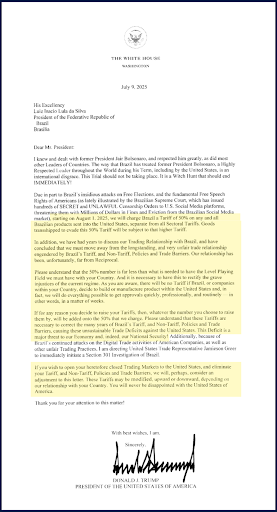
Trump’s letter to Brazil announcing the new tariffs. Highlighted text was present in the form of letters sent to more than a dozen other countries.


So, what are Trump’s real motivations for the imposition of these tariffs on Brazil? As indicated above, he is clearly enamoured of Bolsonaro, while he hasn’t been shy of hiding his dislike for Lula. In addition to helping out his authoritarian buddy, Trump is also clearly seeking to repay Big Tech, significant contributors to his inauguration fund. As we have pointed out previously, Trump’s trade policy has essentially been a scheme to bully countries into deregulation, particularly in the tech space. This also accords with the longstanding U.S. policy to see to it that its digital companies are not regulated by foreign countries.

Looking ahead, things are as unclear as they have always been through the course of Trump’s second term in office. While the tariffs on Brazil are scheduled to go into effect this August, Trump appears to have kept the door open to further negotiations. Barring a diplomatic resolution, the USTR’s S 301 investigation will likely find that Brazil created an unjustifiable burden or restricted American interests, though this could take some time. Such a determination could lead to the imposition of new (more legally sound) tariffs or be used to justify the already announced tariffs against Brazil.

Brazil, meanwhile, has already enacted an Economic Reciprocity law that will allow it to take retaliatory action against the U.S., including by imposing tariffs, suspending commercial concessions and investments, and obligations pertaining to intellectual property rights. It would appear that the Brazilian government is prepared to take steps to protect its sovereignty, though it will also be motivated by the need to ensure continued exports to the U.S., which is an important market for a number of Brazilian products, such as energy, aircraft and machinery, and agricultural and livestock products.

While it is difficult to predict what is likely to happen in the days and months ahead, it’s clear that the Trump administration will continue to threaten tariffs to countries around the world for standing up for their people’s rights on behalf of his billionaire buddies. The question, however, remains: Will countries stand up to Trump’s bullying and instead protect their sovereign right to regulate in the public interest and will Congress hold him accountable for his con on American workers?


Our work is licensed under Creative Commons (CC BY-NC-ND 3.0). Feel free to republish and share widely.

Melinda St. Louis is director at Public Citizen's Global Trade Watch.
Full Bio >


Who Will Fund Gaza’s Reconstruction? – OpEd


Money Finance Wealth Currency Dollar Briefcase

By 

On March 4 Egypt presented to a meeting of the Arab League a detailed and costed plan for the reconstruction, development and administration of post-war Gaza.  It was approved unanimously and is now Arab League policy.  UN Secretary-General Antonio Guterres, who was present at the meeting, “strongly endorsed” the Egyptian plan, and pledged the UN’s full cooperation in implementing it. 


The president of the African Union, Joao Lourenco, also attended the Cairo summit and gave the plan his explicit support together with a commitment to help realize it.

Since then it has been endorsed by the EU.  Statements from the EU High Representative, Kaja Kallas,  and the President of the European Council, Antonio Costa, confirm that the EU sees the plan as a serious basis for discussions on Gaza’s future​.  They have offered “concrete support” from all 27 member countries.

In addition France, Germany, Italy and the UK have all separately backed it.

The Egyptian initiative addresses both immediate humanitarian needs and the long-term governance and reconstruction of Gaza.  It envisages a three-phase process: first, immediate humanitarian action;  then a multi-year reconstruction effort; and finally establishing a new governance structure for Gaza.

The first phase is planned to be completed in about six months; the rebuilding and governance reforms are estimated to last about a further four to five years.


The plan explicitly excludes Hamas from any involvement in the future governance of Gaza.  It also bars the Palestinian Authority (PA) from direct administrative control, but it does envisage an umbrella-type council composed of Palestinian technocrats, operating under the auspices of the PA but supported by an international Governance Assistance Mission.  In addition, to maintain security during the transition, it proposes the establishment of an International Stabilization Force to be led by Arab states.

It is obvious that the cost of rebuilding Gaza’s towns and cities and their infrastructure will be astronomic.  Egypt’s three-phase plan puts it at $53 billion, to be expended over the 5 years.  For the first six months of humanitarian relief, the reconstruction program is costed at $3 billion.  Phase two, which would involve rebuilding infrastructure such as roads and utilities, and constructing 200,000 permanent housing units, would cost some £20 billion.  The final phase, lasting two-and-a-half years and costing $30 billion, aims to complete infrastructure, build another 200,000 housing units, and develop industrial zones, ports, and an airport.

To finance this $53 billion plan, Egypt proposes establishing an internationally supervised trust fund to receive, channel and manage financial support from a wide range of international donors. It specifically calls for the ​involvement of the World Bank:  “a World Bank-overseen trust fund will be established to receive pledges to implement the early recovery and reconstruction plan.”

The plan proposes that Egypt will host an international conference, in cooperation with the UN, to coordinate donor contributions, with the World Bank providing oversight to ensure transparency and effective fund management.  The World Bank has a long-standing presence in Gaza and the West Bank, where it ​has been managing similar trust funds and coordinating with international donors for development and reconstruction projects.

The task of reconstructing Gaza is enormous, and $53 billion is a very great deal of money to have to find.  The donors likely to finance Egypt’s plan include a mix of international and regional actors.  ​Oil-rich nations such as Saudi Arabia and​ Gulf states like the United Arab Emirates (UAE) ​have deep pockets and a history of regional spending, including in Gaza.  ​With an interest in curbing Iranian influence and stabilizing the region​, they are expected to be key contributors, potentially ​expected to provide at least $20 billion initially.  ​A number have indicated that their one proviso is that Hamas, with its links to ​the Muslim Brotherhood and Iran, is to have no role in Gaza’s redevelopment and future governance.

The Egyptian plan envisions mobilizing diverse sources of international aid and investment, so organizations like the UN and global financial institutions, including the World Bank and the EU, are expected to offer financial support. Development agencies, investment funds, and development banks from various countries ​will also ​be targeted.

Egypt is a strategic ally of the US, already supported to the tune of over $1 billion annually, so it is not impossible to envisage the US assisting in the reconstruction program.  Washington is interested in regional stability, counterterrorism, and preventing refugee spillover into other regions.  Support could be either by way of specialist construction and infrastructure suppliers contracted by the administration, or by direct financial donation provided under the guise of humanitarian aid – a sort of post-conflict Marshall Plan-style initiative.

Another possible major donor is China.  China and Egypt are already tied closely since Chinese firms are involved in building Egypt’s new administrative capital and in developing a major industrial zone in the Suez Canal region.  China may well respond favorably to a request from Egypt to help realize its Gaza reconstruction plan, perhaps regarding it as an opportunity to strengthen its strategic position in the Middle East.

China is already investing heavily in the region through its Belt and Road initiative, as well as with strategic investments, trade partnerships, infrastructure development, and diplomatic engagement.  Enjoying a relatively neutral position in the Israel-Palestine conflict, China is in a formal strategic partnership with Saudi Arabia and has close ties with the UAE, which is a key re-export hub for Chinese goods to the region and Africa. Chinese firms are involved in post-war infrastructure rebuilding in Iraq, and China is heavily invested in infrastructure and renewable energy projects in Turkey, Jordan and Lebanon.

Meanwhile Egypt’s Ministry of Foreign Affairs is actively preparing a major donor conference aimed at securing the required financial commitments. Egypt’s plan explicitly calls for broad-based international ​attendance, including Arab states, the EU, China, the US, and other global actors. 

Eyebrows may be raised at the idea of the US and China sitting down together to discuss ​the f​inancing of Gaza reconstruction, but in fact they have both taken part in similar multilateral donor processes in the past, even when their broader relations were tense. Examples are the 2019 Global Fund’s conference, and the International Donors’ conference “Together for the People in Turkey and Syria” in 2023. The urgency of Gaza’s humanitarian crisis and the need for broad international legitimacy make their participation likely.

Both would expect to benefit from contracts worth millions of dollars to construct or reconstruct elements of a restored Gaza, but even so the program’s directors may need to look further afield to find specialist firms to undertake elements of the extensive building and infrastructure operations required.  When the tenders go out for these lucrative contracts, competition will be fierce.

As for the donor conference, it has waited for an end to hostilities in the region.  Given the current political climate, it might soon be convened.  


Neville Teller

Neville Teller's latest book is ""Trump and the Holy Land: 2016-2020". He has written about the Middle East for more than 30 years, has published five books on the subject, and blogs at "A Mid-East Journal". Born in London and a graduate of Oxford University, he is also a long-time dramatist, writer and abridger for BBC radio and for the UK audiobook industry. He was made an MBE in the Queen's Birthday Honours, 2006 "for services to broadcasting and to drama."


Why did they flatten Gaza?

Published July 12, 2025
DAWN


IN Washington, Pakistan and Israel’s Nobel Peace Prize nominee, joined by Israel’s MIT-educated prime minister, were recently toasting their shared success.

While some differences exist, the duo considers its achievement epoch-making: the Arabs have been reduced to a defeated and demoralised lot, humbly offering as tithe a three trillion-dollar investment in America — with a personal jetliner as the topping. While Israel dropped bombs from the sky over Arab lands, regular flights of Gulf carriers to and from Tel Aviv continued undisturbed.

But the victories go further: Iran was once the outlier, the last to challenge US-Israeli domination of the entire Middle East. After 12 days of war its defiance is now merely token. Months earlier its allies in Lebanon and Yemen had been decimated. Mass starvation in Gaza — now just piles of rubble — has eviscerated Hamas. Meanwhile, Israeli soldiers with automatic weapons enjoy daily target practice with live ammunition on Palestinian children as they chase food trucks.

Pronouncing moral judgement on these two men may offer relief to some but to what end? Let’s recall that even the International Criminal Court was openly derided in Washington as a “kangaroo court” when it ordered Netanyahu’s arrest.

Social Darwinists and Bible Belt preachers propelled America into joining the Gaza genocide.

Blaming individual leaders alone misses the point. No matter how powerful, they invariably reflect what their base wants. Consider that in 2024, as Netanyahu addressed the United States Congress amidst his hospital bombing campaign, American lawmakers — mostly Republicans but also many Democrats — repeatedly gave him standing ovations.


We surely need to dig deeper lest we miss the systemic forces shaping the mindset of both leaders as well as Western publics. To see why Israel wants to eliminate as many Palestinians as possible is easy. Over its entire history it has deliberately cultivated a Holocaust-driven us-or-them mentality. While Hamas’s October 7 attack on Israeli civilians was morally abhorrent, Israel has systematically sought to blame all violence on the people it has conquered.

But what about America? What beef does America have with Palestinians living half a world away? In the past, American presidents pursued their political objectives in the Middle East through “gentler” covert means like CIA-led coups and targeted assassinations but never through overt genocide captured on camera. The shift, I will argue below, owes to the rapid rise of Social Darwinism and evangelists of the Bible Belt.

Social Darwinism became a popular belief in 19th-century America soon after Darwin discovered the laws of biological selection. Darwin — a true scientist — forcefully rejected this “Darwinism” as extreme misapplication and distortion of his work. Nevertheless, the capitalist robber barons of his time found this piece of science very useful. British philosopher Herbert Spencer first coined the phrase “survival of the fittest” and advocated that this is the way things ought to be, not just how nature functioned. Society advances, he wrote, when “its fittest members are allowed to assert their fitness with the least hindrance.” The unfit should “not be prevented from dying out”.

America’s cowboy culture readily absorbed Spencer and, in time, Donald Trump inherited this mindset from his father, a property dealer. His political career, culminating in his presidency, was launched by his popular book, Think Big and Kick Ass: In Business and in Life. This crude title bespeaks its crude content: being self-serving and brazen brings success, and ultimately, success is all that matters, regardless of how it’s achieved.

Elon Musk — the richest man in the world and Trump’s ex-sidekick — couldn’t agree more. “The fundamental weakness of Western civilisation is empathy”, he declared, adding that “woke” liberals have weaponised empathy and are “exploiting a bug in Western civilisation.”

Musk trashes social insurance such as Social Security, which he calls a “Ponzi scheme.” His newly launched political party will be still kinder to America’s ultra-rich and yet harsher on ordinary people. As for starving Palestinians: the fewer the better. What do they produce, he asked rhetorically.

While heartlessness might explain why the US has stopped trying to feed the world’s hungry, it fails to explain why America helped Israel flatten Gaza. For that, we must glance at Trump’s political base. In 2024, Trump won over roughly 80 per cent of white conservative, evangelical Christian voters. (Incidentally, most conservative Pakistani-Americans also voted for Trump.)

During my professional visits to the United States over the decades, I’ve often found myself watching white televangelists hawk their beliefs and marvelled at their well-honed delivery skills. Their core message: the Bible commands you to give your absolute support for Israel. Then, without batting an eyelid, they equate the Promised Land of Moses’s time with today’s nation-state of Israel.

One such preacher — later disgraced because of his weakness for women — I watched particularly. Jimmy Swaggart, who died last week, was a Christian Zionist who made his living off the Bible. “Israel is God’s prophetic time clock,” that heralds Armageddon and Jesus’s return to Earth, he sermonised. His son, Donnie Swaggart, carries on his mission today: “We must stand for Israel, for Jerusalem is the chosen city of God, where Jesus Christ, the King of Kings, will one day reign forever.”

That Trump ordered the US embassy to be shifted from Tel Aviv to Jerusalem in his first presidency was surely not accidental.

No logical exercise can ever disprove what the Swaggarts and their ilk preach. Reason can never defeat faith, particularly when it stands behind a holy book. But what about Social Darwinism? Is that unassailable too?

Here one can be more hopeful. Its nonsensical pseudo-scientific claims — virtuous people beget virtuous children being one — are readily disproven. But more importantly, as Darwin himself insisted, cooperation within the human species is fundamental for societal well-being. Cooperation, in turn, demands empathy. Without empathy we’d be living in a dystopic Muskian jungle populated by selfish individuals pursuing selfish needs.

To prevent more Gazas, people in every country must boldly confront their ingrained beliefs, repudiate pure selfishness, and internalise the profound truth that humanity is one. Else the scum shall continue rising to the top, eventually becoming that country’s political leaders.

The author is an Islamabad-based physicist and writer.

Published in Dawn, July 12th, 2025
Israelis kill Palestinians in occupied West Bank every day: former Israel premier

Extremist illegal settlers committing daily violence with impunity, broad societal backing, says Ehud Olmert

Khaled Yousef, Gulsen Topcu and Merve Berker 
 |13.07.2025 - TRT/AA


JERUSALEM/ANKARA

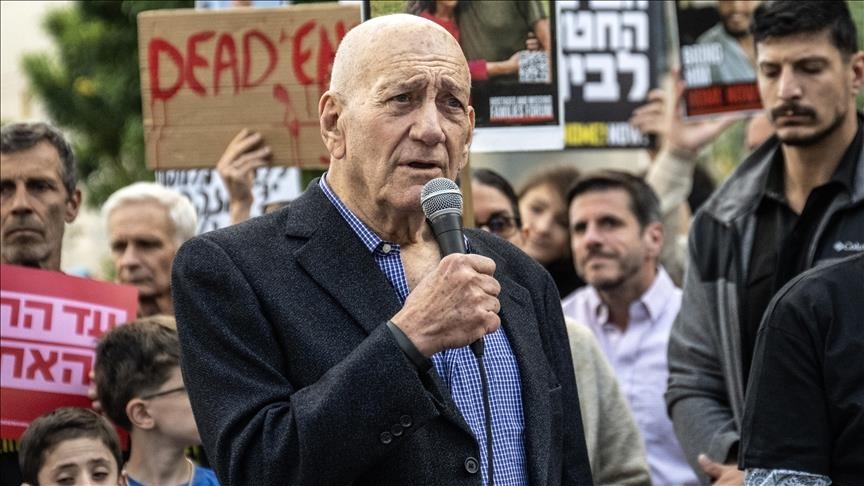
Former Israeli Prime Minister Ehud Olmert said Saturday that illegal Israeli settlers are killing Palestinians every day in the occupied West Bank.

Olmert told Channel 13 TV that Israelis are killing Palestinians daily in "Judea and Samaria" (the West Bank), and the far-right "Hilltop Youth" are committing war crimes.

He dismissed claims that the group is a minority as “a lie,” saying: “They are not a minority, on the contrary, they are supported. Otherwise, they couldn’t be doing this.”

Olmert told the BBC on May 21 that the administration in Tel Aviv was committing war crimes not only in Gaza but daily in the West Bank.

On July 11, Israelis who had seized Palestinian lands beat a Palestinian and fatally shot another in the town of Sinjil, north of Ramallah.

At least 998 Palestinians have been killed and more than 7,000 injured in attacks by the Israeli army and illegal settlers in the occupied West Bank since the start of the war in the Gaza Strip in October 2023, according to the Palestinian Health Ministry.

Israel has since killed nearly 58,000 Palestinians in Gaza, mostly women and children.

The International Court of Justice declared Israel's decades-long occupation of Palestinian land illegal last July and demanded the evacuation of all settlements in the West Bank and East Jerusalem.

The International Criminal Court issued arrest warrants last November for Prime Minister Benjamin Netanyahu and his former Defense Minister Yoav Gallant for war crimes and crimes against humanity in Gaza.

Israel also faces a genocide case at the International Court of Justice for its war on the enclave.