Wednesday, July 16, 2025

 NEWFOUNDLAND

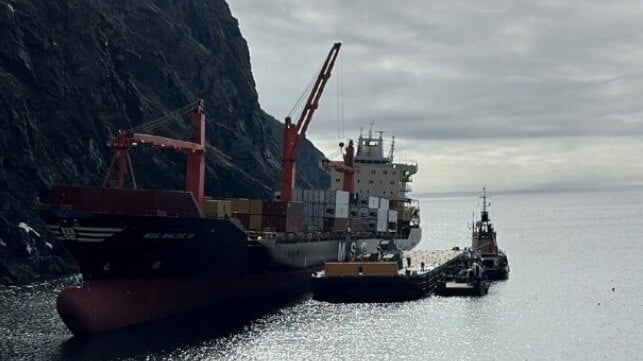
MSC Baltic III Response Shows Significant Progress

MSC Baltic III
Deck operations early in the salvage process (CCG)

Published Jul 15, 2025 4:34 PM by The Maritime Executive


After months of effort, salvors have removed the majority of the bunker fuel aboard the stricken boxship MSC Baltic III, substantially reducing the risk of pollution. 

Taking advantage of calmer summer weather along the coast of Newfoundland, the salvage response team has been bringing a barge alongside to receive cargo containers from MSC Baltic III's deck. The same barge has taken on more than 1,000 tonnes of heavy fuel oil from the vessel's bunker tanks and carried it to the Port of Corner Brook for safe disposal. The ship had an etimated 1,600 tonnes of fuel oil aboard when it grounded, and the pollution prevention effort has reduced environmental risk for Newfoundland's pristine coastline. 

MSC Baltic III ran aground in heavy weather on Newfoundland's west coast on February 15, coming to rest on a shallow rock shelf exposed to wave action. The crew were evacuated in a high-risk helicopter maneuver, and all were retrieved safely. 

The salvage response has been exceptionally challenging, hindered by the remote location, significant site access difficulties, and the continuous stormy weather of the North Atlantic in winter. Salvors persisted, and about 200 of the vessel's cargo containers have been lightered off, including some that were in extremely damaged condition. The operation to mitigate pollution risk from the cargo and fuel oil continues. 

The vessel itself remains wedged firmly on the rock, its hull seriously damaged from its time aground. A refloat attempt is considered impossible in its current condition; for now, salvors hope that the good weather will hold long enough to complete the lightering process before hurricane season raises risk again. 

Local residents are watching closely as well, since ocean industries are central to the region's economy. "Our biggest concern, of course, is pollution ," said Wade Park, the mayor of Lark Harbour, speaking to Radio Canada. "We want to make sure there's no pollution, there's no danger. Fishing is the backbone of our community. Contaminated waters would be disastrous for us."


With Korean Support, Amogy Takes Ammonia Propulsion Tech Ashore

Amogy's ammonia-powered demonstration tug (Amogy)

Published Jul 15, 2025 7:59 PM by The Maritime Executive


One of South Korea's policy banks has made a significant investment in clean power company Amogy, which is designing a system to run hydrogen fuel cells with an ammonia fuel source. 

Ammonia is one of the most promising available fuel options for low-emission propulsion, but it generally requires a small amount of carbon-based fuel to initiate combustion. Burning ammonia also produces NOx, which must be abated before the exhaust stream is released to the atmosphere. 

Amogy's technology takes a different route. Instead of an internal combustion engine as the primary energy generating device on board, it substitutes hydrogen fuel cells. Since these can't run on straight ammonia, Amogy has developed compact equipment that can break down ammonia into its constitutent elements - nitrogen and hydrogen. The nitrogen gas gets released back to the atmosphere, while the hydrogen goes into the fuel cell to generate power. There is no combustion involved, so there are no onboard emissions. (Lifecycle emissions still depend upon the source of the ammonia, whether from green energy or from natural gas.)

Amogy is still a few years out from developing a system large enough for a merchant ship, but it has a test-scale platform on a tugboat and is working on a terrestrial powerplant version as well. It has been successful in raising funds to support its R&D process, and its latest round came to $23 million - led by a tech-focused arm of Korea Development Bank (KDB), the policy bank that supports South Korea's major shipyards and shipowners. The funds will be used to "drive market entry in Asia and scale stationary power applications alongside maritime innovation," Amogy said. 

Korea has a well-developed interest in  green propulsion technology, which it hopes to leverage as a competitive edge in a tough shipbuilding market. But clean ammonia for ships could just as easily be used on shore, where it is just as needed for decarbonization objectives. Amogy noted that Korea's Clean Hydrogen Portfolio Standard (CHPS) and Distributed Energy Act (DEA) will lift the use of hydrogen and ammonia, and that these two closely-related feedstocks will supply two percent of the country’s electricity by 2030 and seven percent by 2035.

"We’ve long recognized the strong demand for ammonia-to-power technology in the shipping industry, but we also see much broader opportunities to use ammonia as a clean fuel – especially with the growing demand for the ‘clean power’ globally. We’re ready to meet that market demand," said Seonghoon Woo, co-founder and CEO at Amogy. “Support for a hydrogen-based economy is especially strong in Asia, and as the most cost-effective hydrogen carrier, ammonia is quickly evolving into the leading zero-carbon fuel solution for these markets."


Is Australia Doing Enough to Ensure Confidence in the AUKUS Sub Deal?

Promises need to shift to performance, judged against a published timeline.

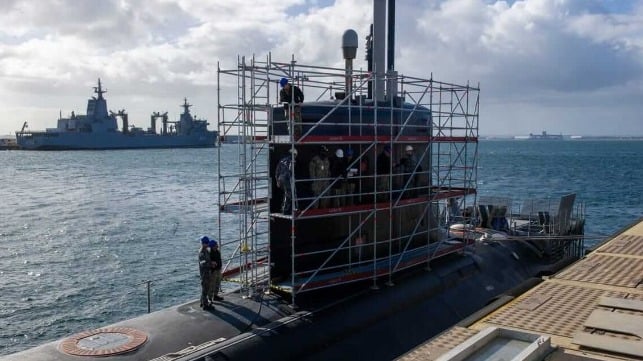
US Navy and Royal Australian Navy sailors attached to the submarine tender USS Emory S. Land performing maintenance aboard Virginia-class fast-attack submarine USS Hawaii at HMAS Stirling, Western Australia, in August 2024 (Mario E. Reyes Villatoro/US Navy Photo)
Crew of the sub tender USS Emory S. Land performing maintenance aboard Virginia-class fast-attack submarine USS Hawaii at HMAS Stirling, Western Australia (USN)

Published Jul 15, 2025 9:00 PM by The Lowy Interpreter


[By Jennifer Parker]

At an estimated $368 billion cost, a Pentagon review underway and talk of the United States seeking a guaranteed commitment in the event of conflict, Australia’s push for nuclear-powered submarines under AUKUS is never far from the headlines. But the idea that Canberra is hostage to American whim is off the mark and lacks self-awareness. Australia must consider how our AUKUS partners view us.

Are our actions instilling confidence in this critical deal? Our real test is proving we can hold up our end: expedite infrastructure, build confidence and show allies and voters alike that Submarine Rotational Force-West (SRF-West) will be ready in 2027, less than two years away.

Since the AUKUS announcement in September 2021, significant progress has been made. Within 18 months, the three partners agreed on an optimal pathway and concluded a binding treaty, no small feat. Training is well underway, with Australian submariners reportedly progressing through the US system, and Australian shipbuilders working at Pearl Harbor to build the skills needed to maintain and eventually construct nuclear-powered submarines at home. And perhaps most remarkably, despite persistent headlines of doubt, the latest Lowy Institute Poll shows more Australians support the acquisition of nuclear-powered submarines than oppose it, a striking shift for a country long defined by its anti-nuclear stance.

Yet for all this progress, a looming infrastructure crunch threatens to derail momentum. The Australian government must now lean in, decisively, to ensure the foundations are in place to sustain what has been achieved.

Worries are growing in Canberra, and Washington, that upgrades at HMAS Stirling and the new Henderson defense precinct are drifting off-schedule. Addressing the Lowy Institute, CSIS president John Hamre warned that many in Washington feel “the Albanese government supports AUKUS but isn’t really leaning in”, a perception he said is “more widely felt … than people realize”. Days later, former US Navy secretary and current Austal chair Richard Spencer drove the point home highlighting that policy alone won’t build submarines: “it has to move from politics to military to construction,” Spencer said. “We need to start moving dirt”.

These worries are hard to verify because Canberra still hasn’t published a real schedule for HMAS Stirling or the new Henderson precinct. The December 2024 Naval Shipbuilding and Sustainment Plan and the March 2025 AUKUS Submarine Industry Strategy trumpet job numbers but stay silent on real infrastructure deliverables. Even the Parliamentary Standing Committee on Public Works, which examined the Stirling upgrade in June 2024, seems to only address the scope. Publicly available detail on Stirling timelines amounts to a single line: “major construction is expected to start in 2025”. With no dated milestones, assurances that we are “investing in both sites” look aspirational, and the perception gap widens.

With no published timelines, even loyal supporters are left wondering whether Canberra can meet its AUKUS obligations, first hosting SRF-West, then taking delivery of an Australian-flagged Virginia-class boat in 2032. Our credibility problem is hardly new: the public and industry still recall years of slipped schedules and blown budgets in naval shipbuilding and infrastructure.

The 2020 Force Structure Plan flagged the need for a second dry-dock in Western Australia, an urgency only amplified by AUKUS, yet five years and two governments later we still lack a start date. Dry-docks are neither cheap nor quick to build, but they are essential if we hope to maintain nuclear-powered submarines on home soil. Meanwhile, the promised east-coast submarine base has vanished from the agenda. Although not critical to the AUKUS pathway, submarine access to both the Indian and Pacific Oceans is central to any credible Australian maritime strategy.

Shipbuilding and sustainment are hardly healthier. Both Australian Navy replenishment ships have been idle since 2024 with engine and shaft failures, and an ANAO audit says the landing helicopter docks suffer “ongoing deficiencies” and “critical failures” thanks to poor contract management. The first 1,640-tonne Arafura offshore-patrol vessel took three-and-a-half years to move from launch (December 2021) to commissioning (June 2025), an extraordinary pause for such a simple platform. Steel for the Hunter-class frigates was cut in 2024, yet the lead ship is not due until 2032 because Canberra will not expedite the program. Meanwhile, the Collins-class submarine life-of-type extension looks increasingly unlikely to proceed as originally scoped, if it proceeds at all.

Every shortfall has its own back-story, too complex to detail in this space, but the record is clear: our patchy performance on naval infrastructure, shipbuilding and sustainment has bred a reputation for delay and indecision. Rather than continually seeking reassurance that Washington and London will meet their AUKUS commitments, Canberra should confront the tougher question: do we inspire confidence, or are we becoming the weak link in the trilateral partnership?

The government’s refusal to lift defense spending, insisting we are “doing enough” despite allied doubts, erodes the very confidence we need to build. Any military planner can see the ADF’s ambitions are kneecapped by a budget that falls well short of our stated strategy.

Much has been achieved since AUKUS was unveiled, but we are now on the critical path: without timely upgrades at HMAS Stirling and Henderson, the first phase stalls. From the outside it is impossible to judge progress, and partners are openly skeptical, hardly surprising given Australia’s patchy record on recent naval projects. Repeating that we are “doing enough” no longer cuts it. If Canberra wants to shore up confidence, it should publish a detailed schedule for the Stirling and Henderson works. Transparency, not talking points, will keep AUKUS on track.

Jennifer Parker is an expert associate at the National Security College, Australian National University, an adjunct fellow at the University of New South Wales and Nancy Bentley Associate Fellow in Indo-Pacific Maritime Affairs at the Council on Geostrategy. Jennifer has over 20 years experience in the Australian Department of Defence working in a broad range of operational and capability areas. 

This article appears courtesy of The Lowy Interpreter and may be found in its original form here

The opinions expressed herein are the author's and not necessarily those of The Maritime Executive.
 

Hawai'i Awards Contract to Sink the Historic Sailing Tanker Falls of Clyde

Falls of Clyde
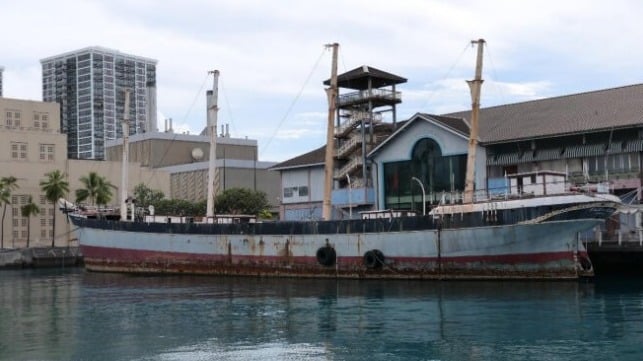
Falls of Clyde circa 2023 (courtesy Save Falls of Clyde)

Published Jul 15, 2025 10:57 PM by The Maritime Executive


The famed sailing ship Falls of Clyde will finally leave Honolulu Harbor following the award of a $5 million contract for its removal, with ocean sinking having been settled as the ideal method of disposal.

The Hawaii Department of Transportation (HDOT) is announcing that after nearly two decades at Honolulu Harbor, the fate of Falls of Clyde has been sealed. Having received numerous proposals on how to remove the vessel, it has settled on ocean disposal at a deep-water site at least 12 miles due south of Honolulu Harbor. Ocean disposal was one of the methods recommended in a Final Environmental Assessment issued in June last year, with the two others being dismantling and third-party acquisition. Florida-based maritime technical consulting firm Shipwright LLC was awarded the contract for its removal.

The 146-year-old vessel has been docked at Honolulu Harbor since 2008 and is currently berthed at Pier 7, where it once served as a museum ship as part of the Hawai‘i Maritime Center. The vessel was impounded in 2016 when its permit was revoked and the owner failed to remove it from the harbor. Since then it has remained in the custody of the department.

HDOT has been wanting to remove the vessel from the harbor since it was delisted from the Hawaii Register of Historic Places in November 2023. Besides, due to significant deterioration, the ship has lost most of the qualities of historic significance that originally led to its listing in the National Register of Historic Places in 1989. The ship was placed on the list because of its national significance as the oldest surviving American tanker and the only surviving sailing oil tanker left afloat, not only in the U.S. but the world.

Following the award of the contract, Shipwright has already assembled a project team with extensive experience with salvage, remediation, wreck assessments, dead ship tows, derelict vessel removal and fragile hulls. Starting next week, the team will begin debris removal and will restore the watertight integrity of the ship’s subdivision bulkheads.

The next task will be hull strength remediation to prepare the vessel to be safely towed out of the harbor in the event of a storm threat or other emergency. From next month through November, additional structural reinforcement work will be performed before the vessel is towed and disposed of in late November.

As part of the project, HDOT has ensured the Falls of Clyde will not be sunk with any treasures after working with a maritime archaeologist to catalog and safely remove all historical items from the vessel and storing the artifacts in a secured facility.

Built in Glasgow, Scotland, Falls of Clyde is the world’s only surviving iron-hulled, four-masted, fully rigged ship. The ship was constructed during a shipbuilding boom inspired in part by increased trade with the U.S., and it made several voyages to American ports while under the British flag. In 1898 the ship first changed ownership when it was purchased by Captain William Matson (of the Matson Navigation Company) and registered in the Republic of Hawai‘i.

From 1899 to 1907, the ship was re-rigged as a bark for sail with fewer crew and made over sixty voyages between Hawai‘i and San Francisco carrying passengers, sugar and general cargo. It was sold on to San Francisco-based Associated Oil Company, which installed large steel tanks in the hull to allow it to carry 750,000 gallons. For decades, the ship would bring kerosene to Hawai‘i and molasses back from Hawai‘i to California.

Falls of Clyde's removal and disposal is part of ongoing initiatives focused on the removal of inoperable vessels from its commercial ports to protect maritime facilities, improve port efficiency and support commerce. This emanates from the fact that more than 90 percent of imported goods enter the state through Honolulu Harbor.


Houthis Purloin Crude Oil From UN-Funded Floating Storage Tanker

Yemen tanker
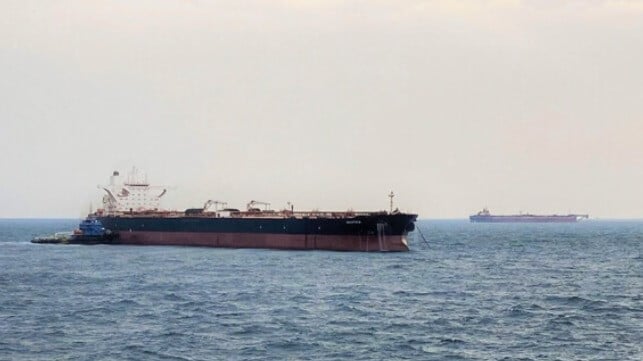
Storage tanker Yemen, ex name Nautica (UN file image)

Published Jul 15, 2025 12:47 PM by The Maritime Executive


In a story broken by Lloyds List and Yemeni journalists, evidence has emerged that the Houthi administration in Yemen is siphoning off crude oil from an oil storage facility maintained by the United Nations off Ras Isa. The story comes as no surprise to observers of Yemen, who have long admired the Houthi’s capacity to leverage UN-funded aid programs to their own economic and political advantage.

The oil that the Houthis have purloined came originally from Yemen’s Marib oilfield, and had been stored in the FSO Safer (IMO 7376472), a floating oil storage facility moored off Ras Isa. This infrastructure fell into disuse when the Houthis captured the coastal area around Ras Isa and Hodeidah in 2015, and the Safer Exploration and Production Operations Company (SEPOC) stopped pumping their Marib crude, as they could no longer sell it.

At this point, the FSO Safer was left holding 1.14 million barrels of oil, today worth nearly $80 million. Holding the oil but unable to sell it, the Houthis also prevented maintenance of the FSO Safer, whose cargo became progressively more volatile as the condition of the ship deteriorated, threatening an explosion and an environmental catastrophe.

In 2022, the Houthis finally agreed to a deal with the UN, whereby the oil aboard the Safer was transferred to VLCC Yemen (IMO 9323948), a tanker that was acquired for the specific purpose. There was no further agreement to proceed either with the removal and salvage of the FSO Safer, or with the disposal of the crude oil now transferred to the Yemen, whose ownership was disputed between by the Houthis and SEPOC. Thus for the last two years, FSO Safer has remained in position, with VLCC Yemen moored close by and still fully loaded. In the meantime, ownership of the Yemen has been transferred gratis to SEPOC, although the UN has also continued to pay directly for the maintenance crew on board the ship.

Since the recent Israeli attacks on the docks and oil facilities at Hodeidah, Ras Isa and Salim, the oil on board the VLCC Yemen has acquired a scarcity value. Even though modern refining facilities and transshipment facilities have been destroyed, locals still have the capacity to "cook" crude oil into poorly distilled products, for which - despite the poor quality - there is a hungry local market.

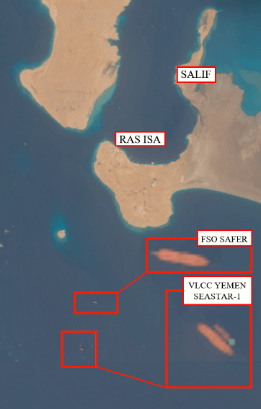
Left: Safer, Yemen and Seastar-1 off Ras Isa, June 8 (Sentinel-2/CJRC)

Hence on June 8, the coastal tanker Seastar-1 (IMO 9163283) was seen alongside the Yemen, transferring oil, and was later seen offloading in Ras Isa. Lloyd’s List reported that prior to June 8, Yemen had also taken on board ship-to-ship transfers of Russian petroleum products.

The UN has lodged a protest over the oil transfers, which must have been made with the aid of the Yemen’s UN-sponsored but presumably press-ganged crew. It would also be feasible for crude oil to be barged the short distance into Ras Isa using lighters. Given that the VLCC Yemen now has a UN-paid crew, and the vessel itself is owned by the Yemeni government’s SEPOC, it may be difficult to curb future siphoning of crude that is much needed by the Houthis.


Food preferences, stigma among reasons students don’t eat free school meals


A study of California and Maine foodservice directors identified top barriers to student use of the universal meal program during the Covid pandemic


New York University


During the Covid-19 pandemic, the federal government enabled schools to provide all children, regardless of need, with free meals to address nutrition and food insecurity. While program participation increased, many students declined the free meals, missing out on potential health and academic benefits.

A new study by nutrition researchers identifies several barriers cited by foodservice directors—the leaders who run school food programs—to student participation, including student preferences for home-cooked meals or fast food, and concerns about how healthy the meals are.

“Even when school meals are free, students don’t always take and eat them. This tells us that cost isn’t the only barrier,” says Deborah Olarte, the study's lead author and assistant professor of nutrition at NYU Steinhardt School of Culture, Education, and Human Development. “From the perspective of school foodservice directors, who are key stakeholders in providing school meals to children, it’s important to understand what other barriers exist, so school meals can be more accessible, appealing, and supportive of student well-being.”

The researchers used previously collected 2021-2022 survey data from 599 foodservice directors in California and Maine by the California Department of Education and the Maine nonprofit, Full Plates, Full Potential, respectively. They then conducted follow-up interviews with a subset of 49 survey participants.

Using data from both the surveys and interviews, the researchers found three statistically significant barriers to students eating school meals: 1) students or parents don’t think the food is healthy, 2) they prefer to eat at home or elsewhere (e.g., fast-food restaurants), and 3) students and parents think that only lower-income students eat school breakfast and don’t want the associated stigma.

“As states consider universal free school meal policies, the next step is making the already healthy meals more appealing and accessible to students. This could be investing in scratch cooking, incorporating student feedback, and extending lunch periods to ensure meals are available without logistical barriers or stigma,” says Olarte

Their findings are published in Journal of School Health.

This study was funded by California General Fund SB 170 and Share Our Strength.

OFF GRID

Pakistan’s quiet solar rush puts pressure on national grid


By AFP
July 16, 2025


Pakistanis are increasingly ditching the national grid in favour of solar power, prompting a boom in rooftop panels - Copyright AFP Asif HASSAN

Zain Zaman JANJUA

Pakistanis are increasingly ditching the national grid in favour of solar power, prompting a boom in rooftop panels and spooking a government weighed down by billions of dollars of power sector debt.

The quiet energy revolution has spread from wealthy neighbourhoods to middle- and lower-income households as customers look to escape soaring electricity bills and prolonged power cuts.

Down a cramped alley in Pakistan’s megacity of Karachi, residents fighting the sweltering summer heat gather in Fareeda Saleem’s modest home for something they never experienced before — uninterrupted power.

“Solar makes life easier, but it’s a hard choice for people like us,” she says of the installation cost.

Saleem was cut from the grid last year for refusing to pay her bills in protest over enduring 18-hour power cuts.

A widow and mother of two disabled children, she sold her jewellery — a prized possession for women in Pakistan — and borrowed money from relatives to buy two solar panels, a solar inverter and battery to store energy, for 180,000 rupees ($630).

As temperatures pass 40 degrees Celsius (104 degrees Fahrenheit), children duck under Saleem’s door and gather around the breeze of her fan.

Mounted on poles above homes, solar panels have become a common sight across the country of 240 million people, with the installation cost typically recovered within two to five years.

Making up less than two percent of the energy mix in 2020, solar power reached 10.3 percent in 2024, according to the global energy think tank Ember.

But in a remarkable acceleration, it more than doubled to 24 percent in the first five months of 2025, becoming the largest source of energy production for the first time.

It has edged past gas, coal and nuclear electricity sources, as well as hydropower which has seen hundreds of millions of dollars of investment over the past decades.

As a result, Pakistan has unexpectedly surged towards its target of renewable energy, making up 60 percent of its energy mix by 2030.

Dave Jones, chief analyst at Ember, told AFP that Pakistan was “a leader in rooftop solar”.

– ‘The great Solar rush’ –

Soaring fuel costs globally, coupled with demands from the International Monetary Fund to slash government subsidies, led successive administrations to repeatedly hike electricity costs.

Prices have fluctuated since 2022 but peaked at a 155-percent increase and power bills sometimes outweigh the cost of rent.

“The great solar rush is not the result of any government’s policy push,” Muhammad Basit Ghauri, an energy transition expert at Renewables First, told AFP.

“Residents have taken the decision out of clear frustration over our classical power system, which is essentially based on a lot of inefficiencies.”

Pakistan sources most of its solar equipment from neighbouring China, where prices have dropped sharply, largely driven by overproduction and tech advancements.

But the fall in national grid consumers has crept up on an unprepared government burdened by $8 billion of power sector debt, analysts say.

Pakistan depends heavily on costly gas imports, which it sells at a loss to national energy providers.

It is also tied into lengthy contracts with independent power producers, including some owned by China, for which it pays a fixed amount regardless of actual demand.

A government report in March said the solar power increase has created a “disproportionate financial burden onto grid consumers, contributing to higher electricity tariffs and undermining the sustainability of the energy sector”.

Electricity sales dropped 2.8 percent year-on-year in June, marking a second consecutive year of decline.

Last month, the government imposed a new 10-percent tax on all imported solar, while the energy ministry has proposed slashing the rate at which it buys excess solar energy from consumers.

– ‘Disconnected from the public –


“The household solar boom was a response to a crisis, not the cause of it,” said analyst Jones, warning of “substantial problems for the grid” including a surge during evenings when solar users who cannot store energy return to traditional power.

The national grid is losing paying customers like businessman Arsalan Arif.

A third of his income was spent on electricity bills at his Karachi home until he bought a 10-kilowatt solar panel for around 1.4 million rupees (around $4,900).

“Before, I didn’t follow a timetable. I was always disrupted by the power outages,” he told AFP.

Now he has “freedom and certainty” to continue his catering business.

In the eastern city of Sialkot, safety wear manufacturer Hammad Noor switched to solar power in 2023, calling it his “best business decision”, breaking even in 18 months and now saving 1 million rupees every month.

The cost of converting Noor’s second factory has now risen by nearly 1.5 million rupees under the new government tax.

“The tax imposed is unfair and gives an advantage to big businesses over smaller ones,” he said.

“Policymakers seem completely disconnected from the public and business community.”
Tackling debt ‘curse’, France wants to slash holidays

NOUS VOULONS PLUS DE VACANCES, PAS MOINS !

WE WANT MORE HOLIDAYS NOT LESS!


By AFP
July 15, 2025


The Eiffel Tower in Paris. — © AFP Ludovic MARIN


Anne RENAUT and Jurgen HECKER

France’s Prime Minister Francois Bayrou said Tuesday he wanted to reduce the number of public holidays as part of an urgent plan to tackle what he called the “curse” of his country’s debt.

Presenting his outline 2026 budget plan, Bayrou said two holidays out of France’s total of 11 could go, suggesting Easter Monday as well as and May 8, a day that commemorates the end of World War II in Europe.

After years of overspending, France is on notice to bring its public deficit back under control, and cut its sprawling debt, as required under EU rules.

Bayrou said France had to borrow each month to pay pensions or the salaries of civil servants, a state of affairs he called “a curse with no way out”.

Bayrou had said previously that France’s budgetary position needed to be improved by 40 billion euros ($46.5 billion) next year.

But this figure has now risen after President Emmanuel Macron said at the weekend he hoped for additional military spending of 3.5 billion euros next year to help France cope with international tensions.

France has a defence budget of 50.5 billion euros for 2025.

Bayrou said the budget deficit would be cut to 4.6 percent next year, from an estimated 5.4 percent this year, and would fall below the three percent required by EU rules by 2029.

To achieve this, other measures would include a freeze on spending increases across the board — including on pensions and health spending — except for debt servicing and the defence sector, Bayrou said.

“We have become addicted to public spending,” Bayrou said, adding that “we are at a critical juncture in our history”.

– Remember Greece –

The prime minister even held up Greece as a cautionary tale, an EU member whose spiralling debt and deficits pushed it to the brink of dropping out of the eurozone in the wake of the 2008 financial crisis.

“We must never forget the story of Greece,” he said.

France’s debt currently stands at 114 percent of GDP — compared to 60 percent allowed under EU rules — the biggest debt mountain in the EU after Greece and Italy.

The government hopes to cut the number of civil servants by 3,000 next year, and close down “unproductive agencies working on behalf of the state”, the premier said.

Bayrou said that wealthy residents would be made contribute to the financial effort.

“The nation’s effort must be equitable,” Bayrou said. “We will ask little of those who have little, and more of those who have more.”

Losing two public holidays, meanwhile, would add “several billions of euros” to the state’s coffers, Bayrou said.

But the proposed measure sparked an immediate response from Jordan Bardella, leader of the far-right National Rally.

He said abolishing two holidays, “especially ones as filled with meaning as Easter Monday and May 8 is a direct attack on our history, our roots and on labour in France”.

Leftist firebrand Jean-Luc Melenchon of the France Unbowed party meanwhile called for Bayrou’s resignation, saying “these injustices cannot be tolerated any longer”.

burs-jh/giv
US consumer inflation accelerates as tariff scrutiny grows


By AFP
July 15, 2025


The US consumer price index was up 2.7 percent from a year ago in June, accelerating from the figure in May, government data showed - Copyright AFP/File Patrick T. Fallon

Beiyi SEOW

US consumer inflation picked up in line with analyst expectations last month, government data showed Tuesday, as policymakers try to gauge how President Donald Trump’s ever-growing list of tariffs is affecting the economy.

Observers are expecting to learn more about the effects of Trump’s duties over the summer months, meaning June’s data marks the start in a series of closely-watched figures — particularly as officials mull changes to interest rates as well.

The consumer price index (CPI) was up 2.7 percent from a year ago in June, rising from the 2.4 percent figure in May as energy costs rose, said the Department of Labor.

Other areas that saw cost increases included household furnishings and apparel, both segments that experts are eyeing for signs of cost hikes after Trump’s sweeping tariffs this year.

While Trump imposed a 10 percent tariff on almost all trading partners in April and separately slapped steeper duties on imports of steel, aluminum and autos, US officials have pushed back against warnings that these could spark price increases.

Economists caution that tariff hikes could fuel inflation and weigh on economic growth, but US Treasury Secretary Scott Bessent has labeled such expectations “tariff derangement syndrome.”

CPI rose 0.3 percent in June from the previous month, an uptick from the 0.1 percent increase in May as well.

Excluding the volatile food and energy segments, CPI climbed 0.2 percent on-month, picking up from May too.

Compared with a year ago, “core” CPI was up 2.9 percent in June.


Even if headline inflation figures show no “meaningful” surge because of tariffs alone, Nationwide economist Oren Klachkin warned it may be too soon to see their full impact just yet.

Businesses have been trying to hold off consumer price hikes through a range of actions, from eating into their own margins to trying to share costs with their suppliers, he said.

But it remains to be seen how long they can do this.

There could be a bigger impact over the summer, Klachkin added.

For now, he is looking “under the surface” at components most exposed to Trump’s tariffs, such as furnishings, recreational goods and cellphones, to discern their effects.

Besides steep tariffs that have already taken effect, Trump has also threatened even higher levels on dozens of key trading partners including the European Union, India, Japan and South Korea if they do not strike deals to avert these elevated levels.

He has also opened doors to further levies on sector-specific imports ranging from semiconductors to pharmaceuticals, injecting more uncertainty in the global economy and worries of supply chain snags.


Op-Ed: Imbecility in slow motion — Tariffs drive inflation


By Paul Wallis
July 16, 2025
DIGITAL JOURNAL


Tariffs on metal imposed by US President Donald Trump are hitting small businesses like Independent Can very hard - Copyright AFP RYAN COLLERD

When discussing the dumbest, most unnecessary economic situation in modern history, sometimes you have to tell the tale like a story for kids. Think Henny Penny for Hedge Funds.

Far too often, upon a time in a little country called They’ve Forgotten Who They Are, the technically insolvent citizens and corporations conscientiously decided to send themselves broke.

They figured out innovative ways of charging themselves far more money than they will ever have for everything. Irresponsible people told them this was wrong for years.

Fearlessly, they continued to send themselves broke. Rents, food, healthcare, housing, you name it; they bankrupted the next two generations just in case there was a risk of prosperity.

Then a great Light of Reason, a dazzling orange-hued Sacred Ignoramus, found the formula for success.

It was amazing:

Base everything you do on a single sentence, non-existent ideology.

Destroy your own credibility just in case someone thinks you know what you’re doing or why you’re doing it.

Ensure that nobody in the country is on speaking terms with anyone else in the country.

Fire everybody who knows what they’re doing.

Sabotage all businesses at all levels.

Make sure nobody has any money and pay yourself a fortune which you then lose.

Ignore the cost of living.

Borrow to the point of absurdity and beyond.

Refuse to admit there’s a tomorrow, let alone a next week.

Then trash any hope of doing business with anyone else on a sane basis by infuriating everyone with whom you do business.

The quaint little extremely broke country of They’ve Forgotten Who They Are also had the luxury of a net 3-digit drop in average IQ in six months. With expectations lowered, everything was great.

It’s nice to occasionally write something motivational.

Now, let’s talk about US inflation. The tariffs are starting to bite, as everyone said they would. Increased prices for imports mean that the volume of imports must go down proportionally.

This is real inflation. That real money comes out of your assets, and it’s not coming back. Unlike the more cosmetic forms of theoretical inflation, this is where profit margins go to die. America’s been living from paycheck to paycheck for years. Massive gouging is destroying real wealth faster than it can be created.

Now, the invulnerable big money is seriously vulnerable.

The real value of your money is what it can buy.

If your billions are suddenly worth peanuts, is that good or bad?

You’d expect an academically underachieving house brick to understand this, wouldn’t you?

The US importers don’t really have a choice. Nor does the distribution network. They have to cover the cost of tariffs.

Their profit margins have been assassinated by tariff rates. You don’t just tack on 20% to your prices and expect nothing to happen. Your sales volumes must go down.

For Main Street, where you pay bills and eat and breathe, it’s worse. Say your personal net wealth went down by 30%. You had a budget that more or less worked. Now, you’ve got an ongoing 30% hole in your budget across the board.

This isn’t “capitalism”, “free enterprise”, or “the survival of the fittest”.

It’s sure as hell and acne not democracy, either.

It’s suicide.

There are no excuses.

You were, as usual, told what would happen, and as usual, it’s happening. Do some sales and margins projections for once in your severely undereducated lives.

What are your book values for 2Q 2025? How about 3Q 2025? Why didn’t you shut this down before it started?

You’ve just flunked Economic Reality 101.

__________________________________________________
Disclaimer
The opinions expressed in this Op-Ed are those of the author. They do not purport to reflect the opinions or views of the Digital Journal or its members.